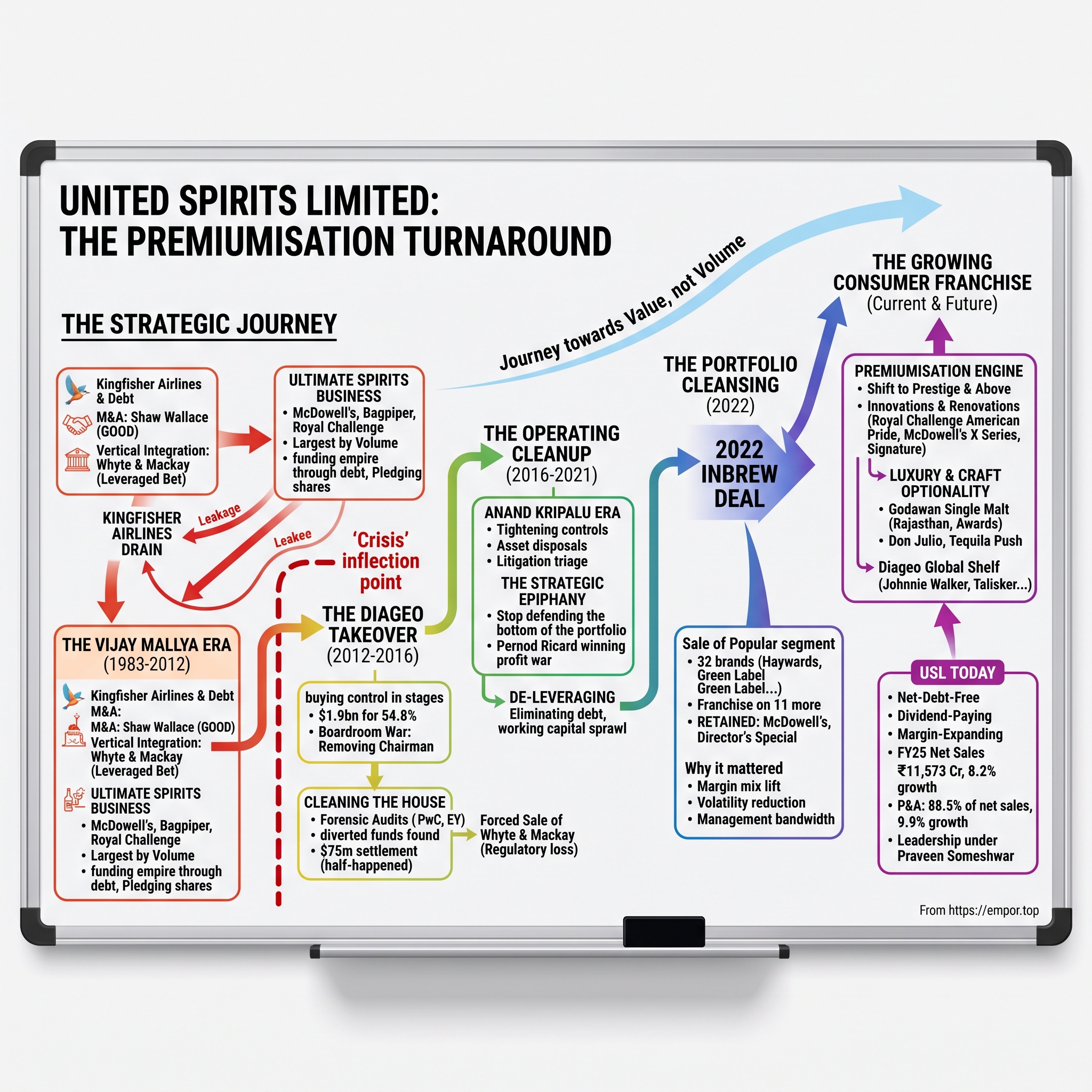
United Spirits Limited (Diageo India): The Premiumisation Turnaround
I. Episode Roadmap & The Jaw-Dropping Turnaround
Picture a boardroom in Mumbai in the winter of 2012. On one side of the table sit executives from Diageo plc, the London-headquartered owner of Johnnie Walker, Guinness and Smirnoff — a company whose internal risk committees have spent decades perfecting the art of not getting into trouble. On the other side sits Vijay Mallya, the self-styled "King of Good Times," a man who owned a Formula One team, an IPL cricket franchise, a fleet of yachts, a private island, and an airline that was hemorrhaging money at a rate that would have alarmed a war ministry. Between them sat United Spirits Limited — the largest spirits company in the world by volume, the maker of McDowell's No. 1, Bagpiper and Royal Challenge, a business so structurally profitable that it had been keeping the entire Mallya empire alive.
Diageo wanted the business. What it got, initially, was the business and the empire's accumulated liabilities, litigation, and a chairman who had no intention of leaving quietly.
Fourteen years later, the picture is unrecognisable. United Spirits Limited today is a net-debt-free, dividend-paying, margin-expanding consumer franchise operating under Diageo's global governance architecture. In FY25, the company reported net sales value of roughly ₹11,573 crore — a little over $1.4 billion — growing 8.2% year over year, with EBITDA of ₹2,058 crore, up 20.5%, and an EBITDA margin of 17.8%, an expansion of 181 basis points against the prior year.12 The Prestige & Above portfolio — the segment where the money actually is — accounted for roughly 88.5% of underlying net sales and grew 9.9%.3 The Popular segment, once the volumetric heart of the company, has been pruned to under a tenth of sales and grew a nearly flat 0.8%.
That last pair of numbers is the whole story compressed into a sentence. This is a company that deliberately shrank the part of itself that made it famous in order to make the rest of itself worth owning.
The central theme of this episode is what happens when a business optimised for one variable — volume, market share, the thrill of being the biggest — is forcibly reoriented around a different variable: value. And underneath that, a second and arguably more interesting question for emerging-market investors: how much of United Spirits' value creation over the past decade came from operating better, and how much came simply from removing a promoter who was extracting capital from the business? Those are very different things. One is repeatable. The other is a one-time arbitrage that has already been harvested.
We will spend this episode testing that distinction. The structure:
- The Vijay Mallya era and the debt-fuelled consolidation
- The Diageo takeover and the boardroom governance war
- Cleaning the house: from volume to margin discipline
- The strategic epiphany: the 2022 Inbrew divestment
- The competitive duopoly: USL versus Pernod Ricard India
- The economics of Indian alcohol and the regulatory maze
- Current leadership under Praveen Someshwar and the growth engine
- Strategic analysis through Helmer's 7 Powers and Porter's 5 Forces
- The bull case, the bear case, and the KPIs that actually matter
A word of framing before we start. Turnaround stories are seductive because they have clean narrative arcs — villain, rescue, redemption. Investors get hurt when they mistake the arc for the economics. United Spirits genuinely did get better. It also operates in one of the most politically captured, tax-distorted, price-controlled consumer categories on earth, and it does so as a subsidiary whose parent's global priorities may not always align with minority shareholders in Mumbai. Both things are true. Let's start where the trouble started.
 Subscribe on LinkedIn
II. The Vijay Mallya Era: Building the Empire on Debt (1983–2012)
To understand United Spirits you have to start not with Vijay but with his father. Vittal Mallya was, by all accounts, the temperamental opposite of his son: quiet, methodical, allergic to publicity. In the decades after Indian independence, he assembled what became the United Breweries group through a patient roll-up of small, capital-starved regional distilleries and breweries — businesses that were individually unremarkable but collectively represented something rare in licence-raj India: national distribution in a category where distribution was the entire game. McDowell & Co., acquired into the fold, became the platform on which the spirits business was built.
Vijay Mallya inherited that platform in 1983, at twenty-eight, following his father's death. What he did with it was, in the pure marketing sense, brilliant. Indian spirits in the 1980s were sold the way commodities are sold — by price per case, by state, through a wholesale system that treated whisky roughly the way it treated cement. Mallya decided that alcohol was not a commodity but an aspiration, and he sold the aspiration relentlessly. Because Indian law prohibits direct advertising of alcohol, he built one of the world's great surrogate-marketing machines: Kingfisher mineral water, Kingfisher soda, a swimsuit calendar that became a national cultural event, a Formula One team, an IPL franchise. The brand was everywhere except on a liquor advertisement.
It worked. McDowell's No. 1, Bagpiper and Royal Challenge became household names, and United Spirits became the largest spirits company on the planet measured by volume — a statistic Mallya loved to repeat, and one that turns out to matter far less than it sounds, for reasons we will get to.
The M&A engine
Two acquisitions define the era, and they are a study in contrast — one of the best deals in Indian consumer history, and one of the worst.
The first was Shaw Wallace. In 2005, after a long and bitter contest for control of what was then USL's largest domestic rival, Mallya secured the spirits business for roughly ₹1,545 crore. It brought in Royal Challenge, Director's Special and Antiquity — brands that were not merely additive but strategically complementary, filling gaps in the mid-price and semi-premium tiers. More importantly, it removed the only competitor capable of matching USL's distribution reach state by state. In one stroke, Indian-made foreign liquor went from a two-horse domestic race to something close to a monopoly at the volume end. As consolidations go, this one was close to textbook: the acquirer bought scale in a business where scale genuinely compounds, and paid a price that the cash flows could service.
The second acquisition was not textbook. In 2007, USL bought Whyte & Mackay, the Glasgow-based Scotch producer, for £595 million. The strategic logic had a certain surface appeal: Indian consumers were trading up into Scotch, imported bulk Scotch was expensive and supply-constrained, and owning distilleries — The Dalmore, Jura, Fettercairn, Tamnavulin — meant owning the raw material rather than renting it. Vertical integration into a scarce input is a legitimate strategy.
The problem was how it was financed. The deal was funded almost entirely with high-cost debt raised against a business whose cash flows were denominated in rupees and whose pricing was, as we'll see, controlled by state governments. USL took on a hard-currency, fixed-obligation liability to buy an asset whose returns were long-dated and uncertain. And the price embedded an assumption that Scotch supply scarcity would persist and that USL would extract synergies it had no operational capability to extract. It was, in the most precise sense, a leveraged bet on an outcome the buyer did not control. That bet would be resolved seven years later, at a loss, under regulatory duress — a sequence we'll cover in the next section.
The fatal pivot
Also in 2005, Mallya launched Kingfisher Airlines. It was conceived as a genuinely premium carrier in a market that was, at the time, discovering low-cost flying — leather seats, in-flight entertainment, cabin crew recruited and trained to hospitality standards, and Mallya himself appearing in the safety video. Indian aviation in that decade was a machine for destroying capital: fuel taxed punitively by states, fares suppressed by competition, aircraft leased in dollars, revenue earned in rupees. Kingfisher's acquisition of Air Deccan in 2007 doubled down precisely when retreat was the correct move.
What followed is the part that matters for United Spirits shareholders. As the airline consumed cash, the spirits business became the funding source. Mallya pledged USL shares as collateral for bank borrowings. Money moved from the profitable subsidiary outward into the loss-making affiliates through inter-corporate deposits, advances, and guarantees — the ordinary plumbing of an Indian promoter group, used in an extraordinary way. Diageo's later forensic reviews would find that USL had extended something on the order of ₹2,100 crore to Kingfisher Airlines and other UB group entities.4 The company that was the crown jewel of Indian spirits was quietly being turned into a captive treasury for an airline that would stop flying in October 2012.
The investing lesson here is not "avoid flamboyant promoters." It is more specific and more useful: in a group structure, the quality of the operating business and the quality of the claim you have on that business are separate questions. USL's brands were excellent throughout this period. Minority shareholders' claim on the cash those brands generated was not. By late 2012, that gap had become untenable, and a buyer was circling.
III. The Diageo Takeover & The Great Boardroom Battle (2012–2016)
Diageo had been trying to crack India properly for years. The arithmetic was irresistible: India is the largest whisky market in the world by volume, a young population with rising incomes, and a cultural drift toward brown spirits that mapped almost perfectly onto Diageo's Scotch portfolio. The obstacles were equally obvious — 28 states each running their own excise regime, no national distribution, and a domestic incumbent with a lock on shelf space that no amount of Johnnie Walker marketing could buy around.
The only sensible entry was to buy the incumbent. And in late 2012, for the first time, the incumbent's owner needed money badly enough to sell.
Buying control in stages
The transaction was not a single clean acquisition; it was a multi-year, multi-instrument grind. In July 2013, Diageo completed the first major leg, acquiring roughly 25% of United Spirits, including a 14.98% stake purchased from a Mallya-controlled entity for approximately $521 million, which — combined with governance and voting arrangements — handed Diageo effective management control.5 An initial open offer to public shareholders had drawn almost no takers, because the offer price sat below the market. Diageo returned in 2014 with a second tender at ₹3,030 per share, and this time it worked: the company's holding rose to roughly 54.8%, at a cumulative cost of around $1.9 billion.6
Pause on that number. Diageo paid roughly $1.9 billion for control of a business it did not yet fully understand, in a market where it had limited operating experience, from a seller under acute financial distress. Distressed sellers are supposed to be a source of bargains. Here, the distress was the reason the asset was available and the reason it was dangerous — because the same pressures that forced the sale had been shaping the accounting for years.
The audits
Once Diageo's people had management control and could open the books properly, they found what pressure tends to produce. Forensic reviews — including work by PricewaterhouseCoopers and, later, EY — identified funds that had moved out of United Spirits to Mallya-affiliated entities including Kingfisher Airlines, Force India and Watson Ltd. An initial tranche of identified diversions was put at roughly ₹1,225 crore; a subsequent 2016 review widened the findings, and USL ultimately sought approximately ₹1,337 crore from various Mallya entities on the grounds that the money had been improperly taken from the company's accounts.4 The full cumulative exposure — including receivables that were simply uncollectable, guarantees that had been called, and inter-corporate deposits with no realistic path to recovery — was never disclosed as a single clean audited figure, and investors should be wary of the very large round numbers that circulated in the press at the time. What is documented is bad enough: a listed company's balance sheet had been used as a credit facility for its promoter's other ventures, and the auditors said so in writing.
Mallya's response was to deny the charges outright.7 That set up the fight.
The boardroom war
This is the part of the story that gets underweighted. Diageo, a FTSE-100 company with a global compliance function, found itself in the extraordinary position of owning a majority of an Indian listed company whose non-executive chairman it wanted removed, could not remove cleanly, and was contractually entangled with. Mallya held rights under shareholder agreements. He had allies on the board. Indian company law gave a chairman meaningful procedural leverage. And every month the standoff continued was a month in which USL's operations, financing and reputation stayed frozen.
The resolution, announced in February 2016, was one of the more remarkable capitulations in modern corporate governance. Diageo agreed to pay Mallya $75 million — roughly £53 million — over five years in exchange for his resignation as chairman and non-executive director of USL and from the boards of associated companies, together with a five-year global non-compete, non-interference and standstill arrangement.8 Mahendra Kumar Sharma, then an independent director and chair of the audit committee, took over as chairman.
It is worth being blunt about what this was. Diageo paid a man it had publicly accused of diverting company funds to go away. The commercial logic was defensible — a multi-year legal war would have cost more than $75 million in operational paralysis alone — but the precedent was uncomfortable, and Diageo clearly came to think so too. In July 2017, after criminal and regulatory proceedings against Mallya intensified, Diageo withheld the remaining $35 million of the settlement and demanded repayment of amounts already paid, citing the misappropriation findings.9 The settlement, in other words, only half-happened.
The forced sale of Whyte & Mackay
Running in parallel was a second problem, and it landed the 2007 acquisition's bill on Diageo's desk. Because Diageo owned Bell's — a leading UK blended whisky — and USL owned Whyte & Mackay, a major supplier of own-label and branded blended Scotch to British supermarkets, the combination raised an immediate competition issue. The UK's Office of Fair Trading concluded in November 2013 that the merged entity would command roughly 40% of the UK blended whisky market and that substantial competition existed between Bell's and Whyte & Mackay's products, and accepted undertakings requiring divestment.[^10]
In May 2014, USL agreed to sell Whyte & Mackay to Emperador Inc., the Philippine brandy group controlled by Andrew Tan's Alliance Global, for £430 million; the transaction completed in November 2014.10 Against the £595 million paid in 2007, that is a headline loss of £165 million before transaction costs, financing costs, and seven years of carrying an expensive debt load — the true economic loss was considerably larger.
Two lessons compound here. First, a debt-financed acquisition of a strategic input is only as good as your ability to hold it through a cycle; USL never had that ability. Second, and less obvious: when you sell control of your company, you also sell control of the timing of every asset disposal. Whyte & Mackay was not sold when the market was good. It was sold when a British regulator required it.
With Mallya gone and the Scotch distilleries sold, Diageo finally had what it had paid for: an unencumbered platform. Now it had to fix the operating business.
IV. Cleaning the House: The Kripalu Era & Balance Sheet De-leveraging (2016–2021)
Anand Kripalu did not come from the drinks industry. He came from Cadbury and Mondelez, where he had run the Indian and South Asian business, and before that from Unilever — a pedigree that meant he understood two things United Spirits desperately needed: how a multinational's financial control environment actually operates day to day, and how to manage a portfolio of consumer brands as a portfolio rather than as a collection of personal enthusiasms.
The job he inherited was unglamorous. USL under the old regime had been run with what might charitably be called improvisation: working capital sprawled, receivables from state corporations aged badly, and the company carried a large and expensive debt load — the legacy of Whyte & Mackay financing and general balance-sheet abuse — alongside a thicket of legacy litigation spanning state excise disputes, tax assessments, land parcels, and disputes with former group entities.
The unglamorous work
The de-leveraging programme ran on three tracks simultaneously. The first was cash conversion: tightening credit terms, chasing state corporation receivables, and rationalising inventory across dozens of bottling locations. The second was asset disposal — non-core land and property, legacy investments, and stakes that had accumulated over decades of promoter-era deal-making. The third was litigation triage: settling or provisioning the enormous backlog of state-level cases rather than allowing them to sit indefinitely as contingent liabilities that no analyst could size.
None of this makes for a good story, which is exactly why it is worth dwelling on. The value created in the Kripalu years came from the elimination of interest expense and the release of trapped working capital, not from growth. It is arithmetic value creation, and it has a hard ceiling — you can only pay down the debt once.
The strategic epiphany
The more consequential realisation of this period was competitive, not financial. United Spirits was, on any volume measure, the largest spirits company in India by a wide margin. And it was losing the profit war.
The winner was Pernod Ricard India — a company that had never held more than a fraction of USL's volume and had never tried to. Pernod built its Indian business around a deliberately narrow portfolio positioned at and above the Prestige price band: Royal Stag, Imperial Blue, Blenders Pride, with Chivas Regal and The Glenlivet imported above them. It ran fewer SKUs, fewer bottling relationships, fewer state-level negotiations, and it made dramatically more profit per case.
USL, by contrast, carried dozens of cheap regional "Popular" brands, each requiring its own state registrations, label approvals, price notifications, bottling arrangements and distribution management, and each yielding a gross margin that barely survived contact with glass and freight inflation. The company was expending enormous management attention on the least valuable part of itself.
This is a pattern worth generalising, because it recurs across emerging-market consumer businesses. Volume leadership is a legacy of the distribution-scarce era. Once distribution is broadly available, volume stops being a moat and starts being a cost — a fixed administrative burden spread across low-value cases. The "we are the biggest" statistic that Mallya loved was, by 2018, closer to a liability than an advantage.
The strategic response was formulated in this period and executed in the next: shift resources, marketing spend, innovation capacity and management bandwidth toward Prestige & Above, and stop pretending the bottom of the portfolio was worth defending. The intellectual work was Kripalu's. The surgery would fall to his successor.
V. The Portfolio Cleansing: The 2022 Inbrew Deal
Hina Nagarajan took over as managing director and CEO in July 2021, arriving from Diageo's Africa business and, before that, a long career at Reckitt Benckiser and Mary Kay. Her first significant act was to do what strategy documents had been recommending for years and what incumbent managements almost never actually do: sell the brands that made the company famous.
The transaction
In May 2022, United Spirits announced the sale of the business undertaking associated with 32 brands in the Popular segment to Inbrew Beverages Private Limited — a vehicle associated with Ravi Deol — for a cash consideration of approximately ₹820 crore.11 The transaction closed on 30 September 2022 as a slump sale, and USL recognised an exceptional gain of roughly ₹828 crore in the second quarter of FY23.12
The brands that went included Haywards, Old Tavern, White Mischief, Honey Bee, Green Label and Romanov — names with genuine equity in the Indian mass market and, collectively, roughly ₹768 crore of FY22 revenue, or about 8% of sales.
Alongside the sale, USL entered a five-year franchise arrangement covering eleven further Popular brands — including Bagpiper and Blue Riband — under which Inbrew manufactures and sells them under licence, with defined purchase and perpetual-licence options.12 This structure is smarter than a simple sale. It transferred operational burden immediately while preserving optionality on brands whose long-term value USL was not yet ready to write off, and it converted a low-margin manufacturing business into a royalty stream.
Critically, USL retained McDowell's No. 1 and Director's Special. These were never really Popular brands in the strategic sense — McDowell's No. 1 is the largest trademark in the portfolio and sits across price tiers, and both were earmarked for premium renovation rather than disposal.
Why it mattered
Look past the headline consideration, which was modest — ₹820 crore is not a transformative sum for a company of this size. The value of the Inbrew deal was structural and it operated on three axes.
First, margin mix. Removing roughly 8% of revenue at the lowest gross margin in the portfolio mechanically lifts the reported margin of what remains, without any operating improvement at all. Investors should discount this portion of the margin expansion story: it is portfolio arithmetic, not execution.
Second, and more genuinely valuable, volatility reduction. The Popular segment had essentially no pricing power. Its cost base — glass bottles, extra neutral alcohol, freight, cartons — is highly inflation-sensitive, while its selling price is set by state government notification. That combination is close to the definition of an uninvestable business: costs float, prices are fixed by a third party with no commercial incentive to move quickly. Exiting it removed the most fragile part of the P&L.
Third, and hardest to quantify, management bandwidth. Dozens of brands across dozens of states means thousands of individual regulatory interactions annually. Shedding them freed the commercial organisation to focus on the twenty or so brands that generate nearly all the profit.
The skeptic's question is a fair one: did USL sell too cheap? ₹820 crore for ₹768 crore of annual revenue is roughly one times sales for a portfolio of established consumer brands — a valuation that would be considered distressed in almost any other consumer category. The defence is that the buyer was acquiring a business with structurally poor economics and considerable regulatory overhead, and that there were not many buyers. That defence is probably right, but it also tells you something important about how little those brands were worth in anyone's hands. USL did not sell a good business cheaply; it sold a bad business at the price a bad business fetches. The value came from no longer owning it.
What remained after September 2022 was, for the first time in the company's history, a portfolio that looked like a premium consumer business rather than a volume manufacturer with some premium brands attached. Which raises the question of whether the remaining business is actually as good as it now looks.
VI. The Economics of Premiumisation: How USL Wins Today
Walk into a bar in Bandra, Indiranagar or Cyber Hub on a Friday night and you will see the thesis in physical form. Fifteen years ago the default order was a large peg of an Indian whisky, mixed heavily, priced for volume. Today the same demographic — better paid, better travelled, and considerably more brand-literate — orders a single malt, a gin and tonic with a botanical brand it can name, or a tequila that costs more per pour than a bottle used to. The volume of alcohol consumed per occasion has, if anything, fallen. The revenue per occasion has risen sharply.
That is the entire premiumisation trade, and it is not a marketing slogan; it is an observable shift in consumer behaviour with a demographic engine behind it.
The market
India consumes well over 400 million cases of spirits annually and is the world's largest whisky market by volume. The structural drivers are the familiar emerging-market consumption stack: urbanisation, household income growth, a median age still under thirty, rising female participation in the on-trade, and a steady erosion of the social taboo around alcohol in urban centres. Layered on top is a specific behavioural change — "drink less but drink better" — which is favourable for anyone selling at the top of the price ladder and unfavourable for anyone selling at the bottom.
The duopoly
The Indian premium spirits market is, in practice, a two-player contest with an aggressive fringe.
United Spirits brings a domestic portfolio built over decades — McDowell's No. 1, Signature, Royal Challenge, Antiquity, Black Dog — sitting underneath the Diageo global luxury shelf: Johnnie Walker, Talisker, The Singleton, Tanqueray, Don Julio, Baileys. Pernod Ricard India brings the reverse-engineered version of the same idea: a tighter domestic set in Royal Stag, Imperial Blue and Blenders Pride, with Chivas Regal, The Glenlivet, Jameson, Absolut and Beefeater imported above.
For roughly a decade, Pernod won this contest on the metric that matters. It generated more profit from a fraction of USL's volume, because it had never accumulated the low-value ballast. USL's entire strategic project since 2016 has been to close that gap — first by fixing the balance sheet, then by removing the ballast, and now by competing brand-for-brand in the Prestige and above tiers.
The current competitive window is partly a gift. Pernod Ricard India has spent several years entangled in Delhi's excise litigation, losing its licence to sell in the capital and being repeatedly denied renewal — a matter we return to in the next section. Delhi is a disproportionately premium market. A competitor absent from it is a competitor not spending against you there.
Investors should be careful about how much credit they give USL for share gains earned during a period when the principal competitor was administratively hobbled. That is a tactical window, not a durable advantage, and windows close.
The margin mechanics
Here is the plain-English version of why mix matters so much. A bottle of entry-level Indian whisky and a bottle of premium Indian whisky contain broadly similar quantities of the same base spirit and sit in broadly similar glass. The packaging is nicer at the top end and the liquid is better, but the incremental cost of goods between the two is far smaller than the incremental price. Prestige & Above brands typically carry gross margins in the 50–60%-plus range against roughly 20–30% for entry-level Popular products.
The consequence is that mix shift is the most powerful margin lever available to the company — considerably more powerful than cost savings, and available without needing a state government's permission. When glass or extra neutral alcohol prices spike and USL cannot raise prices, it can still improve its blended margin by selling proportionally more premium cases. Having taken P&A to roughly 88.5% of net sales, USL has used most of this lever. That is worth stating clearly: the mix-shift engine that drove the margin story from 2019 to 2025 has limited runway left. Future margin expansion has to come from within the P&A segment — trading consumers from Prestige up to Premium and Luxury — which is a slower, harder grind.
Innovation and renovation
The company's answer has been a steady cadence of launches and repositionings aimed at the upper tiers: Royal Challenge American Pride, engineered to capture the global drift toward American-style whiskey; the McDowell's X Series, extending the flagship trademark into rum, gin and vodka aimed at younger urban drinkers; and a craft-led repositioning of Signature. On recent earnings calls management has consistently framed these as brand-equity investments rather than volume plays, and the advertising line supports that: USL raised advertising and promotion spend roughly 15% to about ₹1,295 crore, explicitly tied to premium brand-building.13
That is a real commitment and also a real risk. Advertising spend of that magnitude is a bet that brand investment converts into pricing power. In a category where the retailer is frequently a state government and shelf position is allocated administratively, that conversion is less automatic than it would be in, say, soft drinks. Watch whether A&P growth outpaces P&A net sales growth for a sustained period — that would indicate the company is buying growth rather than earning it.
The luxury and craft optionality
Two portfolio items deserve mention despite their small absolute size, because they are strategically informative.
Godawan is USL's homegrown artisanal single malt, distilled in Alwar, Rajasthan, from locally sourced six-row barley, and named for the critically endangered Great Indian Bustard, with conservation work conducted alongside the Wildlife Institute of India. Since its 2022 debut it has accumulated more than 125 international awards across liquid, packaging and design competitions, including Double Gold at Monde Selection and Triple Gold ratings from the International Taste Institute.141516 Its financial contribution today is immaterial. Its strategic contribution is not: it establishes that Diageo India can create luxury brand equity domestically rather than importing it, in a category — Indian single malt — where Amrut, Paul John and Piccadily's Indri have proven there is genuine international demand.
Don Julio and the tequila push are the mirror image: importing Diageo's global agave franchise into Indian urban luxury bars at precisely the moment the category is inflecting. Again, small volumes; again, high price points and disproportionate influence on where a brand portfolio sits in the consumer's mental hierarchy.
The honest investor framing on both: these are options, not earnings. They should be valued as cheap optionality on the top of the Indian income distribution, and they should not be used to justify a valuation today. The thing that will determine USL's next five years is far less romantic — it is the regulatory and tax structure of the Indian alcohol market, which we turn to now.
VII. The Regulatory & Tax Maze: The Skeptical Investor's Stress Test
If you wanted to design a consumer category to be maximally difficult, you would do roughly what the Indian constitution did to alcohol. You would put the product under state rather than central jurisdiction, so that a national company must negotiate 28 separate regulatory regimes. You would make excise duty on alcohol one of the largest discretionary revenue sources available to state governments, so that the tax rate becomes a political instrument. You would let states decide whether to be a licensor, a wholesaler, a retailer, or all three. And then, when the country finally unified its indirect tax system, you would exclude alcohol from it — while leaving all of alcohol's inputs inside it.
That last decision is the one that quietly costs United Spirits the most money, and it is worth explaining carefully because it is genuinely counterintuitive.
The GST trap
India's Goods and Services Tax is a value-added tax. Its central mechanism is input tax credit: a manufacturer pays GST on what it buys, charges GST on what it sells, and remits only the difference. Tax is therefore levied on value added at each stage, not on the full value repeatedly.
Alcohol for human consumption sits outside GST — states retained it as their own revenue base. But alcohol's inputs do not. USL pays GST on glass bottles, closures, labels, cartons, freight, energy, capital equipment, and services. It then sells a product on which it charges no GST — only state excise duty and VAT. With no GST output liability, there is nothing to offset the input credit against, so the credit is simply lost. Under the GST regime, key inputs and services attract rates materially above the VAT rates that applied before, with packaging inputs such as bottles, caps and labels moving to 18%.1718
The plain-English version: USL pays a tax it can never get back, on almost everything it buys. It is a permanent, unrecoverable cost sitting inside cost of goods sold, and it scales with input inflation. Industry estimates of the drag run into several hundred crore annually for a company of USL's size, though the company does not disclose a discrete figure and investors should treat precise numbers with caution. What is not in doubt is the direction: every rupee of input cost inflation is amplified by an unrecoverable tax wedge.
There is a further wrinkle worth knowing: extra neutral alcohol — the base spirit — has been the subject of extended jurisdictional dispute between the centre and states, with the position clarified such that ENA used for manufacturing alcoholic liquor for human consumption falls outside GST.19 Helpful at the margin; it does not solve the structural problem.
The price control trap
The second structural issue is that in several of USL's largest markets, the buyer is the government.
In Karnataka, Tamil Nadu, Andhra Pradesh, Kerala and elsewhere, state corporations operate as monopoly wholesalers or, in some cases, monopoly retailers. They are the sole channel. They set procurement prices. And consumer prices cannot be raised without state cabinet or excise-department approval.
Think about what this does to a normal consumer-goods operating model. If glass prices rise 20%, a packaged foods company raises prices, or reduces pack size, or reformulates, and recovers the margin within two quarters. USL files an application and waits — sometimes for years. In the interim it absorbs the entire cost increase. When the approval eventually comes, it may not be full, and it may arrive after input costs have already normalised.
This is the single most important thing to understand about the business, and it directly limits how much a premium valuation can be justified on the basis of "brand strength." Brand strength normally converts into pricing power. Here, brand strength converts into shelf presence and consumer preference, but the price itself is set by an administrator with a political incentive to keep alcohol affordable and an excise incentive to keep the state's share high. Management can and does describe revenue growth management as a lever; on recent calls the emphasis has been on mix, portfolio and cost productivity precisely because the price lever is not fully theirs to pull.
State-level volatility, in one case study
The Delhi excise saga is the cleanest available illustration of how quickly this environment can turn.
In November 2021, Delhi implemented a new excise policy that shifted retail from government to private licensees. Within months it collapsed amid allegations of irregularity: the Delhi Lieutenant Governor recommended a CBI inquiry, and the policy was scrapped on 30 July 2022, with the city reverting to the prior regime.20 The investigation swept in a long list of accused, including senior state politicians.
The commercial consequences fell hardest on Pernod Ricard. Its Delhi sales licence was cancelled in 2022; the company challenged the denial of renewal, the Delhi High Court dismissed its plea on maintainability grounds in July 2023, and Delhi continued to reject its licence application in subsequent years — by 2025 the refusal had extended to a third consecutive year, with authorities citing pending criminal proceedings and lack of "moral probity."212223 The Competition Commission of India separately ordered a probe into alleged brand-pushing by Pernod under the 2021-22 policy.24
And then, in a turn that matters for anyone modelling competitive dynamics forward: after examining nearly 300 prosecution witnesses, the trial court concluded that the material on record did not disclose even a prima facie case, and all 23 accused were discharged.25
Three things follow for investors. First, a state can eliminate a major competitor's access to a premium market administratively, without any finding of guilt — which is a windfall for whoever remains. Second, that windfall is reversible, and the legal ground under Pernod's exclusion has now materially shifted. Third — and this is the uncomfortable one — the same mechanism that took Delhi away from Pernod could take a market away from USL. Regulatory risk in this industry is not a tail risk. It is the operating environment.
The prohibition tail
Finally, the genuine tail risk. Bihar imposed complete prohibition in April 2016, removing an entire state's demand overnight. Gujarat has been dry since 1960. Andhra Pradesh attempted phased prohibition. A shift toward prohibition in a large consuming state — Karnataka, Maharashtra, Telangana — would remove a material double-digit share of industry revenue with essentially no operational response available. This is not a modelling assumption; it is a discrete political event with no warning period.
Against that backdrop, the question becomes: who is running the company, and are they the right people for an environment where operational excellence can be overwhelmed by a cabinet decision?
VIII. Current Leadership: Praveen Someshwar & The Diageo Playbook
On 14 January 2025, United Spirits announced that Hina Nagarajan would step down as managing director and CEO to take a global role at Diageo, and that Praveen Someshwar would succeed her effective 1 April 2025 for a five-year term, subject to shareholder approval.2627 The stock fell around 5% on the news — a reasonable proxy for how much credit the market had assigned to the outgoing CEO.28
The Nagarajan record
That credit was largely earned. Nagarajan's four-year tenure produced a defensible execution record on the specific things she said she would do: she completed the Popular-segment divestment, took the company to a net-debt-free position, expanded EBITDA margins toward the high teens, and restored consistent dividend payments. Assessed against the standard for management credibility — did they set targets, explain the plan, and deliver against it, and did they explain the misses — the Nagarajan years hold up better than most Indian large-cap consumer tenures of the same period.
Two caveats keep the assessment honest. First, as discussed, a meaningful portion of the margin expansion was mix arithmetic from divesting low-margin revenue rather than operational improvement in the retained business. Second, her promotion to Diageo's global executive committee is a reminder of the governance structure minority shareholders actually live under: the CEO of United Spirits is a Diageo career executive whose next role is decided in London. That alignment is mostly benign — Diageo's interest in USL's profitability is genuine and its 54.8% stake means it eats its own cooking — but it is not the same as an owner-operator's alignment, and the question of whether India-specific opportunities are ever traded off against global portfolio priorities is one shareholders can never fully audit.
The Someshwar profile
Someshwar's background is unusual for a spirits CEO and, on inspection, well matched to USL's actual problems.
He spent 24 years at PepsiCo across general management, finance and strategy roles in India and Asia Pacific, becoming CEO of the South Asia beverage business in 2009 and then CEO of PepsiCo India's foods business in 2012, running Lay's, Kurkure and Quaker.26 Read that carefully: this is a person who spent two decades building route-to-market in India's most fragmented, most price-sensitive distribution environment, in categories where a rupee of packaging cost matters and where supply chain design is the strategy. Beverages and salty snacks in India are, operationally, closer to Indian-made foreign liquor than Scotch whisky is.
He then spent five years as managing director and CEO of HT Media, running Hindustan Times, Mint and associated radio and digital properties through a structurally declining print business.26 That is a different skill — managing decline, reallocating capital away from a legacy asset, and building digital revenue — and it is arguably the more relevant one for a company that has just amputated a third of its brand count.
The composite: a supply-chain and route-to-market operator with experience in portfolio surgery. What he does not bring is deep spirits or luxury-brand experience. Diageo evidently concluded that the global brand machine can supply that, and that what India needs is execution. That is a coherent bet, and it is falsifiable — if the next three years produce distribution and cost-productivity gains but no acceleration in the premium mix within P&A, the bet will have been half right.
Incentives and capital allocation
Someshwar is a professional, non-founder chief executive with negligible personal shareholding. His incentives are structured against Diageo's global performance framework: net sales value growth, operating margin, and cash conversion. This is the standard multinational-subsidiary arrangement, with the standard implication — the CEO is rewarded for delivering the plan, not for taking asymmetric risks that might create outsized long-term value. Investors should not expect bold, contrarian capital allocation from this seat. They should expect competent, incremental, well-governed execution.
The capital allocation policy reflects exactly that. USL runs an asset-light model with a substantial portion of manufacturing done through tie-ups and franchise arrangements rather than owned plants, carries no net debt, generates high returns on equity, and returns surplus cash through dividends rather than accumulating it. Reinvestment is directed at organic brand-building — the innovations and renovations discussed earlier — and at digital and analytics capability in route-to-market.
The activist's challenge to this posture would be twofold. First, is a net-cash balance sheet in a business with this much regulatory risk actually optimal, or is it excessive conservatism that depresses returns on capital? A reasonable answer is that in a business where a single state can freeze your revenue, balance-sheet fortress-building is rational insurance rather than lazy capital allocation — but it is a genuine debate. Second, and sharper: what is the plan if premiumisation stalls? Management's stated answer across recent calls has been consistent — keep shifting mix upward, keep investing in brand, keep taking cost out of the supply chain. That consistency is itself a credibility marker; USL has not changed its story from quarter to quarter, and it has not blamed the environment for misses it could control. But consistency is not the same as having a Plan B, and no Plan B has been articulated.
With the people and the policy established, we can now formalise what the competitive position actually is.
IX. Strategic Frameworks
Hamilton Helmer's 7 Powers
Branding. This is USL's strongest power and it operates on two levels. Domestically, McDowell's No. 1, Signature, Royal Challenge, Antiquity and Black Dog carry decades of accumulated equity in a category where advertising is banned and brand awareness therefore cannot be bought quickly — a form of accidental protection. Internationally, the Diageo shelf supplies aspiration that no domestic competitor can manufacture. The caveat is the one already made: brand power here converts imperfectly into pricing power because the price is administratively set. Helmer's definition of Branding power requires that the brand support a price premium at equivalent cost. USL clears that bar on the cost side and only partially on the price side.
Cornered Resource. Access to Diageo's global Scotch inventory, blending expertise and maturing stock is a genuine cornered resource. Scotch takes years to mature; you cannot decide today to have twelve-year-old whisky in 2027. Radico Khaitan and Allied Blenders can build excellent Indian spirits and are doing so, but they cannot conjure authentic aged Scotch supply. This is a real and durable advantage — with the important asterisk that USL does not own it. It licenses it from its parent, on terms it does not set.
Scale Economies. USL operates through a large network of owned, contracted and franchised manufacturing and bottling facilities distributed across states — necessarily so, because moving alcohol across state lines attracts export/import duties and permits that make centralised manufacturing uneconomic. This distributed footprint is a genuine barrier: a new entrant must replicate not one factory but a network, each node with its own licence. The counterpoint is that it is a barrier to scale, not to entry — small regional players enter constantly; they simply cannot grow nationally.
Counter-Positioning. USL's exit from the Popular segment is a partial case. It made a move — abandoning volume leadership — that incumbents structurally resist because it means shrinking. Whether competitors are truly unable to follow is doubtful; Radico Khaitan and Allied Blenders have both pushed hard into premium tiers of their own accord. This is better described as a well-executed strategic reallocation than as true counter-positioning.
Process Power. The importation of Diageo's compliance, financial control and marketing systems replaced a genuinely erratic operating model. This is real, but it is a one-time upgrade that has largely been completed. It is not an ongoing source of widening advantage.
Switching Costs and Network Economies are essentially absent. A consumer switches whisky brands at zero cost, and there is no network effect in spirits beyond weak social-signalling dynamics. Any thesis relying on customer lock-in in this category is wrong.
Porter's Five Forces
Threat of new entrants — low to moderate. The regulatory barrier is the moat: manufacturing licences, environmental clearances for distilleries, label registrations and price approvals in 28 distinct regimes, plus retail placement in state-controlled channels. But note the nuance — entry at regional scale is common and periodically produces genuine winners, as Piccadily Agro demonstrated by building Indri into an internationally awarded single malt from a standing start. National scale is what is hard.
Bargaining power of buyers — very high. State buying corporations act as monopsonists in major markets, dictating procurement price, payment terms and channel access. This is the most severe of the five forces for USL and the primary constraint on sustainable margin expansion.
Bargaining power of suppliers — moderate. Grain and molasses for ENA, and glass, are the key inputs. Glass manufacturing in India is concentrated and has periodically exercised pricing power. ENA has a new and structural complication discussed below. USL's scale secures volume discounts but does not neutralise input cycles.
Threat of substitutes — low to moderate. Spirits, and specifically whisky, are culturally entrenched in Indian social drinking, gifting and celebration. Beer competes for occasions, particularly in summer and in southern markets, and ready-to-drink formats are growing. Neither displaces the core. The more interesting long-run substitute is moderation itself — the same "drink better" impulse that drives premiumisation also drives lower volumes, and at some income level those two effects stop being complementary.
Rivalry — high. The Prestige & Above battle between USL and Pernod is intense and increasingly expensive, with Radico Khaitan and Allied Blenders — the latter now publicly listed following its 2024 IPO — pressing from below with credible premium propositions. Advertising is banned, so competition is fought through surrogate marketing, on-trade activation, innovation cadence and trade relationships, all of which are cost-intensive and none of which produce permanent advantage.
The composite picture is a business with a strong brand position and a genuine parent-derived resource advantage, operating in an industry structure where the buyer holds most of the power. That combination supports good returns on capital — USL earns them — but it caps the multiple a rational investor should pay for growth, because the growth is not fully within management's control.
X. Playbook: Business & Investing Lessons
The institutional cleanup arbitrage. The single largest source of value creation at United Spirits over the past decade was not a product, a market, or a strategy. It was the replacement of a promoter who was extracting capital with a parent that was not. Debt came down, related-party leakage stopped, litigation was resolved, disclosure improved, and the market re-rated the claim on the same underlying cash flows. In emerging markets, this pattern — a good operating business trapped inside a bad governance structure — recurs constantly, and identifying it before the cleanup is one of the highest-return exercises available.
The essential discipline is to recognise that this arbitrage is a one-time payment, not an annuity. Once the balance sheet is clean, the disclosure is good and the promoter is gone, that source of return is exhausted. From that point forward you are underwriting the operating business on its merits. USL crossed that line some years ago. Anyone still buying the turnaround story is buying something that has already happened.
Profits over vanity. United Spirits spent thirty years telling the world it was the largest spirits company on earth by volume. It created more shareholder value in the three years after it stopped caring about that statistic than in the decade before. The general principle: market share is a proxy for competitive advantage, not the advantage itself, and in businesses with heterogeneous unit economics — which is most consumer businesses — aggregate share can actively mislead. The right question is never "what share do we have," it is "what share do we have of the profit pool." Pernod Ricard India understood this two decades before USL did, which is why a company with far less volume spent a decade making more money.
The corollary is uncomfortable for incumbent managers: sometimes the correct strategy is to become smaller. Very few management teams will do it, because compensation, org charts and personal identity are all built around scale. That USL executed the Inbrew disposal at all is the most impressive single decision in this story.
The regional scale moat. Conventional manufacturing logic says consolidate production into the largest possible facility and ship. Indian alcohol inverts this completely, because inter-state movement is taxed and permitted as though it were international trade. The winning structure is a distributed web of state-level bottling — owned, contracted, or franchised — matched to state-level regulatory relationships. It is operationally messy and it is exactly the reason a well-capitalised foreign entrant cannot simply arrive and compete. The transferable lesson: where regulation fragments a market, the optimal operating footprint mirrors the regulatory map, not the economic geography. Efficiency and defensibility point in opposite directions, and defensibility usually wins.
A fourth lesson, unstated in the conventional telling. Diageo paid roughly $1.9 billion for control, then paid $75 million to remove the chairman, then sold Whyte & Mackay at a £165 million headline loss under regulatory compulsion. The cleanup was expensive, and it took the better part of a decade. Buying a distressed asset from a distressed seller is not the same as buying it cheaply. The discount you receive is compensation for work you have not yet done.
XI. The Bull vs. Bear Case & KPIs to Track
The bull case
The core argument is positional. If an investor wants exposure to the upgrade in Indian discretionary consumption — the specific phenomenon of a rising middle class trading up within a category it already consumes — there are very few listed instruments that express it as directly as United Spirits. Pernod Ricard India is unlisted. Diageo plc gives global exposure diluted across dozens of markets. USL is a nearly pure-play vehicle, with liquidity, index inclusion and clean accounting.
The operating case rests on three legs. Mix has already lifted the margin from the low teens toward the high teens, and management continues to guide toward sustaining that trajectory; the FY25 combination of 20.5% EBITDA growth on 8.2% net sales growth demonstrates real operating leverage rather than just cost cutting.1 The Diageo luxury shelf — tequila, single malts, premium Scotch — gives access to the fastest-growing and highest-margin end of the market without USL bearing the brand-building cost. And the balance sheet is genuinely fortress-like: no net debt, high returns on equity, strong cash generation, and a consistent dividend.
Momentum has continued past FY25. Consolidated net sales value grew 7.7% in FY26 to approximately ₹12,467 crore, with P&A continuing to lead and the Popular segment continuing to shrink in volume.2930 That is a business compounding at high single digits with margins still trending up — unglamorous, but the compounding is real.
The bear case
Pricing gridlock is the central risk. Extra neutral alcohol pricing has acquired a structural upward bias because India's ethanol blending programme now competes directly for the same grain and molasses feedstock. The government has strong policy reasons to prioritise fuel ethanol; spirits manufacturers are bidding against a subsidised buyer with national energy-security objectives behind it. Combine rising ENA costs, glass inflation, unrecoverable GST on inputs, and state governments that grant price increases slowly or not at all, and you have a margin structure that can compress quickly and recover only with permission. This is not hypothetical — it is precisely the dynamic that suppressed USL's margins in FY22 and FY23.
Regulatory and political risk is not diversifiable. A prohibition move in a large consuming state, a punitive excise revision, or a Delhi-style policy collapse in a major market would hit revenue immediately with no operational offset. And as the Delhi case demonstrated, a company can lose market access on administrative grounds without any judicial finding — the accused in that matter were ultimately discharged, but the commercial damage had already been done over multiple years.25
A revived Pernod Ricard. USL's premium share gains over the past several years coincided with its principal competitor being locked out of the country's most premium urban market. With the criminal case collapsing, the legal basis for continued exclusion has weakened considerably. A Pernod that regains Delhi and redeploys its marketing budget offensively would likely trigger an escalation in trade and promotional spend across the Prestige tier. Margin expansion assumptions in a competitive-normalisation scenario deserve a serious haircut.
The activist's stress test. A skeptical investor would press on four points. First, the parent relationship: USL pays for access to Diageo brands and systems, and minority holders cannot independently verify that intercompany terms are struck at arm's length in their favour — a permanent, unquantifiable governance discount. Second, the diminishing mix lever: with P&A at roughly 88.5% of sales, the mechanical driver of margin expansion is nearly spent, and the market may still be capitalising it as if it were not. Third, disclosure granularity: the company does not break out the unrecoverable GST drag, brand-level profitability, or state-level revenue concentration with enough specificity to model the downside precisely. Fourth, capital return policy: a net-cash balance sheet in a business generating high returns on equity invites the question of whether more aggressive distribution or buybacks would be value-accretive, and the answer has consistently been incremental dividends rather than a stated framework.
A structural question worth sitting with. Premiumisation and moderation are the same trend. The consumer who trades up from a Popular whisky to Signature is also, statistically, the consumer who drinks less often. So far the value effect has dominated the volume effect handsomely. At some level of income and health awareness — visible already in developed markets, where spirits volumes have been flat to declining for years — those two effects cross over. India is nowhere near that crossover today. But the terminal-growth assumption in any long-duration valuation of this business rests on it staying far away, and that assumption is rarely examined.
Three KPIs to track
1. Prestige & Above net sales value growth, split between volume and price/mix. This is the single most informative disclosure the company provides. The headline P&A growth number conflates two very different things: more cases sold (real demand) and better mix or realisation per case (premiumisation). Investors should watch the split. P&A growth driven mainly by volume signals genuine market expansion. P&A growth driven mainly by mix, with flat or declining volume, signals that the company is running out of consumers to upgrade — a much weaker foundation for compounding.
2. Gross margin, tracked against the ENA and glass cost cycle. Gross margin is where the pricing-permission problem shows up first and most clearly. The specific thing to observe is the lag: when input costs rise, how many quarters pass before gross margin stabilises, and does it recover to the prior level or settle lower? A shortening lag over successive cycles would be evidence that the company's premium mix is genuinely giving it more commercial latitude with state authorities. A lengthening lag would confirm the bear case that pricing power in this industry belongs to the state, not to the brand.
3. Free cash flow conversion — operating cash flow relative to EBITDA. In a business selling to government corporations with long and politically variable payment cycles, reported profit and collected cash can diverge for extended periods. Conversion is the cleanest single check on whether growth is real, whether working capital discipline is holding, and whether the unrecoverable-tax and receivable frictions are being managed. Sustained high conversion is what makes the dividend and the net-cash position durable; deterioration would be the earliest warning that something in the state channel has changed.
Three metrics, one question each: is demand real, is pricing recoverable, and does profit become cash. Everything else in this story is commentary.
XII. Epilogue
There is a version of this story that gets told as a morality tale — the flamboyant tycoon undone by hubris, the disciplined multinational restoring order. It is satisfying and it is largely accurate, but it is not the useful version.
The useful version is narrower and less dramatic. United Spirits was, throughout its worst years, a genuinely good business generating genuinely good cash flows. What was broken was never the brands or the distribution or the consumer demand; it was the structure sitting on top of them, which routed the cash somewhere other than the shareholders. Fixing that structure — paying down the debt, settling the litigation, removing the chairman, imposing a control environment, and then having the nerve to sell a third of the brand portfolio because it was not worth owning — took roughly a decade and cost a great deal of money. The result is a company that today looks like what it should have looked like all along.
That is the honest summary, and it carries an honest implication. The extraordinary returns available in this story were available to whoever was willing to underwrite the cleanup while it was still uncertain and ugly. From here, United Spirits is not a special situation. It is a well-run premium consumer business, growing at high single digits, expanding margins slowly, in a category with excellent long-term demographics and a regulatory structure that hands the pricing decision to politicians. Whether that combination is attractive depends entirely on the price paid for it — and on whether the premiumisation engine has more runway than the arithmetic currently suggests.
Praveen Someshwar inherits a company with no obvious mess to clean and no obvious crisis to manage, which is a harder assignment than it sounds. His predecessors were judged on repair. He will be judged on growth — specifically, on whether a portfolio already 88.5% concentrated in Prestige & Above can keep climbing, whether Godawan and Don Julio and the luxury tier can move from rounding error to real contribution, and whether a supply-chain operator from PepsiCo can find cost and route-to-market advantages that a decade of restructuring has not already extracted.
The company has proven it can be fixed. Whether it can compound is a different question, and the answer will show up first in the three numbers above.
References
-
United Spirits Q3 FY25 results: PAT climbs to Rs 473 crore — Business Standard, 2025-01-24 ↩↩
-
United Spirits keeps its nerve as P&A growth leads Q4 surge — The Drinks Business, 2025-05 ↩
-
United Spirits — FY25 Annual Report Analysis — Nirmal Bang Institutional Equities, 2025-08-12 ↩
-
USL slaps fresh charges on Mallya — Business Standard, 2016-07-09 ↩↩
-
Diageo takes control of United Spirits — The Spirits Business, 2013-07 ↩
-
Diageo succeeds in second attempt to take control of United Spirits — Food Dive, 2014 ↩
-
Vijay Mallya denies Diageo's fund diversion charges — Business Standard, 2016-07-10 ↩
-
Diageo announces agreement with Dr Vijay Mallya for his resignation as Chairman and non-executive director of USL — Diageo plc, 2016-02-25 ↩
-
Diageo holds USD 35 million payment to Vijay Mallya — Business Standard, 2017-07-17 ↩
-
Emperador buys Whyte & Mackay for £430m — The Spirits Business, 2014-05 ↩
-
United Spirits to sell 32 liquor brands to Ravi Deol's Inbrew for Rs 820 cr — Business Standard, 2022-05-27 ↩
-
United Spirits Limited closes the transaction involving the sale and franchise of select Popular brands to Inbrew — Diageo plc, 2022-09-30 ↩↩
-
United Spirits raises ad spends 15% to ₹1,295 cr as premiumisation fuels brand-building push — Social Samosa ↩
-
Godawan Artisanal Single Malt Celebrates 125 Global Awards — PR Newswire India ↩
-
Reinforcing India's Place on the Global Whisky Map: Godawan Wins Double Gold at Monde Selection 2025 — Diageo India, 2025 ↩
-
Godawan Artisanal Single Malt Whisky Wins Triple Gold at the International Taste Institute's Superior Taste Awards 2026 — PR Newswire India ↩
-
Impact of GST on the Alcohol Industry: Tax on Liquor in India — Pice ↩
-
Alcoholic Beverages Industry under the GST Regime — Tax Management India ↩
-
No GST on Extra Neutral Alcohol used in manufacturing of alcoholic liquor for human consumption — TaxTMI ↩
-
Delhi excise policy case: chronology of events — Deccan Herald ↩
-
Pernod Ricard says it will challenge Delhi govt's order to deny renewal of sales licence — Business Today, 2023-04-18 ↩
-
Delhi HC dismisses plea of Pernod Ricard for renewal of its liquor licence on ground of non-maintainability — SCC Online, 2023-07-20 ↩
-
Pernod Ricard barred again: Delhi rejects liquor licence for third year — Storyboard18 ↩
-
CCI orders probe against Pernod Ricard over alleged brand pushing under Delhi Excise Policy 2021-22 — Bar and Bench ↩
-
Discharged: The Delhi Excise Policy Case Explained — Data Chutney ↩↩
-
Praveen Someshwar appointed CEO of USL to take over from Hina Nagarajan — The Week, 2025-01-14 ↩↩↩
-
United Spirits appoints Praveen Someshwar as MD & CEO — Storyboard18, 2025-01 ↩
-
United Spirits plummets 5% after Hina Nagarajan set to step down as MD, CEO — Business Standard, 2025-01-14 ↩
-
United Spirits Q4 FY26 revenue preview: consolidated NSV and FY26 full-year NSV up 7.7% — ScanX ↩
-
United Spirits Ltd Q4 2026 Earnings Call Highlights: Strong Premium Segment Growth — Yahoo Finance ↩
 LinkedIn
 WhatsApp
 Reddit
 Hacker News
 Email
Email Kindle
 RSS Feed
 Spotify
 Apple Podcasts
 Amazon Music
 Audible
 YouTube