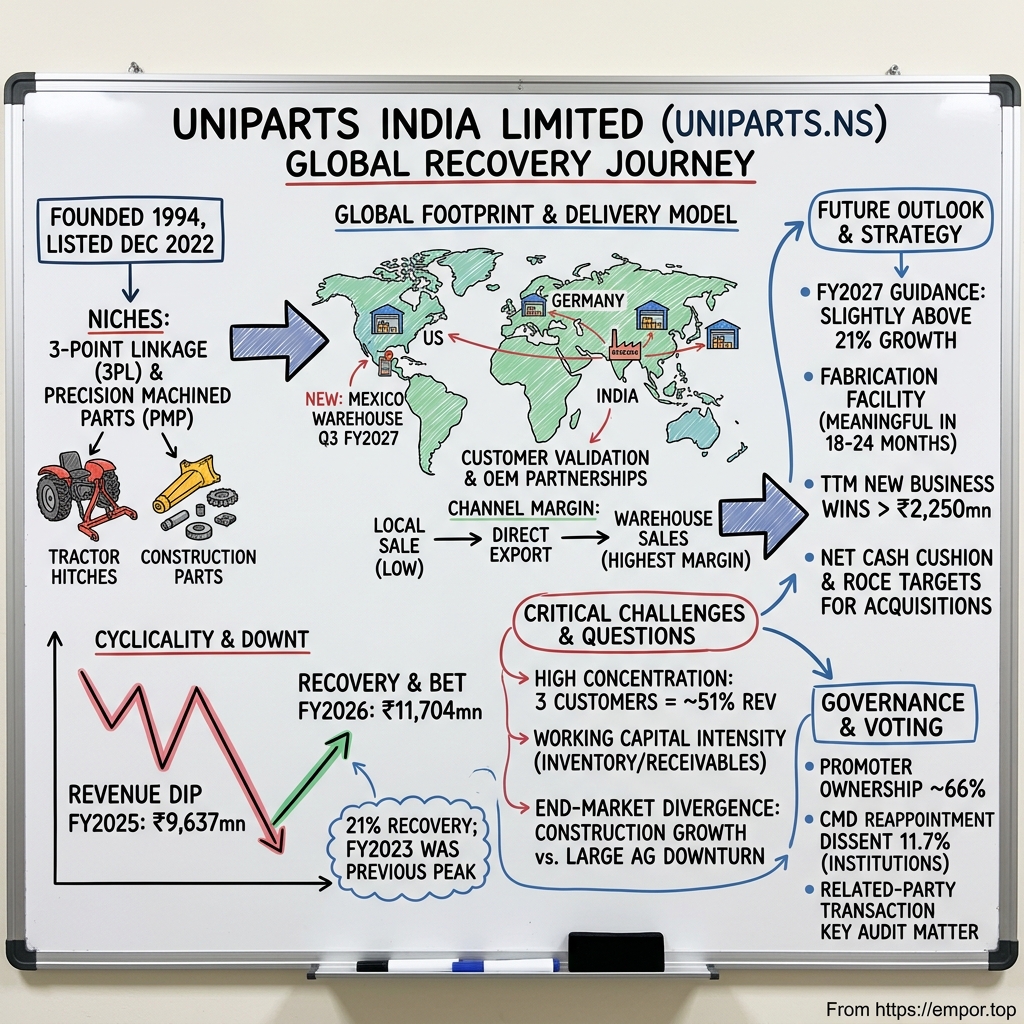
Uniparts India: The Parts Maker Betting on a Global Recovery
I. The factory that sells around the world
Somewhere in a farm-equipment plant in the American Midwest, an assembly line is waiting for a part. It is not glamorous. It is a forged and machined arm, one piece of the three-point hitch that lets a tractor lift a plough, a mower or a seed drill. The line cannot run without it, and the plant manager does not much care where it was forged. What matters is that it arrives on time, fits the first time, and keeps arriving.
That part's journey usually begins thousands of kilometres away, in northern India. It is forged, machined, inspected and packed there. Then it crosses an ocean, sits for a while on a shelf in a warehouse in the United States or Germany, and finally travels the last few hundred kilometres to the customer's line. The work that makes that journey reliable, more than any single product, is what Uniparts India sells.
Start with the size of the operation. In FY2026, the year to March 2026, Uniparts reported consolidated revenue of about ₹11,704 million, roughly ₹1,170 crore1. It serves more than 125 customers in more than 25 countries1. Yet the company is still very much a family-controlled enterprise: promoters and the promoter group held 65.88% of the shares at March 20261.
That combination shapes everything that follows. Uniparts is an Indian-listed company, but it is not mainly an Indian business. India contributed only about ₹1,619 million of FY2026 revenue. The Americas contributed about ₹6,025 million and Europe about ₹2,793 million1. The listed entity is the parent of a small multinational: wholly owned subsidiaries in India, the US and Germany, plus Uniparts Olsen in the United States1.
Investors therefore need to keep two sets of books in mind. The Indian parent's standalone accounts showed revenue of about ₹7,172 million in FY2026. The consolidated group showed ₹11,704 million1. The difference is not a rounding issue. The parent makes components and sells many of them to its own overseas subsidiaries, which then sell to customers. Consolidation strips out those internal sales. Read only the parent, and the economics of the business are distorted. Read only the group, and some of the money trail between India and the rest of the world disappears.
The four questions
This story is organised around four questions.
First, is the recovery durable? FY2026 revenue grew about 21%, but that came after a sharp fall1.
Second, does Uniparts have an edge customers will keep paying for? It claims meaningful niche shares, but its customers are large and concentrated.
Third, how much do the parent's accounts tell us about the group's earnings? Dividends from subsidiaries and intercompany sales make the parent look different from the operating business.
Fourth, can management turn new business wins into lasting growth? Awards, a fabrication facility and a Mexico warehouse are promising. None is yet a proven profit stream.
The clock and the cycle
The company traces its roots to 19942. It listed on Indian exchanges in December 2022 through an offer for sale, which meant the IPO money went to selling shareholders rather than to the company23. And it is now emerging from a demand downturn that cut consolidated revenue by about 15% in FY20251.
One more warning belongs at the start. This is cyclical OEM manufacturing. Uniparts generally recognizes revenue when it dispatches products, at contractual prices net of discounts and volume rebates1. Uniparts refers to long-term agreements with major customers in its annual report, but does not disclose contract lengths, minimum purchase commitments or any recurring-revenue share1. When farmers stop buying big tractors or contractors pause equipment orders, Uniparts feels it.
The verdict for this opening: treat Uniparts as a global supplier whose demand, margins and risks are mostly set overseas, run from an Indian manufacturing base. To understand how it got that shape, go back to a deal in 2005.
 Subscribe on LinkedIn
II. The US foothold that changed the map
In 2005, an Indian component maker made a move that many of its peers would not try for another decade. Uniparts' US subsidiary acquired a controlling stake in Olsen Engineering, a US business that would later be renamed Uniparts Olsen23. It did not buy the whole company at first. It took 50% plus one share2, enough to control it, but with partners still in the room.
That detail is telling. Small Indian manufacturers expanding abroad often face the same problem: their costs are attractive, but their customers are far away, cautious and used to dealing with suppliers who can solve problems in person. A plant in India can quote a good price. It is harder for it to fix a quality issue on a Tuesday afternoon in Iowa. Olsen gave Uniparts a local presence, local relationships and a way to serve customers from inside the United States.
From exporter to near-shore supplier
Over time, the model became a chain rather than a single plant. Manufacturing stayed concentrated in India. US operations and warehousing put inventory close to customers. A German presence served Europe12. Today, the company describes this as a global service-delivery model, and ICRA, the rating agency, named it as a strength4.
The real test of that model is margin. On the Q1 FY2027 call in August 2026, management described three ways the same product can reach a customer5. Local manufacture and local sale has the lowest margin. A direct export from India is the reference point, with a base margin management put at about 20%. A sale from an overseas warehouse is the highest-margin channel5.
That ranking is counterintuitive at first. Warehousing adds cost: rent, people, inventory and shipping. Why should it earn more? The answer is service. A customer buying from a nearby warehouse gets short lead times and buffer stock without carrying that inventory itself. It is paying for convenience and reliability, not just for steel. Uniparts makes the part at Indian cost and sells it with near-local service. Olsen and the warehouses that followed are what make that arbitrage possible.
Mexico: the next node, not a new story
The latest extension of this model is Mexico. Management said first customer deliveries from a Mexico warehouse were expected in Q3 FY2027, the quarter ending December 2026, while most manufacturing would still be done in India5. It framed local manufacturing in Mexico as something to consider later, not an immediate step5.
That sequencing matters. Mexico is not yet a new growth engine. It is another warehouse in a model that already exists. Its value will be measured by whether it wins new customers or wallet share in North America, and whether its margins look like the US warehouse channel rather than a costly start-up.
What Olsen cost, and what it returned
Here the record runs out. The public offer documents describe the Olsen acquisition and the initial controlling stake23, but do not set out a purchase price against a contemporary industry benchmark or the subsidiary's full return on that investment. Without those figures, any claim that the deal was cheap or expensive would be guesswork.
What can be said is narrower and still useful. Two decades after the deal, the US business remains central to how Uniparts reaches its largest market, and the warehouse channel it anchors is the group's highest-margin route5. That is strategic evidence, not a return calculation.
So the Olsen foothold created a lasting route to customers rather than just another operating layer. But it also locked Uniparts into a model that needs inventory sitting in warehouses on two continents. That trade-off—service in exchange for working capital—runs through the rest of the story. First, though, it helps to look at what is actually in those warehouses.
III. A component business with two very different demand clocks
Picture two parts leaving the same group in the same week. One is a tractor hitch component bound for an agricultural OEM. The other is a precision-machined part for an excavator or a forestry machine. They may share factories, engineers and logistics. They do not share customers' buying cycles.
The two products, in plain English
The first product line is the three-point linkage, or 3PL. It is the mechanical system at the back of a tractor that attaches implements such as ploughs and mowers and lets the tractor lift, lower and stabilise them. Think of it as the tractor's shoulder and arm. It has to handle heavy, repeated loads in mud, dust and vibration.
The second line is precision machined parts, or PMP. These are components cut and finished to tight tolerances for construction, forestry and other off-highway equipment. They might be pins, shafts or housings that have to fit precisely inside a larger machine. A small error in a dimension can mean a noisy, failing or unsafe machine.
Together, these two lines are almost the entire business. In FY2026, PMP was about 51.5% of finished-goods sales and 3PL about 46.6%6. Construction and forestry equipment represented about 61.3% of sales, and the Americas about 53.2%6. The company reports a single operating segment, so investors do not get a separate profit figure for each line1.
How the money is made
The commercial model is a mix of stickiness and exposure. Uniparts builds long-term relationships with OEMs, and a new part generally has to be engineered, sampled and validated before a customer will put it into production1. Once a part is on a platform, a customer rarely wants to change suppliers casually. But revenue still depends on dispatches and customer production schedules1.
Customer concentration sharpens the point. In FY2026, three external customers each accounted for at least 10% of revenue. Together they represented about ₹5,890 million, roughly 51% of the ₹11,595 million revenue base used in the segment note1. A year earlier, two customers crossed that threshold, representing about 39%1. The company does not name them, and it does not disclose top-five or top-ten concentration1.
Concentration rose during the recovery. That could be good news: deeper relationships and more wallet share with the biggest OEMs. It also means a single large customer's production cut, or a decision to dual-source, could move the whole group.
Channel mix, not just product mix
The most important insight from the latest call is that margin depends heavily on how a product reaches the customer. Management said warehouse sales were higher-margin and contributed to the FY2026 margin improvement5. The same hitch shipped directly from India and sold through a US warehouse can produce different profits.
That makes reported margins harder to interpret. A rising margin may reflect better pricing, better plant utilisation or simply a larger share of warehouse sales. Uniparts does not publish margins by channel over time, so investors cannot separate those effects cleanly.
Two demand clocks
On the Q1 FY2027 call, management drew a sharp distinction across end markets5. Construction demand and new awards were supporting growth. Small agricultural equipment showed early signs of recovery. Large agricultural equipment remained in a deep downturn, with recovery expected later5.
That is more informative than talking about "the market." Uniparts' growth in FY2026 and early FY2027 leaned on construction and new business. If large agriculture turns up while construction holds, the company could have two tailwinds. If construction slows before large agriculture recovers, the current growth could stall.
Myth vs. reality: the warehouse moat
The tempting story is that warehouses create switching costs. Customers get used to just-in-time supply from a nearby shelf and never leave. That may be partly true. But the company does not disclose customer retention rates, repeat-award rates or warehouse-channel margins over several years. Without them, the warehouse model is evidence of good service, not proof of a durable lock-in.
So the answer to this section's question is: all three matter, but channel matters more than most investors would assume. The products are real niches, end markets set the volume, and the delivery route sets much of the margin. That combination was tested hard.
IV. The downturn that tested the "resilient supplier" claim
In FY2024, Uniparts reported consolidated revenue of about ₹11,395 million. A year later, it was about ₹9,637 million1. Nothing inside the company had dramatically broken. The machines its customers make simply stopped selling as fast. ICRA attributed the weakness to subdued demand in the company's main markets4.
Then the cycle turned. In FY2026, revenue rose about 21% to ₹11,704 million1. Operating EBITDA margin rose from about 15.1% in FY2025 to about 21.1% in FY20266. Consolidated profit rose from about ₹880 million to about ₹1,583 million1.
Those are big swings for a supplier that markets itself as resilient. A six-point margin move in one year is not the behaviour of a business with locked-in economics. It is the behaviour of a manufacturer with significant fixed costs: when volume falls, factories run below capacity and margins compress; when volume returns, the same plants absorb more output and margins expand.
A longer record, with caveats
The decade-long record is mixed. The FY2016-17 annual report showed standalone revenue of about ₹4,116 million for FY20177. The FY2020-21 report showed consolidated revenue of about ₹9,072 million in FY2020 and ₹9,031 million in FY2021, roughly flat, with profit improving from about ₹628 million to ₹912 million8. FY2023 was the earlier revenue peak, and FY2026 still sat below it1.
Those figures mix standalone and consolidated reporting, so they do not form a clean growth series. What they do show is a business that has grown over a decade, but not in a straight line. Flat years, declines and sharp rebounds all appear in the record.
What explains the margin jump?
Management attributes the improvement to better utilisation and a favourable warehouse-sales mix56. Both are plausible and both are cyclical in part. Utilisation falls when demand falls. Warehouse mix depends on which customers are ordering and through which channel. Neither has yet been shown to be permanent.
The latest update
Q1 FY2027 extended the recovery. Revenue rose about 27% year over year, and management raised its FY2027 growth outlook to a couple of percentage points above FY2026's 21%5. That is a confident signal from a management team that, a year earlier, was steering through the trough.
How should investors weigh it? Management's growth call rests on construction and new awards, not on large agriculture, which it still describes as weak5. That is honest framing. It also means the guidance depends on an end market that can turn quickly.
Test the cycle call
The test is straightforward. A second consecutive year of growth, with margins holding near FY2026 levels and customer concentration stable, would strengthen the claim that FY2026 was a step-up. Another reversal, especially if construction weakens before large agriculture recovers, would suggest the company remains as cyclical as its history implies.
For now, the verdict is that the recovery is real but not yet proven durable. One good year after a bad one does not set a new base rate. Whether Uniparts can hold its ground through the next turn depends on a harder question: what keeps customers coming back?
V. Does a niche leader have a moat?
Imagine an OEM engineering team designing a new tractor or excavator. A component has to fit, survive testing, meet quality audits and arrive from a supplier who can deliver across countries. Changing that supplier later means repeating some of that work. This is where component makers try to build moats: in the friction of qualifying a replacement.
The company's claimed position
In its FY2022 industry assessment, Uniparts estimated its global share at about 16.68% in tractor three-point linkage and about 5.92% in precision machined parts for construction, forestry and mining equipment9. Those are meaningful positions in specific niches. They are not shares of the entire off-highway market, and they are company-commissioned estimates last assessed in FY2022, not independently verified current figures.
The competitive map management has described is crowded and awkward. In higher-horsepower 3PL, it named CBM as a competitor10. GKN Walterscheid competes in some areas and is also a customer10. In Indian linkage, Sudtrac and smaller domestic manufacturers compete10. In Japan, Delica is both a competitor and a customer10. In US PMP, General Grind is a named competitor10.
The overlap between customers and competitors matters. When a customer also makes or sources similar parts elsewhere, it has an alternative and a benchmark for price.
Scale context
Comer Industries, which owns Walterscheid, reported €893.7 million of 2025 revenue11. Uniparts reported about ₹11.7 billion in FY20261, several times smaller in euro terms. Comer is a much larger industrial group with broader driveline and power-transmission products, so this is not a like-for-like comparison. It does show that Uniparts operates among larger, better-capitalised players.
The forces, once
Apply Porter's framework.
Buyer power is high, given the customer concentration described above1. Large OEMs negotiate hard, can split volumes and know what parts cost.
Supplier power appears moderate. Steel and machining inputs are commodities, and the company does not disclose supplier concentration1.
The threat of new entrants is limited by OEM validation, engineering know-how and the cost of a global delivery footprint. But it is not zero: low-cost manufacturers in India and elsewhere can qualify parts over time.
Substitutes come mainly from customers' own sourcing options and other suppliers rather than from a different technology. A three-point hitch is a mature design.
Rivalry is real but fragmented, with specialists in each niche and region.
In Hamilton Helmer's 7 Powers terms, the best candidates are switching costs, from validation and integration into customer platforms, and a form of process power, from combining Indian cost with overseas service. Scale economies are limited, given larger rivals. There is no network effect or brand power in the consumer sense.
Falsification
The company's own history is the best test. Its revenue and margins have swung with the cycle, which is consistent with a supplier that lacks pricing power in a downturn. But the cited records do not show whether Uniparts lost bids, customers or share during FY2025. The FY2025-26 annual report does not disclose major customer losses or contract exits1. That absence is not confirmation of a moat; it simply leaves the question unanswered.
The more useful evidence is forward-looking. Management reported trailing twelve-month new-business wins of more than ₹2,250 million5. If those awards keep arriving, and customer concentration rises because of higher wallet share rather than because smaller customers shrink, the switching-cost thesis gains support.
Verdict
The evidence supports a narrower claim than "moat": Uniparts has a meaningful position in fragmented niches, earned through engineering, validation and service reach. It does not prove that position is unassailable. The KPIs that would confirm it are repeat awards, retention, wallet share and price realisation across a downturn. The warehouse channel's share and margins, as Mexico begins, will show whether proximity is a repeatable advantage or just a favourable mix.
A moat that requires inventory on two continents also has a cost. That cost shows up in the cash-flow statement.
VI. The cash conversion behind the earnings rebound
Profit is an opinion; cash is a fact. The old line applies with special force to a company that stocks parts in warehouses around the world.
In FY2026, Uniparts reported consolidated profit of about ₹1,583 million and cash from operations of about ₹1,736 million1. That looks healthy: cash exceeded profit, despite a growing business.
The reconciliation
Three things explain the gap. Depreciation and amortisation of about ₹453 million were added back, since they reduce profit without using cash1. Smaller adjustments included ESOP expense and translation differences1. Working capital went the other way: inventory increased by about ₹443 million and receivables by about ₹299 million, together absorbing roughly ₹742 million, partly offset by higher payables1.
So Uniparts generated strong cash despite feeding its warehouses. FY2025 told the opposite story. Cash from operations was about ₹1,820 million against profit of only about ₹880 million, helped by inventory and receivables releasing cash as sales fell1.
That pattern is classic for a working-capital-heavy manufacturer. In a downturn, cash looks better than profit. In a recovery, growth absorbs cash. Investors who judged the business only on FY2025 cash flow would have overstated its steady-state cash generation.
Who pays late?
Consolidated trade receivables rose from about ₹1,126 million to ₹1,413 million at March 20261. Most of the balance, about ₹1,124 million, was either not due or less than six months overdue1. Only about ₹2.1 million was more than a year overdue, and ₹0.34 million was classified as credit-impaired1. The receivables rise reflects higher sales, not evidence of a bad-debt problem. It is still worth watching, because receivables grew faster than the stability of the end markets warrants.
What the business needs to reinvest
Capital spending is modest. FY2026 purchases of property, plant and equipment and intangibles were about ₹301 million, about 2.6% of revenue, versus about 3.4% in FY20251. R&D expenditure is not separately disclosed in the annual report1. This is a business where engineering sits inside manufacturing rather than in a separately reported lab.
Debt and cash
At March 2026, consolidated borrowings were about ₹922 million, separate from about ₹625 million of lease liabilities1. Against that, cash and current investments totalled about ₹2,502 million1. Before leases, Uniparts was net cash. The lease increase partly reflects new leases and should not be mistaken for new funded borrowing1.
ICRA's view adds a necessary warning. It reaffirmed the rating but cited high working-capital intensity: 44% in FY2025 and 39% in H1 FY20264. Management's latest call reported 139 working-capital days5. In plain terms, Uniparts ties up several months of sales in inventory and receivables to keep its service promise.
The verdict: profit does turn into cash over the cycle, and the balance sheet has a cushion. But the timing of that cash depends on inventory and receivable swings. Three measures are worth tracking: cash from operations against profit, working-capital days and receivable ageing. To see where that cash travels inside the group, follow it from parent to subsidiary.
VII. Is the parent the business—or the bridge to it?
A component leaves a plant owned by Uniparts India and passes through the internal sales chain described earlier before reaching an OEM.
The internal flow
In FY2026, the parent's related-party sales of goods and services were about ₹3,299 million, about 46% of standalone revenue1. The share was the same in FY2025, on a smaller base of about ₹2,620 million1. Those intercompany sales are eliminated on consolidation1.
Dividends flow the other way. The parent reported about ₹840 million of dividend income from subsidiaries, roughly 81% of its ₹1,033 million other income1. By contrast, consolidated other income was about ₹176 million, about 8.6% of profit before tax, down from about 18.6% in FY20251. The parent's other income therefore says much more about internal cash movements than about group earnings. At group level, operating profit, not treasury income, drove the FY2026 rebound.
The balances
Other parent balances complete the picture. At March 2026, the parent had a ₹339 million loan to Gripwel Conag, earning about ₹27 million of interest, and held ₹393 million of preferred stock in Uniparts USA1. A ₹100 million corporate guarantee for a subsidiary appeared in the FY2025 contingent-liability note but not in FY2026112. Standalone receivables rose from about ₹716 million to ₹1,115 million, much of it owed by subsidiaries1.
What the auditor focused on
The auditor treated related-party transactions—including cross-border sales, royalties and management charges—as a key audit matter1. The company says international and specified domestic transactions are supported by transfer-pricing documentation1. But the note does not quantify royalties or management charges separately, and gives no pricing benchmark beyond the arm's-length assertion1.
That is not evidence of wrongdoing. It is a reminder that transfer prices decide where profit sits—in India or abroad—and therefore affect tax, dividends and the parent's apparent profitability.
Verdict
The parent is the bridge, not the whole business. Its revenue and other income are not a clean proxy for group demand. The operating subsidiaries make the global model work, and investors should read the consolidated accounts first, then use the standalone and related-party notes to follow the flows. The next question is where management wants that group to go.
VIII. The next growth bet: awards first, revenue later
On the Q1 FY2027 call, an analyst raised a sore point: investors had been hearing about acquisitions for years. Management's answer was candid. It said it had evaluated about a dozen targets since the IPO, with several deals falling through5. It said it walked away from deals that did not meet its value criteria and wanted acquisitions to be accretive to ROCE and ROE within 18 to 30 months5.
The organic plan
Meanwhile, the company is building organically. Management named large agriculture, construction and fabrication as focus areas5. It also cited new-business wins5. It said large-agriculture awards had begun flowing into results, while the broader opportunity still depended on OEM validation and production ramps5.
Fabrication—making welded assemblies rather than individual machined parts—is the newest adjacent bet. Management said it expected fabrication to become meaningful over 18 to 24 months, funded internally5. It also said annual capex generally runs at 2.5% to 3.5% of revenue5. PTO and hydraulics have also been discussed as options5.
Certification is not commercialisation
The useful discipline here is separating awards from revenue and revenue from returns. An award means a customer has chosen Uniparts for a part. It does not mean that part will ship at forecast volumes, especially if the end market is weak. The company does not disclose a historical award-to-revenue conversion rate, so investors cannot test past awards against later sales. Fabrication, PTO and hydraulics should be treated as options until they show up as revenue and ROCE.
Capital allocation on the record
In October 2025, Uniparts paid a special dividend of about ₹1,010 million, with management saying no inorganic investment was in sight51. That is a disciplined act in one sense: it returned cash rather than letting it sit or forcing a deal. The cited records show no post-listing acquisition113. Olsen remains the main precedent for acquisition-led strategy, and the public material does not establish its purchase multiple or deal-specific returns.
So management's discipline is plausible but not yet proven. Walking away from deals is a good sign. The real test arrives with the first deal it does sign: whether it meets the stated 18-to-30-month accretion hurdle.
The investor's checklist is short. Does fabrication become material within management's window? Does capex stay within its stated range? Do new awards convert into reported sales? Who decides those choices is the next part of the story.
IX. The people, the payout and the control question
At the September 2026 AGM, shareholders reappointed Gurdeep Soni, the company's chairman and managing director. The resolution passed. But 11.7% of votes cast by public institutions opposed it14. That is not a revolt. It is a signal that some institutional holders want more scrutiny.
Who runs Uniparts
Gurdeep Soni leads the board as CMD1. Tanushree Bagrodia is CEO and a whole-time director1. Sandeep Taneja was listed as CFO at year-end after Rohit Maheshwari resigned effective March 11, 20261. The board has eight members, four of them independent1.
The leadership's record across the cycle is mixed in a familiar way. The team managed through FY2025's decline, delivered FY2026's recovery and raised guidance15. The coming year will show whether that confidence is matched by results.
Pay against profit
Consolidated KMP remuneration fell to about ₹153 million in FY2026 from about ₹188 million, even as profit rose from about ₹880 million to ₹1,583 million1. Within that, Tanushree Bagrodia's pay rose to about ₹23 million from about ₹8 million, Gurdeep Soni received about ₹30 million and Paramjit Singh Soni about ₹50 million1. The annual report says Gurdeep Soni's pay came from subsidiary Gripwel Fasteners and Paramjit Singh Soni's from Uniparts USA1. That is legal and disclosed, but it makes it harder for investors to see the full compensation picture from the parent's pay disclosures alone. ESOP grants have added only small dilution: issued shares rose from about 451.34 million to 451.43 million in FY20261.
Control, payout and ownership
Promoter ownership has been stable around 65.7% to 65.9% since FY2023, with no promoter pledge in the March 2026 filing115. Over the same period, domestic institutional ownership fell from about 10.9% to 5.3%, and foreign institutions from about 6.6% to 2.8% before recovering slightly by June 202615. The special dividend returned excess cash1.
The governance facts
The parent paid about ₹1.6 million rent to Soni Holdings, an entity over which key managers and relatives exercise significant influence1. Related-party transactions are an auditor key audit matter1. Standalone contingent liabilities included about ₹53.9 million of income-tax demands and ₹30.1 million of GST matters—modest relative to group scale1. CARO reported no borrowing default and the auditor made no qualification1. On currency, the group selectively hedges and tries to match income and expenses, but carries unhedged receivables, payables and loans, and the annual report's sensitivity table is labelled with the wrong years, leaving the FY2026 comparison unclear1.
The verdict is neither clean nor alarming. Promoter control appears to support patient investment, but minority alignment depends on continued transparency about related-party flows, subsidiary pay and transfer pricing. Watching institutional voting in future AGMs is the simplest test.
X. Analysis and Bull vs. Bear Case
Put three numbers on one page: FY2026 revenue up 21%1, three customers at about 51% of revenue1, and 139 working-capital days5. Together they summarise the opportunity and the risk.
The bull case
Uniparts is a specialised supplier with meaningful niche positions in 3PL and PMP9. It combines Indian manufacturing with US and European service, a model that earns its best margins through warehouses5. It has new awards above ₹2,250 million5, a Mexico warehouse about to start, and a fabrication option. ICRA's reaffirmed AA-/A1+ rating supports its financial flexibility4. Net cash gives it room to wait for good deals rather than chasing bad ones1.
If construction holds and large agriculture recovers, Uniparts could see higher volumes, better utilisation and higher wallet share at its biggest customers.
The bear case
The cycle can reverse. Large customers carry bargaining power, and concentration rose in FY20261. About half of revenue comes from the Americas, and ICRA flagged US tariff and geopolitical uncertainty, with the US accounting for around 45-50% of revenue4. Margins and cash conversion move with volume, working capital and delivery mix15. Adjacent businesses have yet to prove material scale.
An activist-minded skeptic would press on three points: why the parent's related-party pricing isn't benchmarked in more detail, why institutional ownership fell so sharply after listing, and whether the warehouse channel's margin will survive a downturn when inventory becomes a burden rather than a service.
The moat, revisited
The Porter analysis in Section V still applies: buyer power is high, entry barriers moderate, and switching costs real but unquantified. In 7 Powers terms, Uniparts may have switching costs and some process power. It does not yet have proof of durable pricing power. Its reported niche shares are company estimates from FY2022, not current independent data.
Valuation as context
Value Research reported a 21.2x P/E on September 25, 202616. Its peer set ranged from 17.4x for LG Balakrishnan to 159.1x for MTAR Technologies—businesses with very different growth and risk profiles16. With only a short listed history, there is no long valuation track record. The price implies investors expect the recovery to continue, not that they are paying for a premium compounder.
Three KPIs to track
First, revenue and operating margin by end market, especially construction versus large agriculture.
Second, new awards converting into reported sales.
Third, working-capital days alongside cash from operations. The latest reading is 139 days5, with ICRA's intensity measure easing from 44% to 39%4.
FY2027 results, customer concentration and cash conversion will decide which case is gaining evidence.
XI. Business & Investing Lessons
"A customer relationship is earned one validation cycle at a time." The company said large-agriculture awards had begun flowing into results, yet the end market remained weak5. Founders in industrial supply chains should plan for that lag, and investors should never treat a contract win as booked revenue.
"A warehouse can improve service—and tie up cash." The warehouse channel's margin comes with a working-capital cost54. The warehouse is both a service advantage and a mortgage. In a boom, it feels like service. In a bust, it feels like inventory.
"Cash returned is capital not yet put to work." The special dividend was a clean answer to the question "what if there is no good deal?"5 It was also an admission that the company had not found a good use for the money. The lesson for managements: returning cash is honest. Proving you can deploy it well is what earns trust.
"A rebound is not a new base until it survives a cycle." FY2026's 21% growth followed a 15% decline1. A durable recovery must hold its gains when the cycle turns.
XII. Epilogue and Outro
Tonight, Uniparts stands in the middle of a recovery. Construction is helping while large agriculture remains weak5. Management has raised its FY2027 outlook5. Mexico5 and fabrication5 are the next tests.
The next proof points are concrete. If Uniparts delivers its guidance, converts awards into revenue, keeps cash conversion strong through growth and shows Mexico can earn warehouse-like margins, the recovery will look less like a bounce and more like a business finding its footing. If growth slips, working capital swells or a major customer cuts orders, the cycle will reassert itself.
The tension does not go away. Uniparts' global reach creates real opportunity. Its cash, customer concentration and cycle exposure remain grounded in a few industrial end markets that it cannot control.
Back to that forged arm on its way to a Midwestern assembly line. It began in India, waited on a shelf near its customer, and arrived just in time. That journey is Uniparts' entire strategy compressed into one shipment: make it far away, deliver it close by, and charge for the difference.
Uniparts is trying to make distance its advantage; the next cycle will show what that advantage is worth.
References
-
Annual Report 2025–26 — Uniparts India Limited, 2026-09-05 ↩↩↩↩↩↩↩↩↩↩↩↩↩↩↩↩↩↩↩↩↩↩↩↩↩↩↩↩↩↩↩↩↩↩↩↩↩↩↩↩↩↩↩↩↩↩↩↩↩↩↩↩↩↩↩↩↩↩↩↩↩↩↩↩↩↩↩↩↩↩↩↩↩
-
ICRA Rating Rationale — Uniparts India Limited, 2026-05-07 ↩↩↩↩↩↩↩
-
Q1 FY2027 Earnings Call Transcript — Uniparts India Limited, 2026-08-05 ↩↩↩↩↩↩↩↩↩↩↩↩↩↩↩↩↩↩↩↩↩↩↩↩↩↩↩↩↩↩↩↩↩↩↩
-
Q4 FY2026 Earnings Presentation — Uniparts India Limited, 2026 ↩↩↩↩
-
Off-Highway Vehicles Industry Report — Uniparts India Limited, 2022 ↩↩
-
Q3 FY2024 Earnings Call Transcript — Uniparts India Limited, 2024-02-15 ↩↩↩↩↩
-
Voting Results and Scrutinizer's Report, 32nd AGM — Uniparts India Limited, 2026-09-30 ↩
 LinkedIn
 WhatsApp
 Reddit
 Hacker News
 Email
Email Kindle
 RSS Feed
 Spotify
 Apple Podcasts
 Amazon Music
 Audible
 YouTube