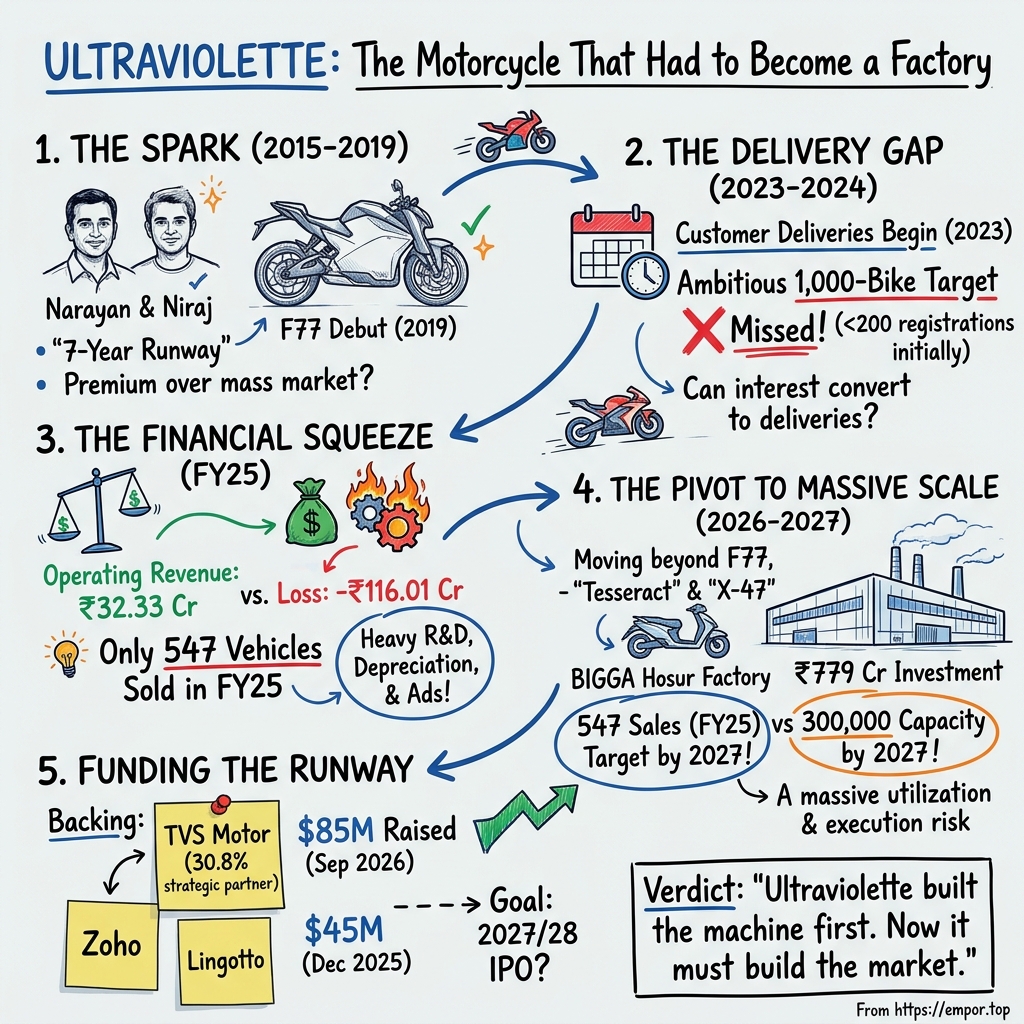
Ultraviolette: The Motorcycle That Had to Become a Factory
I. The Bike on the Stage—and the Factory Behind It
On 13 November 2019, two young engineers from Bengaluru pulled the cover off a motorcycle that looked as if it had flown in from a fighter-jet hangar. The F77 had sharp, faceted bodywork, a claimed top speed of 147 kilometres an hour and a price tag of ₹3 lakh to ₹3.25 lakh, at a time when most Indians who thought about electric two-wheelers pictured a slow commuter scooter.1 Ultraviolette opened online registrations that same day and promised deliveries in the third quarter of 2020.1 The machine was the message: an Indian startup could build an electric motorcycle that people would want, not merely tolerate.
Seven years later, the company is talking about something much larger than a motorcycle. In September 2026, Ultraviolette said it wanted a combined annual production capacity of about 3 lakh vehicles by the middle of 2027, split between an expanded plant in Bengaluru and a new factory in Hosur that it has named BIGGA.2 It said it would spend roughly ₹1,000 crore over five years to get there, and its chief executive linked company-level profitability, expected within about 24 months, to the timing of a future stock-market listing.2 Earlier coverage had described an IPO planned for the 2028 financial year.3
Set those ambitions beside the audited record and the distance becomes the story. In the year to March 2025, Ultraviolette reported operating revenue of about ₹32 crore and a loss of about ₹116 crore.4 It reported 547 vehicles sold in that year.5 The company that plans to make hundreds of thousands of vehicles a year has, in its last audited year, recorded sales of a few hundred.
That gap is not a scandal. Every manufacturer starts small, and a factory has to be planned before the demand it serves arrives. But it does define the question a long-term investor must answer before Ultraviolette ever files a prospectus: can a premium electric motorcycle company turn engineering ambition into a repeatable vehicle business that eventually pays for itself?
Three smaller questions sit inside that one. The first is whether vehicle growth can outrun a cost base that was built for a much larger company. The second is whether the F77's undeniable appeal, the thing that makes people stop and look, can become durable demand at prices that leave a margin. The third is whether the company can fund the bridge from today's volumes to factory-scale volumes without returning to investors so often that the eventual public shareholder inherits a heavily diluted claim.
Before going further, it helps to draw the boundary of the company carefully, because one of its shareholders is far better known than it is. TVS Motor, one of India's largest two-wheeler makers, holds a large minority stake and accounts for Ultraviolette as an associate company. At 31 March 2025, TVS held 30.83% of Ultraviolette's equity shares, plus preference shares.4 TVS also sells hundreds of thousands of electric scooters of its own. None of those sales, profits or factories belong to Ultraviolette. When this story uses TVS's filings, it is because TVS, as an investor, is obliged to report on the startup's performance; it is not because TVS's scale says anything about Ultraviolette's.
No prospectus exists yet. As of mid-November 2026, there is no Ultraviolette draft red herring prospectus or any other offer document among the Securities and Exchange Board of India's public-issue filings.6 Ultraviolette Automotive Private Limited is still a private company whose latest full audited accounts, for the year to March 2025, were filed with the Registrar of Companies in Bengaluru.7 That means the evidence for this underwriting comes from registry records, the disclosures of its associate investor, funding announcements, registration data and what the founders have said in interviews. It is a thinner record than a prospectus would provide, and that thinness is itself one of the things a future public investor will be asked to price.
The product story is already vivid. The F77 was launched in India and, the company says, in 20 European countries.8 A racing derivative set an Indian top-speed record.9 A crossover called the X-47 drew thousands of bookings within a day of launch.10 A scooter called the Tesseract drew tens of thousands.11 The commercial proof, the steady conversion of interest into delivered, paid-for, profitable vehicles, is still being built.
So this is a bet on turning a technically ambitious motorcycle into a scalable product platform, and the gap between reported sales and planned capacity makes commercialisation the test. To understand why the company arrived at this point with a striking product and a small sales base, the story has to go back to the decision two founders made about what to build first.
 Subscribe on LinkedIn
II. Two Founders, Seven Years Before the First Delivery
Ultraviolette Automotive was incorporated in Karnataka in 2015.7 Its co-founders, Narayan Subramaniam, now chief executive, and Niraj Rajmohan, now chief technology officer, still run the company more than a decade later.12 That continuity matters, because nearly everything distinctive about Ultraviolette, from its insistence on building its own battery and drivetrain systems to its willingness to spend years refining a product before selling it, flows from a decision they made at the beginning.
The obvious path in Indian electric mobility was the scooter. Scooters are the backbone of urban personal transport, they are easier to electrify because the battery can sit low under the floorboard, and the buyers are price-sensitive commuters who care about running costs. That is where most of the money and most of the startups went. Ultraviolette chose the opposite end of the market: a high-performance motorcycle that would compete with petrol bikes on acceleration and design, and that would ask buyers to pay a premium for the experience rather than for the savings.
The logic was a kind of proof by example. If an Indian company could build an electric bike that enthusiasts actually desired, it would establish a brand and a body of engineering that could later be stretched into cheaper and higher-volume products. The founders have described this as a platform strategy: develop the core motor, battery pack and control electronics once, then extend them across several vehicles.13 It is a familiar idea in carmaking, where a shared platform spreads engineering costs across many models. Whether it works depends on whether multiple products actually reach customers in volume.
The early investor who made the plan financially plausible was TVS Motor. It took a 14.78% stake in December 2017 and raised it to 25.76% with a further ₹6 crore in August 2018.1 That was a modest cheque by automotive standards, but it gave the founders an industrial partner with supply-chain knowledge and a reason for suppliers and later investors to take them seriously.
Then came the long middle. The F77 shown in November 2019, with a 4.2 kWh battery and a claimed range of 130 to 150 kilometres, was meant to reach customers in the third quarter of 2020.1 It did not. The bike that finally launched on 24 November 2022 was priced from ₹3.8 lakh, well above the 2019 indication.14 Deliveries started in Bengaluru in early 2023, directly from the company's factory.15 By the time of the later Mach 2 version, the battery options had grown to 7.1 kWh and 10.3 kWh, with claimed ranges of 211 and 323 kilometres.16
Read charitably, that history shows a team that refused to ship an under-developed product and used the extra time, which included the pandemic years, to make the bike materially better. Read sceptically, it shows that the company's first public delivery promise slipped by more than two years and its first price indication rose by about a fifth before a single customer received a bike. Both readings are true. What matters for an investor is the pattern it establishes: Ultraviolette's engineering cycle has historically run longer than its public timetable, and that pattern will recur.
The company itself describes seven years of research and development behind its products.8 That investment has continued even after sales began. In the year to March 2025, research and development expense was about ₹7.6 crore, almost three times the previous year's figure.17 Employee costs, much of them engineering salaries, were far larger, at about ₹59 crore.17
The engineering has produced real milestones. In 2024, the F99, a factory racing derivative, completed a quarter-mile run in about 10.7 seconds at the Valley Run event, a time certified as the fastest quarter-mile run by an Indian motorcycle.18 In 2025, Autocar India rode the F99 to 258 kilometres an hour at the NATRAX test track, an India Book of Records entry for the fastest Indian-made electric motorcycle.9 Later, the X-47 arrived with a radar and camera rider-assistance system that the company presented as a first for a production motorcycle.19
None of these milestones is revenue. A speed record shows that the motor, battery and cooling systems can survive extreme loads, which is useful evidence of capability. It says nothing about whether ordinary riders will pay enough for a commuter-capable version to cover the cost of making, selling and servicing it. The same caution applies to awards, patents and design prizes. They tell an investor the company can build things. They do not tell an investor that the company can sell enough of them at a profit.
The founders' choice of a premium motorcycle therefore bought Ultraviolette an identity and a technical base, and it cost the company years and capital before the first customer arrived. The question it left behind is commercial: whether a bike priced several times above a typical Indian commuter motorcycle can find a place in a market that is built, overwhelmingly, around cheaper and more familiar two-wheelers.
III. The F77 Meets a Market Built Around Scooters
In April 2024, Ultraviolette launched the F77 Mach 2, an upgraded version of its only product, and began expanding beyond its Bengaluru base.20 At that point, the company's lifetime registrations were still in the hundreds. Across town and across the country, established manufacturers were selling electric scooters by the hundreds of thousands.
To understand what Ultraviolette is selling, start with what the customer buys. The business is the sale of complete electric motorcycles to retail riders, priced per vehicle, with service and accessories as smaller add-ons. In the year to March 2025, vehicle sales accounted for about ₹28.9 crore of ₹32.3 crore in operating revenue; servicing brought in about ₹1.6 crore and accessories about ₹1.1 crore.5 Nearly nine of every ten rupees came from selling a new bike. There is no subscription base or fleet contract underneath that line, which means each year's revenue depends on persuading a new set of buyers to make a large, discretionary purchase.
The buyer is an enthusiast or an aspirational urban professional who wants a motorcycle that feels fast and looks unlike anything else on the road. In exchange, that buyer accepts a higher price than most petrol bikes of similar practical use, and takes on the uncertainties that still attach to electric two-wheelers in India: whether there is fast charging along the route, how far the bike really goes on a highway, whether the service network will be there when something breaks, and what the bike will be worth in five years when the battery has aged.
The market around that buyer is growing, but it is not the market Ultraviolette has been selling into. In calendar 2025, India registered about 12.8 lakh electric two-wheelers, roughly 11% more than in 2024.21 TVS Motor led with about 2.99 lakh units, or roughly 23% of the total, followed by Bajaj Auto at about 21% and Ather Energy at about 16%.21 Those are scooter businesses, built on the TVS iQube, the Bajaj Chetak and Ather's Rizta and 450 ranges. Legacy manufacturers had taken about 58% of the electric two-wheeler market in the first half of 2025, squeezing the startups that had pioneered it.22 Ola Electric, once the volume leader, saw its sales halve in 2025.21
The closer comparisons are the electric motorcycle makers, and here the scale is much smaller. Between January and mid-August 2026, Revolt Motors registered about 6,900 electric motorcycles and Oben Electric about 3,300; Ultraviolette, with about 3,200, was third.23 Royal Enfield's new electric Flying Flea had registered only about 124 units in the same period.23 Electric motorcycles, as a category, still sell in the low thousands a month, a sliver of an electric two-wheeler market that itself registers more than a lakh vehicles a month. The category's growth is real; its proof as a mass market is not yet in.
That context explains why Ultraviolette's own numbers need careful reading. The company reported 547 vehicles sold in the year to March 2025, a figure drawn from the government's Vahan registration database.5 Divide the ₹28.9 crore of vehicle revenue by those 547 bikes and the answer is more than ₹5 lakh per vehicle, above the F77's Indian list price. Either the registration count misses some deliveries, which the company has long argued, or the vehicle line contains more than bikes sold in India. Whichever it is, the most basic operating fact about a vehicle company, how many vehicles it delivered, is not published by Ultraviolette in a form an outsider can reconcile to its revenue.
The company has disclosed no gross margin or contribution by model, no repeat-purchase or customer-retention data, and no breakdown of revenue by country. It has disclosed no figures on warranty claims or on how service revenue per bike changes as the fleet ages. For a premium vehicle brand, those are the numbers that separate a durable niche from a sequence of launch spikes.
The F77's initial price was ₹3.8 lakh in 2022.14 Later versions of the range started at ₹2.99 lakh.24 In March 2026, Ultraviolette introduced a battery-subscription scheme called Battery Flex, financed with the lender Ecofy, under which buyers pay for the motorcycle upfront and rent the battery monthly; it cut the entry price of the X-47 by about 40%, to roughly ₹1.49 lakh.25 Sales then rose sharply. Vahan data showed 694 registrations in July 2026, a monthly record and about five times July 2025's level, and Autocar India attributed the 2026 surge partly to the lower upfront cost.2326
That response is encouraging and revealing at the same time. It shows there are more buyers for an Ultraviolette motorcycle at a lower entry price. It also shows that demand at the original premium was more limited than the early marketing implied, and that the company had to move toward the mainstream to unlock volume. A battery subscription also changes the economics: some of the vehicle's value, and some of the credit risk, moves to a financing partner, and the revenue Ultraviolette books on each bike may fall. Inc42, examining this shift in 2025, described the company as changing its premium pitch to accelerate sales.20
Europe was meant to be the other proof of premium demand. In June 2025, Ultraviolette launched the F77 Mach 2 and SuperStreet in ten European countries at an event in Paris, with introductory prices of about €9,000.16 The company now says it is present in 20 European countries.8 Selling in Europe tests whether a demanding customer, with a choice of established motorcycle brands, will pay a European price for an Indian electric bike, and whether the company can meet European certification and after-sales requirements. It is a useful test. But Ultraviolette does not disclose how many bikes it has sold in Europe, at what margin, or how much of its revenue comes from outside India. Its co-founder said in mid-2026 that exports were about a tenth of the previous year's sales.27
The evidence therefore supports a modest conclusion. There is a growing electric two-wheeler market, and there is a plausible premium niche for performance electric motorcycles within it. There is no published evidence yet that Ultraviolette has won meaningful scale, pricing power or repeatable unit economics within that niche, and the evidence that does exist suggests price, not just product, governs how fast it sells. The numbers to watch are deliveries by model and market, contribution per vehicle after materials and direct costs, and whether service and parts revenue grows with the fleet.
Which leads to the problem that no product launch can settle on its own. Even a compelling bike must find enough buyers to cover the engineering, marketing, service and factory costs that stand behind it, and in Ultraviolette's case those costs have grown faster than its sales.
IV. The Price of Building the Platform
The year to March 2025 should have been a good one for Ultraviolette, and on the top line it was. Operating revenue more than doubled, rising about 114% to roughly ₹32 crore.4 Yet the loss nearly doubled too, to about ₹116 crore, as the company paid for people, promotion, engineering and the depreciation on equipment it had already put to work.417
The three-year series tells the same story in a sharper form. Operating revenue grew from about ₹8.7 crore in the year to March 2023 to about ₹32 crore two years later; over the same period, the annual loss grew from about ₹7.4 crore to about ₹116 crore.4 Revenue roughly quadrupled. The loss grew about fifteen-fold. Growth was accelerating, but it was accelerating from a base so small that each additional bike did very little to absorb a cost base that was being built for a far larger company.
The expense lines show where the money went. Total expenses in the year to March 2025 were about ₹189 crore.5 Employee benefits accounted for about ₹59 crore, up about 30% on the year; advertising for about ₹29 crore; and depreciation for about ₹27.5 crore.17 Each of those has a strategic purpose. Engineers and technicians develop the next platforms and keep the existing ones running. Advertising builds a brand and fills new showrooms in new cities. Depreciation reflects tooling, test equipment and production lines that have already been paid for.
Set those costs against the 547 bikes the company reported selling and the arithmetic is stark. Ultraviolette's payroll alone came to more than ₹10 lakh for every reported bike, about twice what each bike brought in as revenue. Total expenses came to roughly ₹34 lakh per reported vehicle. Even allowing for registrations that undercount deliveries, the business in that year was not a vehicle maker with a margin problem. It was an engineering organisation with a small vehicle business attached.
That is not unusual for a young automotive company. Fixed costs such as research teams, certification, tooling and a minimum sales and service network have to exist before the first bike is sold, and they do not shrink just because volumes are low. The question an investor must ask is whether those fixed costs are on a path to being covered. The answer depends on a number Ultraviolette does not publish: contribution per vehicle, meaning what is left from each bike's selling price after paying for its battery, motor, frame, components, assembly labour, freight and dealer margin.
A simple illustration shows why that number matters. Suppose, purely as an assumption, that each bike leaves about ₹50,000 of contribution after its direct costs. Covering the year to March 2025's employee, advertising and depreciation costs alone, roughly ₹116 crore, would require about 23,000 bikes a year, more than forty times the reported sales. At ₹1 lakh of contribution per bike, the threshold would halve but still sit near 12,000 bikes. Those are illustrations, not estimates, and the fixed cost base will rise as the Hosur factory is built. They show why the company's turn toward a higher-volume scooter is not a side project; it is the only way the arithmetic closes.
There is newer evidence, and it needs careful handling. For the year to March 2026, Ultraviolette recorded revenue of ₹126.5 crore and a loss of about ₹154 crore, according to a performance schedule in the 2026 Directors' Report of Sundaram-Clayton, a TVS group company.28 If that is right, revenue roughly tripled while the loss grew by about a third, which would be the first real sign of operating leverage: losses falling from more than three times revenue to about 1.2 times.
But the same schedule gives a comparative revenue figure of about ₹36.2 crore for the year to March 2025, which does not match the ₹32.3 crore of operating revenue in the audited summary.284 The gap is almost exactly the ₹3.8 crore of other income Ultraviolette reported that year, which suggests the schedule reports total income rather than revenue from operations.5 That reconciliation is plausible, not confirmed, and the schedule is not a substitute for Ultraviolette's own audited accounts for the year, which have not yet been made public. The trend it shows is encouraging. It cannot settle the question.
The larger gap is in cash. Ultraviolette does not publish an accessible cash-flow statement, a working-capital bridge, the amount of development spending it capitalises, or how much of its capital expenditure has gone into tooling and plant. At March 2025, it reported cash and bank balances of about ₹46 crore and total current assets of about ₹170 crore.5 Against a loss of about ₹116 crore in that year, the cash balance on its own would not have lasted long, which explains the sequence of fundraises that followed. Without the cash-flow statement, an outsider cannot tell how much of the reported loss was non-cash depreciation, how much cash was tied up in inventory and receivables, and how much was spent on assets that do not pass through the income statement at all.
One registry signal deserves mention because it bears on how the company treated its smallest suppliers when cash was tight. Between 2023 and 2024, Ultraviolette filed four half-yearly returns with the corporate affairs ministry listing 269 payments to 16 micro and small enterprises that were outstanding beyond the legal limit of 45 days.7 The amounts and any later settlement are not public. The filing is a required disclosure rather than a finding of wrongdoing, and many growing manufacturers file such returns. Still, an investor underwriting a supply-chain ramp to hundreds of thousands of vehicles should notice that, at a few hundred vehicles a year, the company was already paying small suppliers late.
This is where the platform thesis meets its commercial test. The founders' argument is that a single investment in motors, batteries, power electronics and software can be reused across many vehicles, so that each new product costs less to develop and each additional unit spreads the fixed costs more thinly. That argument is correct in principle and has worked for large automakers. It only creates leverage, however, if multiple products reach customers at sufficient volume, without long delays, quality problems or costly redesigns. If the platform instead becomes a reason to keep re-engineering, it turns into a cost centre with a good story.
The number that would resolve this is contribution per delivered vehicle, tracked alongside annual deliveries and service and parts revenue. Until Ultraviolette publishes it, the platform remains an economic promise rather than an established fact. And the company's record on another kind of promise, its public forecasts of how many bikes it would sell, offers a useful guide to how much weight such promises should carry.
V. The 1,000-Bike Ambition Meets the Delivery Record
In September 2023, a few months after the first F77s reached customers, the founders were confident that Ultraviolette would have at least 1,000 motorcycles on the road by the end of that year.20 At the time, the government's Vahan registration database showed fewer than 200 of its bikes registered in total.20
The company had an explanation. It said Vahan did not count bikes that had been booked but not yet registered, and that it missed electric vehicles sold in some states.20 Both points have some substance; Vahan coverage was incomplete in parts of the country, and a booking queue can sit ahead of registrations. But an explanation is not a delivery record. By Vahan's count, Ultraviolette did not cross 1,000 bikes until nearly a year after the target date, after the April 2024 launch of the F77 Mach 2.20 Registrations for the whole of calendar 2023 were about 271, and for calendar 2024 about 443.23
The target then moved, and grew. In November 2024, the chief executive spoke of reaching 1,000 sales a month within six to eight months.20 In December 2024, the company said it was looking to sell 1,000 bikes a month during 2025.29 By the measure the company did report, it sold 547 vehicles in the whole of the year to March 2025, about half of what it had said it wanted to sell in a single month.5 Monthly registrations were below 80 for a stretch of 2025 and only passed 100 in July and August of that year.20 Calendar 2025 closed with about 1,560 registrations, which was more than three times the previous year, but nowhere near 12,000.23
The company also told a different number story. As of August 2025, Vahan showed about 1,390 Ultraviolette registrations in total, while the company claimed it had sold about 3,000 vehicles in India.20 Such a wide gap, if real, would be worth explaining in detail, with deliveries by state and by month reconciled to revenue. Ultraviolette has not published that reconciliation. A future prospectus will have to, and the numbers it reports will be audited.
None of this proves demand cannot develop. The 2026 record is genuinely better. Between January and mid-August 2026, registrations reached about 3,200, already more than double the whole of 2025, and July's 694 bikes was the best month the company had ever had.23 Autocar Professional estimated the full year could exceed 6,500 units.23 At the time of the July record, the company's cumulative registrations since February 2023 stood at about 5,500.23 The curve is rising. It is still rising from a level far below what management first promised, and on the evidence so far, it is the lower entry price under the battery subscription, not the original premium proposition, that has done much of the lifting.
The most important demand claim today is not about motorcycles at all. On 5 March 2025, Ultraviolette unveiled the Tesseract, its first scooter, together with a smaller motorcycle called the Shockwave.30 The Tesseract was offered at an introductory ₹1.2 lakh for the first 10,000 bookings; it drew more than 20,000 pre-bookings in 48 hours, and the offer was extended to the first 50,000.30 Bookings passed 50,000 within about two weeks, after which the price was to rise.11 By late 2025, the company was citing about 60,000 Tesseract bookings and more than 10,000 for the Shockwave, and the combined figure later passed 70,000.2031
A booking is the beginning of a sales funnel, not the end. Ultraviolette does not disclose how much each booking cost the customer, whether deposits are refundable, how many bookings have been cancelled, or what price buyers will finally pay. A scooter reservation made at an introductory price in March 2025 for a product originally expected in early 2026 now faces delivery in early 2027.31 Some of those customers will have bought something else. Others will convert. The economic value of the bookings depends on conversion, cancellations, delivery dates and realised prices, none of which is yet known.
The pattern across these episodes narrows confidence in Ultraviolette's volume forecasts without destroying it. The evidence is about the same business, the same product and the same management team, and it is recent and repeated: the 2020 delivery slip, a 1,000-bike year-end target missed by about a year, a 1,000-bikes-a-month target for 2025 missed by an order of magnitude, a scooter delivery date that slipped by about a year. That is not unusual for early-stage vehicle companies, where forecasting is notoriously poor, but the base rate offers little comfort, because many such companies did not survive their forecasting errors.
Management behaviour around those misses is mixed. The founders have revised their portfolio in response to the market, adding cheaper products and a battery subscription when the premium proposition sold slowly, which shows a willingness to adapt. They have also kept issuing ambitious new targets, often in interviews, without publishing a reconciliation of the earlier ones. In March 2025, the company said it would launch 12 new products across five platforms within three years and reach annual sales of at least 1 lakh units in three to four years.13 In mid-2026, its co-founder spoke of a target of 20,000 vehicles a month by the 2028 financial year and of revenue growing five-fold in 2026.27 In July 2026, the company spoke of operational break-even in 2026 and profitability on an EBITDA basis, before interest, tax, depreciation and amortisation, in 2027.32 By September, the chief executive was describing company-level profitability as about 24 months away.2
Those last two statements are worth holding side by side, because they show how the profitability horizon has moved within a single season. A company that lost about ₹154 crore in the year to March 2026, on the associate schedule's figures, would need a swing of roughly that size to break even at the operating level during calendar 2026, in the same months that it began spending on a new factory and paying for a delayed scooter's redesign.28 The July statement may have meant something narrower, such as break-even on the existing motorcycle line before head-office and development costs; the public description does not say.32 Either way, by September the date had become "within 24 months", tied to the listing.2 Moving a target is not a fault in itself. Moving it without explaining what changed is the habit a public-market investor learns to discount.
The fair conclusion is that the history narrows the volume claims rather than rejecting them. Ultraviolette has shown it can sell more bikes each year, and that it can attract a large pool of interest for a cheaper product. It has not shown that it can hit a dated volume target, and its targets have tended to move further out without a public accounting of why. The figure that would confirm a revised claim is simple: Tesseract deliveries per month in the first half of 2027, measured against the bookings and against the company's own forecast of at least 10,000 units a month.2
That figure matters more than usual because management is not merely promising more models. It is committing capital to manufacturing capacity sized for demand that has been booked but not yet delivered.
VI. From F77 to BIGGA: A Factory Sized for a Different Company
On 10 September 2026, Ultraviolette announced that it would invest about ₹779 crore over five years in a new manufacturing plant in Tamil Nadu, in the Hosur industrial belt near Bengaluru.33 The factory, named BIGGA, is planned to reach an initial annual capacity of 2.5 lakh vehicles in phases, with infrastructure designed to scale to 5 lakh.34 It will build the Tesseract scooter.34 Together with an expansion of the existing Bengaluru plant to about 50,000 units a year, the company said it was aiming for about 3 lakh units of combined capacity by mid-2027, with BIGGA's first phase expected to start operating between the first and second quarters of that year.2
Weeks earlier, the scooter that the factory was being built to make had been pushed back. In 2026, Ultraviolette moved the Tesseract's market launch to the first quarter of 2027 so that it could redesign the scooter around a new 100-volt electrical architecture, which the company describes as India's first such scooter platform.31 The company said existing bookings would keep their original prices.31
The portfolio logic behind the factory is straightforward. The F77 and X-47 extend the motorcycle line at the premium end. The Shockwave targets a lighter, cheaper motorcycle segment. The Tesseract takes the company into scooters, the largest pool of electric two-wheeler demand in India by a wide margin. If Ultraviolette is to reach the 1 lakh annual units it targeted in 2025, it will be the scooter, not the motorcycles, that carries most of the volume. The company has also said it plans four products on its new VX100 platform over the following 12 months.35 Its chief technology officer has argued that electric motorcycles could see scooter-like growth over the next three years.36
Set the plant against the record rather than against the aspiration. BIGGA's initial capacity of 2.5 lakh vehicles a year is more than 450 times the 547 vehicles reported sold in the year to March 2025. It is about 38 times Autocar Professional's estimate of more than 6,500 registrations for calendar 2026.23 The figures cover different periods and a different product mix; a scooter priced around ₹1.2 to ₹1.45 lakh is a much simpler machine to make in volume than a ₹3 lakh performance motorcycle.11 But the comparison shows the scale of the ramp required. A factory running at 20% of its initial capacity would still need to produce about 50,000 vehicles a year.
The investment, too, needs to be read in context. Of the roughly ₹1,000 crore Ultraviolette plans to spend on manufacturing over five years, about ₹800 crore is for Hosur and about ₹200 crore for Bengaluru.2 Reports said the money would come from internal resources, equity and future cash flows, with little reliance on debt.34 Ultraviolette has no internal resources in the sense of retained profits; it has only the cash raised from investors and whatever future cash flows the business generates. The plan is therefore a bet that equity raised now and cash generated later will be enough to finish a factory before its output is proven.
Capacity figures for the Bengaluru plant have also shifted. In June 2026, the co-founder said a second line would take the existing plant from 30,000 to 60,000 units a year within a couple of months.27 By September, the plan described the Bengaluru plant at about 50,000 units.2 Such revisions are normal in the planning of a factory and may reflect a change in how capacity is counted. They also show how fluid these numbers remain. Announced capacity is a plan, not completed production.
The plan also carries an export assumption. The company said that about 15% of BIGGA's output would initially go abroad, rising to about 25%.2 For a business whose co-founder put exports at about a tenth of the previous year's sales, that is a meaningful step up, and it would mean selling tens of thousands of vehicles a year in markets where Ultraviolette has so far sold, by its own account, only a modest number of motorcycles.27 Export volume of that size would need European and American certification for the scooter, an importer or dealer network in each country, spare-parts logistics and a warranty operation across several time zones. None of that yet exists for the Tesseract.
The Tesseract's redesign is the live test of whether the platform strategy shortens development cycles or lengthens them. The new 100-volt system should, by drawing less current for the same power, reduce heat and resistance losses, and the company says the scooter's peak output rises to about 15 kW.31 That may produce a better scooter. It has also pushed deliveries back by about a year from the original first-quarter 2026 expectation, into the same window in which the factory is meant to start operating. The evidence from the F77, which moved from a 2020 promise to a 2023 delivery, and now from the Tesseract, which moved from early 2026 to early 2027, points the same way. Ultraviolette has repeatedly chosen to make a product better rather than ship it on time. That may build a better brand. It is expensive when a factory is waiting.
For BIGGA to earn its keep, several things have to go right more or less together. Paid bookings have to convert into deliveries at prices close to the ones the company has promised. Suppliers have to deliver battery cells, motors, electronics and body parts at volumes many times larger than they have ever supplied to Ultraviolette, at costs low enough for a scooter priced against the TVS iQube and the Ather Rizta. The quality of the first mass-produced Tesseracts has to hold, because early electric scooter makers in India have learned that service failures spread fast on social media. The dealer and service network has to expand from the 42 stores the company had in mid-2026 to something closer to the reach of established rivals.27 And all of this has to happen before the factory's depreciation and fixed costs swamp whatever contribution each scooter generates.
The risks that matter most to the economics are concrete. The first is demand at the intended price points: booking queues formed at introductory prices can thin when the final price is higher or the wait longer. The second is sourcing, particularly of battery cells, where Indian makers still depend heavily on imports and where cost swings flow straight into margin. The third is production execution, the move from hand-built performance motorcycles to a high-volume assembly line, which is a different kind of manufacturing discipline. The fourth is export certification and after-sales support in Europe and, from 2027, in the United States, where the company has said it intends to enter.37 The fifth is policy: Indian electric two-wheeler economics have long depended on government incentives, and changes to subsidies or local-content rules can move price competitiveness quickly.
The company has made no material acquisition, so there is no deal price to compare with industry valuations, and no goodwill to test. The capital-allocation question is internal: whether the money that has gone into research and development since 2015, and the ₹1,000 crore now going into factories, generates deliveries, contribution and eventually cash. On that question the evidence is still at the start. The research produced a motorcycle that wins admiration and records, and a product family that wins bookings. It has not yet produced a positive contribution that any outsider can see.
The decision to build ahead of demand is defensible in strategy. A scooter business only works at scale, and a company that waits for proof before ordering tooling may find that the market has been taken by the time its line is ready. But the decision is also what turns Ultraviolette from a product company into a capital-hungry manufacturer, and it is the main reason the company keeps returning to investors. Who those investors are, and on what terms they have bought in, shapes what a future public shareholder would actually own.
VII. The Investors Funding the Runway
When TVS Motor first bought into Ultraviolette in December 2017, it paid for a stake of under 15%.1 By March 2025, it owned 30.83% of the startup's equity shares and also held preference shares, with ₹11 crore recorded as its investment in equity and ₹110 crore in preference shares.438 The partner that had backed two engineers with a prototype had become the largest disclosed shareholder in a company now preparing to build a factory.
TVS's role needs to be placed precisely. Its stake gives Ultraviolette a strategic investor with deep knowledge of Indian two-wheeler supply chains, dealer networks and regulation, and a potential partner for sourcing and manufacturing. It does not make Ultraviolette part of TVS. TVS treats it as an associate rather than a subsidiary, and CARE Ratings, in its assessment of TVS, treats it the same way.39 No credit agency has published a standalone rating of Ultraviolette, so there is no independent view of its capacity to service debt.39 TVS is also, through the iQube, the largest electric scooter seller in India, which means that when the Tesseract arrives, Ultraviolette's most important shareholder will also be one of its most formidable competitors.
The commercial ties between the two are small. In the year to March 2025, TVS reported buying about ₹0.85 crore of goods from Ultraviolette, up from about ₹0.67 crore the year before, and had about ₹0.02 crore receivable from it at the year end.38 Those purchases equal about 2.6% of Ultraviolette's operating revenue for the year. TVS reported no royalty, brand fee, management fee or intercompany loan. On the disclosed figures, Ultraviolette is not commercially dependent on its largest shareholder. These are TVS's disclosures; Ultraviolette's own related-party note, which would show the reciprocal balances and pricing basis, is part of the company accounts filed with the registrar rather than any public investor document.
The newer investors arrived as the losses grew and the capacity plans expanded. In August 2025, TDK Ventures, the corporate venture arm of the Japanese electronics group, invested as part of a $21 million round.4020 In December 2025, Ultraviolette announced $45 million from Zoho Corporation and Lingotto, an investment firm that Business Standard described as a Ferrari investor, in an ongoing Series E round.123 In September 2026, it announced a further $85 million led by the deep-technology fund Yali Capital and TDK Ventures, with Lip-Bu Tan, chairman of Walden International and chief executive of Intel, investing and advising.3741 Earlier backers named alongside that round included Qualcomm Ventures, Zoho, TVS Motor and Speciale Invest.37 Since August 2025, the company has announced about $151 million of new capital.37
The registry trail adds detail the announcements leave out. Inc42 reported that Ultraviolette allotted Series E3 and Series E4 compulsorily convertible preference shares worth about ₹373 crore in 2026, with the Series E3 shares issued at ₹2,435 each.42 Compulsorily convertible preference shares are the standard instrument of Indian venture finance: they convert into ordinary shares at a set ratio, usually at or before a listing, and until then typically carry rights that ordinary shareholders do not have, such as priority in a sale or liquidation and protection against later rounds priced lower. The specific rights attached to Ultraviolette's preference shares, including any liquidation preference, participation rights, anti-dilution formula, conversion terms or side letters, are not public.
That matters for valuation. The company has not disclosed a post-money valuation for any of its recent rounds. The nearest public mark is an estimate: when Ultraviolette raised about ₹32.6 crore in the first tranche of its Series E in 2025, that tranche was reported to value the company at about ₹2,887 crore, or roughly $340 million, a figure Entrackr presented as its own estimate.43 That was a small transaction, extrapolated to the whole company, for preference shares carrying protections that public ordinary shares would not have. The larger rounds since then were almost certainly priced higher, but at what level and with what protections are undisclosed. A per-share price, such as the ₹2,435 for Series E3 shares, cannot be turned into a company valuation without the fully diluted share count, which the registry records do not give.
The capitalisation table, the ledger of who owns what, is therefore the largest blank in Ultraviolette's public record. An investor cannot see the founders' current holdings, the size of the employee stock option pool, the number of preference shares in each series and their conversion ratios, or whether any warrants or convertible notes exist. Without those figures, any headline valuation is only a rough implied value for the whole equity. It says nothing about the free float a future listing would offer, nor about how much of the company the founders would still own.
Debt appears to be modest but is not well documented. Registry records show a charge of ₹30 crore in favour of HSBC registered in May 2025 and two further charges of ₹30 crore and ₹15 crore in March and April 2026.7 A registered charge records security given to a lender; it is not the same as a loan that is drawn and outstanding. The accounts that would show funded borrowings, lease liabilities, covenants and repayment schedules are not public beyond March 2025. An enterprise value, the value of the business after adjusting for cash and debt, cannot be reliably calculated from the available record.
What can be sketched is the shape of the runway. Its March 2025 cash balance, previously reported at about ₹46 crore, was less than half the loss that year.5 Since August 2025, it has announced about $151 million of new equity, well over ₹1,000 crore at recent exchange rates.37 Against that, the provisional loss for the year to March 2026 was about ₹154 crore, part of which is non-cash depreciation, and the announced five-year manufacturing plan calls for about ₹1,000 crore of spending.282 Some of the money raised in 2025 has already helped fund operations during the year to March 2026.
Put those together and the arithmetic suggests that the capital raised so far could carry the company through BIGGA's first phase and into the listing window the founders describe, if losses stop growing and the Tesseract starts selling roughly on time. It leaves little room for a second slip. A further delay of six to twelve months, with the factory's costs already committed, would push the company back to private investors before it could offer shares to the public, and probably on less favourable terms. That is why the timing of the scooter matters as much to the capital structure as it does to the income statement.
Governance, too, is visible only in outline. The founders remain chief executive and chief technology officer.12 The company appointed a chief financial officer in 2024; one of the original co-founders stepped down as a director in July 2024; and a nominee director, a board seat typically held by an investor's representative, was appointed in April 2026.7 In November 2024, the Registrar of Companies in Karnataka imposed penalties of ₹5,000 each on the company, Subramaniam and Rajmohan after the company itself reported that its 2019 appointment of a company secretary had been made by circular resolution rather than at a board meeting.44 The amounts are trivial and the lapse was self-reported. It nonetheless concerned board process, which is exactly the area a listed company must get right.
The pieces needed to judge whether management's interests line up with those of outside investors are missing. Founder status alone does not establish alignment. What matters are the founders' current shareholdings after the dilution of many rounds, the size and terms of their option grants, their pay, and whether preference-share terms give some investors a better outcome than others if the company is sold below expectations. None of that is public. A prospectus would have to disclose all of it.
The funding record therefore demonstrates one thing clearly: sophisticated investors, including a strategic shareholder that knows the Indian two-wheeler business intimately, have been willing to finance the plan. It does not demonstrate that they paid a price that would reward a later buyer, and it does not reveal how much of the company each holder owns after the preferences are counted. The IPO the company has described, reported in December 2025 as planned for the 2028 financial year and described in 2026 as roughly 18 to 24 months away, is a stated ambition rather than a filed transaction.3272 The evidence that would turn it into an investable proposition is clear: audited accounts for the year to March 2026, a disclosed fully diluted capitalisation table and, eventually, a draft prospectus with detailed financials and risk factors.
Until then, the most useful thing an outsider can do is to ask what the business might be worth on the evidence that exists, and what would have to come true for the recent private rounds to look sensible in hindsight.
VIII. Analysis & Bear vs. Bull Case
Picture two investors looking at the same bike. The first sees a decade of engineering, sales in Europe, scooter bookings and fresh capital. The second sees a small audited sales base, heavy losses, missed targets and a factory plan far ahead of the business. Both are looking at the evidence. The task is to weigh it.
The case that Ultraviolette can win rests on four pillars. The F77 and X-47 target a rider that India's electric scooter makers have largely ignored, the enthusiast who wants performance and design rather than the lowest running cost. Years of work on batteries, motors and power electronics may support a genuinely modular platform, so that the Tesseract, the Shockwave and the VX100 products reuse rather than reinvent. Exports, first to Europe and then, the company says, to the United States from 2027, could widen the market beyond India's price-sensitive core.37 And new, cheaper products could finally spread the engineering and brand costs over enough units to produce operating leverage, a pattern the 2026 sales surge and the provisional year-to-March-2026 figures hint at.2328
The case against rests on the same facts seen from the other side. Premium positioning limits the number of buyers, as the company discovered when sales accelerated only after a battery subscription cut the upfront price. The base of audited sales remains small, and the company's earlier volume promises were missed by wide margins. Rivals with far larger electric two-wheeler volumes, such as TVS, Bajaj and Ather, can compete in scooters on price, availability and service coverage, and already have the dealer networks Ultraviolette is still building.21 In motorcycles, Revolt and Oben were selling more electric bikes than Ultraviolette through the first half of 2026, and Royal Enfield, the dominant brand in Indian leisure motorcycling, has begun selling electric motorcycles of its own.23
The market-size question needs particular restraint. The broad category, India's electric two-wheelers, registered about 12.8 lakh vehicles in 2025.21 Ultraviolette's reachable market is far narrower: premium scooters priced well above entry-level models, plus performance and commuter electric motorcycles, mostly in the large cities where its stores are. Management's forecast that Tesseract demand points to at least 10,000 units a month implies about 1.2 lakh scooters a year, close to a tenth of the entire 2025 electric two-wheeler market, from a single new model.2 The co-founder's target of 20,000 vehicles a month by the 2028 financial year would mean about 2.4 lakh a year, near a fifth of the 2025 market and comparable to what Bajaj sold.2721 Those figures would require taking customers directly from TVS, Bajaj and Ather, each of which has more stores, longer service histories and the capacity to cut prices or launch competing models in response. The market may well grow fast enough to make room. The forecast still assumes a share gain that among India's electric-first startups, only Ather and Ola have achieved.21
What the structure of the industry allows
The industry's structure explains why a good product does not guarantee a good business. Buyers of two-wheelers have wide choice and almost no switching costs before purchase; a rider weighing a Tesseract can walk into a TVS, Bajaj or Ather showroom the same afternoon. Rivalry is intensifying as legacy manufacturers, which held a majority of the electric two-wheeler market by 2025, push further into electric models.22 Suppliers, especially of battery cells, hold real power over cost and reliability, and a startup buying in small volumes has less leverage than an incumbent buying in large ones. Substitutes are everywhere, from petrol motorcycles to petrol scooters to ride-hailing. Barriers to entry exist in engineering, safety certification and homologation, but the number of companies that have cleared them shows those barriers are surmountable. Nothing in that structure rules out a profitable niche. Nothing in it hands one to a newcomer either.
Hamilton Helmer's framework of seven durable advantages, the "7 Powers", sharpens the point. Ultraviolette's most plausible power is a cornered resource: its accumulated product know-how and platform engineering. But patents and records are not yet evidence of a cost advantage or of customer lock-in, and the company does not disclose any measure of either. A brand may be forming; the bookings for the Tesseract suggest that the Ultraviolette name carries pull with buyers who had never owned one of its bikes. Scale economies are not yet visible, because the company is far below the volume at which they would appear. Network effects are absent. Switching costs, which could come from a proprietary charging network, connected-software subscriptions or a strong resale market, are not established by any disclosed retention or pricing data. On the evidence, Ultraviolette has a capability, not yet a power.
What the price would have to assume
Valuing a company in this position means separating price from value. The only public price signal is the estimate of about ₹2,887 crore attached to a small tranche in 2025, and the recent rounds were priced on undisclosed terms.43 Against operating revenue of about ₹32 crore in the year to March 2025, that estimate equals roughly 90 times trailing revenue. Against the provisional ₹126.5 crore for the following year, it equals about 23 times.28 Both are equity-value-to-revenue multiples, and both are distorted by the tiny revenue base, but they show how much of the price rests on the future rather than the present.
The most useful comparable is a recent listing rather than an operating twin. Ather Energy, a scooter maker, went public in 2025 at a valuation of about ₹12,000 crore, roughly six times its revenue, and its IPO was only about 1.4 times subscribed, a sign that public investors were not willing to pay any price for an Indian electric two-wheeler story.4546 Ather registered about 2 lakh scooters in calendar 2025.21 On that basis, the public market valued Ather at roughly ₹6 lakh of equity for each vehicle it sold in a year. The 2025 private estimate for Ultraviolette, divided by its roughly 1,560 registrations in that calendar year, comes to roughly ₹1.85 crore per annual vehicle, about thirty times Ather's figure, before counting the higher prices of the 2026 rounds.23 Ather is an aspirational rather than a direct peer: it sells scooters at scale, with a far larger dealer network, while Ultraviolette sells mostly premium motorcycles in small numbers. The direct peers, Revolt and Oben, are private and publish no valuations, and the legacy giants, TVS, Bajaj and Royal Enfield's owner Eicher, are excluded because their petrol businesses dominate their economics. The comparison does not say Ultraviolette is overvalued. It says that its private investors are paying for the scooter and factory plan, not for the motorcycles already on the road.
A simple scenario framework shows what that plan has to deliver. In a central case, suppose the company reaches its own stated goal of about 1 lakh vehicles a year around the end of the decade, at an average price of about ₹1.6 lakh across scooters and motorcycles, for revenue of roughly ₹1,600 crore. A mature mass-market two-wheeler maker might earn an EBITDA margin of around 10%, or about ₹160 crore, before depreciation on ₹1,000 crore of factories. Valued at 12 times that EBITDA and discounted back at a venture-appropriate 15% to 20% a year, such a business might be worth something like ₹900 crore to ₹1,100 crore today, before the further dilution it will need to get there.
In a bull case, BIGGA runs near its initial 2.5 lakh-unit capacity and margins reach 12%. Revenue might approach ₹3,750 crore and EBITDA about ₹450 crore; valued at 12 to 15 times and discounted the same way, the equity might be worth something like ₹2,600 crore to ₹3,900 crore today. In a bear case, the Tesseract converts slowly, volumes stall around 30,000 a year at premium prices, and the business never covers its fixed costs. Then the equity is worth little more than its option value and its assets, and a large part of the capital invested would be lost. These numbers are illustrations with wide error bars, not estimates. Their message is that the 2025 private estimate already sits inside the bull-case range, roughly three times the central case, and that the higher prices of later rounds can only be justified if something close to the bull case arrives. The sensitivities that matter most are scooter volume, contribution per vehicle and the amount of further equity the company issues before it breaks even.
Why might a public market price Ultraviolette above that range at listing? Scarcity is one reason. India has few listed electric-vehicle pure plays, and a company with a striking product, a recognisable founder story and famous investors can attract demand beyond its fundamentals. A small free float can amplify the effect. Momentum in electric-vehicle stocks can do the rest. None of those forces is business value. Ather's lukewarm subscription is a reminder that the same market can also refuse to pay.
The sceptical public investor's test is blunt. Would an independent investor fund a plan for 3 lakh units of capacity before seeing sustained monthly deliveries and positive contribution per vehicle? What milestones govern the ₹779 crore BIGGA investment, and can its phases be slowed if the Tesseract converts more slowly than its bookings imply? What happens to the plan if bookings made at ₹1.2 lakh in March 2025 convert at half the rate the company expects in 2027? How much more capital will the company need before it can fund itself, and at what price?
Those questions point to the three operating measures that would most directly confirm or overturn the case. The first is deliveries, by model and by market, reconciled to revenue. The second is contribution per delivered vehicle, which shows whether each sale helps pay for the organisation or merely adds to its costs. The third is factory utilisation, the share of BIGGA's and Bengaluru's capacity actually used. Behind them sit cash burn and runway, and warranty and service costs, which will show whether the move to mass production has been made without quality failures.
Some facts that would sharpen this analysis are simply not public. The company has not published audited accounts for the year to March 2026. The associate schedule that covers that year reports a comparative figure on a different basis from the audited summary. Ultraviolette discloses no private valuation, no fully diluted share count, no cash runway and no model-level economics. Those are statements about the company's disclosure, and a prospectus would have to fill each gap.
On balance, the picture is clear enough. Product development and committed investors have given Ultraviolette a real option on premium and performance electric mobility, and the 2026 sales curve suggests the option is not imaginary. Commercialisation and capital intensity make that option fragile until the next products deliver at scale. The bull case does not require Ultraviolette to become TVS. It requires the Tesseract to sell in the tens of thousands, the factory to fill, and contribution per vehicle to turn decisively positive, all within the funding already raised or one more round at a fair price.
IX. Playbook: Business & Investing Lessons
A motorcycle unveiled in November 2019 reached its first customer in early 2023.115 The company that built it is now building a factory for 2.5 lakh vehicles a year.34 Between those two moments lie lessons that belong to Ultraviolette and to almost no one else.
The first lesson is that a prototype can prove the machine, but only a delivery record proves the business. The F77 that drew headlines in 2019 was a real motorcycle with real performance. It was also, for more than three years, a promise with no customers, a price that rose before launch and a delivery date that slipped from 2020 to 2023. Founders often treat the reveal as the finish line, because it is the moment of greatest attention. Investors should treat it as the starting line, and should measure a company from the first delivered unit, not the first standing ovation.
The second lesson is that a platform is an economic promise until several products ship at a margin. Ultraviolette's founders have argued from the beginning that their motor, battery and electronics would be reused across many vehicles, and the portfolio now includes the F77, the X-47, the Tesseract, the Shockwave and four planned VX100 products.35 But the Tesseract's redesign around a new 100-volt architecture, a year after its unveiling, shows that a platform can also become a reason to keep re-engineering. The test of a platform is not how many products it spawns on a stage. It is how many it ships, how fast and at what cost.
The third lesson is that capacity is a claim on future demand, paid for in the present. BIGGA's ₹779 crore will be spent over years whether or not Tesseract buyers arrive on schedule.33 That is the wager in its purest form: concrete, tooling and depreciation are certain, while the demand that would fill them is a projection. A founder who builds too late loses the market. A founder who builds too early hands the factory's bill to shareholders. For Ultraviolette, the reported sales of a few hundred bikes in its last audited year against capacity planned in the hundreds of thousands makes the timing of that bet the single largest determinant of value.
The fourth lesson is that bookings are the start of a funnel, not the end of a sale. Twenty thousand Tesseract bookings in 48 hours made a striking headline.30 But a booking made at an introductory price for a scooter expected in early 2026 has to survive a delay to early 2027, a rival showroom down the road and, perhaps, a higher final bill. The lesson for every investor who meets a booking number is to ask what it cost the customer to make the booking, what it costs to cancel it, and how many earlier bookings became deliveries.
Underneath all four lies one lesson specific to this company. The engineering-first conviction that created Ultraviolette's differentiation is the same conviction that has repeatedly extended the time before market proof. The founders' refusal to ship a lesser bike made the F77 desirable. It also made the company late. Ultraviolette built the right to compete by engineering. It will only earn the right to scale by selling.
X. Epilogue
Tonight, in mid-November 2026, Ultraviolette is selling more motorcycles than it ever has, helped by a battery subscription that has made its bikes affordable to a wider set of buyers.26 It has a record month behind it, about $151 million of fresh capital from investors who chose to back the plan, and a factory in Hosur that exists, so far, as a plan and a budget.233733 The redesigned Tesseract is due in the first quarter of 2027, the company says.31 BIGGA's first phase is due around the same time, the company says.2
The next six months will decide more than the previous six years. The first moment is the Tesseract launch itself. If it arrives on the revised schedule, at prices close to those promised, and deliveries begin to climb toward the thousands a month, the company will have shown for the first time that it can convert a large booking pool into revenue. If it slips again, or if large numbers of early bookings evaporate, the factory plan will look premature and the company will face a harder conversation with its next investors.
The second moment is the factory's commissioning. A plant that starts on time and ramps smoothly would show that Ultraviolette can manufacture at a scale it has never attempted. A plant that starts with a line built for a scooter that is still being finalised would expose the risk of building ahead of the product. Investors will want to see actual output against the planned 2.5 lakh-unit capacity and the ₹779 crore budget, not announcements of further capacity.
The third moment is a set of numbers. Audited accounts for the year to March 2026 should confirm whether the encouraging trend in the associate schedule is real. They should show cash burn, borrowings and related-party balances. If they confirm the schedule, Ultraviolette will have its first audited evidence of operating leverage. If they do not, the most hopeful data point in the public record will disappear.
Behind those moments sits a question about product breadth. More models can improve utilisation of the factory and spread the cost of the platform. They can also add development, marketing and warranty costs faster than they add contribution. The answer will show up in the contribution per vehicle and in the gap between losses and revenue.
And behind everything sits the listing. A draft prospectus, whenever it arrives, would sharpen scrutiny of all of this: the cap table, the preference terms, the founders' holdings, the cash runway and the model-level economics would all become public. But a filing would not substitute for the operating results it describes. The central question remains the one the F77 first posed in 2019, now in a much larger form: can customer demand catch up with the factory before the funding runway narrows?
XI. Outro
Picture the F77 beside the planned Hosur plant. The bike made people look. The factory has to make them come back, pay, and tell their friends.
The machine is built. Now Ultraviolette has to build the market.
References
-
TVS-backed Ultraviolette unveils F77 electric motorcycle — Autocar Professional, 2019-11-13 ↩↩↩↩↩↩
-
Ultraviolette targets 3 lakh unit production capacity by mid-2027 — Autocar India, 2026-09-11 ↩↩↩↩↩↩↩↩↩↩↩↩↩
-
Ultraviolette raises $45 million from Ferrari investor Lingotto, Zoho — Business Standard, 2025-12-04 ↩↩↩
-
Ultraviolette financial summary in TVS Motor investor filing — TVS Motor, 2026-02-13 ↩↩↩↩↩↩↩
-
Zoho-backed Ultraviolette reports Rs 32 Cr revenue and Rs 116 Cr loss in FY25 — Entrackr, 2025-11-20 ↩↩↩↩↩↩↩↩
-
Public Issues filings — Securities and Exchange Board of India ↩
-
Ultraviolette Automotive Private Limited: company, charges, filings and litigation record — The Company Check ↩↩↩↩↩
-
258kph: Autocar India sets new Indian top speed record with Ultraviolette F99 — Autocar India, 2025 ↩↩
-
Ultraviolette X-47 electric motorcycle records 3,000 bookings in first day — Autocar Professional, 2025 ↩
-
Ultraviolette Tesseract scooter bookings cross 50,000 mark — Autocar India, 2025 ↩↩↩
-
Ultraviolette secures growth capital from Zoho and Lingotto — Ultraviolette, 2025-12-04 ↩↩↩
-
Ultraviolette targets 12 new models in 3 years, annual sales of 1 lakh units in 3-4 years — Autocar Professional, 2025-03-05 ↩↩
-
Ultraviolette launches F77 electric motorcycle at Rs 380,000 — Autocar Professional, 2022-11-24 ↩↩
-
Ultraviolette F77 deliveries commence — Autocar India, 2023 ↩↩
-
Ultraviolette launches F77 electric motorcycles in ten European countries — Autocar Professional, 2025 ↩↩
-
Ultraviolette's FY25 loss magnifies 89% to INR 116 Cr despite healthy top line growth — Inc42, 2025-11-20 ↩↩↩↩
-
Ultraviolette F99 sets record as fastest Indian motorcycle at the Valley Run — Autocar Professional, 2024 ↩
-
Ultraviolette X47 launched at Rs 2.49 lakh — Autocar India, 2025 ↩
-
Ultraviolette changes its premium pitch; will it accelerate sales? — Inc42, 2025-09-26 ↩↩↩↩↩↩↩↩↩↩↩
-
Over 12.8 lakh electric two-wheelers sold in 2025 — Autocar India, 2026 ↩↩↩↩↩↩↩↩
-
Legacy e-2W OEMs keep startups at bay, capture 58% share in first-half CY2025 — Autocar Professional, 2025 ↩↩
-
Ultraviolette hits a new high in July: 694 electric motorcycles — Autocar Professional, 2026-08-13 ↩↩↩↩↩↩↩↩↩↩↩↩↩
-
Ultraviolette F77 SuperStreet launched in India: prices start at Rs 2.99 lakh — Free Press Journal, 2025 ↩
-
Ultraviolette cuts entry price of X-47 by 40% with battery subscription plan — Autocar Professional, 2026 ↩
-
Ultraviolette sales surge in 2026 as BaaS lowers upfront cost — Autocar India, 2026 ↩↩
-
Ultraviolette gears up for Tamil Nadu entry, sets sights on IPO in 18-24 months — DT Next, 2026-06-13 ↩↩↩↩↩↩↩
-
Sundaram-Clayton Directors' Report: Ultraviolette associate performance — Arihant Capital, 2026 ↩↩↩↩↩↩
-
EV market: Ultraviolette looks to sell 1,000 electric bikes a month in 2025 — The Week, 2024-12-29 ↩
-
Ultraviolette Tesseract receives over 20,000 pre-bookings within 48 hours — Autocar Professional, 2025-03 ↩↩↩
-
Ultraviolette pushes Tesseract launch to 2027 with new 100V scooter platform — Autocar Professional, 2026 ↩↩↩↩↩↩
-
Video: Ultraviolette targets operational break-even in 2026 with future IPO in sight — Autocar Professional, 2026-07-06 ↩↩
-
Ultraviolette invests ₹779 crore in new manufacturing facility as E-2W demand pumps up — The Week, 2026-09-10 ↩↩↩
-
India: Ultraviolette Automotive to set up new 250,000-unit e-2W plant — electrive, 2026-09-16 ↩↩↩↩
-
Ultraviolette plans four VX100-based products over next 12 months — Autocar Professional, 2026 ↩↩
-
Electric motorcycles could see scooter-like growth in next three years: Ultraviolette CTO — Autocar Professional, 2026 ↩
-
Ultraviolette raises $85 million, targets US entry in 2027 — Autocar Professional, 2026-09 ↩↩↩↩↩↩↩
-
TVS Motor Company Annual Report 2024-25 — TVS Motor, 2025-07-26 ↩↩
-
TVS Motor Company rating rationale — CARE Ratings, 2025-09-12 ↩↩
-
TDK Ventures invests in Ultraviolette Automotive — TDK Ventures, 2025-08-12 ↩
-
Ultraviolette raises $85 million to expand EV production, enter US market — Business Standard, 2026-09-23 ↩
-
Ultraviolette raises $85 Mn to scale EV production (Series E3 and E4 allotments) — Inc42, 2026 ↩
-
EV maker Ultraviolette Automotive raises Rs 32.6 cr — Venture Intelligence, 2025 ↩↩
-
ROC Karnataka adjudication order on Ultraviolette Automotive — Ministry of Corporate Affairs, 2024-11-28 ↩
-
Ather Energy IPO: what are the prospects for the stock? — Autocar Professional, 2025 ↩
-
Ather Energy IPO manages to scrape through, achieves 1.4x subscription — Business Standard, 2025-04-30 ↩
 LinkedIn
 WhatsApp
 Reddit
 Hacker News
 Email
 Kindle
 RSS Feed
 Spotify
 Apple Podcasts
 Amazon Music
 Audible
 YouTube