UltraTech Cement: Can the Empire Keep Its Returns?
I. Two Hundred Million Tonnes Is the Beginning of the Question
On April 17, 2026, three grinding units started up in three different corners of India on the same day. One was at Shahjahanpur in Uttar Pradesh, one at Patratu in Jharkhand, and one near Visakhapatnam on the Andhra Pradesh coast.1 None of them was a cathedral of industry. A grinding unit is the last step of cement making, where clinker, the dark nodules baked in a kiln, is milled with gypsum, fly ash or slag into the grey powder that ends up in a 50-kilogram bag. Together the three units added about 8.7 million tonnes a year of capacity.1 What made the day matter was the arithmetic. With those three units running, UltraTech Cement's capacity in India reached 200.1 million tonnes a year, and its global capacity reached 205.5 million tonnes including plants in the UAE, Bahrain and Sri Lanka.1
No cement company had built that much capacity inside a single country outside China. On the results call ten days later, chief financial officer Atul Daga put the climb in a single breath: 100 million tonnes in 2019, 150 million by 2024, and 200 million less than two years after that, a year ahead of the company's own target.2 The company called itself the largest cement maker in the world by volume and capacity, excluding China.1 And it did not pause for long. Projects already under way, costing more than ₹16,000 crore, are meant to take it past 240 million tonnes.1 By October the company had added a greenfield plant at Petnikota in Andhra Pradesh and some debottlenecking elsewhere, taking domestic capacity to 204.7 million tonnes, and said it was on track for more than 240 million tonnes by March 2028.3
That is the triumphant version of the story, and most of it is true. UltraTech's revenue from operations reached about ₹88,500 crore in the year to March 2026, the fiscal year Indian companies call FY26.4 Over the previous decade revenue had compounded at about 13.4% a year in rupees, and net profit at about 12.7%.4 That is rare consistency for a business that sells a heavy, undifferentiated product into a cyclical construction market.
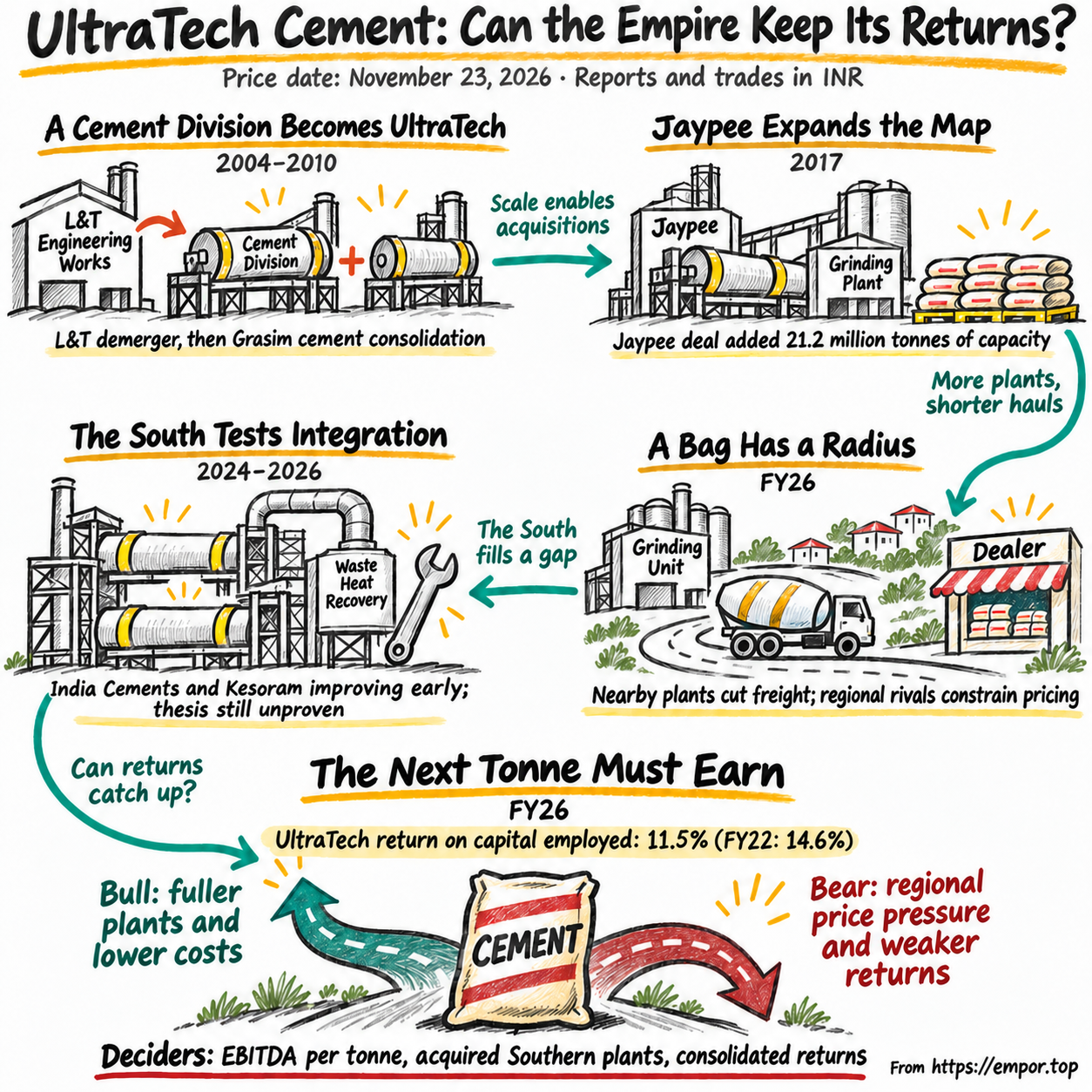
Yet there is a second number that the capacity milestone does not mention. In FY26, UltraTech earned operating profit equal to about 11.5% of the capital employed in the business.4 Four years earlier, in FY22, the same measure was 14.6%.4 Capacity has roughly doubled across the period in which returns drifted down. The empire has grown faster than its yield.
That tension is the spine of this story. The questions that follow from it are the ones a long-term owner of the shares should care about. Can plants bought from troubled sellers earn back what UltraTech paid for them? Does sheer scale protect margins in an industry where cement is, in the end, a regional commodity that a builder can buy from whoever is closest and cheapest? Has the company's buying spree been disciplined, or has the habit of acquisition become its own justification? And what do a rising fee paid to a promoter-group company and two long-running competition cases mean for minority shareholders?
A boundary needs drawing before the story starts. UltraTech is a listed subsidiary of Grasim Industries, which owns 56.11% of it directly, and part of the Aditya Birla Group run by Kumar Mangalam Birla.4 Grasim has its own fibre, chemicals and paints businesses, and the wider group spans metals, financial services and more. None of those belong in this story except where money moves between them and UltraTech. The subject here is the listed cement company and its subsidiaries, including India Cements, which UltraTech now controls.
The revenue line has compounded. The capacity line has compounded. The question is whether the return line will follow, or whether UltraTech has become the kind of company that gets bigger every year without getting better. To understand how it got here, the story has to go back to a time when UltraTech was not a company at all, only a division inside someone else's.
 Subscribe on LinkedIn
II. The Cement Division That Became a Listed Company
The Aditya Birla Group's cement history begins in the early 1980s, when the group set up Vikram Cement for Grasim and Rajashree Cement for another group company, Indian Rayon.5 The first plant had about 1 million tonnes of capacity.4 For most of the next two decades the group's cement interests were a sideline inside companies better known for viscose fibre and textiles, and they grew the way most Indian cement capacity grew then: one kiln at a time, close to limestone, with output sold mostly in the surrounding states. In 1998 the cement businesses of Grasim and Indian Rayon were merged, taking group capacity to about 8.5 million tonnes.5
The leap that created the company in its present form came from a corporate battle rather than a construction site. Larsen & Toubro, India's engineering champion, owned a substantial cement business that had grown into one of the country's larger producers. Grasim had built a stake in L&T itself, and the long contest over that stake ended in a deal in which L&T's cement division was demerged into a separate company and Grasim took control of it.
In July 2004 the Aditya Birla Group took management control of the cement company, then called UltraTech CemCo, giving the group combined installed capacity of about 31 million tonnes.6 The company's own timeline records the L&T cement business as a 17 million tonne acquisition.4 The UltraTech brand was launched the same year, and the company's shares began trading on the stock exchanges as a result of the demerger rather than through any public offering.4
That origin explains a lot. UltraTech never had a founder-entrepreneur in the Silicon Valley sense, and it never raised capital from the public to build its first plants. It inherited operating assets, a dealer network and a listing, and then it was run as a group flagship by managers who had spent their careers inside the Aditya Birla system.
The next step was tidying up. In November 2009 the group announced that Grasim's own cement business, first moved into a subsidiary called Samruddhi Cement, would be merged into UltraTech, with UltraTech issuing four of its shares for every seven Samruddhi shares.7 The merged company would have 48.8 million tonnes of capacity across 22 plants, and the appointed date for the merger was July 1, 2010.7 In the company's own words, all of the group's cement businesses were now under a single entity, which made it the largest cement company in India.4
It is worth being precise about what these two deals did and did not prove. They gave UltraTech national scale early, at a time when most rivals were regional. They also gave it something less visible: the habit of treating capacity as something that could be assembled through transactions rather than only built. But they were consolidations within a family of companies under common control. The prices were set by swap ratios between related entities, and the returns on those assets were never tested against a market alternative. The origin, in other words, was a mix of inherited assets and group restructuring. UltraTech's own record as a capital allocator, the thing a public shareholder should actually judge, starts after 2010.
The people who would make those later decisions were already inside the system. Kumar Mangalam Birla, a chartered accountant with an MBA from London Business School, has chaired the group for three decades and is chairman of UltraTech.8 K.C. Jhanwar, who would become managing director, joined the group's cement business as a management trainee in 1981, also as a chartered accountant, and spent decades rotating through cement manufacturing and other group businesses before becoming UltraTech's chief manufacturing officer in 2016.8 This was a company run by long-tenured insiders who knew how to operate kilns, negotiate with limestone-rich states and manage a dealer network across a subcontinent.
The speed of what followed is easiest to grasp through management's own arithmetic. In April 2026 Daga told analysts that UltraTech had grown from about 65 million tonnes of capacity in 2016 to 200 million tonnes, more than tripling in a decade.2 Some of that came from new kilns and grinding units, but a large share came from buying plants that other companies had built and could no longer afford to run.
By the early 2010s UltraTech had something else its rivals mostly lacked: a balance sheet large enough to buy capacity from people who could no longer afford to keep it. India's cement industry was about to produce a steady supply of such people. The question that would define the next decade was simple. Could UltraTech buy capacity faster and more cheaply than competitors could build it?
III. Jaypee's Plants: A Premium for Capacity, or a Bargain in Disguise?
The first answer came from Gujarat. In 2013 UltraTech agreed to take over Jaypee Cement Corporation's Gujarat operations, an integrated plant at Sewagram and a grinding unit at Wanakbori, for an enterprise value of ₹3,800 crore.9 The unit had 4.8 million tonnes of capacity, and the deal was structured as a demerger in which UltraTech would mostly take on liabilities and issue no more than ₹150 crore of its own shares.9 That worked out to roughly ₹7,900 per tonne of capacity. The important thing was not the price but the precedent. Here was a heavily indebted seller, the Jaypee Group, willing to part with working plants, and a buyer willing to pay for them in a form that barely touched its cash.
The Jaypee Group was one of the great Indian empires of the infrastructure boom. It built dams, expressways, hotels, a Formula One circuit and a large cement business, and it funded much of that with debt. By 2015 its lenders wanted money back, and cement plants were among the few assets with a ready buyer. In February 2016 the two sides signed an initial agreement. By the end of March the deal covered 21.2 million tonnes of capacity after a 1.2 million tonne plant in Karnataka was taken out of the package, and in July 2016 the price was revised again, to about ₹16,200 crore.10
The deal completed in June 2017 at ₹16,189 crore, or about $2.5 billion, for six integrated plants and five grinding units spread across Himachal Pradesh, Uttar Pradesh, Uttarakhand, Madhya Pradesh and Andhra Pradesh.11 The company called it the largest deal concluded in the sector at the time, and it was done through a scheme of arrangement supported by a lender consortium led by ICICI Bank.11 After it, UltraTech had 93 million tonnes of grey cement capacity.11
Was it a good price? The honest answer begins with a benchmark and ends with a caveat. Divide ₹16,189 crore by 21.2 million tonnes and the purchase cost about ₹7,640 per tonne of capacity. A valuation lecture delivered to chartered accountants in Bangalore in April 2016 listed four recent Indian cement deals, including the Jaypee transaction at its earlier price of about ₹7,917 per tonne, Ambuja's deal for ACC at about ₹6,900, and Dalmia Cement's purchases of Bokaro Jaypee Cement at about ₹5,476 and Adhunik Cement at about ₹7,233, for an average of about ₹6,880 per tonne.12
On that small sample, UltraTech paid about 11% more than the average. Against the cost of building a new integrated plant from scratch, which takes years of land acquisition, mining approvals and construction, the price looked more reasonable. But a per-tonne number on its own can mislead. A tonne of capacity in a plant with an old kiln, high fuel consumption and a long haul to its customers is worth much less than a tonne in a modern plant next to a growing city.
So the real test was what happened inside the plants after the deal. Here the public record is thinner than the company's narrative. UltraTech has described a playbook for acquired assets: upgrade kilns, add waste-heat recovery, shift the product mix toward blended cements, rebrand the output and plug the plants into its national logistics system. It does not, however, publish plant-level profit or return figures for the Jaypee assets, so the turnaround cannot be measured plant by plant. What can be measured is the effect on the whole company, and that evidence is sobering.
In FY17, before Jaypee closed, UltraTech's return on capital employed was about 25%.4 By FY19, after Jaypee and the next wave of deals, it had fallen to under 10%, and borrowings had more than doubled.4 Returns recovered to the low-to-mid teens by FY21 and FY22, but they never went back to where they had been before the Jaypee era.4 Part of that decline was the price of growth, and part was the cement cycle, but the pattern is clear enough: the deals added capital faster than they added profit.
The Jaypee transaction also took far longer to finish than its headline suggests. To cover conditions on one plant, the Dalla Super unit in Uttar Pradesh, UltraTech issued ₹1,000 crore of redeemable preference shares into escrow in June 2017.4 Disputes between the parties went to arbitration, and only after a settlement and a final arbitral award in March 2026 did all rights to the unit and its mines vest fully in UltraTech, with the escrowed shares discharged in April 2026.4 Buying from a distressed seller can be cheap. It can also leave nine years of legal loose ends.
The buying did not stop with Jaypee. In 2018 Binani Cement, crushed by debt, went through India's new insolvency process, and a consortium led by Dalmia Bharat initially won the backing of lenders before UltraTech came in with a higher offer. The fight went through the tribunals and, in the end, the Supreme Court upheld the appellate tribunal's approval of UltraTech's bid.13 Binani became a wholly owned subsidiary on November 20, 2018, adding 6.25 million tonnes in Rajasthan, with the group valuing the package, including overseas subsidiaries in China and the UAE, at ₹8,024 crore.14 The core assets were a 4.85 million tonne integrated plant at Nathdwara and a 1.4 million tonne grinding plant at Neem ka Thana, which gave UltraTech access to limestone and a larger position in the north.13 Even allowing for the foreign subsidiaries in the package, UltraTech paid a much higher price per Indian tonne than it had for Jaypee, reflecting the cost of winning a contested auction for a prized limestone location.
The same year UltraTech agreed to take over the cement business of Century Textiles, part of the B.K. Birla Group, for an enterprise value of about ₹8,621 crore.15 It brought three integrated plants in Madhya Pradesh, Chhattisgarh and Maharashtra and a grinding unit in West Bengal, about 13.4 million tonnes in all, paid for with about 14 million new UltraTech shares.16 That deal, like Kesoram later, was struck between branches of the Birla family, and when the competition regulator reviewed Kesoram in 2024 it noted cross-shareholdings between the families of Kumar Mangalam Birla and the late B.K. Birla and recalled an earlier order against UltraTech for failing to provide information about such holdings.17 The regulator approved both deals, but the episode is a reminder that some of UltraTech's purchases were not arm's-length auctions; they were negotiations inside an extended family.
In five years, then, UltraTech bought roughly 45 million tonnes of capacity from Jaypee, Binani and Century. It grew the map faster than any rival could have built it. What that buying spree did not prove was that every one of those tonnes earned its cost of capital. That depended on something less glamorous than dealmaking: whether UltraTech's network could move a heavy, cheap product from all those plants to customers at lower cost than anyone else.
IV. A Bag of Cement Has a Freight Radius
Picture a hardware shop in a small town in Uttar Pradesh. A mason building a house for a family down the road needs forty bags of cement this week. The shop owner orders from a dealer, the dealer orders from UltraTech, and a truck arrives from a plant or grinding unit somewhere within a few hundred kilometres. The family pays per bag. The price on that bag depends on the plant that made it, the road between the plant and the shop, the state's taxes, and how many other brands are fighting for the same mason that month.
That is the revenue unit of this company. UltraTech has no subscriptions and no long-term contracts worth the name. It sells physical deliveries, priced per bag in retail trade and per tonne to builders, infrastructure contractors and ready-mix concrete buyers. Retail trade, mostly individual homebuilders, accounts for roughly two-thirds of volume: on the October 2026 call, Daga said the trade share has held between about 65% and 67%.18 The rest goes to infrastructure, industrial and commercial projects on short purchase orders. To reach those homebuilders, UltraTech works with more than 41,000 dealers and more than 115,000 retailers.4 It also runs its own branded building-solutions stores, about 6,500 of them by October 2026, which already handle more than a quarter of its trade sales; management plans to reach about 10,000 stores by FY29.18
Now the economics. Cement is heavy and cheap for its weight, so the cost of moving it is a large part of what the customer pays. Competition regulators have said as much. When the Competition Commission of India reviewed the Kesoram deal in 2024, it noted that because cement is a bulk commodity with significant transportation costs, consumption clusters around production centres, and those self-contained areas form distinct markets.17 India therefore does not have one cement market. It has a patchwork of regional markets, each with its own set of competitors, and a national company is really a collection of regional positions linked by logistics.
This is where scale can genuinely help. A company with plants and grinding units scattered across the country can place supply close to demand, shorten the average journey and shift product from a region with spare capacity to one that is short. UltraTech says its average lead distance, the distance a tonne travels from plant to customer, has fallen to 367 kilometres, helped by bulk terminals such as a new facility at Lucknow.2 A national procurement machine also buys fuel, bags and freight in volumes that small regional producers cannot match. On the April call Daga noted that UltraTech has about 150 bag suppliers across the country, and that suppliers tend to prioritise their largest customer when bags are scarce, as they were in March 2026.2
Measured nationally, UltraTech's position looks commanding. In FY26 the industry sold about 463 million tonnes of cement and UltraTech sold about 145 million tonnes of it, close to a third.18 Its 200-plus million tonnes of domestic capacity compares with about 113.5 million tonnes for the Adani Group's cement companies, Ambuja and ACC,19 and about 70 million tonnes for Shree Cement.20 But national totals are the wrong lens for a regional business. In the Kesoram review, the regulator found that in the market covering Karnataka, Telangana, Maharashtra and Andhra Pradesh, the combined share of UltraTech and Kesoram would be only about 22% to 26%, that more than 30 companies competed there, and that the four largest held around 45%.17 It called that market unconcentrated.17 National leadership, in other words, does not automatically translate into local dominance.
Run through the classic competitive forces, the picture is mixed. Buyers are fragmented: no single customer accounts for 10% of revenue.4 That protects UltraTech from a powerful buyer squeezing it, but it also means millions of small buyers who can switch brands at the shop counter with little cost. Suppliers are more powerful than they look. Power and fuel cost UltraTech about ₹19,600 crore in FY26, roughly 22% of revenue,4 and coal, petcoke and diesel prices are set by global markets and government policy, not by cement companies. Rivalry is intense and regional. Every new kiln a competitor fires up in a region adds supply that has to be sold, usually through discounts, before prices can rise.
The cost side of the ledger shows why a small edge per tonne matters so much. Fuel is the biggest variable, and in 2026 it became the most volatile. On the October call Daga said fuel cost had risen from about ₹45 to about ₹51.5 per bag, with the price of energy climbing to about ₹2.09 per thousand kilocalories as the West Asia conflict pushed up petcoke, which was trading at around $180 a tonne.18 UltraTech's response was to cut petcoke to about a quarter of its fuel mix, lean on long-term fuel contracts that management said had been unfavourable for two years but were now working in its favour, and push alternative fuels.182
Domestic coal offered little relief, because Coal India was prioritising power stations.18 Meanwhile fixed costs per tonne fell about 6% year on year, because absolute fixed costs rose only about 4% while volumes rose almost 14%.18 That is the scale argument in a single line: when a company sells 145 million tonnes a year, saving ₹10 a tonne is worth well over ₹100 crore, and spreading head-office, marketing and plant overheads over more tonnes compounds the effect.
Mix is the other lever. In the September 2026 quarter about two-thirds of UltraTech's cement was blended, made by replacing part of the clinker with fly ash from power stations or slag from steel mills, and premium products made up about 37% of sales.18 Blending lowers cost and carbon because clinker is the expensive, energy-hungry ingredient. Premium products let a dealer charge a little more for a bag the customer believes is stronger or more water-resistant. Neither is unique to UltraTech, but both reward a company that controls its own fly ash supply chains and has the dealer reach to sell a premium story.
Growth was also uneven across the map, which is a reminder that a national company is a collection of regional businesses. In the September 2026 quarter UltraTech's volumes grew more than 20% in the North, 15% to 20% in the South, about 10% in the West and Central regions, and only about 5% in the East, where heavy monsoon rains disrupted construction; utilisation was above 70% in the North and South and around 60% in Central and Eastern India.18 A plant in a sold-out region earns very different returns from one in a region with spare kilns, even under the same brand.
Those discounts are not small. On a standalone basis in FY26, UltraTech's contracts were worth about ₹96,800 crore at contract prices, and it gave back about ₹15,700 crore in discounts and incentives before reporting revenue.4 For every ₹100 of list value, about ₹16 went back to dealers and customers. That is the industry's version of a price war that never quite ends: the brand on the bag may be national, but the price is negotiated region by region, scheme by scheme.
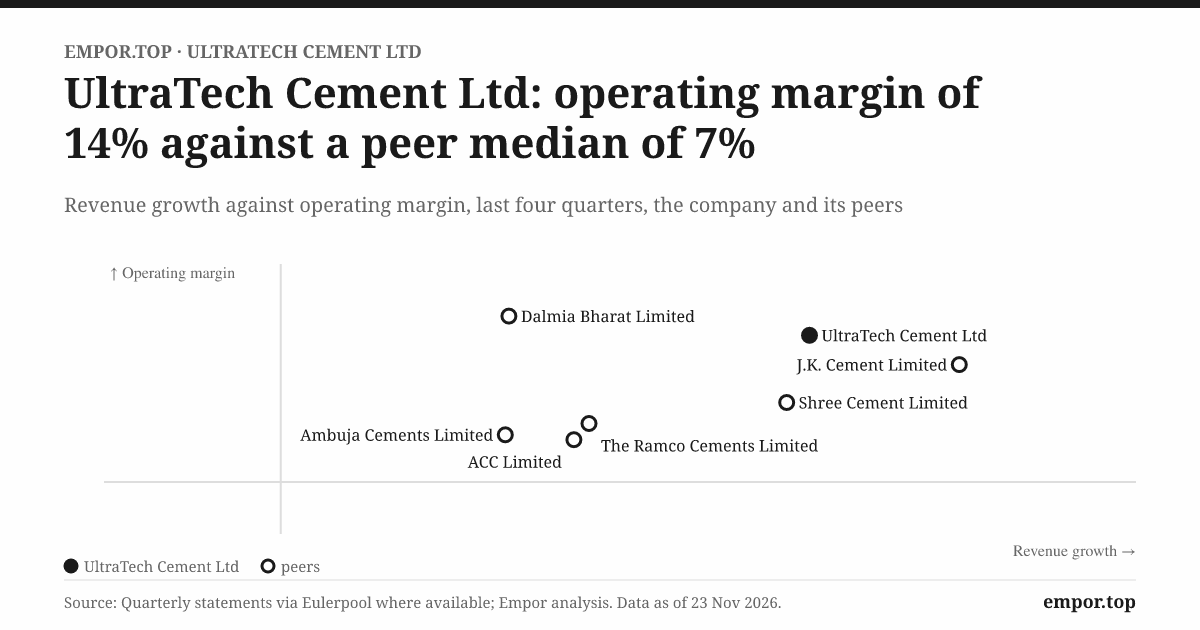
So what does scale actually buy? The evidence supports a specific, narrower claim than "pricing power". UltraTech's advantage is operational reach: more plants closer to more customers, a larger and denser distribution system, and purchasing scale in fuel, bags and freight. Those things lower delivered cost and improve availability, which helps it win volume and gives it a cost cushion in downturns. The company's own claim that it carries a premium brand has some support. On the April call Daga said that rebranding the output of acquired plants as UltraTech helped realisations.2 But the record does not show durable switching costs, and it does not show that UltraTech can hold prices when a region has too much capacity. The ₹15,700 crore of discounts is the counterweight to any claim of pricing power.
The real test, then, is not whether the brand is famous. It is whether realisations and profit per tonne hold up outside the strong construction season, when demand softens and every producer is tempted to cut. The monsoon quarter of 2026 provided one such test. Average trade prices for the July–September quarter were only about 1% to 1.5% below the previous quarter, and Daga said prices rose firmly in late September and October; by mid-October, spot realisations were about 5% above the quarter's average.18 That is encouraging, but it is one season. The scale advantage is real. Whether it converts into returns depends on what the company does with the cash it generates, and that is where the story turns next.
V. The Cash Is Real; the Returns Are the Test
Start with the good news, because there is a lot of it. Over the twelve years from FY15 to FY26, UltraTech reported cumulative net profit of about ₹56,750 crore and generated about ₹99,250 crore of cash from operations, about 1.75 times its profit.4 That gap is not an accounting trick. Cement plants carry heavy depreciation, which reduces reported profit without consuming cash, and UltraTech runs on negative working capital: it collects from customers faster than it pays its own suppliers. In FY26 alone, operating cash flow was about ₹14,240 crore against net profit of about ₹8,190 crore.4 Debtor days, the time customers take to pay, were 25 in FY26, down from a peak of 37 in FY21.4
Earnings that turn into cash give management choices. The question is what management chose. Over those twelve years, after capital spending, UltraTech generated about ₹45,770 crore of free cash flow.4 It paid about ₹9,830 crore of that in dividends, roughly 21%.4 Cash and short-term investments barely moved across the period.4 Nearly everything else went into the ground: new kilns, grinding units, acquisitions and the debt taken on to fund the Jaypee and Binani deals. UltraTech has been a reinvestment machine, not a cash harvester.
The current rate of reinvestment is high. Gross capital expenditure was about ₹9,700 crore in FY26, roughly 11% of revenue,4 and management has said it expects to keep spending about ₹8,000 crore to ₹10,000 crore a year through about 2030.2 CRISIL's August 2026 rating rationale gives the bigger picture: about 37 million tonnes of new organic capacity planned over FY27 to FY29, at a capex of about ₹30,000 crore.21 That is about ₹8,000 per tonne of new capacity, a useful comparison with the roughly ₹7,640 per tonne UltraTech paid for Jaypee a decade earlier.
Now the harder part. The capital base has grown faster than profit. On the measure used here, return on capital employed was 11.5% in FY26, against 14.6% in FY22, and it bottomed at 9.1% in FY25 before recovering.4 Over the latest twelve months to September 2026, it was about 12.5%.4 Those are not disastrous numbers, and the trend over the last year is upward. But for a market leader with a famously efficient operating machine, returns in the low teens are close to what investors usually treat as the cost of capital in India. Each new tonne has to earn more than the old ones if the expansion is to create value rather than merely size.
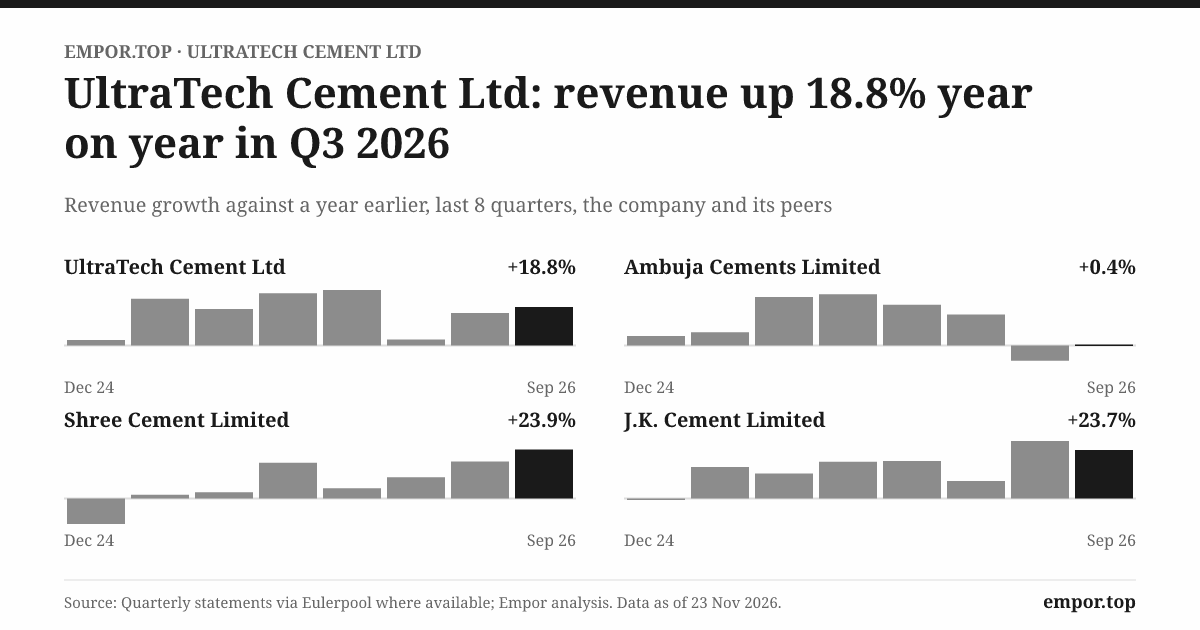
The FY26 recovery itself is worth taking apart, because it shows where profit comes from. Consolidated net sales rose about 17% to about ₹87,400 crore, while operating profit before depreciation, interest and tax rose about 32% to about ₹17,600 crore.22 The margin on that measure widened from under 18% to about 20%. Three things drove it. Volume was the first: UltraTech sold about 145 million tonnes of grey cement in India in FY26, and the acquired Southern plants added tonnes that simply had not been in the base two years earlier.22
Cost was the second: energy cost per tonne fell about 3% and total cost per tonne about 2% in the March quarter.22 Price was the third and smallest; Daga said cement prices had moved only between 0% and 5% across the year.2 In other words, FY26 was a year of volume and efficiency, not of pricing power. That matters for FY27, because fuel costs have since turned against the industry.
Management's chosen yardstick is profit per tonne. Operating EBITDA per tonne, earnings before interest, tax, depreciation and amortisation for each tonne sold, rose from about ₹915 in FY25 to about ₹1,092 in FY26, according to CRISIL.21 In the June 2026 quarter it was ₹1,214.23 On the October call, an analyst asked whether management still stood by its goal of ₹1,400 per tonne by March 2028. Daga replied that it would deliver that commitment, and that cost pressures would be covered by price increases.18 That is a clear target, and a falsifiable one.
The energy programme is where UltraTech is genuinely trying to change its cost curve rather than just grow. A waste-heat recovery system captures the hot exhaust from a kiln and uses it to generate electricity, a little like a car engine that also charges its own battery. UltraTech had 414 megawatts of such capacity and 1.39 gigawatts of renewable power at the end of FY26.4 By September 2026 that had grown to 444 megawatts of waste-heat recovery and 1,580 megawatts of renewables, and green sources met about 48% of power needs.3
Alternative fuels such as industrial and municipal waste supplied about 7.2% of thermal energy.18 On the April call Daga said cost-saving programmes had already delivered about ₹185 per tonne and should exceed ₹300 per tonne by FY28.2 The company does not publish a full accounting of what each energy project cost against what it saves, so investors have to judge the programme through the profit-per-tonne line.
Then there is the bet that is not cement at all. In early 2025 UltraTech announced a move into wires and cables, an investment of about ₹1,800 crore; it launched the business under the brand Ultravolt on September 3, 2026, from a plant at Jhagadia in Gujarat.3 By October about ₹1,100 crore had been spent or committed, and management said more than 1,500 of its building-solutions channel partners had signed up as dealers.18 Daga said the original revenue goal of ₹10,000 crore, set at early-2025 copper prices, might now be worth ₹16,000 crore to ₹18,000 crore because copper had risen.18
When an analyst pointed out that the group's cement return on capital was around 13% while wire makers earned much more, Daga said the company was "not playing this business from ROCE averaging point of view".18 That is candid. It is also the sentence a skeptic would underline. For now the investment is small relative to cement capex and has no earnings record, so the right way to see it is as a strategic adjacency that uses the dealer network, not as a second profit engine.
The balance sheet gives UltraTech room for all of this, but the room is not unlimited. CRISIL reaffirmed its AAA rating with a stable outlook in August 2026, citing net debt of about 1.1 times EBITDA in FY26, while naming input-cost and realisation volatility and debt-funded expansion as the things to watch; its trigger for a downgrade is net debt above about 2 times EBITDA on a sustained basis.21 The pressure point is the dividend.
The board recommended a special dividend of ₹240 per share for FY26,22 which on roughly 29.5 crore shares is about ₹7,000 crore, and CRISIL flagged a planned ₹7,000 crore dividend in FY27 as an addition to outflows.21 That is more than FY26's free cash flow after capex. By September 2026, net debt had risen to 1.26 times EBITDA from 0.94 times in March; Daga attributed most of the rise to capex, with the dividend as one payment, and said leverage would be back below 1 time by March 2027.18
The cash, in short, is real and the dividend is generous. Returns are the unfinished part. The latest chapter of the buying story will decide whether they finish rising, and it took place in a part of India where UltraTech had always been weakest.
VI. India Cements and Kesoram: The South Becomes the Missing Map
For decades, Tamil Nadu was the hole in UltraTech's map. The state is one of India's most industrialised, with booming construction around Chennai and Coimbatore, but limestone is scarce there, and that scarcity has restricted the setting up of new integrated plants. UltraTech had just one integrated unit in Tamil Nadu, at Reddipalayam, with 1.4 million tonnes of capacity and, in the company's own words, limestone of limited remaining life.24 The biggest local player was India Cements, a company founded in 1946 and run for decades by N. Srinivasan, better known to many Indians as the former boss of the Chennai Super Kings cricket franchise and of Indian cricket's governing body.
By 2024 India Cements was struggling: it had high costs, ageing kilns and losses. UltraTech moved in steps. First it bought a 22.77% stake.24 Then, on July 28, 2024, it agreed to buy 32.72% from the promoters and a related company at ₹390 per share, which under India's takeover rules triggered a mandatory open offer for up to another 26% at the same price.24 The promoter block alone, about 10.1 crore shares, cost roughly ₹3,950 crore, and the open offer could cost up to about ₹3,140 crore more if fully accepted.24
At ₹390 a share, India Cements' entire equity was valued at about ₹12,000 crore before counting its debt, around ₹8,400 per tonne of its 14.45 million tonnes of capacity.244 UltraTech gave its reasoning plainly in the offer document. Buying ready-to-use plants would reduce time to market compared with greenfield projects, and would let UltraTech reconsider or defer its own expansion plans in the South.24
The Competition Commission approved the deal in December 2024.25 UltraTech took control later that month and eventually reached 81.49%.4 That left too few shares in public hands, because India requires at least 25% public ownership of listed companies, so UltraTech sold 6.49% through an offer for sale on the exchanges and ended FY26 with 74.99%.4
Kesoram was a different kind of deal. Kesoram Industries, flagship of the B.K. Birla branch of the family, owned two integrated cement plants: a 9 million tonne plant at Sedam in Karnataka and a 1.75 million tonne plant at Basantnagar in Telangana, plus a packing plant at Solapur.17 Kesoram was burdened with about ₹1,700 crore of high-cost debt carrying interest of 18% to 20%.26 In November 2023 the two sides agreed that the cement business would be demerged into UltraTech, with Kesoram shareholders receiving one UltraTech share for every 52 Kesoram shares.26 The deal valued the equity at about ₹5,379 crore,27 and the business at about ₹7,600 crore including the debt and preference shares that moved with it, about ₹7,070 per tonne.26 UltraTech issued about 59.7 lakh new shares,26 and the scheme took effect on March 1, 2025.28
Paying in shares has a cost that the headline price hides. At UltraTech's share price at the time, about ₹9,000, those shares were worth about ₹5,400 crore.27 At the November 2026 price of about ₹12,700, the same shares would be worth about ₹7,600 crore. Kesoram's former owners now share in every rupee of future value UltraTech creates. That is fair in a share swap, but it means the true economic price of Kesoram rises when UltraTech does well.
The early evidence on performance is mixed but improving. In the September 2025 quarter, UltraTech's existing plants earned about ₹966 of EBITDA per tonne, Kesoram's about ₹755, and India Cements' only about ₹386.28 UltraTech then began rebranding the acquired plants' output under its own name: by March 2026 it had completed the brand migration for both businesses.2 India Cements' EBITDA per tonne rose to ₹497 in the March 2026 quarter from ₹305 in December, and it reported a quarterly profit for the first time in a long while.2 Kesoram's plants were already earning about ₹1,000 per tonne.2 In the June 2026 quarter, India Cements reported normalised profit after tax of ₹52 crore, compared with a loss of ₹183 crore two years earlier, on volume growth of 18.5%.23
Some care is needed in reading those numbers. Daga explained on the April call that India Cements now makes and sells cement under the UltraTech brand through a tolling arrangement, and that some marketing and distribution costs sit at the UltraTech level, offset by a mark-up UltraTech charges per bag.2 So India Cements' stand-alone figures do not capture the whole picture. Some of the improvement also came from a better market. In October 2026 Daga said Southern capacity of about 50 million tonnes was sold out, volumes there grew 15% to 20%, and prices were the strongest in the country.18 It is hard to separate integration gains from a rising regional tide, and UltraTech does not publish a breakdown.
The two businesses also arrived with different quality. Of Kesoram's 10.75 million tonnes, 8.5 million were backed by its own clinker and 2.25 million were surplus grinding capacity,27 which meant the plants depended partly on clinker from elsewhere to run their mills fully. Kesoram's cement operations had turned over about ₹3,530 crore in FY23,26 so UltraTech paid roughly twice a year's sales for the business, including debt. India Cements came with non-cement baggage, including coal assets in Indonesia, which it sold after the takeover with the proceeds earmarked to cut debt.29 It also came with local policy risk. In 2026 Tamil Nadu imposed a levy of about ₹160 per tonne that hit India Cements' costs; on the October call Daga said it had been absorbed and there would be no reversal.18 Buying in the South means buying the South's politics as well as its plants.
The heavy lifting has only started. UltraTech committed ₹1,592 crore to efficiency at India Cements, including waste-heat recovery, renewable power and debottlenecking, plus ₹422 crore to add 2.4 million tonnes at plants serving Chennai and Rajasthan, which management said should earn an internal rate of return above 20%.29 In October 2026 Daga said India Cements was at about ₹500 per tonne and that major kiln shutdowns for upgrades were coming, with the January–March 2028 quarter promised as "a fabulous quarter" for the business.18 Management's target is more than ₹1,000 per tonne by the end of FY28.2
How should an investor weigh this against the older acquisitions? Jaypee, Binani and Century show that UltraTech can absorb large amounts of capacity, but they also show that group returns took years to recover and never returned to their pre-Jaypee levels. India Cements is an older, more complicated asset in a difficult limestone geography, and the South has a long history of fierce regional competition. The early improvement is encouraging. The thesis remains unproven until two things happen together: Southern profit per tonne reaches the group average, and the consolidated return on capital climbs meaningfully above its current low teens. If group returns rose above about 15% by FY28, the recovery case would be strongly supported. If assets kept growing while returns stayed near today's level, the South would look like another expensive way to buy market share.
Those judgments, ultimately, are made by people. And the man who led UltraTech through this buying wave is about to hand over the keys.
VII. K.C. Jhanwar's Mandate: Keep Buying, or Let Returns Catch Up?
K.C. Jhanwar also ran the group's viscose filament yarn and chlor-alkali businesses along the way, and has been managing director since January 1, 2020.8 His era is the era of this story's biggest numbers: the climb from about 100 million tonnes to more than 200 million, the purchase of India Cements and Kesoram, and the entry into wires and cables. On the investor calls he tends to speak less than his CFO. Atul Daga, chief financial officer since 2014, does most of the talking: combative, quick with a line ("predicting a roll of a dice is easier" than forecasting the West Asia conflict), and openly frustrated when analysts focus on costs.18
The mandate is about to change hands. UltraTech's board approved Jayant Dua's appointment as managing director (designate) from April 1, 2026, and as managing director from January 1, 2027 for four years, to December 31, 2030; Jhanwar superannuates at the end of December 2026.4 Dua is another group veteran. An engineer from IIT Delhi with an MBA, he joined the group's cement business in 1996, was a senior executive at UltraTech in 2014 and 2015, ran other group companies including Century Textiles, and led the group's renewables and textiles divisions from 2023.30 He inherits a company that has crossed 200 million tonnes and is committed to 240 million, and a promise, made in public, to raise profit per tonne to ₹1,400 by March 2028.18 Whatever the outgoing team pledged, the incoming one will be judged on.
Pay tells part of the incentive story. Jhanwar received ₹28.69 crore in FY26, including a performance-linked incentive of ₹4.94 crore, and he also held stock options and performance share units.4 His pay was about 285 times the median employee's and rose only about 3% in the year.4 Vivek Agrawal, the whole-time director and chief marketing officer, received about ₹14 crore.4 One smaller line in the remuneration note captures the culture of continuity: K.K. Maheshwari, the non-executive vice chairman and a former managing director, receives a pension of ₹3.40 crore a year for his past services.4
Six of the eleven board members are independent, and the board changed its company secretary in December 2025, when Dhiraj Kapoor replaced Sanjeeb Kumar Chatterjee.4 What matters more than the size is what the pay rewards. The variable portion is linked to operating performance, which in practice means volume, profit and execution. Return on capital is not singled out as a governing metric in the way capacity and EBITDA per tonne are in management's public targets. An incentive system that rewards growth and operating profit will tend to produce growth and operating profit; it does not automatically produce higher returns on every rupee invested.
The ownership structure cuts both ways. At the end of FY26 the promoter group held 59.33% of UltraTech, including Grasim's 56.11%, and none of it was pledged.4 That is meaningful skin in the game: the family's main listed holding company owns more than half of the business and shares directly in any value created or destroyed. Promoter holding has actually risen, from about 56.2% a year earlier,4 even after UltraTech issued new shares to Kesoram's shareholders. Domestic institutions held about 18.4% and foreign portfolio investors about 13.6%.4
The flip side of a controlling shareholder is the flow of money to related parties. Here the large items are not where people usually look. Sales of goods to Grasim were only about ₹50 crore in FY26, a rounding error against revenue.4 The item that deserves scrutiny is the fee for management and brand services paid to Aditya Birla Management Corporation, an unlisted group company. It rose 36% in one year, to about ₹744 crore from about ₹547 crore.4 That is under 1% of UltraTech's standalone revenue, but it is a recurring, fast-growing transfer to an entity outside the listed company, and UltraTech does not publish the formula that sets it.
Receivables factored through Aditya Birla Capital, a group finance company, rose almost six-fold to about ₹930 crore.4 Factoring is a financing service, not revenue leakage, but the company does not disclose the rates, so outsiders cannot judge whether the terms beat the market. A newer example surfaced on the October call: UltraTech has guaranteed borrowings of UHG Holdings, a group company it owns 41% of alongside Grasim's 9% and Hindalco's 50%, which will buy aircraft and ships for shared group use.18 Each arrangement may be sensible. Together they describe a listed company woven tightly into a group.
Minority shareholders have not objected. In June 2025 a resolution approving material transactions with India Cements passed with about 99.99% support, and a similar resolution in May 2026 drew about 5,000 votes against out of roughly 87 million valid votes cast by shareholders other than related parties.31 Those votes show that institutions accept the structure. They do not prove that every transaction is priced at the most favourable terms available, because investors vote on frameworks, not on detailed transfer prices.
The fairest way to judge management credibility is to compare promises with outcomes. On capacity and integration, the record is strong. The company said it would reach 200 million tonnes, and did so a year ahead of plan. It said it would complete rebranding at India Cements and Kesoram by June 2026, and finished in March.292 It promised cost savings and said it had delivered about ₹185 per tonne of them.2 On returns, the record is weaker. The Jaypee era diluted returns for years, and the latest buying wave has left return on capital in the low teens. When Daga was asked on the October call how fuel costs might move in the second half, he said simply, "I don't have an answer to that," before he and Jhanwar talked through inventory effects.18 That honesty about the unknowable is refreshing. The silence about a return-on-capital target is more telling.
A skeptical activist would therefore ask Dua's team for three things: a published return-on-capital target alongside the capacity target, plant-level or regional disclosure for acquired assets, and a clear formula for the group management fee. None of these would change the strategy. All of them would make it easier to test. Before reaching that verdict, though, one more set of risks has been hanging over the company for a decade, and it sits in the courts.
VIII. One Old Penalty, One Live Investigation
On September 8, 2026, two judges of the Delhi High Court, Chief Justice Devendra Kumar Upadhyaya and Justice Tejas Karia, dismissed an appeal by UltraTech against the Competition Commission of India.32 Headlines that day could easily be read as "UltraTech loses cement cartel case". That is not what happened. The appeal concerned whether the Builders' Association of India, a trade body representing construction firms, could join an ongoing CCI investigation into alleged cartelisation among cement makers. The court held that the regulator was entitled to let a party with sufficient interest participate.3233 It did not decide whether any cement company had colluded.
The investigation behind that ruling began in 2019, when the CCI opened a probe on its own motion into alleged price manipulation in grey cement, following complaints including one from the builders' association.32 Investigators carried out searches at five manufacturers, including UltraTech, and the director general's report came in July 2022.32 In July 2023 the commission allowed the association to join the proceedings; UltraTech challenged that, lost before a single judge in December 2023, and lost again on appeal in September 2026.32 On November 16, 2026, UltraTech filed a petition in the Supreme Court against the High Court ruling, which has yet to be listed for hearing.34 The merits of the allegations remain undecided.
The older case is different, because there a penalty already exists. In August 2016 and January 2017, the CCI imposed penalties on UltraTech of about ₹1,617 crore and ₹68 crore for alleged cartelisation, about ₹1,685 crore in total.4 After the appellate tribunal upheld the orders, the Supreme Court stayed them in October 2018 on condition that UltraTech deposit 10% of the larger penalty, about ₹162 crore.4 UltraTech, backed by legal opinions, has made no provision for the rest, and its joint auditors, Deloitte Haskins & Sells and KKC & Associates, have drawn attention to the matter in an emphasis-of-matter paragraph in their report.4 An emphasis of matter is not a qualification: the auditors are not saying the accounts are wrong, only that readers should notice this uncertainty.
The money is manageable. Even if UltraTech lost the old appeal outright and paid the remaining ₹1,520 crore or so, the cost would be about a tenth of a single year's operating cash flow. The more consequential risk is behavioural. A finding of collusion in the live investigation would bring penalties, but it would also constrain how freely the industry's largest player could raise prices in the future, and it would hand regulators and large buyers more leverage in a market where pricing already moves with a lag.
Beyond the competition cases sit ordinary tax disputes. Standalone claims against UltraTech not acknowledged as debt totalled about ₹5,384 crore at March 2026, up from about ₹4,844 crore a year earlier.4 The largest item was about ₹2,307 crore of GST, sales tax and related disputes, followed by about ₹911 crore of excise and service tax claims, with smaller amounts for limestone royalties, land, electricity duty, customs and stamp duty.4 These are typical of a large Indian manufacturer that ships goods across many states, and they are distinct from the cartel penalty. They deserve watching for growth, not alarm.
Two other balance-sheet items help a skeptic calibrate. Receivables look clean: on a standalone basis, about 95% were either not yet due or less than six months overdue, and impaired balances were covered by credit-loss provisions.4 Currency exposure is hedged. UltraTech carried about $900 million of foreign borrowings at March 2026, a $400 million sustainability-linked bond due 2031 and a $500 million loan due 2027, with principal and coupon hedged through swaps and options.4 The rupee's slide to about ₹94.85 per dollar at the end of March still forced a non-cash mark-to-market hit to EBITDA, which Daga flagged on the April call.2 It was an accounting nuisance, not a hidden loss.
Three events would change this legal read: a Supreme Court decision on the merits of the old penalty, a final CCI order in the 2019 investigation, or a change in UltraTech's provisioning. Until then, the competition cases are a governance footnote with a tail risk on pricing behaviour rather than a threat to the balance sheet. The real question about UltraTech remains economic, and it can be stated in a single sentence: at today's price, is the next tonne likely to create value?
IX. Analysis & Bear vs. Bull Case
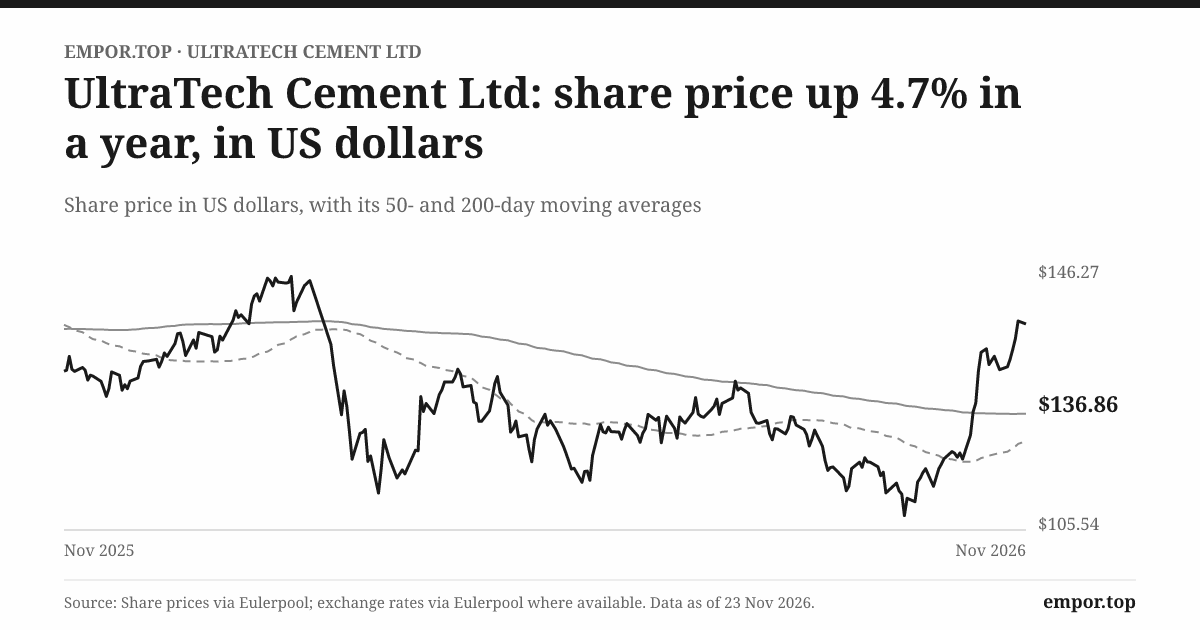
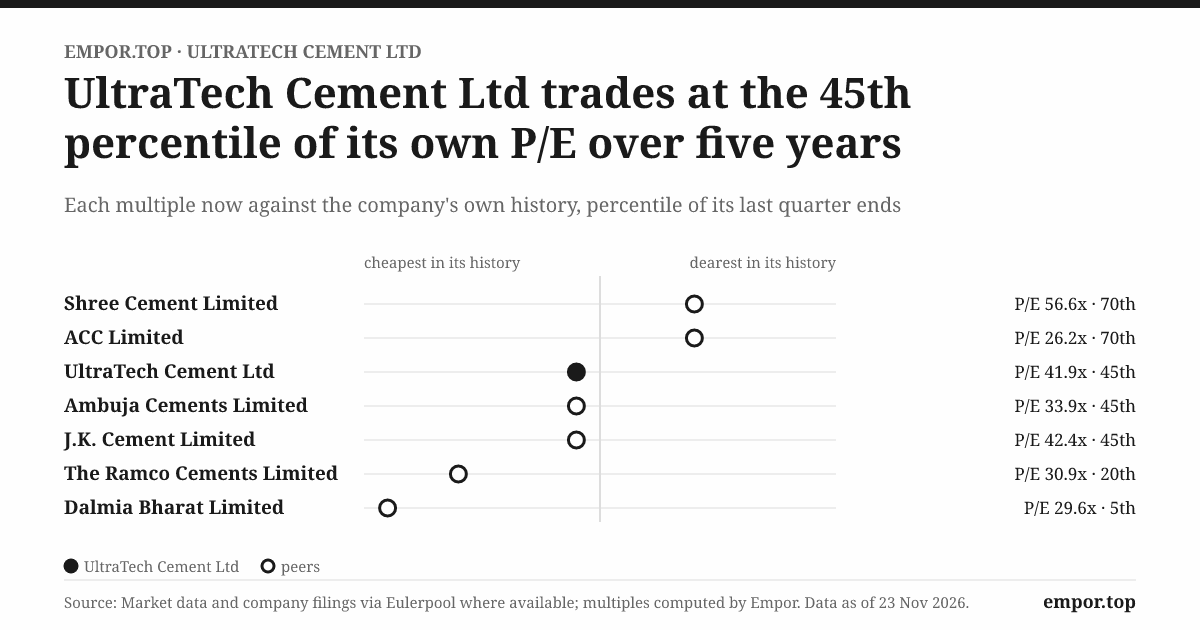
On November 23, 2026, UltraTech's shares closed at ₹12,714, within 3% of their 52-week high, giving the company a market value of about ₹3.58 lakh crore, roughly $38.6 billion. That price is about 42 times trailing twelve-month earnings, a little below its own five-year median of about 43.5 times. Enterprise value, which adds net debt, was about 20 times trailing EBITDA. The dividend yield, swollen by the special payout, was about 1.9%.
Free cash flow yield is harder to pin down because published figures differ with the definition, but on the company's FY26 cash flow, operating cash of about ₹14,240 crore less about ₹9,460 crore of spending on plant and equipment, it was about 1.3%.4 In plain language, the market is paying a premium multiple for a business whose current returns on capital are only modest. The price assumes that profit per tonne and returns will rise as the new capacity fills.
The bull case rests on four mechanisms, each with evidence behind it. First, the national network gives UltraTech a cost cushion. Second, its strong cash conversion supports the AAA rating. Third, integration is beginning to lift profit per tonne at the acquired Southern plants. Fourth, demand looks strong. In October Daga said industry demand was growing close to 10% in a normally weak quarter, that UltraTech was growing faster, and that demand should stay strong at least to March 2029.18 If those four hold together, the new capacity fills, operating leverage kicks in, and returns rise.
The bear case is just as mechanical. Cement remains cyclical and regional. New capacity, UltraTech's and everyone else's, has to be absorbed before prices rise, and Daga himself described prices as rising "always with a lag".18 Return on capital fell from FY22 to FY25 while capacity soared, and has only partly recovered. Acquisitions can add assets faster than they add operating profit, as the Jaypee era showed. The dividend now exceeds free cash flow, pushing leverage up while a ₹30,000 crore capex programme is under way.21 And the wires-and-cables venture, by management's own description, is not being judged on return on capital.
The "duopoly" story deserves a stress test, because it is the most popular bull argument in Indian cement. The claim is that UltraTech and Adani now dominate the industry and will therefore behave rationally on price. Nationally, the two groups together control well over 300 million tonnes of capacity.119 But the regulator's own analysis of the South found an unconcentrated market of more than 30 competitors.17 Shree Cement, at about 70 million tonnes and still expanding,20 Dalmia Bharat and dozens of regional producers still set prices in their own territories. Adani's cement arm says it supplies nearly 30% of the cement used in India's housing and infrastructure,19 which suggests a competitor willing to fight for volume, not a partner in restraint. National concentration has risen. Local discipline is not guaranteed.
Hamilton Helmer's framework of seven sources of durable power helps sort what UltraTech actually has. Scale economies are its clearest power: fixed costs, procurement and logistics spread over more tonnes than anyone else's. Cornered resource is partial: limestone reserves and mining leases in good locations are scarce and valuable, which is exactly why Binani's Rajasthan plant drew a contested auction. Process power is plausible in the integration playbook and the energy programme, though it is hard to prove from outside. Brand is real but bounded by the ₹15,700 crore of discounts. Network effects, switching costs and counter-positioning are essentially absent. That is a respectable moat for a commodity producer, but it is a cost moat, not a pricing moat, and cost moats need constant reinvestment to stay wide.
Three numbers will tell investors whether the bull or the bear is right. The first is operating EBITDA per tonne, which is rising toward management's target of ₹1,400 by March 2028.212318 The second is profit per tonne and utilisation at the acquired Southern plants, especially progress toward the India Cements target.18 The third is consolidated return on capital employed, which remains in the low teens.4 Capacity utilisation, 71% in the September 2026 quarter against 66% a year earlier,3 and net realisations per bag are the supporting context.
The risk radar for the next year is specific rather than generic. The first risk is fuel. Petcoke, imported coal and industrial diesel all rose in 2026, and management said on the October call that costs would stay elevated for some time; it expected only a marginal further impact in the March quarter because cheaper inventory was still in the pipeline.18 The second is demand. The 2026 monsoon was the weakest since 2015, and Daga acknowledged that rural housing could soften in some areas with a lag, while arguing that non-farm income now makes up about 40% of the rural economy.18
The third is the cost of money. In the September quarter UltraTech raised about ₹5,000 crore of bonds at 7.25%, which Daga called a fortunate decision because, he said, nobody would get money at that rate now.18 Higher interest rates would raise the bar every new tonne has to clear. The fourth is execution: about ₹10,000 crore of capex in FY27, of which nearly ₹5,900 crore was spent in the first half, while a new managing director takes over.18 None of these is a reason to expect failure. Each is a reason to watch profit per tonne more closely than capacity.
Management's tone on the calls is worth reading closely, because it shifted across 2025 and 2026. In October 2025, after a quarter of heavy kiln maintenance and higher staff and advertising costs, Daga itemised about ₹200 per tonne of one-off and seasonal pressure, a concrete explanation of a soft quarter.29 In April 2026, with record volumes, he was expansive about dividends, cost savings and a decade of delivering on promises.2
By October 2026, with fuel costs up sharply because of the West Asia conflict, he was candid about not knowing where costs would go but emphatic that prices were now "leading the way" because UltraTech was "sold out".18 The consistency is in the volume message and the capacity targets. The variable is cost, which management repeatedly says it cannot forecast. That is honest, and it is also the reason the ₹1,400 target should be treated as a goal rather than a certainty.
Put the multiple and the record side by side and the judgment becomes conditional. The market already prices UltraTech as a premium franchise. A sustained rise in profit per tonne after the new assets are integrated would justify that premium. Another capacity target, another acquisition or another year of returns stuck in the low teens would not. The proof the company now owes its shareholders is not size. It is yield.
X. Playbook: Business & Investing Lessons
A bag of UltraTech cement leaving a plant in central India might come from a kiln UltraTech built or one it acquired. By the time the bag reaches a dealer, it carries the UltraTech brand, though prices and discounts vary by region. The history inside the bag is invisible to the mason. It is everything to the shareholder.
The first lesson comes from Jaypee's plants. A distressed asset is not cheap at the signing. It becomes cheap, if it ever does, only after the buyer has fixed its kilns, its fuel and its roads. In cement, a bargain is a project, not a price.
The second lesson comes from the freight radius. UltraTech's most durable advantage is getting a heavy, low-value product to customers reliably and at low cost. In a commodity business, geography is strategy.
The third lesson comes from the cash record. UltraTech's cash conversion gives management freedom. It does not show whether the freedom was used well. Capital discipline is measured by what each rupee earns after it is spent, not by how easily the rupee arrived.
The fourth lesson belongs to the Southern deals. Their early recovery is real, but the test is whether the acquired plants reach group-level profit per tonne. Buy the map only if the new territory improves the economics.
And the line that captures the whole story: in cement, the empire is built one freight radius at a time, and judged one return on capital at a time.
XI. Epilogue
Tonight, UltraTech is a company in mid-construction, literally and financially. Its domestic capacity is about 204.7 million tonnes, its target is more than 240 million tonnes by March 2028, and CRISIL counts about 37 million tonnes of new organic capacity planned over three years.321 Management says the acquired plants in the South are about to go through kiln shutdowns for upgrades. A new managing director takes charge on January 1, 2027.4 And management has already hinted at a further organic plan that would take the company "beyond your imagination", well past 240 million tonnes, to be announced before the end of this financial year.18
The next moments that will decide the story are easy to name. The December and March quarters, the strongest construction season of the year, will show whether the price increases of October hold once the festive weeks are over, and whether fuel costs settle. The FY27 results in spring 2027 will show whether return on capital has kept climbing from its FY25 low or stalled in the low teens. India Cements' numbers through FY28 will show whether a business earning about ₹500 per tonne can really reach four digits after its upgrades. Each new capacity announcement will show whether management is adding tonnes where demand is tight, as in the North and South, or chasing share where prices are already soft.
If those readings move the right way, UltraTech will have shown that a commodity company can grow through acquisition and still raise its returns, a rare feat in any market. If they do not, the company will still be the largest cement maker outside China, but its shareholders will have funded size without yield. The legal tail, a Supreme Court decision on the old penalty or a CCI order in the 2019 probe, could arrive at any point, and procedural steps along the way should not be mistaken for verdicts.
The next chapter is already being poured. Whether it sets into value depends on utilisation, regional pricing and returns, and on a new leader who inherits both the network and the promises.
XII. Outro
Somewhere in Uttar Pradesh, Jharkhand or on the Andhra coast, a truck pulls out of one of the grinding units that pushed UltraTech past 200 million tonnes. It carries a few hundred bags of grey powder to a dealer, who will sell them to a mason, who will pour them into the walls of a family's house. That single journey, repeated millions of times a year across a subcontinent, is the whole of UltraTech's business.
UltraTech has learned to build India's largest cement network. Now it has to prove that bigger still means better.
References
-
UltraTech Surpasses 200 Million Tonnes Per Annum Capacity in India — UltraTech Cement, 2026-04-17 ↩↩↩↩↩↩
-
Transcript of Q4 FY26 Earnings Conference Call — UltraTech Cement, 2026-04-27 ↩↩↩↩↩↩↩↩↩↩↩↩↩↩↩↩↩↩
-
Financial Results: Q2FY27 — UltraTech Cement, 2026-10-19 ↩↩↩↩↩
-
Integrated and Sustainability Report 2025–26 — UltraTech Cement, 2026-04-27 ↩↩↩↩↩↩↩↩↩↩↩↩↩↩↩↩↩↩↩↩↩↩↩↩↩↩↩↩↩↩↩↩↩↩↩↩↩↩↩↩↩↩↩↩↩↩↩↩↩↩↩↩↩
-
AV Birla Takes Over L&T Cement Firm — Business Standard, 2004-07-07 ↩
-
Samruddhi Cement Limited to Merge with UltraTech — UltraTech Cement, 2009-11-15 ↩↩
-
UltraTech Cement Limited to Acquire the Gujarat Cement Unit of 4.8 MTPA of Jaypee Cement Corporation Limited — Aditya Birla Group, 2013 ↩↩
-
UltraTech, Jaypee Revise Cement Deal to Rs 16,200 Crore — Business Standard, 2016-07-04 ↩
-
UltraTech Cement Completes Acquisition of Cement Plants of Jaiprakash Associates Limited — UltraTech Cement, 2017-06-29 ↩↩↩
-
Corporate Valuation – Overview — Bangalore Branch of ICAI, 2016-04-06 ↩
-
Binani Cement Renamed UltraTech Nathdwara Cement — Global Cement, 2018-12 ↩↩
-
Binani Cement Limited Now a Wholly Owned Subsidiary of UltraTech — Aditya Birla Group, 2018-11-20 ↩
-
UltraTech to Buy Century's Cement Business in ₹8,621 Crore Deal — Times of India, 2018-05-21 ↩
-
UltraTech to Pass 100 Million TPY Capacity Mark — World Cement, 2018-05-21 ↩
-
Order Under Section 31(1), Combination Registration No. C-2024/01/1106 (UltraTech/Kesoram) — Competition Commission of India, 2024-03-19 ↩↩↩↩↩↩
-
Transcript of Q2 FY27 Earnings Conference Call — UltraTech Cement (NSE filing), 2026-10-27 ↩↩↩↩↩↩↩↩↩↩↩↩↩↩↩↩↩↩↩↩↩↩↩↩↩↩↩↩↩↩↩↩↩
-
Commissioning of Integrated Cement Plant at Kodla, Karnataka — Shree Cement (NSE filing), 2026-03-14 ↩↩
-
Credit Rating Rationale: UltraTech Cement Limited — CRISIL Ratings, 2026-08-17 ↩↩↩↩↩↩↩
-
Financial Results: Q4FY26 — UltraTech Cement, 2026-04-27 ↩↩↩↩
-
Financial Results: Q1FY27 — UltraTech Cement, 2026-07-20 ↩↩↩
-
Detailed Public Statement: Open Offer for The India Cements Limited — SEBI, 2024-08 ↩↩↩↩↩↩
-
CCI Approves UltraTech Cement Limited's Acquisition of The India Cements Limited — Competition Commission of India, 2024-12-20 ↩
-
UltraTech to Take Over Kesoram's Cement Business in an All-Share Deal, Enterprise Value Pegged at Rs 7,600 Crore — Deccan Herald, 2023-11-30 ↩↩↩↩↩
-
UltraTech Cement to Buy Kesoram's Cement Business in Rs 5,379-cr Deal, Announces Swap Ratio of 1:52 — Business Today, 2023-11-30 ↩↩↩
-
Transcript of Q2 FY26 Earnings Conference Call — UltraTech Cement, 2025-10-18 ↩↩↩↩
-
Jayant Dua Appointed as Managing Director of UltraTech Cement — Global Cement, 2026 ↩
-
Postal Ballot Results and Scrutinizer Report: Related-Party Transactions — UltraTech Cement, 2026-06-02 ↩
-
Delhi High Court Upholds BAI Impleadment in CCI's Grey Cement Cartel Probe, Dismisses UltraTech Appeal — LiveLaw, 2026-09-08 ↩↩↩↩↩
-
Delhi High Court Judgment on CCI Proceedings and BAI Participation — Indian Kanoon, 2026-09-08 ↩
-
UltraTech Cement Moves Supreme Court Against BAI's Impleadment in CCI's Cement Cartel Probe — LiveLaw, 2026-11-17 ↩
 LinkedIn
 WhatsApp
 Reddit
 Hacker News
 Email
 Kindle
 RSS Feed
 Spotify
 Apple Podcasts
 Amazon Music
 Audible
 YouTube