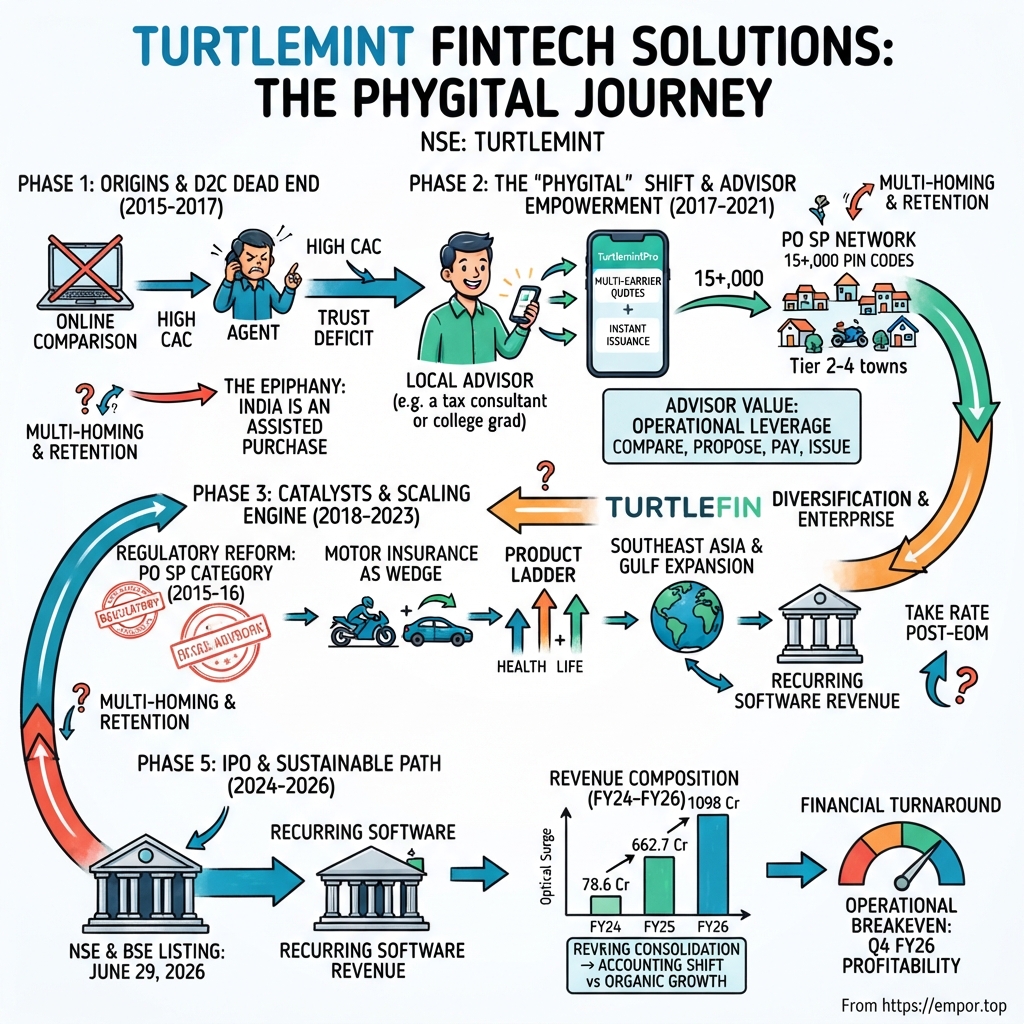
Turtlemint Fintech Solutions: Digitizing India's Million-Agent Army
I. Introduction & Episode Roadmap
On the morning of June 29, 2026, a company that had spent eleven years insisting it was a technology platform rather than a conventional insurance distributor became something unmistakable: a publicly traded enterprise. Turtlemint Fintech Solutions listed on the National Stock Exchange of India under the symbol TURTLEMINT, and simultaneously on the BSE under scrip code 544799, following an initial public offering that raised ₹882.67 crore — roughly $105 million — at an issue price of ₹152 per share.1211
By the standards of Indian technology listings, it was a modest raise. Policybazaar's parent company, PB Fintech, had raised more than six times that sum five years earlier. Yet the significance of the listing lay in the operating model underneath it: a business built by deliberately taking the opposite side of what nearly every insurtech investor believed in 2015.
The counter-intuitive thesis
The prevailing thesis of that era, imported wholesale from Silicon Valley, was straightforward: insurance is an information product, information products are commoditized by the internet, and the traditional intermediary—the neighborhood agent carrying paper brochures—was an endangered species. In that narrative, the spoils belonged to direct-to-consumer digital platforms allowing customers to purchase coverage in four taps without ever speaking to a human.
Turtlemint's founders arrived at a different conclusion, and arrived there the expensive way: by first building a consumer-facing platform, watching customer acquisition economics deteriorate, and confronting the reality beneath the metrics. In India, insurance remains an assisted purchase. Few households in Tier-2 and Tier-3 cities actively seek out a ₹25,000 family floater health policy on their own. A trusted local voice usually has to sit across a table and make the case—and, crucially, serve as the advocate on the ground when a hospital claim encounters administrative friction.
Rather than attempting to disintermediate the agent, Turtlemint chose to equip them. The company built a mobile workflow platform for local advisors: software designed to turn a regional tax consultant, an auto dealer, or a local graduate with a smartphone into a licensed, multi-carrier distributor within days. The industry coined the term "phygital" for this model—an awkward corporate hybrid word, but one that captures a genuine distribution architecture combining human trust with digital policy issuance.
The scale today
By the time of its listing, Turtlemint facilitated over ₹3,000 crore — more than $360 million — in annualized Gross Written Premium across motor, health, and life insurance, distributed through a network of certified Point of Sales Persons covering more than 15,000 pin codes.116 The business operates through two primary engines: TurtlemintPro, the advisor-facing distribution platform that generates roughly 88% of net revenue, and Turtlefin, an enterprise API and bancassurance software layer contributing the remaining ~12% while expanding into Southeast Asia and the Gulf.711
What this story is actually about
Four analytical threads run through the analysis that follows, defining the core investment questions surrounding the company.
The first is the economic breakdown of pure direct-to-consumer insurtech in India, alongside the 2015–2016 regulatory reforms that introduced the Point of Sales Person (PoSP) category and established Turtlemint's addressable market.
The second is the unit economics of hyper-fragmented human distribution: take rates, renewal persistency, and the reality that independent advisors rarely remain captive. Many operate as multi-homed free agents, toggling between competing distributor apps on a single device to capture the highest payout.
The third is corporate plumbing and accounting presentation. In May 2024, Turtlemint's parent entity consolidated its licensed broking subsidiary following the Insurance Regulatory and Development Authority of India's (IRDAI) overhaul of Expense of Management rules. That single corporate restructuring produced an eightfold surge in reported revenue stemming from gross premium accounting rather than an equivalent expansion in underlying policy sales—a distinction critical to evaluating the company's real top-line trajectory.
The fourth is the forward-looking strategic dilemma: whether a hybrid brokerage can transition from venture-subsidized scale to durable accounting profitability while navigating commission competition against PB Partners and InsuranceDekho on one flank, and facing potential disintermediation from Bima Sugam—the regulator-backed digital public insurance infrastructure—on the other.
That final question offers no definitive answer yet, but it yields a clear set of observable operational indicators. The sections that follow examine each in detail.
 Subscribe on LinkedIn
II. India's Underinsured Frontier & The Pre-Digital Agent Era (2000–2015)
Consider a district town in Uttar Pradesh in 2008. A man walks into a two-room office above a sweet shop carrying an insurance policy his father purchased in 1994 from a Life Insurance Corporation (LIC) agent who has long since retired. He wants to know whether the policy covers his mother's emergency hospitalization. It does not. It is an endowment plan—a savings vehicle packaged as life cover, sold because it delivered a tax deduction and generated a sizable agent commission, in that order. There is no longer anyone around to explain the distinction to him.
That scenario, repeated across millions of households, illustrated the structural reality Turtlemint was eventually built to address.
The protection gap
India's primary financial challenge was never a lack of domestic savings. Indian households save prodigiously. The fundamental problem was that almost none of that capital flowed into genuine risk protection. Total insurance penetration hovered below 4% of GDP, and the non-life segment—motor, health, and property cover that protects families against sudden financial ruin—stalled below 1%, compared to a global average north of 6.8%.12 That shortfall was not a marginal rounding error; it defined the entire market.
The root cause lay in distribution, and the history of distribution belonged to LIC. For four decades, the state-owned insurer operated an effective monopoly powered by millions of tied agents. Those agents sold what paid them best: endowment and money-back policies marketed as guaranteed tax-saving vehicles. Pure term cover—the product offering the highest protection per rupee of premium and the lowest upfront commission—remained culturally alien. "I receive nothing back if I survive" remained the default consumer objection Indian agents encountered in the field.
The general insurance dilemma
General insurance suffered from a different structural pathology. Third-party motor cover was legally mandated under the Motor Vehicles Act, generating immense non-discretionary transaction volume across hundreds of millions of two-wheelers and commercial vehicles. Yet statutory mandates brought tight political price caps. Tariff corridors remained rigid, claims frequency ran high, and underwriting margins on third-party motor hovered near zero or ran negative for much of the modern era—creating enormous transaction volume without underwriting margin.
Retail health insurance presented the mirror image: healthy gross margins, but negligible adoption outside tier-1 metros, where it was long viewed as an urban luxury. Product pricing was opaque, hospital billing disputes were routine, and dense policy exclusions fostered widespread consumer skepticism. For the typical retail buyer, the central question was rarely "what does it cost," but rather "will the insurer actually pay the claim."
The bottleneck
All of this business moved through a distribution network constrained by regulatory friction and manual paperwork. Prior to 2015, qualifying as an insurance agent required fifty hours of mandatory classroom instruction and passing a demanding examination administered by the Insurance Institute of India. Once licensed, the agent was legally tied to a single carrier, preventing them from comparing underwriting terms or recommending better-priced alternatives from competing underwriters.
Independent insurance brokers operated across carriers, but their back-office workflows remained legacy-bound: physical proposal forms, manual know-your-customer (KYC) paperwork, paper cheque collection, and policy issuance turnarounds spanning two to four weeks. A vehicle owner whose policy lapsed on a Friday frequently faced driving uninsured well into the subsequent month.
The catalyst
Then the regulatory architecture shifted. Between 2015 and 2016, the Insurance Regulatory and Development Authority of India established the Point of Sales Person (PoSP) category.5 The mandatory training requirement dropped from fifty hours to fifteen. Crucially, a certified PoSP could distribute standardized, pre-underwritten products—motor, straightforward health covers, and basic term life—across multiple life and general insurers, provided they operated under a single licensed broking entity that assumed supervisory responsibility for them.6
Viewed through a commercial lens rather than a compliance framework, the regulator had effectively created a nationwide franchise model. Any firm armed with a broking licence, a reliable digital platform, and the capacity to onboard and govern distributed individuals could recruit an elastic salesforce and route its volume across every underwriting carrier in the country.
The regulatory framework opened the distribution corridor; software provided the operational leverage. In 2015, two engineers were about to spend a year and substantial venture capital discovering firsthand which of those two elements mattered most.
III. Origins & The D2C Dead End: The Pivot to "Phygital" (2015–2017)
Every corporate founding narrative contains a public version and an operational reality. Turtlemint's public story followed a familiar template: two engineers from the Indian Institute of Technology Bombay spotted an inefficient market and built software to modernize it. The operational reality was more instructive, because it began with an expensive miscalculation.
The founders
Dhirendra Nalin Mahyavanshi held degrees from IIT Bombay and the Indian Institute of Management Ahmedabad, two of India's most selective institutions. Yet his subsequent career diverged from the typical path of his peers. Mahyavanshi spent more than eleven years at ICICI Lombard General Insurance, overseeing retail distribution, agency channels, and digital partnerships. That operational tenure proved more consequential than his academic pedigree. He had spent over a decade observing loss ratios, fourth-quarter commission negotiations, and the wide disparity between active, productive agents and nominal names on a roster. He understood an industry reality often omitted from venture capital pitch decks: underwriting carriers, rather than distribution intermediaries, held ultimate economic power.
Anand Prabhudesai provided the complementary operational skill set. After studying mechanical engineering at IIT Bombay and earning an MBA from the University of Chicago Booth School of Business, Prabhudesai built an operating background across Yahoo, Nokia, and the Indian online classifieds platform Quikr. His expertise centered on digital consumer behavior and product adoption at scale—a discipline fundamentally distinct from the intricacies of insurance underwriting.
The false start
In 2015, the co-founders incorporated Invictus Insurance Broking Services Private Limited. Their initial product was an online insurance comparison portal aimed at urban, digitally savvy consumers—in effect, entering direct competition with Policybazaar as a second mover.
The venture encountered two immediate structural barriers.
The first was unit economics. Digital insurance customer acquisition in India relied heavily on paid search. High-intent keywords for motor and term life insurance ranked among the most expensive in the domestic advertising market, bid up by well-capitalized venture-backed competitors. Pure direct-to-consumer distribution required continuous brand spending against single-digit conversion rates—a strategy viable only as long as investor capital remained abundant.
The second barrier was cultural, and it exposed the core limitation of the digital-only thesis. Consumers actively used the portal to compare pricing and study policy terms. Yet at the final point of entering payment details for an annual family health policy or committing to a multi-decade term contract, a large share of visitors abandoned the transaction funnel. Instead, they turned to offline intermediaries—a neighbourhood tax consultant, an accountant, or an experienced local agent—with a fundamental question: Will this insurer actually honour the claim?
The website could display transparent prices, but it could not underwrite consumer confidence. In a market shaped by persistent consumer anxiety over claim rejections, trust was the binding constraint, and that trust resided with an accessible local intermediary rather than an online portal.
The epiphany
The founders concluded that the prevailing industry assumption was inverted. Rather than attempting to eliminate the local advisor, distribution platforms needed to recognize that the advisor remained the core transaction mechanism. The relevant operational challenge was identifying what the traditional advisor could not execute efficiently.
The answer encompassed nearly every operational workflow except relationship trust. Individual agents struggled to compare dozens of carrier options, navigate cumbersome physical paperwork, secure policy issuance in under two weeks, and track upcoming renewals across client portfolios. Each of these friction points represented an addressable engineering problem.
TurtlemintPro, 2017
In 2017, the company launched TurtlemintPro: a mobile-first B2B2C application designed to collapse the distance between a trusted local professional and a licensed, multi-carrier insurance distributor.4 Training, onboarding, know-your-customer verification, and PoSP certification were compressed from a multi-week administrative process into digital workflows completed within hours. Within the app, an advisor could generate cross-carrier comparison quotes, assemble a proposal, transmit a payment link over WhatsApp—the de facto communication utility for Indian small businesses—and deliver an issued policy document digitally.
The commercial value proposition to the advisor was operational leverage: policy turnaround times dropped from fourteen days to several minutes, available carrier options expanded from a single tied underwriter to dozens, and the advisor retained direct ownership of the client relationship.
Yet whether an efficient advisor enablement tool could build a defensible, highly profitable enterprise was a question that subsequent market expansion and regulatory changes would rigorously test.
IV. Scaling the Turtlemint Engine & The Tier 2–4 Playbook (2017–2021)
The strategic choice that defined Turtlemint's subsequent four years centered on geography, and at the time, it appeared counter-intuitive.
While peer consumer fintechs in India engaged in capital-intensive bidding wars for digital-native users in Mumbai, Delhi, and Bengaluru, Turtlemint directed its field teams toward tier-2, tier-3, and tier-4 urban centers: Nagpur, Lucknow, Jaipur, Coimbatore, Patna, and hundreds of regional commercial hubs rarely featured in venture capital presentations.
Why the small towns were the right battlefield
The underlying logic was commercial rather than sentimental. In metropolitan centers, digital-first consumers were reachable through online marketing, forcing platforms to compete on expensive advertising exchanges. In smaller towns, that customer cohort lacked sufficient density, but another asset existed in abundance: individuals who already commanded local trust and held underutilized economic capacity. These included tax consultants with established client rosters, two-wheeler dealership owners who met vehicle buyers at the point of sale, mutual fund distributors with existing financial relationships, and regional college graduates seeking supplemental income without relocating.
Turtlemint did not need to acquire retail policyholders individually in these markets. It needed to recruit distributors, and each distributor arrived with an existing client base.
Motor as the wedge
The product sequence was equally deliberate. Motor insurance functioned as an operational wedge rather than the primary profit driver. A mandatory two-wheeler policy renewal is a low-consideration, statutory transaction—the simplest sale for a newly onboarded advisor to close, offering immediate proof that the platform could generate income within their first week.
The technical catalyst was unglamorous but foundational: direct integration with the central government's VAHAN vehicle database. By entering a registration number into the app, an advisor could instantly retrieve vehicle specifications and prior policy history. Policy issuance was compressed into three minutes without paperwork. For a regional advisor accustomed to paper proposal forms, couriers, and two-week issuance delays, that real-time execution converted initial skepticism into daily operational habit.
Yet motor broking yields modest take rates. The underlying unit economics resided higher up the product ladder, in retail health and guaranteed-return life policies carrying commission rates three to five times greater. Turtlemint structured its software accordingly: modular in-app training, regional-language content, tiered certifications, and commission schedules designed to guide an advisor from placing an ₹800 scooter renewal to selling a ₹30,000 family health floater. Whether an advisor progressed along that product continuum or remained limited to motor renewals became—and remains—the primary determinant of their commercial value to the platform.
The capital
Institutional investors took notice. Turtlemint raised successive funding rounds from Blume Ventures, Nexus Venture Partners, Jungle Ventures, Sequoia Capital India (later Peak XV Partners), and Amansa Capital. By 2021, the company had secured over $69 million in venture equity and reported a network exceeding 100,000 certified PoSP advisors, establishing a commanding position in suburban and rural non-life broking volume.8
Those headline figures demonstrated rapid adoption. They also brought into focus the central analytical question concerning the durability of the model.
Historical falsification: does the network effect exist?
The claim under test. The bull case articulated during the company's private fundraising rounds asserted that Turtlemint possessed a classic two-sided network effect: a growing advisor base aggregates premium volume; superior volume secures preferential pricing and bespoke products from underwriters; better terms attract more advisors; and the resulting flywheel erects switching costs and platform lock-in.
While that dynamic exists in certain two-sided marketplaces, examining it against the day-to-day mechanics of field distribution—specifically multi-homing and advisor retention—reveals a different structural reality.
The disconfirming evidence. Consider the cost of advisor defection. An advisor installs a free mobile application. They hold no physical inventory, commit no capital, sign no non-compete agreements, and incur no platform-specific overhead. Client relationships reside in personal contact lists and local reputation rather than within Turtlemint's proprietary software.
Observed advisor behavior reflects these low switching costs: across active rural advisors, competitive surveys and industry field reporting indicate that over 60% operate two or three distributor applications simultaneously, routing individual policies to whichever broker offers higher commission rates or faster incentive payouts that afternoon.10 This multi-homing is the rational calculation of an independent contractor, and every competing platform faces the same condition.
Retention data confirms the pattern. Annual advisor inactivity across gross registered rosters in the digital broking sector has historically ranged between 45% and 50%—meaning roughly half of all registered individuals cease transacting within twelve months.10 As a consequence, distributor acquisition does not behave like a compounding software asset. It operates as a marketing treadmill that requires continuous recruitment spending merely to keep the active advisor base stable.
The verdict. The hypothesis of a durable network effect is rejected. Adding a hundred-thousandth advisor creates no incremental utility for the preceding ninety-nine thousand; within an overlapping district, it can marginally dilute local sales opportunities. On the underwriting side, insurance carriers integrate readily with any intermediary capable of generating compliant volume, preventing any broker from cornering product supply.
In practice, Turtlemint operates an open distribution highway where transaction volume is continuously rented rather than permanently owned—sustained by execution speed, software usability, and competitive commission payouts.
While less defensible than a self-reinforcing network platform, that distribution engine remains commercially viable. Subsequent analysis in Section IX will examine where the company's genuine defensibility actually resides. For investors evaluating operational health, the falsification test provides a clear benchmark: cumulative advisor registrations are an unreliable proxy for scale; the decisive operational metric is the volume of advisors actively generating premium each month.
V. M&A, Capital Deployment, and The Enterprise Pivot: Turtlefin (2021–2023)
By late 2021, Turtlemint faced a dilemma common to high-growth transaction marketplaces: it had validated its distribution model, but it had also demonstrated that intermediary margins remained exposed to escalating commission competition that no single broker could unilaterally contain.
For a transaction-heavy business confronting structural margin compression, the conventional strategic escape route was enterprise software.
The Series E and the unicorn benchmark
In April 2022, at the peak of the global venture funding cycle, Turtlemint raised $120 million in a Series E round led by Amansa Capital, with participation from Vitruvian Partners and Marshall Wace—valuing the business between $900 million and $950 million.[^10] It was the largest funding round in the company's private history, closing just weeks before macroeconomic tightening curtailed venture capital valuations across the fintech sector.
Management committed the proceeds to three core initiatives: enterprise software, strategic acquisitions, and international expansion. Evaluating execution against those stated commitments provides an objective benchmark for assessing management's strategic discipline.
The birth of Turtlefin
The enterprise thesis originated from an internal operational requirement. To power TurtlemintPro, the company had built and maintained live integrations across the core administration systems of dozens of Indian insurance carriers—a complex engineering challenge spanning modern cloud APIs, legacy mainframe databases, and proprietary quotation engines lacking standardized documentation. For an insurance broker, maintaining that integration infrastructure represented a substantial recurring operational expense.
The strategic pivot turned that cost center into a commercial product. Under the Turtlefin brand, Turtlemint repackaged its multi-carrier integration engine as a white-labeled, cloud-native API platform marketed to commercial banks, non-banking financial companies (NBFCs), and microfinance institutions seeking to modernize their bancassurance distribution.7 The commercial pitch to bank procurement committees addressed a specific operational burden: rather than engineering a bespoke insurance interface within core banking software—and rewriting it whenever an underwriter adjusted rating logic or data fields—institutions could license an active API gateway pre-integrated with more than forty life and general insurance carriers.
For financial institutions, this reduced integration timelines and ongoing maintenance overhead. For Turtlemint, it converted internal infrastructure costs into recurring enterprise software revenue backed by multi-year service contracts—introducing an earnings profile structurally distinct from transactional retail broking.
The acquisitions
Two strategic transactions shaped the enterprise offering.
Last Decimal, February 2023. Turtlefin acquired the Bengaluru-based enterprise insurtech behind "BancaEdge," a specialized bancassurance integration suite, in an undisclosed cash-and-stock transaction reported in the ₹25–35 crore range, or roughly $3 million to $4.2 million.[^9] Against enterprise software multiples prevailing at the time—equivalent to six to eight times annual recurring revenue—the valuation was modest. The primary asset was the client roster: Last Decimal brought active integration contracts with mid-sized scheduled commercial banks, relationships that would have required two or more years to secure through institutional bank procurement cycles from a standing start. In practice, Turtlemint used acquisition capital to purchase calendar time—a sound deployment of cash when navigating protracted enterprise sales cycles.
IOPhysics Systems, 2022. The Pune-based data analytics and machine learning startup operated primarily as an acqui-hire. The team was integrated to develop renewal-churn prediction and cross-selling propensity models for the advisor application. The operational objective was building algorithms to identify which clients an advisor should contact for upcoming policy renewals or cross-sell opportunities. Whether those predictive models materially enhanced advisor productivity remains unverified in company disclosures, and investors must treat the productivity benefit as an unconfirmed operational claim.
International expansion
Turtlefin was deployed in Dubai to power digital insurance distribution across Middle Eastern financial institutions, alongside exploratory joint ventures in Indonesia and Vietnam.7
Examined against reported financials, however, international operations remain a nascent component of the business: overseas revenue accounts for less than 5% of consolidated gross revenue.11 While the underlying premise is rational—bancassurance integration challenges across Southeast Asia and the Gulf mirror those in India—the international footprint has yet to alter the company's risk profile or financial trajectory materially. At its present scale, international expansion functions primarily as an operational call option that requires ongoing management oversight without contributing meaningful operating earnings.
Historical falsification: the "software multiple" claim
The claim. Turtlefin transforms Turtlemint from a labor-assisted, transaction-dependent insurance distributor into an enterprise software provider, entitling the consolidated business to software-as-a-service valuation multiples of ten to fifteen times revenue rather than the lower mid-single-digit multiples typical of financial intermediaries.
The disconfirming evidence. Enterprise sales cycles with commercial banks across India and Southeast Asia span twelve to eighteen months from initial engagement to commercial deployment. This timeline is an unavoidable reality of institutional procurement within regulated financial institutions, structurally constraining how rapidly software revenue can compound.
Financial disclosures clarify the actual split: enterprise platform fees account for roughly 10% to 12% of net operating revenue, while the remaining ~88% remains tied directly to transactional broking commissions.11 Years after the Series E round allocated capital toward enterprise software expansion, platform fees still represent roughly one-eighth of consolidated net revenue.
The verdict. Narrowed, not rejected. Turtlefin provides a high-gross-margin software wedge, and its multi-year contracts introduce recurring revenue to a business whose primary broking commissions must be re-earned each policy cycle. However, Turtlemint remains fundamentally anchored to insurance distribution economics. Upgrading the consolidated enterprise to a software valuation multiple would require enterprise platform fees to approach at least 25% of net revenue alongside transparent disclosure of contract-level net revenue retention. Until segment reporting confirms that shift, the pure-software thesis reflects strategic aspiration rather than current operating reality.
Yet the primary test of management's agility during this period was not software monetization. It was a regulatory overhaul introduced in April 2023 that threatened to disrupt the structural link between the company's software platform and its licensed broking subsidiary.
VI. The Regulatory Earthquake & The Corporate Restructuring (2023–2025)
Understanding the regulatory overhaul enacted by the Insurance Regulatory and Development Authority of India in 2023 requires examining the structural fiction on which much of the domestic insurtech sector had previously operated.
The architecture of the loophole
Historically, Indian regulation strictly capped the commissions an underwriter could pay a licensed intermediary—typically around 15% on motor own-damage and 15% to 20% on retail health, varying by product category and carrier.5 These caps served a clear policyholder-protection purpose: every rupee allocated to distribution expenses represents capital that either erodes an insurer's solvency reserves or increases retail premiums.
Crucially, those statutory ceilings applied only to payments remitted to licensed brokers. They did not govern transactions with unregulated entities. Across the insurtech industry, a standard corporate architecture emerged to navigate the restriction. A licensed broking subsidiary collected its capped statutory commission. Simultaneously, an affiliated but unregulated technology holding company—sharing identical founders, corporate headquarters, and software infrastructure—invoiced those same underwriting carriers for "technology platform fees," "rewards and incentives," and "infrastructure access." Because these supplementary fees fell outside the commission caps, they functioned in practice as additional distribution payouts disguised as software licensing.
Both industry participants and regulatory authorities recognized the reality of the arrangement.
The crackdown
In April 2023, the IRDAI overhauled this framework by replacing product-by-product commission limits with comprehensive Expense of Management regulations. The new rules established a single, aggregate ceiling on the total operating expenses and distribution commissions an underwriter could incur—capped at 30% of gross written premium for general insurers, alongside a corresponding structure for life underwriters.512 Crucially, the regulator closed the secondary channel: insurers were explicitly barred from routing marketing fees or technology-licensing payments to unregulated corporate affiliates of licensed brokers.
The reform marked a fundamental shift in regulatory philosophy. While the prior regime policed the legal form of individual payments, the revised framework governed the aggregate expenditure, placing legal responsibility squarely on the underwriting carrier holding statutory capital. An aggregate ceiling eliminated the room for contractual arbitrage.
The structural crisis at Turtlemint
For Turtlemint, the policy shift created an acute corporate structural challenge.
The operating parent company, Turtlemint Fintech Solutions, had derived substantial revenue by billing underwriting carriers for technology fees. Meanwhile, the broking licence—the statutory foundation permitting policy intermediation—was housed within a separate operating affiliate, Turtlemint Insurance Broking Services, whose equity had historically been held directly by co-founder Dhirendra Mahyavanshi rather than by the parent holding company.[^8]
Under the revised Expense of Management framework, the commercial channel between insurers and the parent technology company ceased to be compliant. The parent company commanded the software platform, an expansive advisor network, and an institutional shareholder registry, but its primary monetization mechanism had been rendered unworkable. The regulatory licence and the operational cash flows resided in disconnected corporate entities, and the regulator had dismantled the mechanism linking them.
The restructuring of May 2024
The resolution was structural. On May 8, 2024, Turtlemint Fintech Solutions acquired 100% of Turtlemint Insurance Broking Services, consolidating the regulatory licence, the underlying commission book, and the software platform under a single corporate umbrella.[^8] This reorganization reconciled the group's compliance status and unified its capitalization table ahead of a public listing that the legacy structure would have precluded.
The resulting accounting transition produced an optical surge in headline revenue that represents the single most critical nuance in Turtlemint's financial disclosures.
Reported consolidated revenue from operations expanded from ₹78.6 crore in FY24—which recognized almost exclusively parent-level technology fees—to ₹662.7 crore in FY25, before climbing to approximately ₹1,098 crore in FY26.11 In headline reporting, this represented an eightfold surge followed by an additional 66% expansion.
Yet that trajectory did not reflect sudden organic market acceleration. The dominant driver of the FY24-to-FY25 increase was the formal accounting consolidation of the broking subsidiary's commission revenue into the public-bound entity's income statement. The underlying policy premium was already being written; it had simply been accounted for in a corporate entity excluded from the parent's prior consolidated reporting. Investors who mistake that shift for sudden commercial acceleration risk drawing flawed conclusions, because that base effect is non-recurring. The reliable baseline for evaluating Turtlemint's underlying growth is its Gross Written Premium volume and net take rate across the transition, rather than statutory top-line comparisons across the restructuring date.
Management credibility and the related-party question
A corporate reorganization where a public-bound entity acquires an operating business directly from its founder warrants close institutional scrutiny, as related-party transactions can serve as a conduit for value leakage if an asset is transferred at an inflated cash valuation.
Disclosures in the company's offer document indicate that the acquisition of Turtlemint Insurance Broking Services was executed through a share swap based on book value, without cash payouts to the founders.11 Receiving equity rather than extracting cash aligned the founders' economic incentives with the long-term capitalization of the consolidated entity. While restated financials and consolidation adjustments still require careful review alongside statutory audit notes, the structural execution addressed the primary governance concern regarding cash extraction.
Regarding the regulatory record, IRDAI inspections identified procedural deficiencies in PoSP advisor onboarding documentation, resulting in minor compounding penalties.56 Documentation lapses in distributed onboarding networks warrant scrutiny, as administrative shortcomings can facilitate product mis-selling across independent advisor channels. However, such administrative findings have been relatively widespread among digital brokers managing high onboarding volumes, and the regulator initiated no licence suspensions or operational curbs. The balanced interpretation points to an ongoing compliance supervision burden across a dispersed, non-employee sales network rather than systemic institutional failure.
With its corporate structure unified and regulatory compliance realigned, Turtlemint's subsequent task was establishing that its operating model could deliver sustainable profitability in the public market.
VII. The IPO Crucible, Unit Economics & The FY24–FY26 Financial Turnaround
There is an unmistakable discipline that settles over an enterprise in the twelve months preceding an Indian public listing. Legal counsel arrives, historical financial restatements commence, and operational decisions are increasingly evaluated through the lens of how they will appear in a regulatory filing that competitors will dissect the moment it becomes public.
Turtlemint found an effective mechanism to delay that competitive exposure.
The confidential pre-filing route
Beginning in September 2025, Turtlemint became one of the earlier Indian growth-stage technology enterprises to utilize the Securities and Exchange Board of India's (SEBI) confidential pre-filing mechanism—a regulatory pathway permitting an issuer to submit its draft offer document privately, address regulatory queries confidentially, and disclose detailed financials and operating metrics only upon formal commitment to the public offer.3
For many corporate issuers, pre-filing functions primarily as a scheduling convenience. For Turtlemint, it provided tangible competitive protection. Direct rivals such as PB Partners and InsuranceDekho compete aggressively for field advisors through commission incentives. A premature public filing disclosing granular take rates by product category, advisor cohort economics, and underwriter volume concentration would have provided competitors with a strategic pricing roadmap. The confidential route granted the company approximately nine months of commercial opacity. SEBI issued its formal observation letter in December 2025, with the public Red Herring Prospectus following in June 2026.311
The offer
The public subscription book opened on June 19, 2026, and closed on June 23.11 The offering structure revealed more about corporate priorities than its headline size.
Of the ₹882.67 crore total proceeds, ₹660.72 crore represented a fresh issue of primary capital earmarked for technology infrastructure investments, geographical expansion of regional partner support centres, brand marketing, and subsidiary capitalization.11 The remaining ₹221.95 crore comprised an offer for sale, providing partial liquidity to early venture capital backers including Nexus Venture Partners, Blume Ventures, and Jungle Ventures.11
The allocation was telling: roughly three-quarters primary capital indicated that the transaction functioned primarily as a corporate capitalization event rather than an institutional exit. Early venture investors trimmed modest portions of their holdings rather than fully liquidating positions, while the founders retained substantial equity stakes. This contrasted sharply with several Indian technology listings from the preceding market cycle that were structured predominantly as secondary sales where public markets functioned as exit venues for pre-IPO investors. The issue was priced at ₹152 per share, and trading commenced on June 29, 2026.12
Dissecting the unit economics
Beyond capital-markets execution, the core analytical question centers on the fundamental earnings power of the underlying business.
By segment, distribution broking commissions generated through the TurtlemintPro platform contribute roughly 88% of net revenue, with enterprise software and API subscription fees from Turtlefin delivering the remaining ~12%.11
By insurance line, the distribution mix illustrates the structural tension between headline transaction volume and commercial margin.
Motor insurance accounts for 54% of gross written premium: high-velocity two-wheeler and private passenger vehicle policies with automated issuance, but carrying the lowest take rate in the portfolio at roughly 12% to 15% under the revised Expense of Management regulations.11 Motor represents the clear majority of transaction volume while generating a minority of gross profit. Operationally, its primary function is distributor and household acquisition—serving as a low-friction wedge to onboard advisors and establish relationships with policyholders.
Retail health insurance contributes 28% of gross written premium, generating take rates of approximately 18% to 22% alongside second-year renewal persistency exceeding 75%.11 This category generates the core of the company's operating gross profit. Because health policies renew with high probability at intact commission rates without repeated customer acquisition expenditure, they represent an annuity-like revenue stream. Consequently, the progressive shift of total gross written premium toward retail health represents the most significant financial trend in the company's operating book.
Life and term protection represents the remaining 18% of gross written premium and introduces a distinct risk dynamic: substantial upfront first-year commissions that remain subject to regulatory clawback provisions if 13th-month policy persistency falls below the statutory 65% threshold.11 Life intermediation allows a distribution platform to enhance near-term revenue by accelerating policy sales, only to experience retroactive commission reversals if policies lapse in subsequent periods. It also represents the product category where mis-selling by independent, distributed advisors creates the greatest regulatory exposure.
The path to profitability
Financially, Turtlemint moved from a consolidated net loss of ₹194.1 crore in FY25 toward operational breakeven across FY26, culminating in its first profitable quarter in Q4 FY26 with a reported net profit of ₹3.12 crore—equivalent to roughly $375,000.11
That net profit figure warrants sober context. Generating ₹3.12 crore against an annualized revenue run rate of ₹1,098 crore represents marginal accounting breakeven rather than an established earnings engine. Its primary value is directional: the operating loss curve inflected prior to the public listing rather than subsequent to it, indicating that cost controls were instituted before entering public market scrutiny.
Operating leverage originated from two identifiable drivers. First, core software engineering and corporate development expenses remained largely fixed against an expanding gross premium base, allowing incremental premium volume to dilute platform overhead. Second, customer service expenditures declined as automated conversational tools absorbed a reported ~70% of routine inbound advisor endorsement inquiries—resolving high-volume, low-complexity policy modification requests that previously required manual call-center intervention.11
That automation narrative warrants analytical caution. While automated support deflection provides genuine operating savings, workflow automation claims are widely cited across corporate presentations and require ongoing empirical validation. The falsifiable operational test is straightforward: if workflow automation yields durable structural leverage, support expenditure per active policy will continue to decline as gross written premium expands. If the reduction reflected a one-time baseline recalibration, support costs will plateau, forcing the business to rely on net take rates to sustain operating margins—precisely where competing brokerages are aggressively discounting.
That dynamic frames the competitive battlefield.
VIII. The Competitive Landscape: Porter's Five Forces Analysis
Consider an advisor in a regional commercial hub at four in the afternoon. A client requests a family health policy. The advisor opens three distributor applications on a single smartphone to compare quotations from familiar carriers and, more decisively, identify which brokerage is offering the highest commission payout that week. The transaction is placed; tomorrow, with another client, the volume may move elsewhere.
That thirty-second calculation encapsulates the competitive reality of Indian insurance distribution. The analysis that follows evaluates that dynamic across five structural dimensions.
Threat of new entrants: MODERATE. High software engineering costs and IRDAI capital and licensing requirements deter early-stage startups, but offer little protection against well-capitalized fintech incumbents.
Bargaining power of suppliers (underwriters): VERY HIGH. The top five private general insurers command the majority of relevant retail underwriting capacity, and Expense of Management regulations grant them the legal authority to recalibrate intermediary commission structures.
Rivalry among existing competitors: HIGH. A sustained turf war with PB Partners, InsuranceDekho, and RenewBuy, fought primarily through advisor commission payouts.
Bargaining power of buyers (PoSP advisors): VERY HIGH. Negligible switching costs and widespread daily multi-homing.
Threat of substitutes: HIGH. State-backed public digital infrastructure via Bima Sugam, direct-to-consumer carrier platforms, and embedded point-of-sale insurance.
1. Rivalry among existing competitors
PB Partners, the advisor-facing division of PB Fintech's Policybazaar, represents the largest direct competitor. Turtlemint's initial operating insight emerged from rejecting Policybazaar's direct-to-consumer model. Yet Policybazaar subsequently leveraged the brand equity, balance-sheet reserves, and public-market currency generated by that consumer portal to launch PB Partners—replicating the PoSP distribution playbook and matching advisor commission payouts point for point.10 Turtlemint's structural counter-positioning lasted approximately five years before the incumbent deployed its capital to contest the identical physical-digital ground.
InsuranceDekho, spun out of the Girnar/CarDekho group, is heavily capitalized and aggressively acquisitive, having absorbed businesses including IRSS and Verak, with particular strength in commercial vehicle lines and the northern Indian belt.10 Its structural advantage is the automotive dealership network embedded in its corporate lineage—dealerships being the primary point of sale where motor insurance is transacted alongside vehicle purchases.
RenewBuy pioneered the branchless rural distribution model and competes aggressively in third-party motor insurance.
The structural constraint governing all four participants is pricing power. When well-funded competitors provide functionally similar software interfaces to an independent distribution force, competitive equilibrium is maintained through advisor payout rates. Incremental commission payouts come directly out of the broker's net take rate. This structural dynamic represents the primary operational headwind facing Turtlemint's operating margin trajectory, regardless of platform execution.
2. Bargaining power of suppliers
Underwriting carriers retain structural power that has strengthened under the revised regulatory regime. Five private general insurers—ICICI Lombard, HDFC ERGO, Bajaj Allianz, Tata AIG, and Star Health—account for the vast majority of underwriting capacity in retail segments. Under Expense of Management regulations, when a carrier approaches its aggregate expense ceiling, the primary compliant lever is reducing disbursements to intermediaries, beginning with the distribution partners whose loss ratios run highest.5
That performance linkage creates sharp operational exposure. If policies sourced through a particular platform's advisor network generate adverse loss ratios—such as health proposals with undisclosed pre-existing conditions from a loosely supervised district—the underwriting carrier can unilaterally reduce that platform's commission schedule or curtail API access to specific products. In this relationship, pricing power resides almost entirely with the risk-bearing balance sheet.
3. Bargaining power of buyers
The economic buyer of Turtlemint's software is not the underlying policyholder, whose relationship remains anchored to the local intermediary. The true customer is the advisor. As established in Section IV, that advisor operates as an independent contractor with no capital invested in the platform and minimal technical switching costs. Rather than behaving as a captive franchisee, the advisor functions as a free agent who effectively re-evaluates platform loyalty with every transaction.
4. Threat of substitutes
The most prominent substitution threat is Bima Sugam, the IRDAI-promoted open-architecture digital marketplace designed to operate for insurance much like the Unified Payments Interface (UPI) functions for digital payments and the Open Network for Digital Commerce (ONDC) was conceived for retail trade.9 The regulatory vision centers on a neutral public infrastructure enabling consumers to discover, compare, purchase, and service policies across all licensed underwriters.
The operational consequence for commercial distributors depends on architectural choices that remain unsettled. If Bima Sugam operates primarily as a utility back-end—standardizing policy discovery and claims infrastructure while preserving the role of human intermediaries—it could benefit Turtlemint by lowering carrier integration costs. If, however, the platform facilitates direct consumer purchases while rebating distribution commissions into discounted retail premiums, it would compress broker take rates by regulatory design, echoing how UPI dismantled merchant payment gateway margins.
Because implementation rules remain in development, this structural risk cannot yet be resolved with certainty. However, the operational asymmetry is unfavorable: the bull case provides marginal back-office cost relief, while the bear case introduces permanent take-rate compression. Consequently, the ultimate policy design of Bima Sugam represents the single largest regulatory variable governing Turtlemint's long-term enterprise value.
Other substitutes present more conventional, incremental pressures: insurers' proprietary direct-to-consumer portals, which bypass intermediaries for straightforward policy renewals, and embedded insurance products distributed at checkout by e-commerce platforms and automotive dealerships.
5. Threat of new entrants
Maintaining live API integrations across more than forty legacy underwriting systems and managing the compliance overhead required to supervise a distributed advisor salesforce present substantial barriers to early-stage technology startups. However, those operational barriers offer minimal defense against mega-fintech platforms such as PhonePe, Google Pay, or Paytm. Each commands existing digital payment relationships across hundreds of millions of Indian consumers and merchant networks, alongside established balance sheets. While early-stage market entry remains constrained, the threat of entry by well-capitalized digital payment ecosystems remains structurally persistent.
IX. Hamilton Helmer's 7 Powers Analysis: Testing the Moat
While Porter's Five Forces framework assesses an industry's structural attractiveness, Hamilton Helmer's 7 Powers framework poses a narrower, more demanding question: does this specific company possess structural advantages that allow it to earn differential returns that persist against competitive arbitrage? Evaluating Turtlemint across all seven powers yields a sobering diagnosis: most fail to materialize.
1. Scale Economies — WEAK TO MODERATE. Present where one would expect: centralized technology infrastructure, claims support teams, regulatory compliance apparatus, and the amortization of the carrier integration layer across an expanding gross premium base. Scale is absent where it counts most. In a pure software marketplace, marginal costs approach zero. Here, every incremental policy triggers a commission disbursement to an independent human advisor, and that payout rate is set by a competitive market rather than by Turtlemint. Scale confers negligible pricing power over underwriting carriers, and as the structural analysis demonstrated, economic bargaining power flows in the opposite direction.
2. Network Effects — WEAK / PSEUDO-NETWORK. Rejected as an operational reality in Section IV. The primary analytical refinement worth adding is that Turtlemint's operating expansion is often mistaken for a network effect because it mimics one on a chart: advisor headcount and gross written premium expand in tandem. Yet correlation driven by an effective sales machine is fundamentally distinct from a dynamic where each new participant enhances utility for existing members. Only the latter creates durable platform defensibility.
3. Counter-Positioning — HISTORICAL, NOW EXHAUSTED. In 2017, this dynamic defined the company's entire thesis, serving as a textbook illustration of the power: Turtlemint adopted a business model that the dominant incumbent could not easily replicate without cannibalizing its core positioning. Policybazaar's consumer brand had been built on bypassing the traditional intermediary; empowering offline agents stood in direct contradiction to its consumer-facing value proposition.
Yet the incumbent eventually adapted. PB Partners emerged, funded by the very direct-to-consumer cash flows the counter-position was presumed to protect.10 Counter-positioning is inherently a transient advantage, and Turtlemint's has fully expired. It represents the clearest instance in this analysis of a competitive moat that was once real and has since dissolved—a reminder that the durability of business-model innovation is measured in years rather than decades.
4. Switching Costs — WEAK, with one exception. Switching costs are negligible on the advisor side, where multi-homing across competing distributor applications remains standard operating practice. They are genuinely moderate, however, within the Turtlefin enterprise software business: a commercial bank that has embedded insurance APIs into its core digital workflows cannot dismantle them without board-level approval and six to nine months of developer migration. This represents the single pocket within the consolidated enterprise where a customer faces real friction to departure—yet it applies to roughly 12% of net revenue, rather than the 88% generated by transactional retail broking.
5. Branding — MODERATE, and pointed in an unusual direction. Turtlemint commands meaningful B2B brand equity among regional advisor cohorts, built upon a prosaic operational virtue: paying distributor commissions accurately and on time. In a market where independent agents have faced delayed settlements from intermediaries for decades, predictable operational fulfillment is a tangible commercial asset that creates stickiness at the margin—often determining which application an advisor opens first on a crowded smartphone screen.
End-consumer brand equity, by contrast, is virtually non-existent, and structurally so. Policyholders place their trust in their local advisor and the underwriting institution whose brand appears on the policy document. Most buyers remain unaware of Turtlemint's intermediary role. That is not an operational failure; it is the phygital model operating as designed. However, it leaves the platform without retail pricing power and without defense if the intermediary layer is ever disintermediated.
6. Cornered Resource — WEAK. The company maintains proprietary underwriting and claims history spanning more than 15,000 pin codes—an operational footprint that requires years of field execution to assemble.11 It does not, however, constitute a cornered resource in Helmer's formal definition: well-funded competitors are compiling comparable localized datasets across identical geographies, and predictive algorithms developed from that data are readily replicable. Founder Dhirendra Mahyavanshi's professional relationships across the general insurance sector provide valuable operational grease—accelerating executive escalations and securing carrier access—yet individual relationships are not a proprietary corporate asset, and their value would diminish if leadership departed.
7. Process Power — MODERATE TO HIGH, and this is the real one. If Turtlemint possesses a durable competitive advantage, it resides here. It is an asset rarely captured in investor presentations because it consists almost entirely of accumulated institutional responses to operational edge cases.
Consider what issuing a two-wheeler policy in three minutes actually demands when a state vehicle database integration experiences downtime—a recurring failure in specific regions at predictable hours. Or processing a health claim where supporting documentation is written in regional languages with district-specific municipal stamps. Or engineering spot-settlement workflows for a vehicular collision in a rural tehsil lacking a designated insurance surveyor, where administrative delays risk permanently damaging an advisor's local reputation.
More than a decade of compounding these operational fixes has yielded an execution reliability that pure software entrants struggle to replicate. Such operational nuance cannot be specified in an engineering roadmap upfront; it must be absorbed through years of live failure in the field. It also produces a tangible quality differential for the advisor precisely when personal credibility with a client is on the line—the rare moment when an intermediary's decision is governed by execution confidence rather than gross commission payouts.
The objective verdict across the framework reveals one real power, one narrow power, one expired power, and four that fail. That conclusion is not disqualifying—many commercially viable enterprises operate effectively on process power and operational discipline alone. However, it indicates that Turtlemint should be valued as an efficient distribution operator competing in a structurally contested market, rather than as a platform technology company possessing compounding network defensibility. Those two operational realities command fundamentally different valuation multiples.
X. Activist Stress Test & The Forward Risk Radar
Put a skeptical long/short equity analyst in a room with Turtlemint's executive team three months following its market debut, and the inquiry shifts away from headline top-line expansion. Instead, two operational friction points dominate the discussion.
The commission receivables squeeze
The first is a working capital mismatch embedded inside the company's advisor-retention strategy.
Turtlemint settles advisor commissions on accelerated weekly payment cycles. In a distributed market characterized by negligible switching costs, predictable, prompt settlement functions as the platform's primary retention mechanism. Underwriting carriers, however, operate on conventional corporate billing cadences, settling commission invoices across sixty- to ninety-day windows.
The mathematical consequence of that timing disparity is immediate: Turtlemint funds two to three months of distributor disbursements directly from its balance sheet on a rolling basis. Because that funding requirement expands in tandem with Gross Written Premium, rapid volume growth structurally absorbs operating cash rather than generating it. Consequently, a distribution platform can demonstrate accounting profitability while experiencing continuous cash absorption—making the primary capital raised in the June 2026 initial public offering an essential liquidity buffer.
The operational vulnerability lies in carrier behavior. If an underwriter delays payment cycles during a period of elevated claims, Turtlemint cannot defer distributor payouts in parallel without immediately triggering advisor defections to competing platforms offering weekly settlements. That structural asymmetry makes days sales outstanding on commission receivables a critical metric for monitoring balance-sheet health.
The loss-ratio guillotine
The second issue concerns the underwriting quality of incremental premium volume.
Expanding distribution into Tier-3 and Tier-4 geographies introduces adverse selection risks that develop gradually. An independent advisor compensated purely on completed transaction volume and supervised through remote digital workflows faces an economic incentive to submit marginal risks: a commercial vehicle with an unverified operating background, or an individual health proposal omitting a pre-existing medical condition.
Such underwriting flaws rarely surface in current-period commission revenue. Instead, they materialize twelve to eighteen months later in carrier loss ratios. If a platform's sourced portfolio experiences sustained loss ratios in the 85% to 90% corridor, underwriters respond through contractual mechanisms: lowering commission tiers, enforcing retroactive clawbacks against future receivables, or terminating API distribution access entirely. The procedural deficiencies identified during IRDAI inspections of Turtlemint's PoSP onboarding documentation reflect this specific operational hazard.5 The material risk is not the nominal regulatory fine; it is the underlying challenge of maintaining underwriting supervision across an elastic salesforce of more than 100,000 independent contractors.
The forward risk radar
Regulatory and public infrastructure — severe. The architectural design, rollout timetable, and commercial fee structure of Bima Sugam remain the most consequential external variables confronting the business.9 It represents an operational risk largely outside management control, where the downside of direct consumer disintermediation outweighs potential back-office integration savings.
Composite licensing. Proposed legislative amendments permitting composite insurance licences—enabling a single corporate entity to underwrite life, general, and health policies simultaneously—could accelerate carrier consolidation. Fewer, larger underwriting institutions holding consolidated balance sheets would command greater leverage when negotiating commission schedules with intermediaries. Intermediary take rates ultimately reflect the degree of competition among risk-bearing suppliers for distribution capacity.
Generative AI disintermediation. The operational impact of generative artificial intelligence presents opposing dynamics. While automated workflows absorbed a reported ~70% of routine advisor administrative inquiries—delivering measurable operational leverage—the subsequent iteration of that technology introduces risk.11 Conversational voice interfaces capable of communicating in regional dialects can explain policy terms and capture applicant data directly from consumers. For standardized transactions such as statutory two-wheeler renewals, digital conversational agents can replicate much of the administrative role of a human intermediary.
The operational defense remains human accountability: an algorithmic model cannot advocate for a policyholder when a contested hospital claim encounters friction. That human safeguard protects complex health and life products. It provides considerably less insulation for the 54% of Gross Written Premium concentrated in commoditized motor lines. Consequently, whether the platform can expand its retail health mix rapidly enough to counterbalance the gradual automation of motor distribution represents a key operational test.
Macroeconomic and cyclical exposure. Sourcing first-time motor policies depends directly on automotive retail sales. Sluggish rural demand for entry-level two-wheelers and commercial vehicles curtails new policy issuance at the point of manufacture, leaving annual renewals as only a partial volume buffer. This cyclical exposure represents the most macro-sensitive segment of the company's operating portfolio.
XI. Business & Investing Lessons
Stepping back from the company's specific trajectory, Turtlemint's eleven-year operating history yields four transferable lessons: two concerning operations, and two concerning financial statement analysis.
1. In low-trust, high-ticket emerging markets, the exoskeleton beats the replacement
A conventional assumption in technology investing is that software eliminates friction by disintermediating human agents. That framework succeeds when operational friction is purely informational. It falters when the primary constraint is trust, because consumer trust is not a data-retrieval problem.
In markets characterized by low institutional trust—where consumers have rational grounds to doubt whether a financial institution will honour its obligations during an emergency—the highest-leverage application of technology is augmenting the trusted intermediary rather than attempting to route around them. Turtlemint's advisors did not become obsolete; software equipped them to compare dozens of underwriting options and complete policy issuance in minutes, increasing their utility to clients while preserving the local relationship.
The generalizable diagnostic is identifying whether a transaction's primary friction is informational or relational. Platforms can automate the former, but they must equip the latter.
2. High participant count is an operating metric, not a moat
This dynamic extends well beyond insurance distribution, applying across gig platforms, creator networks, social commerce marketplaces, and any business model reliant on loosely affiliated independent participants.
An aggregation platform that neither controls its supply side nor binds it through exclusive contracts cannot extract platform rents, regardless of headline participant figures. Where technical switching costs are negligible and multi-homing is standard practice, registered user counts measure the top of a marketing funnel rather than structural platform defensibility. The decisive analytical question is not how many individuals are registered, but what friction they face in defecting—and what cohort data reveals about how many actively transact each month.
3. Read the plumbing before you read the growth rate
In an automated quantitative screen, Turtlemint's eightfold revenue increase between FY24 and FY25 would resemble extraordinary commercial acceleration. In reality, it was predominantly an accounting artifact resulting from shifting a broking licence from an unconsolidated affiliate into the public-bound parent entity following regulatory changes.
The broader principle is that within regulated industries, corporate entity architecture is not legal trivia—it dictates what appears on which income statement. Distinguishing where the statutory licence resides from where the technology platform is monetized represents the difference between measuring organic commercial growth and observing a one-time accounting consolidation. In evaluating any regulated financial intermediary, mapping the corporate plumbing must precede analyzing the reported top line.
4. Build the transactional wedge, monetize the enterprise layer
The strategic path carved by Turtlefin offers a viable playbook for transaction-heavy fintech platforms facing intermediary margin compression: deploy high-volume retail distribution to stress-test proprietary integration infrastructure, then repackage that software layer as an enterprise solution sold to established financial institutions.
Yet that operational blueprint carries a necessary analytical caveat: institutional enterprise sales cycles span twelve to eighteen months, revenue recognition compounds slowly, and corporate presentations routinely discuss enterprise software in proportion to its strategic elegance rather than its actual contribution to gross earnings. The architecture is sound; the commercial timeline is invariably longer than management narratives suggest.
XII. Bull vs. Bear Case & Key Performance Indicators
The bull case
Secular under-penetration. The demographic and macroeconomic tailwinds remain substantial. Indian retail non-life Gross Written Premium has compounded at mid-teen annual rates, and with non-life penetration remaining below 1% of GDP, the structural expansion runway spans decades rather than credit cycles.12 A distributor commanding an expansive small-town advisor footprint is positioned to capture a baseline share of that market growth, even without establishing an unassailable competitive moat.
Operating leverage realized. Following its initial public offering, the balance sheet holds fresh primary capital, and the core fixed-cost infrastructure—carrier integrations, platform engineering, and regulatory compliance apparatus—is largely in place. If the net profit reported in the fourth quarter of FY26 represents a durable operating inflection rather than temporary quarter-end timing, incremental premium volume will flow through at healthy contribution margins.11
Health and life cross-sell maturity. The most consequential operational catalyst for the business is an ongoing product mix shift. If higher-margin, high-persistency health and life policies expand materially as a share of consolidated gross revenue, blended unit economics will improve structurally while muting the disintermediation risks concentrated in commoditized motor lines.
Turtlefin scaling. If enterprise software expands into an independent earnings driver across Southeast Asia and the Middle East, the consolidated company could justify a valuation re-rating anchored to higher-quality recurring software revenue.
The bear case
Bima Sugam margin collapse. A public digital insurance infrastructure that disintermediates retail brokers and rebates distribution commissions into discounted consumer premiums could permanently compress net take rates by hundreds of basis points, leaving commercial intermediaries with limited competitive recourse.9
The PoSP bidding war. Well-capitalized rivals such as PB Partners and InsuranceDekho could sustain aggressive advisor commission bidding funded by deeper corporate balance sheets, driving advisor churn higher while eroding net broker take rates.10 In an extended payout war, Turtlemint's primary capital proceeds provide a comparatively modest balance-sheet cushion.
Regulatory clawbacks and adverse selection. If loss ratios across distributed Tier-3 and Tier-4 advisor networks deteriorate, underwriting carriers can enforce retroactive commission clawbacks and lower payout grids—converting rapid historical volume growth into an operational liability.
Software stagnation. If Turtlefin remains constrained to domestic deployments at roughly 12% of net revenue without securing major multi-year international banking contracts, the enterprise software segment will function as ongoing corporate overhead rather than a high-margin valuation driver.
Weighing it
The core tension between the two theses centers on the balance between volume and price—and in financial distribution, pricing pressure historically exerts the dominant pull on returns. Turtlemint will almost certainly process a substantially larger volume of premium in 2030 than it did at its 2026 listing. The decisive question is what percentage of that volume the platform can retain. That take rate is determined primarily by two external forces outside management's unilateral control: the regulatory authority establishing expense frameworks and competing distributor platforms bidding for field advisors.
The three KPIs that matter
Beyond headline advisor sign-ups, geographical pin-code counts, or gross written premium in isolation, three operational metrics dictate the long-term investment case.
1. Net take rate post-EoM, as a percentage of GWP. Calculated as consolidated net revenue retained after distributor disbursements, divided by total premium processed. This metric provides a direct reading on whether Turtlemint is holding its margin structure against competitive payout bidding, serving as the focal point where regulatory ceilings and advisor competition converge. A sustained net take rate in the mid-teens indicates that the platform is preserving economic value against multi-homing advisors; a drift toward the lower teens signals margin erosion, regardless of underlying premium expansion.
2. Thirteenth- and twenty-fifth-month policy persistence, in health and life. Policy persistency serves as the primary gauge of distribution quality. Sustained persistency demonstrates that the advisor network is placing legitimate protection products that policyholders actively maintain. Declining persistency indicates that advisors are prioritizing upfront first-year commissions on policies that lapse at the first renewal—artificially inflating near-term revenue, inviting regulatory clawbacks, and threatening carrier underwriting relationships. Persistency ratios ultimately expose the underlying health of reported distribution volume.
3. Active advisor utilization ratio. The proportion of registered PoSP advisors who completed at least three policy sales within a trailing thirty-day window. Because roughly half of all registered advisors become inactive within twelve months, cumulative onboarding figures offer limited analytical insight.10 If registered rosters expand while active utilization declines, the platform's distributor acquisition spending is generating idle accounts—an operational divergence that surfaces in this ratio well before it manifests in financial statement revenue.
XIII. Epilogue
The change that came over Turtlemint on June 29, 2026, was not primarily financial; it was a shift in audience.
For eleven years, the company answered to private growth investors—patient, long-horizon, and structurally receptive to gross transaction metrics, advisor headcounts, and pin-code coverage. Those backers were underwriting a story about an addressable market projected for 2035. Now, trading on the NSE, the company answers to a public market constituency that asks a shorter and far less forgiving set of questions: what did the platform earn this quarter, what return is management generating on the primary capital raised, and how does that performance compare to the seasoned financial distribution businesses investors could own instead?1 The first profitable quarter arrived just in time to open that conversation; it did not settle it.
There is a broader analytical lesson here for the second wave of Indian fintech. The first wave largely imported Western playbooks and discovered, at considerable expense, that domestic consumer behaviour resisted pure digital disintermediation. The second wave—with Turtlemint among its clearer representatives—started from the stubborn resilience of India's offline human trust networks, asking how software could equip those intermediaries from within rather than attempt to displace them from without. That operating posture built a viable commercial enterprise serving households in regional commercial centers that formal financial services had long struggled to penetrate.
Whether it created a structurally defensible one remains an open question. The evidence points to a company operating on a single genuine power—accumulated process expertise—supported by operational discipline, yet caught between underwriting suppliers who can recalibrate its economics and a regulator capable of restructuring its entire industry. That is not an indictment; it is a description of financial intermediation, which has historically functioned as a business of narrow spreads defended through execution.
The final irony belongs to the founding thesis. In an era when early insurtech platforms promised to eliminate the intermediary, the enterprise that survived the disruption of insurance distribution did not do so by replacing the agent. It succeeded by becoming the operational infrastructure the agent could not work without—only to discover that remaining indispensable to an independent contractor who can defect at any moment is among the most demanding operating positions in business.
References
-
Turtlemint Fintech Solutions Ltd Stock Quote & Announcements — National Stock Exchange of India (NSE) ↩↩↩
-
Turtlemint Fintech Solutions Ltd Corporate Information & Filings (544799) — BSE India ↩↩
-
SEBI Public Issues & Offer Documents Database (DRHP/RHP Archive) — Securities and Exchange Board of India ↩↩
-
Investor Relations & Corporate Governance Portal — Turtlemint Fintech Solutions Limited ↩
-
Insurance Regulatory and Development Authority of India (Expenses of Management of Insurers Transacting General and Health Insurance Business) Regulations — IRDAI ↩↩↩↩↩↩
-
Turtlemint Insurance Broking Services Regulatory Disclosures & PoSP Guidelines — Turtlemint Insurance Broking ↩↩↩
-
Turtlefin Enterprise SaaS Platform & Bancassurance Architecture Overview — Turtlefin ↩↩↩
-
How Turtlemint Built an Army of 100,000 Insurance Advisors in Bharat — The Ken, 2021-08-12 ↩
-
Bima Sugam: Everything You Need to Know About India's Proposed UPI for Insurance — Moneycontrol, 2024-03-22 ↩↩↩
-
PB Partners vs Turtlemint vs InsuranceDekho: The Battle for India's Insurance PoSP Network — Entrackr, 2024-09-18 ↩↩↩↩↩↩↩
-
Turtlemint RHP Analysis: Financial Restatement, EoM Regulations, and Listing Valuation Comps — Chittorgarh IPO Analysis, 2026-06-16 ↩↩↩↩↩↩↩↩↩↩↩↩↩↩↩↩↩↩↩↩
-
Babu's Gamble: IRDAI's Mission to Insure All by 2047 and the Broker Commission Overhaul — Livemint, 2023-04-03 ↩↩↩
 LinkedIn
 WhatsApp
 Reddit
 Hacker News
 Email
Email Kindle
 RSS Feed
 Spotify
 Apple Podcasts
 Amazon Music
 Audible
 YouTube