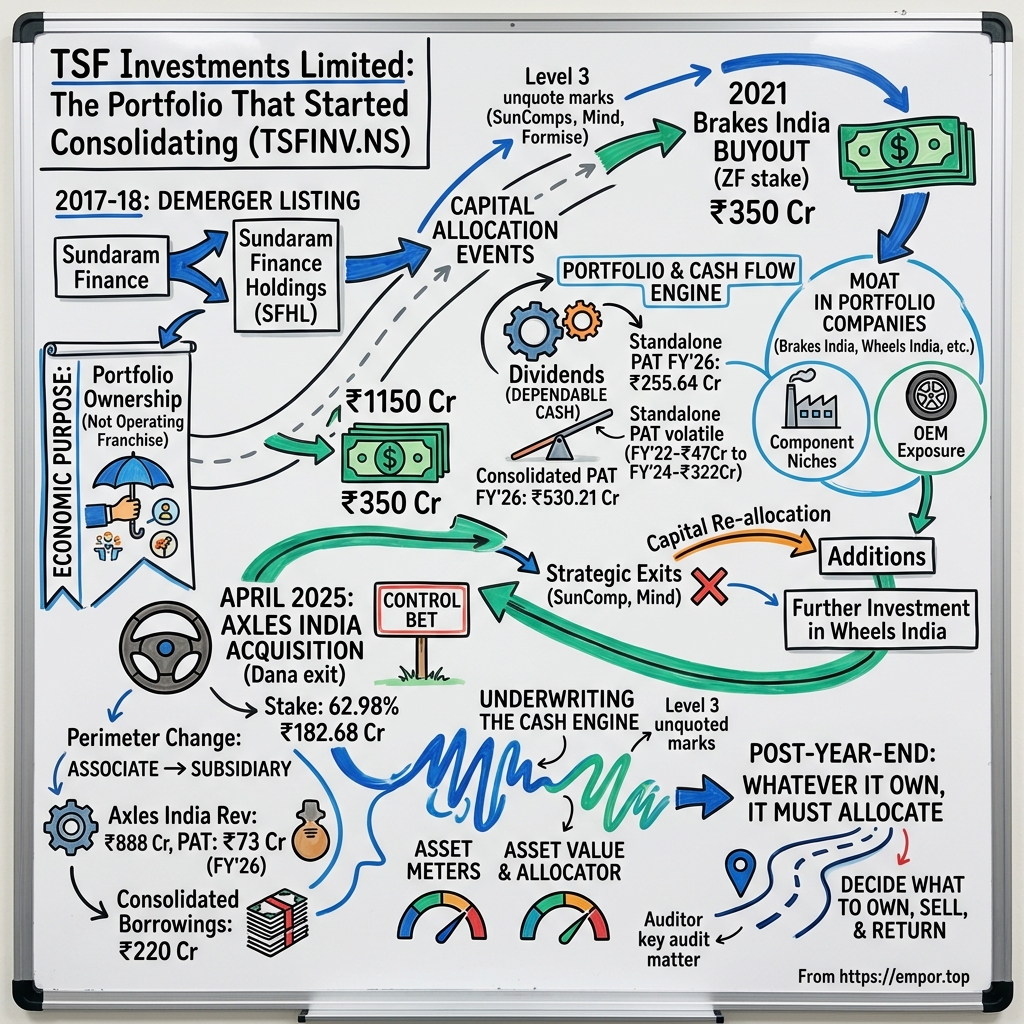
TSF Investments Limited: The Portfolio That Started Consolidating
I. Introduction: A Holding Company Starts Looking Like a Manufacturer
In May 2026, a small office in Chennai with fewer staff than a neighbourhood bank branch published two profit numbers for the same year, and they did not agree.
The first was the listed company's own profit, the money TSF Investments Limited earned as an owner of shares: ₹255.64 crore for the year to March 2026.1 The second was the consolidated profit, the figure that pulls in the businesses TSFIL controls and its share of the ones it only influences: ₹530.21 crore.1 One company, one year, and a gap of more than two to one.
The gap has a simple cause and a complicated meaning. In May 2025, TSFIL took control of Axles India, a Chennai maker of commercial-vehicle axle housings that had sat for years as an "associate", a company in which TSFIL held a large minority stake.110 Once control passed, Axles stopped appearing as one line of "share of profit" and started appearing line by line: its sales, its factory costs, its bank loan, its trade receivables. On top of that, the consolidated accounts carried ₹364.23 crore as TSFIL's share of profits from associates it does not control, and a one-time ₹40.99 crore gain from re-measuring the Axles stake it already owned before taking control.1
So when TSFIL's profit "jumped", what actually happened? Did the listed company earn more, or did the line around what counts as the company move?
That is the puzzle for this episode. The name on the door says "Investments". Its consolidated income statement now includes product sales of about ₹759 crore, mostly the output of a forging and fabrication plant.1 A holding company has started to look, at least on paper, like a manufacturer.
The answer matters because the two numbers serve different readers. A minority shareholder in TSFIL gets paid out of the cash that reaches the parent: dividends from investees, plus whatever the parent realises when it sells investments. Associate profit that stays inside Brakes India or Turbo Energy belongs to TSFIL economically, but it does not reach a TSFIL shareholder until those boards decide to pay it out. Consolidated profit is therefore a description of what TSFIL owns. Standalone cash is a description of what TSFIL gets paid.
Four questions run through the rest of the story.
First, what actually creates TSFIL's value: dividends, fair-value marks, or the operating businesses underneath? Second, how well does it allocate capital, judged by what it bought, what it sold and what happened next? Third, does control of Axles improve the portfolio, or does it just add a factory, a loan and a business cycle? Fourth, do dividends and reported asset values turn into durable value for the minority shareholder, who owns about 45% of the company and controls none of it?4
The first move is simple: separate the portfolio from the perimeter. The consolidation change is material, and it reshapes every headline. It does not, by itself, prove that the portfolio became more valuable. To see why, go back to the moment this company was created, because unlike most listed companies, TSFIL was not founded to make anything. It was carved out to hold things.
 Subscribe on LinkedIn
II. The Demerger Put a Portfolio on the Stock Exchange
For decades, Sundaram Finance was one of the quieter success stories in Indian finance: a Chennai lender to truck operators and car buyers, run by the T.S. Santhanam family's TSF Group with a reputation for conservative underwriting. Over the years it had also collected something that lenders do not usually keep: stakes in industrial companies. Many came from the group's joint ventures with foreign auto-component makers in brakes, wheels, turbochargers and axles, built in the decades when Indian manufacturing needed foreign technology partners.
By the mid-2010s, those stakes created a problem. An analyst valuing a lender looks at loan growth, asset quality and return on equity. A portfolio of minority stakes in brake and wheel makers does not fit that model. It clutters the balance sheet, makes the lender harder to value, and ties up capital that a regulator measures against lending risk.
The answer, worked out in 2017 and 2018, was a scheme of arrangement. Sundaram Finance's non-core investments, along with some shared-services businesses, moved into Sundaram Finance Holdings Limited, and that company's shares were listed on the exchanges.2
A listing, not an IPO
The way it listed matters. TSFIL never ran an initial public offering. No book was built, no new investors bid for shares, and no fresh capital came in at a price the market set. Its shares were listed under an Information Memorandum dated 15 March 2018, the document Indian rules require when a company's shares arrive on the exchange as a result of a demerger rather than an issue.2 Existing Sundaram Finance shareholders simply woke up owning two listed securities instead of one.
That has a lasting consequence. TSFIL's record as a separately reported, separately listed vehicle begins in FY2018. Any story that stretches TSFIL's "growth" back into Sundaram Finance's history mixes up two different businesses. The portfolio is old. The listed company that owns it is not.
Inside the TSF Group, not underneath Sundaram Finance
A common mistake is to call TSFIL a Sundaram Finance subsidiary. It is not. At 31 March 2026, Sundaram Finance held 19.90% of TSFIL as one member of a promoter group that together held 54.99%.41 TSFIL describes itself as an exempted Core Investment Company, a holding company whose assets are mainly investments in group companies and which, below certain thresholds, does not need to register with the Reserve Bank as a non-banking finance company.1 It is a sibling in the group family, not a child of the lender.
The rights issue: capital with a purpose
The most revealing event in TSFIL's capital history came in 2021. The company offered up to 7.10 crore rights shares at ₹50 each, for up to ₹355 crore.3 Rights issues are often treated as boring housekeeping. This one had a target.
ZF, the German auto-parts giant, was leaving its long joint venture in Brakes India. The rights issue helped TSFIL buy that stake, together with another foreign partner's exit, in deals reported at about ₹450 crore in total, including roughly ₹350 crore for an additional 7.71% of Brakes India.53 The capital raised from existing shareholders went straight into deepening exposure to what is now TSFIL's largest dividend payer.
That is the right way to read the rights issue: shareholders were asked to put in more money so the company could own more of a business it already knew. It was not a raise to cover losses or fund a new line of business. Whether that capital earned its keep is a question for Section V. Since then the share count has stayed at about 22.21 crore, with no fresh issue, preferential allotment or private placement in FY2026.1
A new name, the same owners
In September 2025, Sundaram Finance Holdings became TSF Investments Limited. Shareholders approved the change in a postal ballot with 99.99% of votes in favour.1 The company presented it as a group-identity change, aligning the vehicle with the TSF Group brand, and not as an ownership restructuring.1 The promoter stake barely moved, from 54.97% to 54.99% over the year.4
What did the demerger create, then? Not an operating franchise but a listed wrapper around a set of stakes. Its economic purpose is ownership: collect dividends, manage the portfolio, and occasionally buy or sell. That makes the next question unavoidable. If the business is ownership, where does the money actually come from?
III. Dividends Pay the Bills; Market Marks Move the Score
Open TSFIL's FY2026 standalone income statement and the whole business fits on a single page. There is no cost of goods sold, no inventory, no sales force. There are two big lines that matter, side by side.
The first is dividend income: about ₹208 crore.1 That is cash, or cash on its way, paid by companies in which TSFIL owns shares.
The second is "net gain on fair value changes": about ₹81 crore.1 That is mostly the rise in the accounting value of investments held at market or model value, such as mutual funds, alternative investment funds and some equity stakes. It is real in the sense that the assets are worth more on paper. It is not cash until something is sold.
Together, with a sliver of interest income, these lines make up about ₹288 crore of standalone operating revenue.1
The unit of the business
Most companies sell a unit: a car, a subscription, a loan. TSFIL's unit is a stake. It earns money in two ways: when an investee's board declares a dividend, and when the value of what it owns changes. Neither is a contract. No investee is obliged to pay a fixed dividend, and no market is obliged to mark a portfolio higher. TSFIL does not report a recurring-revenue share, contract terms or minimum commitments for its investment income, and given how the income works, it could not meaningfully do so.1
That is the first key insight. The "revenue" of a holding company is a set of decisions made by other boards, plus the mood of the markets that value its holdings.
An uneven path
That explains why the profit line looks the way it does. Standalone profit was about ₹47 crore in FY2022, peaked at about ₹322 crore in FY2024, fell to about ₹236 crore in FY2025, and recovered to about ₹256 crore in FY2026.1 A five-fold rise sounds spectacular. But the path between the endpoints includes a fall of about a quarter in a single year, and the latest result still sits below the peak two years earlier.
This is not a business compounding in a smooth line. It is a portfolio whose reported profit swings with dividend timing and valuation marks. An investor who extrapolates the FY2022-to-FY2026 rise is extrapolating a market environment as much as a business.
Profit is a clue; cash is the receipt
The cash-flow statement is where the two lines separate. Operating cash flow was about ₹204 crore against reported profit of about ₹256 crore.1 The largest reconciling item is exactly the about ₹81 crore of fair-value gains, which the cash-flow statement removes because no cash came in. Dividend timing shifted the numbers by another about ₹12 crore, and tax paid in cash fell to about ₹5 crore from about ₹30 crore the year before.1
Strip the marks out and the picture is reassuring in one way: dividends from investees really do arrive as cash, and TSFIL's tiny cost base, with employee costs of under ₹2 crore, means most of that cash survives.1 The parent is about as capital-light as a listed company can be: it spent about ₹2 crore on fixed assets in FY2026.1
Where the cash went
The cash then flowed out through two doors. About ₹197 crore went to TSFIL's own shareholders as dividends paid during FY2026.1 The rest of the activity sat in investing cash flows, where purchases and sales of mutual funds and other investments dominated. In other words, the parent shuffles its treasury between liquid funds and strategic stakes, and pays a dividend that is roughly the size of the dividends it receives.
For FY2026, the board recommended ₹11.15 per share.1 On about 22.21 crore shares, that is roughly ₹248 crore if paid in full, comfortably more than the operating cash flow of about ₹204 crore and above the about ₹208 crore of dividend income. That arithmetic matters. A payout of that size cannot be covered by fair-value profit, because fair-value profit is not cash. It has to come from investee dividends, cash already on hand, or investment sales.
None of this is alarming on its own. A holding company with ₹7,620 crore of investments can sell a liquid fund to bridge one year.1 But it does change the question an investor should ask. TSFIL's dividend is safe exactly as long as the dividend income from a handful of investees stays strong. That pushes the story down one level, to the businesses that actually make the money.
IV. The Moat Belongs to the Portfolio Companies
Leave the parent's quiet office and drive out to the industrial belt around Chennai, and the portfolio turns physical. Brake assemblies for trucks and tractors. Steel wheels stacked for commercial vehicles and farm equipment. Turbochargers for diesel engines. Axle housings for heavy trucks. Warehouses distributing replacement parts to mechanics across South India. This is where the portfolio's income is earned.
The scale is real. In FY2026, Brakes India reported revenue of about ₹8,034 crore, Wheels India about ₹5,124 crore, and Axles India about ₹888 crore.1 Turbo Energy and India Motor Parts & Accessories, the parts distributor known as IMPAL, complete the core group.1 These are not start-ups. Several have supplied Indian vehicle makers for decades.
Mapping the weight
The portfolio sits in layers. Axles is now a subsidiary, consolidated line by line. Brakes India, Turbo Energy, Wheels India and IMPAL are associates, whose profits show up as a share in the consolidated accounts but whose cash reaches TSFIL only as dividends.1 It is a mistake to read the consolidated revenue mix as TSFIL's own operating business. Almost all of the consolidated product sales are Axles; the far larger businesses, Brakes India and Wheels India, appear only as profit shares.
The competitive arena
Each investee fights a different war. In braking systems, Brakes India competes with global suppliers such as Bosch's Indian business, ZF and Continental. In steel and alloy wheels, Wheels India faces Steel Strips Wheels. Axles works in the same commercial-vehicle supply chain as Automotive Axles and Bharat Forge. Turbo Energy, in turbochargers, competes against global players such as BorgWarner. TSFIL does not publish market-share figures for its investees, and the scale comparison above is the most that the disclosed figures support without assuming a share.
Porter, briefly, at the investee level
The forces facing these companies are familiar to anyone who has studied auto components.
The buyers are powerful. A handful of vehicle makers buy most of the output, negotiate price-downs annually and can qualify a second supplier. Raw materials, especially steel, swing margins, and pass-through clauses often lag cost increases. Demand rises and falls with truck and tractor cycles that no supplier controls.
What protects suppliers is qualification. A brake system or a wheel for a new truck platform has to pass months of testing; once it is designed in, the vehicle maker usually stays with that supplier for the life of the platform. Engineering relationships, often going back to the foreign technology partner, add stickiness.
Independent evidence on one investee confirms both sides. ICRA's February 2026 rating rationale for Wheels India cited TSF Group support, an established market position and a diversified customer base as strengths, while listing moderate debt metrics, margin pressure, export and currency exposure and auto cyclicality as constraints.12 That is a fair summary of the whole portfolio: established, sticky, but squeezed.
Testing the moat
Here is the test, run once. Does TSFIL own businesses with durable competitive advantage?
The affirmative evidence is longevity, scale and qualification. The evidence that would prove a moat, such as multi-year retention of named platforms, price realisation that beats steel inflation, or market share stable through a downturn, is not consistently disclosed across the investees. TSFIL does not report it at the portfolio level, and the investees disclose it unevenly.
The verdict is narrower than "TSFIL owns moats". It owns stakes in established component businesses whose advantages are plausible but unproven at the level of evidence a long-term investor would want. TSFIL's own edge is something different: access. It owns stakes that outsiders cannot buy, and it has a seat at the table when foreign partners leave.
One more caution. A portfolio of brakes, wheels, turbochargers, axles and parts distribution looks diversified. Economically, it is one bet in several forms: Indian vehicle demand, especially commercial vehicles and tractors, plus steel prices and export markets. When the truck cycle turns, it turns for nearly everyone at once.
If access is the edge, the record of how TSFIL used it is the real test of the allocator.
V. The Capital-Allocation Record Has Both Exits and Additions
August 2021 was TSFIL's boldest week. Two foreign partners were leaving the TSF Group's joint ventures, and TSFIL bought them out for a combined ₹450 crore or so.5 The centrepiece was Brakes India: about ₹350 crore for an additional 7.71% stake.5
It was the kind of trade a group-backed holding company exists to make. When a global partner like ZF decides to exit an Indian joint venture, the natural buyer is the domestic family that has run the business beside it. There is no auction among strangers. The price is negotiated among people who know the plant, the customers and the managers. That information advantage is TSFIL's clearest structural edge.
Did it pay off? Brakes India paid TSFIL ₹67.92 crore of dividends in FY2026, more than any other investee.1 That does not prove a return on the 2021 deal, because TSFIL does not publish a bridge from the purchase price to dividends received and current value. But it shows the asset bought was a cash-producing one, not a speculative option.
The other side of the ledger
Not every bet became a lasting holding. In FY2022, TSFIL invested about ₹19.6 crore in SunComp, a carbon-composites venture, as part of a push into lightweight materials alongside an Italian partner, Mind.6 Carbon composites made sense in theory: vehicle makers want lighter parts, and composites are lighter than steel. By FY2025, the SunComp stake had been sold and the Mind relationship exited.7
TSFIL also sold its stake in Sundaram Clayton in 2022, reported at about ₹125 crore.8 Over the years it has adjusted holdings in Wheels India, Flometallic, IMPAL and Delphi-TVS, buying here and trimming there.67
Weighing the exits
What do the exits say? Less than a sceptic might hope and less than a bull might want. The SunComp investment was small against a portfolio worth thousands of crore, and TSFIL does not disclose the realised return on it. An exit is not automatically a loss; a sale can lock in a gain or cut a mistake early. But the composites venture is the clearest recent case of a strategic thesis that did not become a long-term holding, and it tempers any claim that TSFIL's long-horizon investing is consistently successful.
The better reading is that TSFIL's strength is narrow. When it buys more of businesses it already knows, often from departing partners, it buys cash producers. When it tried something new, in composites, the bet did not last. That narrows the "disciplined allocator" claim to a smaller, more defensible one: a disciplined consolidator of familiar group assets.
The activist's question
A sceptical investor would push further. What hurdle rate does TSFIL use? What return on invested capital does it expect from a stake purchase? When does it sell? TSFIL does not publish a hurdle rate or a deal-by-deal return record, and the company's public archive lists filings rather than earnings-call transcripts where such questions might be pressed.9 For a vehicle whose only job is allocating capital, that is a real disclosure gap.
The pattern continued after the year closed. In July and August 2026, TSFIL bought more Wheels India shares in the market and subscribed to new shares, taking its reported stake to about 29%.1314 Money is again returning to a familiar holding. That move should be judged on its terms and on the cash returns it eventually produces, not on the comfort of familiarity. And the biggest familiar holding TSFIL deepened recently was not Wheels. It was Axles.
VI. Axles Turns a Portfolio Stake into a Control Bet
On 10 April 2025, Dana, the American drivetrain maker, left another TSF Group joint venture. TSFIL agreed to buy its 24.16% stake in Axles India for ₹182.68 crore, or ₹296.65 per share, taking its direct holding to 62.98%.1011 Control took effect in May 2025.1
This was a different kind of deal from Brakes India. In 2021, TSFIL bought more of a company it would still not control. In 2025, it crossed the line from minority investor to owner. That changes the accounting, the risks and what investors should expect from management.
What TSFIL bought
Axles India makes axle housings for medium and heavy commercial vehicles. It grew from revenue of about ₹570 crore in FY2022 to about ₹847 crore in FY2025, and about ₹888 crore in FY2026, the first year under TSFIL control.1 FY2026 profit was ₹73.24 crore.1
Two things stand out. Growth was strong through the truck upcycle, roughly 50% over three years, then slowed to about 5% in the first year under TSFIL. That slowdown is more likely the commercial-vehicle cycle than anything TSFIL did, but it is a reminder that control does not exempt a business from its industry.
Was the price right?
Do the arithmetic plainly. TSFIL paid ₹182.68 crore for 24.16% of Axles. Using FY2025 profit, which the outline's own measure implies was about ₹69 crore, the acquired stake's share of profit was about ₹16.6 crore a year.10 Divide the price by that share and the deal works out at roughly 11 times earnings.
For an established supplier, that is not a heroic price. But a fair judgment needs a benchmark: what listed peers such as Automotive Axles trade at, and what similar transactions fetched. TSFIL's filing does not provide that comparison, and the deal price alone cannot establish whether the purchase was cheap or full. An exiting partner usually has less negotiating power than a seller with many bidders, which could favour TSFIL. The proof will be in the return, not the multiple.
The accounting changes on day one
The moment control passed, Axles entered the consolidated accounts line by line, replacing its associate-profit line. TSFIL also booked the previously noted ₹40.99 crore re-measurement gain.1
That is why the consolidated FY2026 increase is partly a perimeter story. Consolidated trade receivables rose from about ₹6 crore to about ₹209 crore as Axles was consolidated.1
The new risks
Control brought debt into the picture. Consolidated borrowings were ₹219.66 crore at March 2026, including a secured bank term loan of ₹211.90 crore.1 TSFIL itself reported no borrowings. But it provided ₹210 crore of security for a wholly owned subsidiary's borrowing, and the security package includes a pledge of the Axles shares held by TSFIL, along with Axles' property and current assets.1
Why does that matter? Because the parent's clean balance sheet is no longer fully separate from group leverage. If the subsidiary's loan ran into trouble, lenders would have a claim on Axles shares that TSFIL owns. The amount is modest against a ₹7,620 crore investment book, and no covenant breach or refinancing pressure is disclosed.1 But it is a new link: before 2025, TSFIL's shareholders owned a debt-free portfolio; now they own a portfolio with a small pledged corner.
What management has, and has not, explained
What return does TSFIL expect from Axles, and how will it integrate the business? TSFIL described the acquisition and the consolidation in its FY2026 annual report, but did not set out a return target or a debt-reduction plan.1 TSFIL does not hold earnings calls with published transcripts, so there is no analyst Q&A where those questions have been asked and answered.9
The verdict on Axles is therefore two-sided. It is a real operating business producing real profit, bought at a price that does not look stretched on first-pass earnings. But it adds cyclicality, debt and a harder test. A minority stake only has to keep paying dividends. A controlled subsidiary has to earn a return on the full purchase price, service its loan and justify the parent's collateral. One year in, that return is unproven.
That leads to the shareholder's most practical question: when all these businesses earn money, who actually receives it?
VII. Who Gets the Cash—and What Is the Portfolio Worth?
Trace the dividends that reached TSFIL in FY2026 and two names do most of the work. Brakes India paid ₹67.92 crore. Turbo Energy paid ₹65.66 crore. Together, ₹133.58 crore, or about 64% of all dividends the parent received.1 Sundaram Business Services added ₹33.55 crore.1
Two companies, in other words, carry most of the parent's cash income. A bad year at either one, or a board decision to retain cash for a capex programme, would be felt directly in TSFIL's ability to pay its own dividend.
Related-party economics, stated plainly
Every one of those dividend payers is a group company. Related-party dividends were ₹207.67 crore, about 72% of standalone operating revenue in FY2026, compared with about 76% in FY2025.17 That is not a red flag in itself. For a holding company built to own group stakes, related-party income is the business model, not a side channel. There is no brand fee or royalty in the standalone schedule, and the only other related-party income of note was about ₹1.5 crore of rent from Brakes India and Turbo Energy.1
The distinction to keep in mind is that these are portfolio-company distributions, not customer revenue. An external customer pays because it wants the product. An investee pays a dividend because its board, on which the same group families sit, decides to.
The value nobody trades
Now turn from cash to value. At March 2026, TSFIL carried standalone investments of ₹7,620.87 crore.1 Some of that is in listed shares, such as Wheels India and TVS Holdings, whose value the market sets every day. But ₹3,925.71 crore of equity instruments measured through other comprehensive income were classified as Level 3.1
Level 3 is accounting language for "no market price exists, so we used a model". Think of it as the difference between knowing a house's value because the identical house next door just sold, and estimating it from rental yields and a guess at the right discount rate. The estimate can be careful and still be wrong. Brakes India and Turbo Energy, the two biggest dividend payers, are unlisted, so their values in TSFIL's books come from valuation models.
The auditor flagged exactly this. The valuation of unquoted investments was a key audit matter, the category auditors use for areas requiring the most judgment.1 The audit opinion was unmodified, and TSFIL reports a record of unqualified financial statements.1 But "unmodified" means the method was reasonable, not that the number is precise.
This matters for the market discount to net asset value that holding companies often trade at. When half the portfolio is model-valued, investors cannot easily verify the NAV, and they demand a margin of safety. TSFIL does not publish an investee-by-investee NAV bridge with valuation assumptions and sensitivities for each material unquoted stake. Until it does, the reported asset value will be easier to discount than to trust.
Pay and alignment
The people allocating this capital are well paid for a company with under twenty permanent staff. CEO S. Ravi's FY2026 remuneration was ₹5.80 crore and CFO C. Senthilnathan's was ₹4.14 crore.1 Senthilnathan joined in December 2024 after the previous CFO, Suresh I.S., left in November.7 Directors' commission is capped at 1% of net profit, and actual KMP and director commission recorded in the standalone statements was a modest ₹0.17 crore.1 Against standalone profit of about ₹256 crore, executive pay of roughly ₹10 crore is about 4% of earnings, not extreme for a capital allocator but a meaningful share of a business with almost no other costs.
The promoter group's 54.99% stake aligns its economics with outside shareholders on the dividend.4 It does not guarantee alignment on everything. A promoter group can rationally prefer to keep capital inside group companies, buy out partners and support group borrowing, choices that may serve the group's industrial strategy more than a minority shareholder's return. Governance signals so far are clean: no exchange or SEBI penalties in the prior three years, an independent director appointed with 99.98% support, and no pledge of promoter shares.14
The smaller items
The remaining balance-sheet items are proportionate. Standalone trade receivables were nil.1 In the consolidated notes, disputed claims were about ₹3.84 crore for the group and ₹44.43 crore for associates, TSFIL's share, down from about ₹70 crore for associates a year earlier.17 Standalone disputed income-tax dues were about ₹0.64 crore.1 Currency exposure sits mainly in the operating group: consolidated hedging derivatives swung from a small asset to a ₹15.69 crore liability, partly offset by a translation gain on overseas holdings such as Dunes Oman.1 None of these is large against the portfolio, but the derivative swing shows how Axles' exports bring market risks the old holding company did not carry.
With the cash and the value laid out, the full case can be argued.
VIII. Frameworks & Bull vs. Bear
Picture two ledgers side by side. On the left, cash that actually arrived at TSFIL in FY2026: ₹207.67 crore of dividends.1 On the right, value recognised in its accounts without cash changing hands: ₹80.53 crore of fair-value gains in the standalone statements and ₹364.23 crore of associate profit in the consolidated ones.1 The bull reads the right ledger as proof of compounding value. The bear reads the left ledger as the only number that pays.
Porter's Five Forces, at the investee level
TSFIL has no customers of its own, so the forces apply to the businesses it owns.
Buyer power: high. Vehicle makers are concentrated, negotiate annual price-downs and can multi-source. ICRA's view on Wheels India, which pointed to diversified customers as a strength, shows the investees work to limit any single buyer's leverage, but the buyer group as a whole holds the stronger hand.12
Supplier power: moderate to high. Steel and other inputs drive costs, and margin pressure from raw materials was one of the constraints ICRA cited.12
Rivalry: intense. Global players such as Bosch, ZF, Continental and BorgWarner compete in the same categories, alongside strong Indian rivals.
Threat of new entrants: moderate. Qualification and tooling costs slow entry, but a global supplier entering India can borrow its credentials.
Threat of substitutes: real over time. Electric vehicles reduce demand for turbochargers and change brake and axle designs, though heavy commercial vehicles are likely to electrify more slowly than cars. This is the single most important long-term substitution risk for Turbo Energy specifically, and it bears directly on one of TSFIL's two largest dividend sources.
Hamilton Helmer's 7 Powers
Run the portfolio through Helmer's framework and the honest answer is that TSFIL holds one Power clearly and borrows others.
Cornered resource is TSFIL's clearest Power: privileged access to stakes in group joint ventures that outsiders cannot buy, demonstrated when ZF and Dana exited and TSFIL was the buyer.510 Switching costs exist at the investees through platform qualification, but their size is not quantified. Scale economies are plausible at Brakes India, one of the larger component makers by revenue, but TSFIL does not show unit-cost advantages. Network economies, brand, counter-positioning and process power do not clearly apply.
Bull case
The bull argues that TSFIL owns established positions in component niches that produce resilient dividends. It has shown it can buy stakes from exiting foreign partners at reasonable prices, and the Brakes India and Axles deals deepened exposure to cash-producing businesses. Axles adds controlled manufacturing earnings, about ₹73 crore of profit in its first year.1 The parent itself is debt-free and costs almost nothing to run.
Bear case
The bear argues that reported group growth reflects perimeter and accounting changes rather than better economics. Two associates supplied most of the parent's dividends. Level 3 valuations weaken price discovery and make NAV hard to verify. Collateral now links the parent's Axles shares to group borrowing. And the record includes a strategic venture, composites, that did not last.
Weighing the history
Which version does the record support? The strongest disconfirming evidence for the "disciplined allocator" claim is the SunComp and Mind exit, which shows strategic diversification has not worked so far. The strongest support is that the large deals, Brakes India and Axles, bought cash producers at defensible prices. The history therefore narrows the claim rather than rejecting it: TSFIL looks like a disciplined consolidator of known group assets, unproven as a builder of new businesses.
The sceptical investor's demands
An activist would ask for four things: an investee-by-investee NAV bridge with valuation assumptions; a five-year history of cash dividends received by investee; a record of capital deployed and realised returns on every purchase and sale; and Axles' debt reduction and return on invested capital. None is published in that form today.
KPIs to track
Three numbers matter most.
Cash dividends received, by investee. Latest reading: ₹207.67 crore, slightly below the prior year's ₹209.52 crore, with about 64% from two companies.1
Standalone profit versus operating cash flow. Latest reading: ₹255.64 crore profit against ₹204.02 crore operating cash flow, the gap mainly fair-value marks.1
Axles' cash flow and debt. Latest reading: ₹73.24 crore profit in FY2026, with ₹219.66 crore of consolidated borrowings mostly tied to the subsidiary structure.1
Risk radar
Only a few risks are material: the auto and commercial-vehicle cycle and OEM pricing pressure; uncertainty in Level 3 valuations; the group collateral link; and currency exposure where exports and overseas holdings matter. Electrification is a slow-moving risk to some investees. Other technology disruption is not a direct threat to these businesses and should not be overstated.
The market's view of all this is best read as the discount it applies to the reported portfolio value, a judgment about how much of the right-hand ledger will ever reach the left. That gap is where the lessons live.
IX. Playbook: Business & Investing Lessons
Go back to the FY2026 standalone income statement, where ₹207.67 crore of dividends sits on the same page as ₹80.53 crore of fair-value gains, both under "revenue", both feeding the same profit line.1 One is a cheque. The other is an opinion about what some assets would fetch. TSFIL's story is a lesson in keeping those apart.
"A holding company's profit is a clue; the dividend is the receipt."
Brakes India's ₹67.92 crore dividend remains the standout receipt.1 For founders running holding structures, the lesson is to report the receipts as prominently as the marks. For investors, it is to start the analysis with the receipts and treat everything else as a range.
"A stake becomes a strategy only when the return survives the exit."
The SunComp and Mind exit was a reminder that a thesis is not a return.67 The general lesson: an allocator's skill is visible only in the full loop, from cash out to cash back. Any portfolio that publishes its buys loudly and its exits quietly is asking to be trusted rather than judged.
"Control changes the accounts on day one; it earns its keep over years."
The Axles consolidation brought an immediate re-measurement gain and a jump in consolidated revenue.1 Neither proves anything. The real test is slower: whether Axles converts profit into cash, pays down its loan and earns more on its full value than TSFIL's shareholders could earn elsewhere. Buying control is easy to report and hard to justify, and the accounting rewards the first part.
"Access is an edge; familiarity is not a hurdle rate."
That access is a genuine advantage. But buying more of what you know is also the easiest decision for a group-controlled vehicle to make, and the further Wheels India purchases in 2026 will test whether familiarity is matched by return discipline.1314
Those lessons point straight at the next twelve months.
X. Epilogue
As of early October 2026, TSFIL sits at an interesting moment. Axles has completed its first full reporting year under control. And over the summer, TSFIL added to Wheels India again.1314 The first-quarter FY2027 results, filed in August, are the first to compare a full Axles-consolidated quarter with a year-earlier quarter in which Axles was only partly inside the perimeter for part of the period, so the headline growth will again mix underlying change with accounting change.1516
Here is what will decide the story.
The Wheels bet. If additional Wheels exposure produces rising dividends and a rising listed value, TSFIL's habit of deepening familiar holdings will look like discipline. If Wheels' margins stay squeezed and its debt stays moderate, as ICRA flagged, it will look like loyalty.12
The Axles test. If Axles generates cash, reduces the ₹219.66 crore of consolidated borrowings and releases the pledge on TSFIL's shares, control will start earning its keep.1 If the truck cycle softens and debt lingers, the parent will have swapped a clean minority stake for a cyclical factory with a loan attached.
The dividend test. If investee cash continues to cover TSFIL's own payout, the dividend story holds. If the payout increasingly relies on selling treasury investments, the dividend becomes a distribution of capital rather than income.
The NAV test. If TSFIL ever publishes a clear investee-by-investee valuation, the market can judge the Level 3 numbers on evidence. If not, the discount will keep doing that job.
Each of these settles one of the four opening questions. None has been settled yet. TSFIL is either a disciplined allocator of industrial cash flows, or a concentrated portfolio with a volatile accounting surface. The evidence so far allows both readings, and that tension is the story.
XI. Outro
Return to where this began: one listed company, two profit figures, ₹255.64 crore and ₹530.21 crore, for the same twelve months.1 The larger number tells you what TSFIL owns. The smaller one tells you what it earned as an owner. Neither tells you, by itself, what a shareholder will get.
Its factories, customers and engineers belong to other balance sheets. The real business is the judgment behind what TSFIL owns, sells and passes on.
References
-
Annual Report 2025–26 — TSF Investments Limited, 2026 ↩↩↩↩↩↩↩↩↩↩↩↩↩↩↩↩↩↩↩↩↩↩↩↩↩↩↩↩↩↩↩↩↩↩↩↩↩↩↩↩↩↩↩↩↩↩↩↩↩↩↩↩↩↩↩↩↩↩↩↩↩
-
Information Memorandum — Sundaram Finance Holdings Limited, 2018-03-15 ↩↩
-
Letter of Offer — Sundaram Finance Holdings Limited, 2021-04-21 ↩↩
-
Shareholding Pattern, 31 March 2026 — TSF Investments Limited, 2026 ↩↩↩↩↩
-
SF Holdings Enhances Stake in Two Companies, Buys Out Foreign Partners for Rs 450 Crore — Moneycontrol, 2021-08-05 ↩↩↩↩
-
Annual Report 2021–22 — Sundaram Finance Holdings Limited, 2022 ↩↩↩
-
Annual Report 2024–25 — Sundaram Finance Holdings Limited, 2025 ↩↩↩↩↩↩
-
Sundaram Finance Holdings Sells Sundaram Clayton Stake — Moneycontrol, 2022 ↩
-
Stock Exchange Communication Archive — TSF Investments Limited ↩↩
-
Acquisition of Shares in Axles India Limited — Sundaram Finance Holdings Limited, 2025-04-10 ↩↩↩↩
-
Sundaram Finance Holdings to Acquire 24.16% Stake in Axles India for ₹182.68 Crore — Autocar Professional, 2025-04-10 ↩
-
Further Acquisition of Shares in Wheels India — TSF Investments Limited, 2026-07-31 ↩↩↩
-
Subscription of Shares in Wheels India — TSF Investments Limited, 2026-08-19 ↩↩↩
-
TSF Investments Ltd Quarterly Results — Business Standard, 2026-09-01 ↩
 LinkedIn
 WhatsApp
 Reddit
 Hacker News
 Email
Email Kindle
 RSS Feed
 Spotify
 Apple Podcasts
 Amazon Music
 Audible
 YouTube