Torrent Pharmaceuticals: The Compounding Machine of Indian Pharma
I. Introduction & Episode Roadmap
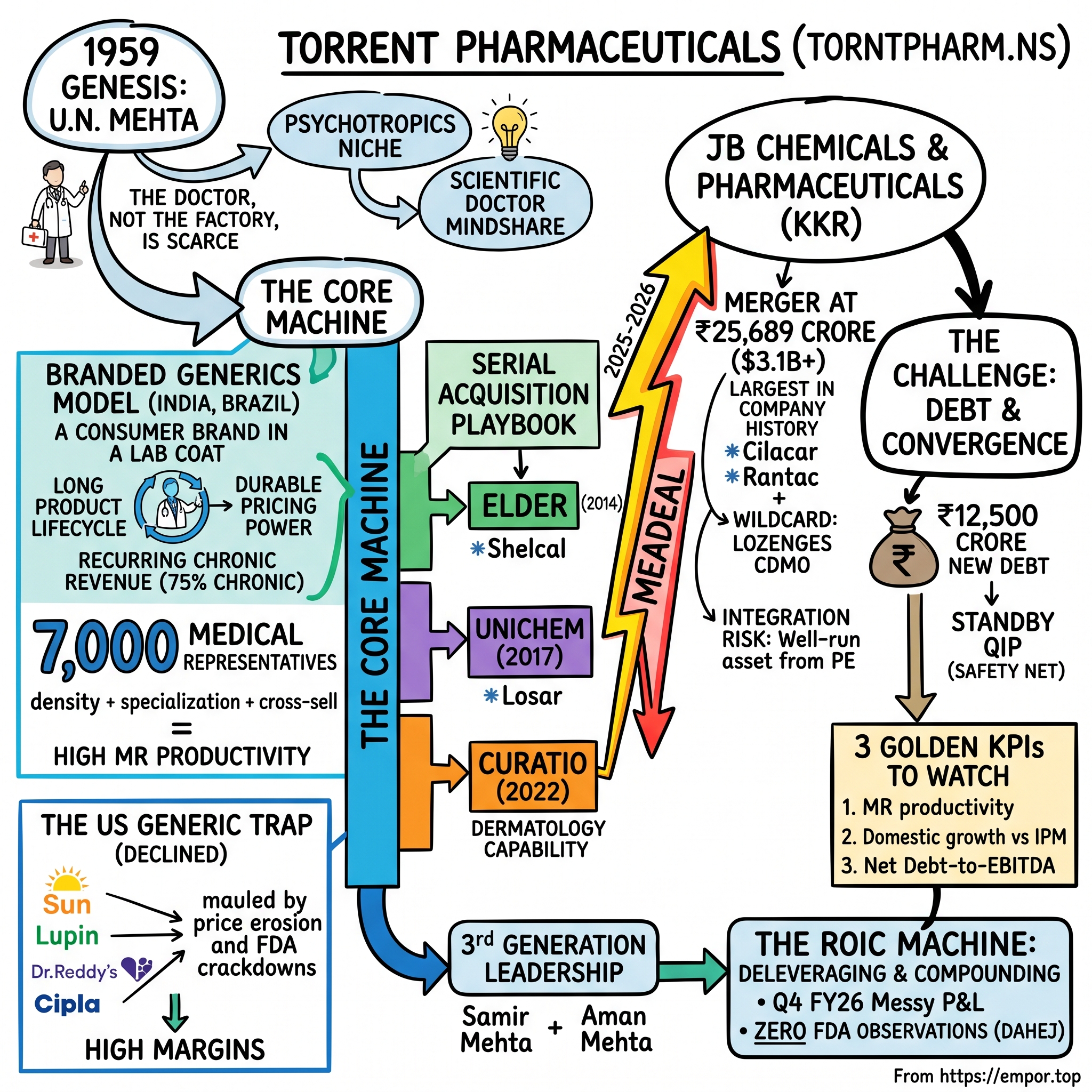
On January 21, 2026, in the unglamorous machinery of an Indian stock exchange filing, one line quietly rewrote the pecking order of the country's ₹2 lakh crore drug industry. Torrent Pharmaceuticals Limited had completed the purchase of a controlling stake in JB Chemicals & Pharmaceuticals from the American private equity house KKR, and set in motion a merger valuing the target at roughly ₹25,689 crore — north of $3.1 billion — the largest deal in Torrent's history.1 With it, a company that traces its roots to a single-room operation in Ahmedabad vaulted into the top five of the Indian Pharmaceutical Market by secondary sales, and into the top four by prescriptions.1
That is the hook. But it would be a mistake to read this as a story about one big cheque. The more interesting question — the one worth two hours of your attention — is how a mid-sized generics maker with almost no meaningful presence in the world's largest drug market became one of the most consistently profitable pharmaceutical franchises in Asia.
The answer is a study in contrarianism. Through the 2010s, the marquee names of Indian pharma — Sun, Lupin, Dr. Reddy's, Cipla — poured capital and ambition into the United States, racing to file generic drug applications and capture the world's richest healthcare market. Many of them got mauled: brutal price erosion as American buyers consolidated into three mega-purchasing groups, and a wave of US Food and Drug Administration crackdowns that turned Indian factories into liabilities overnight. Torrent, almost alone among its peers, largely sat that race out. It kept its US exposure deliberately small and redirected its capital toward something less exciting and far more durable: branded medicines sold to Indian and Brazilian doctors, at margins that would make a consumer-goods company blush.
Consider the shape of that choice for a moment, because it is easy to underrate in hindsight. Declining to compete in the world's biggest market is a decision that looks stupid for years before it looks smart. Every quarter that a rival announced another batch of US approvals, Torrent's management had to explain to analysts why it was not doing the same. Every conference presentation had a slide where the US bar was smaller than the peer group's. Strategic patience is easy to admire retrospectively and excruciating to practise in real time, particularly at a listed company where the scoreboard resets every ninety days.
There is a second reason this company repays study, and it has nothing to do with drugs. Torrent is one of the cleanest available case studies in serial acquisition as an operating capability. There is a small and much-admired category of businesses worldwide — the Constellation Softwares and Danahers of the world — that have figured out how to buy companies repeatedly and make them better, rather than merely bigger. The pattern is always the same: a specific, transferable operating advantage that the acquirer possesses and the target lacks, applied over and over. Torrent's version of that advantage is a sales force. Understanding exactly how it works, and where it might stop working, is the analytical core of this story.
And there is a caution to carry throughout. This is a company with an excellent track record, a highly regarded management team, and a genuinely differentiated model — which is precisely the profile that invites uncritical enthusiasm. The premium multiple it just paid, the debt it just took on, and the fact that its newest acquisition was already well run rather than neglected all deserve harder scrutiny than a good track record usually receives. A compounding machine that everyone agrees is a compounding machine is priced as one.
Here is where we are going. First, the origin story — how a government medical representative named Uttambhai N. Mehta bet everything on the one corner of medicine that multinationals refused to touch. Then, the microeconomics that make Indian "branded generics" behave less like commodities and more like Coca-Cola. Then the heart of the tale: a serial-acquisition playbook, refined across Elder, Unichem, Curatio and now JB Chemicals, that treats an underperforming drug portfolio the way a private equity operator treats a sleepy business — buy it, strip the cost, and run it through a machine that already exists. We will get under the hood of that machine: roughly 7,000 medical representatives whose productivity is the real crown jewel. We will meet the third generation of the family now running the show. And we will stress-test the whole thing — the debt, the integration risk, the regulatory sword hanging over every Indian drugmaker — because a compounding machine is only as good as the assumptions holding it together.
Let us start where every good business myth starts: with a man who had almost nothing, and one idea nobody else wanted.
 Subscribe on LinkedIn
II. The Genesis: Psychotropics & The U.N. Mehta Blueprint (1959–1990s)
Picture Ahmedabad at the end of the 1950s. India is barely a decade old as an independent nation, its pharmaceutical shelves stocked and priced by Western multinationals — Sandoz, Ciba, Glaxo — who treated the subcontinent as a distribution outpost for molecules invented elsewhere. Into this world walks Uttambhai Nathalal Mehta, a medical representative who has spent his working life as the lowest rung of that foreign machine: the man who carries the sample bag and calls on doctors. In 1959, with savings estimated at around ₹25,000, he stepped off that ladder and set up his own venture, Trinity Laboratories, later renamed Torrent.2
It is worth pausing on how improbable that was. A medical representative in 1959 India had no laboratory, no molecule, no capital of consequence, and no relationships that a multinational could not sever at will. What U.N. Mehta had was an observation that would become the founding insight of the entire enterprise: the doctor, not the factory, is the scarce resource. The people who actually decided which drug a patient took were physicians, and physicians could be won — not with the lowest price, but with scientific attention, consistency, and trust built one clinic visit at a time.
The scarcity that mattered
To appreciate why that insight was worth building a company on, consider what a small Indian drugmaker in 1959 actually did. It did not discover molecules — India would not build a serious drug-discovery capability for another forty years, and in any case the country's patent regime, reshaped in 1970 to recognise only manufacturing processes rather than the products themselves, was explicitly designed to let domestic firms copy Western drugs by inventing new ways to make them. So the chemistry was, in a competitive sense, free. Anyone with a modest factory could make the same pill. If the product was undifferentiated and the process was undifferentiated, the only thing left to compete on was access to the person holding the prescription pad.
That is a subtle but foundational point about the industry Torrent was born into, and it explains why Indian pharma's great fortunes were built by distribution organisations rather than laboratories. In most industries the scarce asset is technology or capital. In Indian branded generics, it was relationships — and relationships, unlike patents, do not expire.
Mehta's second insight was where to point that attention. In the 1960s and 1970s, the multinationals concentrated on the large, obvious therapy areas. They almost entirely ignored the central nervous system — psychiatric and neurological medicine, the treatment of mental illness — a segment burdened with social stigma, low volumes, and a small population of specialist prescribers. Around 1968, Mehta began marketing medicines for mental illness, and over the following years Torrent built its identity as a psychotropics-first company.3 This was the classic "riches in niches" play, though nobody called it that then. Psychotropic prescribing had three beautiful properties for a small, capital-starved firm: the volumes were too small for giants to bother contesting, the margins were high, and — crucially — the prescriber relationships were extraordinarily sticky. A psychiatrist who found a molecule that stabilised a patient did not switch brands casually, because the downside of a relapse was measured in human suffering, not rupees saved.
There is a harder edge to this story that gets sanded off in the retellings. Choosing psychiatry in 1960s India meant choosing an area weighed down by profound social stigma, where families hid diagnoses and patients went untreated for years. The addressable market was not just small; it was suppressed. Betting a young company's survival on a therapy area whose demand was culturally repressed was not a clever positioning exercise dreamt up in a strategy session — it was a bet placed by someone with no better options, who found the one door the giants had not bothered to lock. Most such bets fail. This one worked partly because the underlying need was real and the stigma eventually eased, which is to say the founder was both perceptive and fortunate. Good origin stories usually contain more of the second ingredient than the myth admits.
From product to method
Out of that niche came the sales philosophy that still defines the company. Rather than treat the medical representative as a delivery boy, Mehta trained his reps to function as scientific advisors — people a psychiatrist could actually discuss a difficult case with. It was a slower, more expensive way to build a business, and for a company with a narrow product range it was the only durable one. The genius was that this capability — the ability to earn and hold specialist doctor mindshare — turned out to be portable. It could be pointed at cardiology, at diabetes, at dermatology, at any therapy area where a specialist writes the prescription. Torrent did not yet know it, but it was building the asset it would spend the next half-century monetising through acquisition.
The conglomerate that pharma built
The corporate scaffolding came later. Torrent Pharmaceuticals was formally incorporated in 1984, and as the pharma business threw off cash, the family — by now with sons Sudhir and Samir Mehta stepping into leadership — used it to seed an entire conglomerate.4 The Torrent group expanded into electricity generation and distribution through Torrent Power, and later into city gas distribution via Torrent Gas, becoming one of Gujarat's most significant industrial houses.4 For our purposes the important point is directional: pharma was the wellspring. It generated the surplus that built the group, and it retained the reputation as the family's highest-return, most carefully tended asset — the crown jewel it would never risk on the low-margin commodity games that tempted its peers.
That conglomerate structure is worth flagging early as a governance consideration rather than a curiosity. A family that controls a large listed pharmaceutical company and a large listed power utility and a private gas distribution business has more places to put capital, more inter-company relationships to disclose, and more scope for a minority shareholder in one entity to wonder whether decisions were optimised for the group rather than for them. Nothing in Torrent Pharma's record suggests value has been diverted — the pharma company's returns speak for themselves — but a diversified promoter group is a permanent item on the diligence checklist rather than a one-time question. Investors in any of the Torrent entities are, to a degree, underwriting the family's group-level judgement.
Which brings us to the single strategic decision that separates Torrent from almost every large Indian drugmaker of its generation — the decision not to chase America.
III. The Great Divergence: Branded Generics vs. the US Generic Trap
To understand why Torrent looks the way it does, you first have to understand a quirk of the Indian drug market that has no real equivalent in the West. Walk into a pharmacy in the United States with a prescription for atorvastatin, and the pharmacist will hand you whatever generic version is cheapest that week — the molecule is what matters, the maker is interchangeable, and price is set in a race to the bottom. Walk into a chemist in Mumbai with a prescription for Shelcal or Cilacar, and something entirely different happens: the doctor has written a specific brand, and that exact brand is what gets dispensed.
Why the same pill behaves differently in two countries
This is the "branded generics" market, and it changes the physics of the entire industry. In a branded-generics system, the drugmaker is not selling a chemical; it is selling a brand to a prescriber. The molecule may be off-patent and identical to a dozen competitors, but the doctor's loyalty attaches to the name. That gives a well-established brand three properties that look far more like a packaged-goods company than a commodity manufacturer: durable pricing power, a long product lifecycle measured in decades rather than the months a US generic enjoys before erosion, and switching costs borne not by the buyer but by the prescriber and patient, who have no incentive to disrupt a stable regimen to save a few rupees. A branded generic, in other words, is a consumer brand wearing a lab coat.
Why does the system work this way? Two reasons, one legal and one practical. Legally, Indian rules make the dispensing chemist responsible for supplying what the prescription specifies rather than substituting freely. Practically — and more importantly — the branded system exists because trust in manufacturing quality is unevenly distributed. In a market with thousands of drugmakers of wildly varying rigour, a doctor prescribing a heart medication is making an implicit quality judgement, and the brand name is the shorthand for that judgement. The brand is a quality guarantee in a market where quality is genuinely hard to verify. Strip that uncertainty away — as regulators have progressively done in the West — and the brand premium collapses. That is the deep reason the US became a commodity market and India did not.
It is worth being precise about a common misconception here, because it cuts to how durable this advantage really is. The branded-generics premium is not primarily a story about superior science; the molecules are largely identical and bio-equivalence is the regulatory standard. Nor is it purely marketing. It is an information problem: the prescriber cannot personally audit every manufacturer's plant, so they outsource that verification to a name they have trusted for twenty years. This matters analytically because it tells you what would erode the moat. Not a cheaper competitor — those already exist in abundance. What would erode it is anything that makes quality easy for a doctor or patient to verify independently, or any policy that removes the doctor's discretion altogether. India has flirted with both: periodic proposals to mandate generic-name-only prescribing, and the expansion of government-run low-cost pharmacy schemes selling unbranded medicines. Neither has meaningfully dented the branded market to date. But an investor who assumes the structure is permanent is assuming a policy outcome, not a law of nature.
The road not taken
Now hold that picture against what most of Torrent's peers did in the 2010s. The United States, with its enormous population and high drug prices, exerted a gravitational pull on Indian pharma. The path in was the Abbreviated New Drug Application — the regulatory filing that lets a company sell a generic copy once a branded drug loses patent protection — and Indian firms filed them by the hundred, building vast factories to serve the American shelf. Then the trap sprang shut. American drug distribution consolidated into a handful of giant buying consortia with the muscle to demand ever-lower prices, and generic price erosion turned savage — double-digit annual declines became normal. Simultaneously, the FDA intensified its scrutiny of Indian plants, and a single damning inspection report could wipe out a facility's export revenue and a chunk of a company's market value overnight. Capital that had been deployed chasing scale in America was, for many, quietly destroyed.
Torrent's response to all of this was to essentially decline the invitation. Management kept the US portfolio deliberately small and selective, refusing to build the sprawling ANDA pipeline its rivals prized, and instead pushed capital toward the markets where the branded-generics economics held: India above all, and Brazil, another large doctor-detailing market with a similar brand-driven structure. It was a genuinely contrarian bet, and for years it made Torrent look less ambitious than its peers. In hindsight it looks like discipline — the refusal to confuse revenue with value, or scale with a competitive advantage.
Two honest qualifications belong here, because the "Torrent was right, everyone else was wrong" framing is too tidy. First, staying small in America was not a costless choice. There were genuinely profitable years in US generics, particularly for firms that landed exclusive first-to-file positions on large molecules, and Torrent forwent that upside along with the downside. Second, Torrent did not exit the US entirely — it retained a selective portfolio and, as we will see, still depends on FDA goodwill for the plants that serve it. The strategy was one of proportion, not abstinence: keep the exposure small enough that a bad inspection or a price collapse is an irritant rather than an existential event. That is a more defensible and more replicable insight than pure market-timing, and it is the version worth learning from.
The annuity hiding in the pharmacy
The final piece of the domestic strategy is what kind of medicine Torrent sells. Roughly three-quarters of its India revenue comes from chronic and sub-chronic therapies — cardiology, the central nervous system, diabetes, and gastrointestinal care — rather than acute treatments like antibiotics or painkillers.[^5] This is not an accounting footnote; it is the entire quality-of-earnings argument. An antibiotic is bought once, when you are sick, and its sales swing with flu seasons and monsoons. A blood-pressure pill or an anti-epileptic is bought every single month, for years, often for the rest of a patient's life. Chronic medicine is a subscription business hiding inside a pharmacy — recurring, predictable, and insulated from the seasonal volatility that whipsaws acute-focused rivals. It is the closest thing in pharmaceuticals to annuity revenue, and Torrent built its portfolio to own it.
There is also a demographic tailwind under this that deserves stating plainly, since it is the closest thing to a structural growth driver the company has. India is in the middle of an epidemiological transition — as incomes rise, urbanisation increases, and life expectancy lengthens, the disease burden shifts from infectious illness toward the chronic conditions of affluence: hypertension, diabetes, cardiac disease, and the mental-health conditions that were Torrent's founding niche. Diagnosis rates are rising from a low base, which means the number of Indians known to have chronic conditions is growing considerably faster than the number who actually have them. A company whose portfolio is three-quarters chronic is positioned in the fastest-widening part of that river. This is not a competitive advantage — every rival can see the same trend and most have repositioned toward chronic too — but it is a favourable current, and it explains why the Indian market has supported the premium valuations that made the JB deal so expensive.
A durable, high-margin domestic engine is a wonderful thing to possess. It is an even more wonderful thing to lend out — to bolt onto other companies' neglected products. That is the insight that turned Torrent from a good pharma company into an acquisition machine.
IV. The Integration Machine: Torrent's M&A Playbook (2005–2022)
Here is the mental model to hold for the rest of this story. Most acquirers in pharma buy for capacity — factories, pipelines, geographies. Torrent buys for something narrower and more repeatable: underperforming branded portfolios that overlap with the therapy areas its sales force already covers. It does not need the seller's factories or, often, most of the seller's people. What it wants is the brands — the doctor relationships embedded in names like Shelcal and Losar — which it can plug into a distribution engine already running at high productivity. Then it does the unsentimental part: strip out duplicate administrative overhead, rationalise the acquired field force, and let its own reps carry the new brands on visits they were already making. The arithmetic is brutal and beautiful. An acquired portfolio earning a 15% operating margin under a mediocre owner can be dragged up toward Torrent's own 30%-plus corporate average, not by raising prices, but by deleting cost the buyer no longer needs.
Notice what this model quietly assumes, because the assumption is the whole risk. It assumes that the value in a pharmaceutical portfolio lives in the brands and the prescriber relationships, and that these survive a change of ownership largely intact. That is true when the acquired brands are established, chronic, and prescribed out of habit — a doctor writing Shelcal for a decade does not stop because the manufacturer's shareholders changed. It is less true when the value depends on the specific people who nurtured those relationships, or on ongoing innovation, or on a sales culture that resents being absorbed. Torrent's playbook works best on mature, slightly neglected brands and works least well on businesses whose momentum depends on their existing team. Keep that distinction in mind; it becomes the central question of the JB deal.
Learning abroad, executing at home
The template was rehearsed abroad before it was perfected at home. In 2005, Torrent bought Heumann Pharma, a German generics business, from Pfizer — its entry into the regulated European market.5 Germany is a tender-driven, price-competitive world, structurally lower-margin than India, and Heumann was never going to be a profit engine. What it was, was a foothold: a reliable European supply-chain and regulatory platform. Two decades on, in FY26, the German business contributed around ₹1,249 crore in revenue — though, as we will see, temporarily hobbled by third-party supply disruptions.6 Heumann taught Torrent how to operate a regulated foreign asset. The real education came next, at home.
Elder Pharmaceuticals (2014). When Torrent agreed to buy Elder's domestic branded-formulations business for roughly ₹2,004 crore, the skeptics had a field day.[^8] The price looked steep — around four times the acquired sales — and four-times-sales for a portfolio of ageing brands struck many as overpaying. What the skeptics missed was the crown of the deal: Shelcal, a calcium-and-vitamin-D brand, and Chymoral, an anti-inflammatory enzyme. Torrent took Shelcal, pointed its gynaecology and orthopaedic reps at it — exactly the doctors who prescribe calcium supplements to post-menopausal and orthopaedic patients — and turned a solid brand into one of the Indian market's genuine mega-brands, eventually a multi-hundred-crore franchise. The lesson Torrent internalised: the right question is never "what multiple did you pay?" but "what can your distribution do with this brand that the seller's could not?" Judged that way, the "overpriced" Elder deal became a textbook case of accretive M&A.
Unichem Laboratories (2017). Emboldened, Torrent went bigger, acquiring Unichem's India and Nepal branded-formulations business for ₹3,600 crore — around $558 million, and a multiple in the low-4x-sales range comparable to Elder.78 Unichem brought cardiovascular and gastrointestinal workhorses: Losar (an anti-hypertensive), Ampoxin (an antibiotic), and Unienzyme (a digestive aid), plus a portfolio of more than 120 brands.8 Here the playbook ran with almost mechanical precision. Torrent inherited a portfolio operating at roughly mid-teens margins and, through field-force rationalisation and the elimination of duplicated corporate overhead, pulled it toward the corporate average within roughly 18 to 24 months of integration. The Unichem deal is the clearest proof point that the machine was not luck — the same inputs, run again, produced the same margin expansion. That repeatability is the whole thesis.
Curatio Healthcare (2022). The final pre-megadeal acquisition was different in character, and the price tag showed it: ₹2,000 crore for a company with roughly ₹224 crore of FY22 revenue — a multiple of nearly nine times sales, more than double what Torrent had paid for Elder or Unichem.9[^12] Why pay up so dramatically? Because Curatio was not a cost-synergy play; it was a capability purchase. Curatio was a leader in pediatric and cosmetic dermatology, with brands like Tedibar (a baby soap/cleanser), Atogla, and Spoo — a therapy area Torrent barely touched.[^12] Dermatology and cosmetic-adjacent brands command premium valuations for a specific reason: they behave like OTC consumer products, with low price sensitivity, high repeat purchase, and brand loyalty that lives partly with the patient, not just the doctor. Torrent was paying not to squeeze margins but to buy an entry ticket into a structurally attractive, fast-growing segment it could then feed with new launches. Whether nine-times-sales ultimately proves accretive is a question the numbers are still answering — a useful reminder that even a disciplined acquirer pays full price when it wants a capability badly enough.
Line the four deals up and a discipline emerges that is more instructive than any single transaction. Torrent bought domestic, chronic, and brand-led every time; it never bought a US ANDA pipeline, never bought a research-stage biotech, never bought scale for its own sake. It paid low multiples when it was buying cost synergy (Elder, Unichem) and paid up only when it was buying a capability it could not build fast enough itself (Curatio's dermatology). And after each deal it de-levered before doing the next, so the balance sheet was rearmed each time. This is what a repeatable capital-allocation framework actually looks like from the outside — not a slogan in an annual report, but a pattern visible in the deals themselves across more than a decade. The consistency is the credibility.
Four deals, one operating system, refined over seventeen years. The obvious next question — the one every Torrent-watcher was asking by 2025 — was how big a target that operating system could swallow. In mid-2025, they got their answer.
V. The Megadeal: The JB Chemicals Acquisition & Merger (2025–2026)
Every serial acquirer eventually faces the deal that tests whether the playbook scales — the one large enough to break the balance sheet if the integration goes wrong. For Torrent, that deal arrived wearing a private-equity nameplate.
There is an irony worth savouring before the details. Torrent's entire playbook is, in essence, a private-equity operating model dressed in a pharmaceutical company's clothes: buy an underperformer, cut cost, improve returns, repeat. For the JB deal, Torrent found itself buying from an actual private-equity firm — and buying an asset that PE had already spent five years optimising. The usual Torrent target is a business its previous owner neglected, leaving obvious fat to trim. This time the previous owner was a world-class financial operator who had already trimmed it. That single fact reframes the entire risk profile of the transaction, and it is the thread to pull on throughout this section.
The seller's setup. In 2020, KKR — through its investment vehicle — had taken control of JB Chemicals & Pharmaceuticals, a Mumbai-based drugmaker with a respectable but underexploited franchise. Over the following five years, KKR did what good financial owners do: professionalised management, drove growth in the cardiac brand Cilacar and the gastrointestinal antacid Rantac, and scaled JB's contract-manufacturing business in medicated lozenges into a genuine global position. By 2025, KKR had a well-run, growing asset and, as all private equity owners eventually do, a need to exit and return capital to its investors. That exit became Torrent's opportunity.
The transaction. In June 2025, Torrent entered definitive agreements to buy KKR's controlling block. It acquired a 46.39% stake for roughly ₹11,917 crore, and an additional slice of around 2.4% from JB employees for roughly ₹620 crore, both priced at ₹1,600 per share.110 Under Indian takeover rules, acquiring control triggers a mandatory open offer to public shareholders — Torrent's was pitched at ₹1,639.18 per share for up to 26% of the company.11 Taken together, the structure valued JB Chemicals at a fully diluted equity figure of about ₹25,689 crore, the $3.1-billion-plus headline.1 The Competition Commission of India cleared the transaction subject to voluntary modifications, and the controlling stake changed hands in January 2026.1
The merger mechanics. Torrent did not intend to run JB as a standalone subsidiary forever. The plan, approved by the boards, was a full merger in which JB shareholders would receive 51 Torrent shares for every 100 JB shares they held — a share-swap ratio that folds the target's equity into the parent rather than leaving minority holders stranded.11 By January 21, 2026, the controlling-stake acquisition was complete and JB's financials began consolidating into Torrent's, with the statutory merger process running through the National Company Law Tribunal on its own timeline.12
Did Torrent overpay? This is the question that matters, and it deserves a straight answer rather than a cheerlead. On FY25 estimates, JB was valued at roughly 24.8 times EV/EBITDA and about 6.6 times EV/sales — a rich multiple by any absolute standard, and far above what Torrent paid for Elder or Unichem. The bull's defence is relative: high-quality, chronic-heavy Indian branded-generics franchises simply trade at premium multiples now. Mankind Pharma has traded in the high-20s to ~30x EBITDA, and the MNC-controlled Abbott India has commanded something like 35x — so on a comparable basis, Torrent was not paying an outlier price for a scarce, high-quality domestic asset. The bear's rejoinder is equally fair: a multiple that high leaves essentially no margin for integration error, and the synergies have to be real and prompt to justify it. The stock market's own verdict was ambivalent at first — Torrent shares dipped on the announcement, weighed by the open-offer pricing and fears about the leverage required, before recovering as investors digested the strategic logic. That initial wobble is worth remembering: even a well-regarded acquirer gets marked down when it stretches.
The funding math. Financing a ₹25,689 crore transaction without wrecking the balance sheet required careful engineering. Torrent's board approved raising up to ₹12,500 crore through non-convertible debentures and commercial paper — short-to-medium maturities of one to five years, priced roughly in the 7.15%–7.5% range and carrying an expected AA+ rating — placed largely with domestic mutual funds and insurers, alongside credit lines arranged with international banks.1314 Crucially, the board also cleared a resolution to raise up to ₹5,000 crore of equity via a Qualified Institutional Placement if needed to rebalance the debt load.13 That QIP authorisation is a tell about management's mindset: it signals a willingness to de-lever with equity rather than let debt sit on the balance sheet — the "aggressive on the deal, conservative on the aftermath" posture that has defined the company's capital allocation.
There is a wrinkle in the funding story worth drawing out, because it reveals how management thinks about risk. Placing ₹12,500 crore of one-to-five-year paper means Torrent has taken on refinancing risk as well as leverage: a chunk of this debt matures within a few years and will have to be rolled over or repaid, and the rate at which it rolls depends on where Indian interest rates and Torrent's credit rating sit at that moment. An AA+ rating on the issue is comfortable but not bulletproof — it sits a notch below the top tier, and a stumble in integration or a spike in rates would make the refinancing more expensive precisely when the company could least afford it. The standby equity authorisation is the pressure valve, but pulling it means diluting the very family whose alignment is central to the thesis. None of this is alarming on its own; it is simply the machinery of a debt-funded megadeal, and it is why the deleveraging trajectory is one of the three numbers that actually matter here.
The strategic prize. What did the money buy? A stable of chronic and consumer-health brands that slot neatly beside Torrent's own: Cilacar, a calcium-channel-blocker franchise for hypertension; Rantac in gastro; Nicardia, another cardiovascular name; and Metrogyl, a widely used antimicrobial. These are exactly the cardiology-and-GI adjacencies Torrent's reps already sell into. And then there is the wildcard — JB's contract development and manufacturing organisation, a world-leading maker of medicated lozenges for global clients. The CDMO is genuine optionality: a fast-growing, globally-oriented business that could become a meaningful third leg someday. But it is right to size it as optionality, not as the reason for the deal. The core rationale was, is, and should be the domestic branded portfolio and the operating leverage of running it through Torrent's field force. One more question hangs over the strategic logic and deserves an honest airing: if JB was already well run, where does the incremental value actually come from? For the earlier deals, the answer was margin expansion — take a 15% business to 30%. But JB already ran at healthy margins under KKR, so there is less of that gap to close. The Torrent bull would answer that the value is in distribution reach: JB's chronic brands, funnelled through Torrent's larger and more productive field force, can grow faster and penetrate more specialists than JB could manage alone, and duplicated corporate and field overhead between two overlapping cardiology-and-GI organisations can still be stripped out. That is plausible. But it is a growth-and-overhead argument, not the dramatic margin-rescue that made the earlier deals so obviously accretive, and it is a thinner cushion against the premium price. The market is being asked to trust that revenue synergies — historically the least reliable kind — will show up. That is the analytical crux of the whole transaction, and it will not be settled for several years.
Which is exactly the machine we should now open up.
VI. Under the Hood: The Sales Force Engine & MR Productivity
If you want to find the real moat in this business, do not look at the factories or the molecules. Look at the roughly 7,000 people who walk into doctors' clinics every day carrying a Torrent bag.[^5]
Torrent's domestic field force stood at approximately 7,000 medical representatives entering 2026, with the company adding on the order of a few hundred a year.[^5] The metric that matters is not the headcount but the output per head: medical-representative productivity, the average monthly revenue each rep generates. Torrent's has run at a level management has described in the high single-digit-lakh to roughly ₹9–10 lakh per MR per month range, versus an Indian industry average commonly cited around ₹5–6 lakh.15 That gap — the ability to extract nearly double the revenue from the same person calling on the same kind of doctor — is the quantitative signature of the whole strategy. It is where the acquisition margin-expansion actually comes from, and it is why the "overpaid" deals turned accretive.
So what produces that productivity? Three mechanisms, worth understanding because they are the load-bearing walls of the entire thesis.
Specialisation. Torrent does not send a generalist rep to pitch a doctor a grab-bag of unrelated drugs. It organises the field force into therapy-focused divisions — separate teams for cardiology, the central nervous system, diabetes, gynaecology — each calling on the matching specialist. A cardiology-dedicated rep who speaks the language of hypertension management is a more credible scientific advisor than a jack-of-all-therapies, and a credible advisor gets more of a doctor's prescriptions. This is the direct descendant of U.N. Mehta's original psychotropics-consultant model, industrialised across a dozen therapy areas.
Density. Productivity in this business is partly a logistics problem. A rep who spends the day stuck in traffic between far-flung clinics makes fewer face-to-face calls than one working a dense metropolitan cluster of specialists. Torrent's concentration in higher-density urban markets means more scientific interactions per rep per day, and more interactions compound into more prescriptions. Fixed costs — training, sample budgets, management overhead — get spread across a larger base of prescriptions, so density is both a revenue lever and a cost lever at once.
The cross-sell. This is the mechanism that makes the acquisition machine hum, and it is worth stating plainly because it is where financial synergy becomes real. When Torrent buys a portfolio — Curatio's dermatology brands, JB's Cilacar and Rantac — it does not go out and hire thousands of new reps. It hands the acquired brands to the reps it already employs, who are already visiting the relevant specialists. The incremental cost of adding another few products to an existing sales call is close to zero, while the incremental revenue is substantial. That is operating leverage in its purest form, and it is precisely why a portfolio earning 15% margins under its old owner can reach 30%-plus under Torrent without a single price increase.
There is a subtlety worth flagging for the skeptic, though. This same density-and-cross-sell logic has a ceiling. A rep can only carry so many brands into a call before the pitch loses focus and the doctor tunes out; you cannot cross-sell infinitely. Each successive acquisition adds products to bags that are already full, and at some point the marginal synergy shrinks. JB Chemicals is a large enough addition that the integration will test exactly where that ceiling sits. The productivity number is therefore not just a badge of honour — it is the single most important thing to watch to know whether the machine is still working. We will return to it.
It is worth being concrete about what "productivity" is measuring, because the number is easy to misread. Revenue per MR per month is a ratio, and ratios can be flattered. Add a batch of high-value acquired brands to existing reps' bags and productivity jumps — not because the reps got better, but because the numerator grew while the denominator held flat. That is genuine operating leverage and it is real value, but it is different from organic productivity gains driven by better targeting or deeper prescriber relationships. When management reports rising productivity after an acquisition, a careful reader separates the two: how much came from loading more product onto the same feet, and how much from the underlying engine getting more efficient? The first has a ceiling; the second, in principle, does not. Distinguishing them is one of the more useful things an analyst can do with this company's disclosures, and it is why the productivity figure should be read alongside base-business volume growth rather than in isolation.
There is also a labour dimension the model rarely advertises. A field force of 7,000 is 7,000 careers, and the "rationalisation" that produces synergy means, in plain terms, that people lose jobs. Torrent's FY26 accounts carried severance costs precisely because integrating JB meant removing duplicate roles. This is not a criticism — overlapping sales organisations genuinely do not need two reps calling on the same cardiologist — but it is the human cost embedded in the elegant margin arithmetic, and it is also an execution risk. Cut too deep or too clumsily, and you lose the relationships you paid for; cut too little, and the synergies never materialise. The people doing the cutting are making judgement calls about which relationships are load-bearing, and there is no spreadsheet that tells them the answer.
For now, the point stands: Torrent's durable advantage is not a molecule anyone can copy, but a distribution capability that took sixty years to build. That is worth examining through a more formal competitive lens.
VII. Competitive Strategy: Hamilton Helmer's 7 Powers & Porter's 5 Forces
Strip away the narrative and ask the cold question an analyst should ask: what, precisely, stops a competitor from doing to Torrent what Torrent does to its acquisition targets? Two frameworks help war-game the answer — Hamilton Helmer's 7 Powers, which catalogues the sources of durable advantage, and Michael Porter's Five Forces, which maps the structural pressures on an industry.
Start with Helmer's Powers, of which Torrent plausibly holds three.
Brand is the primary one, though it is a peculiar kind of brand — the loyalty lives in the prescriber, not the shopper. When a cardiologist writes Losar or Cilacar instead of "cilnidipine, any manufacturer," that choice reflects years of accumulated clinical trust and confidence that the branded version delivers consistent bio-equivalence. That trust is expensive and slow to build and cannot be bought with a marketing budget, which is what makes it a genuine power rather than mere advertising.
Switching costs are the secondary power, and they attach to the patient. Someone stabilised on a specific anti-hypertensive or anti-epileptic brand is deeply reluctant to switch — and the doctor is reluctant to make them — because the perceived downside of destabilising a working chronic regimen dwarfs any small saving. In acute care, where you take a drug once and move on, this power barely exists. In Torrent's chronic-heavy portfolio, it is pervasive. This is the mechanistic reason chronic revenue is annuity revenue.
Scale economies are the tertiary power, and they are specifically distribution scale. A challenger with 500 reps simply cannot blanket the specialist network that 7,000 reps cover; it cannot achieve the call frequency that builds prescriber habit, and it must spread its fixed marketing and training costs over far fewer prescriptions. The field force is both the moat and the toll booth. Notably, this is a relative power — it protects Torrent against smaller entrants far more than against a Sun or an Abbott India that also fields thousands of reps.
Now Porter's Five Forces, which sharpen where the real pressures lie.
Threat of new entrants is very low. Recreating Torrent's position would require billions in capital and — the part money cannot shortcut — years of relationship-building to earn doctor coverage at national scale. Distribution, not chemistry, is the barrier.
Bargaining power of buyers is where the framework gets interesting, because the individual patient has almost none — you do not haggle over a prescription for a drug keeping you alive. But there is a powerful buyer-proxy: the government. India's National Pharmaceutical Pricing Authority regulates the prices of essential medicines through the Drug Price Control Order, and for drugs outside that list, price increases are capped at roughly 10% a year. The state, in effect, negotiates on the patient's behalf, and it is the single most important check on the pricing power that branded generics would otherwise enjoy.
Threat of substitutes deserves a mention the outline's framework often skips, because in branded generics the substitute is not a different disease treatment — it is the same molecule under a different brand, or no brand at all. Every one of Torrent's off-patent drugs has a dozen chemically identical competitors and a government pharmacy scheme selling the unbranded version for a fraction of the price. The reason those substitutes have not won is entirely the prescriber-trust mechanism described earlier; the substitute is one policy change or one shift in doctor behaviour away from becoming a genuine threat. This is the force most likely to be underappreciated by an investor dazzled by the margins.
Competitive rivalry is high but, crucially, rational. Torrent contends with genuine heavyweights — Sun Pharma, Abbott India, Mankind, Alkem, Cipla — and the market is fragmented enough that no one dominates. But the branded-generics structure channels that rivalry into scientific marketing and brand-building rather than the destructive price wars that define the US generics market. Everyone in the room benefits from not competing on price, and mostly they don't. That rationality is a feature of the market structure Torrent chose to compete in — and a reminder that a chunk of its margin is a gift of Indian market design, not solely of Torrent's own brilliance.
The forces, in sum, describe a business that is genuinely hard to attack from below but is neither a monopoly nor immune to the state. Which raises the governance question: in a founder-controlled house with the family's fortune riding on every capital decision, who is actually steering, and can you trust their judgement?
VIII. Capital Allocation, Governance, & Family Succession
There is a version of the Indian promoter-controlled company that investors have learned to fear: the founder who treats the listed entity as a personal piggy bank, siphons value through related-party dealings, and builds an empire for ego rather than returns. The relevant question for Torrent is whether its concentrated family control is that story — or its opposite.
The concentration is real. The promoter group — the Mehta family, through Torrent Investments — held roughly 68.31% of Torrent Pharmaceuticals as of mid-2025, having trimmed a 3% slice in late 2024 to raise about ₹3,087 crore for other family initiatives, down from around 71%.1617 That level of ownership means the family controls essentially every major corporate decision, and it means something more useful to a minority investor: the Mehtas' own net worth rises and falls with the same share price you own. When roughly two-thirds of the equity belongs to the people making capital-allocation calls, the incentive to compound per-share value over decades — rather than chase revenue vanity — is structurally aligned. Alignment is not a guarantee of good judgement, but it removes one of the most common ways minority holders get hurt.
The alignment argument, though, is more double-edged than promoters like to admit, and a neutral read has to hold both edges. Concentrated ownership aligns the family with long-term value — but it also means the ordinary disciplines of a widely held company are weaker. Independent directors sit on a board where the family commands two-thirds of the votes; a minority shareholder who disagrees with a capital decision has essentially no mechanism to change it; and related-party transactions across the broader Torrent group require the investor to trust that they are struck at arm's length. The check that substitutes for these missing disciplines is reputation and results — the family's incentive to keep compounding is what protects minorities, not the governance architecture. That works beautifully until the interests of the family and the minority diverge, at which point the minority discovers how little leverage they hold. The record gives no reason to expect such a divergence. The structure gives every reason to keep watching for one.
The behaviour, so far, backs the incentives. Torrent's return on invested capital has consistently run above 20%, a figure that is the real report card on whether all those acquisitions actually created value or merely added revenue.18 The allocation framework is legible and repeated: reinvest heavily in the field force — adding on the order of a few hundred productive reps a year; refuse to burn capital on the low-margin US ANDA treadmill that scarred the peer group; and deploy debt-funded M&A only where deep, identifiable cost and distribution synergies exist, followed by a deliberate push to de-lever through operating cash flow. The JB Chemicals financing — heavy debt paired with a standby QIP authorisation to bring leverage back down — is that same doctrine written large.
The open question in any founder business is succession, and here 2025 marked the turn of a generation. Chairman Samir Mehta, the son of the founder and the architect of the modern acquisition-led strategy, continues to drive long-term strategy and deal-making — and, with his brother Sudhir, remains among India's wealthiest industrialists, with the family's fortune anchored by both the pharma and power businesses.19 But effective August 1, 2025, his son Aman Mehta — the third generation, in his early thirties — was appointed Managing Director, stepping up from Executive Director.2021 This was not a parachute promotion. Aman had sat on the board since 2022 and had cut his teeth on exactly the work that matters most at this company: leading post-merger integration of the Unichem and Curatio portfolios — the operational heart of the entire thesis.21 A succession in which the heir has already run the playbook that defines the business is about as low-risk as generational transitions get.
Still, the skeptic should note what concentrated control also means: fewer external checks, a board whose independence is easy to question when the family holds two-thirds of the votes, and a strategy — serial debt-funded M&A — that depends heavily on the continued judgement of one family across generations. The record is strong; the structure demands you keep watching it. And the best place to watch is in the numbers the strategy is now producing.
IX. Current State & Global Footprint: FY26 Earnings Analysis
The financial year that ended in March 2026 is the first in which the JB Chemicals story shows up in the accounts — and it shows up as a study in the difference between the headline and the substance.
The headline is strong. Consolidated FY26 revenue reached roughly ₹13,980 crore, up from about ₹11,516 crore the prior year, with consolidated net profit around ₹2,138 crore.22 Full-year operating EBITDA margin held near a stellar 32.7%, the kind of profitability that reflects the chronic-brand mix and the field-force leverage rather than any one-off.22 But the more revealing panel is the fourth quarter, because it captures the moment two companies became one. Q4 FY26 consolidated revenue surged about 42% year-on-year to roughly ₹4,197 crore — a jump driven almost entirely by the first full quarter of JB's consolidation, which began January 21, 2026.23 Strip JB out, and the base business still grew a healthy 16%, which matters: it says the core engine was accelerating on its own, not merely being flattered by the acquisition.22
Two things in that quarter deserve an analyst's attention rather than a cheer. First, profit fell even as revenue soared — Q4 net profit dropped on the order of a quarter year-on-year, and the EBITDA margin dipped from the mid-33% level of earlier quarters, weighed down by one-off acquisition and transaction expenses and by severance compensation as redundant JB roles were rationalised.24 This is the integration playbook made visible in the P&L: the cost of stripping duplication lands before the synergy benefit fully arrives. It is temporary by design — but "temporary by design" is exactly the sort of claim that should be verified against the next few quarters, not taken on faith. Second, the margin sequence itself is the tell: a machine that habitually runs above 32% is being asked to absorb a large, initially lower-margin business and pull it upward. Watching that reconvergence is watching the entire thesis play out in real time.
Abroad, the picture is mixed in an instructive way. Brazil, Torrent's second branded-generics market, kept compounding at double digits, contributing on the order of ₹1,362 crore in FY26 and growing roughly 30% in rupee terms in the fourth quarter — proof that the doctor-detailing brand model travels beyond India.623 Germany, by contrast, generated around ₹1,249 crore but essentially stalled in constant-currency terms, constrained by manufacturing bottlenecks at third-party suppliers — a vulnerability that prompted management to talk about insourcing more production.6 The German wobble is a useful reminder that the tender-driven European model never carried the same structural advantages as the branded markets, and that outsourced supply chains are a real operational risk.
A word on the quality of these earnings, since a skeptic should always ask whether reported profit is real. Torrent's chronic-heavy, branded model produces cash conversion that is generally strong — recurring prescriptions turn into collected cash without the working-capital drama of lumpier businesses — and the return-on-invested-capital record above 20% is difficult to fake over a decade of acquisitions, because a company that was merely buying revenue at value-destroying prices would see that ratio decay. That said, FY26 is a messy year to judge on, precisely because it blends a clean base business with a half-quarter of a large acquisition, one-off transaction and severance charges, and a step-change in the debt load. The honest analytical stance is that FY26 is a transition year whose headline numbers reward almost no confident conclusion; the signal will come from FY27, the first full year in which the combined entity's true margin structure and cash generation are visible without the noise.
Then there is the United States, historically the drag and the source of regulatory anxiety. Here FY26 delivered genuine relief: over January 19–23, 2026, the FDA inspected Torrent's Dahej facility in Gujarat and closed the inspection with zero observations — no Form 483, no adverse findings.25 For a company whose peers have been repeatedly wounded by hostile US inspections, a clean bill on a key plant is not a minor housekeeping item; it de-risks the US supply baseline and removes an overhang that can, in this industry, erase billions in value in a single letter. Torrent's small, selective US footprint suddenly looks less like timidity and more like a liability it kept small on purpose.
Strong core, first-quarter integration drag, a compounding Brazil, a stalled Germany, and a regulatory reprieve in America — a snapshot of a company in the middle of digesting its biggest bite. The right way to close is to stress-test whether the digestion goes smoothly.
X. Stress Testing: Skeptical Investor Review, Bull vs. Bear Case, & 3 Golden KPIs
Put on the hat of a hard-nosed long/short investor — or an activist looking for the loose thread — and point it at Torrent. Where is this most likely to go wrong?
The debt overhang. The first and most obvious challenge is the balance sheet. Funding a ₹25,689 crore acquisition with something like ₹12,500 crore of fresh debentures and commercial paper materially raised leverage, and debt of that size does two things a skeptic worries about: it consumes cash flow in interest that might otherwise fund dividends, reinvestment, or the next deal, and it reduces the margin for error if anything disappoints. The standby QIP authorisation is management's answer, but issuing up to ₹5,000 crore of equity to de-lever is itself dilutive — a reminder that there is no free lunch in a debt-funded megadeal, only a choice about which stakeholder absorbs the cost. Whether Torrent can de-lever primarily through operating cash flow, and how fast, is a live question, not a settled one.
The integration cliff. The subtler risk is human. JB Chemicals was run well under KKR — that is precisely why it commanded a premium multiple. When Torrent rationalises the acquired field force and consolidates brand ownership, it is deliberately disrupting an organisation that was already efficient. Fire or alienate the wrong sales talent, disrupt the wrong doctor relationships, and you can damage the very brands — Cilacar, Rantac — you paid up to acquire. Buying an underperformer and improving it (Unichem) is one skill; buying a well-run business and not breaking it while extracting synergy is a harder and less-tested one. This is the deal where Torrent's playbook faces its stiffest examination.
The regulatory radar. Two India-specific risks sit permanently over the model. The National Pharmaceutical Pricing Authority can add molecules to the price-controlled Drug Price Control Order list at its discretion, capping the pricing power that makes branded generics attractive; and even outside that list, non-scheduled drugs face a ceiling of roughly 10% annual price increases. Separately, if the government moves from voluntary to strict enforcement of the Uniform Code of Pharmaceutical Marketing Practices — the rules governing how reps can engage and incentivise doctors — the productivity of the very sales engine at the heart of this story could be blunted. Neither risk is hypothetical; both are structural features of operating in India, and both cap the blue-sky case.
The complexity and disclosure angle. An activist would also probe the edges of the portfolio. The inherited CDMO lozenges business is a genuinely different animal from branded formulations — a global, client-driven contract-manufacturing operation with its own margin profile, capital intensity, and customer-concentration risks — and bolting it onto a doctor-detailing company raises the question of whether Torrent is the natural long-term owner or whether this is optionality that could, one day, be worth more in someone else's hands. Diversified conglomerates trade at discounts for a reason; investors like to choose their own exposures. It is far too early to call the CDMO a "diworsification," and management has been right to frame it as optionality rather than a core pillar. But the honest activist question — is every asset in this portfolio one that Torrent is uniquely suited to own? — is worth keeping open rather than assuming the answer is yes because the deal came bundled.
With the risks framed, the bull and bear cases almost write themselves.
The bull case. Torrent executes the JB integration cleanly, hits its cost and distribution synergies, and makes the acquisition EPS-accretive on roughly the timeline management implies. Domestic MR productivity keeps climbing past ₹12 lakh a month as the enlarged portfolio loads more high-value brands into each sales call. The inherited CDMO lozenges business scales into a profitable global growth engine, giving the story a genuine third leg. Cash flow de-levers the balance sheet on schedule, and the whole thing compounds at 20%-plus ROIC as it has for years — a fifth straight proof that the machine scales.
The bear case. Higher-for-longer interest rates make the ₹12,500 crore debt load more expensive to service and slower to retire. Integration friction bruises the legacy JB brands, and market share leaks to rivals during the transition. Germany's supply problems worsen and drag international margins, while an NPPA expansion or aggressive UCPMP enforcement caps the domestic engine. The premium paid for JB proves to be a permanent tax on returns rather than a bargain unlocked. In this version, Torrent is a good company that overpaid at the top of its confidence.
The honest reading is that both cases are plausible, and which one wins will be legible fairly quickly in the operating data. That is what makes the KPI discipline so useful. Three numbers, above all, tell you which movie you are watching:
- MR / field-force productivity — the average monthly revenue per representative. This is the master metric; it captures whether the integration is working, whether the cross-sell ceiling has been hit, and whether the moat is deepening or eroding. Sustained strength above the ~₹10 lakh level says the machine is intact; a stall says the synergies are maxing out.
- Domestic formulation growth versus the Indian Pharmaceutical Market — is Torrent consistently outgrowing the broader IPM? Beating the market means the field force is taking share; matching or trailing it would mean the advantage is fading into the industry average.
- Net debt-to-EBITDA — the deleveraging trajectory. This is the direct readout on whether the "aggressive-then-disciplined" capital doctrine is actually being honoured after the biggest deal in company history, or whether the debt is proving stickier than promised.
Track those three, and you do not need the company's narration to know how the story is going. Which is the whole point — and the source of the broader lessons this business offers.
XI. Playbook & Core Investing Lessons
Step back from the deals and the KPIs, and Torrent's sixty-year arc distils into three lessons that travel well beyond pharmaceuticals.
Lesson 1: Choose the value premium over commodity scale. The defining strategic act of modern Torrent was a refusal — the decision to not chase the US generics market that seduced nearly every large Indian peer. Scale for its own sake is a trap when it comes with commodity economics and price erosion; a smaller position in a market where you own pricing power and brand loyalty compounds far better than a large position in a race to the bottom. The lesson is to compete where the structure of the market rewards you, not merely where the revenue looks biggest.
Lesson 2: M&A is an integration game, not a purchase-price game. Torrent's acquisitions were rarely cheap on entry multiples — Curatio at nine times sales, JB at a premium EBITDA multiple — and the skeptics who fixated on the price tag consistently missed the point. Value in acquisition is created after the cheque clears, by applying a capability the seller lacked. Torrent's superior distribution engine is that capability, and it is why "overpaid" deals became accretive. The right question for any acquirer is never "how cheap did I buy it?" but "what can I do with this that its previous owner could not?"
Lesson 3: Align the capital allocators with the capital. Two-thirds family ownership, a fortune riding on per-share compounding, and a third-generation heir who learned the business by running its integrations — this is what alignment looks like when it works. High promoter ownership is not automatically good; it can just as easily enable the empire-building and self-dealing that plague other founder-controlled firms. What makes it a strength here is that it has been paired, so far, with a disciplined, ROIC-driven framework and a repeatable operating playbook rather than ego. The alignment removes a category of risk; the discipline is what turns that alignment into returns.
None of this makes Torrent's future certain. The JB integration is unproven, the leverage is real, and the regulatory ceiling is permanent. But the enterprise that a former medical representative started in an Ahmedabad room in 1959 has become something genuinely rare: a business that turned a single durable capability — the ability to earn a doctor's trust — into a machine for acquiring, improving, and compounding, deal after deal, for decades. Whether that machine scales through its largest test yet is the question the next several years, and those three golden KPIs, will answer.
References
-
After Much Tussle, Torrent Pharma Clinches JB Chemicals Deal at ₹25,689 Crore Valuation — Medical Dialogues ↩↩↩↩↩
-
Torrent Group: From pharma to power and gas, diagnostics, and more — Forbes India, 2022 ↩
-
Torrent Pharma Finds The Right Formula For Business Growth — Forbes India ↩
-
Torrent Pharmaceuticals Stock Analysis — Screener.in (company history) ↩
-
Torrent Pharma reports strong growth in Q4 of FY26 — Business Vibes of India ↩↩↩
-
Torrent Pharma to acquire India business of Unichem for Rs 3,600 crore — Business Today, 2017-11-04 ↩
-
Torrent completes acquisition of branded formulation biz of Unichem Labs — Business Standard, 2017-12-14 ↩↩
-
Torrent Pharma acquires Curatio Healthcare for Rs 2,000 cr — Business Standard, 2022-09-28 ↩
-
Torrent Pharma completes JB Chemicals stake acquisition — Business Standard (JB Chemicals topic) ↩
-
CCI Greenlights Torrent Pharma's Acquisition of JB Chemicals; open offer and merger terms — ScanX ↩↩
-
Torrent Pharma And JB Chemicals ₹25,689 Crore Deal — analysis ↩
-
Torrent Pharmaceuticals board approves Rs 12,500 crore non-convertible debentures issuance — HDFC Sky ↩↩
-
Torrent Pharma Plans ₹12,500 Crore Bond Sale to Fund JB Chemicals Acquisition — ScanX ↩
-
Torrent Pharma — Company Update, HDFC Securities Institutional Equities, July 2025 ↩
-
Who Owns Torrent Pharmaceuticals — promoter shareholding profile ↩
-
Torrent Pharmaceuticals promoters sell 3% stake, raise Rs 3,087 crore — Business Standard, 2024-10-30 ↩
-
Torrent Pharmaceuticals — return ratios and financials, Screener.in ↩
-
Billionaire Brothers Aim To Scale Up Torrent Pharma With $1.3 Billion Stake Purchase — Forbes, 2025-10-08 ↩
-
Appointment of Aman Mehta as Managing Director — Torrent Pharmaceuticals filing, 2025 ↩
-
Aman Mehta Appointed Managing Director of Torrent Pharma — eHealth Magazine, 2025-05 ↩↩
-
Torrent Pharmaceuticals — consolidated results, Screener.in ↩↩↩
-
Torrent Pharma reports 42% revenue growth in Q4 FY26 — Dealroom.co ↩↩
-
Torrent Pharma Q4 profit drops 26% on JB Pharma acquisition costs, severance compensation — Webnewswire, 2026-05-22 ↩
-
Torrent Pharma Gets Zero USFDA Observations for Dahej Plant — Medical Dialogues, 2026 ↩
 LinkedIn
 WhatsApp
 Reddit
 Hacker News
 Email
Email Kindle
 RSS Feed
 Spotify
 Apple Podcasts
 Amazon Music
 Audible
 YouTube