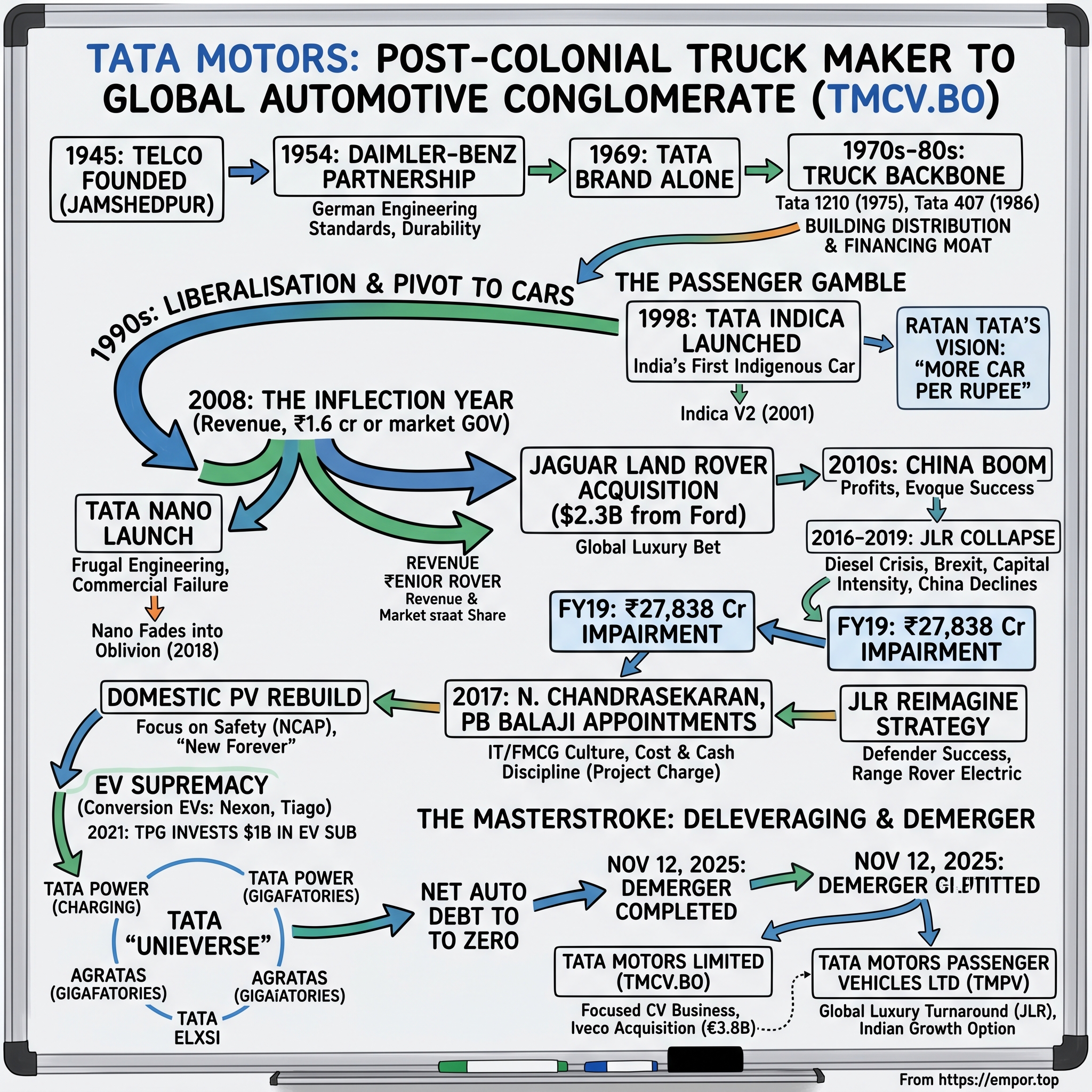
Tata Motors: From Post-Colonial Truck Maker to Global Automotive Conglomerate
I. Introduction & Episode Roadmap
On the morning of November 12, 2025, something strange happened on the Bombay Stock Exchange. A company called Tata Motors Limited began trading — for the first time. Not a re-listing. Not a name change on an existing line. A genuinely new scrip, ticker TMCV, with an ISIN that had never existed before.
This was odd, because Tata Motors Limited had been listed in Bombay since before most of the traders on that floor were born. The explanation is one of the more elegant pieces of corporate origami in recent Indian capital markets history. The commercial vehicle business had been carved out of the old parent into a fresh entity, TML Commercial Vehicles Limited — and then that fresh entity took the historic name. Meanwhile, the original listed company, the one holding the passenger cars, the electric vehicles, and Jaguar Land Rover, was renamed Tata Motors Passenger Vehicles Limited.1 The child inherited the surname. The parent changed its own.
Chairman N. Chandrasekaran summarised the moment plainly: "Today, the restructuring is done — we have two strong independent companies."2 It had taken roughly fifteen months from the August 2024 board approval to the listing bell, with an October 1, 2025 appointed date and a 1:1 share entitlement to every shareholder on record as of October 14, 2025.1
What broke apart that day was a genuinely strange organism. For seventeen years, one Indian listed company had contained two businesses with almost nothing in common: a domestic truck and bus manufacturer that sold to fleet operators counting rupees per tonne-kilometre, and a British luxury carmaker selling £100,000 Range Rovers to buyers in Beverly Hills, Shanghai and Dubai. They shared a balance sheet, a credit rating, and a stock price. They shared almost nothing else. One threw off cash in short, violent cycles tied to Indian infrastructure spending. The other consumed capital continuously — billions of pounds a year — in the endless arms race of premium automotive product development.
The conventional telling of this story is a triumph: a scrappy Indian truck maker buys two crown jewels of British industry from a distressed Ford in 2008, survives near-death, deleverages to zero, and unlocks value through a clean split. That telling is not wrong. It is, however, badly incomplete — and the incompleteness matters, because the story's most recent chapters have been unkind.
Consider what has happened since the demerger was first conceived. In FY25, the last full year as a single company, the group posted consolidated revenue of roughly ₹4.40 lakh crore, an automotive net cash position of about ₹1,000 crore, and a JLR EBIT margin of 8.5% — the British business's best in a decade.7 Eighteen months later, in FY26, JLR's revenue had fallen 21% to £22.9 billion, its adjusted EBIT margin had collapsed to 0.7%, it posted a full-year loss after tax of £244 million, and it burned £2.2 billion of free cash flow.4 The proximate causes were a cyberattack that stopped every JLR factory in the world for five weeks, US import tariffs, a deliberate wind-down of the entire Jaguar model range ahead of a relaunch, and a Chinese market that has become brutally hostile to legacy European luxury.
Meanwhile the commercial vehicle company — the one now carrying the Tata Motors Limited name and the TMCV ticker — quietly delivered its best year on record: FY26 standalone revenue of ₹77,400 crore, EBITDA margin of 13.2%, free cash flow of ₹9,200 crore, and a return on capital employed of 72%.3
The demerger, in other words, split the company at almost exactly the moment the two halves diverged most violently. Whether that was foresight, luck, or simply a long-overdue correction is one of the questions this story has to answer.
It is worth being clear at the outset about which company this story is about, because the naming makes it genuinely confusing. Tata Motors Limited today — ticker TMCV — is the commercial vehicle business: trucks, buses, small commercial vehicles, and shortly a large European acquisition. Jaguar Land Rover, the Nexon EV, the Punch and everything else in the passenger story now sits inside Tata Motors Passenger Vehicles Limited, a separate listed entity. But the history that produced both is a single history, and it cannot be told in halves. The truck business paid for the car business. The car business bought Jaguar Land Rover. Jaguar Land Rover's Chinese profits paid down the debt that constrained the truck business. Untangling them on a stock exchange in 2025 did not untangle them in the past.
Here is the road ahead. We start in a converted railway workshop in Jamshedpur in 1945, and the fifteen-year apprenticeship under German engineers that built India's truck backbone. We move to the 1990s, when a chairman with an architecture degree decided a truck company should build passenger cars, and was laughed at for it. We spend real time on 2008 — the single most consequential year, when Tata bought Jaguar and Land Rover for $2.3 billion and simultaneously launched a $2,000 car, and one of those bets nearly killed the company while the other one merely embarrassed it. We trace JLR's violent cycle through the Chinese boom, the diesel collapse, and a ₹27,838 crore impairment. We examine the turnaround playbook under Chandrasekaran and PB Balaji, the EV land-grab in India and its subsequent erosion, and finally the demerger and the €3.8 billion Iveco acquisition that immediately re-levered the truck company that had just been declared debt-free. Then we run the frameworks, the bull and bear cases, and the handful of numbers that actually matter from here.
 Subscribe on LinkedIn
II. Segment Economics & Revenue Architecture
Before the history, the anatomy — because the shape of these businesses explains almost every decision that follows.
Start with what the old consolidated entity actually looked like, since that structure defined seventeen years of strategy. In FY25, the final clean year before the split, Jaguar Land Rover generated £29.0 billion of revenue against consolidated group revenue of about ₹4.40 lakh crore — roughly three-quarters of the whole. The Indian commercial vehicle business contributed ₹75,053 crore of revenue, and the Indian passenger vehicle business ₹48,445 crore.7
Now look at the profit pools, which is where the asymmetry becomes uncomfortable. In that same FY25, JLR earned a PBT before exceptional items of £2,489 million — call it roughly ₹28,000 crore. The Indian CV business earned ₹6,649 crore. The Indian PV business earned ₹1,083 crore on an EBIT margin of 0.9%.7 So one business supplied the overwhelming majority of the group's earnings, another supplied a reliable but modest domestic stream, and the third — the passenger car business Indian retail investors were most excited about — was, on an operating basis, barely above break-even.
This is the structural fact that made Tata Motors so hard to own. An Indian investor buying the stock as a play on India's car market was, whether they realised it or not, buying a leveraged position on British luxury SUV demand in China and America. When JLR sneezed, the Indian shareholder caught pneumonia — and the Indian businesses they actually wanted exposure to were a rounding error in the consolidated P&L.
The capital allocation picture was worse than the revenue picture. Premium automotive product development is one of the most capital-hungry activities in industry. A single new vehicle architecture — the underlying skeleton of chassis, electrical system, and powertrain mounting that multiple models share — costs billions of pounds and takes half a decade. JLR's FY26 capital expenditure ran at £3.6 billion, with £3.7 billion guided for FY27.10 Against that, the Indian CV business spent roughly ₹2,000 crore of investment expenditure in the first nine months of FY26 and considered that consistent with guidance.19 The order-of-magnitude gap is the whole argument for the demerger in one comparison: two businesses whose capital cycles differ by a factor of twenty do not belong under one credit rating.
Post-split, the two entities look like genuinely different animals.
Tata Motors Limited (TMCV) is now a focused Indian commercial vehicle manufacturer. FY26 standalone revenue was ₹77,400 crore, up 11%, with EBITDA of ₹10,200 crore at a 13.2% margin and EBIT margin of 11.0% — an improvement of 180 basis points.3 It sold 428,000 units in FY26, up 14%, with domestic volumes up 12% and exports up a striking 54%. Its domestic CV market share was 35.7%, but the composition matters far more than the headline: 55.0% in heavy commercial vehicles, 39.5% in intermediate and light, and only 26.8% in small commercial vehicles.3 It ended the year with domestic net cash of ₹7,500 crore and consolidated net cash of ₹13,700 crore, and generated ₹9,200 crore of free cash flow — about 12% of revenue, a figure the CFO singled out on the results call.3
That last set of numbers describes something unusual in automotive: a manufacturer with a 72% return on capital employed. The reason is that Tata's truck business is asset-efficient in a way car businesses are not. Trucks change slowly, tooling amortises over long lives, and the dealer and service network — 1,800-plus touchpoints built over eight decades — was paid for generations ago.24 Capital goes into product refreshes, not into reinventing the vehicle every four years.
Tata Motors Passenger Vehicles Limited (TMPV) is the other animal entirely. FY26 consolidated revenue was ₹3.36 lakh crore, down 8.3%, with EBITDA margin of 6.8% and EBIT margin of just 1.1%.5 JLR is roughly three-quarters of it. The domestic passenger vehicle business sold over 640,000 units in FY26, up 15%, of which more than 92,000 were electric — up 43%.5 The domestic operation is finally scaling; the British operation is in the trough of a self-inflicted and externally-inflicted transition simultaneously.
For an investor, the practical consequence of the split is that you now choose your exposure. TMCV is a cyclical Indian industrial with high returns on capital, negative working capital dynamics in good years, and an imminent European acquisition. TMPV is a global premium automotive turnaround with an Indian growth option attached. These are not the same investment, and for seventeen years you could not buy one without the other.
Myth versus reality: three consensus numbers worth correcting.
The first is the idea that JLR reliably supplies around 70% of group EBITDA. That was approximately true in good years. It is a description of a cyclical peak, not a structural constant. In FY26, JLR's adjusted EBIT margin of 0.7% meant the British business contributed close to nothing at the operating line while still consuming £3.6 billion of capital expenditure.4 Anchoring on peak-cycle contribution shares is exactly how investors mis-modelled this company for a decade.
The second is that Tata commands a 38–40% share of Indian commercial vehicles. The company's own FY24 disclosure put retail share including subsidiaries at 39.1%.24 By FY26 the reported domestic CV share was 35.7%.3 Management has been explicit that this is deliberate: it now manages to "a basket of metrics" indicating profitable growth rather than share alone.19 The margin evidence supports that this was a choice — EBIT margin expanded 180 basis points in the same year share drifted down. But investors should carry the current number, not the legacy one.
The third, and the largest, is the widely repeated claim that Tata holds roughly 70% of India's passenger EV market. It does not, and has not for some time. The current figure is closer to 39%.6 We will come to why that matters enormously.
The genesis of that entanglement runs back eighty years, to a railway workshop that had never built a truck.
III. Foundations: TELCO, Daimler, & The Truck Backbone (1945–1990)
Picture Jamshedpur in 1945. India is two years from independence and the war economy is winding down. In an old East Indian Railway workshop, JRD Tata set up a company to build locomotives and heavy engineering equipment for a country that would soon have to build everything itself. He put a young engineer named Sumant Moolgaokar in charge. The Tata Locomotive and Engineering Company made boilers, road rollers, wagon underframes and steam locomotives.25 In its locomotive era it produced more than 1,100 locomotives, 950 road rollers and 5,000 railway wagons.
There is a detail here that shapes everything after. TELCO did not begin as a vehicle company. It began as a heavy engineering company — foundries, forges, precision casting, machining tolerances measured against railway standards. That industrial base, built for locomotives, turned out to be exactly what you need to build trucks that survive Indian roads. Almost every subsequent Tata advantage in commercial vehicles traces back to owning the metal.
The pivot came in 1954. TELCO partnered with Daimler-Benz of Germany to build medium trucks at Jamshedpur, and the first commercial vehicle — the TMB 312 — rolled out that year, powered by the first diesel engine Tata had manufactured in India.25 The collaboration ran for fifteen years, and its real product was not trucks. It was standards.
The Benz engineers who came to Jamshedpur were, by every account that survives, uncompromising. They brought German tolerances to a workshop that had been building wagon underframes. That transfer of process discipline — heat treatment, casting quality, assembly sequencing — is the single most valuable thing TELCO ever acquired, and it cost almost nothing relative to the JLR deal fifty-four years later. In 1955, a Tata truck completed the Geneva-to-Bombay International Motor Rally, roughly 12,875 kilometres across multiple countries, without a breakdown.25 For a country that had been importing everything, this was propaganda of the most useful kind: proof of durability.
By the late 1960s more than 175,000 Tata-Daimler Benz vehicles were on Indian roads, and vehicle production had overtaken locomotive manufacturing to the point where the company renamed itself Tata Engineering and Locomotive Company.25 The Daimler collaboration ended in 1969, and Telco began operating under the Tata brand alone.24 The Tata 1210 semi-forward truck, launched in 1975, became the workhorse of Indian freight — the vehicle that, more than any policy document, made Indian long-haul logistics possible.24 Heavy commercial vehicle manufacturing proper began in 1983, and the Tata 407 light truck arrived in 1986.24
Now, the standard story credits the License Raj for Tata's dominance — import controls, production quotas, a protected market. That is true but analytically lazy, and worth stress-testing, because the license regime protected Ashok Leyland equally and it did not produce equal outcomes.
What Tata actually built, under cover of protection, was a distribution and service moat that was extraordinarily expensive to replicate and almost impossible to attack head-on. A truck is not a product; it is a working asset. A fleet operator's economics depend on uptime, and uptime depends on whether a spare part and a competent mechanic exist within a few hours' drive of wherever the truck broke down. Tata spent decades seeding workshops, training mechanics, and stocking parts along every national highway corridor. By the time liberalisation arrived, a competitor could import a technically superior truck and still lose, because the customer's real question was never "which truck is better" but "which truck can I get running again by Thursday."
There is a second, subtler asset the license era created: financing relationships. Indian trucking is overwhelmingly financed, often by small operators with thin balance sheets buying one or two vehicles. A manufacturer whose products have decades of predictable resale values, and whose dealers have decades of relationships with lenders, makes the loan easier to approve. That is why Wagh's commentary in January 2026 about small fleet owners returning to the market mattered more than a volume number — participation by small operators is a direct read on credit availability in the segment, and credit availability is what converts freight demand into truck orders.19
That is the durable asset — and it is worth noting that it remains the single most defensible thing about the business trading under TMCV today. Eight decades of amortised distribution is why a 72% return on capital employed is even arithmetically possible.
One honest caveat about this era, since the outline frames it as monopolisation. Tata was never a monopolist. Ashok Leyland — backed by British engineering through its Leyland heritage and strong in southern India — remained a real competitor throughout, and the two split the market along regional and segment lines for decades. What Tata built was not the absence of competition but a structural cost and coverage advantage that made its economics durably better than the second player's. That distinction matters today, because the moat that survived liberalisation was the service network and the financing ecosystem, not the licence.
The protection ended abruptly in 1991. And the first person to understand that a truck moat would not automatically become a car moat was a chairman nobody expected to be radical.
IV. The Passenger Vehicle Gamble: The Indica & Ratan Tata's Vision (1991–2007)
Ratan Tata took over the Tata group in 1991 — the same year India dismantled its industrial licensing regime — and was, by the standards of the Indian business establishment, an unlikely disruptor. He had trained as an architect at Cornell. He was reserved to the point of shyness. He had spent years running unglamorous group businesses. The consensus view was that he was a caretaker between generations.
The consensus was wrong, and the evidence was a car.
In the liberalised market of the 1990s, the small-car segment belonged to Maruti Suzuki, the joint venture between the Indian government and Suzuki, which had spent a decade teaching India what a reliable modern small car felt like. Maruti had Japanese engineering, Japanese supplier discipline, and a distribution network in the segments that mattered. Every rational advisor told TELCO the same thing: stay in trucks, where you are unassailable, and do not attack a Japanese incumbent in the segment they invented.
Ratan Tata decided to do it anyway, and to do it in the hardest possible way — not by licensing a foreign platform, which is what everyone else in India did, but by designing the car in India from a blank sheet. The Tata Indica launched in 1998 as India's first fully indigenous passenger car, and it made India one of only about ten countries capable of designing and manufacturing its own automobile.25 The marketing line — more car per rupee — captured the value proposition precisely: a diesel hatchback with more interior room than anything at the price.
The launch was, by any honest accounting, a mess. Early Indica units suffered from engineering problems that a truck company's quality systems were not built to catch: a diesel engine that was loud in a way truck buyers tolerate and car buyers do not, gearbox and suspension complaints, trim and finish inconsistencies. In a passenger car market, where the customer is an individual spending household savings rather than a fleet manager doing a total-cost calculation, these failures compound into brand damage far faster than they would in commercial vehicles. Tata was learning, expensively, that the disciplines are not transferable.
Which brings us to 1999 and the most-retold scene in Indian business folklore: Ratan Tata travelling to Detroit to discuss selling the struggling passenger car business to Ford, and being told by Ford executives — in the version that has circulated for a quarter century — that Tata had no business entering the passenger car sector and that Ford would be doing them a favour by buying it. The specific words spoken in that room are not part of the public record, and the story has been polished by repetition. What is documented is what happened next, and it is the part that matters analytically.
Tata did not sell. Instead the company did the unglamorous work: the Indica V2, launched in 2001, fixed the noise, the refinement and the reliability complaints, and repositioned the car where its economics actually worked — as the default Indian taxi and fleet vehicle. That repositioning was smarter than it looked. Fleet buyers care about running cost per kilometre and parts availability, which happen to be the two things a truck company is structurally excellent at. Tata had found the passenger-car segment where its existing moat transferred.
The V2 became one of India's best-selling cars and, more importantly, established the proof point: Tata could design, build and sell passenger vehicles at scale. The lesson an investor should draw is not the romantic one about persistence. It is a sharper one about capability transfer — Tata's entry succeeded only where it could lean on assets it already owned, and struggled everywhere it had to build new muscle. That pattern repeats throughout this story.
It is also worth being precise about what the Indica did not achieve, because the mythology tends to overshoot. Designing a car indigenously is a national-capability milestone; it is not, by itself, a profit pool. Tata's passenger vehicle business would spend the next two decades struggling to earn a respectable return on capital, and would still be running EBIT margins under 1% as recently as FY25.7 The Indica proved the company could build cars. It did not prove the company could make money building them. Those are different propositions, and conflating them is precisely the error that would later be repeated with the Nano.
The other quiet legacy of this period was organisational. A truck company that has added a car division has two engineering cultures, two quality regimes, two dealer networks and two customer types under one roof — and, critically, one capital budget that must be split between them every year. That internal competition for capital, established in the 1990s, is the same tension that would eventually be resolved thirty years later by splitting the company in half.
Ratan Tata, having been dismissed by Ford, filed the memory away. Nine years later, Ford would be the seller, and Tata the buyer, in the deal that redefined the company — and it would happen in the same twelve months as the most publicly humiliating product failure in Indian automotive history.
V. The Inflection Year: JLR & The Nano (2008)
Two thousand and eight was the year Tata Motors bet the company twice, in opposite directions, at the same time.
The JLR acquisition. Ford's Premier Automotive Group — the collection of European luxury brands assembled in the 1990s under the theory that Detroit could run European premium marques — had become a slow-motion disaster. Ford had paid $2.5 billion for Jaguar in 1989 and about $2.7 billion for Land Rover in 2000. By 2007, with the American credit market seizing up and Ford's own survival in question, both were for sale.
Tata Motors announced the deal on March 26, 2008, and completed it on June 2, 2008, at a ceremony in Gaydon, England, for a net consideration of $2.3 billion in cash on a cash-free, debt-free basis.13 Ford contributed approximately $600 million to the Jaguar Land Rover pension plans as part of the separation.13 What Tata got was not just two brands: it acquired the manufacturing plants, two advanced design centres in the UK, the worldwide network of national sales companies, and — critically — perpetual royalty-free licences to all necessary intellectual property, with transition agreements from Ford covering engines, stampings, IT and test facilities.13 Ratan Tata called it "a momentous time," and noted the two "iconic British brands with worldwide growth prospects."13
The financial press was, to put it politely, unconvinced. The prevailing narrative held that an emerging-market conglomerate with no premium-automotive experience had bought two chronically loss-making brands at the top of a credit cycle out of national ego. The British unions were nervous. The analysts modelled disaster.
Look at the entry price with the benefit of eighteen years. Tata paid roughly 40% of what Ford had paid for the same assets, and did so at the precise moment global credit markets were closing. That is what buying a distressed asset in a liquidity crisis looks like: the seller is not optimising price, they are optimising certainty of close. But the crucial qualifier — and this is the lesson that gets lost in the triumphalist retelling — is that this only works if the buyer's balance sheet can survive the period between purchase and recovery. Tata bought in June 2008. Lehman Brothers failed in September 2008. Luxury car demand fell off a cliff, and Tata Motors spent the following eighteen months in genuine financial distress, scrambling for rights issues and bridge financing. The deal that later looked like genius was, for about two years, close to fatal. Timing an entry at the trough is only a masterstroke if you are still solvent at the recovery.
The Nano. Simultaneously, Tata was executing the other half of the bet — and here the company's own capital and its chairman's personal attention were consumed by a product that never worked commercially.
The Nano's origin story is genuinely moving: Ratan Tata watching a family of four balanced on a single scooter in Indian traffic and concluding that a safer four-wheeled alternative at a price such families could reach was both a moral and a commercial opportunity. The target price was ₹1 lakh — roughly $2,000 at the time. The car was unveiled at the Auto Expo in January 2008 and reached the market in March 2009 at close to that promised price.
As frugal engineering it was legitimately world-class: a rear-mounted two-cylinder engine, radically reduced part count, a design philosophy that questioned every component's existence. Engineering schools still teach it.
As a commercial product it failed on two fronts, one self-inflicted and one catastrophic.
The self-inflicted failure was positioning. The global press christened the Nano "the world's cheapest car," and Tata never successfully fought that framing. In a market where a first car is a hard-won status marker for an aspirational household, "cheapest" is not a value proposition — it is a stigma. The buyer Tata was targeting did not want the cheapest car; they wanted to stop being seen on a scooter. Early reports of Nano units catching fire, and a broader perception of thin quality, sealed it.
The catastrophic failure was political. Tata had begun building the Nano factory at Singur in West Bengal in 2007. Land acquisition for the site triggered sustained agitation, and in October 2008 — four months after closing the JLR deal — Tata Motors abandoned the West Bengal project entirely.17 The company relocated to Sanand in Gujarat at the invitation of the then chief minister, and the plant began operating in mid-2010.17
Read that sequence again with an investor's eye. In the same calendar year, Tata Motors closed a $2.3 billion cross-border acquisition into the teeth of a global financial crisis, and was forced to evacuate and rebuild a greenfield factory for its flagship domestic product. The capital destruction was real, but the scarcer resource was senior management attention — spent on a political crisis in West Bengal at exactly the moment JLR was haemorrhaging cash in Britain.
The Nano's ending was quiet. Production wound down through 2018; by mid-2018 the company was building units only against confirmed orders, and output effectively ceased that year.17 The Sanand plant, however, survived and was repurposed — converted to a flexible assembly line building the Tiago and Tigor alongside the Nano, and by 2018 accounting for roughly 60% of Tata's passenger vehicle production.17 The factory that a failed car built became the factory that a successful car range needed. That is the closest thing to a happy ending the Nano got.
The company emerged from 2008 owning two British luxury brands and one national embarrassment. Over the next decade, the British brands would take it to heights nobody predicted — and then very nearly destroy it.
VI. JLR's Rollercoaster: China Boom, Brexit Shock, & Near-Death (2009–2018)
The recovery, when it came, came from a direction almost nobody in the 2008 analyst notes had modelled: China.
Under CEO Ralf Speth, a German engineer and former BMW executive who took over JLR in 2010, and with Tata Sons granting the British management an unusual degree of operational autonomy, JLR did two things right in quick succession. First, it launched the Range Rover Evoque in 2011 — a compact, design-led SUV that opened the Land Rover brand to a younger, more urban, more female buyer than the traditional agricultural-heritage clientele. Second, it caught the Chinese luxury wave at precisely the right moment, eventually localising production through the Chery Jaguar Land Rover joint venture.
The economics of that period were extraordinary. Chinese buyers paid enormous premiums for imported European luxury SUVs, and JLR's incremental margin on those units was correspondingly rich. The British business generated EBIT margins above 14% in its best years and pumped billions of pounds of dividends back to Mumbai — cash that Tata Motors used to service the debt taken on to buy it in the first place. The acquisition, in the simplest possible framing, paid for itself out of Chinese demand for Evoques.
This is the point in the story where it is worth pausing to note how much of the "Tata rescued JLR" narrative depends on a single geographic bet that Tata did not engineer. JLR management executed the product and the localisation well. But the demand wave itself was exogenous — a once-in-a-generation expansion of Chinese luxury consumption that lifted every European premium marque. Attributing the whole recovery to acquisition genius overstates the case. Buying the asset cheap was the achievement; the cash flow that validated it arrived on a tide.
Tides go out. Between roughly 2016 and 2019, four things went wrong at once.
China turned. The rapid expansion had come with quality problems and a fractious dealer network, aggravated by disputes over parallel imports that undercut official dealers' economics. Chinese profitability collapsed far faster than volume did, because the pricing premium evaporated first. This is a pattern worth internalising, because it recurs in every premium market: when a luxury brand's scarcity value erodes, the damage shows up in realised price per unit long before it shows up in units. By the time volumes decline, the margin is already gone.
Diesel died. Here it helps to understand why a luxury SUV maker was so exposed. A large, heavy vehicle needs low-end pulling power — torque — and diesel engines deliver that far more efficiently than petrol engines of comparable output. For a company whose entire product range is heavy SUVs, diesel was not a preference; it was the physics-appropriate answer. So JLR built its European strategy around it, and around the emissions certification and engine plants that came with it. When the Volkswagen emissions scandal broke and European regulators and consumers turned decisively against diesel, JLR's exposure was near the top of the industry. This was not a demand problem management could fix with pricing. Replacing a powertrain strategy means new engines, new certification, new plant tooling and new supplier contracts — a five-year, multi-billion-pound programme executed while your current products are losing residual value in the showroom.
Brexit landed. A manufacturer with British plants, European supply chains, and a majority of sales outside the UK faced simultaneous currency volatility, tariff uncertainty, and supply chain re-planning costs.
And the capital base was too heavy. JLR was spending over £4 billion a year sustaining multiple overlapping legacy architectures. When volumes and prices fell, that fixed-cost structure converted a demand shock into an earnings catastrophe.
The reckoning arrived in the third quarter of FY19. Tata Motors took an impairment charge on JLR of ₹27,838 crore — about £3.1 billion — writing down the carrying value of capitalised investment, and posted a quarterly consolidated loss of roughly ₹26,993 crore, the largest in its history at that point.14 The full year FY19 consolidated net loss was ₹28,826 crore, against a profit of ₹8,989 crore the prior year.14
An impairment is a non-cash charge, and management said so at the time. But an investor should read it as more than an accounting entry. An impairment of that size is a formal admission that money already spent on product development would never earn its cost of capital — that JLR had been building vehicles on architectures the market would not pay enough for. Chandrasekaran's language on that result — "our domestic business delivered a resilient performance," with a "Turnaround 2.0" programme underway — was, in hindsight, an accurate read of where the group's stability actually lived.14
JLR returned to a quarterly profit of ₹1,117 crore in Q4 FY19.14 But the structural question was now unavoidable: could a British luxury manufacturer with a bloated cost base, a dying powertrain strategy, and a collapsed Chinese profit pool be fixed at all — and by whom?
VII. The Modern Turnaround: Chandrasekaran, Balaji, & "Project Charge" (2017–2023)
The answer arrived in the form of two men who were not car people.
N. Chandrasekaran became chairman of Tata Sons in 2017, having spent his career at Tata Consultancy Services, the group's IT services business — an operation whose entire culture is built on utilisation rates, delivery discipline and return on capital rather than product romance. Around the same time, PB Balaji joined as Tata Motors group chief financial officer in November 2017. Balaji had trained as a mechanical engineer at IIT Madras and taken a management diploma at IIM Calcutta, then spent most of his career in finance and supply chain roles at Unilever before moving into automotive.18 A consumer-goods CFO and an IT services chairman were now in charge of a British luxury carmaker.
That background turned out to be the point. Neither man was emotionally invested in the sedan programmes, the racing heritage, or the engineering pride that had made the cost base untouchable. They looked at JLR as a capital allocation problem.
The instrument was Project Charge, later Charge+ — a cost and cash programme that attacked working capital, material cost, warranty, investment phasing and fixed cost with a specificity JLR had not previously experienced. The strategic frame that followed, announced under Thierry Bolloré and continued by Adrian Mardell, was called Reimagine, and its central insight was brutal: JLR did not have a brand problem, it had a portfolio problem. It was spending premium-segment development money on products that earned mass-market margins.
The restructuring reorganised JLR around a House of Brands — Range Rover, Defender, Discovery and Jaguar as distinct propositions rather than a single confused hierarchy — and deliberately starved the low-margin end. Jaguar's sedans, which had been chasing BMW and Mercedes in segments where JLR had no scale advantage, were deprioritised. Range Rover and Defender, where JLR had genuine pricing power, absorbed the investment.
The Defender is the proof point that the strategy had real substance. When JLR relaunched it in 2020, the received wisdom was that modernising an icon would alienate the purists. Instead it became one of the most successful premium SUV launches of the decade, selling at prices the old Defender's buyers would have found absurd. The commercial lesson is that authenticity, properly executed, is monetisable — and that JLR's actual competitive advantage was never engineering excellence but the two brand names it owned.
By FY25 the results looked like vindication. JLR delivered revenue of £29.0 billion, an EBIT margin of 8.5% — described in the results release as its best in a decade — and PBT before exceptional items of £2,489 million, up 15%.7 Adrian Mardell, who had joined JLR as a graduate and spent 35 years there before becoming CEO, was credited by Chandrasekaran with "the stellar turnaround of JLR."18
The domestic passenger vehicle rebuild. Running in parallel, and rather less noticed, was a turnaround in India under Shailesh Chandra that was arguably more impressive per rupee spent.
Tata's Indian car business in 2018 was a distant also-ran with roughly 4% market share and an ageing product line. The strategy that fixed it, marketed as New Forever, rested on a genuinely differentiated insight: Indian consumers had begun to care about crash safety, and no volume manufacturer was selling it.
Global NCAP and Bharat NCAP crash ratings had historically been an embarrassment for Indian-built cars. Tata invested in structural safety and began winning five-star ratings across the Nexon, Harrier, Safari and Punch. This was counter-positioning in the textbook sense: incumbents optimising for the lowest possible cost per unit could not match Tata's safety structures without adding cost to their entire range and admitting their existing cars were less safe. Tata turned a specification into an identity.
The share gains followed. By FY26, Tata's domestic passenger vehicle share had reached about 13.0% for the full year, and roughly 14.1% in the second half — enough to make it India's second-largest passenger vehicle manufacturer in H2 FY26, though it finished the full year third behind Maruti Suzuki at 39.7% and Mahindra at 13.4%.12 Volumes exceeded 640,000 units in FY26, up 15%.5
The capital-efficiency signature of this turnaround is best captured by one transaction. In January 2023, Tata Passenger Electric Mobility completed the acquisition of Ford India's Sanand manufacturing plant for ₹725.7 crore, unlocking 300,000 units of annual capacity scalable to 420,000, and transferring Ford's eligible manufacturing employees.16 For roughly $90 million, Tata bought capacity that would have cost multiples of that to build greenfield — from the company that had once offered to buy its car business. The symbolism wrote itself. The economics were better than the symbolism.
Two turnarounds, then, running on different continents at different capital intensities. And underneath the Indian one, something was building that would briefly look like the most valuable asset in the entire group.
VIII. The Hidden Growth Engine: EV Supremacy & Tata "UniEverse" (2020–Present)
Around 2019, most global automakers reached the same conclusion about electrification: to build a credible EV you need a purpose-built platform — a clean-sheet architecture with the battery integrated into the floor, designed from the ground up for electric propulsion. It is the technically correct answer. It also costs billions of dollars and takes five years.
Tata Motors did the opposite, and for a while it worked spectacularly.
The approach was to take existing internal-combustion vehicles — the Nexon compact SUV, the Tiago hatchback — strip out the engine and fuel system, and package a battery and motor into the same body shell. Engineers call these conversion EVs, and purists disdain them: the packaging is compromised, interior space is worse than a native EV, and range per rupee of battery is lower.
But consider the economics from an Indian consumer's perspective. A purpose-built EV platform amortised over a market selling a few thousand electric cars a year produces a vehicle nobody can afford. A conversion, amortised over tooling already paid for by the petrol version, produces an electric car at a price an Indian upper-middle-class household can actually finance. Tata was not trying to build the best EV. It was trying to build the first EV Indians would buy — and it understood that in a market with essentially no EV demand, the binding constraint was price, not sophistication.
It worked. Tata built and then dominated India's passenger EV market, at times holding well over half of it, on capital expenditure that was a rounding error next to what Western manufacturers were spending on dedicated architectures.
The war chest arrived in October 2021, when TPG Rise Climate, with co-investor ADQ, agreed to invest $1 billion — ₹7,500 crore — into Tata's new passenger electric vehicle subsidiary for a stake of 11–15%, implying an equity valuation of up to $9.1 billion.15 The structure mattered as much as the number. By raising capital at the subsidiary, Tata funded dedicated EV architectures without drawing on a parent balance sheet that was still repairing itself from the JLR years. Jim Coulter of TPG framed the thesis around momentum in India's EV movement and supportive government policy.15
The Tata UniEverse. The second element of the strategy is one no standalone competitor can easily copy: the rest of the Tata group.
Tata Power builds public and home charging infrastructure — addressing the range anxiety that is the primary purchase objection in a country with patchy grid reliability. Tata AutoComp handles localised component supply and battery pack assembly. Tata Elxsi supplies software-defined vehicle engineering and automotive code. And Agratas, the group's dedicated battery subsidiary, is building cell manufacturing at scale on two continents: a 40 GWh gigafactory at the Gravity Smart Campus near Bridgwater in Somerset — set to be Britain's largest battery plant, with the steel frame of its first building complete at 525 metres long and production targeted to begin in 2026 — and a plant at Sanand in Gujarat, where the steel structure is complete and cell production is targeted from 2027.26 JLR and Tata Motors are Agratas's first OEM customers.
A word on why cell manufacturing is the load-bearing piece, because "gigafactory" has become a word people use without meaning. In an electric vehicle, the battery pack is typically 30–40% of the total cost — by far the largest single input, more expensive than the body, the interior and the motors combined. That pack is assembled from thousands of individual cells, and cells are made in enormous, capital-intensive plants where the economics are driven by scale and yield. An automaker that buys cells on the open market is, in effect, a reseller of somebody else's most valuable component, and is exposed to their pricing, their capacity allocation and their chemistry roadmap. An automaker that makes its own cells controls its own cost curve. This is why every serious EV player is either building cell capacity or locking up long-term supply, and why the group deciding to fund Agratas is more strategically consequential than any individual Tata EV model.
The theoretical advantage is therefore real: a manufacturer that owns cells, charging, software and components inside one group captures margin at every layer and can subsidise across them. Maruti Suzuki and Hyundai cannot replicate that without either building it or negotiating it with third parties. The catch is timing — none of it is yet in the cost base.
Now the part the bulls do not lead with.
Tata's EV market share has been falling — hard. In FY26, India sold roughly 200,000 electric passenger vehicles, up about 84% year on year to 4.3% of a 4.7 million-unit passenger vehicle market. Tata sold 78,811 EVs, up 36%, for a market share of roughly 39% — down from over 53% the prior year.6 Mahindra sold 42,721, up more than 400%, taking its share to about 21%. JSW MG sold 53,089, up 74%. Maruti's e-Vitara entered late and sold 1,416 units in under two months.6
That is what a first-mover advantage looks like when it meets real competition. Tata grew its EV volumes 36% and still lost fourteen points of share, because the market grew 84% and everyone else finally showed up. The company's own framing — that it retains leadership and that EVs are about 12% of its passenger vehicle sales, well above industry average — is accurate.6 But the mechanism that produced the original dominance was a competitive vacuum, not a structural moat. The vacuum has closed.
The forward plan is correspondingly heavier: Tata has guided to investment of over ₹45,000 crore in the car business through FY30, of which ₹16,000–18,000 crore is earmarked for EVs, and targets EVs at more than 30% of its volumes by FY30. At its June 2026 investor day the passenger vehicle company set out a target of more than 1.2 million units and 20% domestic market share by FY31, from about 640,000 units and 13% in FY26, expanding to 15 nameplates and growing sales outlets from 1,669 to 3,200.12 Management described a multi-powertrain strategy — petrol, diesel, CNG and electric — as "the largest lever."12
That is a near-doubling of volume in five years in a market where the company has just demonstrated it can lose share while growing. The plan is not implausible; India's passenger vehicle penetration is genuinely low and Tata's product cadence has been good. But it should be assessed as an ambition requiring roughly ₹45,000 crore of capital to validate, not as an extrapolation of an established trend.
Which raises the question that had been hanging over the group since 2008: how do you fund a domestic growth business, a global luxury turnaround, and a battery build-out from one balance sheet? The answer, eventually, was that you don't.
IX. The Masterstroke: Balance Sheet Cleanup & The Demerger (2024–2025)
For most of the 2010s, the single number that determined Tata Motors' equity story was automotive net debt. It peaked above ₹65,000 crore. It carried a punitive interest cost, constrained the credit rating, forced defensive capital decisions at both JLR and the Indian businesses, and meant that in any downturn the equity was structurally subordinated to a large fixed claim.
Balaji's central promise as group CFO was to eliminate it. He said so repeatedly, on call after call, with a specificity that made the commitment easy to score.
He delivered. In FY25, Tata Motors reported consolidated revenue of ₹4,39,695 crore, EBITDA of ₹57,600 crore, PBT before exceptional items of ₹34,330 crore, PAT of ₹28,100 crore — and, critically, an automotive net cash position of ₹1,000 crore.7 The group also declared a final dividend of ₹6 per share.7 Guidance given years earlier had been met on schedule.
This deserves to be scored honestly, because guidance discipline is one of the few objective tests of management credibility available to an outside investor. Balaji set a hard, falsifiable, multi-year target in a cyclical business, restated it publicly and repeatedly, and hit it. That track record is why his subsequent appointment as JLR's chief executive — announced in August 2025, effective November 2025, succeeding Mardell — was read by the market as Tata sending its most credible operator to its hardest problem.18
The demerger. The structural fix followed the balance sheet fix.
The board approved the composite scheme of arrangement on August 1, 2024: demerge the commercial vehicle business into TML Commercial Vehicles Limited, merge the passenger vehicle entity into the existing listed company, and give every shareholder one share of the new CV company for each share held.1 The stated rationale was to "empower the respective business groups to pursue their differentiated strategies with greater agility while reinforcing accountability."1 The scheme was advised by PwC on share entitlement, SBI Capital Markets on fairness, AZB & Partners on law, and Deloitte on tax, and management guided to 12–15 months for approvals.1
The mechanics ran roughly on schedule. The appointed date was October 1, 2025; the record date October 14, 2025; and TMCV listed on November 12, 2025, opening at ₹335 on the NSE against an implied value of ₹260.75 — a debut premium of about 28%.2 That premium is the market's crude estimate of the conglomerate discount that had been sitting on the CV business: investors had been valuing India's most profitable truck franchise as an appendage to a British luxury carmaker's earnings volatility, and repriced it the moment it stood alone.
The strategic logic is genuinely sound. A commercial vehicle business with 72% ROCE, 13% EBITDA margins and free cash flow at 12% of revenue is an industrial capital-goods asset, and industrial capital-goods assets trade on a different set of multiples and attract a different shareholder base than global premium automotive turnarounds.3 Separating them lets each attract its natural owner, sets its own capital structure, and pursues M&A on its own credit.
Now the stress test, because "masterstroke" is the outline's word and it deserves interrogation.
First, the net-cash position was a moment, not a state. Within weeks of the split, the commercial vehicle company announced the largest overseas acquisition in Indian automotive history since JLR: a €3.8 billion all-cash voluntary tender offer for Iveco Group at €14.1 per share, announced July 30, 2025, excluding Iveco's defence business.9 The combined entity would sell over 540,000 units annually with roughly €22 billion of revenue split across Europe, India and the Americas. Tata secured a $4.5 billion bridge loan to fund it. A company that spent seven years telling investors that debt reduction was the paramount objective re-levered decisively at the first opportunity after achieving the target. That is not necessarily wrong — the strategic case for European scale and technology access in commercial vehicles is arguable — but investors should note the pattern and price it.
Second, the timing. The split completed just as JLR entered its worst year since the FY19 impairment. On September 2, 2025, JLR announced it had been hit by a cyber incident and shut down all global systems; production restarted on a phased basis from October 8, 2025.8 Q2 FY26 revenue fell 24% to £4.9 billion, with a loss before tax of £485 million and £196 million of direct cyber costs, plus £42 million of voluntary redundancy charges.8 H1 free cash outflow was £1.5 billion. JLR secured a £1.5 billion UK Export Finance-guaranteed loan in October to shore up liquidity, ending September with £3.0 billion cash and £6.6 billion total liquidity, and cut FY26 guidance to a 0–2% EBIT margin with £2.2–2.5 billion of free cash outflow.8
The demerger did not cause any of this. But it did mean that shareholders who woke up on November 12 holding two stocks found one of them entering a crisis that would have been substantially cushioned by the other's cash flows under the old structure. Conglomerate structures destroy value by obscuring good businesses; they also absorb shocks. Tata gave up the shock absorber. In FY26, TMPV's Q3 produced a consolidated net loss of ₹3,486 crore on revenue down 26%, with JLR revenue down 39% and its EBITDA margin at 0.7%.20 The CV company, in the same quarter, delivered its tenth consecutive quarter of double-digit EBITDA margin and its first ever double-digit segment EBIT margin at 10.6%.19
Two companies, one quarter, opposite realities. Which is, in fairness, precisely the argument the demerger was built on.
Third, and least discussed: the demerger removed an internal capital allocation mechanism that had real value even as it destroyed valuation clarity. Under the old structure, JLR's Chinese windfall in the early 2010s funded the deleveraging that eventually let the Indian businesses invest. The Indian CV cash flows cushioned the FY19 impairment year. That cross-subsidy was inefficient and opaque — but it was also the reason the group survived 2009 and 2019. Two standalone companies must each raise capital on their own merits, at their own cost of capital, in whatever market conditions prevail when they need it. For the passenger vehicle entity, which entered its first independent year with a £2.2 billion cash burn and a state-guaranteed loan on its balance sheet, that is a materially different risk position than it occupied eighteen months earlier.
None of which makes the split wrong. The listing-day premium was real money, the strategic clarity is genuine, and the CV company's ability to pursue Iveco on its own credit is a direct consequence of standing alone. But "masterstroke" implies a costless improvement, and this was a trade: valuation transparency and strategic focus, purchased with the loss of diversification and internal funding flexibility. Whether it was a good trade depends almost entirely on whether JLR's FY27 targets hold.
X. Strategic Frameworks: 7 Powers & Porter's 5 Forces
Frameworks are only useful if they survive contact with evidence. Run these two against what the numbers actually show.
Hamilton Helmer's 7 Powers.
Scale Economies — strongest in Indian commercial vehicles, weakest at JLR. Tata's CV business manufactures across four plants — Jamshedpur, Lucknow, Pune and Dharwad — with what Girish Wagh described as "fair bit of flexibility" to move products between them, sharing engines, chassis architectures and supplier tooling across the widest CV range in India.19 JLR's problem, by contrast, has always been insufficient scale: at roughly 300,000–400,000 units it competes against German rivals selling two to three million. That is why breakeven volume, not revenue, has been the organising metric of every JLR turnaround programme. The FY27 target is to reduce cash breakeven to roughly 300,000 vehicles via £1.7 billion of cumulative savings under a programme called Enterprise Missions.10 A business whose strategy is to shrink its breakeven point rather than expand its volume does not have scale economies. It is managing their absence.
Cornered Resource — real, and located almost entirely in two trademarks. Range Rover and Defender are the genuine article: names with heritage that cannot be manufactured, commanding prices no functionally equivalent vehicle could. When JLR's EBIT margin hit 10.7% in Q4 FY25, essentially all of it came from these two lines.7 Jaguar, notably, is not this. Its brand equity has been eroding for two decades, which is why management has effectively bet the marque on a complete reinvention.
Process Power — this is where the Tata group integration claim lives, and it should be treated as promising rather than proven. Owning Tata Power's charging network, Tata Elxsi's software, Tata AutoComp's packaging and Agratas's cells is a genuine structural difference from Maruti or Hyundai. But the evidence that it lowers landed cost per EV today is not yet in the public numbers — Agratas's Somerset plant is only starting production in 2026 and Sanand not until 2027.26 Meanwhile Tata lost fourteen points of EV share in a single year to competitors without any of this apparatus.6 The synergy may prove out from 2027. It has not yet.
Counter-Positioning — the clearest historical example in this story, and now largely spent. Tata's ICE-to-EV conversion strategy was exactly the asymmetry Helmer describes: an approach incumbents could see clearly but would not copy, because global OEMs had committed to dedicated platforms and could not credibly reverse. That window closed when Mahindra, MG and Maruti localised. The safety-rating play in domestic passenger cars was the same manoeuvre and has proven more durable, because matching it requires competitors to redesign structures and implicitly disparage their own installed base.
Switching Costs — underrated, and concentrated in commercial vehicles. A fleet operator running 200 Tata trucks has trained mechanics, stocked parts, financing relationships and telematics data all bound to one manufacturer. Fleet Edge, the CV telematics platform, deepens this by making the operator's own utilisation and fuel data live inside Tata's ecosystem.24 Nothing comparable protects the passenger car business.
Porter's Five Forces, applied separately to each company, because they face different worlds.
Buyer power is high and rising in Indian passenger cars. Consumers face intense competition among Maruti, Hyundai, Mahindra, Kia, Toyota and now Chinese-backed JSW MG, with near-perfect price transparency and negligible switching costs. Tata's 1.1% FY26 EBIT margin on the consolidated passenger entity tells you who holds the power.5 In commercial vehicles buyer power is more nuanced: large fleets negotiate hard, but Wagh's commentary that discounts could moderate "as demand goes up" — and that the company had passed a 1% price increase in January 2026 to offset commodity costs — suggests genuine, if cyclical, pricing latitude.19 At JLR, buyer power is lowest for Range Rover and Defender and highest everywhere else.
Threat of new entrants is the defining risk for JLR. Chinese OEMs have entered European and Middle Eastern premium segments with technically competitive, better-connected, cheaper electric SUVs. In India, the CV business enjoys a much higher barrier, because a new entrant must replicate 1,800-plus service touchpoints before a fleet operator will consider them.24
Supplier power showed up concretely in FY26. Wagh flagged capacity bottlenecks at Indian suppliers — specifically in castings — as demand rose simultaneously across two-wheelers, three-wheelers, cars and commercial vehicles, requiring de-bottlenecking actions.19 Precious metal price volatility also hit material costs.19 These are the ordinary supplier frictions of a cyclical upturn, but they cap how fast the CV business can convert demand into volume.
Substitutes are a genuine long-duration threat in Indian trucking. Dedicated rail freight corridors structurally shift long-haul tonnage off roads. The mitigation is that India's freight growth has been fast enough to absorb both, and that the mix shift toward tippers — driven by mining, infrastructure and urban construction, which Wagh identified as growth drivers — is inherently road-bound.19
On new entrants, one comparison is worth making explicit. 比亚迪 BYD and the broader Chinese cohort did not become competitive in premium SUVs by out-engineering Land Rover on chassis dynamics. They became competitive by being three to five years ahead on the things buyers under forty now evaluate first — infotainment responsiveness, over-the-air software updates, driver assistance, and charging speed — while matching on interior quality at a lower price. That is a genuinely difficult attack to counter, because it requires a legacy manufacturer to rebuild its software organisation, not its factories. JLR's answer is a group software capability via Tata Elxsi and an 800-volt electrical architecture. Whether that closes the gap is an open empirical question, and one where the burden of proof sits squarely with management.
Rivalry is where the two companies differ most sharply. Indian CV rivalry is a stable oligopoly with high entry barriers, and Tata's own commentary reflects a mature competitive posture: management explicitly stated it no longer manages to market share as a single metric but to "a basket of metrics" indicating profitable growth.19 That is a rational stance — and also a convenient framing for a company whose overall CV share drifted to 35.7% in FY26 from higher levels earlier in the decade.3 Global premium automotive rivalry, by contrast, is a capital-intensity arms race against better-capitalised German incumbents and better-funded Chinese challengers.
The frameworks converge on one conclusion: the durable, evidence-backed competitive advantages sit disproportionately in the truck business. JLR owns two of the best brand assets in the industry, but sits in the structurally harder competitive position.
XI. Investor Playbook & Activist Stress Test
The bull case, tested against evidence.
The commercial vehicle franchise is genuinely excellent, and now visible. FY26 delivered ₹77,400 crore of standalone revenue up 11%, a 13.2% EBITDA margin, an 11.0% EBIT margin up 180 basis points, ₹9,200 crore of free cash flow, and a 72% return on capital employed against 61% the prior year.3 Exports grew 54%, including a 70,000-unit order from Indonesia for Yodha and Ultra T.7 trucks.3 The evidence supporting the moat is concrete: 55% share in heavy commercial vehicles, an eight-decade service network, and switching costs that make fleet operators sticky. Wagh characterised FY26 as "a clear inflection point for the commercial vehicles industry, with volumes surpassing pre-FY19 peak."3
The Indian passenger vehicle business has real momentum. Record FY26 volumes above 640,000 units, up 15%, with the domestic business benefiting from India's September 2025 GST rate rationalisation — GST 2.0 — which Wagh said drove 2–5% freight rate improvements and increased demand across categories.19 The safety-led product strategy is a genuine differentiator.
JLR's Q4 FY26 shows the machine still works when it runs. Q4 revenue of £6.9 billion, up 51% sequentially, a 9.2% EBIT margin, £458 million of PBT and £829 million of free cash flow demonstrate that once the cyberattack disruption cleared, the underlying product-and-cost structure produced acceptable returns.4 The Range Rover Electric had close to 77,000 names on its waitlist ahead of a late-2026 delivery window.
The bear case, and the activist stress test.
JLR's FY26 was worse than "one bad year." Full-year revenue fell 20.9% to £22.9 billion; adjusted EBIT margin was 0.7% against 8.5%; PBT before exceptional items collapsed from £2.5 billion to £14 million; and the business posted a £244 million loss after tax while burning £2.2 billion of free cash flow.4 Only some of that was the cyberattack. The Jaguar wind-down was a deliberate management choice, the tariff exposure was a known structural risk, and Chinese weakness has been visible since 2016.
The Jaguar gamble is the single largest binary in the story. JLR killed off its entire existing Jaguar range before its replacement existed — surrendering the revenue with no bridge — in order to relaunch the marque as an ultra-premium electric-only brand. The first product, the Type 01 four-door grand tourer, was still awaiting reveal as of the June 2026 investor day.10 The rebrand itself proved divisive enough that JLR's long-serving chief creative officer departed amid the backlash. If affluent buyers do not accept a six-figure electric Jaguar, the write-off is measured in billions and the marque's residual brand equity goes with it. There is no partial credit here.
Management reversed a strategic commitment, and the market noticed. At the investor day on June 18, 2026, JLR set FY27 targets of £26 billion revenue and roughly 4% EBIT margin, with capital expenditure of £3.7 billion and operating cash flow at breakeven versus a £2.3 billion outflow in FY26.10 It also confirmed that the Electrified Modular Architecture — originally conceived as an electric platform — would now accommodate mild hybrids, full hybrids and plug-in hybrids alongside battery-electric variants across Range Rover, Defender and Discovery.11 CEO Balaji framed the pivot around North America, currently 28% of wholesales, stating an aspiration "to grow our US business to the size of the entire JLR business as it exists today," supported by a collaboration with Stellantis on Defender variants for American buyers.1110
An activist would read that slide deck carefully. Reimagine was sold to investors as an electric-first transformation. Four years later the platform is multi-powertrain, the flagship electric Range Rover has slipped to late 2026, and the FY27 margin target of 4% came in below sell-side expectations — TMPV shares fell 8% on the day.11 Pivoting to hybrids as EV demand softened is defensible commercial pragmatism. But it is a reversal, and a company that reverses a strategy it spent years defending owes investors a clearer account of what it got wrong than "the market changed."
The deleveraging promise had a short half-life. Net automotive debt went to zero in FY25 and the CV company announced a €3.8 billion acquisition funded by a $4.5 billion bridge loan within months.79 Iveco's closing has also slipped — from an original expectation of Q1 FY27, to Q2 FY27 on the Q4 call, with Iveco itself now guiding to the third calendar quarter of 2026, contingent on first separating its defence business.319 Deal timelines slipping by two quarters is not alarming in cross-border industrials. But integrating a European commercial vehicle manufacturer with different labour structures, emissions regimes and dealer economics is precisely the kind of undertaking that historically destroys value, and Tata's own answer on the most basic synergy question — cross-selling between the ranges — was that management was "not in a position to give more details" and would revisit it in a quarter or two.19 For a €3.8 billion transaction, that is thin.
Concentration and cyber risk are now proven, not theoretical. A single intrusion halted every JLR plant globally for five weeks and cost £196 million directly, with hundreds of millions more in lost volume.8 For a manufacturer running lean inventory across a deeply interconnected supplier base, IT systems are load-bearing infrastructure. The FY26 accounts also carried exceptional items at the CV entity: roughly ₹603 crore from India's new labour code, ₹960 crore of demerger costs, and ₹82 crore of Iveco acquisition costs — ₹1,500 crore standalone, ₹1,600 crore consolidated in Q3 alone, which management characterised as non-recurring.19 Full-year FY26 exceptional items of ₹3,700 crore turned a 46% rise in PBT before exceptionals into a 23% decline in reported PAT.3 Investors should watch whether "one-time" items recur.
EV leadership is eroding in real time. Share fell from over 53% to roughly 39% in one year while the market grew 84%.6 Management's response is a ₹16,000–18,000 crore EV investment programme through FY30 and a multi-powertrain hedge. That is a rational response to losing a lead. It is not evidence of a moat.
A few second-layer items worth watching. JLR's liquidity architecture changed materially in FY26 and now includes a £1.5 billion loan guaranteed by UK Export Finance — a state-backed facility, secured during the cyber crisis, that a British luxury manufacturer would not ordinarily need.8 Total liquidity of £6.9 billion at March 31, 2026 included a £1.7 billion undrawn revolving credit facility and a £1.0 billion bridge facility.4 Separately, at the commercial vehicle company, the mark-to-market treatment of its stake in Tata Capital has begun swinging quarterly profit before tax meaningfully — a ₹295 crore gain in Q3 FY26 against a ₹2,350 crore loss in Q2.19 That is a non-operating item flowing through reported earnings, and analysts modelling the CV business should strip it out. The Iveco financing package — a $4.5 billion bridge loan intended to be refinanced with a mix of equity and long-term debt over 12–18 months — also implies a potential equity issuance at the CV entity that current shareholders should factor into their dilution assumptions.
Cyclicality remains unhedged at the CV company. Wagh's own outlook was explicitly conditional: growth continues "if GDP continues to grow at this rate, consumption remains at a higher level, the infrastructure mining activity continues at this level."19 He declined to give full-year segment guidance in January 2026, preferring to wait a quarter.19 That is honest — and it is also a reminder that FY26's record was partly a base effect off a weak FY25 and partly a GST-driven demand pull-forward.
The KPIs that actually matter.
Three, and only three.
1. JLR's free cash flow and progress toward the ~300,000-unit cash breakeven. Everything about the passenger vehicle entity's equity value flows from whether JLR self-funds. FY26 burned £2.2 billion; FY27 targets operating cash flow breakeven.410 Watch the quarterly free cash flow line and the stated breakeven volume, not the revenue headline — a luxury manufacturer can grow revenue and still consume cash indefinitely, which is precisely what happened between 2016 and 2019.
2. Tata's Indian EV market share, tracked monthly against Mahindra and MG. This is the cleanest available read on whether the UniEverse integration is a genuine cost advantage or a story. If Agratas cells and Tata Power charging deliver, share should stabilise or recover as Sanand comes online from 2027. If share keeps sliding while the ₹16,000–18,000 crore is being spent, the moat thesis is falsified.6
3. The CV company's EBITDA margin through a full cycle — and the same number post-Iveco. FY26's 13.2% standalone margin was achieved in an upcycle with favourable mix.3 The question is what it looks like in a down year, and separately, whether consolidating a European business with structurally lower margins dilutes it. Iveco is the largest single variable in TMCV's forward earnings profile, and its margin contribution will be visible from the first consolidated quarter.
XII. Primary Source & Transcript Roadmap for Analysts
For anyone building their own view rather than borrowing one, the primary documents are unusually accessible — and they reveal considerably more than the press coverage.
Start with the demerger documentation. The August 1, 2024 scheme announcement lays out the composite arrangement, the 1:1 entitlement, the advisors, and the 12–15 month approval timeline that management essentially met.1 Read it against the actual outcome — appointed date October 1, 2025, listing November 12, 2025 — as a discipline test.2 Management said fifteen months and took about fifteen months. That is a data point about execution reliability worth carrying into judgments about the Iveco timeline.
Read the FY25 results release as the pre-split baseline. It is the last clean apples-to-apples view of the whole group: ₹4,39,695 crore revenue, ₹34,330 crore PBT before exceptionals, ₹1,000 crore net automotive cash, JLR at 8.5% EBIT.7 Every subsequent comparison — including the "JLR revenue down 21%" headline — is measured against this base, and it was a peak.
Then read the two FY26 results releases side by side. The commercial vehicle company's Q4 and full-year FY26 release and the JLR FY26 release, published within days of each other, describe two companies that until recently shared a balance sheet.34 One reports a 72% ROCE and record free cash flow; the other reports a full-year loss after tax and a £2.2 billion cash burn. Reading them consecutively is the fastest way to understand what the demerger actually separated.
The earnings calls are where the texture lives. The commercial vehicle company's Q3 FY26 call, held January 29, 2026, is unusually rich.19 CFO GV Ramanan opened with a full accounting of exceptional items — the labour code charge, demerger costs, Iveco acquisition costs — before discussing performance, which is a reasonable proxy for disclosure culture. Wagh's answers on supply chain bottlenecks in castings, on bus tender discipline, and on why the company did not bid to win the PM e-Sewa electric bus tender are worth reading in full. On that last point his answer was specific and unusually candid: the company would only participate where payment security, asset-light structure and financial prudence were satisfied, and "we are not L1 in any of these tenders."19 Declining to win volume on unattractive terms, and saying so plainly to analysts, is a behavioural signal about capital discipline that no ratio captures.
For JLR, the June 18, 2026 investor day is the essential document. The FY27 targets — £26 billion revenue, ~4% EBIT, £3.7 billion capex, £1.7 billion of Enterprise Missions savings, ~300,000-unit cash breakeven — are specific enough to score against.10 Read them alongside the earlier Reimagine materials and note what changed: the EMA platform's expansion from electric-only to multi-powertrain, and the elevation of North America over China as the growth priority.11 Comparing successive strategy presentations is the single most useful diagnostic available for management narrative consistency.
The Q2 and Q3 FY26 releases document the crisis. JLR's Q2 FY26 release gives the cyber incident chronology — announced September 2, 2025, phased production restart October 8, 2025 — with £196 million of direct costs, £238 million of total exceptional items, a £1.5 billion H1 cash outflow, and the £1.5 billion UKEF-guaranteed loan.8 TMPV's Q3 FY26 results show the carryover: a ₹3,486 crore consolidated net loss, revenue down 26%, JLR revenue down 39%.20 CFO Dhiman Gupta's framing — "a challenging quarter as anticipated on account of the carryover impact" — is worth comparing against what the company had told investors a quarter earlier.20
Finally, the Iveco transaction documents. The July 30, 2025 announcement sets the terms: €14.1 per share, approximately €3.8 billion, all-cash voluntary tender offer, conditional on separation of Iveco's defence business.9 The gap between that announcement and closing — with Italian Golden Power approval in October 2025, EU merger and foreign-subsidy clearances during 2026, and residual French and Spanish financial regulator approvals — is the live governance story at the commercial vehicle company.
What to look for when you read them. Three habits make these documents far more informative than the headlines derived from them.
First, read the exceptional items before the profit line. The FY26 CV accounts are the case study: reported PAT fell 23% while PBT before exceptional items rose 46%, entirely because of ₹3,700 crore of one-time charges.3 Whether an investor concludes the year was excellent or poor depends on which line they anchor to, and management's framing will naturally favour one.
Second, read prepared remarks and Q&A as separate documents. Prepared remarks tell you what management wants emphasised; the Q&A tells you what analysts do not believe. The gap between them is the useful signal. On the Q3 FY26 CV call, the prepared remarks led with 17 new truck launches and record margins; the analyst questions clustered around supply chain bottlenecks, discount levels, working capital sustainability and Iveco cross-selling.19 That is the honest agenda.
Third, compare each investor day against its predecessor rather than against consensus estimates. Consensus moves with the company. Prior guidance does not. The most valuable single exercise available to a Tata Motors analyst today is to place the original Reimagine materials, the FY25 results release and the June 2026 investor day deck side by side and mark every commitment that changed.212223
XIII. Epilogue & Lessons for Founders and Investors
Eighty-one years after JRD Tata put Sumant Moolgaokar in charge of a railway workshop, the enterprise that grew out of it exists as two separate listed companies with two different problems.
Buying distressed assets is a balance-sheet question, not a valuation question. Tata bought Jaguar Land Rover for roughly 40% of what Ford had paid, weeks before the global financial system froze.13 The entry price was extraordinary. It was also nearly irrelevant, because what determined the outcome was whether Tata Motors could survive the eighteen months of illiquidity that followed. Founders who admire the trade should note that the skill on display was not identifying a cheap asset — that was obvious — but financing the holding period. A great price on an asset you are forced to sell at the bottom is not a great trade.
Frugality is a strategy for markets, not a strategy for status. The Nano and the conversion EVs were the same idea executed against different customer psychology, and the results diverged completely. The Nano stripped cost from a product where the customer was buying social arrival, and the word "cheapest" destroyed it. The Nexon EV stripped cost from a product where the customer was buying a second car and a lower running cost, and it created a market. Frugal engineering does not fail or succeed on engineering. It fails or succeeds on whether the customer is buying utility or identity.
Capability transfers, but only along existing seams. Every Tata Motors success in this eighty-year story came from extending something the company already owned — Daimler's process discipline into truck manufacturing, the truck service network into fleet cars, existing petrol tooling into electric vehicles, an underused Ford factory into passenger vehicle capacity. Every expensive failure came from building a new muscle from scratch in a market whose customer the company did not yet understand. That is not an argument against ambition. It is an argument for being honest about which kind of bet you are making, and pricing the second kind accordingly.
Conglomerate structures both destroy and absorb. The 28% listing-day premium on the commercial vehicle company was the market paying out a discount it had applied for years.2 But within a single quarter, the newly independent passenger vehicle company faced a cyberattack, tariffs, a Chinese downturn and a self-imposed Jaguar revenue gap with no truck cash flows to lean on. Simplification is genuinely valuable, and it is not free. Investors should be as clear-eyed about what a demerger removes as about what it unlocks.
Cyclical businesses reward operators who refuse volume. The most instructive single moment in the recent record is not a headline number. It is Girish Wagh telling analysts, plainly, that Tata did not win a single lot of a 10,900-unit government electric bus tender, and explaining exactly why: the payment security, asset-light structure and pricing did not clear his bar, and "we want to be very patient for this business because this is just the beginning."19 Every incentive in a capital-intensive manufacturing business pushes toward filling the factory. A management team that walks away from a marquee national order, tells the market it walked away, and points to an eventual 850,000-bus electrification opportunity as the reason to stay disciplined, is exhibiting the behaviour that produces a 72% return on capital.193 Investors should weight that more heavily than any margin target, because it is observable, costly, and hard to fake.
Guidance discipline is the most reliable management signal available. Balaji told investors for years that net automotive debt would go to zero, and it did.7 The board said the demerger would take 12–15 months, and it took about fifteen.12 Those are objective, falsifiable commitments that were met — which is exactly why the subsequent items deserve equally rigorous scoring: an EV market share that fell from over 53% to 39% in one year, a JLR EBIT margin that went from 8.5% to 0.7%, an electric-first platform strategy that became multi-powertrain, and a debt-free balance sheet that was re-levered for a €3.8 billion European acquisition within months of the promise being fulfilled.64119
None of that means the current plans will fail. The commercial vehicle company is, on the evidence of FY26, one of the highest-returning industrial franchises in India. JLR's Q4 FY26 showed the operating model still functions when it is not being interrupted. Both companies now have management teams that can be judged on their own results rather than each other's.
But the honest version of this story is not a straight line from post-colonial truck maker to global champion. It is a company that has been rescued twice by a business its founders would recognise — a truck franchise built on distribution, service and eight decades of amortised capital — while the glamorous half kept oscillating between spectacular and existential. Whether the split finally lets each be what it is, or simply removes the safety net from the volatile one, is the question the next five years will answer.
References
-
Demerger of CV business undertaking of Tata Motors Ltd into a separate listed company — Tata Motors, 2024-08-01 ↩↩↩↩↩↩↩
-
Driving Ahead: Tata Motors Commercial Vehicles Listing — Tata Group, 2025-11-12 ↩↩↩↩↩
-
Tata Motors Limited (formerly TML Commercial Vehicles Ltd.) Q4 & Full Year FY26 Results — Tata Motors CV, 2026-05 ↩↩↩↩↩↩↩↩↩↩↩↩↩↩↩↩
-
JLR Delivers Significantly Improved Q4 Performance in Challenging Year — JLR Media Newsroom, 2026-05 ↩↩↩↩↩↩↩↩
-
Tata Motors PV Q4FY26 Profit Falls 32% YoY on JLR Headwinds — Outlook Business, 2026-05-14 ↩↩↩↩
-
FY2026 EV Sales: Mahindra Records 172 Percent Jump in Market Share — Autocar India, 2026 ↩↩↩↩↩↩↩↩
-
Tata Motors Consolidated Q4 FY25 Results — Tata Motors, 2025-05 ↩↩↩↩↩↩↩↩↩↩↩
-
JLR Performance Impacted in Challenging Quarter — JLR Media Newsroom, 2025-11 ↩↩↩↩↩↩
-
Tata Motors to Acquire Iveco Group, Together Creating a Global Player in Commercial Vehicles — Iveco Group, 2025-07-30 ↩↩↩↩
-
JLR Targets £26 Billion Revenue, 4 Percent EBIT Margin in FY27 — Autocar Professional, 2026-06-17 ↩↩↩↩↩↩↩
-
JLR Bets on Hybrids and US as It Looks to Get Back on Growth Path — Forbes India, 2026-06 ↩↩↩↩↩
-
Tata Motors Passenger Vehicles Eyes 20% Market Share by FY31 — Business Today, 2026-06-23 ↩↩↩
-
Tata Motors Completes Acquisition of Jaguar Land Rover — JLR Media Newsroom, 2008-06-02 ↩↩↩↩↩
-
Tata Motors Posts Net Loss of Rs 28,826 Crore in FY19, JLR Turns Profitable in Q4 — Business Today, 2019-05-20 ↩↩↩↩
-
Tata Motors to Raise $1 BN in its Passenger Electric Vehicle Business at a Valuation of up to $9.1 BN from TPG Rise Climate — Tata Motors, 2021-10-12 ↩↩
-
Tata Passenger Electric Mobility Limited Completes Acquisition of Ford India's Sanand Plant — Tata Motors, 2023-01-10 ↩
-
Tata Nano Fades into Oblivion; Sanand Plant Badges New ID — Business Today, 2018-08-07 ↩↩↩↩
-
JLR Executive Announcement — JLR Media Newsroom, 2025-08 ↩↩↩
-
Tata Motors Limited Q3 FY26 Earnings Call Transcript — Tata Motors CV, 2026-01-29 ↩↩↩↩↩↩↩↩↩↩↩↩↩↩↩↩↩↩↩↩↩↩
-
Tata Motors PV Reports Net Loss of Rs 3,486 Crore in Q3 as JLR Cyber Hit Weighs — Business Today, 2026-02-05 ↩↩↩
-
Tata Motors Limited Official Investor Relations Portal — Tata Motors ↩
-
Jaguar Land Rover Official Corporate & Investor Media — JLR Corporate ↩
-
Tata Motors Commercial Vehicles — About Us, History and Fleet Edge Ecosystem — Tata Motors CV ↩↩↩↩↩↩↩
-
King of the Road: 80 Years of Tata Motors — Tata Group ↩↩↩↩↩
 LinkedIn
 WhatsApp
 Reddit
 Hacker News
 Email
Email Kindle
 RSS Feed
 Spotify
 Apple Podcasts
 Amazon Music
 Audible
 YouTube