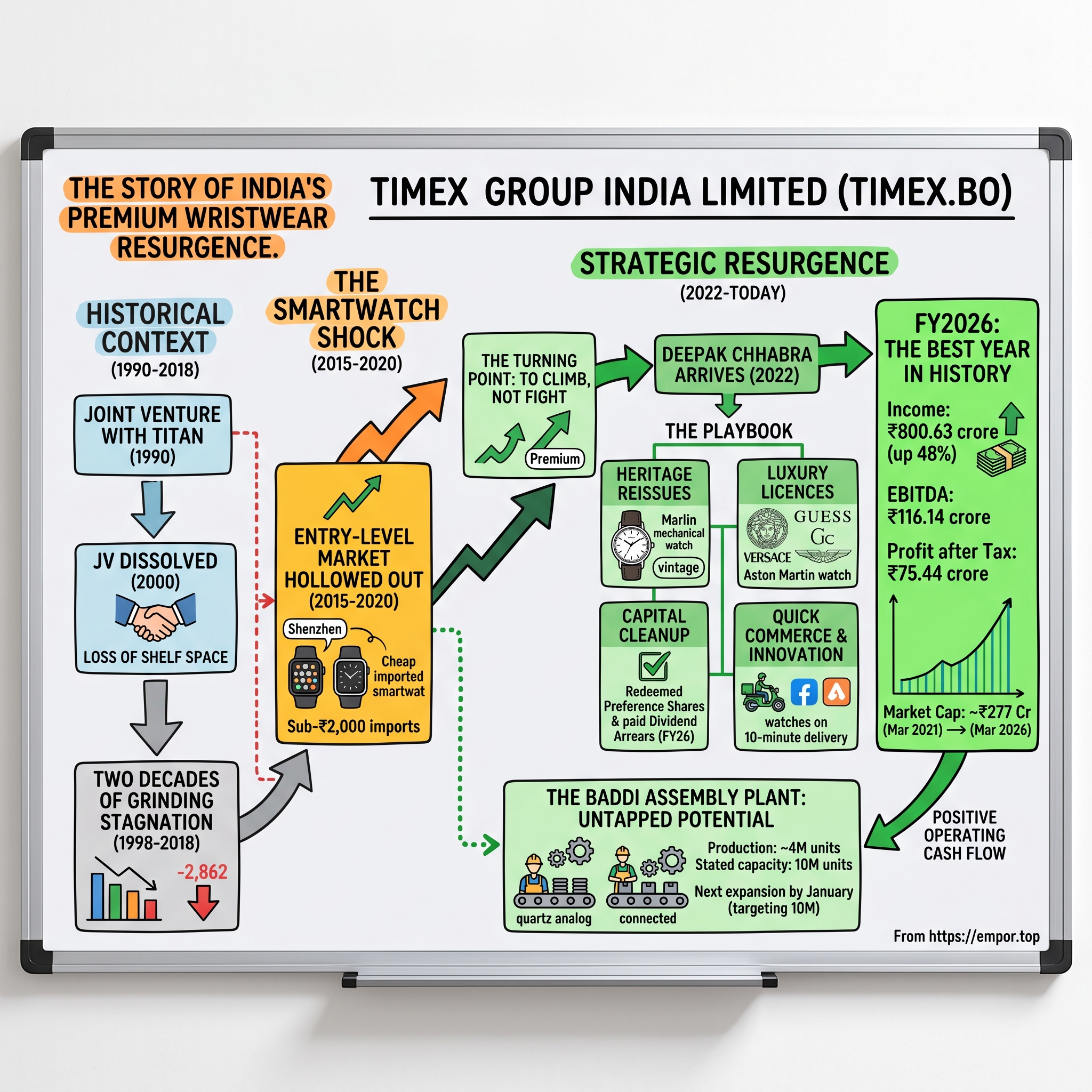
Timex Group India: The Story of India's Premium Wristwear Resurgence
I. Introduction & Episode Roadmap
The board meeting ran late. On the evening of May 26, 2026, in a rented floor of Tower 8 at the World Trade Tower complex in Noida — an unglamorous glass block on the edge of Delhi, a long way from Fifth Avenue or the Vallée de Joux — the directors of Timex Group India Limited approved the audited accounts for the year and adjourned at eight in the evening.1 The numbers they signed off on would have read like a work of fiction to anyone who had followed this company through its first three decades on the Bombay Stock Exchange.
Total income of ₹800.63 crore for the year, up 48% on the prior twelve months. EBITDA of ₹116.14 crore, more than double. Profit after tax of ₹75.44 crore, against ₹31.42 crore a year earlier.1 For most of its listed life, Timex Group India had been the kind of company that made news for the wrong reasons — accumulated losses, unpaid preference dividends, a foreign parent quietly writing cheques to keep the lights on. Now it was posting the best year in its history, and the market had noticed: the company's market capitalisation had gone from roughly ₹277 crore in March 2021 to about ₹2,473 crore five years later, and the share register had swelled from around 45,700 holders in early 2023 to more than 63,000.2
Rewind only four years to fiscal 2022 and the contrast is startling. Total income was ₹265.54 crore. EBITDA margin was a threadbare 3.3%. Profit before tax was ₹3.22 crore — statistically indistinguishable from zero on a business of that size.2 The brand, to most Indian consumers under thirty, was either invisible or a memory: the plastic quartz watch a parent bought them for a school prize. That is the turnaround at the heart of this story, and it is a genuine one.
But a turnaround narrative is not an investment thesis, and it is worth stating the paradox plainly before diving in. How does a 170-year-old American watch legacy survive a bitter corporate divorce from the most powerful distribution machine in Indian retail; then withstand a decade-long assault from sub-₹2,000 imported smartwatches that hollowed out the entry-level watch market; and then reinvent itself as a fashion-and-heritage accessories house? And having pulled that off, what exactly does an investor own at the end of it — a durable franchise, or a well-run trading and assembly operation renting brands it does not control, riding a premiumisation cycle it did not create?
The road ahead. We begin in Waterbury, Connecticut in 1854, with a clock company that decided quality timekeeping should cost a dollar, and follow it to the 1990 joint venture with Titan that briefly made Timex the number-two watch brand in India. Then the split of the late 1990s, which cost Timex its shelf space overnight, and the two lost decades that followed — a period best understood not as bad management but as the compounding cost of having rented someone else's distribution. Then the wearables shock of 2015–2020, and the strategic decision that defines the company today: to walk away from the bottom of the market rather than defend it.
From there, the recent history, which is where the money is. Deepak Chhabra's arrival in 2022 and the playbook he ran: heritage reissues, a borrowed portfolio of global fashion licences, an acquisition that bought back a piece of the distribution Titan had taken away, and an early, genuinely creative bet on ten-minute delivery. Then the mechanics — what the Baddi plant actually does, how the segment reporting really works (it is not what the consensus assumes), what the cash flow statement revealed in FY26, and where the working capital risk sits. Then the war-game: Titan, Fossil, Casio, Ethos, and a wearables cohort in retreat. Then the structural question, tested against Porter and Helmer. Then the disclosure audit, the risk radar, the bull and bear cases, and the lessons.
A note on posture. Management here is articulate, confident, and — on the evidence of the last four years — has largely delivered what it said it would. That earns a hearing, not a pass. Where the company says it will win, the job is to ask what evidence supports the claim and what would falsify it. The most interesting parts of this story are the places where the polished investor presentation and the audited numbers tell subtly different stories.
 Subscribe on LinkedIn
II. Global Heritage & The Tata-Titan Marriage (1854–1998)
Waterbury, Connecticut in the mid-nineteenth century was called the Brass City, and it earned the name honestly — a valley town of rolling mills and stamping presses that turned sheet metal into buttons, lamps, and, from 1854, clocks. The Waterbury Clock Company was founded on a proposition that sounds mundane now and was radical then: combine traditional European watchmaking with American industrial ingenuity, and make quality attainable for millions rather than precious for the few.2 It was, in the language of a later era, a deliberate disruption of a three-hundred-year-old craft industry.
The commercial breakthrough came through a partnership rather than a product. Waterbury supplied the movements for Robert Ingersoll's pocket watch — the "Yankee," sold for a single dollar. In an age when a timepiece was an heirloom and a status marker, the dollar watch made knowing the time a commodity available to a factory worker. Mass timekeeping, sold cheap and sold everywhere. That instinct — democratisation over exclusivity — has been the company's genetic signature ever since, and the post-war slogan that made Timex a household name in America distilled it perfectly: it takes a licking and keeps on ticking. Not the finest watch in the world. The toughest one you could afford.
The ownership history is unusual and it matters. In 1941 the Norwegian shipping magnate Thomas Olsen bought a majority stake in the then-struggling Waterbury Clock Company, and the Fred. Olsen family held Timex for nearly eight decades — a global consumer brand run privately, patiently, across generations, insulated from quarterly earnings pressure. In 2020 the Boston investment firm Baupost Group took ownership of the group. The holding company today is Tanager Group B.V., formerly Timex Group B.V.2 Private, long-horizon ownership is not a footnote here; it is the reason a chronically loss-making Indian subsidiary was funded through twenty years of disappointment rather than shut or sold.
What that parent brings, still, is industrial infrastructure most Indian consumer companies can only rent. Timex Group runs movement production in Besançon, France; research and development in Pforzheim, Germany; watchmaking in Lugano, Switzerland; and assembly in Cebu, the Philippines, and in India — coordinated from headquarters in Shelton, Connecticut, through five regional hubs, nine affiliates and over 120 distributors reaching more than 22,000 points of sale worldwide.2 Design is centralised under Giorgio Galli, the group's chief creative director for over two decades, whose work on collections like the Giorgio Galli S2 gave a mass-market brand genuine design credibility.2 Every one of those capabilities is available to the Indian company without the Indian company having to pay for it upfront — a point we will return to when assessing what shareholders in Noida actually own.
India, 1988. As the country inched toward liberalisation, Timex incorporated an Indian venture on October 4, 1988, initially partnering a local entity, Jayna Times Industries, with the stated aim of assembling two million quartz analog watches a year.3 Jayna withdrew, and a far more consequential partner stepped in. Titan Watches Limited — the Tata Group's watchmaking arm and already the emerging force in Indian horology — signed a joint venture agreement on June 30, 1990. The Indian company was renamed Timex Watches Limited on January 1, 1991, and commercial operations began in 1992.3 The company would list on the Bombay Stock Exchange in 1994.2
The division of labour was clean, and for a few years it was beautiful. Timex brought the global brand, manufacturing know-how, and technology — most visibly Indiglo, the electro-luminescent dial that lit up at the press of a button, launched in India in 1993 and, for a generation of Indian schoolchildren, genuinely magical.3 A first-phase plant in Noida was built for 2.5 million units a year, with a second phase intended to localise components — bezels, dials, straps, movements.3 Titan brought the thing Timex could never have built at speed: the most powerful watch distribution network in the country, anchored by its World of Titan showrooms, plus a manufacturing culture that Tata had spent the 1980s constructing from scratch.
Timex made affordable mass-market quartz watches. Titan kept the premium analog territory and controlled the shelf. Within roughly four years Timex had ridden those rails to become the second-largest watch brand in India, selling millions of entry-level timepieces into a middle class that was, for the first time, being allowed to want things.
It was the high-water mark, and it contained its own undoing. A partner who controls your distribution controls your fate — and every rupee of volume Timex pushed through World of Titan was a demonstration to Titan of exactly how much money was sitting in the mass-market tier it had chosen not to serve. Sooner or later, someone in Bangalore was going to run that arithmetic.
III. The Bitter Divorce & Two Decades of Stagnation (1998–2018)
Joint ventures rarely die in a single dramatic moment. They die the way this one did: with a series of small, rational decisions by the stronger partner, each individually defensible, which together amount to eviction.
Titan's move came in 1997, and it was elegant. Rather than renegotiate with its partner, it launched Sonata — its own entry-level, mass-economy sub-brand, aimed squarely at the affordable volumes Timex depended on.3 Why split the margin on someone else's brand when you own the shelf and can fill it with your own? The five-year collaboration, under which Timex had operated almost as an associate riding Tata rails, ended in December 1997; the venture formally dissolved by 2000.3 Timex Group India's own corporate timeline is blunt about the sequence: joint venture with Titan Company from 1990 to 2000, ended in 2000; subsidiary of Timex Group Luxury Watches B.V. thereafter.2
The consequences were immediate and structural. Timex lost access to World of Titan overnight, which meant losing its primary route to the Indian consumer at exactly the moment that consumer was being formed. And Titan did not stop at the value end: in 1998 it launched Fastrack for the youth segment, closing off the positioning flank Timex might have retreated into. Within roughly eighteen months, the Indian company went from riding the best distribution in the market to having, in practical terms, none.
What followed were the lost decades, and they were grinding. Building a distribution network from nothing in India is not a marketing exercise; it is thousands of individual relationships with multi-brand outlets, distributors and dealers, each requiring credit, inventory, service support and patience. Timex assembled it slowly — multi-brand outlets, a scattering of Timex World franchise stores, defence canteen access — while competing against an incumbent that could out-spend, out-distribute and out-position it at every tier.
The financial record tells the story without embellishment. The parent recapitalised the business repeatedly: forty million partly convertible debentures issued in August 1993 at ₹140 each, taken up by ICICI, UTI, foreign institutional investors and the public; preferential equity in 2000–2001 that lifted the foreign promoter's holding toward 79%; a formal financial restructuring scheme approved in 2003 alongside twenty-five million non-cumulative redeemable preference shares issued to the promoter.3 The company was renamed Timex Group India Limited in 2007, and brought Versace into India in 2006 — an early hint of the licensing strategy that would eventually define it.3 Kapil Kapoor, appointed managing director in 2000, became chairman in 2011.3
Look at the long arc of results and the erosion is unmistakable. In fiscal 2015 the company turned over roughly ₹142 crore and lost about ₹11 crore; FY16 brought another ₹9 crore loss on ₹173 crore of sales; FY17 lost ₹3 crore. The best stretch of the decade — FY18 and FY19 — produced net profits of only ₹8 crore and ₹7 crore on operating margins of about 5%. Then FY20 slipped back into a small loss, and the pandemic drove FY21 revenue down to ₹141 crore with an ₹8 crore loss.4 Through the entire period, reserves remained negative — the accumulated-losses hole ran to roughly ₹65 crore — and the balance sheet carried borrowings above ₹100 crore.4 Debtor days, at one point, sat at 176: the company was effectively financing its own trade channel because it lacked the pull to demand better terms.4
There is a temptation to read this as two decades of managerial failure. That reading is too easy. The more useful diagnosis is structural: Timex's early Indian success was never really its own. It was rented from Titan, and when the landlord took the property back, the tenant discovered there was nothing underneath. Everything that happened between 1998 and 2018 was the bill for that dependence coming due — a lesson in why distribution ownership, not brand awareness, is the scarce asset in Indian consumer goods.
By the late 2010s the company had at least stopped bleeding. And then, just as it approached the shallow end of stability, a wave formed offshore that threatened to make its entire core product obsolete.
IV. The Smartwatch Shock & The Strategic Turning Point (2015–2020)
Picture the Indian wrist in 2015. A college student buying their first proper watch walks into a multi-brand store and chooses between a ₹1,200 Sonata, a ₹1,800 Timex and a shelf of unbranded quartz pieces. Now run the same scene in 2020. That student does not enter the watch store at all. They open an app and buy a rubber-strapped smartwatch with a colour display, a step counter and a heart-rate sensor for under ₹2,000 — sourced from a Shenzhen contract manufacturer, badged by a digital-native Indian brand, delivered in two days.
Between roughly 2015 and 2020, that substitution did to the entry-level watch what the smartphone had already done to the compact camera and the pocket torch. The functional job of a cheap analog watch — telling the time — became a free by-product of a device that did a hundred other things and charged nothing extra for the clock. Noise, boAt and Fire-Boltt scaled with astonishing speed on this proposition. The bottom of the Indian watch market, the tier where Timex had spent three decades scrapping for share, was being commoditised out of existence by companies that were not watchmakers at all and had no intention of becoming any.
Here is where the story turns, and where management deserves credit for a decision defined mostly by what it declined to do. Timex could have fought the feature war. It had the manufacturing base, the distribution and the brand recognition to flood the channel with sub-₹2,000 smartwatches. It dabbled — the Helix Smartwatch 2.0 arrived in 2021, and the company still runs value-focused and feature-focused smart lines under the iConnect and Timex Smart badges, selling on the order of two hundred thousand smartwatches a year.35 But it refused to make that the centre of gravity.
The logic was sound, if unromantic. A price war in ₹1,500 connected devices against players with no legacy cost structure, no service network to fund and no brand equity to protect is not a war a heritage watchmaker wins; it is one it finances. Every unit sold would have carried a thin or negative contribution margin while cannibalising the analog watches that actually paid the bills. The category has since proved the point: management has acknowledged the smartwatch segment declined 25–27% after its initial surge.5 Ceding a shrinking, margin-free tier is not retreat. It is triage.
The first escape route was heritage. The signal came from the parent, not from India. In 2017 Timex reissued the Marlin — a 34mm hand-wound mechanical dress watch drawn from the 1960s archive, powered by inexpensive Seagull movements from China. It was the brand's first mechanical watch in decades, an almost perverse product decision in an era of oversized sports watches, and it sold out almost immediately.6 Timex followed it with a designer collaboration series, larger automatic variants, the revived Q Timex line and a rebuilt Waterbury family. Within a couple of years, a company synonymous with disposable quartz was being written about admiringly by the same watch-enthusiast community that had ignored it for thirty years.
The insight underneath is the single most important idea in this entire story, so it is worth stating carefully. Once the phone took over timekeeping, the watch stopped being a tool and became jewellery. And the economics of jewellery are the opposite of the economics of tools. A tool competes on price and function, and gets commoditised. Jewellery competes on meaning, and meaning supports a price premium indefinitely. Indian millennials and Gen Z would not pay ₹1,800 for a device to tell the time — but they would pay ₹8,000 to ₹18,000 for mechanical romance, vintage authenticity and a look. The category Timex had been losing was dying. The category it could move into was being born.
The second escape route was borrowed luxury. Building premium brand equity from scratch takes decades and enormous marketing capital, neither of which a loss-making subsidiary possesses. So Timex India leaned on the group's licensing machine instead, progressively taking Indian rights to Guess, Gc, Versace, Salvatore Ferragamo, Nautica, Ted Baker, Philipp Plein, Plein Sport, Missoni, Furla and adidas — with Guess and Gc added as recently as 2022.73 In a single strategic move, a company that sold ₹1,500 quartz watches acquired the ability to sell a ₹40,000 Versace to the same distribution network, in the same market, using the same warehouse and the same sales force.
By 2020 the strategic thesis was fully formed: abandon the commoditised utility tier, and become a house of fashion and heritage accessories spanning roughly ₹1,000 to ₹1,00,000. On paper it was elegant. In practice, in 2020, it was entirely unproven — the company was still barely profitable, still had negative reserves, and had just been through a pandemic year. Turning a thesis into a P&L would require someone with a very different skill set from the ones that had run this business before.
V. The Deepak Chhabra Turnaround Playbook (2020–Today)
The person who arrived in March 2022 was not a watch man. Deepak Chhabra came to Timex Group India as Managing Director with a background the investor presentation describes with almost comic understatement as "footwear technologist and marketeer," backed by nearly three decades in consumer retail.27 He had scaled Crocs in India several-fold, worked through Reliance Retail and Wildcraft, and built his reputation on the unglamorous mechanics of consumer distribution: inventory turns, sell-through velocity, shelf productivity, price-point architecture.7
That background matters more than it might appear. Watch companies run by watch people tend to fall in love with product. Watch companies run by retail people fall in love with rate of sale. Timex India's problem in 2022 was not that its watches were bad; it was that too few of them were moving, at too low a price, through too narrow a channel. Chhabra's instinct was to attack all three variables simultaneously.
His own framing, offered when the FY26 results landed, was what he called a "pyramid architecture" — every brand deliberately occupying a distinct price point, aspiration, lifestyle and demographic, "allowing each to grow without competing with the other."1 He describes the portfolio custodian's job as protecting each brand's individual identity while keeping the whole "balanced, scalable and future-ready," and attributes the growth to "clarity of positioning, evolving consumer insight, combined with strong commercial execution and scaling manufacturing capabilities."1 It is a tidy story, well told. The honest analytical response is that the results have so far corroborated the frame — revenue roughly tripled from ₹265 crore in FY22 to ₹800 crore in FY26 at a 32% compound rate, with margins expanding throughout — but that a rising category, a depressed base and a favourable premiumisation cycle would have produced a flattering chart under several plausible strategies.2 Management has claimed the company grew at roughly 40% a year against an industry growing near 13%, which if sustained is genuine share gain rather than tide-riding.8 Two or three more years of data will settle it.
The product ladder. The most visible execution has been relentless newness. Within the core Timex brand, the company has built franchises rather than one-off SKUs: Waterbury, Marlin and Q Timex as the established heritage pillars, with Vector added and Signio launched in the March 2026 quarter as a premium occasion-wear line for men built around automatic, slim and multifunction variants.12 Above that sits the Swiss-made Timex Atelier collection, launched in the December 2025 quarter to deliberately provocative effect — the Marine M1A and GMT24 M1a were positioned to prove, as one enthusiast outlet put it, that Timex could play in the thousand-dollar diver space, generating over 580 million media impressions and roughly $1.1 million of estimated advertising value across 289 PR placements, with launch posts averaging 8.5% Instagram engagement against a 3.0% benchmark.9
Alongside the heritage play runs a steady drumbeat of cultural collaborations — Harry Potter, Superman, MM6, The James Brand, the Netflix series Wednesday, a NASA piece honouring the 1972 Apollo 17 mission built on the Q Timex case, a Peanuts anniversary Marlin, and a tie-up with Sony Pictures Animation's GOAT.12 The company has attached itself to fashion platforms rather than only sports or film: India Beach Fashion Week, Mysore Fashion Week, and the Elle List.12 The strategic point is not that any single collaboration moves the needle; it is that a brand which needs to charge ₹8,000 instead of ₹1,800 must be culturally present, continuously, at the price of roughly 8–10% of revenue in marketing.5
The most striking single data point in the product story is Aston Martin. Timex launched the licensed Aston Martin watch collection in India in December 2025 at roughly ₹45,000–₹50,000 and, by management's account, sold about ten thousand units in two months.8 Take that at face value and it implies something like ₹45 crore of retail value from a single new licence in a quarter, at a price point where the company had almost no history. It is the clearest evidence yet that the premiumisation thesis has real consumer demand behind it, not just internal ambition — though it is a management-reported figure, not an audited disclosure, and one strong launch is not a trend.
Capital cleanup. Running quietly underneath the growth has been the methodical detoxification of a legacy balance sheet, and this is where an investor learns the most about capital discipline. The centrepiece: a tranche of 13.88% cumulative redeemable non-convertible preference shares worth ₹22.90 crore, originally allotted on March 21, 2006 and due for redemption in March 2016. They were not redeemed. With preference shareholder consent the maturity was extended five years to 2021, and then extended another five years to March 2026.1 In March 2026 the board finally approved redemption, paid the dividend accrued to maturity, and settled the whole amount on March 25, 2026 — twenty years after issue and a full decade past the original due date.1
The dividend arrears tell the same story. During FY26 the company paid ₹9.54 crore of accumulated dividend on those shares covering financial years 2018-19, 2019-20 and 2024-25, then declared a further ₹12.71 crore interim dividend in November 2025 covering FY2020-21 through FY2023-24.1 Separately, the board recommended ₹14 crore on a 5% tranche, representing ₹1.75 crore a year for eight consecutive years from FY2018-19 to FY2025-26, plus ₹4.21 crore on a 10.75% tranche.1 In total the company paid out ₹23.65 crore of preference dividends and ₹22.90 crore of redemption in a single year.1
Read that plainly. For eight years this company was not able — or not willing — to pay contractually cumulative dividends to its own controlling shareholder, which is about as clear a signal of distress as a balance sheet can send. The FY26 clean-up is genuine progress and a legitimate use of the first real free cash flow the company has generated. But the equity shareholder should note the ordering: preference capital held by the promoter was made whole first, and the ordinary equity has never received a dividend.4 That is contractually correct and economically defensible while growth absorbs cash. It is also worth watching.
The Just Watches acquisition. On May 19, 2023, Timex acquired Just Watches, a multi-brand watch retailer founded in 2009 with a physical store footprint and the e-commerce site Justwatches.com.10 The consideration was not disclosed. Chhabra framed it as bringing "perfect synergy between the coming together of the two brands," which is the standard language of deal announcements and tells an analyst nothing.10 The strategic substance is more interesting: for the first time since 1998, Timex owned meaningful downstream retail — mall real estate, a curated multi-brand format that could carry rival brands as well as its own, and direct first-party purchase data. Twenty-five years after Titan took away its shelf, Timex bought some back.
The execution, however, is behind the rhetoric. Management has spoken of scaling toward roughly 400 exclusive stores over three years, split between Timex World and Just Watches formats.5 As of the FY26 results, the company operated "over 40" exclusive franchise stores across both banners, alongside more than 5,000 offline trade stores.1 Whatever else the retail ambition is, it is not yet delivered — and a reader should file the 400-store target as a stated intention against which management can be measured, not as a fact.
The float re-rating. For most of its listed life the promoter, Timex Group Luxury Watches B.V., held 74.93%, leaving a razor-thin public float that made the stock nearly untradeable for institutions. That changed rapidly. A June 2025 offer-for-sale sold roughly 15% at a ₹175 floor price, cutting the promoter to 59.93%. A second OFS launched in late December 2025 at a ₹275 floor — a base tranche of 4.47% with a matching oversubscription option — and on completion took the stake to 51.00%.112 Institutional holdings, essentially nil at 0.12% in early 2025, rose above 2% within the year.2
Two observations matter here. First, a common assumption about this sequence is wrong: the promoter was already compliant with the 25% minimum-public-shareholding requirement at 74.93%, so these sales were not forced by regulation. They were a deliberate decision to deepen the float and partially monetise a re-rated asset. Second, the market reaction was not uniformly positive — the stock fell nearly 8% on the December announcement, priced at a substantial discount to the prevailing market, and this was the second large promoter sale in six months.11 A skeptical investor is entitled to note that the party best informed about this business has been a persistent seller into its own strength, even as it has retained control at 51%.
Channel innovation. The most genuinely inventive plank of the playbook is quick commerce. Timex began placing sub-₹10,000 watches on ten-minute delivery platforms — Swiggy Instamart, Flipkart Minutes, Zepto and Blinkit — on the thesis that a watch is a near-perfect impulse gift for Rakhi, Diwali, Valentine's Day and forgotten birthdays.5 Reframing a considered-purchase durable as an instant one is a real creative act, and it reaches consumers without matching Titan's physical scale. Management expects quick commerce to eventually contribute around a fifth of the online business, targeted at sub-₹10,000 SKUs, while luxury stays roughly 85% offline.5
The wider digital shift has been dramatic: e-commerce grew 90% across FY26 and 158% in the March quarter alone, and roughly 40% of the business now comes through online channels, up from about 20% historically.187 Management has also disclosed using AI-driven campaign automation to lift return on ad spend from around 6–6.5x to 8.5x.5 The caveat is straightforward and important: quick commerce is a discount-and-returns-heavy channel, platform take rates are real, and the company does not disclose channel-level contribution margins. Ninety percent growth in e-commerce is a demand signal. It is not, by itself, a profit signal.
VI. Segment Breakdown, Manufacturing, & Financial Mechanics
Drive four hours north of Chandigarh into the foothills of Himachal Pradesh and you reach Baddi — an industrial town built on tax incentives, full of pharmaceutical and light-manufacturing plants. Somewhere in it sits the quiet engine of this entire story: an SA8000- and ISO 45001-certified watch assembly unit that takes piece parts and builds finished watches, handling more than 150 types of movements across analog quartz, mechanical, digital, ana-digi and connected formats, with both online and offline assembly lines to accommodate high- and low-volume movements.2
Two facts about this plant explain most of the recent margin expansion. First, it is effectively fully depreciated — the capital was spent long ago, in the years when this company was losing money.7 Second, it has enormous headroom: the unit produced about four million watches in the prior year and had capacity raised to six million on a single shift, with a stated roadmap to ten million.2 Management has said the next expansion should be ready by January, targeting that ten-million level.8 Total capital expenditure in FY26 was ₹1.90 crore — on ₹800 crore of revenue.1
Explain that in plain terms. Most manufacturers must spend heavily to grow, so revenue growth is partly consumed by the cost of the machines that enable it. Timex's factory is already built and already written off, and it is running well below capacity. Every additional watch assembled therefore carries only its material and direct labour cost; the fixed overhead is already paid for. That is what operating leverage means, and it is why a 48% revenue increase in FY26 produced an EBITDA increase of 134%, with margin vaulting from 9.2% to 14.5%.1 The plant is also registered on the Government e-Marketplace, and serves as an OEM base — management has described assembling around a million watches a year for third-party apparel and outdoor brands including Van Heusen, Allen Solly, Peter England, Woodland and Lavie, plus roughly 200,000 units exported to the global group.25
Myth versus reality on segments. A widely repeated framing of this company holds that it runs two businesses: a core watch operation and a material secondary "IT shared services" division billing the global Timex group. The audited filings do not support that. Timex Group India reports as a single operating segment under Ind AS 108. The note is explicit: the company "is primarily engaged in the business of manufacturing and trading of watches and rendering of related after sales service," while "other activities" comprise providing information and technology support services to group companies — and because the Managing Director, as chief operating decision maker, evaluates performance and allocates resources for the company as one unit, "no separate disclosures of segment information has been made."1
The practical implication is twofold. The watch and fashion business is, for analytical purposes, the whole company — the roughly 90%-plus share often attributed to it understates the case. And the IT-support, OEM and export work, while real and useful for factory utilisation and overhead absorption, is invisible in the published accounts. An investor cannot size it, cannot see its margin, and cannot verify how it is priced to related parties. That is a disclosure gap, not a conspiracy, but it is a gap.
The premiumisation mechanic. The engine of the whole model is average selling price. Management has described ASP roughly doubling in recent years, from around ₹2,500 toward ₹5,000, as the mix shifted away from mass quartz toward the ₹3,000–₹12,000 fashion and heritage band.7 The reason this matters more than volume is arithmetic: on a fixed, depreciated cost base, a rupee of price is worth far more than a rupee of volume, because price carries no incremental material or assembly cost at all. Doubling ASP while holding units flat would transform this P&L. Doubling units while holding ASP flat would barely move the margin.
The FY26 evidence is consistent with real mix shift rather than discount-driven volume. Brand growth for the year ran 62% for the core Timex brand, 51% for Guess and 48% for Versace, with the fourth quarter accelerating to 89%, 108% and 100% respectively.1 Channel growth was similarly broad — trade up 32% for the year and 52% in the quarter, retail up 112% in the quarter.1 Since the core Timex brand contributes roughly two-thirds of revenue, this is emphatically not just a luxury-licensing story; the mass-to-premium migration of the flagship brand itself is doing most of the heavy lifting.5
The quarterly shape, and one uncomfortable quarter. The year did not progress smoothly, and the pattern is instructive. The June 2025 quarter delivered revenue of about ₹169 crore, up 55%, with net profit rising more than fivefold off a tiny base.12 The September quarter, capturing the festive build, produced roughly ₹244 crore of revenue and the company's highest-ever quarterly profit at that point, with operating margin around 17.5%.13 Then the December quarter broke the pattern: total income of ₹151.51 crore grew only 26%, and EBITDA before exceptional items came in at ₹10.28 crore — a margin of just 6.8%, against 15.7% for the first half.9 Advertising and sales promotion in that quarter alone ran ₹14.52 crore, close to 10% of revenue.9 Then the March quarter snapped back hard: ₹235.83 crore of total income, up 73%, at a 17.4% EBITDA margin.1
That December dip deserves attention precisely because nobody drew attention to it. The investor presentation for the quarter led with "profit before exceptional item and tax tripled" — true, but flattering, because it compares against a weak base quarter rather than against the 15.7% margin the company had just demonstrated.9 The plausible benign explanations are heavy pre-festive marketing spend, launch costs for Atelier and Aston Martin, and seasonal channel dynamics. The less benign possibilities — discounting to clear festive inventory, or channel loading in the September quarter that had to be absorbed later — cannot be ruled out from public disclosure. This is exactly the kind of question an analyst would ask on a conference call, if one existed.
The cash flow inflection — the single most important number. For years Timex's reported profits were suspect because they did not become cash. In FY25 the company reported ₹31.42 crore of net profit and generated negative ₹3.15 crore from operations.1 In FY26 that reversed decisively: cash generated from operations was ₹119.07 crore before tax, ₹90.99 crore after, and the company ended the year with ₹33.95 crore of cash against literally nil a year earlier.1 That cash funded the preference redemption and the dividend arrears without new borrowing; short-term borrowings were repaid to zero.1
This is the difference between a business that reports profit and one that produces it, and it is the strongest single piece of evidence in the bull case. But read the composition carefully. Within that ₹119 crore of operating cash, inventories consumed ₹45.62 crore while trade payables released ₹47.20 crore.1 In other words, the working capital contribution was roughly neutral: the inventory build required to support 48% growth was financed almost exactly by stretching supplier credit. That is competent treasury management, and it reflects a company whose suppliers now want its business. It is not the same as structurally superior cash conversion, and it will not repeat indefinitely — payables cannot expand forever.
Where the balance sheet risk actually sits. Inventory closed the year at ₹196.93 crore against ₹800 crore of revenue — inventory days near 158.14 That is the structural reality of a business that must carry hundreds of styles across a wide price ladder and hold festive depth, and it will not fall dramatically. Receivables, by contrast, are well controlled at ₹58.16 crore, with debtor days around 27, down from that dismal 176 a decade ago — evidence of real bargaining power gained in the trade channel.14 Total equity stands at ₹111.28 crore, of which "other equity" is ₹101.18 crore, and non-current borrowings are ₹29.49 crore.1
Two analytical cautions follow. First, headline return ratios screen spectacularly — Screener shows ROCE and ROE far above any reasonable normalised level — but this is substantially an artefact of a tiny equity base left over from decades of accumulated losses, not evidence of extraordinary asset efficiency.4 Investors should treat those figures as arithmetic, not achievement. Second, the "asset-light" label management prefers is only half accurate: the factory is light, but the inventory is heavy, and growth will keep absorbing cash into working capital. Any misjudgement of fashion or festive demand shows up first as a bloated warehouse and then as a margin problem.
Accounting judgments worth flagging. The FY26 accounts carried an unmodified audit opinion from Deloitte Haskins & Sells LLP, and Grant Thornton Bharat LLP was re-appointed internal auditor for FY2026-27 — a clean bill on both counts.1 One judgment does deserve a note. Following the government's notification of the four Labour Codes on November 21, 2025, consolidating twenty-nine existing labour laws, the company recognised an additional ₹5.31 crore provision for gratuity and leave-encashment liabilities and classified it as an exceptional item on grounds of materiality and non-recurring, regulation-driven character.1 That is a defensible treatment. It also means the widely quoted headline of "PBT of ₹107.4 crore, up 151%" is the pre-exceptional figure; statutory profit before tax was ₹101.94 crore.1 The company disclosed both clearly, but a reader who only sees the press release gets the flattering one.
VII. Competitive Landscape & Industry Dynamics
Start with the size of the prize, because it explains why everyone is suddenly interested in the Indian wrist. The domestic watch market is worth on the order of $4.6 billion and compounding at roughly 10% a year, with mass-market product still accounting for around three-quarters of revenue — meaning the premium tier is small, fast-growing and largely uncontested relative to its potential.14 The structural fact underneath is the one Chhabra keeps returning to: by his estimate only about 15–16% of Indians own a watch at all, and a great deal of current demand in tier-2, tier-3 and tier-4 towns is genuine first-time purchase.8 Roughly three-quarters of Timex's consumers are under thirty-five.8 A category being penetrated at the bottom and premiumised at the top simultaneously is a rare and favourable configuration.
Now the war map, and it is dominated by one player.
Titan Company is the incumbent, and the irony is total — the same Tata entity that made Timex and then broke it. Titan commands more than half of India's organised watch market through a complete brand ladder: Sonata at the value end, Fastrack for youth, Titan in the core, Xylys above that, and the Helios and Helios Luxe multi-brand formats reaching into premium and accessible luxury. Its recent quarterly disclosures show domestic watches growing in the low teens with analog up mid-teens, while its own smartwatch line fell 26% — the same category rotation Timex is riding.15 Critically, Titan has publicly targeted the above-₹25,000 band, where it holds a far smaller share than in the mass market and is growing very fast off that base, and expects premium product to become a much larger slice of watch revenue over the next few years.15
That is the central competitive tension in this entire story, and it deserves to be stated without euphemism. Timex escaped the commoditised bottom by climbing into premium. Titan is now climbing into the same place, with vastly more capital, a national retail estate it owns, and a store-opening cadence Timex cannot match. Timex's counter-positioning is real — international fashion licence authority in Versace, Guess and Ferragamo, plus 170-year heritage credibility in Marlin and Q Timex, neither of which Titan's home-grown brands can manufacture — but it is a positioning advantage, not a scale advantage, and positioning advantages can be attacked.
Fossil India is the closest like-for-like peer: the other fashion-licensed watch house, generating on the order of ₹868 crore of revenue in the year to March 2024, and reported to have weighed an Indian public listing.16 Timex claims share gains against it, and the mechanism is plausible — Timex spans a wider price ladder, from entry-level core product up to Versace, while Fossil is concentrated in a narrower fashion band, and Timex moved onto quick commerce earlier. But Fossil is not a weak competitor, and a Fossil India IPO would create a well-capitalised, directly comparable listed rival and give the market a cleaner benchmark against which to judge Timex's multiple.
Casio holds the digital and G-Shock stronghold, a genuinely defensible niche built on decades of engineering identity, where Timex competes only at the edges with rugged-analog and Expedition-style product. Ethos sits above everyone, running the listed luxury Swiss retail model with FY26 revenue of about ₹1,612 crore, up nearly 29% — but selling watches largely above ₹1,00,000, a tier above where Timex plays.17 Notably, Ethos reported profits muted by a surging Swiss franc, which is a live demonstration of exactly the currency mechanism that threatens anyone importing hard-currency product into India.17 Timex occupies the accessible-luxury bracket beneath Ethos, roughly ₹10,000–₹50,000, which is arguably the sweet spot of the current cycle: large enough to be a real market, aspirational enough to carry margin, and cheap enough that a rising middle class can actually reach it.
The mass wearables cohort — Noise, boAt, Fire-Boltt — is the competitor whose threat has most visibly receded. Indian smartwatch shipments fell 27% year on year in the June 2025 quarter, the fifth consecutive quarterly decline, and the broader wearables market contracted about 4% across 2025 to roughly 114 million units, with smartwatches down almost 18%.1814 The sub-₹2,000 flood saturated, and the devices had low retention: a cheap smartwatch is not an heirloom, and once the novelty of step counts fades many buyers do not replace it. Some of those consumers are trading back into analog watches as fashion objects — precisely the migration Timex is now built to capture. The risk on the other side is that a genuine premium reset in wearables, driven by health sensing and AI assistants, re-energises the category at higher price points that would compete with Timex's own ₹5,000–₹15,000 band rather than its ₹1,500 legacy.
One force cuts across the entire map: trade policy. Under the India–EFTA agreement, which took effect in September 2025 after being signed in March 2024, Indian import duties on Swiss watches began stepping down from 22% — to roughly 18.86%, then about 15.71% from January 2026, phasing to zero by 2031.19 Swiss watch exports to India had already surged 25.2% in 2024 to CHF 274 million before the duties even started falling.19 For Timex this is genuinely double-edged. Cheaper Swiss inputs help the imported movements and the Swiss-made Atelier line. But every year the duty falls, authentic Swiss brands become structurally cheaper in India, compressing the price gap between an accessible-luxury fashion watch and an entry Swiss piece — pressure applied at exactly the altitude Timex is trying to climb to.
VIII. Strategic Frameworks: Porter's 5 Forces & Helmer's 7 Powers
Strip the narrative away and the question that decides everything is structural: does Timex Group India possess a durable competitive advantage, or is it a well-run operator surfing an unusually kind set of conditions? Two frameworks help adjudicate, and neither returns a comfortable answer.
Porter's Five Forces. On the threat of substitutes, the picture is genuinely bifurcated, and the bifurcation is the strategy. In the mass tier the substitute — a phone, or a cheap smartwatch — is devastating, which is why Timex left. In the fashion tier, an analog watch behaves like jewellery, and no device substitutes for what a Versace on the wrist communicates. The threat is therefore high at the bottom and low at the top, and the company has deliberately migrated toward the low-threat end. Rating this force as moving from high to medium is fair, but the improvement is a consequence of repositioning rather than of anything defensible the company built.
Buyer power is weak, and this is a real structural positive. Consumers are atomised, no single retailer commands a decisive share of the market, and in heritage and fashion collections purchase decisions are emotional rather than comparative — nobody haggles over a Marlin. The improvement in debtor days from 176 to around 27 is quantitative evidence that the balance of power with the trade channel has shifted toward Timex.4
Supplier power is moderate. Movements come from a concentrated set of Japanese and Swiss manufacturers, and the group's own Besançon production covers only part of the need, so component pricing is not fully in the company's control. Global group procurement scale blunts this materially — a standalone Indian brand would face far worse terms — but it is a dependency, and it is denominated in foreign currency.
Threat of new entrants is low for the specific position Timex occupies, though this needs care. Launching a watch brand in India is trivially easy — a Shenzhen supplier, a Shopify store and an influencer budget will do it. Replicating Timex's actual position is not: multi-year exclusive Indian rights to a stable of global fashion houses, more than 5,000 trade points of sale, a depreciated assembly plant handling 150 movement types, and a nationwide after-sales network of company and authorised service centres.12 The barrier is real, but note what it is made of — mostly licences and distribution, both of which are relationships rather than assets.
Competitive rivalry is high and intensifying. Titan is larger by an order of magnitude and is deliberately advancing into Timex's chosen tier; Fossil mirrors the model; and the falling Swiss duty steadily arms a new class of premium competitor. This is the force that matters most, and it is moving the wrong way.
Hamilton Helmer's Seven Powers. Timex's most tangible power is cornered resource: exclusive Indian rights to Guess, Versace, Ferragamo, Aston Martin, adidas and the rest, negotiated and held at the parent level and deployed locally. This is genuinely valuable — a competitor cannot simply decide to sell Versace watches in India. But it is rented, not owned, held by the controlling shareholder rather than by the listed entity, with renewal terms and expiry dates that are not publicly disclosed. That is a cornered resource with a landlord.
Branding power exists in two distinct forms that should not be conflated. The genuine 170-year Timex heritage — the archive that made the Marlin and Q Timex possible, the "Greatest Of All Timekeepers" positioning the company now leans into — supports a real price premium the company earns rather than borrows.2 The licensed portfolio supplies borrowed equity that is powerful but rented. Only the first is truly the shareholder's.
Counter-positioning is the most interesting claim and the most defensible strategically: Timex runs an asset-light, quick-commerce-agile, licence-fed fashion model that a larger incumbent tethered to a heavy exclusive-store estate finds awkward to imitate without cannibalising its own retail, and that a consumer-electronics wearables player has no brand permission to attempt. Counter-positioning works precisely when the incumbent can copy you but would hurt itself doing so — and Titan's investment in owned retail is exactly the kind of commitment that makes fast channel-shifting uncomfortable.
What is conspicuously absent matters as much as what is present. There is no network effect. There are no switching costs — a consumer who bought a Timex last year owes it nothing next year. There are no scale economies relative to Titan; if anything the scale disadvantage is severe. There is no process power that a competitor could not replicate with a good operations hire. What Timex has is a well-chosen position — heritage plus borrowed luxury plus channel agility — defended by execution quality and licence access rather than by structure.
For a long-term owner the sober conclusion is this: the advantages are real, currently working, and visibly translating into margin, but they are rentable and contestable. The thesis rests on continued sharp execution and a favourable premiumisation cycle, not on a fortress. That is a materially different risk profile from a business with genuine structural moats, and it should be priced differently.
IX. Downstream Writer Guidance: Earnings Call & Q&A Audit
Begin with an absence, because it shapes everything an outside investor can verify. Timex Group India does not hold regular analyst earnings conference calls.7 There is no forum where a fund manager can ask why the December-quarter margin collapsed to 6.8%, what the Guess licence renewal date is, or what quick-commerce returns actually run. The public disclosure diet is quarterly results, a designed investor presentation, press releases, an annual report and the AGM — the thirty-eighth of which was scheduled for August 20, 2026.5 Every one of those channels is authored by the company. None permits follow-up questions.
For a micro-cap emerging from obscurity, that was understandable. For a company that has tripled revenue, added tens of thousands of shareholders, attracted institutional money and trades on a rich multiple, it is a governance gap — and it is the first thing an activist investor would put in a letter. The burden therefore falls on reading the filings against the marketing. Doing that carefully surfaces four areas worth continuous monitoring.
Royalty and related-party leakage. Timex India pays royalties to the group for brand rights, and these scale with the business. Royalty expense was ₹27.72 crore in FY26 against ₹21.54 crore the prior year.1 The encouraging read is in the ratio rather than the rupees: royalty grew about 29% while revenue grew 48%, so the burden actually fell from roughly 4.0% to about 3.5% of revenue. That is the opposite of what a minority shareholder fears when a controlling parent sets the price, and management deserves acknowledgement for it. The quarterly pattern is noisier — royalty was ₹5.48 crore in the December quarter and ₹4.63 crore in March, on very different revenue bases — which suggests it is not a simple flat percentage of sales.91 The related-party web extends further, through IT support fees, export transfer prices and the preference capital and dividends flowing to the Dutch parent.1 None of these are disclosed with enough granularity for an outsider to independently verify arm's-length pricing. Nothing here looks abusive. It is simply unverifiable, which is a different problem.
Foreign-exchange exposure. The company imports movements and components priced in hard currency and now sells Swiss-made product, so a weakening rupee raises input costs directly. FY26 showed only a modest unrealised exchange loss of ₹29 lakh in the cash flow reconciliation, so this was not a material drag in a benign year.1 But the company publishes no detailed hedging policy, and the mechanism is potent: Ethos, a peer with heavier Swiss exposure, saw FY26 profits visibly compressed by franc strength despite strong revenue growth.17 A sharp INR depreciation would compress Timex's gross margin unless price increases stick, and in a discretionary category price increases do not always stick.
Quick-commerce economics. The disclosure asymmetry here is stark. The company reports channel growth rates with enthusiasm — 90% for the year, 158% in the March quarter — but never channel profitability.1 The unanswered questions are specific: what are return and cancellation rates on impulse-gifted watches; what discount depth is required to hold the ten-minute shelf; what platform commission applies; and what happens to inventory that has been pushed into quick-commerce dark stores if sell-through disappoints. Until any of this is disclosed, the correct interpretation of triple-digit e-commerce growth is that it is a demand and relevance signal, not a margin one.
Licence renewal timelines. This is the largest unquantified risk in the entire filing set. The company does not publish expiry dates or renewal conditions for Guess, Versace, Ferragamo, Aston Martin or any other licence. An investor is implicitly trusting that the parent will keep renewing Indian rights on terms favourable to the listed subsidiary — plausible given that the parent owns 51% and benefits from the subsidiary's success, but entirely uncontracted from the minority's point of view. If a licence were lost, the first the market would learn of it is likely to be the announcement.
Testing management credibility over time. The fair assessment is mixed and, on balance, positive. The narrative across the Q3 and Q4 FY26 presentations and press releases has been consistent — the same pyramid-architecture framing, the same emphasis on premiumisation, manufacturing scale-up and channel efficiency — with no unexplained strategy pivots.91 Stated goals have largely been met: capacity was raised from three million to six million units as promised, quick commerce was launched across the platforms management named, and revenue targets described in interviews were achieved.85 The company disclosed the labour-code exceptional item transparently in both the presentation and the notes rather than burying it.1
Against that, three habits warrant scepticism. Headline framing consistently uses the flattering measure — the press release led with pre-exceptional profit before tax and a 151% growth rate, while statutory PBT grew about 138%.1 Quarterly EBITDA growth was described as 167% in the press release and 172% in the presentation for the same quarter, a small inconsistency but a telling one.12 And the weak December quarter was framed around a tripling of profit before tax rather than the sequential margin decline that a candid discussion would have led with.9 None of this is misleading in the regulatory sense; all of it is investor-relations craft. But a management team that voluntarily explained a soft quarter would earn considerably more credibility than one that reframes it.
The red flags to keep monitoring are therefore concrete rather than generic: an unexplained divergence between festive-quarter dispatches and subsequent-quarter growth; any step-up in royalty or parent service fees that outpaces revenue; and gross margin compression concealed behind top-line expansion. On the FY26 evidence — unmodified audit opinion, a real cash-flow inflection, royalty falling as a share of sales, borrowings repaid — none of those wires has been tripped.1 The asymmetry is simply that the market is grading this management almost entirely on documents management wrote.
X. Investment Story Spine: Risk Radar & Bull vs. Bear Case
The risk radar, mechanism first. Currency and supply-chain risk is structural rather than cyclical: imported Japanese and Swiss movements mean rupee weakness raises cost of goods directly, and with no disclosed hedging framework the shareholder is exposed to a variable the company does not control and does not explain. Licence non-renewal risk is closer to existential for the premium tier — lose Guess or Versace and a high-margin revenue slice disappears, with no owned brand able to substitute borrowed equity at short notice. Parent-governance and transfer-pricing risk runs through royalties, IT support fees and export prices, all negotiated with the entity that controls the board.
Then the ordinary hazards of a discretionary consumer business, which are not ordinary at all in this case. An urban discretionary slowdown hits fashion accessories early and hard, because a watch purchase is almost infinitely deferrable. The inventory intensity — roughly ₹197 crore held against ₹800 crore of sales — means a demand miss converts quickly into markdowns.1 Execution risk is live: the 400-store retail ambition and the ten-million-unit capacity plan both require operational delivery well beyond what has been demonstrated so far.58 Regulatory change has already cost real money once, via the labour codes. And competitive risk is intensifying from two directions simultaneously — Titan advancing upward into accessible luxury, and Swiss brands descending as duties fall.
Finally, valuation risk deserves naming as a risk in its own right, not as a footnote. Following a re-rating that took the shares from around ₹200 to a 52-week high near ₹592 and a market capitalisation of roughly ₹5,600 crore, the stock traded around 70 times trailing earnings in July 2026.4 A multiple like that embeds years of continued high growth. It does not require the bear case to be right for an investor to lose money; it only requires growth to decelerate to something merely good.
An activist's stress test. What would a sceptical long-short investor put in a letter to this board? Probably five things. First, the absence of any analyst conference call while the company enjoys a growth-stock multiple. Second, the sequencing of capital returns — preference capital held by the promoter made whole in full, including eight years of arrears, while ordinary shareholders have never received a dividend and equity dilution is not on the table.14 Third, related-party opacity: royalty, IT fees and transfer pricing all set with the controlling shareholder and none independently verifiable. Fourth, the promoter's own selling behaviour — two large offers for sale within six months into a rising market, at meaningful discounts, from a party with perfect information.11 Fifth, the gap between the 400-store retail narrative and the 40-odd stores actually operating.51 None of these is disqualifying. Together they describe a company whose disclosure and governance have not yet caught up with its market capitalisation.
The KPIs that actually matter. Three metrics, tracked quarter after quarter, will tell an investor whether the thesis is intact long before the headline profit does.
The first is average selling price, or unit realisation. This is the truest test of whether premiumisation is real and durable or whether growth is discount-driven volume dressed up as mix shift. If ASP keeps rising, the strategy is working at its foundation. If revenue grows while ASP stalls, the company has quietly reverted to being a volume business with better marketing.
The second is EBITDA margin percentage. This validates that operating leverage on the depreciated Baddi base and the shift toward licensed and heritage product is being retained rather than competed away in trade discounts and platform fees. The December-quarter dip to 6.8% is the reason this metric must be watched quarterly rather than annually — annual figures smooth over exactly the information an investor needs.9
The third is the share of revenue coming from e-commerce and quick commerce. This tracks distribution agility and direct customer ownership, and over time it will reveal whether the digital channel is margin-accretive or margin-dilutive. Rising digital share alongside rising EBITDA margin would be powerful confirmation. Rising digital share alongside falling margin would indicate the company is buying growth.
The bull case. India is simultaneously under-penetrated and premiumising, and Timex sits precisely at the intersection — capturing first-time buyers in smaller cities with core product while trading urban consumers up into fashion and heritage. If ASP continues climbing while Guess, Versace and Aston Martin scale, margin has room above the 14.5% already achieved, because every incremental unit on a fully depreciated plant running at roughly two-thirds utilisation drops a fat contribution to the bottom line. The FY26 cash-flow inflection suggests the model has crossed from parent-funded to genuinely self-funding, which changes the character of the business entirely. Quick-commerce and e-commerce leadership could let Timex own urban impulse gifting before larger competitors fully mobilise. Trade-policy tailwinds cut Timex's own import costs. And the base is still modest: on roughly ₹800 crore of revenue in a market of several billion dollars, there is a great deal of room to grow before scale becomes a constraint.
The bear case. Remove the tailwind and the structure looks thin. The advantages are rented — licences owned by the parent, luxury equity borrowed, no switching costs, no network effects, no scale advantage. A discretionary slowdown would strike exactly where the company has concentrated its bet, and the inventory position would amplify the damage. Loss or unfavourable renewal of a marquee licence would remove a high-margin tier at a stroke. Titan's premium push and expanding multi-brand estate can outspend Timex on the accessible-luxury shelf indefinitely, and the EFTA duty phase-out steadily arms genuine Swiss brands to compete downward into the same range. Sharp rupee depreciation would compress gross margin with no disclosed hedge. Working capital will keep consuming cash as growth continues, and the payables expansion that funded FY26 cannot repeat forever. The promoter has been a consistent seller. There is no conference call at which to press any of this. And the valuation already reflects success, which makes the risk-reward asymmetric: the good news is substantially in the price, while the structural questions remain open.
The neutral verdict is that Timex Group India has earned the right to be taken seriously again — the operating turnaround is real, audited, and now cash-backed. It has not yet earned the right to be assumed durable. Those are different things, and the distance between them is precisely what the next few years of ASP, margin and channel-mix data will resolve.
XI. Playbook: Key Business & Investing Lessons
Lesson 1: When a technology shock commoditises your product, climb rather than fight. The most consequential decision of Timex India's last decade was one it declined to make. It could have poured capital into sub-₹2,000 smartwatches to defend volume against digital-native competitors, and it would have lost — those rivals carried no legacy cost structure, no service network and no brand equity to protect, which meant they could price at levels Timex could not survive. Instead the company ceded the tier and moved up into fashion, heritage and identity, where a watch is jewellery and a phone is no substitute at all. The generalisable insight is that when the floor of your market is being commoditised, the exit is upward, into meaning and margin, not sideways into a feature war you will finance and lose.
Lesson 2: Licensing lets a regional player rent a moat it could never build — and rented moats come with landlords. Deploying the parent's global brand rights let an Indian subsidiary access ₹40,000 price points without spending decades or fortunes constructing luxury equity from nothing. That is enormous leverage and it is the single biggest reason the P&L transformed as fast as it did. But the same borrowed equity that powers the growth is the largest identifiable thing that could unwind it, and it sits on a contract the minority shareholder cannot read. Asset-light scaling and structural fragility are two faces of one decision. The investing discipline that follows is to always ask, of any licensed business, who owns the asset and what happens on renewal.
Lesson 3: Channel agility can bypass an incumbent's distribution moat, but the new channel's economics must be proven separately. Timex could never rebuild Titan's showroom empire, so it went where Titan was structurally slow — marketplaces, ten-minute delivery, impulse gifting. Reframing a considered-purchase durable as an instant one is a genuinely creative act of positioning, and it reached consumers without matching the incumbent's physical scale. The discipline is to remember that a channel which grows fast is not automatically a channel that earns well, and that a company celebrating channel growth while withholding channel margin is telling you only half the story.
Lesson 4: Legacy recovery is measured in decades, and balance-sheet discipline precedes growth. The most underrated part of this story is how long the boring work took. Absorbing the loss of distribution in 1998, surviving two decades of losses, funding operations through repeated promoter recapitalisations, clearing preference shares issued in 2006 and dividend arrears stretching back to 2018, and finally converting reported profit into actual operating cash — none of it was glamorous, and all of it had to happen before the growth of FY23 through FY26 could count for anything. Turnarounds look sudden in the headline and glacial in the ledger. For an investor, the discipline visible in a balance-sheet clean-up is usually a better predictor of whether a recovery is real than any single quarter of revenue growth, because revenue can be bought and cash generation cannot.
The final observation is a neutral one. Timex Group India has authored a genuine, hard-won revival, and in FY26 it delivered the one thing that had eluded it for thirty years: cash that matches the profit. Whether that revival hardens into a durable franchise or proves to have been an exceptionally well-executed ride on a premiumisation cycle and a licence portfolio the company does not own is the question that the next several years — and those three KPIs — will answer.
References
-
Outcome of Board Meeting, Audited Financial Results and Press Release for the year ended March 31, 2026 — Timex Group India Limited (BSE filing), 2026-05-26 ↩↩↩↩↩↩↩↩↩↩↩↩↩↩↩↩↩↩↩↩↩↩↩↩↩↩↩↩↩↩↩↩↩↩↩↩↩↩↩↩↩↩↩↩
-
Investor Presentation, Q4 FY2025-26 — Timex Group India Limited (BSE filing), 2026-05-26 ↩↩↩↩↩↩↩↩↩↩↩↩↩↩↩↩↩↩↩↩↩
-
Timex Group India Ltd — Financials, Ratios and Shareholding — Screener.in, accessed 2026-07-22 ↩↩↩↩↩↩↩↩↩↩
-
Timex Group India eyes continued double-digit growth in FY26, boosts ad spends beyond Rs 55 crore — Storyboard18 ↩↩↩↩↩↩↩↩↩↩↩↩↩
-
The pointy end of the Timex revival: a short history of the breakout Marlin collection — Time+Tide Watches ↩
-
Time in Motion: How Timex India is Driving Growth Again — The Loggical Investor ↩↩↩↩↩↩↩
-
Smaller cities are seeing higher purchases of watches: Timex Group India MD — Business Today, 2026-07-22 ↩↩↩↩↩↩↩↩
-
Investor Presentation, Q3 FY2025-26 — Timex Group India Limited, 2026-02-03 ↩↩↩↩↩↩↩↩
-
Timex Group acquires watch retail brand Just Watches — afaqs, 2023-05-19 ↩↩
-
Timex Group India shares fall as promoter announces second OFS in six months at ₹275 per share — ScanX, 2025-12-29 ↩↩↩
-
Timex Group India standalone net profit rises 503.70% in the June 2025 quarter — Business Standard, 2025-07-30 ↩
-
Timex Group India Q2 FY26: Stellar Festive Surge Drives Record Profitability — MarketsMojo ↩
-
India's Wearables Market Declines 4.0% to 114 Million Units in 2025 as Smartwatch Shipments Fall 17.6% (IDC) — BizTechReports, 2026-04-20 ↩↩
-
Titan gears up to take on global watch giants in premium, luxury segment — Business Standard, 2026-06-03 ↩↩
-
Fossil India Is Said to Weigh IPO That Could Raise $400 Million — The Business of Fashion ↩
-
Ethos Revenue Climbs 29% to ₹1,612 Cr; Profits Muted by Swiss Franc Surge — Trade Brains ↩↩↩
-
India Smartwatch Shipments Fall 27% YoY in Q2 2025, Fifth Successive Quarter of Declines — Counterpoint Research ↩
-
Swiss Watches Set To Get Cheaper With India-EFTA Trade Agreement — Outlook Luxe ↩↩
 LinkedIn
 WhatsApp
 Reddit
 Hacker News
 Email
Email Kindle
 RSS Feed
 Spotify
 Apple Podcasts
 Amazon Music
 Audible
 YouTube