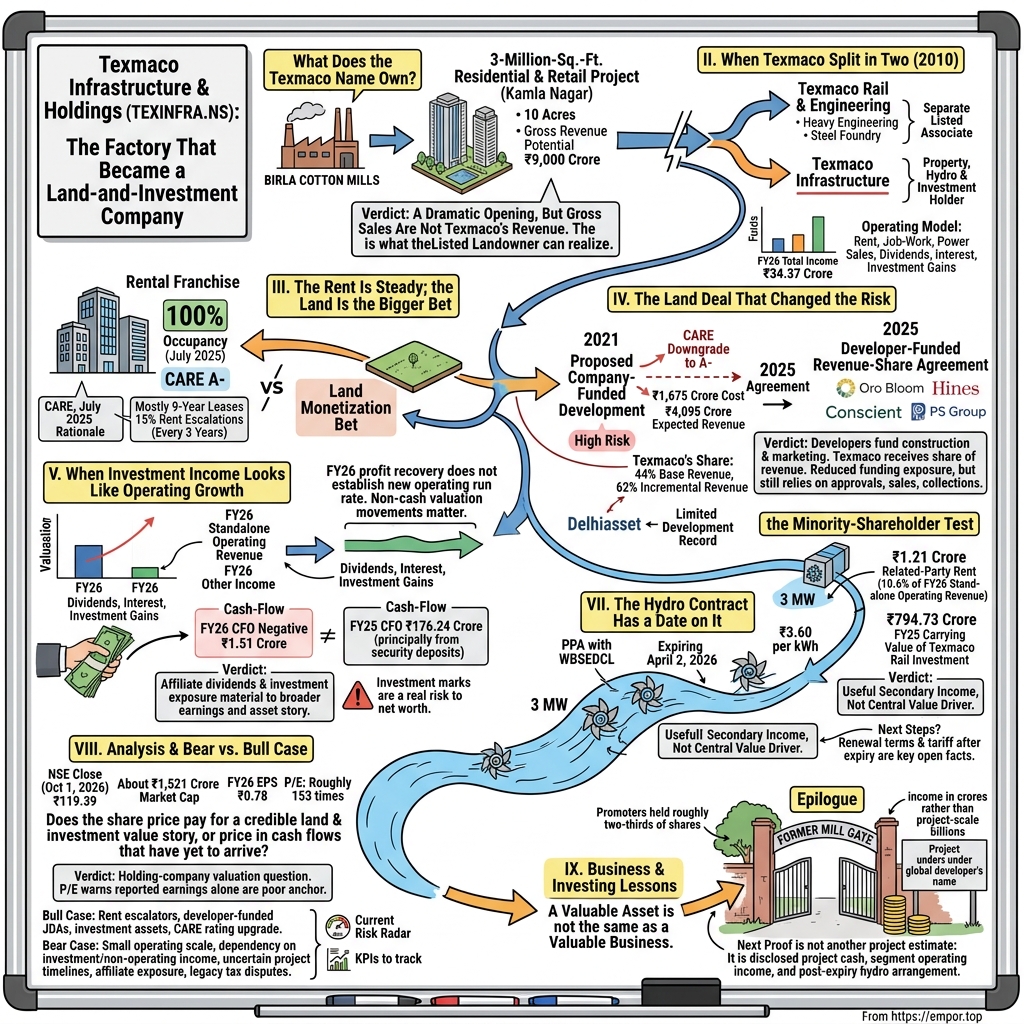
Texmaco Infrastructure & Holdings: The Factory That Became a Land-and-Investment Company
I. Introduction: What Does the Texmaco Name Own?
Walk north from the old walled city of Delhi, past the bustle of the university district, and you reach Kamla Nagar. Behind a long boundary wall sits a piece of land that once housed the Birla Cotton Mills. Spindles turned here in an age when Indian industrialists built factories where their workers could walk to work. The looms are long gone. In 2025 the site became the subject of a different kind of announcement: a global developer, Hines, said it would redevelop the Kamla Nagar parcel with its partners into a residential-led, mixed-use project.1
The numbers in the headlines were large. Reports described a roughly 10-acre site with about 3 million square feet of planned development, and a gross project revenue potential of around ₹9,000 crore.23 For a listed company whose standalone total income in FY26 was ₹34.37 crore, that is a startling figure, more than 250 times its annual income.4
That gap is the whole story, and the first lesson. The ₹9,000 crore is what homebuyers and retail tenants might pay the project over many years if everything goes right. It is not Texmaco Infrastructure's revenue. Texmaco is the landowner. It receives a contractual share of what the developers collect, and only once approvals, construction, sales and collections happen. The figure that matters for a shareholder is not the size of the building. It is the size of the cheque that crosses the gate.
So who, exactly, is Texmaco Infrastructure & Holdings? Investors who hear "Texmaco" usually picture railway wagons rolling out of a Kolkata factory. That business belongs to a different listed company, Texmaco Rail & Engineering. What remained in the listed entity examined here is something quieter and stranger: an office park in Gurugram, a small hydro plant in the hills of north Bengal, job-work services, a pile of mutual funds and group-company shares, and land. Old land, in places where land is very hard to come by.
The market, meanwhile, prices this collection richly against its earnings. On October 1, 2026 the shares closed at ₹119.39 on the NSE.5 With about 12.74 crore shares outstanding,6 that implies a market value of roughly ₹1,521 crore, against FY26 standalone profit of about ₹10 crore.4 That is about 153 times earnings. Nobody paying that price is buying the earnings. They are buying a claim on assets and on the future conversion of those assets into cash.
That raises four questions, and this story is organised around them.
First, can old land become cash for shareholders? Texmaco has owned these parcels for decades. Ownership alone has not produced large distributable profits.
Second, what actually earns the company's profits? As the numbers will show, the investment ledger of dividends, interest and market gains has been doing more of the work than the rent roll.
Third, does capital allocation serve minority shareholders? The company sits inside the Adventz group of the Saroj Kumar Poddar family, and a large share of its balance sheet is invested in affiliated companies.
Fourth, can a developer-led land partnership become repeatable growth, or is it a one-off monetisation of a historical endowment?
The verdict at the outset is deliberately cautious. Kamla Nagar makes a dramatic opening, but its gross sales should not be confused with what the listed landowner can realise. To understand why the listed company looks the way it does, the story has to start with the day the Texmaco name was split in two.
 Subscribe on LinkedIn
II. When Texmaco Split in Two
For most of its life, Texmaco was an engineering company. Textile Machinery Corporation was incorporated in 1939, in the closing years of colonial India. It made machinery for the textile mills that dotted Bengal and Bombay, then branched into heavy engineering, steel castings and railway wagons. It was the kind of company that defined Indian industrial capitalism in the twentieth century: a family group, a factory town, a broad product list, and land acquired when land was cheap and plentiful.
The 2010 demerger
The decisive modern moment came in 2010. Under a scheme of arrangement, the heavy engineering and steel foundry businesses were demerged into a separate company, Texmaco Rail & Engineering.7 Shareholders of the original company received shares in the new one. The industrial heart, with its wagons, foundries and order books from Indian Railways, walked out of the door into its own listed vehicle.
What stayed behind? The parent kept the property, the hydro power plant, and a set of investments. In 2012 it took a name that described the leftover portfolio, Texmaco Infrastructure & Holdings, and a new ticker, TEXINFRA.7
Demergers like this are common in Indian family groups. They are often justified on the grounds that a manufacturing business and a property business attract different investors, need different capital and deserve different valuations. That logic has merit. But it also creates a listed entity whose economics are easy to misread. Texmaco Rail & Engineering is a separate listed company, held by Texmaco Infrastructure as an associate investment and treated as a related party, not a subsidiary.6
What the listed company actually does
Today's group consists of the listed parent; subsidiaries High Quality Steels, Macfarlane & Co. and Valley View Landholdings; step-down subsidiaries Startree Enclave and Topow Buildcon; and an associate, Lionel India.6 The operating model is simple to describe.
It collects rent, mainly from Global Business Park in Gurugram. It earns job-work revenue for services provided. It sells electricity from a small hydro plant at Neora in West Bengal under a power purchase agreement. And alongside these, it earns dividends, interest and gains on its investment portfolio.6
Think of it less as an operating company and more as a family's estate that happens to be listed. The estate has a building that pays rent, a small power station, a brokerage account, shares in relatives' businesses, and some valuable plots inherited from the factory days.
The base rate
How large is the operating engine? In FY25, standalone operating revenue was ₹9.16 crore, essentially flat against ₹9.33 crore the year before.6 Total income was ₹25.52 crore, because other income, meaning dividends, interest and investment gains, added ₹16.37 crore.6 On a consolidated basis, revenue from contracts with customers was ₹15.87 crore.6
FY26 looked better on the surface. Standalone total income rose to ₹34.37 crore and profit after tax was ₹9.98 crore.4 Operating revenue rose to ₹11.45 crore, while other income reached ₹22.93 crore.8
Two things stand out. Operating revenue grew, but from a very small base, and it remained only about a third of total income. And the company does not publish a long-run, business-by-business series that would let an investor say the operating assets are compounding. A single year of improvement after a flat year is a data point, not a trend.
That is the base rate any story about this company must respect: a listed holding company with operating revenue around ₹10 crore a year, sitting on assets valued by the market at more than a hundred times that figure. The demerger left the listed company with the rent, the river and the land. The rent is the logical place to start, because it is the steadiest part of the portfolio and the part most often mistaken for a franchise.
III. The Rent Is Steady; the Land Is the Bigger Bet
In April 2024, a quarter of Global Business Park stood empty. By May 2025, every lettable square foot was taken. CARE Ratings, reviewing the company in July 2025, recorded the move from 75% occupancy to 100%.9 For a landlord with one meaningful commercial property, that swing is the difference between a soft year and a full one.
How the rent machine works
The mechanics are simple, and they are worth understanding because they make the income legible. Tenants sign individual lease agreements. CARE reported that the leases were mostly nine years long, with a three-year lock-in, and with rent escalating by 15% every three years.9
An analogy helps. A nine-year lease with three-year steps is like a staircase. The landlord knows the height of each step in advance. Every three years the rent climbs by 15%, which works out to roughly 4.8% a year compounded, comfortably close to Indian inflation in most recent years. The lock-in means a tenant cannot leave in the first three years without penalty. After that, the tenant can walk, and that is where renewal risk sits.
Collections also looked healthy. CARE put collection efficiency at around 100% in FY24.9 Trade receivables at the end of FY25 were tiny, at about ₹0.03 crore standalone, with no disputed or impaired balances.6 Tenants were paying on time.
There is a financing layer too. The company's term loans are secured against the Gurugram property and its rental income, and CARE described an escrow mechanism under which about ₹0.31 crore of monthly rent was routed to cover about ₹0.28 crore of monthly debt service.9 In other words, the building pays its own mortgage with a thin margin to spare. That is prudent structuring. It also shows how small the rental surplus is once debt service is paid.
Setting the scale honestly
The temptation in a story like this is to compare Texmaco with India's great office landlords. Resist it. DLF's Cyber City alone advertises about 15 million square feet of office space in Gurugram.10 Listed office REITs such as Embassy Office Parks report portfolios measured in tens of millions of square feet.11 Texmaco does not disclose the leased area of its portfolio. Those giants are market context, not operating peers. They show what a scaled landlord looks like: diversified tenants, multiple campuses, the ability to move a growing client from one building to another.
Texmaco's rental book, by contrast, produced ₹6.30 crore of consolidated rent in FY25.6 Job work produced ₹6.72 crore and electricity ₹2.86 crore.6 So the rent is not even the largest operating line. Job work, the provision of services, is slightly larger, and CARE previously identified Texmaco Rail, the affiliated wagon maker, as a job-work customer.12 The company does not publish customer-level revenue shares, so the reader cannot see how much of that job-work line depends on the affiliate.
Myth vs reality
The myth: Texmaco owns a durable rental franchise in a prime NCR market.
The reality: Texmaco owns a well-let property with sensible contracts. Its advantages are location, full occupancy and escalators written into leases. What it has not demonstrated is scale, tenant switching costs or pricing power. CARE itself listed lease non-renewal and small operating scale among the company's key constraints.9 When three-year lock-ins end, tenants in Gurugram have abundant alternatives, many offered by landlords with far deeper pockets.
The company's own history tests the "durable" claim directly. Only a year before the 100% reading, a quarter of the building was vacant. The franchise survived that period, but it shows that occupancy here can swing by 25 points in a year. That is a property with good recent execution, not a moat.
The fair conclusion narrows the claim. The rent is steady enough to service the property debt and fund a modest overhead. It buys time. It does not by itself explain a ₹1,500 crore market value. The three things to watch are occupancy, realised rent per square foot (which the company does not disclose), and the outcome of renewals as the first lock-ins expire.
The rent is the floor. The ceiling, and the reason the market pays what it does, is a parcel of land in north Delhi, where the company once tried to become a developer itself and then changed course.
IV. The Land Deal That Changed the Risk
In March 2021, CARE Ratings cut Texmaco Infrastructure's long-term rating from A+ to A-.12 Ratings agencies rarely move two notches without a reason, and this one had a specific reason: the company was planning to develop the Kamla Nagar site itself.
The 2021 plan: becoming a developer
The plan CARE described was ambitious for a company of this size. The project was estimated to cost about ₹1,675 crore and expected to generate about ₹4,095 crore of revenue.12 For a company with single-digit-crore operating revenue, that is like a corner shop deciding to build a shopping mall.
How would it be funded? Largely by customer advances and land monetisation, according to the rating rationale.12 That is the standard Indian residential model: sell flats before they are built, use buyers' money to fund construction. It works brilliantly in a rising market for a developer with a brand and a track record. It is dangerous for a newcomer, because if sales lag, construction stalls, and the developer has to borrow or inject equity to keep going.
CARE named the risks plainly: approval risk, saleability risk, and the company's limited track record in real-estate development in Delhi.12 Put simply, the agency doubted that a holding company with a few dozen employees could manage a project worth many times its balance sheet.
The 2025 restructuring: becoming a landowner
Four years later, the structure looked very different. In early 2025, the Adventz group announced a partnership with Hines and Conscient for the 10-acre site.23 Texmaco signed a development agreement with Oro Bloom, a Hines–Conscient joint venture.9 In July 2025, Hines described the project as a redevelopment of an iconic Kamla Nagar site.1
The crucial shift is who pays. CARE reported that the developers would bear the development, construction and marketing costs, and that the company did not plan to take on debt for the project.9 Texmaco contributes the land and receives a share of revenue.
What share? CARE described Texmaco's entitlement as 44% of base revenue and 62% of incremental revenue, plus a share of other charges and income.9 In plain terms: the parties set a base price schedule. Of the money collected at that base price, Texmaco gets 44 paise in every rupee. If the developers manage to sell above the base, Texmaco gets 62 paise of every extra rupee. That upside tilt is an interesting feature. It rewards the landowner disproportionately if the market is strong.
What the ₹9,000 crore really means
Here is where investors should slow down. The reported gross project potential of about ₹9,000 crore is a headline about sales value.2 Even if the full figure were realised, it would come in over many years, it would include charges and taxes, and Texmaco's share would depend on how much sold at base and how much above. A mechanical "44% of ₹9,000 crore" would be wrong in several ways: it ignores timing, the split between base and incremental revenue, and how the agreement defines revenue.
Still, the order of magnitude is instructive. If even a fraction of that gross figure arrives over a decade, Texmaco's share could dwarf its current rent and power income. That is the bull case in a sentence, and it explains much of the market value. The company has not disclosed a schedule of expected receipts, and project cash received to date is not separately disclosed.
Entally: a second parcel
Kamla Nagar is not the only parcel in play. Texmaco also signed a development agreement with PS Group for land at Entally in Kolkata, again with the developer bearing the costs.9 It is a second monetisation opportunity. It is not evidence of a scaled real-estate business. Two agreements to unlock inherited land do not make a developer, and they do not yet make a repeatable growth engine.
Testing the "safer structure" claim
Does the record support the idea that the JDA structure has de-risked the land story? Partly.
The 2021 downgrade is the strongest disconfirming evidence in the company's own history, and it concerned the same asset. It showed that the company's earlier instinct was to take full development risk with limited experience. The switch to a developer-funded model directly addresses the funding concern CARE raised. That is a real improvement for the landowner.
But it does not remove the other two risks CARE named. Approvals still have to be obtained. Flats still have to sell. Collections still have to arrive, and only then can Texmaco's share flow. The company also exchanged control for safety: decisions on design, pricing and launch timing now rest largely with partners.
There is one more clue on the balance sheet. In FY25, standalone liabilities included a jump of ₹180.01 crore in miscellaneous security deposits, up from almost nothing the year before.6 The company does not spell out the counterparty in the notes, but a deposit of that size arriving in the year the JDA was signed is consistent with a refundable or adjustable deposit from the development partner. Its terms matter. A deposit is money the company may have to return or offset against future entitlements. It is not income.
Capital allocation questions follow naturally. There is no disclosed acquisition price or deal benchmark that would support an "overpaid" or "underpaid" verdict on these agreements. The real questions are the economic terms of each JDA, how the ₹180 crore deposit is being used while it sits on the balance sheet, and what return the company earns on capital tied up in land that has produced little cash for decades.
The verdict: history narrows the claim but does not reject it. The structure is safer than the 2021 plan. Whether it was enough will be settled by approvals, launch, and the first rupees of revenue share paid to Texmaco. Until then, the profits the company reports come from somewhere else, and that somewhere is its investment ledger.
V. When Investment Income Looks Like Operating Growth
At the end of FY26, Texmaco reported standalone profit after tax of ₹9.98 crore, a striking reversal from a loss of ₹8.56 crore the year before.46 A casual reader would see a turnaround. The details tell a more interesting story.
Following the income
Start with the composition. In FY26, operating revenue was ₹11.45 crore and other income was ₹22.93 crore.8 So for every rupee of operating revenue, the company earned roughly two rupees from its investments and treasury. Total income was ₹34.37 crore and profit before tax ₹13.37 crore.4
FY25 shows the same pattern more starkly. Other income of ₹16.37 crore was about 3.75 times profit before tax of ₹4.37 crore.6 That other income included about ₹5.5 crore of dividends, ₹2.8 crore of interest, and about ₹6.2 crore of gains on the sale and fair valuation of current investments.6 Without those items, the operating business would have reported a loss.
Why the FY25 loss at all, when pre-tax profit was positive? A deferred-tax charge of ₹12.71 crore.6 Deferred tax is an accounting entry, often tied to the difference between how assets are valued for tax and for books; it rarely represents cash leaving the building that year. So the FY25 loss was mainly an accounting hit, and part of the FY26 "recovery" is simply the absence of that hit. FY26 tax expense was a more ordinary ₹3.39 crore.4
The conclusion is not that FY26 was bad. It is that FY26 profit does not establish a new operating run rate. The company's reported earnings are mostly a function of what its portfolio yields and how markets move.
The cash-flow puzzle
Now follow the cash, because this is where the numbers become genuinely misleading if read quickly.
In FY25, the standalone cash-flow statement reported operating cash flow of ₹176.24 crore.6 For a company with ₹9 crore of operating revenue, that would be extraordinary. It is also not what it looks like.
Walk through it step by step. Begin with pre-tax profit of ₹4.37 crore. The accountants then strip out the dividend, investment gain and interest income, because those belong in investing activities. Before any working-capital changes, operating cash flow was negative ₹9.32 crore.6 Then came a ₹182.56 crore increase in trade and other liabilities, of which ₹180.01 crore was the miscellaneous security deposit described earlier.6 That deposit, not the business, produced the reported cash flow.
Where did the money go? The same year the company bought ₹193.28 crore of investments, and standalone current investments ended the year at about ₹230 crore, largely in mutual funds.6 Cash and equivalents were under ₹2 crore.6 In plain terms: a large deposit arrived, and it was parked in the market.
FY26 confirmed that the FY25 figure was a one-off. Operating cash flow returned to negative ₹1.51 crore, even with positive profit.8 The cash-flow statement once again reversed fair-value gains, dividends and interest when calculating operating cash.8
Myth vs reality
The myth: Texmaco turned profitable in FY26 and generated huge cash in FY25.
The reality: the operating business is roughly cash-neutral to slightly negative on its own. Profits rely on investment income. The FY25 cash surge came from the deposit discussed above, which may carry obligations; the company invested that money in market securities, which now generate some of the "other income" that flatters profit.
That loop deserves attention. If the deposit is from a development partner and is later adjusted against Texmaco's revenue share, then today's treasury income is partly earned on money that is economically pre-paid future revenue. That would not be improper, but it would mean the earnings are less independent than they look.
The marks cut both ways
Investment values are also a source of risk, not just income. FY26 other comprehensive income included a large loss on equity investments.8 Comprehensive income captures changes in the value of long-term holdings that bypass the profit line, and for a company that holds hundreds of crores of group shares, those swings can dwarf a year of rent. CARE's earlier rationales recorded sharp changes in quoted investment values between dates, and named diminution in investment value as a constraint.913
The most useful test for any future year is to rebuild earnings with the investment items set apart: rent, job work and power in one column; dividends, interest and fair-value gains in another; deferred tax and deposit movements in a third. Until the company itself reports that way, investors have to do the separation themselves.
Those investments raise an obvious question. Whose shares are they, and on what terms does money move between Texmaco and the companies around it?
VI. The Affiliate Ledger and the Minority-Shareholder Test
On May 13, 2026, alongside its audited results, Texmaco filed its related-party disclosure with the NSE. Read line by line, it is a map of the Adventz group.8
Rent came in from Zuari Industries, Hettich India, Simon India and Lionel India, totalling ₹1.21 crore.8 Dividends came from Texmaco Rail, about ₹3.98 crore, and Zuari Industries, about ₹0.28 crore.8 Rent of about ₹0.48 crore went out to related parties, and there were purchases from High Quality Steels, Lionel India and group service companies.8 Loans had been made to subsidiaries High Quality Steels and Valley View Landholdings, with balances due at year end, alongside related-party investments and security deposits.8
Getting the denominators right
The ₹1.21 crore of related-party rent equals about 10.6% of FY26 standalone operating revenue of ₹11.45 crore.8 Measured against total income, it is about 3.5%.4 The right denominator here is operating revenue, because rent is an operating line. On that basis, roughly one rupee in ten of operating sales comes from group-connected tenants. That is material. It means part of the "100% occupancy" story rests on sister companies being tenants.
The dividends are a different matter. They are other income, not operating sales. But they matter more for profit: the Texmaco Rail dividend alone was a sizeable slice of FY26 other income.8
The big number: Texmaco Rail
The heaviest item is the investment in Texmaco Rail. FY25 consolidated statements carried it at about ₹795 crore.6 That is more than half the company's current market value, held in one affiliated, listed, cyclical manufacturer.
This is the crux of the minority-shareholder question. A minority shareholder in Texmaco Infrastructure who wanted exposure to Texmaco Rail could buy Texmaco Rail directly. Holding it through this vehicle adds a layer of holding-company cost and control. Indian markets typically apply a discount to such layered holdings, and investors here should expect the same logic.
Governance: who decides
Promoters held about 66% as of March 31, 2025, up slightly over the year.14 The biggest holders included Zuari Industries with about 21%, Adventz Finance with about 17%, Zuari International with about 10%, Saroj Kumar Poddar with about 7% and Duke Commerce with about 7%.14 Foreign institutions held about 0.4%, and domestic institutions were negligible.14 No promoter pledge was reported.14
The circularity is worth noticing. Zuari Industries is both a major shareholder and a tenant. Texmaco Infrastructure owns shares in Zuari Industries and receives dividends from it. Money and ownership loop through the group.
The company says its related-party transactions are in the ordinary course and at arm's length, and the FY25 auditor reported no bad-debt expense on related-party balances.6 No royalties or brand fees were disclosed.6 Those are meaningful comfort points. But "arm's length" is a statement, not a disclosure. What minority shareholders lack is a reconciled schedule: rents per square foot charged to group tenants versus third parties, interest rates on loans to subsidiaries, and the return earned on each affiliate investment.
At the 86th AGM in September 2026, all seven resolutions passed with the requisite majority.15 The vote on new constitutional documents drew some institutional opposition.15 With institutions owning so little, their votes cannot change outcomes, which is exactly why dissent there is worth noting. It is a stress signal, not an activist campaign.
The new managing director
In November 2025, the board appointed Anish Choudhury as managing director.16 He held no shares in the company when he was appointed.16 In FY26 his remuneration was about ₹88 lakh.8 Against FY26 standalone profit of about ₹10 crore, that is under 9% of profit, high for a company of this size but not unusual for a group-appointed professional. No equity-based management incentive is evident in the cited disclosures.
That leaves a practical test of credibility. A new MD at a holding company is judged by three things: whether the land deals hit their milestones, whether the investment portfolio earns its keep, and whether disclosure improves. The first annual report under his leadership is the place to look for a segment-level breakdown of the kind minority holders have lacked.
An activist reading the ledger would ask a blunt question: why does a company with ₹230 crore of treasury investments and nearly ₹800 crore in an affiliate pay a dividend of only ₹0.15 per share,6 and why does it lend to subsidiaries rather than return cash? The company has not published a capital-allocation framework that answers it.
If the affiliate ledger is the most complicated part of Texmaco, the hydro plant is the simplest. It also comes with a date stamped on it.
VII. The Hydro Contract Has a Date on It
In the hills of north Bengal, the Neora river runs down toward the plains. Texmaco's small hydro plant sits on that water. It is a modest machine: 3 MW of capacity.9 In FY25 it supplied about 8.03 million units of electricity to the state utility, WBSEDCL.9
The contract behind those units was a 10-year power purchase agreement paying ₹3.60 per kWh, and CARE reported that it was due to expire on April 2, 2026.9 That date has now passed.
How it earns
The mechanism is straightforward. Water flows, turbines turn, units are metered, the utility pays the tariff. Output depends on rainfall and river flow, and CARE flagged generation variability as a constraint.9 A dry season means fewer units and less revenue, with no way for the company to make up the shortfall.
The scale needs to stay in proportion. Electricity sales were ₹2.86 crore of FY25 consolidated customer revenue.6 Useful, steady, but not a value driver for a company priced at around ₹1,500 crore.
The open fact
The key question after April 2026 is what replaced the old agreement. A renewal at the same tariff would keep the line roughly unchanged. A lower tariff, a shorter contract, or a gap would reduce it. Texmaco has not publicly disclosed the post-expiry terms in its filings to date. The FY27 quarterly results will show whether electricity revenue continued at the old run rate.
There is also talk of expanding hydro capacity. Until the company discloses an approved investment, a funding plan and commercial output, that remains an idea, not a growth engine. The company's own record here is a caution: consolidated capital work-in-progress of ₹12.35 crore at FY25 included ₹12.04 crore that had been in progress for more than three years.6 Projects that sit for years on the balance sheet are a reminder that announcing capacity and commissioning it are different things.
The hydro plant, then, is a secondary stream with a contractual question mark. With all the pieces now on the table, the remaining question is how the market is valuing them together.
VIII. Analysis & Bear vs. Bull Case
On October 1, 2026 Texmaco's shares closed at ₹119.39.5 That puts the market value at about ₹1,521 crore, against FY26 earnings per share of about ₹0.78, a multiple of roughly 153 times.45
Nobody should read that multiple as a straightforward earnings bet. At 153 times, earnings would have to grow enormously just to reach the multiples of ordinary listed companies. The price is really a statement about assets: land, group shares and treasury investments, net of liabilities, and the discount a minority investor should accept for holding them through a promoter-controlled vehicle.
That makes this a holding-company valuation question. A rough sense of scale helps. The Texmaco Rail stake carried at about ₹795 crore and current investments of about ₹230 crore together account for roughly two-thirds of the market value on FY25 book figures.6 Market values of those holdings will have moved since. The land, the office park and the hydro plant make up much of the rest, along with whatever the market thinks the JDA revenue shares are worth. Without a dated look-through valuation of the land and quoted holdings, a precise discount or premium to net assets cannot be established.
Porter's Five Forces
Buyers. In leasing, tenants hold real power. Gurugram offers large, modern campuses from scaled landlords like DLF and the office REITs.1011 Texmaco's 100% occupancy and contractual escalators are evidence of good execution, not of tenant captivity. At renewal, tenants can compare. In hydro, the buyer is a state utility operating within a regulated tariff framework, which caps what a 3 MW generator can negotiate.
Suppliers. In development, Texmaco's key input is the land itself, which it already owns. The scarce resource on the other side is development capability, which Hines and Conscient supply. That gives the partners meaningful bargaining power over timelines and launch decisions.
New entrants. In office leasing, entry is capital-intensive but well funded; new supply in NCR is constant. In north Delhi residential, entry is limited by land availability. That is Texmaco's real edge.
Substitutes. Tenants can substitute flexible offices or other micro-markets. Homebuyers can choose other projects. Electricity from the plant competes with every other source the utility can buy.
Rivalry. Intense in NCR offices. Less so for well-located large parcels in old Delhi neighbourhoods.
Seven Powers
Of Hamilton Helmer's seven powers, only one plausibly applies: a cornered resource, the land parcel itself. Ten acres of contiguous land in an established north Delhi neighbourhood is not easily replicated. There is no network effect, no brand power to speak of in development (the brand on the hoarding will be the developer's), no scale economies, no switching costs beyond lease lock-ins, no counter-positioning and no proven process power.
The moat claim must therefore stay narrow. Valuable land may be scarce. But a cornered resource only creates shareholder value when it is converted into cash, and this company's record of converting its land into recurring cash for shareholders is so far thin. History neither rejects nor proves the claim. It leaves it intact but unproven, pending JDA receipts.
Bull case
Full occupancy and built-in escalators support a stable base of rent that services the property's debt.9 The developer-funded JDAs mean Texmaco does not have to spend its own capital on construction, and CARE noted no debt was planned for the projects.9 The revenue-share terms tilt toward the landowner on upside pricing.9 The company holds substantial investments in mutual funds and group companies, giving it balance-sheet value and liquidity. And the credit view improved: CARE upgraded the long-term bank facility rating from BBB+ to A- in 2026.1718 That upgrade is worth weighing because it came from the same agency that downgraded the company in 2021 over the self-funded plan; the agency has seen both versions of the strategy.
Bear case
Operating scale is very small, around ₹11 crore of standalone operating revenue.8 Reported profits depend on dividends, investment gains and deferred-tax swings, not on the operating assets. The operating business, stripped of those items, produced negative cash flow in both FY25 and FY26.68 JDA cash flows are uncertain in timing and size, and the developer controls key decisions. Roughly two-thirds of shares sit with promoters, institutions are barely present, and a large part of the balance sheet is invested in affiliated companies on terms that are asserted rather than fully disclosed. The hydro contract has expired and replacement terms are not public.
Activist stress test
A skeptical long/short investor would push on three points. First, the ₹180 crore security deposit: what is it, who paid it, when must it be repaid or adjusted, and who keeps the returns earned on it while it is invested? Second, the affiliate portfolio: what return has the Texmaco Rail stake delivered relative to simply returning capital, and why does the company lend to loss-making subsidiaries? Third, the payout: with a modest dividend of ₹0.15 per share,6 what is the plan for distributing JDA proceeds when they arrive?
Risk radar
The material risks are specific. JDA approvals, construction progress and sales velocity. Lease renewals as lock-ins expire. Hydro water availability and the replacement contract. Swings in investment values, especially group shares. Affiliate exposure through loans and investments. And legacy tax disputes: at FY25, the company disclosed ₹1.82 crore of disputed income-tax demands, already pre-deposited, covering assessment years from FY14 to FY20.6 The FY25 auditor gave an unmodified opinion, but flagged material going-concern uncertainty at two step-down subsidiaries with negative net worth and no commercial revenue.6 Those are small in rupees, but they show the group carries dormant entities management chooses to keep alive.
Technology and AI disruption are not material here; physical property and hydro generation face little direct substitution.
The KPIs that matter
Three measures will tell investors more than any earnings figure.
Office occupancy and collections. Latest reading: 100% occupancy in May 2025, up from 75% a year earlier, with collections near 100%.9
JDA milestones and cash paid to Texmaco. Latest reading: agreements signed, developer-funded; project cash received by Texmaco is not separately disclosed.
Operating cash flow after removing investment items and deposit movements. Latest reading: negative ₹1.51 crore in FY26, after a deposit-driven ₹176 crore in FY25 that was negative ₹9 crore before working capital.68
Valuation discipline
The right way to frame the price is to compare it with a dated look-through value of land, quoted holdings and treasury assets, minus liabilities including the security deposit, and then apply the minority discount appropriate to a promoter-controlled holding company. The roughly 153 times P/E is a warning that reported earnings are a poor anchor, not a verdict on asset value. The market appears to be assuming that the land will eventually produce substantial cash and that the group holdings retain their value. Both assumptions are plausible. Neither is proven yet.
IX. Business & Investing Lessons
Picture the Kamla Nagar gate at three moments. In the mill era, it let workers in and cloth out. In 2021, it stood in front of a plan for a holding company to become a developer, and a rating agency pushed the company down two notches in response. In 2025, it bore the promise of a global developer's project, funded by someone else's capital. The land did not change. What changed was who carried the risk, and that is the thread running through every lesson.
A valuable asset is not the same as a valuable business. Texmaco's land is valuable, but its value to shareholders depends on what reaches the listed company. For investors in any land-rich Indian company, the line to remember is simple: the price of the plot is not the profit of the owner.
A safer structure still has to deliver. The JDA structure removes one way to fail, but approvals, sales and collections remain. Founders and boards often treat a signed partnership as an outcome; it is only a starting gun. The lesson for this company is that a contract is a promise, and promises are measured in receipts.
A deposit is a promise, not a profit. The security deposit explains the FY25 cash-flow spike. Its investment income does not turn it into earnings. Investors who read headline cash flow as earnings quality would have been badly misled. Always ask where the cash came from before admiring how much there is.
Follow the cash through the related-party ledger. In a group like Adventz, the related-party schedule is central to judging whether transactions benefit minority shareholders. When the schedule is the best map of the business, the quality of that schedule is part of the investment.
Those lessons point toward the next few filings, because that is where this story will be decided.
X. Epilogue: The Next Receipts Decide the Thesis
Tonight, Texmaco Infrastructure stands at an unusual point. Its office park is fully let.9 Its old hydro contract has passed its expiry date.9 Two development agreements were signed, and a global developer's name is attached to its most valuable land.1 A new managing director has been in the chair for less than a year.16 A credit agency that once downgraded it has upgraded it.1718 And the market is paying around 153 times last year's earnings for the whole bundle.5
What happens next will come in a series of small documents rather than a single dramatic event.
The first is the quarterly filing that shows electricity revenue after April 2026. If the line holds steady, the hydro plant has quietly secured its future. If it drops or disappears, the company will have to explain the new terms.
The second is the first evidence of Kamla Nagar and Entally moving from contracts to cash: approvals granted, launches announced, and, most importantly, a revenue-share receipt that appears in Texmaco's own accounts. A receipt would turn the 44%-of-base-revenue clause from a number in a rating rationale into money.9 Investors should also watch for any debt or guarantees Texmaco takes on for the projects, and for how the large security deposit is ultimately treated.
The third is the FY27 annual report. Will operating cash flow turn positive once investment gains, dividends, tax effects and deposits are stripped out? Will related-party rent, still about a tenth of operating revenue,8 grow or shrink? Will the new management publish segment-level income so minority holders can see the engine without reverse-engineering it?
Each outcome maps to the four questions this story began with.
The tension that remains is simple. The asset is real. The cash is still a promise.
XI. Outro
Go back to the mill gate in Kamla Nagar. It has outlived the looms, the engineering company that owned them, the demerger that carved that company in two, and a plan that nearly turned a quiet holding company into a developer it was not built to be. It will open onto a project bearing a global name, while the listed company that owns the ground still counts its income in single and double-digit crores.
That is what makes Texmaco Infrastructure an unusual stock on the NSE: the most valuable thing it owns is plain to see, and almost none of its potential value has yet shown up in the accounts. The land survived everything. The decisive test is what comes back through the gate.
References
-
Hines to Redevelop Iconic Kamla Nagar Site in Delhi — Hines, 2025-07-21 ↩↩↩
-
Adventz group partners with Hines and others for 10-acre project — The Week/PTI, 2025-01-31 ↩↩↩
-
Hines JV to Develop Condo-Led Complex on Delhi's Birla Mills Site — Mingtiandi, 2025-02-03 ↩↩
-
FY26 financial highlights, Board's report — Texmaco Infrastructure & Holdings via Goodreturns, 2026 ↩↩↩↩↩↩↩↩
-
TEXINFRA historical price data — StockAnalysis, data through 2026-10-01 ↩↩↩↩
-
Annual Report 2024–25 — Texmaco Infrastructure & Holdings Limited, 2025-08-25 ↩↩↩↩↩↩↩↩↩↩↩↩↩↩↩↩↩↩↩↩↩↩↩↩↩↩↩↩↩↩↩↩
-
Demerger information — Texmaco Rail & Engineering Limited ↩↩
-
FY26 audited results and related-party disclosures — NSE, 2026-05-13 ↩↩↩↩↩↩↩↩↩↩↩↩↩↩↩↩↩
-
CARE rating rationale — Texmaco Infrastructure & Holdings Limited, CARE Ratings, 2025-07-03 ↩↩↩↩↩↩↩↩↩↩↩↩↩↩↩↩↩↩↩↩↩
-
CARE rating rationale — Texmaco Infrastructure & Holdings Limited, CARE Ratings, 2021-03-24 ↩↩↩↩↩
-
CARE rating action — Texmaco Infrastructure & Holdings Limited, CARE Ratings, 2024-06-07 ↩
-
Annual Report 2024–25, shareholding pattern — Texmaco Infrastructure & Holdings Limited, 2025-08-25 ↩↩↩↩
-
Managing Director appointment and board outcome — NSE, 2025-11-10 ↩↩↩
-
Credit rating revision notice — Texmaco Infrastructure & Holdings Limited, 2026-06-30 ↩↩
 LinkedIn
 WhatsApp
 Reddit
 Hacker News
 Email
Email Kindle
 RSS Feed
 Spotify
 Apple Podcasts
 Amazon Music
 Audible
 YouTube