Tenneco Clean Air India: The Supplier Inside Every Other Car
I. The Part in the Car You Never See — Opening Scene (4 min)
Picture the end of an assembly line somewhere in western India. A compact SUV rolls off under the fluorescent lights. A quality inspector walks around it with a clipboard, checks the panel gaps, starts the engine and listens. The car will soon sit in a showroom, where a family will argue over the colour, the touchscreen and the boot space. Nobody in that showroom will ask who made the dampers that keep the car steady over a speed breaker, or the canister under the floor that cleans the exhaust before it leaves the tailpipe.
The automaker asked, years earlier. Long before the first car was built, its purchasing and engineering teams put suppliers through a slow, demanding qualification process. They tested parts, audited plants, negotiated prices and finally picked a winner for that vehicle program. Very often in India, the winner was Tenneco.
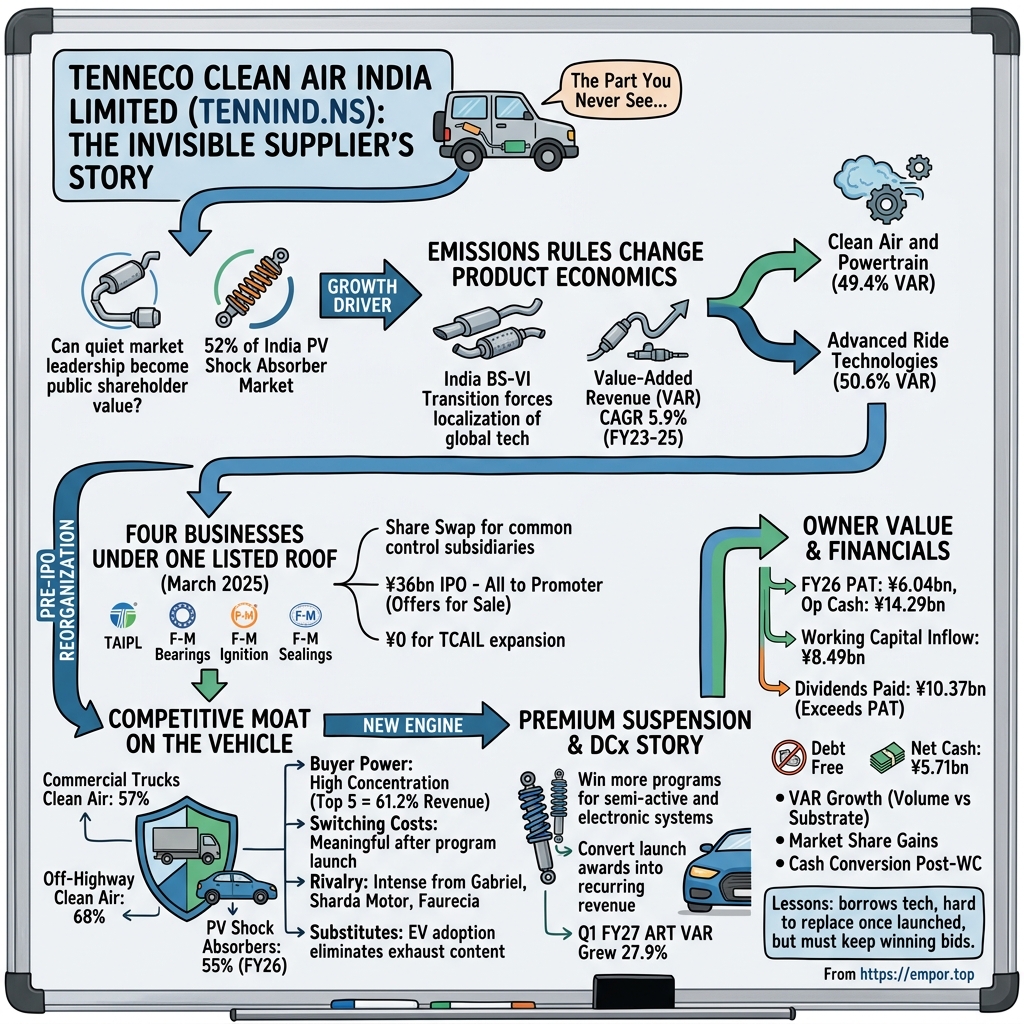
Tenneco Clean Air India Limited, listed on the NSE and BSE as TCAIL, is one of those companies whose products sit inside vehicles from Maruti Suzuki, Tata Motors, Mahindra & Mahindra, Hyundai and many others, while its name never appears on a badge.1 Its scale is real. By its own industry report, it held about 52% of India's passenger-vehicle shock-absorber and strut market in FY25.2 In FY26 the listed group reported revenue from operations of about ₹54.0 billion (roughly ₹5,400 crore).3
Then there is the number that frames the public-market story. When TCAIL listed in November 2025, its IPO raised ₹36 billion. The company received none of it.1 Every rupee went to the selling promoter, a Tenneco group entity, which sold part of its stake to public investors. That was not a scandal; offers for sale are common. But it sets up the questions this story has to answer.
The first concerns what the listed company actually is. TCAIL is not global Tenneco. It is an Indian holding company with four Indian subsidiaries: Tenneco Automotive India, Federal-Mogul Bearings India, Federal-Mogul Ignition Products India and Federal-Mogul Sealings India.13 Tenneco LLC, owned by Apollo-affiliated funds, sits at the top of the global pyramid.1 Global Tenneco's plants, patents and customer list are context for this story. They are not TCAIL's revenue.
The second is whether growth is accelerating. The third is whether automakers can switch suppliers more easily than market-share figures suggest. The fourth is how much of TCAIL's economics depends on terms set by its parent: royalties, related-party sales and technology licences. The fifth is whether newer suspension technology can turn from a showroom talking point into material revenue.
The verdict at the start is simple to state and harder to resolve. Tenneco India has a strong position in components that automakers cannot do without. The open question for a public shareholder is how much of that position keeps growing, and how much of its value stays inside the listed company. The answer starts with a regulation.
 Subscribe on LinkedIn
II. The Emissions Rule That Changed the Product — and the Economics (7 min)
In April 2020, India skipped a step. Rather than move from Bharat Stage IV emission norms to BS-V, the country leapt straight to BS-VI, broadly comparable to Euro 6. Automakers had a short window to redesign engines and exhaust systems for tighter limits on particulates and nitrogen oxides. A further phase of stricter real-driving norms followed in 2023.2
For an exhaust supplier, that leap changed the product. A muffler and a pipe became an emissions plant on wheels. Diesel vehicles needed particulate filters to trap soot and selective catalytic reduction systems that inject a urea solution to break down nitrogen oxides. Petrol vehicles needed better catalytic converters. These systems are built around ceramic or metallic substrates coated with precious metals such as platinum, palladium and rhodium. An analogy helps: the substrate is a honeycomb sponge, the precious-metal coating is the chemistry that cleans the gas as it flows through.2
Tenneco has been manufacturing in India since 1995 and already knew this technology from Europe and the United States.4 Its challenge was to localize it, adapting global designs for Indian vehicle platforms, Indian duty cycles and Indian price points. Regulation did not hand Tenneco a franchise. It raised the engineering content of each relevant vehicle, and rewarded suppliers able to qualify complex systems quickly.
The pricing unit hiding inside revenue
Here is the first puzzle for anyone reading TCAIL's accounts. Much of the cost of a clean-air system is the substrate and its precious metals. Tenneco buys them, often from suppliers the automaker has selected, and passes the cost through to the customer. When metal prices move, revenue moves, but Tenneco's value-adding work does not.1
So management reports value-added revenue (VAR), which strips out those pass-through substrate costs. It is the better measure of Tenneco's own activity, and the gap between the two lines tells a story.
Reported revenue fell 10.6% in FY25, from about ₹54.7 billion to about ₹48.9 billion.1 A casual reader would have seen a shrinking business. In fact, the decline came mainly from lower substrate prices and from some customers switching to cheaper Indian substrate suppliers.1 VAR still grew in FY25, but only 2.6%.5 Over FY23–FY25, VAR rose at a 5.9% annual rate, from about ₹39.0 billion to about ₹43.8 billion.1
That is the base rate: a steady, mid-single-digit underlying grower. Then FY26 broke the pattern. VAR rose 12.3% to about ₹49.2 billion on higher volumes and program wins, and revenue recovered to ₹54.0 billion.53
A step-up, or a good year?
The honest reading is that FY26 was a strong year that has not yet proven to be a new trend. Two facts temper the excitement. First, profit after tax grew 9.3% to ₹6.04 billion, slower than the roughly 20% annual pace of FY23–FY25.31 Faster sales did not convert into faster profit growth, partly because of listed-company costs and a ₹272 million exceptional charge tied to India's new labour codes.3 Second, the consolidated record begins in FY23 because of the 2025 reorganization. Four years is a short window to declare a change in the growth rate.
There is also a hard ceiling on part of this business. A fully electric vehicle has no exhaust. Management estimated at its August 2026 AGM that EV-related sales were only about 1% of the total, with a future scenario of 3–3.5%.6 Those are management's estimates, not audited measurements. But the direction is clear: battery-electric adoption shrinks the clean-air growth pool, while hybrids and alternative-fuel engines may preserve some of it.
So regulation built the product and lifted content per vehicle. It did not guarantee a long-run growth rate, and the listed company's own record is too young to settle that. That young record exists because of a corporate reshuffle in early 2025.
III. Four Businesses Were Put Under One Listed Roof (8 min)
In March 2025, before any public investor owned a share, Tenneco rearranged its Indian furniture.
TCAIL, incorporated in 2018, had been a relatively narrow entity. Through share swaps, it issued about 189.5 million new shares to Tenneco group entities and in return took ownership of four Indian businesses: Tenneco Automotive India (TAIPL), and the three Federal-Mogul companies making bearings, ignition products such as spark plugs, and sealings.1 Overnight, the listed vehicle went from a slice of Tenneco's Indian operations to most of them.
This was a common-control transaction, an internal reorganization between companies with the same ultimate owner. It is not an acquisition that can be benchmarked against deal multiples, because no independent buyer negotiated a price. Its effect was to broaden the operating perimeter of the company that would later be sold to the public. The prospectus restated a three-year consolidated history as if the group had always been together.1 That is accounting convention, not a decade of organic growth.
The Motocare detour
One transaction before the swap deserves a careful trace. TAIPL owned Motocare India, an aftermarket business. Before the reorganization, TAIPL transferred Motocare to Federal-Mogul Motorparts India, a fellow Tenneco subsidiary that stayed outside the listed perimeter, for ₹8.29 billion. TAIPL recorded a ₹5.73 billion gain in its standalone accounts.7
Why does this matter? Because Motocare did not disappear from TCAIL's story. It remains a fellow subsidiary and a significant customer. In FY25, Motocare India was named in the prospectus as 4.74% of revenue.1 Sales to Motocare are real sales, but they are sales to a sister company, on terms set within the group. They should not be read as independent end-customer demand.
An IPO that funded the seller
At the November 2025 IPO, the promoter sold 90,680,100 shares at ₹397 apiece.1 The shares listed on 19 November 2025.1 Before the offer, the promoter group held 97.25%; afterwards, 74.79%, a level that remained unchanged through June 2026, with no shares pledged.18
The ownership picture kept moving. On 12 August 2026, Tenneco Mauritius Holdings, one promoter entity, disclosed a market sale that cut its direct holding from 60.22% to 47.69%.9 Readers should keep the direct holder and the promoter-group total apart; the group includes other entities. But the direction of travel is plain: the parent has been a seller.
Meanwhile institutions arrived. Between November 2025 and June 2026, foreign portfolio investors rose from about 4.3% to 9.7% of the shares, and domestic mutual funds from 4.2% to 7.1%.810 Seven months is too short to call that a trend, but early public demand clearly existed.
What the listing did and did not do
Here is the capital-allocation point stated plainly. No external acquisition by TCAIL drives today's growth. The share swap exchanged equity among sister companies; the IPO turned part of the promoter's holding into cash. Neither event funded a new plant, a research centre or a technology purchase for the listed company.
That is not necessarily bad for a minority shareholder. The listed company had cash, capacity and an owner with global technology. But it frames the investor question: since the public offer did not fund the growth plan, the growth plan must be funded from operations. That puts all the weight on how Tenneco actually wins business on a vehicle.
IV. Where Tenneco Wins Its Place on the Vehicle (15 min)
Every car sold in India begins as a competition among suppliers. Years before launch, an automaker issues a request for quotation for a new platform. Suppliers bid on design, price, quality systems and capacity. Engineers test prototypes on rigs and test tracks. Tenneco describes this RFQ-to-award process as taking anywhere from six to more than 18 months.1 Win it, and the supplier must then meet cost, quality and delivery targets for the program's life, often five to seven years. Lose it, and that slot is closed until the next model.
This is the arena where TCAIL's economics are decided, and it is worth understanding what the company actually sells.
Two businesses of almost equal weight
TCAIL reports two divisions. Clean Air & Powertrain covers exhaust after-treatment, plus the Federal-Mogul businesses: bearings that let engine parts spin with minimal friction, sealings and gaskets that keep fluids in and contaminants out, and ignition products such as spark plugs. Advanced Ride Technologies, or ART, makes shock absorbers and struts, the parts that stop a car bouncing after every pothole, and increasingly more sophisticated suspension systems.5
In FY26 the two were almost perfectly balanced: ART contributed 50.6% of VAR, Clean Air & Powertrain 49.4%.5 That balance matters for the electrification debate, because one half does not need an internal combustion engine and the other largely does.
Market share, read with proportion
The CRISIL industry report commissioned for the IPO gives the clearest map of where Tenneco is strong.2
In passenger-vehicle shock absorbers and struts, Tenneco held about 52% of the market by value in FY25. Chief executive Arvind Chandrasekharan said that rose to around 55% in FY26.211 That is genuine leadership in a large category.
In clean air, the picture is uneven. Tenneco held about 57% of the commercial-truck clean-air market and about 68% of off-highway clean air, excluding tractors. In passenger vehicles, its clean-air share was only about 19%.2 So the strongest clean-air positions are in trucks and construction equipment, where diesel engines and complex after-treatment systems are standard, and where the electrification threat is slower.
These are value-share estimates in an industry report prepared for an IPO. They show where Tenneco sells most. They do not show where it earns most, because TCAIL does not report profit by division.
The rivals
The competitive set differs by product. In shock absorbers, Gabriel India is the most important domestic rival.2 In exhaust systems, Sharda Motor, Faurecia (now part of Forvia), Eberspächer, JBM and Mark Exhaust all compete.212 Sharda, for instance, built a large exhaust and emissions business serving major Indian automakers.12 None of these competitors matches Tenneco in every niche, but several are qualified, capable and hungry for the same programs. Some are especially strong in passenger-vehicle exhausts, exactly where Tenneco's share is lowest.
Porter's forces, applied once
Buyer power is the defining force. The top five customers produced about 61% of revenue in FY23 and about 62% in FY25; the top ten were about 82% in FY25. Three customers each exceeded 10% of FY25 revenue.1 Most names are masked in the prospectus. A supplier with that concentration negotiates with a handful of large, sophisticated buyers who know Tenneco's costs and can award the next program elsewhere.
Switching costs are meaningful but bounded. Once a damper or after-treatment system is engineered into a platform and validated for emissions certification, changing suppliers mid-program is expensive and risky. But the company has no exclusivity agreements, and most business runs through purchase orders rather than long-term supply contracts with guaranteed volumes.1 The lock-in lasts for a program, not forever.
Rivalry and entry: incumbent scale, local engineering and a history of qualifications help. A newcomer cannot easily win a BS-VI after-treatment program without a track record. But established rivals can, and automakers routinely dual-source to keep suppliers honest.
Substitutes: battery-electric vehicles remove the exhaust system entirely. Hybrids and CNG or ethanol platforms keep some clean-air content.
Supplier power: substrate and precious-metal prices create timing exposure. Customer price resets happen periodically, so cost moves can hit margins before they are passed through.1
Testing the stickiness
The affirmative evidence for customer stickiness is real. Tenneco served 119 customers in FY25 and had 427 programs in production by Q1 FY26.15 Long relationships with India's largest OEMs show repeat program wins over many model cycles.
The strongest disconfirming evidence comes from management itself. On the Q1 FY27 earnings call in August 2026, analysts pushed on why Clean Air & Powertrain grew 9.6% when the reported vehicle market grew faster. Management's answer was revealing: Tenneco had no clean-air business with a leading Japanese passenger-vehicle maker, and EVs were growing. Adjusting the market for those two factors, management argued, its performance was in line or better.13
Two things follow. First, the absence of one of India's largest car makers from the clean-air customer list is a large hole in the passenger-vehicle position, and it helps explain that modest 19% share. Second, the adjusted comparison is management's own framing. It may be fair, but it was constructed after the fact to explain an underperformance.
Analysts also pressed on a roughly 170-basis-point year-on-year margin decline in the quarter. Management pointed to the costs of being a listed company and to input-cost inflation not covered by indexation clauses.13 That second explanation directly illustrates supplier power and buyer power working together: when costs rise and price formulas do not cover them, the supplier absorbs the difference until it can renegotiate.
The calibrated verdict: the evidence supports a strong, qualified supplier with a leading position in shock absorbers and in commercial and off-highway clean air. It narrows any broader claim of a moat in passenger-vehicle clean air, where share is modest and a major OEM is missing. Program wins and retention are the real proof of advantage, and the weakest disclosure is profit by division. Without it, nobody outside the company can say which half creates more value. Which brings the story to the half management talks about most.
V. The New Suspension Story Has to Leave the Test Track (8 min)
Imagine two cars crossing the same broken stretch of road. In one, the dampers are passive: oil forced through fixed valves, tuned once at the factory as a compromise between comfort and handling. In the other, sensors read the road and the car's body movement many times a second, and electronically controlled valves change damping on the fly. The second car glides; the first one merely copes.
That gap is the opportunity Tenneco is chasing in suspension. Its global parent developed the technology, including its DCx valve design and semi-active and electronic systems. The Indian team's job is to adapt those products to local platforms and price points, then win the programs.514
Already a core business
It is important to start with what is already true. Suspension is not a speculative side bet. ART already made up about half of FY26 VAR,5 and management told the AGM that more than half of sales are shock absorbers.6 In Q1 FY27, ART's VAR grew 27.9% year on year, the fastest growth in the company.13
The question is not whether suspension matters. It is whether the premium layer, semi-active and electronic systems, can become a meaningful revenue stream on top of the base business.
The Mahindra proof point
The clearest commercial example is Mahindra's electric SUVs, the BE 6 and XEV 9e. Tenneco's investor presentation described electronic suspension fitted to these models and the ride benefits it brought.5 That is a meaningful reference: a demanding Indian OEM chose an advanced Tenneco system for flagship electric vehicles.
But a single platform is not a thesis. Neither TCAIL nor Mahindra discloses the revenue from those fitments, and premium EV SUVs are still a small share of Indian vehicle production. The example proves capability and customer acceptance. It does not yet prove scale.
Two different transition risks
Electrification affects the two divisions differently. An EV still needs dampers; often heavier battery packs make good suspension more important. An EV does not need an exhaust. Management's estimate that more than half of sales come from shock absorbers therefore improves the mix story. It is not proof that every rupee of suspension revenue is EV-ready, or immune to changes in vehicle architecture, pricing pressure and competition from Gabriel and others.6
New awards, unsized
The Q1 FY27 call brought fresh evidence. Management reported four new customers for conventional and DCx suspension platforms, an order from a European all-terrain vehicle maker, and a spark-plug award it called strategically useful.13 None of these orders was given a value.13
That is where discipline is needed. A nomination is a promise of future volume, conditional on the vehicle launching on time and selling well. A validation milestone is engineering progress. A patent belongs to the global group. None of these is recurring revenue for TCAIL until parts ship.
Tenneco's own record on conversion is mostly positive in the base suspension business, where it went from about 48% to 55% PV share in a short period by management's account.11 The record for premium electronic systems is too short to judge.
The forward test is concrete: disclosed order-book growth, production launches on schedule, new customers who keep ordering, and ART growth compared with Indian passenger-vehicle production. If ART keeps outgrowing the market for several more quarters, the suspension thesis graduates from claim to evidence. Growth on paper, however, must eventually show up as cash.
VI. The Cash Came In Through Working Capital, Then Went Out as Dividends (9 min)
Open TCAIL's FY26 cash-flow statement and the top line looks spectacular. Profit after tax was ₹6.04 billion. Operating cash flow was ₹14.29 billion, well over twice profit.3 For a manufacturing company, that is unusual. The puzzle is where the extra cash came from.
The bridge
Walk through it step by step.
Start with cash generated before any working-capital changes: about ₹9.10 billion. That is profit adjusted for depreciation, provisions and other non-cash items, and it is the cleanest view of underlying cash earnings.3
Then add working-capital movements, which contributed roughly ₹8.49 billion. Trade payables rose by about ₹1.90 billion, meaning Tenneco took longer to pay its suppliers or bought more on credit. Trade receivables fell, meaning customers paid faster or owed less. Other liability movements also helped.3
Subtract about ₹3.29 billion of tax paid, and you arrive at the ₹14.29 billion headline.3
The conclusion: the underlying cash engine produced around ₹9 billion, already healthy against ₹6 billion of profit. The rest came from squeezing the balance sheet. Working-capital releases can be valuable, but they cannot repeat indefinitely. A company cannot keep stretching payables or shrinking receivables every year.
Where the cash went
Most of it left as dividends. TCAIL paid about ₹10.37 billion of consolidated dividends in FY26, more than its entire year's profit. Capital expenditure was only about ₹1.15 billion. The year ended with ₹5.71 billion of cash and no bank borrowings.73
A payout above earnings is possible once, funded by a working-capital release and accumulated cash. As a run rate, it is not. At the time, the promoter group owned about three-quarters of the company, so roughly three-quarters of those dividends flowed to Tenneco entities.8
Reinvestment deserves a closer look. Over FY23–FY25, capex ran at only about 1.3–1.8% of revenue, and direct R&D expense was below a quarter of a percent.1 The company announced new plant additions in 2026.5 Investors should track whether those plants fill up and earn their keep, not just whether they get built.
Do not confuse standalone with consolidated
A second trap sits in the standalone accounts. TCAIL the parent company reported FY26 other income of about ₹9.12 billion, of which ₹8.96 billion was a dividend from its subsidiary Tenneco Automotive India.3 That is money moving from one pocket to another inside the listed group. It is eliminated in consolidation, where other income was only about ₹590 million, around 7% of pre-tax profit.3 The consolidated figure is the one that reflects external earnings.
Who pays late
The receivables question can be answered with the annual report. Consolidated trade receivables were ₹6.35 billion at FY26 year-end, down from ₹6.87 billion.37 About ₹1.45 billion was due from related parties. About ₹4.90 billion was not yet due, and about ₹1.21 billion was less than six months overdue.7
Credit losses look small. The expected-credit-loss allowance was about ₹46 million, of which ₹28 million related to balances with a significant increase in credit risk and ₹18 million to credit-impaired balances.7 Against a ₹6.35 billion book, that is less than 1%. The ageing improved from FY25, when more than half of receivables were less than six months overdue.1
The company gives an average credit period of 30–120 days but does not name its overdue customers.7 It would be wrong to infer that any particular OEM pays late.
Smaller balance-sheet items
Three items deserve a mention in proportion. Lease liabilities of about ₹515 million are well covered by cash, so the group has net cash after leases.3 Vendor bill financing, a supplier-finance arrangement, fell to about ₹283 million from about ₹503 million.3 And consolidated contingent liabilities were about ₹1.32 billion at year-end, mainly tax matters plus claims inherited through the reorganization.7 The FY26 auditor's report and CARO report carried no qualifications or adverse remarks.76 A clean audit does not resolve the claims, but it shows no new red flag. No credit agency has published a company-specific rating, so management's debt-free description has no independent agency check.
Cash, then, is genuine and the balance sheet is strong. But FY26's conversion was flattered by timing, and its dividend outran profit. Much of that dividend went to the parent, whose role in the business runs well beyond ownership.
VII. A Profitable Listed Company Still Depends on Its Parent (8 min)
Follow a single damper through TCAIL's books. The design may originate in a Tenneco engineering centre abroad. The brand on the technical documents is Tenneco's. The Indian plant pays a royalty for using that brand and know-how. Some components may be bought from fellow subsidiaries; some finished parts may be sold to Motocare, another fellow subsidiary. At every step, the terms are set inside the group.
That is the essence of TCAIL's relationship with its parent: a genuine operating asset that comes with recurring costs.
The royalty trail
Royalties for group brands and technical know-how were about ₹1.12 billion in FY23, jumped to about ₹2.57 billion in FY24 (4.7% of revenue), then fell back to about ₹1.10 billion in FY25.1 In FY26 they were about ₹1.19 billion, roughly 2.2% of revenue.7 The prospectus attributed the charges to brand and technical rights but did not explain the FY24 spike in a way that lets an outsider model future fees.1
Compare that with what the Indian group spends itself. FY25 R&D expense was about ₹67 million; FY26 consolidated R&D was about ₹108 million.17 The royalty is more than ten times the local R&D line. TCAIL is not a standalone innovation engine. Nor is it a pure royalty conduit: 132 design, engineering and R&D employees were on staff in June 2025, and application engineering, testing and production happen locally.1
The licence cannot generally be terminated by the licensor before 1 January 2031, except in specified circumstances.1 That gives a measure of security. The group also withdrew its advance-pricing-agreement application covering royalty and support charges, an attempt to agree transfer-pricing terms with tax authorities in advance.7 The withdrawal leaves those charges subject to ordinary tax scrutiny.
Related-party flows
In FY25, sales of products and services to related parties were about ₹3.58 billion, and with related-party other income they made up 7.86% of total income. Purchases from related parties were about ₹2.18 billion.1 In FY26, related-party product sales and services were about ₹3.32 billion, with Motocare a major counterparty.7 As noted above, these sales are legitimate, but they are not evidence of independent end-market demand.
The management team now
The current chapter has one central figure. Arvind Chandrasekharan joined as whole-time director and CEO in May 2025, shortly before the DRHP was filed.1 He has been the public face of the listing and of the suspension push, including in trade-press comments about share gains.11 His public style focuses on market share and order wins, with a habit of reframing growth against an adjusted served market, as discussed above.13
His FY26 remuneration was about ₹85.4 million.7 The AGM notice proposed revised terms from April 2026, including variable pay of up to 50% of total cost to company and eligibility for long-term incentives.15 Shareholders approved with 99.9945% of votes cast in favour.6 That near-unanimity says less than it seems: the promoter owns about three-quarters of the shares, and public non-institutional participation is low. For context, his pay is around 1.4% of FY26 consolidated profit.
Governance, then and now
The prospectus was candid about the past. A vendor-payment fraud at a subsidiary between FY18 and June 2023 caused about ₹194 million of losses, and the subsidiary filed a police complaint in July 2025. Earlier audit reports identified weak segregation of vendor payments, delayed statutory dues and audit-trail findings.1 The board at FY26 year-end had eight directors, three of them independent.1
The FY26 audit was unmodified, with no CARO qualifications or adverse remarks.7 That is real improvement. The forward test is whether the controls hold through several years of listed-company scrutiny.
The verdict: parent access is an asset, and the 2031 licence protection is meaningful. But the right question is whether that borrowed technology earns returns above its fees. That is exactly what a buyer of the shares must price.
VIII. Bull, Bear, and the Price of the Story (9 min)
On IPO day the arithmetic was simple. At ₹397 a share, against FY25 earnings per share of ₹13.68, the offer valued TCAIL at about 29 times earnings and about 3.3 times revenue.1 The prospectus set that against selected listed peers averaging about 48 times, a range running from Sharda Motor at under 10 times to Gabriel India at about 76 times, using October 2025 prices.1 Investors were invited to see a market leader priced below its peer average. Since then, the business has delivered 12.3% VAR growth in FY26 against a 5.9% FY23–FY25 base.51
The debate is whether that faster growth is the new normal, and whether the market already assumes it is.
The bull case
The bull argument rests on positions that are measurable. Leading value share in PV shock absorbers, commercial-truck clean air and off-highway clean air; 427 programs in production; long relationships with India's largest automakers; net cash and no bank debt.253 Q1 FY27 brought market-share gains reported by management and 27.9% ART growth.13 If Indian vehicle production keeps growing, and content per vehicle keeps rising with premium suspension and tighter emissions norms, TCAIL is positioned to grow faster than the market.
The bear case
The bear argument rests on the same record read differently. FY25 showed how sensitive revenue is to substrate pricing and sourcing decisions made by customers.1 The missing Japanese OEM limits passenger-vehicle clean air.13 EVs remove exhaust content entirely. Customers are concentrated, can dual-source, and negotiate hard; the Q1 margin dip from unindexed inflation shows the cost of that bargaining power.13 Group royalties and related-party flows take a slice of value before minority shareholders see it. And the consolidated record is only four years long.
Seven Powers, briefly
Hamilton Helmer's framework helps sort which advantages are durable.
Scale economies: present but moderate. Leading volume in dampers spreads plant and engineering costs, but rivals such as Gabriel also operate at large scale.
Switching costs: real within a program, as argued in the business section, but reset at each new model. The Japanese OEM gap shows incumbency in one place does not transfer to another.
Process power: plausible, in the know-how to localize and qualify complex systems cheaply. It is hard to measure from outside.
Cornered resource: the Tenneco technology licence is the closest candidate. But it is a resource TCAIL rents, not owns, which is why the royalty matters.
Brand, network effects and counter-positioning: largely absent. Automakers buy on specification, cost and quality, not brand loyalty.
The overall verdict: TCAIL has a solid but conditional advantage built mainly on switching costs and process know-how within programs, supported by a rented technology base. Retention and new program wins are better evidence than claims of technology leadership.
An activist's questions
A skeptical long-short investor would press on three points. Why did FY26 dividends exceed profit when new plants are planned? What do royalty and support fees buy, and how are they set now that the advance-pricing application was withdrawn? Why not disclose profit by division, so investors can see whether suspension or clean air earns the higher return? Each question has a reasonable answer available to management. None has been fully answered in public.
Three KPIs that matter
First, VAR growth split into volume and substrate effects. The latest reading is 12.3% for FY26, up from 2.6% in FY25.5 Direction: improving.
Second, market share and program launches by product, especially PV suspension share, last put by management at about 55%, up from 52%.112 Direction: improving, on management's figures.
Third, cash conversion after working capital, alongside capex and dividends. FY26 cash before working capital was about ₹9.10 billion against ₹6.04 billion of profit, with dividends above profit.3 Direction: strong, but flattered by a one-time release.
Valuation discipline
The offer-time comparison is now a year old. Any current judgment needs the post-listing trading range and refreshed peer multiples, set against what those multiples imply. A multiple close to the IPO level assumes steady mid-to-high single-digit underlying growth; a much higher one assumes FY26's pace persists and that parent costs stay contained. Whether the price assumes too much depends on evidence that has not arrived yet. What the story already offers are its lessons.
IX. Lessons from the Parts Inside the Car — Lessons (5 min)
Go back to that RFQ, years before a car's launch. An automaker's engineers have just picked Tenneco for a new platform. Champagne is premature. The supplier must now deliver for six years at a price agreed before input costs moved, and then win the next round from scratch.
Lesson one: "A supplier can be hard to replace after launch, but it still has to win the next bid." Tenneco's program base and leading shares show what qualification can build.5 The missing Japanese OEM shows its limit: switching costs protect a program, not a customer.13 Founders building B2B industrial companies should notice the difference between stickiness and entitlement. The moat is renewed one bid at a time.
Lesson two: "Borrowed technology is an advantage when it earns more than its royalty." TCAIL's royalty bill, many times its own R&D spend, shows the trade-off.7 That deal can be excellent: it brings global designs to Indian platforms without global development costs. It becomes poor value only if the margin the technology protects shrinks below the fee. For investors in any subsidiary of a multinational, the royalty line is where the parent's interests and the minority's interests meet.
Lesson three: "A cash-rich balance sheet is a fact; a repeatable cash yield is a pattern." FY26's cash conversion and dividend payout both benefited from working-capital timing.37 Neither is a run rate. The lesson is to look beneath headline cash conversion, find the working-capital release, and wait for a second and third year before calling it a habit.
Lesson four: "An IPO that pays the seller tells you who the listing was for." The offer funded the promoter, not the company.1 That does not make the business weaker. It means public shareholders must rely entirely on operating cash and the parent's goodwill to fund the next phase, and should watch whether later promoter sales and dividend policy serve both sides equally.
X. The Next Two Years Decide Whether the Growth Rate Changed — Epilogue (2 min)
Tonight, in early October 2026, TCAIL stands at an interesting point. It has nearly one year as a listed company behind it, a strong FY26, a Q1 FY27 with fast suspension growth and a margin dip, and a promoter that has started selling down part of its direct stake.139
The next scheduled moment is the half-year order-book update, which management said would come with H1 FY27 results; the most recent disclosure referenced a base of about ₹12.4 billion.13 If that order book grows and the new suspension customers turn into sized programs, the story gains weight. If the order book stalls, FY26 starts to look like a good year rather than a step-change.
Further out sits the prize management has hinted at: an entry into a clean-air program with the leading Japanese OEM it does not currently serve, placed around FY28–FY29.13 That would close the largest gap in passenger-vehicle clean air. But a nomination is not a sale. Investors should wait for production volumes.
Meanwhile the new plants will ramp, DCx applications will either multiply or stay niche, and each annual report will add another year of related-party notes, receivables ageing, litigation updates and shareholder votes. Two more years of VAR growth, split into volume and substrate effects, will answer the central question: did the growth rate change, or did one year flatter it? The tension is that both outcomes remain plausible today.
XI. The Invisible Parts Have to Keep Earning Their Place — Outro (1 min)
Return to the SUV rolling off the line. Its driver will never learn who made the dampers or the exhaust after-treatment. The automaker's purchasing team knows exactly, and will reconsider the choice at the next model.
Tenneco Clean Air India still depends on access to its parent's engineering.5 It raised ₹36 billion at listing and kept none of it.1 The driver may never notice the part. Shareholders should notice who pays for it, who sets its terms and where the cash goes.
References
-
Prospectus — Tenneco Clean Air India Limited, 2025-11-14 ↩↩↩↩↩↩↩↩↩↩↩↩↩↩↩↩↩↩↩↩↩↩↩↩↩↩↩↩↩↩↩↩↩↩↩↩↩
-
CRISIL Industry Report — Tenneco Clean Air India, 2025-11 ↩↩↩↩↩↩↩↩↩↩
-
FY26 Audited Financial Results and Auditor's Report — Tenneco Clean Air India, 2026-05-30 ↩↩↩↩↩↩↩↩↩↩↩↩↩↩↩↩↩↩
-
Tenneco Clean Air India's Turnaround Journey Towards IPO — Autocar Professional ↩
-
FY26 Investor Presentation — Tenneco Clean Air India, 2026-06-02 ↩↩↩↩↩↩↩↩↩↩↩↩↩↩
-
Integrated Annual Report FY2025–26 — Tenneco Clean Air India, 2026-08 ↩↩↩↩↩↩↩↩↩↩↩↩↩↩↩↩
-
Shareholding Pattern as of 30 June 2026 — Tenneco Clean Air India ↩↩↩
-
NSE Insider-Trading Disclosure — Tenneco Mauritius Holdings, 2026-08-14 ↩↩
-
Q2 and H1 FY26 Earnings Call Transcript — Tenneco Clean Air India, 2025-12-05 ↩
-
Tenneco's PV Suspension Share Grew from 48% to 55% in Eight Months — Autocar Professional ↩↩↩↩
-
Sharda Motor Industries Limited Rating Rationale — CRISIL, 2023-01-16 ↩↩
-
Q1 FY27 Earnings Call Transcript — Tenneco Clean Air India, 2026-08-06 ↩↩↩↩↩↩↩↩↩↩↩↩↩
-
Tenneco Clean Air: Can Suspension Tech Drive Its Next Growth Phase? — The Indian Express ↩
 LinkedIn
 WhatsApp
 Reddit
 Hacker News
 Email
Email Kindle
 RSS Feed
 Spotify
 Apple Podcasts
 Amazon Music
 Audible
 YouTube