Tata Investment Corporation Limited: The Tata Portfolio Inside the Tata Portfolio
I. Introduction: The Company That Owns a Piece of the Tata Story
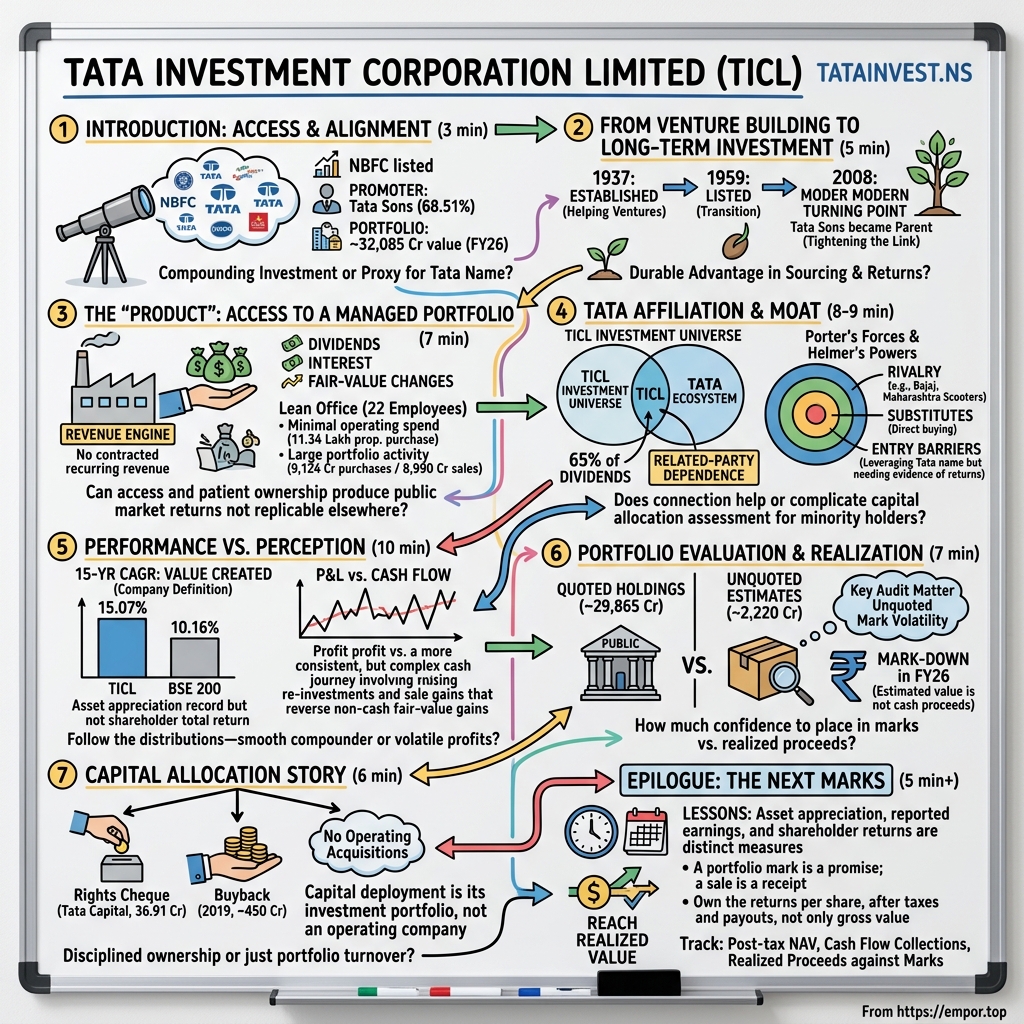
Picture one share in a listed company. It has no factory, no product and no customer queue. Look through it and you find something unusual: slices of 91 other companies, most of them traded on the same exchanges, many of them carrying the same three-syllable name that has been part of Indian business for more than 150 years1. That share belongs to Tata Investment Corporation Limited, or TICL. It is a Russian doll of Indian capitalism: a Tata-controlled company whose main job is to own pieces of other companies, many of them Tata companies.
At 31 March 2026, TICL estimated the market and fair value of its portfolio at roughly ₹32,085 crore1. Tata Sons, the group's private holding company, owns about 68.51% of TICL directly2. So a minority shareholder who buys TICL on the NSE is renting a seat inside the Tata ecosystem, a minority seat, in a company controlled by the same family of companies it invests in.
That set-up raises one question this story keeps coming back to. Is TICL a compounding investment company that earns its keep through selection and discipline, or a market-priced proxy for the Tata name that trades on headlines about Tata Sons, Tata Capital and whatever group listing comes next?
The entity boundary needs to be clear from the start. TICL is a listed non-banking financial company that is registered as an investment company1. It is not Tata Sons. It does not own the operating profits of Tata Consultancy Services, Tata Steel or Titan. It owns shares, and what reaches TICL from those companies is what they choose to pay out in dividends, plus whatever the market or a valuer says the shares are worth. Its consolidated accounts add a wholly owned subsidiary, Simto Investment Company, and its associates. The standalone company is the core of the story1.
Three questions run through what follows. First, does the portfolio create value across a full market cycle, rather than in one bull run? Second, does Tata affiliation give TICL an investing edge that an ordinary investor cannot copy? Third, can minority shareholders trust the marks put on the portfolio and the way capital is allocated?
The tidy answers are tempting: "it's a Tata company, it must be good" or "it's a holding company, it must trade at a discount." Neither survives contact with the filings. What survives is more interesting: a story about the gap between what a portfolio is worth, what it earns, and what its owners actually get. To see how that gap opened, one has to go back to a company that once helped build businesses rather than merely holding them.
 Subscribe on LinkedIn
II. From Helping Create Companies to Owning Their Shares
In 1937 India was still a colony, its industrial base was thin, and starting a large enterprise required capital that few Indian institutions could supply. That year the company now called TICL was established3. Its early mission, as the Tata group tells it, was to help establish and finance new ventures. In other words, it was something closer to a development financier than a passive portfolio3.
The company listed its shares in 1959, which makes it one of the older listed vehicles on Indian exchanges3. Through the 1960s and 1970s it supported new enterprises, many inside the Tata orbit, as India's licence-raj economy made patient, connected capital scarce and valuable3. In that era, access mattered a great deal. If permission, financing and partners were hard to find, a group-linked investment house had a real reason to exist.
Then India changed. Liberalisation in the 1990s, deeper equity markets and the arrival of mutual funds, foreign portfolio investors and, later, retail brokerage apps steadily made it easier to get the kind of exposure TICL offered. The company gradually became what it calls itself today: a long-term investment company with a diversified portfolio of quoted and unquoted equity, held mainly for appreciation rather than trading1.
The modern turning point came in 2008, when Tata Sons became TICL's holding company3. That tightened the link. From then on, TICL was not just a Tata-associated investor. It was a subsidiary of the group's apex holding company, with its board, strategy and capital allocation ultimately sitting under Tata Sons' control. TICL's portfolio and dividend stream were already heavily tied to group fortunes in FY154.
This history matters for one reason. The origin story is about creating access. The investment case today has to be about returns. A public investor in 2026 can buy Tata Steel, Titan or Tata Consumer Products directly with a phone. So the question is not whether TICL once helped build companies. It is whether a legacy of access and patient ownership still produces returns that a shareholder could not get by buying the underlying shares themselves.
The rest of the story tests that proposition. First, though, it helps to see what this company actually "sells" when it has no product at all.
III. What Does This Investment Company Actually Sell?
Walk into TICL's office and you will not find a shop floor. At the end of FY26 the company had 22 permanent employees1. That year it spent about ₹11 lakh on property and equipment, less than a mid-sized restaurant might spend on a kitchen refit1. Yet in the same twelve months it bought about ₹9,124 crore of investments and sold about ₹8,990 crore1. The economic activity is not in the furniture. It is in the trades.
So what is the product? In plain terms, TICL sells access to a managed portfolio. Its 91 investees comprised 76 quoted and 15 unquoted companies at the end of FY261. Revenue comes from four sources: dividends from investees, interest on debt instruments and deposits, changes in the fair value of investments that pass through the profit and loss account, and a little property rent1. There is no price per unit, no customer contract, no subscription and no contracted minimum. Nothing here resembles recurring revenue in the software sense.
That has three consequences an investor should keep in mind.
First, income is borrowed from other boardrooms. The dividend line depends on decisions made by investee boards over which TICL usually has little influence. When Tata Steel cuts a dividend in a commodity downturn, TICL's revenue falls without TICL doing anything differently.
Second, "profit" moves with the market. Under Ind AS, some changes in investment value hit the profit line, while gains on most long-term equity holdings are routed through other comprehensive income and retained earnings instead1. Section VI shows why that creates a measurement trap.
Third, turnover is not reinvestment in the conventional sense. The roughly ₹9,000 crore of annual purchases and sales looks enormous next to a ₹4,656 crore book-value portfolio1. Much of it is likely treasury churn through liquid instruments rather than wholesale rotation of core equity. TICL does not publish a split. Either way, portfolio purchases are the company's equivalent of capex, and should not be confused with factory investment.
Some of the usual operating-company tools do not apply here. The board report says TICL has no industrial or manufacturing activity and gives no technology-absorption particulars1. Segment reporting is not meaningful because there is one business: investing1. Exposure to artificial intelligence comes only indirectly, through investees such as IT-services companies whose own economics may be reshaped by AI.
The useful analytical frame is the one a fund analyst would use: what is in the portfolio, what cash does it throw off, how volatile are the marks, and what does it cost to run? On the last point, TICL is extremely lean. Twenty-two employees running a five-figure-crore portfolio means the cost layer is thin. The bigger costs, as later sections show, are taxes, deferred tax on unrealised gains, and the price minority holders pay for governance they do not control.
That brings us to the most important question about the income line: whose dividends, exactly, is TICL living on?
IV. When the Tata Dividend Becomes TICL's Revenue
Related-party notes are where annual reports put the uncomfortable fine print, the payments to the parent, the loans to sister companies, the royalties. TICL's related-party note is remarkably quiet on those fronts. The company reported nil related-party purchases and sales, and nil related-party loans or advances, in FY261. It pays no parent royalty or management fee1.
Read the dividend tables, though, and a different picture emerges. Add up the dividends TICL received from entities it classifies as related parties—Tata Sons, its subsidiaries and associates—and the total comes to about ₹190 crore for FY261. That is roughly 65% of all dividend income and around 45% of operating revenue1. The company does not present that aggregate as a headline figure, but its own related-party schedule makes it possible to calculate.
That is the reveal of this section. TICL's related-party exposure does not lie in sweetheart contracts or cash flowing upstream. It lies in the income engine itself. Close to half of the money the company earns from operations comes from the dividend decisions of companies in the same group as its controlling shareholder.
On the balance sheet, related-party investments had a book value of roughly ₹1,566 crore, about a third of the ₹4,656 crore total investment book1. Book value understates economic weight because many of these stakes were bought decades ago at far lower prices. The live, market-value exposure to Tata names is larger than the book figure suggests.
It is worth separating the small from the large here. The headline related-party transaction of FY26 was a ₹36.91 crore subscription to Tata Capital's rights issue1. Related-party investments made during the year were about 0.4% of total investments made, down from about 4% in FY251. So the flow of new money into group companies was small. The stock of group exposure built up over decades is what matters.
What protects the minority? The company says related-party transactions are conducted at arm's length and are subject to audit-committee approval and review1. The board had eight directors, five of them independent1. Those are the formal safeguards. They are designed to prevent unfair transactions, and the disclosures show no sign of any. They do not, however, address the subtler issue: concentration. No audit committee can make Tata group payout policies more diversified than they are.
The governance tension is simple to state. Tata Sons remains TICL's controlling shareholder2. Tata-linked issuers supply a large share of TICL's income. Does that alignment help minority holders? Arguably yes, because the controlling shareholder's interest in TICL's value runs in the same direction as theirs. Does it make capital allocation harder to assess? Also yes. When a group-controlled vehicle subscribes to a group company's rights issue, an outsider cannot easily tell whether the decision was the best use of capital or loyal participation in a group raise.
This is not evidence of misconduct. It is evidence that the right way to analyse TICL is issuer by issuer, which the company does not make easy. TICL does not publish a multi-year series that separates returns on related-party holdings from returns on the rest. That makes the moat question, whether this portfolio is hard to copy, both more important and harder to answer.
V. The Moat Test: Is a Tata Portfolio Hard to Copy?
Imagine a thought experiment. An investor opens a brokerage account, downloads TICL's list of quoted holdings and buys the same shares in the same proportions. What would they be missing?
That is the moat question for any listed investment company. If the replica performs just as well, the holding company is an extra layer of tax, cost and governance with nothing to show for it. If it cannot be replicated, through private deals, early access or superior selection, the layer can earn its keep.
Start with what the portfolio looks like. Financial services, insurance and asset management were the largest block, about 19% of portfolio book value at FY26; FMCG and consumer durables made up around 12%1. Across 91 investees and roughly 29,865 crore of quoted market value, this is a broad, mostly listed, India-heavy equity book1. That breadth is a feature. It is not, in itself, a moat.
Run the frameworks once, against TICL's actual economics.
Rivalry. TICL competes for investor capital with the BSE 200, with index funds and with other listed investment companies such as Bajaj Holdings & Investment, Maharashtra Scooters and JSW Holdings. Bajaj Holdings is several times TICL's size by market capitalisation; Maharashtra Scooters and JSW Holdings are smaller. None of them is a like-for-like portfolio; each is mostly a wrapper around one family's stakes. The relevant contest is not over customers but over whether the wrapper delivers more per share than the contents.
Substitutes. These are the biggest threat. Quoted Tata companies are available to everyone. Diversified mutual funds and index products offer cheap, liquid exposure to the same Indian large caps. Every rupee of TICL's return must justify itself against those alternatives.
Barriers and cornered resources. Long-standing relationships could plausibly give TICL access to unquoted Tata investments, the kind of pre-IPO stake in Tata Capital that ordinary investors could not buy until its 2025 listing. That is the strongest argument for a structural edge. The FY26 marks, discussed in Section VIII, cut against it: unquoted valuations roughly halved in a year. Access is real. Superior realised returns from that access are not shown in the filings.
Buyer and supplier power. TICL has no customers in the usual sense. The nearest equivalent to "supplier power" is investee boards' control over dividends. The related-party concentration described in Section IV means that power is concentrated in one group.
Switching costs and brand. Shareholders face no switching costs; they can sell on any trading day. The Tata brand helps TICL's reputation and probably its credit standing, but a brand does not raise portfolio returns. Helmer would say that of his seven powers, scale economies, network effects, counter-positioning, switching costs, branding, cornered resource and process power, only cornered resource (privileged access to unquoted group deals) is a plausible candidate here, and it remains unproven.
Myth vs reality. Myth: owning TICL is a cheap way to own Tata's best. Reality: TICL owns minority stakes in listed Tata companies that anyone can buy, a handful of unquoted stakes whose value swings with valuation models, and a small piece of Tata Sons itself. The "best" of Tata, the controlling economics of TCS, lives with Tata Sons, not with TICL.
The verdict: TICL is a diversified, low-cost, almost unborrowed investment vehicle with deep exposure to the Tata ecosystem. Active-selection skill and exclusive access remain possible advantages rather than demonstrated ones. The best evidence on whether they exist is TICL's long-run record, which the company itself sets out, under a label that deserves careful reading.
VI. Does "15% Value Created" Mean 15% for Shareholders?
Every annual report has a page management is proud of. In TICL's FY26 report it is a 15-year comparison: from 2011 to 2026, the company's "Value Created" grew at a compound annual rate of 15.07%, against 10.16% for the BSE 2001. Five percentage points a year for fifteen years is a large gap. Compounded, it means roughly doubling the benchmark's terminal result.
It is a striking number. The first job is to understand what it measures.
TICL defines value created as the estimated realisable value of its investments plus net current and fixed assets, less shareholder funds1. Put simply, it is an asset-value measure: roughly, how much the portfolio's estimated worth exceeds the capital recorded on the books, tracked over time. It is not total shareholder return, which would ask what an investor who bought a TICL share in 2011 and reinvested dividends earned on the stock exchange. It is also not earnings growth.
The company points to genuine distributions alongside the number. Over the 15 years it reports paying about ₹2,049 crore of dividends1, and in 2019 it bought back 45 lakh shares for up to ₹450 crore, about 8% of its equity56. Those payouts belong in a per-share return comparison. The value-created page does not present one, and the benchmark comparison does not adjust for the tax drag that a holding company carries but an index fund investor would not.
Now test the "smooth compounder" story against the profit record. Standalone profit after tax was about ₹203 crore in FY16 and ₹350 crore in FY2671. Over a decade, that is growth of roughly 5.6% a year, respectable but far below 15%. In between, profit fell from about ₹237 crore in FY18 to ₹148 crore in FY19, ₹119 crore in FY20 and ₹109 crore in FY218. A naive reading would call that a four-year slump.
The explanation is partly accounting. From FY19, under Ind AS, gains on selling long-term equity investments stopped flowing through the profit line and were instead booked to retained earnings through other comprehensive income81. So the FY18-to-FY21 decline partly reflects a change in where gains are recorded, not just a collapse in economics. The series crosses that presentation break, which makes simple profit CAGRs misleading in both directions.
What does the evidence say once both are weighed? The history narrows the claim. TICL's portfolio has appreciated substantially over 15 years, and on the company's own measure it has done so faster than the BSE 200. That is credible: a portfolio heavy in Tata names that included long-held stakes in companies such as Titan and Trent would have benefited greatly from the period. But the claim that shareholders have compounded at 15% is not established by the value-created page, and the profit record shows that reported earnings are neither smooth nor a good proxy for value.
The test that would settle it is a per-share total return, after dividends, buybacks, taxes and costs, against a suitable benchmark across a full market cycle. That number is the one to ask for, and it is one the company does not present. In the meantime, the next best evidence lies in the cash: how much of the reported profit actually arrives as money.
VII. Profit Is Not the Same as Cash: Follow the Distributions
Open the FY26 cash-flow statement and the first thing it does is take something away. It starts from profit before tax of about ₹383 crore and immediately subtracts roughly ₹83 crore of fair-value gains1. Those gains were real enough to count as profit, but no cash changed hands. The shares were simply worth more on paper at year-end.
After that adjustment, and after small working-capital movements and about ₹39 crore of taxes paid, operating cash flow was about ₹268 crore against reported profit of about ₹350 crore1. The roughly ₹80 crore gap is mostly explained by non-cash remeasurement and taxes, not by customers who stopped paying. That is good news on quality: what TICL calls income from dividends and interest is largely collected.
The usual free-cash-flow lens would mislead here. An operating company's free cash flow is operating cash minus capex. For TICL, the equivalent of capex is buying investments, and the equivalent of asset sales is selling them. Both sit in investing cash flow, and both are huge relative to profit1. The meaningful cash cycle runs like this: dividends and interest come in; some holdings are sold; proceeds are reinvested; dividends go out to shareholders.
There is a second, quieter stream. In FY26 about ₹345 crore of after-tax gains from selling long-term investments were credited directly to retained earnings and never appeared in profit1. Put that beside the ₹350 crore of reported profit and the scale of the measurement problem becomes obvious. Roughly as much value was realised outside the profit line as inside it. An investor screening TICL on a price-to-earnings ratio would miss half the story.
The receivables line holds no surprises once scaled. Trade receivables rose to about ₹95 lakh from about ₹2 lakh, a near-fiftyfold jump that sounds alarming until you notice it is less than a crore on a ₹32,000-crore portfolio1. The balance was undisputed, considered good and within six months1.
Treasury items are similarly small. Other income was about ₹6 crore, mostly ₹4.6 crore of interest on an income-tax refund and ₹1.2 crore from lending securities1. Cash equivalents were just ₹1.16 crore, with about ₹298 crore parked in mutual funds1. TICL does not hoard cash. Its liquidity is its portfolio.
The verdict: the reported profit is of decent cash quality, but it is the wrong scoreboard. The cash that matters is dividends collected plus realised gains, minus taxes, compared with what reaches shareholders. That scoreboard depends on one more variable: whether the valuations behind it can be trusted, especially where no market price exists.
VIII. What Is an Unquoted Tata Share Worth Before Someone Buys It?
Here is the puzzle. Over FY26, TICL's quoted portfolio barely moved: market value of about ₹29,865 crore was close to the year before1. Yet total estimated portfolio value fell from about ₹34,343 crore to about ₹32,085 crore1. Something else had to fall a long way.
It did. The estimated value of unquoted investments, including mutual funds, dropped from about ₹4,339 crore to about ₹2,220 crore, roughly halving in a single year1. TICL does not break that decline down position by position in its summary table, but part of it plausibly reflects holdings moving from unquoted to quoted status, Tata Capital's 2025 listing being the obvious candidate, as well as revaluation of what remained private. Either way, the lesson for minority holders is the same: unquoted estimates can move by billions of rupees when assumptions or circumstances change.
How are those estimates produced? For quoted shares, the answer is simple: the stock exchange. For unquoted ones, it is a model, typically comparable-company multiples or discounted cash flows, prepared with external valuation reports. TICL's auditor identified valuation of investments as a key audit matter and described its use of external valuation reports for the unquoted book1. A key audit matter is not a qualification. The audit opinion was unmodified, and CARO reported no adverse items1. It simply means the auditor considered valuation to be the area most dependent on judgment.
Weigh the evidence. On one side, roughly 93% of the estimated portfolio value is quoted and marked by the market every day. That is a much stronger evidentiary base than most private-equity-heavy holding companies can claim. On the other, the 7% that is unquoted has just demonstrated how much it can swing, and the Tata Sons stake inside it, discussed in Section XI, is exactly the kind of asset whose value depends on events nobody can model precisely.
The strongest test of any private mark is the price someone eventually pays for it. TICL does not publish a portfolio-wide series of realised proceeds against prior carrying values for its unquoted positions. Until it does, the honest stance is that the quoted book deserves high confidence, and the unquoted book deserves a discount for uncertainty, not because anything is wrong with the valuers, but because a mark is a forecast and a sale is a fact.
That raises a closely related question: when TICL does deploy capital in a visible, discrete decision, what does the record show?
IX. One Rights Cheque, One Buyback—and No Operating Acquisition Story
Most Acquired episodes have an acquisitions chapter: a bold bet, a bidding war, a write-off. TICL's capital-allocation record is quieter. The two most visible decisions of recent years were a cheque into a group company and a cheque back to shareholders.
The first was the Tata Capital rights issue subscription noted in Section IV1. Months later, Tata Capital went public with an offer price set at the top of its ₹310–326 band910. After the IPO, TICL's stake represented about 2% of Tata Capital's equity10. The IPO price gave TICL something it rarely has for an unquoted stake: a public mark.
Was the holding bought cheaply? The rights subscription alone cannot answer that. TICL does not disclose a complete cost basis for its full Tata Capital position, and the rights cheque was only the most recent tranche. The listing confirms that the stake has a market value; it does not establish that TICL earned an unusual return on it. Calling the position a coup or an overpay would require a cost history and a realised outcome that are not in the public record.
The second decision was the 2019 buyback, noted in Section VI5611. For a holding company that habitually trades below the estimated value of its assets, buying back its own shares can be one of the most accretive moves available: each rupee spent buys more than a rupee of underlying portfolio. That is the bull reading. The bear reading is that one buyback in a long history is a gesture rather than a policy. TICL's routine return of capital is the dividend; it has not established a recurring buyback programme.
It is worth being explicit about what does not belong in this story. Tata Steel's Corus, Tata Motors' Jaguar Land Rover, Air India's return to Tata hands: those acquisitions belong to the companies or holding entities that made them. They affect TICL only through the value of its minority stakes. TICL itself has no operating-acquisition record.
One more capital event is cosmetic. In 2025 TICL subdivided each ₹10 share into ten ₹1 shares12. That changed the share count and face value, but not paid-up capital or intrinsic value. It did coincide with a speculative surge in the share price, a pattern Section XI returns to.
No rights issues, preferential allotments, delisting attempts or promoter pledges were identified in TICL's capital history from the 2019 buyback through the 2025 split512. The capital record is that of a conservative, unleveraged portfolio holder. Whether the people running it are paid in a way that rewards long-run results is the next question.
X. The Bonus Rises Faster Than One Year's Profit
Amit Dalal became Managing Director on 1 January 20251. He took over a company built for continuity: a small team, a long-held portfolio, a chairman, Noel Tata, who also sits at the centre of the Tata group's power structure1. Dalal's first full fiscal year in the top job ended in March 2026, and the compensation table shows how the board scored it.
His FY26 pay was about ₹7.76 crore, including a performance bonus of about ₹3.10 crore payable in FY271. The year before, MD compensation was about ₹4.35 crore2. That is a rise of roughly 78%. Over the same period, standalone profit rose from about ₹283 crore to about ₹350 crore, roughly 24%12. Part of the pay jump reflects a full year in the role versus a partial one, but the bonus component grew faster than profit by any measure.
The structure is conventional for Indian listed companies: fixed salary plus a variable commission or bonus linked to performance and net profit. TICL has no employee stock-option scheme1, and Dalal held no TICL shares at March 20261. That last point matters for alignment. A manager who owns nothing in the company is rewarded through a bonus tied to one year's reported profit, whose limitations Section VI explains.
The skeptical activist question writes itself: why should a bonus be linked to one year's reported profit when the company's own preferred scorecard is 15-year value creation? A profit-linked bonus can reward a good market year as readily as good stewardship. The fair response is that one year is too short to judge, and the board has not tied pay to an explicit multi-year shareholder-return metric that would let outsiders check.
Shareholder voting offers a modest signal. At the FY26 AGM, the resolutions passed comfortably, with over 99.7% of votes in favour of the dividend resolution13. But dissent was concentrated where you might expect it: about 9% of votes cast by public non-institutional holders opposed that resolution13. With the promoter group controlling roughly three-quarters of the shares1, the overall tally says more about ownership than about agreement.
The board's formal structure is solid on paper, and it includes one woman1. Whether that board holds management to a full-cycle standard will be visible only after the next downturn tests both the portfolio and the bonus formula.
Pay is an internal question. The largest external variable in TICL's story sits one level up, inside a regulatory dispute about its parent.
XI. The Parent's Listing Question Is Not the Same as TICL's Asset Value
In September 2026, the Reserve Bank of India rejected Tata Sons' application to surrender its registration as a core investment company1415. The decision mattered because the RBI's classification of Tata Sons as an upper-layer NBFC had already pushed the conglomerate's holding company toward a mandatory public listing, which Tata Sons had sought to avoid1615. The rejection revived an uncertainty that had shadowed Tata stocks for more than two years, and the RBI subsequently filed a caveat in the Bombay High Court, signalling it expected a legal challenge14.
For TICL, two very different relationships get confused in this debate.
The first: Tata Sons controls TICL2. A Tata Sons listing would change nothing directly about that.
The second: TICL owns shares in Tata Sons. Here the filings are precise. TICL reported holding 326 Tata Sons shares with a book value of about ₹193 crore1. Even marked at a much higher fair value, that stake is a modest fraction of a ₹32,000-crore portfolio. A Tata Sons IPO would give it a public price and might lift its estimated value, but it would not revalue TCS, Titan or the other listed holdings, which already have market prices.
The market has not always respected that distinction. In March 2024, rumours of a Tata Sons IPO triggered a group-wide rally in which TICL shares rose 28%17. In September 2025, TICL surged around the Tata Capital IPO and the share split, then fell about 9% in early October as the frenzy cooled1819. Each episode looked like the market pricing TICL as a lottery ticket on group listings rather than as a portfolio.
The broader context helps. Most Indian family business groups already have listed holding companies, which makes Tata Sons the conspicuous exception20. If Tata Sons does list, investors will gain a direct way to own the apex of the group, a substitute that could arguably reduce the appeal of indirect proxies like TICL rather than enhance it.
The right posture is to treat the RBI decision as a catalyst to watch, not a thesis. It can move sentiment around Tata-linked holdings for months. It cannot, on its own, change the cash TICL collects or the market value of its quoted book. With the moving parts now laid out, the bull and bear cases can be weighed directly.
XII. Analysis & Bull vs. Bear Case
Set two numbers side by side. At FY26, the estimated pre-tax value of TICL's portfolio was about ₹32,085 crore1. After providing for deferred tax on unrealised gains and adding other net assets, post-tax net assets were about ₹28,834 crore1. The deferred tax liability, roughly ₹3,362 crore1, is the government's claim on gains that have not been realised. Any honest measure of what TICL is worth to a shareholder starts from the post-tax figure, not the headline.
Whether TICL's market capitalisation sits above or below that post-tax asset base is the single most important valuation fact for a holding company, and it moves daily. Historically, Indian holding companies have often traded at substantial discounts to their underlying assets, and TICL's speculative bursts in 2024 and 2025 showed that the gap can narrow sharply on group headlines and then widen again. A premium would imply the market is paying for future Tata-listing optionality or for management skill. A discount implies it is charging for tax drag, controlled governance and illiquid marks. Neither is a forecast; each is an assumption worth making explicit.
Sensitivity is large. TICL estimated that a 2% broad-market move would change equity recorded through other comprehensive income by about ₹589 crore1. That is a reminder that TICL's book value is, at heart, an Indian equity-market beta with a Tata tilt.
The bull case. TICL owns a diversified portfolio of 91 investees, overwhelmingly quoted, run by a 22-person team at minimal cost1. CRISIL rated its ₹10 crore debenture programme AAA/Stable, citing a large, diversified portfolio, strong capitalisation and healthy earnings, and reported nil borrowings as of June 202521. The rated programme size is not evidence of any draw. Its long-run value-created measure outpaced the BSE 2001. Dividends are paid reliably. Access to unquoted group deals, from Tata Capital to Tata Sons, is a real option that ordinary investors lack.
The bear case. Value created is not shareholder return. Related-party dividends concentrate income in one group's payout decisions1. The unquoted marks just halved1. The quoted holdings can be bought directly, without TICL's tax and governance layer. The parent controls the company, management owns no shares, and the bonus formula rewards a one-year profit number that moves with markets.
Risk radar. Market falls hit both portfolio value and OCI directly. Private valuation assumptions affect the unquoted book. Tata-related dividend dependence links income to group investees. The Tata Sons regulatory dispute can whip sentiment in both directions.
Credit, tax and obligations. FY26 reported no contingent liabilities, but ₹16.18 crore of uncalled venture-capital commitments, down from ₹22.53 crore1. Lease liabilities of about ₹1.31 crore are accounting obligations, not funded debt1. The deferred tax liability is the largest obligation on the balance sheet and is crystallised only when gains are realised.
Other exposures. TICL reported no unhedged foreign-currency exposure at March 2026, and about ₹7.80 lakh of foreign-currency spending with no foreign-currency earnings1. Covered-call derivative positions disclosed in the accounts are portfolio tools, not currency hedges1.
Putting the frameworks together. Porter's analysis showed that substitutes, direct shares and funds, are the dominant force, and that investee boards hold the closest thing to supplier power. Helmer's lens found one plausible power, a cornered resource in group access, that remains unproven in realised returns. The verdict: TICL has the characteristics of a well-run, conservative vehicle. It does not yet have demonstrated evidence of a durable investing edge.
Three KPIs to track. First, post-tax NAV per share against the market price: the FY26 post-tax asset base was about ₹28,834 crore, and the discount or premium against it tells you what the market assumes. Second, dividend and interest cash collected against reported profit: FY26 operating cash flow was about ₹268 crore against ₹350 crore of profit, a healthy gap explained by non-cash gains. Third, realised proceeds against prior unquoted marks: the series that would settle whether the private book is valued fairly, which TICL does not yet publish.
XIII. Lessons
A portfolio mark is a promise from a model; a sale is a receipt. TICL's unquoted estimates roughly halved while its quoted book barely moved. For any holding company, the lesson is to look at how private marks behave when a stake finally changes hands.
A good holding company earns its extra layer through allocation, access or governance—not through the family name alone. TICL's office has 22 people and a brand that opens doors across Indian business. But every quoted Tata share in its portfolio is a click away for any investor. The wrapper is worth something only if it consistently does what the investor cannot do alone, and the proof has to come from realised returns, not from the logo.
Measure the owner's return per share, after taxes and payouts, not only the portfolio's gross value. The roughly 15% value-created figure is a real achievement in asset terms. It is not the number a shareholder lives on. Between it and the investor's account sit deferred taxes, profit lines that exclude some realised gains, and a share price that has swung with rumours about a parent's listing.
When half your revenue is your parent's family dividends, concentration is your governance question. TICL's related-party note is clean on fees and loans, yet related-party dividends supply about 45% of operating revenue. Founders and investors studying group structures should look past the transactions table to the income statement: dependence is not misconduct, but it is a risk no audit committee can approve away.
XIV. Epilogue: The Next Marks Have to Become Cash
Tonight, TICL stands in an odd position. Its parent is still caught in the regulatory dispute over a possible listing. Its MD's pay has just jumped, and the portfolio marks have diverged. Its shareholders own a piece of a story whose most exciting chapters are being written in other boardrooms.
The next moments that will decide the story are unglamorous. The next two to four quarterly results will show whether dividend cash keeps pace with reported profit, and whether fair-value gains or losses drive the headline. Each annual report will bring a fresh valuation table: if unquoted marks recover as positions are realised at or above their carrying values, the FY26 markdown will look like conservatism; if sales come in below the marks, it will look like the beginning of a reckoning.
The Tata Sons dispute will produce its own milestones: court hearings, RBI responses, perhaps a listing timetable. If Tata Sons lists, TICL's stake gains a public price and the group's apex becomes directly investable. Watch whether that changes TICL's disclosed asset value meaningfully, or mainly its market narrative. History suggests the narrative moves first and faster.
Finally, the pay question will get its answer only after the next full cycle. If management's bonuses rise in good markets and fall in bad ones while per-share total return beats a fair benchmark over the cycle, the formula will have proved adequate. If bonuses ratchet up while shareholder returns lag, the 2026 jump will be the first entry in a longer charge sheet.
The tension that remains is the one the story began with. TICL owns a slice of a remarkable group. Whether owning that slice through TICL beats owning it directly will be decided not by the next Tata IPO headline, but by repeatable per-share returns and marks that turn into cash.
XV. Outro
Go back to that single share. Inside it sit the portfolio and the tax and governance complications already described.
That is what makes TICL unlike an operating company, and unusual among listed vehicles in India. It is a Tata portfolio inside a Tata-controlled company. Owning the Tata story, it turns out, is not the same as earning the Tata story's full return. That return gets written one realised rupee per share at a time.
References
-
Eighty Ninth Annual Report 2025–2026 — Tata Investment Corporation Limited, 2026 ↩↩↩↩↩↩↩↩↩↩↩↩↩↩↩↩↩↩↩↩↩↩↩↩↩↩↩↩↩↩↩↩↩↩↩↩↩↩↩↩↩↩↩↩↩↩↩↩↩↩↩↩↩↩↩↩↩↩↩↩↩↩↩↩↩
-
Eighty Eighth Annual Report 2024–2025 — Tata Investment Corporation Limited, 2025 ↩↩↩↩↩
-
Annual Report 2014–2015 — Tata Investment Corporation Limited, 2015 ↩
-
Buyback of Equity Shares — Tata Investment Corporation Limited ↩↩↩
-
Letter of Offer for Buyback — Securities and Exchange Board of India, 2019-01-31 ↩↩
-
Annual Report 2015–2016 — Tata Investment Corporation Limited, 2016 ↩
-
Intimation of Price Band for Tata Capital IPO — Tata Capital, 2025-09-29 ↩
-
Tata Capital IPO Basis of Allotment — National Stock Exchange of India, 2025-10-10 ↩↩
-
Tata Investment Corporation Limited: Post-Buyback Public Announcement — SEBI, 2019-02-27 ↩
-
Share Subdivision Filing — Tata Investment Corporation Limited, 2025 ↩↩
-
Voting Results of the 89th Annual General Meeting — Tata Investment Corporation Limited, 2026 ↩↩
-
RBI Rejects Tata Sons' Request to Surrender CIC Registration — The Economic Times, 2026 ↩↩
-
RBI Asks Tata Sons to List: Timeline of the Regulatory Tussle — Business Standard, 2026 ↩↩
-
Tata Sons Listing Uncertainty After RBI Classification — Reuters, 2026-08-06 ↩
-
Tata Stocks Rally on Tata Sons IPO Speculation — The Economic Times/Reuters, 2024-03-09 ↩
-
Tata Investment Shares Fall After September Rally — The Economic Times, 2025-10-07 ↩
-
Tata Investment Shares Surge as Tata Capital Board Approves IPO — Moneycontrol, 2025 ↩
-
Holding Companies of Most Family-Owned Business Groups Already Listed — Business Standard, 2026-08-09 ↩
 LinkedIn
 WhatsApp
 Reddit
 Hacker News
 Email
Email Kindle
 RSS Feed
 Spotify
 Apple Podcasts
 Amazon Music
 Audible
 YouTube