TAC Infosec: The Customer That Became the Company
I. Two companies inside one set of results
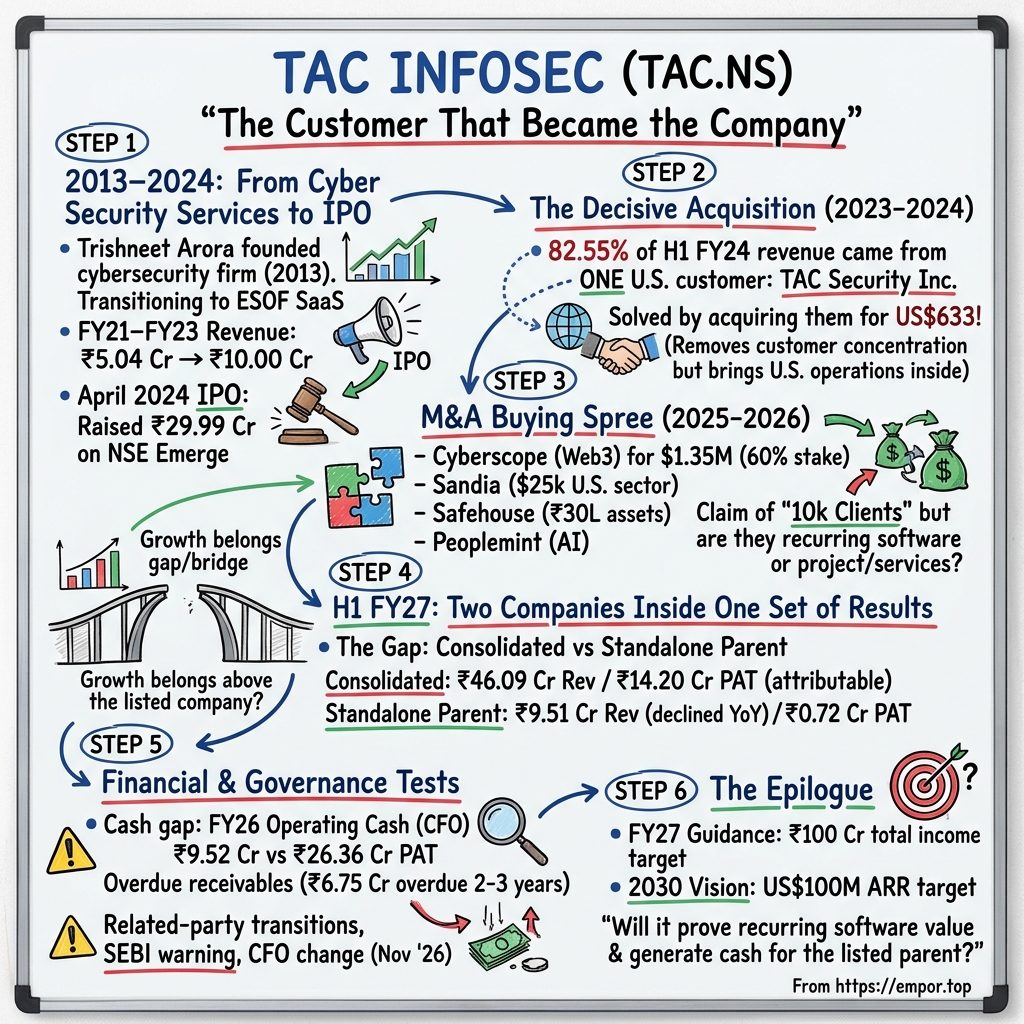
On November 14, 2026, TAC Infosec's board met, signed off the first half of the 2027 financial year, and sent two documents to the National Stock Exchange within minutes of each other.12 Read one and you meet a cybersecurity group in a hurry. Read the other and you meet a small Indian software and services company having a quiet, slightly disappointing six months. They have the same name, the same founder, the same ticker. They are not the same business.
The first document, the consolidated results, describes the whole family of companies that TAC Infosec owns or controls. Between April and September 2026 that group earned ₹46.09 crore of revenue from operations, up from ₹29.49 crore in the same half a year earlier, which is growth of more than half in twelve months.1
It reported ₹19.13 crore of profit after tax, and after setting aside the slice that belongs to outside shareholders in its subsidiaries, ₹14.20 crore attributable to the owners of TAC Infosec itself.1 Those are remarkable numbers for a company that, three years earlier, had never sold a share to the public. They imply a net margin north of 40%, a level that most of the world's listed security software companies, including some worth billions of dollars, have never reached.
The second document, the standalone results, describes only the Indian company whose shares trade on NSE Emerge. In the same six months, that company earned ₹9.51 crore of revenue, down from ₹10.06 crore a year earlier, and made a profit of ₹0.72 crore.2 Its revenue shrank while the group's grew by half. Its profit was about a twentieth of the group's attributable figure. The group's revenue was nearly five times the listed parent's own.
That gap is the hook for this whole story, because it reframes a simple question that every shareholder should be able to answer: what exactly do you own when you buy a share of TAC Infosec? You own the Indian company, its cash, its people and its products.
Through it, you own stakes of varying size in a U.S. security company, a Greek-founded Web3 auditing business, a consultancy LLC and a growing list of smaller acquisitions. Some of those stakes are whole; some are shared with other investors, which is why ₹4.93 crore of the group's half-year profit belongs to someone else.1 And the growth, for now, lives mostly above the listed company rather than inside it.
None of this is unusual in itself. Plenty of excellent businesses are holding companies for subsidiaries that do the real work. But it changes what an investor has to check. In a single-entity company, revenue growth is the scoreboard. In a group like this one, the scoreboard has to be read in layers: how much of the growth is the parent, how much is acquired, how much is transactions between family members that wash out on consolidation, and how much of the profit actually reaches the listed shareholder as cash.
So this story carries four questions from the first scene to the last. The first is whether the founder's customer base, which began as a handful of security-testing relationships, can become recurring product revenue that renews year after year. The second is whether the acquisitions TAC has made since listing are earning their cost or simply adding new chapters to the pitch.
The third is whether the group's striking earnings reach the listed parent and turn into cash, rather than piling up as receivables. And the fourth is whether minority investors, the roughly 44% of owners who are not the promoter, can trust the company's disclosures and capital allocation as the corporate family grows more complicated.3
To answer them, the story has to go back to the moment before the IPO, when TAC Infosec was a small company with one customer that mattered more than all the others combined. That customer is the key to everything that followed, because TAC Infosec did not just keep it. It bought it.
 Subscribe on LinkedIn
II. From a founder's security firm to a public company
Trishneet Arora was a teenager in Punjab when he began building a name in cybersecurity, and by 2013 he had turned that interest into a business.4 The story the company tells about its origins is the classic one of the self-made technical founder: a young man from Punjab with no corporate pedigree, finding vulnerabilities in other people's systems and then convincing companies to pay him to find them first.
Indian media turned him into something of a celebrity founder in the late 2010s, and the company he built still carries his initials in its brand. What matters for investors is less the legend than the shape of the business it produced, and the habits of a founder who has always run the company as its chief salesman, chief strategist and public face. He is today its Founder, Chief Executive Officer and Chairman, three roles concentrated in one person.5
The listed entity, TAC Infosec Ltd., is younger than the brand. Its 2025–26 annual report was its tenth, which places its first financial year in the middle of the last decade.5 For most of that time it was a modest operation. The earliest public financial history, from the prospectus that preceded the listing, shows revenue of ₹5.04 crore in FY21 and ₹5.11 crore in FY22, essentially flat, before it roughly doubled to ₹10.00 crore in FY23.4
Profit followed a similar path: about ₹0.61 crore in each of the first two years, then ₹5.07 crore in FY23.4 That last jump, a profit margin of about half of revenue in a single year, is the first sign of the pattern that runs through this whole story: when TAC's numbers move, they move in steps rather than slopes, and the steps tend to coincide with changes in who the customers are and how the company is organised.
What was TAC actually selling in those years? Two things, broadly. The first was penetration testing, the security world's equivalent of hiring a professional burglar to try to break into your house and then write a report on how they got in. It is skilled, valuable and stubbornly labour-intensive: every engagement needs trained testers, and the revenue scales roughly with the number of people doing the testing.
The second was a software platform the company calls ESOF, short for Enterprise Security in One Framework, which the prospectus presented as a software-as-a-service product for vulnerability management alongside the testing services.4 If penetration testing is a burglar hired for a day, vulnerability management is a permanent security system that scans the doors and windows every night and tells you which ones are unlocked, ranked by how dangerous they are. That kind of product is sold by subscription, and subscription businesses are what public markets pay the highest multiples for.
TAC's story to investors has always been a migration story: from the burglar-for-hire model to the security-system model. The prospectus described the company in exactly those mixed terms, a SaaS platform sitting next to penetration-testing services.4 It did not, then or since, give a split of revenue between the two, and that absence will matter in every section that follows.
The listing came in April 2024. TAC Infosec filed its draft red herring prospectus in January 2024, its red herring prospectus in March and its final prospectus on April 2.647 The offer was small by any standard: 2,829,600 new shares at ₹106 each, raising ₹29.99 crore gross and about ₹26.09 crore after expenses.7 Crucially, it was entirely a fresh issue. The founder sold nothing; every rupee went into the company.7
That is the kind of structure minority investors like to see, because it means the money is being raised to build the business rather than to cash out its owners. The prospectus earmarked the proceeds for product development, for hiring, and for one specific purchase: the acquisition of a U.S. company called TAC Security Inc.7 The shares made what one business newspaper headline called a stellar debut on NSE's SME platform.8
It is worth pausing on what kind of company had just gone public. NSE Emerge is a platform for small and medium enterprises, with lighter listing requirements than the main board and, in practice, a shareholder base dominated by individuals. TAC arrived there with a three-year audited record, revenue of about ₹10 crore, 56 permanent employees and a founder who held a clear majority of the shares.4 The promoter owned roughly 56.9% after the listing, foreign institutions about 9.8% and domestic institutions about 2.2%, with the public holding the rest.3
There is one boundary that needs to be drawn clearly before the story moves on, because confusing it would distort everything else. TAC Infosec is the listed Indian company. TAC Security Inc., and later CyberScope and the other subsidiaries, sit inside the group that TAC Infosec controls.5 When this story talks about the group's revenue, it means the consolidated total of all of them.
When it talks about the parent, it means the Indian company alone. The FY21 to FY23 numbers above are the parent's. Most of the impressive numbers since are the group's. Treating them as one continuous series would be like measuring a person's height and then, two years later, measuring the same person standing on a ladder.
So the young public company had raised its money, earmarked a chunk of it for an American acquisition, and promised to become a platform. The obvious question is why that particular acquisition mattered so much. The answer lies in a single line of the prospectus's customer disclosures.
III. The customer that became the acquisition
Every IPO prospectus has a section that management would rather investors skimmed. In TAC Infosec's case it was the table of customer concentration. It showed that in FY21, TAC's largest single customer accounted for about 40% of revenue, and in FY22 about a third.4 That was already high for a company of its size. Then the line took off. In FY23, the year revenue doubled, the top customer accounted for 71.66% of everything TAC earned. In the six months to September 2023, the last period before the IPO filing, the figure was 82.55%.4 More than four rupees in every five that TAC Infosec collected came from one place.
That place was TAC Security Inc., a company incorporated in the United States, sharing the founder's brand and, as the related-party disclosures made clear, connected to the promoter.4 The customer mix changed over time in a revealing way: that same customer had been just 14.09% of revenue in FY22.4
In a little over eighteen months it went from a meaningful client to the overwhelming majority of the business. And the export share of TAC's revenue tracked it almost exactly, rising from about 40% in FY21 to 82.55% in the first half of FY24, which tells you the doubling of TAC's revenue in FY23 was, in large part, the doubling of what it billed to the American affiliate.4
Think about what that means from a buyer's chair. A prospective IPO investor in early 2024 was being asked to value a company whose growth had come overwhelmingly from selling services to a related U.S. entity. The obvious risk was that the relationship could change on terms the minority shareholder could not control: prices could be reset, volumes moved, or the U.S. entity's own customers could disappear. TAC's solution was elegant on paper. It would buy the customer.
The prospectus framed the deal as strategy rather than housekeeping. Bringing TAC Security Inc. inside the group would be forward integration, moving the listed company closer to the end customers in the United States; it would allow global onboarding of clients directly; and it would give TAC a stronger international presence.7 In March 2024, just before the listing, TAC Infosec acquired the U.S. company.4 The disclosed price was about US$633, a number small enough to fit on a restaurant bill.7
That figure deserves care rather than mockery. A price of a few hundred dollars for a company with an operating history and customer relationships does not mean the business was worthless, nor that the listed company got a bargain in the ordinary sense. It means the transaction was a transfer between related parties, closer to moving a subsidiary from one pocket of the same founder's coat to another than to a negotiated purchase.
Nobody priced TAC Security Inc. on a multiple of its earnings, because the point was not to buy earnings; it was to change where the customer sat. For minority investors that was, on balance, a protective move: the value of the U.S. relationships would now sit inside the listed company rather than in an affiliate outside it.
But consolidation does something subtle to the numbers, and it is the reason this section carries the title it does. Once TAC Security Inc. became a subsidiary, every sale the Indian parent made to it became an intra-group transaction. In the consolidated accounts those sales are eliminated, because a company cannot earn revenue by selling to itself.
What remains is what TAC Security Inc. sells to its own external customers. In other words, the acquisition did not remove the customer concentration. It moved it across the accounting boundary. The question was no longer "how much does TAC depend on TAC Security Inc.?" but "how much does the group depend on whoever TAC Security Inc.'s customers are?"
And that question, so far, has no published answer. The FY26 annual report does not disclose the share of consolidated revenue from the largest external customers, nor any supplier concentration.5 It reports a single operating segment.5 So the concentration that was once laid out in a prospectus table has been folded into a consolidated total that cannot be pulled apart from the outside.
There is a second, quieter consequence. The parent's own standalone revenue, which before the IPO was mostly sales to TAC Security Inc., still depended heavily on overseas billing. In FY26, the parent's export sales were ₹14.85 crore, three-quarters of its ₹20.01 crore standalone revenue, and down from ₹19.61 crore the year before.5 How much of that went to group companies, and on what pricing, is exactly the bridge the company's reporting does not lay out in one place. It matters because intra-group pricing decides where profit lands, and where profit lands decides how much of it belongs to the listed shareholder outright and how much is shared with minority holders in the subsidiaries.
So the acquisition of the largest customer solved one problem and posed another. It made the listed company the owner of its most important relationship. It did not prove that anyone beyond that relationship wanted to buy TAC's products in volume. That proof would have to come from the platform itself, and from whether the customers the group added after 2024 would pay, stay and spend more. Which is where the real business-model question begins.
IV. Can ESOF escape the penetration-test labor model?
Walk into any large company's security operations centre and the problem TAC is trying to solve is visible on the screens. Every server, laptop, web application and cloud account has software on it, and every piece of software has flaws. Thousands of new vulnerabilities are published each year. No security team can fix all of them, so the real job is triage: knowing which holes exist, which ones attackers are actually exploiting, and which to patch first.
Vulnerability management software does that triage at machine speed. Application security tools do the same for the code a company writes itself. Both are sold as subscriptions, and the best of them become part of the daily workflow of the security team, which is where software businesses earn their durability.
TAC's ESOF platform is pitched squarely into that market, with vulnerability-management and application-security products sold alongside the penetration testing and other services the company has always offered.45 Management has spent the years since listing asking investors to see it as a platform company that also does services, rather than a services company that also has a platform. The difference is not semantic. A services firm is valued on the people it employs and the hours they bill. A platform is valued on recurring revenue, the share of customers who renew, and how much more each customer spends each year.
Start with what the record does show, because it is not nothing. In FY26, TAC's directors reported ₹7.7 crore of research and development spending, roughly 13.5% of consolidated revenue.5 Cash spent on property, intangible assets and development came to about ₹6.3 crore, and the group capitalised about ₹4.8 crore of employee costs into intangible assets under development, up from about ₹0.9 crore the year before.5 Permanent headcount reached 90 at March 2026, against 56 at the time of the IPO filing.54 A company that was merely relabelling a testing practice as a platform would not be building software assets at that pace.
There is, however, an accounting judgment buried in the jump in capitalised salaries, and it is worth naming. When a company capitalises development costs, it moves salaries out of this year's expenses and onto the balance sheet as an asset, to be amortised over future years. That is legitimate when the software genuinely produces future revenue.
It also flatters current profit. The about ₹4.8 crore capitalised in FY26 is equivalent to almost a fifth of the group's profit before minority interests.5 It does not make the profit illusory, but it means part of the reported margin is a bet on the future value of the product, and that bet is only as good as the product's commercial traction.
The evidence that is missing
Here is the problem. The public record establishes that TAC is investing in software. It does not establish that TAC is a software business in the economic sense. The company's filings do not state a standard pricing unit, a typical contract length, a minimum commitment, a renewal rate or the share of revenue that recurs.45 The company reports a single operating segment, so there is no clean line between subscription income and project work.5
Management has said on investor calls that customer retention is high, but has not published audited cohort data or net revenue retention, the metric that tells you whether last year's customers are spending more or less this year.9 Without those figures, an investor cannot tell whether a rupee of TAC revenue is a rupee that will come back next year or a rupee that has to be won again.
To see why that matters, look at what the established players in this market look like. Tenable, one of the category's leaders, reported about US$999 million of revenue in 2025.10 Qualys reported about US$669 million.11 Both are listed in the United States, both are built almost entirely on subscriptions, and both publish the retention and recurring-revenue metrics that TAC does not.
Tenable's own investor materials cite a market-share ranking for a defined device vulnerability and exposure-management category in which Tenable holds 26.6%, Qualys 17.3% and Rapid7 12.5%.[^12] Those shares apply only to that specific category, not to cybersecurity as a whole, but they make the point vividly: the core of this market is already held by a few large specialists, each with thousands of enterprise customers and research budgets bigger than TAC's entire revenue many times over.
These are not clean peers. TAC is a small company selling partly to small and mid-sized customers, often through partners and in markets where the large vendors are less present. It does not have to beat Tenable to build a good business. But the comparison sets the competitive terrain, and the terrain is unforgiving in three specific ways.
The first is buyer power. Security buyers routinely run several tools at once and compare vendors at renewal. A product that scans for vulnerabilities is easier to replace than, say, an accounting system, because the data it produces is regenerated every time it runs. Unless TAC's products are deeply embedded in a customer's remediation workflow, the cost of switching to a rival is low.
The second is incumbent scale. The large vendors fund research teams that write detection rules for new vulnerabilities within hours of disclosure. Coverage is part of the product, and coverage is a scale game.
The third is the absence of proof of lock-in. The strongest defence a small vendor can have is customers who stay and expand. TAC has not disclosed the data that would show that.
The pre-IPO affiliate relationship tells investors very little about how unrelated buyers behave.4 The customers acquired since then, through partners and through CyberScope, are where the evidence will come from.
When management presents a figure of around 10,000 clients, it refers to a combined total across TAC and CyberScope, including customers of project-based audit work.12 A count of that kind measures reach. It is not the same as 10,000 paying software subscribers, and the company has not published how many of those clients pay for a platform subscription, what they pay on average, or how many renew.
It helps to picture what a successful version of ESOF would look like from the inside. A mid-sized bank or a software company buys a subscription. Every week the platform scans its websites, servers and code, finds new weaknesses, ranks them, and hands the security team a short list of what to fix. The team builds its own processes around that list: tickets flow into their engineering systems, reports go to their auditors and regulators, and dashboards go to the board.
After a year or two, replacing the platform would mean retraining staff, rebuilding integrations and explaining to auditors why the history has changed. That embedded routine, not the scanner itself, is what makes a security platform sticky. The question for TAC is how many of its customers have reached that stage, and the company does not report it.
The distinction matters most because of how penetration testing is changing. Artificial intelligence cuts both ways for a company like TAC. On one side, AI tools lower the cost of finding vulnerabilities, which threatens the pricing of human-led testing and the moat of any vendor whose differentiation is a list of checks.
On the other, AI also helps attackers find holes faster, which raises the value of continuous discovery and of prioritisation that tells a stretched team what to fix first. The winners will be vendors whose software sits in the workflow and gets smarter with use. The losers will be those selling tests that a cheaper automated tool can run. TAC's filings do not give investors the data to know which side of that line its revenue sits on.
Two round numbers
Management's own forecasts provide the cleanest test of the platform claim, because a scalable software model ought to make growth more predictable rather than less. In May 2025, the founder told investors that FY26 revenue could reach ₹100 crore.13 The year closed with consolidated revenue of ₹57.26 crore.5 That is excellent growth by most standards, nearly double the previous year, but it is a little over half the figure investors were given. In July 2026, management set a fresh target of ₹100 crore of total income for FY27.12 The first half of FY27 delivered ₹46.09 crore of revenue from operations, so the target requires a second half stronger than the first.1
Neither forecast proves anything about the platform by itself; both are best treated as testable statements rather than delivered outcomes. But the gap between the first forecast and the outcome is useful evidence. A business with high recurring revenue usually knows most of next year's revenue at the start of the year. A business that misses its own forecast by close to half is telling you, whatever its marketing says, that a large part of its revenue still has to be won deal by deal.
That is the tension at the heart of the business model. A platform can grow without adding testers at the same rate, which is why its margins can expand as it scales. But that only happens if customer additions convert into paid, renewing accounts. Until TAC shows that conversion, the honest description is a mixed business with a credible software investment programme and an unproven recurring model. The company's answer to that uncertainty, since listing, has largely been to buy more businesses. Whether those purchases were bargains or distractions is the next question.
V. What did the acquisitions buy?
The deal that changed TAC's numbers most was struck with a small team of blockchain security auditors. CyberScope I.K.E. is a Greek company that reviews smart contracts, the self-executing programs that run decentralised finance applications and crypto tokens. A smart contract is a vending machine made of code: once deployed, it pays out whatever its logic says, so a single coding mistake can let an attacker drain every coin inside it. Projects pay auditors to check the code before launch and publish the audit as a badge of trust. It is a niche, it is global, and it rises and falls with the crypto market.
In February 2025, TAC Infosec announced it would buy 60% of CyberScope for US$1.35 million.14 The filing reported that CyberScope had earned revenue of about US$1.23 million in FY24 and profit of about US$646,000.14 Do the arithmetic and the purchase valued the whole of CyberScope's equity at about US$2.25 million, roughly 1.8 times its annual revenue and about 3.5 times its profit. Those are not, on their face, aggressive multiples. Listed security software companies have traded at several times revenue for most of the past decade, and a business converting more than half its revenue into profit would ordinarily command more than three and a half years of earnings.
Why, then, so cheap? Two reasons sit in the nature of the business. The first is that CyberScope's revenue is project-based. Each audit is a separate engagement, so revenue is closer to a consulting practice than a subscription, and it has to be re-earned every year. The second is crypto exposure. Audit demand tracks token launches and new decentralised-finance projects, and those track the price of crypto assets.
A year of strong profits in a buoyant market is not the same as a durable earnings stream, which is exactly why a buyer can pay a low multiple without getting a bargain. An acquisition multiple is only as good as the earnings behind it, and these earnings carry a cycle inside them. There is also no close set of comparable transactions in Web3 audit firms against which to judge the price precisely, so the fairest verdict is that TAC does not appear to have overpaid on the disclosed figures, with the important caveat that the disclosed figures came from one good year.
What the deal clearly did buy was capability and reach. CyberScope brought smart-contract auditing, a recognisable brand among Web3 projects and a large base of crypto clients, which is part of how management arrives at its combined client count.1512 TAC later contributed its stake to CyberScope Web3 Security Inc., a U.S. holding company that filed a registration statement with the Securities and Exchange Commission for a proposed listing in the United States.516
It also showed up in the group's treasury. In FY26 the consolidated accounts recorded a ₹1.52 crore fair-value loss on crypto holdings, enough to push total other income slightly negative for the year.5 A security auditor that holds digital assets on its balance sheet adds the volatility of those assets to the volatility of its order book.
Small cheques, bigger stories
The other acquisitions are smaller in money and larger in narrative. The company said Sandia, a U.S. entity bought for US$25,000, was meant to give TAC a route into American public-sector security contracts through a state contract vehicle.15 Its operations were delayed; by mid-2026 management said they were becoming operational in FY27.12 A contract vehicle is a licence to bid, not a stream of revenue. Governments are demanding customers that multi-source, re-tender and squeeze price, and being on an approved list does not guarantee orders. Until Sandia books revenue, it is an option, and a cheap one.
In September 2026, TAC announced a transaction involving Safehouse, and the details shifted as it progressed. What began as the acquisition of a company for up to ₹1 crore became a purchase of assets for ₹30 lakh.17 The filing described the deal as TAC's entry into consumer, or B2C, cybersecurity; the description of the assets themselves referred to building-monitoring technology.17 Those two descriptions are not obviously the same business, and the company has not set out how a building-monitoring asset becomes a consumer security product, what revenue it carries, or what it will cost to develop.
TAC also disclosed the acquisition of Typoapp.io, an engineering-intelligence platform that analyses software development activity, without stating a purchase price in that notice.17 And at the November 14 board meeting it approved the acquisition of Peoplemint AI for up to ₹2.5 crore.2 Here the disclosure itself raises a question.
One field in the filing describes the target's size as about ₹2.5 lakh of turnover, while a table in the same filing lists FY26 turnover of ₹3.34 crore.2 The difference between those two numbers is more than a hundredfold, and it is the difference between paying almost the entire turnover of a business and paying less than its annual sales. A shareholder deserves to know which is right before assigning any strategic weight to the deal.
Step back and the pattern is clear. In about two years as a listed company, TAC has bought or agreed to buy a Web3 auditor, a U.S. public-sector entry vehicle, a consumer-security asset, an engineering-analytics tool and an AI company, while still building out its core vulnerability-management platform. Each purchase was cheap in absolute terms. Together they widen the story faster than they deepen the evidence.
A skeptical investor would ask a simple question: if the core platform's recurring economics are still undisclosed, why add four new adjacencies rather than prove the first one? Management's implicit answer is that small, cheap bets create options at low cost. That is a reasonable answer only if the company later reports which options paid off, and so far it reports none of them separately.
The proposed U.S. listing of CyberScope Web3 Security is the largest of these options. The subsidiary's registration statement with the SEC went through more than one amendment, the normal back-and-forth in which regulators ask questions and the issuer refines its disclosures.16 For TAC's shareholders that document is valuable for a reason that has nothing to do with the listing itself: it is the most detailed public description of the Web3 business that sits inside their company, written under U.S. securities-law liability.
A shareholder trying to build the parent-versus-subsidiary bridge that TAC's own reports do not provide would start there. It could give the group a currency for further acquisitions and a market price for the subsidiary. It could also dilute TAC's share of that subsidiary, and it moves a growing share of the group's value further from the Indian listed company. Until it happens, it is optionality, not value realised. What has already happened is visible in the group's numbers, and it is where the story turns from strategy to arithmetic.
VI. Growth moved above the listed company
Picture two lines on a chart. One is TAC's reported revenue, which ends up as the group's. It climbs from ₹11.70 crore in FY24 to ₹30.50 crore in FY25 and ₹57.26 crore in FY26, a five-fold rise in two years.155 The other is the revenue of the listed parent on its own. It reaches ₹20.01 crore in FY26.5 Then, in the first half of FY27, the lines diverge. The group's revenue rises to ₹46.09 crore for the half. The parent's falls to ₹9.51 crore.12
The first thing to understand about that chart is that the group line is not one continuous series. Before March 2024, the parent's revenue was essentially the whole story. After it bought TAC Security Inc., after it bought 60% of CyberScope, after it added a consultancy LLC and the rest, the perimeter of what "TAC" meant kept widening.5 Some of the growth is acquired. Some is the acquired businesses growing after purchase. Some is the parent itself. The company has not published a bridge that separates organic growth from acquired growth, so the headline growth rate mixes all three.
Following the profit, not just the revenue
The profit picture makes the boundary sharper still. For FY26, the group reported profit after tax of ₹26.36 crore before minority interests, and ₹22.51 crore attributable to TAC Infosec's shareholders, up from ₹14.41 crore the year before.5 The parent alone earned ₹4.86 crore.5 Even before adjusting for intra-group transactions, that implies the subsidiaries contributed something like three-quarters of the profit attributable to the listed company's owners.
The margin gap is just as striking. The parent earned about 24 rupees of profit for every 100 rupees of revenue in FY26, a very respectable figure for a security services and software company. The group as a whole earned about 46 rupees per 100 before minority interests.5 For that to happen, the subsidiaries had to be earning far higher margins than the parent: the arithmetic implies subsidiary margins well above half of their revenue.
That is consistent with the kind of profitability CyberScope reported at the time of its acquisition, and it is far above what most listed security software businesses report.14 Very high margins are not a red flag in themselves, but they are unusual enough to deserve explanation, and the explanation lives in subsidiary accounts that the company does not present line by line.
The first half of FY27 pushes the contrast to an extreme. The group reported profit after tax of ₹19.13 crore; after setting aside ₹4.93 crore for minority holders in its subsidiaries, ₹14.20 crore belonged to TAC Infosec's owners.1 The parent earned ₹0.72 crore, with revenue down about 5% from the previous year.2 On those figures, the parent contributed around one rupee in every twenty of attributable group profit. Its own margin dropped to under 8%.
There is a reason the attributable figure is the one that matters. Minority interest is the share of a subsidiary's profit that belongs to outside shareholders in that subsidiary. When TAC owns 60% of a business, 40% of that business's profit is consolidated into the group headline but does not belong to TAC's shareholders. The size of the minority deduction, about a quarter of the group's profit in the first half, tells you that a substantial share of the group's earnings is generated in businesses TAC does not fully own.1 Anyone who quotes the profit figure before the minority deduction overstates what TAC's own shareholders earned by about a third.
The question that the bridge would answer
What would it take to settle the parent-versus-subsidiary question? A bridge: a reconciliation showing each major subsidiary's revenue and profit, the transactions between them and the parent that are eliminated on consolidation, and the split between businesses owned before April 2024 and those bought since. Companies with more complicated structures than TAC publish exactly this.
Until TAC does, three things that investors might naturally assume cannot be assumed. The group's growth cannot be attributed to ESOF, because the company does not separate platform revenue. It cannot be attributed to the Indian parent, whose revenue declined in the latest half. And the group's margins cannot be treated as a sign of software economics, because the highest-margin activity appears to sit in project-based subsidiaries.
None of this means the group's growth is not real. Revenue is revenue; consolidated accounts are audited annually and reviewed half-yearly. It means the growth is happening in a different place from where many shareholders assume. The listed company is increasingly a holding company for faster-growing subsidiaries, and the value of a share depends on how much of the subsidiaries the parent owns, how their profits reach the parent, and whether those profits arrive as cash.
Even the parent's own profit is less operational than it looks. In FY26 the Indian company reported ₹6.95 crore of profit before tax, of which ₹1.59 crore was other income rather than earnings from selling security products and services.5 Part of the parent's income comes from lending: it had extended a ₹9.61 crore five-year loan at 7% to its own subsidiary TAC Security Inc., denominated in U.S. dollars, and it earned 12% on an unsecured deposit with an outside finance company.5
Interest from a subsidiary is a legitimate way to move cash up a corporate structure, but it is not evidence that the parent's operating business is thriving. Strip it out and the listed company's operating contribution in FY26 was smaller still, and if those two balances stayed in place, the interest on them alone would come to roughly ₹0.6 crore a half-year, close to the parent's entire first-half profit of ₹0.72 crore.
Currency adds one more layer of noise. The group recorded ₹1.28 crore of foreign-exchange fluctuation inside its operating revenue in FY26, which means part of the reported top line reflected movements in the rupee rather than sales.5 The company does not disclose a quantified hedging policy or a schedule of derivative positions.5 For a business that earns most of its money in dollars and reports in rupees, that is not a crisis, but it is one more reason the headline numbers cannot be read at face value.
That last point is where the reported numbers meet their hardest test. Profit on a page is a claim; cash in a bank account is evidence. The FY26 cash-flow statement is where TAC's founder's forecasts, its governance record and its working capital all meet.
VII. The founder's forecast meets the cash and governance record
When Trishneet Arora talks to investors, he talks in big round numbers. In May 2025 the number was ₹100 crore of revenue in FY26.13 In July 2026 it was ₹100 crore of total income in FY27 and, further out, US$100 million of annual recurring revenue by 2030.12 The style is consistent: confident, global in ambition, impatient with the idea that a company from Punjab should think small. It is also, for a public company, a style that hands investors a precise yardstick to measure it against.
The first yardstick has already been measured. FY26 consolidated revenue was ₹57.26 crore against the ₹100 crore the founder had floated.513 On the May 2026 results call, management explained the shape of the year: the first half had been boosted by roughly US$1 million of partner-led orders, and the second half was a period of normalisation.9 It is a coherent explanation, and it is also a revealing one.
A first half lifted by a cluster of partner orders and a second half that falls back is the signature of a business whose revenue arrives in lumps. The company still does not publish the recurring-revenue data that would show the underlying base beneath those lumps. The miss was explained. It was not reconciled with the platform narrative, because the company did not publish the metrics that would have allowed that.
Where the profit went
The cash-flow statement tells the rest. In FY26 the group reported ₹26.36 crore of profit after tax before minority interests and generated ₹9.52 crore of cash from operations.5 Put simply, for every 100 rupees of profit, about 36 rupees arrived as operating cash; measured against the profit attributable to TAC's shareholders, about 42. The previous year, operating cash flow had been ₹19.39 crore, so cash generation fell while reported profit rose.5
The reasons are laid out in the statement itself. Some of the difference is non-cash: depreciation and impairment, ₹3.72 crore of share-based compensation, foreign-exchange translation and the crypto fair-value loss.5 Those are add-backs, so they would normally push cash above profit, not below it. The real drain was working capital, which absorbed ₹25.37 crore during the year. Almost ₹12.9 crore of that went into higher trade receivables, and another ₹10.6 crore into other assets and advances.5 The group booked the revenue; it had not yet collected a large part of it.
Receivables, the money customers owe, more than doubled from ₹9.92 crore to ₹22.82 crore in a year.5 By itself that might reflect growth, since a business that doubles its sales usually doubles what it is owed. The ageing is the harder part. Of the March 2026 balance, ₹13.16 crore was six to twelve months past due, and ₹6.75 crore was two to three years overdue.5
None of it was classified as doubtful or disputed, and the group wrote off only ₹0.41 crore of bad debts during the year.5 An invoice that is two to three years old at March 2026 dates from roughly the period around the IPO. Treating such balances as fully collectible is an accounting judgment that belongs to management and the auditors, but it is one investors can test with a single number: whether that ₹6.75 crore turns into cash in FY27.
The group's treasury choices add a further layer. At March 2026 the consolidated accounts held ₹22.88 crore in cash and bank balances.5 Alongside it sat a ₹4.70 crore unsecured inter-corporate deposit at 12% with Goenka Business & Finance, an outside lender, and the parent had extended a ₹9.61 crore five-year loan at 7% to its own subsidiary TAC Security Inc.5 Lending to an unrelated finance company at a high interest rate is an unusual use of cash for a growth company that is also making acquisitions, and it is the kind of decision a minority shareholder would want explained.
Fairness requires the other column too, and it is substantial. The founder approved ₹1.50 crore of remuneration for himself in FY26 and drew none of it.5 He held 55.82% of the company in September 2026, only modestly below his stake at listing, so his wealth rises and falls with the minority shareholders'.3
In February 2026 he pledged 9.12% of the company's equity and sold a small portion to support financing for a proposed acquisition; when that acquisition was put on hold, the pledge was released by April 30.18 The company has also built incentives through equity rather than cash, with an FY26 employee stock option scheme and a further scheme for up to 400,000 options approved by postal ballot in November 2026.1920
Equity incentives are not free, and they appear in the accounts as a real cost: share-based compensation was ₹3.72 crore in FY26, close to a fifth of the parent's standalone revenue, even though it consumed no cash.5 The one-for-one bonus issue during the year doubled the share count without changing anyone's economic stake, a cosmetic move that made the share price look more accessible to individual investors.5 Borrowings are negligible: less than ₹1 crore at March 2026 and ₹0.75 crore at September 2026.51 A ₹0.77 crore income-tax dispute that had been pending was resolved in the company's favour.5 This is not a company with a stretched balance sheet or an extractive founder.
The related-party record is mixed rather than alarming, and it needs reading carefully. FY26 related-party transactions totalled ₹7.37 crore, a figure that is easy to quote as a share of revenue and misleading if you do.5 It bundles together unlike things: loans to directors that were subsequently repaid, remuneration, a ₹1.00 crore reimbursement capitalised as part of the CyberScope acquisition, and the salary and stock-option value of family members employed by the company.5 The director loans are repaid and no principal was outstanding at year-end.5 The fact that the company made loans to directors at all is the governance point; the total is not.
The customer moves again
The transaction that most deserves scrutiny is the one that brings the story full circle. In September 2026, TAC's board proposed transferring TAC Security Inc., the customer that became the company, into CyberScope Web3 Security Inc., the U.S. holding company preparing for its own listing.19 In exchange, TAC Infosec would receive 9,213,750 shares of CyberScope Web3, with TAC Security Inc. valued at about ₹14.15 crore.19 Shareholders approved the resolution by postal ballot, but the scrutinizer's report recorded that 12.7% of the votes cast by non-promoter shareholders went against it.20
Why should a minority investor care about an internal reshuffle? Because the subsidiary receiving the asset is not wholly owned and plans to sell shares to new investors in the United States. Before the transfer, TAC Infosec owned TAC Security Inc. outright. After it, TAC Infosec owns shares in a company that owns TAC Security Inc. alongside CyberScope, and other shareholders in that company share in the value.
The fairness of the deal depends entirely on two valuations, of TAC Security Inc. and of CyberScope Web3's shares, and on how much of CyberScope Web3 TAC holds after any listing. The valuation report was put to shareholders, and most approved, but a material minority of independent voters said no. That is a governance signal worth carrying forward: the group's most important asset has twice now been moved across a corporate boundary, once into the listed company for a few hundred dollars and once out of direct ownership into a subsidiary preparing to raise outside money.
The disclosure record adds to the picture. In April 2026, SEBI issued TAC an administrative warning for delayed disclosure of a subsidiary's SEC clearance relating to its proposed U.S. offering.21 No penalty was imposed and no restriction followed.21 But the subject of the warning was precisely the area where shareholders most need timely information: events in subsidiaries that affect the value of the parent. In October 2026 the company also posted notice of an independent director's resignation, which leaves the board's independence balance to watch.17
Then, on November 14, the board announced that Malkit Singh Bharaj, chief financial officer since December 2024, would become Group Finance Director, with Rajinder Singh appointed as CFO.25 Bharaj's predecessor had resigned in September 2024, so this is the third person in the CFO chair in a little over two years.5 A group finance role could be exactly what a sprawling corporate family needs, someone whose job is to make subsidiary reporting coherent. It could also simply be a reshuffle. The test is whether the next set of accounts includes the subsidiary bridge, the recurring-revenue disclosure and the collection record that the group's shareholders currently lack.
So management has delivered fast reported growth, has not extracted cash from the company, and has kept the balance sheet clean. The evidence supports that narrower claim of credibility. It does not yet support the broader one, that the company converts its promises into cash-backed, transparently reported value. How the market weighs those two versions of TAC is where the bull and bear cases part.
VIII. Analysis & Bear vs. Bull Case
On November 16, 2026, TAC Infosec's shares closed at ₹376.55.22 At that price the market valued the company at roughly ₹790 crore, on a share count that had doubled after a one-for-one bonus issue in FY26.522 The stock traded at about 35 times trailing earnings and almost 9 times book value, according to Value Research, compared with a one-year median of about 46 times earnings and 11.5 times book.22 The data provider's median for its peer set was about 34 times earnings.23
The temptation is to read that de-rating as a sign that the shares have become cheaper. It is better read as the market recalibrating what it is prepared to pay for growth it cannot fully see. A price of 35 times earnings still assumes that the group's profits will keep rising rapidly and that a large part of them will reach the listed parent as durable earnings.
A lower multiple than the stock's own recent history is not evidence of value; it is evidence that the market's confidence has fallen from a very high level. The ownership record points the same way. Foreign institutions held almost 10% at listing and essentially none by September 2026; domestic institutions went from about 2% to nearly zero.3 The register is now dominated by the promoter and individual investors.
The strongest version of the bull case goes like this. Vulnerability management and application security address a real and growing need, and AI is making that need more urgent, not less. TAC has made a serious commitment to software development.5 CyberScope gives it a profitable foothold in Web3 security and a large base of global clients into which ESOF and AppSec can be cross-sold, the company says.1412
The founder's alignment and the group's growth give that case a base, though the parent and group figures are not a continuous series.5 If even part of the client base converts to recurring subscriptions, the operating leverage of software could carry the group past its FY27 target and towards its 2030 ambition, and the market would have to re-rate the parent as the owner of a global platform.
The bear case starts with what is missing. TAC has not published recurring-revenue or retention figures. Its 10,000-client figure spans TAC and CyberScope and includes project-based audit customers, so it cannot be read as 10,000 software subscribers.12 The parent-group divide remains stark in the latest half.12
Cash conversion, aged receivables, the missed forecast and governance concerns remain the bear's strongest evidence, including the SEBI warning, shareholder dissent on the TAC Security Inc. transfer and turnover in the CFO chair.521202
Imagine a skeptical long-short investor reading the same filings. The first challenge would be portfolio complexity: a company with an unproven core platform now owns, in whole or part, a U.S. services affiliate, a Web3 auditor headed for its own listing, a public-sector entry vehicle, a consumer-security asset and two software startups, without reporting any of them separately. The second would be cash allocation: why lend to an outside finance company at 12% while paying for acquisitions and carrying aged receivables?
The third would be accountability: the FY26 forecast was missed by close to half, and the FY27 target was set again at the same round number. None of those challenges is an accusation of wrongdoing. Each is a request for disclosure that the company could satisfy in a single annual report, and the speed with which it does so will say a good deal about how it regards its minority shareholders.
Where a moat would have to come from
Put TAC through Michael Porter's five forces and the picture is clear. Buyer power remains high, rivalry is intense among scaled leaders such as Tenable and Qualys, and substitutes are rising as AI-assisted tools and bundled features erode the value of stand-alone scanning.1011[^12] The threat of new entrants is moderate; building a credible scanner is easier than ever, but building trust with enterprise buyers is not. Supplier power is low, since TAC's main inputs are engineers and cloud infrastructure, though competition for skilled security staff is real. On balance, the industry structure rewards scale and workflow embedding, and penalises small vendors without proven lock-in.
Hamilton Helmer's seven powers ask a narrower question: what durable advantage lets a company earn returns above its cost of capital? Scale economies belong to the incumbents. Network economies are weak in this category. Counter-positioning is TAC's most plausible claim: a lower-cost, partner-led model aimed at smaller customers and emerging markets that the big vendors underserve. Switching costs would be the decisive power if TAC could show high retention and expansion, but it has not published that data. Brand exists in CyberScope's Web3 niche and in the founder's personal profile, but not at enterprise scale.
A cornered resource, such as proprietary vulnerability data or an exclusive channel, is not evident; the Sandia contract vehicle is a right to bid, not a guaranteed flow of orders. Process power, the hard-to-copy operating know-how that makes a company better at what it does, would show up in margins and retention, and the margins the group reports appear to come mostly from project-based audit work. The honest conclusion is that TAC's advantage today is narrower than its narrative: it is a capable, low-cost operator with a niche brand and an unproven platform, not yet a company with a demonstrated moat.
The three numbers that matter
Three readings will tell investors which case is winning. First, whether the gap between the listed parent and the group keeps widening, as it did in the first half of FY27.12 If the parent's own numbers keep shrinking relative to the group, the listed company is becoming a holding company whose value depends on how it shares in subsidiaries.
The second is paid, recurring revenue, with renewals: today the company does not disclose it, which is itself the reading, and its first appearance would change the debate more than any acquisition. The third is cash: if FY27 cash flow rises towards profit and overdue receivables are collected, the bear case loses its sharpest point.5
Peer comparisons with Tenable and Qualys show what scale looks like in this market, but they are not a clean valuation peer set for a ₹790 crore Indian SME listing. The most useful comparison is with TAC's own history: its growth, its cash conversion, and what the market paid for it when its story was simpler. The investor's job is to decide which of these numbers will move first. The company's history offers a few lessons about how to watch.
IX. Business & Investing Lessons
Before its IPO, TAC Infosec depended heavily on one customer. After the acquisition, the group's revenue grew far faster than the parent's.45 Every lesson in this story begins with that move.
The first lesson is that buying your biggest customer changes the chart; only external demand changes the business. TAC's acquisition of TAC Security Inc. was sensible: it moved the listed company's most important relationship inside the corporate boundary, where minority investors would at least share in its value. But consolidating that relationship did not prove external demand; it changed where the revenue sat. For founders, the lesson is that integrating a related customer removes a governance risk but proves nothing about the market. For investors, the question after any such move is simple: what does the company now sell to people it does not own?
The second lesson is that a customer count is distribution only when customers pay, renew and expand. The 10,000-client figure measures reach across TAC and CyberScope, not paid software subscriptions.12 A subscription company earns its valuation by showing that last year's customers come back and spend more. Until a company publishes those figures, investors should treat a client count as a marketing statistic and keep asking for the conversion rate.
The third lesson is that an acquisition multiple is only as good as the earnings behind it. CyberScope's modest purchase multiple looked less compelling once its project-based, crypto-exposed earnings were considered.14 Cheap multiples on cyclical earnings are not bargains by default; they are bets on the cycle. The same lesson applies to the smaller deals that followed. Small cheques create options, but the value of an option depends on the company later reporting which options paid off.
The fourth lesson is that a group's profit belongs to the listed shareholder only after minority interests, cash needs and governance are counted. TAC's first-half results showed how sharply the group headline, the listed parent's earnings and cash conversion can diverge.125
Each layer is legitimate accounting. Together they show why a reported profit figure is the beginning of an investor's analysis, not the end of it. And when the group's key asset is moved into a subsidiary that plans to raise outside money, the listed shareholder's claim on that profit becomes a matter of valuation reports and voting records, not just earnings.
None of these lessons is a verdict on the founder. The evidence describes a high-growth, founder-led company that has built a product, kept its balance sheet clean and taken no salary from it. The quality of its long-term execution will be decided by what the next set of filings shows, which is where the story turns next.
X. Epilogue
TAC Infosec enters the second half of FY27 with a new chief financial officer, a Group Finance Director, a postal ballot behind it and a fresh set of promises in front of it.220 The group's first-half result leaves the July target demanding, after the previous year showed a strong first half and a weaker second.1129
The first moment that will decide the story is the full-year FY27 result, expected around May 2027. It will show whether the guidance was met, and more importantly where the growth came from: the parent, the businesses bought since 2024, or transactions between group companies. If the parent's own revenue resumes growth alongside the group, the holding-company question softens. If the gap widens again, the listed company's value increasingly depends on what it owns rather than what it does.
The second moment is the first disclosure of recurring revenue. A company that has told investors it aims for US$100 million of annual recurring revenue by 2030 will eventually have to report its current annual recurring revenue, its renewal rate and the average revenue per paying customer.12 When that number appears, the platform thesis becomes testable. If it does not appear, the 2030 ambition remains a slogan, however sincerely held.
The third moment is collection. The long-overdue receivables will either turn into cash during FY27 or move into an older bucket.5 The FY27 cash-flow statement will show whether operating cash rises towards attributable profit. A year of cash conversion close to profit would answer one of the bear case's sharpest objections in a single page.
The fourth is the CyberScope listing path, along with the AI and consumer-security initiatives. If CyberScope Web3 Security lists in the United States, the market will put a price on a subsidiary that would also hold TAC Security Inc., and TAC's shareholders will finally see what their indirect stake is worth, and how much of it was diluted to get there.1619 Peoplemint, Safehouse and Typoapp will either begin reporting distinct revenue and costs, or they will fade into the consolidated total.
There is a quieter test running alongside all of these: the board. The independent director who resigned in October will need replacing, and the shape of the board that oversees the next round of intra-group transactions matters as much as the transactions themselves.17 The dissent recorded on the TAC Security Inc. transfer was a minority, but it was a measurable one, and the next postal ballot will show whether it grows or fades.20
The ending remains conditional. If the next results show customers renewing and cash following earnings, the platform case strengthens and the group's growth starts to look like durable value for the listed shareholder. If only the group totals grow, while the parent shrinks and cash lags, the question this story began with stays open: what does a shareholder in TAC Infosec actually own?
XI. Outro
Go back to that line in the prospectus: a U.S. company sharing the founder's name, which accounted for most of the listed company's revenue before the IPO.4 TAC's answer was to buy it for a nominal sum, then build a family of businesses around it until the group had far outgrown the parent.712 This autumn, shareholders approved moving that same customer into a subsidiary preparing to sell its own shares in America.1920
That is TAC Infosec's unusual path: a customer relationship turned into a company, a company turned into a group, and public shareholders asked to follow the value as it moves across each new boundary. The customer became the company. The question now is whether the company can become a durable product business, one that earns its growth from strangers who pay, renew and stay.
References
-
Unaudited Consolidated Results, H1 FY27 — NSE, 2026-11-14 ↩↩↩↩↩↩↩↩↩↩↩↩↩↩
-
Unaudited Standalone Results and Board Meeting Outcome, H1 FY27 — NSE, 2026-11-14 ↩↩↩↩↩↩↩↩↩↩↩↩↩
-
Red Herring Prospectus — TAC Infosec Ltd., 2024-03-18 ↩↩↩↩↩↩↩↩↩↩↩↩↩↩↩↩↩↩↩
-
Annual Report 2025–26 — TAC Infosec Ltd., 2026 ↩↩↩↩↩↩↩↩↩↩↩↩↩↩↩↩↩↩↩↩↩↩↩↩↩↩↩↩↩↩↩↩↩↩↩↩↩↩↩↩↩↩↩↩↩↩↩↩↩↩↩↩↩↩
-
Draft Red Herring Prospectus — TAC Infosec Ltd., 2024-01-22 ↩
-
NSE SME TAC Infosec encrypts success with stellar debut — Business Standard, 2024-04-05 ↩
-
Analyst and Investor Meeting Transcript — TAC Infosec Ltd., 2026-05-20 ↩↩↩
-
Analyst and Investor Meeting Transcript — TAC Infosec Ltd., 2026-07-29 ↩↩↩↩↩↩↩↩↩↩
-
Acquisition of CyberScope I.K.E. — TAC Infosec Ltd., 2025-02-05 ↩↩↩↩↩
-
CyberScope Web3 Security Inc. Form F-1 (Amendment) — U.S. Securities and Exchange Commission, 2026 ↩↩↩
-
Investor Relations and Stock Exchange Disclosures — TAC Security ↩↩↩↩↩
-
Postal Ballot Scrutinizer Report — TAC Infosec Ltd., 2026-11-11 ↩↩↩↩↩↩
-
SEBI Administrative Warning Letter — TAC Infosec Ltd., 2026-04-23 ↩↩↩
 LinkedIn
 WhatsApp
 Reddit
 Hacker News
 Email
 Kindle
 RSS Feed
 Spotify
 Apple Podcasts
 Amazon Music
 Audible
 YouTube