Systango Technologies: The Offshore Arbitrage Machine
I. Introduction & Episode Roadmap (00:00–00:10)
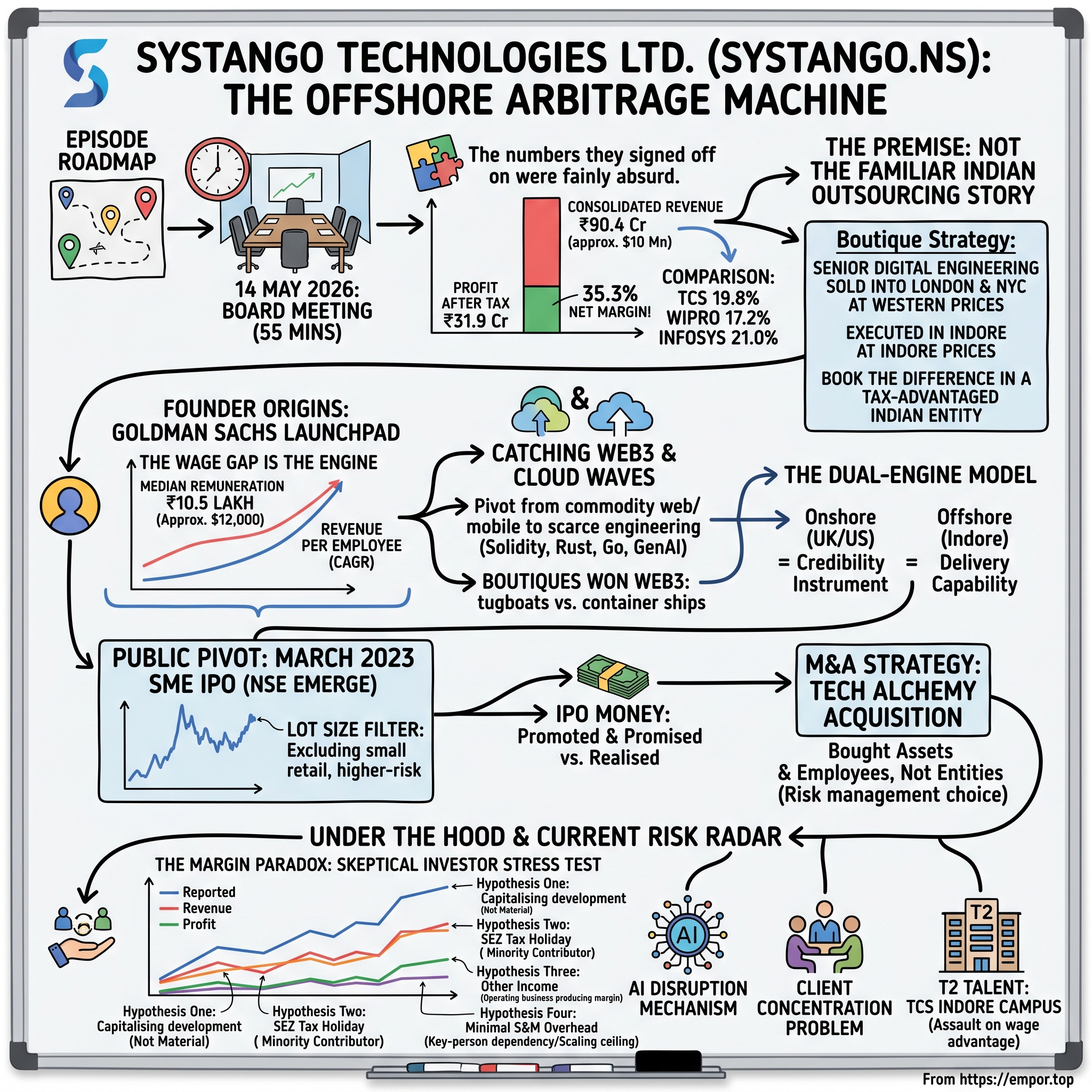
On the morning of 14 May 2026, a five-person board met in Indore, Madhya Pradesh — a city better known to most Indians for its street food lanes and its perennial ranking as the country's cleanest city than for anything resembling a technology cluster. The meeting began at 12:30 p.m. and ended at 1:25 p.m. Fifty-five minutes. In that window, the directors of Systango Technologies Limited approved audited results for the year ended 31 March 2026 and declared an interim dividend of ₹7 per share.7
The numbers they signed off on were, by the standards of the Indian IT services industry, faintly absurd. Consolidated revenue of ₹9,037.86 lakh — about ₹90.4 crore, or roughly $10 million. And out of that, a profit after tax of ₹3,187.67 lakh: ₹31.9 crore.7 Thirty-five paise of net profit for every rupee of revenue.
To understand how strange that is, consider the giants. In the same fiscal year, Tata Consultancy Services — the bellwether of Indian IT, a company with more than 600,000 employees — reported an operating margin of 25.0% and a net margin of 19.8%, which it described as its best in four years.3 Wipro's IT services operating margin came in at 17.2%.4 Infosys reported an adjusted operating margin of 21.0%.20 Systango, with fewer than three hundred people, posted an EBITDA margin of 37.6% and a net margin of 35.3%.1
A company one ten-thousandth the size of TCS earned nearly double its net margin. That is the puzzle this story exists to interrogate.
The premise. This is not the familiar Indian outsourcing story. The 2000s version — the one that built Infosys and Wipro — was about scale, process maturity, CMMI certifications, and the relentless industrialisation of software labour. Its economics were volume economics: thin margins on enormous headcount, with the moat sitting in delivery reliability and the ability to absorb a Fortune 500 client's entire IT estate.
Systango is playing a different game entirely. It is a boutique: fewer than 300 people, 600-odd clients over its lifetime, and a services mix weighted toward the technologies that large vendors find structurally awkward to staff.1 In the first half of FY26, generative AI, cloud and data engineering accounted for 45% of services revenue, application development 38%, and blockchain and Web3 17%.14 The business model, stripped to its essentials, is an arbitrage: sell senior digital engineering into London and New York at Western prices, execute it in Indore at Indore prices, and book the difference in a tax-advantaged Indian entity.
The paradox. There is a second, more literal puzzle that any investor pulling up Systango on a screening tool will hit immediately. Several financial data services report the company's FY26 revenue as ₹904 crore and its profit as ₹319 crore — a hundredfold overstatement.56 The error is mechanical and traceable, and unpicking it turns out to be more instructive than it sounds, because it reveals something real about how thinly this company is covered and how little of the analytical scaffolding that surrounds a mainboard-listed company exists here.
But the deeper question is not arithmetic. It is whether a 35% net margin at this size is a durable structural feature or a temporary configuration of favourable conditions — low wages that have not yet inflated, a tax shelter with a statutory clock on it, a client roster concentrated enough to be fragile, and a demand environment for Web3 and GenAI engineering that has been generous. Each of those has an expiry risk. This story tests all four.
The roadmap. The path runs from a dormant shell company registered in Indore in 2004 under the name Bushcare Overseas Private Limited,8 to a Goldman Sachs trading-technology desk in London where a young engineer from Indore spent five and a half years learning what institutional software actually demands,910 to a small-cap listing on the NSE Emerge platform in March 2023,11 to a £1.5 million asset-and-talent purchase of a London Web3 studio in June 2025 that the company disclosed to the exchange and then, curiously, stopped talking about.15
Along the way there are governance questions worth sitting with, an auditor's note that most readers will skim past and shouldn't, and a capital allocation record that looks very different depending on whether you read the press release or the annual report.
 Subscribe on LinkedIn
II. Founder Origins: The Goldman Sachs Launchpad & Tier-2 Arb (00:10–00:25)
In January 2007, Vinita Rathi landed in the United Kingdom. She had grown up in India and taken her engineering degree at Devi Ahilya Vishwavidyalaya in Indore — a state university, not an IIT, completing a B.E. in Information Technology in 2004.8 One month after arriving in Britain, she joined Goldman Sachs.9
She stayed five and a half years, working on sales and trading technology and rising to vice president.910 It is worth dwelling on what that particular seat teaches, because it explains a great deal about what Systango later became.
What a trading floor teaches an engineer. Sell-side trading technology is an unforgiving discipline. The systems are not websites; they are latency-sensitive pipelines where a few milliseconds of delay is a commercial loss and a data inconsistency is a regulatory event. The engineering culture that produces them is obsessive about three things that ordinary application development treats casually: correctness under load, auditability of every state change, and security posture that assumes hostile scrutiny by default.
For an engineer, absorbing that standard early is a permanent recalibration. It sets a floor on what "done" means. And it has direct commercial value later, because the clients who pay the highest rates for software — banks, exchanges, fintechs, anyone touching regulated money — are precisely the ones who need that standard and can tell within one technical conversation whether a vendor has it.
The second asset was not technical at all. It was the network. Goldman is one of the most efficient professional-network manufacturing machines in the world; its alumni scatter across hedge funds, fintech startups, and the boards of scale-ups. An Indian engineer who spends five years inside it emerges with something an Indore-based services firm could not otherwise buy at any price: warm, high-trust access to buyers in London.
That network did not just help. It was the founding event. By Rathi's own account, the business began when a former Goldman colleague approached her for help setting up a development team in India.9 Systango was not conceived as a company and then sold to clients. It was reverse-engineered from a single client request into a company.
What she noticed while doing that job became the strategic thesis. Offshore teams, she has said, were systematically undervalued despite being technically strong — and the thing separating an exceptional developer from an average one was rarely raw coding ability. It was the soft skills: the willingness to question a requirement, to express a view, to understand what the product was actually for.9 That is a diagnosis of the body-shopping model's core defect, and the boutique positioning Systango later adopted follows directly from it.
The co-founder and the shell. The corporate vehicle came with a history that had nothing to do with software. The entity now called Systango Technologies Limited was incorporated on 17 September 2004 as Bushcare Overseas Private Limited, registered with the Registrar of Companies for Madhya Pradesh and Chhattisgarh. A shareholders' resolution passed at an extraordinary general meeting on 11 August 2006 changed the name to Systematix Technocrates Private Limited, with the fresh certificate issued on 18 August 2006.8
Both Vinita Rathi and her co-founder Nilesh Rathi — today the company's Whole-Time Director and Chief Financial Officer — have been associated with the company since 2006.8 Nilesh took a Bachelor of e-Commerce from the same Indore university in 2003 and has run the administrative, accounting, financial, taxation and legal side of the business throughout.8 The division of labour has been unusually stable: she faces the client and the market from London; he runs the machine from Indore. In more than a decade of filings, that split has not changed.
The name Systango arrived on 18 May 2016, and the conversion to a public limited company on 27 December 2022 — three months before the IPO.8
A small but telling detail for anyone assessing management's own account of itself: the company's investor materials date the business to 2007, describing it as having "commenced operations" that year as a digital engineering services company.1 The corporate entity is two years older and was originally something else entirely. Neither framing is wrong, but they are different stories, and the one management tells is the tidier one.
Why Indore. Here is where the strategy becomes genuinely deliberate rather than merely convenient. Rathi is from Indore; setting up there had an obvious personal logic. But it also had a structural one, and the company built on it for two decades.
Indore in the late 2000s had something rare: a real engineering talent pool without a real engineering employer market. Devi Ahilya Vishwavidyalaya and its Institute of Engineering & Technology, along with the newer IIT Indore, graduate competent software engineers every year. What the city did not have was Bangalore's bidding war — the phenomenon where three companies chase the same developer and salaries compound at 15% annually while attrition runs above 20%.
The wage gap is the engine of the whole business, and the company's own disclosures let us size it. In FY25, the median remuneration of Systango's employees was ₹10,49,994 — roughly ₹10.5 lakh a year, or about $12,000.[^16] For a firm whose staff is overwhelmingly technical, that is a Tier-2 number. And critically, it barely moved: median pay rose just 1.74% over the prior year's ₹10,32,072.[^16] In an industry where wage inflation is the standard margin thief, Systango's wage bill per head was essentially flat.
Attrition tells the same story from the other side. The company reported employee retention with attrition below 10%,14 against an actuarial assumption of 5% per annum used in its gratuity valuation.8 Tier-1 Indian IT has historically run at double to quadruple that. Low attrition is not just a cultural nicety; it is a direct margin input, because every replacement hire carries recruitment cost, ramp-up time, and a period of billing at less than full productivity.
The SEZ layer. On top of the wage advantage sits a tax structure. Systango's registered and administrative offices are in STP-I Crystal IT Park on Ring Road, Indore — inside a Special Economic Zone, in premises leased from the Madhya Pradesh Audyogik Kendra Vikas Nigam.8 Under Section 10AA of the Income Tax Act, a unit located in an SEZ gets a 100% deduction on profits from exported services for five consecutive assessment years, followed by 50% for the next five.[^16] At the time of the IPO, the company disclosed two SEZ units in Indore; the FY25 annual report refers to a unit in SEZ, singular.8[^16]
The tax benefit is real but, as we will see later, it is a smaller part of the margin story than the headline suggests — and it carries a statutory clock that investors should be watching rather than assuming away.
What Indore gave Systango, then, was not one advantage but a stack of them: cheaper engineers, engineers who stayed, cheap real estate, and a tax shelter on export profits. What it could not give was customers. Those had to come from six thousand kilometres away — which is why the next chapter of this story is about building a front end in London and New York while keeping every unit of expensive work firmly at home.
III. Catching the Web3 & Cloud Waves: Rebranding & Scaling (00:25–00:45)
The rename in 2016 was not cosmetic. A firm called Systematix Technocrates is selling you IT services in the 1990s sense of the phrase — a vendor, a resource pool, a line item in a procurement system. A firm called Systango is selling you something else, and the years that followed show what.
The pivot was away from commodity web and mobile development toward stacks where the supply of competent engineers was genuinely scarce. The company crossed ₹10 crore of revenue in 2019 and ₹20 crore in 2021 — modest absolute numbers, but the composition was shifting toward work that could be priced on scarcity rather than on hours.1
Why boutiques won Web3. To understand why a 200-person firm in Indore could take work that TCS could not, you have to understand how large IT services companies actually function.
A firm like TCS or Infosys is, underneath the branding, a machine for matching a very large pool of trained people to a very large pool of standardised demand. It works because the skills are stable enough to train at scale. You can put ten thousand graduates through a Java curriculum because Java will still be Java in three years, and the client's requirement will still be recognisably the same requirement.
Blockchain engineering in the 2018–2022 window broke every assumption in that model. The languages were new and moving — Solidity for Ethereum smart contracts, Rust for the newer high-performance chains, Go for infrastructure tooling. The frameworks turned over in months. There was no stable curriculum to write, no certification path to industrialise, and no way to forecast demand well enough to justify training a thousand people. Worse, the work was small: a DeFi protocol or an NFT marketplace is a project measured in tens of engineers, not thousands — beneath the deal-size threshold at which a large vendor's sales apparatus is economic to deploy.
For a boutique, every one of those defects was an advantage. Small deals are the only deals. A twelve-person team learning Solidity is a weekend decision, not a corporate programme. And the client — typically a funded startup or a crypto-native scale-up — cared about shipping in eight weeks, not about a vendor's process maturity certification.
A useful way to think about it: large IT vendors are container ships, superbly efficient on established routes and nearly impossible to redirect. Boutiques are tugboats. When a new port opens with no charted channel, the tugboat gets there first. The obvious follow-up question — what happens when the channel is charted and the container ships arrive — is the central bear argument, and we return to it.
Systango's later positioning shows the pattern repeating with AI. The company has said it built document-processing AI solutions before ChatGPT's 2023 breakout,14 and it was named among the first twenty companies globally to receive Google's Generative AI specialisation.1 It also holds AWS Premium Partner and Adobe Bronze Partner status.14 These are third-party validations rather than self-assessments, which makes them worth more than most of what appears in an investor deck — though partner-tier designations measure certified skills and committed cloud spend, not the profitability of the work.
The dual-engine model. The organisational architecture that makes the arbitrage work is deceptively simple, and it was assembled deliberately over a decade.
Systango Ltd (UK) was incorporated in 2012 to reach European markets.1 Systango LLC was established in the United States in 2020 as a wholly owned subsidiary.18 And in December 2022, the company acquired 100% of Isystango Ltd, UK.8
The logic is about trust, not tax. A London fintech CTO deciding whether to hand a payments platform to an offshore vendor is making a career-risk decision. A UK-registered counterparty with a UK contract, UK jurisdiction, and a person who can be in their office by lunchtime materially lowers that perceived risk — even when everyone involved knows the engineering will happen in India. The onshore entity is not a delivery capability. It is a credibility instrument and a contracting convenience.
The delivery, meanwhile, stays in Indore. The pattern is visible in the group's own numbers. In FY26, the standalone Indian entity earned ₹29.89 crore of profit after tax on ₹75.89 crore of revenue — a net margin close to 40%. The consolidated group earned ₹31.88 crore.7 In other words, the Indian entity generated roughly 94% of group profit. The overseas subsidiaries, which sit closest to the customer, keep almost none of the economics.
This is exactly what the model predicts. The front end books the client contract; the Indian entity bills the front end for delivery; the profit accumulates where the cost base and the tax rate are lowest. It is a legitimate and entirely conventional structure. It is also worth naming plainly, because it means that when you buy this company you are buying an Indian engineering P&L with foreign sales offices attached — not a UK or US business.
One governance footnote worth flagging. Isystango Ltd was not bought from a third party. The DRHP discloses that the company acquired 100% of Isystango Ltd, UK from its own promoters, Nilesh Rathi and Vinita Rathi, with effect from 20 December 2022, for total consideration of ₹268.72 lakh.8 The transaction landed weeks before the company converted to public limited status and roughly ten weeks before the IPO opened.
The prospectus itself acknowledged the exposure, noting that while related-party transactions were conducted on an arm's-length basis including the purchase of shares from promoters, there could be no assurance regarding such dealings.8 The sum is small and the disclosure was made. But the sequencing — promoters selling an asset to the company they control, immediately before that company sells shares to the public — is precisely the kind of thing a skeptical investor should note and carry forward, because it establishes a pattern of how this board handles conflicts of interest.
That listing, and what management promised the market when it arrived, is where the story turns from private company to public one.
IV. The Public Pivot: March 2023 SME IPO (00:45–01:00)
The Systango Technologies IPO opened on 2 March 2023 and closed on 6 March, offering 38,68,800 fresh equity shares of ₹10 face value in a price band of ₹85 to ₹90, targeting ₹34.82 crore.11[^12] The lot size was 1,600 shares, meaning a retail investor needed roughly ₹1.44 lakh to participate — with one lot the effective maximum for a retail bidder.11 Hem Securities ran the book; Bigshare Services was the registrar.11 The offer drew strong demand from retail investors.12 The shares listed on the NSE Emerge platform on 15 March 2023 at ₹98 against the ₹90 issue price, a first-day gain of about 8.9%.[^12]13
That is a competent, unremarkable small-cap listing. The interesting question is why a profitable, debt-free, cash-generative company chose to do it at all.
The SME platform, demystified. NSE Emerge is a separate listing venue for small and medium enterprises, with lighter compliance obligations than the mainboard and — critically — much higher minimum ticket sizes. That high lot size is a deliberate filter: it excludes small retail investors from a segment regulators regard as higher-risk. The consequence is a shareholder base that is thin and a stock that is illiquid. As of March 2026, the company had 2,637 shareholders.2 For context, a mainboard mid-cap would have hundreds of thousands.
Systango was not raising money because it needed money. At the time of the offer, it had reported ₹6.77 crore of net profit on ₹33.92 crore of revenue for FY22, and ₹5.72 crore of profit on ₹23.01 crore of revenue in the six months to 30 September 2022.11 A business converting a fifth of revenue into profit and carrying no debt does not require external capital to fund organic growth.
So the listing bought three things that are not capital.
The first was credibility. For a Western enterprise buyer evaluating an unknown Indian vendor, "publicly listed and audited on the National Stock Exchange of India" is a meaningful de-risking signal. Rathi has described the NSE listing as a transformative milestone that gave the company confidence for future growth and acquisitions.9 In a business where the primary sales obstacle is perceived counterparty risk, that is a real if unquantifiable asset.
The second was acquisition currency. A listed company can issue shares. An unlisted one can only write cheques.
The third was liquidity and price discovery for the founders' own holdings — worth stating plainly, since it is the reason most closely held profitable companies eventually list.
Where the money was supposed to go — and where it went. The stated objects of the issue were strategic investments and acquisitions, investment in subsidiaries, working capital, general corporate purposes, and issue expenses. The prospectus earmarked ₹1,000 lakh for strategic investments and acquisitions and ₹1,000 lakh for investment in subsidiaries.8
Here is where the FY25 annual report repays close reading. Two full years after listing, as at 31 March 2025, the company disclosed its utilisation of IPO proceeds. Against the ₹800 lakh finally allocated to strategic investments and acquisitions, the amount utilised was nil. Against ₹1,000 lakh allocated to investment in subsidiaries, ₹31.35 lakh had been deployed — about 3%. Working capital had absorbed ₹648.64 lakh of ₹1,000 lakh, and general corporate purposes ₹300 lakh of ₹343.13 lakh. Issue expenses ran over: ₹398.39 lakh actually incurred against ₹338.79 lakh earmarked.[^16]
Add it up and roughly ₹13.8 crore of the ₹34.82 crore raised had been deployed after two years — about 40%. The single largest stated purpose of the offer, acquisitions, had consumed nothing at all.
There are two readings, and an honest analysis holds both. The charitable one is discipline: management refused to overpay for a deal simply because it had told the market it would do deals, and left the cash in the treasury instead. Given how many small-cap acquisition programmes destroy value, that restraint has genuine merit.
The less charitable one is that a company raised money for a purpose it did not execute for two years, and the money sat earning treasury returns while the equity it issued diluted existing holders. Investors gave the company acquisition capital in March 2023; the first material acquisition came in June 2025. That is a long gap between promise and delivery, and it is a fact about management's operating tempo worth carrying into any assessment of what they say they will do next.
The ownership picture. Promoters held 72.17% of the equity as of March 2026, with foreign institutions at 0.47%, domestic institutions at 1.69%, and public shareholders at 25.67%.2 Vinita Rathi individually held 53,27,400 shares, or 36.32%, as at March 2025.[^16] The company reported no encumbrance on promoter shares.
High insider ownership is usually presented as alignment, and it partly is: the founders' wealth rises and falls with the stock. But the same concentration cuts the other way, and the prospectus said so — such concentration allows promoters to influence the outcome of matters submitted to shareholders for approval.8 At 72%, minority shareholders have no practical mechanism to force a change of course. Whatever the board decides, happens. That places an unusually heavy weight on the board's own quality of judgement, which makes the composition of that board — two promoters, one non-executive chair, two independent directors — a relevant consideration rather than a formality.1
The balance sheet, meanwhile, remained essentially debt-free throughout, with long-term borrowings of ₹1 million against a net worth of ₹1,355 million at the end of FY26.1 Growth has been funded from operating cash flow, which reached ₹33.77 crore on a consolidated basis in FY26 against ₹12.38 crore the prior year.7
Which brings us to what management finally did with the war chest.
V. M&A Strategy: Benchmarking the Tech Alchemy Acquisition (01:00–01:25)
On 19 June 2025, iSystango Limited — the UK holding entity — signed a memorandum of terms with Tech Alchemy Limited and others to acquire assets and transfer employees for £1,500,000. The company disclosed the transaction to the National Stock Exchange the following day.15
Tech Alchemy described itself as a Web3 and blockchain software development agency, operating from London.16 For Systango, roughly ₹16 crore was the largest single capital commitment in its history — around half of the entire IPO raise, and about half of a full year's profit at the FY25 run rate.
The structure is the strategy. Read the disclosure carefully and note what was bought: assets, and employees transferred. Not shares. Not the corporate entity.15
This distinction is the whole deal. Buying a company means buying its balance sheet, its history, and its liabilities — every unresolved tax position, every employment dispute, every contract signed by a predecessor, every warranty given to a client three years ago. Buying assets and hiring the people means acquiring the parts that generate future cash while leaving the archaeology behind with the seller.
For a cross-border acquirer with limited M&A infrastructure, that structure is a rational risk-management choice. It is also cheaper, because a seller accepting an asset deal is typically a seller with limited alternatives. And it is faster, which matters when the asset being purchased is a team of engineers whose willingness to stay decays with every week of uncertainty.
What it does not buy is certainty of retention. In an asset-and-talent transaction, the acquirer gets contracts and an offer letter to each employee. It does not get the employees. Client relationships in a boutique agency live in individual heads, and a senior engagement lead who declines the transfer takes their accounts with them. The gap between what was purchased and what was retained is invisible from outside — and, notably, the company has not disclosed it.
The valuation question, and its limits. A common framing of this deal is that it was struck at a favourable multiple against a sector where digital engineering agencies command 2.5x to 4.0x sales. That framing deserves scrutiny rather than repetition, for a simple reason: Tech Alchemy's revenue at the time of the transaction was not disclosed in the exchange filing, and Systango has not published it since.15 A price-to-sales multiple requires a sales figure. Without one, the "disciplined multiple" argument is an assumption wearing the costume of an analysis.
What can be said with confidence is narrower and more useful. Asset-and-talent deals structurally clear at lower multiples than share purchases, because the seller is not being paid for the entity, the goodwill of continuity, or the balance sheet. The buyer takes on integration and retention risk in exchange for price. So the deal was probably cheap in multiple terms — but "cheap" here is compensation for risk transferred, not evidence of superior negotiating skill.
The synergy thesis, and how to falsify it. The stated logic was straightforward: Tech Alchemy's engineering and design capabilities would strengthen Systango's footprint across London and the wider UK market.15 Underneath that is the arbitrage engine — take the acquired client contracts, which were being delivered at London cost, and re-staff them from Indore. Revenue holds; delivery cost collapses; margin expands.
There is genuine evidence the UK business grew. In the half year to September 2025, the United Kingdom accounted for 24% of revenue, with the United States at 68%, Canada at 5%, and the rest of the world at 3%.14 Compare that with the pre-IPO position, when the UK was 15.28% of standalone revenue in FY22 against the US at 67.39%.8 The UK share moved up meaningfully while the US share held. Group revenue rose 34.7% in FY26.1 Something worked.
But here is the part that should give an investor pause. Systango published a detailed investor presentation for the half year ended 30 September 2025 — the first full reporting period after the acquisition — running to more than thirty slides covering strategy, service lines, client concentration, headcount and partnerships.14 It did not mention Tech Alchemy once. Neither did the annual update presentation for the year ended March 2026, published on 18 June 2026, whose "Journey" timeline slide lists the milestones management considers definitive: the 2016 rename, the 2020 US subsidiary, the 2022 NSE listing, the 2022 acquisition of Systango Ltd (UK), the 2023 Great Place to Work recognition, and for 2026, the Alibaba Cloud alliance and the formation of a Strategic Advisory Board.1 The largest acquisition in the company's history does not appear on its own timeline.
The H1 FY26 deck's operational highlights instead led with a trade show appearance at Big Data London 2025, the launch of GenAI Studio, four new fintech clients, and a go-to-market collaboration with a firm called Chesamel.14 By the June 2026 deck, Chesamel had disappeared from the narrative too.
There are innocent explanations. Asset purchases do not create a named subsidiary, so there may be no legal entity to point at. Marketing decks emphasise forward-looking capability over completed transactions. Perhaps the integration was folded into the existing UK operation and management saw no reason to name it separately.
But investor communication is a choice, and the pattern here is a real analytical fact rather than a quibble. A company that spent half its IPO proceeds on a transaction and then omitted it from two consecutive investor presentations has made it structurally impossible for an outside shareholder to assess whether that capital was well spent. No revenue contribution disclosed, no retention figures, no integration milestones, no commentary on whether the offshoring of acquired contracts actually happened. The single largest test of management's capital allocation ability is, from the outside, unmeasurable.
The prior moves, for context. The Tech Alchemy purchase was not Systango's first portfolio decision. Edsystango Technoeducation Private Limited remained a subsidiary only until 25 September 2022 before being divested.8 Meanwhile, Systango Account Aggregator Services Private Limited was incorporated on 4 February 2021 to operate as an RBI-regulated NBFC-Account Aggregator, and at the time of the prospectus had no revenue from operations.8 It was later converted into an LLP with effect from 10 April 2024.7
Read together, these show a management team willing to prune. Exiting a domestic education venture to concentrate on high-margin export engineering was the right call on the arithmetic. But the account aggregator entity — a regulated financial-infrastructure licence sitting inside a software services company — has spent five years without producing disclosed revenue. Small, but a reminder that this team has started ventures adjacent to its core competence before, and that the discipline is not perfect.
Which raises the obvious question: what exactly makes the core engine work well enough to justify all this?
VI. Under the Hood: Industry Structure & Competitive Dynamics (01:25–01:50)
Strip away the branding, the partner badges and the Web3 vocabulary, and Systango's economics reduce to a single spread: the gap between what a client in London or New York pays for an hour of senior engineering and what Indore costs to supply it.
Sizing the spread from disclosed numbers. Rather than rely on estimated billing rates, the company's own filings let us triangulate. In FY26, consolidated revenue of ₹90.4 crore was produced by a team of roughly 280 people.1 That works out to approximately ₹32 lakh of revenue per employee — call it $37,000. Against a median employee remuneration of ₹10.5 lakh,[^16] the business generates around three rupees of revenue for every rupee of median compensation.
That ratio is the entire model in one number. And its trajectory matters more than its level: in FY25, the same calculation on ₹67.1 crore of revenue and 276 permanent employees yields roughly ₹24 lakh per head.1[^16] Revenue per employee rose something like a third in a single year while median pay rose 1.74%.
That gap is the margin expansion. Not a pricing trick, not an accounting choice — the company sold materially more output per person while paying each person almost the same. The question an investor must then ask is why output per person jumped so sharply, because the answer determines whether it repeats. Plausible contributors include a richer mix shifting toward GenAI and data engineering work that bills higher, better utilisation of existing staff, the UK contracts acquired with Tech Alchemy being delivered from India, and AI tooling making each engineer more productive. Management has not broken this down, so the durability is unproven.
Headcount is the tell. The employee data reveal something a casual reader would miss. Technical headcount was 281 in FY23, fell to 244 in FY24, was 251 in FY25, and stood at 267 by the half year to September 2025, with support staff moving from 31 to 29 across the same span.14 The company ended FY26 describing a team of 280-plus.1
So over three years in which revenue grew from ₹52.3 crore to ₹90.4 crore — up roughly 73% — headcount was essentially flat, dipping before recovering.114 This is the opposite of the classic Indian IT model, where revenue growth and headcount growth move together because the product being sold is, fundamentally, people.
That decoupling is the most important operational fact in this business, and it deserves a clear conclusion: Systango has been growing by raising the value of each engineer's output rather than by adding engineers. If that persists, the model has genuine operating leverage of a kind large-cap IT services simply does not possess. If it was a one-off mix shift or a temporary boost from acquired contracts, then future growth reverts to hiring — and hiring at scale in Indore is precisely what would break the wage advantage.
The competitive set. Systango does not compete with TCS in any meaningful sense. The two rarely appear in the same procurement process; deal sizes differ by orders of magnitude and buyers differ in kind. Its actual rivals are the global population of boutique digital engineering studios — UK and US agencies with fifty to five hundred people, often with their own offshore centres in India, Poland, Portugal or Vietnam.
Against large vendors, the boutique advantages are structural and real: senior engineers accessible to the client rather than hidden behind account managers, weeks-not-quarters mobilisation, and freedom to work in whatever stack the problem demands. Systango markets a twelve-to-sixteen-week schedule for its GenAI Studio engagements, with a single integrated pod spanning product, AI/ML, engineering and DevOps to eliminate handoffs.14 For a client trying to get a model into production, that is a genuinely differentiated offer.
Against other boutiques, however, the advantages thin out considerably. Speed, senior access and stack flexibility are the table stakes of the entire boutique category — they are what everyone in the segment sells. What Systango has that most peers do not is the cost base: an Indore engineering floor is cheaper than a Kraków or Lisbon one and dramatically cheaper than a London one. And what it has that most Indian peers do not is a founder with genuine London financial-sector standing.
That is a defensible position. It is not, however, a proprietary one. Nothing prevents a London studio from opening in Indore.
The client concentration problem. The most important risk disclosure in Systango's investor materials is a chart most readers would skim. In the half year to September 2025, the top three clients accounted for 46% of revenue, the top five for 62%, and the top ten for 78%.14
That concentration got worse, not better, as the company grew. In FY25 the same figures were 38%, 49% and 69%; in FY23 they were 38%, 48% and 65%.14 The concentration was worse still around the IPO, when the top five customers represented 78.71% of revenue in the six months to September 2022.8
The implication is direct: at these ratios, the loss of a single top-three account would remove a mid-teens percentage of group revenue. Because much of the cost base is salaried engineers who cannot be shed at the same speed a contract ends, the profit impact would be disproportionately larger. This is the structural fragility that sits underneath the impressive margin, and it deserves at least as much weight in an investment case as the margin does.
Sizing the proprietary products. Systango markets several products alongside its services. Shootih, launched in 2021, was positioned as a business wealth-management platform helping Indian SMEs and mid-cap companies track finances, receive alerts when cash sat idle, and deploy it into mutual funds and money market instruments.19 Swotter is a cloud learning management system, presented more recently as a white-label LMS.14
In its investor materials, the company groups these under "solution licensing" as one of several revenue streams, alongside time-and-materials project billing, staff augmentation, managed and maintenance contracts, and blockchain-as-a-service.14 The revenue split it actually discloses, however, is by technology — generative AI, cloud and data engineering; application development; blockchain and Web3 — with no separate product line broken out.14
The honest conclusion is that these are not, on any available evidence, financially material. The balance sheet supports this: intangible assets stood at ₹26 million at the end of FY26 against total assets of ₹1,505 million.1 A software product business of consequence would show far more capitalised development than that.
What they are is credible demonstration assets. A firm selling AI engineering benefits from having shipped and operated its own AI products; it is proof of capability rather than a PowerPoint claim. That has real commercial value in winning services work. But investors should resist any suggestion that these justify a product-company valuation multiple. The engine is services, and it is close to entirely services.
Which brings us to the question everyone arrives at eventually: is the margin real?
VII. The Margin Paradox: Skeptical Investor Stress Test (01:50–02:10)
Pull up Systango on several widely used financial data services and you will read that the company generated FY26 revenue of ₹904 crore and profit after tax of ₹319 crore, with revenue up 34.7% and EBITDA of ₹340 crore at a 37.6% margin.56
Every growth rate and every margin in that description is correct. Every absolute number is wrong by a factor of one hundred.
The mechanics of the error. The company's investor presentation reports its financials in millions of rupees: revenue from operations of INR 904 Mn, EBITDA of INR 340 Mn, PAT of INR 319 Mn.1 The audited statements filed with the exchange are denominated in lakhs: revenue from operations of ₹9,037.86 lakh and profit after tax of ₹3,187.67 lakh.7 One crore equals 100 lakh, so ₹9,037.86 lakh is ₹90.38 crore, and INR 904 million is the identical figure expressed differently.
An automated crawler reading "904" and attaching the wrong unit label produces ₹904 crore — a company ten times the size of the real one, at a price-to-earnings ratio of under one. The ratios survive because they are unit-independent; only the absolutes break.
This is a small story that carries a real lesson. Systango is a sub-₹350 crore company on an SME platform with no sell-side research coverage and 2,637 shareholders.2 Nobody in the data pipeline caught a hundredfold error in the headline revenue of a listed company, which tells you how little institutional scrutiny operates at this end of the market. Anyone underwriting this business must read the filings themselves, because the derived data cannot be relied upon.
Now the real question. Is a 35% net margin in IT services sustainable, or is it an artefact? Let us take the skeptical hypotheses one at a time and test each against disclosed evidence.
Hypothesis one: they are capitalising development costs to flatter profit. This is the standard trick — book engineer salaries as an intangible asset rather than an expense, and profit rises without any change in the business.
The evidence does not support it. Systango's cash flow statement shows acquisition of intangible assets under development of ₹39.12 lakh in FY25 and ₹149.17 lakh in FY24.[^16] Against FY25 profit before tax of ₹29.10 crore, the FY25 capitalisation is around 1.3% of pre-tax profit.[^16] Even if every rupee were reclassified as an expense, the margin would barely move. Intangibles on the balance sheet declined from ₹28 million to ₹26 million during FY26 — meaning amortisation exceeded new capitalisation.1 The company is running this balance down, not building it up.
Verdict: not a material factor. Dismissed on the evidence.
Hypothesis two: the SEZ tax holiday is doing the work. Partly true, but much less than the narrative suggests, and this is worth working through because it is widely overstated.
In FY26, the group reported profit before tax of ₹392 million and a tax charge of ₹73 million — an effective rate of about 18.6%.1 India's standard corporate rate for companies electing the concessional regime is roughly 25.2% including surcharge and cess. So the tax benefit is worth around six and a half percentage points of pre-tax profit. Applied to revenue, that translates to roughly three percentage points of net margin.
Strip the tax advantage entirely and Systango's net margin would be somewhere near 32% rather than 35%. Still extraordinary. Still roughly 60% above TCS's net margin.3
Verdict: real, quantifiable, and a minority contributor. The margin does not depend on it.
Hypothesis three: other income is padding the result. Systango holds a large treasury. At the end of FY26 it carried current investments of ₹676 million, non-current investments of ₹351 million and cash of ₹157 million — roughly ₹118 crore of financial assets against total assets of ₹150.5 crore.17 Nearly four-fifths of the balance sheet is a securities portfolio.
That portfolio generated other income of ₹59 million in FY26.1 Remove it entirely and pre-tax profit falls from ₹392 million to ₹333 million — still 36.8% of revenue. The operating business is genuinely producing the margin.
Verdict: other income is a meaningful contributor to reported profit but not the source of the operating margin. Worth noting, though, that an investor buying this company is buying a treasury portfolio nearly as much as an operating business, and treasury returns are not an engineering competence.
Hypothesis four: minimal sales and marketing overhead. This one holds, and it is a genuine structural advantage. The company explicitly describes a lean operating model with minimal sales and marketing overhead.14 Founder-led origination through a London financial-services network costs a fraction of what an enterprise sales organisation costs. For most IT services firms, selling is one of the largest non-delivery expense lines. Systango has substantially outsourced that function to a personal network.
The corollary is uncomfortable: an advantage embodied in one person's relationships is also a key-person dependency and a scaling ceiling. A network can support ₹90 crore of revenue. It is far less clear it can support ₹900 crore. The 2023 investor presentation's note about increased sales and marketing spend to generate more business hints management knows this.10
Where the skepticism should actually land. Having dismissed the accounting hypotheses, three genuine soft spots remain.
The first is disclosure asymmetry between the group and its parts. The auditor's report on the FY26 consolidated results contains an "Other Matter" paragraph that most readers will skip. It states that the statement includes the unaudited financial results of two subsidiaries — including a subsidiary of one such subsidiary — reflecting total assets of ₹2,272.84 lakh and net profit after tax of ₹263.13 lakh, and that these results were certified and furnished by management rather than independently audited.7 These are the overseas entities, whose accounts were prepared under local standards and converted to Indian GAAP by management; the auditor audited the conversion adjustments but not the underlying statements.7
The audit opinion was unmodified and this arrangement is common for small overseas subsidiaries.7 But it means the entities that hold the UK operations — including whatever Tech Alchemy became — are the ones whose numbers carry the least independent verification. Roughly 8% of group profit sits in management-certified accounts. Not alarming. Worth knowing.
The second is the half-yearly volatility that annual figures conceal. Systango reports semi-annually, and the two halves of FY26 looked like different companies. The first half delivered an EBITDA margin of 42.2% and a net margin of 40.2%; the second half delivered 33.1% and 30.0%.114 Revenue was almost identical across the halves — ₹455 million then ₹449 million — so the margin swing was entirely cost and mix, not volume.1
Nobody has explained the nine-percentage-point compression. It could be acquisition integration costs, a mix shift, one-off first-half items, or the beginning of genuine pricing pressure. The FY26 annual presentation reported the full-year figure without addressing the deterioration within it.1 For an investor, the second-half margin is the more recent and therefore more relevant data point, and it is materially below the annual headline.
The third is the plain fact that Systango's revenue is small enough for a handful of engagements to swing the margin. At ₹90 crore, three good contracts can lift the whole company's profitability; three ending can depress it. Statistical stability requires diversification this business does not yet have.
The management credibility audit. Assessing management by behaviour rather than assertion produces a genuinely mixed picture.
On the credit side: no debt through a decade of growth, no promoter share pledges,2 a real dividend paid out of real cash, and a demonstrated willingness to exit a non-core business. In FY26 free cash flow tracked profit closely — operating cash flow of ₹33.77 crore against ₹31.88 crore of net profit — which is the single best evidence that the reported earnings are cash-backed rather than accounting artefacts.7 Profits you can spend are profits that exist. Receivable days also improved from 84 to 48.2
On the debit side, three specific behaviours.
Investor engagement went backwards after listing. The company's investor relations page lists earnings call recordings for H1 FY23-24 and FY22-23 — and none after.18 A company that held calls in its first year as a listed entity stopped doing so. Analyst questions on a live call are the mechanism by which management is forced to explain results it would rather summarise; abandoning them, while continuing to publish polished decks, is a reduction in accountability precisely as the business grew more complex.
Stated plans have quietly vanished. The H1 FY23-24 presentation set out a forward focus that included a new office and joint venture in Dubai for the Middle East and Africa.10 No Dubai entity appears in the FY26 subsidiary list.7 The Middle East does not feature in current geographic disclosure.14 The plan was dropped without explanation. Similarly, the number of key global markets claimed in the snapshot slide fell from four in November 2025 to three in June 2026, with no commentary.114 Individually these are minor. As a pattern, they show a management team comfortable announcing directions and abandoning them silently.
And there is the capital allocation question already established: acquisition proceeds unspent for two years, then deployed in a transaction subsequently absent from investor communication.
The picture that emerges is of operators who run the business well and communicate about it selectively. The engineering economics look real and cash-verified. The disclosure practices would not survive contact with an activist investor.
VIII. Strategic Moats: Porter's 5 Forces & Helmer's 7 Powers (02:10–02:30)
Frameworks are useful precisely because they are unsentimental. Applied honestly, they tend to demote the advantages a company markets most loudly. Here is what happens when you run Systango through two of them.
Hamilton Helmer's 7 Powers.
Counter-Positioning — present but weakening. Helmer's most demanding power describes a business model a competitor cannot copy because copying it would damage their existing economics. Systango's version was genuine during the Web3 wave: a large vendor could not build a Solidity practice without breaking the training-at-scale and utilisation frameworks that make its model work, and could not economically pursue projects worth a few hundred thousand dollars.
The honest assessment for 2026 is that this power is eroding. Generative AI is not Web3. Every major IT services firm has built a GenAI practice, because unlike blockchain, enterprise AI demand is enormous, budgets are large, and buyers are exactly the Fortune 500 clients large vendors already own. The scarcity that protected boutiques in blockchain does not exist in AI at the same intensity.
Systango's evidence of differentiation is real but modest: the Google generative AI specialisation among the first twenty companies globally, AWS Premium Partner status, and now a strategic alliance with Alibaba Cloud signed in early 2026 targeting AI-driven cloud adoption in the UK with an intent to extend into Europe and Asia-Pacific.11417 The Alibaba tie-up is genuinely differentiated positioning — Alibaba Cloud's UK enterprise channel is underdeveloped relative to AWS and Azure, so being an early partner in a thin market is more valuable than being one of thousands of AWS partners. But it was signed only months ago and has produced no disclosed revenue. It is optionality, not a moat.
Cornered Resource — the strongest claim, and the most fragile. The Indore talent position is real and quantified: median pay flat at ₹10.5 lakh, attrition below 10%, and a headcount that produces three rupees of revenue per rupee of median compensation.14[^16] A prominent local employer in a city with engineering colleges and few competing bidders genuinely does get first pick.
The vulnerability is that this resource is only cornered while the city stays uncrowded. TCS announced an integrated campus in Indore for IT and BPO operations with an initial investment of ₹550 crore in the first phase and a total development area expected around 1.5 million square feet.21 That single facility, at maturity, could employ multiples of Systango's entire workforce. A resource that a competitor can acquire by writing a cheque is not, in Helmer's strict sense, cornered.
Switching Costs — moderate, and mostly incidental. When Systango builds a client's smart contract infrastructure, RAG pipeline or data platform, the client acquires a system whose design decisions live partly in the heads of the engineers who made them. Replacing the vendor means paying someone to relearn it. That is real friction and it supports the repeat business the company describes.14
But the friction is a byproduct of custom software rather than a designed lock-in. There is no proprietary platform the client must keep licensing, no data gravity, no network of other users. Once a system is stable, the switching cost decays. And AI coding assistants are actively lowering the cost of comprehending unfamiliar code — which erodes this power over time rather than strengthening it.
Scale Economies, Network Economies, Branding, Process Power — largely absent. At ₹90 crore of revenue there are no meaningful scale economies. There is no network effect. Brand recognition is confined to a niche. Process Power — the accumulated organisational capability that took Toyota decades — is what large Indian IT firms actually have and boutiques do not.
The conclusion is that Systango holds one moderate power under active assault, one weakening power, and one incidental power. That is a real business with a favourable cost position, not a fortress.
Porter's Five Forces.
Bargaining power of buyers — high, and rising. Concentration is the mechanism. When the top three clients are 46% of revenue,14 each of those clients knows precisely how much leverage they hold. Meanwhile the buyer's alternatives are abundant: hundreds of boutique studios worldwide compete for the same work, and switching a project-based engagement at renewal is not difficult.
Threat of substitutes — high, and structurally novel. The substitute is not a competing agency. It is the client's own developers, made two or three times more productive by AI coding tools, deciding they no longer need to outsource. This attacks the volume of hours demanded rather than the price per hour, which is why it is more dangerous than ordinary competition.
Threat of new entrants — high. Barriers to founding a digital engineering boutique are close to zero: a few senior engineers, a client relationship, and a laptop. The only durable entry barrier is reputation, which takes years but is available to anyone willing to spend them.
Supplier power — moderate and rising. The suppliers are engineers. Their power is a direct function of local labour market tightness — the Indore dynamic already described.
Competitive rivalry — high. A fragmented market of thousands of near-identical firms with no scale advantages is textbook conditions for margin compression.
Here is the genuine analytical puzzle. Porter's framework applied to Systango's industry predicts thin margins. Systango earns 35%. Frameworks that fail to explain the data are usually incomplete rather than wrong, and the resolution is that Systango is not really competing in the industry Porter's forces describe. It sells into a high-price market and manufactures in a low-cost one, and the spread between two geographically separated markets is where the profit lives.
That reframing clarifies the investment question considerably. The relevant risk is not that competitors will compete the margin away in the usual manner. It is that the geographic spread itself closes — through Indore wage inflation, through AI making the offshore labour hour less valuable, or through clients simply needing fewer hours.
Every one of which is now visibly in motion.
IX. Current Risk Radar & Future AI Horizon (02:30–02:45)
In September 2025, Systango's team demonstrated its generative AI capabilities at Big Data London, and management reported strong interest from both enterprise and startup audiences. In the same half year it formally launched GenAI Studio, onboarded four new fintech clients — two in the UK, two in the US — and struck a go-to-market collaboration with Chesamel.14
Read one way, that is a company executing a pivot. Read another, it is a company hurrying to get ahead of the technology that threatens its own product.
The AI disruption mechanism, in plain terms. Systango sells engineering hours. Even when priced as fixed-cost projects, the underlying economics are hours multiplied by rate multiplied by utilisation. Generative coding assistants attack the first term directly. Work that once took a competent developer a week — boilerplate, integrations, test scaffolding, standard CRUD interfaces — increasingly takes a day or two with an assistant.
Follow that through and it is genuinely threatening. If a client's internal team becomes twice as productive, they need half as much external help for the same output. Worse, the work most easily automated is exactly the work an offshore delivery model traditionally absorbed: high-volume, well-specified, junior-heavy tasks. The offshore value proposition was always "the same work, cheaper." AI offers "less work, entirely."
The counter-strategy, and whether it is credible. Systango's answer is to move up the value chain. GenAI Studio is structured as a four-stage engagement — intake and prioritisation, a prototype sprint building a working prototype on the client's own stack, review against baseline metrics with security checks, and embedding at scale with monitoring and training — delivered by a single cross-functional pod on a twelve-to-sixteen-week schedule.14 The company also markets a generative business intelligence platform, custom AI agents built on GPT, Gemini and Llama, and intelligent document processing using AI, NLP and OCR.14
Translated: instead of selling developers who write code, sell teams that get AI systems working reliably inside a real business.
The strategic logic is sound, because the genuinely hard part of enterprise AI is not writing model-calling code. It is everything around it — cleaning the data, connecting to systems of record, building retrieval so the model answers from the company's own documents rather than inventing plausible fiction, establishing access controls and audit logs, and deciding what happens when the model is wrong. Systango's emphasis on governance by design, with built-in access controls, audit logs and explicit go/no-go processes before launch,14 targets precisely the reason most corporate AI pilots never reach production.
There is also a genuine internal-use angle: the company cites early adoption of AI for execution efficiency and differentiation.14 A services firm whose own engineers are AI-augmented can hold rates while cutting delivery hours — capturing the productivity gain as margin. The FY26 revenue-per-employee jump is at least consistent with that happening.
But the honest caveat is that this is a strategy statement, not a track record. No disclosure separates GenAI Studio revenue from the broader technology grouping it sits inside. The 45% of H1 FY26 services revenue attributed to generative AI, cloud and data engineering14 bundles a new practice with established cloud and data work, making the new business unmeasurable from outside. And every competitor — boutique and large-cap alike — is making a nearly identical claim.
Concentration and the venture funding channel. The client concentration described earlier interacts with a second exposure: 68% of half-year revenue came from the United States and 24% from the United Kingdom,14 and the target customer set is explicitly high-growth startups and scale-ups alongside global enterprises.14
The transmission mechanism runs from venture capital to Systango's order book with almost no lag. Startups and scale-ups fund discretionary engineering out of raised capital. When funding markets tighten, those budgets are cut first — not reduced, cancelled — because a pre-revenue company preserving runway stops all non-essential development immediately. Systango's exposure is amplified because Web3 and crypto-adjacent clients are the most cyclical funding category in existence.
Enterprise-grade risk management would diversify: more large enterprises with committed multi-year budgets, more recurring managed-services revenue, more geographies. The company does market managed and maintenance contracts with recurring SLA-backed fees as a revenue stream,14 which is the right instinct. Whether it is material is not disclosed. The withdrawal from the Middle East plan and the reduction in claimed key global markets suggest geographic diversification has gone backwards rather than forwards.
Wage inflation in Indore. The third exposure is the one that would do the most damage most quietly. Systango's cost advantage rests on Indore remaining a place where good engineers are cheap and stay put. That is a function of limited local demand, and local demand is rising. The city now hosts a growing roster of large employers, and TCS's committed campus investment21 represents a step change in local hiring capacity.
The arithmetic is unforgiving. Systango's compensation base runs roughly a third of its revenue per employee. If Indore salaries were to inflate meaningfully faster than billing rates for several consecutive years, the compression would flow almost one-for-one into operating margin. Median pay rising 1.74% in FY25 shows the pressure had not arrived by then.[^16] It is a leading indicator worth watching in each annual report, precisely because it is the earliest visible sign the model is under strain.
Two further items worth a brief note. Systango's H1 FY26 highlights disclosed that the company made selective strategic investments in customer companies, described as deepening long-term partnerships and aligning growth objectives.14 Non-current investments rose from ₹133 million at the end of FY25 to ₹351 million a year later.1 Taking equity stakes in your own customers is not inherently improper, but it is a practice that warrants disclosure discipline: it can blur the line between revenue earned and capital deployed, and no breakdown of these positions has been published.
And the SEZ benefit itself has a statutory clock. The 100% deduction runs five years, followed by 50% for five more.[^16] The company has not disclosed when its unit's benefit period began or when it steps down. A future step-down would be a knowable, scheduled margin event — and the absence of a disclosed timeline is a gap in an otherwise quantifiable model.
X. Playbook & Core Lessons (02:45–03:00)
Every company story yields transferable lessons, and the useful ones are those that survive being stated with their limits attached.
Lesson one: Tier-2 arbitrage works, but it is a decaying asset that must be actively harvested.
The Indore decision looks obvious in retrospect and was not. In the mid-2000s, conventional wisdom held that a serious Indian IT company belonged in Bangalore, Hyderabad or Pune, near the talent, the clients, and the ecosystem. Systango went to a city with engineering colleges and no bidding war and became one of the more prominent employers there.
The evidence that it worked is in the numbers already discussed: near-flat median wages, sub-10% attrition, and a revenue-to-compensation ratio that supports a margin roughly double the industry leaders'.
But the lesson comes with an expiry warning that the arbitrage's own success guarantees. Tier-2 advantages exist because a location is undiscovered. Prove that good engineering happens there cheaply and you have advertised it. The large employers arrive; wages converge; the advantage decays. The correct strategic response is to treat the cost advantage as a limited-duration window and use it to build something that outlives it — reputation, proprietary capability, client relationships with genuine switching costs, or products. Whether Systango has done enough of that is, on current disclosure, unresolved.
Lesson two: onshore credibility plus offshore execution is a powerful configuration, and a founder-shaped one.
The dual-engine model separates where you are believed from where you build. Believability is expensive and geographically fixed: a London fintech trusts a London counterparty. Building is cheap and geographically mobile. Splitting them lets a company buy credibility in the expensive market and manufacture in the cheap one.
Systango's execution of this was unusually clean because its founder's Goldman Sachs pedigree supplied the credibility directly rather than requiring it to be purchased through years of enterprise sales spend. That is why the sales and marketing line is so light,14 and it is a substantial part of the margin advantage.
The limitation is severe and worth stating flatly: this asset is personal, not institutional. A network belongs to a person. It can be introduced to colleagues but not transferred. It scales to the number of relationships one individual can maintain. The transition every founder-led services firm must eventually make — from founder-originated revenue to an institutional sales engine — is expensive, margin-dilutive, and frequently unsuccessful. Systango has not yet visibly made it. The hiring of regional sales leadership for the Americas and EMEA114 suggests an attempt is underway; whether it produces revenue that does not trace back to the founder is one of the more consequential open questions in this business.
Lesson three: in cross-border M&A, structure is a substitute for diligence — but disclosure is not optional.
The asset-and-talent structure of the Tech Alchemy purchase was, on its merits, well-chosen for an acquirer of Systango's size and experience. Buy the contracts and the people; leave the corporate archaeology with the seller. Small companies acquiring across borders rarely have the legal and financial infrastructure to underwrite a full share purchase, and the structure substitutes cleanly for capability they do not have.
The lesson's second half is where Systango provides a cautionary rather than exemplary case. Structuring a deal well is necessary but not sufficient. A public company that deploys half its IPO proceeds into a transaction owes its shareholders an account of what that capital bought — revenue contribution, employee retention, integration progress, margin effect. Publishing two consecutive investor presentations that omit the transaction entirely114 converts a defensible deal into an unassessable one.
For investors, the transferable principle is uncomfortable but valuable: the quality of an acquisition and the quality of disclosure about it are independent variables. A good deal, poorly disclosed, is indistinguishable from a bad one until the aggregate numbers eventually reveal which it was. Absent disclosure, the only honest position is to withhold judgement — and to weight management's future capital allocation promises accordingly.
A fourth lesson, unstated in the playbook but visible in the record: growing output per employee is the only durable way for a services business to compound margin.
Every other lever eventually exhausts. Rates hit what the market bears. Tax holidays expire. Wage arbitrage converges. What does not exhaust is making each person more productive. Systango's most impressive achievement over the past three years was growing revenue by roughly 73% on a flat headcount.114 Whether that reflects a repeatable capability or a favourable window is the single most important thing an investor in this business needs to determine — and it is the question the bull and bear cases ultimately argue about.
XI. Bull vs. Bear Investment Case (03:00–03:15)
Set the two cases against each other and they turn out to disagree about one thing: whether the past three years were a structural achievement or a favourable configuration.
The bull case.
Start with what is not in dispute. Systango is debt-free, with long-term borrowings of ₹1 million against net worth of ₹1,355 million.1 It converts profit to cash: FY26 operating cash flow of ₹33.77 crore against ₹31.88 crore of net profit.7 Returns on capital are high — the company reported ROCE of 33% and ROE of 27% for FY26.12 Receivable days improved to 48 from 84.2 It paid a ₹7 per share interim dividend.7 Promoters hold 72.17% with no pledges.2
The growth is real and accelerating: revenue compounding from ₹52.3 crore in FY23 to ₹90.4 crore in FY26, with margins expanding at every step from 30.2% EBITDA to 37.6%.1 Three-year revenue CAGR of 20% and PAT CAGR of 32%.1
The bull's central argument is that the operating leverage is structural. Growing revenue 73% on flat headcount is not a trick that can be repeated by accident. It suggests a genuine mix shift toward higher-value work — AI, data engineering, cloud — plus internal AI-driven productivity gains. If both persist, incremental revenue arrives at very high incremental margin, and the company compounds without the capital intensity or headcount inflation that caps the large vendors.
Layer on specific catalysts: a UK business that grew from roughly 15% to 24% of revenue,814 a large treasury of about ₹118 crore available for further acquisitions,1 the Alibaba Cloud alliance in a channel where competition for partner status is thin,17 and a demonstrated ability to buy capability cheaply.
Finally, the market's valuation reflects considerable skepticism. As of the most recent screening data, the company traded at a market capitalisation of about ₹312 crore against a price-to-earnings ratio near 9.8 and a dividend yield around 3.3%.2 With roughly ₹118 crore of financial assets on the balance sheet,1 a material portion of the market value is backed by the treasury. The bull argues the market is pricing this as a business whose margins will mean-revert, and that if they do not, the gap between price and performance is substantial.
The bear case.
The bear's argument is not that the numbers are wrong. It is that they describe conditions rather than capabilities.
Start with the margin's foundations. The wage advantage depends on Indore staying cheap, and TCS's ₹550 crore campus commitment21 is a direct assault on that. The tax advantage has a statutory expiry the company has not dated.[^16] The productivity gain that drove FY26 has not been explained and therefore cannot be assumed to repeat.
Then note that the deterioration may already be visible. The second half of FY26 delivered an EBITDA margin of 33.1% against 42.2% in the first half, on essentially flat revenue.114 Nine percentage points of margin evaporated within a single fiscal year, unexplained. If the second half is the truer signal, the annual headline overstates the current earning power.
Add concentration. Top-three clients at 46% and top-ten at 78%, both worse than two years earlier.14 The bear's scenario needs no macro catastrophe — one large client insourcing or moving vendor removes a mid-teens share of revenue, and the salaried cost base cannot adjust in time.
Add the technology threat. AI coding tools attack billable hours directly. The company's counter-strategy is unmeasurable from outside because no separate GenAI revenue is disclosed.
Add governance. Earnings calls discontinued after the first year as a listed company.18 The Dubai expansion announced and silently dropped.10 The largest acquisition in company history absent from two successive investor decks.114 Related-party purchase of the UK subsidiary from promoters immediately before the IPO.8 IPO acquisition proceeds unspent for two years.[^16] Equity investments in customer companies without disclosed detail.14 Individually explicable; collectively a pattern of a company that discloses what flatters and omits what complicates.
Add the 72% promoter holding,2 which means none of the above can be corrected by shareholder pressure.
The bear's synthesis: this is a small, concentrated, founder-dependent services business earning temporarily exceptional margins in a niche under active technological assault, with disclosure practices that make independent verification difficult. If margins revert toward the high-teens-to-low-twenties typical of the industry, both earnings and the multiple applied to them would compress together.
What the frameworks say when combined. Porter predicts thin margins for this industry; Systango earns 35%; the reconciliation is that the profit comes from a geographic spread rather than from industry structure. Helmer's powers are mostly weak or weakening, with the Cornered Resource — the Indore talent position — the strongest and the one most directly threatened. Neither framework supports the view that these margins are protected by anything durable. Both support the view that they are protected, for now, by a cost position that competitors can replicate if the prize grows large enough to justify the effort. That is the crux: the margin is real, its persistence is a bet on the window staying open.
The three KPIs that matter.
Rather than tracking a dozen metrics, three carry most of the information about whether the bull or the bear is right.
First: revenue per employee. This is the master metric for this business, because it captures pricing, mix and productivity in a single number that management cannot easily dress up. Both the company's headcount and its revenue are disclosed at each reporting period.114 If revenue per employee keeps climbing, the operating leverage thesis is intact and AI is helping rather than hurting. If it flattens while headcount grows, the company has reverted to selling people, and the margin story is over. If it falls, AI-driven rate compression has arrived. This single ratio adjudicates the central disagreement.
Second: client concentration, specifically the top-three share. Disclosed in the investor presentations.14 The trend has been adverse. Falling concentration alongside continued growth would indicate the sales function is broadening beyond founder-originated accounts — the institutional transition that determines whether this business can outgrow its founder. Rising concentration means growth is coming from deepening a handful of relationships, which raises returns and fragility simultaneously.
Third: median employee remuneration, published annually in the directors' report. This is the cleanest available proxy for whether the Indore cost advantage is holding.[^16] It is the earliest warning signal for the single largest structural risk, and because it is a statutory disclosure it will keep appearing regardless of what management chooses to emphasise.
Together these three answer the question the whole story turns on: is the offshore arbitrage machine an engineering business that has learned to produce more per person, or a well-executed trade on a cost gap that the market is steadily closing? The disclosed evidence supports both readings today. The next few reporting periods should start to separate them.
References
-
Systango Technologies Limited — Investor Presentation, Annual Update for the year ended March 2026 (NSE filing) — National Stock Exchange of India, 2026-06-18 ↩↩↩↩↩↩↩↩↩↩↩↩↩↩↩↩↩↩↩↩↩↩↩↩↩↩↩↩↩↩↩↩↩↩↩↩↩↩↩
-
Systango Technologies Ltd — Consolidated Financials, Shareholding and Ratios — Screener.in ↩↩↩↩↩↩↩↩↩↩
-
TCS closes FY26 with Improving Sequential Growth Momentum and Strong Deal Wins — Tata Consultancy Services ↩↩
-
Wipro Announces Financial Results for Q4 and Full Year FY26 — Wipro Limited, 2026 ↩
-
Systango Technologies FY26 revenue rises 34.7% to ₹904 crore — ScanX ↩↩
-
Systango Technologies (NSEI:SYSTANGO) — Earnings & Revenue Performance — Simply Wall St ↩↩
-
Outcome of Board Meeting: Audited Standalone and Consolidated Financial Results for the half year and year ended 31st March 2026, with Independent Auditor's Report (NSE filing) — Systango Technologies Limited, 2026-05-14 ↩↩↩↩↩↩↩↩↩↩↩↩↩↩
-
Draft Red Herring Prospectus — Systango Technologies Limited, 2023 ↩↩↩↩↩↩↩↩↩↩↩↩↩↩↩↩↩↩↩↩↩
-
Vinita Rathi on women in tech, leading Systango, and her journey so far — Startups Magazine ↩↩↩↩↩↩
-
Systango Technologies Limited — Investors Call Presentation, Half Year Ended 30th September 2023 ↩↩↩↩↩
-
Systango Technologies IPO opens on March 2; check price band & other details — Business Today, 2023-03-01 ↩↩↩↩↩
-
Systango Technologies SME IPO Subscribed Heavily on Retail Demand — Financial Express, 2023-03-03 ↩
-
Systango Technologies Limited — Investor Presentation for the Half Year Ended 30th September 2025 (NSE filing) — National Stock Exchange of India, 2025-11-14 ↩↩↩↩↩↩↩↩↩↩↩↩↩↩↩↩↩↩↩↩↩↩↩↩↩↩↩↩↩↩↩↩↩↩↩↩↩↩↩↩↩↩↩↩
-
Systango Technologies Ltd — Company Mergers/Acquisitions Announcement: iSystango Limited memorandum of terms with Tech Alchemy Limited — StockInsights, 2025-06-20 ↩↩↩↩↩
-
Tech Alchemy — Web3 & Blockchain Software Development Agency ↩
-
Systango × Alibaba Cloud: Scaling AI in the UK — Systango Technologies, 2026 ↩↩
-
Investors — Reports, Filings & Announcements — Systango Technologies ↩↩
-
Indore-based Shootih is helping SMEs and MSMEs invest their idle money — YourStory, 2022-04 ↩
-
Infosys FY26 results: $20.2B revenue, 21% margin — Infosys Ltd Form 6-K via StockTitan ↩
-
TCS to set up large software development campus in Indore — Tata Consultancy Services ↩↩↩
 LinkedIn
 WhatsApp
 Reddit
 Hacker News
 Email
Email Kindle
 RSS Feed
 Spotify
 Apple Podcasts
 Amazon Music
 Audible
 YouTube