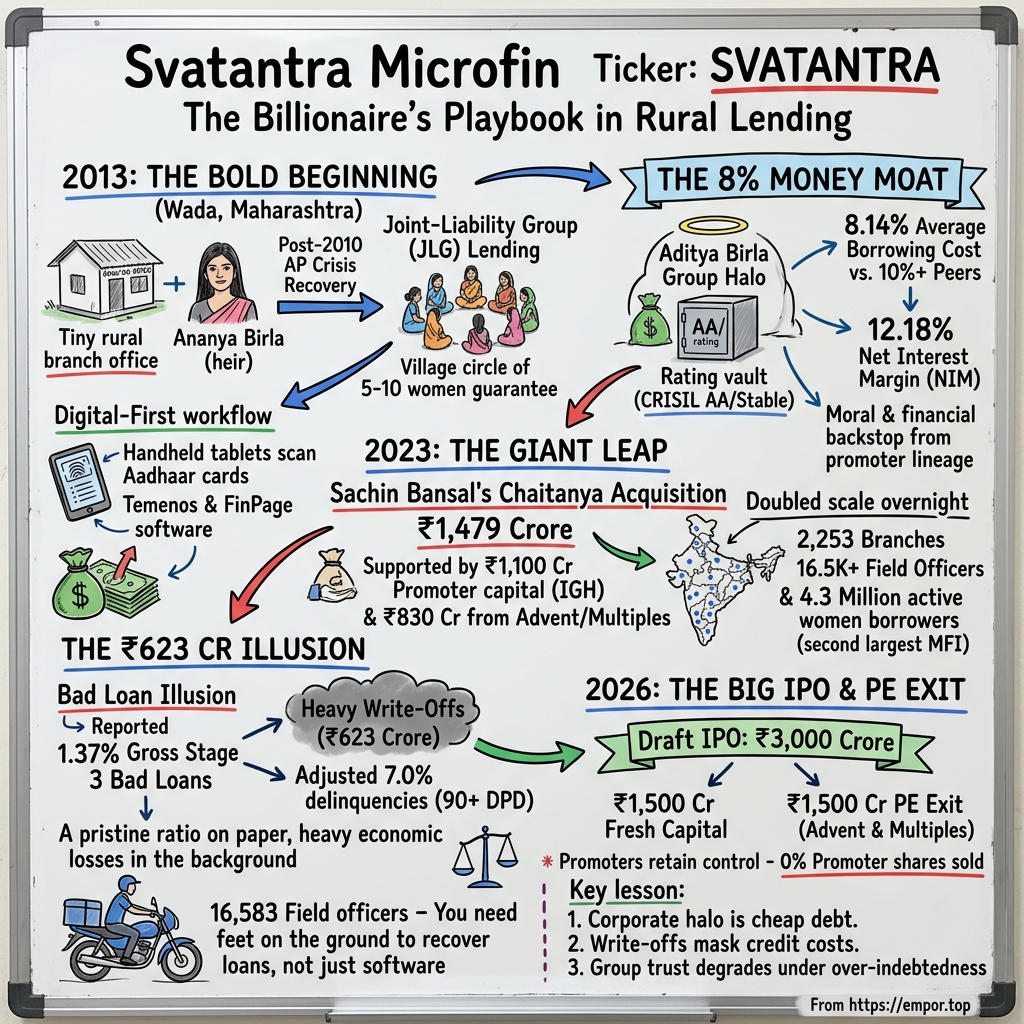
Svatantra Microfin: The Billionaire's Playbook in Rural Lending
The Billionaire's Daughter in Wada
In March 2013, in Wada, a farming tehsil in Maharashtra's tribal hinterland a short drive northeast of Mumbai, a new lender opened its doors with a proposition that most of Indian finance still regarded as radioactive. It would lend small sums, without collateral, to groups of poor rural women, and it would collect the money back in cash, in instalments, at village meetings1. The lender was called Svatantra, Sanskrit for "independent", and its promoter was Ananya Birla, the eldest child of Kumar Mangalam Birla and an heir to the Aditya Birla fortune1. The company had been incorporated in Mumbai in 20121.
The timing looked perverse. Barely two and a half years earlier, the Andhra Pradesh government had issued an ordinance that choked off microfinance collections in the industry's largest state, and banks had stopped lending to microfinance companies across India for fear that the contagion would spread11. Most heirs to industrial dynasties go into the family's cement, metals or retail businesses. This one chose the corner of finance that had just nearly died.
Thirteen years later, the bet has become a very large business. At the end of March 2026, Svatantra managed a consolidated loan book of about ₹23,818 crore and earned a net profit of about ₹649 crore for the year2. It served roughly 4.31 million active borrowers, almost all of them women, from 2,253 branches in 23 states and union territories34. Its revenue from operations came to roughly ₹4,121 crore2. Rating agencies describe it as India's second-largest non-bank microfinance lender, behind only CreditAccess Grameen5.
Now the company wants public shareholders. On August 13, 2026, Svatantra filed a Draft Red Herring Prospectus with the Securities and Exchange Board of India for an initial public offering of ₹3,000 crore2. Half of that, ₹1,500 crore, is fresh capital that will go into the company to strengthen its regulatory capital. The other half is an offer for sale through which its two private equity investors, Advent International and Multiples Private Equity, will take money off the table26. The Birla family is selling nothing6. No price band has been set, so tonight there is a filing and a set of numbers, but no price.
That is the frame for this story. A public-market investor looking at Svatantra is not really being asked whether microfinance can be a good business; listed peers have already answered that it can be, sometimes. The investor is being asked four narrower questions. The first is whether Svatantra's asset quality has genuinely escaped the rural credit stress that battered its peers in 2025, or whether heavy write-offs flattered its headline bad-loan ratio of 1.37 percent3. The second is whether its cheap funding, at an average cost of about 8.14 percent, belongs to Svatantra or to the Aditya Birla name standing behind it3. The third is whether the ₹1,479 crore purchase of Chaitanya India Fin Credit from Sachin Bansal's Navi group built lasting scale or imported southern risk and integration drag7. The fourth is why two blue-chip private equity firms are selling ₹1,500 crore of stock roughly two and a half years after they invested, while the promoter sells nothing6.
One boundary needs drawing before the story begins. The company being listed is Svatantra Microfin Limited, which holds the microfinance business and owns a small affordable-housing lender, Svatantra Micro Housing Finance Corporation, as a wholly owned subsidiary1. It is not the Aditya Birla group, and none of the group's listed companies' earnings belong to it. Svatantra pays no brand or management royalty to the group7. But the group's investment companies have put serious equity into it and, as the rating agencies spell out, stand behind it in ways that matter enormously to its cost of money58. Keeping those two facts in view at once, independent economics but borrowed credibility, is the central discipline of underwriting this company.
The verdict worth testing through the rest of this episode is simple to state. Svatantra turned founder pedigree, a clean start and early investment in field systems into genuine scale. But its leap to number two came through a single large merger that changed the company's geography, its cost base and its capital structure, and the cleanest-looking numbers in its prospectus are the ones that most need a second look.
 Subscribe on LinkedIn
The Microfinance Trap and the 2010 Meltdown
To understand why a clean start was worth so much in 2013, go back to Hyderabad in October 2010. After a run of borrower suicides that local politicians and the press blamed on aggressive collection practices, the Andhra Pradesh government promulgated an ordinance that forced microfinance lenders to register with the state, banned multiple lending and coercive recovery, and in practice made the weekly doorstep collection, the heartbeat of the business, politically dangerous11. Repayment rates on loans in the state, which had run near 99 percent before the ordinance, fell below 20 percent within months11. Lenders with Andhra exposure took heavy losses, and banks, which supplied almost all of the industry's funding, stopped lending to microfinance companies everywhere11.
The crisis exposed what microfinance had become in its boom years. The product at its core is elegant. A joint-liability group is a small circle of women from the same village who each take a loan and agree to stand behind one another's repayment. Nobody pledges land or gold; the collateral is social, the knowledge that a neighbour's default becomes the group's problem and the group's shame. When it works, it lets a lender reach households that no bank branch would ever underwrite, at a cost that a moneylender cannot match.
When it fails, it fails collectively. In the years before 2010, competing lenders had poured into the same villages, often lending to the same households several times over, at rates that were largely unregulated. The social guarantee that made group lending safe depended on each borrower having limited access to credit; once a household could borrow from three or four lenders, the group meeting stopped being a check on borrowing and became a venue for refinancing. That is the original sin the industry has never fully escaped, and it returned, as this story will show, in 2025.
The Reserve Bank of India responded by setting up a committee under board member Y. H. Malegam in October 2010, which reported in January 2011; the central bank broadly accepted its recommendations that May11. The new regime created a dedicated class of regulated lender, the NBFC-MFI, and gave it a rulebook: income ceilings for eligible borrowers, limits on how much any household could owe across lenders, mandatory reporting to credit bureaus, and transparent pricing. Later revisions, which today cap eligibility at household income of ₹3 lakh a year, kept the same architecture3.
The trade-off embedded in that rulebook is the key to Svatantra's whole strategy. Regulation made microfinance safer and more legible to banks, which meant that the industry's scarce resource stopped being borrowers and became funding. A lender that could convince banks and bond investors that it was disciplined, well-governed and well-capitalised could grow; one that could not would starve. Post-crisis microfinance, in other words, privileged institutions that looked like institutions.
Svatantra arrived as exactly that kind of entity. It carried none of the pre-2010 bad loans, none of the distrust of state governments that legacy lenders had earned, and none of their paper-based ledgers. It could build its processes around the new regulations from the first day rather than retrofitting them. Whether that clean slate was worth much is not a matter of opinion; the evidence comes later, in its funding costs.
The economics of the product itself are straightforward and unforgiving. Svatantra's microfinance loans typically run 12 to 24 months and are repaid in fortnightly or monthly instalments3. In the year to March 2026, its microfinance book yielded about 21.9 percent, and its overall portfolio, including housing loans, about 20.7 percent3. Those are high rates by the standards of salaried urban credit, and they need to be, because out of them a lender must pay for its borrowing, a field staff that visits every borrower in person, and the losses that arrive whenever a district floods, a crop fails or a state government decides that lenders make a convenient villain. Revenue in this business is recurring by construction, since every loan pays back in instalments within two years, but it is also renewed by construction: the book must be re-lent constantly, which makes the lender's growth a continuous bet on the next year of rural credit conditions.
Building the Digital-First Field Machine
Picture the basic unit of Svatantra's business: a circle of women seated on a mat or a courtyard floor, a loan officer with a tablet, perhaps twenty minutes of attendance, collection and conversation. Every loan the company makes passes through some version of that meeting, and every rupee of its ₹23,818 crore book is ultimately repaid, or not, in a village somewhere.
That is why, for a lender like Svatantra, the ordinary industrial notion of reinvestment does not apply. There are no factories and no laboratories. The equivalent of capital expenditure is people, branches and systems. Svatantra's network grew from 1,840 branches in March 2024 to 2,253 in March 2026, spread across 446 districts, and it employed about 24,594 people, of whom roughly 16,583 were field officers4. The ratio says what the business is: about two of every three employees spend their days on the road, visiting borrowers.
The technology spending sits behind that field force. Svatantra runs its loan accounting on the Temenos core banking platform, originates loans through a paperless system called FinPage, and uses Credgenics software to manage collections workflows45. Management's case is that this stack, adopted early, lets a loan officer verify identity, record an application and trigger a disbursement directly into a borrower's bank account without paper, which lowers fraud and cash leakage and shortens turnaround. That is a real advantage over the paper-ledger lenders of a decade ago. It is not, by itself, an advantage over today's listed peers, all of whom have digitised origination and disbursement.
The test of whether technology changed the economics is the cost base, and here the record narrows the claim. In the year to March 2026, operating expenses rose about 28 percent to roughly ₹1,461 crore, and the cost-to-income ratio, operating costs as a share of net income after interest, stood at about 49.7 percent38. Put plainly, half of every rupee of spread the company earns goes to running the branch network. That is not unusual for Indian microfinance, but it is not the profile of a software-led lender either. Field officers scale with borrowers, and borrowers scale with the book, so costs scale with volume. Software digitised the paperwork; it did not replace the motorcycle.
The year to March 2026 also produced the strangest-looking number in the prospectus. Svatantra earned a net profit of about ₹649 crore, yet reported operating cash flow of minus ₹5,393 crore9. A reader trained on industrial companies would see a business burning money. That reading is wrong. Under Indian accounting rules, a lender's loans to customers are classified as operating outflows, so every rupee disbursed counts against operating cash flow, while every rupee borrowed to fund it shows up under financing. Disbursements jumped about 53 percent that year to roughly ₹20,242 crore, and the company funded the growth with about ₹7,067 crore of net financing inflows9. Negative operating cash flow is what a growing lender looks like.
The question that matters is therefore not cash conversion but return on capital. In that year, Svatantra earned a net interest margin of about 12.2 percent of average loans, up from 9.8 percent two years earlier, and a return on net worth of about 15.6 percent32. Collection efficiency, the share of instalments due that were actually collected, was around 97 percent9. These numbers say a lot about how the machine runs: the spread is wide and widening, the collection apparatus works, and the return on equity is respectable without being spectacular, because cost and credit losses absorb a large share of the spread.
There is one more uncomfortable fact about the organic machine. By the year to March 2023, after a decade of building, Svatantra's loan book had reached about ₹7,499 crore, concentrated in central and northern India5. That was a solid regional franchise. But growing branch by branch, hiring and training field officers district by district, would have taken many more years to approach CreditAccess Grameen, whose book is today about ₹29,600 crore6. If Svatantra wanted to become a national institution in this cycle, it would have to buy its way there. In 2023, a seller appeared.
The Sachin Bansal Fire Sale
The seller was Sachin Bansal, the Flipkart co-founder, whose Navi Technologies had owned Chaitanya India Fin Credit, a Bengaluru-based microfinance lender with a large southern and western footprint7. Navi was refocusing its financial-services strategy, and Chaitanya's high-touch village lending sat awkwardly beside an app-first consumer lending model. In 2023, Svatantra's holding company agreed to buy Chaitanya for ₹1,479 crore7.
The deal was financed in a way that tells the story of who really carried the risk. The promoter group did not ask the operating company to borrow its way into the acquisition. Instead, IGH Holdings, a promoter group investment company, injected ₹1,100 crore of fresh equity, in the year to March 2024, to pay for most of the purchase7. In March 2024, Advent International, through its affiliate Violicina, and Multiples Private Equity committed ₹1,930 crore to the group, of which about ₹830 crore was primary capital injected into Svatantra itself in the following year1. Across December 2021 to December 2025, promoter group entities put in about ₹1,425 crore of equity7. Net worth roughly doubled in two years, from about ₹2,370 crore in March 2024 to about ₹4,738 crore in March 20261.
The effect on scale was immediate. Consolidated loans under management jumped to about ₹16,472 crore by March 2024, more than double the pre-deal Svatantra book1. Revenue from operations rose from about ₹2,429 crore in the year to March 2024 to about ₹4,121 crore two years later1. That was not organic growth; it was a step change bought with family and private equity capital, and the right comparison for judging it is not Svatantra's earlier growth rate but what the same capital would have produced in branches.
What did Svatantra pay in terms an investor can compare? The company does not disclose Chaitanya's net worth at acquisition in its abridged prospectus, so the price-to-book multiple paid cannot be established from its own filings, and claims that the deal was struck at a sharp discount or a full premium should be treated as unverified. What can be said is that the acquisition was made at a moment when the listed microfinance sector was enjoying a strong recovery and bank funding had returned, which means it was not obviously a distressed purchase. Bansal was a strategic seller exiting a non-core business, not a forced seller in a credit crunch.
Integration was the harder test, and it is not finished. Chaitanya's co-founder Anand Rao joined Svatantra's board as Joint Managing Director alongside Managing Director Vineet Chattree10. The legal combination took a long time: a court-approved scheme of amalgamation merging both Chaitanya and the holding company, Svatantra Holdings, into Svatantra Microfin took effect only on March 21, 2026, more than two years after the purchase1. The statutory auditors' reports for the years to March 2025 and March 2026 each carry an Emphasis of Matter drawing attention to the scheme, and modifications under the companies' auditor reporting order on matters of regulatory reporting, while leaving the audit opinion itself unqualified10. An Emphasis of Matter is not a red flag in itself; it tells readers that comparisons across years are complicated by the merger accounting. But it does mean that the restated, three-year financial history in the prospectus is a reconstruction, and that clean like-for-like comparisons of the legacy Svatantra business before and after the deal are not available.
The most consequential effect of the merger was geographic. Before Chaitanya, Svatantra was a lender built on the Hindi heartland; it remains the largest non-bank microfinance lender in Bihar and Uttar Pradesh3. Chaitanya added substantial exposure to Karnataka and Maharashtra3. Diversification is the bull reading: no single state's politics or monsoon can now sink the company. The bear reading is that Karnataka, along with Bihar, became one of the epicentres of the borrower over-indebtedness that swept the industry in 2024 and 2025, to the point that the state legislated against coercive microfinance recovery in early 2025. Svatantra bought its southern footprint shortly before the south became the problem. The prospectus does not break down credit losses by state, so how much of the subsequent pain came from the acquired book is not something the company has disclosed.
The fairest verdict on the deal is that it worked as a strategic leap and is unproven as an investment. It made Svatantra a national number two, financed without stretching the operating company's balance sheet. Whether it created value per share depends on two things that will only become visible after listing: whether the combined cost base falls as systems and branches are rationalised, and whether the acquired book's credit losses settle at a level the combined spread can carry. And that spread, it turns out, depends heavily on something Svatantra did not build itself.
The Aditya Birla Group Halo and the 8% Money Moat
Every non-bank lender in India lives or dies by its access to wholesale funding. Unlike a bank, Svatantra cannot take deposits, so the money it lends to village women must first be borrowed from banks, development finance institutions, mutual funds buying its debentures and commercial paper, and investors buying securitised pools of its loans73. When liquidity is plentiful, that works. When it tightens, as it did in 2010 and again after the IL&FS default of 2018, the lenders without strong backing are the first to be rationed.
Svatantra's funding profile is exceptional for a microfinance lender. In the year to March 2026, its average cost of borrowing was about 8.14 percent, and its incremental borrowing, the rate on new money raised during the year, was about 8.27 percent, down from 9.6 percent two years earlier39. Against a portfolio yield of about 20.7 percent, that is the source of the 12.2 percent net interest margin. Its borrowing base reached about ₹18,613 crore, against equity of about ₹4,738 crore, a debt-to-equity ratio of roughly 3.9 times91. Its asset-liability profile shows positive cumulative cash mismatches in every maturity bucket up to a year, meaning more money falls due to it than from it over every horizon in that window3.
The rating agencies explain why. CRISIL upgraded Svatantra's long-term rating to AA with a stable outlook on March 30, 2026, from AA-minus, and CARE Ratings reaffirmed its AA rating on April 23, 2026, having upgraded it the previous December58. Both agencies cite the company's scale and capitalisation. But both also cite, as a central rating strength, strong support from the Aditya Birla group investment companies that back it58. An AA rating opens the doors of mutual funds and the treasury desks of large banks; a single-A rating, more typical for standalone microfinance lenders, does not open them as wide.
How much is that worth? The prospectus does not publish peer borrowing costs, and precise spreads for each competitor vary by quarter, so the gap cannot be stated to the basis point from Svatantra's own filings. The structure of the advantage is nonetheless clear from the arithmetic. Every percentage point of lower funding cost on a debt base of about ₹18,600 crore is worth roughly ₹186 crore a year before tax. Svatantra's pre-tax profit in the year to March 2026 was in the region of ₹860 crore, inferred from its ₹649 crore net profit at India's standard corporate tax rate2. So a funding disadvantage of even one and a half points, the kind of gap that separates AA from single-A borrowers in Indian credit markets, would have consumed about a third of its pre-tax earnings. The halo is not decoration; it is a large share of the profit.
Is the halo deserved, or is it a subsidy? Here the behaviour of the family offers real evidence. The promoter group did not merely lend its name. It put in roughly ₹1,425 crore of equity over four years, including the ₹1,100 crore that paid for Chaitanya, and it extracts no royalty for its brand7. Its registered office is leased from unrelated third parties7. A group that writes cheques of that size, and takes nothing back in fees, has given credit markets a tangible reason to believe it would write another in a crisis. That is a more durable foundation than a letter of comfort.
But the disconfirming evidence sits in the same rating documents. The ratings are explicitly conditioned on that continued support5. Support is a commitment of intent, not a legal guarantee, and its credibility depends on the family's economic stake. After the IPO, the promoter holding will fall from about 60 percent toward the low fifties, depending on the price at which fresh shares are issued, because the family sells nothing but is diluted by the primary issue6. That still leaves control firmly in family hands. The risk is not that the halo disappears at listing; it is that public ownership changes how the halo is read. Once Svatantra has public shareholders and a market price, credit analysts will increasingly underwrite the listed company on its own numbers.
So the halo thesis survives historical testing but narrows. Svatantra's funding advantage is real, large and earned partly through the family's demonstrated willingness to commit capital. It is also not Svatantra's own: a different shareholder base would not inherit it. The post-listing test is simple to name. Watch the spread at which Svatantra's debentures and commercial paper trade relative to government securities over the first year as a listed company. If that spread holds, the market is treating the support as permanent. If it widens, the margin that makes Svatantra look like the best-run lender in its industry will narrow with it. And margin matters most because of what it has had to absorb.
The ₹623 Crore Illusion: Write-Offs Behind the Curtain
Open the prospectus to the asset-quality pages and the headline looks almost too good. At the end of March 2026, Svatantra's gross stage 3 loans, the accounting category for loans more than 90 days overdue, stood at 1.37 percent of the book, down from 2.34 percent a year earlier; for the pure microfinance book, the figure was 1.19 percent3. Net of provisions, stage 3 was just 0.48 percent3. In a year when listed peers were reporting gross bad-loan ratios several times higher, Svatantra appeared to have sailed through the storm.
The storm was real. After the pandemic, microfinance lenders expanded rapidly, and the industry's long-standing weakness re-emerged: households in Bihar, Karnataka, Tamil Nadu and elsewhere took loans from several lenders at once, and as debt burdens outran incomes, repayments cracked across the industry in 2024 and 2025. The industry's self-regulatory bodies tightened guardrails on how many lenders could serve a single borrower and how much total debt a household could carry. Rating agencies, CRISIL among them, flagged the vulnerability of microfinance borrowers to over-indebtedness, regional disruption and natural calamities as the core constraint on the sector's ratings, Svatantra's included58.
The question is how Svatantra emerged so clean. The answer begins with a different number on a different page. In the year to March 2026, Svatantra charged about ₹623 crore of impairment on financial instruments, its credit cost, to the profit and loss account3. That was about 3.04 percent of its average loans, and about 3.39 percent for the microfinance book3. A lender whose headline bad loans are 1.37 percent of the book does not, in a steady state, lose more than 3 percent of it to credit costs in a single year. The gap between those two numbers is the write-off.
Here is the mechanism, in plain terms. When a microfinance loan goes bad, a lender first provisions against it, and if recovery looks unlikely it eventually writes the loan off, removing it from the books entirely. A written-off loan no longer appears in gross stage 3. So the bad-loan ratio measures what is still on the balance sheet, not what has been lost. A lender that writes off aggressively can show a low ratio even while its customers default at high rates. That is not fraud or even sharp practice; prompt write-off is prudent accounting. But it means the gross stage 3 ratio, taken alone, tells an investor very little about how the loan book actually behaved.
CRISIL supplied the missing number. In its March 2026 rationale, it reported that Svatantra's loans more than 90 days overdue, adjusted to add back write-offs over the previous twelve months, rose from 6.4 percent in March 2025 to 7.0 percent in December 20255. That metric is the closest thing to an economic default rate available for the company, and it was getting worse, not better, during the very period in which the headline ratio was improving. Read together, the numbers tell a coherent story: Svatantra's borrowers defaulted at rates broadly comparable with the industry's stress, and the company absorbed those defaults through its income statement and wrote them off rather than carrying them.
That is the heart of the matter, and the conclusion cuts both ways. The bear reading is that the 1.37 percent ratio is close to an artefact, and that an investor who pays for "immunity to the rural credit cycle" is paying for something the business does not have. The bull reading, which deserves equal weight, is that Svatantra earned enough to pay for those losses and still report a 15.6 percent return on equity. A lender that can lose more than 3 percent of its book in a bad year and still make healthy profits has a spread wide enough to function as a shock absorber. That is exactly what the halo-funded margin buys.
The worked arithmetic makes the stakes concrete. Svatantra's average loan book in the year to March 2026 was about ₹20,500 crore, which follows from its ₹623 crore credit cost being 3.04 percent of average loans3. If credit costs fell to a more normal 2 percent, the charge would drop to about ₹410 crore, adding roughly ₹210 crore to pre-tax profit, or about ₹160 crore after tax. Net profit would rise by about a quarter, and return on equity would move toward 19 percent. If instead credit costs rose to 4 percent, a not unprecedented level for the industry in a bad year, pre-tax profit would fall by about ₹200 crore and the return on equity would slip toward 12 percent, below most estimates of what Indian equity investors require from a lender of this risk. The whole valuation debate, in other words, rests on a single variable: what normal credit cost looks like for this book through a full cycle.
Svatantra's record on that question is short. It has lived through demonetisation, the pandemic and the 2024 to 2025 over-indebtedness cycle, but most of its current book was originated after the Chaitanya merger and in a single credit cycle. The company also discloses the recovery machinery behind its numbers: it and its housing subsidiary had initiated 352 recovery and criminal proceedings and 3,202 SARFAESI and related recovery actions, the latter covering about ₹204 crore, mostly against secured housing borrowers10. Unsecured microfinance cannot be recovered through courts in any meaningful volume; its collections rest on field officers and group pressure. That is why the next two quarters of disclosures matter more than any number in the prospectus. The red herring prospectus, when filed, should carry asset-quality data through September 2026, and the settling figures will be gross slippages and twelve-month write-offs, not the stage 3 ratio.
The verdict is that the headline recovery is substantially a function of write-offs, and that the underlying economic default rate as of late 2025 was still elevated. What remains intact is the company's ability to absorb those losses. Which raises the question that two of Svatantra's most sophisticated shareholders have, in effect, already answered.
The Private Equity Sprint to the Exit
In March 2024, at roughly the same moment Svatantra was finishing the job of paying for Chaitanya, Advent International and Multiples Private Equity agreed to invest ₹1,930 crore1. Advent invested through an affiliate called Violicina; Multiples, the firm founded by Renuka Ramnath, invested through three of its funds6. In August 2026, roughly twenty-nine months later, both put shares into the offer for sale: Violicina up to about ₹1,065 crore and Multiples up to about ₹435 crore, together ₹1,500 crore6.
The cap table before the offer is simple. Promoters hold about 60 percent: Ananya Birla about 26.5 percent directly, her entity Antimatter Media about 33.5 percent, and her mother Neerja Birla a fraction of one percent6. Violicina holds about 28 percent and the three Multiples funds about 11.5 percent6. That adds up to about 803 million shares, consistent with paid-up capital of ₹803 crore at a face value of ₹1016. The company discloses no outstanding convertible preference shares after a conversion in the past year and does not detail any employee option pool in its abridged prospectus; the full prospectus will need to confirm whether options dilute the count further, so the fully diluted share base is not yet settled1.
The sponsors' cost is disclosed. Their weighted average acquisition price is about ₹67 per share, and about ₹53 for shares acquired in the past year through conversion of preference shares1. Ananya Birla's average cost is about ₹11 per share, and Antimatter Media's about ₹651. For context, the company's net asset value at March 2026 was about ₹59 per share and its earnings per share about ₹92. So the private equity investors paid somewhat above today's book value, at a moment when book value was much lower, and are selling at a price yet to be fixed.
Because no price band exists, the size of their gain cannot be stated. It can be bracketed. At a price of 2 times post-issue book value, a level discussed further when the valuation is weighed, the shares would be worth roughly ₹155, and a sponsor that paid ₹65 would realise about 2.4 times its money on the shares it sells, before tax, in under three years. At 1.5 times book, the multiple would still be close to 1.8 times. Those are good outcomes, not spectacular ones by private equity standards, and the speed is part of the return.
Why sell now, and why sell this much? The benign answer is fund mechanics. Private equity funds have finite lives and limited partners who want distributions; an IPO is the first chance to sell in size, and the stake being sold is only a part of their holding. On the scale of what they own, ₹1,500 crore will likely represent somewhat less than half of the sponsors' combined stake at plausible prices, leaving them as material shareholders after listing. A sponsor that wanted out entirely would have sought a larger sale or a strategic buyer.
The skeptical answer deserves its place alongside. Sophisticated lenders' investors know better than anyone that microfinance margins are cyclical. Svatantra's net interest margin is at a three-year high, its funding cost at a low, and its credit costs falling from a peak; selling into that combination is what a rational seller would do whether or not they expected trouble. The combined facts that the sponsors are selling and that the economic default rate was still rising in late 2025 do not prove they foresee a downturn. They do mean that the public buyer is being asked to buy at the point in the cycle the private sellers found most attractive.
The promoter's posture matters equally. The family selling nothing and accepting dilution from the fresh issue is a strong signal of long-term commitment, and it reinforces the support thesis that underpins the company's ratings6. It also preserves concentrated control. After listing, the family is likely to retain a majority, which means public shareholders will be minority investors in a family-controlled lender whose most important asset, its credit standing, depends on the family's continuing goodwill.
Governance is designed to reassure. The ten-member board has five independent directors, among them N. G. Shankar, Mamta Suri, Balasubramanian Ganesh, Mathew Joseph and Ashish Razdan, with Ananya Birla as non-executive chairperson, Shweta Jalan representing Advent and Renuka Ramnath representing Multiples10. That is a board with real financial-services experience. The company does not disclose executive pay and the performance metrics behind it in its abridged prospectus10. Diligence on the red herring should ask a direct question: are management's incentives tied to loan growth, or to credit-adjusted returns?
The anchor book will be the first real price signal. Domestic mutual funds, which are already among Svatantra's lenders, will be asked to become its shareholders too. Their demand at a given price will say whether institutional investors believe the halo and the write-off story are permanent features or cyclical gifts. That signal is a price, though, not a valuation, and the two have to be kept apart.
Playbook: Business & Investing Lessons
The first lesson is that a corporate halo is the cheapest money in finance, and the most borrowed. Svatantra did not build its 12 percent margin by charging village women more than its rivals do; its yields sit in the industry's ordinary range. It built the margin on the liability side, by borrowing at around 8 percent because credit markets believe the Birla family will not let it fail. For founders, the lesson is that in lending the shareholder register is part of the product. For investors, the line to remember is harsher: a moat you can lose by changing your shareholders is a moat on loan.
The second lesson concerns what a bad-loan ratio measures. Svatantra's 1.37 percent stage 3 ratio and its ₹623 crore credit charge came from the same year and the same loans. One counted what was left on the balance sheet; the other counted what had been lost. In microfinance, the honest scoreboard is the write-off-adjusted default rate, which was 7 percent and rising in late 2025. Headline bad loans measure what you kept; credit costs measure what you lost.
The third lesson is about buying scale with patient money. When Svatantra wanted to leap from regional to national, it did not borrow to pay for Chaitanya. The family put up ₹1,100 crore of equity first, then brought in private equity, then took more than two years to finish the legal merger. That sequencing kept the operating company's leverage reasonable through the integration. The broader point for founders is that in a regulated, levered business, an acquisition financed with debt is two bets at once, and only one of them is the business.
The fourth lesson is the oldest in microfinance and the one the industry keeps relearning. Group lending turns social ties into collateral, but only as long as each borrower's credit is scarce. Once four lenders crowd into the same village, the group meeting that once disciplined borrowing becomes the place where one loan repays another. Svatantra's 2025 is a reminder that social collateral is only as strong as the credit bureau behind it.
The fifth lesson is about technology. Svatantra's software, from Temenos to FinPage, made it faster and cleaner to lend; its cost-to-income ratio of about 50 percent shows that it did not make it cheaper to collect. The 16,583 field officers are the business. Software accelerates origination, but only motorcycles recover the money.
Analysis & Bear vs. Bull Case
Picture an institutional sales desk in Mumbai with two sets of numbers side by side: Svatantra's draft prospectus and CreditAccess Grameen's latest results. CreditAccess, the only Indian microfinance lender larger than Svatantra, manages a book of about ₹29,600 crore and trades at a market value of about ₹24,700 crore6. The question that desk will be asked by clients is whether Svatantra deserves to be valued like the leader, at a discount to it, or at a premium.
Begin with what kind of value this is. For a lender, the meaningful anchors are book value and earnings, not revenue or enterprise value. Debt here is raw material, not financing in the industrial sense, so an enterprise-value bridge that subtracts ₹18,600 crore of borrowings is meaningless, and comparisons must be made on an equity basis: price to book, price to earnings, and return on equity. Svatantra's book value at March 2026 was about ₹4,738 crore; the fresh issue would lift it to roughly ₹6,238 crore, before issue costs12. Its net profit was about ₹649 crore.
Now apply the simplest lens finance offers for valuing a lender. A bank or lender that earns a sustainable return on equity, grows at a steady rate, and faces a given cost of equity is worth a multiple of its book equal to the return minus growth, divided by the cost of equity minus growth. Assume Indian investors require about 14 percent from a microfinance lender and that Svatantra can grow its book at around 10 percent over the long run. If the company's sustainable return on equity is 15.6 percent, its 2026 figure, the justified multiple is about 1.4 times book. If normalised credit costs settle near 2 percent and returns reach 18 to 19 percent, the multiple rises to about 2 to 2.25 times book. If credit costs remain around 3 percent and funding costs rise after listing, returns could settle nearer 13 percent, and the justified multiple falls below 1 times book.
Translated into equity value, on post-issue book of about ₹6,238 crore, those cases give a range from roughly ₹6,000 crore in the stressed case, through about ₹8,700 crore in the central case, to about ₹14,000 crore in the optimistic case. These are not targets; they are a map of what the price assumes. The most sensitive inputs are credit cost and funding cost, which together move return on equity by several points either way. Growth matters less than either.
The comparable view works differently. CreditAccess's market value of about ₹24,700 crore against a book of about ₹29,600 crore in loans implies the market prices it at a large multiple of its own book value and as a premium franchise, which is the multiple Svatantra's bankers will reach for6. But CreditAccess's premium has been built over a longer listed record, through cycles, as the most consistently profitable lender in the sector. Svatantra has a shorter record, a merger still settling, and a margin that depends partly on a parent's support rather than an operating edge. The other listed lenders, Spandana Sphoorty, Fusion Micro Finance and Muthoot Microfin, are closer in business model but were hit harder by the 2024 to 2025 stress, and have at times traded below book value6. They make a poor ceiling and a useful floor.
The reconciliation is uncomfortable for anyone hoping for a premium. The intrinsic view, built on Svatantra's actual returns, centres on roughly 1.4 to 2 times book. The comparable view argues for a figure between the stressed peers and CreditAccess. At 2 times post-issue book, Svatantra would be valued at about ₹12,500 crore, around 19 times its trailing earnings. That price would embed an assumption that credit costs fall well below 3 percent and that funding costs hold near 8 percent after listing. A price above that would require the market to treat the halo as permanent and the 2025 losses as a one-off. A price below it would mean the market is pricing the write-off-adjusted default rate, not the stage 3 ratio.
Why might the market pay more than the central range anyway? IPO scarcity, the narrative of a young founder and a famous family, a free float of only about a fifth of the company, and mutual-fund enthusiasm for lenders after a recovery are all forces that move prices. None of them changes what the business earns.
The competitive analysis clarifies the fight. In Hamilton Helmer's language, Svatantra has some scale economies, since a 2,253-branch network spreads head-office, technology and compliance cost across more borrowers, though field staffing scales with volume. Its clearest power is a cornered resource: access to a credit umbrella that no standalone lender can replicate. It has a degree of process power in digitised, paperless origination that cuts turnaround and fraud. What it lacks is switching costs. A woman borrowing ₹50,000 can join a rival's group next month, and many do. In Porter's terms, buyers have power through multi-lending, suppliers of capital have power over everyone but the best-rated, and the regulator's caps on household debt set the ceiling on industry growth.
The bull case runs as follows. Svatantra is now spread across 446 districts, which makes any single state's crisis survivable4. The ₹1,500 crore of fresh capital will lift its capital adequacy, already a healthy 22.8 percent, well above regulatory minimums, funding several years of growth without heavy borrowing1. Its AA ratings keep funding near 8 percent and margins near 12 percent. And the housing subsidiary offers a slower-growing, secured diversification away from pure group lending.
The bear case is equally coherent. The write-off-adjusted default rate of 7 percent says the rural credit cycle is not over, and another year of 3 percent credit costs would hold returns close to the cost of equity5. The sponsors will still own a substantial stake after the offer, which means predictable supply once lock-ups end. Cost-to-income near 50 percent shows that the southern expansion is expensive to run. And regulatory risk never sleeps: any tightening of household indebtedness rules or pricing directly hits volumes or margins.
Weighing both, the evidence supports Svatantra as a sound, large and well-backed lender whose reported numbers flatter its economics in the specific ways described. That warrants valuation at parity with the stronger listed peers on earnings normalised for credit cost, not a premium to the leader. Three numbers will settle whether that judgement is too cautious: credit cost as a share of average loans, which needs to fall below about 2.5 percent; the write-off-adjusted 90-day default rate; and the spread at which the company borrows over government bonds.
Epilogue
Tonight, Svatantra Microfin is a company in waiting. Its draft prospectus has been with the regulator for two months, and it has not yet set a price band or launched its book-build2. The ₹3,000 crore offer, half to the company and half to the sponsors, is defined; everything else is still to be decided by the markets.
The first decisive moment will be the asset-quality disclosures for the half-year to September 2026, which should appear in the red herring prospectus or the company's first results as a listed entity. If write-offs fall and the adjusted default rate drops back toward the levels of earlier years, the company's claim to have absorbed the cycle will be vindicated, and the stage 3 ratio will start to mean what it appears to mean. If credit costs stay above 3 percent of loans, the question of whether the 2026 profit was normal or a lucky pause will become the central question of its public life.
The second moment is the order book itself. If institutional investors, particularly the domestic mutual funds that already lend to Svatantra, bid aggressively for shares being sold by the sponsors, it will show that sophisticated buyers accept the halo as durable. If demand is thin, or the price is set near book value, the market will have priced in the write-off reality, and the sponsors will have learned that the window was narrower than they thought.
The third moment will come months after listing, in the bond market. Svatantra's debentures and commercial paper will begin to be priced against the backdrop of a listed equity, quarterly results and public scrutiny of every slippage. If spreads hold, the Birla support will have survived the transition to public ownership. If they widen, Svatantra will discover how much of its margin was its own.
Beneath all three runs the tension the company was founded with. Svatantra was built to give rural women access to fair credit after an industry had shown how quickly that credit could become a trap. Public markets will now ask it to grow its earnings every quarter. In microfinance, those two missions coincide only as long as growth does not outrun what borrowers can repay, and the 2025 cycle showed exactly how thin that line is.
Outro
Go back to Wada in March 2013, to a single office in a farming tehsil, opening when respectable finance still treated village lending as a scandal waiting to happen. The founder's surname would have opened almost any door in India. She chose the door that had just been slammed shut.
Thirteen years later, that office has become a lender of roughly ₹24,000 crore serving more than four million households. Its genius was never a secret algorithm or a revolutionary app. It was something stranger: the credit rating of a century-old industrial dynasty, wrapped around the unsecured promise of India's poorest rural women. Public investors are now being asked to price both halves of that bargain, and to decide which half they are really buying.
References
-
Draft Abridged Prospectus, Capital structure and financial summary (p. 8) — Svatantra Microfin Limited, 2026-08-13 ↩↩↩↩↩↩↩↩↩↩↩↩↩↩↩↩↩
-
Svatantra Microfin files papers with Sebi for ₹3,000 crore public offer — Business Standard, 2026-08-14 ↩↩↩↩↩↩↩↩↩
-
Draft Abridged Prospectus, Business and key performance indicators (p. 10) — Svatantra Microfin Limited, 2026-08-13 ↩↩↩↩↩↩↩↩↩↩↩↩↩↩↩↩↩↩
-
Draft Abridged Prospectus, Company overview (p. 5) — Svatantra Microfin Limited, 2026-08-13 ↩↩↩↩
-
Rating Rationale: Svatantra Microfin Private Limited — CRISIL Ratings, 2026-03-30 ↩↩↩↩↩↩↩↩↩↩
-
Draft Abridged Prospectus, Offer details and shareholding (p. 8) — Svatantra Microfin Limited, 2026-08-13 ↩↩↩↩↩↩↩↩↩↩↩↩↩↩
-
Draft Abridged Prospectus, Promoters and related parties (p. 5) — Svatantra Microfin Limited, 2026-08-13 ↩↩↩↩↩↩↩↩↩
-
Press Release: Svatantra Microfin Limited — CARE Ratings, 2026-04-23 ↩↩↩↩↩
-
Draft Abridged Prospectus, Cash flows and borrowings (p. 9) — Svatantra Microfin Limited, 2026-08-13 ↩↩↩↩↩
-
Draft Abridged Prospectus, Board, litigation and auditor qualifications (p. 14) — Svatantra Microfin Limited, 2026-08-13 ↩↩↩↩↩
-
Effects of Reserve Bank of India Regulations on Public Sector Lending for Micro Finance Institutions — Microfinance Gateway, 2011-10 ↩↩↩↩↩
 LinkedIn
 WhatsApp
 Reddit
 Hacker News
 Email
Email Kindle
 RSS Feed
 Spotify
 Apple Podcasts
 Amazon Music
 Audible
 YouTube