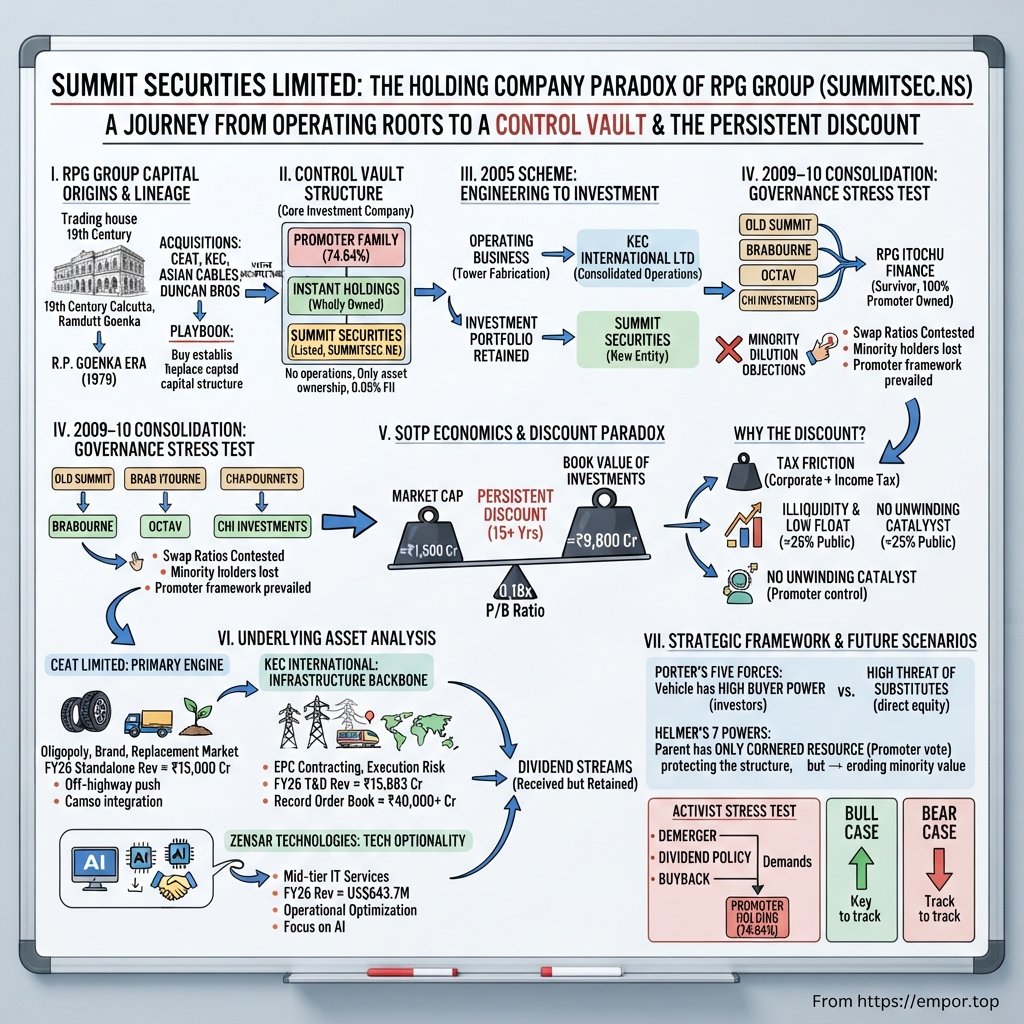
Summit Securities Limited: The Holding Company Paradox of RPG Group
I. Introduction & Episode Roadmap
There is a building in Chembur, an eastern suburb of Mumbai, at an address that reads like a typo on a corporate filing: 213, Bezzola, B Wing, 71, Sion-Trombay Road.1 No trading floor. No factory. No campus with a logo on the roof. From this registered office, a company with a book value north of ₹7,800 per share and an investment portfolio carried at roughly ₹9,800 crore conducts its entire business, which consists almost exclusively of owning shares in other companies and collecting the dividends they choose to send.2
That company is Summit Securities Limited, listed on the NSE as SUMMITSEC and on the BSE under scrip code 533306.34 It is a Non-Banking Financial Company registered with the Reserve Bank of India, but it does not lend to the public in any commercial sense. What it does is hold — directly and through its wholly owned subsidiary Instant Holdings Limited — the promoter-side equity of the RPG Group companies chaired by Harsh Goenka: tyre maker CEAT Limited, power transmission contractor KEC International Limited, and mid-tier IT services firm Zensar Technologies Limited.21
Here is the paradox that makes this company worthy of analysis rather than simple obscurity. In trading as of mid-2026, Summit Securities carried a market capitalisation of roughly ₹1,500 crore against a consolidated book value of investments many multiples of that figure — representing a price-to-book ratio of about 0.18.2 Put plainly, the market has consistently valued the company at fifteen to twenty paise for every rupee of underlying listed equity for over fifteen years.
The standard value-investor reflex is to label this a mispricing: buy the holding company, acquire the operating assets at a fraction of their quoted market price, and wait for convergence. That trade is one of the oldest in Indian equities, and it has a long history of failing to deliver. The more useful question — the one at the center of this analysis — is not how large the discount is, but what purpose the discount serves. Discounts of this magnitude and persistence are rarely accidents of market inattention. They typically reflect structural realities: tax friction on any potential unwinding, the absence of a mechanism by which minority shareholders can force a liquidation, and a controlling shareholder whose economic interests are served by keeping the vehicle exactly as it is.
Summit Securities provides a remarkably clean case study for examining that dynamic because virtually nothing else takes place within the entity. There is no operating business to obscure financial analysis, no leverage at the parent level, and no management team whose operational execution can be evaluated. What remains is a direct test of a central proposition: does owning assets through a controlled holding vehicle deliver the financial returns of owning those assets directly?
The story follows that question through eight key sections:
- The Goenka family's arc from a nineteenth-century Calcutta trading house to a modern Indian conglomerate, and why that lineage produced this specific holding structure.
- The 2005 scheme of arrangement that hollowed out an operating engineering company and left behind the shell renamed Summit Securities.
- The 2009–10 consolidation of four investment companies into RPG Itochu Finance Limited — and the swap-ratio dispute that provides the single best historical view of how this promoter group treats minority shareholders when interests diverge.
- The underlying assets themselves: CEAT, KEC, Zensar, and the smaller holdings — examining what each earns, what drives its core business, and where each sits competitively in 2026.
- The mechanics of the holding company discount, testing the arbitrage thesis against the fifteen-year historical record.
- Helmer's 7 Powers and Porter's Five Forces applied separately to the holding vehicle and to the operating assets, illustrating why the two score almost inversely.
- The activist stress test — evaluating what a skeptical fund would demand and the mathematical realities of why such an approach cannot force change.
- The bull and bear cases, outlining the specific metrics an investor must track.
The central theme extends far beyond one office in Chembur: in public markets, when does asset quality translate into shareholder returns, and when does the corporate architecture in between erode that value?
 Subscribe on LinkedIn
II. RPG Group Lineage & Capital Origins
Every Indian business house has an origin story polished by retelling, and the Goenkas' is more burnished than most. The family's commercial roots trace to Ramdutt Goenka, a nineteenth-century Marwari trader who moved to Calcutta when Calcutta was the commercial capital of British India and agency houses — not factories — were where fortunes were made. The lineage produced Sir Badridas Goenka, who in 1933 became the first Indian chairman of the Imperial Bank of India, the institution that later became the State Bank of India. That detail matters less as trivia than as a marker of what the family was: not industrialists in the mill-owning sense, but financiers and intermediaries whose core competence was ownership rather than operations.
That distinction echoes forward eight decades into a holding company in Chembur.
The R.P. Goenka Era: Buying the Departing Multinationals
The modern group was assembled by Rama Prasad Goenka, universally known as R.P., who formalised RPG Enterprises in 1979.5 His timing was a study in reading regulation as opportunity. Post-independence India had progressively squeezed foreign multinationals, and the Foreign Exchange Regulation Act of 1973 forced foreign shareholders in Indian operations to dilute their stakes below a majority. A generation of British and European companies decided India was no longer worth the trouble. R.P. Goenka decided it was.
What followed was an acquisition campaign unusual in Indian business history for being almost entirely inorganic: Duncan Brothers, the tea and trading house; CEAT, the Italian-origin tyre business; KEC, the power transmission contractor; Dunlop India; and Asian Cables. The playbook was consistent — buy an established brand with distribution and a technical base from an owner who wanted out, keep the name, keep the engineers, and replace the capital structure.
This style of empire-building directly shaped how the group thinks about ownership. A founder who builds a factory owns the asset because he built it. A founder who buys twelve companies over two decades owns them through an accumulating web of investment vehicles, cross-holdings, and intermediate shells, because serial acquisition in a capital-constrained, high-tax environment produces that exact structure. The holding company was not a later financial-engineering idea bolted onto the group; it was the group's native architecture from the beginning.
The 2010 Division: Two Brothers, Two Groups
R.P. Goenka's two sons divided the empire. The formal separation, completed around 2010, gave Harsh Goenka the RPG Enterprises banner and with it CEAT, KEC International, Zensar Technologies, RPG Life Sciences, and Harrisons Malayalam. Sanjiv Goenka took the power utility, retail, carbon black, and media assets into what became the RP-Sanjiv Goenka Group.5
Family divisions in Indian business houses are notoriously destructive of minority value — often generating years of litigation, frozen capital allocation, and scheme-of-arrangement machinery whose swap ratios are negotiated between brothers rather than benchmarked to market. The Goenka split was, by the standards of the genre, orderly. But the mechanism by which control was allocated remains the crucial element: control did not move by transferring operating shares one by one. It moved by allocating investment companies. Instant Holdings, Brabourne Enterprises, CHI Investments, Octav Investments — names that mean nothing to a consumer and everything to a cap table.
Why a Core Investment Company?
The underlying structural logic is straightforward. A promoter family wants to control several listed operating companies while owning, in cash terms, far less than 100% of each. The cheapest way to accomplish that is to hold the promoter stakes inside one or more intermediate companies, and then control those intermediates. Capital is spent once at the top and leveraged into control several layers down.
The Reserve Bank of India recognised this pattern and created a specific regulatory category for it: the Core Investment Company. A Core Investment Company is a non-banking financial company that holds at least 90% of its net assets in group companies, with at least 60% in equity, and is restricted from trading those investments except through block sales or disinvestment.6 In exchange for accepting these constraints and public-funds limits, the entity receives lighter regulatory treatment than a general-purpose NBFC.
Those constraints are critical for outside shareholders. A Core Investment Company is, by design, not permitted to be a diversified investment manager. It cannot freely rotate capital into whatever assets offer the best return. It operates, in regulatory intent as well as practice, as a control vault. Summit's own description of itself — an investment company with a portfolio of listed and unlisted holdings, registered as an NBFC with the RBI — is accurate and complete, which is itself the point.1
The promoter group holds nearly three-quarters of Summit Securities — approximately 74.64% — while public shareholders hold roughly 24.85%. Institutional participation is virtually absent, with foreign institutions holding about 0.05% and domestic institutions accounting for roughly 0.46%.2 That ownership distribution is not incidental to the valuation; it drives the valuation.
That leads directly to the question of how a 1945-vintage engineering company became a shell holding those stakes.
III. The 2005 Restructuring: Carving Out KEC Infrastructures
A corporate scheme of arrangement rarely makes headlines. It proceeds through valuation reports, board resolutions, High Court petitions, statutory newspaper notices, and shareholder meetings in rented halls. Yet at the conclusion of that legal process, an enterprise that manufactures physical goods can stop producing overnight, leaving behind an entity whose sole function is to own assets.
The entity that eventually became Summit Securities began as an industrial operation — the historical corporate vehicle for the KEC power transmission business that R.P. Goenka acquired. For decades in the late twentieth century, it ran a traditional engineering business: fabricating and erecting the high-voltage steel transmission towers that span the Indian subcontinent.
By the early 2000s, the RPG Group faced a structural redundancy common to serial acquirers: power transmission engineering sat across multiple legal entities. Split balance sheets, duplicated overheads, and fragmented order books weakened the group's ability to bid for large global engineering, procurement, and construction contracts just as India's national grid expansion and rural electrification drives were accelerating. Competing effectively required consolidating those operations under a single banner.
The Scheme
Under a scheme of arrangement effective December 26, 2005, the group transferred the power transmission business to KEC International Limited, consolidating all engineering operations into a single listed contractor. The remaining entity — an operating company stripped of operations — was renamed Summit Securities Limited on January 9, 2006.7
That separation defines the modern holding vehicle. The productive industrial assets were moved into KEC International, while the corporate shell retained the investment portfolio. What remained was no longer an operating business, but a standalone balance sheet.
From P&L to Portfolio
The restructuring fundamentally altered the company's financial mechanics. Revenue from tower fabrication contracts gave way to dividend receipts and interest income, while raw material expenses and capital expenditures disappeared in favor of mark-to-market portfolio adjustments.
This shift changes how the entity must be evaluated. Standard operating metrics — unit economics, capacity utilization, and managerial execution against guidance — do not apply to a holding shell. Summit's reported financials illustrate the point: on fiscal 2026 revenue of about ₹144 crore, its operating margin runs near 97% because overhead is minimal, consisting primarily of audit fees, secretarial expenses, listing charges, and director remuneration.2 Consolidated net profit for fiscal 2026 stood at about ₹105 crore against reserves of roughly ₹8,544 crore.2
That combination — ₹105 crore in net profit on ₹8,544 crore in reserves — generates a return on equity of roughly 1.1%.2 While a 1% return on equity would signal severe distress in an operating business, for a holding company it is largely an accounting artifact. The book value reflects the fair value of appreciated shareholdings, whereas the income statement captures only cash dividends. Underlying holdings can compound earnings internally, but that growth expands book value rather than reported net income at the parent level.
Consequently, standard quantitative screens can mischaracterize Summit Securities as an underperforming financial entity. In reality, it is a dedicated holding vehicle whose income statement cannot capture the economic earnings of its underlying assets.
What Shareholders Expected
Following the 2005 restructuring, public shareholders expected Summit to serve as a streamlined proxy for the RPG Group's core holdings, offering exposure to CEAT and KEC International through a single listed vehicle.
However, that premise assumed the controlling shareholders would operate the vehicle to unlock value for minority investors. Four years later, a subsequent corporate transaction put that assumption to a direct public test.
IV. The 2009–2010 Consolidation: Swap Ratio Controversies & Governance Lessons
In July 2009, shareholders of a handful of thinly traded Indian investment companies received a scheme document outlining a major structural overhaul. The proposal called for extinguishing their existing equity and replacing it with a substantially smaller number of shares in an unfamiliar corporate entity.
The immediate pushback, preserved in financial press coverage from the period, makes this episode the single most informative chapter in Summit Securities' history for evaluating corporate governance.
The Blueprint
The RPG Group proposed merging four investment entities — the erstwhile Summit Securities Limited, Brabourne Enterprises Limited, Octav Investments Limited, and CHI Investments Limited — into RPG Itochu Finance Limited, a wholly owned subsidiary of RPG Enterprises. The appointed date of the scheme was March 31, 2009. The merged entity would be renamed Summit Securities Limited and listed on the BSE and NSE.81
The stated rationale was practical: four overlapping investment shells, each incurring separate board, audit, compliance, and listing costs, held fragmented stakes in the same underlying group companies. Collapsing them into a single entity promised to reduce overhead, simplify the corporate structure, and create a unified listed vehicle with greater liquidity than four illiquid stubs.
However, the choice of surviving entity was critical. While the four merging companies held the underlying investment assets, the survivor, RPG Itochu Finance, was a 100% promoter subsidiary. Schemes of arrangement can be structured in either direction; selecting the promoter-owned shell as the acquirer carries direct implications for how ownership is redistributed.
The Ratios
Valuation firm Grant Thornton determined the exchange ratios. On July 10, 2009, the board approved the swap ratio for CHI Investments: one equity share of RPG Itochu Finance (par value ₹10) for every six equity shares of CHI (par value ₹10). The remaining ratios followed the same structure — one RPG Itochu Finance share for every sixteen shares of the erstwhile Summit Securities, one for every twenty-eight shares of Brabourne Enterprises, and one for every twenty-one shares of Octav Investments.8
For individual investors, those exchange ratios resulted in a sharp contraction in share counts. In one investor account recorded at the time, a holding of 1,400 shares was reduced to 233.8 Such consolidation ratios can be economically neutral if per-share net asset values differ proportionately, leaving the shareholder's underlying economic position unchanged. Whether that mathematical balance held true here was precisely what became contested.
Historical Falsification Pass: The Governance and Minority-Alignment Claim
The claim under test. The consolidation was undertaken to clean up fragmented cross-holdings and deliver a simpler, more valuable, more liquid vehicle to all shareholders — promoter and minority alike.
The disconfirming evidence. Minority shareholders of CHI Investments publicly objected, challenging both the rationale and the valuation methodology. Their primary technical complaint focused on a specific structural imbalance: RPG Itochu Finance, the surviving entity, had equity of roughly ₹5 crore and no significant operations, assets, or profitability of its own, yet its promoter shareholders emerged with a claim on the combined pool of assets contributed by the four merging companies.8 Minority holders argued this structure diluted the value of their contributed assets. One shareholder's summary, quoted at the time, was blunt: the move "does not appear to be fair with minority investors," alleging "significant erosion in the value of investments."8
The group's response was procedural rather than substantive. RPG maintained that the swap ratios had been "determined by independent reputed valuers and approved by the Stock Exchanges and the High Court," and declined requests to revise them.8 Shares of the merging companies were suspended from trading on February 3, 2010, and the scheme proceeded.8
Weighing it. The procedural defense remains valid under standard legal frameworks. Indian scheme-of-arrangement rules at the time required High Court sanction, stock exchange observation letters, and independent valuation reports — all of which were obtained. No regulatory body subsequently voided the transaction, nor did any court strike down the ratios. The transaction cannot be characterized as an unlawful act that drew regulatory penalties; rather, it was a structural dispute that minority holders lost through available legal channels.
Yet the outcome provides clear empirical evidence regarding corporate control. Four entities whose minority shareholders lacked the voting power to block a scheme were folded into a promoter-owned survivor at ratios the minority contested but could not change. The episode serves not as proof of illegal conduct, but as a calibration of governance authority: when promoter and minority interests diverged, the controlling shareholder's framework prevailed.
The calibrated conclusion. The historical record does not reject the claim that the consolidation simplified the corporate structure; the resulting single listed entity is undeniably more coherent than four fragmented stubs. What the history does is narrow the claim sharply: the simplification was executed on terms set by the controlling shareholder, over documented minority objections, and without a mechanism for minority preferences to alter the outcome. Any investment thesis assuming that Summit Securities' controlling shareholders will voluntarily act to close the holding company discount must confront this historical baseline. While it does not prove they will never unlock value, it establishes the base rate supported by historical evidence.
What would falsify the narrow version. A single, specific, observable event: a corporate action at Summit Securities that transfers value to minority holders at the expense of promoter optionality — a meaningful share buyback, an explicit dividend pass-through policy, or a demerger of underlying stakes. None has occurred since 2010. The dividend line in Summit's reported financials has stayed at zero yield.2
V. Segment-Level Asset Analysis: Anatomizing the Crown Jewels
Strip away the holding company architecture and Summit Securities represents a three-line portfolio with a minor tail. Those three primary holdings serve as clean proxies for distinct Indian macroeconomic drivers: the consumer and automotive cycle, the national and global grid infrastructure cycle, and the offshore technology services cycle. Because these sectors display low correlation with one another, the underlying portfolio achieves genuine diversification — yet it remains wrapped in a structure that prevents public investors from capturing those returns directly.
The investments reside both directly on Summit's balance sheet and within its wholly owned subsidiary, Instant Holdings Limited.12 Instant Holdings functions as the operational core of this structure — an unlisted investment vault sitting inside the listed vault.
1. CEAT Limited — The Primary Value Engine
CEAT represents the principal growth driver within the portfolio, and fiscal 2026 marked its transition beyond a purely domestic footprint.
The company manufactures tyres across two-wheelers, passenger vehicles, commercial fleets, and off-highway applications. India's tyre industry operates as an oligopoly dominated by MRF, Apollo Tyres, JK Tyre, CEAT, and the domestic units of Bridgestone and Michelin. In this market structure, distribution reach and brand equity in the replacement segment drive profitability far more than incremental technical differentiation. Original equipment manufacturer sales provide volume but carry low margins; the replacement market, where end consumers request brands by name, generates the bulk of economic profit.
CEAT's multi-year strategy has focused on product premiumisation and category expansion. In September 2025, the company executed a major step in that plan by acquiring Michelin's Camso off-highway tyre and rubber track business for ₹1,185.56 crore, acquiring the compact construction equipment bias tyre and track operations while excluding the brand name and finished goods.910
The financial results for fiscal 2026 reflect early performance following the transaction. Consolidated EBITDA expanded 38% to ₹2,063 crore, with operating margins rising to 13.16% from 11.32%, while standalone revenue grew 15.5% to surpass ₹15,000 crore for the first time.10 Camso contributed ₹420.65 crore to consolidated product revenue during its seven months under CEAT ownership through March 31, 2026.10 Concurrently, off-highway tyres expanded from roughly 12% to 14% of total revenue to approximately 20%.10
The financial evidence reveals two distinct underlying dynamics. The initial margin expansion stemmed largely from cyclical input cost relief, as gross margins returned to the target band of 40% to 42% following lower prices for natural rubber and crude-derived synthetic inputs.10 That raw-material benefit remains subject to cyclical reversal. By contrast, the strategic tilt toward off-highway tyres introduces a structurally higher-margin, lower-volume product line with longer replacement cycles and reduced sensitivity to domestic two-wheeler pricing pressures.
Management has maintained a cautious near-term outlook. At an investor meeting in May 2026, CEAT highlighted potential margin pressures, leading to divergent views among market analysts.11 During the fiscal 2026 earnings discussion, executive leadership identified Camso and international expansion as the primary growth drivers for fiscal 2027 while explicitly noting persistent cost headwinds. Management allocated approximately US$30 million toward upstream compound mixing and calendering capabilities, projecting integration completion by the end of fiscal 2027 and material margin gains beginning in fiscal 2028.9 This multi-year timeline underscores that the acquisition requires sustained operational integration rather than offering an immediate valuation re-rating.
The critical test for CEAT involves tracking whether off-highway revenue share remains above the high teens through a softer construction-equipment cycle, and whether Camso's gross margins hold up under CEAT's operational cost structure. Both indicators will be visible in quarterly filings ahead of fiscal 2028.
2. KEC International Limited — The Infrastructure Backbone
While CEAT mirrors the consumer cycle, KEC International tracks infrastructure capital expenditure. In 2026, KEC stands well-positioned relative to its core end markets.
KEC builds power grid infrastructure — high-voltage transmission lines and substations — alongside railways, civil structures, urban transport, pipelines, and cables. Engineering, procurement, and construction contracting operates under strict financial constraints: contractors bid fixed prices years prior to project completion, fund substantial working capital in receivables and retention monies, and derive net margins entirely from execution efficiency against cost estimates.
Fiscal 2026 delivered record operational scale for the contractor. Total revenue expanded 8% to ₹23,506 crore.12 Transmission and distribution — the historic business line carved out of the corporate entity that became Summit — rose 24% year-on-year to ₹15,883 crore, accounting for 68% of total revenue and generating T&D order inflows of approximately ₹17,700 crore.12 The combined order book and lowest-bidder position crossed ₹40,000 crore, representing roughly 1.7 times annual revenue, while management outlined 12% to 15% top-line growth guidance for fiscal 2027.12
This surge in transmission revenue reflects broad industry tailwinds: India's renewable energy evacuation build-out coinciding with global power grid upgrades. The key operational metric is whether KEC converts its 1.7-times order book into cash flow rather than expanding receivables. While management's public commentary has highlighted record order intake and revenue milestones, the decisive metrics for equity holders remain net working capital as a percentage of revenue and interest expense relative to EBITDA, where EPC contractors have historically seen value eroded.13
Competitively, KEC operates alongside domestic peers such as Kalpataru Projects International and Larsen & Toubro. Its core distinction lies in an international footprint spanning over one hundred countries. This geographic reach diversifies exposure away from any single national capex cycle, but introduces foreign exchange, geopolitical, and local execution risks. Consequently, project exposures across the Middle East and Africa that expand KEC's market potential also expose operations to project delays when regional stability shifts.
3. Zensar Technologies Limited — The Tech and Optionality Play
Zensar represents the smallest of the three core holdings and possesses the least defined structural advantage.
As a mid-tier information technology services provider, Zensar reported fiscal 2026 revenue of US$643.7 million, representing growth of 3.1% in reported currency and 1.7% in constant currency.14 Its service portfolio concentrates in high technology, banking and financial services, and healthcare, serving primarily North American and European corporate clients.
Mid-tier IT services vendors occupy a challenging competitive position. Tier-one providers benefit from scale, brand equity, and the capacity to absorb large-scale digital transformations, while boutique specialists differentiate through niche domain expertise. Mid-market vendors frequently face direct price competition from both sides. Peers such as Mphasis, Persistent Systems, and LTIMindtree have generally responded by establishing deep specialization within specific verticals.
Zensar's fiscal 2026 performance reflects these industry dynamics. Chief Executive Officer Manish Tandon characterized results as "a modest yet resilient revenue performance this year, centred around offshore-led volume growth," while noting that the annualized order book, net profitability, and cash balances reached historic highs.14 Fourth-quarter net profit margin reached 14.4% of revenue, up 50 basis points sequentially, following an EBITDA margin of 15.2% and a net profit margin of 13.1% in the first quarter of fiscal 2026.15 Third-quarter revenue grew 2.2% year-on-year in reported currency.16
This combination of modest revenue growth alongside record profitability indicates operational optimization — shifting delivery offshore, improving employee utilization, and defending pricing. While effective for protecting margins in a subdued spending environment, gains from offshore mix adjustments and utilization tightening remain finite.
Zensar has increasingly highlighted its artificial intelligence initiatives, reporting enterprise adoption of its AI-native offerings in the fourth quarter and stating that 85% of its workforce has completed AI certifications.14 Certification metrics represent operational inputs rather than commercial outcomes. The ultimate test for IT services providers during technology shifts is whether automation accelerates revenue per employee and overall growth relative to peers. Flat top-line revenue combined with margin expansion indicates defensive cost management, presenting a clear metric to monitor over upcoming quarters.
4. The Tail
Beyond the three primary holdings, Summit's balance sheet includes smaller legacy assets: RPG Life Sciences, the group's pharmaceutical arm; Harrisons Malayalam, a plantation and agribusiness operator; and various treasury fixed-income instruments.2 These holdings contribute minimally to total portfolio value and reflect historical group acquisitions rather than active capital allocation decisions. Additionally, Sudarshan Electronics & T.V. Limited ceased to be a subsidiary effective May 8, 2024, streamlining the corporate structure.1
In sum, the underlying operating assets are real, cyclically diversified, and operationally sound. The central analytical question remains why owning these assets through a listed holding vehicle generates such a persistent valuation discount.
VI. SOTP Economics & The Holding Company Discount Paradox
Here is the arithmetic that has tempted a generation of Indian value investors and disappointed most of them.
Take Summit's consolidated balance sheet. Investments are carried at roughly ₹9,807 crore against total assets of about ₹9,811 crore — meaning the company is, to three significant figures, nothing but its portfolio.2 Borrowings are minimal, leaving the entity effectively debt-free at the parent level.2 Book value sits at around ₹7,847 per share.2 Against that asset base, equity markets value the company at roughly ₹1,506 crore, with the stock trading near ₹1,392 — representing a price-to-book ratio of about 0.18.2
Because the parent carries no meaningful debt, no leverage adjustment is required: the look-through net asset value is essentially the market value of the CEAT, KEC, Zensar, and smaller stakes, minus trivial corporate overhead. Summit's annual operating cost structure — audit fees, secretarial expenses, listing charges, and modest administrative remuneration — is small enough that capitalising it barely alters the calculation. The gap between market price and look-through value is therefore not an artifact of hidden liabilities; it is a structural discount applied to the holding vehicle itself.
Why the Market Applies It
Three mechanisms, and they compound.
Tax friction. Suppose Summit attempted to convert its holdings into cash and distribute the proceeds. Selling appreciated shares held for decades triggers corporate capital gains tax. Distributing those funds as dividends triggers income tax in the hands of shareholders. The same rupee is taxed first at the corporate level and again upon distribution. A substantial portion of any theoretical net asset value realisation is consumed by taxation before reaching investors, placing the realisable net asset value materially below headline mark-to-market figures. A rigorous sum-of-the-parts analysis must acknowledge that the initial ten to twenty percentage points of the discount represent tax arithmetic rather than negative market sentiment.
Illiquidity and the absence of governance rights. With roughly a quarter of equity in public hands and institutional participation under 1%, daily trading volumes remain thin.2 A constrained float creates a structural friction: buyers cannot accumulate meaningful positions without driving up prices, and sellers cannot exit without depressing them. Consequently, marginal daily pricing reflects low-volume transactions rather than institutional price discovery. Compounding this friction, public shareholders hold no board representation and lack formal mechanisms to influence portfolio management.
No unwinding catalyst. This remains the primary structural barrier. For a holding company discount to narrow, a structural catalyst must occur — such as a liquidation, demerger, share buyback, or acquisition. Each mechanism requires explicit initiative from the controlling shareholder. A promoter group holding roughly 74.64% has little economic incentive to pursue these actions; the existing architecture already secures operational control of three listed companies at a fraction of direct equity cost. Unwinding the structure would incur substantial tax liabilities to generate cash the controlling entity does not require.
Historical Falsification Pass: The Deep-Value Arbitrage Claim
The claim under test. SUMMITSEC is a mispriced security offering cheap, leveraged exposure to CEAT and KEC at an unsustainably wide discount that must eventually converge.
The disconfirming evidence. The strongest counter-evidence is historical duration. The consolidated entity has been listed since 2010. Over that period, CEAT expanded from a regional tyre manufacturer into an enterprise exceeding ₹15,000 crore in standalone revenue with a global off-highway footprint; KEC developed into a ₹23,500 crore diversified engineering contractor; and Zensar more than doubled its dollar revenue.101214 These operational expansions match the underlying asset growth required by an arbitrage thesis. Yet throughout this period, the discount did not converge, with Summit continuing to trade at a small fraction of its book value, most recently near 0.18 times.2 Market commentary across this timeline consistently records the stock trading at a deep discount to underlying asset value, with fluctuations reflecting broader market cycles rather than structural convergence toward zero.17
The mechanism underlying this disconnect is straightforward. If CEAT's equity value doubles, Summit's look-through net asset value doubles accordingly — yet Summit's market price may not keep pace if the percentage discount applies multiplicatively to the higher asset base. An expanding discount percentage can absorb underlying asset growth. Consequently, holding company investors experience persistent tracking error relative to the underlying operating equities.
Weighing it. Evaluating whether sixteen years of non-convergence constitutes definitive proof requires examining the underlying structural causes. Three factors indicate the discount is structural rather than temporary: clear financial frictions exist via taxation and illiquidity, identical discount patterns persist across Indian listed holding vehicles, and the controlling shareholder faces economic disincentives to unwind the vehicle.
This assessment would alter only under systemic regulatory or tax reforms — such as Securities and Exchange Board of India mandates requiring liquidity mechanisms for holding company shareholders, or tax code revisions removing double taxation on corporate restructurings. Neither policy shift has occurred, making valuation convergence a speculative bet on regulatory changes rather than company fundamentals.
The calibrated conclusion. The empirical record refutes the naive arbitrage thesis of automatic discount convergence. However, it permits a narrower thesis: Summit provides exposure to operating assets at a valuation embedding a wide, structural, and historically stable discount. Under this framework, returns depend on underlying net asset value compounding faster than discount expansion, with value accruing through book value appreciation rather than cash distributions.
The key metric for evaluating this strategy is the historical trend of the discount — calculated as one minus market capitalisation divided by look-through net asset value — across full market cycles. A discount oscillating within a stable band alongside expanding asset value supports the narrow holding thesis, whereas a discount that steadily widens erodes shareholder returns faster than underlying earnings compound.
Which raises the question of where the cash actually goes.
VII. Management Governance, Capital Allocation, & Dividend Leakage
Every year, CEAT, KEC, and Zensar declare dividends. Every year, a portion of those payouts flows into the accounts of Summit Securities and Instant Holdings Limited. And every year, public shareholders of Summit face the same question: how much of that cash comes out the other side?
Based on available financial disclosures, the answer is stark: Summit Securities' dividend yield has been zero.2
The Structure at the Top
The board and management architecture is minimal by design. Harsh Goenka chairs RPG Enterprises and sets overarching group strategy, while the operational decisions driving Summit's net asset value are made within CEAT, KEC, and Zensar, rather than in Chembur.5 Summit's own board includes independent directors with deep group-adjacent operational experience, including Ramesh Chandak, former managing director and chief executive of KEC International. Day-to-day statutory compliance falls to a company secretary, while routine investor queries are handled through a single disclosed email address.1
This lean setup is not inherently flawed. A holding company ought to maintain low overhead, and Summit's costs are demonstrably low — its near-97% operating margin on investment income serves as arithmetic evidence that expenses remain tiny relative to receipts.2 For shareholders, a minimalist administrative footprint is far preferable to an expensive corporate centre that seeks to justify itself through deal-making.
However, low operating expenses do not guarantee aligned capital allocation, a distinction frequently overlooked in holding company evaluations.
Where the Cash Sits
Dividends received from the operating subsidiaries accumulate directly at Summit and within Instant Holdings. For fiscal 2026, consolidated net profit stood at about ₹105 crore — with trailing twelve-month profit near ₹120 crore — against total reserves of roughly ₹8,544 crore.2 These figures describe an entity generating real cash flow that remains modest relative to its asset base, while retaining virtually all of it. A five-year profit compound annual growth rate of about 42% reflects expanding dividend streams from growing operating assets — a positive signal regarding portfolio health that nevertheless fails to reach shareholders as cash.2
Crucially, the parent vehicle has consistently avoided taking on debt.2 This represents a genuine and notable discipline. Holding companies controlled by promoter groups frequently face temptation to borrow against appreciated shareholdings to finance broader group initiatives — a practice that has historically destabilised several Indian corporate houses during market downturns when falling share prices triggered pledge calls. Summit's strict avoidance of parent-level leverage is a clear structural positive.
Historical Falsification Pass: The Dividend Pass-Through Claim
The claim under test. Summit Securities functions as a yield vehicle, offering investors a single listed wrapper to collect dividend income generated across the RPG Group.
The disconfirming evidence. The reported dividend yield is 0%.2 The company maintains no disclosed policy committing it to pass through a specific proportion of incoming dividend income. Cash simply accumulates inside the balance sheet rather than flowing out to shareholders.
The historical record is unambiguous: SUMMITSEC does not operate as an income distribution vehicle, and evaluating it as one represents a fundamental mischaracterisation.
Weighing it. The essential question is why cash retention persists, which can be interpreted through two distinct lenses. The constructive interpretation notes that Core Investment Company regulations constrain capital deployment, dividend distribution historically carried tax friction, and retaining cash within the parent provides flexibility to support group subsidiaries if capital needs arise — a relevant consideration for a conglomerate managing capital-intensive engineering and tyre operations. The skeptical interpretation views retained capital in a promoter-controlled entity as promoter optionality financed by minority shareholders who receive no direct return for providing that liquidity.
Both interpretations align with the empirical data. However, the balance of evidence is informed by the 2009–2010 consolidation precedent. When promoter preferences and minority interests clashed during that restructuring, the outcome favoured the promoter while adhering strictly to procedural approvals. The ongoing dividend retention policy follows the identical pattern: fully compliant with regulations, clearly disclosed, and consistently oriented toward retaining corporate optionality.
The calibrated conclusion. The empirical record refutes the yield-vehicle hypothesis. Summit Securities operates as a control vault with an internal treasury function, not an income pass-through entity. A defensible thesis for minority shareholders rests on the premise that retained earnings compound inside the structure, increasing book value over time. Yet that compounding translates into investor returns only if public markets eventually re-rate the book value — and sixteen years of a price-to-book ratio hovering near or below 0.2 indicates that such recognition has not occurred.
What would falsify the revised claim in the owner's favour. Falsification would require a clear, formal corporate action: either the adoption of an explicit dividend distribution policy or the execution of a meaningful share buyback. Both mechanisms lie fully within the board's authority, yet neither has been implemented. This remains an active, verifiable baseline.
The analytical frameworks in the following section detail why the holding vehicle and its underlying operating assets receive sharply contrasting market valuations — and why that gap lies at the heart of the investment narrative.
VIII. Strategic Frameworks: Hamilton Helmer's 7 Powers & Porter's Five Forces
Evaluating the competitive position of the holding vehicle separately from its underlying assets reveals an almost complete divergence.
Hamilton Helmer's 7 Powers
Hamilton Helmer's framework asks what allows an enterprise to sustain returns above its cost of capital in the face of competition. Applied at the parent level, the results are almost uniformly negative.
Scale economies: absent. Summit produces no goods and renders no services; overhead does not decline on volume because operational volume does not exist. Inside CEAT, by contrast, scale is genuine — tyre manufacturing requires heavy capital investment for fixed-cost absorption, while raw material procurement at national scale confers a tangible cost advantage over smaller rivals.
Network effects: absent at the parent level and modest even at Zensar. While IT services partner ecosystems generate some commercial pull, clients do not select Zensar simply because other clients have done so.
Counter-positioning: absent at the parent. CEAT's expansion into electric-vehicle tyres and specialized off-highway segments under-served by incumbents represents a partial form of counter-positioning, though Michelin's sale of Camso indicates the category remains actively contested.
Switching costs: absent at the parent. Switching costs are meaningful at KEC, where utilities and grid operators qualify contractors through multi-year vetting processes. An approved vendor list creates a structural barrier that a new entrant cannot bypass through pricing alone. However, that advantage has a strict boundary: pre-qualification determines who may bid, not who wins. Among accredited vendors, price competition remains intense, keeping engineering margins thin across the sector.
Branding: absent at the parent — no customer selects a product because of Summit Securities. Branding is strong at CEAT, where decades of replacement-market distribution and consumer brand equity allow dealer recommendations to drive sales.
Cornered resource: this is the sole power the parent vehicle holds. Summit's cornered resource is the promoter voting block itself — approximately 74.64% of its own equity, controlling in turn the promoter stakes in the operating companies.2 It cannot be replicated at any price because the shares are not for sale, conferring complete protection against hostile takeovers or activist campaigns.
Yet this structural advantage presents a fundamental conflict: the cornered resource secures control for the promoter while eroding value for minority shareholders. The voting block that renders the vehicle unassailable is the precise mechanism preventing the holding discount from closing. It functions as a moat around the controlling family, not around the business operations.
Process power: absent at the parent. Process power exists at KEC, where decades of institutional experience executing complex high-voltage grid projects across varied international jurisdictions represent hard-to-replicate operational capability.
The combined assessment shows that economic durability resides entirely within the operating subsidiaries. The parent vehicle adds no competitive power of its own while deducting value through tax friction, administrative expense, and illiquidity. As a pure wrapper, it generates negative structural alpha unless it solves a specific capital allocation problem that investors cannot address independently.
Porter's Five Forces, Applied to the Vehicle
Threat of new entrants: very low. A competing Summit Securities cannot be established because its primary input — control blocks in CEAT, KEC, and Zensar — is unobtainable. The Reserve Bank of India's Core Investment Company framework adds a further regulatory barrier.6 However, this barrier protects the entity's corporate existence rather than shareholder returns.
Bargaining power of suppliers: low. Summit's suppliers consist primarily of auditors, legal counsel, and share registrars, whose fees represent a minor administrative expense.
Bargaining power of buyers: extremely high. The "buyers" of Summit's equity are public market investors whose sole mechanism of influence is execution price. Unable to direct corporate policy, force asset sales, or exit large positions without market impact, investors exercise their power by applying a steep valuation penalty. A price-to-book ratio near 0.18 reflects the market enforcing the only pricing lever available.2
Threat of substitutes: high and decisive. Investors seeking exposure to CEAT can purchase CEATLTD directly on the NSE.3 Equivalent direct access exists for KEC and Zensar. Direct equity ownership delivers dividend income, trading liquidity, and freedom from holding-company friction. The holding vehicle competes against unencumbered substitutes available continuously to all market participants. Consequently, the holding discount is not an anomaly coexisting with substitute competition; it is the market equilibrium forced by it.
Rivalry: not applicable in a product-market sense. Summit competes for nothing except investor capital, and in that market it competes directly against the operating assets on its own balance sheet.
Evaluating both frameworks together yields a clear conclusion: Summit Securities is a protected corporate vault whose structural defenses accrue to its controlling shareholders, holding underlying assets whose competitive advantages accrue to direct equity holders. The minority shareholder in the holding vehicle occupies a position that fully captures neither benefit.
This structural reality forms the exact premise an activist investor would target — if an activist possessed the voting power to force a change.
IX. Activist Stress Test & Bear vs. Bull Case
In Western capital markets, Summit Securities presents a classic profile for activist intervention: a market capitalisation of roughly ₹1,500 crore backed by multiples of that value in liquid listed equity, zero parent-level debt, and minimal operating overhead. In London or New York, an event-driven fund would construct an activist campaign within quarters.
What an Activist Would Demand
An activist agenda would focus on three standard, well-precedented corporate actions:
One: demerge the underlying stakes. Distribute the CEAT, KEC, and Zensar shares directly to Summit's shareholders in proportion to their holdings. Shareholders would own the operating assets directly at quoted market prices without the holding vehicle wrapper, eliminating the discount entirely.
Two: adopt an explicit dividend pass-through policy. Commit in writing to distributing a substantial percentage of incoming dividend income. While this would not close the net asset value gap directly, it would convert the vehicle into a yield-generating security, providing the market with a cash-flow basis for valuation.
Three: buy back shares. With the stock trading at a deep discount, allocating retained cash to share repurchases is mathematically accretive to book value per share for remaining holders. It represents the single most value-accretive deployment of excess cash for a vehicle trading near 0.18 times book.2
Why the Campaign Cannot Happen
The structural obstacle to activism is quantitative and regulatory. Under India's Companies Act, 2013, a special resolution — required for schemes of arrangement, major buybacks, and key structural changes — requires approval from 75% of votes cast. The promoter group holds approximately 74.64% of total equity.2
Because voter turnout among retail investors is typically partial, a 74.64% holding effectively guarantees the promoter complete control over special resolutions. No coalition of public or institutional shareholders can assemble the 75% threshold needed to compel corporate action.
Securities and Exchange Board of India regulations offer a partial safeguard by requiring majority-of-minority approval for certain related-party transactions and structural schemes, excluding promoter votes. However, this functions strictly as a veto mechanism. Minority shareholders can block proposed schemes they deem unfavorable, but they cannot initiate corporate restructurings that the controlling shareholder does not propose. Consequently, activist intervention is not merely difficult; it is legally unavailable without promoter alignment.
The Bull Case
Asset backing at a fraction of market value. The underlying assets are listed, marked daily, and unencumbered by parent-level debt.2 Purchasing these holdings at a deep discount anchors the investment to tangible net asset value rather than an operating earnings multiple.
Diversified exposure to Indian growth vectors. Portfolio assets span complementary macroeconomic cycles: CEAT participates in automotive and replacement tyres alongside global off-highway demand; KEC tracks power grid expansion and infrastructure investment; and Zensar targets enterprise technology spending.101214 Low correlation among these end markets provides structural portfolio diversification.
Compounding look-through earnings. The operating subsidiaries continue to expand their underlying earnings. Summit's profit growth — driven by incoming dividend streams — demonstrates ongoing portfolio appreciation even as cash is retained at the parent level.2
Free optionality on structural reforms. Potential developments — such as capital gains tax rationalisation, regulatory mandates targeting holding company discounts, or a promoter-led group simplification — offer asymmetric upside. While unpredictable, this optionality is embedded at current valuation levels.
Parent-level capital discipline. The controlling shareholder's refusal to lever the parent vehicle against appreciated equity stakes avoids a major vulnerability that has historically compromised other Indian holding companies. Maintaining zero parent debt throughout the post-2010 period represents a key structural defense.2
The Bear Case
The value trap represents the baseline scenario. Sixteen years of persistent valuation discounts alongside expanding underlying asset values indicate that market mispricing is structural rather than temporary.
Absence of yield. A zero dividend yield requires total returns to rely entirely on price appreciation in an illiquid stock governed by a thin float.2
Zero operational governance. Investors possess no direct operational influence over the underlying businesses. Operational headwinds at individual subsidiaries — such as raw material cost spikes at CEAT or project execution delays at KEC — cannot be influenced by holding company shareholders.
Concentrated portfolio risk. While holding three companies offers diversification compared to a single stock, the portfolio remains concentrated relative to broader market indices, exposing investors to shared domestic macroeconomic factors.
Governance precedent. The 2009–2010 consolidation remains the sole major restructuring on record, and it was executed over documented minority objections.8 This history illustrates that structural changes prioritize controlling group preferences over minority preferences.
Regulatory overhang. Reserve Bank of India policy reviews regarding Core Investment Company frameworks — including leverage limits, capital requirements, and multi-tier holding structures — introduce ongoing regulatory uncertainty.6 Regulatory updates could impose compliance costs or alter corporate flexibility.
X. Strategic Playbook & Crucial KPIs to Track
Most companies require an extensive dashboard. Summit Securities requires three primary metrics, two of which are not reported by the company.
KPI 1: The Look-Through NAV Discount
Calculated as one minus market capitalisation divided by the market value of the underlying equity holdings. This represents the central metric for any investor, and it must be tracked as a trend across a full market cycle, rather than as a single point estimate. A point estimate confirms only that the discount remains wide, which is already established. The historical trend reveals whether the holding structure is eroding capital returns faster than the underlying assets generate them.
The analytical framework is straightforward: a discount oscillating within a stable band while net asset value compounds allows shareholders to capture underlying asset growth, albeit with timing lags and price volatility. Conversely, a discount that widens persistently indicates that structural friction is absorbing asset appreciation, converting tracking error into the primary investment risk.
KPI 2: The Dividend Pass-Through Ratio
Defined as Summit's dividend distribution expressed as a proportion of dividend income received from the operating portfolio. This ratio remains zero, as no dividend is distributed to public shareholders.2
The rationale for monitoring an unchanged metric is that any shift would represent a high-consequence event. The introduction of a maiden dividend or an explicit distribution policy would signal a fundamental change in how the controlling shareholder views minority investors — a posture that has remained unchanged for sixteen years. It serves as a binary monitoring item: static until a structural shift occurs.
KPI 3: Aggregate Portfolio Earnings and Order-Book Quality
This metric tracks the combined earnings trajectory across CEAT, KEC, and Zensar, emphasizing leading operating indicators over lagging reported net income. For CEAT, key indicators include off-highway revenue share and whether gross margins remain within the 40% to 42% target band as raw material costs normalize.10 For KEC, crucial measures are order book-to-revenue coverage and net working capital days — the primary metric distinguishing engineering contractors that convert order books into cash flow from those that accumulate receivables.12 For Zensar, the benchmark is constant-currency revenue growth relative to mid-tier IT peers, testing whether artificial intelligence initiatives expand commercial revenue or compress service volumes.14
These operating drivers determine underlying net asset value expansion, whereas the first two KPIs dictate how much of that growth accrues to minority shareholders.
Management Credibility, Assessed by Behaviour
Evaluating management credibility requires separating operational stewardship from minority value realization.
Regarding capital preservation, the empirical record is consistent. The parent entity maintains zero debt, operates with minimal overhead, avoids value-destructive diversification, and refrains from using corporate funds to support struggling group affiliates at inflated valuations.2 This discipline compares favorably with several contemporary Indian promoter holding companies.
Regarding minority value realization, the record demonstrates no history of value transfer to public holders. The controlling shareholder has declared no dividends, initiated no share buybacks, and executed no demergers, while completing one major corporate restructuring over documented minority objections.82 Across a sixteen-year listing history, the absence of value-unlocking initiatives reflects an established corporate policy rather than a temporary delay.
An objective analysis maintains both conclusions simultaneously. The controlling shareholders have operated as effective custodians of the asset base while structuring the vehicle to retain corporate optionality rather than distribute realized value to public shareholders.
The Risk Radar That Actually Applies
The operational risk profile traces directly to the underlying assets. Input cost volatility affects CEAT, where natural rubber and crude-oil derivatives represented a margin tailwind in fiscal 2026 before management signaled prospective cost headwinds.1011 International execution and geopolitical risks affect KEC, where foreign currency fluctuations and regional instability can trigger project delays and working-capital expansion. Technology transition risks affect Zensar, where artificial intelligence poses both a strategic opportunity and a threat to traditional offshore delivery models. Additionally, regulatory risk resides in potential revisions to the Reserve Bank of India's Core Investment Company guidelines, which could alter operating rules or capital requirements for holding structures.6
Conversely, standard balance-sheet risks do not apply at the parent level: refinancing risk is absent due to zero parent debt, and operational execution risk does not exist in an entity with no physical operations.
XI. Epilogue, Key Takeaways, & The Investor Lesson
Return to the office in Chembur. Nothing happens there in the way operations run at a tyre plant in Halol or along a transmission line crossing Rajasthan. Shares are held. Dividends are received. Board meetings are convened, resolutions passed, and statutory filings submitted. The building functions as a vault, and the asset inside that vault is control.
The lesson Summit Securities provides is one of the most persistent traps in public market investing, and it is counterintuitive precisely because it challenges core value-investing orthodoxy. Buying assets for less than their quoted market value is supposed to yield positive returns. Here it has not — not because the assets were overstated, the accounting was flawed, or management misallocated capital out of the entity. It has failed to deliver because the corporate architecture separating the shareholder from the assets contains no mechanism for transferring underlying value, and because the controlling shareholder empowered to create such a mechanism has no economic incentive to do so.
Three broader principles follow from that dynamic.
First, asset backing without a clear realisation mechanism represents corporate scenery rather than a true margin of safety. A genuine margin of safety requires a reliable conduit from asset value to shareholder returns. When that path depends entirely on controlling-shareholder discretion, the protection accrues to the party holding control, not to minority investors.
Second, valuation discounts that persist for over a decade across multiple market regimes and business cycles are typically structural rather than temporary anomalies. The burden of proof rests with the investor alleging a market inefficiency rather than with the market applying the discount. Addressing that burden requires identifying a specific catalyst and timeline, as an indefinite horizon does not constitute a value-unlocking catalyst.
Third, analyzing a holding company is fundamentally distinct from analyzing its underlying operating assets. Summit Securities holds equity in a major tyre manufacturer expanding its global off-highway footprint, an international power transmission contractor carrying a record order book, and a mid-tier technology services provider navigating industry transitions amid modest top-line growth. While each operating asset maintains viable business drivers, whether a minority stake in their holding vehicle constitutes a viable investment is an entirely separate question. That outcome depends not on CEAT's gross margins or KEC's order inflows, but on a 74.64% promoter voting block, tax friction, and sixteen years without a structural corporate action.
Summit Securities serves as an instructive case study because its trade-offs are exceptionally transparent. The company presents no operational complexity to untangle, no obscure accounting judgments, and no complex management guidance to evaluate against operational performance. It consists simply of a portfolio, a corporate structure, a controlling shareholder, and a quoted stock price. Equity markets have evaluated those four variables for sixteen years and maintained a consistent valuation. An investor who challenges that market assessment is not uncovering a hidden asset; they are making a specific, falsifiable bet that the corporate structure will eventually change. Clarifying that distinction is essential, as it represents a fundamentally different investment proposition than the classic value trade it appears to be.
References
-
Summit Securities Limited — Company Overview, Subsidiaries and Corporate Information ↩↩↩↩↩↩↩
-
Summit Securities Ltd — Consolidated Financials, Shareholding and Balance Sheet, Screener.in ↩↩↩↩↩↩↩↩↩↩↩↩↩↩↩↩↩↩↩↩↩↩↩↩↩↩↩↩↩↩↩↩↩
-
National Stock Exchange of India — Summit Securities Limited (Symbol: SUMMITSEC) ↩↩
-
BSE India Company Page — Summit Securities Ltd (Scrip Code: 533306) ↩
-
Reserve Bank of India — Regulatory Framework for Core Investment Companies ↩↩↩↩
-
Summit Securities Ltd — Company Summary and Corporate History, IIFL Capital ↩
-
CHI Investments' shareholders miffed over RPG Group's merger move — Moneylife, 2009 ↩↩↩↩↩↩↩↩↩
-
CEAT sees Camso, overseas markets driving FY27 growth despite cost pressures — Business Standard, 2026-07-27 ↩↩
-
CEAT Acquires Camso's Off-Highway Tires and Tracks Business from Michelin — CEAT Specialty ↩↩↩↩↩↩↩↩↩
-
Ceat flags near-term margin pressure; brokerages split on outlook — Business Standard, 2026-05-27 ↩↩
-
KEC Reports Highest Ever Revenues, Order Intake and Profitability — Construction World ↩↩↩↩↩↩
-
KEC International Limited (KEC.NS) Q2 FY2025-26 Earnings Call Transcript ↩
-
Zensar registered 3.1% YoY revenue growth in reported currency for full year FY26 — PR Newswire ↩↩↩↩↩↩
-
Zensar FY26 Results: Q4 Revenue Growth and AI Wins — Zensar Technologies ↩
-
Zensar registered 2.2% YoY revenue growth in reported currency for Q3FY26 — Zensar Technologies ↩
-
Summit Securities Ltd — Financial Analysis and Holdings, Trendlyne ↩
 LinkedIn
 WhatsApp
 Reddit
 Hacker News
 Email
Email Kindle
 RSS Feed
 Spotify
 Apple Podcasts
 Amazon Music
 Audible
 YouTube