StarAgri: The Phygital Architects of India's Agri-Value Chain
I. Introduction & Episode Roadmap (0:00 - 0:08)
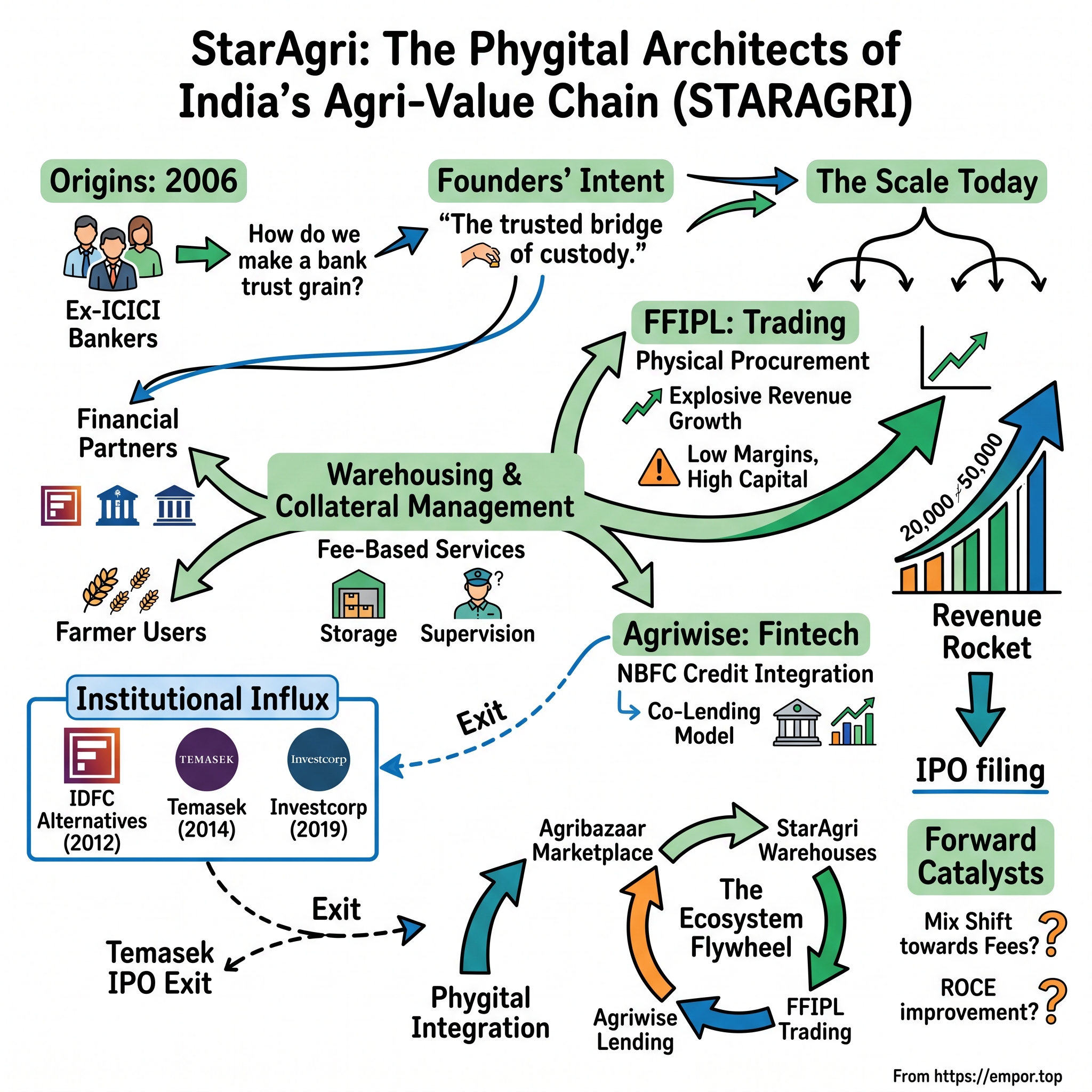
Start with the founding gesture, because it tells you what kind of company this is. In 2006, four men who worked the agricultural-lending desks of ICICI Bank in Rajasthan — Amith Agarwal, Suresh Goyal, Amit Goyal, and Amit Khandelwal — left the bank to start a warehousing company in Jaipur.4 They were not agronomists or engineers. They were credit people. They had spent their careers as channel partners for ICICI's priority-sector lending programme, which meant their job was to find rural borrowers a bank could safely lend to — and, more often, to explain to the bank why it could not.4 The problem they left to solve was not "how do we store grain." It was "how do we make a bank trust grain enough to lend against it." That distinction shaped everything StarAgri became.
The scale today is genuinely large. StarAgri operates 2,189 warehouses across roughly 379 locations in 19 states, with storage capacity above five million metric tonnes.15 In the fiscal year ended March 2024 it reported consolidated operating revenue of ₹9,892.5 million — ₹989.25 crore, about US$118 million at then-prevailing rates — up 41.8% year on year, with profit after tax of ₹46.66 crore, up 162.3%.12 In FY25 the top line grew a further 55% to roughly ₹1,560 crore, with net profit of about ₹68.5 crore, and management has publicly targeted crossing ₹2,000 crore in FY26.5 The IPO on file is a fresh issue of up to ₹450 crore plus an offer-for-sale of 2.69 crore shares.3
Those are the numbers the company leads with. The rest of this piece is about the numbers it would rather you dwelt on less. Because inside that ₹989 crore of FY24 revenue is a composition problem: the great majority of the top line comes not from warehousing or collateral management — the businesses that carry the moat — but from a physical procurement-and-trading subsidiary that buys and sells commodities at razor-thin margins and consumes working capital to do it. The warehousing and collateral businesses are the crown jewels; the trading business is the thing that makes the revenue chart look like a rocket.
This is the pattern that recurs in every asset-and-finance business that decides to integrate down its own value chain: the highest-quality revenue is small and slow, the lowest-quality revenue is large and fast, and the reported growth rate is dominated by the wrong one. A public-market investor's entire job, faced with a company like this, is to unbundle the blend and value the pieces for what they actually are — because the company, understandably, would prefer to be valued as a single, fast-growing whole. The reader should keep a running question through everything that follows: of every additional rupee of revenue StarAgri reports, how much is fee and how much is trade, and are they worth the same? They are not, and the difference is most of the analysis.
The roadmap: first the post-harvest problem and the founders' particular fitness to solve it; then the core custody-and-credit engine that is the actual business; then the institutional capital — IDFC, Temasek, Investcorp — that scaled it and then, importantly, mostly walked away before the IPO; then the segment economics and the trading-versus-services paradox; then a genuine comparison against the two companies that occupy the same seam, NCML and Arya.ag; then the fintech and marketplace extensions, Agriwise and Agribazaar; then the playbook, the valuation, and the bull-and-bear stress test a skeptical public buyer would run before writing a cheque.
 Subscribe on LinkedIn
II. The Backdrop: India's Post-Harvest Crisis & The Founders' Genesis (0:08 - 0:23)
To understand why a warehouse can be a good business, you have to understand how much value India destroys after the harvest and before the sale. The country is one of the world's largest producers of grains, pulses, oilseeds, and spices, and it loses an enormous fraction of that output in the gap between field and market — spoilage from unscientific storage, pest infestation, moisture and temperature swings, and handling losses.6 The government's own estimates of annual post-harvest losses run into the tens of thousands of crores. The physical waste is only half the damage. The other half is financial, and it has a name in rural India: distress selling.
Distress selling is the phenomenon of a farmer dumping the entire crop within days of harvest, at the exact moment when everyone else is also selling and prices are at their seasonal floor, because the farmer has no place to safely store the grain and no way to borrow against it. The crop is the farmer's only asset, and it is a perishable, illiquid one. The result is a structural transfer of value away from the producer, harvest after harvest, toward whoever has storage and cash and can wait.
The obvious fix — let farmers store the crop and borrow against it until prices recover — was blocked by a trust problem, not a physics problem. This is where the founders' banking DNA becomes the whole point. Banks in India have long been obligated to lend a mandated share of their book to agriculture under priority-sector rules; the incentive to lend to farmers is regulatory, not merely commercial. The obstacle was never willingness. It was collateral. A banker in a city branch cannot verify that a sack of wheat exists in a village three hundred kilometres away, cannot grade its quality, cannot stop the borrower from selling it out from under the loan, and cannot easily seize and auction it on default. Rural collateral was, from the bank's chair, unmonitorable and unenforceable.
The instrument meant to solve this is Warehouse Receipt Financing. The mechanics are elegant on paper: a farmer or trader deposits graded commodity in a warehouse, the warehouse issues a receipt attesting to the quantity and quality, the borrower pledges that receipt to a bank, and the bank lends a percentage of the assessed value.6 The receipt turns a pile of grain into something a banker can treat like a security. But the whole edifice rests on one assumption — that the receipt is honest, that the grain named on it really exists, in the stated quantity and quality, and will be there when the bank comes to claim it. In 2006 that assumption routinely failed. Receipts were issued by warehouses with no independent supervision, no standardized grading, and every incentive to look the other way when a depositor wanted to borrow more than the grain was worth. The receipt was only as good as the character of the warehouse keeper, and banks had learned, expensively, not to trust it.
So the founders' promise was narrow and precise, and it is worth stating in their terms: we will be the trusted bridge of custody between the farmer's crop and the bank's capital. They incorporated Star Agriwarehousing and Collateral Management Private Limited in Jaipur in April 2006, and moved the head office to Mumbai in 2009 as the bank relationships nationalized.4 The insight was not that India needed more warehouses. India had warehouses. It was that India needed a warehouse operator a bank would underwrite — one that graded scientifically, supervised honestly, insured properly, and stood behind its own receipts. The four founders had spent years on the other side of that transaction, watching banks reject perfectly good rural collateral because no credible party would vouch for it. They knew exactly what a lending officer needed to see. The business they built was, in a sense, an empathy engine for the risk committee of a commercial bank — designed from the inside out to mirror the workflows and risk tolerances of the people who would ultimately fund it.
That origin explains a durable feature of the company: its primary customer has never really been the farmer. It has been the bank. The farmer is the user; the bank is the buyer. Almost everything that follows — the certifications, the liability structure, the relationship moat, the cautious credit ratings — flows from the fact that StarAgri sells trust to lenders for a living.
It is worth pausing on the size of the opportunity, and on the discipline of not overstating it — because "India's post-harvest market is enormous" is true and almost useless as an investment fact. The broad category is genuinely vast: India produces well over 300 million tonnes of foodgrains a year plus oilseeds, pulses, and spices, and the country's scientific storage capacity has for decades lagged production, leaving a structural shortfall that the government and private operators have both tried to close. But the reachable market for a company like StarAgri is much narrower than the category, and it is bounded by three things. First, geography and crop: the warehouse-receipt-financing model works best for storable, gradable, non-perishable commodities — grains, pulses, oilseeds, spices — not for the perishables (fruit, vegetables, dairy) that make up a large share of India's agricultural value and post-harvest loss. Second, banking appetite: the addressable revenue is capped by how much banks are actually willing to lend against warehouse receipts, which is a function of their priority-sector obligations and their risk appetite, not of how much grain exists. Third, competition: StarAgri shares this reachable market with NCML, Arya.ag, and a long tail of smaller collateral managers, so its ceiling is a share of the financeable-storable-commodity market, not the whole agricultural economy. The honest framing is that StarAgri operates in a large and under-penetrated market with a long runway, but the credible reachable market — financeable, gradable commodity that banks will lend against and that StarAgri can profitably custody — is a fraction of any headline "agri-TAM," and market-share claims should be anchored to named competitors and bank budgets rather than to the size of Indian agriculture.
III. The Core Engine: Warehousing & Collateral Management (0:23 - 0:41)
The company's real product is a receipt a bank will believe, and building that product required two capabilities stacked on top of each other: scientific storage, and independent supervision. The first is the physical layer. The second is the moat.
Start with storage. StarAgri built out and took over warehouses engineered to actually preserve agricultural commodities — controlled for moisture and temperature, protected against pests, with laboratory-grade grading of what comes in and out. The company has emphasised NABL-accredited testing and standardized quality assessment as the backbone of the receipt.67 The economic claim attached to scientific storage is that it materially raises the price a farmer eventually realises, because well-stored grain both avoids spoilage losses and can be sold later in the season at higher prices rather than dumped at the harvest floor. Management has cited crop-realization improvements in the range of 10–15% from scientific storage plus deferred selling.6 That figure should be read as a directional benefit rather than an audited number — it bundles storage quality with the timing arbitrage of not selling at the bottom, and the two are hard to separate. But the direction is real and it is why farmers and traders pay to store rather than sell immediately.
The second layer is where the actual business lives: collateral management. This is the service of being the bank's eyes and hands at the warehouse. Under a collateral management agreement, StarAgri takes physical custody of pledged commodity, supervises it on the bank's behalf, issues the warehouse receipt the bank lends against, and manages the release of stock only against the bank's instructions as the loan is repaid. The company has built formal relationships with a large roster of banks and financial institutions — the outline and company materials reference agreements with more than forty lenders — and the volume of pledged commodity under its supervision is the cleanest single measure of how much the banking system trusts it.6 That number is striking: the assets under management in the collateral-management business — the value of commodity StarAgri supervises as custodian for financial institutions — rose from more than ₹10,000 crore in FY23 to more than ₹17,000 crore in FY25.2 By FY25 the company was describing warehouse-receipt-backed financing facilitated across its network in the region of ₹1.5 lakh crore cumulatively.5
Now the part the marketing does not emphasise, and the part a public-market underwriter must stare at hardest: the liability. When StarAgri issues a warehouse receipt, it is not merely offering an opinion about the grain. It assumes legal and financial responsibility for the quantity and quality of what it certified. If the grain is short, or the quality was misgraded, or — the classic failure mode — a local supervisor colluded with a depositor or trader to sign for stock that was never there or was quietly sold, the bank's recourse is not to the farmer. It is to StarAgri. The company must make the bank whole. This is the "absolute liability" character of collateral management, and it is the load-bearing wall of the entire enterprise. It is simultaneously the source of the moat and the source of the tail risk.
It is the moat because it is exactly what a software-only competitor cannot offer. Anyone can build a platform that displays a receipt; only a company willing to stand financially behind ten thousand rural warehouses, staffed by supervisors it has trained and can be sued for, can issue a receipt a bank will actually lend against at scale. That willingness to be liable is the product. But it is the tail risk because the liability is real, it is concentrated in the weakest link — a single colluding supervisor at a single remote site — and it does not scale down gracefully. A fraud at one warehouse can generate a claim, a lawsuit, and a headline. We will return to this in the bear case, because it is not hypothetical: StarAgri has been named in criminal proceedings arising from exactly this kind of dispute.8
Finally, the economics of the core, which are genuinely attractive and are the reason this company is interesting at all. Warehousing and collateral management are, at their heart, fee businesses. StarAgri charges rental for storage and supervision fees for custody, largely on a variable basis tied to the volume and tenure of stock. When the model works, it throws off cash without requiring the company to own the grain or take price risk on it. This is the "asset-light service" engine the company wants public investors to focus on — high-margin, capital-efficient, sticky, and compounding with every additional bank relationship. The problem, as the segment analysis will show, is that this beautiful engine is only a minority of the reported revenue. The majority comes from somewhere much less beautiful.
It helps to think about the unit of the business, because it clarifies what kind of company this is and how its revenue behaves. The natural unit is not a "customer" in the SaaS sense; it is a warehouse-tonne-season — a tonne of graded commodity, stored for a storage cycle, generating a rental-and-supervision fee, and potentially generating a second layer of value when that same tonne is pledged and financed. Across a network above five million tonnes of capacity running at roughly 73% utilisation in FY25, that is a large, granular, and diversified base of small recurring fees rather than a handful of big contracts.5 The revenue from the fee businesses is best understood as repeating-transactional: it is not contracted subscription revenue with multi-year lock-in, and volumes rise and fall with each harvest and with commodity prices, so it carries seasonality and cyclicality. But it is sticky in the way that matters — the bank relationships and the depositor relationships recur season after season, and the switching cost for a bank to move its collateral manager mid-cycle is high. This is a crucial distinction for revenue quality: the warehousing and collateral fees are durable and recurring even though they are not contractually locked, whereas the trading revenue that dominates the top line is genuinely transactional — each buy-sell is a discrete event with no annuity behind it. When a public buyer asks "how much of StarAgri's revenue would still be here next year if growth stopped," the answer is "most of the fee revenue, and much less of the trading revenue," and that is a more useful question than the headline growth rate.
IV. Institutional Influx: Private Equity Backing & Capital Allocation (0:41 - 0:56)
A company that sells trust to banks has to look, itself, like something a bank would trust — which in practice meant bringing in blue-chip institutional capital that vouched for the balance sheet. StarAgri's cap-table history is a clean three-act story of institutional money flowing in, scaling the business, and — this is the part the outline understated and a buyer must get right — flowing back out well before the IPO.
Act one, 2012: IDFC Alternatives, the private-equity and infrastructure arm of India's IDFC, invested ₹150 crore.9 This was the transition from a regional north-Indian operator into something with national ambitions and an institutional governance overlay. IDFC was an infrastructure investor, and it treated the warehouse network as infrastructure — long-duration, asset-backed, cash-generative.
Act two, 2014: Temasek, the Singapore state investment company, deployed roughly ₹250 crore — about US$50 million — through Claymore Investments (Mauritius) Pte. Ltd., taking approximately a 27% stake.10 This was Temasek's maiden bet in Indian agri-logistics, and at the time it was among the largest single institutional commitments the sector had seen.10 Temasek's involvement matters for two reasons beyond the money. First, it is a validation signal that has value in itself when your customers are risk committees — being "Temasek-backed" is a line StarAgri has used in its own positioning for a decade.11 Second, Temasek is a sophisticated, patient, but ultimately return-seeking owner, and its behaviour at the IPO — partially exiting — is a data point about how a long-horizon insider views the price, which we should weigh rather than ignore.
Act three, 2019: Investcorp, the Bahrain-based alternative-asset manager, acquired IDFC Alternatives' entire private-equity and infrastructure business, and with it inherited the StarAgri position.12 For a period the register therefore read: founders, Temasek via Claymore, and Investcorp as the successor to IDFC.
Here is the correction that changes the underwriting. By the time StarAgri filed its DRHP in December 2024, the register no longer looked like that. The draft prospectus disclosures reported to the market show promoters holding 88.17% and Claymore/Temasek holding 11.83% — and nothing else of size.313 The IDFC-then-Investcorp financial-investor stake is simply gone; Investcorp is reported to have exited the position by around 2022.12 This matters for three reasons. First, it means the frequently repeated framing of "founders retaining ~55% with large financial investors alongside them" is out of date: on the DRHP figures the founders and their entities control roughly seven-eighths of the company outright, which is a very high level of promoter concentration for a company about to sell to the public. Second, it means the pre-IPO institutional discipline that IDFC and Investcorp imposed is no longer on the register — the remaining outside shareholder, Temasek, is heading for the exit rather than staying to govern. Third, it reframes the OFS: of the 2.69 crore shares being sold, Claymore is offering 1.19 crore and the promoters 1.50 crore, so both the last big institutional holder and the controlling family are taking cash off the table in the same transaction.3 None of that is disqualifying, but it is the opposite of the "aligned promoter, patient institutional co-owner" picture and a public buyer should price it as such.
What did the founders build with two decades of institutional capital? Two adjacent businesses that turned StarAgri from a warehousing company into a value-chain conglomerate — and, in doing so, created the revenue-composition problem at the centre of this story.
The first is Farmers Fortune (India) Private Limited (FFIPL), the direct-procurement and corporate-supply-chain arm. FFIPL buys agricultural commodities — from farmers, mandis, and aggregators — and sells them onward to corporate buyers, food processors, and exporters. Physically, it feeds StarAgri's own warehouses and creates captive volume. Financially, it is a buy-sell trading operation, and its revenue grew explosively: from roughly ₹190 crore in FY22 to about ₹462 crore in FY23, and it became the single largest line in the consolidated accounts thereafter.2 The strategic logic — "capture more of the value chain, create stickiness, utilise our own storage" — is coherent. The financial consequence — a huge, low-margin, working-capital-hungry top line that dominates and arguably distorts the group's economics — is the thing bears will attack.
The second is Agriwise Finserv Limited (AFL), an in-house agri-focused non-banking financial company. Having spent years helping banks lend against warehouse receipts, the founders reasoned they could lend directly and keep the spread. AFL is the vertical-integration bet on the credit side, just as FFIPL is the bet on the physical side. It is a smaller business than either warehousing or FFIPL, but it is the strategically most interesting and, as the fintech section will show, the one carrying the clearest early-warning signs on asset quality.
There is a way to judge the founders here beyond the strategy on paper, which is to look at how they have behaved as allocators over two decades. The favourable evidence: they built a genuinely large, profitable, investment-grade business from a standing start in 2006, attracted and retained blue-chip capital, survived multiple agricultural downcycles without blowing up, and executed a real structural improvement — the asset-light pivot — that shows a willingness to change the cost base when the cycle demanded it. That is a track record of durability, which in Indian agri-business is not to be taken for granted; many of their contemporaries did not survive.
The less favourable evidence is subtler and is about discipline. The decision to scale FFIPL's trading revenue so aggressively looks, from the outside, like a choice to optimise for headline size — the ₹1,000-crore-and-beyond revenue milestone that gets a company into the newspapers and onto IPO roadshows — at some cost to the quality of the composite business. A management team focused purely on per-share intrinsic value might have grown the trading book more slowly and the fee book faster. The fact that the founders are also selling ₹1.50 crore shares' worth in the OFS, alongside the last institutional holder, is a governance data point rather than a red flag — founders taking some liquidity after twenty years is normal — but it belongs in the ledger of how aligned the controllers are with the public shareholders who will buy at the listing price.3
The capital-allocation verdict, held provisionally: the founders took infrastructure and validation capital raised for a custody business and reinvested it into trading (FFIPL) and lending (AFL). Both moves increase the surface area of the business and both consume capital and risk in ways the core fee business does not. Whether that was value-creating or value-diluting is precisely the question the segment economics have to answer.
V. The Revenue Paradox: Dissecting the Segment Economics (0:56 - 1:13)
Here is the single most important thing to understand about StarAgri as a public-market prospect, and it is a compositional fact hiding inside a growth story. The FY24 consolidated numbers are, on their face, excellent: operating revenue of ₹989.25 crore, up 41.82%, and profit after tax of ₹46.66 crore, up 162.30%, at a PAT margin of about 4.7%, with reported return on equity of 10.81%, return on capital employed of 12.43%, and a debt-to-equity ratio of 0.83.12 A company growing 42% and more than doubling profit looks, at a glance, like a platform. The question is what is actually driving the top line.
The answer is trading. On the consolidated FY24 mix as characterised in the offering materials and reporting, the procurement-and-trade-facilitation business — FFIPL — accounts for roughly 71.6% of operations, on the order of ₹7,080 million (₹708 crore). Warehousing services contribute roughly 16%, around ₹1,580 million (₹158 crore). Collateral management contributes roughly 6.3%, around ₹628 million (₹63 crore). The remainder is allied services.2 (One caveat on precision: different StarAgri materials describe the mix differently — some management commentary has framed warehousing as around half of revenue on a narrower, standalone basis, which is not the same universe as the consolidated split above.6 The exact segment percentages are a first-order diligence item for the final prospectus. But the shape is not in dispute: physical procurement dominates the consolidated top line, and the fee businesses, which carry the moat, are the minority.)
Why does this shape matter so much? Because the three segments have almost nothing in common economically, and blending them into one revenue number and one P/E multiple obscures more than it reveals.
Collateral management is the best business StarAgri has. It is a fee for supervision and custody; it requires little capital; it is sticky because banks do not casually change the custodian who stands behind years of live loans; and it scales with the trust the company has already accumulated. Its ₹63 crore of FY24 revenue is small, but it is the highest-quality revenue in the group and the truest expression of the moat.
Warehousing is the second-best business. It is a rental-and-service fee, variable in cost, and — critically — increasingly asset-light, as discussed below. Its ₹158 crore is real, recurring, and defensible.
Procurement — the ₹708 crore, the thing making the growth chart soar — is the worst business in the group by every measure that a long-term investor cares about, even though it is the biggest. It is buy-sell commodity trading. Gross margins on physical agri-trading are wafer-thin, measured in low single-digit percentages, because you are essentially a spread operator moving fungible commodities between a purchase price and a sale price. It is working-capital intensive: to run ₹708 crore of trading you have to fund inventory and receivables, which is why the group carries the debt it does. And it is inherently low-return-on-capital, because every additional rupee of trading revenue requires roughly proportional additional working capital, unlike the fee businesses where an additional bank relationship costs almost nothing to serve. Trading revenue is not worth the same as fee revenue, and no honest valuation treats it as if it were.
This is why the "phygital platform" framing deserves scrutiny. A platform earns high-margin, recurring, capital-light revenue and is valued as a multiple of that revenue's durability. A trading house earns low-margin, transactional, capital-heavy revenue and is valued as a low multiple of book value or earnings. StarAgri is a weighted average of both, and the weighting is roughly three-quarters trading by revenue. The genuine risk for public shareholders is not that the business is bad — it is profitable and growing — but that the company will present itself as the platform while the revenue statement is dominated by the trading house, and that the market, once it does the segment arithmetic, will price the blend closer to the trading house than to the platform. Top-line growth of 42% is far less impressive when most of it is low-margin trading volume that any competitor with a balance sheet can also buy.
There is, in fairness, a genuine strategic argument in the company's favour, and it deserves airtime. The procurement business is not purely a margin story; it is partly a utilisation and stickiness story. FFIPL's purchases flow into StarAgri's own warehouses, driving occupancy of assets that would otherwise sit idle in the off-season, and the relationships FFIPL builds with corporate buyers deepen the value chain the company sits inside. If the trading business is the loss-leader that keeps the high-margin storage assets full and the ecosystem sticky, then a low-margin ₹708 crore that supports a high-margin ₹220 crore of fees could be rational. The honest reading is that this is a plausible defence that the disclosed data cannot yet confirm — because the company has not published the cross-segment contribution economics that would prove the trading volume actually lifts warehousing utilisation and fee capture. A public buyer should demand that proof in the prospectus rather than accept the narrative.
This is also where the path to durable profitability — as opposed to reported profitability — has to be examined, because StarAgri is already profitable and that fact can lull a buyer into skipping the harder question. StarAgri does report real net profit (₹46.66 crore in FY24, ₹68.5 crore in FY25), and there is no evidence of the "adjusted-EBITDA-only" theatre common to loss-making startups.15 But the reported EBITDA margin of about 8.7% and PAT margin of about 4.7% are consolidated blends, and they are structurally capped by the trading mix: as long as three-quarters of revenue is sub-5%-margin procurement, the group margin cannot rise much without the mix shifting toward fees.2 The genuine test of durable profitability is therefore not "is it profitable" but "does free cash flow grow faster than revenue" — and here the working-capital dynamic is the crux. A trading business that grows 40% a year has to fund 40% more inventory and receivables, which absorbs operating cash exactly when the income statement looks best; this is why the group carries roughly 0.8x debt-to-equity, most of it working-capital financing, and why interest cost is a real drag on the bottom line.2 The ₹450 crore fresh issue is, in large part, a working-capital top-up for precisely this reason: ₹120 crore for StarAgri and ₹125 crore for FFIPL.3 That is a rational use of primary proceeds, but a buyer should read it clearly — the equity is partly being raised to feed the working-capital appetite of the low-return trading engine, not only to compound the high-return fee engine. The falsification test for the profitability thesis is simple to state: over the next few years, does return on capital employed climb (which would prove the asset-light fee mix is winning) or stay stuck in the low teens (which would prove the trading engine's capital hunger is offsetting the fee engine's quality)? FY24 ROCE of 12.43% is a decent starting point but not yet proof.2
The one clearly positive operational development in the segment story is the asset-light pivot in warehousing. StarAgri has been deliberately shifting from fixed long-term leases toward revenue-sharing arrangements with local warehouse owners, in which the owner supplies the physical building and StarAgri supplies the certification, supervision, bank relationships, and receipts — and the two share the revenue. The population of warehouse owners on lease-or-revenue-share arrangements grew from 703 in FY23 to 1,057 in FY25, roughly a 50% increase, and the large majority of the network now operates on lease or revenue-share rather than owned assets.5 The financial logic is defensive and sound: in an agricultural downcycle, when storage volumes and fees fall, a revenue-share cost base falls with them, whereas a fixed-lease cost base does not. Converting a fixed cost into a variable one protects margins through the cycle. This is the structural change most responsible for StarAgri's improving credit profile and its ability to grow the network without proportional capital, and it is the strongest single piece of evidence that the "asset-light" claim is more than rhetoric — at least on the storage side. The company's investment-grade ratings from CARE, and the ratings relationship it maintains with India Ratings and Research, sit on top of this improving cost structure.714
VI. Competitor Shootout: StarAgri vs. NCML vs. Arya.ag (1:13 - 1:30)
The cleanest way to test whether StarAgri's strategy is smart or merely large is to look at the two companies that occupy the same seam of the Indian economy and have chosen deliberately different paths through it. Both are direct operating peers — same customer type (banks and agri-supply chains), same geography, same fundamental problem of post-harvest custody and finance — and both have made a strategic choice StarAgri did not. That makes them the right comparison set, more instructive than any offshore agri-tech "category leader," because they reveal what the same problem looks like when you weight the trade-offs differently.
NCML — National Commodities Management Services (formerly National Collateral Management Services) — is the Goliath, and it is instructive precisely because it went the opposite way. NCML is controlled by Prem Watsa's Fairfax India Holdings, which owns roughly 91% of the equity, giving it deep, patient, permanent capital and a "buy quality infrastructure and hold forever" philosophy.15 Under Fairfax, NCML made a decision StarAgri did not: it exited the low-margin businesses. It stepped back from collateral management and physical trading and redeployed into heavy, durable capital expenditure — steel silos, NABL laboratories, testing infrastructure, and weather-intelligence and analytics capabilities.15 The result is a smaller but far more stable revenue base — NCML's revenues for the twelve months to December 2023 were around US$33 million (roughly ₹268 crore consolidated in the FY23 accounts) — built on owned, defensible physical assets rather than trading turnover.15 NCML chose margin and asset durability over top-line scale. StarAgri chose top-line scale — via FFIPL trading — over margin purity. A public investor is entitled to ask which philosophy the market rewards, and the honest answer is that permanent-capital owners like Fairfax can afford to optimise for slow, high-quality compounding in a way that IPO-stage founders selling into public demand often cannot.
Arya.ag is the tech-native pure-play, and it is arguably the more dangerous comparison for StarAgri's valuation narrative — because Arya.ag makes the "phygital platform" claim more credibly. In FY24 Arya.ag reported operating revenue of about ₹340 crore, up 18%, and net profit of about ₹19 crore, up roughly 2.5x.16 The critical difference is composition. Arya.ag deliberately minimised low-margin physical trading and drove the majority of its revenue — reported at around 62% — from asset-light storage and fintech interest income, i.e. from the high-quality parts of the value chain that StarAgri earns but dilutes with trading.16 Put the two side by side and the contrast is sharp: Arya.ag earns roughly a third of StarAgri's FY24 revenue but a comparable slice of net profit, because its revenue mix is weighted toward exactly the segments a platform investor wants. On a "quality of revenue" basis, Arya.ag arguably looks more like the platform StarAgri says it is.
There is a second-order point in the Arya.ag comparison that public buyers should not miss: the two companies are converging on the same end-state from opposite directions. Arya.ag started tech-native and asset-light and is adding physical depth; StarAgri started physical-and-liability-heavy and is adding digital and financial layers. Whoever ends up with the better blend — enough physical presence to be trusted by banks, enough asset-lightness to earn high returns on capital, and enough software to lower the cost of trust — wins the category. On the current evidence, Arya.ag looks closer to that blend on a revenue-quality basis while StarAgri is far ahead on physical scale and bank penetration. The prize is the same; the question is which starting point is easier to finish from, and that is genuinely unresolved.
Where does that leave StarAgri's positioning? Management's framing is that it is the "full-stack phygital aggregator" — the only one of the three that operates the entire chain end to end: physical procurement (FFIPL) feeding physical storage, storage generating collateral receipts, receipts feeding both bank lending and its own NBFC (Agriwise), and the whole thing settling on a digital marketplace (Agribazaar).
The bull reading is that this integration creates a flywheel and customer stickiness no single-segment player can match — a farmer or trader who procures, stores, finances, and sells through one ecosystem is expensive to pry loose. The bear reading is that "full-stack" is a euphemism for "conglomerate," that each additional segment dilutes returns on capital and adds a discrete risk (trading margin, credit risk, fraud liability), and that the market will apply a conglomerate discount rather than a platform premium. The competitor shootout does not settle the argument, but it clarifies the stakes: NCML proves you can earn better margins by doing less, and Arya.ag proves you can tell the platform story more cleanly by trading less. StarAgri has chosen to do more, and it must now convince public investors that more is worth more — not merely bigger.
VII. The Ecosystem Extension: Agriwise Finserv & Agribazaar (1:30 - 1:42)
The two ecosystem extensions are where StarAgri's ambition to be more than a warehouse operator becomes concrete — and where the risk profile shifts from operational to financial.
Agriwise Finserv Limited (AFL) is the specialised agri-finance NBFC, and it is the vertical-integration bet on credit. The logic is intuitive: StarAgri already knows which farmers and traders have graded, stored, insured commodity in its warehouses — it is the collateral manager — so it is unusually well positioned to lend against that collateral itself and keep the spread instead of handing the loan to a bank. AFL's assets under management reached roughly ₹299 crore at the end of FY24 and, per the outline, around ₹358 crore by June 2025, on a tangible net worth of around ₹173 crore at FY24 (the outline cites a higher figure closer to ₹183 crore for a later date).17 It is a young, sub-scale lender, and its economics are still forming: after an operating loss in FY23 it turned a modest pre-provision operating profit of about ₹4.4 crore in FY24, indicating the business had only just begun to cover its own cost base.17
Two structural features of AFL matter for the underwriting. The first is the deliberate shift to a co-lending model, in which AFL originates and services loans but funds a large share of them jointly with banks, keeping only a slice on its own balance sheet. The outline reports co-lending rising to around 41% of AUM in 2025 from about 24% in 2023.17 This is the sensible way for a small NBFC to grow: it leverages banks' cheaper, larger balance sheets, limits AFL's own capital consumption, and lets it maintain a stronger capital-adequacy profile than balance-sheet lending would allow. It is, in effect, AFL applying to its own lending the same "asset-light, use someone else's balance sheet" logic that StarAgri applied to warehousing.
The second feature is the warning sign, and it must not be waved away: asset quality is deteriorating as the book seasons. Gross non-performing assets rose to 4.07% at the end of FY24, from 2.84% a year earlier, with net NPAs at 2.06%.17 A gross NPA above 4% on a young, fast-growing loan book is a meaningful number. It tells you that a non-trivial share of loans made in the earlier, smaller book have already gone bad, and rising NPAs in a growing book are especially concerning because the growth denominator normally flatters the ratio — the bad loans are surfacing faster than the fresh lending can dilute them. AFL's ratings sit in the BBB- band accordingly.18
The cause is the intrinsic cyclicality of agricultural credit: repayment depends on the monsoon, on crop prices, and on the ever-present political risk of farm-loan waivers, which can render even well-underwritten agri-loans uncollectible overnight when a state government promises to forgive them. Compounding this, a large share of AFL's portfolio — the outline cites around 67% — is in Loans Against Property (LAP) rather than pure commodity-backed lending. That changes the risk profile from "secured by liquid, graded, insured commodity in our own warehouse" to "secured by rural real estate that is slow and contentious to enforce," which is a materially weaker collateral position and a slower recovery when things go wrong. An NBFC concentrated in agricultural LAP is exposed to exactly the weather-and-politics tail that the parent's warehousing business was designed to hedge. There is an irony worth naming: the group's most sophisticated financial expression of its expertise — lending directly against the commodity it custodies — has drifted into property lending that has little to do with the warehouse moat. AFL is the highest-beta piece of the StarAgri story, and a chunk of the ₹450 crore fresh issue is explicitly earmarked to strengthen it.
Agribazaar is the digital layer — an e-marketplace operated under common promoters that functions as the trading floor of the ecosystem. The design is neat: buyers and sellers discover prices and settle transactions digitally on Agribazaar, while the physical settlement — the actual grain changing hands, graded and custodied — happens inside StarAgri's warehouses.5 By FY25 the platform was reporting cumulative trade volumes above 12 million metric tonnes with transaction value over US$1 billion, and connections to hundreds of thousands of farmers.5 This is the piece that most justifies the "phygital" branding, because it is the genuine digital-plus-physical loop: a trade that clears in software and settles in a warehouse.
But two cautions apply. First, Agribazaar is described as a sister company under common promoters, not necessarily a consolidated subsidiary — which raises the related-party question of how value, and cost, are shared between StarAgri and an entity the same family controls. Cross-entity arrangements between a listed company and an unlisted promoter affiliate are a standard governance flag, and the terms will need to be transparent in the final prospectus. Second, a marketplace's trade-volume statistics are a vanity metric until you can see the take rate and the contribution margin — twelve million tonnes and a billion dollars of GMV tell you the pipe is full, not that the pipe is profitable. The economically meaningful questions — what does Agribazaar earn per tonne, and does that revenue accrue to public shareholders or to the promoter-owned entity — are diligence items, not settled facts.
VIII. Playbook: Business & Investing Lessons (1:42 - 1:53)
Step back from the numbers and ask what kind of advantage StarAgri actually has, using Hamilton Helmer's framework of durable "powers" — because the answer determines whether the moat is real or rhetorical.
The strongest claim is Process Power. This is the power that comes from an organisation's ability to do something complex and specific that competitors cannot easily copy even if they know exactly how it is done, because the capability is embedded in thousands of coordinated human routines. StarAgri's process power is the unglamorous, standardised training and supervision of a rural workforce that physically audits, samples, grades, and guards commodity across two thousand warehouses in nineteen states. A software company can build a receipt-issuing app in a quarter; it cannot, in a quarter, build a trained, supervised, honest, and insurable field force spread across rural India. That takes years and a tolerance for the tail risk of the whole thing. This is genuine, and it is the most defensible thing about the business. The caveat is that process power in a fraud-exposed business is only as strong as its weakest node — the same distributed human network that constitutes the moat also constitutes the liability surface, and the two cannot be separated.
The second claim is a Cornered Resource in the form of the founders' banking relationships. Because the four founders came from ICICI's rural-lending desks, they built the company to speak the language of bank risk committees, and they accumulated, over two decades, institutional trust that is hard to replicate. Banks do not casually swap collateral managers — the switching cost is high because a custodian sits inside live loan relationships and years of operational history. This is real, but it is worth being precise about its nature: it is a relationship and switching-cost advantage, not a legal monopoly. Competitors like NCML and Arya.ag have their own bank relationships. The moat is that StarAgri's are deep and sticky, not that they are exclusive.
The third lesson is a warning, not a power: the danger of top-line bloat through vertical integration. The FFIPL story is the cautionary tale. Integrating downstream into physical trading captured more of the value chain, but it did so by loading the income statement with low-margin, capital-hungry revenue that dilutes group returns on capital and — crucially for an IPO — invites a valuation multiple built on the blended, trading-heavy business rather than the pristine fee business. There is a general principle here for founders building in emerging markets: revenue you add by owning more of the physical chain is not automatically value you add, and it can actively destroy value if it drags your multiple down faster than it grows your profit. "Capture more of the value chain" is a strategy that sounds like discipline and can be its opposite.
The fourth lesson is the genuinely replicable one: converting fixed assets into variable cost. The shift from owned and long-leased warehouses to revenue-sharing arrangements is a clean piece of financial engineering with real operational logic. It lets the company grow its network footprint without growing its capital base, and it makes the cost structure breathe with the agricultural cycle — when storage volumes fall in a bad year, so does the cost of the space. It is the single move most responsible for the improving credit profile, and it is a blueprint any asset-heavy business in a cyclical, capital-scarce market should study.
There is a fifth lesson, implicit in the whole story, that is really a lesson about narrative discipline for founders approaching public markets. StarAgri has for years described itself in the vocabulary of technology — "phygital," "platform," "data-driven," "agritech" — and that vocabulary is not wrong, but it is aspirational relative to a revenue statement that is three-quarters physical trading. The gap between how a company describes itself and what its numbers actually say is one of the most reliable predictors of post-IPO disappointment, because the market eventually reprices to the numbers regardless of the language. The disciplined version of StarAgri's story is more modest and more durable: a trusted rural-custody-and-finance business with a growing digital layer and a large, lower-quality trading operation attached. Founders who let the market discover that gap on its own, quarter by quarter, tend to fare worse than those who set expectations to the numbers from the start. Which version StarAgri tells on its roadshow will tell a public buyer something about how the relationship will go.
IX. Analysis & Bull vs. Bear Case: The Activist Stress Test (1:53 - 2:06)
Now the hard part: what is this company worth, and what would a skeptical public buyer have to believe to pay it? Take the bull case, the bear case, and then the valuation honestly.
The bull case
The bull case is that StarAgri is a rare thing — a profitable, growing, real-asset-backed piece of Indian rural infrastructure with a genuine moat and multiple ways to compound. The physical network is large and hard to replicate: 2,189 warehouses across nineteen states, wired into forty-plus banks, supervising over ₹17,000 crore of pledged commodity.12 The moat is process power plus relationship stickiness that pure-tech entrants cannot easily buy. Growth is fast and, unusually for Indian infrastructure, profitable — 42% revenue growth and a 162% profit jump in FY24, followed by another 55% top-line year in FY25 to roughly ₹1,560 crore with profit near ₹68 crore.15 The asset-light pivot is protecting margins through the cycle and improving the credit profile. The ecosystem — trading (FFIPL), lending (Agriwise), and marketplace (Agribazaar) — gives it optionality and stickiness that a single-segment competitor lacks. Promoter alignment is high, with the founders controlling roughly 88% and having personally navigated multiple agricultural cycles since 2006.3 And the ₹450 crore fresh issue would recapitalise the working-capital-hungry parts of the group — ₹120 crore for StarAgri's own working capital and ₹125 crore for FFIPL's — reducing consolidated interest costs and strengthening the base from which the fee businesses compound.3
The bear case
The bear case is the activist's, and it is a stress test in three parts.
First, operational fraud risk is structural, not incidental. The absolute-liability model means a single colluding supervisor at a single remote warehouse can generate a real financial claim and a real lawsuit — and StarAgri has in fact been named in criminal proceedings arising from warehouse-receipt and lending disputes. The company was a party to proceedings before the Madurai bench of the Madras High Court, decided in November 2024, connected to a bank matter (involving the erstwhile Lakshmi Vilas Bank) and the CBI's economic-offences wing.8 The specifics of any individual case matter less than the category: a business whose core product is being financially liable for grain it certified will, at scale, periodically be defrauded by its own weakest node, and each instance is a potential headline, provision, and blow to the bank trust that is the entire franchise. This is a permanent operating-cost-of-doing-business, and it does not go away with size — arguably it grows with it.
Second, valuation-multiple compression from the trading-house problem. As the segment analysis established, roughly 72% of FY24 consolidated revenue is low-margin physical procurement, not high-margin fees.2 Public markets are sophisticated about this; they will look through the "phygital platform" branding to the revenue statement and are likely to apply a trading/conglomerate discount rather than a platform premium. The company earns a genuine platform's revenue only in the ~22% slice that is warehousing and collateral management; the rest is priced like what it is. An investor paying a platform multiple on the whole is over-paying, and the market will probably not make that mistake — which means the pricing gravity is downward relative to how the company will present itself.
Third, Agriwise asset quality and agri-credit cyclicality. A gross NPA of 4.07% and rising, on a young book concentrated 67% in rural LAP, is a live warning that the group's lending arm is exposed to the exact monsoon-and-politics tail — crop failure, price collapse, farm-loan waivers — that the warehousing business exists to hedge.17 The fresh issue is partly there to shore this up, which is itself a tell: capital is being raised in part to fund the weakest, most cyclical piece of the enterprise.
The competitive structure: a Five Forces read
Porter's framework is useful here precisely because it exposes where StarAgri's economics are strong and where they are structurally squeezed. Rivalry is moderate-to-high in the fee businesses: NCML, Arya.ag, and a long tail of regional collateral managers compete for the same bank relationships, and rivalry is intense-and-margin-destroying in trading, where FFIPL competes with every trader and aggregator who can fund inventory. Buyer power is the decisive force, and it cuts against StarAgri: the buyers of the high-value service are banks — large, sophisticated, price-sensitive counterparties who set the terms of collateral-management mandates and can, in principle, move them. The offsetting factor is switching cost, which converts that buyer power into stickiness once a mandate is won, but it does not eliminate the banks' pricing leverage. Supplier power is low and getting lower, which is the good news embedded in the asset-light pivot: the "suppliers" of physical warehouse space are thousands of small local owners with little individual leverage, which is exactly why StarAgri can push them onto revenue-share terms. Threat of substitutes is real but slow: government warehousing (the Food Corporation of India, the Central and State Warehousing Corporations), the Warehousing Development and Regulatory Authority's push toward negotiable electronic warehouse receipts, and banks building in-house monitoring all nibble at the edges of the private collateral-management model, and a fully digitised, regulator-backed electronic-receipt system could over time reduce the premium on any single private guarantor. Threat of new entrants is low in the physical-and-liability layer (hard to build a trained, insurable field force) but high in the software-and-marketplace layer (Arya.ag exists because that layer is contestable). The net Five Forces read is a business with a defensible core hemmed in by powerful bank-buyers on one side and a low-margin, low-barrier trading operation on the other — which is, once again, the same platform-versus-trading-house tension in a different vocabulary.
A scenario-based intrinsic value frame
With no price band published, the responsible move is to reason about intrinsic value as a set of scenarios keyed to the variables that actually drive it — revenue mix, fee-segment margin, NBFC credit costs, working-capital intensity, and the multiple the market assigns to each piece — and to treat the output as a wide range, not a number. Three sketches, all built on the disclosed FY24–FY25 operating base and none of them a target:
In a bear scenario, the mix stays trading-heavy, fee growth is modest, Agriwise's NPAs keep rising and force higher provisions, working capital keeps absorbing cash, and the market prices the whole group like the commodity trader that most of its revenue represents — a low single-digit-to-high-single-digit earnings multiple on a blended profit that itself is squeezed by credit costs and interest. In this world the enterprise is worth a modest multiple of book and the "platform" narrative is repudiated.
In a base scenario, the fee businesses (warehousing plus collateral management) keep compounding in the mid-teens or better, the asset-light pivot lifts ROCE toward the mid-teens, Agriwise stabilises its asset quality around current levels, and the market values the group on a sum-of-the-parts: a quality infrastructure-services multiple on the ~₹220 crore fee stream, a trader's multiple on FFIPL, and a modest premium-to-book on a stabilising Agriwise. This blend lands materially above the bear case but well below a clean "platform multiple on all profit."
In a bull scenario, the mix shifts decisively toward fees and marketplace take-rate income (Agribazaar monetising its GMV), Agriwise's co-lending model scales asset-light with improving credit metrics, working-capital intensity falls as trading becomes proportionally smaller, ROCE moves into the high teens, and the market — helped by IPO scarcity and the Temasek-backed narrative — is willing to pay a genuine platform premium on a demonstrably higher-quality earnings stream.
The spread between these three is enormous, and that spread is the honest answer: the intrinsic value of StarAgri is unusually sensitive to a single variable — whether the revenue mix moves toward fees or stays anchored in trading — and no amount of DCF precision can substitute for watching which way that mix actually moves post-listing. The key sensitivities, in order, are: fee-segment revenue growth versus trading growth; Agriwise credit cost; working-capital-to-revenue; and the cost of capital, which for a cyclical Indian agri-business with a fraud-liability tail is not low.
Public-market readiness: the diligence gaps
Several governance and disclosure items are not yet public and should be flagged as diligence questions for the final prospectus rather than assumed away. StarAgri will list with very high promoter concentration — roughly 88% on the DRHP figures — which means, for years, public shareholders will be minority holders in a founder-controlled company, and the usual protections (board independence, related-party controls, minority-protection provisions) will matter more than usual.3 The related-party question is live and specific: Agribazaar is described as a sister entity under common promoter control, and the terms on which value and cost flow between the listed company and that affiliate are exactly the kind of arrangement a public buyer must see in full.5 The founders and Temasek are both selling in the OFS, so insider selling at the listing is a fact, not a hypothetical — the relevant diligence is the size of what remains locked up and the promoters' stated intentions thereafter.3 Board composition, independent-director strength, executive compensation, and any promoter guarantees or loans to group entities are not yet in the public record; their absence from public view is not evidence of their soundness, and each is a prospectus-stage item. And the historical litigation around warehouse-receipt disputes belongs in the risk-factor section of any final filing — a mature disclosure will quantify the contingent liabilities, not merely narrate them.8
The post-listing test
Finally, build the reckoning into the story. Three KPIs will most directly confirm or falsify this underwriting after listing, and they are the numbers to watch each results season: (1) the revenue-mix trend — fee-and-marketplace revenue growth versus FFIPL trading growth, because the entire platform-versus-trading-house verdict rides on it; (2) Agriwise gross NPA and credit cost, because that is where the group's cyclicality will surface first and most violently; and (3) return on capital employed, the single cleanest summary of whether the asset-light strategy is actually creating value or merely turnover. The catalysts that could force the market's profitability reckoning are identifiable in advance: a poor monsoon or a state farm-loan waiver hitting Agriwise; a large warehouse-fraud claim crystallising; a commodity-price swing compressing FFIPL's already-thin trading spreads; or, on the upside, a demonstrable step-up in Agribazaar's monetisation that would validate the platform thesis. A share price can and will move on IPO mood, scarcity, and momentum in the quarters after listing regardless of any of this — but those forces are sentiment, and these three KPIs are the business, and over time the second wins.
Price is not value: the valuation problem
Now the discipline the instructions demand, and it is the most important paragraph for a public buyer. StarAgri's IPO valuation cannot currently be calculated, and anyone quoting a market cap is guessing. The DRHP structure discloses a fresh issue in rupees (up to ₹450 crore) and an offer-for-sale in share count (2.69 crore shares), but no price band, no total post-issue share count, and no fully diluted cap table have been published — because those come at the RHP stage, which has not arrived.3 You cannot multiply a share count you do not have by a price that does not exist. Any "implied valuation" circulating before the price band is a back-of-envelope extrapolation, not a fact, and this piece will not manufacture one.
What can be done is to bound the intrinsic value from the disclosed operating evidence, as a range with explicit sensitivities rather than a target. The honest inputs: FY24 consolidated PAT of ₹46.66 crore and FY25 PAT of about ₹68.5 crore, growing fast but off a small base and heavily dependent on trading volume; a low-quality revenue mix that deserves a below-market multiple on the trading portion and an above-market multiple only on the ~₹220 crore fee portion; a young NBFC that should be valued on book and asset quality, not earnings; and a working-capital-intensive balance sheet that consumes cash as it grows. A defensible way to think about it is sum-of-the-parts: value the collateral-management and warehousing fee streams as a quality infrastructure-services business (a mid-to-high-teens earnings multiple is arguable given growth and stickiness); value FFIPL's trading as a commodity trader (a low single-digit-to-high-single-digit earnings multiple, or a modest premium to the working capital it ties up); and value Agriwise on a modest multiple of tangible book, haircut for the rising NPAs. The sum of those pieces, on FY25 numbers, lands well below where a naïve "₹68 crore of profit × a platform multiple" calculation would put it — and the gap between those two answers is exactly the trading-house discount the bear case predicts.
On the enterprise-value question, the bridge is only partly buildable: the group carries debt (a reported FY24 net debt-to-equity around 0.83, largely working-capital financing for the trading book), and the ₹450 crore fresh issue would add primary cash and reduce leverage — but without the full balance sheet, cash position, and lease liabilities from the prospectus, a precise enterprise value cannot be struck, and an EV multiple should not be compared against the equity multiples of peers.2 The comparable set reinforces the caution rather than resolving it: NCML is a private, Fairfax-controlled, lower-revenue but higher-quality peer that the market cannot directly price; Arya.ag is private and earns a cleaner mix at a third of the revenue. Neither hands you a clean listed multiple to stamp on StarAgri, and the nearest listed reference points — Indian agri-logistics and warehousing names, and diversified commodity traders — bracket a wide range precisely because the business straddles two archetypes.
What the prospective price will embed, and where the market may deviate
When the price band arrives, it will embed a set of assumptions a buyer should name out loud: continued 40%-plus revenue growth (which requires the low-margin trading engine to keep expanding, consuming working capital), stable-to-improving fee-segment margins, Agriwise asset quality stabilising rather than deteriorating further, and no large fraud claim crystallising. The market may well price above a sober central range for reasons that are about mood rather than value — IPO scarcity in a hot Indian primary market, the "Temasek-backed agritech" narrative, a constrained free float (the founders keep ~88% and are selling only a sliver, so very few shares actually trade), and momentum. Those forces are real and can move a stock for quarters, but they are not business value, and a constrained free float cuts both ways: it can inflate the listing and starve the register of the institutional owners who would otherwise hold management accountable.
X. Epilogue & Outro (2:06 - 2:10)
StarAgri is, at its core, a very Indian success story of the unglamorous kind: four bankers who left ICICI in 2006 to solve the trust problem sitting between a farmer's crop and a lender's balance sheet, and who spent twenty years building a piece of rural economic infrastructure that now moves ₹1,560 crore of revenue and stands behind ₹17,000 crore of pledged grain.125 The moat is real where it is real — the process power of a trained field force and the relationship stickiness of two decades of bank trust are not things a competitor conjures in a funding round.
But the IPO forces the question the branding has spent years deferring: will the public market value StarAgri as the asset-light, technology-enabled logistics-and-finance platform it presents itself as, or price it as the commodity trading house that three-quarters of its revenue statement says it is? The evidence points to a business that is genuinely both — a high-quality fee engine wrapped inside a low-quality trading shell — and the market's job at listing will be to weight the two. The three post-listing KPIs that will settle the argument are clear: the mix shift (does high-margin fee and marketplace revenue grow faster than low-margin FFIPL trading, or does trading keep bloating the top line?); Agriwise asset quality (does the gross NPA stabilise below the current 4%-plus, or does agri-credit cyclicality assert itself?); and return on capital (does ROCE climb toward the high teens as the asset-light pivot matures, or does the working-capital drag of trading hold it down?). Those three numbers, more than any narrative, will tell public shareholders whether they bought a platform or a trading house.
And two structural features should stay in every buyer's field of vision, because they are the parts that differ most from the story management will tell: promoter control near 88% with the last patient institution (Temasek) heading for the exit even as it lists, and an absolute-liability operating model whose greatest strength and greatest tail risk are the same distributed human network. The takeaway for founders and investors building in emerging markets is the one StarAgri embodies without meaning to: infrastructure that earns trust is enormously valuable, but revenue bought with a balance sheet is not the same as value, and the gap between the two is precisely what a public market exists to price.
References
-
Star Agriwarehousing files IPO papers with Sebi, aims to raise Rs 450 cr — Business Standard, 2024-12-05 ↩↩↩↩↩↩↩
-
Star Agriwarehousing Files ₹450 Crore IPO Papers with SEBI: All You Need to Know — Groww, 2024-12 ↩↩↩↩↩↩↩↩↩↩↩↩
-
Star Agriwarehousing files for ₹450 Cr IPO; Temasek to partially exit — 5paisa, 2024-12 ↩↩↩↩↩↩↩↩↩↩
-
How StarAgri empowers the agri value chain — Business India ↩↩↩
-
StarAgri records 55% growth in revenue in FY25, company eyes Rs 2,000 Cr revenue in FY26 — Agro Spectrum India, 2026-02-06 ↩↩↩↩↩↩↩↩↩↩↩
-
How Temasek-Backed StarAgri Is Applying Tech To Streamline The Agri Value Chain — Inc42 ↩↩↩↩↩↩
-
Star Agriwarehousing and Collateral Management Limited — Rating Rationale, CARE Ratings, 2024-07-12 ↩↩
-
M/S. Star Agri Warehousing & Collateral Management vs The Inspector of Police — Madras High Court (Madurai Bench), via Indian Kanoon, 2024-11-14 ↩↩↩
-
Collateral Management firm Star Agri warehousing submits IPO papers to Sebi — Agro Spectrum India, 2024-12-08 ↩
-
Temasek invests Rs 250-cr in StarAgri — Business Standard, 2014-04-03 ↩↩
-
Inside StarAgri's INR 1,500 Cr Blueprint For Profitable Growth In Indian Agritech — Inc42 ↩
-
Investcorp acquires IDFC Alternatives' private equity, realty arms — IBEF, 2019 ↩↩
-
Upcoming IPO: Temasek-backed Star Agri files draft papers with SEBI — Upstox, 2024-12 ↩
-
Agriwise Finserv Limited / India Ratings and Research press release — India Ratings (Ind-Ra) ↩
-
Fairfax India Holdings Corporation 2023 Annual Report (NCML details) — Fairfax India, 2024-03 ↩↩↩
-
Arya.ag reports Rs 340 Cr revenue in FY24, profit surges 2.5X — Entrackr, 2024-09 ↩↩
-
Agriwise Finserv Limited — Rating Rationale, CARE Ratings, 2025-01-13 ↩↩↩↩↩
-
Agriwise Finserv Limited — Rating Rationale, CRISIL Ratings, 2024-07-02 ↩
 LinkedIn
 WhatsApp
 Reddit
 Hacker News
 Email
Email Kindle
 RSS Feed
 Spotify
 Apple Podcasts
 Amazon Music
 Audible
 YouTube