Snitch: The Maharaja of Indian Fast Menswear
I. Introduction & Episode Roadmap [00:00 - 15:00]
In the twelve months to March 2026, a Bengaluru menswear company that did not exist in its current form six years earlier booked roughly ₹900 crore of operating revenue — about 80% more than the ₹498 crore it recorded the year before.12 That growth rate, at that revenue base, in Indian apparel, is genuinely rare. It is also the least interesting number in the story.
The more interesting number is the one sitting next to it. On that ₹900 crore of revenue, Snitch reported an unaudited EBITDA margin of roughly 2% to 3% — somewhere between ₹18 crore and ₹27 crore of operating earnings before interest, tax, depreciation and amortisation.1 The year before that, on ₹498 crore of audited revenue, the company filed a net loss of about ₹1.7 crore with the Registrar of Companies, spending ₹1.02 to generate every ₹1 of revenue.2 A business that had been profitable in its early D2C years slipped, at scale, into breakeven territory — and then clawed its way back to a thin positive margin while nearly doubling again.
Between those two facts sits the entire underwriting question. In June 2025, Snitch closed a Series B round led by 360 ONE Asset at a post-money valuation reported at ₹2,400–2,500 crore, roughly $294 million, a near-fivefold step-up from the approximately ₹500 crore mark of its December 2023 Series A.34 The round was structured as Series B Compulsorily Convertible Preference Shares — 1,755 shares issued at ₹15,89,385 apiece, raising ₹278.93 crore in the primary tranche, with 360 ONE alone putting in ₹220 crore for a 9.67% stake.4 That is a private preferred security, priced by one lead investor, in a company with no public float, no audited quarterly reporting, and no filed prospectus. It is a price. It is not a value.
This is the tension a public-market investor has to resolve before Snitch's stated ambition — an IPO within a few years — becomes a live decision. The company has assembled something real: a pull-based, decentralised manufacturing loop that turns designs into shelf-ready garments in weeks rather than seasons; a 115-store physical footprint built in under three years; an app-first customer base with roughly 45% repeat purchase behaviour; and a founder who came to fashion from the supply side rather than the marketing side.15 It has also assembled a set of liabilities that only become visible at scale: operating leases, working capital that grows with revenue, an advertising line that ran to ₹83 crore in FY25, and a margin structure that has so far refused to widen the way the bull case requires.2
The paradigm shift the company represents is real enough. India's organised menswear market has historically been contested by global fast-fashion houses running 12-to-18-month design-and-buy calendars — Inditex's Zara, H&M — and by domestic conglomerate retail platforms with enormous capital behind them, principally Tata's Trent (Westside and Zudio) and Reliance Retail's Trends. Snitch bypassed that calendar entirely, running instead on a compressed design-to-shelf cycle measured in weeks and served by a fragmented network of independent vendors across India's textile clusters.6 Whether that operating design is a durable competitive power or merely an early-stage advantage that erodes as the company gets big enough to be worth copying is the question the next three years will answer.
There is a further complication that a reader coming from public markets should register immediately. Almost every number in the preceding paragraphs comes from one of two sources: statutory filings with India's Registrar of Companies, which are audited but arrive with a lag of many months and disclose far less than a listed company's annual report; or company-supplied unaudited figures relayed through the trade press. The two do not always agree. Snitch's FY25 revenue has been reported at ₹498 crore on the filed basis and at approximately ₹520 crore on the company's own unaudited basis; FY25 EBITDA has been described both as roughly negative 1% of revenue on the filed numbers and as approximately ₹30 crore, a fivefold year-on-year increase, on the founder's unaudited numbers.126
That discrepancy is not necessarily evidence of anything untoward — unaudited management figures routinely exclude items that statutory accounts capture, and definitions of EBITDA vary in the absence of a reporting standard. But the gap is roughly ₹35 crore on a company whose entire filed operating result was a small loss, which means the difference between the two presentations is larger than the result itself. Where this article uses a number, it says which basis it is on. Where the bases conflict, it uses the filed one and notes the alternative. That discipline is not pedantry; it is the whole difference between reading a marketing record and reading a diligence record.
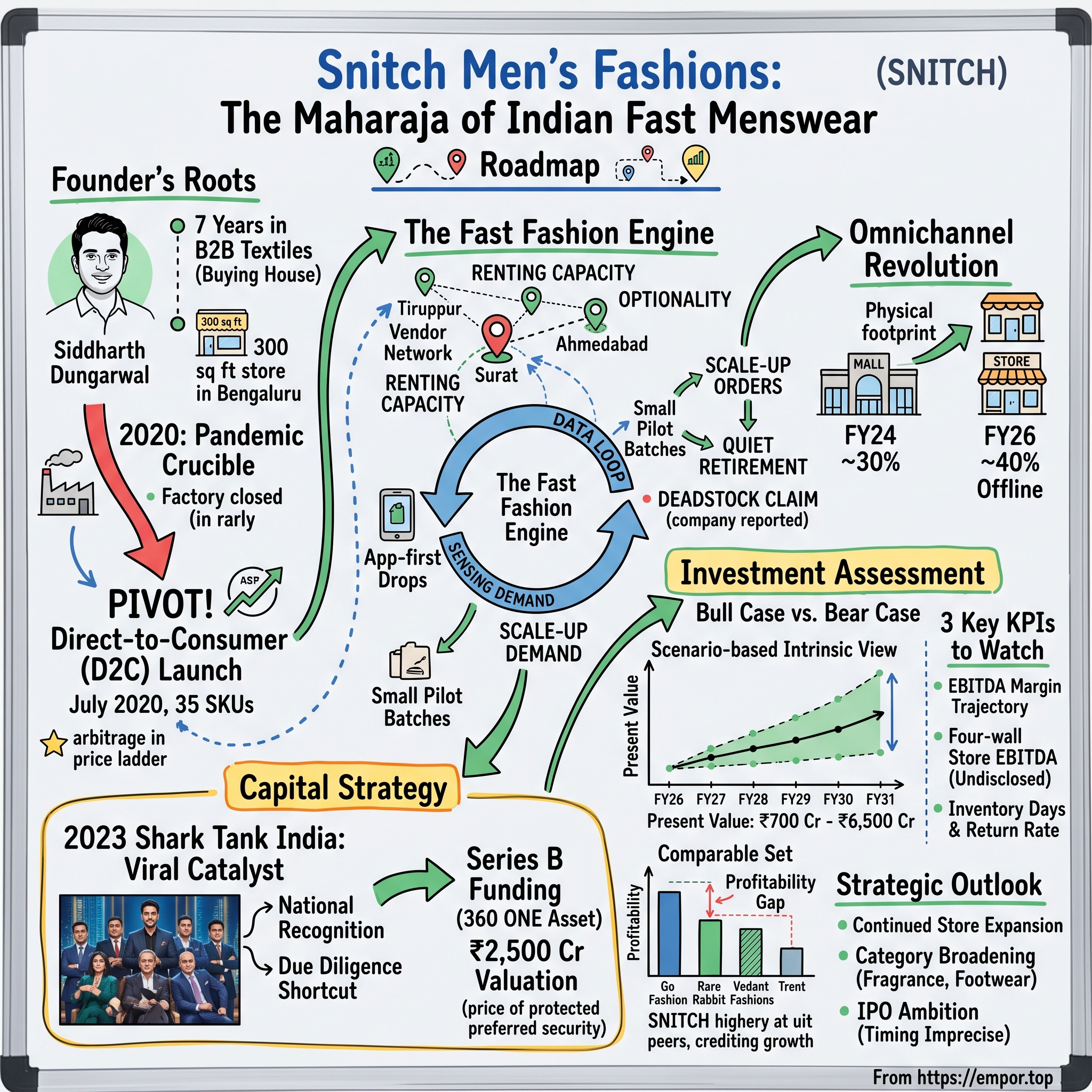
The route through the story runs as follows. Siddharth Dungarwal's decade in the B2B textile trenches of Bengaluru, which is where the supply-chain competence actually came from. The 2020 collapse of that B2B business and the forced pivot to direct-to-consumer. The anatomy of the fast-fashion engine — the vendor network, the drop cadence, the data loop, and how much of it is proven versus asserted. The omnichannel build-out, which is simultaneously the growth engine and the source of the margin compression. The capital structure, which is where private preferred economics and public common economics diverge sharply. A strategic assessment using Helmer's 7 Powers and Porter's Five Forces, applied only where they clarify the economics rather than decorate them. And finally the underwriting itself: what ₹2,500 crore embeds, what a scenario-based intrinsic view produces, what genuinely comparable listed businesses trade at, and which two or three operating metrics would confirm or falsify the whole thesis.
 Subscribe on LinkedIn
II. The Founder's Apprentice: Siddharth Dungarwal's Textile Roots [15:00 - 35:00]
The most consequential fact about Siddharth Dungarwal is that he spent roughly seven years selling clothes to other brands before he ever sold one to a consumer. That sequence matters more than any origin-story colour, because it explains why Snitch's competitive claim is a supply-chain claim rather than a marketing claim — and it sets the bar for judging whether that claim holds.
The Storefront and the Cash Cycle
Dungarwal opened a small clothing store in Bengaluru at seventeen, roughly 300 square feet, before the conventional education-to-corporate path had a chance to claim him.6 Retail at that scale teaches a specific and unglamorous lesson: how long cash stays trapped between the moment you pay a supplier and the moment a customer pays you. In Indian apparel retail, that gap is the business. Margin is a function of how fast inventory moves and how little of it has to be marked down. Nothing in a spreadsheet teaches that as efficiently as personally financing a rack of shirts that will not sell.
From Selling Clothes to Sourcing Them
The pivot to manufacturing happened around 2012 and was, by Dungarwal's own account, opportunistic rather than strategic. Holding surplus fabric and working through relationships with textile suppliers, he took a buyer's request for custom t-shirts and produced them — discovering in the process that the economics of intermediation and production were structurally better than the economics of a single storefront.6 The insight is not subtle, but acting on it is: he shut down the retail-first mental model and spent the next stretch of his career building a buying house.
From roughly 2012 to 2019, that buying house supplied established Indian apparel brands, including Arvind Fashions and Madura Fashion.6 This is the part of the biography that carries genuine analytical weight, and it deserves to be stated precisely rather than romanticised. A buying house is a coordination business. It matches a brand's specification to the right cluster — the right knitter in Tiruppur, the right power-loom unit in Surat, the right dye-house, the right stitching contractor — negotiates price and lead time, manages quality control, and absorbs the friction of dealing with dozens of small, undercapitalised, family-run production units. Doing that for seven years for demanding national accounts produces two assets that money cannot quickly buy: a mapped vendor graph with known reliability characteristics, and a working knowledge of what Indian men's bodies and preferences actually require in terms of fit, fabric grade and regional styling.
The Grievance That Became a Model
It also produces a specific grievance, which is the seed of Snitch's model. Supplying mid-market national chains meant watching, from the inside, how much value the traditional structure destroyed. Brands committed to large minimum order quantities months ahead of demand. Lead times ran long. Trend calls were made by merchandising committees working from last season's data. And when the call was wrong — as a meaningful share of calls always are — the correction arrived as end-of-season markdowns that ate the gross margin the whole supply chain had worked to protect. Dungarwal spent years being paid to execute a system he could see was structurally lossy.
The honest counter-observation is that this insight was not proprietary. Every buying house in India could see the same inefficiency; Inditex built a $100 billion company on the identical observation three decades earlier and in a different geography. What distinguishes Dungarwal is not that he noticed but that he was positioned, when circumstances forced the issue, to act on it with an existing vendor network rather than having to build one from scratch under time pressure. That is a real head start, and it is also a depreciating one — vendor networks in Tiruppur and Surat are non-exclusive by nature, and a well-funded competitor can rent the same capacity.
Snitch itself was launched in late 2019, and it did not begin as a consumer brand. It began as a B2B operation — the natural extension of the buying house, selling into the same wholesale channels Dungarwal already knew.6 Which meant that when the Indian government imposed one of the world's strictest lockdowns in March 2020, the business was pointed directly into the storm.
III. The Pandemic Crucible & The Pivot to Direct-to-Consumer (D2C) [35:00 - 55:00]
The 2020 lockdown did to Indian wholesale apparel what a power cut does to a cold chain. Physical retail stopped. The stores Snitch supplied stopped ordering, and — more damagingly for a working-capital-intensive B2B business — the ones that had already ordered stopped paying. Accounts receivable froze while manufactured inventory sat immobile in warehouses. For a company whose entire economic model was the velocity of goods and cash between production and retail, both variables went to zero simultaneously.
The Only Door Not Nailed Shut
The available responses were narrow. Liquidate the inventory into a market where every other distressed supplier was doing the same thing, and take the loss. Wait, and hope the receivables eventually clear. Or find a buyer who was still buying. Dungarwal, with founding team member Chetan Siyal, chose the third option and went straight to the consumer, launching an e-commerce storefront in July 2020 with 35 SKUs.6 The choice reads as visionary in retrospect; at the time it was closer to the only door not nailed shut. Dungarwal has been reasonably candid about this: "D2C was never a strategy," he has said of the period.6 That candour is worth noting early, because founder willingness to describe a forced move as a forced move is one of the few behavioural signals available before a company files.
The Gap in the Price Ladder
What made the pivot work was not the decision itself but the arbitrage it walked into. Indian menswear in 2020 had a conspicuous hole in the middle of its price ladder. At the top, global fast-fashion brands offered genuinely current design at price points that excluded most of the demographic that wanted them — a Zara shirt at ₹2,500 to ₹5,000 is not a purchase an Indian college student or a first-job professional makes casually. At the bottom, domestic value brands delivered basic shirts in the ₹700 to ₹1,500 band, but with a design language set by long lead times and conservative merchandising: dependable, cheap, and visually a season or two behind.
Snitch aimed at the gap: premium-looking, trend-forward menswear priced roughly between ₹999 and ₹1,800.7 The strategic logic is that this position is defensible from both directions. Against Zara it competes on price with an acceptable design gap; against value retail it competes on design with an acceptable price gap. Whether it is defensible against a well-capitalised domestic player attacking the same band — which is precisely what Tata's Zudio has been doing from below — is a harder question, and it is the central bear argument.
The timing of the launch amplified everything. A generation of young Indian men were confined at home with unusual quantities of attention to allocate and Instagram as the primary allocation venue. Snitch leaned into visual, high-frequency "drops" rather than structured seasonal collections — a merchandising rhythm that suits social media, suits short attention, and, critically, suits a supply chain that can produce in small batches. The initial inventory moved quickly, which validated the thesis and, more usefully, generated the first tranche of the demand data the whole model would later be built on.
What the Growth Curve Does and Does Not Prove
The scale of what followed is best appreciated by the base it started from. Snitch recorded operating revenue of about ₹11 crore in FY21.6 By FY24 that had reached roughly ₹241–243 crore, and by FY25, ₹498 crore on audited numbers.26 From ₹11 crore to ₹498 crore is a 45-fold increase across four financial years — a compound annual growth rate above 160%. Growth of that shape is almost always a demand-side phenomenon rather than an execution triumph; the company found a real, underserved, price-sensitive, style-hungry cohort and served it before anyone else got organised.
The analytical caution is that demand discovered in an unusual window is not automatically demand that persists in a normal one. The 2020–2022 period featured suppressed competition, cheap digital advertising as incumbents cut budgets, and a captive online audience. All three conditions have since reversed. The evidence that Snitch's product-market fit outlived the anomaly is reasonably good but not conclusive: roughly 300,000 monthly customers, more than 1.6 million cumulative consumers served, a repeat purchase rate around 45%, and a stated retention rate above 65%.6 A 45% repeat rate in fast fashion is respectable — it is not Amazon, but it means nearly half of purchasing customers come back, which materially reduces the blended cost of acquiring revenue. What is not disclosed, and what would matter far more, is cohort-level contribution margin over time: how much a 2022 cohort has spent cumulatively versus a 2025 cohort at the same age, and whether the newer cohorts cost more to acquire and spend less. Absent that, retention is a claim supported by an aggregate, not a proof.
IV. Shark Tank India Season 2: The Virality Catalyst [55:00 - 75:00]
In early 2023, Dungarwal walked onto the set of Shark Tank India Season 2 and asked for ₹1.5 crore in exchange for 0.5% of Snitch — an ask that implied a ₹300 crore valuation.5 He walked out with ₹1.5 crore for 1.5%, split evenly across all five investors on the panel: Anupam Mittal, Aman Gupta, Namita Thapar, Vineeta Singh and Peyush Bansal.58
The arithmetic deserves to be stated plainly, because it is routinely narrated backwards. Dungarwal did not win a valuation negotiation. He lost one, by a factor of three: the deal he accepted implied a ₹100 crore valuation against a ₹300 crore ask. He accepted it because he had signalled from the outset that he wanted all five investors or none, treating the syndicate's collective distribution and credibility as worth more than two-thirds of the paper valuation on a 1.5% slice. Whether that was shrewd or merely a good story depends entirely on what the 1% of extra dilution bought.
What 1% of Extra Dilution Purchased
What it bought was distribution of attention, and by the evidence it bought a lot. At the time of the pitch the business was already substantial for a three-year-old brand — shipping in the region of 2,000 orders a day, drawing roughly 50,000 daily website visitors, with around 500,000 app downloads and monthly revenue near ₹9.3 crore, all achieved without institutional capital.5 That last detail is the one that separated Snitch from the typical Shark Tank pitch: it was a profitable, bootstrapped, unit-economics-positive business asking for a small cheque, not a cash-burning startup asking for runway. On a show whose investor panel had grown visibly weary of pre-revenue optimism, that was an unusually strong hand.
The broadcast effect was immediate and, for a consumer brand, exactly the right kind. National television introduced Snitch to an audience that digital targeting could not have reached at any sane cost, and the traffic arrived organically rather than as paid clicks. For a D2C business, an organic acquisition surge is worth several multiples of the equivalent paid volume, because it lowers blended customer acquisition cost for as long as the resulting cohorts keep purchasing.
Two second-order effects mattered more than the traffic spike itself. The first was capital-structural: the appearance functioned as a due-diligence shortcut for institutional investors. Ten months after the broadcast, Snitch raised ₹110 crore in a Series A co-led by SWC Global and IvyCap Ventures.[^9]910 It is impossible to prove the causal link from public evidence, but the sequencing is suggestive — national brand recognition compresses the time a growth fund spends getting comfortable with a consumer brand's demand.
The second was in physical retail, and it is the underrated one. Commercial leasing in Indian malls is a relationship business in which developers ration prime floor space by perceived brand pull. A three-year-old menswear label with no offline track record would ordinarily start in the weak positions on the upper floors. National recognition changed the negotiating position materially, and the subsequent build-out of over a hundred stores in under three years is difficult to imagine without it.1
The Depreciating Asset
The necessary discount to all of this: a virality event is a one-time asset that depreciates. The 12-to-18 month CAC benefit was real and is now spent. Snitch's FY25 advertising and marketing expense of ₹83 crore — about 17% of that year's ₹498 crore of revenue — is the number that reveals what the post-Shark Tank world costs.2 Management subsequently rationalised marketing spend substantially, reportedly cutting it by roughly half as a share of the business, which contributed to the FY26 margin recovery.6 That reduction is a genuine operational achievement, and it is also the single most important thing to watch: if a brand can cut acquisition spend in half and still grow 80%, the brand is doing real work. If growth decelerates sharply in FY27 while marketing stays low, the earlier growth was rented.
V. The Fast Fashion Playbook: Deciphering the Decentralized Supply Chain [75:00 - 100:00]
Every apparel company claims a supply-chain advantage. The distinguishing question is whether the claim shows up in the financial statements, and for Snitch the answer is: partially, and with important qualifications.
Renting Capacity Instead of Owning It
The architecture itself is straightforward to describe. Rather than building capital-heavy centralised factories or committing to large production runs with a small number of large suppliers, Snitch coordinates a distributed network of independent manufacturing vendors spread across India's specialised textile clusters.6 Each cluster does what it is structurally best at. Tiruppur in Tamil Nadu — India's cotton-knit capital, built on decades of export-driven knitwear infrastructure — handles high-turnover t-shirts, hoodies and casual loungewear. Surat in Gujarat, the epicentre of synthetic textiles and high-efficiency power looms, supplies lightweight printed shirts, blends and experimental fabrics. Ahmedabad and Bengaluru cover structured denim, tailored trousers and premium cotton weaves.
The economic point of this fragmentation is not cost. Indian textile clusters are already competitive on cost; a large centralised buyer might well negotiate better unit pricing than a distributed one. The point is optionality. A brand with dedicated factories has to fill them, which means production decisions are driven partly by capacity utilisation rather than purely by demand. A brand renting capacity across dozens of independent units can scale a specific style up or down without stranding an asset. Snitch converted a fixed cost into a variable one — which is precisely why the balance sheet stays light and why the company could grow revenue 45-fold without a corresponding capital expenditure programme.
Sensing Instead of Forecasting
Layered on top is the drop model. Rather than seasonal buys, Snitch releases new designs continuously in small pilot batches, watches the response in its own app — click-through, cart additions, early sell-through velocity — and issues scale-up orders to the vendor network only for designs that clear a performance bar.6 Designs that do not clear it are quietly retired having consumed a trivial amount of capital. Design-to-shelf cycles run as short as a few weeks against the traditional 12-to-18 month calendar.6 The SKU count tells the story of what this enables: from 35 at launch in July 2020 to more than 5,000 today, spanning shirts, jackets, hoodies, co-ords, sweaters and innerwear, with newer extensions into perfumes, footwear, jewellery and accessories, plus a Snitch Plus plus-size line.6
The plain-language version is that Snitch replaced forecasting with sensing. Traditional apparel bets on what will be fashionable in nine months and lives with the consequences. Snitch makes a hundred cheap small bets, reads the results within days, and pours capital only into the ones already winning. It is closer to how a portfolio manager sizes positions than to how a merchandiser plans a season. The company's own emphasis on the resulting metric — very low deadstock relative to a traditional retail industry that routinely marks down 15% to 25% or more of a season's buy — is the natural consequence.6
Where the Claim Outruns the Evidence
Here is where the evidentiary discipline has to bite. The low-deadstock figure is a company-reported metric with no independent verification, no standardised definition, and no audited disclosure behind it. There is no filed document establishing how Snitch defines deadstock, over what horizon, or whether goods transferred to outlet channels or bundled into promotions count. A reader should treat it as directionally credible — the operating model plainly should produce lower markdown losses than a seasonal buyer — and simultaneously as unproven at the specific number quoted.
More usefully, the balance sheet offers a partial cross-check. At the end of FY25 Snitch carried ₹226 crore of current assets against ₹498 crore of revenue.2 That is roughly 45% of annual revenue tied up in short-term assets — inventory, receivables and cash combined. It is not the crisp inventory-days figure a public filing would give, and it is inflated by the ₹279 crore Series B closing shortly after, but it establishes the shape of the business: Snitch is working-capital intensive, as every apparel retailer is, and growth consumes cash before it produces it. The listed comparison is instructive. Go Fashion, India's leading women's bottom-wear specialist, carries roughly 180 days of inventory; Trent, running a far larger and faster-turning platform, carries about 70. Whatever Snitch's true figure, the pull model should place it toward the fast end of that range, and if it does not, the central operating claim is weaker than advertised.
The second discount is on durability. A distributed vendor network is a genuine capability but a poor moat, because it is built on non-exclusive relationships with independent counterparties. Any competitor with capital can approach the same units in Tiruppur and Surat. What is harder to replicate is the accumulated institutional knowledge — which vendor delivers on time at which volume, which one handles a difficult fabric, how to sequence orders so no single unit becomes a bottleneck — and the data loop, which improves with volume. Those are real, and they are the reason a copy would take a competitor eighteen months rather than three. They are not the reason a competitor would fail.
The third and most important discount: the supply chain advantage, whatever its magnitude, is not currently showing up as an operating margin advantage. Snitch's FY25 procurement cost was ₹230 crore against ₹498 crore of revenue — about 46% of revenue, implying a gross margin in the region of 54% before other direct costs.2 That is a respectable apparel gross margin and consistent with the low-markdown claim. But it converted into an EBITDA margin of roughly negative 1% on a filed basis, because ₹65 crore of employee benefits, ₹83 crore of advertising and the remainder of the ₹508 crore expense base consumed all of it.2 The supply chain is doing its job. Everything downstream of it is currently spending the proceeds.
VI. Omnichannel Revolution & Retail Unit Economics [100:00 - 125:00]
The decision to build physical stores was not an expansion of the D2C model. It was an admission of its limits.
Pure-play online apparel in India carries two structural taxes that do not exist in the same form elsewhere. The first is returns and the cash-on-delivery habit. A meaningful share of Indian e-commerce fashion orders are placed on COD, and fashion return rates run far above other categories because size and fit cannot be verified before delivery. Every return costs forward shipping, reverse shipping, handling, inspection and — in a trend-driven business where the garment may be out of fashion by the time it returns to the warehouse — a real probability of markdown. The second tax is acquisition cost inflation: as search and social auctions have filled with well-funded competitors, the cost of buying an incremental online customer has risen structurally, capping the margin any digital-only fashion brand can hold.
Building the Network
Snitch's response was to build offline aggressively. The footprint reached 59 stores during FY25 and exceeded 115 across India by FY26, with the 111th opening marking a publicised milestone along the way.1611 Offline moved from about 30% of revenue in FY24 to 40–45% in FY25, and by FY26 the channel mix stood at roughly 60% online and 40% offline, with the offline side growing around 75% year on year.16
The store formats and their capital requirements are disclosed with unusual specificity for a private company, and they are the most useful operating disclosure available. Mall outlets run 1,800 to 2,000 square feet; high-street stores run 4,000 to 5,000. Fit-out capital expenditure runs approximately ₹3,000 per square foot. Ownership is split roughly 60% franchise and 40% company-operated, with management moving toward a 50:50 balance.6
Those numbers permit a real calculation, which is worth doing slowly. A 4,000 square foot company-operated high-street store costs roughly ₹1.2 crore to build. A 2,000 square foot mall store costs roughly ₹60 lakh. If Snitch operates around 46 stores directly today — 40% of 115 — and the mix skews toward smaller mall formats, cumulative company-funded store capital expenditure is plausibly in the range of ₹40 crore to ₹70 crore. Against ₹279 crore of Series B primary capital, that is affordable. It is also the reason the franchise-heavy structure exists: franchising transfers the fit-out capital and the lease obligation to the partner, letting Snitch buy distribution with someone else's balance sheet. The shift toward 50:50 means Snitch is deliberately taking more of that capital burden back onto its own books in exchange for more margin and more control — a defensible choice that raises the capital intensity of every future store.
The Case for Bricks
The strategic case for offline rests on three claimed benefits. Higher average order value, because tactile interaction and in-store styling drive larger baskets than a phone screen. Near-elimination of the returns tax, because a customer who tries a garment on before paying does not return it for fit. And dual use of the store as a hyperlocal fulfilment node, which converts a fixed-cost lease into a distribution asset. The first two are structurally sound and well-established across global specialty retail; Snitch has not published store-level AOV or comparative return rates, so the magnitude in its case is not established from public evidence.
The third benefit became a distinct product line. Snitch Quick, launched in October 2025, delivers apparel within 60 minutes using existing stores as urban fulfilment hubs. It operates in Bengaluru, Delhi, Gurugram and Ahmedabad, with Hyderabad and Mumbai planned, and already contributes roughly 10% of online revenue.1 The strategic reasoning is sound: grocery-first quick-commerce platforms struggle with apparel because size-and-colour SKU proliferation breaks their dark-store economics, whereas Snitch's stores already hold the full size run of its own catalogue with staff who know it. Ten percent of online revenue — which is 60% of total — implies roughly 6% of company revenue, or on the order of ₹54 crore in FY26. For an initiative less than a year old, that is meaningful traction rather than a press-release pilot.
It is still the smallest part of the story, and it is worth resisting the temptation to let it crowd out the main event. The main event is that the offline channel is now roughly ₹360 crore of annual revenue growing at 75%, and that it carries lease liabilities, store staff costs, and a fixed cost base that does not flex when a trend cycle turns. That is the trade Snitch has made: it bought lower returns, higher basket sizes and a fulfilment network, and it paid with operating leverage that works violently in both directions.
Category expansion is the margin lever management is pulling alongside it. Perfumes, footwear, jewellery and accessories have been added to the assortment, with the strategic rationale that fragrance and accessories carry structurally higher gross margins than apparel and sell well as checkout-adjacent impulse purchases.16 The mechanism is real and standard in specialty retail. The magnitude is not disclosed, and the claim that it lifts blended corporate gross margin by several hundred basis points cannot be verified from any public source — it would require knowing the revenue mix and the category-level margins, neither of which Snitch has published. Treat it as a credible plan with an unproven contribution.
The Missing Number
The number that ultimately settles the offline question is four-wall store EBITDA and payback period, and it is not disclosed. Without it, a reader cannot distinguish between a store network that generates cash within eighteen months and one that generates revenue while quietly consuming it. This is the single most important line item that a future filing would have to reveal, and its absence should be treated as a gap in the evidence rather than as reassurance.
VII. Corporate Governance, Ownership & Capital Allocation [125:00 - 145:00]
Snitch has raised roughly $53 million across its institutional life, which for a business at ₹900 crore of revenue is remarkably little.1 The composition of that capital, and the securities it purchased, determines how much of the headline valuation actually accrues to whoever eventually buys common shares in a public offering.
The Series A closed in December 2023 at ₹110 crore, co-led by SWC Global and IvyCap Ventures Advisors, at a valuation of approximately ₹500 crore.[^9]910[^13] Proceeds were directed at retail expansion and enterprise systems — a legible use of funds for a company that was, at that point, transitioning from a digitally native brand into an omnichannel retailer and discovering that neither its ERP nor its inventory planning had been built for stores.
Reading the Series B Properly
The Series B is where the analysis needs care, because the publicly circulated headline and the filed reality are not the same number. The round was announced in June 2025 as $40 million led by 360 ONE Asset, with participation from existing backers SWC Global and IvyCap Ventures, the Ravi Modi Family Office — the promoters of Vedant Fashions, which operates Manyavar — and a group of angels.[^14]12[^16] The corporate filings underlying it record a primary issuance of 1,755 Series B Compulsorily Convertible Preference Shares at ₹15,89,385 each, raising ₹278.93 crore, of which 360 ONE contributed ₹220 crore for 9.67%, with SWC Global and IvyCap each adding ₹29.4 crore.4
Three things follow from that, and they are the sort of things a headline valuation obscures.
First, the arithmetic of the lead investor's own cheque implies a post-money valuation of roughly ₹2,275 crore — ₹220 crore divided by 9.67% — rather than the ₹2,400 to ₹2,500 crore that circulated in coverage.34 The gap is not evidence of anything improper; it is most likely the difference between a stake calculated on outstanding shares and a valuation quoted on a fully diluted basis inclusive of the ESOP pool, or the effect of additional participants closing at slightly different terms. But it illustrates the core problem with private marks: the same round can be described accurately at ₹2,275 crore or ₹2,500 crore depending on which share count is used, and the larger number is the one that travels.
Second, the announced $40 million and the filed ₹278.93 crore primary tranche differ by roughly ₹60 crore. The difference is most plausibly accounted for by the angel and family-office participation, by tranches closing on different dates, or by a secondary component. No public source establishes which, and no source reports a founder secondary sale in this round.4 That is a diligence item, not an accusation — but "how much of the announced round was primary capital that entered the company versus secondary that went to existing holders" is a question with a definite answer that is simply not public.
Third, and most consequentially for a public-market reader: what 360 ONE bought was preference shares, not common stock. Compulsorily Convertible Preference Shares in the Indian venture context routinely carry a liquidation preference that pays out ahead of common equity in a sale or winding-up, anti-dilution protection that adjusts the conversion ratio if a later round prices lower, and information and consent rights that give the holder visibility and veto power the common shareholder never receives. The specific terms attaching to Snitch's Series B CCPS — the preference multiple, whether it participates after conversion, the anti-dilution formula, board composition, protective provisions, and any side letters — are not publicly disclosed. This matters because a preferred share with downside protection is worth more than a common share with the same claim on upside. When a public offering converts everything to common, that protection disappears. The ₹2,500 crore figure was the price of a protected security; it is not the price of the unprotected security a public investor would buy.
Who Owns What, and What That Implies
The ownership picture, as recorded in mid-2025 shortly after the Series B allotment, showed founders holding roughly 47%, institutional funds about 29%, other individual holders roughly 16%, the ESOP pool 6.4%, an enterprise holder 0.8% and angels 0.5%, with Dungarwal's own stake at approximately 47.1% post-allotment.13 Those proportions are broadly consistent with the outline's expectation of a founder retaining a strong equity position, and they carry the usual double-edged implication. A founder with 47% is powerfully aligned with long-term equity appreciation and cannot be easily removed — good, when the founder is right. It also means that after an IPO's dilution, a single individual would likely remain the dominant shareholder with effective control over board composition and strategic direction, and future public shareholders would be minority participants in a founder-controlled company. Neither is unusual in Indian listings; both should be priced.
What can be built from public information, and what cannot, should be stated explicitly. There is no disclosed fully diluted share count. The CCPS conversion ratio is not public. The ESOP pool's size is reported at 6.4% but its vesting schedule, exercise prices and expected future grants are not. There are no disclosed warrants, convertible notes or SAFEs, but their absence from press coverage is not evidence of their absence from the cap table. Consequently, any market capitalisation calculated for Snitch today is a rough implied equity value derived from a single negotiated private transaction, not a share count multiplied by an observable price. Total equity value and free float are entirely different quantities here, and free float does not yet exist.
The enterprise-value bridge is similarly unbuildable with precision. Cash at hand is not separately disclosed, though the ₹226 crore of FY25 current assets plus the ₹279 crore Series B inflow indicate the company is not capital-constrained near-term.24 Debt is not disclosed. Most significantly for a retailer, lease liabilities under Ind AS 116 are not disclosed, and for a business operating 115 stores those liabilities are economically equivalent to debt — long-dated, contractual, and senior to equity. Any enterprise value for Snitch would therefore be a guess, and comparing an equity-value multiple for Snitch against an enterprise-value multiple for a listed peer would be an error. Where this article compares, it compares like with like and says which.
Judging Management by Behaviour
On capital allocation behaviour, the record is genuinely favourable and deserves credit. Snitch scaled from ₹11 crore to ₹900 crore of revenue on approximately $53 million of external capital, deploying it into stores, technology and working capital rather than into manufacturing plant or into subsidised customer acquisition.16 Management has stated it is not currently seeking fresh capital.1 That is a materially different behavioural profile from the Indian D2C cohort that raised repeatedly to fund discounting. Set against it: the FY25 slip into a small loss came precisely because marketing and employee costs outran revenue, which suggests the discipline is real but not automatic, and the subsequent halving of marketing intensity was a correction rather than a plan executed as designed.26
Management's forecasting record is mixed in a way that is worth recording without exaggeration. Dungarwal publicly targeted ₹1,000 crore of revenue in FY26; the company delivered approximately ₹900 crore.114 Missing a self-set target by 10% while growing 80% is a minor miss, and the more useful signal is that the target was specific, public, and subsequently reported against rather than quietly withdrawn. The FY27 target is ₹1,400 crore.1 On the listing, statements have varied: an IPO "within three years" from around mid-2025, and elsewhere an FY30 target.614 Those are not contradictory so much as imprecise, which is itself informative — the company is signalling intent without committing to a date, which is the correct posture for a business whose margin structure is not yet ready for quarterly public scrutiny.
VIII. Hamilton Helmer's 7 Powers & Porter's 5 Forces Analysis [145:00 - 165:00]
Strategic frameworks earn their place only when they change a number. Applied to Snitch, two of Helmer's powers do real work, two are weaker than the narrative suggests, and the Porter analysis explains why the margin structure looks the way it does.
Counter-positioning is the strongest claim, and it is genuinely present — but it is narrower than usually stated. Counter-positioning exists when an incumbent declines to copy a challenger's model because copying would damage its existing business more than the challenger does. For Snitch, the incumbents that genuinely cannot follow are the traditional wholesale-and-department-store apparel brands whose economics depend on long production runs, distributor margins and seasonal buys. Adopting weekly small-batch drops would break their volume commitments with large suppliers and disrupt distributor relationships built over decades. That is real counter-positioning.
It does not, however, apply to the competitors that matter most. Trent's Zudio was itself built as a fast, high-turn, own-brand format with a compressed supply chain — it is not an incumbent trapped by legacy economics, it is a differently-configured challenger with a Tata balance sheet behind it. Nor does it apply to newer D2C entrants, who face no legacy at all. The power protects Snitch from the slowest competitors and offers nothing against the fastest, which is the wrong way round for a moat.
Scale economies are emerging and should be described carefully. As purchase volume grew from roughly ₹100 crore to over ₹500 crore of procurement, Snitch's leverage with vendors in Tiruppur and Surat improved — better fabric pricing, priority in the production queue, more favourable terms.26 That is a genuine, compounding advantage. But the reinvestment choice matters: if those savings are passed to the consumer to hold the ₹999–₹1,800 price band, the power shows up as volume growth rather than margin expansion, which is exactly the pattern the FY25 and FY26 income statements display. Scale economies that are competed away are still strategically useful — they raise the bar for a subscale entrant — but they will not by themselves produce the margin structure a public valuation requires. And in absolute terms, Snitch's ₹900 crore is dwarfed by Trent's roughly ₹20,000 crore of revenue.15 Whatever scale advantage Snitch holds over a ₹100 crore startup, Tata holds a far larger one over Snitch.
Switching costs are effectively zero and should be acknowledged as such rather than dressed up. A consumer changes fashion brands with one tap or one step into a different store. There is no contract, no data lock-in, no ecosystem, no learning curve. Snitch's roughly 45% repeat rate is earned every single transaction through novelty and relevance, not retained by friction.6 This is the structural reason fast fashion is a hard business to hold: the customer relationship must be re-won continuously, and one bad season of trend calls resets it.
Branding sits somewhere in the middle, and the honest reading is that Snitch has strong awareness and unproven pricing power. Awareness it clearly has — a national television platform, a large app-installed base, roughly 18 million digital sessions a month and 1.6 million cumulative customers.6 Brand power in Helmer's sense, though, means the ability to charge more than a functionally identical competitor. Snitch's entire positioning is built on not charging more, which is precisely why customers come. A brand that must hold ₹999–₹1,800 to keep its proposition intact has awareness, not pricing power. The distinction shows up in the ₹83 crore FY25 advertising line: a brand with real pricing power spends less to be chosen.2
The Porter analysis explains the resulting economics with unusual clarity.
Rivalry is very high and getting worse. Snitch is fighting global fast fashion (Zara, H&M, Uniqlo), conglomerate-backed value retail (Trent's Zudio and Westside, Reliance Trends), and a crowded field of D2C brands including The Souled Store, Bewakoof, Bonkers Corner, The Bear House, Rare Rabbit and Powerlook.6 The most economically consequential of these is Zudio, which attacks Snitch's price band from below with Tata's cost of capital and store network — and which is the reason Snitch's "sits in the gap between premium and value" positioning is a description of where it currently is rather than a description of a defended position.
Threat of new entrants is high at the bottom and moderate at the top. Launching an online menswear brand in India requires a Shopify account, a third-party logistics partner and a marketing budget. Getting past roughly ₹100 crore requires supply chain depth and working capital, and getting past ₹500 crore with an omnichannel footprint requires institutional capital and retail operating competence. That threshold is a real filter, and it is where Snitch's seven years of buying-house experience genuinely pay. But it filters out only the smallest competitors.
Supplier power is low, and this is Snitch's cleanest structural advantage. India's garment manufacturing base is highly fragmented and, in aggregate, has more capacity than committed demand. By splitting production across a large number of independent vendors, no single unit holds leverage over Snitch's schedule or its cost base.6 This is one of the few forces genuinely working in the company's favour, and it is durable because it derives from the structure of Indian textile manufacturing rather than from anything Snitch invented.
Buyer power is high, which is the force that caps everything. Indian apparel consumers in the ₹999–₹1,800 band are exceptionally price- and style-sensitive, face near-infinite substitutes, and have zero switching cost. Snitch cannot raise prices without volume consequences. Its path to higher margin therefore runs almost entirely through cost — better sourcing, lower returns, higher store productivity, category mix toward accessories — rather than through price. Every element of the bull case has to survive that constraint.
IX. The Investment Case: Bull vs. Bear & Key KPIs [165:00 - 175:00]
The underwriting question can be stated in one sentence: does ₹2,500 crore represent a reasonable claim on the cash Snitch will eventually produce, or does it represent the price a single growth fund was willing to pay for a protected security in a fashionable category?
What ₹2,500 Crore Embeds
Start with what the mark implies against operating reality. Against FY25 audited revenue of ₹498 crore, the ₹2,500 crore post-money is roughly 5.0 times sales; against FY26's approximately ₹900 crore, about 2.8 times.123 Those are equity-value-to-revenue ratios, not enterprise-value ratios, because Snitch's cash, debt and lease liabilities are not disclosed. Against FY26 EBITDA of ₹18–27 crore, the same mark is somewhere between 90 and 140 times operating earnings.1 That last figure is the one that should stop a public-market reader. It is not damning — a business growing 80% is legitimately valued on future earnings rather than present ones — but it establishes that essentially none of the current valuation is supported by current profitability. All of it is a claim on margin expansion that has not yet happened.
The bull case, stated at its strongest, runs like this. Snitch occupies a price and design position that neither Zara nor Zudio can occupy simultaneously, and it defends that position with a supply chain that converts trend risk into small, cheap, reversible bets. The 115-store network is not a cost centre but a distribution and fulfilment asset that lowers returns, raises basket size and enables 60-minute delivery no pure-play can match.16 The offline channel is compounding at 75%, faster than the company average, and it is the higher-margin channel.1 Category extension into fragrance, footwear and accessories raises blended gross margin without requiring new customers. And critically, all of this has been achieved on approximately $53 million of external capital, which means the return on invested capital in the business — once margins normalise — could be very high.1 Get to ₹3,000 crore of revenue at a 12% EBITDA margin, and the business earns ₹360 crore before financing, on a capital base that would still be modest by retail standards.
The bear case is not the mirror image; it is more specific. Its first argument is that the margin structure has not improved in the way the model promises. Snitch has now had two consecutive years at scale — ₹498 crore and ₹900 crore — and produced approximately negative 1% and positive 2–3% EBITDA margins respectively.12 Nearly doubling revenue produced almost no operating leverage. For a business whose entire thesis is capital-light agility, that is the wrong shape. Something downstream of the supply chain — store operating costs, staff, marketing, or discounting invisible in the aggregate — is absorbing the gross margin the sourcing model generates.
Its second argument is the retail commitment. Building past 115 stores toward stated ambitions of several hundred means signing long-dated leases in a market where mall rents in Tier-1 India have been rising. Lease liabilities are contractual and senior to equity; they do not flex when a season disappoints. A retailer with a 3% EBITDA margin and a growing fixed lease base is one bad trend cycle from a genuinely difficult year, and the four-wall economics that would determine how bad are not disclosed.
Its third argument is reverse logistics and COD exposure, which intensifies exactly where growth is going. Expansion into Tier-2 and Tier-3 markets increases the COD share of orders and, with it, the return and refusal rate. The offline channel mitigates this for offline sales; it does nothing for the 60% of revenue still transacted online.1
Its fourth is trend execution. A model that makes a hundred small bets a month is robust to individual misses and fragile to systematic ones. If the merchandising instinct that has driven five years of growth degrades — through scale, through founder attention moving to retail expansion, or through the customer cohort ageing out of the aesthetic — the correction arrives as discounting, which hits gross margin and brand simultaneously.
A Scenario Range, Not a Number
A scenario-based intrinsic view, built transparently and treated as a range rather than an answer, frames the gap. All three scenarios start from FY26 revenue of approximately ₹900 crore and run five years to FY31, with a 25% effective tax rate and a 14–15% cost of equity appropriate to a private, single-category, founder-controlled Indian consumer business.
In a bear path, growth decelerates sharply as Zudio and D2C rivals compete the price band away: revenue reaches roughly ₹2,000 crore by FY31, EBITDA margin stalls near 5%, and post-lease-depreciation operating margin sits around 2%. That produces roughly ₹30 crore of after-tax operating profit. Even at a generous 20 times, the terminal equity value is around ₹600 crore, and discounting five years at 14% brings the present value to roughly ₹300 crore. Add some option value for the brand and the store network and the figure lands in the ₹600–900 crore band.
In a base path, Snitch roughly hits its FY27 target of ₹1,400 crore and then grows at a decelerating 20–25%, reaching ₹3,000–3,300 crore by FY31, with EBITDA margin widening to 10–11% as store maturity, category mix and reduced marketing intensity all contribute. Operating margin after depreciation of around 7–8% yields after-tax operating profit near ₹170–190 crore. At 25–30 times — a multiple consistent with a profitable, growing Indian specialty retailer — the terminal equity value is ₹4,300–5,700 crore, discounting to roughly ₹2,200–2,900 crore today.
In a bull path, offline compounds as management describes, quick commerce scales nationally, accessories and fragrance meaningfully lift blended margin, and international markets contribute: revenue near ₹4,500 crore by FY31 at a 14% EBITDA margin, producing around ₹370 crore of after-tax operating profit. At 35 times, that is roughly ₹13,000 crore terminal, or about ₹6,500 crore in present value.
The range that falls out — roughly ₹700 crore to ₹6,500 crore, with a central band of ₹2,200–2,900 crore — is wide, and the width is the finding. The ₹2,500 crore private mark sits almost exactly on the base case. That means the round embedded successful execution of the base path with essentially no margin of safety: the investor paid today for margin expansion, store maturation and sustained growth that have not yet been demonstrated. The sensitivities are unequal — the valuation is far more sensitive to the terminal EBITDA margin than to the growth rate. Holding revenue at the base case and moving the margin from 10% to 6% roughly halves the outcome; holding margin and cutting growth by a quarter reduces it by perhaps a third.
Building an Honest Peer Set
The comparable set has to be constructed rather than assembled, because most obvious comparisons are wrong.
The genuine direct peers are private and therefore lack market prices, but they are the right economic match. The Souled Store — Indian D2C apparel, similar price band, similar customer, similar omnichannel trajectory — ended FY25 with roughly ₹492 crore of operating revenue and ₹11 crore of profit, and has filed for an IPO comprising a ₹300 crore fresh issue and a ₹300 crore offer for sale.1617 Its revenue is almost identical to Snitch's FY25, it is more profitable, and it is growing more slowly. When it prices, it will be the single most relevant valuation reference point Snitch has ever had. Rare Rabbit, at roughly ₹636 crore of FY24 revenue and ₹76 crore of profit, demonstrates that a premium-positioned Indian menswear brand can earn a double-digit net margin — which is simultaneously encouraging for the category and unflattering for Snitch's current 2–3%.17 Bewakoof, at roughly ₹162 crore, is a different scale entirely.17
Among listed businesses, the closest economic analogue is Go Fashion (India), which runs a single-category, specialty, franchise-and-company-store apparel model in India. It trades at a market capitalisation of roughly ₹1,805 crore, about 2.6 times enterprise value to sales and 8.6 times EV/EBITDA, with a 22.7% return on capital employed and roughly 180 days of inventory.18 It is the most instructive comparison available, and the comparison is uncomfortable: a profitable, established, cash-generating single-category retailer with a 20%-plus ROCE is worth less in the public market than Snitch's last private mark, on similar revenue and vastly better margins. The market is not paying a premium for growth in this pocket of Indian retail right now — Go Fashion's shares have fallen from a 52-week high of ₹894 to ₹343.18
Vedant Fashions, whose promoter family office participated in Snitch's Series B, trades at roughly ₹10,139 crore market capitalisation, about 7.4 times EV/sales and 15.2 times EV/EBITDA, on a 20.7% return on equity.[^14][^23] It carries a much higher multiple because it runs a franchise-heavy, high-gross-margin ethnic-wear model with structurally superior economics. It is a useful aspirational reference for what a well-run Indian apparel brand can be worth, not a direct peer.
Trent is the category leader and should be explicitly separated out. At approximately ₹1,54,613 crore of market capitalisation on roughly ₹20,074 crore of FY26 revenue, a 19% operating margin and a 28% ROCE, it trades at about 7.8 times EV/sales and 45 times EV/EBITDA.15 It is not a peer to Snitch in any meaningful sense — it is twenty-two times the size, backed by Tata, and operating multiple formats. It appears here as the competitor whose Zudio format directly attacks Snitch's price band, and as a caution: the market has already de-rated Trent from a 52-week high of ₹5,674 to ₹2,899, which is what happens when a high-multiple retail growth story decelerates.15
Two exclusions deserve explanation. Global fast-fashion comparables — Inditex, H&M — are excluded because their vertical integration, geographic diversification and scale produce entirely different capital intensity and margin structures; borrowing their multiples would be an error of category. And Aditya Birla Fashion and Retail, at roughly ₹6,981 crore of market capitalisation, is excluded as a direct peer because it is a multi-brand conglomerate retail platform with a very different business mix, though it is worth noting that the entire listed Indian branded-apparel complex has been de-rating.
Reconciling the two views produces a coherent picture. The intrinsic scenario work centres around ₹2,200–2,900 crore. The comparable work, applied honestly, argues for less: at Go Fashion's 2.6 times EV/sales, Snitch's ₹900 crore of FY26 revenue supports roughly ₹2,340 crore of enterprise value before any adjustment for Snitch's far thinner margins and undisclosed lease liabilities — and Go Fashion earns a 22.7% ROCE while Snitch's FY25 filed ROCE was negative 5.8%.218 Adjusting for that profitability gap, a comparables-driven view would sit meaningfully below ₹2,500 crore. The intrinsic view is more generous because it credits growth the comparables do not.
Where the two views diverge, the reasons are identifiable and should be named as pricing forces rather than value. A private round is priced by one buyer with a protected security, not by a market clearing common stock. Growth of 80% is genuinely scarce in Indian apparel and commands a scarcity premium. A future IPO would introduce further pricing forces — restricted free float, retail investor enthusiasm for a recognisable consumer brand, momentum from a well-received listing — that can move a price far above or below intrinsic value for extended periods. None of those forces creates a rupee of business value. They determine what someone will pay, which is a different question.
The addressable market deserves restraint, because the category number and the reachable number are far apart. India's total apparel market is frequently sized in the tens of billions of dollars, and menswear is the largest single segment within it. That figure is close to useless for underwriting Snitch. The reachable market is defined by four constraints the company actually operates under: it sells menswear only, in a price band of roughly ₹999 to ₹1,800, to a trend-conscious urban and semi-urban cohort broadly between eighteen and thirty-five, reachable through app-based commerce and 115 physical stores concentrated in Tier-1 and larger Tier-2 cities. Strip out women's wear, children's wear, ethnic occasion wear, the unorganised local-tailor market, the sub-₹700 value segment where Zudio and unbranded retail dominate, and the ₹2,500-plus segment where global brands sit, and what remains is a fraction of the headline.
Within that fraction, market share assumptions have to be tied to named competitors rather than to a percentage of a large number. Snitch's ₹900 crore competes for the same wallet as The Souled Store at roughly ₹492 crore, Rare Rabbit at roughly ₹636 crore, Bewakoof at roughly ₹162 crore, the menswear portion of Zudio's very large volume, and the Indian menswear revenue of Zara, H&M and Uniqlo.61617 Reaching ₹3,000 crore by FY31 — the base case — does not require inventing demand; it requires taking share from that specific set while the set defends itself. The likely competitive response is legible: Zudio competes on price and store density, the D2C cohort competes on design and social distribution, and the global brands compete on brand cachet. None of them has to lose for Snitch to grow, because the category itself is expanding as Indian incomes rise and as branded apparel takes share from unbranded. But all of them can compress Snitch's margin while it grows, which is precisely the pattern the last two income statements show.
The path to durable profitability, as distinct from adjusted profitability, requires being specific about what must change. Gross margin appears adequate at roughly 54% on the FY25 procurement figures.2 The problem is entirely in operating expense. Employee benefits of ₹65 crore and advertising of ₹83 crore together consumed ₹148 crore, or 30% of FY25 revenue, and neither line scales down automatically.2 Marketing intensity has already been roughly halved, which is the single largest lever and one that has been pulled.6 What remains is store productivity: revenue per square foot rising as the FY25 and FY26 cohorts mature, which lowers store operating cost as a percentage of revenue without any new spending. Layered on that is category mix toward accessories and fragrance, and the gradual reduction of returns drag as the offline share of revenue rises. If all four contribute, a low-double-digit EBITDA margin at ₹3,000 crore is plausible arithmetic rather than wishful thinking.
The financing question sits alongside it. Snitch is not currently seeking capital and holds the proceeds of a ₹279 crore round against a business that is roughly EBITDA-neutral.14 But growth in apparel retail consumes working capital before it produces cash, and the ₹226 crore of FY25 current assets against ₹498 crore of revenue implies that reaching ₹1,400 crore would tie up meaningfully more.2 On the order of ₹100 crore to ₹150 crore of incremental working capital, plus company-store capital expenditure as the mix shifts toward 50% owned, is a plausible call on cash over the next two years. That is comfortably within the Series B proceeds if EBITDA stays positive; it is not if margins slip back below zero. The falsifying evidence would be a fresh capital raise before FY28 despite the stated intention not to seek one — that would indicate the working capital cycle is consuming more than the operating model generates.
Three metrics would confirm or falsify the underwriting, and they should be watched in this order of importance.
First, EBITDA margin trajectory alongside revenue growth. The bull case requires margin to widen from 2–3% toward low double digits as stores mature and marketing intensity falls. If FY27 delivers the targeted ₹1,400 crore with EBITDA margin still under 5%, the operating-leverage thesis is falsified regardless of how fast revenue grows.1
Second, four-wall store EBITDA and payback period, currently undisclosed. This determines whether the offline build is an investment or a subsidy, and it is the number a filing would have to reveal.
Third, inventory days and blended return rate. The pull-based supply chain's entire claim is that it keeps capital out of unsold goods. Inventory days rising as the store network expands — because stores require stock held in place rather than centrally — would indicate that omnichannel has quietly reversed the model's core advantage.
The events that would force a reckoning are identifiable: The Souled Store's IPO pricing, which will set a public reference for the category; the FY27 results against the ₹1,400 crore target; and the first full year in which store openings slow enough to reveal underlying same-store performance rather than growth-by-addition.
X. Epilogue & Strategic Outlook [175:00 - 180:00]
Snitch's stated next act runs along three axes. Continued store expansion, with the network past 115 and management having signalled ambitions well beyond that.111 Category broadening from menswear into a lifestyle portfolio — fragrance, footwear, jewellery, accessories — which is the principal disclosed lever for lifting blended gross margin.16 And international expansion, where the record is instructive: offline expansion into West Asia was postponed on account of regional geopolitical conditions, while online sales in the region continued.1 That is a company disclosing a plan it deferred rather than quietly dropping it, which is a modestly positive governance signal in a market where deferred plans often simply vanish from the narrative.
Beyond that sits the listing itself. Management has targeted ₹1,400 crore of revenue in FY27 and has spoken of an IPO on timelines ranging from within three years to FY30.1614 The imprecision is appropriate. A company at a 2–3% EBITDA margin is not a company that wants quarterly public scrutiny; a company at 10% would be.
There is a real lesson in the arc, and it is not the one the funding headlines tell. Snitch's durable achievement is that it built a demand-sensing manufacturing loop before it built a brand, and it built the brand before it built stores — the correct order, and the opposite of how most Indian apparel companies have been assembled. Seven years in a buying house gave Dungarwal a vendor graph that a competitor cannot rent overnight, and the pull-based model turns the single largest destroyer of apparel margin, the markdown, into a series of small reversible bets. That is genuine, and it explains a 45-fold revenue increase on very little capital.
The equally real limitation is that this advantage lives entirely above the gross margin line. Below it — in store operating costs, in staff, in advertising, in the returns and reverse logistics of a 60%-online business, in the lease obligations of a rapidly expanding network — Snitch currently spends nearly all of what its supply chain earns. Two consecutive years of near-doubling revenue produced almost no operating leverage.12 Every rupee of the ₹2,500 crore private mark rests on the proposition that the next two years will look different from the last two.
What makes the case genuinely open rather than merely optimistic is that the mechanisms for the change are identifiable and already partly in motion: stores opened in FY25 and FY26 have not yet reached mature productivity, marketing intensity has already been cut roughly in half, higher-margin categories are being added, and quick commerce is contributing at 10% of online revenue less than a year from launch.16 Each of those, if it works, widens margin without requiring a single new customer. If they work together, the base case is conservative. If they do not, a business at ₹1,400 crore of revenue earning 3% is a very different thing from what the last private round paid for — and the public market, when it eventually sets a price, will be considerably less patient than a preference shareholder with a liquidation preference and a ten-year fund life.
References
-
D2C Brand Snitch's FY26 Revenue Surges 80% To ₹900 Cr — Inc42, 2026 ↩↩↩↩↩↩↩↩↩↩↩↩↩↩↩↩↩↩↩↩↩↩↩↩↩↩↩↩↩
-
Snitch nears Rs 500 Cr revenue in FY25, stays close to breakeven — Entrackr, 2025 ↩↩↩↩↩↩↩↩↩↩↩↩↩↩↩↩↩↩↩↩
-
Apparel brand Snitch secures Rs 279 Cr at Rs 2,500 Cr valuation — YourStory, 2025-05 ↩↩↩
-
Exclusive: Snitch to raise Rs 280 Cr in Series B round at Rs 2,500 Cr valuation — Entrackr, 2025 ↩↩↩↩↩↩↩
-
Men's fashion brand Snitch raises Rs 1.5Cr from all Shark Tank India judges — Indian Startup News, 2023 ↩↩↩↩
-
How Snitch Stitched An INR 500 Cr Revenue Run In 5 Years — Inc42, 2025 ↩↩↩↩↩↩↩↩↩↩↩↩↩↩↩↩↩↩↩↩↩↩↩↩↩↩↩↩↩↩↩↩↩↩↩
-
How Bengaluru-based menswear brand Snitch is riding the fast fashion wave in India — The Economic Times, 2023-06-02 ↩
-
Meet the founder who secured an all-shark deal on Shark Tank India Season 2 — YourStory, 2023-02-15 ↩
-
Menswear brand Snitch raises Rs 110 crore in Series A funding — Moneycontrol, 2023-12-05 ↩↩
-
Menswear brand Snitch raises Rs 110 Cr Series A funding co-led by SWC Global and IvyCap Ventures — YourStory, 2023-12-05 ↩↩
-
Snitch hits new milestone with 111th store launch; eyes Rs 900 crore revenue in FY26 — DFU Publications, 2026 ↩↩
-
D2C menswear brand Snitch raises $40 million Series B funding — YourStory, 2025-06-05 ↩
-
Snitch — Latest Shareholding & Valuation — Tracxn, 2025-07-03 ↩
-
Snitch Eyes Rs 1,000 Cr Revenue By FY26, Plans IPO Within Three Years, Says Founder Siddharth Dungarwal — BW Disrupt, 2025 ↩↩↩
-
Trent Ltd — consolidated financials and valuation metrics — Screener.in, accessed 2026-07-21 ↩↩↩
-
The Souled Store Aims for Global Retail Expansion & IPO in 2 Yrs — Indian Retailer ↩↩
-
How D2C Brand The Souled Store Soared To Profitability After Slumping To 52x Losses — Inc42 ↩↩↩↩
-
Go Fashion (India) Ltd — consolidated financials and valuation metrics — Screener.in, accessed 2026-07-21 ↩↩↩
 LinkedIn
 WhatsApp
 Reddit
 Hacker News
 Email
Email Kindle
 RSS Feed
 Spotify
 Apple Podcasts
 Amazon Music
 Audible
 YouTube