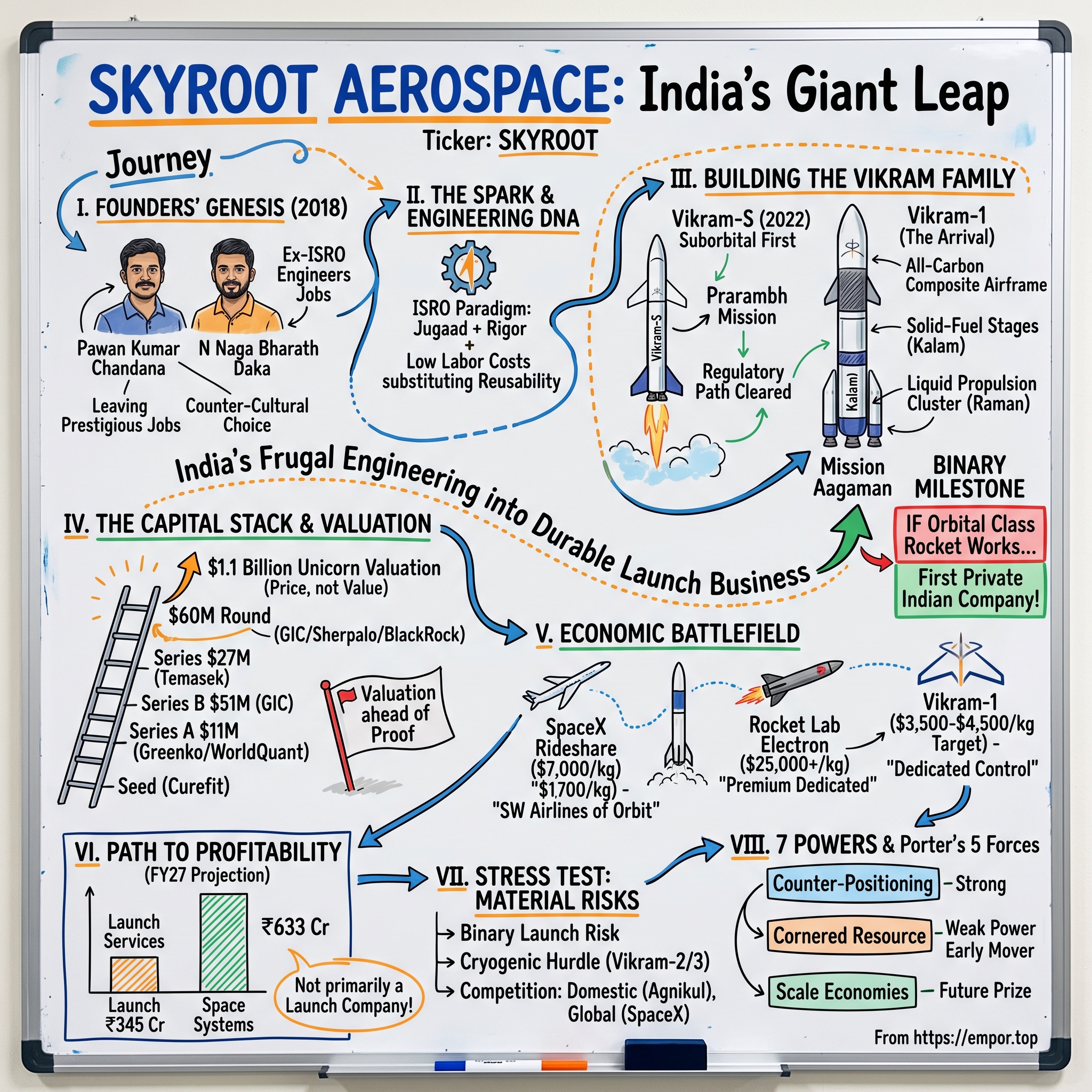
Skyroot Aerospace: India's Giant Leap into Private Space
I. Introduction & Episode Roadmap (0:00 – 0:08 | 8 Mins)
In two days' time, on the morning of July 12, 2026, a countdown will begin at the First Launch Complex of the Satish Dhawan Space Centre in Sriharikota, on the sandbar of the Bay of Bengal where India has launched almost every rocket it has ever flown. The vehicle on the pad will not belong to the Indian Space Research Organisation. It will belong to a nine-year-old private company from Hyderabad called Skyroot Aerospace, and the rocket is named Vikram-1. The mission is called Aagaman — Sanskrit for "the arrival" — and the launch window runs from July 12 to August 4.1 If the four stages fire in sequence and the fourth stage places its payload in low Earth orbit, Vikram-1 will become the first orbital-class rocket ever designed, built, and launched by a private Indian company.1
It is worth being precise about the word "if." As of today, July 10, 2026, that launch has not happened. The rocket is reported to be fully stacked at the pad, but every account hedges with the same conditional, because orbital rocketry is one of the least forgiving businesses on Earth.1 That conditional is the entire story of this episode.
Two months before the countdown, in early May 2026, Skyroot gave the market a very different kind of number. It closed a $60 million funding round co-led by Singapore's sovereign wealth fund GIC and Ram Shriram's Sherpalo Ventures, with participation from funds managed by BlackRock, the world's largest asset manager. The round valued the company at roughly $1.1 billion — making Skyroot India's first space-technology unicorn.2 It brought the total the company has raised to more than $160 million, or about ₹1,500 crore.3
Here is the tension a public-market investor has to sit with. The $1.1 billion is a price, agreed between a private company and a handful of sophisticated investors buying preferred shares, struck before the product has ever reached orbit. The launch is the proof. Almost never in the history of hardware companies does the price arrive so far ahead of the proof, and almost never is the proof so brutally binary.
And the graveyard is real. Virgin Orbit — a Richard Branson company that actually reached orbit — filed for bankruptcy in April 2023 and was auctioned off for roughly $36 million, against a $3.7 billion valuation at its SPAC listing barely eighteen months earlier.45 Astra Space went public via SPAC at around $2.1 billion, burned through nearly half a billion dollars, and was taken private by its founders at fifty cents a share in 2024 as the "only alternative" to bankruptcy.6 Small launch is where valuations go to die.
So the big question of this episode: can a private Indian startup — staffed largely by ex-ISRO engineers, exploiting one of the lowest cost structures in high-end aerospace on the planet — counter-position itself against SpaceX's rideshare juggernaut and Rocket Lab's premium dedicated launches, and turn India's frugal-engineering DNA into a durable, profitable launch business? Or is $1.1 billion just another number waiting for a rocket to prove it wrong?
Here is the roadmap: - The ex-ISRO founders, and the cultural rift between public and private space in India. - The engineering: solid-fuel stages, 3D-printed liquid engines, and the cryogenic leap still to come. - The capital stack: how Skyroot reached the launch pad on under $160 million, who owns it, and what a private "unicorn" mark does and does not mean. - The economics: SpaceX Transporter versus Rocket Lab Electron versus Vikram-1, in dollars per kilogram. - The 7 Powers, the five forces, and the one binary event that sits above all of it.
 Subscribe on LinkedIn
II. The Spark: Ex-ISRO Founders & India's Aerospace DNA (0:08 – 0:23 | 15 Mins)
To understand Skyroot you first have to understand the institution its founders left, because the whole company is an argument with it.
The ISRO Paradigm
The Indian Space Research Organisation is, by a wide margin, the most cost-efficient large space agency in the world, and it became so out of necessity. For decades India was locked out of Western cryogenic-engine technology by sanctions and export controls, and it built its capability the hard way — indigenously, slowly, and cheaply.
The emblematic result was the Mars Orbiter Mission, Mangalyaan, which reached Mars orbit in September 2014 at a total cost of about $74 million — famously less than the roughly $100 million production budget of the Hollywood film Gravity.11 That number was not a gimmick. It reflected a genuine engineering culture: jugaad, the Indian instinct for frugal improvisation, welded onto rigorous, conservative systems engineering. ISRO does not fail often, and it does not spend much.
The paradox worth sitting with is that ISRO's greatest strength — extreme frugality forged under embargo — is also the source of the opportunity Skyroot exists to capture.
When you are denied cryogenic engines by treaty and must reverse-engineer them yourself, when your budget is a rounding error against NASA's, you learn to design out cost at every joint. That habit produced a talent base of engineers who instinctively think in rupees per kilogram rather than dollars per requirement. It is, in a sense, the most valuable export India's space program never meant to create: a workforce trained to build orbital-class hardware cheaper than anyone else on Earth.
But ISRO is a government agency, and it optimizes for national missions — communications satellites, navigation constellations, planetary science, and strategic launch capability — on a government's timeline and a government's risk appetite. It was never built to chase the fast-growing global commercial market for launching small satellites for private constellation operators, the market that exploded after SpaceX and Rocket Lab proved that hundreds of small satellites would fly if launch got cheap and frequent enough. A national agency that flies a handful of prestige missions a year, prices launches as a strategic service rather than a commercial product, and cannot easily take a rocket-blows-up risk on a commercial customer's schedule, structurally cannot serve that market. That gap — between what ISRO is optimized to do and what the commercial small-satellite boom demands — is what two of its own engineers decided to run at.
The Founders' Genesis
Pawan Kumar Chandana is Skyroot's co-founder, CEO, and CTO. He took a dual degree — a B.Tech in mechanical engineering and an M.Tech in thermal engineering — from IIT Kharagpur in 2012, then spent roughly six years as a scientist at the Vikram Sarabhai Space Centre, ISRO's principal rocket-building lab in Thiruvananthapuram. His work there was on the heavy end of the fleet: the GSLV Mk-III (now LVM3), its enormous S200 solid boosters, and the GSLV Mk-II.9
It is worth correcting a detail that circulates loosely: Chandana's ISRO expertise was in solid-stage and systems engineering, not liquid propulsion — a distinction that matters, because solid motors are exactly what Vikram-1 leads with. His co-founder, Naga Bharath Daka, the COO, came from IIT Madras and worked in the flight-computers and avionics group at the same center — the brains of the rocket rather than the muscle.810
In 2018 they left. It is hard to overstate how counter-cultural that was. A scientist's post at ISRO is one of the most prestigious and secure jobs an Indian engineer can hold; walking away from it to build rocket hardware — not an app — as a private startup, in a country that had never permitted a private orbital launch, was close to unthinkable.
They founded Skyroot in Hyderabad on June 12, 2018, with a team of ten, and were incubated at the city's T-Hub startup center.8
There is a human texture worth adding here, because it shapes the incentives. These were not wealthy founders hedging a small bet; they were salaried government scientists in their late twenties putting their careers and reputations on the line in a country where startup failure still carries stigma and where hardware failure is spectacularly public.
The early team of ten worked out of modest premises, incubated at Hyderabad's T-Hub, before any of the marquee sovereign money arrived.8 The equity they and their engineers now hold — the ESOP pool discussed later — is the payoff for that early asymmetry of risk, and it is precisely the incentive structure ISRO could never offer.
Judge founders by behavior, and two things stand out. First, they picked the hardest possible category — physical launch vehicles, where the feedback loop is measured in years and a single failure can be terminal — rather than the softer, better-funded adjacencies of satellite software or ground systems. Second, they sequenced their proof carefully rather than promising the moon: a suborbital demonstrator first, then an orbital vehicle, then heavier lift. That is the disciplined ISRO habit of proving one thing at a time, carried into a venture-backed company that faces constant pressure to do the opposite.
The consistency test cuts mostly in the founders' favor so far. When they launched Vikram-S in 2022, they described it accurately — a suborbital technology demonstrator, not an orbital vehicle — rather than dressing it up as more than it was. The public messaging around the 2026 raise has been notably measured for a company that had just achieved unicorn status: the CEO's own quote framed the money as "confidence from some of the world's most reputed investors" rather than a victory lap.2
The place where candor will really be tested is not the marketing but the launch itself — specifically, how management characterizes Mission Aagaman if it fails, and whether the ambitious FY27 and FY32 projections get walked back honestly when reality diverges. Whether the founders' proving-one-thing-at-a-time discipline survives contact with a $1.1 billion valuation and impatient growth-equity investors demanding a cadence ramp is one of the open questions of the story.
III. Rocket Science 101: Building the Vikram Family (0:23 – 0:38 | 15 Mins)
Every rocket company lives or dies on a few engineering choices, so it is worth walking through Skyroot's in plain language.
Vikram-S and the Regulatory First
The first proof point came fast. On November 18, 2022 — just over four years after founding — Skyroot launched Vikram-S on a mission it named Prarambh ("the beginning"). It was a single-stage suborbital rocket that reached an apogee of about 89.5 kilometers, and it was the first privately developed rocket ever launched from Indian soil.8[^12] Vikram-S did not reach orbit and was never meant to; its real payload was regulatory and institutional. It proved that a private company could get a rocket licensed, secure range access at a government spaceport, and fly it safely — clearing a path that had never existed before.
It is worth dwelling on why the suborbital-first sequence mattered commercially and not just technically. The single largest barrier to private launch in India was never purely the physics — it was the question of whether the state would let a private company put a rocket on a national range at all, and whether it could be insured, licensed, and safely operated outside ISRO's direct control. By flying Vikram-S successfully and without incident, Skyroot converted an abstract regulatory possibility into a demonstrated precedent.
Every subsequent negotiation over range access and licensing started from "you have done this before" rather than "no one has ever done this." That is an underappreciated form of first-mover advantage: not a patent, but a trodden regulatory path that a competitor now has to walk behind you — and it is the kind of soft, institutional edge that never shows up in a specification sheet but matters enormously in a state-gated industry.
The Vikram-1 Architecture
The main event is Vikram-1, the vehicle now on the pad. It is a four-stage rocket standing roughly 20 meters tall, with an all-carbon-composite airframe, designed to lift up to 350 kg to low Earth orbit and about 260 kg to a Sun-synchronous orbit — the polar orbit most Earth-observation satellites want.[^12] (Some third-party databases list higher figures; Skyroot's own materials and the consensus record use 350/260, so those are the numbers to underwrite.) Carbon-composite construction is itself a cost-and-performance choice: composites are lighter than the aluminum-alloy structures traditional rockets use, which means more of the vehicle's mass budget goes to payload rather than to the rocket carrying itself — but they are also finicky to manufacture repeatably, which is a recurring source of delay in the industry. It is the same material bet Rocket Lab made with Electron, and it comes with the same trade-off: better performance per launch, harder manufacturing at cadence.
The architecture embodies a deliberate paradox. The first three stages are solid-fueled — named Kalam-1200, Kalam-250, and Kalam-100 after India's "missile man" and former president A.P.J. Abdul Kalam.12[^12] Solid motors are essentially very sophisticated fireworks: cheap, dense with energy, storable, and mechanically simple, which makes them ideal for the brute-force job of getting off the ground and out of the thick lower atmosphere. But they cannot be throttled or restarted — once lit, they burn to completion.
So the fourth stage switches to liquid propulsion: a cluster of four small Raman-series engines (sources differ on whether the flight variant is badged Raman-1 or Raman-2) that can be pulsed and controlled to inject a satellite into a precise orbit.[^12] Cheap, dumb thrust for the climb; expensive, smart thrust for the finish. It is a rational way to build an affordable small launcher, and it is the same broad philosophy — solid boost, liquid precision — that many small launchers converge on.
There is a strategic elegance to the solid-first architecture that is easy to miss and that speaks well of the founders' judgment. Solid motors are the technology ISRO knows best — Chandana himself worked on the giant S200 solid boosters of the LVM3 — and India has decades of institutional expertise and supply chain for them.9
By leading Vikram-1 with three solid stages, Skyroot leaned on the part of the national capability that was most mature and least export-restricted, and deferred the genuinely hard, embargo-prone technology (cryogenics) to later vehicles. In other words, they front-loaded the reachable and back-loaded the difficult — the opposite of the "hardest thing first" hubris that has sunk other launch startups. A skeptic would note the flip side. Solids also cap your reusability and your ultimate cost curve, since you cannot recover and re-fly a spent solid motor the way SpaceX recovers a Falcon booster; the architecture that gets Skyroot to orbit cheapest today is not the architecture that wins the long-run cost war against a reusable incumbent. Skyroot's answer is that low labor costs substitute for reusability at small scale — a reasonable bet for now, but one that weakens as SpaceX pushes reuse further.
Design, Print, Fire
The manufacturing philosophy is where Skyroot makes its loudest efficiency claim, under the slogan "design, print, fire." Its liquid engines lean heavily on metal 3D printing. Back in 2020, when it test-fired a Raman engine with a fully 3D-printed injector, the CEO said the additive approach had "reduced the overall mass by 50 percent" and cut the component count and lead time by around 80 percent versus conventional machining and casting.13
The logic is sound and increasingly industry-standard — Rocket Lab, Relativity, and Agnikul all print engines — but note that this is a management claim about a subsystem, demonstrated on test stands, not yet validated across a high-rate production line delivering orbital reliability. There is a difference between printing an engine that fires on a test stand and printing engines, week after week, that fire identically in flight; the second is a production discipline, and it is where the real money and the real risk live. The proof is cadence, and cadence does not exist yet.
The Cryogenic Frontier: Vikram-2 and Vikram-3
Then comes the genuinely hard part still ahead: Vikram-2 and Vikram-3. Vikram-2 is designed to lift about 900 kg to LEO (600 kg to SSO) using a cryogenic upper stage — Skyroot's Dhawan engine family, burning liquefied natural gas and liquid oxygen.14[^12] Vikram-3 targets around 815 kg to LEO.[^12]
Cryogenic propulsion — handling propellants at hundreds of degrees below zero — is the technology the West embargoed India on for a reason: it is brutally difficult, and it is where rocket programs routinely lose years. Skyroot has static-fired Dhawan-series hardware, including 3D-printed variants,26 but flight-proven, high-cadence cryogenic operation is a multi-year mountain the company has not yet climbed. Almost every dollar of the growth case beyond the smallest satellites depends on getting up it — which is why the Vikram-2 timeline is one of the KPIs a public investor would watch most closely.
IV. The Capital Stack & Board Architecture (0:38 – 0:53 | 15 Mins)
Now the part a pre-IPO underwriter cares about most: who put in money, on what terms, and what the headline valuation actually represents.
The Private Capital Evolution
Skyroot's capital history is a clean escalation. The seed came in 2018 from Indian consumer-startup founders (Curefit's Mukesh Bansal and Ankit Nagori are the names most consistently reported, though the exact figure is only loosely documented and should be treated as low-confidence aggregator data rather than a primary disclosure).17
The Series A of about $11 million closed in mid-2021, led not by a marquee institution but by the founders of Greenko Group, the Indian renewable-energy company, with WorldQuant Ventures alongside — smart, sector-adjacent money to prove the propulsion technology.15 The step-change came in September 2022: a $51 million Series B led by GIC, then the largest single funding round in Indian space-tech history.16 GIC invested through a vehicle called Waverly and took a substantial stake — Entrackr's reading of the filings put GIC at roughly 30% post-round, at a post-money valuation near $165 million, with the money coming in as compulsorily convertible preference shares (CCPS) rather than common stock.17 That a sovereign wealth fund took a nearly one-third position this early is worth pausing on: GIC is not a momentum investor, and a stake that size implies both conviction and negotiated protections commensurate with the risk.
In October 2023 came a quieter roughly $27 million round led by Temasek, Singapore's other sovereign investor, taking cumulative funding to about $95 million.18 Note that this round — which the outline omits entirely — did not disclose a valuation, and the widely repeated "$519 million in 2023" figure appears to be a later reconstruction rather than a number struck in that round.3 It is a small but instructive example of how quickly a private company's valuation history blurs once you move past the announced headline rounds.
That brings us to May 2026: the $60 million round co-led by GIC and Sherpalo, with BlackRock-managed funds, the Greenko founders again, Arkam Ventures, Playbook Partners, and the Shanghvi family office (of Sun Pharma) joining.2 Total capital raised: north of $160 million. Reported valuation: $1.1 billion.3 For reference, that valuation is up from an estimated ~$519 million in 2023 — though that earlier figure was never company-disclosed and appears to be a reconstruction, so treat the "more than doubled" narrative as approximate rather than precise.3
Why the $1.1 Billion Is a Price, Not a Value
Now the discipline a pre-IPO reader must bring: a $1.1 billion "unicorn" valuation is a price on preferred shares, not the value of the company to a common shareholder — and the two are not the same. GIC, Sherpalo, and BlackRock did not buy the same security a future public investor would buy. At least since the Series B, the institutional money has come in as compulsorily convertible preference shares — Entrackr's reading of the 2022 filings described the round as issued in the form of Series B CCPS at a set price per share.17 Preferred shares in a venture round typically carry a liquidation preference — a right to get their money back (sometimes a multiple of it) before common shareholders see anything in a sale or wind-down — and often anti-dilution protection, pro-rata rights, and information and board rights.
Skyroot has disclosed none of these specific terms publicly, which is itself the point: the liquidation preferences, participation rights, ratchets, and side letters attached to that $1.1 billion are unknown, and until they are disclosed in a filing, the headline number should be read as the top of a waterfall, not a per-share value that flows evenly to everyone. A $1.1 billion post-money on a company that has raised $160 million means, at a minimum, that a meaningful slice of any downside is contractually shielded for the newest investors — and that the founders' and employees' common shares sit behind that preference stack.
Why does this matter so much for a pre-IPO reader? Because the mechanics of how a "unicorn" price is manufactured are routinely misunderstood.
A post-money valuation is simply the price per share in the latest round multiplied by the total share count as if every share were worth that price — but the new preferred shares are worth more than the common shares precisely because they carry downside protection the common shares lack. Academic work on venture valuations (the Stanford/UBC "squaring venture capital valuations with reality" research is the canonical reference) has repeatedly shown that headline unicorn valuations overstate the fair value of common equity by wide margins — often 40% or more — once you properly price the preferences, the ratchets, and the IPO-protection terms embedded in the latest round.
Applied here, the honest statement is not "Skyroot is worth $1.1 billion" but "the most recent investors paid a price that implies $1.1 billion for their protected security, and the value of a common share — the thing a public investor would eventually buy — is some unknown, and probably meaningful, discount to that."
An IPO is, among other things, the event that collapses this distinction: preferred converts to common, the preferences fall away, and the market re-prices the whole thing as ordinary equity. That conversion is exactly why a private mark is a starting point for diligence, not an answer.
The enterprise-value bridge deserves the same restraint. To move from equity value to enterprise value you need cash, debt, and lease-like obligations — and for Skyroot, only fragments are public. The public record shows the company has raised roughly $160 million cumulatively and recently topped up with $60 million, so it is cash-rich relative to its tiny revenue, and it carries no publicly reported significant debt.
But there is no audited balance sheet, no precise cash position net of the Infinity Campus capital outlay, and no visibility on any lease financing on that facility. The correct posture is therefore to say plainly that a reliable enterprise value cannot be computed from public information, and to refuse the common error of comparing Skyroot's private equity-value mark against a public peer's enterprise-value multiple as if they were the same currency. When the Rocket Lab and Firefly comparisons arrive below, that distinction does real work.
The Cap Table, Dilution, and the ESOP
The ownership split, per Tracxn's reading (which should be reconfirmed against a filing before anyone relies on it), runs roughly: investment funds ~43%, founders ~23%, a strategic/enterprise holder ~20%, the ESOP pool ~7.2%, and angels ~6%.19 Two observations follow. First, the founders have already been diluted below a quarter of the company before an IPO — normal for capital-intensive hardware, but it carries two consequences a public investor must track. It means founder control at listing will depend on differential voting rights, founder-friendly board provisions, or a dual-class structure that have not been disclosed, not on raw economic ownership.
And it means the founders will need further capital (Vikram-2's cryogenic program is not cheap) that will dilute them further, sharpening their incentive to reach a liquidity event before their stake thins too far. That incentive can align with public shareholders — it pushes toward proving the business — or against them, if it pushes toward listing before the operating proof is mature. Which way it cuts depends entirely on whether Vikram-1 flies.
Second, that ~7.2% ESOP pool is genuinely notable in the Indian aerospace context. For fifty years, ISRO's engineers worked for fixed civil-service salaries and the intangible prestige of national missions; Skyroot is, for the first time at scale, offering aerospace engineers equity in the upside they build.
At the Series B the company had already expanded its option pool meaningfully, converting a chunk of the raise into employee incentive.17 That is a real recruiting weapon in a country where the alternative employer for a propulsion engineer is a government lab that cannot grant stock — and we will return to whether it constitutes a durable "cornered resource" under Helmer's framework.
For now, note the governance flip side: a 7.2% option pool is also 7.2% of future dilution that public shareholders will absorb, and the terms of those options — vesting, strike prices, any milestone-linked or founder mega-grants — are exactly the kind of thing that will need scrutiny in a filing rather than applause in a press release.
Board Power and Capital Efficiency
On governance: GIC's Mayank Rawat, of its India direct-investment group, took a board seat with the Series B, and Ram Shriram joined the board with the 2026 round.1720 Shriram's presence is the headline the company wants. He founded Sherpalo Ventures, was one of Google's earliest investors and an original board member (widely reported as writing an early check of around $250,000 — not, as some accounts loosely claim, Google's very first check, which was Andy Bechtolsheim's $100,000), and still sits on Alphabet's board.2021
For a deep-tech hardware company that will one day want to sell launches to Western constellation operators and eventually tap public markets, a director of that stature is real signaling value. But signaling is not underwriting. Shriram's conviction and the sovereign funds' checks tell you these are serious people betting seriously; they do not tell you the rocket works or the unit economics close. As a small marker of how a private round's timeline can blur, the May 2026 raise was, per legal-trade reporting, advised by Trilegal, TT&A, and Cyril Amarchand Mangaldas, with a reported completion around mid-June 2026 — a reminder that the "May" announcement date and the actual legal close were separate events, and that headline round dates are approximations until a filing pins them down.22
One more point of capital-efficiency context, because it is the bull case's foundation. Skyroot has built a suborbital rocket, developed an orbital-class launcher to the pad, and stood up a large factory on cumulative funding of roughly $160 million — of which perhaps $100 million has actually been spent to date, given the recency of the last two rounds.
Set that against the Western graveyard: Astra raised nearly $500 million and reached the brink of bankruptcy before being taken private at fifty cents a share; Virgin Orbit spent well over a billion dollars across its life and was auctioned for scrap.56 If Vikram-1 reaches orbit, Skyroot will have reached the same milestone for a small fraction of that capital — and that, not the celebrity director, is the single datum that would most justify a fresh, serious look at the valuation. Capital efficiency is not a moat, but in a business that has bankrupted better-funded rivals, it is the closest thing to a survival trait.
V. The Launchpad & Factory: Infinity Campus and the Regulatory Sandbox (0:53 – 1:08 | 15 Mins)
A launch company is only as good as its ability to repeat. One rocket is a science project; a business is a factory. So the most economically important building Skyroot owns is not on a launch pad — it is the Infinity Campus in Hyderabad, a roughly 200,000-square-foot integrated design, manufacturing, and test facility inaugurated in November 2025 by Prime Minister Narendra Modi, and designed, on paper, to produce one orbital rocket per month.8
That target — twelve vehicles a year — is the number the entire bull case runs through, and it deserves skepticism proportional to its importance. Twelve orbital launches in a year would put Skyroot among the busiest launch providers on the planet; Rocket Lab, a mature public company that has flown Electron for years, has never sustained a launch a month across a full year. A vertically integrated factory capable of that cadence is a necessary condition, but the binding constraints on a small launcher are rarely the factory — they are engine qualification, range availability at a shared national spaceport, and, above all, demand.
Infinity Campus is real capital expenditure converted into optionality; whether that optionality is ever exercised depends on things outside its walls. Treat "one rocket a month" as an aspiration that defines the ceiling of the model, not a run-rate — and remember that the same building, under-utilized, becomes a fixed-cost drag that pulls the other way.
The vertical-integration logic is worth stating in business terms, because it is doing two jobs at once.
By designing, printing, and testing under one roof, Skyroot compresses the iteration loop — a design change can go from CAD to fired hardware without waiting on external suppliers — which is genuinely valuable in a development-stage company where speed of learning is the scarce resource. But vertical integration is also a fixed-cost bet: it only pays off if volume arrives to spread that overhead. A factory sized for twelve launches a year that flies two is an anchor, not an asset. This is the same coin as the scale-economies argument in the 7 Powers discussion, seen from the cost side: the model that looks brilliantly efficient at cadence looks bloated below it, and the company does not yet control which world it lives in.
The Regulatory Sandbox
None of this would be legal at all without a policy revolution that is easy to underrate. For decades, Indian space was a government monopoly; a private company simply could not build or fly a launch vehicle. Three changes cracked it open. First, in 2022 the government created IN-SPACe — the Indian National Space Promotion and Authorization Center — as a single-window regulator and clearinghouse to authorize private space activity and grant access to ISRO facilities.25 Second, the Indian Space Policy 2023 formally codified private participation across the value chain.25 Third, in February 2024 the Union Cabinet liberalized foreign direct investment in the sector.24
That FDI reform is where a careful reader has to correct a widely repeated error. It is not a blanket "100% FDI under the automatic route" for rockets. The 2024 policy is tiered: up to 100% automatic FDI for manufacturing components and sub-systems; up to 74% automatic for satellite manufacturing and operation; and — critically for Skyroot — only up to 49% automatic FDI for launch vehicles and spaceports, with anything beyond that requiring case-by-case government approval.2324 The logic is national security: a launch vehicle is dual-use technology, indistinguishable in its fundamentals from a ballistic missile, so the state keeps a hand on the tiller.
For a public-market investor this distinction matters directly and concretely: foreign ownership of a pure-play Indian launch company is capped under the automatic route, which shapes how much of Skyroot a GIC or a BlackRock can ultimately hold, how a future public float could be structured, and how much foreign demand a listing could absorb.
The regulatory door is open — but for launch, it is open partway, and deliberately so. That has a practical implication for an eventual IPO: a listing would most naturally happen on an Indian exchange, drawing on India's deep and enthusiastic domestic retail and institutional base, rather than on Nasdaq alongside Rocket Lab and Firefly — which is both an opportunity (a captive, patriotic, liquidity-rich home market) and a constraint (a narrower pool of specialist space investors to price the risk).
VI. The Economic Battlefield: SpaceX Rideshare vs. Rocket Lab vs. Skyroot (1:08 – 1:28 | 20 Mins)
Strip away the rocket romance and Skyroot is selling a commodity with a price per kilogram, into a market defined by one dominant supplier. So the central question is brutally simple: at what price can Vikram-1 put a kilogram into orbit, and is there a business in the gap between the incumbents?
The Elephant: SpaceX Transporter
Start with the elephant, SpaceX. Its Transporter rideshare program is the Southwest Airlines of orbit: a big Falcon 9 flies a standard route to a standard Sun-synchronous orbit and sells seats. The published rate is about $350,000 for up to 50 kg to SSO, and roughly $7,000 per additional kilogram beyond that.7 For a 350 kg satellite that pencils out to somewhere around $2.5 million — an astonishingly low price that no small dedicated launcher can match head-on.
This is the number that has killed small-launch companies. If your satellite can tolerate a generic orbit and SpaceX's schedule, rideshare is almost unbeatable on cost — and a great many satellites can.
But — and this is the crack in the wall that every small launcher aims for — rideshare has a real cost that is not on the price sheet: you fly on SpaceX's clock, to SpaceX's orbit. If you are building a constellation and you need a satellite in a specific orbital plane at a specific time to fill a gap, the bus doesn't stop there.
You then either buy a whole dedicated Falcon 9 (tens of millions of dollars, wildly over-sized for one small satellite), or pay for an orbital transfer vehicle — a "space tug" — that eats your mass budget, your money, and your schedule. Dedicated small launch exists to sell control: your orbit, your timeline. The entire economic question for Skyroot is how many customers value that control enough to pay a premium over rideshare — and whether that number is large enough to fill a factory built for twelve launches a year.
The Premium: Rocket Lab Electron
That is the market Rocket Lab's Electron owns, and prices at a premium. Electron lifts roughly 300 kg to LEO for a widely cited list price around $7.5 million — an effective $25,000–$30,000 per kilogram, several times the rideshare rate.6 Customers pay it because dedicated, responsive, white-glove access to a bespoke orbit is worth it to them.
Rocket Lab has proven the willingness-to-pay exists; it flies Electron regularly and has built the rest of its business (satellites, components, and the larger Neutron rocket) on top of that dedicated-launch beachhead. This is the template Skyroot's own projections implicitly follow — and the reason Rocket Lab, for all its losses, is the company Skyroot most wants to be measured against.
Skyroot's Wedge — and the Revenue Engine Underneath It
Skyroot's entire "why it wins" thesis lives in the space between $7,000 and $30,000 per kilogram. The argument is cost structure. Elite aerospace engineering talent in Hyderabad costs a fraction of what it costs in Long Beach or Auckland; India's manufacturing and test costs are lower; and the ISRO ecosystem provides infrastructure and a trained labor pool that would take a Western startup a decade and a fortune to replicate.
If Skyroot can offer a dedicated Vikram-1 launch of 350 kg for something like $3.5–4.5 million, it would undercut Rocket Lab's dedicated price by roughly half while offering the control that rideshare cannot — landing in striking distance of rideshare economics without rideshare's rigidity. That is a genuinely differentiated position if the cost claim is real at scale.
And there is the rub — "if at scale." As of today the price is a projection, not a quoted, fulfilled, repeatable contract. Skyroot has not yet flown a paying satellite to orbit.
A cost advantage on a spreadsheet is not the same as a cost advantage on the tenth flight, when reliability, insurance, range fees, and the fixed cost of the factory are amortized across real cadence. The India cost edge is plausible and even likely — but it is, at this moment, early and unproven in revenue, and an honest underwriter files it under "credible hypothesis," not "demonstrated moat."
Do the arithmetic that the revenue engine actually depends on, because it disciplines the excitement. Suppose Skyroot hits everything: a $4 million average price per Vikram-1 launch and a cadence of twelve a year. That is roughly $48 million of annual launch revenue at full tilt — a real business, but a modest one, and one that arrives only after years of ramp. It is nowhere near enough to justify a $1.1 billion valuation on its own; on a plausible mature launch margin, a pure Vikram-1 launch business supports a fraction of that mark.
This is the single most important structural fact about the bull case, and it is buried in the company's own projections: of the ~₹977 crore of revenue Skyroot projects for FY27, only about ₹345 crore is launch services — the rest, ₹633 crore, is "space systems."30 In other words, the company's own model does not expect to be primarily a launch company. The valuation is underwritten by a larger, higher-margin satellite-and-systems business that is today almost entirely prospective.
That is either the smart Rocket Lab-style playbook — use launch as a beachhead and build the fatter, more diversified business on top of it — or it is where the bull case quietly does most of its heavy lifting on the least-proven segment. Probably it is both. Either way, an underwriter should not let the romance of the rocket distract from the fact that the rocket is not where most of the projected money is supposed to come from, and that the larger number rests on a business line with even less operating history than the launcher itself.
The market-sizing has to be handled with the same restraint. The category TAM for small-satellite launch is frequently quoted in the tens of billions of dollars per year by the 2030s, and it is easy to multiply that by a hoped-for market share and arrive at a triumphant number. Resist it.
The reachable market for a company at Skyroot's present position — one un-flown orbital vehicle, a single launch site, an Indian cost base, and a payload class capped at 350 kg — is far narrower: the subset of small-satellite operators who need a dedicated launch (not rideshare) to a specific orbit, whose payloads fit Vikram-1's envelope, who are willing to fly on a new provider's first commercial vehicles, and who are not foreclosed by national-security rules from launching on an Indian rocket (a real constraint for U.S. defense-adjacent payloads). That reachable slice is a small fraction of the headline TAM, and it is contested by SpaceX rideshare below on price and Rocket Lab above on track record.
The path from that beachhead to the category TAM runs through years of demonstrated reliability, the heavier Vikram-2 and Vikram-3 to widen the payload envelope, and international customer trust that a two-launch company does not yet have. Any market-share assumption that skips those steps is arithmetic, not analysis.
The Foes, Domestic and Global
The competitive threats come from both directions. Domestically, Agnikul Cosmos is the mirror image of Skyroot: another IIT-pedigreed startup that flew its suborbital Agnibaan SOrTeD demonstrator in May 2024 — the world's first flight powered by a single-piece 3D-printed engine, from India's first private launch pad — and is developing its own orbital vehicle.34 India may end up with two credible private launchers competing for the same domestic satellites and the same limited range slots, which would compress the very pricing power the bull case assumes.
Globally, the incumbents are not standing still: SpaceX's Starship, if it works, threatens to collapse launch costs by another order of magnitude and make the entire dedicated-small-launch premium harder to defend.
And then the customer paradox, which the outline names sharply. India's most promising satellite makers — like the hyperspectral-imaging company Pixxel, backed by Google — are global buyers, not patriotic ones.35 If SpaceX rideshare is cheapest and their satellites can tolerate the orbit, they will fly SpaceX, national pride notwithstanding. Skyroot's domestic market is not automatically its own; it has to be won on price and responsiveness, against the most formidable launch company in history. A launch bought from Skyroot is a launch not bought from SpaceX, and that decision gets made on a spreadsheet.
One more dimension of the revenue engine matters for anyone underwriting durability: the quality of the revenue, not just its quantity. Launch is inherently transactional and lumpy — a satellite operator buys a launch, the rocket flies, the revenue is recognized, and then the relationship resets to zero.
There is no subscription, no recurring contract, no net-revenue-retention curve of the kind that makes software businesses so valuable; a launch company's backlog is only as good as the customers' own funding and schedules, both of which slip constantly in the satellite industry. Early on, that revenue is also almost certainly concentrated — a company that has flown zero commercial orbital missions will book its first revenue from a small handful of customers and possibly a single anchor government or defense contract, which means one cancellation can swing a year. This is precisely why the "space systems" line in Skyroot's projections is strategically important: satellite manufacturing, components, and services can carry more durable, higher-margin, and potentially more recurring economics than launch itself.
But it is also the segment furthest from proof today, so the more durable-looking half of the projected business is the half with the least evidence behind it. When a filing eventually appears, the customer-concentration disclosure and the split of committed versus pipeline backlog will tell a public investor more about revenue quality than any headline growth rate.
VII. The Playbook & Hamilton Helmer's 7 Powers (1:28 – 1:43 | 15 Mins)
Hamilton Helmer's framework asks a hard question of any business: which of its advantages is a Power — a durable barrier that lets it earn returns above its cost of capital — and which is just an operational strength a competitor can copy? Held to that standard, Skyroot's moat is mostly prospective.
Counter-Positioning is the strongest claim, and it is real in structure. Western launchers — Rocket Lab, Firefly — are bound by high labor costs, ITAR and export-control overhead, and expensive domestic supply chains. They cannot simply relocate to India to match Skyroot's cost base; their national-security entanglements and customer bases forbid it. Skyroot builds high-tech rockets at low-cost-country prices and sells globally, and the incumbents can't follow without abandoning who they are. That is a textbook counter-position.
The caveat is that it is only a Power once the cost advantage is proven and customers actually reroute their business to capture it. Right now it is a well-designed position awaiting its first commercial validation — the strategy is sound, but a strategy that has not yet earned a rupee of external launch revenue is a hypothesis, not a moat.
Cornered Resource — the ex-ISRO talent pool — is the most seductive claim and the weakest as a durable Power. Yes, ISRO has spent fifty years training thousands of world-class propulsion and avionics engineers, and yes, Skyroot's equity (the ESOP pool) lets it offer something the civil service cannot.19
But a resource is only "cornered" if rivals can't access it — and Agnikul, and every future Indian space startup, is fishing the same pond with the same equity bait. Skyroot has an early-mover advantage in that talent market, not a lock on it. The real, defensible asset is the culture and accumulated institutional know-how it compounds from that talent over time — the muscle memory of having actually built and flown hardware — not the raw availability of engineers.
Process Power — the "design-print-fire" additive-manufacturing pipeline — is plausible but unproven. Process Power is the hardest Power to establish because it requires an organizationally embedded way of working that competitors can't replicate even when they can see it.
Skyroot's 3D-printing claims (halving engine mass, cutting lead times by ~80%) are impressive on the test stand,13 but 3D-printed engines are becoming table stakes across the industry — Agnikul, Rocket Lab, and Relativity all print. Until Skyroot demonstrates a reliability-at-cadence that others structurally cannot match, this is operational excellence, not yet a Power.
Scale Economies are, by the company's own admission, not yet achieved — and this is the crux. The whole model is a bet that at ~12 launches a year, the fixed costs (the Infinity Campus, tooling, range infrastructure, the standing engineering team) amortize across enough flights to drive marginal cost down and open a durable margin. That is the correct shape of the endgame.
But it is entirely in the future, gated on demand that does not yet exist and a cadence never demonstrated. Scale economies are the prize; they are not a current asset — and in a business where the dominant competitor already enjoys them at a scale Skyroot cannot approach, they may be a prize that is structurally hard to win.
The remaining three Powers are worth naming precisely because they don't yet apply, and saying so is part of an honest scorecard. Switching Costs — normally a strong Power in enterprise businesses — are weak in launch: a satellite operator chooses a launch provider mission by mission, and switching to a cheaper or more reliable rocket next time costs them little beyond re-integration. There is no installed base locking customers in; every launch is a fresh competition.
Branding as a Power (the ability to charge more purely because of the name, as Rocket Lab arguably now can for its reliability reputation) requires a track record Skyroot simply does not have — you cannot build a reliability brand with zero orbital flights, and the brand it does have today ("India's first private unicorn") is investor-facing narrative, not customer-facing pricing power. Network Economies are essentially absent from the launch business model.
So of Helmer's seven, Skyroot has one Power in credible structural form (Counter-Positioning), two that are early-mover advantages masquerading as Powers (Cornered Resource, Process Power), one that is the future prize (Scale Economies), and three that don't apply. That is not a damning scorecard for a company at this stage — it is exactly what an honest pre-orbital assessment should look like — but it is a long way from the fortified moat the $1.1 billion price implies, and the gap between the two is the risk premium.
Stated as a wager, then, the bull and bear cases are cleanly opposed. The bull says: a structurally lower cost base than any Western rival, a talent pool no one else can staff as cheaply, a vertically integrated factory, sovereign-fund validation, a supportive home government, and a first-mover position in the world's most populous country — a combination that, once the rocket flies, could compound into exactly the launch-plus-space-systems platform the public market now pays lavishly for. The bear says: none of the durable Powers is actually built yet, the one genuinely differentiated position (cost) is unproven in revenue, the reachable market is small and contested on both flanks by the most formidable competitor in the industry's history, the business loses more money the more it grows, and the whole edifice rests on a binary event with a coin-flip's worth of first-attempt reliability. Both cases are internally consistent; the launch window is what will start to adjudicate between them.
Run the same evidence through Porter's five forces and the picture sharpens. Supplier power is moderate — Skyroot's vertical integration and India's supply base help, but access to the national spaceport is a single, government-controlled chokepoint. Buyer power is high and rising — satellite operators are sophisticated, price-sensitive, and have a cheaper default (SpaceX rideshare) at all times. Rivalry is intense and structurally loss-making — this is an industry littered with well-funded corpses. Threat of substitutes — rideshare plus space tugs, and eventually Starship — is severe. Threat of new entrants is real (Agnikul, and others behind it).
It is, in short, a genuinely difficult industry — one where even the winners lose money for a decade — and Skyroot's answer to it is a cost position that is credible but not yet earned in revenue. The honest verdict: the architecture of a moat is visible; the moat is not built.
VIII. The Stress Test: Material Risks & The Ultimate Binary Milestone (1:43 – 1:55 | 12 Mins)
Every underwriting comes down to what could go wrong, and here the risks are unusually concrete.
The Binary Milestone
The binary launch risk sits above everything. Mission Aagaman flies in a window that opens July 12, 2026.1 A maiden orbital flight is the single least reliable event in the business — historically, a large share of first orbital attempts fail somewhere in the ascent. If Vikram-1 fails, Skyroot faces the classic small-launcher spiral: a 12-to-24-month investigation and redesign, continued cash burn with no launch revenue, and a valuation struck at $1.1 billion that suddenly has no proof beneath it.
A failure would not necessarily be fatal — SpaceX failed its first three orbital attempts and survived to become the most valuable space company on Earth — but for a company that has already priced in success, it would be a severe, and very public, re-rating, and it would likely force the next capital raise onto worse terms. Conversely, a clean orbital insertion would be the most valuable single event in the company's history, converting the entire narrative from "if" to "how fast." No underwriting of this company is stable until that window closes.
The cryogenic hurdle is the second-order risk. Vikram-1's solid-plus-small-liquid architecture is achievable; the growth case beyond the smallest payloads depends on the Dhawan cryogenic upper stage for Vikram-2, and cryogenics is exactly the technology that has caused multi-year slips at agencies and companies far larger and better funded.[^12]26 The path from a 350 kg launcher to a 900 kg launcher runs directly through the hardest problem in the propulsion textbook.
The Financial Reality and the Path to Profitability
The financial reality is the sobriety check. Skyroot is, by any conventional measure, a pre-revenue company that reports small numbers. In FY24 it recorded a net loss of about ₹55.5 crore on total "revenue" of roughly ₹29 crore — and that revenue was essentially interest income on its raised cash, not launch sales, against total expenses of about ₹84.5 crore.27 FY23 was similar (a ₹55.2 crore loss on operating revenue of just ₹44 lakh), and FY22's loss was ₹23.7 crore.28
The provisional FY26 numbers show revenue jumping to about ₹101 crore — real money at last, likely from early launch-services and space-systems contracts — but with a negative EBITDA of roughly ₹130 crore, meaning the losses are widening in absolute terms as the company scales spending ahead of revenue.29 This is entirely normal for a pre-orbital launch company; the point for an underwriter is that the operating business is still tiny and deeply cash-consumptive, and the burn rate implies the recent $60 million buys a finite runway that is itself a function of hitting the launch schedule.
Against that, the growth projection is a hockey stick — and it is important to attribute it correctly. The figures of ₹977 crore of revenue by FY27 (split roughly ₹345 crore of launch services and ₹633 crore of space systems) and ₹13,205 crore by FY32 are Skyroot's own internal projections, reported from its valuation documentation — not, as sometimes stated, a Tracxn forecast.3029 Whose numbers they are matters enormously: these are the company's own bull case, and they embed near-flawless execution — immediate orbital success, a rapid ramp to high cadence, a large "space systems" business that barely exists today, and no serious competitive price war. Going from ~₹101 crore to ~₹977 crore in a single year (FY26 to FY27) is a roughly 10x leap that assumes Vikram-1 works on the first try and converts a pipeline into flown, paid missions almost immediately.
That is possible; it is not a base case a conservative investor should adopt without discounting heavily. The honest way to use these projections is as the company's stated ambition — a statement of what management is aiming at and what the valuation implicitly requires — not as a forecast an outside underwriter would independently produce. The gap between the two is precisely the risk being priced.
The path-to-profitability question — not adjusted profitability, real free-cash-flow profitability — is where the launch business is structurally unforgiving, and it deserves to be spelled out. To generate sustainable free cash flow, Skyroot must clear a demanding stack of conditions more or less simultaneously: reach a launch cadence high enough to amortize the Infinity Campus and the standing engineering payroll; hold a gross margin per launch that survives insurance, range fees, and the cost of the expendable hardware it throws away on every flight; fund the ongoing, cash-hungry development of Vikram-2's cryogenic stage out of that thin early margin or fresh capital; and do all of it faster than competitors compress the price.
The FY26 numbers show the shape of the problem clearly — revenue of ~₹101 crore against a negative EBITDA of ~₹130 crore means the company is spending well over two rupees for every rupee of revenue, and that gap is widening in absolute terms, not narrowing, as it scales toward first launch.29
That is not a criticism; it is the physics of a pre-cadence launch company. But it means the profitability reckoning is not a near-term event, and the honest falsification test is specific: if, two or three years after first orbital launch, gross margin per flight is not visibly positive and cadence is not climbing toward double digits, the durable-profitability thesis is broken regardless of how the revenue line looks, because revenue bought with widening losses is not a business — it is a subsidy.
The financing corollary is that Skyroot will almost certainly need to raise again. The $60 million closed in mid-2026 buys a finite runway against a ~₹130 crore annual EBITDA loss that will grow as Vikram-2 development ramps — call it, very roughly, a couple of years of cushion before another round or a public listing is required, and less if the launch slips and burn continues without the revenue inflection.29
That is the practical reason the IPO question is live at all: not because the business is ready for public scrutiny, but because capital-intensive hardware companies must keep feeding the furnace, and at a $1.1 billion private mark the pool of private investors willing to fund the next, larger round at a higher price is thin. The public market may end up being not a triumphant exit but the necessary next source of capital — which is a very different thing, and one that changes the incentives around when a listing is pursued.
Valuation: Intrinsic and Comparable Views
Which frames the intrinsic-value question. With no filing, no audited forward statements, and a business whose revenue is about to be determined by a single launch, a precise discounted-cash-flow valuation is not honestly available — and pretending otherwise would be false precision. Any DCF here would be a spreadsheet whose output is dominated by two assumptions the analyst simply invents: whether the rocket works, and how fast cadence ramps afterward. What can be done is to bound the outcomes with an explicit, scenario-based frame rather than a single false-precision number.
In a success scenario, Vikram-1 reaches orbit, Skyroot ramps toward several launches a year at $3.5–4.5 million each, builds the higher-margin space-systems line, and eventually fields Vikram-2 — a company that could plausibly grow into a few hundred million dollars of revenue over the back half of the decade, at which point a $1.1 billion mark looks like an entry point rather than a peak, and the public comparables (below) would support a large multiple on rapidly growing launch revenue.
In a stall scenario, the launch slips or partially fails, cadence never reaches escape velocity, Agnikul and rideshare compress pricing, and the company raises again at a flat or lower valuation with the preference stack protecting the newest money and diluting founders and employees. Because that down-round money would likely come in senior to today's shares, the pain in the stall case falls disproportionately on common holders — the founders, the employees holding those ESOP options, and any future public shareholders — which is the concrete, cap-table reason a private mark cannot be carried forward as if it were safe.
The distance between those two branches is enormous, and the fork is two days away. That is the sensitivity that dominates every DCF input — growth, margin, reinvestment, and cost of capital all hinge on a single binary this quarter.
The comparable-company lens is instructive but must be handled carefully, because the peers are public and Skyroot is not, and because they trade on enterprise value while Skyroot's mark is a private equity value with unknown preferences. There is, bluntly, no clean operating peer for a company that has not yet flown a paying satellite to orbit — every candidate is either much larger and further along, or failed. That absence is itself a finding: it means any multiple borrowed from a public peer is being applied across a wide gap in maturity and risk, and should be discounted for it, not applied at face value.
Rocket Lab (Nasdaq: RKLB) is the aspirational category leader, not a direct peer: FY2025 revenue of about $601.8 million (up ~38%), still unprofitable with a net loss near $198 million, yet carrying a market capitalization around $51.6 billion in mid-2026 — an extraordinary trailing revenue multiple in the mid-80s that reflects the market pricing its Neutron rocket and space-systems ambitions, not its current launch economics.3132 Note the basis carefully: that is an equity market cap on a company with real cash and some debt, and it is a forward-looking multiple on a diversified space business, not a launch-only number.
Firefly Aerospace (Nasdaq: FLY) is the closest recent-IPO comparable: it listed in August 2025 at $45 a share and closed its first day near an $8.5 billion valuation on quarterly revenue that had jumped to about $56 million — again a very high multiple on early, lumpy revenue, and one struck in the enthusiasm of an IPO pop rather than in steady-state trading.33
These comparables tell you two things at once. The public market is currently willing to pay lavishly for credible launch-and-space-systems platforms — which flatters Skyroot's $1.1 billion, implying very roughly 90x its tiny ~₹101 crore (~$12 million) FY26 revenue: richly valued, but not absurd against these peers if the growth materializes. But those same peers are themselves unprofitable and priced on faith, which means the "comp support" is really a shared narrative premium that could compress hard if sentiment turns — as it did, catastrophically, for the entire small-launch SPAC cohort in 2022–2023. The comparables are the destination Skyroot hopes to reach, not evidence of what it is worth today.
Reconciling the two views makes the embedded assumptions explicit. The $1.1 billion private mark prices in success — orbital validation, a multi-year cadence ramp, a real and higher-margin space-systems business that barely exists today, and a valuation multiple sustained by the same market enthusiasm now lifting RKLB and FLY. It is defensible as a price given the peer set and the sovereign-fund conviction behind it; it is not yet supported by value in the form of proven, cash-generating operations.
The market may well hold Skyroot above a sober central estimate for reasons that are about pricing rather than business quality — Indian-unicorn scarcity, a compelling national-champion narrative, a tightly held cap table with essentially no free float to create selling pressure, and the sheer momentum of a marquee raise landing weeks before a historic launch. When a listing eventually comes, those same forces — scarcity of a pure-play Indian space asset, a small initial float, and post-IPO momentum — could push the quoted price well above or below anything intrinsic analysis would support, and could do so for a long time. Those forces are real and can persist for years; they are not the same as intrinsic value, and an underwriter should never confuse the two.
Governance, Readiness, and the Bear Case
Governance and public-market-readiness form a quieter but equally real risk cluster, and the honest posture is to flag them as diligence items rather than to assume their absence is safety. Several things are simply unknown today and will need to be laid bare in any eventual filing. The cap table shows a ~20% "enterprise/strategic" holder alongside the funds, founders, and ESOP;19 who that is, what rights they hold, and whether any related-party commercial arrangements exist between that holder and Skyroot is undisclosed and material.
Board independence is untested — a board featuring GIC's and Sherpalo's nominees is a board of large investors, which is normal for a late-stage private company but is not the independent-majority structure public markets expect, and the transition is not trivial.
Voting rights, any founder super-voting shares, executive compensation, the terms of the ESOP and any milestone-linked founder grants, insider-selling arrangements in secondary transactions, and the company's exposure under India's launch-licensing and export-control regime are all currently outside public view. None of this is evidence of a problem; the point is the opposite — the absence of disclosure is not evidence of safety, and a disciplined reader treats each of these as an open question to be answered by a prospectus, not a box already ticked.
That is the difference between reading the public record as a diligence record and reading it as a marketing record — and it is the discipline the entire pre-filing exercise demands.
The skeptical public-market stress test, finally, points at demand, not engineering. Suppose the rocket works. Is there enough dedicated small-launch demand, at a price that clears Skyroot's costs, to fill twelve launches a year — after SpaceX rideshare and eventually Starship soak up the price-insensitive majority of the market, and after Agnikul takes a share of the domestic pie? If the commercial-constellation boom cools with the cost of capital, or consolidates among a few large operators who negotiate hard, the high-cadence launcher could find itself with a factory built for a market that never fully arrives. The bear case for Skyroot is not that it can't build a rocket — it is that it builds a good one into a market that SpaceX has already priced for.
IX. Epilogue (1:55 – 2:00 | 5 Mins)
Everything about Skyroot Aerospace, in the second week of July 2026, is poised on a single point. In two days, a launch window opens over Sriharikota, and within it a nine-year-old company will attempt something no private Indian firm has ever done.
If Vikram-1 reaches orbit, it will retroactively justify a great deal — the $160 million, the $1.1 billion mark, the sovereign funds and the Alphabet director, and the founders' improbable decision to walk out of ISRO in 2018.12 If it doesn't, it will join a long list of small rockets that priced their promise ahead of their proof. Either way, the price was set months ago; only now does the proof begin.
For the public-market investor watching from outside the fence, the underwriting reduces to three KPIs that will confirm or falsify the whole thesis. First and above all, orbital success and then demonstrated launch cadence — one flight is a milestone; a launch every few weeks is a business, and the gap between those two is where most small launchers die. Second, launch pricing and gross margin realized in signed, flown contracts, which will show whether the India cost advantage is real in revenue rather than on a slide. Third, the Vikram-2 cryogenic timeline, which gates every payload class above the smallest satellites and therefore most of the projected revenue. Those are the numbers to watch after any listing; a share price can wander far from them on mood and momentum, but over time it is those three that the business must deliver.
The diligence items for the eventual filing are equally clear, and none should be assumed benign simply because it is unstated today: the liquidation preferences and voting rights sitting under that $1.1 billion, the true fully diluted share count, the cash runway against the burn, related-party dealings with the strategic holder, executive and founder equity terms, and the customer concentration behind those projected revenues. A prospectus will answer these; a press release never will.
The broader narrative is the one India has been trying to write for a decade: that a country long celebrated for world-class software can also build world-class deep-tech hardware — that the nation that put a probe in Mars orbit for less than a Hollywood film can now do it privately, at cadence, for the world's satellites.
Skyroot is the sharpest test yet of that thesis. The rocket is stacked. The window opens Sunday. Between now and then, the only honest thing to say is that the price has been set, and the proof is still on the pad.
References
-
India Poised for First Private Orbital Launch as Vikram-1 Window Opens — TechTimes, 2026-07-09 ↩↩↩↩↩
-
Skyroot raises $60 million ahead of first orbital launch attempt — SpaceNews, 2026-05-07 ↩↩↩↩
-
Skyroot Aerospace Becomes India's First Space-Tech Unicorn With $60 Million Raise; Valuation Hits $1.1 Billion — Free Press Journal, 2026-05-07 ↩↩↩↩
-
Virgin Orbit shuts down after selling assets in bankruptcy auction — CNBC, 2023-05-23 ↩
-
Virgin Orbit shutting down, selling assets for just $36 million — Axios, 2023-05-24 ↩↩
-
Astra is the space industry's first SPAC bust of 2024 — TechCrunch, 2024-03-07 ↩↩↩
-
SpaceX Rideshare Pricing as of February 2026: What It Costs, What's Included — New Space Economy, 2026-02-27 ↩
-
Prof. Pawan Kumar Chandana (Dual Degree, 2007–2012) Soared to Success with Skyroot Aerospace — IIT KGP Alumni Foundation India (accessed 2026-07-10) ↩↩
-
Meet the founders of India's first aerospace company 'Skyroot Aerospace' — MyNation (accessed 2026-07-10) ↩
-
India's $74 million Mars mission cost less than 'Gravity' movie — CNN Business, 2014-09-25 ↩
-
India's Skyroot Aerospace Test-Fires Upper Stage Rocket Engine Fitted With 3D Printed Injector — Manufactur3D, 2020-08-16 ↩↩
-
Vikram Series Launch Vehicles — Skyroot Aerospace (official site, accessed 2026-07-10) ↩
-
Skyroot Aerospace completes Series A funding to become the most affordable on-demand ride to space — SpaceNews, 2021-07-06 ↩
-
Skyroot Aerospace Raises $51 Million Led by GIC to Propel the New Future of Small-Satellite Launches — SpaceNews, 2022-09-05 ↩
-
Exclusive: Skyroot Aerospace raises over $50 Mn in new round — Entrackr, 2022-09 ↩↩↩↩↩
-
Spacetech startup Skyroot Aerospace raises $27 Mn led by Temasek — Entrackr, 2023-10 ↩
-
Skyroot Aerospace — Latest Shareholding & Valuation — Tracxn (accessed 2026-07) ↩↩↩
-
Meet Ram Shriram, the Google Backer Betting Big on Skyroot Aerospace — Outlook Business, 2026-05-07 ↩↩
-
The Billionaire You've Never Heard Of Who Wrote Google's Third Check — Celebrity Net Worth, 2025-08-06 ↩
-
Skyroot rockets to Unicorn status with $60 million fundraise; Trilegal, TT&A, CAM advise — Bar & Bench ↩
-
India Permits Up To 100% FDI in Space Sector: Key Policy Changes — India Briefing, 2024-02 ↩
-
Cabinet approves amendment in FDI policy on Space Sector — Press Information Bureau, Government of India, 2024-02-21 ↩↩
-
Indian Space Policy 2023: An evaluation — Space Policy (ScienceDirect), 2025 ↩↩
-
Skyroot Aerospace and Dhawan-II's 3D-Printed Cryogenic Engine — Cryogenic Society of America ↩↩
-
Skyroot Aerospace's Losses Grow 15% YoY To Rs 55.5 Cr In FY24 — Infomance, 2024 ↩
-
Skyroot Aerospace's FY23 Net Loss Jumps Over 2X To INR 55 Cr — Inc42, 2023 ↩
-
Skyroot's provisional FY26 financials show Rs 101 Cr revenue; projects Rs 13,205 Cr by FY32 — Entrackr, 2026 ↩↩↩↩
-
Skyroot Aerospace forecasts Rs 977 crore in revenues by FY27 ahead of Vikram-1 launch — inkl / Moneycontrol, 2026 ↩↩
-
Rocket Lab (RKLB) Revenue 2019–2026 — StockAnalysis.com (accessed 2026-07) ↩
-
Rocket Lab USA (RKLB) Market Cap — CompaniesMarketCap (accessed 2026-07) ↩
-
Rocket maker Firefly Aerospace soars over 30% in market debut to land at $8.5 billion valuation — CNBC, 2025-08-07 ↩
-
India launches nation's 1st 3D-printed rocket engine on debut flight of Agnibaan rocket — Space.com, 2024-05-30 ↩
 LinkedIn
 WhatsApp
 Reddit
 Hacker News
 Email
Email Kindle
 RSS Feed
 Spotify
 Apple Podcasts
 Amazon Music
 Audible
 YouTube