SKF India Limited: The Bearing Maker That Split Its Story in Two
I. The day a 54% stock drop wasn’t a 54% loss — 3 min
On the morning of 15 October 2025, anyone glancing at a market terminal would have seen what looked like a disaster. SKF India, one of the oldest and most respected names in Indian engineering, seemed to have lost more than half its value before lunch. Message boards lit up. Screenshots circulated. The Economic Times ran a piece whose headline asked the question every confused retail holder was typing into a search bar: did SKF India shares really crash 54%?1
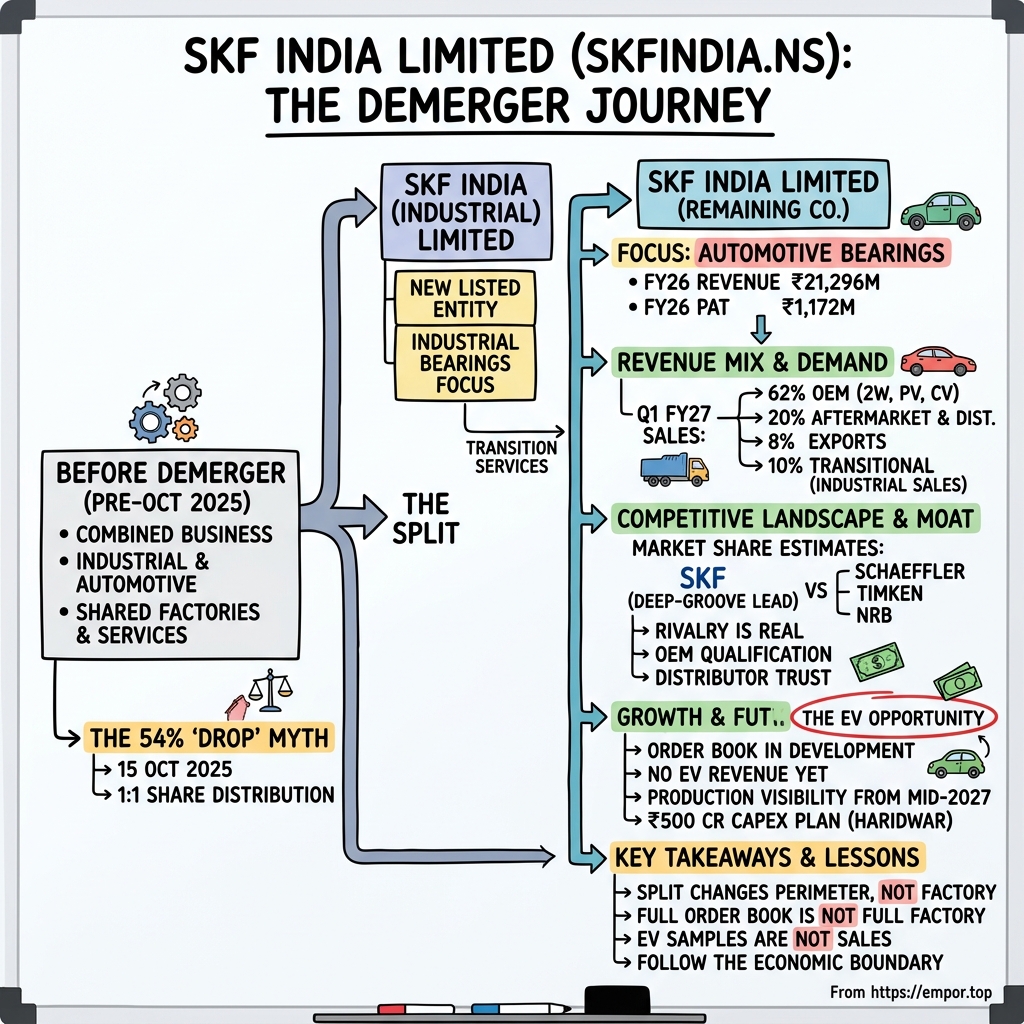
They had not. Nothing had broken at the factories in Pune or Bengaluru, and no customer had walked away. What had happened was quieter and more structural. The stock had started trading without the industrial business that used to sit inside it. Under a scheme of arrangement, SKF India demerged its industrial operations into a new company, SKF India (Industrial) Limited, effective 1 October 2025.2 Shareholders on the record date were entitled to one Industrial share for every SKF India share they held.14 The price "fell" because the shares no longer included a large slice of the old company. The value had been moved into a second envelope, not set on fire.
That envelope took a while to arrive. The Industrial shares listed separately on 5 December 2025, so for several weeks holders owned one quoted security and one entitlement they could not yet sell.4 The confusion is understandable. The cause is simple once it is said plainly: the old ticker, SKFINDIA, now stands for the automotive bearing business, and the industrial bearing business has its own listing.
This story is about the company that kept the old name. That sounds like a technicality, but it shapes every number that follows. Any growth rate, margin, cash-flow ratio or valuation multiple that reaches back before October 2025 describes a bigger, different company. Read carelessly, the history flatters or condemns a business that did not exist in its current form.
So the episode asks four questions, and keeps returning to them.
First: can the automotive company turn its growth into earnings? Revenue rose in FY26, but profit from the continuing business fell by more than half.
Second: can it defend its place against rivals that have been growing faster? SKF is the most famous bearing name in the world, but in India the estimates suggest it has been losing share.
Third: will the new capacity and electric-vehicle programs earn their cost? Management is planning a large capital program while its factories are close to full.
Fourth: does the split make the parent group's dealings and the company's cash conversion easier to judge, or harder?
The split redrew the listed company's boundary. Investors who forget that will misread almost everything else, so the first job is to say exactly what is left inside the box.
 Subscribe on LinkedIn
II. The business that remained — 4 min
Picture the old SKF India as a large house with two families living in it. The automotive family and the industrial family shared the kitchen, the plumbing and the bill for the electricity. They used some of the same factories, the same back office, the same IT systems, and in places the same customers. The 2025 reorganization did not build a wall overnight. It drew a property line, then spent months working out who owned which pipe.
The house itself is old. SKF India was incorporated in 1961 and commissioned its first Pune bearing plant during that decade, as Indian industrial policy pushed for local manufacturing of precision components.6 The long history matters for one reason only: it explains the manufacturing know-how, the qualified product lines and the customer relationships that the automotive company carries forward. Decades of being an approved supplier to vehicle makers is an asset that does not appear on the balance sheet but shows up in which programs a supplier is invited to quote on.
After the split, the FY26 annual results had to do something awkward: present the automotive business as "continuing operations" and push the industrial business into "discontinued operations," then re-present FY25 on the same basis.24
On that basis, the remaining company reported FY26 revenue of about ₹21,300 million, up 15.4% from a re-presented FY25 figure of about ₹18,450 million.3 That is healthy growth for a component supplier. The problem arrives one line lower. Continuing profit after tax fell from about ₹2,630 million to about ₹1,170 million.3 Revenue up by roughly a sixth; profit down by more than half.
The cost lines tell part of the story. Operating expenditure on the continuing perimeter rose from about ₹14,700 million to about ₹18,800 million, much faster than sales.3 Some of that reflects the strange plumbing of a transition year: shared costs being allocated, separation expenses, and products bought from the Industrial company and resold. Some of it may reflect ordinary pressure on margins. The accounts do not separate those two explanations cleanly, and that ambiguity is the most important fact about FY26.
There is a second trap. The full-year cash-flow statement is not split between continuing and discontinued operations.3 It covers nine months of the combined company and three months of the remaining one. Any "cash conversion" ratio calculated from it describes a company that no longer exists.
And a third, about borrowed numbers. AB SKF, the Swedish parent, reports group revenue and market positions on a global scale. SKF India (Industrial) reports its own results. Neither is evidence about the automotive company listed as SKFINDIA, and this story uses neither as a stand-in.
FY26, then, is a useful first bridge to the new company, but it is not a clean run rate. Nine months of it belong to a different perimeter, and the last three months are full of transition flows. The cleaner read starts with what the company actually sells, and to whom.
III. A bearing gets specified, made and replaced — 8 min
On the Q1 FY27 earnings call in August 2026, an analyst asked the question every investor in an auto-component company eventually asks: how do OEM sales divide among two-wheelers, cars and trucks? Management answered with approximate percentages, not audited segment accounts, and declined to go much further.7 That small exchange captures both what is knowable about SKF India's revenue and where the disclosure stops.
What a bearing actually does
Start with the object. A bearing is the component that lets something spin without grinding itself to pieces. Inside a wheel hub, a gearbox, an engine, an alternator or a motor, a shaft has to rotate thousands of times a minute while carrying load. Put metal directly on metal and friction generates heat, wear and failure. A bearing puts a ring of precisely shaped balls or rollers between the moving part and the still part, so the load rolls instead of rubs.
The analogy is a heavy wardrobe. Drag it across the floor and it scrapes and sticks. Put it on a few round logs and it glides. A bearing is those logs, machined to tolerances measured in microns, made of steel that has been heat-treated to survive millions of cycles, and sealed and lubricated so it can do that job inside a car for years without being thought about.
That last point matters commercially. When a bearing works, nobody notices it. When it fails, a wheel can seize or a gearbox can destroy itself. For a vehicle maker, a cheap bearing that fails is enormously expensive. That asymmetry is the foundation of any claim SKF has to pricing power, and it is tested properly in the next section.
Three ways a sale happens
SKF India sells bearings and related components by product and application, through two main routes.78
The first is the OEM route: selling directly to vehicle makers for the production line. Here a bearing is specified at the design stage. Engineers from the supplier and the vehicle maker work out what the application needs, the part is tested and validated, and the supplier is "nominated" for a program. Once a vehicle model is in production, the bearing in it is not casually swapped out, because re-validating a part costs time and carries risk.
The second is distribution and the vehicle aftermarket: selling through distributors and parts channels to mechanics and fleet owners replacing worn components. Here brand, availability and the mechanic's trust carry more weight, and so does price competition, including from cheaper alternatives and counterfeits.
On the Q1 FY27 call, management put the mix at roughly 62% OEM, 20% distribution and vehicle aftermarket, 8% exports and about 10% sales to SKF Industrial during the transition.7 Within OEM, it described about 54% from two-wheelers, 31% from passenger vehicles and 15% from commercial vehicles.7 Two-wheelers, the scooters and motorcycles that dominate Indian roads, therefore account for roughly a third of total company sales on these approximate figures.
Each piece of the mix tells a different story.
The OEM share means SKF India's volumes move with Indian vehicle production. When manufacturers build more vehicles, they need more bearings; when production slows, orders slow with it. Management said Q1 FY27 volumes grew 22% year on year, a strong reading that tracks a buoyant period for vehicle output.7
The aftermarket share is the replacement engine. It should, in principle, be steadier, because the installed base of vehicles keeps wearing out parts whatever new-vehicle sales do. That is the theory. Section V shows that the practice in 2026 was less comfortable.
The 10% sold to SKF Industrial is the oddest item. It exists because some products the automotive company sells are still made in factories that now belong to the Industrial company, and some flows run the other way. Management has said these Industrial volumes are not a growth priority and expects them to decline over time.7 Investors should treat them as scaffolding around the new building, not as part of the structure.
How price moves
Bearings are made from special steel, and steel prices swing. Who absorbs those swings decides margins.
Management said OEM contracts generally link price adjustments to commodity indices, but that recovery can lag by one to two quarters.7 In plain terms: when steel gets more expensive, SKF pays more immediately and gets the money back from vehicle makers later. When steel gets cheaper, the reverse can briefly flatter margins. That makes any single quarter's margin partly a timing artifact, and it means mix, how much is sold to which customer in which channel, matters as much as volume.
What the company does not say
Here the disclosure runs out. SKF India does not publish customer concentration, contract lengths, minimum purchase commitments or the share of revenue under multi-year agreements.78 On the Q4 FY26 call, management declined to give a finer customer or end-market split.8 OEM nominations give visibility over a model's life, but nothing in the company's disclosures establishes that they work like recurring-revenue contracts with guaranteed volume.
It would be tempting to fill the gaps: to divide revenue by an assumed number of bearings and produce an "average selling price," or to assume that a two-wheeler-heavy OEM book means two or three dominant customers. Neither is supportable from what the company publishes. Indian two-wheeler production is concentrated among a handful of manufacturers, so concentration is plausible, but plausible is not disclosed.
The verdict is straightforward. SKF India's main engine is automotive OEM supply, demand follows vehicle production and replacement cycles, and price follows steel with a lag. Investors are underwriting a cyclical volume business whose margins depend on timing and mix. What would make it more than that is a durable edge in winning and keeping programs, and that is where the evidence becomes contested.
IV. When the market leader stopped outgrowing the market — 8 min
Imagine a chart with three lines on it, spanning FY16 to FY23. One is SKF. One is Schaeffler, the German group behind the FAG and INA brands. One is Timken, the American tapered-roller specialist. If SKF's reputation meant what the name suggests, its line would sit on top and stay there. It does not.
In an October 2023 sector report, Centrum Broking estimated SKF India's share of the Indian bearing market at about 27% in FY16 and about 22% in FY23.9 Over the same period, it estimated Schaeffler's share rising from about 14% to about 33%.9 It also estimated that SKF's domestic product revenue grew about 5% a year while the market grew nearly 8% a year.9 A company growing slower than its market loses share by arithmetic, and these estimates say that is what happened.
The rivals
The Indian bearing market is not one market. It is a set of product niches, and each has a different leader. Centrum's FY23 estimates put Schaeffler ahead overall, with SKF leading in deep-groove ball bearings, the workhorse design found across vehicles and machines, while Timken led in tapered roller bearings, used where heavy combined loads appear, such as truck wheel ends, and NRB Bearings led in needle rollers, the slim cylindrical rollers packed into tight spaces like gearboxes.9 National Engineering Industries, maker of the NBC brand, and other global and domestic suppliers compete across these segments.9
That structure matters. It means "the bearing market" is really a collection of specialist fights. A supplier can be dominant in one niche and an also-ran in another, and the overall share figure blends them. It also means rivalry is real: vehicle makers have several qualified alternatives for most bearing types.
What could protect SKF
The case for a moat rests on three mechanisms.
The first is qualification. Getting a bearing approved for a vehicle program means design collaboration, testing and validation. Once a part is in production, switching it costs the vehicle maker time and risk. That gives the incumbent supplier stickiness for the life of a model.
The second is application engineering. Knowing how a bearing behaves inside a particular gearbox at a particular temperature is accumulated knowledge. A supplier with deep application expertise can win the design-in conversation earlier.
The third is distribution and brand in the aftermarket. A mechanic who trusts the SKF name, and a distributor network that can deliver the right part quickly, can support replacement sales even against cheaper alternatives.
All three mechanisms are plausible. None is quantified by the company. SKF India does not publish customer retention, program win rates, lost bids, price realization against peers or measures of switching cost. The moat is an inference from how the industry works, not a number the company reports.
The falsification test
So put the disconfirming evidence directly beside the claim. If qualification, engineering and brand gave SKF a durable advantage, it should at least have held its share. On Centrum's estimates it lost about five points in seven years while Schaeffler more than doubled its share.9
There are honest caveats. The estimates span Schaeffler India's 2018 merger with its sister entities, which mechanically enlarged Schaeffler's reported footprint, so part of the swing reflects a corporate combination rather than customers switching.9 The SKF figures also describe the old combined company, industrial and automotive together, not today's automotive-only business. Neither caveat reverses the direction. SKF grew slower than the market on its own domestic product revenue, and that is not explained by a rival's merger.
Management offered a different framing on its July 2025 analyst call. It described SKF's share as "fairly steady" over the prior three years, gave no specific figures, and said the company had walked away from some low-profit business.10 Both statements can be true at once. A supplier can hold share in the segments it chooses to fight in while losing it in segments it judged unprofitable. But "we walked away" is also what any company says when it loses volume, and without data on which business was abandoned and at what margin, the claim cannot be tested.
The calibrated verdict
The history narrows the moat claim rather than rejecting it. SKF India plausibly has a real advantage in product qualification, application know-how and aftermarket distribution, especially in deep-groove ball bearings. The evidence does not support a claim of broad market leadership or superior growth, and the direction of the share estimates runs against SKF over the longest span available.
The forward test is specific. A generic promise to "gain share" is not useful. Investors can watch whether domestic automotive revenue grows faster than vehicle production, whether price and mix improve rather than erode, whether aftermarket volume recovers, and whether new nominations turn into profitable production. Those are the measures that would show the moat widening or confirm it is shallower than the brand suggests. The biggest nomination question of all concerns vehicles that do not burn fuel.
V. The EV order book is not yet an EV profit pool — 6 min
On the Q1 FY27 call, an analyst asked the question that hangs over every Indian auto-component company now: how much revenue comes from electric vehicles, and what is the market share? Management's answer was candid. The EV business is still in development, and it gave no revenue figure.7
That answer deserves credit for honesty, and it sets the boundary for this section. EV bearings are a possible future. They are not a business today.
Why EVs change bearings without removing them
Electric vehicles still have wheels, axles and rotating shafts, so they still need bearings. But the bearing content changes. An electric motor spins much faster than a combustion engine, sometimes over 15,000 revolutions a minute, so bearings need different tolerances and lubrication. Stray electrical currents can pass through a bearing and pit its surfaces, a failure mode that needs insulated or hybrid designs. And an EV drops many of the combustion-engine and multi-speed-gearbox applications where bearings used to sit.
So electrification is not a simple tailwind or headwind. It shifts the bearing mix toward higher-specification parts and away from some traditional ones. For a supplier with strong engineering, that can be an opportunity to sell more valuable parts. For a supplier that is slow to qualify, it is a chance for rivals to take the new programs.
What management said
Management described development programs across vehicle segments and said EV platforms were expected to enter production from around mid-2027, with fuller visibility building toward 2028.7 It did not quantify current EV revenue or share.7
Certification is not commercialization. A sample shipped, a validation passed or a technology show attended is evidence of capability. It is not revenue, and it is certainly not margin. The case for EV bearings depends on three things the company has not yet shown: that customer programs actually ramp to volume, that SKF's share of those programs is meaningful, and that the parts earn returns above the cost of the capacity built for them.
The factory is nearly full
The more concrete near-term story is capacity. Management said factory loading was around 93%, that efficiency upgrades had freed up about five million additional pieces, and that a capital plan of roughly ₹500 crore, about ₹5,000 million, included new capacity at Haridwar.7
The stated purpose is revealing. Management said the new capacity is primarily meant to reduce dependence on products sourced from SKF Industrial, with growth a secondary benefit.7 In other words, a good part of the first wave of investment is about finishing the separation: making in-house what the automotive company currently buys from its former sibling. The new line is expected to start late in FY27 and contribute more in FY28.7
That is a sensible goal, and it should help margins if in-house production costs less than buying from Industrial. But it reframes the capex. Part of ₹500 crore is the price of the demerger, not a bet on new demand.
The counterweight
The same call carried less comfortable news. Management said vehicle aftermarket revenue was flat to slightly down, acknowledged recent discounting, and described a plan to recover volume.7 It also said some product lines are low-margin or loss-making and are candidates for rationalization.7
Put those statements beside the EV optimism and the picture becomes balanced. The established replacement business, which should be the steady earner, needed price cuts to hold volume. Some existing products lose money. And the new growth lane has no revenue yet.
Operating context belongs in proportion too. SKF India points to decarbonized plants, water-positive sites and customer technology shows.5 Those may matter for winning programs with vehicle makers that care about supply-chain emissions. They are not evidence of a profitable EV business.
EV bearings are a plausible extension of SKF India's core skills. The investment case should give them weight only as programs convert to quantified revenue. Until then, the question is whether the existing business throws off enough cash to fund the capacity, and that is harder to answer than it looks.
VI. The cash arrived, but whose cash was it? — 5 min
Open the FY26 cash-flow statement and one line jumps out. Trade receivables, money owed by customers, absorbed about ₹5,000 million of cash during the year.3 Capital spending used about ₹2,300 million.3 The company's customers, in effect, borrowed more than twice what it spent building factories.
That should be alarming. Then the next line arrives, and the picture changes.
The cash bridge
FY26 cash from operations was about ₹3,600 million, against total profit after tax, continuing and discontinued together, of about ₹2,660 million.3 On the face of it, the company turned more than a rupee of cash for every rupee of profit. That looks like strong conversion.
Walk through how it got there. Depreciation of about ₹630 million and other non-cash charges were added back.3 Then working capital moved violently in both directions. Receivables consumed about ₹5,000 million, but higher payables, money SKF owed its own suppliers, provided about ₹4,670 million, and inventory release added about ₹190 million.3 The receivables hole and the payables cushion almost cancelled out.
Those are enormous swings for a company of this size, and they were almost certainly shaped by the demerger: balances being transferred, invoices raised for transition services, intercompany flows between the two SKF companies. As noted above, the cash-flow statement is not split.3 So the honest conclusion is narrow: the combined company generated more cash than reported profit in FY26, through working-capital movements large enough to dominate the result. It does not establish how well the standalone automotive company converts profit into cash.
Receivables quality
Trade receivables ended FY26 at about ₹7,170 million, down from about ₹8,490 million a year earlier.3 That decline is not evidence of better collection, because the opening balance included the industrial business and the closing balance does not.
The more useful question is how much of the balance is overdue, and from whom. SKF India says it reviews overdue balances individually and provisions on a lifetime expected-credit-loss basis, meaning it estimates losses over the full life of each receivable rather than waiting for a default.4 It recorded no impairment on related-party receivables in FY26 or FY25.4 That says the group's own balances are being paid. It says nothing about third-party customers. The publicly accessible version of the FY26 receivables-ageing note does not reproduce its figures, so overdue exposure by bucket remains unclear from the company's published material.
The treasury layer
Other income, mostly interest and returns on surplus cash, was about ₹770 million in FY26, around 29% of continuing profit before tax and exceptional items.3 Cash at year-end was about ₹2,920 million, with surplus funds held in bank deposits and quoted government securities.34
That share matters. When almost three rupees in ten of pre-tax profit come from treasury, the operating business is earning less than the headline suggests. And the demerger moved cash between the companies, so the year-end balance should not be read as a full-year average earning interest. As cash is spent on the Haridwar capacity, this treasury cushion will shrink, which will pull reported profit down unless operations improve.
What to track
The measure that matters is post-demerger operating cash flow, read alongside receivable days and overdue ageing. As noted above, the FY26 cash conversion ratio belongs to the old company. The first clean year will show whether the automotive business collects as well as it sells. Some of those cash flows ran through the parent group, and that relationship has its own accounting puzzle.
VII. The split created two companies, but left a shared bill — 5 min
For six months after the demerger, a strange kind of business went on inside SKF India. Some customer contracts had not yet been transferred, or "novated," to the new Industrial company. So SKF India kept billing those customers, for work Industrial was actually doing, and passed the money along.
Between 1 October 2025 and 31 March 2026, SKF India billed about ₹1,040 million for services performed by Industrial on its behalf and passed through about ₹1,460 million of inventory.4 Together that is about ₹2,500 million, more than a tenth of the continuing company's annual revenue. These flows are not ordinary automotive demand. They are the paperwork of separation, and anyone measuring the remaining company's growth or margin needs to strip them out.
The parent in the room
The larger relationship is with the parent. AB SKF held 52.58% of SKF India at 31 March 2026.4 The holding went through an intra-group reshuffle: SKF UK and SKF Förvaltning transferred their stakes to AB SKF on 1 October 2025, and AB SKF moved the stake to its wholly owned SKF Vertevo AB on 22 December 2025.4 That was a change in the holding vehicle, not in control.
A controlling parent can be a large advantage. It brings global product designs, engineering support, a brand recognised in every workshop, and sourcing scale. It also creates a channel through which value can move in either direction: royalties paid for the brand and technology, products bought from group factories, and service charges for IT and administration.
SKF India lists services it receives from the group, including administration, IT, royalty and trademark services.4 The company describes its related-party dealings as arm's length, its balances as unsecured and settled in cash, and recorded no impairment of related-party receivables in FY26 or FY25.4 Those are the stated controls.
What the accessible FY26 disclosure does not easily expose is the current-year value of affiliate purchases and royalties, by category. That is the number a skeptical investor would most want: how much of each rupee of revenue flows back to the group. The pre-demerger record shows why it matters. In the 15 months to March 2016, the old combined company bought about ₹9,780 million of raw materials and finished goods from related parties.6 That figure belongs to a different business with a different perimeter, and it should not be used as today's run rate. But it shows that affiliate sourcing has historically been large relative to sales.
The tax trail
Transfer pricing, the price at which group companies charge each other, attracts tax-authority scrutiny for exactly this reason. Here there is a concrete outcome. On 18 March 2026, SKF India signed an advance-pricing agreement with the tax authority covering FY13 to FY20 transfer-pricing matters with the ultimate parent.4 An advance-pricing agreement is essentially a negotiated settlement in advance on what counts as a fair intra-group price. Total contingent claims fell to about ₹2,140 million from about ₹5,820 million, as historic claims were removed and prior-period tax charges booked.4 A FY22 transfer-pricing assessment of about ₹690 million remains under appeal.4 Tax matters carried through the demerger come with a contractual right of reimbursement between the two companies for final settlements.4
That is a meaningful clean-up of a long-running overhang, though it also confirms that the tax authority has repeatedly challenged the group's internal pricing.
Currency and the balance sheet
SKF India imports more than it exports and identifies exposure to the US dollar, the euro and the Swedish krona.4 It says it seeks to recover material currency movements from customers.4 The company does not quantify hedge volumes, annual FX gains or losses, or how long recovery takes, so the margin effect of a sharp rupee move is unclear.
The balance sheet keeps everything else in proportion. SKF India reported no funded borrowings; lease liabilities were about ₹29 million, and sanctioned working-capital lines of about ₹1,730 million went unused.34 The company did not obtain a credit rating, so there is no agency rationale to lean on.12 Debt is not the risk here.
The verdict: the transition flows are material and should be separated from automotive demand, and the parent relationship is governed by stated controls, but its current cost to minority shareholders is not laid out in one easy schedule. The people now responsible for running the remaining company took over at exactly the moment the boundary was drawn.
VIII. A new management team inherits a full factory — 5 min
On the Q1 FY27 call in August 2026, analysts pressed management on the factory and aftermarket pressures described above, and its growth outlook.7 The new leadership's answers were the first serious test of its credibility.
Who is running it
The leadership changed with the demerger. Mukund Vasudevan stepped down as managing director effective 30 September 2025 and became a non-executive director.5 Shailesh Sharma became managing director on 1 October 2025, the day the demerger took effect.5 Chief financial officer Ashish Saraf also left on 30 September 2025, with Aashi Arora appointed interim CFO the next day.5 By the Q1 FY27 call, Mayank Holani was the finance lead speaking for the company.7
That turnover matters for accountability. The FY26 results span the old team's last nine months and the new team's first three. The profit decline cannot be pinned on the current leadership, and nor can any recovery yet be credited to it. The company does not publish detailed biographies or pay terms in its annual report, so judging this team means judging what it says and whether it happens.
Reading the call as a credibility test
The Q1 FY27 numbers were striking in both directions. Management said revenue grew about 27% on its own reconstructed comparison, with volumes up 22%.7 Yet quarterly net profit fell about 48% to about ₹619 million, according to ETAuto's reading of the reported results.14 The reconstructed growth figure is management's own adjustment for the changed perimeter, so it should be weighed as a management claim.
Management raised its growth outlook toward 20%, after earlier guidance around 12%.78 It reiterated the capacity and loading details described above.7 It also volunteered the bad news: aftermarket weakness, recent discounting, and a plan to recover volume.7
That is better than vague. Specific dates, a specific loading figure and an acknowledged weakness give investors something to check. But it is one quarter from a new team, and the gap between revenue growth and profit decline is exactly the gap the team has to close.
Disclosure versus delivery
Management says it will rationalize loss-making products and redirect capacity toward automotive customers.7 The call did not provide product-level profitability, the revenue at stake in rationalization, or a payback calculation for the capex. Raising the growth outlook from about 12% to about 20% within a few months could reflect genuinely stronger demand, or it could reflect an outlook that moves with the latest quarter. The next three quarters will show which.
Incentives and accountability
As noted above, AB SKF controls the board.4 Parent ownership does not by itself align management with minority shareholders. The parent earns from SKF India through dividends and also through royalties, services and product sales, so its interests overlap with minorities' but are not identical.
The FY26 directors' report says detailed employee-remuneration information is available for inspection rather than reproduced in the report.5 The managing director's pay trend against profit, and any equity-linked incentive, are not set out in the published report, so pay-for-performance alignment cannot be shown.
At the 65th AGM in August 2026, the resolutions passed with the requisite majority.11 The summary outcome does not show dissent percentages. The AGM says only that the parent's votes carried, which they almost always will.
The verdict on management is "testable, not yet tested." The answers were specific enough to be held against outcomes. That leads straight to the question the market is pricing.
IX. Analysis & Bull vs. Bear — 5 min
Put two facts side by side. At the 1 October 2026 close, SKF India traded around ₹1,450 a share, roughly 34 times trailing earnings.13 And its continuing profit in FY26 had more than halved. A multiple in the mid-thirties for a business whose earnings just fell sharply is a bet on the future, not a reward for the past. So what is it a bet on?
The bull case
SKF India sells components that vehicles cannot run without, into one of the world's largest and fastest-growing vehicle markets. Its OEM relationships and application engineering plausibly protect qualified supply for the life of each program. The company says its factories are nearly full, a sign of demand, and that new capacity should add output and replace costlier products bought from Industrial, which could lift margins. Q1 FY27 volumes grew strongly.7 There is no debt.3 And EV bearing programs offer a new lane from 2027 onward, with higher-specification parts.7
The bear case
The bear has real evidence, not just worries. Profit fell sharply in FY26 even as revenue rose.3 Quarterly profit fell again in Q1 FY27.14 On Centrum's estimates, SKF's domestic growth lagged the market and its share declined while Schaeffler's expanded.9 Aftermarket volume weakened and needed discounting.7 Price recovery lags steel costs by a quarter or two.7 Treasury income props up a large slice of pre-tax profit.3 EV revenue remains unquantified.7 And the capex hurdle has risen: the business must earn returns on ₹500 crore of new capacity from a lower profit base.
Porter's Five Forces
Rivalry is high. Schaeffler, Timken, NRB, NBC and others each lead distinct bearing niches, and vehicle makers can usually qualify more than one supplier.9
Buyer power is meaningful. Indian vehicle production is concentrated among large manufacturers who negotiate hard and index prices to commodities. SKF India does not disclose its customer concentration, which leaves the exact degree unknown.
Supplier power is moderate. Special steel is a commodity input with volatile pricing, and a meaningful share of product and know-how comes from the parent group, whose terms minorities cannot fully see.
Threat of new entrants is limited by qualification, precision manufacturing and distribution reach. Those are entry barriers, not an unassailable moat; Schaeffler's rise shows that a determined, well-capitalized rival can gain ground.
Threat of substitutes is application-specific. Nothing replaces the bearing as such, but electrification changes which bearings a vehicle needs. In the aftermarket, cheaper and counterfeit products pressure price.
Hamilton Helmer's 7 Powers
Switching costs are the strongest candidate. Re-qualifying a bearing in a production vehicle is costly, giving incumbents stickiness through a model's life. But switching happens at each new model, and the share history suggests SKF has not won its share of new programs.
Branding is real in the aftermarket, where mechanic trust matters, but the need to discount in 2026 limits how much premium the brand commands.
Scale economies exist at the global SKF group level, in research and product design, and reach the listed company only through the parent relationship, at a cost that is not fully published.
Cornered resource is weak; the know-how is shared with group companies and partly licensed.
Counter-positioning, network economies and process power do not clearly apply. Nothing in the record shows SKF India producing at structurally lower cost than Schaeffler or Timken in India.
The honest summary is one power, switching costs, held program by program, plus brand in the aftermarket. That is a real but modest moat, consistent with a company that defends its position rather than one that compounds share.
Valuation as data
A trailing P/E of about 34 is a dated reference, not a verdict.13 The trailing period straddles the demerger, so the "E" mixes perimeters, and the stock's own historical multiple series describes a combined company. A fair comparison with Schaeffler India and Timken India would need consistent post-demerger earnings and current prices for all three. What can be said is that the price assumes margins recover from the FY26 trough and that growth near management's outlook persists; it does not price SKF India as a business in decline.
Three KPIs
First, automotive revenue growth against vehicle production. The latest reading is strong, with growth measured against a reconstructed base.7 The direction is up, but on a reconstructed base.
Second, operating margin, as own capacity replaces Industrial-sourced product and price recovery catches up with input costs. The direction is down: FY26 continuing profit more than halved, and Q1 FY27 profit fell again.314
Third, receivable days and operating cash conversion after the split. There is no clean post-demerger reading yet.
Events that settle the debate
The first full year of clean automotive-only results. Haridwar commissioning and utilization. Aftermarket volume recovering without further discounts. Quantified EV revenue once production ramps. A published receivables ageing and a complete affiliate-transaction schedule. Each will move the argument more than any change in the share price.
X. Playbook: Business & Investing Lessons — 3 min
A shareholder opens a brokerage statement in December 2025 and finds two SKF lines where there used to be one. One holds the industrial business. The other holds the automotive factories, now running at over 90% of capacity, with a capex bill on the way. The lessons sit in the gap between those two lines.
"A spin-off changes the perimeter before it changes the factory." On 1 October 2025, the legal boundary moved. The factories, the shared IT systems, and the contracts not yet novated did not move with it.4 For any investor in a demerged company, the first task is to separate continuing operations from transition flows before calculating a single growth rate.
"A full order book is not a full factory." Loading near 93% sounds like strength, and the company says it is a sign of demand.7 But high utilization is also a constraint: it caps growth until new lines run, and new lines bring commissioning risk, ramp-up costs and yield problems. Capacity turns into profit only after it is commissioned and runs at good yield, and investors should watch Haridwar, not the order book.
"A bearing can be technically essential and still be commercially ordinary." No vehicle runs without bearings, and a failed bearing is a costly problem. SKF has the most famous name in the industry. Yet on the best available estimates its Indian share fell while a rival's more than doubled.9 Being essential protects the category. It does not protect any one supplier's share or price.
"A sample is not a sale." EV programs, validation wins and technology shows are evidence of capability.7 They earn weight in an investment case only when customer programs ramp to revenue with margins. The test is conversion.
"Cash has a boundary too." As noted above, FY26 cash from operations exceeded profit, but the combined statement cannot prove the standalone company's collection discipline.3 Only the post-split statements can.
XI. Epilogue — 2 min
Tonight, SKF India stands at an awkward midpoint. It has a new managing director a year into the job, a factory the company says is close to full, a capital plan the company says it has approved, a growth outlook the company has raised toward 20%, and a profit line that has not yet followed revenue upward.5714 The first complete post-demerger fiscal year, FY27, is half over.
The next moments that will decide the story are already on the calendar.
The coming quarterly calls will show whether management keeps its growth outlook. If it does, and margins improve with it, the 12%-to-20% upgrade will look like insight. If the outlook slips, the test is whether management explains the miss in quantified terms, volume, price, mix and cost, or in generalities.
The company says the Haridwar line is due to start late in FY27.7 Its commissioning date and its early utilization will show whether the capex is replacing Industrial-sourced product as promised. Watch the share of sales still bought from SKF Industrial: as it falls, margins should rise if the in-house economics are better. If it does not fall, the separation is taking longer and costing more than planned.
The aftermarket is the quiet test. Recovery in volume without further discounting would suggest the brand still carries pricing weight. More discounting would suggest the replacement market is becoming a price fight.
Then come the EV programs, with the company expecting production from mid-2027 and fuller visibility in 2028.7 The first quantified EV revenue figure will turn optionality into evidence, one way or the other.
And the market-share debate should be revisited only when a consistent, post-demerger series exists. Until then, any confident claim about SKF India's competitive position rests on estimates that describe a different company.
The split's success was not settled by the listing. It will be settled by whether the remaining company compounds earnings with cleaner economics. Revenue is moving. Profit is not yet. That gap is the tension to watch.
XII. Outro — 1 min
Somewhere on an Indian highway tonight, a scooter's wheel turns on an SKF bearing, as it would have in 1965 or 1995. The bearing does not know that its maker is now two listed companies, or that a share price once appeared to halve in a morning. It just has to spin, quietly, for years.
The company that made it faces the same test as the part. Its reinvention depends on whether the new automotive company can make profit, and then cash, spin as smoothly as its products.
References
-
Did SKF India shares really crash 54% in intraday trade? Here's the truth — The Economic Times, 2025-10-15 ↩↩
-
SKF India Limited completes demerger of its industrial business — SKF India, 2025-10-13 ↩↩
-
SKF India Limited FY26 audited results and auditor reports — NSE, 2026-05-13 ↩↩↩↩↩↩↩↩↩↩↩↩↩↩↩↩↩↩↩
-
SKF India Ltd. Notes to Accounts, FY26 — Goodreturns ↩↩↩↩↩↩↩↩↩↩↩↩↩↩↩↩↩↩↩↩
-
SKF India Ltd Directors' Report, FY26 — India Infoline ↩↩↩↩↩↩
-
SKF India Q1 FY27 Earnings Call Transcript — Stock Analysis, 2026-08-17 ↩↩↩↩↩↩↩↩↩↩↩↩↩↩↩↩↩↩↩↩↩↩↩↩↩↩↩↩↩↩↩↩↩↩
-
SKF India Q4 FY26 Earnings Call Transcript — Stock Analysis ↩↩↩↩
-
Indian Bearing Sector — Centrum Broking, 2023-10-12 ↩↩↩↩↩↩↩↩↩↩
-
SKF India Limited analyst call transcript — NSE, 2025-07-21 ↩
-
SKF India Ltd outcome of the 65th Annual General Meeting — BazaarWatch, 2026-08-14 ↩
-
SKF India FY26 Integrated Governance Filing — NSE, 2026-05-20 ↩
-
SKF India historical market data and valuation snapshot — Scripbook, 2026-10-01 ↩↩
-
SKF India Q1 net profit falls 47.6% to ₹61.9 crore — ETAuto, 2026 ↩↩↩↩
 LinkedIn
 WhatsApp
 Reddit
 Hacker News
 Email
Email Kindle
 RSS Feed
 Spotify
 Apple Podcasts
 Amazon Music
 Audible
 YouTube