Siemens Limited: The Industrial Engine of India's Capex Supercycle
I. Introduction & Episode Roadmap (10:00)
On a July morning in 2026, a screen on Dalal Street shows a number that ought to make a value investor put down their coffee. Siemens Limited — the Indian arm of a 179-year-old German engineering house — trades at roughly ₹3,668 a share, carrying a market capitalisation of about ₹1.31 trillion, or a shade over $15 billion.1 That is not, in itself, remarkable. What is remarkable is what sits underneath the price: a company that sells switchgear, transformers, factory controllers and freight locomotives, and whose most recent reported quarter saw profit fall nearly 10 percent.2
Capital goods companies are supposed to be boring. They are supposed to trade at fifteen times earnings, twenty in a good year, and to be periodically destroyed by the cycle. Siemens Limited trades in the low-to-mid eighties on trailing earnings — a multiple ordinarily reserved for consumer franchises with pricing power measured in decades, or software businesses with gross margins in the nineties. It is a company that makes physical objects out of copper and steel, sells many of them to state-owned railways and utilities, and is 69 percent owned by a parent in Munich that does not have to ask Indian minority shareholders for permission to do very much at all.3
So the question that animates this story is simple to ask and genuinely hard to answer: how did a controlled subsidiary of a German industrial conglomerate become one of the most expensively valued capital-goods companies on earth — and is the market pricing a durable machine, or a moment?
The answer runs through four distinct stories, and they do not all point the same direction.
The first is the invisible machinery. Almost nobody outside the industry can name a Siemens product, yet the company's equipment sits inside the electrical spine of modern India — the substations feeding hyperscale data centres, the control systems running cement kilns and pharmaceutical plants, the signalling that moves freight across the Indian Railways network. This is infrastructure-as-plumbing: unglamorous, deeply embedded, and very difficult to rip out once installed.
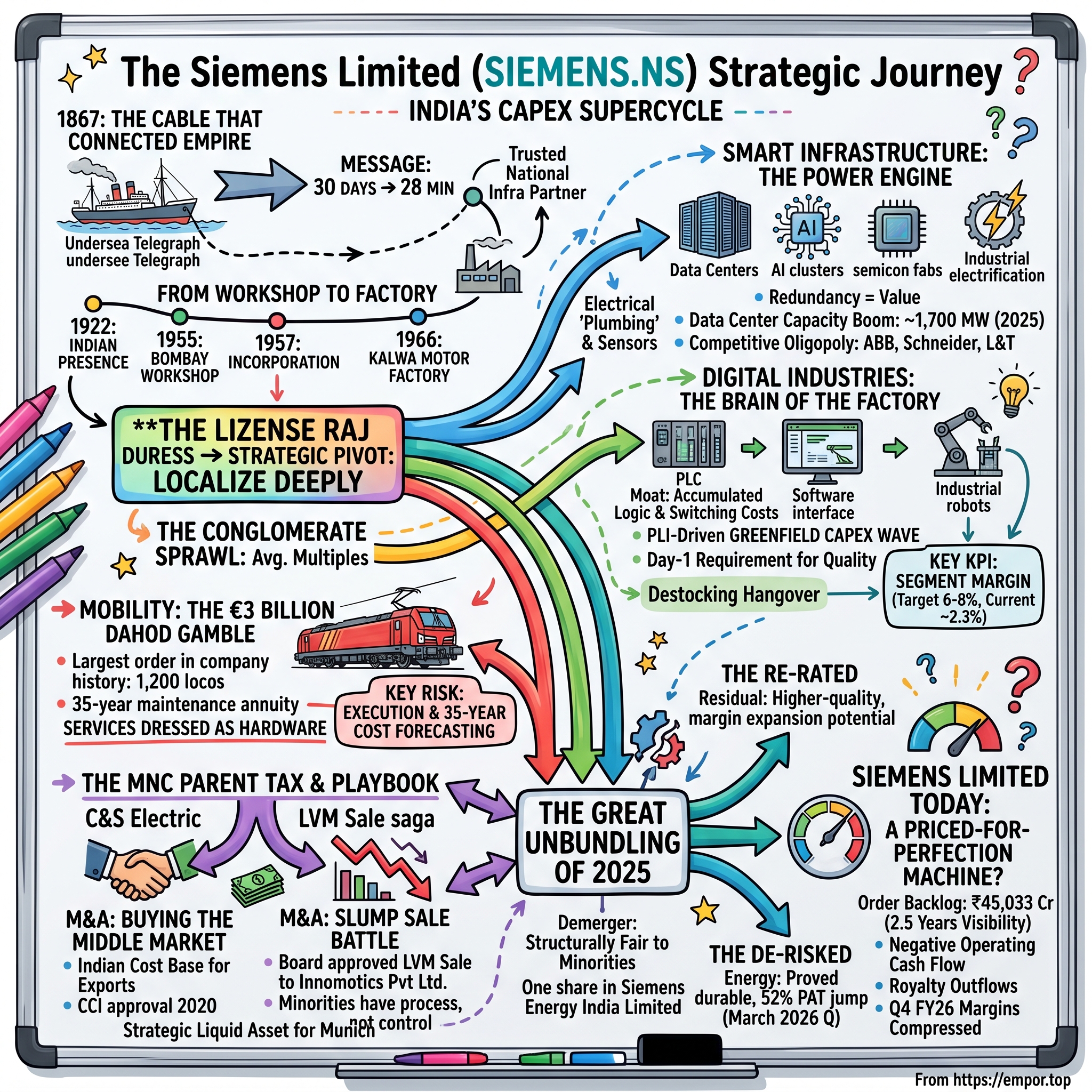
The second is the great unbundling of 2025. For most of its listed life, Siemens Limited was a conglomerate stapled together — a heavy, lumpy, project-driven power and energy business bolted onto a lighter, faster automation and infrastructure business. In March 2025 the two were separated, and shareholders received one share of Siemens Energy India Limited for every share they held.4 What remained was a different company with a different margin structure and, the market decided, a different multiple.
The third is the parent-subsidiary tension — the quiet, recurring theme of every Indian MNC subsidiary story. Siemens AG has twice used its Indian listed vehicle as a strategic lever: once in November 2023, buying an 18 percent stake from a distressed Siemens Energy AG at a deliberate discount to market,5 and again through the sale of the Low Voltage Motors business, which finally closed on 1 June 2026 after a three-year saga that began with the stock falling 10 percent in a single session.67 The lesson for minority holders is uncomfortable and worth sitting with.
The fourth is the playbook — what actually drives orders in Indian capital goods, how Siemens stacks up against ABB, Schneider Electric, L&T and Alstom, and whether the mechanisms behind the premium multiple are real, measurable, and durable, or whether they are cyclical tailwinds wearing the costume of a moat.
We will test each of these rather than assume them. Because the awkward truth visible in the most recent numbers is that this exquisitely valued company is currently having a fairly difficult time operationally — margins compressing, one segment earning a small fraction of its target profitability, and cash conversion running negative. Whether that is noise inside a structural growth story or the first crack in a priced-for-perfection narrative is the central question. And to answer it, we have to start much earlier than 2026 — with a cable at the bottom of the Black Sea.
 Subscribe on LinkedIn
II. The 1867 London-to-Calcutta Line & Indian Localization (15:00)
In 1867, a message from London to Calcutta took roughly thirty days. It travelled by ship, by rider, by hand. The British Empire's administrative nervous system ran at the speed of the monsoon.
That year, Siemens Brothers won the contract to change it: an 11,000-kilometre telegraph line running overland and undersea from London through Prussia, Russia, Persia and the Gulf, terminating in Calcutta. It was completed in 1870, and the effect was violent. Message transit collapsed from about thirty days to twenty-eight minutes.8 To grasp what that meant, imagine compressing a month of decision latency into the length of a tea break — for an empire that governed a subcontinent by correspondence.
This matters for the modern story in one specific way, and it is not sentiment. It is that Siemens' relationship with India began as a contract with the state to build critical national infrastructure. Not as a consumer brand, not as an importer of goods, but as the entity trusted to lay the wire that the government's authority travelled along. Nearly 160 years later, the company's largest single order is once again a contract with an arm of the Indian state to build infrastructure that the country runs on. The business model has been strikingly consistent; only the technology changed.
From workshop to factory
The modern Indian company grew out of something considerably humbler than a transcontinental telegraph. Siemens established a formal Indian presence in 1922, but manufacturing began in 1955 with roughly two dozen workers in a small workshop beneath the Mahalaxmi bridge in Bombay. A year later came the first proper factory at Worli, assembling switchboards from imported components with little more than a drilling machine and a power saw.9 The company was incorporated in its present corporate lineage on 2 March 1957.9
Then came the hard decades. Post-independence India built an industrial policy regime — the License Raj — designed explicitly to constrain foreign capital and force domestic capability. Import licences were rationed. Foreign equity was capped and periodically forced down. Capacity itself required government permission. For a German engineering company whose entire competitive advantage lay in importing superior technology, this was close to an existential design problem.
Siemens' response is the single most important strategic decision in its Indian history, and it was made under duress rather than from foresight: localise, deeply and early. Medical equipment assembly was added at Worli from 1959, switchgear manufacturing from 1960, and in 1966 the company built a motors factory at Kalwa in Thane — a plant that is still operating and was digitalised decades later as a showcase of Siemens' own automation technology.109
The analytical point is that the License Raj, which was intended to punish multinationals, inadvertently forced Siemens to build exactly the asset that would matter most sixty years later: a genuinely Indian manufacturing base, an Indian engineering workforce, and Indian supply chains. Competitors who chose to serve the market through imports and agents were structurally disadvantaged when procurement rules later began favouring domestic content — and when currency moves made imported equipment ruinously expensive. Siemens did not out-think the regime. It adapted to it, and the adaptation compounded.
The conglomerate that grew too many arms
By the 2000s, the accumulated result was a sprawl. Siemens Limited at various points touched power generation equipment, transmission and distribution, industrial automation, building technologies, healthcare imaging, mobility and rail, motors and drives. This was a faithful mirror of the parent: Siemens AG in Munich was itself a conglomerate running everything from hearing aids to gas turbines.
Conglomerates of this kind carry a specific investor problem. The parts have wildly different economics — a gas turbine project business consumes working capital and books revenue over years with execution risk on every contract, while an industrial software and controls business turns over inventory quickly, carries high gross margins, and scales without much incremental capital. Bundle them and you get an average. Averages get average multiples.
Munich spent the 2010s and 2020s systematically dismantling that structure globally — spinning out healthcare as Siemens Healthineers, carving off the energy business as Siemens Energy AG, divesting large drives. India, being a separately listed entity with its own minority shareholders, could not simply follow. It had to be untangled deal by deal, each one requiring boards, valuers, regulators and — sometimes — a fight.
Which brings us to the structural question that governs everything else: who actually controls this company, and in whose interest is it run?
III. The MNC Structure: Who Really Owns Siemens India? (15:00)
Here is a thought experiment. You own a business in India that is growing, cash-generative, and worth over ₹1.3 trillion in the public market. You own 69 percent of it. The remaining 31 percent is held by Indian mutual funds, foreign institutions, and retail investors who bought the shares on the National Stock Exchange.
Why on earth would you keep the other 31 percent outstanding? Why not buy it in, delist, and stop having to explain yourself to proxy advisers every time you want to reorganise a division?
The architecture
The ownership stack is straightforward. Siemens AG of Munich holds roughly 69 percent. Siemens Energy AG holds a residual 6 percent. The free float is about 25 percent.11 Promoter holding in aggregate therefore sits at about three-quarters of the company, which is close to the maximum permitted under Indian listing rules requiring a 25 percent public shareholding — a constraint that itself explains why the parent cannot simply creep further up the register without triggering a delisting process.12
Why stay listed
Several reasons, and they are more practical than sentimental.
Local listing confers procurement legitimacy. A meaningful share of Siemens' Indian order book comes from state entities — Indian Railways, state electricity boards, public sector undertakings, municipal transit authorities. A publicly listed Indian company with Indian directors, Indian audited accounts and Indian regulatory disclosure is a materially easier counterparty for a government buyer than a wholly-owned foreign subsidiary. Under "Make in India" and domestic-content preference frameworks, that distinction has hardened from soft advantage to procurement scoring.
Local listing also creates a talent and currency instrument. An Indian listed entity can attract senior Indian executives who want to run a listed company rather than a branch office, and it gives the group an acquisition currency and a local capital access point it does not otherwise have.
And there is a less-discussed reason: a listed subsidiary is a liquid asset. A 100 percent-owned subsidiary is worth whatever an internal transfer-pricing memo says it is worth. A listed subsidiary has a daily, observable, third-party-validated price — and that turns out to be extremely useful when the group needs to move value between its own entities in a hurry.
November 2023: the Indian jewel becomes a fire escape
Which is precisely what happened in late 2023.
The context was a crisis at Siemens Energy AG. The former Siemens power business, spun out and separately listed, had been hit by severe quality problems in its Siemens Gamesa wind turbine unit. The damage was large enough that in November 2023 Siemens Energy secured a guarantee package of roughly €15 billion involving the German government, banks and Siemens AG itself.13 Guarantees are the lifeblood of project businesses — without them you cannot bid — and Siemens Energy was running out of balance sheet to support them.
Siemens Energy AG also happened to own 24 percent of Siemens Limited India, an asset that had appreciated enormously and had nothing to do with wind turbines.
On 15 November 2023, Siemens AG announced it would purchase 18 percentage points of that stake for €2.1 billion in cash, taking its own holding from 51 percent to 69 percent and reducing Siemens Energy's to 6 percent.514 The parent also agreed indirect financial measures of about €1 billion to help Siemens Energy arrange third-party guarantees.5
The detail that made Indian governance observers sit up was the price. The purchase was struck at a 15 percent discount to the five-trading-day volume-weighted average price before signing — described in the announcement as a customary discount for a block of that size.5
Now, a bulk-block discount is genuinely normal in equity markets; moving 18 percent of a company in one transaction is not something you do at screen price. But consider the structure from a minority shareholder's seat. Two entities, both controlled or heavily influenced by the same Munich orbit, transacted a large block of your company between themselves, at a price they set, at a discount to the market price you paid — with the proceeds used to solve a balance-sheet problem at one of them that had nothing whatsoever to do with Indian operations. No Indian minority shareholder was offered participation. No open offer was triggered, because inter-se promoter transfers are treated differently under Indian takeover rules.
Nothing here was improper. Everything here was informative. It established, in the clearest possible terms, that Siemens Limited India is simultaneously two things: an operating business serving Indian customers, and a strategically liquid asset on Munich's balance sheet. When the two roles conflict, the record suggests which one wins.
The same announcement contained the seed of the next act. Siemens and Siemens Energy agreed to propose to the Indian board a demerger of the energy business, with the stated aim of completing it in 2025 — significantly earlier than previously planned.5 That decision would eventually reshape what Siemens Limited is. But before we get to the split, we should understand what was left standing after it: the segment that now carries the company.
IV. The Power Engine: Smart Infrastructure and the Data Center Boom (25:00)
Walk into a hyperscale data centre under construction on the outskirts of Mumbai or Hyderabad and the thing that surprises most visitors is how little of it is computers. The servers occupy the middle. Everything else — and it is most of the building — is the apparatus for delivering absolutely reliable electricity to those servers and removing the heat they produce.
That apparatus is Siemens Limited's largest business.
What "Smart Infrastructure" actually means
The segment name is corporate and unhelpful, so here is the plain-English version. When electricity arrives at an industrial site or a large building, it arrives at high voltage — useful for transmission over distance, lethal and useless for equipment. It must be stepped down, split into circuits, protected against faults, monitored, and switched. The equipment that does this is switchgear, transformers, busbars, circuit breakers and protection relays. Layered on top is software that watches the whole electrical estate — a substation that reports its own health, a building system that dims lights and modulates chillers based on occupancy.
Think of it as the plumbing of a building's electrical system, plus the sensors and valves that make the plumbing self-aware.
In the quarter ended March 2026, Smart Infrastructure produced revenue of ₹2,594 crore out of a company total of ₹4,618 crore — a shade over 56 percent of the business.2 It is not a segment; it is the company's centre of gravity.
Why demand is genuinely structural, not merely cyclical
Three demand pools have converged, and each one has a physical mechanism behind it rather than a slogan.
Data centres. India's installed data centre capacity crossed roughly 1,700 MW during 2025, after a supply addition of about 440 MW — itself up around 160 percent on the prior year. Roughly 500 MW of further capacity was expected to be added during 2026, implying growth near 30 percent.15 Cumulative investment commitments reached about $126 billion by the end of 2025 and were projected to exceed $180 billion during 2026.16
The mechanism matters more than the megawatts. A data centre's economic value depends on uptime, and uptime depends on electrical redundancy. Operators build power paths in duplicate or triplicate, which means a facility of a given capacity buys substantially more switchgear than a factory of the same load would. AI training clusters make this worse — or better, if you sell switchgear — because rack power densities have risen sharply, concentrating enormous loads into small physical areas with unforgiving thermal and electrical requirements.
Siemens has been positioning explicitly for this. In 2024 it opened a 6,000 square metre Center of Competence for Data Centers at Global Infocity Park in Chennai, staffed with over 200 designers, planners and engineers serving the Asia-Pacific region, focused on modular and scalable power distribution — with a claim that modularisation can cut installation and commissioning time by as much as 60 percent.17
That claim is worth interrogating rather than accepting. If it holds in the field, it is commercially powerful: data centre developers are financing-cost sensitive and time-to-revenue is often worth more than equipment price, which lets a supplier defend price on speed rather than discount. If it does not hold, it is marketing. The evidence available publicly is the company's own; independent verification is not disclosed.
Semiconductor fabs and process industries. In a chip fabrication plant, a voltage sag lasting a few milliseconds — far too brief for a human to perceive — can ruin wafers worth a great deal of money, because the manufacturing processes involved are continuous and unforgiving. The same logic applies in pharmaceutical batch production and speciality chemicals. This is where power quality equipment stops being a commodity purchase and starts being an insurance policy, and insurance policies are bought on reputation.
Industrial electrification. Refineries, steel plants, cement works and large factories increasingly run captive generation and complex internal grids, particularly as renewable integration forces them to manage variable supply. Every such installation is a distribution and automation sale.
The competitive war-game
This is a genuinely contested market, and it is important not to describe it as though Siemens were unopposed.
ABB India competes at the high end with strong digital grid and electrification technology and, like Siemens, a deep Indian manufacturing base. ABB globally raised its 2026 sales outlook on data centre demand — evidence that this tailwind is being captured across the sector, not by any one player.18
Schneider Electric is the low-voltage distribution and building-management heavyweight, leads the Indian data centre switchgear market with roughly an 18 percent share by one estimate, and has stated plans to expand its Indian operations by two-and-a-half to three times.19
Larsen & Toubro is the domestic champion, and its advantage is different in kind: unmatched EPC execution scale, deep relationships across Indian public and private capex, and a cost base that a European-parented company struggles to match on price alone.
The honest read is that Siemens is a strong participant in an oligopoly of strong participants, not a dominant one. Its differentiation rests on engineering reputation and reliability economics — the argument that its equipment costs more up front and less over its life through fewer failures and lower maintenance. That argument is real for mission-critical loads, where the cost of failure dwarfs the equipment price. It is much weaker in commodity segments, where buyers optimise for capex.
The uncomfortable evidence in the numbers
And here the story turns, because a market this attractive attracts competition, and competition shows up in margins.
Smart Infrastructure's profit margin in the March 2026 quarter compressed by roughly 410 basis points year-on-year to about 11.1 percent, attributed to higher commodity prices, currency headwinds and heavy competition.20 Management pointed specifically to higher commodity prices and a depreciating rupee.21
This is the single most important operating fact in the company's recent record, and it deserves to be stated plainly. Siemens' largest and most strategically favoured business, sitting in the middle of an enormous secular demand wave, saw its profitability fall materially. Strong demand did not translate into pricing power sufficient to offset input costs.
There are two readings. The charitable one: copper and steel moved sharply, the rupee weakened, and fixed-price contracts booked at older assumptions had to be executed at newer costs — a timing problem that resets as the backlog reprices. The sceptical one: in a market growing this fast, capacity is arriving from every direction, and the price-setting power a premium brand is supposed to command is proving thinner than the multiple implies.
Which reading is correct is the question for anyone holding this stock, and it is answerable only by watching this specific margin line over the next several quarters. That makes it a KPI, and we will return to it.
Smart Infrastructure is the volume engine. The higher-margin story — the one that is supposed to justify a software-like valuation — sits in a smaller segment that has been having an even harder time.
V. The Brain of the Factory: Digital Industries & The PLI Capex Wave (20:00)
There is a moment in every automation sales cycle that explains the entire business model. A plant manager, three years into running a production line, needs to add a new machine. The line is controlled by a particular vendor's programmable logic controllers, programmed in that vendor's software, networked on that vendor's protocol, and maintained by technicians trained on that vendor's platform. A competitor offers the new machine's controller at 30 percent less.
The plant manager buys the incumbent's controller anyway. Not out of loyalty — out of terror. An unplanned production halt costs vastly more than the saving.
That is the Digital Industries business, and it is why the segment is supposed to be the crown jewel.
What is actually being sold
A programmable logic controller is best understood as an industrial computer built for one job: reading sensors and switching things on and off, forever, without crashing. It sits in a cabinet on a factory floor and decides that when this tank reaches that temperature, this valve opens. A distributed control system is the same idea scaled to an entire refinery or power plant. Above them sits engineering software — the environment in which the logic is written, simulated, and versioned — plus product lifecycle management tools and, increasingly, digital twin software that models a plant before it is built.
The switching costs are not in the hardware. They are in the accumulated logic. A decade of process control programs, safety interlocks, alarm configurations and operator training constitutes a substantial and largely undocumented body of institutional knowledge encoded in a proprietary environment. Replacing the vendor means re-creating all of it, and validating it, while the plant is not making anything.
This is a genuine moat, and it is the most defensible of the mechanisms in the Siemens story. It is also why the segment carries the highest structural margins — in the March 2026 quarter it contributed ₹1,175 crore of revenue, or roughly a quarter of the total.2
The Indian structural case
The bull argument runs as follows. India's Production Linked Incentive schemes have channelled capital into electronics, pharmaceuticals, chemicals, automotive components, solar and defence manufacturing. A new Indian factory built to compete with established Chinese and Vietnamese plants cannot compete on labour cost alone — the wage gap is no longer decisive and the quality-consistency gap is. Automation is therefore not a productivity upgrade to be added later; it is a day-one requirement for export qualification. Every greenfield plant is a Digital Industries sale, and every Digital Industries sale creates a two-decade annuity of expansions, spares and software renewals.
The argument is coherent. The evidence for it, in Siemens' own numbers, has been thin.
The destocking hangover, and what management said about it
Through 2024 and 2025 the segment went through a painful correction. During the post-pandemic supply crunch, distributors and end customers had over-ordered controllers and drives to protect themselves against lead times. When lead times normalised, they stopped ordering and worked down inventory instead. Reported demand collapsed even though underlying consumption did not.
Management's framing across successive calls was that destocking was progressively working through and nearing completion, and that the business was showing sequential improvement in orders and revenue. On the demand environment more broadly, Sunil Mathur has maintained that the company was not seeing a slowdown in either private or public capital expenditure.22
Two things are worth noting about how this was handled. First, management chose not to discount aggressively into a weak market. That is a defensible decision — in a business where the moat is switching costs and the brand promise is reliability, buying share with price damages the thing you are actually selling, and a controller sold cheap today is not worth more than a controller sold at full price a year later. Second, and less comfortably, the recovery has been repeatedly described as imminent across multiple quarters. Guidance discipline is measured by whether such statements land.
They have not yet landed in the margin. Digital Industries' profit margin in the March 2026 quarter ran at roughly 2.3 percent — far below the 6 to 8 percent range management has indicated as the target for the segment.20 Revenue grew 14.8 percent in the quarter, so the volume recovery is visibly arriving.20 The profitability has not followed it.
What this means, stated plainly
A segment earning about a third of its own target margin while growing revenue in the mid-teens is telling you something specific: the recovery is coming through in lower-margin mix, or through revenue that has been won on price, or through a cost base that was maintained through the downturn and has not yet been leveraged. Any of these is survivable. None of them is consistent with the "software-like economics" framing that the premium multiple leans on.
The bull case requires this line to normalise toward 6 to 8 percent as volumes recover. If it does, the segment's contribution to group profit rises materially without any additional revenue — genuine operating leverage. If it does not, then the most defensible moat in the portfolio is failing to convert into economics, and an important pillar of the valuation is unsupported.
The competitive field
Rockwell Automation is formidable in discrete manufacturing automation, particularly in automotive and packaging. 三菱電機 Mitsubishi Electric competes hard in the mid-range controller market where price sensitivity is higher. Honeywell is entrenched in process automation for refining and chemicals, where its installed base creates exactly the same switching-cost dynamic that protects Siemens elsewhere. In India specifically, all of these compete alongside domestic and Chinese suppliers at the value end.
Switching costs, importantly, protect the incumbent at each account — they do not help you win new ones. In a market where the growth is coming from greenfield plants, every new factory is a genuinely open competition. The moat defends yesterday's revenue. Tomorrow's has to be won on merit.
There is one part of the business, though, where the switching costs are not measured in months of plant downtime but in decades of national infrastructure — and where Siemens has already won.
VI. The Massive €3 Billion Dahod Gamble: Mobility & Dahod Locomotives (20:00)
In May 2026, at a depot in Visakhapatnam, Siemens handed over the first of 1,200 electric freight locomotives to Indian Railways and inaugurated the maintenance facility that will service them.2324 It had been roughly three years since the order was placed. There are eleven more years of deliveries to go, and then two more decades of maintenance after that.
This is the largest locomotive order in Siemens' 179-year history.25
The contract
Indian Railways awarded the project in early 2023 — the letter of award reported at around ₹26,000 crore — covering 1,200 six-axle electric freight locomotives rated at 9,000 horsepower, together with full-service maintenance across 35 years, taking total contract value to approximately €3 billion.[^26]25 The machines are Indian Railways' most powerful six-axle electric freight locomotives, designed for 120 km/h operation, with an axle load of 22.5 tonnes and capability to haul up to 5,800 tonnes on defined gradients. They were the first Indian Railways rolling stock successfully tested to the European standard EN 14363.26
Assembly happens at Indian Railways' own factory at Dahod in Gujarat. Maintenance runs out of Railways depots at Visakhapatnam, Raipur, Kharagpur and Pune. Deliveries were planned across eleven years from 2024.26
Mobility contributed ₹833 crore of revenue in the March 2026 quarter — around 18 percent of the total.2 Its share of the order backlog, however, is far larger than its revenue share, which is the entire point of a project business.
Why this is a genuinely different kind of asset
Most industrial revenue is won and re-won constantly. This is not. Three characteristics make it structurally unusual.
It is decades long. A 35-year maintenance obligation is a relationship that will outlast most of the people who signed it. Governments do not casually swap locomotive or signalling partners mid-programme, because the switching costs are systemic — spare parts inventories, depot tooling, technician certification, software, and the operational risk of running a mixed fleet.
It is a services annuity dressed as a hardware sale. The manufacturing portion is capital-intensive and competitively bid. The maintenance portion is contracted, recurring, and — if priced correctly — considerably more profitable. This is the razor-and-blades structure applied to freight rail.
It is politically embedded. Assembly at a state-owned facility with substantial Indian localisation, drawing on Siemens' component manufacturing base, makes the project a "Make in India" success story that both the customer and the supplier have strong incentives to keep working.
Now the risk, and it is not small
Here is the question a sceptical analyst asks, and asks repeatedly on calls: how do you price a maintenance contract that runs to roughly 2058?
Over 35 years you must forecast the cost of copper, steel, semiconductors, specialist labour and logistics. You must forecast the failure rates of components that have not yet accumulated field history. You must forecast rupee behaviour against the euro for imported content. Get the escalation clauses wrong and a contract that looks profitable in a spreadsheet becomes a slow, contractually-mandated bleed that you cannot walk away from.
Siemens has not publicly disclosed the escalation mechanics of the Indian Railways contract, and the specific structure is not disclosed. That is normal commercial practice and also a genuine information gap for outside investors. It means a material portion of the company's long-term earnings profile rests on contractual terms that shareholders cannot inspect.
The counter-argument is that Siemens Mobility has executed long-cycle rolling stock and service contracts in multiple geographies for decades and presumably knows how to write them. That is a reasonable prior. It is not evidence.
Execution, and the competitive field
The near-term risk is more prosaic: delivering 1,200 locomotives over eleven years through a factory operated by the customer, with a localised supply chain, on schedule. The first handover in May 2026 is a genuine de-risking event — the design works, the plant works, the depot exists. The remaining 1,199 are a manufacturing ramp problem.
Mobility's profit margin in the March 2026 quarter was around 6.6 percent, up roughly 40 basis points year-on-year — the only segment to expand margin in the period — against a global Siemens Mobility ambition closer to 10 percent.20 That combination is informative: it is the segment with the least glamorous multiple story and the best recent margin trajectory, which suggests execution on the ramp is going better than the market's attention level implies.
Alstom competes fiercely in metro rolling stock, high-speed and signalling across India. BHEL, state-owned, competes on cost and political positioning in traction. Neither has an order of this scale in freight locomotives.
The Dahod programme was won on capability. The next set of moves — the ones that shaped the company's actual portfolio — were won and lost in boardrooms.
VII. The Playbook: M&A, C&S Electric, and the Innomotics Slump Sale Battle (30:00)
Every industrial company eventually confronts the same strategic problem: you have built a premium product for customers who will pay for it, and beneath you sits a much larger market of customers who will not. Do you go down-market and risk your brand, or stay premium and cede volume?
Siemens Limited answered that question in March 2021, and then spent the following five years demonstrating that the reverse operation — selling a business up to the parent — is politically far more expensive.
C&S Electric: buying the middle of the market
C&S Electric was a Delhi-based manufacturer of low-voltage switchgear, busbars, protection devices and related electrical equipment, serving the price-sensitive volume tier of the Indian market that Siemens' own product line largely did not address.
Siemens completed the acquisition of a 99.22 percent stake for ₹2,100 crore on a cash-free, debt-free basis, having received Competition Commission of India approval in August 2020.2728 The stated logic was to strengthen Siemens' position in low-voltage power distribution and electrical installation technology in one of the world's fastest-growing economies, and to establish a design and manufacturing hub in India capable of exporting electrification solutions to other fast-developing markets.29
Read that second clause carefully, because it is the more interesting half. Siemens was not only buying Indian market access; it was buying an Indian cost base from which to serve other emerging markets. That is a different and more durable rationale than volume alone — it makes the acquisition a platform rather than a product line.
At the time, the price drew questions. Indian industrial assets were commanding premium valuations, and paying over ₹2,000 crore for a business in the commoditised end of switchgear looked expensive against domestic comparables. The counter-argument was that Siemens was not buying earnings; it was buying a distribution channel into a customer segment it could not reach organically, plus manufacturing capacity it would otherwise have had to build.
The subsequent integration has been described by the company as successful, with the business contributing to the broader Smart Infrastructure and export effort. Specific standalone margin progression for C&S Electric is not separately disclosed in Siemens Limited's public reporting, and claims about precise post-acquisition margin expansion should be treated cautiously in the absence of segment-level disclosure. What can be said from the reported group numbers is that Smart Infrastructure has grown into the dominant revenue segment and that export contribution has been cited as a positive driver — consistent with the acquisition thesis, though not conclusive proof of it.
The Low Voltage Motors saga: a three-year lesson in who holds the pen
The other half of the playbook is more revealing, and the popular version of the story is not quite right. It is worth getting the sequence correct.
Act one, May 2023. Siemens Limited's board approved the sale of its Low Voltage Motors and Geared Motors businesses, including related customer service, to Siemens Large Drives India Private Limited — a subsidiary of Siemens AG — for ₹2,200 crore, with effect from 1 October 2023.7
The market's reaction was immediate and unambiguous. The stock fell as much as 10 percent intra-day to around ₹3,338.7 The objection was structural rather than arithmetic: a controlled subsidiary was transferring a profitable, growing business unit to an entity owned by its own controlling shareholder, at a price the controlling shareholder was effectively on both sides of. Whatever the valuation work said, minority shareholders were being asked to hand over an asset to the person who set the terms.
Act two, the global chessboard. Siemens AG had been assembling its motors and large drives operations worldwide into a standalone entity called Innomotics. On 1 October 2024, Siemens AG completed the sale of Innomotics GmbH to the American private equity firm KPS Capital Partners.30
This is where the sequence becomes analytically interesting. The Indian LVM business had been earmarked to go into a global unit — and that global unit was then sold to a third party. From a minority shareholder's perspective, the concern crystallised: was the Indian asset being aggregated into a package for the parent's benefit, with the Indian listed entity receiving a fixed rupee price while the parent captured the value of the assembled whole?
Act three, December 2025. The transaction was restructured. On 8 December 2025 the board approved a slump sale of the Low Voltage Motors and Geared Motors business — including associated customer service operations — to Innomotics India Private Limited, for an enterprise value of ₹2,200 crore on a cash-free, debt-free basis.31
Critically, and this is where the common narrative diverges from the record: because Innomotics had by then been sold to KPS, the buyer was no longer under Siemens AG's control. Siemens Limited stated that the transaction was not a related party transaction, the buyer being distinct from the Innomotics GmbH entity sold to KPS in October 2024.31 Two independent valuations as of 30 September 2025 were commissioned, from Grant Thornton Bharat LLP and KPMG Valuation Services LLP, and reviewed by the board before the consideration was approved.31
The company also disclosed what it was actually selling. For the twelve months to 30 September 2025, the LVM business generated revenue of ₹967 crore — about 6 percent of the company excluding Energy — and profit from operations of ₹35 crore, roughly 2 percent of the total.31 Across the eighteen-month transitional financial year it produced revenue of about ₹1,521 crore.32
And the board's rationale was blunt. The Low Voltage Motors business functioned largely as a sales organisation with outsourced manufacturing, dependent on Innomotics — by then KPS-owned — for intellectual property and other capabilities. On that basis, the board concluded that selling to Innomotics India was the best available option.31
Act four, June 2026. The sale closed on 1 June 2026.6
What actually happened here, honestly assessed
The popular framing — that Siemens AG extracted a prized, high-growth Indian jewel at a modest price and flipped it into a global package sold to private equity — is emotionally satisfying and factually incomplete.
The disclosed economics do not describe a jewel. A business producing roughly 6 percent of revenue but only about 2 percent of operating profit was, by the company's own numbers, materially below-average in profitability — earning roughly a third of the group's average operating margin on the revenue it generated. And the strategic logic that it was a sales organisation without its own manufacturing or intellectual property is a real constraint, not a pretext: once the IP owner sits outside the group, the Indian entity is selling somebody else's product with somebody else's technology and no control over either.
What is fair criticism is the process and the optionality. The ₹2,200 crore price was first set in 2023, in a transaction with an affiliate, at a moment when the buyer and the seller shared a controlling shareholder. That the price survived unchanged into a 2025 restructuring with a third-party buyer — after two and a half years in which Indian industrial asset valuations moved substantially — is a legitimate question, and the two independent valuations, while procedurally proper, were commissioned by the same board.
More fundamentally, minority shareholders never had a genuine choice. The strategic decision to consolidate motors globally and then sell that platform was taken in Munich, for reasons concerning the global portfolio. India's role was to comply. The Indian board's job was reduced to negotiating the price of an outcome it had not chosen.
That is the actual lesson, and it generalises: in a controlled MNC subsidiary, minority shareholders own the economics of the business but not the decision about which businesses they own. It is a permanent, structural discount factor that no governance framework fully eliminates.
Which makes the next transaction genuinely surprising — because it is the one where the parent did the opposite.
VIII. The Great Escape: The 2025 Energy Business Demerger (20:00)
If the Low Voltage Motors sale showed what a controlling parent can do to minority shareholders, the energy demerger showed what it can do for them — and the difference between the two mechanisms is the most instructive contrast in this entire story.
Two ways to separate a business
When a listed company wants to remove a division, it has broadly two routes.
A slump sale transfers the business to a buyer for cash. The listed company receives money. Shareholders receive nothing directly — the cash sits on the balance sheet, and they must trust the board to deploy it well. If the buyer is an affiliate of the controlling shareholder, the minority is entirely dependent on the fairness of the price.
A demerger splits the business into a new company and issues shares in that company directly to existing shareholders, pro rata. Nobody sets a price. Nobody buys anything. Shareholders simply end up owning the same assets in two separate wrappers, and the market decides what each is worth.
The second route is structurally fairer to minorities for one reason: it is impossible to underpay someone for something you hand them.
Siemens used the first route for motors and the second for energy — a business orders of magnitude larger.
The execution
The plan was set out in the November 2023 agreement between Siemens AG and Siemens Energy AG, which proposed the demerger to the Indian board with the intention of completing it in 2025.5[^34] The demerger took effect on 25 March 2025, following National Company Law Tribunal approval.32 The record date was set for 7 April 2025, and eligible shareholders received one share of Siemens Energy India Limited for every one share held in Siemens Limited.4 Siemens Energy India Limited listed on both BSE and NSE on 19 June 2025, with Siemens AG holding 69 percent, Siemens Energy AG 6 percent, and a free float of 25 percent — mirroring the parent company's structure exactly.11
Roland Busch, President and CEO of Siemens AG, framed the outcome as simplifying and strengthening the corporate structure in India, reflecting a strategic focus on empowering each business to succeed independently.11
Why the market cared so much
Consider what Siemens Limited looked like before. It was two businesses with fundamentally incompatible financial profiles.
The energy business built and serviced power transmission and generation equipment — large projects, long execution cycles, heavy working capital, milestone-based revenue recognition, and execution risk concentrated in a small number of very large contracts. It was capable of excellent returns in an up-cycle and painful ones in a down-cycle.
The remaining businesses — infrastructure, automation, mobility — turned over faster, carried less contract concentration, and required less capital per rupee of revenue.
Blended together, investors could not underwrite either one cleanly. The energy business's volatility contaminated the multiple applied to the automation business, and the automation business's quality obscured the risk in energy. A conglomerate discount is not irrational; it is a rational response to reduced legibility.
Separating them gave the market two clean stories to price — and the market priced them enthusiastically. On the ex-date, Siemens Limited's shares moved sharply,4 and Siemens Energy India listed well above its indicated discovery price.4
But be careful about the causation
It is tempting to conclude, as the popular narrative does, that stripping out a low-margin volatile business allowed the market to re-rate Siemens Limited to a premium multiple, and that the demerger therefore "unlocked value."
The evidence complicates this. The demerged energy business has not behaved like a low-quality asset. Siemens Energy India delivered revenue growth of 27.4 percent year-on-year in its March 2026 quarter with profit after tax up 52.4 percent to ₹375 crore, on an order backlog that expanded 22.2 percent.3334 For the eighteen-month period, the energy business contributed ₹25,608 crore of revenue and ₹4,185 crore of profit after tax.32
Meanwhile the remaining company — the supposedly higher-quality residual — has been the one with compressing margins and a segment earning a third of its target profitability.
So the more accurate statement is this: the demerger did not remove a bad business. It removed bundling. Both halves were re-rated because both became individually underwritable, and because India's power capex cycle happened to be extremely strong at exactly that moment. That is a real benefit of the structure, and a considerably more modest claim than "value unlocked by shedding a laggard."
There is also an unresolved structural item. Siemens Energy AG has been expected to eventually acquire a controlling stake in Siemens Energy India, subject to regulatory approval.11 The mechanism and timing of that are not disclosed, which leaves a governance question outstanding in the sibling entity that Siemens Limited shareholders received shares in.
What it says about the parent
Munich chose the shareholder-friendly structure for the largest separation and the cash structure for the smaller one. A cynic notes the ₹2,200 crore business was small enough that a fight was manageable while a demerger of that size would have been disproportionate machinery. A fairer reading is that the parent understood a slump sale of the entire energy business would have been indefensible and possibly unapprovable, and that it chose correctly under constraint.
Either way, the outcome is that shareholders who held through 2025 own two listed companies instead of one. Whether they should thank the parent or the constraint is a matter of temperament — and it brings us to the people who had to sit in the middle of it.
IX. Management, Incentives, and the "MNC Parent Tax" (15:00)
There is a specific kind of executive job that exists only in listed multinational subsidiaries, and almost nobody outside them understands how strange it is.
You report to a global business unit head in Munich who evaluates you on metrics set for a portfolio spanning forty countries. You simultaneously owe fiduciary duties to Indian public shareholders whose interests occasionally diverge from that portfolio. You negotiate with Indian Railways and state electricity boards on multi-decade contracts. You explain quarterly results to Indian analysts who want to know why a division is earning a third of its target margin. And when the parent decides to sell one of your divisions, your job is to make that outcome as fair as possible to shareholders whose consent you cannot actually obtain.
Sunil Mathur
Sunil Mathur has held that job as Managing Director and Chief Executive Officer of Siemens Limited since 2014, with responsibility extending across South Asia.3536 Twelve years is a long tenure anywhere; in an MNC subsidiary, where headquarters routinely rotates leadership, it is unusual, and it says something about both his standing in Munich and his standing in India.
His formation is financial rather than engineering — a background as Chief Financial Officer before taking the chief executive role. That matters for how the business has been run. The consistent behavioural pattern across his tenure is a preference for margin protection over volume capture: declining to chase low-margin orders during the Digital Industries downturn, maintaining pricing discipline through the destocking period, and framing conservative order selection as a deliberate choice rather than an outcome.
In March 2025, following the demerger, Mathur was appointed Chairman of the newly constituted board of Siemens Energy India Limited, while continuing as MD and CEO of Siemens Limited — with Guilherme Mendonca, previously head of the Indian energy business, taking over as MD and CEO of the demerged company.37 That arrangement provided institutional continuity across the separation, though it also means one individual sits at the top of both entities that shareholders now own, which is a governance point worth noting rather than a problem in itself.
Assessing credibility by behaviour, not rhetoric
The most useful test of any management team is not what they say in a good quarter but how they explain a bad one.
On this measure the record is mixed but broadly creditable. The Digital Industries destocking was named early, described mechanically rather than blamed on macro conditions, and tracked across calls with sequential detail. When margins compressed in the March 2026 quarter, Mathur attributed it specifically to higher commodity prices and a depreciating rupee, and cautioned that the company was monitoring key economic parameters affecting capex spending — while simultaneously noting that domestic demand had sustained with continued ordering from both private and public sectors.21 That is a reasonably candid pairing of good news and bad news in one statement, which is not universal practice.
The less favourable observation is that the Digital Industries recovery has been described as approaching across several successive periods without the margin following. Repeatedly signalling an inflection that does not arrive in profitability erodes the value of the signal, regardless of whether the underlying diagnosis is correct.
Incentives, and the structural problem with them
Siemens Limited is not founder-run. Senior management holds minimal direct equity in the Indian listed entity, and compensation is oriented toward performance-linked bonuses and Siemens AG group instruments; the detailed structure of Indian executive compensation is disclosed in the company's annual report rather than summarised here.
The analytical consequence is worth stating without euphemism. To the extent that leadership's long-term wealth is tied to Siemens AG rather than to Siemens Limited, incentives are aligned with the global portfolio's outcome, not specifically with the Indian minority shareholder's outcome. In the overwhelming majority of situations these point the same way — a well-run Indian business is good for everyone. In the specific situations where they diverge, such as the disposal of an Indian division into a global restructuring, the alignment is not there.
Deepak S. Parekh
Which is precisely why the chairmanship matters. Deepak S. Parekh has served as Chairman of Siemens Limited since May 2023,38 joining a board that also includes independent directors Sindhu Gangadharan, Anami Roy and Shyamak R. Tata, alongside Siemens AG nominees Matthias Rebellius, Tim Holt and Dr Juergen Wagner, with Wolfgang Wrumnig as Executive Director and Chief Financial Officer.38
Parekh's standing in Indian corporate life derives from decades at HDFC, where he built one of the country's most respected financial institutions and, over time, acquired a reputation as the person Indian boards and governments called when something needed independent adjudication. His presence at the head of a controlled subsidiary's board is a meaningful signal — a chairman with that reputation has no incentive to preside over an obviously unfair related-party outcome, because his reputation is worth more than the directorship.
But signals are not the same as powers. An independent chairman of a company whose controlling shareholder owns 69 percent can insist on process — independent valuations, proper disclosure, board scrutiny — and can raise the reputational cost of overreach. He cannot outvote the parent. Governance quality in this structure raises the floor on how minorities are treated. It does not determine the outcome.
That distinction — between a floor and a decision — is the essence of the MNC parent tax, and it is one of the things that has to be weighed against everything attractive about the business.
X. The Bull vs. Bear Case & 7 Powers Analysis (20:00)
So: is the multiple defensible?
Let us take the frameworks seriously rather than decoratively, and test each claimed advantage against evidence rather than assertion.
Hamilton Helmer's 7 Powers, applied honestly
Switching costs — present, strong, and narrower than advertised. The Digital Industries mechanism described earlier is genuine: accumulated control logic and operator training create real lock-in at the account level, and the same dynamic protects Siemens in installed electrical estates and, most powerfully, in the multi-decade rail relationship. But note the precise boundary. Switching costs defend the installed base. They do not win greenfield projects, and the growth in Indian capital goods is overwhelmingly greenfield. This power protects the denominator; it does not create the numerator.
Scale economies — present, moderate. A local manufacturing footprint across Maharashtra and Gujarat, combined with parent R&D funded at global scale, lets Siemens amortise development costs over volumes no India-only player can match while manufacturing at Indian cost. This is a real advantage over pure importers. It is not much of an advantage over ABB or Schneider, who have essentially the same structure. In a three-way contest where all parties enjoy the same power, the power ceases to differentiate.
Cornered resource — present in one place only. The institutional credibility to win and hold a 35-year Indian Railways relationship is close to non-replicable on any relevant timeframe. This is the strongest single power in the portfolio and it applies to one segment generating roughly 18 percent of revenue.
Branding — real, and monetisable only in critical applications. The German engineering reputation supports price in mission-critical settings where failure costs dwarf equipment costs. The recent Smart Infrastructure margin compression is direct evidence that this brand premium is not sufficient to offset input cost inflation across the segment as a whole.
Counter-positioning, network economies, process power — largely absent. There is no business model competitors cannot copy, no user-network effect, and no proprietary process advantage that peers lack.
The honest tally is two strong powers with limited scope, two moderate ones that peers share, and three absent. That is a good industrial business. It is not, on this framework, a structurally protected compounder of the kind that ordinarily earns eighty times earnings.
Porter's Five Forces
Rivalry is intense and, on the margin evidence, intensifying — ABB, Schneider, L&T and a widening field of domestic and Asian suppliers competing for the same electrification demand. Buyer power is high in the state segment, where tenders are price-competitive and payment cycles long, and moderate in private industrial where the switching-cost dynamic bites. Supplier power has been visibly damaging: copper, steel and semiconductor input costs, combined with rupee weakness, drove the recent margin compression, and Indian electrical equipment supply chains have shown genuine strain, with procurement cycles for core equipment reportedly stretching beyond twelve months and transmission project timelines slipping from 18–24 months toward 30–36 months.39 Threat of substitutes is low — there is no alternative to switchgear. Threat of entry is low at the high end, where certification, safety approvals and installed-base relationships take years to build, but meaningfully higher at the commodity end.
The five-force read describes an industry with attractive structural characteristics at the top end and eroding ones in the middle — which maps precisely onto what the segment margins have been doing.
The bull case
The strongest version does not rest on moats. It rests on duration and positioning.
India is in a genuine multi-year capital expenditure expansion, and Siemens sells into three of its most reliable channels simultaneously: electrical infrastructure for data centres and industry, factory automation for PLI-driven manufacturing, and rail for public infrastructure. An order backlog of ₹45,033 crore as at March 2026 represents roughly two and a half years of revenue visibility — a level of forward certainty that manufacturing businesses rarely have.232
Post-demerger, the company is structurally lighter. Removing the capital-intensive energy project business improves return on capital employed and reduces working capital intensity for a given revenue base. The balance sheet is cash-rich and carries negligible debt, which means growth is self-funded and the company is insulated from the refinancing and cost-of-capital risks that will hurt leveraged capital goods peers in a higher-rate environment.
And the parent relationship, for all its costs, delivers something no domestic competitor can replicate: access to a global R&D budget, a global product portfolio, and — increasingly — export mandates that let Indian plants serve other markets, which decouples a portion of revenue from the Indian cycle.
The bear case, and it is not weak
Priced for perfection, and currently not delivering perfection. At roughly eighty-plus times trailing earnings, the multiple embeds years of high growth and margin expansion. What the March 2026 quarter actually delivered was revenue growth of 14.6 percent, profit after tax down 9.6 percent, consolidated EBITDA margin down about 143 basis points, and total expenses growing 16.7 percent — faster than revenue.220 A company at this multiple has essentially no tolerance for a period in which costs outrun sales.
The cash conversion question. Operating cash flow in the period was negative by roughly ₹535 crore despite reported profitability, driven by a working capital outflow of around ₹2,993 crore.20 For a growing project-and-equipment business, expanding working capital alongside a rising backlog is mechanically expected — you buy inventory and fund receivables before you get paid. But profit that does not convert to cash is exactly what an activist investor examines first, and it is the metric most worth watching for deterioration.
MNC leakage risk is permanent, not resolved. Royalty and technology-transfer fees paid to the parent are a continuing transfer of Indian economics to Germany, and the rate is set by a party that controls the board. The LVM precedent establishes that further portfolio decisions can and will be taken in Munich. Nothing about the demerger changed that structure.
Execution risk in multi-decade backlogs. The 35-year rail maintenance obligation is an unhedgeable long-duration cost exposure whose contractual protections are not publicly disclosed.
The cyclical question underneath everything. Indian public capital expenditure is a political variable. Railway capital allocation, state grid spending and PLI disbursement all depend on fiscal choices that can shift with budgets and elections. Management has said it sees no slowdown in either public or private capex,22 while also cautioning that key economic parameters affecting capex are being monitored.21 Both statements can be true; the second is the one that matters for a stock priced on continuation.
The activist stress test
A sceptical fund taking a hard look would ask four questions. Why is Digital Industries earning a fraction of its own target margin two years into a stated recovery, and what specifically changes that? Why did operating cash flow turn negative in a period of strong reported profitability, and is working capital growth proportionate to backlog growth or worse? What exactly is paid to Siemens AG in royalties and group charges as a proportion of profit, and how is that rate determined and reviewed? And what governance mechanism exists to prevent the next portfolio decision from being taken the way the LVM decision was — a question to which the honest answer is: none that binds a 69 percent shareholder.
None of these are disqualifying. All of them are unresolved. And an unresolved question at fifteen times earnings is an opportunity; at eighty times, it is a risk.
XI. Key KPIs, Risks & Epilogue (10:00)
Strip away the narrative and there are three numbers that will tell a holder of this company whether the story is working, long before the earnings line does.
One: order intake and the book-to-bill ratio. Orders lead revenue by roughly two years in this business, which makes intake the earliest honest read on demand. In the quarter ended March 2026, new orders rose 32.6 percent year-on-year to ₹6,731 crore against revenue of ₹4,618 crore — a book-to-bill well above one, meaning the backlog was still growing.2 The backlog itself reached ₹45,033 crore, up 9.3 percent.2 What matters going forward is not the absolute level but the ratio: as long as orders exceed revenue, the runway is extending. When book-to-bill drops below one for consecutive quarters, the capex cycle has turned, and it will show there first. A caution on interpretation — this particular quarter's strength was supported by a large export order in Mobility,21 and lumpy project wins can make a single quarter's intake unrepresentative. Watch the trend, not the print.
Two: Smart Infrastructure segment margin. This is the single cleanest test of whether the premium brand converts into premium economics. The segment is over half the company, sits in the middle of the most attractive demand pool, and has just seen margin fall roughly 410 basis points to around 11.1 percent.20 If margin recovers toward prior levels as the backlog reprices and commodity costs settle, the pricing-power thesis survives and the multiple has a foundation. If it stays compressed while revenue grows, the conclusion is that this is a volume business in a competitive market being valued as a franchise — and the correction, when it comes, will be severe.
Digital Industries margin is the natural companion metric and worth tracking alongside, but Smart Infrastructure is the one that moves group profitability.
Three: related-party transactions and royalty outflows. Disclosed in the annual report and in the consolidated related party transaction statements the company publishes.40 The question is directional: are payments to the Siemens group growing faster than Indian profits, and are new asset transfers being proposed? This is the metric that measures how much of the Indian business's economics the Indian shareholder actually keeps.
The transitional financial year, decoded
One accounting matter that will confuse anyone comparing historical data. Siemens Limited historically reported on an October-to-September fiscal year, inherited from the parent. India's standard corporate and tax year runs April to March. The company changed to the Indian convention, and to bridge the gap it ran a one-time eighteen-month transitional financial year from 1 October 2024 to 31 March 2026.4132
The practical consequences are significant for anyone reading the numbers. Reported "full year" figures for that period cover eighteen months, not twelve — revenue of about ₹25,599 crore and net income of about ₹2,752 crore for the period are not comparable to any prior annual figure.42 The period also contains the energy demerger, meaning energy contributed to part of it and not the rest.32 The board recommended a dividend of ₹18 per equity share of ₹2 face value for the eighteen months.2 Any per-share growth rate computed naively across this boundary will be wrong, and screening tools that do so should be distrusted.
It is also worth noting that alongside these changes, Siemens Rail Automation Private Limited was set to be amalgamated with Siemens Limited — a further simplification of the Indian structure.32
The risk radar, briefly and only where it bites
Input-cost and currency exposure is the live one, and it has already done visible damage. Supply-chain constraint in Indian electrical equipment is real and cuts both ways — it supports pricing while lengthening delivery and tying up working capital.39 Political and fiscal risk sits under the public-sector order book. Execution risk concentrates in the eleven-year locomotive ramp. Technology disruption is a slower burn: the shift toward software-defined automation and cloud-based industrial platforms could, over a decade, weaken the hardware-anchored switching costs that currently protect the installed base — a risk that is easy to dismiss and expensive to dismiss wrongly.
Epilogue
The temptation is to end a story like this with a verdict. It is more useful to end it with the tension.
Siemens Limited is a genuinely good business. It has a manufacturing base built under duress six decades ago that turned out to be the right asset, a 35-year relationship with the Indian state that almost nobody could replicate, a backlog that stretches two and a half years into the future, and a balance sheet that lets it grow without asking anyone for money. It is positioned, with unusual precision, across the three channels of Indian capital formation that are most likely to keep spending.
It is also a company whose largest segment just saw margins fall in the middle of a boom, whose highest-quality segment is earning a fraction of its own target, whose cash conversion recently ran negative, and whose most important strategic decisions are made by a shareholder in Munich who is not obliged to consult the other 31 percent.
The eighty-times multiple is a statement that the first paragraph is durable and the second is temporary. That is a specific, testable claim — and the three metrics above are how a patient investor tests it, quarter by quarter, rather than taking anyone's word for it.
What the last three years demonstrate, more than anything about valuation, is that a localised, execution-focused subsidiary operating under a foreign parent's constraints can build something genuinely valuable in India — and that the shareholders who own it will always own the economics one degree removed from the decisions. That gap is the price of admission. Whether it is worth eighty times earnings is the only question that remains.
References
-
Siemens Limited (SIEMENS.NS) share price and market capitalisation — NSE India ↩
-
Siemens Limited Reports results for the quarter ended March 31, 2026 — Siemens India, 2026-05-26 ↩↩↩↩↩↩↩↩↩
-
Siemens Limited India Investor Relations Portal — Siemens India ↩
-
Siemens soars on ex-date for demerger — Business Standard, 2025-04-07 ↩↩↩↩
-
Siemens and Siemens Energy shape solution to provide stability and accelerate separation in India — Siemens AG, 2023-11-15 ↩↩↩↩↩↩
-
Siemens Limited successfully closes sale of Low Voltage Motors business to Innomotics India Pvt. Ltd. — Siemens India, 2026-06-01 ↩↩
-
Siemens dips 10% after board okays sale of low voltage-geared motors biz — Business Standard, 2023-05-22 ↩↩↩
-
Oldest MNC: Siemens still going strong in India — Business Today, 2013-05-20 ↩↩↩
-
Digitalization saved a 50-year-old factory in India — Siemens ↩
-
Siemens successfully lists energy business in India — Siemens AG, 2025-06-19 ↩↩↩↩
-
Siemens Energy secures EUR 15 billion guarantee package — Reuters, 2023-11-14 ↩
-
Siemens AG to buy 18% stake in Siemens India from Siemens Energy — Reuters, 2023-11-29 ↩
-
India data centre capacity to jump 30% in 2026; 500 MW supply boost expected: CBRE report — Business Today, 2026-04-01 ↩
-
India's Data Centre Boom Hits New Gear: 500 MW Of Fresh Capacity Expected In 2026 — BW Businessworld, 2026 ↩
-
Siemens strengthens Data Center presence with new Center of Competence for APAC — Siemens AG, 2024 ↩
-
ABB lifts 2026 sales outlook on data centre demand — RTÉ, 2026-04-22 ↩
-
India's Data Centre Dream Faces A Supply Chain Reckoning — The Core ↩
-
Siemens Ltd Q4 FY26 Results Analysis: Orders Surge 32.6%, Margin Pressures Persist — CompoundingAI, 2026 ↩↩↩↩↩↩↩
-
Siemens Limited quarterly results commentary, Sunil Mathur — Siemens India, 2026-05-26 ↩↩↩↩
-
Siemens Limited earnings call transcript — BSE India corporate filings ↩↩
-
Milestone in the €3 billion project: Siemens hands over first locomotives for commercial operation and inaugurates depot in Visakhapatnam — Siemens AG, 2026-05 ↩
-
Siemens delivers first of 1,200 electric freight locomotives to India in biggest-ever order — RailFreight.com, 2026-05-06 ↩
-
Siemens Mobility awarded a €3 billion project in India – largest locomotive order in company history — Siemens AG, 2023 ↩↩
-
Siemens Indian locomotive order worth €3bn — International Railway Journal ↩↩
-
Siemens completes the acquisition of C&S Electric in India — Siemens India, 2021-03 ↩
-
Siemens completes acquisition of 99.22% stake in C&S Electric — Moneyworks4me ↩
-
Siemens to acquire C&S Electric in India to meet growing electrification needs — Siemens AG ↩
-
Innomotics India acquires the Low Voltage business — Innomotics press release ↩
-
Siemens Limited Board approves sale of Low Voltage Motors and Geared Motors business to Innomotics India Private Limited for INR 2,200 crore — Siemens India, 2025-12-08 ↩↩↩↩↩
-
Siemens Q4 FY26 Results: Revenue +14.6%, Orders Surge 32.6% — Sahi, 2026 ↩↩↩↩↩↩↩
-
Siemens Energy India Q4 FY26 results: Net profit jumps 52% to ₹375 crore — Business Standard, 2026-05-14 ↩
-
Siemens Energy India Q2 FY2026 revenue up 27.4% YoY — pv magazine India, 2026-05-15 ↩
-
Sunil Mathur, Designated CEO of Siemens Ltd., India — biography, Siemens ↩
-
Sunil Mathur to take over as new chairman of Siemens Energy India — Business Standard, 2025-04-01 ↩
-
India's Data Centre Dream Faces A Supply Chain Reckoning — The Core ↩↩
-
Siemens Limited Consolidated Related Party Transactions for the period ended 31 March 2025 — Siemens Limited ↩
-
Updates — Change of Financial Year — Siemens Limited filing to NSE and BSE, 2026-05-14 ↩
-
Siemens Limited Reports Earnings Results for the Fourth Quarter and Eighteen Months Ended March 31, 2026 — MarketScreener, 2026 ↩
 LinkedIn
 WhatsApp
 Reddit
 Hacker News
 Email
Email Kindle
 RSS Feed
 Spotify
 Apple Podcasts
 Amazon Music
 Audible
 YouTube