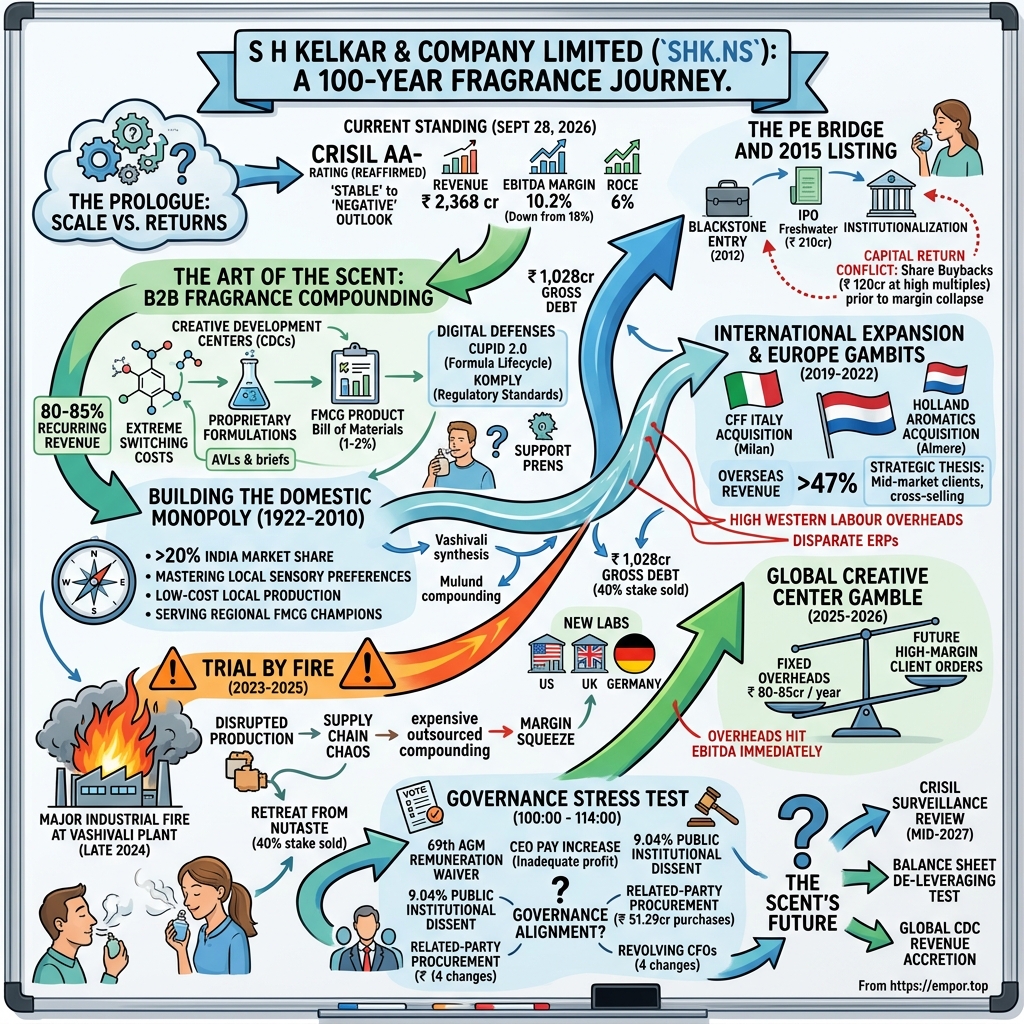
S H Kelkar and Company Limited: The Chemistry of Scent, Global Ambition, and the Cost of Capital
I. Prologue: The Hundred-Year Scent and the Negative Outlook (00:00 – 12:00)
On September 28, 2026, a short rating action landed in the inbox of every lender to S H Kelkar and Company Limited. It looked dull. CRISIL Ratings reaffirmed the long-term rating on the company's bank facilities at CRISIL AA-, a solid investment-grade mark that most Indian mid-caps would envy. Then came the line that mattered: the outlook moved from "Stable" to "Negative."1
Rating agencies do not change an outlook on a whim. A negative outlook is a formal warning. It tells lenders and investors that the agency sees a real chance of a downgrade, and that management now has a fixed window to prove it wrong. CRISIL's reasoning was blunt. Operating profitability in fiscal 2026 had fallen further than it expected, and it named three causes: heavy spending on new overseas creative centres in the US, Germany and the UK, higher insurance premiums, and the leftover costs of a fire at the company's Vashivali plant.1
To understand why that letter matters, you need to know what S H Kelkar is, and what it has become.
Most consumers have never heard of it. They have smelled it. S H Kelkar, which trades under the brand Keva, describes itself as India's largest homegrown fragrance and flavour house.2 Its scents go into soaps, shampoos, detergents, fine fragrances, incense and room fresheners. Its flavours go into drinks, bakery goods and sweets. Its customers include multinational consumer-goods companies, Indian national brands and a long tail of regional manufacturers, and no single customer accounted for 10% or more of group revenue in either of the last two years.2
On the surface, the growth story is clean. Consolidated revenue rose from about ₹834 crore in FY15, the year before the listing, to about ₹2,368 crore in FY26.23 That is almost three times larger, a compound growth rate of roughly 10% a year for more than a decade.
Now look underneath. Net profit in FY26 was about ₹69 crore. In FY15 it was about ₹70 crore.23 Eleven years of growth, a public listing, two buybacks, two European acquisitions and a global expansion programme, and the company earns slightly less than it did before it went public. Operating margin, which ran at 16% to 18% between FY16 and FY21, fell to about 14% in FY25 and about 10% in FY26.23 Return on capital employed, a measure of how much profit each rupee in the business generates, slid from about 19% in FY17 to about 6% in FY26.3 That is below what the company pays its banks.
Meanwhile the balance sheet got heavier. Borrowings plus lease obligations crossed ₹1,000 crore by March 2026.2 Including leases, net debt stood at roughly four times annual operating profit.2 For a business that was once a self-funding domestic compounder, that is new territory.
So the central question of this story is simple to state and hard to answer. Can an Indian family business that has spent a century learning how India likes to smell turn itself into a profitable global contender? Or has the pursuit of multinational status destroyed the returns that made it worth owning?
Four threads run through the answer.
The first is the oligopoly problem. Global fragrance is dominated by four Western houses: Givaudan, DSM-Firmenich, IFF and Symrise. Keva is trying to win work from the same multinational brand owners they serve. The question is whether a mid-sized Indian house can break in, or whether its new Western creative centres will simply absorb capital for years.
The second is the margin question. Is the drop from 18% to 10% a temporary bruise from a plant fire and a burst of new overheads, or a permanent loss of pricing power?
The third is leverage. Can Keva service roughly ₹1,000 crore of debt and leases without selling assets, raising equity or losing its rating?
The fourth is alignment. As returns fall below the cost of borrowing, are the promoter family's pay, its private companies' dealings with the listed company, and the turnover in the finance chair consistent with the interests of minority shareholders?
The verdict this story builds toward is not a simple one. Keva has real strengths: sticky customers, a deep formulation library and a domestic franchise that has lasted a century. But its global expansion has front-loaded fixed costs and debt well ahead of the profitable customer volume that is supposed to pay for them. Whether that gap closes is the whole investment case. To see why the gap exists, start with how this strange industry makes money.
 Subscribe on LinkedIn
II. The Art of the Scent: How Fragrance Compounding Actually Works (12:00 – 27:00)
Picture a perfumer's bench in a Keva creative lab. Rows of small brown bottles, each holding a single ingredient: an essential oil pressed from citrus peel, a patchouli extract, a synthetic musk, a sharp aldehyde that smells of clean laundry. The perfumer weighs drops on a precision scale, dips paper blotters, waits, sniffs, adjusts. The goal might be the scent of a new bar of soap for a consumer-goods company. When the formula is finished, it may contain dozens or hundreds of components. It receives a private reference number, and from that moment it is a trade secret.
That is fragrance compounding. A fragrance house does not usually sell a single chemical. It sells a recipe, mixed in its own plant and shipped to the customer as a concentrate, priced per kilogram.2 The customer, say a soap maker, adds a small amount of that concentrate to its product. The same model applies to flavours, where the concentrate goes into a beverage or a biscuit.
The economics of this business are unusual, and they explain almost everything that follows in this story.
Start with the customer's view. The fragrance is a tiny line in the cost of a soap or shampoo. Yet it is often what the consumer remembers. Change it, and loyal buyers may notice that their favourite shampoo smells different and switch brands. So once a brand owner has launched a product with a particular fragrance, it is very reluctant to change supplier. Keva cannot simply be swapped out for a cheaper rival, because the rival does not have the formula. This is why the company reports that more than 80% to 85% of its revenue is recurring, even though most customers do not sign long-term volume contracts.2
Now the commercial process. Large brand owners keep an approved vendor list, a short list of fragrance houses allowed to compete for their business. When a brand plans a new detergent or a refreshed body wash, it issues a "brief," a description of what it wants, and invites a handful of approved houses to submit samples. The winner gets the formula into production and earns revenue for as long as the product sells. Getting onto the list is slow. Winning briefs is competitive. Once won, the business tends to stay won.
Here is the catch. Stickiness protects volume, not price. Keva's contracts generally allow prices to be revisited as raw material costs move.2 But passing on cost increases depends on negotiation, and large customers negotiate hard. The raw materials themselves, natural oils that depend on harvests and synthetic chemicals derived from petrochemicals, swing in price. So the business behaves like enterprise software on the customer side and like a commodity chemical maker on the cost side. Volume is fairly steady. Gross margin is not. The company itself characterises demand cyclicality as low-to-medium but margin cyclicality as high.2
Fragrance is the bigger part of the business by far, serving fine fragrance, personal wash, fabric care and air care. Flavours serve food and beverages and are a smaller contributor. That balance shifted further toward fragrance in July 2024, when Keva sold a 40% stake in its flavours subsidiary NuTaste Food and Drink Labs and turned it into an associate company rather than a consolidated subsidiary.2 That story returns in Section VI.
What does a fragrance house own, then? Mostly three things: its library of formulas, its relationships on approved vendor lists, and its ability to make the concentrate consistently, batch after batch, without contamination or variation. Keva has added software to this. It runs a formula lifecycle platform it calls CUPID 2.0, rolled out across its Italian and European operations, and a regulatory compliance tool called KOMPLY that checks formulas against safety standards such as those of IFRA, the industry's global standards body.2 These are sensible defences against a world where AI tools may speed up formula screening. They are not, on the evidence available, a product that earns revenue on its own.
On sourcing, Keva says about 35% of its inputs in FY26 were sustainably sourced, and that it runs an internal supplier audit team.2 That matters because the largest brand owners increasingly ask for traceable ingredients as a condition of staying on their vendor lists.
The lesson of this section is the foundation for everything after. Keva's customer relationships are durable. That is the good news. The bad news is that durability on its own does not guarantee profit. Profit depends on pricing power against big buyers, cost control against volatile inputs, and the overheads required to win new briefs. Hold on to that distinction. It explains how a company can keep its customers for decades and still see its margins fall by almost half. And it explains why the company's history began not with global ambition but with a very local advantage.
III. From Girgaum to Mulund: Building India's Domestic Monopoly (1922–2010) (27:00 – 41:00)
The company traces its roots to 1922 Bombay, when S H Kelkar began working with natural extracts and essential oils for Indian products: soaps, hair oils and the fragrant sticks of incense that perfume homes and temples across the country.[^4] It was formally incorporated as a company in 1955.2 Over the following decades, control passed to the Vaze family, which still runs it. Ramesh Vaze, now non-executive chairman, led the business through its industrial growth years, and his son Kedar Vaze is today whole-time director and group CEO.2
The early advantage was knowledge of the local nose. India's consumers did not want the scents designed for Paris or New Jersey. They wanted jasmine, sandalwood, rose and strong, long-lasting fragrance in soap that might be used in hard water and hot weather. A domestic house that understood those preferences, and could make them cheaply, had something the big foreign firms could not easily replicate.
The second advantage was who Keva served. India's consumer market is not just Hindustan Unilever and a few multinationals. It is also thousands of regional soap makers, detergent brands, hair oil companies and incense manufacturers. Many of them are too small for a global house to bother with. They need small order sizes, fast turnaround, and a supplier who will change a formula next week rather than next quarter. By serving this long tail alongside larger national brands, Keva built a customer base with no dangerous dependency on any single buyer.
The third advantage was raw materials. Over time Keva moved into making some of its own aroma chemicals, the building-block molecules of fragrances, including at its facility at Vashivali in Maharashtra.[^4] For a compounder, owning part of the ingredient supply means more control over cost and quality. It also creates a quiet dependency. If that plant goes down, the compounding business has to buy those ingredients from someone else, at someone else's price. That is exactly what happened decades later.
How strong did this domestic franchise become? In its IPO documents the company described itself as the largest Indian-origin fragrance company by revenue in the domestic market.[^4] Keva's claim to market leadership comes from its own and industry estimates rather than audited market data, so treat precise share figures with care. But CRISIL's 2026 rating action also cited the company's leading position in Indian fragrance as a core strength, which gives the claim an independent supporter.1
The key investor point from this era is that the original Keva earned high returns for a specific reason. It did not have to fight the global giants on their own ground. It served customers they underserved, in a market where local taste and speed mattered more than global scale. That is a narrower moat than "dominance," but it was a real one.
That domestic machine eventually ran into the limits of its own market. Growth in India alone was steady but not explosive, and a family business that wanted to become something bigger needed outside capital and outside discipline. That is where private equity entered the story.
IV. The Private Equity Bridge and the 2015 Listing (2010–2018) (41:00 – 55:00)
In November 2015, S H Kelkar listed on both the National Stock Exchange and BSE. The initial public offering combined fresh shares worth ₹210 crore with an offer for sale in which Blackstone, the private equity firm that had backed the company since 2012, and promoter Prabha Vaze sold part of their holdings.2[^4]
Blackstone's role is worth understanding. Private equity investors in family-run Indian companies usually push for the same things: tighter control of working capital, cleaner financial reporting, professional middle management and a credible route to a listing. The business was being prepared for exactly that, with the fresh money aimed at repaying debt and upgrading facilities.[^4]
The company that arrived on the stock market was a good one. Operating margins of 16% to 18% and a return on capital of about 19% in FY17 put it in the top tier of Indian specialty chemical and ingredient businesses.3 Revenue grew from about ₹834 crore in FY15 to about ₹1,114 crore by FY20.3 It was profitable, mostly self-funding and rooted in a domestic franchise with little competition from the giants in its core niche.
Then management made two choices that look different in hindsight than they did at the time.
The first was to return cash to shareholders. In 2019, Keva bought back 33 lakh shares at ₹180 each, about ₹59 crore. In December 2021 it bought back another 29 lakh shares at ₹210 each, about ₹61 crore.2 Together, roughly ₹120 crore went out of the business.
Buybacks are not bad by nature. When a company has more cash than it can invest at good returns, returning it is the disciplined thing to do. The question is whether that was Keva's situation. The 2021 buyback came in a year when profits were near their peak, and it came after the company had already decided to expand overseas through acquisitions financed partly with debt. The shares were retired at ₹180 to ₹210. In October 2026 they trade around ₹138 to ₹141.3 Shareholders who tendered did well. Shareholders who stayed own a company that later needed borrowed money to rebuild a burned plant and fund foreign expansion. With hindsight, the ₹120 crore would have covered a meaningful part of the overdraft the company carries today.
It is fair to add one defence. In 2019 and 2021, nobody could predict a factory fire, and leverage was modest. A buyback looked like a reasonable use of surplus cash. But capital allocation is judged on how it holds up under stress, and this one did not hold up well.
The second choice was a strategic pivot. With the domestic market maturing, management began looking abroad, and the route it chose was to buy rather than build. It is the next chapter, and it shaped everything after.
V. Buying into Europe: The CFF Italy and Holland Aromatics Gambits (2019–2022) (55:00 – 71:00)
Imagine the logic from Mumbai in the late 2010s. You have a solid domestic franchise. You want to sell to European brands. But a European brand owner will not easily put an unknown Indian house on its approved vendor list. Qualifying takes years. Building relationships takes longer.
So you buy someone who already has them.
Through its Dutch holding company, Keva Europe B.V., the company acquired businesses in Europe, including Creative Flavours & Fragrances (CFF) in Italy and Holland Aromatics in the Netherlands.24 Keva's overseas subsidiaries today include CFF Keva Italy and Holland Aromatics, alongside units in Indonesia, Singapore, China, the UK, the US, Germany and the UAE: in total 17 operating and holding subsidiaries.2
The theory was attractive. Global giants focus heavily on the largest multinational accounts. Below them sits a big market of mid-sized European brands and private-label manufacturers that want creative, responsive suppliers. CFF brought an Italian creative base. Holland Aromatics brought a Northern European presence. India would make the cheaper building blocks; Europe would design and finish local formulas for local clients.
What did it deliver? Revenue certainly grew. Consolidated sales rose from about ₹1,114 crore in FY20 to about ₹1,930 crore in FY24.3 By FY26, overseas markets accounted for about 48% of consolidated revenue.2 Keva became, on paper, a genuinely international company.
But profit did not follow at the same pace. Over the FY15-FY26 period, operating profit grew at roughly 6.6% a year, against about 10% for revenue.23 The gap is the heart of this story. A company that adds revenue faster than profit is either taking on lower-margin business, carrying higher overheads, or both. European operations come with higher labour costs, stricter chemical rules such as the EU's REACH regime, multiple IT systems and the management cost of running businesses in many countries.
Currency became another source of noise. Keva reports in rupees but earns heavily in euros and dollars. It hedges part of its exposure with forward contracts, but in FY26 foreign exchange losses plus losses on derivatives together reached about ₹16.5 crore, up from about ₹5 crore the year before.2 That is not catastrophic, but for a company with pre-exceptional profit before tax of about ₹76 crore, it is a meaningful bite.
Then there is the debt structure. Several overseas loans are in euros and dollars at floating rates, and some are backed by standby letters of credit from the Indian parent.2 By March 2026 the parent stood as guarantor for subsidiary bank loans of up to about ₹546 crore.2 In plain terms, the risks of the foreign businesses travel straight back to the Indian balance sheet.
One more episode from this period deserves a brief mention. In FY24 the company dissolved its Employee Benefit Trust, which held company shares for staff incentive purposes, selling the shares for about ₹49 crore and booking a loss of about ₹22 crore.2 It was a small item, but it adds to a pattern of capital decisions that cost shareholders money.
So how should an investor judge the European strategy? The evidence narrows the original claim rather than rejecting it. Acquisitions did diversify revenue and give Keva a foothold in Europe. They did not, on the record so far, bring the high-margin, scale-efficient business the strategy promised. Whether that changes depends on what the company does next. Unfortunately, what came next was a fire.
VI. Trial by Fire: Vashivali, Supply Chain Chaos, and NuTaste's Retreat (2023–2025) (71:00 – 86:00)
During fiscal 2025, fire struck Keva's manufacturing facility at Vashivali in Maharashtra.5 For a compounding business, it was not just a lost building. Vashivali was where Keva made part of its own ingredients. With it damaged, the company had to rebuild, and in the meantime it had to keep supplying customers who would not accept a gap in their shampoo production.
That is where the vertical integration that once protected margins turned into a liability. Ingredients that Keva once made in-house had to be bought elsewhere, and production had to be reorganised around a damaged site. The company built up inventory to avoid running out. Receivables rose as well.
The cash flow statement tells the story more clearly than any narrative. In FY25, Keva reported net profit of about ₹73 crore but generated only about ₹16 crore of cash from operations, because working capital absorbed about ₹239 crore.2 Put simply, for every rupee of reported profit, only about 22 paise arrived as cash. After capital spending, free cash flow was negative by about ₹80 crore.2 The gap had to be filled with borrowing.
FY25's reported profit also had help from a transaction that had nothing to do with fragrance. In July 2024, Keva sold a 40% stake in NuTaste, its food and beverage flavours subsidiary, and kept 40% as an associate.2 The deal generated a one-off gain of about ₹20 crore in other income that year.2 Strip that out, and FY25's underlying profitability was weaker than the headline. NuTaste's sale also signalled a partial retreat from flavours just when the company needed every source of steady earnings.
FY26 repeated the pattern with a different crutch. Pre-exceptional profit before tax fell about 57% to roughly ₹76 crore. Reported net profit of about ₹69 crore was supported by an exceptional insurance gain of about ₹36 crore linked to the fire.2 Insurance did its job. But an insurance payout is not a business.
The cash flow bounced back sharply in FY26, to about ₹263 crore from operations.2 At first glance that looks like recovery. Look more closely and the biggest driver was the release of about ₹168 crore from other current assets as insurance claims were settled.2 Receivables actually grew by about ₹104 crore and payables shrank by about ₹89 crore.2 In other words, the operating business was still absorbing cash; the insurer paid the bill.
The receivables deserve a closer look because they reveal who pays and how quickly. Trade receivables rose about 25% to about ₹635 crore, and the average collection period lengthened from about 87 to about 98 days.2 Most dues are still current or less than six months overdue, so this is not a collapse in credit quality. But overdue balances beyond six months reached about ₹34 crore, and the company raised its provision for doubtful debts to about ₹6 crore, roughly five times the previous year.2 Customers are taking longer to pay, and Keva is funding that with debt.
The lesson of the fire is not that accidents happen. It is that the business had less shock absorption than its history suggested. A company with modest debt and strong cash generation could have rebuilt Vashivali out of its own resources. Keva, having spent on buybacks and acquisitions, had to borrow to do it. And just as it was rebuilding, management decided to step on the accelerator overseas.
VII. The Global Creative Center Gamble: Building Beyond the Balance Sheet (2025–2026) (86:00 – 100:00)
While Vashivali was being restored, Keva was opening something new: Creative Development Centres in the United States, Germany and the United Kingdom.12 These are the labs where perfumers meet brand teams, test ideas and create the samples that win briefs. Keva already had creative centres in places including Mumbai, Amsterdam, Almere, Milan, Singapore and Jakarta.2 The new ones put it inside the home markets of some of the world's largest consumer brands.
The logic is sound in principle. Global brand teams in personal care and prestige beauty want to work side by side with perfumers. They expect to smell samples the same day, change direction quickly and build trust over many meetings. A fragrance house that can only offer a video call from Mumbai is at a disadvantage. If Keva wants briefs from Western multinationals, it probably needs physical presence.
The problem is timing and scale. CRISIL estimated the operational expense of the new centres at about ₹80 to ₹85 crore.1 That cost hits the profit line immediately. The revenue those centres are supposed to win arrives much later, because a brief won today may not become a product on shelves for many months, and new suppliers are often tested on small projects first.
The numbers show the strain. Consolidated capital expenditure more than doubled, from about ₹96 crore in FY25 to about ₹206 crore in FY26.2 Lease obligations, the accounting liability for long-term rentals, roughly doubled to about ₹178 crore as the company leased new overseas premises.2 Borrowings excluding leases rose to about ₹851 crore, including about ₹148 crore of bank overdrafts.2
Here is the worked calculation that ties these together. Operating profit fell from about ₹297 crore in FY25 to about ₹242 crore in FY26, a drop of roughly ₹55 crore, even as revenue grew about 11.5%.2 If the new creative centres cost about ₹80 to ₹85 crore, then the rest of the business actually grew its operating profit by roughly ₹25 to ₹30 crore before those costs. That is the bull's arithmetic: strip out the investment phase, and the underlying engine still runs. The bear's response is that the costs are not optional and do not end. Leases run for years; perfumers and regulatory staff are salaried; and the margin line also absorbed higher insurance premiums and post-fire overheads.1
CRISIL noted margin falling to 10.4% from 14.4% on its own measure.1 Either way, profitability is close to its lowest in the listed era. CRISIL's stated monitorables are the pace of margin recovery in FY27 and the revenue that the new creative centres actually bring in.1
What would prove the strategy right? Not announcements of new labs, nor patents, nor awards. The test is revenue: briefs won from Western brand owners, turned into production volume, at margins that absorb the centres' running costs. Keva reports that it filed seven Indian priority patent applications and received 13 international patent grants in FY26.2 Those are useful, but patents are not orders. Keva has also reported that core Europe grew about 15% year on year.2 That is encouraging but not yet decisive.
Notice also what the company spends on formal research. Consolidated reported R&D was about ₹6 crore in FY26, about 0.25% of revenue.2 The global leaders spend many times that share. Keva's competition in the West rests on creative service and responsiveness, not on discovering new molecules. That makes the creative centres the core of the bet, and it also explains why management was willing to take on so much cost so fast.
The strategy may be right. The sequencing has been expensive. Building three new Western centres at once, while a key plant was still recovering and debt was rising, put the fixed costs in front of the revenue. That decision has also put the governance of the company under a sharper light, because when profits fall, everyone looks harder at who is getting paid.
VIII. The Governance Stress Test: Remuneration Waivers, Family Trusts, and the Revolving CFO (100:00 – 114:00)
On August 12, 2025, shareholders voted at Keva's 69th annual general meeting. Most resolutions were routine. One was not. Special Resolution 4 asked shareholders to approve a waiver of recovery of excess remuneration paid to Kedar Vaze during FY25.6
The background is a quirk of Indian company law. The Companies Act limits how much a company can pay its executive directors relative to profits. When profits fall short, payments above the limit may need to be recovered unless shareholders approve otherwise. In FY25, after the fire, profits were inadequate, and Kedar Vaze's pay exceeded the limit.2 The board asked shareholders to waive recovery.
The resolution passed. Promoters hold about 55% of the shares, so they could carry it alone. But about 9% of public institutional votes cast went against it.6 In Indian mid-cap governance, where institutions often vote with management by default, that is a visible signal.
Then came FY26. Kedar Vaze's total pay rose about 18%, from about ₹3.7 crore to about ₹4.4 crore, including a profit commission of about ₹0.7 crore and a variable incentive of about ₹0.5 crore.2 Over the same year, pre-exceptional profit before tax fell about 57%.2 His pay was about 35 times the median employee's.2 The absolute amounts are not extravagant by global standards. The direction is the issue. Executive pay rose in a year when underlying profit more than halved.
The finance function also changed hands. Group CFO and company secretary Rohit Saraogi resigned on July 30, 2025.2 Legal counsel Deepti Chandratre served as interim CFO from October 7, 2025, and Jagdish Agarwal became group CFO on December 2, 2025.2 Leadership changes happen. But a CFO departure in the middle of a fire recovery, a debt build-up and an expansion programme deserves investor attention, and the company did not publicly explain the reasons in its annual report.
Then there are the dealings with the family's private companies. In FY26, Keva bought about ₹51 crore of goods from Keva Aromatics Private Limited, a promoter-controlled unlisted company, about 3.8% of raw material consumption.2 It paid about ₹8 crore in rent to Keva Constructions Private Limited, another promoter entity, which is also one of the larger promoter shareholders.2 The company states these transactions are at arm's length and in the ordinary course of business.2 They are not unusual for an Indian family group, and they are disclosed. But they create a structural question: when a family owns both buyer and seller, minority shareholders depend on the audit committee to ensure fair pricing.
The auditor, Deloitte Haskins & Sells, issued a clean audit opinion for FY26.2 In its separate CARO report, however, it noted that title deeds for two properties at Mulund with a net carrying value of about ₹12 crore remained in the names of companies merged into Keva as of April 1, 2019, still not transferred.2 It is a small matter, but seven years is a long time to leave legal paperwork undone.
Ownership is shifting too. Promoter holding drifted down from about 59% in March 2024 to about 55% by March 2026.23 Kedar Vaze's personal stake fell from about 10.8% to about 9.4%, partly through a transfer to his spouse and partly through market sales.2 Domestic institutional holding, meanwhile, rose from almost nothing in March 2024 to about 6% by June 2026.3 A larger, more engaged domestic institutional base could become a stronger voice at future meetings. Promoters have pledged none of their shares, which removes one common risk.2
What is the verdict? There is no evidence here of the most serious governance failures: no qualified audit, no pledged promoter shares, no undisclosed transactions. The board is half independent.2 But there is a pattern of friction. Pay moved up while returns fell. The finance chair turned over at a critical time. And recurring business with the family's private companies continues. None of this alone breaks the investment case. Together, it means investors should expect less benefit of the doubt from institutions if margins do not recover. Which brings the story to the most important question: does Keva have a moat strong enough to recover them?
IX. Frameworks, Moats & The Bull/Bear Case (114:00 – 131:00)
Put Keva on a map of the global fragrance industry. At the top sit Givaudan, DSM-Firmenich, IFF and Symrise, each with revenue many times Keva's, global master supply agreements with the biggest consumer-goods companies, and research budgets that create proprietary molecules nobody else can sell. Givaudan, the largest, runs at operating margins far above Keva's current level. At home, Keva also competes with Indian aroma chemical makers such as Privi Speciality Chemicals and Oriental Aromatics, which sell ingredients rather than finished fragrances but compete for the same pool of investor attention and some of the same customers.
Where does Keva fit? It is too small to match the global giants on scale, and it now carries more Western fixed cost than a nimble regional compounder. That middle position is the strategic puzzle.
Hamilton Helmer's 7 Powers
Switching costs: strong in the domestic core. This is Keva's clearest power. Once a fragrance is in a successful product, brand owners rarely change it. The 80% to 85% recurring revenue and the absence of any customer above 10% of sales support this.2 But the record also limits it: switching costs kept customers through the fire and the margin collapse, yet they did not stop margins from falling. The power protects volume, not price.
Scale economies: weak globally. The leaders spend far more on research and run larger, more efficient plants. Keva's reported R&D of about 0.25% of revenue is a sign of a business competing on service, not science.2
Network effects: none. Fragrance formulas do not become more valuable as more customers use them.
Counter-positioning: moderate. Keva can serve mid-sized and digital-first brands faster and in smaller lots than the global houses want to. Management credits its KNew platform with winning such accounts.2 The risk is that this segment pays less and churns more.
Cornered resource: moderate at best. Thirteen international patents granted in FY26 and in-house aroma chemical capacity are useful, but Keva does not own the blockbuster molecules that give the leaders pricing power.2
Process power: strong. A century of making consistent concentrates, avoiding contamination and managing thousands of formulas is real know-how. It is hard to copy quickly.
Branding: moderate in B2B. Keva is well known in India and parts of Asia and the Middle East. Among Western procurement teams, it is still building recognition, which is exactly what the creative centres are meant to change.
Porter's Five Forces
Buyers: high to moderate power. Large global brands extract price concessions; smaller Indian brands have less leverage. Rising receivable days suggest buyers are using their leverage on payment terms too.2
Suppliers: moderate to high power. Natural ingredients depend on harvests, synthetics on petrochemical prices. The fire showed how quickly losing in-house supply hands power to outside vendors.
Substitutes: very low. Consumers will keep wanting products that smell and taste good.
New entrants: low. Regulatory approvals, safety testing and customer qualification take years.
Rivalry: high. Abroad, Keva fights the global leaders for briefs. At home, it faces both global houses expanding in India and local chemical makers.
The summary is that Keva has a narrow, real moat in Indian fragrance, built on switching costs and process know-how, and no proven moat yet in the West. The history neither rejects nor confirms the global thesis; it leaves it unproven.
The Activist's Stress Test
A skeptical activist would ask uncomfortable questions. Why run three new Western creative centres at once instead of proving one first? Could some overseas operations be closed or sold? Could non-core property in Mulund be monetised? Could proceeds, plus disciplined working capital, reduce the roughly ₹639 crore of current borrowings that carry the most refinancing risk?2 And why should executive pay rise when the return on capital is below the cost of debt? The activist's plan would aim to shrink the company back to its high-return core. The weakness of that plan is that it would give up on the only route to becoming more than a domestic leader. That is the trade-off investors must weigh.
The Bull Case
The bull sees an investment phase, not decay. Strip out the creative centres' cost and the underlying operating profit grew in FY26. If briefs from the US, UK and Germany turn into production volume, the fixed costs are absorbed, and margin can move back toward its historical mid-teens. A fully restored Vashivali reduces reliance on outside ingredients. Capital commitments have already dropped sharply, from about ₹59 crore to about ₹8 crore, which suggests the heavy capex phase is ending.2 Valuation adds to the case: at about 1.4 times book value and about 12 times operating profit including leases, the market prices Keva as a struggling chemicals company rather than a sticky formulation house.23 Privi trades at roughly 38 to 41 times earnings.3 If margins recover, the bull argues the gap could narrow.
The Bear Case
The bear sees a company that has repeatedly grown revenue without growing profit, and now has less room for error. If Western customers take two or three years longer to convert than hoped, the creative centres will keep draining cash. If CRISIL downgrades, borrowing costs rise across debt that is largely floating-rate. If domestic customers push harder on price as Indian consumer demand slows, the core cannot carry the expansion. And the governance friction means institutions may not give management a long grace period.
On a trailing basis, the stock trades at roughly 28 times reported earnings, a multiple that already assumes some recovery.3 Market pricing is therefore not purely pessimistic. It implies the market expects profits to rise, not merely stabilise.
The Three KPIs That Matter Most
-
Consolidated operating margin, excluding one-offs. Latest reading: about 10% in FY26, down from about 14% in FY25.2 Direction: falling. The question is whether it can climb without insurance gains or stake sales.
-
Net debt to operating profit, including leases. Latest reading: about 4 times in FY26.2 Direction: rising. This is the metric CRISIL and lenders watch most closely.
-
Revenue from the new Western creative centres. Latest reading: not separately disclosed by the company. Direction: unknown. It is the single number that would prove or disprove the global strategy, and investors should push for it to be reported.
These frameworks summarise the analysis. The story's lasting value, though, is in the lessons it offers founders and investors.
X. Playbook: Business & Investing Lessons (131:00 – 143:00)
Lesson 1: Stickiness is not pricing power. Keva's customers stayed through a factory fire, a debt build-up and a halving of margins. That is remarkable loyalty. It did not protect profits. A soap maker that will never change its fragrance can still squeeze its fragrance supplier on price, and raw material costs do not care how loyal the customer is. Founders often treat retention as proof of a moat. Keva shows that retention measures how hard it is to lose a customer, not how much the customer will pay.
"Switching costs keep the customer in the room. They do not make the customer pay for the furniture."
Lesson 2: You can lease a lab, but not a relationship. In 2025 and 2026, Keva opened creative centres in three Western markets at once, adding roughly ₹80 to ₹85 crore of running costs before the briefs that would justify them had been won.1 The lab is the easy part. The trust that puts a supplier on a global brand's approved list takes years. Founders entering a relationship-driven market should stage investment to evidence: one centre, proven conversion, then the next.
"Building the perfumery is quick. Earning a place on the brief takes a decade, and the rent is due monthly."
Lesson 3: A buyback is a bet that you will never need the cash. Keva spent about ₹120 crore buying back shares at ₹180 to ₹210 in 2019 and 2021.2 A few years later it was borrowing to rebuild Vashivali and fund foreign expansion, with an overdraft of about ₹148 crore.2 For a business carrying physical-plant risk and heavy working capital, the cash on the balance sheet is insurance as much as surplus. Return it only once you have priced the disaster.
"Every rupee returned in good years is a rupee you borrow back in the bad ones, with interest."
Lesson 4: When returns fall below the cost of debt, pay becomes a referendum. At the 69th AGM, promoters carried a waiver on the CEO's excess pay, while about 9% of institutional votes said no.6 The next year pay rose 18% as underlying profit halved.2 Governance tension rarely shows up when returns are high. It shows up when they fall, and every decision is read for alignment.
"Shareholders forgive a family business a great deal when it earns its cost of capital. Below that line, they start reading the pay slip."
XI. Epilogue: The Next Moments on the Scent (143:00 – 150:00)
Tonight, S H Kelkar trades at around ₹138 to ₹141 a share, valuing the company at about ₹1,900 crore.3 That is roughly a third below the ₹210 at which it bought back shares in 2021.2 The market is pricing it as a chemicals company with a stretched balance sheet, while still paying a multiple that assumes some profit recovery.
Three moments will decide which story wins.
The first is CRISIL's next review. The negative outlook gives management a window, typically twelve to eighteen months, to show improvement.1 If FY27 margins recover meaningfully, and the creative centres begin to show revenue, the outlook can return to stable. If not, a downgrade would raise borrowing costs on debt that is mostly floating-rate, adding pressure exactly where the company has the least slack.
The second is the balance sheet at March 31, 2027. Net debt excluding leases was about ₹786 crore at March 2026.2 A reduction of ₹100 to ₹150 crore funded by operating cash, not asset sales or insurance, would be the clearest sign the business has turned. With capital spending commitments already down sharply, it is possible.2 It is not yet evidence.
The third is the 71st AGM in 2027. Domestic institutions now hold about 6% of the company.3 If they vote in larger numbers against pay or related-party arrangements, it would signal that minority shareholders expect change.
Each of these maps onto the central questions. Margins answer the oligopoly question: are the creative centres winning profitable work? Debt answers the balance-sheet question. Votes answer the alignment question. None will be settled tonight. Keva sits in the uncomfortable middle: too established to fail quickly, too stretched to wait patiently.
XII. Outro (150:00 – 154:00)
In 1922, in Bombay, the founder of this company was working with natural extracts to scent soap and hair oil for Indian households.[^4] The business survived colonial rule, independence, decades of controls and the arrival of global consumer brands, because it knew one thing better than anyone: how India liked to smell.
A century later, Keva has set out to learn how Hamburg, New Jersey and London like to smell too. In doing so it has taken on the cost structure of a multinational while still carrying the balance sheet of an Indian mid-cap. Its formulas still sit inside millions of products, quietly, invisibly, reliably. The open question is whether that reliability can be turned into returns again.
In fragrance, the best scents linger long after the bottle is closed. In the public markets, so does the memory of capital that never earned its keep.
References
-
CRISIL Rating Rationale: S H Kelkar and Company Limited (Outlook Revised to Negative) — CRISIL Ratings, 2026-09-28 ↩↩↩↩↩↩↩↩↩↩
-
70th Annual Report FY 2025-26 — S H Kelkar and Company Limited, 2026-07-07 ↩↩↩↩↩↩↩↩↩↩↩↩↩↩↩↩↩↩↩↩↩↩↩↩↩↩↩↩↩↩↩↩↩↩↩↩↩↩↩↩↩↩↩↩↩↩↩↩↩↩↩↩↩↩↩↩↩↩↩↩↩↩↩↩↩↩↩↩↩↩↩↩↩↩↩↩
-
S H Kelkar & Company Ltd Consolidated Financial Analysis — Screener.in, 2026-10-02 ↩↩↩↩↩↩↩↩↩↩↩↩↩↩↩↩
-
Corporate Acquisition of CFF Creative Flavours & Fragrances S.p.A. Regulatory Disclosure — S H Kelkar and Company Limited / BSE India ↩
-
69th Annual Report FY 2024-25 — S H Kelkar and Company Limited, 2025-07-15 ↩
-
Voting Results & Scrutinizer's Report 69th AGM (Managerial Remuneration Waiver) — S H Kelkar and Company Limited, 2025-08-12 ↩↩↩
 LinkedIn
 WhatsApp
 Reddit
 Hacker News
 Email
Email Kindle
 RSS Feed
 Spotify
 Apple Podcasts
 Amazon Music
 Audible
 YouTube