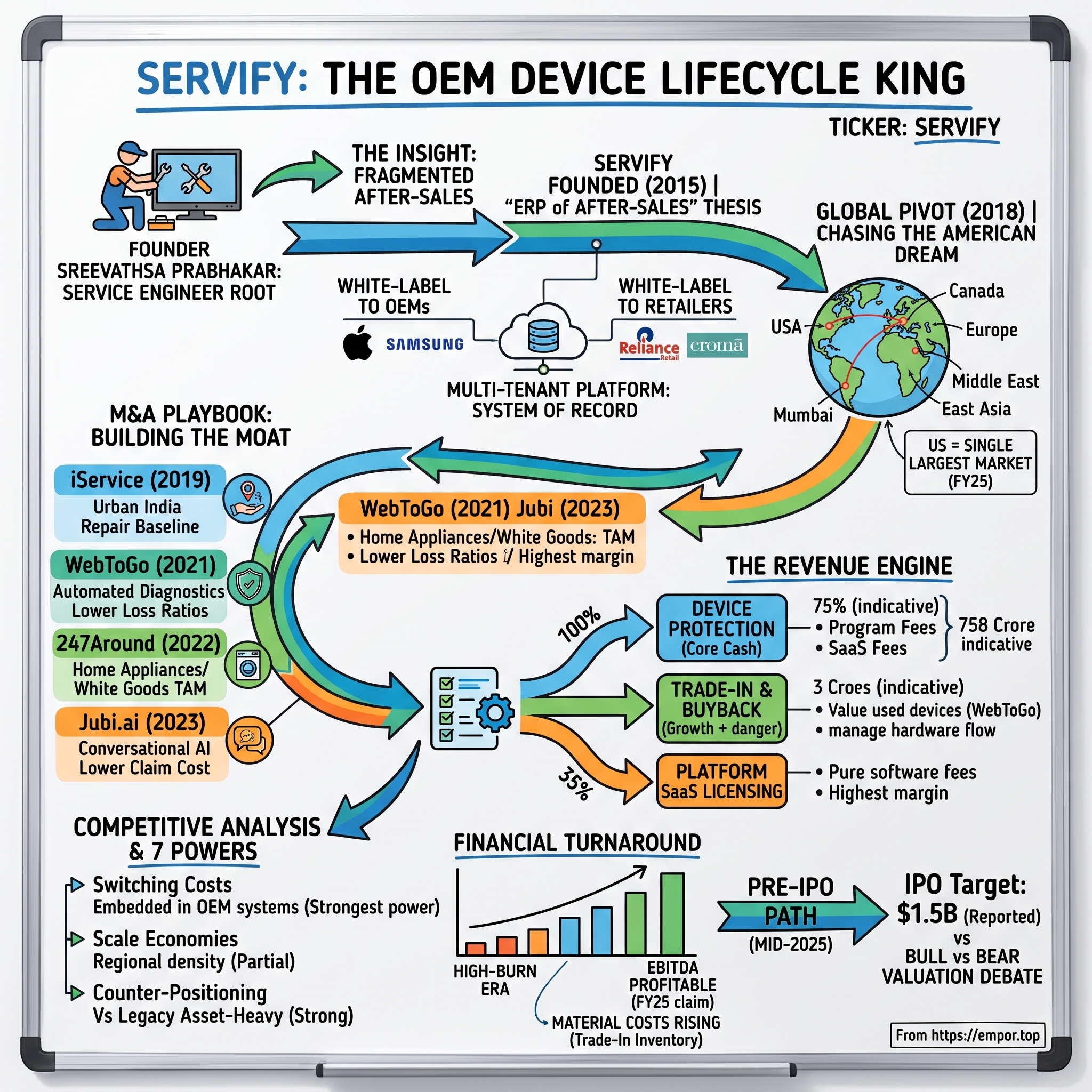
Servify: The OEM Device Lifecycle King
I. Introduction & Episode Roadmap
Buy an iPhone in Mumbai, hand it to the Apple Authorized Service Provider when the screen cracks, and somewhere in the plumbing behind that transaction sits a company most consumers have never heard of. The AppleCare+ terms and conditions for India name it in the fine print: the plan is "administered by" Servify.1 Do the same trade-in or protection-plan transaction in Bengaluru, Toronto, or Dubai for a Samsung, an AT&T handset, or an HP laptop, and the odds are good that the same invisible layer is coordinating the claim, the diagnostic, the repair, and the logistics. Servify has spent a decade making itself the connective tissue of device after-sales for some of the most demanding brands on earth — and it did so from Mumbai, built by a man who started his career fixing televisions in strangers' living rooms.
That is the hook, and it is genuinely striking: a founder from the operational trenches of Nokia and Samsung service centers built a software layer that now touches device protection, trade-ins, and diagnostics across more than three dozen countries.[^5] But a good hook is not an investment thesis, and this is not an investor-relations story. Servify is preparing to become a public company. In mid-2025 it signaled intent to file a Draft Red Herring Prospectus (DRHP) with India's markets regulator, the Securities and Exchange Board of India (SEBI), for an offering reported at roughly $400–500 million, targeting a valuation around $1.5 billion, with a pre-IPO round of about $100 million meant to carry it across the unicorn threshold.2 Some reports have floated numbers as high as $2.3 billion.3 Those figures are market prices, not answers. The job of this episode is to separate the two.
Here is the central tension. Servify has built something real — deep integrations into the checkout and warranty systems of Apple and Samsung, a fraud-fighting diagnostics stack acquired out of Germany, and a genuine turnaround from cash-incinerating growth to something approaching breakeven. In FY25 its operating revenue crossed the ₹1,000 crore mark on a consolidated basis and the company claimed EBITDA profitability.[^4] But the same business carries the two scars that make public-market investors flinch: extreme customer concentration in a handful of brands that could, in principle, build the whole thing in-house, and a revenue mix increasingly weighted toward low-margin, working-capital-hungry device trade-ins rather than pure software fees. The question is not whether Servify is impressive. It is whether an impressive operator with structurally thin margins and existential concentration deserves a software-like valuation — and what a public investor would actually be underwriting at $1.5 billion.
One framing device will run underneath the whole episode, because it is the discipline a pre-IPO story most needs. Price and value are different questions. The private rounds, the $1.5 billion target, the eventual grey-market chatter around the listing — these are prices, observations of what someone was willing to pay for a particular security at a particular moment under particular terms. Value is a separate thing: the cash the business can actually generate over its life, discounted for time and risk, adjusted for how much of it flows to the specific shares a public investor would own. A pre-filing startup makes it unusually tempting to collapse the two — to carry the last private mark forward as if it were proven worth — and unusually important not to. Every valuation number in this piece is therefore treated as either a price to be interrogated or a scenario to be stress-tested, never as an answer to be accepted.
The roadmap. First, the founder: Sreevathsa Prabhakar's arc from service engineer to a first exit, and the insight that seeded Servify. Then the founding thesis — the "ERP of after-sales" — and why India was the sandbox. Then the audacious global pivot, the acquisition playbook that bought the moat one piece of IP at a time, and a careful look under the hood at how the money actually flows. From there, the competitive analysis through Helmer and Porter, the financial turnaround and capital structure, the skeptic's stress test, the durable lessons, and finally the pre-IPO valuation debate — bull and bear, intrinsic and comparable. Let's start where the operator learned the business: in the repair shop.
 Subscribe on LinkedIn
II. Sreevathsa Prabhakar: From Service Engineer to the B2X Exit
Sreevathsa Prabhakar did not arrive at after-sales service through a McKinsey deck. He arrived through the back of a television set. His early career was spent in technical service and consumer customer-experience roles at BPL, Nokia, Samsung, and Tata Teleservices — the operational trenches of India's consumer-electronics and telecom boom, where the job was to make broken things work and keep customers from walking.[^5] He trained as an electrical and telecom engineer at Mangalore University and later took an MBA in Information Technology from the University of Mumbai, but the education that mattered most was watching, up close, how badly the after-sales machine ran.4 The picture he took away was consistent across every brand he worked for: after-sales service was a cost-center nightmare. Repair networks were fragmented. Customer communication was poor. Turn-around times were long. And fraud was everywhere — fake claims, pre-damaged devices swapped in for repair, non-functional handsets pushed through trade-in programs.
This is the crucial founder detail, and it is worth pausing on because it is the source of whatever durable edge Servify has. Pure software people rarely understand physical logistics; they build elegant systems that shatter on contact with a repair shop that has no spare parts and a courier who lost the package. Prabhakar had the opposite problem and the opposite advantage: he understood the mess intimately and needed to learn how to abstract it into software. Domain-first, technology-second is a rarer and more defensible starting point than the reverse.
In 2009 he acted on the diagnosis for the first time, founding The Service Solutions (TSS) — a bootstrapped, operations-heavy customer-service venture for consumer durables.[^5] TSS was not a technology company; it was a services company that took over the grubby work of managing repairs and customer contact for brands. It worked well enough that in 2014 it was acquired by B2X, a German customer-care outsourcing group that was rolling up after-sales operations across emerging markets.[^5] For a first-time founder, an acquisition by a strategic European buyer was a clean, respectable exit.
The interesting part is why he did not stop there — and what he concluded on the way out. Prabhakar's own account, repeated across interviews, is that operational outsourcing solved the immediate staffing problem but was structurally unscalable.5 You could always hire more agents and rent more repair benches, but you were selling labor, and labor does not compound. The real bottleneck, he decided, was the absence of a unified digital layer connecting every party in the chain — the brand, the customer, the service center, the insurer, and the logistics provider — each of whom was operating from a different spreadsheet with a different version of the truth. Solve that coordination problem in software, and you could sell something with margins and network effects rather than headcount. That conclusion — that the prize was the coordination layer, not the labor — is the intellectual seed of Servify. The test of the thesis, which the rest of this story adjudicates, is whether a coordination layer sitting on top of inherently physical, low-margin repair and resale activity can ever earn software economics. Prabhakar bet it could.
III. Founding Servify & The "ERP of After-Sales"
In 2015, Prabhakar incorporated Service Lee Technologies Private Limited in Mumbai and put a consumer-facing app in the market under the brand Servify.6 The first version was aimed at consumers — a place to store your device warranties, book repairs, and manage your gadgets. It did not work as a business. Consumers do not think about after-sales until something breaks, which makes them expensive to acquire and impossible to retain between failures. The company pivoted, and the pivot is the whole story: Servify stopped trying to own the consumer relationship and instead sold itself to the brands and retailers who already owned it. B2C became B2B2C.
The reframed thesis was ambitious in a boring-sounding way. Servify would build a multi-tenant, cloud-based platform that coordinated the entire lifecycle of a device — effectively an operating system, or an ERP, for after-sales. The value of the analogy is precise. An ERP does not do any one department's job; it is the shared system of record that lets manufacturing, finance, and sales stop lying to each other. Servify's platform aimed to be the shared system of record for a device's post-purchase life, connecting five constituencies who had never shared one: the OEMs and retailers who sell the device and the protection plan; the customers who file claims, request diagnostics, or trigger trade-ins; the insurers and underwriters who bear the actuarial risk; the authorized service centers who execute repairs; and the logistics providers who move the hardware.
The pitch to the OEM was the load-bearing idea, and it is subtle enough to miss. Servify's line to Apple and Samsung was, in effect: do not hand your customer over to a third-party insurer. Traditional extended-warranty and device-protection programs forced a premium brand to route its own customer — at the most stressful moment, when the device is broken — into the call center of a carrier or an insurance company whose brand experience had nothing to do with the manufacturer's. Servify offered a white-labeled alternative: the customer would experience a premium, brand-consistent support flow that looked and felt like Apple or Samsung, while Servify handled the administrative and logistical plumbing invisibly behind it. This is a counter-positioning pitch, in Hamilton Helmer's language — Servify was not asking the OEM to trust a rival brand; it was offering to make the OEM's own brand the whole experience. That alignment of incentives, more than any single feature, is why the model could get inside companies as controlling as Apple.
It is worth being precise about why the ERP framing is more than a marketing analogy, because it is the intellectual foundation of the switching-cost moat the valuation later leans on. A point solution — a repair-booking app, a diagnostics tool, a trade-in calculator — can be swapped out on a weekend. A system of record cannot, because everything else has been wired to depend on it. The moment an OEM routes its warranty logic, its claims adjudication, its service-center dispatch, and its logistics tracking through Servify's data model, Servify stops being a vendor and starts being infrastructure. The strategic ambition embedded in "ERP of after-sales," then, was never really about features; it was about becoming the layer that other systems assume is always there. That is a high bar, and the early consumer-app failure showed how easily a lesser version of the idea dies. The company only became defensible when it stopped selling convenience to consumers and started selling indispensability to enterprises.
From 2015 to 2018, India was the sandbox. Servify built deep integrations with OEMs including OnePlus and Xiaomi and worked toward Apple's Indian operations, alongside large retail networks such as Reliance Retail and Croma.[^5][^9] India was the right laboratory for an unglamorous reason: it is one of the hardest after-sales markets on earth — price-sensitive, logistically fragmented, fraud-prone, and thin on ARPU. A platform that could make the economics work on a ₹12,000 handset in a tier-three Indian city had, in a sense, already solved the hard version of the problem. The bet was that the same plumbing, pointed at a $1,200 iPhone in California, would throw off far more revenue per device. Whether that bet paid off is the subject of the next chapter.
IV. "Chasing the American Dream": Going Global
Most Indian consumer startups, when they talk about going global, mean opening in the UAE and calling it international. Servify did something structurally different, and in 2018 it made the move that defines the company today: it went after global enterprise B2B contracts and pointed itself squarely at the highest-value market in the world.[^5] Prabhakar relocated temporarily to the United States to pitch Silicon Valley directly — not to sell to Indian-Americans or to open a sales office, but to win the after-sales business of the world's premier consumer-electronics and telecom brands on their home turf.5
The logic was a follow-the-margin argument. Indian device repairs are low-ARPU by nature; the same operational effort applied to a premium US or Canadian protection or trade-in program throws off multiples more revenue per transaction, because the device is worth more, the plan costs more, and the trade-in values are higher. Servify was moving from the hardest, cheapest version of its business to the richest one. The strategic elegance is that it had already built and stress-tested the platform in the unforgiving Indian market; the US was, in principle, the same plumbing pointed at fatter pipes.
How did a Mumbai company stand toe-to-toe with entrenched, multi-billion-dollar Western incumbents like Asurion? The claimed answer was software-led automation over asset-heavy physical operations. The incumbents had grown up owning physical infrastructure — retail repair storefronts, carrier-bound logistics, large call centers. Servify's argument to a prospective OEM partner was that it could deliver the same outcome with a lighter, more configurable, API-first technology layer, without asking the brand to adopt a rival's storefront or carrier relationship. That is a plausible edge, and the results give it some support: by FY25, the United States had become Servify's single largest market, contributing roughly ₹400 crore — about 51% of total revenue — up 38% year on year, while India accounted for around ₹330 crore.7 A company that a decade earlier was integrating with Croma now earned more than half its revenue in America.
But the skeptic should read that same fact two ways. Winning US enterprise contracts is genuine validation that the platform is world-class — you do not administer programs for the likes of Apple, Samsung, AT&T, and HP by being cheap.2 It is also the origin of the concentration problem that will haunt the valuation: a business whose growth is powered by a handful of enormous Western contracts is, by construction, a business whose fate is tied to a handful of enormous Western customers. The global pivot created both the upside and the central risk in the same stroke.
There is a subtler point worth drawing out about why the US number is both impressive and slightly worrying at the same time. Servify's US revenue is heavily protection-plan revenue tied to premium devices, which is exactly the high-quality, high-margin end of its mix — good. But that same revenue is the part most exposed to the two customers who could most easily replace it. Geographic diversification, in other words, has not bought Servify customer diversification; it has concentrated the best revenue in the riskiest relationships. A business can look wonderfully diversified on a map of countries and dangerously undiversified on a list of customers, and Servify is closer to the latter than the former. That is the honest reading of "America is now our biggest market."
The pivot was also expensive, and it was financed by a decade of venture capital and by acquisitions. It is worth being explicit that Servify's international scale-up was never self-funded from operating cash; it was underwritten by successive equity rounds and by the IP purchases we turn to next. That dependence on external capital is itself a fact a public investor must price: the turnaround toward breakeven is recent, and for most of its history Servify grew by spending other people's money faster than it earned its own.
V. The M&A Playbook: Systematically Buying the Moat
Servify's acquisitions are the clearest window into how management actually thinks, because M&A is where a company spends real money on its stated theory of the world. And the pattern here is unusually disciplined: rather than buy brand marketing, customer lists, or organic geographic scale, Servify repeatedly bought technology IP and operational capability aimed at a specific bottleneck. Four deals define the playbook.
The first, in early 2019, was iService, a Bengaluru-based smartphone and laptop repair specialist, acquired in a cash-and-stock deal.8 The purpose was grounding: it gave Servify an immediate, controlled, high-quality physical repair baseline in urban India, so the platform was not just orchestrating other people's repair benches but had a directly managed network to set the standard. For a company selling reliability to Apple, owning a piece of the physical execution mattered.
The second is the most strategically important. In April 2021 Servify acquired the diagnostics and self-care solutions business of WebToGo, a Munich-based provider, bringing in tools branded myhandycheck and wenewa.9 To understand why this deal is the keystone of the moat, you have to understand device protection's silent killer: fraudulent and inflated claims. A protection program bleeds money when customers claim on pre-existing damage, or when a trade-in accepts a device described as working that is in fact dead. Every fraudulent claim flows straight into the loss ratio that the underwriter bears — and a bad loss ratio makes the whole program uninsurable at a reasonable price. WebToGo's technology enabled remote, automated, on-device diagnostics: the phone effectively tests itself and reports its true condition before a claim or trade-in is accepted. That capability lowers loss ratios for Servify's underwriting partners, which lets those partners price capacity cheaply, which makes Servify's programs more attractive to OEMs. It is a genuine, compounding advantage — not because diagnostics are magic, but because they sit at the exact economic chokepoint where fraud meets underwriting.
The third deal, 247Around in early 2022, pushed Servify beyond phones into home appliances and white goods — refrigerators, air conditioners, washing machines — by strengthening the service-fulfilment network for large products.10 This is best understood as a TAM-expansion option: a call on a much larger universe of devices, but strategically secondary to the smartphone core, and unproven as a profit engine. The fourth, Jubi.ai in early 2023, was a cash-and-equity acquisition of a Mumbai conversational-AI bot platform.[^14] Its job was cost: automating front-end claim triage and customer interaction to strip manual call-center expense out of the system. In a business where every avoided human touch improves the margin on an inherently service-heavy product, buying rather than building the automation layer bought years of time.
It is worth judging this M&A record the way one judges any management team: against what it promised and what it delivered. The stated logic — buy IP, not scale — is consistent across every deal and across years of interviews, which is itself a positive signal; founders who describe one strategy and execute another are a red flag, and Servify's actions have matched its words. The deals were also modest in size relative to the capital raised, suggesting disciplined price behavior rather than trophy-hunting. The unresolved question a diligent investor should carry forward is integration proof: it is easy to acquire diagnostic IP and an AI bot; it is harder to demonstrate, with disclosed metrics, that the WebToGo tools actually lowered measured loss ratios and that Jubi.ai actually cut cost-per-claim. Those causal links are asserted in the narrative and plausible on the logic, but they are not yet evidenced in public numbers — a reasonable ask for the eventual filing, and a fair place to withhold full credit until the data appears.
Put the four together and the thesis is coherent: use M&A to buy IP that lowers system-wide cost and risk — diagnostics to cut fraud, AI to cut labor, owned repair to set quality, appliances to widen the funnel. Contrast this with the reference incumbent. Asurion, the US giant, historically spent enormous capital acquiring physical assets — most visibly the uBreakiFix retail repair chain — building a heavy, brick-and-mortar, carrier-bound footprint.11 Servify's counter-bet was to stay asset-light and buy the software that automates the expensive parts. The caveat a diligent investor must hold: "asset-light" is a spectrum, not a state, and as we will see, Servify's own trade-in business has quietly pulled it toward holding physical inventory. The M&A was disciplined. Whether the resulting business is as capital-light as the narrative claims is a separate question — and it turns on how the money actually moves, which is next.
VI. Under the Hood: Industry Structure & Segment Economics
Strip away the branding and Servify sits in the middle of an insurtech-adjacent value chain that runs, roughly, like this: an OEM or retailer distributes a device and a protection or trade-in plan at the point of sale; Servify acts as the technology platform and third-party administrator (TPA) that runs the program; an underwriter provides the actuarial capacity and balance sheet that bears the risk; and an authorized service network executes the physical repair. The single most important structural fact for an investor is where Servify sits in that chain — and, crucially, where it does not sit.
Servify operates as a platform and TPA, not as the risk-bearer. It offloads the actuarial risk to large balance-sheet insurers and reinsurers — the kind of counterparties, such as AmTrust (which also participated as an investor) or major Indian insurers, whose business is absorbing correlated losses.[^16] This is the difference between selling picks and bearing the mine's geology. If a program's loss ratio blows out — a manufacturing defect wave, a currency shock in refurbished values — the first-order actuarial pain lands on the underwriter's balance sheet, not Servify's. That shielding is real and valuable; it is also incomplete, because an underwriter that keeps losing money on a Servify-administered program will eventually re-price or exit, and that pain lands squarely on Servify. The company is insulated from a single bad quarter of claims but not from the durable economics of the programs it runs.
The revenue engine has three parts, and their differing economics are the crux of the entire valuation debate.
Device protection and extended warranties are the core cash generator. Servify earns program-administration fees and technology/SaaS fees for running these plans, and the volume is driven by attachment rate — the share of buyers who add a plan at checkout. This is the most attractive revenue in the business: relatively steady, embedded in the OEM's systems, and defended by real switching costs once the integration is live. Servify's own FY25 numbers make the dependence explicit: protection-plan revenue was roughly ₹758 crore, the overwhelming majority of the ₹781 crore operating total.7 This segment is the company today.
Device trade-in and buyback is the growth-and-danger segment. As smartphone average selling prices have risen, trade-ins have become the primary mechanism by which consumers subsidize an upgrade — you hand back the old phone to knock money off the new one. Servify's engine values the device in real time, runs the remote health diagnostic (the WebToGo IP earning its keep), and manages the circular flow of used hardware. The appeal is that this drives enormous top-line volume. The danger is buried in that same sentence: managing the circular flow can mean holding used phones, and a business that holds depreciating inventory of a fast-obsolescing good has taken on working-capital intensity and price risk that pure software never carries. This is the segment that most threatens the "asset-light SaaS" framing, and it is growing.
Platform SaaS licensing is the purest and smallest slice — straight software fees charged to carriers and retailers who use Servify's backend but run their own logistics. It is the highest-margin revenue and the best evidence for the software story, but on the public record it is not yet the dominant contributor.
Before the competitors, a word on the size of the prize, handled with the restraint the instructions demand. It is easy to draw an enormous TAM here: billions of devices sold annually, a global device-protection and extended-warranty market measured in the tens of billions of dollars, plus a fast-growing secondary/trade-in market on top. But category TAM is not reachable market. Servify's reachable market is bounded by the specific OEM and retailer relationships it can win, the geographies where it has built delivery capability (India, the US, Canada, parts of Europe, the Middle East, East Asia), the price points at which its programs make sense, and the underwriting capacity available to it. A more honest framing is that Servify is competing for a share of the administration and technology fees on protection and trade-in programs run by a finite list of large brands and carriers — a market measured not by the retail value of every plan sold but by the thin slice of platform, administration, and diagnostic fees Servify can capture from it. That reachable slice is large enough to support a multi-hundred-million-dollar revenue business (Servify is already one), but it is nowhere near the headline "device-lifecycle TAM," and the difference between the two is exactly where over-optimistic pre-IPO narratives live. The right question is not "how big is the category" but "how many more Apple-and-Samsung-scale programs, in how many countries, can Servify realistically win before a larger rival or an in-house OEM team gets there first" — and that is a much narrower, competition-bounded number.
Now the competitive matrix, which sets the frame for how public markets will price this. Asurion is the entrenched US behemoth — north of $8 billion in revenue, deeply wired into US telecom carriers, but carrying heavy physical retail overhead and significant leverage, and branded through the carrier rather than the OEM.11 Bolttech, Singapore-based and backed by Richard Li's Pacific Century group, is a fast-growing insurtech built around an insurance-exchange marketplace layer; it reached roughly $2.1 billion in valuation and around $320 million of revenue on its most recent disclosed marks.12 Onsitego is the India-focused, more asset-heavy consumer-retail play, partnering with chains like Croma. And Likewize (the former Brightstar/Assurant device business) is a global scale competitor in trade-in and protection logistics. Servify's distinctiveness in this set is its OEM-white-label, diagnostics-led, India-cost-base positioning. Its vulnerability is that every one of these rivals is larger, better capitalized, or both — a point the competitive-advantage analysis has to take seriously.
VII. Competitive Advantage: Hamilton Helmer's 7 Powers & Porter's 5 Forces
Frameworks are only useful if they change the number you would pay, so let's use Helmer and Porter to pressure-test where Servify's advantage is real versus rhetorical.
Start with the power the company leans on hardest: switching costs. This is Servify's most credible moat, and the evidence is structural rather than promotional. Once Servify's APIs are wired into an OEM's checkout flow, its warranty operations, its claims systems, and hundreds of downstream service-center and logistics endpoints, ripping it out is not a procurement decision — it is a high-risk operational surgery on a live, customer-facing system, with the failure mode being that protection claims stop processing for real customers. That is exactly the kind of embedded, mission-critical integration that produces default renewal. The support for this power is the business's own longevity with marquee partners and the fact that it administers programs as sensitive as AppleCare+ in India.1 Switching costs are real here, and they are the single best reason the business is more defensible than its thin margins suggest.
Scale economies via network density is the second claimed power, and it is real but partial. As repair and trade-in volumes rise, Servify can negotiate better parts pricing and faster turn-around times from local repair shops, and richer diagnostic data improves fraud detection — a feedback loop that, in theory, makes each incremental OEM cheaper to serve and each program more profitable. The honest caveat: Servify's scale is a fraction of Asurion's, so to the extent scale economies dominate this industry, the largest player, not Servify, enjoys the deepest version of this advantage. Servify's density is regional and OEM-specific, not global.
Counter-positioning is the third, and it is the most elegant. Servify offers OEMs a white-labeled, tech-first, asset-light alternative to the carrier-branded, insurer-led legacy model. A slow-moving legacy insurer cannot easily copy this without cannibalizing the very carrier-branded business that is its bread and butter — the classic counter-positioning trap where the incumbent's existing model punishes it for imitating the entrant. This is a genuine and durable edge against the legacy players. It is weaker against a nimble insurtech like Bolttech that shares the same modern, asset-light instincts.
Now Porter, which is where the mood darkens. The bargaining power of buyers is severe and is the defining risk of the entire investment. A small number of premium OEMs — Apple and Samsung above all — hold enormous sway over Servify's economics. When your customer is a trillion-dollar company that could fund an in-house alternative out of petty cash, the pricing power sits emphatically on their side of the table. The threat of substitutes is moderate-to-serious and is really the same risk wearing a different hat: the most dangerous substitute is an OEM deciding to build in-house warranty and trade-in administration, forward-integrating Servify out of its own value chain. And competitive rivalry is high — a global field of well-capitalized players (Asurion, Bolttech, Likewize, and regional specialists) all chasing the same OEM and carrier contracts. The power of suppliers — underwriters and repair networks — is moderate: Servify depends on third-party insurance capacity, and if underwriters demand higher pricing or exit the consumer-durables niche after a bad global loss-ratio cycle, Servify's program economics and attachment rates suffer.
The synthesis is the thing to hold onto. Servify has one strong, real power (switching costs), one elegant but narrower power (counter-positioning against legacy insurers), and one partial power (regional scale). Against that, it faces the most concentrated buyer power imaginable and a live threat of customer forward-integration. A company can be genuinely well-defended against everyone except its own largest customers — and that is close to Servify's exact position.
The investing implication of that synthesis is what a public buyer must internalize. Switching costs are the reason Servify is not a commodity and deserves some premium to a pure services business — they are why an OEM does not re-tender the contract every year and why the revenue has an annuity-like quality that a labor-outsourcing shop lacks. But switching costs measured against a customer that could build the capability itself are a speed bump, not a wall; they raise the cost of the OEM's decision to leave without ever removing the option. The net moat, honestly scored, is real but bounded: strong enough to justify pricing Servify above a plain TPA, not strong enough to justify pricing it like a SaaS company whose customers are thousands of small, sticky accounts none of whom could ever replicate the product. The entire multiple debate, reduced to one sentence, is a debate about how many turns of revenue a real-but-bounded moat is worth — and the answer sits closer to insurtech than to software.
VIII. The Financial Turnaround & Capital Allocation
The financial story is a turnaround, and the turnaround is real — but the trajectory matters more than any single year, and the accounting deserves care because the public reporting comes from more than one lens.
The high-burn era is the baseline. Scaling globally, integrating logistics, and absorbing WebToGo and 247Around was capital-intensive, and it showed: on a consolidated basis, Servify posted a net loss of roughly ₹300 crore in FY22 and around ₹229 crore in FY23.1314 Those are large losses against a revenue base that was still under ₹700 crore — the signature of a company buying growth and capability faster than it could monetize them.
Then the discipline arrived. For FY24, one widely reported consolidated view had operating revenue up about 23% to roughly ₹754 crore, with net loss shrinking 59% to about ₹93.81 crore.213 For FY25, the company said operating revenue crossed ₹1,000 crore and that it achieved EBITDA profitability.[^4] A separate, more granular entity-level read of the FY25 filings — useful precisely because it is less flattering — shows operating revenue of about ₹781 crore (up ~16% from ~₹675 crore), net loss narrowing ~14% to about ₹85 crore, and EBITDA still marginally negative at around −6.5%, with a cost of roughly ₹1.12 to earn each rupee of operating revenue.7 The gap between "crossed ₹1,000 crore and reached EBITDA profitability" and "₹781 crore in operating revenue with EBITDA still slightly negative" is not necessarily a contradiction — consolidated group figures, total income including other income, and standalone entity figures can each tell a defensibly different story — but it is exactly the kind of definitional fork a real DRHP will have to resolve, and a diligent investor should treat the headline "EBITDA profitable" as a claim awaiting audited, clearly-scoped confirmation rather than a settled fact.
What the numbers unambiguously show is the shape of the business. Material costs — dominated by the physical, trade-in-linked side — ran around ₹592 crore in FY25, up ~20% and representing roughly 68% of total expenses, while employee costs actually fell slightly to about ₹151 crore.7 That mix is the financial fingerprint of the tension in this whole story: the fastest-growing costs are physical and low-margin, not software and high-margin. Losses narrowing is genuine progress and reflects real operating leverage on the SaaS and administration fees; but the cost base is drifting toward the hardware-heavy end, which caps how "software-like" the eventual margin can be.
Before governance, the funding history deserves a disciplined walk, because private rounds are the only pricing anchors that exist for a pre-filing company and they must be handled as prices, not proofs. Servify has raised somewhere in the region of $130–170 million across its life, with the reported cumulative figure drifting upward across sources ($130 million in one IPO-preview account, higher in others) — the imprecision itself a reminder that these are secondary-reported numbers, not audited disclosures.215 The most consequential and best-documented round is the Series D of August 2022: roughly ₹520 crore, about $65 million, led by the Singularity Growth Opportunity Fund, with participation from AmTrust, the Pidilite promoter family office, and existing backers Iron Pillar, BEENEXT, Blume Ventures, and DMI Sparkle Fund.[^16]16 Reporting at the time put the round at a valuation just under $1 billion — that is, near-unicorn, but not yet unicorn.[^16] A later Series D3 tranche of about ₹66.27 crore led by BEENEXT topped up the round.17 The presence of AmTrust in the cap table is worth flagging as a strategic-investor signal rather than a pure financial one: an underwriting counterparty taking equity is aligned with Servify but also has motives (channel access, data, program economics) distinct from a fund seeking financial return, and strategic-investor marks should never be read as clean third-party price discovery.
Three cautions follow directly. First, the ~$1 billion 2022 mark and any ~$1.5 billion IPO target are private preferred valuations struck on securities that almost certainly carry rights public common shareholders will not get. Late-stage Indian venture rounds routinely include liquidation preferences, and sometimes participation or anti-dilution protection; none of these has been publicly disclosed for Servify, which means the honest statement is that the preference stack is unknown, not that it is absent. A ₹520 crore round priced near $1 billion tells you what one set of investors paid for protected preferred stock in 2022; it does not tell you what unprotected common stock is worth in 2026, and the two can differ materially. Second, these were predominantly primary rounds (capital into the business), whereas the coming IPO is reported to be majority secondary (existing holders selling) — a completely different transaction whose price says as much about sellers' liquidity needs as about intrinsic value. Third, none of these rounds is a small transaction being extrapolated to the whole company; they were sizable, which makes them better anchors than a tiny strategic check — but "better anchor" is not "answer."
Now the capitalization, built only from what is public — and the honest result is that it cannot be built completely. The disclosed shareholding proportions are reasonably clear: founders collectively about 23.28%, ESOP about 7.89%, funds about 57.48%, with the balance across enterprise, angel, and other holders.15 What is not public is the absolute fully-diluted share count, the breakdown of common versus each class of preferred, the exact option and RSU overhang beyond the headline ESOP percentage, any warrants or convertibles, and the voting rights attached to each class. That gap matters concretely: you cannot convert a ~$1.5 billion headline into a defensible per-share or free-float figure without those components, so any "market cap" quoted before the DRHP is a rough implied equity value, not a computed one. It is also why the enterprise-value bridge cannot yet be drawn: Servify's cash balance, any debt or lease-like financing, and the split between primary proceeds (which add cash) and secondary proceeds (which do not) are undisclosed, so total equity value cannot be cleanly translated into enterprise value, and any EV/revenue multiple quoted here should be understood as an approximation resting on the assumption that net debt is small — plausible for an equity-funded startup, but unverified.
On governance and alignment, the record is encouraging in what it shows and silent on what a filing must supply. A founding group still holding roughly a quarter of the business after multiple dilutive rounds signals meaningful, if not controlling, alignment — and note the 23.28% is a group figure across a founding team of several people (Prabhakar plus co-founders), not Prabhakar's personal holding, which the public record does not cleanly isolate.15 Early institutional backers — Blume Ventures, Iron Pillar, BEENEXT, DMI Sparkle Fund — have held board influence, and the narrative that they enforced the pivot from growth-at-all-costs to EBITDA discipline is consistent with the timeline of the turnaround.16 The diligence items for a future filing are the ones no amount of favorable reporting can substitute for: the true fully-diluted cap table, the preference stack, related-party dealings, board independence, differential voting rights if any, executive compensation and equity incentives, and the individual insider holdings and any secondary sales. Their absence is not evidence of safety; it is simply the unwritten half of the story. We fold what can be inferred into the valuation section — but first, the stress test.
IX. Activist Stress Test & The Skeptical Investor's Radar
Put on the hostile hat, because this is where a public-market underwriting is won or lost, and Servify's risks are unusually concentrated rather than diffuse.
The first and largest is the concentration nightmare, and it deserves to be stated without softening. Servify has not publicly disclosed what share of its platform volume flows through Apple and Samsung, but every signal — the marquee-brand positioning, the US revenue surge driven by premium-OEM programs, the AppleCare+ administration in India — points to a business where a small number of contracts carry a large share of the economics.17 "Not disclosed" is itself the finding: the absence of a concentration number is the single most important gap in the public record, and a real DRHP's risk factors will have to fill it. The reason it is existential rather than merely material is the identity of the customers. If Apple or Samsung decides to self-administer — to forward-integrate device protection and trade-in into its own operations, which it has the capital, data, and engineering depth to do — or simply switches vendors at contract renewal, the effect on Servify's cash flows is not a dent but a potential structural break. Switching costs raise the barrier to that decision; they do not remove the option from a customer that owns the checkout, the customer relationship, and the device operating system.
The second is the working-capital strain of trade-ins, which is the quiet way the "asset-light" story frays. Trade-in programs generate impressive top-line volume, but running them well can require taking possession of used phones — holding depreciating inventory of a good whose value can fall sharply and suddenly. In a downturn, or after a flagship launch that craters last year's model, secondary refurbished values can drop faster than a buyback engine repriced, creating direct write-down risk on inventory Servify is holding. The rising material-cost line in FY25 is the early financial echo of this dynamic. The bull will say the diagnostics and real-time valuation engine manages the risk tightly; the bear will note that no valuation engine repeals the fact that you are long a rapidly depreciating physical asset.
The third is underwriter dependency. Servify's asset-light shield depends on third-party insurers continuing to provide capacity at attractive prices. That is a benefit in calm times and a vulnerability in bad ones. If global loss ratios in consumer-durables protection deteriorate, underwriters can demand higher pricing or withdraw from the niche entirely; either way, program economics compress and attachment rates — the lifeblood of the core segment — can suffer. Servify does not control this input, and its own diagnostics-led fraud reduction is precisely the mitigant it is selling to keep underwriters happy. That circularity is the business: Servify's fraud-fighting IP is not a nice-to-have; it is the thing standing between the company and an underwriter revolt.
Two further risks belong on the radar even though the outline does not foreground them, because a public investor would raise them immediately. The first is currency and macro exposure. With more than half of revenue now earned in US dollars against a substantially rupee-denominated cost base, Servify's reported growth flatters in a strong-dollar environment and would compress if the rupee strengthened or if US consumer-electronics demand softened in a downturn — and a downturn is also precisely when trade-in values fall, so two risks correlate against the company at the worst possible moment. The second is regulatory and classification risk. A business that administers protection plans and interacts with insurance capacity across multiple jurisdictions sits near lines that regulators can redraw — how extended warranties are classified, what counts as insurance versus a service contract, consumer-protection rules on trade-in disclosures, and cross-border data handling for device diagnostics. None of this is currently a visible problem, but "operates in a lightly-defined regulatory space across many countries" is a risk factor a DRHP will have to enumerate, not omit.
None of these is disqualifying. All of them are the kind of concentrated, structural risk that a public market prices with a lower multiple and a demand for disclosure — which is exactly the collision the valuation section has to resolve. The pattern across the whole stress test is worth naming: Servify's risks are not diffuse operational annoyances that a good management team grinds down over time; they are structural features of where the business sits in the value chain — beneath giant customers, atop depreciating inventory, dependent on third-party balance sheets. Structural risks do not respond to execution the way operational ones do, and public markets, correctly, charge more for them.
X. Playbook: Business & Investing Lessons
Three durable lessons fall out of the Servify story, and they are worth extracting because they generalize well beyond this one company.
Lesson one: the domain advantage is underrated and hard to copy. Prabhakar's years inside Nokia and Samsung service centers were not a quaint origin detail; they were the reason the software mapped onto messy reality instead of an idealized flowchart. Pure software teams routinely underestimate physical logistics — the missing part, the fraudulent claim, the courier who fails a pickup — and build systems that break on contact with the world. Founder-market fit rooted in operational scar tissue is a real, if unglamorous, edge, and it is nearly impossible for a better-funded outsider to acquire quickly.
Lesson two: enable, don't disintermediate. The pivotal strategic choice was to not compete with Apple and Samsung by selling consumer-branded warranties, but to white-label and protect the OEM's own relationship with the customer. Positioning yourself as the invisible enabler of a powerful partner, rather than a rival for its customer, is what let a Mumbai startup get inside the most control-obsessed brands on earth. The same choice is also the source of the concentration risk — enabling a giant means depending on a giant — which is the honest footnote to the lesson: the strategy that opened the door is the strategy that created the dependence.
Lesson three: use M&A to buy IP and time, not scale. Servify's acquisitions — automated diagnostics from WebToGo, AI triage from Jubi.ai, a repair baseline from iService — were purchases of specific, cost-lowering capabilities that would have taken years to build, dropped straight into a platform that could immediately deploy them across every program. The contrast with Asurion's capital-heavy acquisition of physical storefronts is instructive: buying capability that compounds across your whole network is a fundamentally different act from buying assets that must each be operated. The discipline of buying IP over scale is a repeatable capital-allocation habit, and it is the most encouraging thing about how this management team spends money.
There is a fourth lesson the story teaches by way of warning rather than triumph, and a public-market reader should not leave without it: the strategy that gets you in the door can become the risk that defines you. Every one of Servify's smartest choices — enable the OEM, white-label the experience, follow the margin to premium markets — pulled it deeper into dependence on a tiny number of powerful customers. The virtues and the vulnerability are not separable; they are the same decision viewed from two angles. This is a general truth about platform businesses that ride on top of giants: the closer you get to being indispensable to a whale, the more your fate is the whale's to decide. It does not make the strategy wrong. It makes the concentration a permanent feature to be managed and disclosed, not a bug to be someday fixed — and it is why the single most important number in the coming filing is the one Servify has never published: how much of the business rides on Apple and Samsung.
XI. The Pre-IPO Valuation: Bull vs. Bear Case
Now the question the whole episode has been circling: what would a public investor actually be underwriting, and is $1.5 billion a price or a value?
Start with the three KPIs that most directly confirm or falsify the thesis, because after listing these are what to watch. First, the underwritten program loss ratio — the real-time test of whether the WebToGo diagnostics are actually weeding out fraud and keeping underwriters willing to provide cheap capacity. Second, the OEM/retailer checkout attachment rate — the percentage of buyers adding a plan at point of sale, which is the single cleanest driver of the high-margin core segment. Third, the refurbished secondary-market margin — the yield realized when liquidating traded-in devices against the buyout value, which is the direct read on whether the trade-in engine is a profit center or a working-capital trap. A public investor who tracks only these three will know whether the underwriting is holding long before the income statement confirms it.
The bull case is coherent and grounded in real tailwinds. Smartphones are premiumizing worldwide; as average selling prices rise, out-of-warranty repairs become prohibitively expensive, which turns protection plans from a discretionary add-on into something closer to an essential purchase — a secular demand tailwind Servify sits directly under.7 The circular-economy trade-in wave is a genuinely large volume driver, and Servify owns differentiated IP (real-time valuation plus remote diagnostics) at exactly the point where that market is hardest to run well. And operating leverage is visibly kicking in: the losses narrowed sharply while revenue grew, and management's contention is that incremental international revenue increasingly drops toward EBITDA rather than being consumed by fresh investment.2[^4] If attachment rates rise, loss ratios stay contained, and the SaaS-licensing slice grows faster than the hardware-heavy trade-in slice, the margin structure could mature toward something a public market would pay up for.
The bear case is equally coherent and, on the current evidence, harder to dismiss. Customer concentration is severe and undisclosed. Gross margins are structurally lower than pure-play SaaS because the business carries real logistical and inventory cost — the ₹592 crore material line is not going away, and it is growing.7 And the valuation multiple the market assigns is the crux: pure software companies can command 12x or more on revenue, but a TPA/insurtech business with physical fulfillment and thin margins is more naturally priced at insurtech or services multiples — call it a 3x–8x EV/revenue zone rather than a SaaS zone. On roughly ₹1,000 crore (about $120 million) of revenue, the arithmetic is stark: a services-like 6x–8x sales multiple implies something in the ballpark of $0.7–1.0 billion of value, while the reported ~$1.5 billion target implies roughly 12x+ — a software multiple on a business whose fastest-growing costs are decidedly not software. That gap is the entire debate expressed as a single number.
Turn to a transparent intrinsic sketch — not a target, but a way to see what the price embeds. Take the ~$120 million FY25 revenue base. To justify a $1.5 billion equity value on any sober forward basis, an investor has to believe several things simultaneously: that revenue compounds at a high rate for years (the crossing of ₹1,000 crore and the 38% US growth make, say, 25–35% plausible for a stretch); that the mix shifts toward higher-margin SaaS and administration fees so that EBITDA margins climb from roughly breakeven toward the high teens or better at scale; that the trade-in segment's working-capital and write-down drag stays contained; and that no major OEM forward-integrates during the window. Run those assumptions generously and a defensible intrinsic range still lands below the headline price in most scenarios, converging on it only in the aggressive cases where margins expand fast and concentration never bites. Run them conservatively — margins that stall in low single digits because the hardware mix keeps growing, a single large-contract renegotiation — and the intrinsic value sits well under $1 billion. The sensitivity that dominates is not growth; it is the terminal margin, and the terminal margin is exactly what the physical trade-in mix threatens.
A few more variables belong in any honest intrinsic sketch, precisely because glossing over them is how false precision creeps in. Reinvestment and capital needs: a business carrying growing trade-in inventory ties up working capital as it scales, so free cash flow will lag reported EBITDA — the faster the trade-in segment grows, the wider that gap. Taxes: Servify has accumulated losses that may shield near-term profits, but a maturing, profitable company eventually pays a normal corporate rate, and a valuation that models perpetual tax-free cash flow is fooling itself. Dilution: the ESOP pool near 8% and any fresh issuance mean today's per-share claim shrinks over time, so equity value per share grows slower than total equity value. Cost of capital: an emerging, concentration-exposed, currency-mismatched business in a competitive niche warrants a high discount rate — meaningfully above what one would apply to a diversified compounder — and a high discount rate is unkind to a company whose profits arrive mostly in the out-years. Stack these honestly and the intrinsic exercise does not produce a point estimate; it produces a wide range whose center sits below the headline price in most reasonable configurations and only reaches it when several optimistic assumptions hold at once. That is not a verdict that Servify is overvalued; it is a statement that the price embeds a demanding set of things going right, and that the burden of proof — as it should be for any pre-profit company — sits with the bull.
A word on how that peer set is actually constructed, because a lazy comp set is how mispricings get laundered into "fair value." The direct operating peers are the businesses that share Servify's model — OEM/carrier-facing device protection and trade-in administration with real physical fulfillment. Bolttech is the closest listed-adjacent reference: a modern, asset-lighter insurtech, founded 2020, most recently valued around $2.1 billion on roughly $320 million of revenue — implying a private mark near 6–7x revenue for a faster-growing, insurance-marketplace-flavored business.12 Asurion is the category ceiling, not a multiple comp: at north of $8 billion of revenue it defines what scale looks like, but it is far larger, more leveraged, and carrier-branded, so its economics do not map cleanly onto a $120 million platform.11 Onsitego and Likewize are directional India/global operating peers but lack clean, current public multiples, so they inform the qualitative picture more than the arithmetic. The exclusions matter as much as the inclusions: pure-play vertical SaaS companies are not in the set, because they carry no inventory and no logistics and therefore earn margins Servify structurally cannot; and recent buzzy insurtech IPOs with different unit economics are aspirational, not comparable. Applying the highest available revenue multiple — a SaaS 12x — to Servify would be precisely the error of pricing a hardware-touching TPA as if it were software. The defensible comp-derived range starts from insurtech/services multiples (call it 3x–8x forward EV/revenue), and even Bolttech's ~6–7x is generous for Servify given Servify's thinner margins and heavier trade-in mix.
Reconciling the two views: the comparable lens (services/insurtech multiples, Bolttech's ~$2.1 billion on ~$320 million revenue as a growth-insurtech reference point, Asurion's scale as the category ceiling) and the intrinsic lens both suggest the $1.5 billion figure sits at the optimistic end of a defensible range rather than in its center.1211 Why might the market clear there anyway? Because IPO pricing is not a DCF. Scarcity (few pure device-lifecycle plays available to public investors) is a real force in the Indian new-issue market, where thematically distinctive names trade at premiums simply because there is no substitute in the index. Narrative matters too — "the Indian B2B startup that conquered the US enterprise market" is a genuinely attractive story that fund managers can sell to their own investors. Free float will likely be constrained in the early aftermarket, especially if the offer is majority secondary and lock-ups keep insider stock off the market, so a thin tradable supply can meet strong pre-IPO demand from mutual and sovereign funds and clear at a rich price.23 And momentum, once a stock is listed, can carry it far from any intrinsic anchor for extended stretches, in either direction.
Every one of those forces is real, and every one of them moves the price without touching the value. That is the distinction this entire exercise exists to preserve. A public investor buying at the offer is making two bets that are easy to conflate and important to separate: a bet on the business (does the loss ratio hold, does the margin mix improve, do the giant customers stay), and a bet on the crowd (will scarcity and momentum keep the price elevated long enough to exit well). The first is underwriting; the second is speculation on flows. They can both pay, and they can diverge violently — a stock can rise for a year on mood and then face a reckoning when a single large-contract renegotiation or a quarter of trade-in write-downs forces the market to re-underwrite the economics. The events most likely to force that reckoning are knowable in advance: an OEM concentration disclosure in the DRHP that is worse than feared, a first public quarter that reveals the "EBITDA profitable" claim rests on a narrow definition, a downturn that hits trade-in values, or — the single largest catalyst — any credible sign that Apple or Samsung is building in-house. A public investor's job is to hold the price as an observation and keep re-checking the value against those catalysts, rather than mistaking a rising quote for a validated thesis.
XII. Epilogue & Outro
As of mid-2026, the DRHP that would convert all of this from analysis into audited fact has not yet resolved into a public offering document on the record examined here; the signals point to a filing with SEBI for an offering reported around $400–500 million, structured with a majority as an offer for sale — roughly 55–60% by some reports — and the balance as a fresh issue.2 That structure is itself a data point worth weighing: an offering weighted toward secondary sales is, in meaningful part, a liquidity event for early institutional backers — BEENEXT, Blume Ventures, Iron Pillar, and the funds that carried Servify from Mumbai app to global platform — rather than primarily fresh capital for the business.216 A public investor is, to that extent, buying shares from the people who know the company best, which is neither damning nor reassuring on its own but is precisely the kind of fact a filing's use-of-proceeds and selling-shareholder tables exist to make legible.
What is not yet knowable is the list that matters most: the fully-diluted share count including every ESOP, warrant, and convertible; the preference stack and whether early rounds carry liquidation preferences, participation, or anti-dilution ratchets that make private preferred shares economically unlike the common stock the public will buy; the individual insider holdings and any related-party arrangements; the lock-up terms; the formal risk factors; and the audited, clearly-scoped confirmation of the "EBITDA profitable" claim. None of those absences is evidence of a problem. All of them are diligence items that a real prospectus must supply before the $1.5 billion question can be answered rather than debated — and the honest posture toward a pre-filing startup is to hold the price as an observation and the value as an open question.
Step back, though, and the achievement is genuine regardless of where the shares eventually clear. A former service engineer who started by fixing televisions built, from Mumbai, a software layer that quietly runs device protection, diagnostics, and trade-ins for the world's premier consumer-electronics brands, and exported that stack into the richest enterprise market on earth until America became its single largest source of revenue.7 That is a rare and real story of an Indian B2B company competing and winning on global terms. The post-listing test will be narrow and clear: watch the loss ratio, watch the attachment rate, watch the trade-in margin, and watch — above all — for any sign that a marquee OEM is thinking about doing this itself. The business has earned the right to be taken seriously as a public company. Whether it has earned a software multiple is the question the market, and the coming filing, will settle.
References
-
AppleCare+ Terms and Conditions for India — administered by Servify (Apple Authorized Protection Provider) — Apple Inc. Legal, 2025-10-01 ↩↩↩
-
Exclusive: Servify To File DRHP For $500 Mn IPO By August — Inc42, 2025 ↩↩↩↩↩↩↩↩
-
Servify Eyes $2.3 Billion Valuation with 2026 IPO Plans — IndiaIPO, 2025 ↩↩
-
Biography of Sreevathsa Prabhakar: Founder & CEO of Servify — We Rise By Lifting Others, 2024-08 ↩
-
Sreevathsa Prabhakar On Raising Nearly $100 Million To Help You Take Control Of All Your Devices — Dealmakers Podcast / Alejandro Cremades, 2021-12-08 ↩↩
-
Service Lee Technologies Private Limited — Company Profile & Financials — Tracxn ↩
-
US emerges as Servify's largest market in FY25 with Rs 400 Cr revenue — Entrackr, 2025 ↩↩↩↩↩↩↩↩
-
Device management platform Servify acquires Bengaluru service specialist iService — VCCircle, 2019-02-12 ↩
-
Servify acquires Munich-based WebToGo key diagnostics business — Business Standard, 2021-06-17 ↩
-
Servify — Company profile and acquisitions (iService, WebToGo, 247Around, Jubi.ai) — Wikipedia ↩
-
Asurion — Company Profile, Valuation & Financials — PitchBook / PrivCo, 2026 ↩↩↩↩
-
bolttech Revenue 2025: $320M revenue, $2.1B Valuation — GetLatka, 2025 ↩↩↩
-
Decline In Non-Operating Expenses Helps Servify Narrow FY23 Loss Over 90% To INR 229 Cr — Inc42, 2023 ↩↩
-
Servify's income spikes around 2X to Rs 611 Cr in FY23 — Entrackr, 2023-11 ↩
-
Servify — Latest Shareholding & Valuation (Founders 23.28%, ESOP 7.89%, Funds 57.48%) — Tracxn, 2026 ↩↩↩
-
Servify raises Rs 520 crore in new round; aims for IPO in two years — Business Standard, 2022-08-24 ↩↩↩
-
Servify Secures INR 66.27 Cr in Series D3 Funding Led by BEENEXT — Entrepreneur India, 2025 ↩
 LinkedIn
 WhatsApp
 Reddit
 Hacker News
 Email
Email Kindle
 RSS Feed
 Spotify
 Apple Podcasts
 Amazon Music
 Audible
 YouTube