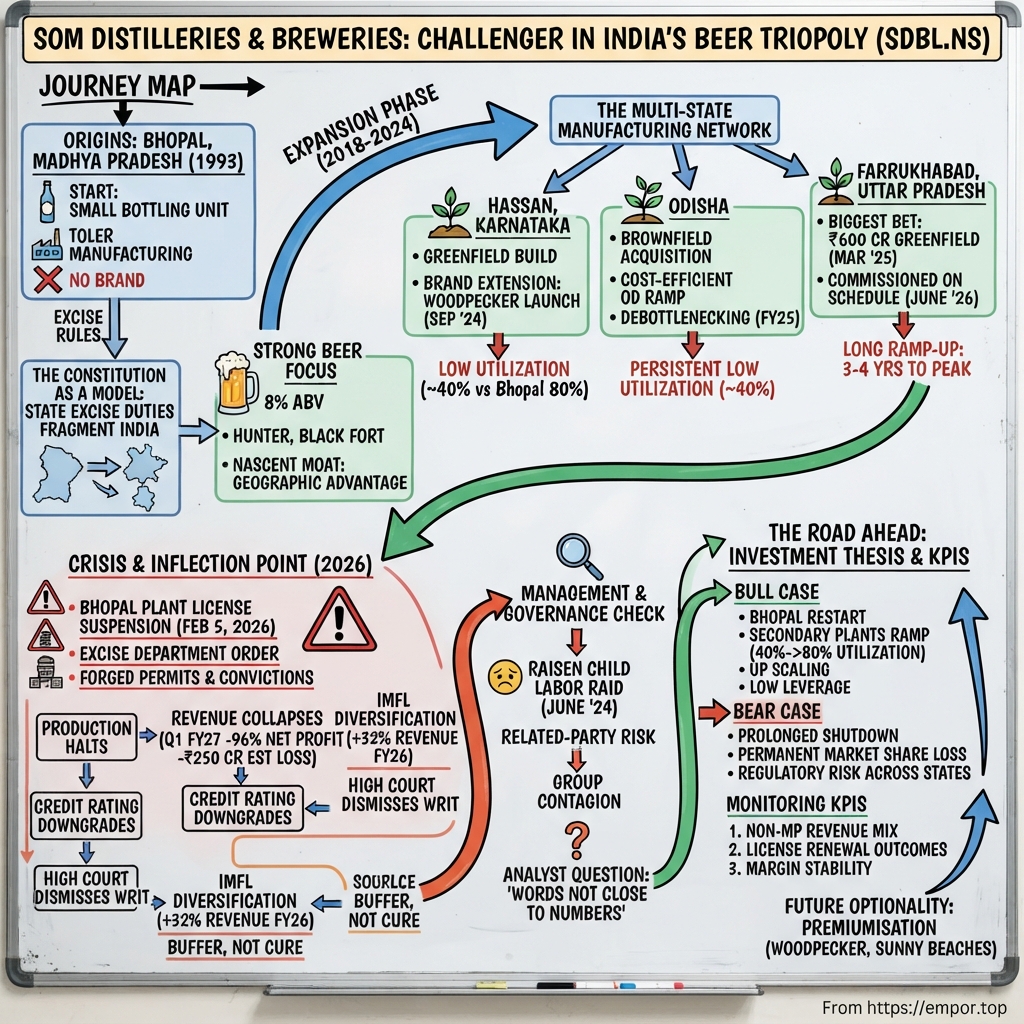
Som Distilleries & Breweries: The Regional Challenger in India's Beer Triopoly
I. Introduction & Episode Roadmap: The Challenger in India's Alcobev Triopoly
On February 5, 2026, Som Distilleries & Breweries Limited disclosed a major regulatory disruption: the Excise Department of Madhya Pradesh suspended the manufacturing licences of two Som Group units.1 The Bhopal brewery, the core asset around which the company built its central Indian operations, halted production immediately.
The financial fallout was severe. For the fiscal year ended March 2026, consolidated revenue fell roughly 15% to ₹1,229.3 crore from ₹1,442.9 crore, while consolidated net profit collapsed about 90% — from just under ₹96 crore to single-digit crores.2 The March 2026 quarter alone produced a consolidated net loss of ₹55.48 crore.3 Within eight weeks, a business that had compounded volume growth for years saw its operational core disrupted by the loss of state regulatory authorization.
Som Distilleries & Breweries (SDBL.NS on the NSE) represents the primary independent fourth player in an Indian beer market dominated by a multinational triopoly: United Breweries (majority-owned by Heineken and owner of Kingfisher), AB InBev (with Budweiser and Haywards 5000), and Carlsberg (with Tuborg). Against global balance sheets, the Bhopal-based brewer constructed a multi-state plant network, a portfolio of mass-market strong beers — Hunter, Black Fort, and Woodpecker — and a group installed capacity that management placed in the mid-thirty-million cases annually by FY2026 after its Uttar Pradesh plant came online.4
Evaluating SDBL requires balancing its operational execution against a troubled regulatory record. On one side, SDBL has demonstrated manufacturing and distribution scale in a demanding sector of Indian consumer goods. On the other, its promoter group has repeatedly faced legal and regulatory enforcement: a 2024 child-labour raid by India's federal child-rights commission at a group distillery in Raisen,5 a 2026 excise suspension traced to forged transport permits and criminal convictions of persons associated with the licensee,6 a refusal by the Madhya Pradesh High Court to intervene,7 and subsequent credit rating downgrades as the Bhopal plant remained dark.8
This analysis examines the company across five key dimensions. First, the economics of Indian beer: how state-level excise jurisdiction creates fragmented markets, why inter-state duties give local plants a structural cost advantage, and why strong beer dominates Indian consumption. Second, how a small bottling unit in Bhopal expanded into a multi-state manufacturer through a greenfield build in Karnataka, a brownfield acquisition in Odisha, and a ₹600 crore investment in Uttar Pradesh. Third, SDBL's competitive positioning against its three global rivals. Fourth, a critical test of management's claims regarding moats, geographical diversification, and capital discipline against historical performance — including an investor conference call in which an analyst told the finance director directly that "your words have nowhere been close to the numbers."9
Finally, the study outlines the core drivers of the investment thesis: potential growth paths, operational risks, and key monitoring metrics. The narrative begins where every Indian alcohol business story starts — not with a product, but with state constitutional law.
 Subscribe on LinkedIn
II. Origins & Central India Foundations (1993–2017): From Bottling Unit to Strong Beer Dominance
Bhopal in 1993 was not an obvious place to build a beverage company. It was a city still defined in the national imagination by the 1984 gas disaster, sitting in a state — Madhya Pradesh — that was poor, landlocked, agricultural, and administratively conservative. It had no port, no premium consumer base, and no brewing tradition. What it did have was barley within trucking distance, cheap land, and an excise department.
Jagdish Kumar Arora founded Som Distilleries & Breweries there in 1993 and has served as its Executive Chairman and Managing Director since 2009.10 The founding operation was modest to the point of being unrecognizable as the origin of a ₹1,200 crore group: a small bottling line doing white-label work, filling liquor for third parties for a fee. That is a toll-manufacturing business — no brand, no pricing power, no direct consumer relationship. It is also, crucially, an education. Before a company can sell alcohol in India, it must first learn to navigate the regulatory distribution plumbing, and white-label bottling provided that operational foundation.
The constitution as a business model
To understand the company's trajectory, one must understand a central structural fact: in India, alcohol is a state subject under the constitution. Each state writes its own excise policy, sets its own duty rates, licenses its own manufacturers, and in many cases controls the wholesale distribution channel outright. Karnataka routes essentially all liquor through a state beverages corporation, while Madhya Pradesh operates its own excise and tendering regime. The practical effect is that India is not a unified beer market of 1.4 billion people, but rather 28 distinct state markets, each with its own annual policy cycle, price approval process, and regulatory gatekeeper.
Layered onto that structural fragmentation is the physical cost of moving goods across borders. Shipping beer across a state border incurs import duties and freight costs that add tens of rupees per case to the landed cost of a product with administered retail prices. Because beer is heavy, low-value, and mostly water, it is economically inefficient to transport long distances. The combination of inter-state duties and freight weight means the most competitive brewer is often not the one with the largest single plant, but the one with manufacturing capacity inside the target state.
This dynamic explains how a Bhopal-based regional firm survived alongside global incumbents. A multinational brewer's scale advantages in global procurement and marketing are partially diluted by a system requiring local manufacturing presence and state-approved pricing.
Finding the niche nobody wanted
The second structural insight involved product composition. The Western model of beer — a 4.5% alcohol-by-volume lager consumed socially — represents a tiny fraction of Indian beer consumption. The overwhelming majority of Indian beer volume is "strong" beer, typically containing 7% to 8% ABV. The driver is economics rather than taste: for price-sensitive consumers seeking maximum alcohol content per rupee spent, strong beer offers superior value.
Som built its portfolio around this demand profile. Hunter, positioned as a super-strong beer, and Black Fort, a strong beer, targeted mass-market consumers in central India. These were value-driven products sold through channels where retail recommendations and distributor margins frequently outweigh advertising. The manufacturing base at Raisen, near Bhopal, gave Som a cost position in its home market that out-of-state competitors could not match, making Madhya Pradesh the cash generator funding the company's early expansion.
Testing the "regional moat" claim
That historical narrative requires careful scrutiny. The assertion that early market dominance in Madhya Pradesh established a durable product moat in mass beer is not fully supported by execution evidence.
A cost advantage rooted in a home-state regulatory structure is a geographic moat, not a brand moat. In a licensed industry, geographic moats exist at the discretion of state regulators. The single-state concentration that drove Som's early profitability also left it vulnerable. Decades later, when Madhya Pradesh suspended the group's manufacturing licences, the result was an immediate collapse in consolidated earnings.2 Consumer brand familiarity with Hunter could not protect earnings when regulatory action halted production.
Similarly, early attempts to diversify into Indian Made Foreign Liquor (IMFL) failed to match the scale of the core beer operations. Even in FY2026, when beer volumes fell sharply due to plant shutdowns while IMFL revenue grew 32%, spirits remained a minority contributor to a business dominated by mass strong beer.4 The record of the company's first two decades demonstrates an ability to operate as a low-cost regional beer manufacturer rather than a builder of transferable brand equity.
The physics of a beer company
The economics of brewing are closely tied to physical constraints. Beer is roughly 90% water, and a standard case weighs approximately 15 kilograms while selling at factory-gate prices in the value segment that leave narrow margins. Freight costs erode margins over distance, while glass packaging is both costly and breakable.
To manage packaging costs, the Indian industry relies on returnable glass bottles that are collected, washed, and refilled multiple times. This system reduces raw material costs but introduces operational complexity, as cost per case depends on bottle return rates and glass condition. When management subsequently highlighted returnable bottle economics as a key margin variable, it reflected the operational reality that recovery rates represent one of the few direct levers for gross margin management under fixed retail prices.
Seasonality introduces a second constraint. Indian beer consumption concentrates heavily in the hot months from March through June and declines during winter. Breweries operate as fixed-cost assets sized for peak summer demand that must be maintained through slower quarters. Consequently, unseasonal weather can shift quarterly volumes significantly, making annual capacity utilization figures a smoothed metric over highly variable operational periods.
Combined, these physical and regulatory parameters define the operating profile: capital-intensive, geographically constrained, seasonally volatile, price-regulated, and driven by unit cost efficiency. The economic model closely resembles cement manufacturing, where proximity to the end customer dictates competitive advantage.
By 2017, management sought to address single-state concentration by expanding production into additional states — initiating the next phase of the company's expansion.
III. The Multi-State Expansion Strategy & M&A Playbook (2018–2024)
Every regional Indian beverage manufacturer eventually faces a strategic fork in the road: defend its home state indefinitely to harvest cash and accept a growth ceiling, or replicate the model in new jurisdictions while navigating fresh regulatory regimes from scratch.
Som chose expansion, executing three distinct plays between 2018 and 2026: a greenfield build in southern India, a brownfield acquisition in the east, and a large greenfield project in the north.
Play one: Hassan, Karnataka — build it yourself
Karnataka represents one of India's largest and most lucrative beer markets, tightly governed by a state beverages corporation that acts as the sole intermediary between brewers and retailers. Som entered the state through Woodpecker Distilleries & Breweries Private Limited, a majority-owned subsidiary operating a brewery in Hassan. Establishing a local facility eliminated inter-state duties and freight surcharges on regional sales, removing a major structural cost disadvantage.
The Hassan plant also served as a vehicle for brand extension. In September 2024, the company launched Woodpecker beer in Karnataka, receiving a positive market response.11 While local manufacturing secures cost parity, introducing a dedicated brand into established distribution channels creates a growth asset. Whether Woodpecker develops into a sustainable franchise or remains a line extension remains an open question in 2026.
Plant utilization at Hassan, however, lagged behind original operations. On a November 2025 conference call, Som's finance director disclosed that while the main Bhopal brewery operated at roughly 80% capacity, utilization at Hassan and Odisha hovered around 40%.9 Consequently, years after commissioning, the southern and eastern expansions were operating at less than half their capacity, leaving the legacy single-state plant to generate the bulk of earnings.
Play two: Odisha — buy it cheap
The Odisha transaction represented the group's most capital-efficient asset acquisition. In July 2018, Som acquired a brewery in Odisha through a dedicated subsidiary for approximately ₹46 crore, subsequently upgrading and commercializing the facility to serve eastern regional markets.12 Acquiring an existing brewery mitigated development risk, as the site was already zoned, constructed, and critically, held an active manufacturing license.
Subsequent debottlenecking validated this approach. The Odisha facility expanded its operational capacity from around 6 million cases to 9 million cases during FY2025.9 Expanding a licensed site requires significantly less capital per incremental unit than greenfield construction, as core infrastructure, environmental approvals, and utility connections are already in place.
However, low utilization rates persisted post-expansion. Even after the facility was enlarged, it continued to run at approximately 40% capacity. By Q1 FY2027, reported volumes in Odisha grew roughly 40% year-on-year, while Karnataka rose 30%.13 These gains occurred off a depressed baseline, accelerated primarily because the temporary shutdown of the primary Bhopal plant restricted alternative supply.
Play three: Farrukhabad, Uttar Pradesh — the biggest bet yet
In March 2025, Som announced plans for a greenfield brewery in Uttar Pradesh,14 India's most populous state, where establishing local production is essential for cost-competitive distribution. The project was executed through Woodpecker Greenagri Nutrients Private Limited, a corporate vehicle acquired outright for the development.15 A ground-breaking ceremony (bhoomi pujan) was held at Farrukhabad in May 2025 across roughly 40 acres allotted by the state industrial development authority, laying the foundation for an integrated brewery, distillery, bottling, and maturation complex.16 Total projected capital expenditure reported in press accounts reached approximately ₹600 crore for the complete project,17 while management's November 2025 guidance framed the initial brewery phase at roughly ₹350 crore for 10 million cases of annual capacity, targeting operational launch by June 2026.9
The project met its target timeline. The Uttar Pradesh brewery was commissioned on June 9, 2026, adding roughly 10 million cases to annual capacity, though management advised investors that reaching peak utilization would require three to four years.13 While delivering a greenfield brewery on schedule demonstrated strong project execution, the extended ramp-up schedule poses financial headwinds, as depreciation and interest expenses accrue immediately while revenue scales gradually.
What the capital allocation record actually says
Evaluating Som's three expansion initiatives reveals a mixed capital allocation record. The company demonstrated operational proficiency in facility construction and acquisition: the Odisha acquisition was secured below replacement cost, subsequent debottlenecking proved capital-efficient, and the Uttar Pradesh plant was completed on schedule.
However, capacity expansion outpaced earnings growth. Despite multiplying total production capacity over eight years, consolidated net profit in FY2026 remained lower than levels recorded prior to the expansion program. Committing capital to a ₹350 crore to ₹600 crore greenfield build in Uttar Pradesh while existing plants in Karnataka and Odisha operated at 40% capacity increased financial leverage before demonstrating returns on earlier capital deployments. Elevated capital expenditure and working capital requirements led to higher finance costs and depreciation charges through FY2026.9
While geographic expansion was strategically necessary—as the February 2026 licensing suspension in Madhya Pradesh highlighted the existential risk of single-state reliance—execution lagged the timeline required to insulate the business. When the regulatory disruption occurred, multi-state assets remained underutilized capacity rather than mature profit drivers.
The financing question nobody asked early enough
The capital structure supporting the expansion introduced significant structural vulnerability. Constructing four breweries within eight years required substantial capital for land acquisition, brewhouses, fermentation tanks, bottling lines, and effluent treatment systems. Som funded these investments through a combination of internal cash generation from Madhya Pradesh, debt facilities, and short-term working capital borrowings.
Company disclosures through FY2026 confirmed that interest expenses and depreciation rose substantially, driven by higher working capital utilization and capital outlays for plant expansion.9 This cost structure impacted short-term profitability, as fixed capital charges affected the income statement immediately while capacity utilization lagged.
This financing model depended heavily on operational continuity at the core Bhopal plant to generate cash flow for debt service and ongoing construction. When the excise suspension halted production at Bhopal in February 2026, the company faced ongoing funding requirements for the Uttar Pradesh project and working capital across secondary sites without its primary cash generator. Although Som avoided distressed equity dilution during the crisis, the episode underscored the financial risks of funding long-term capital projects from a single regulated operating asset.
IV. Core Business Deep-Dive: Economics, Named Competitors, & Market Structure
A retail transaction at a liquor shop in Bhopal or Bhubaneswar takes about twenty seconds. A customer typically asks for a specific price point and alcohol strength rather than a brand name. The shopkeeper reaches for available stock that fits the requested price and offers favorable retailer margins. Without shelf-browsing, label-reading, or brand-led selection, this transactional reality dictates the operating economics for Som Distilleries & Breweries.
What the company actually sells
Beer remains the foundation of the business. The core portfolio — Hunter, Black Fort, Woodpecker, and associated labels — sits overwhelmingly in the economy and regular segments. On a November 2025 conference call, executive leadership acknowledged this positioning, describing the company as "quite strong in the economy and regular segment" while identifying premium as the opportunity ahead.9 Indian Made Foreign Liquor (IMFL) — comprising whisky, rum, and vodka — forms a smaller secondary line, but it diverged sharply from beer performance during FY2026: while beer sales fell around 20% in FY2026 under regulatory shutdowns, IMFL revenue grew roughly 32%.4
This divergence demonstrates that the spirits division provides functional revenue diversification rather than mere portfolio breadth. Spirits carry higher value per liter, face lower freight sensitivity, experience less seasonal volatility, and require less physical capacity than beer. When regulatory actions disrupted brewing operations, spirits sales continued. While SDBL remains predominantly a beer manufacturer, IMFL serves as an operational buffer against single-category shocks.
The three giants across the table
SDBL competes against three global brewing conglomerates. Market leader United Breweries, majority-controlled by Heineken, anchors its position with Kingfisher, leveraging global technical resources, brand scale, and a national balance sheet capable of absorbing regional market disruptions. AB InBev fields Budweiser at the premium end while competing directly in SDBL's mass strong-beer segment with Haywards 5000 and Knock Out, backed by global capital reserves. Carlsberg has captured urban market share with Tuborg, establishing brand equity in strong beer that exceeds value-segment alternatives.
In contrast, SDBL lacks national distribution infrastructure, consumer pricing power, and major marketing budgets. Its competitive position relies instead on localized manufacturing cost advantages, aggressive trade margins for distributors and retailers, and the operational speed of a founder-led company responding to state excise policy changes.
How money actually flows in this business
The economic structure of the Indian alcoholic beverage sector dictates producer profitability. A case of beer leaves the brewery at a state-approved ex-factory price. Taxes and statutory markups — including state excise duties, state beverage corporation margins, transport fees, and retail margins — constitute the majority of the final retail price, leaving the brewer with a small fraction of gross revenue.
This structure creates two primary operating constraints. First, brewers function as price-takers at both ends of the supply chain, unable to set retail prices or adjust wholesale rates unilaterally. When raw material costs for barley or glass packaging rise, manufacturers must apply to state excise authorities for price adjustments and await annual policy revisions. Consequently, industry profit margins fluctuate according to state regulatory cycles rather than market forces.
Second, while alcohol excise represents a vital source of revenue for state governments, state fiscal dependence does not protect individual manufacturers. When regulatory authorities enforce compliance suspensions against a specific producer, competing brewers absorb the displaced volume, preserving state tax revenues. The state depends on aggregate industry output, not on any single licensed corporate entity.
Where the competitive battle is actually fought
Because brand pull remains limited in value beer and pricing is fixed by regulation, competition centers on three operational battlegrounds.
First is the administrative process governing annual state excise policies, including label registrations, price approvals, duty classifications, and government supply tenders. Success requires regulatory compliance, administrative efficiency, and local operational presence, making regulatory enforcement the primary threat to market standing.
Second is trade economics, defined by retailer margins per case, order fulfillment speed, and inventory availability during peak summer demand. Local manufacturing capacity provides a distinct operational advantage by enabling rapid order replenishment compared to out-of-state competitors.
Third is retail cold-chain availability. In mass-market beer, product temperature and immediate availability heavily influence consumer selection. Production disruptions erode market share rapidly, as retailers substitute alternative brands and consumers adapt to available choices.
While SDBL competes effectively on distribution speed and trade incentives against multinational rivals, administrative and regulatory compliance has proven to be its main operational vulnerability.
Running the frameworks honestly
Evaluating SDBL through strategic frameworks highlights structural limitations. Under Hamilton Helmer's 7 Powers framework, most traditional competitive advantages are absent. The beer industry offers no network effects, and consumers face zero switching costs for value-segment purchases. Counter-positioning is inapplicable against incumbents that already market economy strong beers, such as AB InBev's Haywards 5000. Brand power — defined as the ability to command a persistent price premium — resides with established brands like Kingfisher and Budweiser rather than Hunter or Black Fort.
SDBL's primary structural advantage lies in localized process power and geographic freight savings. An in-state brewery avoids inter-state tariffs and long-distance transport costs incurred by out-of-state competitors. However, this cost structure does not constitute an exclusive resource, as competing brewers can replicate the advantage by constructing local production units.
Porter's Five Forces framework underscores further structural pressure. Buyer power is high; state beverage corporations operate as monopsonies controlling purchase volumes, payment schedules, and wholesale pricing. In Madhya Pradesh, state authorities maintain control over licensing and procurement. Manufacturers cannot independently adjust prices to absorb packaging or raw material inflation. On a November 2025 conference call, executive leadership reflected this lack of pricing power when asked if a 15% EBITDA margin was sustainable, stating, "Let's hope that we continue to post margins like this."9 Supplier bargaining power remains significant as well, particularly regarding returnable glass bottle inventory and raw material inputs.
Overarching these forces is regulatory power. In state-controlled alcohol markets, regulatory bodies simultaneously act as licensors, tax collectors, primary buyers, and enforcement authorities. Regulatory compliance determines operational continuity, making licensing governance the central determinant of business stability.
Consequently, SDBL relies on localized operational execution rather than a protected competitive moat. Profitability remains dependent on manufacturing efficiency and ongoing regulatory compliance, shaping the context for management's ongoing effort to expand into premium product categories.
V. Hidden & Optionality Bets: Premiumisation & IMFL Expansion
Value-segment consumer goods companies frequently follow a familiar growth narrative: after establishing scale in economy products, management attempts to move up the price ladder to expand profit margins. In practice, however, successful premiumisation remains the exception rather than the rule.
Som Distilleries & Breweries articulated this strategy during its November 2025 earnings call. Executive leadership stated that rather than chasing volume alone, the company would shift its primary focus toward margin expansion through premium offerings, acknowledging its core strength in economy and regular beer while identifying premium products as its chief growth opportunity.9 Three distinct initiatives underpin that strategic ambition.
The three bets
The first initiative focuses on premium and craft-adjacent beer. SDBL positioned its Woodpecker brand to target urban consumers seeking higher-tier offerings beyond value-segment strong beers—a demographic cultivated in metropolitan markets by brands such as Bira 91, Kronenbourg, and Hoegaarden. Wheat beer and milder flavor variants serve as the main product offerings in this category.
The second initiative uses mild beer to drive both volume and brand image. The company launched Sunny Beaches, a new mild beer brand that reached 5,000 retail outlets within a month of introduction, a rollout management explicitly framed as replicating its earlier playbook for Power Cool.9 While securing 5,000 outlets demonstrates SDBL's established distribution reach, initial retail placement does not guarantee consumer repeat purchases, which ultimately determine brand viability.
The third initiative targets spirits premiumisation through the expansion of Mahavat whisky into northern India and a planned single malt launch in key benchmark markets such as Mumbai.9 Introducing a single malt represents a significant stretch for a regional beer manufacturer, as the Indian single malt category relies heavily on established brand provenance and heritage.
Sizing it honestly
Despite their strategic emphasis, these initiatives remain financially immaterial to SDBL's current earnings profile. Premium beer and new-format products account for only a small fraction of total group volume. Even the fastest-growing segment—IMFL, which reported 32% revenue growth in FY2026—expanded against a contracting beer baseline, enhancing revenue mix metrics without altering the core earnings structure.4 Consequently, an investment thesis on SDBL rests primarily on its mass strong-beer operations in Madhya Pradesh, Karnataka, Odisha, and Uttar Pradesh, while premiumisation efforts function as long-term optionality.
Falsifying the premiumisation claim
Evaluating whether craft beer and IMFL premiumisation will drive structural margin expansion requires examining several operational hurdles.
The primary challenge stems from SDBL's historical operating record. Despite long-standing efforts to build its spirits business, IMFL remains a secondary contributor alongside the core brewing operation. This pattern reflects structural industry barriers rather than temporary execution delays: Indian spirits distribution is dominated by established national players with deep brand equity and entrenched state distribution relationships. A challenger spirits brand encounters the same state-level regulatory gatekeeping as beer manufacturers, but without the freight cost advantages that local breweries enjoy over out-of-state competitors.
A second constraint involves input cost dynamics. Management commentary explicitly links margin sustainability to raw material inflation and returnable glass bottle recovery rates.9 Although premium products offer higher theoretical gross margins per case, fixed state-administered retail pricing combined with variable packaging costs can compress expected margin gains.
Third, premiumisation depends fundamentally on brand equity. While SDBL has demonstrated strong distribution capabilities by placing new labels into thousands of retail outlets, it has yet to establish consumer brand pull capable of commanding sustained price premiums.
This historical context does not invalidate SDBL's premiumisation potential entirely—the growth of IMFL during FY2026 indicates independent category demand—but it suggests realistic boundaries. Premium products and spirits could develop into a meaningful secondary earnings stream over several years, rather than driving an immediate margin re-rating. A key performance indicator for this transition is whether the revenue share of IMFL and premium products increases during periods of normalized beer production, rather than solely during brewing disruptions.
Ultimately, product strategy remains secondary to corporate governance and executive management execution.
The second-layer read on the optionality
Evaluating SDBL's optionality reveals two additional operational factors.
First, distribution reach differs from sustained consumer offtake. Reaching 5,000 outlets quickly reflects SDBL's core trade distribution strength, which allows local facilities to fulfill distributor orders faster than out-of-state competitors. However, initial placement without consumer sell-through risks stock returns and strained distributor relationships. Tracking repeat order rates per outlet following initial rollout remains essential for assessing true market adoption.
Second, premium brewing increases operational complexity and capital intensity. Producing wheat beers, milder lagers, and longer-maturation styles requires specific brewing processes and extended tank residency times, effectively reducing effective production capacity per case. While SDBL's current excess capacity in secondary facilities absorbs these requirements with low incremental costs, premium production ultimately competes for brewery capacity alongside core volume brands.
While these factors do not alter the fundamental investment profile, they highlight the operational requirements needed to execute a premiumisation strategy in a business historically focused on mass-market volume.
VI. Governance, Promoter Profile, & Historical Falsification Pass
On June 16, 2024, officials from India's National Commission for Protection of Child Rights conducted an unannounced inspection at a distillery in Raisen district, Madhya Pradesh. The findings quickly drew national attention: 59 children—39 boys and 20 girls—were working at the facility. The commission's chairman reported that children suffered burnt hands and peeling skin from sustained contact with spirits and chemicals.18 Madhya Pradesh's Chief Minister publicly announced that the business had been booked for child labor and that its license was suspended, alongside the suspension of state excise inspectors.5 State authorities subsequently impounded the facility.6
A precise factual distinction is critical here. The listed company stated that the Raisen facility was operated by an associate private limited entity within the promoter group, rather than the listed company itself, and argued that third-party labor contractors had failed to perform proper age verification.6 While this represents a valid legal boundary, from a governance perspective it highlights systemic group risk rather than providing an operational defense.
The structure is the story
Som Distilleries & Breweries Limited operates within a broader promoter-controlled group architecture. Unlisted entities—most notably Som Distilleries Private Limited—hold substantial equity in the listed company, with Som Distilleries Private Limited holding roughly 9.8% alongside Executive Chairman Jagdish Kumar Arora's direct 24% stake and Director Ajay Arora's 4% holding.19
For minority shareholders, this group architecture introduces two structural concerns. First, related-party transactions between listed and unlisted promoter entities create channels where economic value can shift within the group. Second, reputational and regulatory contagion can bridge corporate entities: when the unlisted distillery was raided in 2024, the listed company's share price, credit ratings, and operating standing bore the financial impact. The legal distinction between corporate entities provided no protection against market consequences.
The 2026 suspension and the courts
The regulatory disruption of early 2026 shared a similar structural pattern. On February 4, 2026, the Excise Commissioner of Madhya Pradesh suspended eight manufacturing licenses linked to group entities over allegations involving the transportation of foreign liquor using forged permits and criminal convictions of individuals associated with the licensee.7 Management publicly characterized the enforcement action as stemming from a 2012 matter to which the listed entity was not a party.1
The legal challenge failed to overturn the administrative action. On March 23, 2026, Justice Vivek Agarwal of the Madhya Pradesh High Court dismissed the group's writ petition, ruling that trade in liquor is not a fundamental right protected under Article 14 and that statutory administrative actions under the Madhya Pradesh Excise Act, 1915, remain valid when proportionate.720 This ruling emphasizes a key investment reality: liquor manufacturing in India operates as a state-conferred privilege rather than an absolute commercial right, placing the company's core revenue generation under ongoing regulatory discretion.
Subsequent legal proceedings yielded limited operational relief. While an appellate bench permitted an associate entity to participate in a state country-liquor tender on an interim basis, the core license suspension at Bhopal remained in force.21 By mid-2026, the company disclosed that state excise authorities had rejected its FY2026–27 license renewal application for the Bhopal brewery, prompting further legal appeals.22
The auditor and disclosure lens
This corporate structure places significant reliance on financial disclosure quality, as public shareholders view intra-group economics primarily through annual related-party schedules and independent audit reports. Evaluating the business requires close examination of related-party transaction volumes, pricing terms, and auditor comments regarding internal financial controls.
Where an unlisted promoter entity acts simultaneously as a supplier, associate, and major shareholder of a listed company, reported consolidated earnings require rigorous verification. The 2024 enforcement action demonstrated that while corporate liability may be legally partitioned, operational and regulatory risks spill over directly to the listed entity.
Judging management on behaviour, not statements
Assessing executive management requires weighing operational delivery against compliance performance. Operationally, leadership has demonstrated execution capability: building production facilities across four states, acquiring the Odisha plant below replacement cost, expanding capacity efficiently, and commissioning the Uttar Pradesh facility on schedule. Furthermore, promoter equity remains unpledged, avoiding forced-selling risks. During the Bhopal plant shutdown, management chose to retain staff, maintaining roughly ₹5 crore per quarter in payroll expenses to preserve restart readiness.13
Conversely, the compliance record reveals persistent vulnerabilities. The 2024 child-labor enforcement action and the 2026 permit-forgery suspension represent two distinct regulatory failures within two years. For a business whose cash flows depend entirely on state regulatory authorization, repeated compliance lapses represent a systemic operational risk regardless of which specific entity holds the license.
Guidance discipline has similarly diverged from operational outcomes. On the November 2025 earnings call, management projected full-year revenue of roughly ₹1,600 crore, but full-year FY2026 revenue came in at ₹1,229 crore.92 On that same call, a VMC Advisors analyst remarked directly that "your words have nowhere been close to the numbers which were given as guidance," to which the finance director responded by attributing missing targets to regulatory factors "beyond our control."9 While external disruptions were real, setting aggressive targets in a regulatory-dependent business points to an ongoing guidance discipline problem.
In summary, Som Distilleries & Breweries combines proven manufacturing execution with a governance framework that has generated severe regulatory disruptions. Investors are evaluating not merely product competitiveness, but the promoter group's ability to maintain regulatory compliance across multiple state jurisdictions—a risk factor clearly reflected in recent financial results.
VII. Earnings Calls, Transcripts, & Capital Allocation Audit
The most revealing moment in SDBL's recent investor communications was not a quarterly metric, but an analyst refusing to accept management's narrative.
During the November 2025 earnings call — three months before the Bhopal license suspension, when management framed underperformance as soft consumer demand rather than regulatory risk — leadership attributed a 19% year-on-year volume drop to excise duty hikes in Karnataka and broader market softness. The chief operating officer noted that the industry slowdown began in the fourth quarter of the prior year and persisted through the first two quarters, before offering an optimistic outlook: "We definitely expect a much higher, much better recovery during Q3 and Q4."9
That exchange followed a familiar corporate script: acknowledge underperformance, point to macro headwinds, and project a sharp recovery in subsequent quarters. However, analysts challenged those assumptions during the question-and-answer session. When management guided for roughly ₹800 crore in second-half revenue to hit a full-year target of ₹1,600 crore, analysts openly questioned its credibility. Pressed on whether a 15% EBITDA margin was realistic, executive leadership responded, "Let's hope that we continue to post margins like this."9
What actually happened
When February arrived, market demand arguments became secondary to regulatory reality. For FY2026, SDBL reported consolidated revenue of roughly ₹1,229 crore to ₹1,233 crore, EBITDA of approximately ₹89.7 crore, and net profit of roughly ₹10 crore — down sharply from nearly ₹96 crore in net profit the prior year.24 The fourth quarter accounted for the bulk of the decline, generating a consolidated net loss of ₹55.48 crore.3 Even in the third quarter, prior to the license suspension, net profit had fallen by roughly 74.5% year-on-year alongside a 24% drop in beer volumes that management attributed to cold weather.23
This timeline demonstrates that operational weakness predated regulatory enforcement. While the license suspension turned a difficult fiscal year into a severe operational setback, volume contraction was already underway.
Heading into FY2027, the Bhopal facility remained shut. First-quarter consolidated revenue stood at ₹268.8 crore with EBITDA of ₹15.2 crore. Management estimated the suspension cost ₹250 crore to ₹260 crore in lost revenue during the quarter alone13 — an amount roughly equal to total reported quarterly sales. Consolidated net profit fell by a reported 96%.13 Volume gains of 30% in Karnataka and 40% in Odisha provided partial operational offsets, but proved insufficient to cover the gap.
The credit and balance-sheet read
Credit rating agencies responded quickly to the operational disruption. On June 30, 2026, ICRA downgraded the long-term credit rating of Som Distilleries & Breweries Odisha Private Limited from [ICRA]BBB to [ICRA]BBB- with a Negative outlook, while lowering its short-term rating from A3+ to A3, citing the Madhya Pradesh license suspensions as the primary driver.8 Infomerics separately downgraded ratings across the Som Distilleries group following the Bhopal plant shutdown.24 This rating action highlights group contagion risk: an operational disruption at a parent facility in Madhya Pradesh triggered credit downgrades for a subsidiary in Odisha, demonstrating that credit risk bridges legal entities within a shared promoter structure.
Despite these operational pressures, SDBL maintained balance sheet stability. Gross debt-to-equity remained flat at 0.31x through the Q1 FY2027 disruption, while operating cash flow reached approximately ₹28 crore during the quarter.13 Maintaining positive cash flow with a shuttered primary facility reflects working-capital control, supported by a distribution model where primary buyers are state-owned beverage corporations.
However, low financial leverage functions as a solvency buffer rather than a growth driver. While conservative borrowing prevented a liquidity crisis when revenue dropped by one-third, it could not prevent the revenue loss itself. For a producer vulnerable to administrative licensing decisions, balance sheet discipline provides time to pursue legal remedies but does not replace operating cash flow. Management's FY2027 revenue guidance of ₹1,400 crore to ₹1,500 crore at approximately 10% EBITDA margins remains explicitly dependent on resolving the Bhopal licensing status and scaling production at the Uttar Pradesh facility4 — targets tied to regulatory outcomes outside the company's direct control.
Reading the narrative across three reporting periods
Tracking SDBL's corporate disclosures across three consecutive reporting periods highlights how executive narrative evolved alongside operational stress.
In November 2025, management framed underperformance as a cyclical slowdown driven by higher excise duties in Karnataka and unseasonal weather, forecasting a strong second-half recovery.9 Following the February 2026 enforcement action, messaging shifted to legal and procedural arguments, characterizing the suspension as stemming from a 2012 enforcement matter to which the listed entity was not a party.1 By the release of FY2026 annual results and FY2027 first-quarter disclosures, reporting became more quantitative, providing specific estimates for lost quarterly revenue and idle plant costs, while acknowledging that FY2027 targets depended directly on resolving the Bhopal license and ramping the Uttar Pradesh plant.134
This shift toward detailed financial disclosure provided clearer visibility into the scale of operational disruption. Quantifying lost quarterly revenue at ₹250 crore to ₹260 crore offered a concrete basis for evaluating recovery timelines.
However, detailed reporting after an enforcement action does not offset overoptimistic guidance beforehand. Proposing a ₹1,600 crore revenue target in late 2025 despite analyst skepticism reflected persistent guidance discipline challenges. Consequently, FY2027 projections of ₹1,400 crore to ₹1,500 crore require careful evaluation against management's historical guidance track record.
What an investor should demand next
Three specific disclosures would significantly improve underwriting visibility for SDBL: plant-by-plant volume and capacity utilization metrics published quarterly to verify geographical diversification; a clear legal roadmap and timeline for resolving the Bhopal license suspension; and detailed disclosures on the volume and pricing terms of related-party transactions within the promoter group. Without these reporting metrics, assessing the range of operational outcomes for the business remains challenging.
VIII. Investment-Story Spine: "Why Win / Why Not" & Current Risk Radar
Strip away the narrative details, and the case for Som Distilleries & Breweries reduces to a fundamental question: is this a sound operating business temporarily disrupted by regulatory enforcement, or a structurally vulnerable enterprise whose fragility has been laid bare?
The case for winning
The bullish thesis rests first on the group's manufacturing footprint. As of mid-2026, the company operates breweries across Madhya Pradesh, Karnataka, Odisha, and Uttar Pradesh. Assembling that four-state network required eight years and several hundred crore rupees in capital investment—a position that competitors cannot replicate quickly, given that each facility required separate state-level licensing and administrative approvals. In an industry where local manufacturing dictates unit delivery costs, an established multi-state presence provides a genuine structural position.
Second, the group's secondary plants are expanding independently. In the first quarter of fiscal 2027, volume grew roughly 30% in Karnataka and about 40% in Odisha, even while operating at approximately 40% of capacity. Because the fixed costs of these facilities are already absorbed, incremental volume growth yields attractive economics, as filling existing capacity generates high contribution margins.139 Although geographical diversification proceeded too slowly to shield earnings in fiscal 2026, those non-home markets represent the primary engine for an operational recovery in fiscal 2027 and 2028.
Third, the Uttar Pradesh facility provides substantial growth optionality. Commissioned on schedule, the 10 million case brewery expands addressable market access in India's most populous state, even allowing for management's three-to-four-year timeline to achieve full utilization.13
Fourth, balance-sheet resilience supports financial survivability. With promoter shares unpledged, gross debt-to-equity maintained near 0.31x, and positive operating cash flow generated even during the worst quarter in group history, the business has avoided distressed equity dilution.1319
The case against
The bear case presents a distinct and more direct structural critique.
First, single-asset concentration risk has moved from a theoretical vulnerability to a realized loss. Management estimated that the primary Bhopal plant contributed ₹250 crore to ₹260 crore in quarterly revenue.13 An asset of that scale—whose operating license was administratively suspended and whose renewal application for fiscal 2027 was subsequently rejected by state excise authorities22—highlights severe concentration exposure. Furthermore, the Madhya Pradesh High Court's ruling that liquor trading is not a fundamental constitutional right closes off a key avenue for judicial relief.7
Second, the business lacks pricing power to offset raw material inflation. While input costs for barley, returnable glass bottles, and packaging fluctuate with market forces, wholesale and retail prices remain tightly regulated by state authorities. This asymmetry leaves profit margins exposed to input cost increases.
Third, persistent compliance issues impose a permanent valuation discount. Two major regulatory enforcement actions within two years, extensive transactions with unlisted promoter-owned entities, and a guidance track record that market analysts have openly challenged as unreliable9 limit institutional investment interest and depress valuation multiples.
Fourth, lost retail placement is difficult to recover rapidly. During the months the Bhopal plant remains offline, multinational competitors—United Breweries, AB InBev, and Carlsberg—absorb displaced volume across Madhya Pradesh retail outlets. In value-segment beer, consumer loyalty remains low, and products that disappear from retail shelves risk being permanently replaced by available alternatives.
The activist lens
A skeptical institutional investor evaluating the company would confront four key operational questions for which public disclosures provide incomplete answers. First, why did management allocate ₹350 crore to ₹600 crore in capital toward a fourth greenfield brewery in Uttar Pradesh while existing facilities in Karnataka and Odisha were operating at roughly 40% capacity? Second, what are the precise volume terms and transfer pricing mechanisms governing transactions between the listed entity and unlisted promoter-controlled companies? Third, why did failed compliance controls surface neither the third-party labor contractor issues nor the permit irregularities prior to state regulatory action? And fourth, if external regulatory factors are genuinely beyond management's control, why does leadership continue issuing precise financial guidance premised on stable regulatory conditions?
Risk radar
The primary operational threat remains legal and regulatory: continued refusal of the Bhopal excise license, alongside potential enforcement spillover into other operating jurisdictions. High-tier risk centers on geographic concentration; despite maintaining four brewery sites, historical earnings remain heavily tied to a small group of state markets, as demonstrated by the fiscal 2026 earnings collapse. Medium-tier risks include input-cost volatility across barley, extra neutral alcohol, and glass packaging; execution and utilization risks at the new Uttar Pradesh facility while under regulatory oversight; and tightening credit access following credit rating downgrades. Demand seasonality remains a secondary variable—demonstrated in the third quarter of fiscal 2026, when cold weather and state excise duty changes drove a volume decline of more than 20% without regulatory intervention.23
Given all that, what does an investor actually watch?
IX. The 3 KPIs That Matter Most & Bull vs. Bear Case
When evaluating a company with complex legal and operating dynamics, tracking every headline metric—volumes, margins, brand rollouts, and court dates—can obscure the primary investment signals. Three specific key performance indicators carry nearly all the essential information.
There is equal discipline in identifying what not to track. Quarterly revenue in the Indian alcoholic beverage sector reflects short-term weather fluctuations, state policy cycles, and licensing timelines—three variables that generate substantial noise around a slower structural trend. Overreacting to a single quarter's performance creates a double misjudgment: assuming a temporary winter slowdown or excise hike signals structural failure, or assuming a peak summer volume surge implies long-term compounding power.
The following three metrics map directly to core questions in the investment thesis and can be verified through public disclosures without complex financial modeling.
KPI 1: Non-Madhya Pradesh revenue as a share of group revenue
This ratio compresses the geographic diversification thesis into a single metric. SDBL's multi-year expansion across Karnataka, Odisha, and Uttar Pradesh aimed to reduce operational reliance on a single state excise regulator. Results through FY2026 showed that geographic risk remained concentrated in the home state. If non-Madhya Pradesh revenue rises durably—even when the Bhopal facility operates at full capacity—the diversification strategy is delivering results. Conversely, if the ratio increases only when the primary home-state plant is shut down and contracts once production resumes, the company has not diversified its earnings base; it has merely shifted output between facilities.
KPI 2: Plant operating status and licence renewal outcomes
SDBL's most critical public disclosures are regulatory filings regarding facility licensing rather than quarterly financial statements. The metric is binary: whether each brewery across Bhopal, Hassan, Odisha, and Farrukhabad holds an active license, and whether annual state excise renewals proceed without regulatory intervention. Because state excise authorities rejected the Bhopal license renewal for FY2026–27 and the company is pursuing legal remedies,22 the resolution of that proceeding represents the single highest-information event for the business. Financial performance across all other divisions remains downstream of this outcome.
KPI 3: Gross margin and EBITDA margin stability through an input-cost cycle
Margin stability tests pricing power, providing a direct measurement of business quality independent of legal outcomes. The company generated EBITDA margins near 15% during normalized periods and provided guidance of roughly 10% for FY2027.94 Monitoring margin resilience through rising barley, extra neutral alcohol, and glass packaging costs reveals whether SDBL possesses operational insulation. If profit margins compress systematically during input-cost inflation, it confirms an inability to pass on costs, indicating the business operates as a price-taking processor. If margins remain stable through raw material swings, claims of manufacturing cost efficiency gain analytical support.
Secondary operational metrics—such as premium category volumes, single malt introductions, and new retail outlet counts—remain immaterial to near-term earnings and are secondary to core margin performance.
The bull synthesis
The constructive case relies on a multi-stage operational recovery. First, the legal and administrative challenges in Madhya Pradesh resolve within a manageable timeframe, allowing the Bhopal plant to resume production where local cost advantages and distributor networks remain recoverable. Second, secondary facilities in Karnataka and Odisha expand utilization from 40% toward the 80% historical levels of the main plant, converting underutilized capacity into high-margin operating cash flow without additional capital expenditure. Third, the newly commissioned Uttar Pradesh facility ramps toward its 10 million case annual capacity over three to four years, establishing a major footprint in northern India. Under this scenario, group revenue recovers toward management's ₹1,400 crore to ₹1,500 crore target range, credit ratings stabilize, and low debt leverage allows SDBL to capitalize on a multi-state manufacturing network.
In this view, the FY2026 disruption accelerated necessary geographical diversification, leaving the company with expanded capacity and favorable base effects for earnings recovery.
The bear synthesis
The negative thesis outlines a prolonged structural contraction. The Bhopal license remains unrestored, as successive administrative and legal decisions extend the shutdown without constitutional relief. During the outage, retail shelf space across Madhya Pradesh shifts permanently to multinational brands—Kingfisher, Haywards, and Tuborg—backed by global capital reserves and trade incentives. Meanwhile, fixed overhead expenses at the shuttered facility continue to drag on earnings, while the Uttar Pradesh facility incurs depreciation and interest charges during an extended ramp-up period. Downgrades by credit rating agencies increase working capital financing costs across all operating units, while persistent governance concerns limit access to institutional equity.
Under this scenario, a multi-state footprint does not constitute a competitive moat; rather, it exposes the business to regulatory discretion across multiple state jurisdictions.
An objective assessment indicates that future performance depends less on commercial execution than on administrative and legal determinations. Both bullish and bearish outcomes remain tied to regulatory decisions, defining the fundamental risk profile of the business.
The scenario that sits between them
A more probable outcome lies between these two extremes. The business experiences a slow, partial resolution: Madhya Pradesh operations resume after extended legal proceedings, incurring legal costs and permanent market-share losses to competitors. Utilization in Karnataka and Odisha improves gradually, while the Uttar Pradesh facility ramps according to management's three-to-four-year timeline. EBITDA margins settle between historical highs of 15% and the 10% target guided for FY2027.
In this baseline scenario, conservative balance-sheet leverage prevents insolvency, but financial recovery reflects base-effect rebounds rather than structural quality gains. Investors receive compensation for absorbing regulatory uncertainty and operating leverage across underutilized facilities, rather than for holding a protected consumer brand franchise—a critical distinction when evaluating a regional producer competing against global brewing conglomerates.
X. Playbook & Key Investing Lessons
Lesson 1: A regulatory cost advantage and a regulatory single point of failure are the same asset viewed from different angles
The core rationale for constructing localized breweries was clear: inter-state duties and freight surcharges penalize centralized production, making a manufacturing plant inside each target state a durable cost edge. That structural logic was sound and remains valid. What it overlooked, however, is that the identical license conferring that advantage can be administratively revoked—at which point the cost edge instantly inverts into a total loss of revenue from that jurisdiction. Som's Bhopal facility was simultaneously its greatest operational asset and its single largest point of failure, not sequentially, but throughout its existence.
The broader takeaway for investors in licensed sectors is straightforward: evaluate not only the cash flow generated by a regulatory permit, but also the immediate consequences if that authorization is withdrawn. An asset dependent on annual administrative renewal should not carry the same valuation multiple as an unencumbered physical asset. Moreover, a company that concentrates its primary production in a single regulatory jurisdiction carries operational risks that traditional debt leverage and interest coverage metrics fail to capture.
Lesson 2: Volume scale is not brand equity, and only one of them survives a shutdown
Som established substantial volume scale in mass strong beer, generating revenue, cash flow, and operating leverage. But in a value segment, volume alone offers little protection during a supply disruption. Price-sensitive consumers seeking a standard strong beer do not wait for Black Fort or Hunter to return to store shelves; they substitute whatever product is immediately available at a similar price point. Genuine brand equity—the kind United Breweries maintains with Kingfisher—creates consumer pull strong enough to endure a temporary supply interruption. That durable brand pull is precisely what Som never developed, largely because value-segment margins leave little room for sustained brand-building investments.
This structural dynamic creates a strategic trap. Low pricing drives the volume required to fund production capacity, and added capacity demands further volume, yet nothing in that operational cycle generates the pricing power required to escape it. Som's push into premium beer and spirits reflects an explicit effort to break out of this cycle, but the group's multi-decade operating record in spirits suggests that investors should hold those premiumisation ambitions to a rigorous evidentiary standard.
Lesson 3: Balance-sheet safety and enterprise safety are different things
With gross debt-to-equity near 0.31x, unpledged promoter holdings, and positive operating cash flow maintained even during severe operational stress, Som appeared financially conservative on conventional screening metrics. That conservative balance sheet genuinely mattered, enabling the business to navigate the fiscal 2026 licensing crisis without resorting to distressed equity dilution.
However, standard financial leverage metrics evaluate solvency risk rather than operational interruption risk. They offer no indication of whether a state excise authority will grant an annual license renewal. For businesses operating under strict state oversight—where products are distributed through government-controlled channels and manufacturing depends on statutory licenses—the governance and compliance record is not merely a qualitative detail. It is a central determinant of the valuation discount rate. Experiencing two major regulatory enforcement actions within two years in an industry governed by state discretion represents a fundamental operational risk that belongs in core valuation models rather than financial footnotes.
The overarching lesson extends well beyond the Indian alcoholic beverage sector: when a company's primary buyer, principal regulator, and central operational risk are tied to state authorities, underwriting the business means underwriting a regulatory relationship. Som constructed multi-state breweries specifically to reduce its reliance on a single jurisdiction. The events of fiscal 2026 demonstrated that geographical diversification had not proceeded rapidly enough to insulate the core enterprise.
References
-
Som Distilleries and Breweries Updates on License Suspension Proceedings — ScanX ↩↩↩
-
Som Distilleries & Breweries reports consolidated net loss of Rs 55.48 crore in the March 2026 quarter — Business Standard / Capital Market, 2026-06-01 ↩↩↩↩
-
Som Distilleries Posts Rs 37.31 Cr Q4 Loss — Whalesbook Corporate News, 2026 ↩↩
-
Som Distilleries FY26 Revenue ₹1,233 Cr; Guides ₹1,400–1,500 Cr for FY27 — Whalesbook Corporate News, 2026 ↩↩↩↩↩↩↩↩
-
MP govt suspends licence of distillery involved in child labour case — Deccan Herald, 2024-06-19 ↩↩
-
Govt impounds Som's distillery, suspends licences over child labour — Business Standard, 2024-06-19 ↩↩↩
-
Liquor Business Is Not A Fundamental Right: MP High Court Upholds License Suspension Of Distilleries — LiveLaw, 2026 ↩↩↩↩
-
Som Distilleries & Breweries Odisha Private Limited: Rating rationale — ICRA Limited, 2026-06-30 ↩↩
-
Som Distilleries & Breweries Ltd — November 2025 Conference Call Summary, Specter ↩↩↩↩↩↩↩↩↩↩↩↩↩↩↩↩↩↩↩↩
-
Jagdish Kumar Arora, Som Distilleries & Breweries: Profile and Biography — Bloomberg Markets ↩
-
Som Distilleries launches Woodpecker beer in Karnataka; stock soars 7% — Business Standard, 2024-09-16 ↩
-
Som Distilleries Acquires Odisha Brewery for Rs 46 Crore — India Infoline, 2018-07-10 ↩
-
Som Distilleries Q1 Results: Revenue Falls To ₹268.8 Crore Amid MP Shutdown — ScanX, 2026 ↩↩↩↩↩↩↩↩↩↩↩
-
Som Distilleries to set up greenfield brewery in Uttar Pradesh — Business Standard / Capital Market, 2025-03-03 ↩
-
Som Distilleries and Breweries acquires Woodpecker Greenagri Nutrients — Just Drinks ↩
-
Som Distilleries & Breweries conducts Bhoomi Pujan for its upcoming project in Farrukhabad — Business Standard / Capital Market, 2025-05-22 ↩
-
Som Distilleries Launches ₹600 Crore Greenfield Project in Uttar Pradesh — Angel One ↩
-
58 child labourers rescued from distillery in Madhya Pradesh's Raisen — Deccan Herald, 2024-06-16 ↩
-
Som Distilleries & Breweries Limited — Ownership, Simply Wall St ↩↩
-
Som Distilleries Private Limited & Ors. v. State of Madhya Pradesh & Ors. — Verdictum, 2026 ↩
-
Som Distilleries Reports No Change in Licence Suspension, Wins Limited Court Relief — TipRanks ↩
-
Som Distilleries pursues legal remedies after excise license rejection — ScanX, 2026 ↩↩↩
-
Som Distilleries Faces Profit Drop, MP Plant License Suspended Again — Whalesbook, 2026 ↩↩
-
Som Distilleries Credit Ratings Downgraded by Infomerics Amidst Bhopal Plant Suspension — Whalesbook Corporate News, 2026 ↩
 LinkedIn
 WhatsApp
 Reddit
 Hacker News
 Email
Email Kindle
 RSS Feed
 Spotify
 Apple Podcasts
 Amazon Music
 Audible
 YouTube