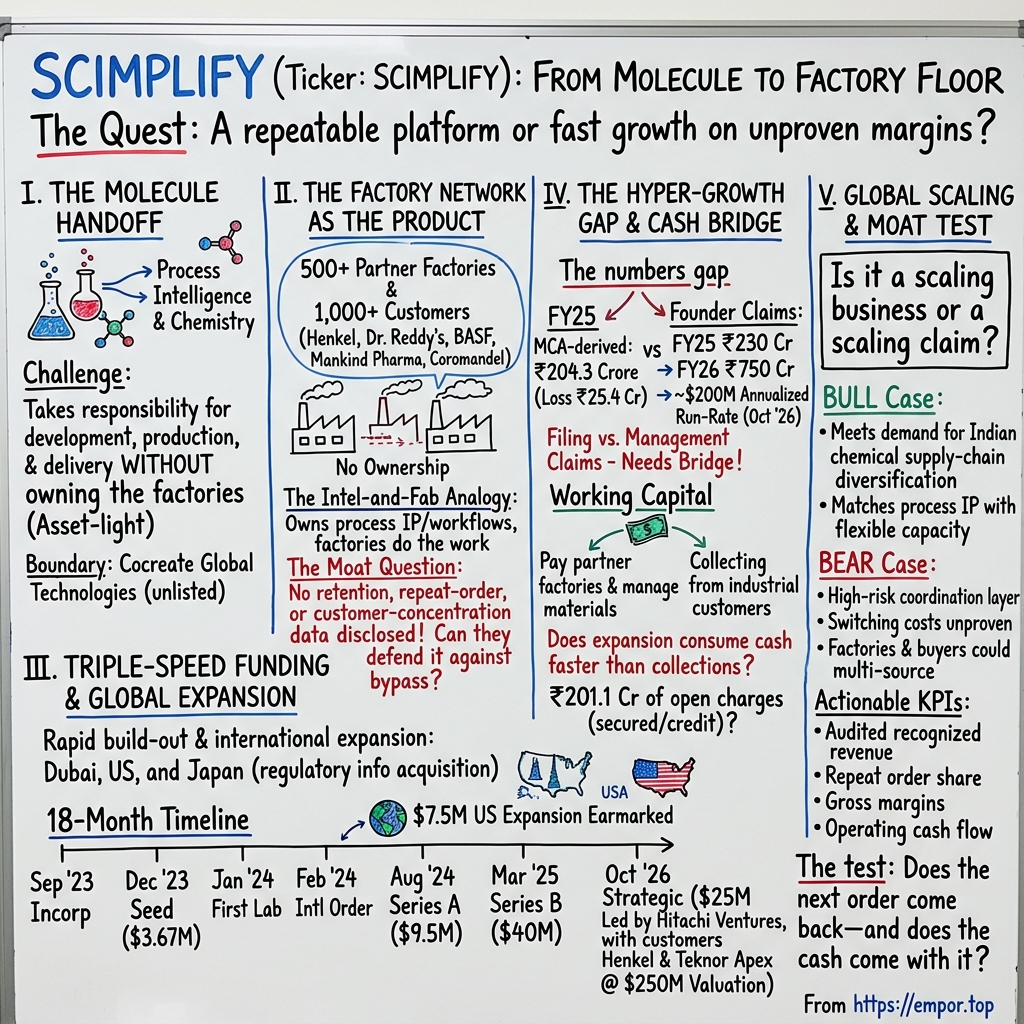
Scimplify: From Molecule to Factory Floor
I. The Order That Has to Become a Business
Somewhere in a buyer's procurement file sits a chemical that is hard to get. Perhaps it is an intermediate for an insecticide, a building block for a battery electrolyte, or a high-purity reagent for an electronics line. The buyer knows the molecule it needs and the specification it has to meet. What it does not know is who can make it reliably, at what cost, in what volume, and with paperwork that will survive an audit.
That is the moment Scimplify wants to own. A customer brings the problem. Scimplify's chemists work out a route in a laboratory in Hyderabad or Bengaluru, refine the process until it can be repeated, and then carry it across the hardest gap in industrial chemistry: the handoff from a glass flask to a steel reactor in somebody else's factory.
The company describes itself as a "science-first manufacturing company for advanced materials," and it promises to take responsibility for the whole chain, from development through production to delivery, while drawing on more than 500 manufacturing partners rather than a fleet of plants of its own.1 The legal entity behind the brand is Cocreate Global Technologies Private Limited, an unlisted Bengaluru company incorporated in September 2023, whose whole-time directors are co-founders Sachin Santhosh and Salil Srivastava.2 In three years, that small company has gone from a single laboratory to a business that, in its founders' telling, is selling at an annualised pace of about $200 million.3
That last number is where the story becomes interesting, and also where it becomes difficult. The latest audited accounts the company has filed with India's corporate registry are for the year to March 2025. In that year, Cocreate booked about ₹204 crore of revenue and lost about ₹25 crore.2 A crore is ten million rupees, so the business sold roughly ₹17 crore of material a month and spent more than it earned doing it.
Eighteen months later, Santhosh was describing a very different company: one that had been EBITDA-positive for two months, expected to turn a profit after tax that same month, and aimed to reach a $400 million annualised run rate within a year.3 In a long interview published in September 2026, the founders gave revenue of about ₹230 crore for the year to March 2025 and about ₹750 crore for the year to March 2026.4 None of those later numbers is yet in an audited filing.
So the central question is not whether Scimplify is growing. Every available signal says it is, and fast. The question is whether a customer's first order turns into a durable, profitable relationship that comes back, batch after batch, and whether the cash from that relationship arrives on time. A process-development project can be won once. A business is built when the same customer keeps buying, when the factory keeps hitting specification, and when the payment cycle does not swallow the profit.
The gap between Scimplify's filed results and management's newer figures is not a scandal; it is the normal lag between a fast-growing private company and its accountants. But it is also the space in which an investor has to decide what is proven and what is promised.
There are two further questions behind the first. One is whether the network of partner factories gives Scimplify an advantage that a customer, a factory or a rival intermediary cannot simply route around. The other is whether the company's expansion into the United States and Japan, and into new materials such as tungsten derivatives and rare earths, can justify the capital it has raised and the price its investors have paid.
That price is not small. In October 2026, Hitachi Ventures led a $25 million strategic round, and TechCrunch, citing a person familiar with the deal, reported a post-money valuation of $250 million.3 Mint reported that the founders collectively held about 29.8% of the company, with 3one4 Capital and Accel the largest outside holders.5
It helps to be clear about what Scimplify is not. It is not a listed company, and it has not filed a draft prospectus: there is no Scimplify or Cocreate offer document in the Securities and Exchange Board of India's register of public issues.6 There is therefore no price band, no use-of-proceeds statement, no lock-up schedule and no formal list of risk factors for an outside investor to read. Every judgment about its value has to be built from registry filings, funding reports, company material and founders' interviews, and every one of those sources has to be weighed for what it can and cannot prove.
What can be proved is enough to make the company worth taking seriously. Registry-based reporting shows revenue rising from under ₹20 crore in the short first year to about ₹200 crore in the first full one.7 Investors including Accel, Bertelsmann, Omnivore, 3one4 and now Hitachi Ventures repeatedly put in money at rising valuations. Global industrial companies bought from it, and two of them bought into it.
What has not yet been proved is the part that matters most for a long-term owner: that the business keeps its customers, earns a margin that survives the cost of coordinating hundreds of independent factories, and turns that margin into cash. The rest of this story follows that order from the lab bench to the factory floor and asks, at every stage, what crosses the bridge more than once.
 Subscribe on LinkedIn
II. The Factory Network That Became the Product
Sachin Santhosh did not come to chemicals from a laboratory. He studied materials science at the Indian Institute of Technology in Madras, went into investment banking, and then joined OfBusiness, a business-to-business commerce company that started by helping small manufacturers buy steel and other raw materials.4 TechCrunch also placed him at Bizongo, the packaging supply platform, while his co-founders Salil Srivastava and Dheeraj Dhingra came from Zetwerk, the Bengaluru company that built a large business by routing manufacturing orders to a network of contract factories.8
The founding team, in other words, had already watched two of India's best-funded attempts to turn fragmented industrial supply into a platform. Scimplify was their attempt to apply the same idea to chemistry, where the fragmentation is worse and the cost of a mistake is higher.
The problem Santhosh describes is easy to state. India has thousands of chemical factories, many of them family-run, many of them capable, and very few of them easy for a foreign buyer to find, qualify and trust. A purchasing manager at a European adhesives company or a Japanese electronics maker can read a supplier's brochure, but cannot easily tell whether its reactors will hold a temperature profile, whether its effluent treatment will pass an inspection, or whether its second batch will match its first.
Qualifying a new supplier for a regulated or high-performance chemical can take a year or more. The buyer's alternative is to stay with an existing supplier, often in China, even when the price or the geopolitical risk makes that uncomfortable. Scimplify's pitch is that it can compress that process, and in some cases take a customer from requirement to delivered material in about two months rather than the twelve to eighteen months the founders say is typical.3
What Scimplify sells, then, is not a molecule and not a directory listing. It is a bundle. Its scientists develop or improve a synthetic route, which is the sequence of reactions that turns cheap starting materials into the target compound. Its quality team audits candidate factories; Santhosh has said the company checks more than 200 parameters and runs a quality team of about fifteen people.4 It then transfers the process to one or more partner plants, oversees production, arranges testing at third-party laboratories, and ships the result.
The commercial terms are set project by project through proposals, purchase orders and statements of work, and the company's own terms of use frame it as the accountable counterparty for the order.9 That is the important point. The customer does not contract with the factory. It contracts with Scimplify, and Scimplify carries the risk if the batch is late or off-specification.
A buyer may well pay for that accountability. One invoice, one quality file and one company to blame is worth something to a procurement team that would otherwise manage five unfamiliar suppliers in three countries. It is also worth something to the factories. A mid-sized plant in Gujarat or Telangana may have spare capacity and good chemists but no sales force in Tokyo or Ohio. If Scimplify brings it a qualified process and a paying customer, the plant fills its reactors without having to find either.
The company's marketing turns this into a set of big numbers. Its website claims more than 500 manufacturing partners, more than 1,000 customers in more than 30 countries, and "thousands of scientists and technical partners."1 Its Scinode page describes a four-layer system of scientific intelligence, a network of "pre-audited" factories, an agentic artificial-intelligence layer and a quality-and-compliance engine.10 Named customers in press reports include Henkel, Coromandel, Dr Reddy's, Coherent, Holcim, BASF, Sanyo, Marubeni, TDK and Mankind Pharma.11 Those are serious names. A company just over three years old does not get onto the approved-supplier list of BASF or TDK by accident.
But reach is not the same as a moat, and the evidence on what happens after the first order is thin. Scimplify does not publish the share of revenue that comes from repeat customers, the number of customers who buy more than once a year, the share of its largest customers in sales, or how many of its partner factories produce the bulk of its volume. The interview gives one revealing hint. Of the 500-plus partners, Santhosh said, about 70 work with Scimplify regularly every quarter.4
That is a more useful number than 500, and it suggests the real operating network is much smaller and more concentrated than the headline. It is also exactly what a well-run network should look like, since most buyers do not want a different factory for every batch. Yet it also means that the claim of breadth tells an investor less about the business than the depth of a few dozen relationships, which the company does not describe.
The partner count has also moved in a way that deserves attention. When Scimplify raised its Series B in March 2025, TechCrunch described its ATOMS marketplace as listing specialty chemicals from more than 5,000 factories run by more than 200 manufacturers across ten countries, including China, Vietnam and Egypt.8 Eighteen months later, the company's story had become one about reducing dependence on China, and the headline figure had become 500-plus manufacturing partners with about 90% of manufacturing in India.3
Neither framing is false; companies reposition as markets shift. But the shift from an open sourcing marketplace to a curated, India-centred manufacturing network is a real change in what Scimplify says it is, and it narrows the claim. The current business is not a vast platform with network effects across thousands of plants. It is a process-development and contract-manufacturing operator that happens to use other people's reactors.
Santhosh borrows an analogy from semiconductors. "You could think of us like Intel," he said, "meaning we're the ones actually designing the process," while the partner factories "function more like the fab, the ones physically running it at scale."4 The designer owns the know-how and the customer relationship; the fab owns the equipment.
The analogy is attractive and worth testing. In semiconductors, the design is hard to copy, protected by patents and years of engineering, and the customer cannot take it to a foundry and cut the designer out. In specialty chemicals, a synthetic route is valuable, but once it has been transferred to a factory and run at scale, the factory's own chemists understand it intimately.
Scimplify has said it holds about eight patents, mostly on processes, with about five more at various stages.4 That is a start, but most of the processes it runs for customers will not be patented, and many will belong contractually to the customer anyway. The risk is not theft so much as disintermediation: a customer that has seen the plant, met the plant manager and watched three good batches may decide the next contract can go straight to the factory at a lower price.
Santhosh's answer to that risk is economic rather than legal. A factory that bypassed Scimplify, he argued, would be trading a steady flow of future work "for what, an extra 15% margin one time on a single transaction?"4 It is a sharp line, and it is probably right for the factory: a mid-sized plant gains more from a partner that keeps its reactors full than from one stolen order.
It is a weaker defence against the customer, which has no such flow of work to lose, and against a rival intermediary that offers the same plant the same volume on better terms. The founder's argument narrows the disintermediation risk to the buyer's side of the bridge. It does not remove it.
What could stop that? There are three possible answers, and each is plausible. First, a customer may value Scimplify's ability to multi-source, so that if one plant has a fire, an inspection failure or a capacity crunch, the volume can move to another qualified site without a new year-long qualification. Second, Scimplify may keep improving the process, so that its version is always cheaper than the one the factory inherited.
Third, the customer may simply prefer one accountable counterparty for many molecules rather than many relationships for one each. All three are real sources of switching costs in contract manufacturing. None can be measured from the outside. The proof would be repeat orders, the share of molecules produced at more than one plant, on-time and in-specification delivery rates, and price realisation on renewals. The company does not disclose any of them.
The competition helps clarify the stakes. India already has large, integrated research and manufacturing companies. Syngene, the Biocon-backed contract research and manufacturing group, reported about ₹3,642 crore of revenue from operations in the year to March 2025 with an EBITDA margin of roughly 30%.12 Divi's Laboratories, one of the world's largest makers of active pharmaceutical ingredients and custom-synthesis products, reported sales of roughly ₹9,400 crore and net profit of about ₹2,200 crore in the same year.13 Those companies own their plants, have decades of regulatory history and charge for both science and capacity.
They are not like-for-like comparisons for Scimplify, which owns little capacity and serves a much broader set of industries, from paints to batteries. What they show is the prize: in this industry, the companies that win the trust of global customers can earn margins most manufacturers only dream of. What they also show is the cost of entry. Their margins rest on owned assets, long qualification histories and repeat contracts measured over years. Scimplify is trying to reach a similar position of trust without the assets. Whether that is a cheaper route or merely a shorter one is the question the rest of this story keeps returning to.
III. A First Lab, an Overseas Order, and Three Rounds in Eighteen Months
Scimplify's own timeline reads like a company in a hurry. In December it raised a $3.67 million seed round. In January 2024 it opened its first laboratory, and in February it shipped its first international order. By April it had an office in Dubai, by July it was selling fragrance products in Switzerland, and in August it raised a $9.5 million Series A.
In September it launched ATOMS, its sourcing platform; by November it said it had served 500 customers; in December it opened a second lab. Indonesia followed in January 2025, the $40 million Series B in March, and offices in the United States and Japan in April.14 That is roughly one major milestone a month for eighteen months.
The speed of the early traction matters, because it is one of the few places where a founder's claim can be checked against a filing. Santhosh has said that three months after starting, the business was already running at almost $10 million a year.4 The registry figures show about ₹18 crore of revenue for the short first financial year, which ended in March 2024, a little over $2 million.2
For a company whose first lab opened in January and whose first international order shipped in February, roughly $2 million of revenue in the first quarter of real trading is broadly consistent with a run rate approaching $10 million by the end of that period. That early claim, in other words, survives contact with the filed numbers. It is a small but genuine point in management's favour.
The capital came fast too. The Series B in March 2025 was co-led by Accel and Bertelsmann India Investments, with UMI joining and existing investors Beenext, Omnivore and 3one4 Capital participating; the company said it valued Scimplify at about $150 million after the money went in and brought total funding since inception to $54 million.8 At the time, the company had about 150 employees, 600 customers in more than 16 countries, subsidiaries in Dubai and Indonesia, and was considering buying one or two chemical factories.8 It was, by its own description, still mainly a sourcing and made-to-order chemicals business serving pharmaceuticals, agriculture and industry.
What did that capital buy? The visible answer is reach: laboratories, offices in five countries, a sales presence abroad and a growing scientific staff. By the September 2026 interview, the company said it had three labs, two in Hyderabad and a newer one in Bengaluru, with around 60 full-time scientists, and about 300 people on payroll.4 TechCrunch reported about 340 staff including about 70 scientists a few weeks later.3
Employee Provident Fund records showed 248 employees in May 2026, a narrower measure on a different date.2 The less visible answer, and the one that matters more, is whether the capital built an engine that runs on its own: a way of winning and keeping customers that pays for its own expansion. The early funding bought the speed needed to find out. It did not, by itself, prove the answer.
The company's single acquisition is a useful test of that distinction. In late May 2025, Scimplify Japan, a subsidiary with ¥8 million of capital, acquired the business of Japan Chemical e-data Corporation.15 That company was founded in 2001 and ran Chemical e-data Search, a Japanese-language portal that helps buyers find outsourcing partners by chemical, synthesis technology and equipment such as reactors and distillation columns; it had earlier marketed a chemical-regulation database in Japan.15 Santhosh called it "a small acquisition."4 No price, revenue or profit for the acquired business has been disclosed.
Scimplify's careers page summarises the deal as its "1st acquisition: 100 factories in Japan."14 That phrase is best read as marketing shorthand for the portal's supplier directory rather than as a description of factories acquired, because what changed hands was an information business, not production assets. The strategic logic is coherent: a trusted Japanese-language database of contract manufacturers gives a foreign entrant a way into Japan's conservative chemical buyers and suppliers. But without a price or contribution, the deal cannot be benchmarked, and it says more about Scimplify's intentions in Japan than about its ability to integrate acquisitions.
Then came the 2026 money, and here the public record needs some careful assembly. In July 2026, Entrackr reported, from a board resolution filed with the registry, that Scimplify had approved the allotment of 12,647 Series C compulsorily convertible preference shares at ₹1,43,012 each, raising about ₹181 crore.7 Hitachi Ventures was to put in about ₹76 crore for a 3.28% stake, with 3one4 Capital, Accel, Omnivore and Bertelsmann Nederland providing the rest.7
Venture Intelligence reported the same round as a Series C and listed the post-round holdings: 3one4 at about 15.5%, Accel at about 13.8%, Omnivore at about 12.1%, Bertelsmann at about 10.3% and Hitachi Ventures at 3.3%.16 Entrackr estimated the post-money valuation at about ₹2,323 crore, more than double the previous round's.7 The arithmetic checks: Hitachi's ₹76 crore for 3.28% implies about ₹2,320 crore for the whole company.
In October, Scimplify announced a $25 million "strategic" round, again led by Hitachi Ventures, in which Henkel and Teknor Apex, a US-based polymer compounder, joined as new investors alongside the existing backers.3 Entrackr and TechCrunch both covered it, and TechCrunch's source put the post-money value at $250 million.17 The company said total equity funding had reached $80 million.3 Read together, those figures suggest the July Series C and the October announcement are largely the same transaction seen at two stages, rather than two separate rounds.
The seed, Series A and Series B add up to a little over $53 million. Add $25 million and the total lands close to $80 million, as the company says. If the July ₹181 crore, worth about $19 million, had been separate from the October $25 million, cumulative equity funding would be nearer $100 million. The most plausible reading is that the Series C was a single round, with financial investors allotted first and the strategic customers, Henkel and Teknor Apex, joining for the balance of about $6 million. Neither the company nor the reports set out that reconciliation, and the round's share terms beyond the class of security have not been published.
The October announcement had an unusual cast. Hitachi Ventures is the corporate venture arm of a group that is also, according to TechCrunch, a Scimplify customer.3 Henkel, the German adhesives and consumer-goods group, and Teknor Apex were reported customers as well. Having the people who buy from you also own part of you can open doors: a customer-investor has reasons to qualify more of your products, to share its supply-chain roadmap and to vouch for you inside its procurement department.
It can also complicate the investor's view of revenue. A customer that owns equity has a stake in the supplier's valuation, and the supplier has a reason to keep that customer happy on price and terms. When a company's valuation rests partly on growth from the same strategic partners who are funding it, outside investors need to see those relationships measured, not just announced.
The ownership numbers help frame who controls those decisions. After the 2026 round, Mint, citing registry data through the Tracxn database, reported the founders collectively at 29.8%, 3one4 Capital at 15.2% and Accel at 13.7%.5 Those figures are slightly below July's 15.5% and 13.8% for the two funds, consistent with a little further dilution as the strategic investors came in. Together with Omnivore and Bertelsmann, the four lead venture investors hold a little over half the company, more than the founders.
That is an ordinary picture for a company three rounds in, and it means the founders run the company with the consent of a powerful investor group rather than through outright control. How employee stock options are structured, how large the pool is and whether the founders hold any special voting or board rights has not been disclosed.
There is one more record to read before moving on to the numbers. Scimplify is a private company, so there are no earnings calls, no analyst questions and no investor-day presentations to compare against later results. What exists instead are the founder interviews of March 2025 and September and October 2026. Read together, they show a company that has kept its core strategy, partner manufacturing guided by in-house science, while steadily raising its ambitions: from specialty chemicals for pharmaceuticals and agriculture, to advanced materials for energy, electronics and defence, to a stated aspiration to challenge China's dominance in critical materials.3
They also show some candour. "We made real mistakes there early on," Santhosh said of the company's early work, and "we've got plenty of products ourselves that haven't worked out," adding that there were cases where he had "paid a scientist's salary and nothing usable came out of it."4 That honesty is useful. It is also a reminder that in a project business, not every development effort becomes a product, and not every product becomes a repeat order. The operating metrics that would show those rates—how many development projects convert to commercial supply and how many commercial products are reordered—are the ones the company has not yet published.
IV. The ₹204 Crore Year and the Revenue That Outran It
The first full year is the anchor, so it is worth looking at closely. In the year to March 2025, Cocreate Global Technologies reported revenue of about ₹204 crore, an EBITDA loss of about ₹21 crore and a net loss of about ₹25 crore.2 Entrackr, reading the same filing, put operating revenue at about ₹200 crore and the loss at ₹25.38 crore.7
The small difference between the two revenue figures is most likely the difference between operating revenue and total income, which includes interest and other income. Either way, the picture is clear. In its first full year, Scimplify sold about ₹200 crore of chemicals and services and lost about one rupee for every eight it took in.
The comparison with the year before is spectacular and almost meaningless. Revenue rose about elevenfold, from roughly ₹18 crore to roughly ₹204 crore, but the earlier year covered only the six months after incorporation, and the first lab did not open until the fourth of those months.14 A company that goes from a standing start to a full year of trading will always show a giant growth rate. The useful question is not the multiple but the trajectory within the year, and the filing does not reveal how revenue moved from quarter to quarter.
Then the founders' figures begin to diverge. In the September 2026 interview, the company gave revenue of about ₹230 crore for the year to March 2025, about 13% more than the filed figure, and about ₹750 crore for the year to March 2026.4 Santhosh had also described calendar 2024 as "about 100 crore of business that year, with decent margins already."4 A month later, TechCrunch reported that Scimplify's annualised revenue run rate had reached about $200 million, tripling from a year earlier, and that management was targeting $400 million within a year.3
There are several honest ways those numbers could all be true at once, and an investor needs to know which. The ₹230 crore figure might include sales booked by overseas subsidiaries that sit outside the Indian company's standalone accounts, or gross order value rather than recognised revenue. If Scimplify sometimes acts as an agent, arranging supply for a fee, while at other times it buys from the factory and resells, the accounting rules require different treatment: as principal, it books the whole sale; as agent, only its commission.
A change in the mix, or in how the company describes its activity, could produce a gap of this size without anything being wrong. Calendar years and financial years also differ by a quarter, which matters enormously in a business growing this fast. The filed figure and the founder's figure are not necessarily in conflict. They are not yet reconciled, and the company has not explained the bridge.
The run rate deserves its own scrutiny, because it is now the headline number. At October 2026's exchange rate of about ₹95.5 to the dollar, $200 million a year is roughly ₹1,900 crore, or about ₹160 crore a month.18 The founder's figure for the year to March 2026, ₹750 crore, works out to an average of about ₹62 crore a month. If both are accurate, Scimplify's monthly sales in the autumn of 2026 were more than two and a half times the average of the year that had ended only six months earlier.
That is possible if the company was growing steeply through the year, ending March 2026 well above its average and continuing to climb. The "tripling" claim implies a run rate of about $67 million a year earlier, which at the then exchange rate is roughly ₹590 crore a year.18 A business that exited October 2025 at around ₹50 crore a month and accelerated through the winter could plausibly average ₹62 crore for the year and reach ₹160 crore a month by October 2026. The numbers hang together, but only just, and only if growth was steep and continuous.
Run rates, however, are a choice of window. A run rate taken from the single best month of a project business can overstate the year, especially if one or two large shipments landed in that month. It is not an audited figure, it is not a twelve-month total and it is not cash. The careful reading is that Scimplify is probably growing at a rate that would be remarkable for any industrial business, and that the company itself has chosen to present that growth in the most flattering available form.
Profitability needs the same treatment. In October 2026, Santhosh said the company had been EBITDA-positive for the previous two months and expected to be profitable after tax that month.3 Set beside the filed record, that is a sharp turn: from an EBITDA loss of about ₹21 crore in the year to March 2025 to a positive operating result in the late summer of 2026. Scale could explain it. If gross margins hold while revenue rises severalfold, the fixed costs of laboratories, scientists and offices become a smaller share of each rupee of sales.
But two months is a short window, and EBITDA, earnings before interest, tax, depreciation and amortisation, leaves out exactly the costs that matter in a working-capital-heavy business: interest on borrowing to fund inventory and receivables. The claim deserves to be believed provisionally and tested hard: will the full year to March 2027 show a profit, and will operating cash flow follow it?
The valuation sits uneasily across these different bases. The Series C pricing implies about ₹2,320 crore for the company, and the reported $250 million post-money value is roughly ₹2,400 crore at October's exchange rate.718 Against the filed ₹204 crore of revenue for the year to March 2025, that is about eleven to twelve times sales. Against the founder's ₹750 crore for the year to March 2026, it is a little over three times. Against the claimed ₹1,900 crore run rate, it is about one and a quarter times.
The same price looks expensive, moderate or cheap depending on which revenue figure is used, and each figure comes from a different source, period and definition. That spread is itself the most important fact about Scimplify's valuation. Investors who paid ₹1,43,012 a share in 2026 were not paying eleven times audited sales; they were paying a little over one times a run rate they believed in, on the strength of information about the business that outsiders do not have.
That is a reasonable thing for informed private investors to do, and it is not evidence that the run rate is wrong. It is evidence that the price depends almost entirely on the most recent, least audited numbers. The figures that will settle the matter are straightforward: audited revenue for the year to March 2026, a reconciliation of that figure to the founder's ₹750 crore, an explanation of how much of it is booked as principal and how much as agent, the share of revenue from repeat customers, gross margin by year, and operating cash flow. Until then, the filed loss-making base and the claimed run rate belong in separate sentences, and neither should be borrowed to prop up the other.
V. The Lab-to-Factory Bet Goes Global
After the Series B closed in March 2025, Scimplify did what its investors had funded it to do. It opened offices in the United States and Japan, bought its way into the Japanese supplier world through the Chemical e-data portal, and pushed hard for overseas customers.1415 By October 2026, the company said that customers outside India supplied more than half its revenue, up from less than 5% about eighteen months earlier, and that the United States alone was running at about $60 million a year, up sixfold from $10 million, or roughly 30% of the business.3 It described local teams in the United States, Japan, Indonesia and the United Arab Emirates, and customers in more than 40 countries.3
The shift in end markets was even sharper. According to management, energy, electronics and defence had grown to about 45% to 50% of revenue, from less than 15% a year earlier.3 A company that began with pharmaceutical intermediates and agrochemicals had, by its own account, become in large part a supplier to battery, semiconductor and defence supply chains. The timing fits a real global trend.
Western and Japanese manufacturers have spent several years trying to reduce their reliance on Chinese suppliers for critical chemicals and materials, and India, with its large chemical industry and lower costs than Europe or Japan, is an obvious place to look. Scimplify's pitch, captured in TechCrunch's headline about challenging China's grip on critical materials, is that it can be the bridge between that demand and Indian capacity.3
Internationalisation in chemicals, though, is not a sales exercise. A Japanese electronics customer qualifying a new supplier of a high-purity material will audit the plant, test multiple lots, and demand documentation on impurities down to parts per billion. A US defence-adjacent customer may need traceability and export-control compliance. Every one of those requirements has to travel with the process, from Scimplify's lab to a partner's reactor in India to a container on its way to Ohio.
When the company says that customers in more than 40 countries buy from it, the claim worth testing is not the number of countries but whether quality and delivery hold up across them. Batch failure rates, rework and returns are not disclosed.
The United States is where the company is putting the most concrete money. TechCrunch reported that about $7.5 million of the latest round was earmarked for US expansion, including building out manufacturing, though Santhosh said the allocation could change.3 The company has said it plans to extend production to the United States and Japan, and in the interview Santhosh described it as actively evaluating its own manufacturing footprint in both countries.43 That is a notable evolution for a company that built its identity on not owning factories.
A small, operated US facility for final processing, testing or blending could shorten delivery times and satisfy customers who want domestic supply. It also means capital expenditure, fixed costs and the operating risks the asset-light model was designed to avoid. Seven and a half million dollars will not build a large chemical plant; it can fund a pilot or finishing site and a local team. Its success should be judged by the US customers it qualifies and keeps, not by the announcement of a facility.
The new materials are the most strategically interesting part of the story and the least proven. Scimplify has said it is working on tungsten derivatives produced from scrap and on rare-earth materials.3 Both matter. Tungsten is essential for hard metals, electronics and defence, and China dominates its supply. Rare-earth elements are central to permanent magnets for electric motors and wind turbines, and their supply chain is even more concentrated.
A company that could produce either at scale outside China, from recycled feedstock, would have a valuable business. But the public record establishes work under way, not revenue. The company has not disclosed how much of its sales come from these materials, whether any have reached commercial-scale supply, or what margins they earn. They are options, and they should be priced as options: worth something if they convert to paid, repeat business, worth little if they remain development projects.
The same caution applies to Scimplify's partnerships. In April 2026, Scimplify signed a memorandum of understanding with CSIR's Indian Institute of Chemical Technology in Hyderabad, one of India's leading public chemistry laboratories, to accelerate the "lab-to-market" journey for agrochemical molecules through collaborative research and joint development of intellectual property.19 For a young company, a link with a national laboratory is a useful source of chemistry talent and technology. But an MoU is an agreement to collaborate; it carries no stated financial terms and no commitment to buy anything. It is evidence of capability-building, not of sales.
It is worth comparing the growth claims with what is actually known about who buys. The customers named in the press, Henkel, Coromandel, Dr Reddy's, Coherent, Holcim, BASF, Sanyo, Marubeni, TDK, Mankind Pharma and Hitachi, cover adhesives, crop protection, pharmaceuticals, photonics, building materials, chemicals, trading and electronics.113 That breadth supports the idea that Scimplify can serve many industries. It does not tell an investor which of those relationships are large, which are recurring and which were single projects.
A rising share of revenue from energy, electronics and defence could reflect a handful of large orders from a few customers as easily as a broad new franchise, and the company has not said which. The founders have described more inbound demand from large customers and an expectation of onboarding major European companies.4 That is encouraging, but inbound interest is the beginning of a qualification process, not the end of one.
The phrase "asset-light" needs testing too, because it is doing a lot of work in Scimplify's story. Not owning factories does mean the company avoids the heavy capital cost of reactors, utilities and effluent plants. It does not mean the company avoids the cost of being responsible for them. Scimplify has to fund process development before revenue, audit and re-audit factories, pay for third-party testing, and absorb the cost when a batch fails. Santhosh has spoken of about 50 third-party test labs in the network, including some in the United States.4
Each of those is a cost of coordination. Asset-light businesses tend to have lower gross margins than asset-heavy ones, because they pay a factory's margin as well as their own, and they compete on speed and service rather than on owning the cheapest capacity. The question is whether Scimplify's coordination costs fall as a share of sales as it grows. If they do, the model scales. If every new market brings a new layer of audits, staff and testing, the margin may never widen.
Three operating measures would separate a scalable system from a fast-growing project book. The first is revenue from repeat customers, ideally by cohort: how much do the customers acquired in 2024 buy in 2026 compared with 2025? The second is quality: the share of batches delivered on time and in specification, and the cost of rework and returns.
The third is gross margin by product line or customer cohort, which would show whether mature relationships earn more than new ones, as they should if the process improvements and switching costs are real. Scimplify publishes none of them. A future offer document would have to address at least the first and third, and how it does so will say a great deal about the business.
VI. The Customer Who Also Owns a Piece of the Company
When Hitachi Ventures, Henkel and Teknor Apex took equity, the company and TechCrunch described them as customers as well as strategic investors.1153 Their investment can serve as a reference for conservative buyers. Before the announcement, Tigerfeathers noted that several of Scimplify's biggest global customers and partners were set to join its cap table, and Santhosh described demand from large companies increasingly arriving inbound.4
That stake does not prove repeat purchases or favourable terms, and it can create conflicts: a customer-investor may be offered better pricing, longer payment terms or exclusive capacity than a normal customer would get. Or the supplier may feel pressure to keep that customer's business regardless of margin, because losing it would be a public signal.
Neither need happen; both are the kind of thing an investor must be able to check. The figures that would settle the question are ordinary: the annual sales to each customer-investor, the receivables outstanding from each, the pricing basis, any long-term commitments, and any guarantees, loans or exclusivity arrangements. None of those has been published.
Independent commentators have read the round more sceptically. Open magazine, reviewing the October deal, asked whether Scimplify could "make the chemistry pay," and pointed to the company's widening losses in its filed accounts, the difficulty of ensuring consistent quality across partner factories, and the potential conflict in having customers as investors.20 Those are analytical concerns, not reported problems, but they are the right concerns.
Indian company law already requires disclosure of related-party transactions, and a shareholder that holds a small stake is not necessarily a related party in the legal sense. A 3% shareholder is unlikely to qualify. That is precisely why voluntary disclosure matters. If Scimplify eventually files for a public listing, a prospectus would normally show revenue concentration by customer, and investors should look for the customer-investors' share in it.
The published ownership figures put the four lead financial investors at a little over half and the founders at a little under a third, with the strategic investors holding small stakes.165 The full capitalisation table, including the employee option pool and any convertible instruments, has not been published, and the per-round terms beyond the class of shares are not public. The 2026 allotment was of compulsorily convertible preference shares, which is the standard instrument for Indian venture rounds.7
Such shares normally carry rights that ordinary shareholders do not have, such as a preference on liquidation, anti-dilution protection and investor consent rights over major decisions. Whether Scimplify's investors hold those rights, and on what terms, is not disclosed. That matters for valuation. A $250 million post-money figure for preferred stock with downside protection is not the same as a $250 million value for the common shares a public investor would eventually buy.
Management's credibility is the other thing to weigh here, because a company that invites its customers onto its shareholder register asks investors to trust its own account of those relationships. The record is short but not empty. On the positive side, the early run-rate claim of nearly $10 million a year at three months old is broadly consistent with the filed first-year revenue.
The founders have also been candid about failed products and early mistakes. On the other side, the founder's ₹230 crore figure for the year to March 2025 sits about 13% above the filed number without an explanation, and the headline numbers in company materials, factory counts, customer counts and country counts, change from page to page and year to year.
The careers page's "100 factories in Japan" summary of what was really a supplier-directory acquisition is a small example of that habit of promotion.1415 The $400 million run-rate target for late 2027 is the next clean test. If the company reaches it, or misses it and explains why, the record of guidance discipline will lengthen. For now, it is too short to show whether management is conservative or optimistic in its forecasts.
The governance documents that would sharpen this picture already exist. Cocreate's audited financial statements for the years to March 2024 and 2025 are filed with the Ministry of Corporate Affairs, and they contain the auditor's report, the CARO annexure that Indian auditors use to flag specific concerns, the related-party note, director remuneration and any contingent liabilities. Scimplify has not published that detail itself, and the summaries of those filings in circulation carry only the headline revenue and losses.
An investor considering a stake would want to see those notes before drawing conclusions about governance. Until they are public, the honest verdict is that the strategic investors may well deepen Scimplify's customer relationships, but the evidence available does not measure that benefit, and the commercial relationships remain opaque.
VII. The Cash Behind the Growth Claims
There is a trap in the phrase "asset-light," and it is not about factories. A company that orchestrates manufacturing through partners may own no reactors, but it still stands in the middle of a chain of payments. In a typical order, Scimplify may need to buy raw materials or pay a partner factory before the finished product is shipped, and its industrial customers, especially large multinationals, often pay on terms of 60 or 90 days or more after delivery.
In between sit inventory, goods in transit, testing and the risk of a rejected batch. The faster sales grow, the more cash that gap consumes. A business can be profitable on paper and still need a steady stream of outside money simply to fund its own growth.
A simple illustration shows the scale. If Scimplify's net working capital, its receivables and inventory minus what it owes suppliers, were equivalent to 60 days of sales, every extra ₹100 crore of annual revenue would tie up roughly ₹16 crore of cash. A move from about ₹200 crore of sales to the ₹1,900 crore implied by the claimed run rate would, on that assumption, absorb something like ₹280 crore.
That is a hypothetical ratio, not a disclosed one. It is meant only to show why the question matters. A company growing at Scimplify's pace can consume a large share of its equity funding in working capital alone, even before it spends on laboratories, offices or a factory in the United States.
The filed numbers say the business lost about ₹25 crore in the year to March 2025.2 They do not say how much cash it used. Scimplify has not published its cash-flow statement, receivables ageing, unbilled revenue, overdue balances, provisions for doubtful debts, write-offs or customer advances for either of its two filed years. Those are the numbers that would show whether its sales are turning into cash on time, and whether some customers are slow or disputing payment. A pre-IPO investor would want them before forming any view on cash conversion.
The debt side is just as important and just as easily misread. The Ministry of Corporate Affairs' charge register shows eleven open charges against Cocreate worth about ₹201 crore, and three satisfied charges worth about ₹39 crore.21 A charge is a security interest registered in favour of a lender, typically over receivables, inventory or other assets. It records the maximum amount the lender is entitled to secure, not how much has actually been borrowed. A working-capital line of ₹50 crore registered as a charge may be drawn to ₹10 crore or not at all.
So the ₹201 crore is not a measure of Scimplify's debt. It is evidence that lenders have extended secured facilities of meaningful size to a company with about ₹200 crore of filed revenue, and that the business, like most trading and manufacturing businesses, funds part of its working capital with bank and venture lending. Venture Intelligence lists Alteria Capital and InnoVen Capital among the company's past financiers; both are best known in India as venture-debt lenders.16 The drawn balances, interest rates, maturities and covenants are not disclosed.
The one independent credit view on the record comes with an important qualification. ICRA, one of India's main rating agencies, assigned Cocreate's ₹100 crore of bank facilities a long-term rating of BB+ with a positive outlook and a short-term rating of A4+.22 On ICRA's scale, BB+ sits one notch below investment grade, and a positive outlook signals that an upgrade is possible. But ICRA records the rating as not accepted by the company. The non-acceptance dates to 30 April 2026; Cocreate requested and was granted a review, and ICRA's register notes that the client did not accept the rating on 27 October 2026.22
Under Indian rules, a company can decline to accept a rating, and many do when they consider it too low. ICRA warns explicitly that unaccepted ratings "are not subject to the periodic monitoring/surveillance exercise and may not be representative of the current credit quality of the rated entity."22 So the BB+ cannot be read as a current endorsement of Scimplify's credit. It is a snapshot of how one agency saw the company in the spring of 2026, which the company itself rejected.
Two points stand out. First, the facility being rated was ₹100 crore, or roughly half the filed revenue of the year to March 2025, which suggests Scimplify was seeking significant bank borrowing to fund its growth. Second, the company chose not to accept the rating even after a review, which implies a disagreement between Scimplify and the agency about its credit quality. The reasons are not public. Without ICRA's rationale, there is no way to know what strengths and weaknesses the agency weighed.
There are other small signals worth noting. Business-intelligence records show fourteen court cases filed by the company, ten of them pending and four disposed.2 Cases filed by a company are not findings against it, and the records do not describe what the cases concern. For a business that sells to many customers on credit, some of them could be recovery claims. If they are, they are a reminder that collections are a real operating issue in this industry. It is a detail to check, not a conclusion to draw.
Foreign exchange adds a further layer. More than half of Scimplify's revenue now comes from customers outside India, while about 90% of its manufacturing remains in India, according to management.3 That creates a natural currency mismatch: the company may invoice in dollars, euros or yen while paying factories and staff in rupees.
A weakening rupee helps margins on export sales already contracted, and a strengthening rupee hurts. The rupee was trading at about ₹95.5 to the dollar in October 2026, against about ₹88.4 a year earlier, a depreciation that would have flattered rupee-denominated revenue from dollar sales.18 Scimplify has not disclosed its currency exposures by currency, its hedging policy, or its foreign-exchange gains and losses.
The central test, then, is simple to state. As revenue rises, does operating cash flow improve alongside gross margin and repeat sales, or does each step up in revenue require more equity or more debt? The company's own trajectory offers a partial answer. It raised about $80 million of equity in three years and arranged secured facilities on top of that.321
That is consistent with a business whose growth consumes cash. Management's claim of recent EBITDA profitability, if it holds, would be the first sign that the model can begin to fund itself. The audited accounts for the year to March 2026, and especially the cash-flow statement, will show how far that process has gone.
VIII. Analysis & Bear vs. Bull Case
Put the pieces on the table together. A company less than three and a half years old, with about ₹204 crore of audited revenue and a ₹25 crore loss in its only full filed year, has been priced by its investors at roughly ₹2,300 crore to ₹2,400 crore.2718 Management says it is now selling at about $200 million a year, is EBITDA-positive and expects a net profit.3 Those numbers can support very different conclusions, depending on what an investor believes about the parts of the business that are not visible.
The bull case starts with a real problem. Global buyers of specialty chemicals and advanced materials need suppliers outside China, India has abundant chemical manufacturing capacity, and the work of matching the two, developing a process, qualifying a plant, guaranteeing quality and taking responsibility for delivery, is genuinely hard. Scimplify has shown it can do that work for blue-chip customers across several industries and several continents. It has done so with modest capital, compared with the cost of building plants, and its growth, even on the filed numbers, is extraordinary.
If the founders' figures are right, revenue roughly tripled again in the year to March 2026 and the business crossed into operating profit with sales still accelerating. A company in that position, with a network of qualified factories, a library of developed processes and a growing list of global customers, could become a platform that each new customer and each new factory makes more valuable. The strategic investors' arrival suggests that sophisticated industrial buyers see something worth backing.
The bear case does not require the growth to be false. It argues that the economics may be less durable than they look. Customers that learn where their product is made may go to the factory directly. Factories that receive one process from Scimplify may compete for the next one on price. Large customers routinely multi-source, so they may treat Scimplify as one of several suppliers rather than a partner.
And the work itself, process development and contract supply, is a project business, which means revenue can rise quickly as large orders land and fall as they finish. Nothing in the public record shows customer retention, lost bids, price realisation or factory-level quality history, which are exactly the measures that would distinguish a sticky platform from a busy broker. The filed accounts show a loss-making business, the latest numbers are management's own, and the only independent credit opinion is one the company declined to accept.
Industry structure helps frame those two cases. Scimplify sits across three categories that are usually separate: specialty-chemical sourcing and distribution, contract research and process development, and contract manufacturing. The established distributors show what a pure intermediary can earn. Azelis, the Belgian specialty-chemicals distributor, reported a gross margin of about 24% and an adjusted EBITA margin of about 10% in 2025.23 IMCD, its Dutch rival, reported about €4.8 billion of revenue and €498 million of operating EBITA in 2025, a margin of a little over 10%.24
Those businesses add value through formulation help, regulatory work and logistics, and their margins have been earned over decades of supplier and customer relationships. At the other end, Syngene and Divi's, with their own plants and long regulatory records, earn EBITDA or net margins in the twenties and thirties.1213 Scimplify's long-term margin is likely to land somewhere between those poles: above a pure distributor if its process know-how is worth paying for, well below an asset-owning contract manufacturer because it pays the factory's margin.
The closest Indian comparisons are the companies its founders came from. Zetwerk, which routes manufacturing orders to a network of contract factories across many industries, listed on India's stock exchanges on 23 October 2026, at an issue price that valued it at about ₹25,600 crore against revenue of about ₹15,900 crore in the year to March 2026, and a net loss of about ₹1,600 crore, inflated by a large one-time employee stock-option charge.25 That is an equity value of about 1.6 times trailing revenue for a loss-making company with a similar model and a far longer record.
OfBusiness, the raw-materials platform where Santhosh once worked, reported revenue of about ₹20,600 crore and a profit after tax of about ₹724 crore for the same year, with an EBITDA margin of about 4%, and was reported to be aiming for a listing at a valuation of $6 billion to $9 billion.26 Those are not direct peers. Both are far larger, sell lower-value products and earn thinner margins than a specialty-chemicals business should. But they show how public and late-stage private investors are valuing Indian asset-light manufacturing platforms today: at roughly one to four times revenue, depending on profitability.
Against that yardstick, Scimplify's price is not extravagant if the run rate is real and profitable. At about 1.25 times claimed annualised revenue, it would be valued below Zetwerk on a forward basis. At about three times the founder's figure for the year to March 2026, it would be valued in line with OfBusiness's target range. At eleven to twelve times audited revenue for the year to March 2025, it would look expensive by any measure. The difference is entirely about which numbers are believed. Private investors who have seen the monthly data have chosen the run rate; a public investor would have to wait for the audit.
A simple scenario framework helps turn that into a range. Suppose, in a central case, that Scimplify reaches about ₹4,000 crore of revenue in four years, roughly double the current run rate, and earns a 7% EBITDA margin, between OfBusiness and the European distributors. After depreciation, interest and a 25% tax rate, that might leave about ₹180 crore of net profit. If the market then valued it at 30 times earnings, a reasonable multiple for a growing Indian specialty-manufacturing business, the equity would be worth about ₹5,400 crore.
Discount that back four years at about 18% a year, a cost of capital suited to a young, unproven company, and allow for perhaps a fifth more dilution from future fundraising and stock options, and today's value comes out at roughly ₹2,200 crore. That is close to what investors paid in 2026.
In a weaker case, revenue stalls around ₹2,000 crore, margins stay near 3% because coordination costs rise with every new market, and the business is valued like a trading company at well under one times revenue. Today's value would then be in the hundreds of crores, perhaps ₹500 crore to ₹800 crore. In a stronger case, revenue reaches ₹8,000 crore with a 10% EBITDA margin as process improvements and repeat business compound, and the company earns a premium multiple; the present value could be around ₹8,000 crore.
These are illustrations, not forecasts. They show that the 2026 price embeds something like the central case: roughly a doubling of the claimed run rate within four years, a sustained operating margin in the high single digits, and working capital and dilution that stay under control. The single most powerful sensitivity is margin. At ₹4,000 crore of revenue, each percentage point of EBITDA margin is worth about ₹40 crore a year, or roughly ₹370 crore of present value on the same assumptions. That is why gross margin, not revenue, is the number to watch.
An enterprise value, the price of the whole business including its debt and net of its cash, cannot be calculated reliably. Scimplify has not disclosed its cash balance or the amount drawn on its secured facilities, and the ₹201 crore of registered charges is a ceiling, not a balance.21 Any headline figure is an equity value, and even that is approximate, because the full count of preference shares, options and other convertible instruments has not been published and the post-money valuation is for preferred stock with rights that public common shareholders would not share.
Porter's framework clarifies where the risks lie. Buyers are large and sophisticated, and their power depends on how concentrated Scimplify's revenue is and whether they can multi-source, which is not disclosed. Suppliers, the partner factories, have power to the extent that capable plants are scarce and hard to replace; if qualified capacity is abundant, Scimplify can switch, and if it is scarce, the factory can demand a larger share of the margin.
Barriers to entry depend on process know-how, quality systems and accumulated customer trust, none of which can yet be measured from outside. Rivals include not only other Indian intermediaries but the in-house sourcing teams of the customers themselves and the business-development arms of large Indian chemical companies.
Hamilton Helmer's seven powers point to where Scimplify could build an advantage. Process power, the accumulated know-how of running many processes across many plants, is the most plausible. If Scimplify's chemists can develop routes faster and cheaper, and transfer them more reliably than anyone else, that capability is hard to copy. Scale economies could follow, if a large network lets it spread audit and quality costs across more volume and win better terms from factories.
Switching costs could build up as processes are qualified and customers grow used to dealing with one counterparty. But the public record has not yet shown any of those powers translating into superior retention, margins or cash returns. The case for a moat is a mechanism, not a measurement.
Optionality deserves the same discipline. The company says Scinode, its agentic-AI workflow system, has about $2 million of planned investment and a "launch cohort" call to action on its website.310 Tungsten derivatives from scrap and rare-earth materials are under development.3 Each could matter. Each is, for now, a plan or a capability claim rather than a source of disclosed revenue. A company that has already reframed itself from a sourcing marketplace, ATOMS with its thousands of listed factories, to an advanced-materials manufacturer in eighteen months has shown it can pivot quickly. It has not yet shown that each new frame produces durable revenue.
The handful of indicators that would change the verdict are clear. The first is audited, recognised revenue, reconciled to the founder's figures and to billings. The second is the share of revenue from repeat customers and its trend by cohort. The third is gross margin and operating cash flow, together with receivables ageing. If those show durable repeat business, rising margins and cash that keeps pace with growth, the bull case will have earned its valuation. If they show a churning project book, flat margins and rising working capital, the bear case will have been right without the growth ever being false.
There is no long record to fall back on. Scimplify has existed for barely three years. It has no decade of proof that its moat holds, its management sets conservative targets or its new products turn into revenue. The strongest current checks on the growth narrative are the filed loss of the year to March 2025, the gap between that year's filed revenue and the founder's figure, and a credit rating the company would not accept. Those do not refute the story. They are the evidence it still has to answer.
IX. Playbook: Business & Investing Lessons
A network is only a moat when customers return to it. Scimplify can count more than 500 manufacturing partners and more than 1,000 customers, and those numbers make good headlines.1 But the figure that slipped out in an interview, the roughly 70 factories that work with the company every quarter, says more about the business than the 500.4
For any company that sits between buyers and sellers, the size of the directory is a vanity metric. The test is how many customers come back, how much more they buy each year, and whether they keep coming back when the factory down the road offers them a better price. Founders building intermediaries should measure repeat business before they measure reach. Investors should ask for the 70, not the 500.
Asset-light does not mean responsibility-light. Scimplify chose not to own reactors so that it could move fast and spend its capital on science and customers. That choice did not move the burden of quality anywhere else. When a batch made in a partner's plant in India fails a test in a customer's laboratory in Japan, it is Scimplify's name on the invoice and Scimplify's reputation on the line.
The lesson for anyone building on other people's assets is that the asset you do not own still has to be managed as if you did, and the cost of managing it, the audits, the testing, the quality teams, the rework, is where the economics of an asset-light model are actually decided.
A run rate is a promise about pace, not a year of collected cash. Scimplify's audited year shows about ₹204 crore of revenue and a loss; its founders describe a business selling at about ₹1,900 crore a year and turning a profit. Both can be true. The audit trails the business, and fast-growing companies are always ahead of their accounts.
But a run rate is a single month or quarter dressed as a year. It leaves out the slow-paying customer, the batch that was rejected, and the working capital it took to ship the goods. For founders, quoting a run rate is fine as long as the bridge to audited revenue and cash is ready. For investors, the lesson is to price the run rate only after seeing the bridge.
A strategic investor is most valuable when the customer relationship becomes measurable. Hitachi, Henkel and Teknor Apex bought into Scimplify because they buy from it. That is a vote of confidence that money alone could not purchase, and it may open more doors in a year than a sales team could in five. But it also blurs the line between a customer's demand and an investor's interest.
The way to turn a strategic investment from a reputational asset into an investable one is disclosure: what each customer-investor buys, on what terms and how promptly it pays. The companies that make that relationship visible earn a premium for it. The ones that keep it vague invite the suspicion that the relationship is better as a story than as a ledger.
X. Epilogue
Tonight, Scimplify is a three-year-old company with laboratories in Hyderabad and Bengaluru, teams in five countries, a network of hundreds of partner factories, a $250 million price tag from its latest round, and a founder who says the business is selling at $200 million a year and has just turned profitable.3 It has a stated ambition to double that run rate to $400 million within a year, about $7.5 million earmarked for building out in the United States, and about $2 million set aside for Scinode, its AI workflow platform.3
It also has one audited full year, a ₹25 crore loss in that year, ₹201 crore of registered secured charges, and a BB+ credit rating it has declined to accept.22122 Everything that happens next will be about which of those two sets of facts better describes the company.
The first decisive moment is mundane: the filing of audited accounts for the year to March 2026 with the corporate registry. If those accounts show revenue close to the founder's ₹750 crore, with the difference to the earlier ₹230 crore claim explained, the growth story will gain a solid floor. If they show something materially smaller, or a large gap explained by agency accounting or subsidiaries outside the Indian entity, the run rate will need a new interpretation. Either way, the cash-flow statement in those accounts will reveal how much of the growth has turned into collected money and how much is sitting in receivables and inventory.
The second is the durability of profitability. Two months of positive EBITDA in the late summer of 2026 is a start. The test is whether the full year to March 2027 shows a profit after tax, whether that profit converts into operating cash, and whether the company can grow without raising another large round soon. If Scimplify reaches the next stage of funding with profits and cash flow to show, it will have proved that the asset-light model can fund itself. If it needs another large equity raise to keep growing, the question of capital intensity will return.
The third is disclosure. A company preparing to become public eventually has to publish what it has so far kept private: the revenue from its largest customers, the share coming from its strategic investors, repeat-business rates, gross margin by year, receivables ageing and the full capitalisation table with the rights attached to each class of shares. Whether Scimplify starts sharing more of that before it files any offer document, or waits until the regulator requires it, will say a great deal about how it intends to treat public shareholders.
The fourth is the international bet. The Japan acquisition will show its worth in the Japanese customers and factories it brings into the network, not in the deal announcement. The US expansion will show its worth in qualified American customers and in whatever manufacturing presence the company builds there. Tungsten, rare earths and AI-enabled workflows will matter when they show up as named revenue and repeat orders. If, a year from now, they are still described as work in progress, the market will be right to value them as options rather than as businesses.
The $400 million target is the clearest marker. If Scimplify reaches it with improving margins and stable working capital, it will have one of the more remarkable growth records in Indian industry, and the bull case will have earned the right to be priced. If it reaches the number by stretching payment terms, chasing low-margin volume or leaning on strategic customers, the growth will have come at the expense of the quality investors most need to see.
And if it misses, the response will matter as much as the miss: candour about why, and a credible plan to fix it, would do more for management's credibility than another ambitious target. The tension that remains is the one this story began with. Scimplify has shown that it can win an order. It has not yet shown, in a form an outside investor can check, that the orders come back and the cash comes with them.
XI. Outro
Picture the batch again. A process worked out by a chemist in Hyderabad is written into a transfer document, carried to a partner's plant, run through a reactor that Scimplify does not own, tested in a laboratory it does not run, and shipped to a customer that may also be its shareholder. At every step, someone else's hands touch the product. And at every step, it is Scimplify's promise that is being kept or broken.
That is what makes the company unusual. It is trying to make that model work at unusual speed. The early evidence says it can sell that promise. The test is whether the next order comes back, and whether the cash comes with it.
References
-
Cocreate Global Technologies Private Limited company profile and financial summary — The Company Check ↩↩↩↩↩↩↩↩↩
-
Scimplify raises $25M to challenge China’s grip on critical materials with AI — TechCrunch, 2026-10-14 ↩↩↩↩↩↩↩↩↩↩↩↩↩↩↩↩↩↩↩↩↩↩↩↩↩↩↩↩
-
Scimplify: Material Ambitions — Tigerfeathers (Rahul Sanghi), 2026-09-25 ↩↩↩↩↩↩↩↩↩↩↩↩↩↩↩↩↩↩
-
B2B manufacturing startup Scimplify raises $25 mn led by Hitachi Ventures — Mint, 2026-10-14 ↩↩↩↩
-
Public Issues register — Securities and Exchange Board of India ↩
-
Exclusive: Scimplify set to raise Rs 181 Cr at over 2X valuation jump — Entrackr, 2026-07-16 ↩↩↩↩↩↩↩↩
-
Scimplify raises $40M to help manufacturers access specialty chemicals — TechCrunch, 2025-03-12 ↩↩↩↩
-
Accel-backed Scimplify raises $25 million in funding led by Hitachi Ventures — Moneycontrol, 2026-10-14 ↩↩↩
-
Syngene results for Q4 FY25 and full-year FY25 — Syngene International, 2025-04-23 ↩↩
-
Divi's Laboratories Limited reports earnings results for the full year ended March 31, 2025 — MarketScreener (S&P Capital IQ), 2025-05-17 ↩↩
-
About us: Scimplify Japan acquired the business of Japan Chemical e-data Corporation — Chemical e-data Search ↩↩↩↩
-
Speciality chemicals maker Scimplify to raise Rs 181 Cr led by Hitachi Ventures — Venture Intelligence, 2026-07-17 ↩↩↩
-
Scimplify raises $25 Mn in strategic round led by Hitachi Ventures — Entrackr, 2026-10-14 ↩
-
G.5 Foreign Exchange Rates (Monthly) — Board of Governors of the Federal Reserve System, 2026-11-02 ↩↩↩↩↩
-
CSIR news digest, 16–30 April 2026: Scimplify and CSIR-IICT partner to accelerate agrochemical innovation — CSIR, 2026-05-01 ↩
-
Customers Buy In. Can Scimplify Make the Chemistry Pay? — Open, 2026-10-15 ↩
-
Cocreate Global Technologies charges — The Company Check ↩↩↩↩
-
Full-year 2025 results: Azelis delivers strong cash flow growth in challenging markets — Azelis, 2026-02-19 ↩
-
IMCD reports 2025 EBITA decline despite revenue growth and acquisitions — European Coatings, 2026-02-20 ↩
-
Rs 15,913 crore revenue, Rs 1,606 crore loss: Zetwerk makes a 5% stock market debut — Indian Startup News, 2026-10-23 ↩
-
IPO-bound OfBusiness' FY26 profit jumps 21% YoY to ₹724 Cr — Inc42, 2026-07-29 ↩
 LinkedIn
 WhatsApp
 Reddit
 Hacker News
 Email
 Kindle
 RSS Feed
 Spotify
 Apple Podcasts
 Amazon Music
 Audible
 YouTube