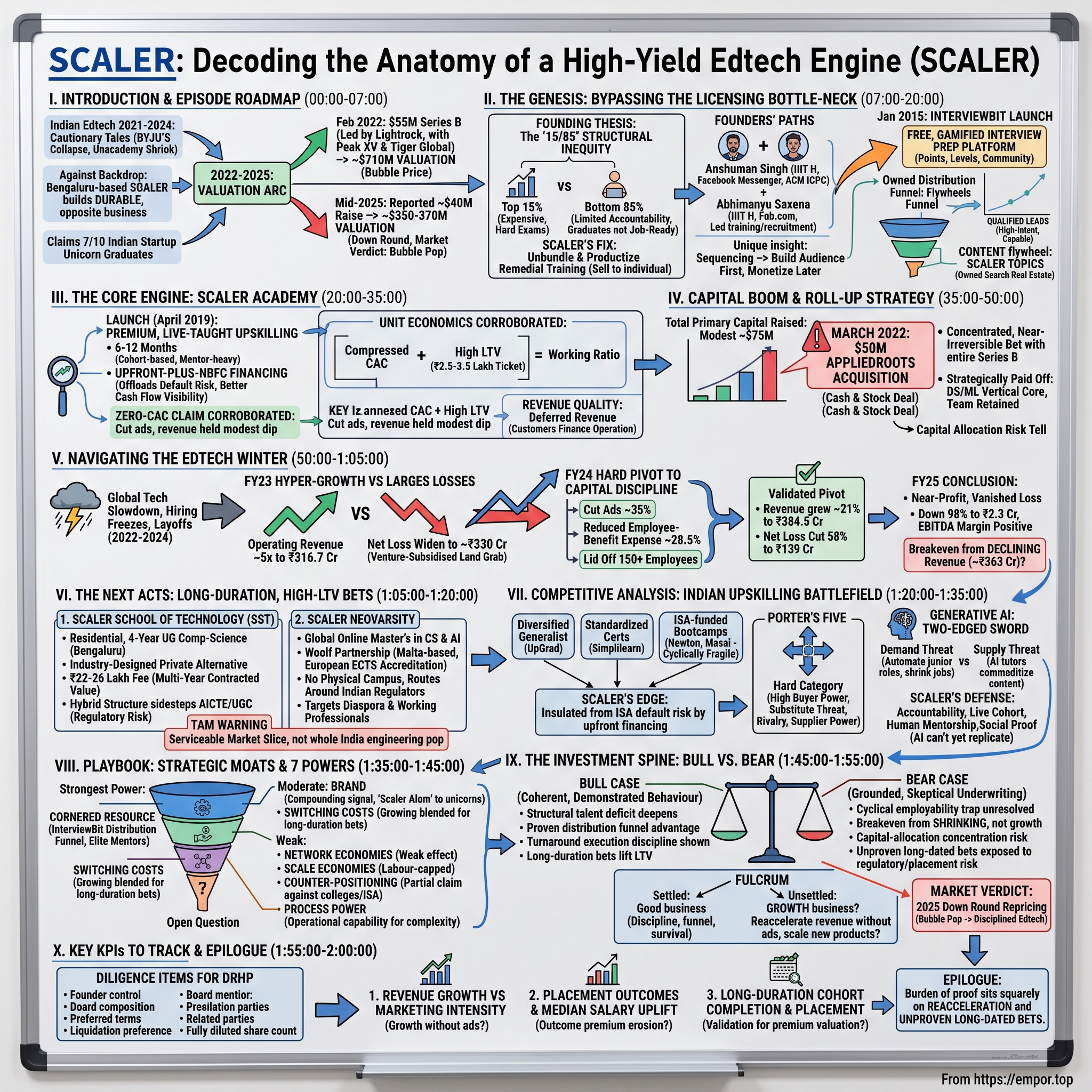
Scaler: Decoding the Anatomy of a High-Yield Edtech Engine
I. Introduction & Episode Roadmap (00:00 - 07:00)
Between 2021 and 2024, Indian edtech turned from the country's most celebrated startup category into its most cautionary one. BYJU'S, valued at $22 billion at its peak, collapsed into insolvency proceedings and near-total write-downs; Unacademy shelved its own IPO ambitions and shrank; the sector's defining lesson became that a company can spend hundreds of crores buying growth and still have nothing durable to show for it. Against that backdrop, a much smaller Bengaluru company built the opposite kind of business — one that claims its graduates now populate roughly seven out of every ten of India's startup unicorns, and that reached the edge of breakeven not by raising more money but by learning to stop spending it.12
That company is Scaler, and the fact worth sitting with from the first minute is the arc of its own valuation. In February 2022, at the top of the venture cycle, Scaler raised $55 million led by Lightrock India at a reported valuation of about $710 million, with existing backers Sequoia India (now Peak XV) and Tiger Global joining.1 Roughly three years later, in mid-2025, the company was reported to be raising about $40 million at a valuation of only $350–370 million — a down round that cut the headline number to roughly half its peak.3 The private market, in other words, has already delivered a verdict that the 2022 mark was a bubble price, not a business value. Any pre-IPO underwriting of Scaler has to begin there: not with the number the company would like to carry into a listing, but with the number a fresh set of investors was actually willing to pay after the music stopped.
This is not an investor-relations story, and Scaler has filed no prospectus — there is no DRHP, RHP, S-1 or F-1 to read. The company is tagged a startup because that is its lifecycle stage, not because a listing is imminent. What follows is an independent underwriting from the public record: the founders' diagnosis of a broken engineering-education market; the genuinely clever distribution engine built on the free InterviewBit funnel; the aggressive $50 million acquisition that consumed almost an entire funding round; the brutal cost-rationalisation that turned a ₹330 crore FY23 loss into a near-breakeven FY25; the long-duration bets on a residential four-year college and European-accredited online degrees; the competitive battlefield; a structural read through Helmer's 7 Powers and Porter's Five Forces; and finally the bull and bear cases with the handful of metrics that would confirm or falsify the thesis after any eventual listing.
A word on method, because it governs everything after. Price and value are different questions, and Scaler's own history makes the distinction unavoidable. The $710 million of 2022 and the ~$360 million of 2025 are both prices — amounts at which parcels of preferred stock changed hands under terms that public common shareholders will never receive — not appraisals of the enterprise. The preferred stock held by Peak XV, Tiger Global and Lightrock almost certainly carries liquidation preferences, and possibly participation, anti-dilution and information rights, none of which are public and all of which sit ahead of the common stock a future IPO would sell. Where a figure is a market price, we treat it as one, and reason toward value from operating evidence — revenue quality, unit economics, margin structure, reinvestment needs and the credibility of the path to sustainable profit. Where the evidence to compute something an investor would want does not exist — a fully diluted common-equivalent share count, the preferred terms, an enterprise-value bridge — we say so plainly rather than manufacture precision. That posture is the only honest way to underwrite a company whose most-quoted numbers are the residue of two very different moods in the venture market.
One more framing point deserves stating up front, because it recurs in every section. Scaler is not a software company, and the instinct to underwrite it as one is the single most common error a reader will bring to it. Its core product is delivered by expensive humans — live instructors and one-to-one mentors — which means its gross margin is structurally capped in a way a SaaS company's is not, and its scale economics behave more like those of a premium services business than a software platform. That distinction governs which peers are relevant, which multiples are defensible, and what a credible path to profitability even looks like. Throughout this analysis we will resist SaaS vocabulary — "ARR," "net revenue retention," "zero marginal cost" — where it would flatter the business into a category it does not belong to, and instead ask the questions that actually determine value for a labour-inflected, outcome-guaranteed education franchise: how cheaply it acquires students, how reliably it places them, how much of each cohort's fee it keeps after paying the humans who teach them, and whether the long-duration products can bend that curve.
 Subscribe on LinkedIn
II. The Genesis: Bypassing the Licensing Bottle-neck (07:00 - 20:00)
The company's founding thesis rests on a number that Indian technology has quietly lived with for two decades: the country graduates well over a million engineers a year, and industry employability studies have repeatedly found that only a small single-digit percentage of them are ready for high-end software roles without substantial retraining.4 The gap between a degree and a job is not marginal; it is the entire market. Co-founder Abhimanyu Saxena framed it as a structural inequity — a higher-education system in which the top sliver of institutions charge steep tuition and screen through brutal entrance exams, while the long tail operates with, in his words, "limited accountability," producing graduates without the core skills global tech firms demand.1 Whether or not one accepts the rhetoric, the underlying observation is empirically defensible and is the soil the whole business grows in.
Saxena's framing has a name in the company's own telling — the "15/85" structural inequity. In his diagnosis, the top 15% of India's higher-education institutions cater to students who can afford tuition of $11,000 or more and clear punishing entrance exams, while the bottom 85% operate with little accountability for whether their graduates can actually do the work.1 The result is a talent pipeline that is simultaneously enormous and mostly unusable — a paradox in which employers cannot find engineers in a country producing more than a million of them a year. One can read that framing as marketing, and partly it is; a founder selling a fix has every incentive to dramatise the problem. But the core of it is corroborated by two decades of employer complaints and by the survival of an entire industry — the campus-to-corporate training programs that IT-services giants like Infosys and TCS run internally precisely because fresh graduates arrive not job-ready. Scaler is, in effect, an attempt to unbundle and productise that remedial training and sell it directly to the individual rather than the employer.
The two founders were unusually well-placed to see the gap from both ends. Anshuman Singh and Abhimanyu Saxena were batchmates at IIIT Hyderabad, one of India's stronger computer-science institutions.5 Singh was among the first programmers hired directly from India into Facebook, where he worked on the team that built Facebook Messenger, and was a two-time ACM ICPC World Finalist — competitive-programming credentials that matter enormously to the audience Scaler would later sell to.56 Saxena, after a stint at Progress Software, joined the New York-based design-commerce startup Fab.com, where he led front-end engineering and, tellingly, ran the company's internal learning and recruitment programs across New York, Berlin and Pune.56 Between them they had lived the exact pain the business addresses: Singh had sat on the hiring side of the world's most selective engineering interviews, and Saxena had run the training pipelines that tried to close the skills gap inside a fast-scaling company. That combination — one founder who knew what "good" looked like from inside FAANG hiring, the other who had operationalised the teaching of it — is the credibility underneath the product, and it is why the curriculum has consistently been positioned as designed by practitioners rather than academics.
The insight that turned that experience into a company was sequencing. Rather than build a paid course and then go hunting for students — the default, expensive edtech motion — the founders built the audience first and monetised it later. In January 2015 they launched InterviewBit, a free, heavily gamified platform for software engineers preparing for interviews at top technology firms.56 It was deliberately given away. Over several years it accumulated a large, high-intent developer community — the company has cited a funnel in the millions of registered users — precisely the people who, having proven their ambition by grinding through interview prep, are the highest-converting possible prospects for a premium career accelerator.7 This is the single most important strategic decision in the company's history, and it is worth naming plainly for what it is: InterviewBit was not a business, it was a customer-acquisition asset, and building it years ahead of monetisation is the reason Scaler's later economics look different from its peers'.
The gamification was not incidental; it was the mechanism. InterviewBit structured interview preparation as a progression system — points, levels, unlockable problem sets, leaderboards — which turned a tedious chore into something users returned to daily and, crucially, generated a continuous behavioural signal of intent and ability. A developer who has climbed several levels of InterviewBit has self-identified as ambitious, capable and career-focused, which is exactly the profile that converts to a ₹3 lakh accelerator. In marketing terms, InterviewBit performs the qualification and scoring that competitors pay sales teams and ad-targeting algorithms to approximate — and it does so for free, because the users volunteer the effort. That is the difference between spraying ads at a cold audience and having warm, pre-qualified leads walk in the door having already demonstrated they want what you sell.
There is a second, subtler asset the founders built alongside the funnel: content that ranks. Over time the group accumulated a large library of technical explainers and preparation material — later consolidated and extended into the Scaler Topics hub — that captures organic search traffic from developers Googling programming concepts, feeding still more high-intent users into the top of the funnel at no incremental acquisition cost.8 Owned distribution and owned search real estate compound on each other: the more content ranks, the more developers arrive; the more developers arrive, the more the community and the brand signal strengthen. This flywheel is slow and unglamorous, but it is the kind of asset that is very hard for a well-funded latecomer to buy, because it was accumulated over a decade of giving things away.
For an underwriter, the durable signal from the genesis period is not the founders' pedigree, which is real but is table stakes among Indian venture-backed startups. It is the demonstrated understanding that in a category defined by ruinous acquisition costs, owning a free top-of-funnel is worth more than any course. Everything that later distinguishes Scaler's financial profile — its ability to slash marketing spend by a third and still grow, its survival through a winter that killed better-funded rivals — traces back to a decision made in 2015 to give something valuable away and wait.
III. The Core Engine: Scaler Academy & The Zero-CAC Funnel (20:00 - 35:00)
In April 2019, four years after InterviewBit launched, the founders finally switched on monetisation. Scaler Academy opened as a premium, live-taught upskilling program: a six-to-twelve-month curriculum of live coding classes, data structures and algorithms, system design, and one-to-one mentorship from working engineers at top firms.58 The format matters to the economics. Unlike recorded-video edtech, where the marginal cost of another student is near zero but so is the perceived value, Scaler's live, cohort-based, mentor-heavy model commands a high price precisely because it is labour-intensive and hard to fake — and that same labour intensity caps its gross margin. This is the central tension of the business: it sells an outcome, not a video, and outcomes require expensive humans.
The pricing reflects the positioning. Scaler Academy's flagship programs have been priced in the range of roughly ₹2.5–3.5 lakh, typically paid upfront or financed through no-cost EMIs arranged with non-bank lending partners.8 The choice of upfront-plus-financing over the income-share agreements (ISAs) favoured by cheaper rivals is a deliberate and, in emerging markets, a shrewd one. ISAs — where the student pays nothing until employed and then remits a share of salary — sound student-friendly but shift enormous collection and default risk onto the provider, and India's weak small-claims enforcement makes that risk acute. By taking committed payment upfront and offloading the credit risk to an NBFC, Scaler converts a soft promise into hard, recognised revenue and preserves cash-flow visibility. It is a less romantic model than the ISA, and a materially more bankable one.
The genuine differentiator, though, is the top of the funnel. The conventional Indian edtech giant — the pre-collapse BYJU'S, UpGrad, Simplilearn — acquires students through paid channels: Google and Meta ad auctions, inside-sales floors, cold-calling. Reporting and disclosed financials across the sector routinely show marketing and sales absorbing 40–50% or more of operating revenue, a tax that scales with growth and never goes away. Scaler's claim is that InterviewBit lets it largely bypass this: high-intent developers prepare for free on InterviewBit, the strongest are organically routed into Scaler Academy, and the company acquires its highest-value customers at a fraction of the auction price. The claim is not merely rhetorical, and this is important — it is corroborated by behaviour under stress. When Scaler cut advertising spend by 35% in FY24 and a further 30% in FY25, revenue did not collapse; it dipped only modestly.29 A business whose growth is bought dies when the ad budget is cut. Scaler's did not, which is the strongest available evidence that the zero-CAC funnel is real rather than a pitch-deck talking point.
Two cautions keep this from being a victory lap. First, "zero-CAC" is a marketing shorthand, not an accounting fact: InterviewBit costs money to build and maintain, and its cost simply sits in a different line than paid media. The right question is not whether CAC is zero — it is not — but whether Scaler's fully-loaded acquisition cost is structurally below competitors', and the FY24–FY25 evidence suggests it is. Second, an organic funnel is only as good as the audience's continued reasons to enter it; if free AI coding assistants and interview-prep tools erode the reason developers grind through InterviewBit in the first place, the top of the funnel narrows regardless of how efficiently Scaler converts it. The moat is real today; it is not obviously permanent.
It is worth translating the unit economics into plain language, because they are the crux of whether the model is durable. In a healthy consumer-education business, three numbers have to line up: what it costs to acquire a paying student (CAC), what that student pays over the relationship (lifetime value, or LTV), and how long before the fee covers the acquisition cost (payback). The peers that collapsed had CAC so high — because they bought students through advertising and phone-bank sales — that LTV/CAC ratios were thin and payback stretched, so every new cohort consumed cash before it produced any. Scaler's bet is that routing acquisition through InterviewBit compresses CAC dramatically while the ₹2.5–3.5 lakh ticket keeps LTV high, producing a ratio and a payback period that actually work. The company does not disclose these figures, so an outside underwriter cannot verify the exact ratio — that is a first-order diligence item for any future filing. But the indirect evidence is unusually strong: a business that can cut advertising by roughly a third two years running and lose only single-digit revenue is, by definition, one whose customers were not primarily bought with that advertising in the first place.
There is also a revenue-quality question hiding inside the model, and it cuts in Scaler's favour. Because students pay upfront (or via financed EMIs disbursed upfront by an NBFC), Scaler collects cash at or near enrolment for a service delivered over the following six to twelve months. That produces deferred revenue — cash in the door for teaching not yet done — which is why the company's balance sheet carries current liabilities far in excess of its cash: much of that liability is very likely unearned course fees, not borrowings.9 For a services business this is a genuinely attractive feature: customers finance the operation, working capital runs negative in the good sense, and revenue is recognised steadily as classes are delivered rather than lumpily. It is the closest thing Scaler has to a software company's recurring-revenue smoothness, and it is a real, if underappreciated, quality of the business.
The company wraps all of this in a value-creation narrative that a diligent reader should hold at arm's length. At the Series B, Saxena claimed the cumulative annual salaries of Scaler graduates exceeded ₹600 crore and that the academy adds more than $100 million to India's GDP each year, with an ambition to reach a billion dollars; he also asserted the business had grown eight-to-nine-fold in the prior year and was cash-flow positive, without elaborating.1 These are management claims, unaudited and self-serving, and several are hard to reconcile with the heavy audited losses that later surfaced in the company's financials — a business carrying losses of that magnitude in the years around the claim was not, in any conventional accounting sense, "cash-flow positive."2 The GDP figures measure gross graduate earnings rather than any value the company itself captures. They are useful as evidence that Scaler defines its product as career outcomes, and as a small cautionary flag on the gap between founder framing and audited reality. The relevant proof is not what graduates earn; it is whether their willingness to pay recurs across cohorts as hiring conditions change — which is precisely what the winter of 2022–2024 would test.
IV. The Capital Boom & The $50M Roll-Up Strategy (35:00 - 50:00)
Scaler's capital history is short and lopsided. After bootstrapping InterviewBit and the early academy, the company raised a roughly $20 million Series A in 2020 from Sequoia India and Tiger Global, and then, at the very top of the cycle in February 2022, a $55 million Series B led by Lightrock India at the reported ~$710 million valuation.1 Total disclosed primary capital raised across the company's life is a modest ~$75 million — strikingly little for a company that reached ₹384 crore of revenue, and itself a data point about the capital efficiency the InterviewBit funnel enables.23 Most of the story of what Scaler did with that money is the story of a single decision.
The M&A began small and sensible. In August 2021 Scaler acquired Coding Elements, and in October 2021 Coding Minutes, each reported at roughly $1 million — tuck-ins to absorb beginner-level content and early-stage developer audiences.10 Then, in March 2022 — barely a month after closing the $55 million Series B — Scaler announced the acquisition of AppliedRoots, the bootstrapped company behind the well-regarded AppliedAICourse, for $50 million in a cash-and-stock deal.1112 The arithmetic is arresting and demands to be stated bluntly: Scaler spent a sum roughly equal to its entire fresh Series B on a single acquisition of a company its founders had bootstrapped without venture money. AppliedRoots had served some 40,000 learners over four years and brought a six-person founding team, deep data-science and machine-learning IP, and the technical talent that would build Scaler's DS/ML vertical and its SEO-driven content hub.1112
Did Scaler overpay? On the multiples of the moment, the price was defensible in a way it would not be today. In 2021–2022, private edtech changed hands at 15–20x forward revenue, and a strategic buyer racing to stand up a high-margin data-science line could rationalise paying a premium for premium IP and a proven curriculum team. On any post-winter basis, $50 million for a bootstrapped training platform looks like a top-of-cycle price paid with top-of-cycle currency — and, crucially, paid partly in Scaler's own stock, which means AppliedRoots's founders effectively bet a portion of their proceeds on the ~$710 million mark that the market has since roughly halved. That structure both softened the cash outlay and quietly transferred some of the overpayment risk to the sellers.
The cash-and-stock structure carries a subtlety that matters for how a public investor should read the company's balance sheet history. Paying partly in equity meant Scaler did not drain the full $50 million from its bank account, preserving cash for operations at a moment when it was also burning heavily on growth — a sensible liquidity move. But it also means the acquisition consideration recorded on the books was denominated in the inflated 2022 currency, and any goodwill or intangibles capitalised from the deal were struck at top-of-cycle values. If those assets were later reviewed for impairment against a halved enterprise value, a write-down would be an accounting event a future prospectus would have to disclose. There is no public evidence such an impairment has been taken, but the possibility is exactly the kind of item that lives in the footnotes of a real filing and is invisible in press coverage of the round.
For a public-market underwriter, the AppliedRoots deal is less interesting as a valuation question than as a governance and capital-allocation tell. It reveals a management team willing to make a very large, concentrated, near-irreversible bet with almost the whole of a funding round — decisiveness that can look like conviction in an up-cycle and recklessness in a down one. The bet appears, with hindsight, to have paid off strategically: the DS/ML vertical became a core revenue line, and the acquired team was retained rather than churning out. But the pattern is the thing to file away. A company that will spend $50 million of $55 million on one deal is a company whose future M&A must be watched closely, because the same instinct, applied to a worse target in a worse cycle, is exactly how balance sheets get destroyed. The 2023 acquisition of Delhi-based Pepcoding, a smaller content-and-community tuck-in, suggests the roll-up instinct persisted, though on a far less consequential scale.1314
V. Navigating the Edtech Winter: Hyper-Growth vs. Rationalization (50:00 - 1:05:00)
The macro turned almost immediately after the Series B. Through 2022–2024, rising interest rates, a global technology slowdown and waves of layoffs at exactly the FAANG-and-unicorn employers whose offer letters justified Scaler's price tag put the whole thesis under strain. A career accelerator's demand is reflexively tied to hiring: when the jobs at the end of the funnel freeze, the return on a ₹3 lakh course drops, enrolment softens, and the students already enrolled on EMIs become likelier to default. This is the cyclical trap at the heart of the business, and 2022–2024 was its first real stress test.
The FY23 numbers show a company that had pressed the accelerator into that headwind. Operating revenue surged roughly fivefold to about ₹316.7 crore as the post-acquisition product suite scaled, but total expenses ballooned past ₹600 crore, and the net loss widened to around ₹330 crore — roughly 90% worse than the prior year.15 The EBITDA margin sat near -97%, the signature of a classic venture-subsidised land grab: buying revenue faster than the unit economics could support it. Had that trajectory continued, Scaler's modest ~$75 million war chest would have been exhausted quickly, and the company would have been forced to raise into the teeth of a winter that had already shut the funding window for edtech. This is the moment at which most of Scaler's peers began their unravelling.
What happened next is the single most important piece of evidence in the entire underwriting, because it is a test of management under duress rather than in a fair wind. Through FY24, Scaler executed a hard pivot to capital discipline. It laid off more than 150 employees, concentrated in sales and marketing.[^16] It cut advertising and promotional spend by about 35%, to roughly ₹92 crore, leaning harder on the InterviewBit funnel it already owned.2 It reduced employee-benefit expense by about 28.5%, to around ₹230 crore.2 The results validated the pivot: FY24 operating revenue still grew about 21% to ₹384.5 crore, while the net loss was cut by 58% to ₹139 crore, and the EBITDA margin improved from roughly -97% to about -32%.2 Revenue up, losses more than halved, marketing slashed — the exact combination that is impossible for a business whose growth is purchased, and straightforward for one whose growth is organic.
The EMI dimension deserves a closer look, because it is where the winter's risk concentrates and where Scaler's model is genuinely better hedged than its rivals'. When a student finances a ₹3 lakh course through an NBFC partner, the lender disburses the full fee to Scaler upfront and the student repays the lender over time. The credit risk — the chance the student, unable to find the promised job, stops paying — sits with the NBFC, not with Scaler, at least on a first-order basis. That is structurally superior to the ISA model, where the provider itself is the lender and eats every default. But the hedge is not absolute: if placements deteriorate badly enough that default rates spike, NBFC partners will either withdraw financing, tighten approval criteria, or demand higher rates and recourse terms — any of which raises the effective price to students and throttles enrolment at exactly the wrong moment. So while Scaler does not sit directly on the credit risk, it sits on the second-order demand risk that flows from it. In a deep enough hiring freeze, the financing rail that makes the ₹3 lakh ticket affordable is precisely what seizes up.
FY25 pushed the story to its logical conclusion, and here the reader must weigh a genuine ambiguity. Revenue actually declined about 5.5%, to ₹363 crore from ₹384 crore, as the company continued to prune.9 But the net loss all but vanished — down 98% to just ₹2.3 crore, with EBITDA turning marginally positive — as employee costs fell a further ~26.5% to ₹169 crore and advertising dropped another ~30% to ₹64 crore.9 This is the crux question of Scaler's maturation: is a business that reaches breakeven by cutting costs faster than revenue a durably profitable company, or a shrinking one? The honest answer is that FY25 proves the model can be run at breakeven, which most Indian edtechs never demonstrated, but it does not yet prove Scaler can grow and earn at the same time. A near-flat-to-declining top line married to near-breakeven is a very different investment than the hyper-growth story the 2022 valuation embedded, and the balance sheet carries its own caution: reported cash of only about ₹13 crore against current liabilities of roughly ₹330 crore points to a company that needed the mooted 2025 raise not as a luxury but to shore up working capital.9 Discipline is real and creditable; it is not the same thing as a reaccelerating, self-funding engine, and the underwriting must not confuse the two.
VI. The Next Acts: SST and Global Accredited Degrees (1:05:00 - 1:20:00)
If Scaler Academy is the cash engine, the company's two newest bets are attempts to change what kind of business it is — to trade the transactional economics of a six-month bootcamp for the long-duration, high-lifetime-value economics of formal education. The more ambitious of the two is the Scaler School of Technology (SST), a residential, four-year undergraduate computer-science program launched in Bengaluru.16 The pitch is audacious: a private, industry-designed alternative to a conventional engineering degree, taught in India's tech capital, for students willing to bet four years and a large sum on employability over a traditional credential.
The economics of SST are genuinely different from anything else Scaler does, and this is the point. Total fees run to roughly ₹22–26 lakh per student across the four years once tuition, hostel and mess are included, with a parallel UGC-recognised online degree from a partner such as BITS Pilani or IIT Madras paid separately to those institutions.17 A single 500-student cohort therefore represents well over ₹100 crore of multi-year contracted value — an order of magnitude more lifetime value per student than a bootcamp, and, critically, revenue with far higher switching costs. A student two years into a four-year residential program with peers, housing and a half-finished degree does not casually churn. The regulatory design is deliberate: SST itself offers an industry certification rather than a standalone AICTE/UGC-approved degree, sidestepping the curriculum rigidity of India's higher-education regulators, while the parallel online degree from an accredited partner supplies the formal credential.17
That same design is also the bet's central vulnerability, and it should not be soft-pedalled. The model works only so long as Indian students and their fee-paying parents continue to value demonstrated outcomes over the reassurance of a conventional, regulator-blessed degree — and only so long as India's education regulators tolerate the hybrid structure. A single adverse ruling from UGC or AICTE on the marketing or structure of such programs, or a cohort with disappointing placements at the end of four years, could impair the model far more than any bootcamp setback, precisely because the commitments are so large and so long. SST is high-conviction, high-duration, and unproven: its first cohorts have not yet graduated into the job market, so its central claim — that a Scaler undergraduate degree places as well as an IIT one — remains a hypothesis, not a result.
The second bet, Scaler Neovarsity, is lower-stakes but strategically clever. Neovarsity offers online master's-level programs in computer science and AI through a partnership with Woolf, a Malta-based accredited higher-education body, delivering degrees accredited under the European Credit Transfer and Accumulation System (ECTS) with US equivalency.1819 The arbitrage is elegant: because Woolf carries European accreditation recognised across the US, Europe and Canada, Scaler can sell an accredited master's degree to working professionals globally — including India's large cohort of engineers seeking a credential for immigration or promotion — without building a single physical campus or securing Indian regulatory approval.18 Woolf is explicitly not UGC/AICTE-recognised in India, which the company discloses; its value is precisely that it routes around the Indian system rather than through it.18 Neovarsity is the clearest expression of Scaler's ambition to become a "new-age university" at asset-light cost, and management has positioned it as a growing share of revenue. But the specific revenue contribution is a company assertion rather than an audited disclosure, and it should be treated as directional until a filing substantiates it.
This is also the right place to discipline the addressable-market question, because "India needs engineers" is a category TAM that tempts founders and investors into fantasy math. The relevant market for Scaler is not the millions of engineering graduates India produces, nor the global shortage of developers in the abstract. It is the far smaller, reachable population that can afford ₹2.5–3.5 lakh for an accelerator or ₹22 lakh-plus for SST, has the aptitude to complete a rigorous live program, and believes a Scaler credential will pay for itself in placement. That reachable market — affluent-enough, ambitious, urban or digitally connected Indians in and around the technology workforce, plus a diaspora and Global South extension via Neovarsity — is a real and growing pool, but it is a slice of the category, not the category. Any valuation that implicitly assumes Scaler can address the whole of India's engineering population is confusing the size of the problem with the size of the serviceable market, and the two are separated by the price point and the aptitude filter. Management's international ambition is a genuine attempt to widen that serviceable market — but it also puts Scaler into competition with established global players (Coursera, edX, Western bootcamps and universities) on their home turf, where the InterviewBit funnel is weaker and the brand is unknown.
Allocating analytical weight here matters. SST and Neovarsity are strategically the most important things Scaler is doing, because they are the only parts of the business that could plausibly justify a valuation well above a mature bootcamp's. They are also the least proven, the longest-dated, and the most exposed to regulatory and placement risk. A public-market investor is being asked to pay today for outcomes that will not be visible for years — which is exactly the kind of bet the private market repriced downward in 2025.
VII. Competitive Analysis: The Indian Upskilling Battlefield (1:20:00 - 1:35:00)
Scaler competes on a crowded field, and the useful move is to separate its rivals by economic model rather than lump them into "edtech." UpGrad is the heavily funded, diversified generalist — degree partnerships, corporate training, a sprawling course catalogue built partly through acquisitions — and it carries a correspondingly larger cost base and a heavier reliance on paid lead generation. It is bigger than Scaler and less focused; its breadth is a hedge and a drag at once. Simplilearn, backed by Blackstone, sits in standardised professional certification — cloud, project management, analytics — a more profitable and more defensible niche than consumer bootcamps, but one that lacks the specialised software-engineering brand equity that Scaler has concentrated on. These two are Scaler's most serious peers in scale, but neither is a clean operating comparable: UpGrad is broader and more marketing-dependent, Simplilearn is more certification-and-enterprise-oriented.
At the other end sit the direct model competitors — Newton School, Masai School and similar bootcamps — that compete on price and lean on income-share agreements. These are the truest operating peers by business model, and they are also the most cyclically fragile. An ISA-funded bootcamp is structurally short the tech hiring cycle: when placements slow, revenue is deferred or defaults rise, and the provider absorbs the loss. Scaler's upfront-plus-NBFC model insulates it from exactly this failure mode, which is why it survived the winter that thinned this cohort. The comparison flatters Scaler, but honestly so: its financing structure is a genuine, demonstrated advantage over the ISA bootcamps, not merely a branding one.
A Porter's Five Forces read clarifies why the whole category is structurally hard, Scaler included. Buyer power is high: students purchase one product — a salary increase — and the moment placement outcomes wobble, demand evaporates, giving customers enormous leverage over price and pushing every provider to compete on guaranteed outcomes it cannot fully control. The threat of substitutes is extreme and rising: LeetCode, GitHub, free YouTube curricula, Udemy, Coursera and, increasingly, AI coding tutors deliver much of the raw content for free, so a paid provider can only defend a premium by wrapping content in the two things that are genuinely hard to substitute — intense live mentorship and credible placement matching. Rivalry is high because the barriers to launching a simple bootcamp are trivial, fragmenting the low end even as brand defends the premium tier. Supplier power is a quieter but real force: Scaler's product depends on recruiting active senior engineers as part-time mentors, a scarce and expensive input whose cost sits at the heart of the gross-margin ceiling. Only the threat of new entrants at the premium, outcomes-guaranteed end is meaningfully constrained — and that constraint is Scaler's whole competitive case.
The single most important competitive development is not any of these named rivals, though — it is generative AI, which sits under the "threat of substitutes" force but deserves separate billing because it cuts both ways with unusual force. On the demand side, AI coding assistants that write and debug code threaten to automate exactly the junior-to-mid-level engineering tasks that Scaler's graduates are trained to perform, which could shrink the population of jobs at the end of the funnel and, with it, the willingness to pay for training toward them. On the supply side, AI tutoring could commoditise the content-delivery layer, letting a free chatbot teach data structures competently and undercutting the informational value of a paid course. Scaler's defence against both is the same: the parts of its product that AI cannot yet replicate — the accountability of a live cohort, the credibility of human mentorship from working engineers, the social proof of the alumni brand, and the placement relationships with employers. That defence is plausible and, for now, holding. But it is a defence against a fast-moving threat, and a public-market investor should treat "AI does not commoditise the core" as an explicit, load-bearing assumption of any bull case rather than a settled fact.
The through-line is that Scaler is not winning because the category is attractive; it is winning a difficult category by owning the one asset — the InterviewBit funnel — that neutralises the sector's worst structural feature, its ruinous cost of acquiring high-intent buyers. Strip that away and Scaler looks like every other bootcamp fighting buyer power and free substitutes with expensive human mentors. Keep it, and Scaler is the rare edtech that can defend a premium without bleeding on customer acquisition.
VIII. Playbook: Strategic Moats & The 7 Powers Framework (1:35:00 - 1:45:00)
Hamilton Helmer's 7 Powers asks a sharper question than "does the company have a moat": it asks which specific, persistent power lets a business hold price above cost against competent competition. Applied to Scaler, the honest answer is that it has one strong power, a couple of moderate ones, and several that are weaker than the marketing implies.
The genuinely strong power is a cornered resource in the form of the InterviewBit distribution funnel. This is not a brand or a network effect; it is a proprietary, pre-existing pipeline of high-intent developers that a competitor cannot replicate without either building an equivalent free platform over many years or paying to acquire the same audience in ad auctions. The evidence that it is a real power, not a claimed one, is behavioural: Scaler cut marketing by roughly a third across FY24–FY25 and still held revenue within single digits, which is only possible if acquisition genuinely runs through an owned channel.29 Related but distinct is a second cornered resource — access to elite mentors, the working senior engineers Scaler recruits as instructors. This is harder to replicate at scale than a curriculum, but it is also an input Scaler must keep paying for, so it functions as much as a cost as a moat.
The company's brand is a moderate power and the one most likely to compound. The "Scaler alum" signal — the claim that seven in ten Indian tech unicorns employ its graduates — if it holds up, functions as a recruiting filter that lowers placement friction for both students and employers, which is the flywheel a premium education brand needs.1 But the claim is management's, unaudited, and constructed on a self-selected numerator (alumni presence, not alumni share), so it should be read as suggestive of brand strength rather than proof of it. Switching costs are genuinely high for SST and Neovarsity — a half-finished multi-year degree is expensive to abandon — but low for the core six-month academy, where the EMI commitment is the main lock-in. Since the academy is still the overwhelming majority of revenue, the blended switching-cost power today is modest and only grows if the long-duration products scale. Scale economies are real but capped by the model itself: live, mentor-led delivery does not amortise toward zero marginal cost the way recorded content does, which is the same labour intensity that both justifies the price and limits the margin.
Two of Helmer's remaining powers are worth addressing precisely because Scaler largely lacks them, and naming the absence is as useful as cataloguing the strengths. The first is network economies — the property whereby each additional user makes the product more valuable to other users, as in a social network or a marketplace. Scaler does not really have this. A student's course does not become more valuable because another student enrolled; the alumni network has a mild version of the effect (a bigger, more prestigious alumni base is a marginally better placement signal), but it is weak and slow-building compared with a true network business, and it does not lock users in the way a genuine network effect does. The second is counter-positioning — a superior business model that incumbents cannot copy without damaging their existing business. Here Scaler has a partial claim: the legacy engineering colleges it competes with genuinely cannot pivot to an industry-led, outcomes-guaranteed, regulator-light model without abandoning the degree-granting franchise that is their whole reason for existing. Against the ISA bootcamps, Scaler's upfront-plus-NBFC model is arguably counter-positioned too, since a pure-ISA player cannot switch to upfront collection without contradicting its student-friendly marketing premise. These are real but secondary advantages, and they defend against specific rivals rather than the category at large.
The process power question — whether Scaler has developed hard-to-replicate operational capabilities in curriculum design, mentor management and placement — is the most interesting open one, because it is the power most likely to determine whether the company can scale SST and Neovarsity without the wheels coming off. Running a live, mentor-heavy program at quality is genuinely hard; doing it across a bootcamp, a four-year residential college and a global online master's simultaneously is harder still, and the operational muscle to do so is the kind of tacit, accumulated capability that competitors cannot simply buy. If Scaler has built it, process power quietly underwrites the whole diversification strategy; if it has not, the expansion into longer, more complex products is where execution risk concentrates. There is not yet enough public evidence to score this power confidently, which is itself the point: it is a capability the market will only be able to assess once the multi-product model has run for several more years.
Netting it out: Scaler's durable edge is narrower than the "new-age university with multiple moats" framing suggests. It rests primarily on one thing — owned distribution — with brand as a promising second act and switching costs as a bet on products that have not yet scaled. That is a real competitive position, and a more fragile one than a diversified moat, because a single power, however strong, is a single point of failure if the audience that feeds the funnel ever thins.
IX. The Investment Spine: Bull vs. Bear (1:45:00 - 1:55:00)
The bull case is coherent and rests on demonstrated behaviour rather than projection. The structural talent deficit is real and, if anything, deepening as AI, ML and cloud demand outruns what traditional universities can supply, and Scaler is building a "new-age university" at a fraction of a physical institution's capital intensity. Its distribution advantage is proven, not promised — the FY24–FY25 cost cuts without revenue collapse are the receipt. Management has shown it can execute a turnaround, converting a ₹330 crore loss into near-breakeven in two years, which is a rarer skill among Indian startup founders than the ability to grow.159 And the pivot toward SST and Neovarsity, if it works, structurally raises lifetime value per student from a one-time bootcamp fee to a multi-year, multi-lakh relationship. In the optimistic reading, Scaler is a disciplined, capital-efficient franchise that has already survived the winnowing that destroyed its category and is now positioned to grow into durable profitability from a clean base.
The bear case is equally grounded, and a skeptical public-market investor should weight it heavily. First, the cyclical employability trap is unresolved: Scaler's entire premium is a claim on the tech hiring cycle, and if big-tech hiring stays subdued — or if generative AI genuinely automates the junior-to-mid engineering roles Scaler's graduates fill — the placement engine stalls, enrolment falls, and EMI defaults rise, all at once. This is not a tail risk; it is the base-rate risk of the model, and 2022–2024 showed how quickly it bites. Second, the breakeven is the wrong kind: FY25's near-profit came from a declining top line, and a company that reaches breakeven by shrinking has not yet proven it can be profitable while growing — the only version of profitability that supports a growth valuation. Third, capital-allocation concentration: spending $50 million of a $55 million round on one acquisition worked once, but it reveals a risk appetite that could destroy the balance sheet if repeated against a worse target, and the thin ~₹13 crore cash position leaves little margin for error. Fourth, the long-dated bets are unproven and regulator-exposed: SST's first graduates have not yet hit the market, and its hybrid structure is one adverse UGC/AICTE ruling away from impairment.
Management judgment sits at the centre of both cases, and the record is genuinely mixed rather than uniformly good or bad. On the debit side, the founders made claims at the top of the cycle — "cash-flow positive," growth of "eight-to-nine times" — that sit uneasily beside the audited ₹330 crore FY23 loss that later emerged, and they made a $50-million-of-$55-million capital bet that only hindsight excuses.115 A skeptical reader is right to note that these are the behaviours of founders comfortable with aggressive framing and concentrated risk. On the credit side, and weighing more heavily in the final analysis, the same team did the thing most Indian startup founders conspicuously failed to do: when the cycle turned, they cut hard and fast, absorbed the reputational cost of layoffs and a down round, and drove the business to breakeven rather than to insolvency.[^16]39 Turnaround execution is a rarer and more valuable skill than growth-at-any-cost, and Scaler's management demonstrated it under real pressure. The synthesis is that this is a team to trust on discipline and to watch closely on promotion — capable operators whose public statements should be discounted for optimism but whose actions, when the money was on the line, were sound.
Both cases point at the same fulcrum, and that convergence is itself the finding: whether Scaler is a good business is largely settled — the discipline, the funnel and the survival are real. Whether it is a growth business worth a growth valuation is entirely unsettled, and hangs on a single unproven proposition: that the company can reaccelerate revenue without reopening the marketing spigot, and can scale SST and Neovarsity into high-margin, high-LTV lines before AI and the hiring cycle erode the bootcamp core. The private market's 2025 down round to ~$360 million is best read as its answer to exactly this question — a repricing from "hyper-growth new-age university" toward "disciplined but slow-growing profitable edtech." The bull case is a bet that the repricing overshot; the bear case is a bet that it was correct, or not yet finished.
X. Key KPIs to Track & Epilogue (1:55:00 - 2:00:00)
Because Scaler has filed no prospectus, the honest posture on the standard public-market questions is to name them as diligence items rather than pretend they are answered. Founder control, board composition, the preferred terms held by Peak XV, Tiger Global and Lightrock, any liquidation-preference stack that would sit ahead of IPO buyers, insider secondary sales, executive incentives, related-party dealings with the acquired founders now inside the company, and the true fully diluted share count — none of these is public, and their absence is not evidence of safety. Any real underwriting waits for a DRHP that discloses them. What can be said now is that the capital structure is almost certainly founder-heavy given the modest ~$75 million raised, which is good for alignment and awkward for free float; that the 2025 down round means new investors likely negotiated protections against exactly the repricing that had just occurred; and that the ~₹360 million private mark, not the ~$710 million peak, is the only defensible current anchor — and even that is a preferred-share price, not a common-equity value.
Several of these unknowns deserve to be flagged with specific pointed questions a future filing must answer, because their answers materially change the underwriting. On the preferred stack: if Peak XV, Tiger Global and Lightrock hold participating preferred with a 1x-or-greater liquidation preference — the market standard for late-cycle 2022 rounds — then in any exit below the invested capital, those investors are made whole before common shareholders see a rupee, which means the economic value of the common stock a future IPO would sell can be materially lower than a simple "valuation ÷ shares" calculation implies. A down round like 2025's often triggers anti-dilution ratchets that reprice earlier preferred downward, quietly increasing the earlier investors' share count at the founders' and employees' expense; whether such ratchets fired, and how they were settled, is a first-order governance question. On founder control: a founder-heavy cap table is reassuring for alignment but means the eventual free float could be thin, which mechanically amplifies post-listing price volatility in both directions and can produce a scarcity premium that has nothing to do with value. And on related parties: the six AppliedRoots founders who took Scaler stock and then joined to run a core vertical are related parties whose incentives, lock-ups and any ongoing arrangements a prospectus would need to lay out. None of this is a red flag today; all of it is unknowable today, and treating the silence as comfort would be the precise mistake this section exists to prevent.
It is also worth stating what a future filing would let an underwriter finally see that no amount of press coverage reveals: audited segment economics splitting the mature Academy from SST, Neovarsity and the DS/ML vertical; the fully-loaded contribution margin per student after mentor costs and placement expense; genuine cohort data on completion, placement and salary uplift rather than headline claims; the true cash position net of the financing round; stock-based compensation, which in a founder-and-employee-heavy company can be a large and easily-overlooked cost; and the formal risk factors, in which management is legally obliged to describe, in its own words, the things that could go wrong. Until those exist, every confident-sounding number about Scaler — including the ones in this analysis — carries an asterisk, and the responsible posture is to underwrite the direction of travel while withholding judgment on the precise magnitude.
On the valuation itself, price and value must be kept apart to the end, and it is worth being explicit about both the intrinsic and the comparable lens before reconciling them. Start with the intrinsic frame, built from the operating evidence rather than the mark. Scaler did roughly ₹363 crore of revenue in FY25 at approximately breakeven, having demonstrated it can run the model without losses.9 The value of that stream depends almost entirely on which of two futures one underwrites. In a base/bear scenario, revenue stays roughly flat to low-single-digit growth as the bootcamp core matures and AI pressures the low end; the business earns a modest operating margin — call it the high-single to low-double digits that a disciplined services-education company can sustain — on a slowly growing base. Capitalised at a multiple appropriate to a low-growth, labour-capped services business (a low-double-digit multiple of a small earnings stream, or low-single-digit multiple of revenue), the intrinsic equity value in this scenario sits materially below the ~$360 million private mark. In a bull scenario, revenue reaccelerates to sustained double digits as SST and Neovarsity scale, blended margin lifts because those long-duration products carry higher contribution per student, and the company compounds off a clean, cash-generative base; here a mid-to-high-single-digit revenue multiple is defensible, and the intrinsic value reaches or exceeds the private mark. The honest output is a range, not a point — plausibly from meaningfully below to modestly above the 2025 round — with the spread driven overwhelmingly by two sensitivities: the revenue growth rate and whether the mix shift toward higher-LTV products actually lifts margin rather than merely adding cost.
The comparable lens points the same way and mostly cautions against the high multiples the company would prefer. There is no clean listed pure-play Indian upskilling peer, so any comparison is by analogy to a facet of the business. The closest operating peers are premium, outcomes-linked, human-delivered education businesses — which the market prices on modest revenue multiples precisely because their gross margins are capped by teaching labour, not on the double-digit forward-revenue multiples that recorded-content or SaaS platforms command. The aspirational comparables — global content-subscription platforms like Coursera, or high-multiple SaaS — are the ones to exclude most firmly, because Scaler's dominant revenue line does not share their near-zero marginal cost; borrowing their multiple is the exact "value a services business as software" error flagged at the outset. Simplilearn and UpGrad are closer in geography and category but poor statistical comparables: one is private and enterprise-tilted, the other broader and more marketing-dependent, and neither's current multiple is independently verified here — any real comparison would need each peer's metric, period, currency, share count, and EV-versus-equity basis pulled fresh and stated explicitly before being applied. The one hard comparable Scaler does have is its own two private marks, and the trajectory between them — $710 million down to ~$360 million — is itself the market's most honest statement that the earlier multiple was unsupportable.
Reconciling the two lenses, they converge on the same conclusion from opposite directions: the intrinsic frame says the ~$360 million mark is a bull-case outcome that requires reacceleration and margin mix-shift to justify, and the comparable frame says a labour-capped services-education business should, absent that shift, trade nearer a services multiple than a software one. What the private mark therefore embeds is a specific and demanding set of beliefs — that growth returns to double digits without rebuilding the ad engine, that SST and Neovarsity scale into a material, higher-margin share of revenue, that AI does not commoditise the core, and that regulation stays benign. An eventual IPO could still price above any central intrinsic range for reasons that are not business value — the scarcity of a rare profitable Indian edtech story after the sector's serial blow-ups, a thin founder-controlled float, narrative and post-listing momentum — but those are pricing forces, and confusing them with worth is the specific error this analysis is built to avoid.
On the enterprise-value bridge, candour is the only defensible posture: it cannot be reliably constructed from public information. Cash was reported at roughly ₹13 crore at FY25, current liabilities at about ₹330 crore (much of which is likely deferred course fees rather than debt), and the terms and quantum of any planned primary proceeds from the 2025 round are not disclosed in a way that permits a clean net-cash-or-debt figure.9 Without knowing how much of the current liability is genuine financial debt versus unearned revenue, and without the preferred-stock terms, one cannot responsibly convert the ~$360 million equity mark into an enterprise value, and one must never compare an equity-value multiple against an enterprise-value multiple. These are diligence items for a future filing, not gaps to be filled with assumption.
Three KPIs will confirm or falsify the thesis faster than anything else, and each maps to a fork above. First, revenue growth reconciled against marketing intensity — the single most important number — because the whole bull case is that Scaler can grow again without rebuilding the ad machine; a return to double-digit growth with marketing held near its rationalised FY25 level would validate the funnel as a durable growth engine, while growth that only returns alongside rising ad spend would prove the moat was thinner than claimed. Second, placement outcomes and median salary uplift, the ground truth of the entire product; if the outcome premium erodes — whether from a frozen hiring market or AI displacing entry-level roles — every other metric follows it down. Third, SST and Neovarsity cohort completion and, eventually, placement — the falsifiable test of the long-duration bet that alone could justify a premium valuation, and the one that will not report a verdict until the first SST cohorts graduate.
The catalysts that will force the reckoning are identifiable even now, and they arrive on different clocks. The nearest is the terms and pricing of the mooted 2025 raise: how much primary versus founder secondary, at what valuation relative to the halved mark, and whether it closes at all — each a direct, near-term market verdict on whether sophisticated private investors, after diligence, believe the repricing overshot or undershot. On a medium horizon sits the sequence of annual results: whether FY26 and FY27 show revenue reaccelerating while marketing intensity stays low, or whether the breakeven turns out to have been bought with a permanently smaller business. And on the longest clock is the first SST graduating class entering the job market — the single event that will convert the boldest bet from hypothesis to evidence — alongside any regulatory move by UGC or AICTE on hybrid degree structures, which could arrive at any time and would hit precisely the products carrying the highest expectations. The event that would most forcefully trigger a public-market profitability reckoning is the combination investors should fear most: a frozen tech-hiring market that suppresses placements at the same moment AI visibly erodes entry-level engineering demand, because that pincer would attack enrolment, pricing power and EMI performance all at once, and no amount of cost discipline can offset a demand shock at the top of the funnel.
Scaler's story is, in the end, a rebuke to its own category — proof that in consumer internet, whoever owns the audience wins, and that a free prep community built years before monetisation can be worth more than any amount of advertising. That is a genuine and rare achievement, and it is why Scaler is still standing, and near profitable, while flashier and better-funded rivals became cautionary tales. It is also not yet the same thing as proof that a disciplined, near-breakeven, slow-growing edtech is worth a growth-company price. A price can drift far from value on scarcity, narrative and momentum, especially in the thin float of a founder-controlled listing, and for a time the market may pay for the story of the rare profitable Indian edtech regardless of the operating trajectory beneath it. But over a full cycle it is the three KPIs above — growth against marketing intensity, placement outcomes, and the completion and placement of the long-duration cohorts — that will settle the question. The burden of proof sits squarely on a reacceleration and a set of long-dated bets that, as of mid-2026, remain unproven; the base is now clean enough that the proof is at last possible, but it has not yet been delivered.
References
-
Edtech Startup Scaler Academy Bags $55 Million in Funding Led by Lightrock India — The Economic Times, 2022-02-01 ↩↩↩↩↩↩↩↩
-
Scaler nears Rs 400 Cr revenue in FY24; losses down by 58% — Entrackr, 2025-01-15 ↩↩↩↩↩↩↩↩
-
Exclusive: Scaler to raise $40 Mn at reduced valuation — Entrackr, 2025-06-05 ↩↩↩
-
IIITH Alumni Startups InterviewBit and Scaler Academy – Reimagining Online Tech Education — IIIT Hyderabad Blog ↩
-
From Hacking Facebook to Hacking Education: The Anshuman Singh & Scaler Dossier — FounderThesis ↩↩↩
-
Scaler revenue declines to Rs 363 Cr in FY25; cuts losses by 98% — Entrackr, 2025-12-30 ↩↩↩↩↩↩↩↩↩↩
-
Tech upskilling startup Scaler acquires AppliedRoots — Entrackr, 2022-03-03 ↩
-
Tech Upskilling Startup Scaler Acquires Online Learning Platform AppliedRoots — YourStory, 2022-03-03 ↩↩
-
Upskilling start-up Scaler acquires Applied Roots for $50 mn — Business Today, 2022-03-03 ↩↩
-
Scaler Acquires a Delhi-based Education Platform Pepcoding — Scaler Blog, 2023-05-31 ↩
-
Edtech Startup Scaler Acquires Delhi-based Education Platform Pepcoding — The Economic Times, 2023-05-31 ↩
-
Scaler's Revenue Climbs 5X to Over Rs 300 Cr in FY23; Losses Up by 90% — Entrackr, 2024-02-14 ↩↩↩
-
Scaler School of Technology Academic Program — Scaler School of Technology ↩
-
Scaler School of Technology Fees 2026: Tuition, Hostel, and Mess Charges Explained — Colleges Simplified, 2026 ↩↩
 LinkedIn
 WhatsApp
 Reddit
 Hacker News
 Email
Email Kindle
 RSS Feed
 Spotify
 Apple Podcasts
 Amazon Music
 Audible
 YouTube