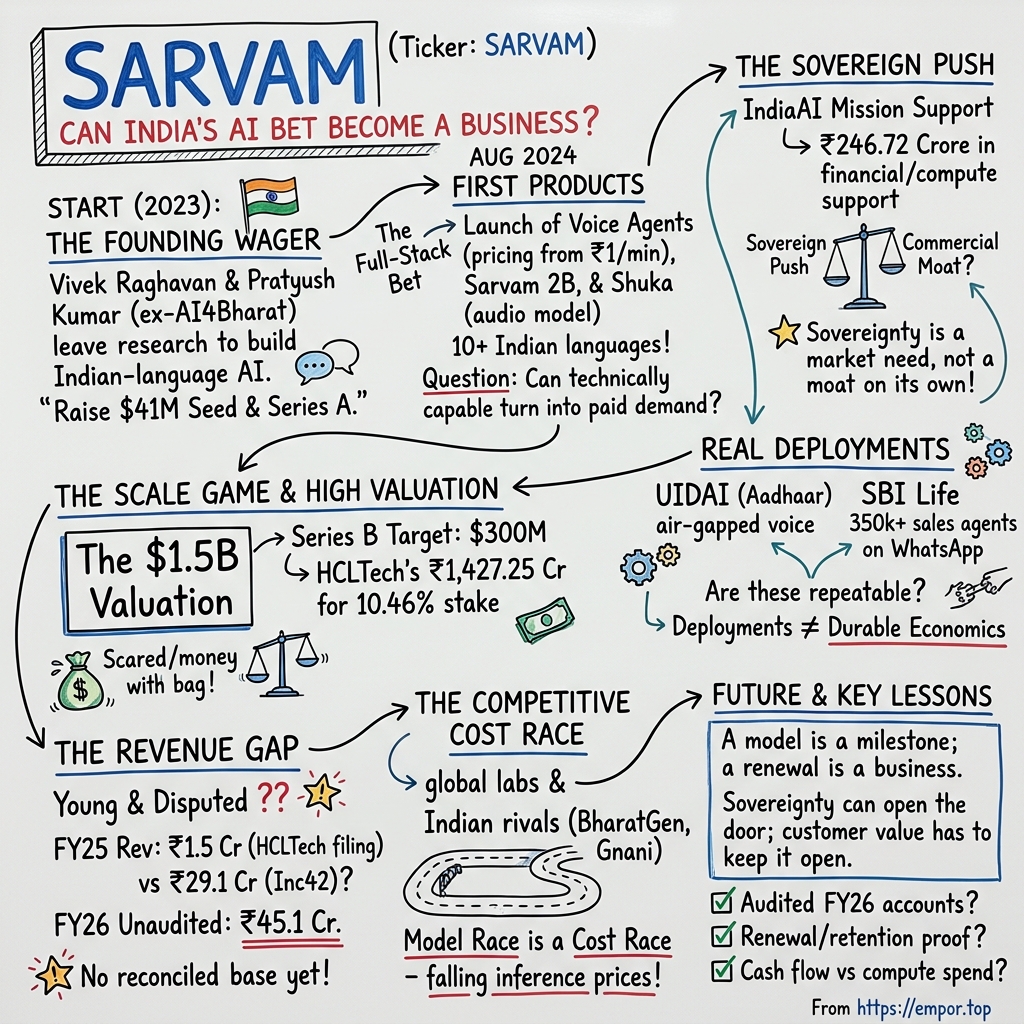
Sarvam: Can India’s AI Bet Become a Business?
I. The Billion-Dollar Question
On 15 June 2026, a Bengaluru company that had been trading for less than three years told the world that it was worth one and a half billion dollars. Sarvam announced that it had raised $234 million in the first close of a $300 million Series B round at a post-money valuation of $1.5 billion, and that HCLTech, one of India's largest information-technology services firms, would put in $150 million as the lead strategic investor.1 Ten days later the money moved. HCLTech paid ₹1,427.25 crore for 41,421 Series B2 compulsorily convertible preference shares, which gave it a disclosed stake of 10.46%.2 India's business press crowned a new unicorn, and the founders wrote of frontier models, compute at scale and a "forward-deployed" push into banks, insurers, government departments and the armed forces.1
Then came the number that complicates everything. In the same week, unaudited figures that HCLTech shared about its new investee put Sarvam's revenue for the year to March 2026 at about ₹45.1 crore, up from about ₹1.5 crore the year before.3 Forty-five crore rupees is roughly $4.7 million. Set beside a $1.5 billion price, it means investors were paying something like three hundred times the company's latest year of sales, and the year before that is not even agreed. A separate financial profile compiled from Sarvam's statutory filings reports total revenue of ₹29.1 crore for the year to March 2025, not ₹1.5 crore, and ₹11.1 crore for the year before that.4 The two FY25 figures differ by a factor of almost twenty. Both cannot describe the same thing.
That gap, between a price set by some of the most sophisticated investors in Indian technology and a revenue base small enough to be argued over, is the subject of this story. It is not a gap that proves anyone wrong. Venture investors price young companies on what they might become, and a business built on artificial intelligence can move from almost nothing to a great deal very quickly. But a public-market investor who someday meets Sarvam in a prospectus will need more than a price. That investor will need to know whether the company has a product edge customers will pay to keep, whether government enthusiasm and showcase deployments are turning into repeat usage, and whether the money raised in 2026 buys a durable position or mostly funds an expensive race to keep pace with laboratories in San Francisco, Beijing and Paris that spend more on compute in a quarter than Sarvam has raised in its life.
Some boundaries first. Sarvam is a trading name. The legal entity is Axonwise Private Limited, a private company in Bengaluru, and it is the party that signs customer contracts.56 HCLTech is a minority investor, not a parent; it holds preference shares that convert into equity on terms that have not been published, and it does not consolidate Sarvam's economics.2 Sarvam has no listed shares and has not filed a draft prospectus. The most recent reporting about its capital concerns another private round, not a listing.7 So the evidence a public investor would normally lean on, an offer document with audited accounts, risk factors, a capitalisation table and related-party notes, does not yet exist. What exists is a trail of funding announcements, product launches, customer stories written by the company, government backgrounders and two inconsistent sets of revenue numbers.
That trail is still worth following carefully, because the central tension is real and not merely financial. India has twenty-two scheduled languages, hundreds of millions of people who are more comfortable speaking than typing, and public services that must reach citizens over a crackling telephone line in Odia or Bhojpuri as often as through a smartphone app. Speech recognition that can hear an eight-kilohertz call in code-mixed Hindi and English, document software that can read a handwritten land record in Marathi, and a voice agent that can explain a pension certificate to a seventy-year-old in Tamil solve problems that a general-purpose chatbot trained mostly on English text may handle badly. Sarvam's founders built the company around that conviction. The same problems, however, are visible to OpenAI, Google, Meta and Anthropic, which have far more capital, far larger models and established distribution through clouds, phones and enterprise software already sitting on Indian desks. They are visible, too, to a small field of Indian rivals, some of them funded by the same government that backs Sarvam.
The question for the rest of this story is therefore narrow and hard. Not whether Sarvam can build impressive technology, because it plainly can, but whether that technology can become a business whose revenue recurs, whose customers renew, and whose cost of serving each conversation falls faster than the price customers will pay for it. The story begins with two researchers who decided that the answer was worth a company.
 Subscribe on LinkedIn
II. Two AI Researchers Choose to Build a Company
In the summer of 2023, the generative-AI wave that ChatGPT had set off the previous November was breaking over every technology market in the world. In India, it posed an awkward question. The country had spent a decade building some of the most ambitious digital public infrastructure anywhere, from the Aadhaar identity system to the payments rails that carry most of its retail transactions, yet the large language models suddenly reshaping software were trained elsewhere, on data that underweighted Indian languages, and served from data centres that Indian regulators did not control. Two people with unusually relevant résumés decided to answer it with a company rather than another research programme.
Vivek Raghavan had spent about a decade helping build India's digital public infrastructure, including Aadhaar.8 Pratyush Kumar had founded AI4Bharat, an open-source research initiative that had become one of the most important sources of datasets and models for Indian languages.8 Their partnership joined two kinds of experience that rarely sit in the same room: the practical knowledge of how a technology reaches a billion people through government systems, and the research depth to build language and speech models where the data is scarce, noisy and spread across scripts. They founded Sarvam in August 2023.5 The name, Kumar said, comes from the Sanskrit word for "all", a statement that the technology should be accessible to everyone.8
The ambition was broader than a single chatbot from the start. The founders described a "full-stack" plan for generative AI: train models in-house through research, then build an enterprise platform on top, concentrating on Indian languages, voice-first interfaces, co-building domain models with Indian enterprises and population-scale applications on top of India's public digital stack.8 That plan matters for an investor because it fixed the company's economic shape early. A company that trains its own models carries research and compute costs that a pure application developer can avoid, in return for control of the core technology and the chance to tune it for problems others neglect. A company that also builds applications for enterprises and governments takes on implementation work that looks more like services than software. Sarvam chose both at once.
The capital arrived almost immediately. On 7 December 2023, four months after founding, Sarvam announced a $41 million Series A led by Lightspeed, with Peak XV Partners and Khosla Ventures participating, and described it as the largest raise at that stage for an Indian AI startup.8 Peak XV's managing director, Harshjit Sethi, called the founding team "among the highest calibre AI teams we have seen emerge from India".8 For a company with no product and no revenue, the round was a bet on people and on a thesis. Sarvam published neither its terms nor the valuation.
That early cheque did two things at once. It gave Sarvam an unusually long runway for a research-heavy start, enough to hire scientists and rent compute without immediate pressure to sell. It also set an expectation that would follow the company for the next three years: that the founders would turn research into products and customers, not only into technical demonstrations and open-source releases. Large early rounds are a double-edged gift. They buy time to do hard things well, and they make it easier to postpone the question of who will pay.
For an investor trying to judge management, the record of that period is thin in a specific way. Capital allocation is visible, in the sense that the funding announcements say what the money was for. But the founders' own shareholdings, their pay, the size of the employee option pool and the incentive terms that tie management to outcomes have not been published by the company, and as a private company Sarvam has no obligation to publish them outside its statutory filings. There is also no earlier venture to judge them by: neither founder had previously run a venture-backed company through a full cycle of boom, miss and recovery. The test of their stewardship would therefore have to come from Sarvam itself, starting with what they chose to build and sell first.
III. The First Products Put the Thesis on Trial
The first real answer arrived in August 2024. Sarvam launched what it called a full-stack generative-AI platform, voice-enabled and multilingual, supporting ten Indian languages: Hindi, Tamil, Telugu, Malayalam, Punjabi, Odia, Gujarati, Marathi, Kannada and Bengali.9 The launch had several parts, and each told a different story about where the company thought money would come from.
At the base sat models. Sarvam 2B was described as an open-source small language model for Indian languages trained from scratch on an internal dataset of four trillion tokens, and Shuka 1.0 was an audio model built as an extension on Meta's Llama 8B so that it could take spoken input directly.9 Above them sat a set of model APIs for translation, speech recognition, speech synthesis and document parsing, sold to developers who wanted to build their own applications. At the top sat products: Sarvam Agents, custom voice agents that a business could put on a telephone line, on WhatsApp or inside its own app, with pricing that started at ₹1 a minute, and A1, a generative-AI workbench for lawyers covering regulatory questions, drafting, redaction and data extraction.9
The commercial idea is easiest to see from the buyer's side. Imagine an insurer with millions of policyholders who need renewal reminders, or a state government that wants to call farmers to check whether subsidised seed arrived. A human call centre costs money per minute and struggles to staff every language. A general-purpose model might handle English and standard Hindi well, but stumble on a regional accent over a poor phone line, or on a conversation that slides between Kannada and English mid-sentence. A voice agent tuned for those conditions, priced per minute, replaces a labour cost with a software cost. That is a clear value proposition, and it explains why voice became the centre of Sarvam's business. By mid-2026, Inc42 reported, conversational agents accounted for nearly 80% of an annualised revenue run rate estimated at about $12 million.3
The full-stack argument is that owning the models lets Sarvam tune them for local scripts, telephony audio and code-mixed speech in ways that a company renting someone else's model cannot. There is some independent support for the claim that the tuning works. In February 2026, the government's own backgrounder described Sarvam's speech-to-text model, Saaras, as supporting all twenty-two scheduled languages, eight-kilohertz telephony audio and code-mixed speech, and its text-to-speech model, Bulbul, as offering thirty-nine voices in eleven languages.10 The same month, Deedy Das, a partner at Menlo Ventures who had earlier been one of Sarvam's sharpest critics, wrote that the company had "the best text-to-speech, speech-to-text, and OCR models for Indic languages".11
That critic's earlier view is the strongest piece of disconfirming history in Sarvam's product record, and it belongs here rather than in a footnote. In May 2025 Sarvam released Sarvam-M, a 24-billion-parameter model built on top of Mistral Small.12 Two days later Das noted that it had logged just 23 downloads, compared it with a Korean open-source model that reportedly drew nearly 200,000 downloads in a month, and called the gap "embarrassing".11 Other critics argued that fine-tuning an existing model had become a commodity.12 The episode mattered because it went to the heart of the thesis: if the market did not want a slightly better Indian-language text model, what exactly was Sarvam's model research for?
The company's subsequent behaviour is the more useful evidence. It did not abandon model training, but its centre of gravity moved toward the places where specialisation showed most clearly, in speech, documents and deployable agents, and toward models trained from scratch rather than fine-tuned. By February 2026, Das had reversed himself in public, writing "I was wrong about Sarvam" and conceding that his view of the direction had been mistaken, while adding that he had no insight into the company's business metrics.11 The reversal narrows the earlier criticism rather than erasing it. It confirms that Sarvam's speech and document models are technically strong. It says nothing about whether anyone is paying enough for them.
That is where the price list becomes revealing. Sarvam's public pricing today spans an unusual range of units: tokens for language models, minutes for speech recognition, thousands of characters for speech synthesis and translation, pages for document digitisation, and minutes of source media multiplied by target languages for dubbing.13 Self-serve plans run from a ₹9,999 monthly Pro tier through a ₹49,999 Growth tier to a ₹1,99,999 Business tier, with enterprise pricing set by negotiation, and every verified user receives ₹100 of free credits on sign-up.13 The voice agents that started at ₹1 a minute in 2024 are now listed "from ₹3 a minute", which may reflect a richer product, a different packaging or a different target customer; the company does not explain the change.913
The terms of service fill in the contractual skeleton. Customers can pay in advance, in arrears or by consumption; monthly and annual subscriptions renew automatically until cancelled; Sarvam must give thirty days' notice of fee changes; and any signed order form or enterprise agreement overrides the general terms.6 What none of these documents disclose is the part that would tell an investor whether this is a software business. Sarvam does not publish how much of its revenue comes from self-serve subscriptions versus negotiated contracts, how long enterprise contracts run, what minimum commitments they carry, how much revenue recurs from one year to the next, or what it costs in compute and people to serve each workload.
So the first trial of the thesis ended with a split verdict. The products work, and in speech and documents they appear to be among the best available for Indian languages. The economics remain private. The real test was never whether Sarvam could launch models; it was whether customers kept using them after the pilot ended and the novelty wore off. To answer that question at national scale, Sarvam needed a very large customer, and in India the largest customer is the state.
IV. The Government Makes Sovereignty a Market
On 26 April 2025, the Indian government chose Sarvam as the first company under the IndiaAI Mission's foundation-model programme, selecting it from more than five hundred proposals to build what officials called India's sovereign large language model ecosystem.14 The mandate, as the government described it, was an open-source model of 120 billion parameters intended to improve governance and public-service access.14 A month later three more companies were added: Soket AI, which would build an open-source 120-billion-parameter model, Gnani AI, which would build a 14-billion-parameter voice model, and Gan AI, which would build a 70-billion-parameter multilingual model focused on speech synthesis.14 By February 2026 the government counted Sarvam as one of twelve organisations selected under the mission's innovation-centre pillar, with financial and compute support amounting to about ₹247 crore.10
The policy logic is straightforward. A country that depends entirely on foreign models for its citizen services, its defence planning and its enterprise data accepts a strategic dependency, and India decided not to. The IndiaAI Mission, with an outlay of about ₹10,372 crore over five years, set out to build shared compute capacity and fund domestic models.15 By May 2025 the government said it had empanelled more than 34,000 graphics processors through industry partners, available to Indian developers at subsidised rates.14 Reports that June said foundation-model builders would receive a 100% subsidy on the compute used for their models.15
For Sarvam, this support changed the cost of doing the most expensive thing it does. Training a frontier-class model requires thousands of high-end graphics processors running for weeks, an outlay that would otherwise consume a large share of a startup's capital. When Sarvam released its 30-billion and 105-billion-parameter models in March 2026, it said training had been "conducted entirely in India on compute provided under the IndiaAI mission".16 The government, in effect, underwrote a large part of the research bill that sits at the bottom of Sarvam's stack.
Here an investor must separate three things that are easily blurred. The about ₹247 crore is described as financial and compute support for a model-building project; it is not cash revenue for selling a product, and the government's description does not establish how much of it is grant, how much is subsidised compute time, and how much, if any, flows through Sarvam's income statement.10 Public compute access lowers Sarvam's costs; it does not generate customers. And the mandate itself is a programme of work, not a protected market. Indeed, it is worth noticing that the model Sarvam released was a 105-billion-parameter system rather than the 120-billion-parameter one the government had described in 2025.1416 Model sizes are a crude measure of capability and the company presents its 105B model as competitive with larger reasoning models, but the difference is a reminder that public mandates and delivered products do not always match.1
The field around Sarvam is also crowded with publicly supported rivals. BharatGen, a government-funded consortium housed at IIT Bombay with support from the Department of Science and Technology, launched Param 2, a 17-billion-parameter mixture-of-experts model covering twenty-two Indian languages, at the India AI Impact Summit in February 2026.17 Gnani is building speech models with mission support, and AI4Bharat, the initiative Kumar founded, continues to release open research that anyone, including Sarvam's competitors, can use.14 Above all of them sit the global providers. OpenAI, Google, Meta and Anthropic all sell into India, and Meta's open Llama family has been a common base for Indian developers; Sarvam's Shuka audio model was built on it.9 No independent source measures market share among these providers in Indian-language AI, so any claim that Sarvam leads the market commercially, as opposed to technically in particular tasks, is unsupported.
What government enthusiasm does supply is visibility and proof points. At the February 2026 summit, Union Home Minister Amit Shah held Sarvam up as an example of why "the future belongs to India".10 The government's backgrounder listed partnerships that would have been unthinkable for a three-year-old startup without that endorsement: Aadhaar services, a planned 50-megawatt AI compute hub with the Government of Odisha, and a 20-megawatt AI data centre anchoring a research park with the Government of Tamil Nadu and IIT Madras.10 In October 2026, Sarvam signed a memorandum of understanding with Headquarters Integrated Defence Staff, under the Ministry of Defence, setting up an umbrella framework for AI projects across the Army, Navy and Air Force, to be executed by a firewalled national-security division called Chanakya.18
Each of these is a door opening. None discloses a contract value. The defence memorandum is explicitly a framework under which projects might later be commissioned; it states no duration, project count or financial terms.18 The state data-centre partnerships raise a further question that the company has not answered in public: whether Sarvam is merely a technology partner to infrastructure the states will own, or whether it expects to invest its own capital in power-hungry facilities, which would change the capital intensity of the business entirely.
Government buyers are also a particular kind of customer. They can be enormous, and their endorsement carries weight with private enterprises. But they buy through procurement processes that reward the lowest compliant bid, they can and often do split work among several vendors, and their budgets move with political cycles. Sovereignty is a genuine market need, and Sarvam is well placed to serve it. It is not, by itself, a moat. Whether it becomes one depends on what happens after the memorandum is signed and the model is deployed, and the clearest place to watch that is inside one of the most sensitive computer networks in India.
V. A Voice Agent Reaches Aadhaar and SBI Life
The Unique Identification Authority of India runs the system that has issued Aadhaar numbers to more than a billion residents, and it guards that system's data with unusual care. In March 2025 it partnered with Sarvam, and by March 2026 the company could describe a deployment that few software vendors anywhere could claim: a full generative-AI stack, from model to inference to orchestration, hosted on premises inside UIDAI's air-gapped infrastructure, meaning a network physically cut off from the public internet.19 The voice agents running there collect residents' feedback on enrolment and updates, including detecting when residents have been overcharged; send real-time alerts on suspicious authentication; help pensioners obtain digital life certificates; and support age verification for residents over seventy.19 Sarvam says these use cases serve about four crore residents.19 UIDAI's chief executive, Bhuvnesh Kumar, put the point plainly: "This deployment runs fully air-gapped, on infrastructure we control, with end-to-end data residency."19
That sentence is the value proposition in miniature. A government agency holding biometric data for most of a nation cannot send citizens' voices to a model hosted abroad, and it cannot easily use a system it does not control. A vendor that can deliver its whole stack inside the customer's walls, in the languages its citizens actually speak, solves a problem that a cloud-only foreign provider structurally cannot. If that capability is rare, and if it is hard to replicate, it could be a genuine source of advantage in exactly the customers who matter most to Sarvam.
The private-sector counterpart came from insurance. SBI Life, one of India's largest life insurers, built with Sarvam an AI assistant on WhatsApp for its front-line distribution force of more than 3.5 lakh sales agents, roughly 350,000 people.20 The assistant answers product questions in eleven languages, generates personalised sales material, calculates premiums and surfaces underwriting guidelines, all inside the messaging app those agents already use all day.20 Sarvam calls it the largest enterprise WhatsApp chatbot use case in India.20 The commercial promise is tangible: a large, dispersed, multilingual sales force gets an expert at its elbow without the insurer building a new app or training every agent on a new system. The Series B announcement added a nationwide voice campaign for more than 45 million policyholders at what it called a leading insurer, along with more than 17 million farmers surveyed for the Ministry of Agriculture.1 Inc42 named Tata Capital as another customer.3
The most detailed public evidence of what these agents do at scale comes from a programme Sarvam ran with the EkStep Foundation in January and February 2026. Twenty organisations, most of them government departments and public-interest groups, used Sarvam's voice-agent platform for thirty-one days, logging more than 74 lakh voice-AI minutes and reaching about 50 lakh unique people.21 The National Health Authority used it for outreach on an elderly health-insurance scheme and reported a 42% increase in daily enrolments; the Government of Odisha called 32,000 farmers to confirm seed deliveries; the Government of Maharashtra found that 2.75% of scheme-delivery interactions flagged interference by middlemen.21 These are vivid results, and they show something important: voice agents can reach people that forms, apps and call centres miss.
They also show the trap in reading deployments as revenue. The EkStep programme was funded by a grant that EkStep administered, worth about ₹1 crore and equivalent to five lakh voice-AI minutes per participating team.21 The participating organisations, in other words, were not paying customers buying minutes at list price; they were grantees using donated capacity. The report itself contains small inconsistencies between its summary and its tables on reach and conversation counts, which is not unusual for an impact report but is a reminder that these figures were prepared by the vendor and its partners rather than audited.21 Whether any of the twenty organisations went on to buy Sarvam's service with their own budgets after the grant ended is the question that would turn the programme from a demonstration into evidence of demand, and the company has not said.
The same gap runs through every customer story. The UIDAI page gives no call volumes, no contract value and no term.19 The SBI Life page offers no measure of sales, conversion, productivity or cost; its only outcome claim is that the tools improve "productivity and reach".20 Sarvam does not disclose how much any single customer contributes to revenue, how concentrated its revenue is among its largest buyers, whether those buyers have renewed, or how quickly they pay. For a young company whose largest deployments are with state bodies and large financial institutions, concentration is the risk that matters most: a single renewal decision by a government department could move annual revenue by a large fraction.
There is a reasonable bull reading of all this. Getting a full AI stack approved inside an air-gapped identity system is the kind of reference that sells the next ten government deals, and a WhatsApp assistant that hundreds of thousands of agents use daily is hard to rip out once embedded. Sarvam said in November 2026 that it now provides its offerings to more than 100 enterprises and government institutions.22 There is an equally reasonable bear reading: showcase deployments with public bodies are often priced for the reference rather than for profit, grant-funded usage flatters reach, and large customers who can run a model inside their own walls can, in principle, run someone else's model there too.
The evidence does not yet choose between them. The case studies prove use; they do not prove economics. The measurements that would settle it are specific: the share of revenue that recurs, the renewal rate among the customers named in these stories, the concentration of revenue in the top handful of buyers, and the speed at which they pay. Until those exist, Aadhaar and SBI Life are proof that Sarvam's tools reach demanding workflows, and a promise that the workflows will pay. And while Sarvam was proving the workflows, the ground under its models was moving.
VI. The Model Race Turns Into a Cost Race
In March 2026, a few weeks after the India AI Impact Summit, Sarvam released the weights of two new models to anyone who wanted them. Sarvam 30B and Sarvam 105B were reasoning models trained from scratch, built on a mixture-of-experts design that activates only a fraction of the network for each word, which makes them cheaper to run than their headline size suggests; the 30B model uses about 2.4 billion active parameters at a time.16 Sarvam said they were trained on twelve to sixteen trillion tokens, with a tokenizer covering all twenty-two scheduled Indian languages, and published benchmark tables showing the larger model scoring in the high eighties and nineties on standard tests of mathematics and knowledge.16 In pairwise comparisons on Indian-language tasks, judged by another AI model, Sarvam said its 105B system won about 90% of the time.16 The company says its 105B model powers Indus, its consumer app, and its 30B model powers Samvaad, its conversational-agent platform.16
These are serious technical achievements for a company of Sarvam's age and budget, and they partly answer the criticism of a year earlier. They also illustrate the economic problem at the centre of the business. The benchmarks are self-reported, and the Indian-language comparison was run by Sarvam using a judge it chose.16 More importantly, giving away the weights of a strong model means that anyone, including a customer, can host it without paying Sarvam for the model itself. Open-sourcing builds goodwill, attracts developers and suits the public-good mandate attached to government support. It also signals where Sarvam expects to capture value: not in licensing the model, but in hosting it, tuning it, wrapping it in applications and deploying it inside customers' systems.
The price list confirms the point. Sarvam's API sells access to its 105B model at ₹10 per million input tokens and ₹25 per million output tokens, prices it labels as introductory through the end of 2026.13 The same list also sells access to models Sarvam did not build, including Google's open Gemma 4 31B model and a DeepSeek model.13 A developer can thus use Sarvam partly as an Indian-hosted inference platform for other people's models. That widens the funnel, but it also concedes that the model layer is becoming interchangeable, and that a price war in inference is already under way. When a company's own flagship model is priced at an introductory discount and sold alongside competitors' models on the same page, the model itself is not where the pricing power sits.
The industry structure becomes clearer from the buyer's chair. An Indian bank wanting a multilingual voice agent has four broad options. It can call a global model through a cloud provider, accepting data-residency questions in exchange for scale and a constant stream of improvements. It can hire an Indian specialist such as Sarvam or Gnani, buying better local-language performance and on-premises deployment. It can host an open model, possibly Sarvam's own, on its own hardware with its own engineers. Or it can pay a systems integrator to assemble a solution from parts, which is precisely the business HCLTech is in. Sarvam's challenge is that the second option must remain clearly better than the third and the fourth, at a price the bank will keep paying after the pilot.
Could local specialisation create a lasting moat? There are three plausible sources. The first is task performance: if Sarvam's speech recognition makes measurably fewer errors on rural telephone audio, every percentage point translates into fewer failed calls and happier citizens, and buyers will pay for that. The second is data: years of deployments in Indian voice conversations, documents and dialects could produce training data that rivals cannot easily buy, a cornered resource in the language of strategy, though only if Sarvam has the legal right to use customer data for training, which its contracts, not disclosed, would determine. The third is deployment capability: delivering a full stack inside an air-gapped government network is hard, and having done it once at UIDAI is a credential.
Against each sits a credible counterforce. Task performance gaps in AI have repeatedly narrowed as general-purpose models improve and as global providers add languages; what is best for Indian speech in 2026 may be merely good enough in 2028. Data advantages depend on terms that government customers in particular are reluctant to grant. And deployment capability is a services skill, valuable but replicable by integrators with deeper benches, including Sarvam's own investor. Buyers' ability to multi-source and switch limits pricing power unless Sarvam proves, in renewals and expansions rather than benchmarks, that its specialisation keeps earning its place.
Management is also directing capital toward new fronts. The Series B announcement earmarked funds for research on a "next frontier model for agentic, coding, and cybersecurity use-cases".1 Coding assistants and cybersecurity are among the most fiercely contested markets in AI, dominated by global companies with enormous distribution. These are bets, not businesses; they generate no disclosed revenue. They deserve attention mainly because they reveal management's capital allocation: a company with a small unaudited revenue base is choosing to compete at the frontier rather than concentrate solely on the voice and document niches where its edge is clearest.
The document side of the business shows the same pattern in a different medium. In February 2026 Sarvam launched Sarvam Vision, a 3-billion-parameter model for reading documents, and the government described the company's document-understanding system as tailored to more than twenty-two Indian languages, mixed scripts and handwriting.1110 By June the company said it had digitised more than 35 million pages, citing insurance forms and land records.1 Document digitisation is listed at ₹0.50 a page.13 At that list price, 35 million pages would be worth less than ₹2 crore, and real enterprise prices are often lower. The arithmetic is not a criticism of the product, which addresses a genuine bottleneck in Indian administration. It is a reminder of how large usage must become before per-unit AI services add up to a large business, and why the value Sarvam can capture may depend more on the workflows it builds around a page or a minute than on the page or the minute itself.
The honest scorecard for the moat is therefore not a benchmark table. It is a set of commercial measures that Sarvam does not yet publish: paid production workloads, renewals by named customers, expansion in spending by existing customers, and the price it actually realises per minute and per million tokens after discounts. Those numbers would show whether the specialisation earns its keep. The only public financial figures available are the revenue lines, and they do not agree with each other.
VII. The Revenue Line Jumps—and the Base Does Not Reconcile
When HCLTech told the stock exchanges about its investment in June 2026, it did something Sarvam had never done in public: it put numbers on the company's sales. According to the unaudited financials HCLTech shared, those figures implied a thrilling story, a thirtyfold jump in a single year, the shape of a product catching fire.3
The trouble is that they do not stand alone. A financial profile built from Axonwise's statutory filings reports total revenue of ₹29.1 crore for the year to March 2025, up from ₹11.1 crore the year before, alongside total expenses of ₹131.5 crore and a net loss of ₹102.4 crore.4 On that series, FY25 revenue was nearly twenty times what the HCLTech-linked figure says. If the higher figure is the right base, the FY26 number represents revenue about one and a half times FY25's, respectable for a young company but nothing like a thirtyfold leap. If the lower figure is right, the growth is spectacular but the FY25 starting point was almost nothing.
The two series cannot simply be stitched together, and no growth rate should be computed across them. But the difference is not a mystery without clues. Sarvam's first commercial platform launched in August 2024, which falls inside the year to March 2025, and the company had no launched product at all during most of the year to March 2024.9 Yet the filing-based profile shows ₹11.1 crore of total revenue in that first, product-less period.4 A company that had just raised $41 million and parked it in deposits would earn interest, and Indian accounts typically include such "other income" in total revenue while reporting revenue from operations separately.8 If that is what happened, the ₹29.1 crore FY25 figure may be mostly treasury income on the Series A cash, and the ₹1.5 crore figure may be revenue from operations. That would reconcile the two sources neatly. It remains an inference, not a fact: the company has not published a revenue bridge, and the distinction between operating revenue, interest and any government-linked receipts is exactly what its audited statements would show.
Whichever reading is right, three conclusions survive. The first is that Sarvam's commercial revenue was very small until recently. Even on the most generous reading, it was earning tens of crores while spending more than ₹130 crore a year.4 The second is that something did change in FY26. Inc42 reported in June 2026 that Sarvam's annualised revenue run rate was estimated at about $12 million, with conversational agents accounting for nearly 80% of it.3 Twelve million dollars is roughly ₹115 crore a year, more than double the FY26 total, which suggests that the business ended the year much larger than it began. Run-rate estimates are fragile, however, and this one is reported rather than disclosed by the company.
The third conclusion is the one that matters most for an investor: the FY26 figure is unaudited. Sarvam had not, as of the HCLTech filing, published audited accounts for the year in which its business apparently took off, and an unaudited turnover number, shared by an investor at the moment of investing, is the weakest form of financial evidence there is. It does not say how much of the ₹45.1 crore was recurring usage, how much was one-time implementation work, how much came from government-linked projects and how much was other income. It does not say whether customers paid.
The Series B announcement offered a different kind of growth evidence: more than two million conversations a day, usage that had doubled in two months, more than ten million API calls a day, more than 35 million pages digitised and more than 500,000 hours of audio transcribed a month.1 These are usage figures, not revenue, and usage can grow quickly when much of it is subsidised, grant-funded or priced for adoption. A conversation handled at an introductory price, or for a showcase public-sector customer, adds to the volume line without necessarily adding much to the revenue line. The gap between Sarvam's usage claims and its small revenue is itself informative: it suggests either very low realised prices, a long lag between usage and billing, or both.
So the financial story at the end of FY26 was still mostly a question of conversion. Sarvam had reach, and it had a revenue line that had clearly started to climb. What it lacked, in public, was a statement that would show what kind of revenue it was. The decisive evidence will be the audited FY26 accounts, filed with the Ministry of Corporate Affairs, with a reconciliation of revenue from operations, other income and any grant-related receipts, and a cash-flow statement showing how much of the reported revenue turned into cash. Another headline growth figure would add little.
Meanwhile, the investors had already set their price.
VIII. The $1.5 Billion Price of Staying in the Race
The Series B came together over a season of shifting reports. In early April 2026, Bloomberg reported that Sarvam was close to raising $300 million to $350 million at a valuation of about $1.5 billion, with Bessemer Venture Partners expected to lead and Nvidia, Amazon and Prosperity7 Ventures among the participants.23 When announced on 15 June, the lead was HCLTech, with Bessemer investing alongside it and existing backers Khosla Ventures and Peak XV continuing their support; the first close was $234 million against a $300 million target.1 Amazon and Prosperity7 were not among the investors Sarvam named.
In early August came the rest. Filings showed that Sarvam's shareholders had approved a further $74 million, roughly ₹698 crore, from about thirteen investors at the same $1.5 billion valuation.24 Nvidia was the largest, at about ₹238 crore, followed by Glade Brook at about ₹190 crore and Gaja Capital at about ₹95 crore, with Indigo Ventures committing ₹30 crore and Activate participating for an undisclosed amount.24 Activate's founder, Aakrit Vaish, called it "the single largest capital commitment we've ever made to a company".24 Together, the two tranches brought the Series B to a little over $300 million.
These were primary investments: the money went into the company, not to selling shareholders, which matters because primary capital funds the business rather than providing early holders with liquidity. No secondary sales by founders or early investors have been reported.
The price is best understood by working through what HCLTech actually bought. It paid ₹1,427.25 crore for 41,421 preference shares, which works out to roughly ₹3.45 lakh per share.2 Those shares represented 10.46% of the company on the basis HCLTech disclosed, which implies about 3.96 lakh shares in total and an equity value of roughly ₹13,650 crore.2 At the exchange rate implied by HCLTech's own figures, ₹1,427.25 crore for $150 million, that is about $1.43 billion, close to the $1.5 billion post-money valuation the company announced.12 The small difference probably reflects the share count on which each figure was measured, which has not been published. If the August tranche was issued at the same price per share, it added roughly 20,000 shares and trimmed HCLTech's holding to just under 10%. That last calculation assumes a price that has not been disclosed.
Three warnings attach to the headline. First, the $1.5 billion is a post-money figure for preference shares, not a market capitalisation for common equity. HCLTech's shares are compulsorily convertible preference shares that convert into equity "in accordance with the terms of the issuance", terms that have not been published.2 Indian venture preference shares typically carry protections that common shareholders do not get, such as preferences on liquidation and adjustments if later rounds are priced lower. If Sarvam's Series B shares carry such rights, they are worth more than an ordinary share, and multiplying their price across the whole share count overstates what the company's common equity is worth.
Second, the share count behind any headline valuation is incomplete. Sarvam has not disclosed the size of its employee option pool, any warrants or convertible instruments, the founders' holdings, or the voting rights attached to each class. A fully diluted figure cannot be built from public information, so the implied equity value is a rough mark rather than a precise one.
Third, an enterprise value cannot be calculated. The post-money valuation includes the cash just raised, perhaps close to ₹2,900 crore across both tranches before any was spent, but Sarvam's cash balance, any borrowings and any lease obligations for data-centre capacity have not been published. Subtracting the new cash alone would cut the implied value of the operating business substantially, but without the full balance sheet the figure would be guesswork.
With those caveats, the multiple is still sobering. On roughly ₹13,650 crore of implied equity value and ₹45.1 crore of unaudited FY26 revenue, investors paid about three hundred times trailing sales. On Inc42's estimated $12 million run rate, the multiple is still about 125 times.3 These are equity-value multiples on revenue whose quality is unknown, and they should not be compared with enterprise-value multiples quoted for listed software companies. But they establish the scale of what is being priced: almost none of the $1.5 billion is explained by the business as it stood when the money arrived.
What, then, must Sarvam earn? A transparent if illustrative exercise helps. Suppose late-stage investors demand a return of about 20% a year, a common hurdle for risky growth equity. Over six years, a company valued at $1.5 billion would need to be worth roughly $4.5 billion to deliver that. Suppose further that, by then, Sarvam is a mature and still-growing AI software business that the market values at around eight times revenue. It would need revenue of roughly $560 million, about ₹5,300 crore, or more than a hundred times its FY26 figure. If future fundraising dilutes today's holders by a quarter, the required revenue rises to about $750 million. And if the business turns out to look more like implementation services than software, valued at perhaps three to four times revenue, the requirement climbs well beyond $1 billion. The multiples and return rates here are assumptions chosen to show the shape of the problem, not estimates of fair value, and small changes to them move the answer a great deal. The shape is the point: the valuation assumes Sarvam becomes one of the largest AI software companies in India by revenue within a few years, at margins that its public record cannot yet demonstrate.
A comparable-company check offers little help. There is no listed Indian company that sells its own foundation models and voice agents, so no direct operating peer exists. Indian IT services companies such as HCLTech are listed and profitable, but they are services businesses with very different growth and margins; using their multiples would understate Sarvam's ambition. Global AI category leaders such as OpenAI and Anthropic are themselves private and priced on revenue bases many times larger than Sarvam's, so they are aspirational comparisons, not peers. Listed voice-AI and enterprise-AI software companies exist abroad, but they differ in customer base, geography and capital intensity. The honest conclusion is that the Series B price is anchored to scarcity and strategic value rather than to any comparable earnings stream.
The way the round changed shape between April and June also deserves attention. A financial investor, Bessemer, was reported as the expected lead in April; by June the lead was a strategic corporate buyer, and two of the names reported in April did not appear.231 Rounds change shape for many ordinary reasons, and the price held at about $1.5 billion throughout, so the shift is not evidence of weakness. But it does mean the largest single cheque came from an investor whose return includes commercial benefits beyond the shares themselves. Those investors also enjoy an information advantage that future public shareholders will not: they negotiated with access to Sarvam's management accounts, pipeline and contracts, none of which are public. A price agreed between insiders with that information and strategic motives is a meaningful signal, but it is not the same as a price a market of outside investors would set from published accounts.
That scarcity is real. HCLTech's chief executive, C Vijayakumar, described Sarvam as "a differentiated full-stack AI platform for enterprises and governments".1 For an IT services giant whose business is threatened and reshaped by AI, owning a slice of India's best-known model builder, with the option to bundle its products into client projects, is worth more than a financial return alone. Nvidia's motive is different again: it sells the chips on which Sarvam's compute runs, and investing in a prominent national-champion customer supports demand for its own products. Strategic investors pay for strategic benefits, and their prices are not clean signals of what a financial buyer, or eventually a public shareholder, would pay for the cash flows alone.
The use of the money confirms the stakes. Sarvam said the Series B would fund research on its next frontier model and access to compute at scale to expand its forward-deployed work across key industries.1 ThePrint reported that around 30% to 50% of the round would go to procuring new compute and graphics processors, and that the company planned to raise further rounds given how capital-intensive the industry is.25 In October 2026, The Economic Times reported, as relayed by Analytics India Magazine, that Sarvam was in talks to raise $250 million to $300 million at a valuation of about $3 billion, double the June price four months after it was set; Sarvam did not respond.7 The company has made no acquisitions, so there is no record of overpaying for other businesses. The capital-allocation question is internal: whether research and compute convert into paying workloads before the next round is needed. On present evidence, Sarvam is raising money far faster than it is earning it, at rising prices, on the strength of capability rather than of audited commercial results.
IX. The Founders’ Next Test Is Commercial Discipline
In November 2026, Sarvam announced that Sashikumar Sreedharan, who had led Google Cloud's business in India and spent about thirty-five years at companies including Microsoft India, IBM and Wipro, would join as president and chief business officer and take a seat on the board.22 His remit is broad: enterprise and government business, plus marketing, finance, forward-deployed engineering, service delivery and commercial operations.22 For a company led until then by two researchers, it was the clearest signal yet that the next phase would be judged on selling, not on shipping models.
The appointment is too recent to count as evidence of results. What it does reveal is a judgment by the founders about where the company was weakest. Hiring a seasoned cloud-sales leader, and giving that person authority over finance as well as revenue, is what a company does when it has products customers like and needs a machine to turn them into contracts, collections and renewals. It is also an admission, implicit but meaningful, that the research-led culture that built Sarvam's models is not by itself enough to build its business.
Judged by their behaviour over three years, Vivek Raghavan and Pratyush Kumar have earned credit on several counts. The record shows that they raised capital, shipped products and won deployments in demanding environments.8191619 They also responded to public criticism by changing the company's technical emphasis, a response the critic later acknowledged.11
Several things that would let an investor judge their discipline are missing. The company has not published guidance, so there is no record of promises made and kept or missed. It does not publish a regular operating report; the figures it has released, conversations per day, API calls per day, pages digitised, are usage metrics chosen by the company rather than standard financial measures.1 Inc42's profile counts 477 employees, but there is no consistent series of headcount, research spending or compute costs against which to judge cost control.4 The board's composition beyond the founders and its new president has not been disclosed.
These government relationships add a governance dimension that public investors will eventually want to see addressed.1018 They are commercially valuable, but they also expose the company to political and procurement risk and raise questions about how decisions are made when the interests of a public mandate, such as open-sourcing models, and the interests of shareholders, such as capturing value from them, diverge. The company's open-source releases suggest that, so far, it has resolved that tension in favour of the public mission, which may be wise for its reputation but is not obviously the path that maximises revenue.
HCLTech's and Nvidia's positions as both investors and commercial counterparties create potential conflicts. Any commercial agreements with these investors, and any related-party transactions in the statutory accounts, have not been published. In a future prospectus they would be among the first things to read.
The credibility verdict should therefore be proportionate. The founders have shown that they can attract capital and talent, build strong technology for their niche and get it deployed in hard places. They have not yet shown, because the record is too short and too private, that they can set financial targets and meet them, control costs as the company scales, or correct a commercial miss as candidly as they corrected a technical one. The test from here is simple to state. Future claims about enterprise scale will need to be matched by audited revenue, renewals and cash generation. Sreedharan's arrival makes that test explicit. The next twelve months will show whether he was hired to build a commercial engine or to sell a story.
X. Analysis & Bear vs. Bull Case
Picture two things side by side. On one side, a pensioner in a village in Odisha receives a call from a government voice agent, speaks in her own language and gets her digital life certificate sorted without travelling to an office. On the other, a ledger showing perhaps ₹1.5 crore of operating revenue or perhaps ₹29 crore of total revenue in the year to March 2025, an unaudited ₹45 crore in the year after, and a $1.5 billion price set on that base. Both pictures are true. The investment case is about whether the first can pay for the second.
The case for Sarvam starts with the problem it solves. Indian-language speech recognition over telephone audio, document reading across scripts and handwriting, and voice agents that can operate inside government networks are hard technical problems where general-purpose models trained mostly on English often perform worse, and where foreign-hosted systems cannot meet some customers' data rules. Independent observers, including a former critic, rate Sarvam's speech and document models as the best available for Indian languages.11 Its customer stories show real workflows at real scale, from an air-gapped identity system to an insurer's sales force.1920 National policy is pushing in its direction, and it has the endorsement and compute support of the state.10
The case against starts with what the public record does not show. A technical lead in AI can narrow quickly as global models add languages and improve; there is no guarantee that Sarvam's edge in 2026 survives to 2028. Buyers can compare vendors, host open models themselves, including Sarvam's own, or negotiate hard, and the company's flagship model is already sold at introductory prices next to competitors' models.13 There is no public evidence of retention, price realisation, customer concentration or unit costs that would prove Sarvam captures durable value from its technology rather than handing most of it to customers.
Michael Porter's five forces sharpen the picture. Buyer power is high: large enterprises and government agencies buy in bulk, run procurement processes and can split work among vendors. Supplier power is significant: compute comes ultimately from Nvidia, which is now also an investor, and at present much of it comes through a government programme whose terms Sarvam does not control. The threat of substitutes is strong, because open models and global APIs are improving constantly. Rivalry is intensifying, with both funded Indian peers and global giants in the market. Barriers to entry are mixed: training frontier models is expensive, but public compute lowers that barrier for rivals too.
Hamilton Helmer's seven powers ask which durable advantages could survive that pressure. Scale economies are not yet demonstrated; Sarvam is small, and its costs run far ahead of its revenue. Network effects are weak in enterprise AI, though usage data might improve models over time. Switching costs could become meaningful once a voice agent is embedded in a customer's systems and workflows, but no renewal data has been published to show it. A cornered resource is possible if Sarvam's Indian-language data and expertise produce measurable task advantages and the data is legally usable for training. Counter-positioning is partly present: global providers have little incentive to build air-gapped, on-premises deployments for Indian government agencies, a business Sarvam embraces. Brand matters in government sales, and Sarvam's national-champion status is a real asset. Process power has not yet had time to form.
The bull case follows from those possibilities. Production deployments expand into recurring workloads; government references turn into multi-year contracts; insurers and banks move from pilots to enterprise-wide use; API revenue becomes visible and diversified; and Indian-language performance earns renewals at prices that cover compute costs with a healthy margin. Sreedharan builds a sales organisation that converts goodwill into contracts. Revenue compounds at very high rates for several years, the next round at $3 billion is justified by audited results, and a listing eventually follows on the strength of a business rather than a story.
The bear case follows from the forces. Model capability commoditises faster than Sarvam can differentiate; inference prices keep falling; public-sector adoption remains procurement-led, project-based and politically exposed; and the most visible deployments prove to be references priced for prestige rather than profit. Compute and research costs then consume capital faster than paid usage grows, the company becomes dependent on raising money at ever-higher prices, and any check on that momentum, a flat or lower-priced round, would expose how much of the valuation rested on scarcity.
Underneath both cases sits the path to profitability, and it runs through a few relationships that can be stated even where the numbers cannot. Each voice minute Sarvam sells must cover the compute that serves it, the engineers who deployed it and a share of the research that built the model. In FY25, the filing-based figures show that the company spent ₹131.5 crore against total revenue of ₹29.1 crore, for a loss of ₹102.4 crore.4 To reach durable profitability, revenue has to grow many times faster than costs, which requires three improvements at once. Gross margin must rise as models become more efficient per conversation, something the mixture-of-experts design of Sarvam's newest models is meant to help with, since the company claims three to six times more throughput per graphics processor than a comparable baseline.16 Forward-deployed engineering, which is labour-intensive and looks like consulting, must give way to repeatable product deployments that need far fewer people per customer. And research spending, which the Series B is explicitly designed to increase, must eventually stabilise as a share of revenue rather than racing ahead of it. Sarvam does not publish gross margins, the split of costs between serving customers and training models, or employee costs, so none of these trends can yet be checked. The evidence that would falsify the path is equally clear: gross margins that stay thin as volume grows, or a revenue mix that stays dominated by custom projects.
The size of the prize needs equal restraint. The broad category, AI for Indian enterprises and government, is large and growing, and contact centres alone employ huge numbers of people across the country. But the market Sarvam can reach today is narrower: Indian-language voice and document workloads, sold mainly to banks, insurers, government bodies and a growing set of developers, at prices measured in rupees per minute and paise per page. In that narrower market, the competition is not only other AI vendors but also cheap human labour, existing call-centre contracts and the integrators who already own the customer relationship. Any market-share assumption that justifies the valuation has to explain why HCLTech's rivals, global cloud providers and India's own publicly funded model builders will not take a large share of the same budgets.
Three measures would distinguish these futures most quickly. The first is audited revenue broken down by type, distinguishing recurring platform and API usage from project work, government-linked receipts and other income. The second is retention and concentration: whether named customers renew and expand, and how much revenue depends on the largest few. The third is operating cash flow set against compute and research spending, which would show whether the business is moving toward self-funding or remains a research programme financed by investors. The next financial statements, evidence of enterprise renewals and the price of the next financing round will determine whether Sarvam's story moves from technical promise to business proof.
XI. Lessons from a Company Building Before the Market Is Settled
In August 2024, Sarvam put a price on an idea. A voice agent, speaking ten Indian languages, cost a business ₹1 a minute.9 It was a small number with a large implication: a research thesis about language and access had become something a customer could buy. Two years later, the price list has grown longer and the voice agents have grown more capable, but the most important lessons of Sarvam's young life are still visible in that first decision to turn science into a meter.
The first lesson is that a model is a milestone; a renewal is a business. Sarvam's technical work earned praise from a former critic and reached demanding deployments.1119 But the moment that matters to investors is not the launch or the deployment; it is the day a customer, paying with its own budget, chooses to keep paying. For founders, the point is that technical excellence earns a meeting, not a contract. For investors, it is that a case study proves a product can work; only a renewal proves that it is worth paying for.
The second lesson is that sovereignty can open the door, but customer value has to keep it open. The Indian state selected Sarvam from more than five hundred proposals and supported its research with about ₹247 crore of financial and compute help.1410 No startup could buy that kind of endorsement. Yet the same government funded rivals, from BharatGen to Gnani, and buys through procurement rules that reward competition.1714 A national mission can create a market for domestic capability; it cannot guarantee that any single company will win it. The companies that last will be the ones whose customers would choose them even without the flag.
The third lesson is that a large raise buys time, not a moat. Sarvam's 2026 funding exceeded $300 million, and by October the company was reportedly in talks to raise more at double the price.1247 Money of that scale can rent compute, hire researchers and fund forward-deployed engineers in every major industry. It cannot buy customer loyalty or make a technical lead permanent. The risk in a capital-intensive race is that each round funds the next model rather than the next contract, and that the valuation rises because rivals are raising too. The test of capital is not how much was raised, but how much paying usage it bought.
The fourth lesson is the most specific to Sarvam: a grant-funded minute is not a paid minute. The EkStep programme showed substantial reach and usage, but the minutes were donated through a grant.21 Usage that someone else pays for can show what a product can do; it cannot show what a customer will pay. In AI, where usage can scale at almost no marginal cost to the customer until the bill arrives, the distinction between reach and revenue is the most important line on any slide.
XII. The Next Three Proof Points
Tonight, Sarvam stands at an unusual point for a company valued in billions. It has a newly hired president with a mandate to sell, a reported negotiation to double its valuation, an umbrella framework with India's defence establishment, deployments with more than 100 enterprises and government institutions, and open-sourced models that serious critics respect.22718 It also has a revenue history that its own sources do not agree on and a latest year of revenue that has not been audited.34 The thesis remains open, not because the company has failed any test, but because the decisive tests have not yet been published.
The first proof point is the audited accounts for the year to March 2026. When they are filed with the Ministry of Corporate Affairs, they should reveal revenue from operations separately from other income, settling whether the ₹29 crore or the ₹1.5 crore figure better describes the company's commercial base in FY25, and showing how much of the ₹45 crore in FY26 came from operations.34 If revenue from operations reconciles upward and the notes show repeatable customer usage rather than one-time project fees, the commercial case strengthens materially. If much of the revenue proves to be interest, grants or one-off deployment work, the growth story becomes far more fragile than the June headlines suggested.
The second proof point is evidence of renewal and concentration. The year ahead will show whether the customers named in Sarvam's stories, UIDAI, SBI Life and the participants in the EkStep programme, renew, expand and pay with their own budgets. It will also show whether the defence framework turns into funded projects.18 A future offer document would have to disclose the share of revenue from the largest customers; until then, signs of expanding contracts and new paying customers in banking and insurance will be the best available signal. If revenue turns out to be concentrated in a handful of public bodies, a single procurement decision could reshape the company's year.
The third proof point is the cash-flow view of research and compute. ThePrint reported that between 30% and 50% of the Series B would go to compute.25 The company's next statements should show how fast it is spending, how much of that spending goes to training new models rather than serving customers, and whether the cost of serving each conversation is falling. If compute and research spending rise without a matching rise in paid workloads, the capital requirement will keep outrunning the business, and Sarvam will remain dependent on investors' appetite for the next round.
Overlaying all three is the reported fundraising at about $3 billion.7 If it closes at that price on the strength of audited results, it will be a vote of confidence grounded in evidence. If it closes on usage claims and strategic interest alone, it will raise the bar that future public investors must clear. If it does not close, or closes at a lower price than reported, the market will have delivered its own verdict on the gap between capability and commerce. The next year will decide which of those stories Sarvam is telling.
XIII. Outro
Somewhere in India today, a voice agent built by Sarvam is talking to someone who has never typed a search query, in a language that most of the world's AI systems still handle clumsily. It might be a pensioner confirming her life certificate, a farmer checking a seed delivery or an insurance agent asking for a premium quote.192120 That conversation is the clearest thing Sarvam has made: proof that a national-language capability can work at the scale of a country.
What the conversation cannot yet prove is that someone will keep paying for it. Sarvam's founders have bet that the voice in a citizen's ear can become a platform that customers cannot do without, and investors have priced that bet at $1.5 billion and, perhaps soon, at twice that.17 The voice has spoken. The renewal is the proof still to come.
References
-
Announcing Series B — Sarvam AI, 2026-06-15 ↩↩↩↩↩↩↩↩↩↩↩↩↩↩↩↩
-
USD 1.5 Billion Valuation: IT Major Completes Rs 1,427 Crore Investment in Sarvam AI, Secures 10.46 Per Cent Stake — DSIJ, 2026-06-26 ↩↩↩↩↩↩
-
Sarvam Enters Unicorn Club With $234 Mn Funding Round Led By HCLTech — Inc42, 2026-06-15 ↩↩↩↩↩↩↩↩
-
Sarvam AI in talks to raise $300 Mn at $3 Bn valuation: Report — Analytics India Magazine, 2026-10-13 ↩↩↩↩↩↩
-
Sarvam AI secures a landmark $41 million in Series A funding — Sarvam AI, 2023-12-07 ↩↩↩↩↩↩↩↩
-
Sarvam AI: Powering a Made-in-India AI Revolution — Press Information Bureau, 2026-02-21 ↩↩↩↩↩↩↩↩↩
-
From 'embarrassing' to impressive: Top Silicon Valley VC calls Sarvam, praises Indic AI breakthroughs — Business Today, 2026-02-07 ↩↩↩↩↩↩↩
-
Can Sarvam justify its $53 mn backing and govt mandate in India's AI Mission? — Business Today, 2025-05-30 ↩↩
-
National compute capacity crosses 34,000 GPUs; three more foundation models selected under IndiaAI Mission — Press Information Bureau, 2025-05-30 ↩↩↩↩↩↩↩↩
-
Govt To Offer 100% Compute Subsidy To Sarvam, Others For Foundational Models: Report — Inc42, 2025-06-23 ↩↩
-
Open-Sourcing Sarvam 30B and 105B — Sarvam AI, 2026-03-06 ↩↩↩↩↩↩↩↩↩
-
'Most real-world use cases don't need trillion-parameter AI': BharatGen CEO Rishi Bal on Param 2 launch — Business Today, 2026-02-16 ↩↩
-
Sarvam and HQ IDS establish joint framework for AI adoption across the Army, Navy and Air Force — Sarvam AI, 2026-10-27 ↩↩↩↩↩
-
Aadhaar activates voice agents for 4 crore Indians — Sarvam AI, 2026-03-09 ↩↩↩↩↩↩↩↩↩
-
SBI Life builds AI applications for customer engagement and sales at scale — Sarvam AI, 2026-02-18 ↩↩↩↩↩↩
-
Listen at Scale: EkStep x Sarvam Impact Report, Jan–Feb 2026 — Sarvam AI, 2026 ↩↩↩↩↩↩
-
Sarvam Ropes In Google Cloud India MD Sashikumar Sreedharan As President & CBO — Inc42, 2026-11-10 ↩↩↩↩
-
Sarvam AI Nears Mega Fundraise to Take on Global AI Giants — Outlook Business, 2026-04-04 ↩↩
-
Sarvam To Raise $74 Mn In Series B Extension From NVIDIA, Others — Inc42, 2026-08-05 ↩↩↩↩
-
Sarvam AI's unicorn moment and the Anthropic ban — ThePrint, 2026-06-22 ↩↩
 LinkedIn
 WhatsApp
 Reddit
 Hacker News
 Email
 Kindle
 RSS Feed
 Spotify
 Apple Podcasts
 Amazon Music
 Audible
 YouTube