Sansera Engineering: Precision, Programs and the Price of Growth
I. A ₹1,200 Crore Bet on What Comes Next
In the middle of October 2024, Sansera Engineering's board did something that a company in its position rarely needs to do. It asked the market for money. The Bengaluru maker of connecting rods, crankshafts and rocker arms had grown for most of four decades, had listed on the stock exchanges three years earlier, and was profitable every year along the way.
Yet on 15 October 2024 it closed a qualified institutional placement, selling about 7.72 million new shares at ₹1,554 apiece to raise ₹1,200 crore.1 Existing shareholders woke up owning a slice of a bigger company that was also cut into about 14% more pieces.
Why would a founder-led manufacturer with a record of steady growth choose to dilute itself? The placement document gave the plain answer: about ₹700 crore would repay or prepay borrowings, about ₹200 crore would go to land for a new plant and to machinery at existing ones, and the rest would fund general corporate purposes.1
The less plain answer, the one this story is really about, is that Sansera had decided its next decade would look different from its last four. It wanted room to build factories for aircraft parts, semiconductor-equipment components and electric-vehicle parts, without carrying the debt load that had accompanied every previous expansion.
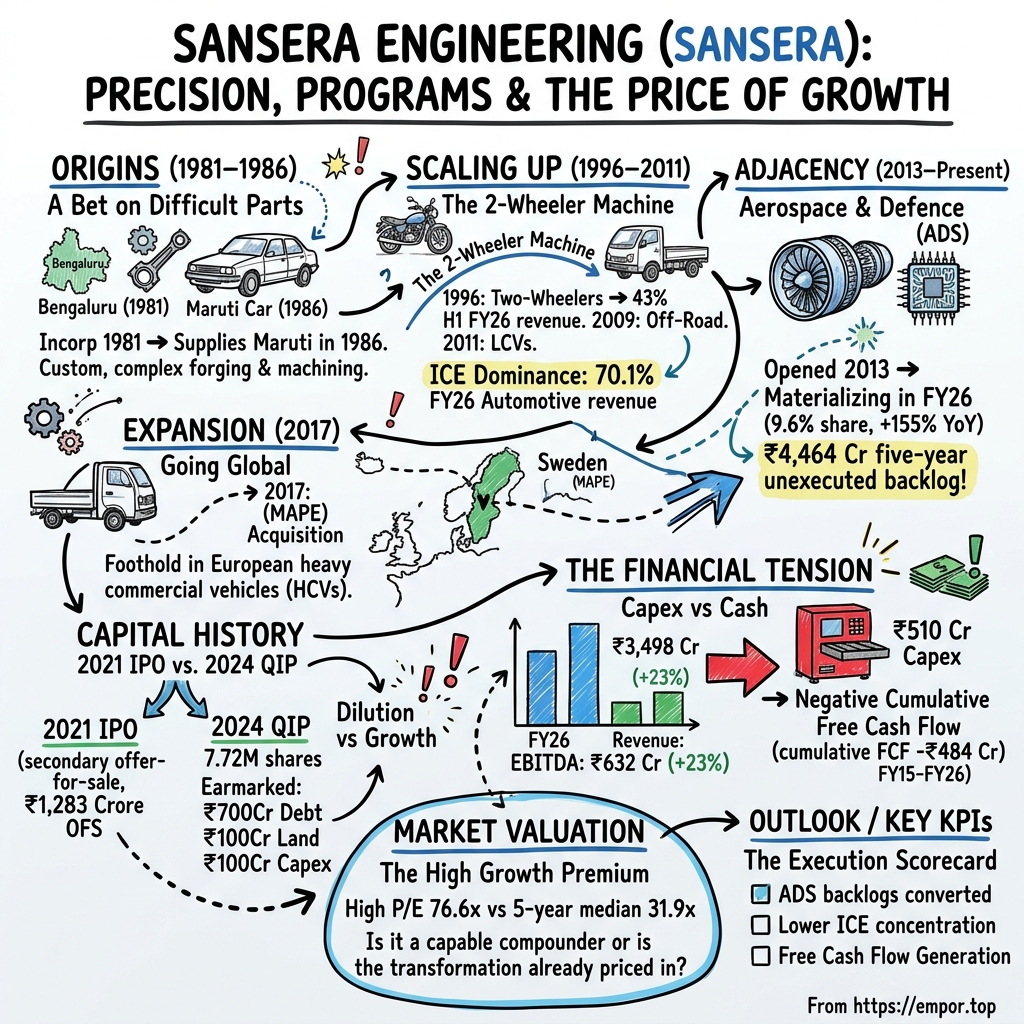
Two years on, the scale of the company is clear. In the year to March 2026, Sansera booked revenue of about ₹3,498 crore, its highest ever.2 More than seven of every ten rupees of that revenue still came from parts for internal-combustion engines in cars, motorcycles, scooters, tractors and trucks.3 The aerospace, defence and semiconductor business, which the company calls ADS, contributed under a tenth, about 9.6%.3 The new Sansera is growing fast, but the old Sansera still pays most of the bills.
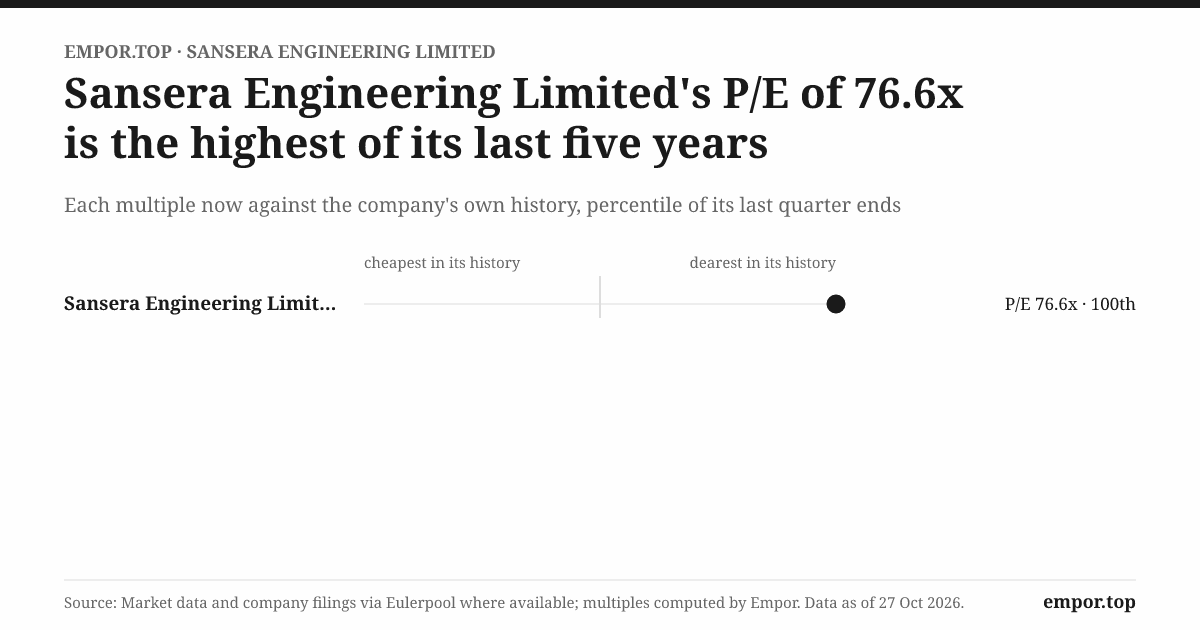
And the stock market has already decided which one it is buying. On 27 October 2026, the shares traded at about 77 times trailing earnings, against a five-year median of roughly 32 times.4 In effect, investors are paying today for profits that the new businesses have not yet earned.
Put those multiples in human terms. At 32 times earnings, a buyer is paying for roughly three decades of today's profit. At 77 times, the buyer is paying for more than seven decades of it, unless profits grow much faster than they have in the past. The difference between those two numbers is the market's estimate of how much Sansera will change. It is, in effect, a forecast that the company of 2031 will look quite unlike the company of 2021, which made nearly nine-tenths of its revenue from combustion-engine parts.2
Management has given the market plenty to build that forecast on. On its earnings calls through 2026, the company spoke of an aerospace, defence and semiconductor order backlog running into thousands of crores, an aspiration of ₹8,000–9,000 crore of total revenue by the end of the decade, and a target for combustion-engine parts to shrink to about 60% of sales.25 Those are targets, not results. The results so far are real but early: a business that grew its non-automotive revenue by about 130% in the latest quarter, from a small base, while still spending more on factories than its operations generate in cash.53
That gap between what Sansera is and what it is priced to become frames four questions. Can the businesses next door to auto, above all aerospace and semiconductor parts, become large enough to change the company's character? Does the craft of making a difficult part give Sansera any real power over the price it charges, or only a seat at the table? Can a business that has reinvested almost everything it has ever earned finally produce cash for its owners? And what does the share price already assume about all three?
The answers begin in a much smaller Bengaluru workshop, in the early 1980s, when a young metallurgist decided that the safest way into the Indian auto industry was to make the parts that were hardest to get right.
 Subscribe on LinkedIn
II. Bangalore's Bet on Difficult Parts
On 15 December 1981, a small private company called Sansera Engineering was incorporated in Bengaluru.6 India's car market at the time was a museum. Two models, the Hindustan Ambassador and the Premier Padmini, carried designs from the 1950s, waiting lists ran for years, and the licence regime that governed industry decided who could make what and how much. But change was being prepared in New Delhi. The government had set up Maruti Udyog to build a modern small car with Suzuki of Japan, and that car would need hundreds of components that Indian suppliers had never been asked to make to Japanese standards.
The man behind Sansera was an engineer with an unusual mix of training for the era. S. Sekhar Vasan, born in 1953, had studied metallurgical engineering at IIT Madras, graduating in 1975, then earned a management diploma from IIM Bangalore.71 He worked in industry at a company called Rambhal Industries before striking out on his own.7
Metallurgy matters to this story. A metallurgist thinks about what happens inside a piece of steel when it is heated, hammered and cooled: how the grain flows, where a crack might start, how a part fails after millions of cycles. That is precisely the knowledge a forging business lives on.
Sansera chose components that sit at the heart of an engine, beginning with connecting rods, the steel links that turn a piston's up-and-down punch into the crankshaft's rotation.
A connecting rod looks simple: a bar with a hole at each end. It is anything but. It is stretched and compressed thousands of times a minute, its two bores must be machined to within microns of their specified size and position, and its weight must be held so precisely that rods in the same engine balance one another. A bad one does not just wear out. It breaks, and when it breaks the engine is usually destroyed.
That difficulty was the point. A supplier that could make such parts repeatedly, at production volume and on the customer's schedule, would be hard to replace once qualified. In 1986, Sansera began commercial production of components for Maruti's passenger vehicles.6 Maruti became the anchor of the business, and it would remain one of its most important four decades later: on the Q1 FY2027 call, management said Sansera supplied almost three-quarters of Maruti's volume in the components it makes for the carmaker.5
The accountants who joined the engineer
The company Vasan founded became, by the early 1990s, a partnership of an engineer and a group of accountants. Fatheraj Singhvi, Unni Rajagopal and Devappa Devaraj were partners in the Bengaluru chartered-accountancy firm Singhvi, Dev & Unni, and Sansera's own history records that the three were brought in as co-promoters around 1990; Singhvi joined the board in March 1991.86 Singhvi stayed a partner in the accounting firm until 2006, when he moved into Sansera full time.9
That pairing shaped the company. An engineer founder brought the obsession with process and the willingness to spend on machines; financially trained partners brought the habit of watching every rupee of working capital in a business where steel sits in inventory and customers pay in sixty or ninety days. Neither alone would have explained Sansera. Together they produced a company that invested heavily but kept the books tight enough to borrow.
Sansera's early growth also involved its first takeover, closer to home. In 2007 it bought a controlling 51% stake in Fitwel Tools and Forgings, a forging company that had been making parts since 1987, and raised its holding to 70% in 2014; the founding family of Fitwel kept the rest.6 Owning a forge meant Sansera could control the raw shape of its parts before machining them, a step that matters when tolerances are tight and delivery schedules tighter. It is the backward integration that Preetham still describes as part of "Sansera's history."5
The early bet, then, was capability-led. Sansera did not win business by being the cheapest or the biggest. It won by being able to make a part that demanded tight tolerances and dependable delivery, and by staying close enough to the customer to do it again and again. Whether that capability would become a durable advantage, though, depended on how far it could travel. The passenger-car market of the 1980s was small. Something much bigger was rumbling past on Indian roads, on two wheels.
III. The Two-Wheeler Programs That Made the Business
In the 1990s, the vehicle that defined Indian mobility was not the Maruti 800. It was the motorcycle, and later the scooter. Families who could not dream of a car could stretch to a 100cc commuter bike, and Indian manufacturers, often in partnership with Japanese firms, were building them by the millions. Every one of them needed a connecting rod, a crankshaft, rocker arms and gear-shifter forks. For a supplier that had learned its trade on car engines, the two-wheeler industry was the scale opportunity of a lifetime.
Sansera began supplying the two-wheeler industry in 1996.6 Over the following fifteen years it widened its reach across vehicle types, moving into off-road vehicles such as tractors in 2009 and light commercial vehicles in 2011.6
By the time of its listing, the company described 69 product families, from connecting rods and rocker arms to gear-shifter forks, crankshaft assemblies and the "stem comp" parts used in engine valve trains.6 It had grown to 16 plants, 15 in India and one in Sweden, and by its 2024 placement document to 17.61 Installed capacity, by an independent estimate in that document, was about 132 million units a year, with rocker arms and connecting rods the largest lines.1
What the customers bought, and what they promised
The two-wheeler customers made Sansera big, and the biggest made it dependent. In FY2021, the year before listing, Bajaj Auto alone accounted for about a fifth of revenue, and the top five customers together for roughly 60%.6 The company's prospectus named its leading OEM relationships across segments, and the long tenure of several, Maruti since the 1980s and the major two-wheeler makers since the 1990s, is documented rather than merely claimed. What the documents do not say is that any of those relationships were locked in by contract.
That is the revenue model in one sentence. Sansera ships parts against purchase orders and supply agreements that set prices per part, and it is paid when parts are delivered. Its domestic customers generally do not commit to minimum volumes or long contract periods, and their forecasts beyond the near term are tentative.6
An OEM nominates Sansera for a part on a vehicle platform, and Sansera invests in dies, tooling and machining lines in the expectation that the platform will sell well and the nomination will last. If the vehicle flops, or the OEM brings a second supplier onto the part, or the customer decides to make it in-house, the volume shrinks and Sansera carries the cost of underused machines.
So bargaining power runs mostly one way. OEMs can shift volumes, change forecasts and qualify multiple suppliers, and in two-wheeler connecting rods, Sansera's main rivals include Bajaj's own in-house operations and Japan's 武蔵精密工業 Musashi Seimitsu.6 Quality and on-time delivery help a supplier defend a program once it is in production, and the cost of re-validating a part gives the incumbent an edge at renewal. But those advantages raise the odds of keeping a program; they do not guarantee its lifetime.
Where does this leave Sansera in the global pecking order? The prospectus commissioned an industry study from the engineering consultancy Ricardo, which estimated that Sansera supplied about 2.3% of the world's light-vehicle connecting rods in calendar 2020, up from about 0.9% five years earlier, enough to place it among the top ten global suppliers.6
The ten biggest players, including OEMs' in-house operations, held about 60% of the market, and the list of competitors read like a roll call of global engineering: MAHLE, American Axle, Japan's 安永 Yasunaga, Linamar, ThyssenKrupp and Bharat Forge.6 By 2023, an industry estimate in the QIP document put Sansera's light-vehicle share at about 2.8%.1
That trajectory deserves a fair reading. Tripling a global share in less than a decade is a real accomplishment, and it says that OEMs outside India were also trusting Sansera with parts. But a share under 3% in a fragmented market is the profile of an established, respected supplier, not a dominant one. The parts are hard to make, which keeps the field limited to qualified players. They are not so hard that only Sansera can make them.
Two-wheeler scale and customer depth built the business. They also concentrated it, not only in customers but in a technology. In the first half of FY2026, two-wheelers were still about 43% of revenue and automotive ICE about 73%, according to the credit agency ICRA, which listed that mix among the company's rating constraints.10 By the end of the year, ICE had eased to about 70%.3
The unresolved weakness of Sansera's core business is that a part can be very hard to make and still be exposed to the OEM's pricing and the industry's production cycle, and, ultimately, to the day the engine it serves stops being built. Sansera's first serious move to widen its customer map came not from India but from a small truck-parts maker in western Sweden.
IV. Sweden Bought Sansera a New Customer Geography
On 14 April 2017, Sansera's Mauritius subsidiary signed an agreement to buy MAPE Sweden AB, a maker of connecting rods for heavy commercial vehicles in Trollhättan, from its Italian parent, MAPE Technology. Sansera took all of it for €3.5 million and renamed it Sansera Sweden.6
For a supplier that had grown almost entirely by building plants in India, one customer at a time, the purchase was a deliberate leap, even if the cheque was small. Overnight Sansera had a factory in Europe, a workforce that spoke the language of European truck makers, and a product line, heavy-truck engine components, that it did not make at home.
The logic was easy to state. Heavy trucks were the one big vehicle category Sansera barely touched, and the customers that mattered in that segment were largely European. Winning them from India would have meant years of sample submissions and audits, and even then a European truck maker might prefer a supplier a few hours' drive away, not a sea voyage. Buying a supplier that already held the relationships collapsed that timeline. It also gave Sansera something it could not easily build: a local production base in Europe that could serve customers who wanted their supply close.
What the record can and cannot say
Was it a good deal? Here the honest answer is narrower than either a booster or a skeptic would like. Sansera disclosed the price but not the profits, assets or order book it bought with it, so there is no way to set €3.5 million against what other buyers paid for comparable European component makers and call it a bargain or an overpayment. What is clear is that the bet was small relative to the company: a few tens of crores of rupees for a business that the Ricardo study credited with lifting Sansera's commercial-vehicle connecting-rod share sharply after 2017.6
What the record does show is how the asset aged. When Sansera prepared its listing four years later, it still carried goodwill of about ₹17.7 crore for Sansera Sweden, and its impairment testing through March 2021 found no need to write any of it down.6 The same was true for the goodwill from its earlier purchase of the Fitwel forging business.6 A goodwill balance that survives a pandemic-hit year untouched is evidence against an early disappointment. It is not proof of a high return on the money spent.
The operating record a decade later is more encouraging. In the fourth quarter of FY2026, Sansera's automotive ICE revenue reached a record, and management singled out commercial vehicles, "led by the strong growth in Swedish subsidiary," as one of two drivers.2
Sansera Sweden is also one of the parent's own customers: the listed company sells components to it, and as of March 2026 the Swedish subsidiary owed the parent about ₹7 crore, a small but real sign of a working supply chain between the two.3 The European foothold also gave Sansera a base from which to court European passenger-car and off-road customers, the export programs that later stalled and restarted with the tariff and demand turbulence of 2025 and 2026.
It is worth being precise about the boundary. Sansera Sweden is a subsidiary of the listed company and its results are consolidated into Sansera's own; this is not a story about a parent group buying assets around the listed entity. Every rupee of the Swedish business's revenue and every krona of its cost flows through the figures Sansera's shareholders own.
What changed after 2017 is the shape of growth. The Swedish deal remained the company's signature overseas purchase. Its later expansion came almost entirely from building: new plants in India, new lines for existing customers, new product categories and, in 2025–2026, a joint venture with Japan's Nichidai Corporation for precision cold-forged parts.2
On the Q1 FY2027 call, Preetham said every published projection assumed only organic growth, while adding that the company keeps "our ears and eyes open" for acquisitions, especially outside autos.5 Sweden, in other words, proved that Sansera could buy and integrate a business. It did not turn the company into a serial acquirer.
The lasting lesson of the Swedish purchase was that Sansera's skills could cross borders and vehicle types. The next test was much harder: could the same precision travel from the engine bay to the wing?
V. Aerospace Took a Decade to Become a Revenue Line
In 2013 Sansera opened a facility dedicated to aerospace components.6 In a company whose identity was built on forging and machining steel for engines, the new plant meant teams learning a quality regime that makes even automotive look relaxed. A car-engine part is checked by sampling. An aircraft part is documented down to the batch of raw material, and a single nonconforming part can ground a production line at the airframe maker.
For most of the following decade, the plant was more promise than profit. Aerospace manufacturing has a peculiar rhythm. A supplier must win approvals from the aircraft or engine maker, pass a first-article inspection on every new part, and often secure accreditation for special processes such as surface treatment before it can ship anything in volume. Each step takes months, and a supplier usually starts with small, low-risk parts.
Hari Krishnan, who now runs the division, described that path on the Q4 FY2026 call: Sansera began with cargo-system and lighting parts, moved to landing-gear components, engine casings and structural parts, and only recently won "very, very complex parts from Boeing."2 The maximum size of component the plant could handle grew from about 1.5 metres to 4 metres.2
When the credential became a business
Then the business turned. Several forces arrived at once. Boeing and Airbus raised production of their best-selling aircraft, and Krishnan said Sansera was increasing its share of parts on the A350 and 737 platforms.2 Global aerospace companies began actively seeking Indian suppliers. And a new customer category appeared: makers of semiconductor manufacturing equipment, whose demand surged with the build-out of artificial-intelligence data centres, needed precision-machined parts and more machining capacity than their existing supply chains could provide. Sansera began mass production for one such customer toward the end of the second quarter of FY2026.2
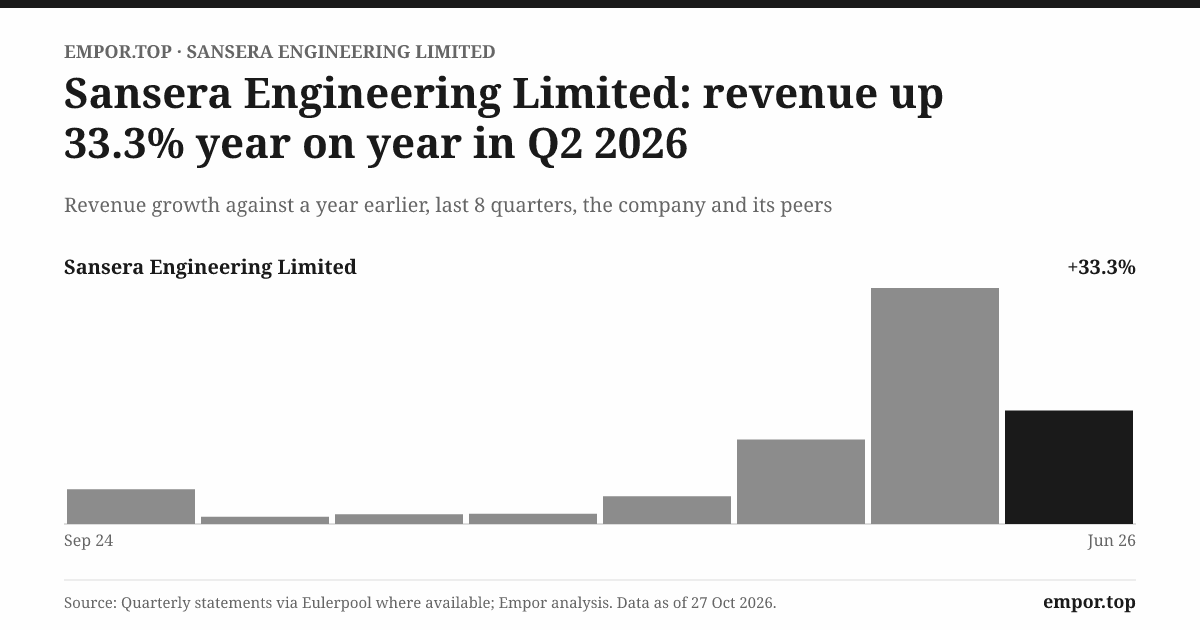
The numbers changed character quickly. In FY2026, ADS revenue from product sales reached about ₹315 crore, up roughly 155% in a year, with aerospace growing about 63% and semiconductor equipment rising from almost nothing.2 Aerospace, defence and semiconductor together made up about 9.6% of revenue, and non-automotive work as a whole about 16.4%.3 In the first quarter of FY2027, ADS revenue was about ₹145 crore, more than three times its level a year earlier.5
The figure that attracts the most attention is the backlog. As of March 2026, Sansera reported an unexecuted ADS order backlog of about ₹4,460 crore, to be executed over five years.2 By August it had climbed to about ₹5,750 crore after a single new semiconductor-equipment order worth about ₹1,250 crore over five years; management said that order would take its business with that one customer to about $75 million a year.5 That needs to be read carefully.
ADS backlog is a cumulative five-year figure, the total value of orders the company expects to ship by FY2031. It is not the same as the "peak annual revenue" measure Sansera uses for its auto order book, which estimates a program's best single year. Spread over five years, ₹5,750 crore averages a bit over ₹1,100 crore a year, though in practice the ramp will be back-loaded. Management's own guidance for FY2027 ADS revenue is ₹550–600 crore.2
Even that guidance depends on things outside Sansera's control. The new semiconductor order will not produce significant revenue until calendar 2027 and will peak in 2029, Krishnan said, because "the defining lead time is the arrival of the mother machine," machine tools that take seven to nine months to deliver.5 Customers must then validate each line. Backlog is a schedule of intentions, not revenue in the bank.
Defence is the smallest of the three and the least developed. Krishnan described the current business as precision-machined parts supplied in small batches to the Indian Space Research Organisation and Hindustan Aeronautics, plus some exports to Israeli companies.5
The plan is bigger: a separate defence plant, a push for large orders from European defence customers, and a move into sheet-metal fabrication, which Krishnan argued would let Sansera bid for whole packages of parts rather than leaving some on the table.5 Management talks of building defence capacity that could support about ₹500 crore of revenue over five years.5 For now that is capacity planning, not an order book.
The new surface-treatment plant is the less glamorous but more immediately important piece. Aerospace parts usually need special processes such as anodising or chemical treatment after machining, performed in facilities accredited under NADCAP, the industry's audit programme for such work.
Until it had its own, Sansera shipped parts out for treatment and waited for them to come back, which lengthened lead times and handed part of the margin to someone else. Management said it expected NADCAP and customer approvals for the in-house line within the September quarter of 2026.5 It is a small step that matters: it turns Sansera from a machine shop into a supplier that can deliver a finished part.
Two other cautions belong next to the excitement. Semiconductor equipment is the fastest-growing piece of ADS, but it is also the most cyclical: chip-equipment orders have historically swung hard with the chip cycle, and Sansera's semiconductor revenue depends heavily on one customer, though it says it is in talks with "the other big player."2
And when Krishnan named Boeing and Airbus, he called them the "ultimate" customers, which signals that much of the work reaches them through tiers of the supply chain; the names describe the programs Sansera's parts fly on, not a direct contract that guarantees volume.5 Krishnan acknowledged the main risk himself when asked what could go wrong: barring "something catastrophic like what happened to Boeing about 6 years ago," he saw aerospace as lower-risk than semiconductors.5 It was a candid answer, and a reminder that the 737 MAX grounding once froze an entire supply chain.
What the decade-long aerospace build shows is that Sansera can convert a technical credential into revenue, but only slowly and only when demand arrives from outside. The 2013 plant did not become a meaningful business until 2025, and it took a global aircraft upcycle plus an AI-driven equipment boom to get there. The next question was how to pay for the factories those orders now require, which brings the story back to Sansera's two trips to the capital markets.
VI. The IPO Raised Cash for Sellers; the QIP Raised It for Sansera
On Friday, 24 September 2021, Sansera's shares opened on the National Stock Exchange at ₹811.50, about 9% above the ₹744 issue price.11 Investors had piled into the offer: it was subscribed about 11.5 times, with institutional buyers bidding for more than 26 times the shares set aside for them and total bids exceeding ₹10,000 crore for an issue of about ₹1,283 crore.12 At the top of its price band, the whole company was valued at about ₹3,823 crore.12 Five years later it would be worth about seven times that.
But there was a detail that every first-time Sansera shareholder should have noticed. Not a rupee of the IPO money went to the company.
The listing was entirely an offer for sale. About 17.2 million existing shares changed hands, and the proceeds went to the people selling them.6 The largest sellers by far were two Mauritius-registered vehicles linked to CVC Capital Partners, which had invested in Sansera in 2013 and sold about 13.5 million shares between them, roughly four-fifths of the offer.6 The founders sold the rest: Vasan about 2.1 million shares, and Singhvi, Unni Rajagopal and Devaraj about 0.57 million each.6
There is nothing improper about this structure. Private-equity investors need an exit, and a listing is often the cleanest way to deliver it while giving a company a public currency and wider ownership. But it means the IPO tells you about the sellers' timing, not the company's needs. In 2021, Sansera did not ask the market for capital. It was a profitable company with debt equal to nearly three-quarters of its equity, funding its own expansion from operating cash and bank loans.3
The second visit, and why it was different
Three years later, the company came back, this time for itself. The board approved a qualified institutional placement on 20 August 2024, shareholders approved it at the September AGM, and the issue opened on 10 October.1 Sansera sold about 7.72 million new shares at ₹1,554 each, a discount of about 5% to the regulatory floor price of ₹1,635.48, raising ₹1,200 crore, or about ₹1,175 crore after expenses.1 Unlike the IPO, every rupee of this went into the company.
The use of proceeds told the strategy. The single biggest allocation, ₹700 crore, was to repay or prepay borrowings.1 A further ₹100 crore was earmarked for land for a new plant and another ₹100 crore for capital expenditure at existing plants, with the balance of about ₹275 crore for general corporate purposes.1 The rating agency ICRA later confirmed that the proceeds had been used largely to prepay or repay debt, and cited the stronger balance sheet when it reaffirmed Sansera's AA rating with a stable outlook in January 2026.10
The effect on the balance sheet was immediate. Debt fell from roughly two-thirds of shareholders' equity at March 2024 to about a sixth a year later, and the company ended FY2025 with more cash than at any point in its history.313 By March 2026, debt had crept back up slightly, to about a fifth of equity, as working-capital borrowings funded growth, but Sansera was close to net cash before lease liabilities.32 The QIP had swapped a leveraged supplier for a well-funded one.
It came at a price. Existing shareholders' claim on the company was diluted by roughly a seventh, and the promoter group's stake fell from about 35% at the end of 2023 to about 29% by September 2026, the decline coming from the new issue and from sales by existing holders rather than any change in control.414 Today, domestic mutual funds and other institutions own about 30%, foreign portfolio investors about 23% and the public about 18%, spread across almost 118,000 shareholders.14 None of the promoters' shares are pledged.14
The comparison between the two capital events is the clearest single lens on Sansera's ambitions. In 2021 the market paid early investors to leave a company that was funding itself. In 2024, the company itself asked for money, and cut its debt, because its management wanted to build faster than its cash flow allowed. That is a bold choice, and a defensible one: it removed financial risk at the moment the company was committing to new segments with long ramp-up times.
But it also changed the arithmetic. Every rupee of future profit is now shared among more shares, and every new factory must earn a return not just for lenders but for shareholders who paid ₹1,554 a share to fund it. Management has said it does not expect to need another fundraise "at this moment," while keeping the option open for "good opportunities."5 The balance sheet is stronger. Whether the capital earns its keep depends on what happens on the factory floor, and on whether customers value Sansera enough to keep filling it.
VII. The Factory Floor Is the Moat—and the Customer Is the Judge
Walk the length of a Sansera forging line and the product changes shape every few metres. A steel bar is cut to a billet, heated until it glows, struck in a die into the rough silhouette of a connecting rod, trimmed, heat-treated and cooled. Then it moves to machining, where the bores are cut, the big end is split and reassembled, and the finished part is measured against tolerances finer than a human hair.
At the end of the line it goes into a crate stamped for a customer's assembly plant, where it will be bolted into an engine on a schedule set by somebody else. In FY2026 Sansera's factories produced close to 120 million components this way, almost a crore every month.2
That last detail is the whole competitive question in miniature. The factory is Sansera's. The schedule is the customer's.
Management likes to point to how much of the factory is its own invention. Sansera builds many of its special-purpose machines and automation cells in-house, and on the Q4 FY2026 call Rahul Kale, who had just been promoted from chief operating officer to chief executive of the automotive division, said the in-house machine-building plant was booked for almost a year ahead.2
New lines, he said, were being designed so that they ran with about 20% of the old manning and the rest automated or robotic, partly because labour had become hard to find and keep in the company's northern plants.2 That is a genuine capability. A supplier that can design its own fixtures, build its own special machines and shave labour out of a line can quote a new program faster and with more confidence than one that buys everything off a catalogue.
Now set that beside the cancellable, forecast-driven orders on which Sansera invests ahead of demand.6 In plain English, Sansera invests on the strength of a nomination and a forecast, and the customer keeps the right to change its mind. A pitch about in-house machine building and a risk factor about cancellable orders sit in the same company story, and both are true.
So which wins? The honest way to answer is to start with the economics of a single part, then look at who else could make it, then look at what the customers have actually done.
Who else can make the part
A precision component begins as engineering work long before it becomes revenue. The OEM shares a drawing; the supplier designs the forging die and the machining process, builds or buys tooling, makes samples, and submits them for validation. Only after the part passes durability tests and the customer audits the line does serial production begin.
For an engine part that might run for the life of a vehicle platform, the qualification process is a filter: a supplier who repeatedly ships parts that pass inspection, on time, at volume, earns a reputation that is costly for the customer to replace. Changing suppliers mid-program means re-validating a part inside an engine, and nobody in a purchasing department wants to explain a warranty recall caused by a cheaper connecting rod.
But that filter is not a wall. Sansera's global share of the connecting-rod market remains under 3%, a real achievement for a company that started with a single Maruti order, but also a reminder that the category has many qualified alternatives. When a European or American OEM tenders a new engine program, it has a list of credible bidders, and it uses that list.
At home, the picture is more favourable. On the Q1 FY2027 call, Preetham said that for the components Sansera supplied to Maruti Suzuki, the company provided almost 75% of the volume, and he described Sansera as a majority or single source for many of its auto OEMs.5 He also said the company had not lost wallet share with any customer and had gained share with TVS, Yamaha and Suzuki, while an analyst pointed out that Sansera's motorcycle revenue had grown in single digits to low double digits for three quarters while industry motorcycle volumes had grown in the high teens.5
Management's answer was that its figures were revenue and the industry's were units, which was fair as far as it went. The analyst's question is the right one to keep asking, because wallet share is the single best test of whether customers value a supplier more over time.
What the customers have done
The strongest evidence for Sansera's position is not a market-share table. It is that the same OEMs keep coming back with more parts. The two-wheeler relationships begun in the 1990s were still among Sansera's largest in FY2026, and the company was expanding crankshaft capacity at Pantnagar and Manesar precisely because two-wheeler makers were outsourcing crankshafts they had previously made in-house.5 Outsourcing is a vote of confidence: an OEM hands over work only to a supplier it trusts to run it as well as it would.
The concentration numbers tell the same story from the other side. In FY2026 Sansera's top five customers took about 46.5% of revenue, down from about 49.6% a year earlier and from roughly 60% in the years around the listing, when Bajaj Auto alone accounted for about a fifth of sales.36 Two customers still each exceeded 10% of revenue, together a little over a quarter.3
The trend is real diversification, achieved mostly by growing the rest of the book faster than the biggest relationships. It is not independence. A company that gets nearly half its revenue from five buyers, none of whom has committed to minimum volumes, is still negotiating from the smaller side of the table.
Cash is where that imbalance usually shows first, so it is worth answering directly who pays and how fast. In FY2026 Sansera's receivables equalled about 67 days of revenue, below the 85-day peak of FY2022 and almost exactly where the ratio stood a decade earlier.3 The standalone ageing schedule showed no disputed balances, an allowance of about ₹2.4 crore against nearly ₹592 crore of receivables, and just ₹0.33 crore older than three years.3
The two largest customers made up about a quarter of receivables, roughly in line with their share of revenue; the company does not name which customer owes the small long-dated balance.3 The conclusion is reassuring: big customers are not using Sansera as a bank by stretching payment terms. Where buyer power shows up is in price.
And price is the softest part of the evidence. On the Q1 FY2027 call, the CFO Vikas Goel said Sansera was still "engaging with our customers for the pass-through" of steel, aluminium, consumable and labour inflation, and that none of that compensation had yet reached the profit and loss account; the quarter's gross-margin gain came from product mix and a weaker rupee instead.5 That is how pricing works for most auto suppliers.
Raw-material costs are usually passed through with a lag by formula, and everything else is argued over. A supplier with true pricing power would not need to wait for a negotiation to recover inflation in tooling and wages. Sansera does.
The operating record over the long run points the same way. The company's operating margin stayed in a band of roughly 10% to 14% for a decade, ending FY2026 at about 12%, almost exactly where it was ten years earlier.3
Recent improvement in EBITDA margin, to about 18% for FY2026 and above 19% in the latest quarter, came largely from the shift toward aerospace and exports, which management says earn margins in the 25%-to-30% range.52 The core automotive franchise looks like a well-run supplier earning a steady, unspectacular return on a steadily growing asset base, not a business that can raise prices at will.
So the factory is a moat of a particular kind. Process know-how and customer qualification create switching friction: once Sansera is validated on a part, it usually keeps it for the life of the program, and the outsourcing wins show OEMs trust it with more. What the record does not show is a cost or price advantage large enough to lift returns above the industry's. The claim survives, narrowed: Sansera has a defensible position in the parts it already makes, and a good chance of being invited to bid on the next ones. It does not have the power to name its price.
That limit matters most for the parts that face a slow structural decline. Connecting rods and crankshafts exist because pistons go up and down. An electric scooter has no crankshaft. The question that has quietly hung over the company since its listing is whether the same machine-building, forging and machining skills can make something just as valuable after the combustion engine starts to shrink.
VIII. New Mix, Old Cash Test
On 21 May 2026, Preetham opened the Q4 call by calling FY2026 "a pivotal year." Revenue reached about ₹3,498 crore, up 16%; EBITDA reached about ₹632 crore, up 23%, with the margin up a point to 18.1%; and net profit reached about ₹327 crore, up 51%.2 The fourth quarter alone brought in almost ₹1,000 crore of revenue, the company's best ever, with EBITDA margin above 19%.2 The same year, Sansera spent about ₹510 crore on property, plant and equipment, and the CEO told analysts to expect a similar figure in FY2027.2
Those two facts belong together. A record profit and a record-scale investment programme are the same story told from two ends of the cash-flow statement, and the most important thing an investor can do with FY2026 is follow the money from one end to the other.
Separating the engine from the tailwind
Start with the profit line. A 51% jump in net profit on 16% revenue growth looks like dramatic operating leverage, and some of it was. Employee costs grew more slowly than sales, and the richer mix of aerospace, semiconductor and export work lifted margins quarter after quarter.2 But a meaningful slice came from below the operating line. Other income rose to about ₹59.5 crore from about ₹20 crore the year before, made up mostly of roughly ₹31 crore of foreign-exchange gains and about ₹23 crore of interest on deposits.23 That other income amounted to about 13% of profit before tax.3
The operating improvement itself is easy to decompose in the fourth quarter, where management gave the cost lines. Revenue rose 28% year on year, but employee costs rose only 14%, so the payroll that had been hired for growth was now being spread over far more output.2 Other operating expenses grew in line with sales, as freight and consumables inflation offset scale benefits.2
Most of the 3-point rise in EBITDA margin, to 19.3%, therefore came from two sources: labour leverage and a richer mix of ADS and export work. Finance costs, meanwhile, rose 17% as the company borrowed again for working capital, a small reminder that the post-QIP balance sheet was already being put to use.2
Neither component of other income is fake, but neither is the core business. The interest income exists because the QIP left Sansera holding cash; as that cash is spent on plants, the interest will shrink. The currency gains reflect a weakening rupee against the dollar and euro on export receivables, which management itself described in Q1 FY2027 as a "short-term respite" while it waited for customers to agree to price increases.5
Other income also included recoveries from an employee-theft matter at the Fitwel subsidiary; those should not recur.3 Strip those out and FY2026 was still a good year, with EBITDA growth well ahead of sales. It was simply less extraordinary than the headline profit growth suggests.
Where the cash went
Now follow the operating cash. Over the twelve years from FY2015 to FY2026, Sansera reported cumulative net profit of about ₹1,562 crore and generated about ₹2,603 crore of cash from operations, roughly two-thirds more than its accounting profit.3 That gap is not suspicious. It is what a capital-heavy manufacturer looks like: large depreciation charges reduce reported profit without consuming cash, so operating cash flow should exceed net income. Sansera's earnings, in other words, are backed by real cash coming in the door.
Then the cash goes straight back out. Over the same twelve years, capital expenditure exceeded operating cash flow by a cumulative ₹484 crore.3 In only a handful of years, notably the pandemic-shaped FY2020 and FY2021 when the company throttled investment, did free cash flow come out meaningfully positive. FY2025 and FY2026, the first two years after the QIP, were both negative, the second by well over ₹100 crore.313 The gap was filled by borrowing before 2024 and by shareholders' money since.
FY2026 also showed a new pressure. Working capital absorbed cash as receivables and inventory rose faster than payables, and management was candid about why. Goel told analysts that the automotive business had actually improved its working-capital ratios, but that ADS was building "a new set of working capital" as volumes grew and the semiconductor line started from scratch, pushing operating cash down from about 12% of revenue to 11%.2
Hari Krishnan added that semiconductor customers were working to localise some raw-material sources, which would shorten holding periods.2 That is a plausible explanation, and it comes with a testable prediction: if it is right, ADS working capital should stabilise as a share of ADS revenue within a year or two.
The middle segment, tech-agnostic and electric-vehicle parts, gets less attention than ADS but matters as much to the long-run story. These are parts that a vehicle needs whatever powers it, such as suspension, steering and chassis components, plus parts specific to electric drivetrains. The segment set records in the fourth quarter of FY2026 and again in the first quarter of FY2027, growing about 20% each time, helped by rising electric two-wheeler sales in India.25
Sansera has also started supplying components for an energy-storage program at a North American customer, which Preetham said should bring in ₹80–100 crore a year once at volume.2 It is a useful hedge against the slow shrinkage of combustion engines. It is not yet big enough to offset it, and some of the company's US electric-vehicle customers, Preetham acknowledged, had "a rough year."2
The mix is moving. In FY2026 automotive ICE made up about 70% of revenue, tech-agnostic and electric-vehicle components about 13.5%, and non-automotive about 16.4%, of which ADS was about 9.6%.3 Management's long-stated aim, repeated on the Q4 call, is for auto ICE to fall to about 60% of revenue with the other 40% split between non-auto and tech-agnostic or xEV parts; by the fourth quarter of FY2026 the non-ICE share had reached about 32%.2
By the first quarter of FY2027, non-auto alone was 20.8% of sales, up from about a tenth a year earlier, after revenue in the segment more than doubled.5 The 40% figure is a target, not a forecast, and one quarter is not a year. Still, the direction is unmistakable and faster than at any point since listing.
What is not yet visible is whether this new mix will make the company a better generator of owner cash or merely a bigger consumer of capital. On the Q4 call Hari Krishnan put the ADS asset turn at about two: every rupee of machinery and buildings should eventually support about two rupees of annual revenue.2
At 25% to 30% EBITDA margins, that is an attractive return once a plant is full. The catch is the word "once." Five-axis machine tools for aerospace and semiconductor parts arrive seven to nine months after they are ordered, customers must validate each line, and first-article inspections take months more.25 For a long stretch, the investment sits on the balance sheet earning little.
Sansera's own return figures show that lag. Return on capital employed by the conventional calculation was about 13.6% in FY2026 and return on equity about 10.5%, both below the levels of FY2024, because the QIP roughly doubled equity before the new capacity could earn on it.3 Management's own reported ROCE, on its narrower definition, was 18%.2 Either way, the returns are adequate rather than exceptional, and well short of what a 77-times earnings multiple usually implies.
That leaves the decisive test of this chapter. High capex is not a problem if it builds capacity that customers fill at good margins; it is a problem if the capacity runs half-empty or the margins disappoint. The evidence to watch is not the capex plan or the order book, but whether revenue per rupee of new fixed assets and free cash flow after capex both rise as the FY2025–FY2027 investments mature. That puts the spotlight on the people deciding where the money goes.
IX. The Promoters' Next Test Is Execution
On 24 September 2026 Sansera's shareholders gathered for the company's 44th annual general meeting. The agenda had the usual business of a growing company and a few items that drew attention: higher remuneration limits for the top executives, the appointment of three new independent directors to replace two whose terms had ended in July, and the reappointment of directors including the independent director Samir Inamdar and the co-founder Fatheraj Singhvi.152 Every resolution passed. But about 5.4% of the votes cast opposed Inamdar's reappointment, and about 2.5% opposed Singhvi's, while the pay revisions drew almost no opposition at all, about 0.06%.15
Those are small numbers, and they should be read as such. A dissent of 5% would barely register at a widely held Western company. In an Indian mid-cap where promoters and loyal domestic funds together control a large share of the vote, it is enough to say that some institutions had reservations about board independence, without saying what they were. The company has not explained them, and nobody voting against has said why. The cleaner inference is a narrower one: shareholders were comfortable paying management more, and somewhat less comfortable with who was watching them.
The people running the plan
The founding generation is still in charge of the strategy. S. Sekhar Vasan, the metallurgist who founded the business, is chairman and managing director, and his executives describe him as the company's "Chief Engineer," personally leading the aerospace blisk project; Hari Krishnan credited the order conversion "100%" to Vasan's involvement.2
Fatheraj Singhvi, the co-founder who built the financial side of the company, serves as executive vice chairman.3 The operating generation below them is now clearly visible. B. R. Preetham, executive director and group CEO, leads the earnings calls and sets the targets. Hari Krishnan runs ADS and joined the board as an executive director in 2026. Rahul Kale runs the automotive division. Vikas Goel is chief financial officer.53
Their pay has risen with the profits. In FY2026 the two most senior executives each received about ₹5.5 crore and Preetham about ₹4.5 crore, all higher than the year before, under a remuneration policy that mixes fixed and variable components.3 Against a net profit of about ₹327 crore, the top three executives' pay is a little under 5% of earnings: not extravagant by Indian promoter-company standards, but not trivial either, and the AGM approved headroom for more.
The promoter group's ownership gives them reason to care about the share price as well as the salary. Their stake aligns them with shareholders without giving them unchallengeable control; none of their shares were pledged.144
The record behind the promises
Management's credibility is best judged by comparing what it said with what then happened. On ADS, the record is good. Management set growth guidance for FY2026 ADS revenue and reported on the Q4 call that it had met it, with product sales up about 155% to roughly ₹315 crore.2 It then guided to ₹550–600 crore for FY2027, and in Q1 ADS revenue was about ₹145 crore, more than three times the prior-year quarter and on a pace consistent with the guidance.25
When an analyst in August suggested ADS might reach ₹1,500 crore the following year, Hari Krishnan pushed back plainly: "going to INR1,500 crore next year is not as per our plan."5 Managers who correct over-optimistic analysts are rarer than they should be, and it counts in Sansera's favour.
Margin guidance shows the same restraint. After a first quarter in which EBITDA margin, adjusted for a one-off tariff provision, touched about 20.4%, an analyst asked whether 20% to 25% was the new benchmark. Preetham declined to raise the bar: the quarter had been flattered by an unusually high export share and a favourable currency, and he would be "more happier" inching from last year's 18.1% toward 19%, while still talking about the company's aspirational "20-20-20" targets.5 Aspiration and guidance were kept in separate boxes, which is what a careful management team does.
On exports, the record is mixed and openly so. Through FY2026 management acknowledged that new order bookings were "soft, largely from international customers due to global uncertainty," and that programs which had stalled in North America and Europe were only starting to pick up.2
A long-discussed plan for a US connecting-rod plant remained on hold in 2026 as the company waited for tariff stability; customers had instead started sourcing more from India as a stop-gap.25 Management did not dress this up. It also did not give a date for when the delayed export programs would reach full volume, and the Q1 call added a new item: a ₹12.6-crore provision for US import duties paid the previous year, which the company says it is still trying to recover.5
Two other items belong in proportion. The Fitwel subsidiary suffered a theft by a former employee; the statutory auditors described it under CARO reporting, a police complaint was filed and recoveries were under way, and the auditors' opinion on the financial statements remained unmodified.3 That is a control lapse at a subsidiary, caught and pursued, not an accounting qualification.
And in Q1 FY2027, Sansera booked a ₹16.9-crore exceptional charge to settle a US District Court litigation matter that had been disclosed in the 2021 prospectus, settling without admitting liability.5 Both items were disclosed promptly and neither changes the economics of the company, but both remind investors that a manufacturer selling into the United States and Europe carries operational and legal risks that do not appear in segment charts.
Related-party dealings are modest. In FY2026 purchases from related parties, mainly the Fitwel forging subsidiary, were about 6% of standalone purchases, and sales to related parties, mainly Sansera Sweden, were about a third of a percent of sales; there were no loans to related parties and no royalty or brand fee.3 The parent stood behind a ₹64.5-crore guarantee for a subsidiary's borrowing facility.3
There is one strategic investment worth noting: Sansera has been raising its stake in MMRFIC Technology, a Bengaluru defence-electronics company that the chairman has championed, and Preetham said on the Q4 call that the holding should be between 45% and 50% after preference-share conversion, describing the business as "definitely a long haul."2 It is small relative to Sansera, but it is precisely the kind of optionality investment whose returns should be reported over time.
Put together, the promoters have shown ambition and a willingness to invest heavily while cutting leverage, and their recent guidance has proved reliable. What they have not yet shown is that a decade of reinvestment can produce positive cumulative free cash flow. The scorecard for the next three years is short: whether ADS revenue tracks guidance and the backlog converts on schedule, whether top-five customer concentration keeps falling, and whether free cash flow after capex turns durably positive. Those three numbers will settle more of the debate than any AGM vote. They also frame the question the market has already answered with its price.
X. Analysis & Bear vs. Bull Case
On 27 October 2026, Sansera's shares valued the company at about ₹26,800 crore, roughly 77 times trailing earnings, more than twice its five-year median of about 32 times.4 Measured another way, an investor buying the whole company would be paying about seven times annual sales and about 36 times EBITDA, for a business whose free cash flow over the past year was slightly negative.43 Earnings per rupee invested, the inverse of the P/E, came to about 1.3%, a fraction of what an ordinary Indian bank deposit pays.
That price is not a judgment on the past. It is a bet on a future in which aerospace, semiconductor equipment and electric-vehicle parts become large, high-margin businesses. The question is whether the evidence assembled so far supports the size of that bet.
The bull case starts with relationships. Sansera has supplied Maruti since the 1980s and the leading two-wheeler makers since the 1990s, and those customers are now handing it work they used to do themselves.5 Its top-five concentration is falling. Recent growth is well above the company's own long-run rate: revenue compounded about 17% a year over FY2023–FY2026 against about 15% over the decade, and profit faster still.3
The new businesses use the same skills, precision machining of hard metals to tight tolerances, so this is an adjacency, not a reinvention. ADS has gone from a technical credential to a business with a backlog of about ₹5,700 crore.5 If management's FY2031 aspiration of ₹8,000–9,000 crore of revenue were met at roughly 20% EBITDA margins, today's valuation would look much more ordinary.5
The bear case starts with the same numbers from the other side. About 70% of FY2026 revenue still came from parts for combustion engines.3 Customers decide volumes and can split programs between suppliers. Sansera's investment programme has yet to produce sustained free cash flow, and the company has relied on outside capital, debt before 2024 and equity since.
The FY2031 aspiration is just that: Preetham himself declined to say whether 20%-plus growth would continue beyond the current year.5 And the multiple already discounts much of the success. At more than twice its own historical median, the price leaves little room for a slow ramp, a semiconductor downturn, or another year of soft export orders.
Five forces and seven powers
Michael Porter's framework clarifies where the pressure comes from. Buyer power is the strongest force: a handful of OEMs account for nearly half of revenue and can change volumes or qualify alternatives. Rivalry is intense but rational in a fragmented global connecting-rod market.
Supplier power is moderate: steel is largely passed through by formula, while long lead times for specialised machine tools constrain how fast Sansera can grow ADS.2 The threat of new entrants is low in the short run because of qualification barriers and capital intensity, but not negligible. The threat of substitutes is the long-term force: electrification removes crankshafts and connecting rods from vehicles altogether.
Hamilton Helmer's seven powers set a higher bar. The strongest candidate is process power, the accumulated know-how of running forging, heat treatment and machining at volume, reinforced by in-house machine building. The outsourced crankshaft programs and jet-engine blisk work illustrate it. Switching costs are real but bounded to the life of a program; they protect existing parts, not future bids.
Scale economies are modest: Sansera is small relative to MAHLE globally, so it cannot claim a cost advantage from size. Network effects, brand and cornered resources do not apply in any meaningful way. Counter-positioning is weak. The verdict is that Sansera has one partial power, process know-how plus program-level switching costs, which explains why it keeps winning business, but not a power strong enough to explain why it should earn returns far above its cost of capital.
Peers offer limited guidance. Sona BLW, the most EV-oriented listed auto-component maker in India, traded at about 67 times trailing earnings in late October 2026; Ramkrishna Forgings, a forging peer, at about 117 times; Endurance Technologies at about 40 times in an earlier September reading.161718 Those snapshots were taken on different dates and reflect different accounting and business mixes, so they show mainly that the Indian market is willing to pay high multiples for engineered-component companies with a growth story. Sansera is priced inside that range, not at an extreme.
A skeptical investor would press three questions. What return will the QIP-funded land and capacity actually earn, and when? How quickly will the ADS backlog become recognised revenue, given machine lead times and customer validation? And why should a company with 2.3% of a fragmented global category command a multiple that implies something closer to dominance?
The answers will come from three numbers. The first is ADS revenue and its conversion from backlog against guidance.25 The second is top-five customer share of revenue, which was about 46.5% in FY2026 and is falling.3 The third is free cash flow after capex, still negative in FY2025 and FY2026 and cumulatively negative over twelve years.3 Two of the three are moving the right way. The third is the one the valuation most needs, and at 77 times earnings there is not much room for a long ramp that earns modest returns.
XI. Playbook: Business & Investing Lessons
Sansera's history is a forty-five-year study in a trade: invest first, qualify, ship, and hope the program lasts long enough to pay for the factory. Four lessons come out of it that belong to this company and no other.
The first lesson comes from 1996, when a passenger-car supplier entered India's two-wheeler market and became, within a generation, a core supplier to its biggest makers. A narrow capability travels. The same metallurgy and machining that made a Maruti connecting rod could be scaled for motorcycles, then tractors, then trucks.
But the customers came with the capability, and so did their leverage. At listing, the biggest two-wheeler OEM accounted for about a fifth of revenue, and Sansera still could not set its own price. The line to remember: a skill can follow you to a new customer, but so does that customer's bargaining power.
The second lesson comes from Sweden. The 2017 acquisition extended Sansera's reach in Europe and into a segment it did not serve at home. Its strategic logic was clear, but the company's disclosures do not let an outsider calculate precisely whether the capital earned more than it cost. Acquisitions should be judged by the cash they return, not the map they change.
The third lesson comes from aerospace. Sansera opened a dedicated aerospace facility in 2013, but it took most of the following decade for that credential to become a meaningful business. Rising aircraft production, demand for Indian suppliers and semiconductor-equipment makers' need for machining capacity helped turn it into a ₹300-crore business. Certification is an option, not an asset, and options expire if nobody exercises them.
The fourth lesson comes from the QIP. In October 2024 Sansera asked shareholders for ₹1,200 crore, repaid most of its debt, and bought itself room to invest without strain. That flexibility is valuable. It also carries an obligation: every new share must eventually earn its keep. A stronger balance sheet buys time. It does not buy returns.
The single line that captures Sansera: a machine can make a precise part; only a customer program that pays back the factory makes it a business.
XII. Epilogue
Tonight, on 27 October 2026, Sansera is in the middle of the most important build-out in its history. The 80,000-square-foot hangar for aerospace and semiconductor work is coming on stream; a surface-treatment facility is awaiting NADCAP approval, the aerospace industry's accreditation for special processes; the defence business is moving to its own plant; and a build-to-suit facility nearby is due to add another 100,000 square feet.5
In the auto business, crankshaft lines are going in at Pantnagar and Manesar, a Nichidai joint venture is equipping a plant for cold- and warm-forged parts, and the Bengaluru plants are adding machining for electric-vehicle components.52 Management's stated plan is to have capacity able to generate about ₹3,500 crore of ADS revenue by FY2031.5
The second-quarter results, due within weeks, will be the first test. Management has said it expects FY2027 revenue growth in the high teens to 20%, with ADS growing 75% to 80%.5 If the second and third quarters keep pace, the guidance will look conservative. If the auto business slows in the second half, which management cautioned would be weaker than the first because of a tougher base, or if inflation pass-throughs remain stuck, margins will tell the story first.
The bigger moments sit further out. The first calendar quarters of 2027 will show whether the new semiconductor order starts generating significant revenue, as Hari Krishnan said it would, on the way to a peak in 2029.5 The FY2027 annual report will show whether ADS working capital has stabilised and whether free cash flow has turned positive despite a second year of roughly ₹500 crore of capex. The blisk program, if it moves from sample to series production, will be evidence that Sansera can compete for rotating engine parts, the most demanding work in aerospace machining.
Each outcome tests one of the story's central questions. If ADS hits ₹550–600 crore in FY2027 and the backlog keeps converting on schedule, the diversification thesis moves from promising to proven. If top-five concentration falls below 45% while revenue grows, the bargaining position improves. If free cash flow turns positive and stays there through the investment cycle, the market's premium multiple begins to look earned rather than borrowed from the future.
And if not? If the export programs stay delayed, the semiconductor cycle turns, or the new plants take longer to fill, Sansera will remain what it has been for most of its history: a capable, growing, cash-hungry auto supplier. That is a respectable business. It is not the business priced into the shares tonight.
XIII. Outro
Go back to the factory floor, to the forging press striking a billet into the shape of a connecting rod. That rod will likely end up in a motorcycle somewhere in India, as Sansera's rods have since the 1990s. A few hundred metres away, in a newer building, a five-axis machine is carving a structural part for an Airbus A350 or a component for a chip-making tool, the kind of work that barely existed at Sansera a decade and a half ago.
About 70% of last year's revenue still came from the first building. In the most recent quarter, about a fifth came from work like the second.35 Sansera has proved, over four decades, that it can make difficult components and earn its way into demanding supply chains. The next proof is harder and less glamorous: turning that skill into a broader business that returns cash as reliably as it ships parts. Precision earned Sansera the right to compete. Execution will decide whether it earns the right to be priced as it is.
References
-
Placement Document, Qualified Institutions Placement — Sansera Engineering, 2024-10-15 ↩↩↩↩↩↩↩↩↩↩
-
Q4 FY2026 Earnings Conference Call Transcript — Sansera Engineering, 2026-05-28 ↩↩↩↩↩↩↩↩↩↩↩↩↩↩↩↩↩↩↩↩↩↩↩↩↩↩↩↩↩↩↩↩↩↩↩↩↩↩↩↩↩↩↩↩↩
-
Integrated Annual Report 2025–26 — Sansera Engineering, 2026-09-02 ↩↩↩↩↩↩↩↩↩↩↩↩↩↩↩↩↩↩↩↩↩↩↩↩↩↩↩↩↩↩↩↩↩↩↩
-
Sansera Engineering consolidated financials, valuation and shareholding history — Screener ↩↩↩↩↩
-
Q1 FY2027 Earnings Conference Call Transcript — Sansera Engineering, 2026-08-20 ↩↩↩↩↩↩↩↩↩↩↩↩↩↩↩↩↩↩↩↩↩↩↩↩↩↩↩↩↩↩↩↩↩↩↩↩↩↩↩↩↩↩
-
Red Herring Prospectus — Sansera Engineering, 2021-09-06 ↩↩↩↩↩↩↩↩↩↩↩↩↩↩↩↩↩↩↩↩↩↩↩
-
Alumni profile: S. Sekhar Vasan — IIT Madras Alumni and Corporate Relations ↩↩
-
Profile and Directorships of Directors — Sansera Engineering, 2025-04 ↩
-
Sansera Engineering lists at 9% premium over issue price of Rs 744 — Business Standard, 2021-09-24 ↩
-
Sansera Engineering IPO subscribed 11.5x, gets bids worth over Rs 10,000 cr — Business Standard, 2021-09-16 ↩↩
-
Integrated Annual Report 2024–25 — Sansera Engineering, 2025 ↩↩
-
Shareholding Pattern, quarter ended September 2026 — Sansera Engineering, 2026-10 ↩↩↩↩
-
Sansera Engineering 44th AGM voting results — Tulsian, 2026 ↩↩
-
Sona BLW Precision Forgings statistics — Stock Analysis, 2026-10-23 ↩
-
Ramkrishna Forgings statistics — Stock Analysis, 2026-10-19 ↩
 LinkedIn
 WhatsApp
 Reddit
 Hacker News
 Email
 Kindle
 RSS Feed
 Spotify
 Apple Podcasts
 Amazon Music
 Audible
 YouTube