Sagar Cements: The Treadmill of Tonnage
I. Introduction & Episode Roadmap
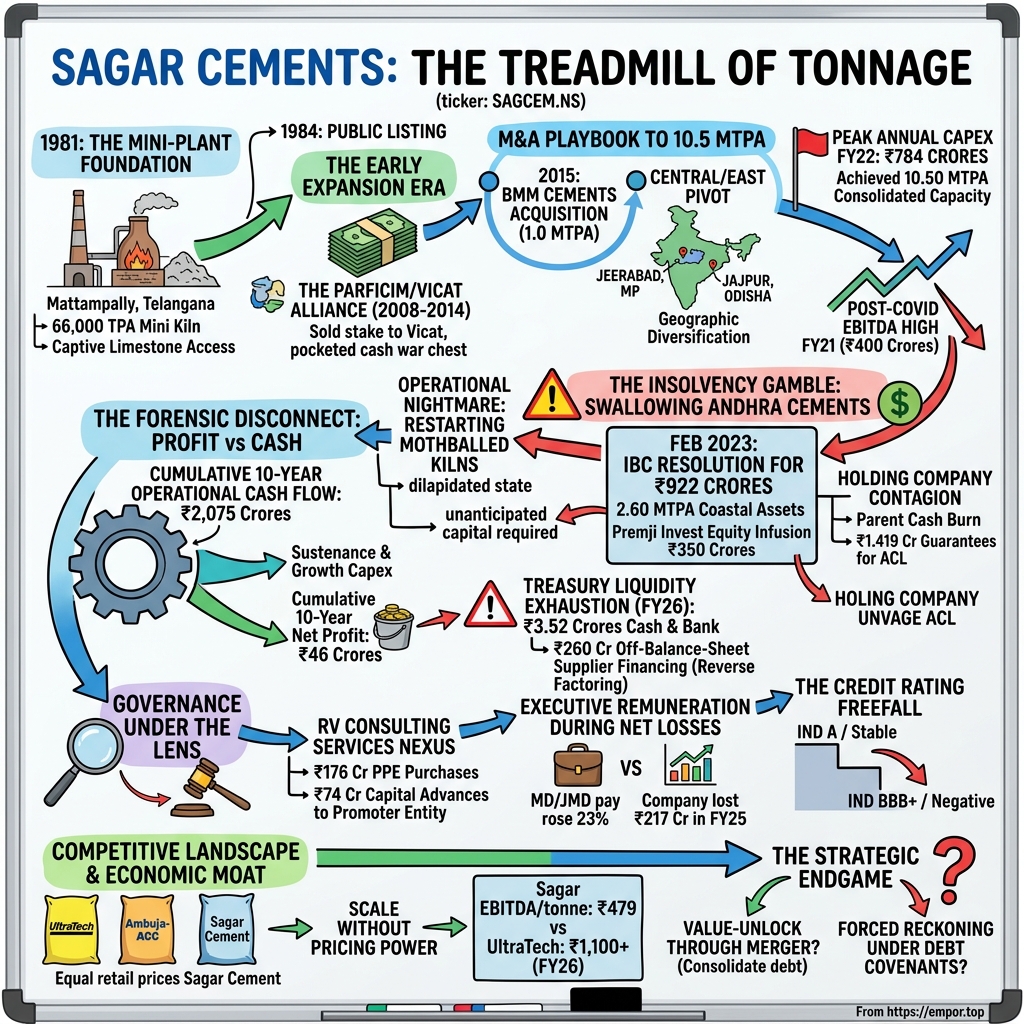
Picture two numbers on a whiteboard in Hyderabad. The first is 2.75. The second is 10.50. They are the company's installed cement capacity in million tonnes per annum, the first from around FY15 and the second from FY24 onward12. Between them lies a decade of building: kilns lit in Madhya Pradesh, grinding mills switched on in Odisha, a bankrupt Jaypee-era plant pulled out of an insolvency court in Andhra Pradesh. By the yardstick a cement company uses to describe itself, tonnes of capacity, Sagar Cements grew almost fourfold. Today it sells into five southern and central states and calls itself a regional heavyweight.
Now write a third number under the first two: 46. That is roughly the cumulative consolidated net profit, in crores of rupees, that Sagar earned for its shareholders across the ten fiscal years from FY17 to FY262. Over the same decade, revenue added up to more than ₹16,500 crore and operating cash flow came to about ₹2,075 crore2. Nearly all of that cash went back into kilns, mills, mines and acquisitions. The decade closed with a ₹217 crore loss in FY25 and an essentially break-even FY2612.
So a business built about ₹16,500 crore of sales to keep roughly ₹46 crore. That gap is what this story is about. Cement is a capital arena where a single integrated plant costs thousands of crores, where a bag cannot travel more than a few hundred kilometres before freight eats the margin, and where prices in South India have broken down into price wars again and again for four decades. Sagar played that game hard. The question is who won.
Three questions run through the story.
The first is the capacity trap. In a regional commodity business ruled by freight distances and price swings, does doubling scale build an operating fortress, or a debt treadmill that hands the economic surplus to lenders and equipment suppliers instead of equity holders?
The second is the IBC rescue. In 2023 Sagar bought Andhra Cements out of insolvency at what looked like a steal per tonne[^3]. Did that deal give it cheap coastal assets, or did it tie the parent to a subsidiary that needs constant support?
The third is the related-party funnel. Why did equipment purchases from, and capital advances to, a promoter-controlled company jump exactly when the group's cash fell to almost nothing and the rating agency was cutting its grades13?
The route runs from a 200-tonne-a-day plant in Nalgonda to a multi-state cement group. It passes through a French alliance and its unwinding, a distressed acquisition in Kurnool, Premji Invest's ₹350 crore bet, the restart of Andhra Cements' old kilns, and then into the footnotes: reverse factoring, promoter advances, auditor remarks. It ends with the endgame now in view, a merger that pulls the troubled subsidiary into the parent while the rating sits on a negative watch.
 Subscribe on LinkedIn
II. Roots in the Telangana Limestone Belt
In 1981 the village of Mattampally in Nalgonda district (now Suryapet district, Telangana) sat on top of something valuable and dull: limestone. That year a company was incorporated in Hyderabad to quarry it and turn it into cement. Its corporate identity number still carries the year, L26942TG1981PLC0028871. The founder, S. Veera Reddy, started small. The first plant was a 200-tonnes-per-day unit, about 66,000 tonnes a year[^5]. That is a rounding error next to the 10.5 million tonnes the group runs today, and it was a mini-plant even by the standards of the time.
Mini-plants were a creature of policy. In the late 1970s and early 1980s India was easing price and distribution controls on cement, and smaller producers got incentives to bring local limestone into a supply-starved market. For an entrepreneur in Andhra Pradesh the logic was simple. The rock was cheap and sat next to the kiln, demand was rising, and the large national producers were far away. Sagar listed on the stock market in 19841, and its later expansions were funded partly by public shareholders. That habit of going to the market for capital will come back again and again.
From shaft kiln to rotary kiln
Early mini-plants commonly used vertical shaft kilns. Picture a tall chimney: limestone and fuel go in at the top, and clinker, the grey nodules that are ground into cement, comes out at the bottom. They are cheap to build and hard to run consistently. The quality varies and the fuel bills are heavy. The industry's winners moved to dry-process rotary kilns, the long, slightly tilted steel tubes that turn slowly over a flame and produce clinker continuously and efficiently. Sagar made that move and expanded Mattampally in steps until it reached about 2.75 MTPA by the middle of the 2010s12. That step, more than the founding, is what turned a policy-era mini-plant into a real cement company. It also locked Sagar into its geography. A cement plant is anchored to its quarry, and its quarry was in the South.
The southern curse
Geography matters in cement more than almost anywhere else. A tonne of cement is worth only a few thousand rupees, and moving it by road gets expensive within a few hundred kilometres. So cement markets are regional, and regions differ a lot. South India, with large limestone belts in Andhra Pradesh, Telangana and Karnataka, has long had more capacity than local demand, and utilisation has often run well below the levels typical in the North and Centre4. When too many kilns chase too few trucks, regional price discipline tends to break down into discounting. Sagar's home market has been structurally prone to gluts for as long as the company has existed.
That matters for the core thesis. A low-cost producer with its own limestone can survive a glut. It cannot make a glut profitable. The best Sagar could build on its own ground was a durable floor, not a high ceiling.
Staying independent, and the French interlude
The 2000s brought global capital into Indian cement. Holcim, Heidelberg and Lafarge bought in, and the Aditya Birla group put together what became UltraTech. Many small southern producers sold. Sagar did not. Instead, in 2008, it brought in a foreign partner on its own terms: France's Vicat, through its arm Parficim, took a direct stake in Sagar at ₹700 a share and formed a 50:50 joint venture with it15. The JV, Vicat Sagar Cement, was meant to build a large new plant in Karnataka.
The partnership did not last. By 2014 Vicat had exited its relationship with Sagar, and Sagar had sold its share of the joint venture to the French group5. Accounts of the unwinding describe friction between the partners, and the important result was the money. Sagar came out of the decade still independent and with cash in hand at the moment its regional rivals were selling. The verdict on these years is mixed. The founding generation built a real integrated producer with its own limestone, and it got through the consolidation wave intact. It also stayed tied to the South's chronic oversupply. The next generation of management would try to get out of that market by buying their way into new ones.
III. The M&A Playbook: BMM, Jeerabad, and the March to 10 MTPA
The new playbook started in Kurnool district, Andhra Pradesh, at a plant that was not quite working. In 2015 Sagar agreed to acquire BMM Cements, a roughly 1 MTPA integrated unit at Gudipadu with its own 25 MW captive power plant, for an enterprise value reported at about ₹540 crore[^8]. BMM had been squeezed by financial strain and project problems. For Sagar it was a shortcut. Instead of spending years on land, mining permits and environmental clearances, it could buy a near-finished plant and finish the job itself.
The managing director's chair by then belonged to the founder's family. Dr. S. Anand Reddy is managing director and S. Sreekanth Reddy is joint managing director, and between them they run the company1. They also sit at the centre of the promoter group that owns just under half of it, directly and through RV Consulting Services, a company in which they exercise control1. That dual role, executives of a listed company and controllers of a private company that supplies it, will matter later. In the 2010s the story was momentum. Gudipadu came under Sagar's control and is today one of the parent's two integrated plants, next to Mattampally1.
Going 800 km north
The bolder move was leaving the South. Through Sagar Cements (M) Private Limited, a subsidiary 65% owned by the parent, Sagar built an integrated plant at Jeerabad in Madhya Pradesh's Dhar district1. It also added a grinding unit at Jajpur in Odisha1. The logic made sense on paper. Central and eastern India have historically run tighter supply-demand balances than the South, so a tonne sold there should fetch more. The move also spread Sagar's risk across more than one regional cycle.
There was a policy sweetener in the Centre as well. In FY26 the Jeerabad subsidiary booked about ₹68 crore of government grants from the Madhya Pradesh Industrial Development Corporation, tied to production and employment thresholds, up from about ₹46 crore a year earlier1. That is real cash, and in a year when consolidated EBITDA was about ₹292 crore2 it was a large part of the profit pool. It also means some of the "higher-margin central market" thesis is in fact a state incentive, which by nature does not last forever.
The capital bill
Every one of these moves was paid for mostly with debt. Capex peaked at about ₹784 crore in FY22, the year that also absorbed the Andhra Cements bid and the central expansions12. Capacity reached 10.50 MTPA by FY2412. The group structure got more complicated along the way: a parent with two integrated plants and two grinding units, a 65%-owned subsidiary in Madhya Pradesh, and, soon, a listed subsidiary in Andhra Pradesh. Each had its own lenders and its own guarantees from the parent.
The false dawn
Then came FY21, which looked like proof that the plan was working. In the year of the pandemic, Indian cement producers held back output during lockdowns, petcoke was cheap, and the government spent on infrastructure. Sagar's operating margin hit about 29%, EBITDA reached about ₹400 crore and net profit was about ₹186 crore2. Measured over the decade, that single year produced more net profit than all the other nine combined, since the cumulative ten-year total is only about ₹46 crore2.
That fact is the real verdict on this section. FY21 was not a new plateau. It was a cyclical peak, and the ten-year record shows it. Margins fell to about 6% by FY252. Geographic diversification did help: Sagar now sells in more markets than just Andhra and Telangana. But diversification does not raise returns when every new market is a commodity market and every plant is financed with borrowed money just before fuel costs spike. The evidence supports a narrower claim than "scale created a stronger company." Scale created a bigger company that is just as exposed to the cycle and carries more debt. And at the top of that false dawn, management went after the biggest deal in its history.
IV. The Insolvency Gamble: Swallowing Andhra Cements
In February 2023 the Hyderabad bench of the National Company Law Tribunal approved Sagar Cements' resolution plan for Andhra Cements Limited[^3]. ACL was a bankrupt company that had been part of the Jaypee Group's sprawling empire and had gone through India's Insolvency and Bankruptcy Code. Sagar's plan valued the deal at roughly ₹922 crore[^3]. In return it got an integrated plant at Dachepalli in Guntur district, close to the Amaravati capital region, and a grinding unit at Visakhapatnam on the coast1[^3]. The deal also came with idle kilns, disused railway sidings and years of neglect.
Why it looked cheap
The arithmetic made the deal compelling. Andhra Cements brought roughly 1.65 MTPA of clinker and 2.60 MTPA of grinding capacity. At about ₹922 crore, Sagar was paying the equivalent of around $43 a tonne, against greenfield replacement costs commonly put at $90 to $100 a tonne1[^3]. Building that capacity from scratch would have taken years of land acquisition, a limestone auction and environmental approvals. Through the IBC, the court handed it over in one order.
Premji's ticket
To fund the bid without loading the parent with even more debt, Sagar sold equity. In May 2022 it allotted about 1.32 crore shares at ₹265 each to PI Opportunities Fund I Scheme II, the investment arm of Azim Premji's family office, raising ₹350 crore1[^9]. Premji Invest ended up with about 10.1%1. The ₹265 price was reported at the time as a premium to the market[^9]. That signal mattered as much as the money: a respected long-term investor had backed the plan with its own capital. Even so, the record is plain. The listing price on March 31, 2026 was about ₹1531, well below what Premji paid. The backing gave the plan credibility. It did not make the plan work.
Restarting a dead plant
A mothballed cement plant is not a car you jump-start. Refractory bricks lining the kiln crack and fall out when it sits cold. Electrical substations decay. Conveyors seize. Railway sidings that carried coal in and cement out sit unused. Restarting all of that took money and time that the bid price did not include. Sagar has since expanded Dachepalli clinker output and has a cement grinding expansion under way there1. But the subsidiary's own numbers show how far it still is from paying for itself. In FY26, ACL burned about ₹25 crore of operating cash and lost about ₹67 crore at the net level1.
How the subsidiary leaned on the parent
This is where the deal's cost moves from Andhra Cements' books to Sagar's. In FY26 the parent lent ACL about ₹150 crore in intercorporate loans, with nothing repaid during the year1. It gave ACL an unconditional letter of financial support1. And it guaranteed about ₹975 crore of ACL's borrowings, on top of about ₹444 crore guaranteed for the Madhya Pradesh subsidiary, for total corporate guarantees of about ₹1,419 crore1.
Put plainly, the "cheap" plant came with an ongoing claim on the parent. A guarantee does not appear as debt on the parent's own balance sheet, but if the subsidiary cannot pay, the lenders come to Sagar.
What the auditor said
The clearest warning came from the auditor. B S R and Co gave the FY26 accounts an unmodified opinion1. But in the consolidated report's CARO annexure, which collects the auditors' remarks on each group company, Andhra Cements drew adverse remarks under three clauses: unpaid statutory dues, cash losses, and, most seriously, Clause 3(xix), material uncertainty about whether the company could meet liabilities falling due within one year1. The parent drew remarks too, on disputed and undisputed statutory dues1. A Clause (xix) remark is not a going-concern qualification of the group. It is the auditor saying, in the formal language of the Companies Act, that this subsidiary cannot be assumed to pay its bills without help.
Collapsing the structure
Sagar's response has been to pull the problem closer. In FY26 the parent sold 15% of ACL through an Offer for Sale, taking its stake from 90% to 75% to meet minimum public shareholding rules, and raised about ₹88 crore1. Then on March 30, 2026 its board approved, in principle, a scheme of amalgamation to merge ACL into Sagar itself6. The case for it is real. A single entity removes trapped cash, makes it easier to move clinker between plants, and may allow tax losses to be used. The cost is just as real. ACL's debt, losses and auditor remarks would sit on the parent's own balance sheet.
The verdict is narrower than either side would like. At about $43 a tonne, the price of the assets was low by any replacement-cost measure. Execution has turned that price into a much larger total bill, paid in restart capital, cash losses and parent guarantees. The deal is neither a masterstroke nor a disaster yet. It is a bet that has not paid for itself, and the deciding number is whether ACL's operating cash flow turns positive after debt service. To see why the parent cannot carry that bet indefinitely, look at its treasury.
V. The Forensic Disconnect: Profit, Cash, and Off-Balance-Sheet Levers
On March 31, 2026, the treasury desk at Sagar's Hyderabad office closed the year with consolidated cash and cash equivalents of about ₹3.5 crore1. A year earlier the figure was about ₹70 crore1. The standalone margin-money deposits, the cash banks hold as collateral for letters of credit, fell from about ₹64 crore to about ₹4.5 crore1. Against that sat roughly ₹149 crore of term debt due within the next twelve months1. For a company with about ₹2,650 crore of annual revenue2, ₹3.5 crore is less than half a day's sales.
How does a business that reports ₹200-plus crore of operating cash flow most years end up with almost no cash? The answer is not fraud. It is arithmetic, plus one piece of financing that sits in an unexpected place.
The depreciation mirage
Start with how the cash flow statement works. Operating cash flow begins with net profit and adds back depreciation, because depreciation is not a cash payment. In FY26 Sagar's depreciation and amortisation was about ₹240 crore1. Interest, about ₹197 crore, is shown under financing activities rather than operating activities1. So a company can report a loss and still show healthy operating cash: in FY26 consolidated operating cash flow was about ₹216 crore against a net loss of about ₹1 crore12.
Over ten years that pattern adds up to about ₹2,075 crore of operating cash against about ₹46 crore of net profit, with roughly ₹1,243 crore of depreciation in between12. If depreciation were just an accounting artefact, the operating cash figure would be the true measure of earning power. In cement it is not. Kilns, preheaters, ball mills and dust collectors wear out. Refractory linings need replacing. Pollution rules tighten and require new equipment. Depreciation is the accounting estimate of a cost that eventually has to be paid in cash.
FY26 shows it plainly. Operating cash flow of about ₹216 crore minus capex of about ₹423 crore leaves free cash flow of roughly minus ₹208 crore1. To close that gap the group took on about ₹397 crore of new gross term loans and ran its cash balance down to almost nothing1. That is the treadmill in one year: the plants produce cash, the cash goes straight back into the plants, and the shortfall is borrowed.
The supplier financing line
The second clue is easy to miss. Reported borrowings at March 31, 2026 were about ₹1,672 crore1. That figure is what most screens and ratio databases pick up. But in Note 15, under "other financial liabilities," the group disclosed about ₹260 crore of supplier finance arrangements, up from about ₹227 crore a year earlier1.
The mechanism is simple. Sagar's suppliers of coal, petcoke and equipment get paid upfront by a partner bank under 90-day usance letters of credit. Sagar repays the bank later and pays interest for the delay1. The supplier is happy, Sagar's payables look like ordinary trade payables, and the liability does not appear under borrowings. Economically, though, it is a short-term bank loan. It carries interest, it depends on bank credit lines, and banks can shrink those lines when a borrower weakens.
Add the supplier finance and about ₹36 crore of lease liabilities to reported borrowings and total economic debt comes to roughly ₹1,968 crore1. Against FY26 EBITDA of about ₹292 crore2 and almost no cash, that is net debt of roughly 6.7 times EBITDA. Using reported borrowings alone gives a ratio closer to 5.7 times. Both are high for a cyclical commodity producer. The extra turn of leverage hidden in the supplier finance is the part an analyst who stops at "borrowings" would miss.
Myth versus reality: "the receivables are clean"
A common reassurance about Sagar is that its working capital is tight, and on the narrow measure that is true. Debtor days have stayed between about 22 and 33 days over five years1. Standalone gross receivables were about ₹186 crore, with about ₹16 crore of expected credit loss provision, roughly 8.5%1. Most of the overdue balances are less than six months old. The parent provides almost fully for balances older than three years1. Collections are not the problem.
The problem shows up on the pricing side. In FY26 the parent billed about ₹2,016 crore of gross contract revenue and gave back about ₹270 crore in trade discounts and rebates, about 13.4% of the gross bill, up from about 12.3% in FY251. Dealers pay on time partly because they are paid to. Volume grew about 10.7% to 6.10 million tonnes in FY261, and the rising rebate share suggests some of that growth was bought with price.
The verdict on this section is the sharpest in the story. Sagar's operating cash flow is real cash, but it does not belong to shareholders. It belongs first to the kilns' maintenance bill and then to the lenders. Reported leverage understates the true figure by about a sixth. A company in this position needs every party it deals with to behave, and that raises a governance question: who else is the money flowing to?
VI. Governance Under the Lens: RV Consulting, Remuneration, and the Rating Downgrade
There is a board meeting every listed Indian company holds that rarely makes news: the one that sets pay for the top executives. At Sagar, the FY26 remuneration outcome was this. Managing director Dr. S. Anand Reddy received about ₹5.25 crore and joint managing director S. Sreekanth Reddy about ₹4.73 crore, together about ₹9.98 crore1. That was roughly 23% more than the previous year's combined ₹8.11 crore1. The previous year was FY25, when the group lost about ₹217 crore2 and India Ratings cut its rating to BBB+3.
Pay against profit
The structure of the pay matters. It is fixed salary and perquisites, with no variable commission linked to profit1. So when profits collapsed, executive pay did not. The MD's pay came to about 81 times the median employee's, and the JMD's about 73 times, while median employee pay rose about 6.3%1. Fixed pay during a downturn is not improper in itself. But a 23% raise after a ₹217 crore loss sends a signal about who is protected from the cycle and who is not.
The RV Consulting nexus
The bigger issue is RV Consulting Services Private Limited. It is a promoter-group company: it holds about 9% of Sagar's equity, the largest single promoter block, and Sagar describes it as an entity in which key management personnel exercise control1. It is also one of Sagar's suppliers.
In FY26 the group bought about ₹176 crore of property, plant and equipment from RV Consulting, double the roughly ₹89 crore bought in FY251. Capital advances paid to RV Consulting, money paid ahead of delivery, went from about ₹4 crore to about ₹74 crore, an increase of roughly seventeen times1. In the same year Sagar borrowed ₹50 crore unsecured from RV Consulting and paid it about ₹6.8 crore in interest1. Another promoter-linked company, Panchavati Polyfibres, supplied about ₹50 crore of cement bags1.
Put those flows in sequence and the timing is uncomfortable. In the year the group's cash fell from about ₹70 crore to about ₹3.5 crore, it sent about ₹74 crore of advances to a company controlled by its own managing directors. On top of that, the same company is both a lender to Sagar, earning interest, and a supplier, earning margin on equipment. Sagar publishes the volumes of these transactions. It does not publish the competitive bids, the margin RV Consulting earns, or what the ₹74 crore of advances is buying. Without that, minority shareholders cannot tell whether the prices are fair.
The fair counterpoint is that related-party transactions are approved by the audit committee and that the most material ones go to shareholders. In a postal ballot concluded on March 13, 2026, on a material change to related-party transactions with Andhra Cements, about 99.7% of votes cast were in favour, while about 10.2 crore promoter and interested shares abstained as required1. The board includes three independent directors and nominees from Premji Invest, AVH Resources and the Telangana State Industrial Development Corporation1. That is real oversight. It is also worth noting that the ballot covered dealings with Andhra Cements, not with RV Consulting, and that the turnout among non-promoter shares was small, about 1.24 crore votes.
The rating slide
The rating agency's verdict has moved in one direction. India Ratings had Sagar at IND A/Stable in October 2023, moved the outlook to Negative while affirming the A rating in August 20247, and downgraded it to IND BBB+/Negative in May 20253. In July 2026 it downgraded the Madhya Pradesh subsidiary to IND BBB/Stable8. The reasons are consistent across the releases: weak EBITDA per tonne in southern markets, net leverage well above the agency's comfort levels, and liquidity drained by continued debt-funded capex38. EBITDA per tonne was about ₹256 in FY25 and about ₹479 in FY2613, against the ₹800 to ₹1,000 that the industry's stronger producers have earned in decent years.
The governance verdict follows. None of this is proof of wrongdoing, and the promoters have pledged no shares1. But the combination of rising related-party capex, a promoter loan, executive raises during losses and a falling credit rating explains why the market prices Sagar's tonnes so far below what they would cost to build. To see whether those tonnes can ever earn more, the next step is to look at the competition.
VII. Competitive Landscape & Economic Moat: Scale Without Pricing Power
Walk into a dealer's yard in Vijayawada. Stacked side by side are 50 kg bags of UltraTech, ACC or Ambuja, and Sagar. All are OPC 53-grade cement made to the same Bureau of Indian Standards specification. A mason building a house checks the grade and the date, then asks which bag is cheaper. Sagar's brand has real recognition in Telangana and coastal Andhra, but in this market it typically sells at a discount to the national leaders. Everything else about Sagar's competitive position follows from that.
The industry has consolidated around Sagar
Indian cement has gone through a fast consolidation. UltraTech bought Kesoram's cement business and a controlling stake in India Cements. Adani's Ambuja bought Sanghi, Penna and Orient4. In South India, much of the capacity is now controlled by two groups with low leverage, nationwide logistics and rail networks, and the balance sheets to absorb a long price war. Sagar is a 10.5 MTPA independent between them. UltraTech alone has well over 150 MTPA.
Porter's five forces
Threat of new entrants: low. A greenfield integrated plant costs in the region of ₹7,500 to ₹8,500 per tonne of capacity1, and limestone now has to be won at auction. Few new players can enter. But this barrier protects the industry, not Sagar specifically. The incumbents that matter are already inside.
Supplier power: high. Coal and petcoke are about 36% of production cost1. In FY26 Sagar used about ₹310 crore of domestic coal and petcoke, entirely unhedged, and about ₹78 crore of imported fuel, hedged1. The direct currency exposure is small, a 5% rupee move changes pre-tax profit by less than ₹1 crore1, but the commodity exposure is not. When fuel spikes, Sagar has no way to pass it on faster than its competitors.
Buyer power: high. No customer accounts for even 10% of revenue1, which sounds like strength. It is not. Thousands of small dealers and masons who can switch brands at zero cost are, collectively, very powerful. The 13.4% of gross billing given back as rebates is the price of that power1.
Threat of substitutes: low. Nothing replaces concrete in Indian construction. Blended cements reduce the clinker in each bag but are still cement.
Rivalry: intense. When the South has too much capacity, producers push clinker and cement across state borders, and realisations fall for everyone. The rating agency has pointed specifically to slow price recovery in southern markets as a cause of Sagar's weakness3.
Helmer's seven powers
Scale economies: weak. Ten million tonnes is big enough to spread plant overheads but too small to match the national leaders on freight, fuel purchasing and rail logistics.
Network effects, counter-positioning and switching costs: none. Cement is a standardised product. Sagar runs the same playbook as everyone else.
Branding: modest. The Sagar name is known regionally, but it sells at a discount rather than a premium.
Cornered resource: partial. Captive limestone at Mattampally, Gudipadu, Jeerabad and Dachepalli1 secures supply, but every serious competitor has its own limestone too.
Process power: modest. Sagar has fuel flexibility and is testing newer technology, LC3 calcined clay cement, syngas and electric loaders, but total R&D was about ₹7.7 crore in FY261. That is enough for pilots, not for a cost advantage.
The verdict: a scale trap
The evidence rejects the idea that 10.5 MTPA gives Sagar a moat. The cleanest test is EBITDA per tonne. The rating agency's numbers put Sagar at about ₹256 in FY25 and about ₹479 in FY2631. Market leaders have generally earned well over ₹1,000 a tonne in normal years. A gap that large is not about the cycle alone. It is about cost position, freight, and price. Sagar is big enough to be a target in a regional price war and too small to set prices. The claim that would survive is narrower: Sagar owns real, well-located plants with captive limestone that would be worth more inside a larger competitor than they are on their own. That is the question the next sections come back to.
VIII. Playbook: Business & Investing Lessons
1. In heavy industry, depreciation is a bill, not a footnote
The moment: ten years, about ₹2,075 crore of operating cash flow, about ₹46 crore of net profit2. A naïve reading says the business generates cash and the accounts are too conservative. The reality is that roughly every rupee of that cash went back into kilns and mills and was topped up with borrowing. When maintenance and modernisation capex keep matching or exceeding depreciation, operating cash flow is an intermediate number, not owner earnings. At Sagar, the kiln always eats first.
2. Distressed capacity is only cheap if it can feed itself
The moment: Andhra Cements bought out of insolvency at about $43 a tonne[^3], then losing about ₹25 crore of operating cash a year later and needing nearly ₹1,000 crore of parent guarantees1. Plants end up in the IBC for reasons: neglected equipment, logistics penalties, weak markets. The purchase price is only the first instalment. The rest is paid in restart capex, operating losses and the parent's credit rating. A bargain per tonne can still be expensive per year.
3. Look below the borrowings line
The moment: ₹1,672 crore of reported borrowings, and ₹260 crore more in Note 15 as supplier finance1. Reverse factoring is legal and widespread. It is also bank debt in all but name, and it is exactly the kind of credit that gets cut back first when a borrower is downgraded. An analyst who stops at "borrowings" misjudges Sagar's leverage by about a sixth. If a bank is paying your suppliers, you owe the bank.
4. When growth capex becomes related-party capex
The moment: ₹176 crore of equipment bought from RV Consulting and ₹74 crore advanced to it in the year the cash ran out1. In capital-heavy businesses, the biggest flows of money are capex, and when a promoter-controlled company sits in that flow, the incentives of the promoters as suppliers and as shareholders diverge. The company carries the cement price risk; the supplier earns a margin either way. When the promoter is also the vendor, minority shareholders own the cycle and the promoter owns the order book.
IX. Analysis & Bull vs. Bear Case
Imagine two analysts in Mumbai looking at the same company. The deep-value analyst sees 10.5 MTPA of plants, captive limestone and a stock that values all of it at about $42 a tonne of capacity1. The credit analyst sees net debt above six times EBITDA, ₹3.5 crore of cash and a negative outlook on a BBB+ rating13. Both are right. The disagreement is about which number wins first.
What the market is pricing
At about ₹153 a share on March 31, 2026, with about 13.07 crore shares outstanding, Sagar's market value was about ₹2,000 crore1. Adding reported net debt gives an enterprise value of roughly ₹3,670 crore, or about ₹3,930 crore with supplier finance counted1. That is about ₹3,500 per tonne of capacity, well under half the commonly cited greenfield cost, and well below the per-tonne prices paid in recent southern deals such as UltraTech's India Cements purchase and Ambuja's Orient acquisition, which analysts have generally put around $100 a tonne or more4. On earnings it is about 12.5 times FY26 EBITDA, and P/E is meaningless because there are no profits12. The price implies the market values Sagar as a set of assets that do not reliably earn their cost of capital, partly offset by the chance that someone else will buy them.
The bull case
The replacement-cost discount. At about $42 a tonne against roughly $90 to $100 to build new, the assets are cheap. If a consolidator ever buys Sagar at anything near recent deal multiples, the equity would be worth far more.
The Andhra Cements merger. A single entity removes trapped cash between parent and subsidiary, may allow ACL's tax losses to be used, and makes it simpler to move clinker from Dachepalli to the coastal grinding units6.
Home-market demand. Revived construction in Andhra Pradesh, including Amaravati and Polavaram, would fall right in the middle of Sagar's plants.
Clean promoter shares and a strong investor. No promoter shares are pledged1. Premji Invest holds about 10.1% and AVH Resources about 19.6%1, which means sophisticated outside capital could back a recapitalisation.
Operating leverage. On roughly 6 million tonnes of sales1, every ₹100 a tonne of extra margin adds about ₹60 crore of EBITDA, which is a fifth of FY26's total.
The bear case
The liquidity wall. About ₹3.5 crore of cash against about ₹149 crore of scheduled repayments in FY27 and about ₹293 crore of working capital lines that are payable on demand1. Sagar has to refinance, sell assets or raise equity. Any further weakness in southern prices makes each of those harder.
Further downgrades. The rating already sits on a negative outlook3. A cut toward BBB- would raise borrowing costs and could shrink exactly the supplier finance and working capital lines Sagar depends on.
The giants' staying power. UltraTech and Adani have the balance sheets to keep southern prices low for a long time. Sagar does not.
Related-party drag. If capex keeps flowing through promoter-controlled vendors, minority shareholders get the cycle's downside and only part of the upside.
Historical falsification: does the bull case survive the record?
Three bull claims deserve testing against Sagar's own history.
"Cheap assets will eventually earn." Over ten years, a company that doubled and then quadrupled capacity earned a cumulative ₹46 crore2. Only one year, FY21, produced returns worth the name. The record narrows this claim sharply: cheap assets earn when the cycle peaks, and the cycle has peaked once in a decade.
"Management can execute large deals." BMM and Jeerabad are running, which is real execution. But Andhra Cements is three years past the court order and still burning cash with an adverse auditor remark1. The claim survives in a smaller form: management can build and acquire plants; it has not yet shown it can make them earn their cost of capital.
"Strong backers provide a safety net." Premji Invest put money in at ₹265; the stock trades far lower1[^9]. Backers can supply equity, but at a price that dilutes existing holders. The safety net is real but not free.
The three KPIs that matter
- Consolidated EBITDA per tonne. It was about ₹479 in FY26, up from about ₹256 in FY2513. It needs to reach something like ₹750 to ₹800 sustainably for the debt and capex to be comfortable.
- Net debt to EBITDA, counting supplier finance. Roughly 6.7 times today12. The rating agency's comfort level is below about 3.5 times3.
- Unencumbered cash and the ACL auditor remark. Cash is about ₹3.5 crore1. A rebuild above ₹100 crore, and the removal of the Clause (xix) remark on Andhra Cements, would show the liquidity strain is easing.
The overall verdict, hedged once: on the record, Sagar is not a compounding business. It is a leveraged option on southern cement prices and on a takeover, with a governance discount the company itself could reduce through better disclosure.
X. Epilogue
Tonight, Sagar Cements runs 10.5 MTPA of plants across five states from its office in Hyderabad, with about ₹3.5 crore in the bank and a balance sheet that needs every one of its counterparties to stay patient1. Management talks of 11.75 MTPA by FY27 and 20 MTPA by 20351. The question is whether the balance sheet gets there with the equity intact.
Three events will decide it.
The Andhra Cements merger. The board approved the scheme in principle on March 30, 20266. It still needs approval from shareholders, creditors and the NCLT. If it goes through cleanly, the group becomes simpler and cash can move freely. If lenders object or tax disputes slow it down, the subsidiary's losses keep landing on the parent through guarantees and loans, without the structural benefits.
India Ratings' next review. The agency already downgraded the Madhya Pradesh subsidiary in July 20268. Its next look at the parent will show whether FY26's improvement in EBITDA per tonne is enough. A stable outcome would buy time. A further cut would raise the cost of every line of credit Sagar relies on.
Southern demand and prices. If the revived Amaravati build-out and other Andhra projects push regional prices up meaningfully, operating leverage works in Sagar's favour quickly. If prices stay flat, the company keeps running to stand still.
The tension at the centre of this story has not gone away. Dr. Anand Reddy and Sreekanth Reddy have built a cement group of real physical size. What they have not yet shown is that it can be anything other than a well-located set of assets waiting either for a price spike or for a larger buyer like UltraTech or Adani.
XI. Outro
In 1981, a kiln at Mattampally made 200 tonnes of clinker a day[^5], and in a corner of Nalgonda that was a real achievement. Today the group's plants produce in a morning more than that first kiln made in a year. The rock is the same. The trucks are bigger. The bills are much bigger.
Forty-five years in, Sagar has proved it can build kilns from Telangana to Madhya Pradesh to the Bay of Bengal. What it has not yet proved is who the kilns work for. In heavy industry, volume is vanity, operating profit is sanity, and free cash flow into your own bank account is reality. On the record so far, Sagar's kilns have worked for the lenders and the equipment suppliers. Whether they will ever work for the shareholders is still open.
References
-
45th Integrated Annual Report 2025-26 — Sagar Cements Limited / BSE India, 2026-06-16 ↩↩↩↩↩↩↩↩↩↩↩↩↩↩↩↩↩↩↩↩↩↩↩↩↩↩↩↩↩↩↩↩↩↩↩↩↩↩↩↩↩↩↩↩↩↩↩↩↩↩↩↩↩↩↩↩↩↩↩↩↩↩↩↩↩↩↩↩↩↩↩↩↩↩↩↩↩↩↩↩↩↩↩↩↩↩↩↩↩
-
Sagar Cements Consolidated Historical Dossier — Screener.in, 2026-10-02 ↩↩↩↩↩↩↩↩↩↩↩↩↩↩↩↩↩↩↩↩
-
India Ratings Downgrades Sagar Cements Limited to IND BBB+/Negative — India Ratings and Research, 2025-05-08 ↩↩↩↩↩↩↩↩↩↩↩
-
South India Cement Price Dynamics and Consolidation Overview — CRISIL Market Intelligence & Analytics ↩↩↩
-
French Cement Major Vicat Exits Sagar Cements JV — Business Standard, 2014-07-16 ↩↩
-
Corporate Announcement: Scheme of Amalgamation of Andhra Cements with Sagar Cements — BSE India, 2026-03-30 ↩↩↩
-
India Ratings Affirms Sagar Cements Limited at IND A/Negative — India Ratings and Research, 2024-08-12 ↩
-
India Ratings Downgrades Sagar Cements (M) Private Limited to IND BBB/Stable — India Ratings and Research, 2026-07-02 ↩↩↩
 LinkedIn
 WhatsApp
 Reddit
 Hacker News
 Email
Email Kindle
 RSS Feed
 Spotify
 Apple Podcasts
 Amazon Music
 Audible
 YouTube