Safe Enterprises Retail Fixtures: Standardizing the Shop Floor of India's Retail Revolution
I. Introduction & Episode Roadmap
Somewhere in India, right now, a Zudio store is being born. A raw concrete shell in a Tier-3 town — bare walls, exposed conduit, a landlord's lease clock already ticking — will be handed over to a crew on a Monday. By the following weekend it will have gleaming white perimeter walls lined with steel bays, hanging rails at exactly the right height, a cash desk with an acrylic top, stepped display tables at the entrance, and lighting that makes a ₹399 shirt look like it belongs there. The shopper who walks in on opening day will not think about any of it. That is the entire point.
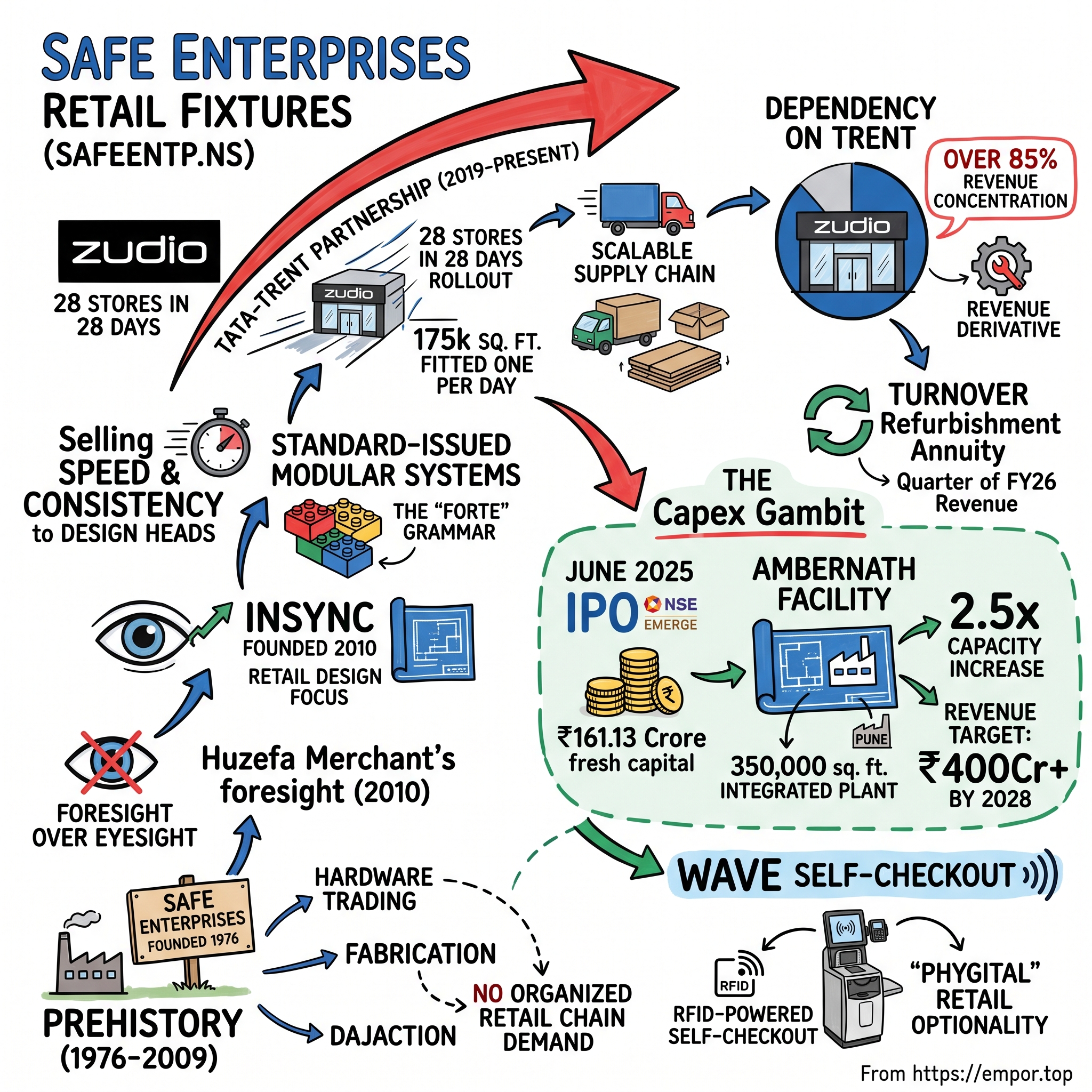
In early 2019, that process ran at a pace nobody in Indian retail had attempted before. Trent Limited, the Tata Group's retail arm, opened 28 Zudio stores across the country in 28 days — roughly 175,000 square feet of selling space, delivered and fitted out one store per day, in a country where a single store fit-out routinely took six weeks.1 The fixture partner for the entire rollout was a Mumbai family firm most people in Indian capital markets had never heard of: Insync Shopfittings, the standardized-systems brand of Safe Enterprises.
Ashley D'Cruz, then head of store planning and projects at Trent, described the brief plainly: "The challenging opportunity given by Mr Tata of opening 28 stores in 28 days itself was very intimidating."1 On the supplier side, Huzefa Merchant, director of Insync, framed it as a manufacturing problem rather than a construction one: "We took on the challenge to fit out 28 stores in 28 days spanning over 1,75,000 Sq. ft."1 Thirty-five distinct SKUs, all pre-engineered, all drawn from one standardized structural family called Forte, shipped flat and assembled on site.1
That month is the hinge of this entire story. It is when a metal-bashing job-shop turned into something closer to a product company.
The subject, and the paradox
Safe Enterprises Retail Fixtures Limited listed on the NSE Emerge SME platform on 27 June 2025, raising ₹161.13 crore of entirely fresh capital at ₹138 per share.2 Just over a year later, it is a debt-free manufacturer with a market capitalisation in the neighbourhood of ₹1,180 crore, carrying zero borrowings and a return on capital employed that most listed Indian industrials would find embarrassing to sit next to.5
Here is the paradox that makes the company worth an episode. In the year ended March 2026, Safe reported consolidated revenue of ₹218.4 crore and net profit of ₹63.9 crore — a net margin of roughly 29%, on an operating margin of about 36%.34 Those are software margins. This is not software. This is powder-coated sheet steel, tubular hanging rails, particle board, acrylic, and a small army of installers on trains and trucks.
Something in that combination is either a genuine structural advantage or a temporary artefact of one extraordinary customer relationship. Working out which is the analytical job of this piece.
The uncomfortable fact at the centre
The company's own offer documents disclosed that a single customer accounted for more than 85% of revenue at the time of listing.2 The prospectus material does not brand that customer in the summaries available publicly, but the company's client roster leads with Zudio and Westside, and its most publicised project remains the Zudio rollout.101 Read the numbers alongside the client list and the picture assembles itself: Safe Enterprises is, to a first approximation, a leveraged operating derivative on how fast Trent opens and refreshes stores.
That is a wonderful place to be while Trent compounds. In FY26, Trent crossed ₹19,701 crore of standalone revenue, opened 212 net new Zudio stores, and finished March 2026 with 963 Zudio and 300 Westside stores.11 It is a considerably less wonderful place to be on the day that pace changes, or on the day Trent's procurement team decides one supplier holding that much of its fit-out pipeline is a risk it cannot carry.
There is a broader reason this small company is worth an hour of attention. India's organized retail build-out is one of the most reliable structural stories in the domestic economy, and most ways of playing it are expensive, crowded, and exposed to fashion risk, rent inflation and same-store sales. Safe Enterprises offers a different exposure: it gets paid when stores are built, regardless of whether the clothes inside them sell. That is a genuinely distinctive position in the value chain. It is also, as this piece will argue, a position with a specific and identifiable failure mode.
Roadmap
The story runs in six movements. First, the long, unglamorous prehistory — a 1976 partnership firm doing hardware and fabrication in a country where organized retail barely existed. Second, the pivot that actually created the business: Huzefa Merchant's decision to stop selling custom carpentry and start selling engineered, repeatable systems. Third, the Trent years, and what standardization does to both margins and dependency. Fourth, a forensic look at where a 36% operating margin in sheet metal actually comes from, and which parts of it are durable. Fifth, the 2025 IPO and the Ambernath capex bet — the moment a family partnership started spending other people's money. Sixth, the technology arm, the WAVE self-checkout platform, and a hard stress test of the moat, the governance, and the numbers that would falsify the bull case.
It starts with a hardware shop.
 Subscribe on LinkedIn
II. The Old Guard: Hardware Trading and Early Shopfitting (1976–2009)
Picture Bombay in 1976. The Emergency is in force. Imports are throttled by licensing. There is no such thing as a shopping mall in India, and the word "retail" describes a kirana counter, a cloth merchant, or a government emporium. In that year, a partnership firm called Safe Enterprises came into existence — a small operation in the hardware and fabrication trade, founded by the Merchant family and destined to spend the next quarter-century in near-total obscurity.6
It is worth pausing on how little the founding says about the company that exists today. Safe Enterprises did not spend 1976 to 2009 building toward a modular shopfitting empire. It spent those years doing what thousands of small Indian engineering firms did: taking orders, cutting metal, quoting on price, and surviving.
There was no industry to serve
The reason is structural, not personal. Through the 1980s and most of the 1990s, Indian retail was overwhelmingly unorganized — millions of independently owned shops, each one a bespoke universe. If a shopkeeper needed shelving, he called a local carpenter and a neighbourhood welder. They arrived with plywood, angle iron, and a measuring tape, and they built something in place. It was slow, it was heavy, it was unrepeatable, and it was fine, because nobody was trying to open the same store in forty cities.
"Shopfitting" as a category requires a specific precondition: a customer that intends to build the same store many times. Without chain retail, there is no demand for standardization, and without demand for standardization, a manufacturer cannot invest in tooling, because tooling only pays back over volume. Indian fabricators were therefore trapped in a low-margin equilibrium by the structure of their own market. The problem was not that they lacked ambition; it was that repeatability had no buyer.
The first real customers arrive
That changed at the end of the 1990s. Shoppers Stop, Pantaloons and the early department-store formats began putting up multi-city footprints. Modern trade grocery followed. Suddenly there were procurement managers whose job was to open store number eleven and store number twelve and have them look like store number one.
Safe Enterprises moved with that shift, transitioning from general hardware and fabrication toward retail display and fixture manufacturing, and rooting its operations in the Thane–Belapur industrial corridor of Navi Mumbai — the MIDC belt around Sanpada where the company's operations are still headquartered today.10 The early client list from this era, still visible in the company's own materials, is a museum of Indian modern retail's first generation: Godrej Nature's Basket, Reliance Retail, Future Group.7
By one internal telling, the shop-fittings business proper dates to 1991 rather than 1976, and the company describes itself as having been India's first organized shop fittings manufacturer.9 Both dates can be true — a 1976 partnership vehicle, a business line that became recognisably shopfitting in the 1990s. It is a useful early signal about disclosure quality at this company: the corporate history is told loosely, in marketing register, and an investor should hold the pre-listing chronology lightly.
Why the old model could never be a good business
The important thing about this period is not what Safe achieved but what the model structurally could not achieve.
Custom fabrication has three permanent handicaps. It has no operating leverage, because every job is a new engineering problem and the design cost is consumed on a single order. It has no quality consistency, because the output depends on which crew showed up. And it has no pricing power, because a customer comparing three quotes for a bespoke rack is comparing three commodity fabricators, and the only visible variable is price.
Layer on the working-capital reality of Indian subcontracting — the retailer pays on completion, the fabricator finances steel, labour and transport in the interim — and you get a business that can grow revenue for decades without ever generating meaningful return on capital. That is where Safe Enterprises sat through the 2000s: a competent, mid-tier supplier in a fragmented trade with no defensible position.
The subcontractor's trap is worth describing precisely, because escaping it is the entire plot of this story. A fabricator's asset base is a shed, some welding sets, a cutting machine and a crew. The barrier to entry is roughly the cost of a shed. So every time a fabricator earns an above-average margin on a job, a competitor down the road observes it, buys a shed, and bids the margin away. Nothing about the work compounds. Yesterday's job teaches you very little about today's, because today's is a different drawing. The knowledge that accumulates is craft knowledge in the heads of individual workers, and craft knowledge walks out of the gate every evening.
The only escape is to build something that does compound — a design library, a tooling investment, a stocked catalogue, a trained national installation network — and each of those requires a customer willing to buy the same thing enough times to justify it. Which means the fabricator cannot escape alone. It needs the market structure to change first. Through the 2000s, in India, it was starting to.
For investors, the era matters as a baseline. Every extraordinary number the company reports today — the operating margin, the return on capital, the cash generation — has to be understood as a departure from what this industry naturally produces, not an expression of it. Something specific had to change to break the pattern. That something was a person, an idea, and a decision to stop selling labour and start selling a system.
III. Huzefa Merchant and the INSYNC Pivot: Standardizing the Fragmented Shop Floor (2010–2016)
The most striking thing about the man who redesigned this company's economics is a detail he refuses to let anyone treat as a detail. Huzefa Salim Merchant is partially sighted. His answer to the obvious question has become the line he is known for across the Indian retail-design circuit: "It takes foresight to run a business not eyesight."8
It is a good line. It is also, unusually for a founder aphorism, a reasonably accurate description of what he actually did.
A different way of seeing the problem
Merchant did not come at shopfitting as a fabricator looking for more work. He came at it as a designer looking at a bottleneck. By 2010, international brands were arriving in India in numbers, domestic chains were setting national expansion targets, and every one of them ran into the same wall: the physical build-out of a store was the slowest, least predictable, most quality-variable part of the whole operation. A retailer could sign a lease in a week and merchandise a store in a day. Fitting it out took a month and a half and produced a different result every time.
So he founded Insync in 2010 as the research, product-development and distribution arm of the family business — positioned, in the company's framing, as India's first standardized shop fitting systems brand.9 Not a fabrication shop with a nicer logo. A product company that happened to make furniture for stores.
Merchant's public output over the following decade reads like someone deliberately building category authority: more than ten design copyrights and multiple pending patents by his mid-thirties, a place on the Asia Retail Congress list of the hundred most influential retail minds in India in 2018, an award from Times Network for a smart shop-fitting solution, and a steady stream of teaching and mentoring at design schools including NID Bangalore and Raffles.89 For a components supplier, that is an odd investment of a founder's time — until you realise that the buyer of a standardized fixture system is not a procurement clerk but a store-design head, and design heads are recruited through ideas, not price lists.
What "modular" actually means, in plain terms
The technical core of the pivot deserves unpacking, because the word "modular" gets thrown around until it means nothing.
The old way: a retailer's architect draws a store. A fabricator measures every wall, designs a unique rack for each run, builds it, trucks it, and installs it — with a carpenter on site solving the inevitable mismatches. Each store is a prototype. Prototypes are expensive and slow.
The new way: the manufacturer designs, once, a structural grammar. A standard upright with slots at a fixed pitch. A standard bracket that clicks into those slots. A standard shelf, a standard rail, a standard base. Every component is engineered to work with every other component, in the way Lego bricks do. The retailer's designer then composes a store out of that grammar rather than commissioning new parts.
Three consequences follow, and they are the whole business.
First, the factory stops making one-offs and starts making runs. A slotted upright is an upright whether it goes to Nagpur or Nashik, so it can be stamped in volume on tooled lines, held as stock, and pulled against orders. That converts a project business into something with the cost curve of a manufactured product.
Second, the site work collapses. Flat-packed components assembled with basic tools take hours instead of days, and the crew does not need to be skilled carpenters. That is what turns 28 stores in 28 days from an insane request into a logistics exercise.
Third — and this is the part that compounds — the retailer's own systems start to conform to the grammar. Store layouts get drawn against the module. Visual merchandising guidelines get written against the shelf pitch. Regional installation teams get trained on the click system. Every one of those is a small, quiet act of lock-in, and none of them appears on a balance sheet.
Safe's system family carried names like Forte, and it was Forte that formed the structural backbone of the Zudio identity — wall bays and floor units drawn from a single engineered set.1
Selling a system is a different sale
The pivot also changed who the company had to persuade, and that is easy to miss.
A fabricator sells to a procurement manager, and procurement managers are trained to run three quotes and take the lowest. A systems company sells to the person who decides what the store is — the head of store design or store planning — and that person is buying speed, consistency and the ability to hit an opening date across forty cities without personally supervising any of them. Price still matters, but it is no longer the only visible variable, because the comparison set is no longer three identical quotes for the same drawing.
This explains the shape of Safe's go-to-market, which looks strange for a manufacturer. There are experience centres rather than showrooms — including one in Cochin, far from the Maharashtra manufacturing base — and distribution touchpoints reaching as far as Dubai and Kansas City, alongside corporate accounts, franchises and distributors.72 Experience centres exist so a designer can walk a system, touch the bracket, see the finish and imagine composing with it. That is a design-industry selling motion applied to industrial products, and it is consistent with a founder who spends his time on award juries and design-school lecterns rather than in procurement waiting rooms.8
It also creates a subtle asymmetry that matters for the moat discussion later. The buyer who chooses a modular system is not the buyer who pays the invoice, and the person who chooses it will have to personally live with the consequences of switching.
The consolidation, and what is not disclosed
The commercial logic of pulling Merchant's design-and-distribution venture together with the family's fabrication capacity is obvious: one side had the engineering and the client relationships, the other had the metal. The precise legal mechanics and timing of that integration — the slump-sale arrangements and internal reorganisations that preceded the eventual public-company structure — are not laid out in the public materials reviewed for this piece, and no reliable dated record of a 2016 transaction was available. What is on record is the destination: the partnership firm was converted into a public limited company in July 2024, ahead of the listing.6
There is one more strand worth flagging now, because it becomes important later. The Insync shop-fittings brand today sits under a separate corporate entity, Safe Enterprises Retail Technologies Private Limited, which the parent describes as the vehicle for standardized shop fitting systems.10 That entity was incorporated in 2020.16 For most of the last two years it has been a majority-owned subsidiary rather than a wholly owned one — a structural loose end the company only tidied up in June 2026, and the manner of that tidying is one of the sharper governance questions in this story.
The pivot itself, though, did exactly what it was designed to do. It gave Safe Enterprises a product to sell instead of hours to bill. What it needed next was a customer with the ambition to consume that product at industrial scale. In 2019, one arrived.
IV. The Tata-Trent Rocketship: How Zudio Rewrote Safe's Destiny (2019–Present)
Zudio's proposition is brutally simple and, for a supplier, enormously consequential: sell trendy apparel at price points so low that the store's economics only work if everything around the merchandise is ruthlessly cheap to build, fast to open, and identical everywhere. A ₹299 t-shirt cannot subsidise a bespoke store.
That constraint is why Trent needed a partner who thought in SKUs rather than in projects — and why the 28-store sprint of early 2019 was less a stunt than a qualifying exam.1
What the rollout actually proved
Read the mechanics of that project and you can see the supplier's business model working in real time. Because the fixtures were standardized, the manufacturing could be de-linked from the store schedule: parts could be produced and stocked ahead of the openings, then allocated as sites came available. Because they were flat-packed, transport cost per store dropped and multiple stores could ship from one production batch. Because they were click-assembled, installation teams could be deployed in parallel across the country rather than sequentially.
The alternative — thirty-five bespoke fixture types designed for twenty-eight different floor plates — is not slower by 20%. It is impossible.
What Safe demonstrated, in other words, was not craftsmanship. It was that it had converted store fit-out from a construction activity into a supply-chain activity. That is a genuinely different thing to sell, and it is the reason the relationship did not stay a one-off.
Riding a rocket
The subsequent seven years have been, for Safe, a case study in the returns to being attached to the right customer at the right moment.
Trent's expansion has been relentless. In FY26 alone it opened 60 Westside and 212 Zudio stores, entered dozens of new cities, and finished the year with a footprint of 17.7 million square feet across 321 cities.11 Its full-year revenue grew 18% to ₹19,701 crore, with operating EBITDA up 27% and adjusted profit after tax up 25% to ₹1,988 crore.11 For a supplier whose revenue is a function of stores built and stores refreshed, that is the definition of a favourable backdrop.
Safe's own trajectory tracks it closely. Consolidated revenue moved from ₹101 crore in FY24 to ₹138 crore in FY25 and ₹218 crore in FY26 — roughly a 47% compound rate over two years, with net profit rising from ₹23 crore to ₹64 crore over the same span.3 The first half of FY26 was the inflection: revenue up 94.6% year on year and profit up 96.1%, which management attributed to added capacity, an expanded Pune unit and new customer formats.15
There is a useful detail buried in the half-yearly cadence. Because Safe reports twice a year rather than four times, the shape of the business is easier to see: revenue of ₹58 crore and ₹81 crore in the two halves of FY25, then ₹112 crore and ₹106 crore in FY26.3 The second half of FY26 was marginally smaller than the first — not a decline in any meaningful sense, but a reminder that this is project revenue recognised against a customer's construction calendar, not a subscription. Lumpiness is native to the model, and any single period should be read with that in mind.
The relationship also runs deeper than Zudio's Indian estate alone. Trent's format portfolio spans Westside, Zudio — now including six stores in the UAE — and a set of smaller lifestyle concepts, and its FY26 result was strong enough that the board approved the company's first bonus issue.11 A supplier attached to a customer that is confident enough to issue bonus shares is, for the moment, attached to the right customer.
The concentration, stated plainly
Now the uncomfortable part, and it deserves precision rather than euphemism.
At the time of the IPO, the offer documents disclosed that a single customer contributed over 85% of revenue, with more than 98% of revenue coming from established, repeat relationships.2 That is not "customer concentration" in the ordinary sense of a top-five client list being chunky. That is a business with one customer and a rounding error.
The company's disclosed client roster spans Zudio, Westside, Godrej Nature's Basket, Reliance Retail and Future Group, and its own website adds Studio West and Sports Connect.710 Set that alongside the Zudio rollout history and the identity of the dominant account is not mysterious. What has not been disclosed in the materials reviewed here is a precise, named, year-by-year breakdown of Trent-group revenue for FY26 — investors are working from an IPO-era concentration figure and inference.
The FY26 disclosures do offer a partial update, and it cuts both ways. The company executed fixtures for 425 stores across 25 states during the year and reported 88 unique customers.4 Eighty-eight customers sounds like diversification. But revenue per store executed rose 65% to ₹51.39 lakh, which means the growth came overwhelmingly from doing more per store rather than from a broader base of stores.4 A long tail of small accounts alongside one enormous one is still one enormous one.
What the dependency actually means
The honest framing is that Safe is currently an operating derivative on Trent's store programme, with a small and growing set of side businesses attached.
That has a specific set of implications. On the upside, demand visibility is unusually good for a capital-goods-adjacent business: store rollout plans are set months ahead and Trent publishes them. Sales cost is negligible. Production planning is easy when one customer's format dominates the mix. Those are real advantages and they show up directly in the margin.
On the downside, three things are true simultaneously. First, there is no long-term contract underpinning the relationship — the concentration exists at the customer's discretion. Second, the customer is a Tata company with an institutional procurement function, and such functions do not typically leave a critical input single-sourced forever; dual-sourcing to an organized peer such as Instor India is an entirely ordinary thing for a buyer in this position to do.20 Third, and most subtly, Trent's own chairman has flagged that expansion has run behind internal ambition. Noel Tata told shareholders the company was "looking to accelerate this agenda in the coming years" while describing Trent as still "in the initial laps of our growth."11 That is a growth signal, but it is also an admission that store-opening pace is a variable Trent actively manages — and every variable Trent manages is a variable Safe's revenue inherits.
The section's takeaway is uncomfortable but clear: the quality of Safe's operating performance is genuine and demonstrable, and the durability of it rests on a relationship whose terms the company does not control. Which raises the next question — how much of the margin is the customer, and how much is the model?
V. Under the Hood of the Business Model: Why the Margins are Astronomical
Take two businesses. One sells cloud software with 80% gross margins and a sales team that costs a fortune. The other bends steel. Somehow, in FY26, both ended up converting close to three rupees in ten of revenue into net profit. The steel one is the subject of this episode, and the arithmetic behind that outcome is worth taking apart carefully, because parts of it are structural and parts of it are borrowed.
The trajectory, and what it does not say
Consolidated revenue grew from ₹101 crore in FY24 to ₹138 crore in FY25 to ₹218 crore in FY26, with operating margin climbing from 31% to 36% and staying there.3 Profit after tax reached ₹63.9 crore in FY26, up 63%.4
The first thing to note is that margin expansion stalled even as revenue grew 58%. Operating margin was 36% in both FY25 and FY26.3 For a business whose bull case rests on operating leverage, a flat margin through a year of near-60% growth is informative: the leverage that was available from the existing asset base appears to have been largely harvested by FY25, and incremental volume in FY26 came with proportional cost. That is not a criticism — 36% is exceptional in this trade — but it does temper the idea that margins simply keep climbing with scale.
Second, a slice of the FY26 profit is not operating profit at all. Other income jumped from about ₹1 crore to roughly ₹7 crore, against pre-tax profit of ₹84 crore.3 That is IPO money sitting in deposits and investments earning a return while the factory it was raised for gets built. It is real income, but it is treasury income, and it will not scale with the business.
Third, and least discussed, the tax line has been quietly doing work. The effective tax rate fell from about 32% in FY24 to 27% in FY25 and roughly 24% in FY26.3 That progression is entirely consistent with the shift from a partnership firm to a corporate structure and the tax treatment that follows it, and it is not in any way improper. But it does mean that a portion of the headline profit growth over the last two years came from the denominator of the tax calculation rather than from the business. An investor comparing FY24's ₹23.09 crore of profit on ₹101.38 crore of revenue with FY26's outcome is comparing two different tax regimes as much as two different operating years.12 Pre-tax profit growth is the cleaner comparison, and it is still excellent — but it is a smaller number than the headline.
Where the operating margin actually comes from
Four mechanisms explain the bulk of it, and they differ sharply in how durable they are.
Tooling amortised across repetition. This is the strongest and most structural driver. When a fixture family is engineered once and then produced across hundreds of stores, the design and tooling cost — the genuinely expensive intellectual work — is spread over an enormous denominator. The marginal store consumes steel, board, coating and labour, but almost no engineering. A bespoke fabricator pays the engineering cost on every order; Safe pays it once per system. That difference alone can account for double-digit percentage points of margin, and it persists as long as the systems keep getting reused.
Turnkey scope capture. Safe does not sell shelves and leave. It sells conceptual design, prototyping, manufacturing and installation as a single scope.2 Each of those steps, sold separately, would carry a thin margin and a coordination cost for the retailer. Bundled, they carry a premium — because what the retailer is buying is not furniture but a delivered, working store on a date certain. The company holds 16 registered designs under the Designs Act 2000, which is a modest but non-trivial legal fence around the systems it sells.2
Near-zero customer acquisition cost. With one customer generating the overwhelming majority of revenue and more than 98% of revenue coming from repeat relationships, the selling and marketing line is structurally tiny.2 There is no field sales force, no channel margin, no bidding cost of any consequence. This is a large, real contributor to the margin — and it is also the single most fragile one, because it is a direct financial expression of the concentration risk. A diversified Safe Enterprises would be a lower-margin Safe Enterprises. Investors should be clear that the two things they might wish for — diversification and sustained 29% net margins — are partly in tension.
The refurbishment annuity. Organized retailers refresh store interiors on a rolling three-to-four-year cycle, and that cycle is now visible in Safe's numbers: refurbishment work contributed about ₹54 crore in FY26, roughly a quarter of revenue.4 This is the most underrated line in the business. New-store revenue is cyclical and depends on a customer's expansion appetite; refurbishment revenue is a function of the installed base, which only ever grows. With nearly a thousand Zudio stores now in the field, the refresh pool compounds mechanically even if openings slow.11 It is the closest thing this company has to recurring revenue.
The one number management itself is walking down
Here is the most credible thing in the FY26 disclosure, and it deserves credit precisely because it is unflattering. Alongside a year of 29.2% net margin, management guided to a sustainable net margin of around 25% over the longer term.4
Companies with concentrated customers and spectacular margins usually do the opposite — they extrapolate. Guiding margins down by four points while reporting record profit is either genuine conservatism or an early acknowledgment that price concessions, a broader customer mix, or the depreciation and overhead of a large new plant will compress economics. Either reading is useful. It sets a benchmark investors can hold management to, and it is the sort of specific, falsifiable statement that makes later performance assessable rather than debatable.
The cash-flow tell
Profit is an opinion; cash is a fact, and the FY26 cash statement is where a sceptic should spend time.
Operating cash flow was about ₹34 crore against operating profit of ₹79 crore — a conversion ratio of roughly 68%, down from 91% the year before.3 Working capital days deteriorated from 38 to 62 on a consolidated basis.3 On the standalone entity the same pattern shows up, with working capital days moving from 56 to about 79.5
This is the mechanical signature of a turnkey business growing fast: you build inventory ahead of rollouts, you carry receivables while a customer's project accounting catches up, and the faster you grow the more of your profit is locked in the pipeline rather than in the bank. It is not, by itself, a red flag — inventory-ahead-of-rollout is precisely the model that made the 28-day sprint possible. But it does mean that reported profit and distributable cash are diverging, and that a growth slowdown would release cash while an acceleration would consume it. A company reporting 29% net margins while converting two-thirds of operating profit into cash is a company whose quality of earnings is good but not pristine.
The margin, then, is roughly half structural design economics and half the gift of a single enormous customer. Which made the decision the family took in 2024 and 2025 — to raise public money and pour it into one very large factory — both logical and loaded.
VI. The June 2025 IPO & The Ambernath Capex Gambit
Every family manufacturing business in India eventually reaches the same fork. The order book is bigger than the factory. The customer is asking about next year's capacity. And the money required to answer that question is more than the family can put on the table or would be comfortable borrowing.
Safe Enterprises reached that fork with an added complication: it was running the operation out of scattered, leased, sub-scale sheds.
Cleaning up the vehicle
The structural work came first. The partnership firm that had existed since 1976 was converted into a public limited company in July 2024 — a necessary precondition for listing and, just as importantly, a shift from a vehicle designed for family control to one designed for outside shareholders.6 Ahead of the issue, the promoter group — Saleem Shabbir Merchant, Munira Salimbhai Merchant, Huzefa Salim Merchant and Mikdad Saleem Merchant — held 95.19% of the company.7
The issue
The IPO opened on 20 June 2025, closed on 24 June, and was priced in a band of ₹131 to ₹138 with a lot size of 1,000 shares.2 It was an all-fresh issue of ₹161.13 crore — no promoter selling a single share, meaning every rupee raised went into the company rather than into family pockets.2 For a first-generation-controlled SME issuer, that is a meaningful signal, and one worth remembering when weighing the related-party transaction that came a year later.
The book closed 14.70 times subscribed overall, with institutional demand at 34.31 times, non-institutional at 12.51 times and retail at 4.44 times.2 The pattern is unusual and slightly telling: the professional money was five times keener than the retail money. Anchor investors took just over 35 lakh shares.13 The shares listed on NSE Emerge on 27 June 2025 at ₹158.55, about 15% above the issue price.13
Post-issue, promoter holding settled at 70.07%, split roughly evenly across the four family members at about 17.5% each.76 As of March 2026, that stake was unchanged, with foreign institutions holding 0.79% and domestic institutions 6.64% — a real, if small, institutional presence in an SME name, spread across a shareholder base of only about 1,716 holders.5
That last number is the one retail investors under-weight. A company can have excellent fundamentals and still be a difficult security to own. NSE Emerge is a platform designed for smaller issuers with lighter continuous-disclosure obligations than the main board, and a register of well under two thousand holders with 70% locked in promoter hands leaves a thin free float.[^22] Price moves are amplified in both directions, and exiting a position of any size is a different exercise than it would be on the main board. The 52-week range through late July 2026 — roughly ₹175 to ₹319 against a current price near ₹253 — is a fair illustration.5
Where the money went
The use of proceeds was specific, which is more than can be said for many SME issues. Roughly 40.9% of the issue — ₹65.89 crore — was earmarked for capital expenditure on a new integrated manufacturing facility. A further ₹6.99 crore was allocated to the subsidiary for plant and machinery, and ₹40 crore to working capital across the parent and subsidiary, with the balance to general corporate purposes.2
The facility is in Ambernath, in Thane district, and it is a genuinely large swing for a company of this size: a plant of 350,000 square feet in total, of which more than 250,000 square feet is manufacturing area, targeted for commissioning in December 2026.144
The strategic logic, and the risk
The problem it solves is real. Safe had been operating from multiple leased units in the Navi Mumbai belt, with the attendant inefficiencies — material moving between sheds, duplicated overhead, capacity ceilings on each site, and a dependence on landlords that the offer documents themselves flagged as a risk.2 Woodworking in particular was substantially subcontracted, which meant paying away margin and surrendering control over a material that matters enormously in fashion-retail fixtures.
The Ambernath plan consolidates five existing Navi Mumbai plants into one integrated operation, and Huzefa Merchant has put a number on the outcome: "Overall, our manufacturing capacity will increase by around two and a half times."14 The design includes the mundane logistics details that actually determine throughput — simultaneous loading of six trucks, same-day client dispatch — alongside upgraded machinery and an experience centre.14 Separately, the Pune unit is being expanded to 180,000 square feet in total with over 96,000 square feet of manufacturing, taking the group's combined footprint past 530,000 square feet.14 That Pune expansion is already partly done: 46,505 square feet was added during the first half of FY26, along with an advanced robotic cell commissioned to cut cycle times.15
Attached to it is a target: revenue exceeding ₹400 crore by 2028.14 Against ₹218 crore in FY26, that implies roughly 35% annual growth for two years — ambitious, but not absurd given the FY26 run rate, and, crucially, specific enough to be scored later.
Three risks sit on this plan and none of them should be waved away.
The first is timing. Commissioning is targeted for December 2026, five months from now, and the balance sheet shows ₹59 crore of capital work in progress at March 2026 against the ₹65.89 crore earmarked — broadly on pace, though the bulk of equipment installation and commissioning remains ahead.3 Capital projects at this size slip routinely.
The second is transition. Consolidating five working plants into one while running a rollout schedule for a customer that opens a store roughly every other day is an operational tightrope. A month of disruption at Ambernath is not just a Safe Enterprises problem; it is a Trent problem, and it is exactly the sort of event that prompts a procurement department to qualify a second supplier.
The third is what happens to returns. The company's headline efficiency ratios — return on capital employed above 47% and return on equity around 35% on the trailing year, with the pre-IPO business having generated figures far higher still — were produced by a business running on leased sheds with almost no capital in the ground.519 Owning a 350,000 square foot plant changes that arithmetic permanently. Depreciation rises, the capital base inflates, and the return ratios that make this company look extraordinary will compress even if the plant performs perfectly. That is not a failure; it is the price of controlling your own production. But investors anchoring on historical ROCE are anchoring on a capital structure that no longer exists.
One more capital-allocation observation belongs here. Despite reserves of ₹264 crore and no debt, the company has paid no dividend.35 For a business generating this much profit with a defined capex programme, retaining everything through the build is defensible. Once Ambernath is commissioned and the working capital cycle stabilises, continued zero distribution alongside a large treasury balance would become a legitimate question for shareholders to press.
Meanwhile, in Pune, a second and much less understood business has been quietly getting large.
VII. The Technology Frontier: Phygital Retail and "Safe Retail Technologies"
On 7 July 2026, Safe Enterprises announced something that does not fit the profile of a sheet-metal company: it had deployed the first commercial orders of an RFID-powered self-checkout platform called WAVE.17
To understand why a fixture manufacturer is shipping checkout technology, start with the pressure its customers are under. A physical store competes with a phone. The phone offers infinite selection, instant checkout and personalised recommendations. The store offers the ability to touch the product — and a queue. Every minute a shopper spends waiting to pay is a minute the format is losing an argument it cannot win on selection.
What WAVE does, in plain language
Conventional checkout works by line-of-sight: a barcode has to be found, oriented and scanned, one item at a time. RFID works by radio instead. Each garment carries a tiny tag — a chip and a printed antenna, costing a few rupees — that responds when it enters a radio field. It does not need to be seen, only to be nearby.
WAVE puts that field into a checkout zone. A shopper places an armful of clothing into the unit, and every tagged item announces itself simultaneously. No scanning, no unfolding, no queue of one-item-at-a-time.17 Mikdad Merchant, whole-time director, made a point that matters commercially more than the technology does: "WAVE isn't limited to new stores. It can be installed in existing outlets with standalone or integrated versions."17 The addressable base is therefore the entire installed store estate, not just the opening pipeline.
Initial deployments came from fashion retail, with tier-one cities as pilot markets before any move into smaller towns.17 The company framed the opportunity against a global retail automation market projected to grow from about $31.2 billion in 2026 to $77.4 billion by 2034.17
That last figure deserves the sceptical treatment it invites. A global market-size projection for "retail automation" — a category that includes everything from warehouse robotics to electronic shelf labels — tells an investor essentially nothing about what an Indian fixture manufacturer can capture from it. It is a slide-deck number. The meaningful facts in the announcement are narrower and more useful: a product exists, it has been engineered to retrofit, and someone has paid for it.
There is also a real adoption question that the announcement does not address, and it is the crux of whether WAVE becomes a business or stays a demo. RFID self-checkout only works if every garment carries a tag, which means the retailer has to tag at source, maintain tag data discipline across its supply chain, and absorb a per-item cost on merchandise that may retail for a few hundred rupees. Global fashion retailers that have deployed RFID at scale spent years getting their supply chains ready before the checkout hardware made sense. In Indian value retail, where the entire format is built on shaving rupees out of the cost stack, that is a genuine hurdle. The technology is not the constraint; the retailer's readiness is. This is why "first commercial orders" in tier-one pilot stores is the correct scale of claim, and why extrapolating from it would be premature.
Alongside WAVE sits the quieter but more immediately commercial technology line: electrified shopfittings. These are fixtures with low-voltage power integrated into the structure itself, so that LED-illuminated hangers, lit shelf edges and digital screens can be powered without visible wiring or an electrician re-running conduit every time a layout changes.3 It is unglamorous, and it is exactly the sort of feature that lets a supplier charge more for a wall bay than a fabricator can.
The subsidiary is not a side project
Here the received narrative needs correcting. Safe Enterprises Retail Technologies Private Limited, incorporated in 2020 and operating from Pune, is routinely described as a small strategic venture.16 The numbers say otherwise. The subsidiary reported turnover of ₹53.69 crore in FY26, up from ₹42.49 crore the year before.18
Against consolidated revenue of ₹218 crore, that is not a rounding error — it is roughly a quarter of the group before intra-group eliminations, and it is growing. Part of the explanation is that this entity is not purely a technology venture: the company's own materials place the Insync standardized shop-fittings brand under it.10 So the subsidiary is best understood as the group's systems-and-technology arm, carrying both the modular product brand and the newer automation platform, with its own expanding Pune manufacturing base.
The gap between the standalone parent and the consolidated group makes the point concretely. Standalone FY26 revenue was about ₹173 crore against consolidated ₹218 crore, and standalone profit about ₹54 crore against consolidated ₹64 crore.53 A meaningful share of the group's growth in FY26 came from outside the parent entity.
The governance question attached to it
Which brings us to 11 June 2026, when the board approved acquiring the residual 5.74% of the subsidiary — 28,677 shares — at ₹4,300 to ₹4,400 per share, purchasing them from Saleem Shabbir Merchant, Huzefa Salim Merchant and Mikdad Saleem Merchant to make it a wholly owned subsidiary.18 The company classified the transaction as a related-party transaction under the listing regulations and stated it was conducted on an arm's length basis, with completion expected within 60 working days.18 At the same meeting, A D V & Associates was re-appointed statutory auditor for FY27 and APRA & Associates LLP appointed internal auditor.18
The strategic rationale — full ownership enabling deeper integration of operations and technology across the group — is entirely sensible, and clean subsidiary structures are better than messy ones.
But the transaction deserves scrutiny rather than applause. Run the arithmetic: 28,677 shares representing 5.74% implies roughly 500,000 shares outstanding, so a price near ₹4,350 values the entire subsidiary at approximately ₹217 crore, for a consideration of roughly ₹12.5 crore. The listed company, using capital raised from public shareholders a year earlier, bought a stake from its own promoters in an entity whose valuation is not independently observable. "Arm's length" is an assertion by the parties to the transaction. Whether a valuation of roughly four times the subsidiary's annual revenue was fair is a judgement shareholders cannot verify from the disclosure available, and the minority-stake structure existed in the first place because the promoters chose to hold the technology arm partly outside the listed vehicle.
None of this indicates wrongdoing. It does illustrate a structural feature of promoter-controlled SME issuers: value can move between related pockets in ways that are legal, disclosed, and still worth watching. The cleanest resolution is the one the company chose — but investors should note that the cleanup enriched the promoters rather than the reverse, and should watch for whether any further assets sit outside the listed entity.
For all the attention it attracts, the technology story is not yet the investment case. It is optionality: a credible reason for a retailer to treat Safe as a systems partner rather than a fabricator, and a possible route to customers that a pure metal-bender could never reach. Whether that optionality is worth anything depends on whether it eventually breaks the company's dependence on a single account — which is where the stress test begins.
VIII. The Investor Stress Test: Playbook, Moats, & Risks
Put a sceptical long-short investor and an activist in a room with this company's filings and let them fight. That is the useful exercise, because the bull case here is easy to state and the bear case is easy to dismiss, and both are traps.
Myth versus reality
Myth: this is a high-margin business because it is a great manufacturer. Reality: it is a high-margin business because it is a great manufacturer with one customer. The design economics are real and durable; the near-zero selling cost is real and conditional. Separate the two and the sustainable margin is lower than the reported one — which is, notably, exactly what management has guided to.4
Myth: 88 customers means diversification is under way. Reality: revenue per store executed rose 65% in FY26 while the number of stores served grew far more slowly, meaning growth came from deeper penetration of existing relationships, not from a broadening base.4 Counting logos is not measuring concentration.
Myth: exports and new geographies are meaningful. Reality: at the time of listing, exports were disclosed at roughly 1% to 1.3% of revenue.2 There are distribution touchpoints in Dubai and Kansas City and an experience centre in Cochin, and Middle East orders were highlighted in the first half of FY26.715 These are seeds, not a segment.
Myth: the technology arm is a small side bet. Reality: as established, the subsidiary carrying it did over ₹53 crore of revenue in FY26.18 The mis-framing runs in the opposite direction from the usual.
Helmer's 7 Powers, honestly applied
Switching costs — real, but narrower than it looks. The genuine lock-in is not the steel. It is that a retailer's store blueprints, CAD libraries, visual merchandising standards and regional installation training are all written against one supplier's structural grammar. Changing suppliers means re-drawing the system and re-training the field. For a chain opening a store every other day, that friction is expensive and risky. This is the strongest power in the portfolio. Its limit: the friction is high but not prohibitive, and a large buyer can amortise a transition over years while dual-sourcing in the interim.
Scale economies — emerging, unproven. Once Ambernath runs, Safe will buy steel, board and coating at volumes no unorganized workshop can match, and will absorb overhead across a far larger base.14 But scale is a claim until it is a cost curve, and the plant has not been commissioned. Grade this one "pending."
Process power — plausible and underrated. The ability to hold inventory ahead of a rollout, allocate it across sites, and land installation crews nationwide on schedule is organisational knowledge accumulated over years. It does not appear in any filing. It is what the 2019 sprint actually demonstrated.
Cornered resource, network economies, branding, counter-positioning — largely absent. Sixteen registered designs offer a modest fence, not a moat.2 There is no network effect in shop fittings. The brand matters to store-design heads, which is worth something, but a retail chain does not pay a premium because shoppers recognise the fixture maker.
Porter, and the one force that dominates
Four of Porter's five forces read benignly. Supplier power is moderate — steel and board are commodities with many sources, though input-cost inflation is a genuine margin variable in a business selling to a price-obsessed value retailer. Threat of substitutes is low; stores need fixtures. Rivalry among organized players is limited, with a small set of national-scale competitors such as Instor India alongside a long tail of local fabricators.20 New entrants face a real barrier, because the capital and tooling required to serve a national chain is beyond a workshop.
And then there is buyer power, which overwhelms all of it. When one customer is the majority of your revenue and there is no long-term contract, that customer sets the terms whenever it chooses to. It can demand price concessions and be confident of getting them. It can qualify a second supplier and immediately change the negotiating dynamic. It can slow its store programme for reasons entirely internal to its own strategy. Safe's defence is that it is genuinely good at something hard and that switching is disruptive — a real defence, and a thin one against a counterparty of this size.
What an activist would attack
An activist reading these filings would build a list, and it would be short but pointed.
Capital allocation and the treasury. A large share of IPO proceeds sat in deposits and investments through FY26, generating other income while the plant was built — visible in an investing cash outflow of roughly ₹184 crore against ₹59 crore of construction in progress.3 That is normal for a staged capex programme, but it means a meaningful portion of the market's capital is currently earning a deposit rate, and the company distributes nothing.
The related-party purchase. Public capital used to buy a promoter-held minority stake in a subsidiary at an unverifiable valuation, as described above, is a standing item on any governance checklist.18
Disclosure asymmetry. As an SME-platform issuer, Safe reports on a half-yearly rather than quarterly cadence, and detailed investor materials are less accessible than for main-board peers.21 Recorded investor calls and results releases exist, but the depth of analyst Q&A that would let an outsider pressure-test the concentration story is limited. That is a legitimate discount factor, not a scandal.
The shared-premises point. The offer documents themselves flagged that the company operated from a registered office shared without formal agreements, alongside general dependence on leased premises.2 Ambernath resolves the second issue directly; the first is the kind of housekeeping detail that separates SME governance from main-board governance.
Quality of earnings. Cash conversion fell to roughly two-thirds of operating profit in FY26 while working capital lengthened.3 Watch whether this is growth-related or structural.
The current risk radar
Three risks are material; the rest are noise for this business.
Demand transmission from one customer. Not an abstraction. Every deceleration in Trent's opening programme flows to Safe with a short lag, and Trent's own leadership has acknowledged managing that pace actively.11 The refurbishment annuity provides a partial cushion, and it is the most important structural offset in the business.4
Input-cost inflation. Selling engineered steel and board to a value-fashion retailer means limited ability to pass through raw material spikes quickly. Bringing woodworking and coating in-house at Ambernath is precisely the mitigation management has chosen, and it is a sensible one — but vertical integration converts a variable cost into a fixed one, which helps in a rising market and hurts in a downturn.
Execution. The plant, the plant, and the plant. A five-site consolidation delivered on time and without disrupting a marquee customer would materially strengthen the whole thesis. A delayed or disruptive one would damage the only relationship that matters.
Technology disruption, by contrast, is a modest risk here rather than an existential one. E-commerce has been taking share in Indian apparel for a decade, and value physical retail has kept expanding anyway — indeed, WAVE is a bet that stores get more equipment, not less.
Why it wins from here, and what breaks it
The case for winning rests on three testable propositions: that modular systems create enough switching friction to hold the anchor customer through pricing pressure; that the refurbishment base grows into a genuine annuity as the installed store estate compounds; and that Ambernath's integration converts today's design-led margin into a defensible cost position that opens up customers the company cannot currently serve profitably.
The case breaks if any one of three things happens: Trent dual-sources meaningfully and margins reset toward ordinary manufacturing levels; the plant slips or disrupts and the relationship is damaged at the worst possible moment; or diversification arrives, as it may, only at margins so much lower that revenue growth stops translating into profit growth.
The three things worth tracking
Concentration disclosure. The share of revenue from the largest customer or customer group, as and when the company discloses it. Any sustained move below the mid-70s driven by new customer revenue rather than by the anchor shrinking would be the single most important development in this story.
Store-execution intensity. Stores executed in a period multiplied by revenue per store — the FY26 figures were 425 stores at ₹51.39 lakh each.4 Splitting growth into volume and intensity tells you immediately whether the company is winning more work or simply doing more per site, and the two have very different durability.
Cash conversion and the working capital cycle. Operating cash flow as a proportion of operating profit, alongside working capital days.3 For a turnkey supplier scaling into a new plant, this is where trouble shows up first — well before it reaches the profit line.
IX. Epilogue & Surprises
The surprise in this story is not that a shopfitting company got big. It is where the profit came from.
Nothing about steel bays and particle-board display tables suggests high returns. The industry's default state is exactly what Safe Enterprises lived through for its first three decades: fragmented, price-driven, capital-hungry, and structurally incapable of earning much. What changed was not the material. It was the decision to stop treating each store as a problem and start treating stores as instances of a system — to do the expensive engineering thinking once and then sell it several hundred times.
That is the transferable lesson, and it applies far beyond fixtures. In any business where the customer buys the same thing repeatedly, the margin belongs to whoever converts bespoke work into a product. Everything downstream of that conversion — the inventory held ahead of demand, the flat pack, the unskilled installer with an Allen key, the 28 stores in 28 days — is a consequence, not a strategy.
There is a corollary worth naming. The most valuable thing Safe Enterprises owns is not a patent, a plant or a brand — it is the fact that a very large retailer's operating procedures have been written around its geometry. That kind of advantage is invisible in financial statements, impossible to buy, and slow to build. It is also, uniquely among moats, something the customer can decide to dismantle. Suppliers who depend on embedded standards live in a peculiar state: enormously secure right up until the moment the buyer decides the security is a problem.
The second lesson is less comfortable and just as important. Safe Enterprises did not build these economics alone. It built them alongside a customer whose ambition demanded exactly this capability at exactly the moment the capability existed. Great supplier businesses are frequently made this way, and the arrangement is genuinely symbiotic while it lasts. But symbiosis is not the same as independence, and the financial statements of a company earning 29% net margins on one relationship should be read as a description of a position rather than a permanent property.
Which leaves the open question this company will answer over the next two years, and it is refreshingly concrete. By December 2026 the Ambernath plant is meant to be commissioned. By 2028 management has said revenue should exceed ₹400 crore, roughly double FY26.144 Those two commitments are dated, specific, and public — the kind of targets that let outsiders judge management on behaviour rather than narrative.
If the plant lands on time and the incremental capacity gets filled by retailers whose names are not Zudio or Westside, then the story becomes something genuinely rare in Indian small caps: a design-led manufacturer that escaped the gravity of its founding customer. If the plant lands and the capacity is filled by more Trent stores, the company will be larger, more integrated, more efficient — and just as dependent, having spent public money to become a better version of what it already was.
The final surprise is how much of this hinges on things that will not appear in a press release. Not the WAVE launch, not the plant ribbon-cutting, not the next record half-year. The determinative facts are duller: whether the largest-customer percentage in next year's disclosure has moved and why, whether cash conversion recovers once the growth rate normalises, whether the promoters keep their remaining assets inside the listed vehicle, and whether the 25% sustainable-margin number management volunteered turns out to have been conservatism or a warning.4 Those are the lines an investor should read first when the next set of accounts lands.
Huzefa Merchant built a business by seeing a structure nobody else in his trade had bothered to look for. The question now is whether the same instinct works when the problem is not how to build a store faster, but how to stop needing one customer to keep building them.
References
-
Zudio opens 28 stores in 28 days — Retail4Growth, 2019-02-11 ↩↩↩↩↩↩↩
-
Safe Enterprises Retail Fixtures IPO — Company details, objects of the issue, risk factors and subscription data, Zerodha, 2025-06 ↩↩↩↩↩↩↩↩↩↩↩↩↩↩↩
-
Safe Enterprises Retail Fixtures Ltd — Consolidated financials, balance sheet and cash flow, Screener.in ↩↩↩↩↩↩↩↩↩↩↩↩↩↩↩↩
-
Safe Enterprises FY26 Net Profit Rises to ₹63.90 Crore — ScanX, 2026-05 ↩↩↩↩↩↩↩↩↩↩↩↩↩
-
Safe Enterprises Retail Fixtures Ltd — Standalone financials, shareholding pattern and market data, Screener.in ↩↩↩↩↩↩↩
-
Safe Enterprises Retail Fixtures Ltd IPO — Company history, conversion to public limited company and promoter holding, m.Stock, 2025-06 ↩↩↩↩
-
Safe Enterprises Retail Fixtures Limited IPO 2025: Price, Date, GMP & Allotment Details — IndiaIPO, 2025-06 ↩↩↩↩↩↩
-
Industry Talk With Mr. Huzefa Merchant, Founder of INSYNC Shop Fittings — Raffles Design International Mumbai ↩↩↩
-
Trent Q4 FY26 Results: Revenue Up 20%, Profit Up 43%, Bonus Shares Announced — StartupTalky, 2026-04-22 ↩↩↩↩↩↩↩
-
Safe Enterprises Retail Fixtures IPO Date, Review, Price, Allotment Details — IPO Watch, 2025-06 ↩
-
Safe Enterprises Retail Fixtures Ltd. IPO — Issue Date, Price, Timeline, Lot Size & Subscription Info, Goodreturns, 2025-06 ↩↩
-
Safe Enterprises Retail Fixtures to expand manufacturing footprint to over 530,000 sq. ft. across Ambernath & Pune — Retail4Growth, 2026 ↩↩↩↩↩↩↩
-
Safe Enterprises PAT Jumps 96% in H1; Share Price Surges 9.79% — HDFC Sky, 2025-11-11 ↩↩↩
-
Safe Enterprises Retail Technologies Private Limited — Company profile, ZaubaCorp ↩↩
-
Safe Enterprises enters $30 bn+ retail automation space with WAVE, deploys first commercial orders — Retail4Growth, 2026-07-07 ↩↩↩↩↩
-
Safe Enterprises approves auditor re-appointment and acquisition of 5.74% stake in SERTPL — ScanX, 2026-06-11 ↩↩↩↩↩↩
-
Safe Enterprises Ltd FY26 Results: Revenue Doubles, Debt-Free SME with 96% ROCE — Enrich Money, 2026 ↩
 LinkedIn
 WhatsApp
 Reddit
 Hacker News
 Email
Email Kindle
 RSS Feed
 Spotify
 Apple Podcasts
 Amazon Music
 Audible
 YouTube