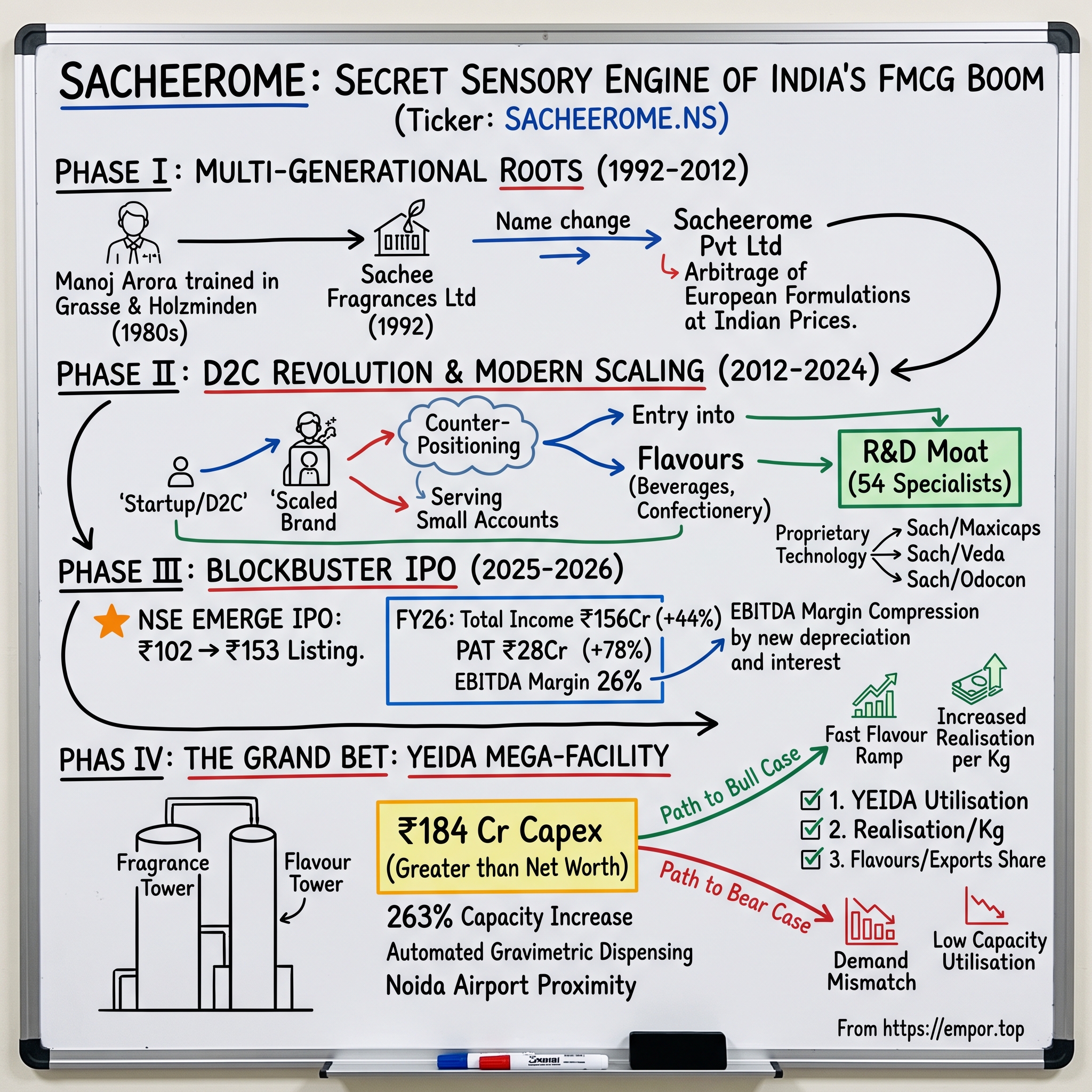
Sacheerome: The Secret Sensory Engine of India's FMCG Boom
I. Introduction & Episode Roadmap
There is a particular kind of Indian company that almost nobody can name and almost everybody has smelled.
Walk down the detergent aisle of any modern-trade store in Delhi or Chennai. Pick up a bottle of shampoo, a bar of soap, a fabric conditioner, a hand wash. Somewhere between one and three percent of what you paid for that product is a viscous, amber-coloured liquid that a chemist somewhere blended from a few dozen molecules. It costs almost nothing relative to the packaging, the surfactants, the advertising. And it is the single thing a consumer will notice first, remember longest, and complain about most loudly if it ever changes.
On June 16, 2025, the company that blends a great many of those liquids for Indian brands walked onto the NSE Emerge platform. Sacheerome Limited had priced its IPO at ₹102 a share. It listed at ₹153 — a 50% premium on day one.1 Just over a year later, in July 2026, the stock traded around ₹420, carrying a market capitalisation near ₹940 crore against a trailing price-to-earnings multiple of roughly 33.2 A business that did ₹70 crore of revenue in FY23 had become a near-quadruple bagger from its issue price inside thirteen months.
That is the hook. But the interesting question is not "why did the stock go up." SME IPOs in India went up in 2025 as a matter of routine; that tells you about the market, not the company. The interesting question is whether the underlying business deserves the attention it is now getting — and whether the enormous bet it has just placed on its own future demand is a masterstroke or an act of hubris.
Because Sacheerome has done something unusual for a company its size. In FY26 it generated ₹152 crore of revenue from operations and ₹40.66 crore of EBITDA — a 26.02% margin, up from 21.61% the year before.3 Net profit was ₹28.44 crore, up 78%.3 Return on equity ran at roughly 27% and return on capital employed near 36%, with borrowings on the balance sheet reduced to essentially nil.2 By almost any screen, this is a beautiful little business.
And it has committed ₹184.16 crore — more than its entire annual revenue, and more than its entire net worth — to building a single new factory near Noida International Airport that will multiply its production capacity by roughly 3.6 times.4
Companies of this size do not usually make bets of that shape. When they do, the outcome tends to define the next decade in one direction or the other.
That is the tension this story turns on. Here is the roadmap.
We will start with the economics of smell and taste: why a fragrance house looks, on paper, like one of the stickiest B2B businesses in existence, and where that stickiness is genuinely earned versus merely asserted. We will trace the Arora family from old Delhi's aromatic ingredient trade through a training pilgrimage to Grasse and Holzminden, and through four corporate name changes that each mark a strategic pivot. We will look at how the direct-to-consumer boom of the 2010s handed a mid-sized Delhi compounder a customer base that the global giants were structurally uninterested in serving.
Then we will get to the hard part. We will take apart the FY26 numbers and show that the growth was not what most headlines said it was. We will walk through the YEIDA capital expenditure and stress-test it the way a sceptical investor would — including the moment on the company's first earnings call when an analyst politely pointed out that the expansion is larger than the annual growth of the entire market the company's own prospectus described. We will compare Sacheerome against S H Kelkar, the listed Indian giant of this industry, and against Privi Speciality Chemicals, the upstream molecule maker — and we will find that one of the most commonly repeated claims about this industry does not survive the comparison.
Finally we will lay out what would have to be true for the bull case to work, what would break it, and the two or three numbers that will settle the argument over the next thirty-six months.
One framing note before we begin. NSE Emerge in 2025 was not a normal market. It was a venue where small, profitable, family-controlled Indian businesses could raise permanent capital at valuations that the same businesses would not have commanded from a private equity fund, and where the demand side was dominated by leveraged retail and high-net-worth applications chasing listing-day pops. That environment produced some excellent companies and a great many that were merely lucky. The only way to tell the difference is to ignore the price action entirely and interrogate the operating business — which is what the rest of this piece does.
Start with the product, because everything else follows from it.
 Subscribe on LinkedIn
II. The B2B Sensory Value Chain: Magic, Moats, and Hamilton Helmer's 7 Powers
A fragrance order does not begin with a price list. It begins with a brief.
Manoj Arora described the mechanic himself on Sacheerome's first earnings call in November 2025, and it is worth quoting because it is the whole business in five sentences: "We are a creative house. We work on the briefs of the customers. They share the brief, geography-wise, age-wise, gender-wise, we get the requirements, and we develop the product which is supplied to one key company that becomes the proprietary right of that. We are just the custodian. We do not give that product or anything even similar to that."5
Unpack that. A brand manager at an FMCG company arrives with a problem, not a purchase order. They want a body wash for women aged 22 to 35 in tier-two Indian cities, priced to hit a ₹99 shelf point, that reads as "fresh" in the first three seconds and "comforting" forty minutes later, that survives eighteen months in a warehouse in Nagpur without turning, and that does not smell like the market leader. Several fragrance houses receive the same brief. Each submits blind samples. Consumer panels sniff them. One wins.
The winner's formula then gets written into the brand's specification documents, its stability data, its regulatory dossiers, and — crucially — into the memory of every consumer who buys the product. And it stays there.
It is worth being concrete about what "the formula" physically is, because the word makes it sound more mysterious than it is and less defensible than it is. A finished fragrance compound is a blend of anywhere from a dozen to two hundred individual materials — synthetic aroma chemicals, natural essential oils, extracts, fixatives, solvents — weighed to fractions of a gram and combined in a specified order. Any competent chemist with a gas chromatograph and a mass spectrometer can take a competitor's compound and produce a list of what is in it.
What analytical equipment cannot recover is the reasoning: why 0.4% of one molecule rather than 0.6%, what the accord was meant to evoke at minute one versus minute forty, which of the two hundred rejected trials failed consumer panels and why. Reverse-engineering gets you a copy that smells approximately right and behaves differently in the base, in the bottle, and over eighteen months on a shelf in a warehouse where the temperature reaches forty-five degrees.
So the protection is not legal. There are essentially no enforceable patents on a fragrance accord. The protection is that copying is expensive, imperfect, and — this is the important part — pointless, because the customer who owns the original has no reason to buy a slightly wrong version of what they already have.
This is where the switching-cost story comes from, and it is a real one. The fragrance is a rounding error in the cost of goods sold. It is not a rounding error in the brand. Changing it means re-running stability testing, re-certifying the formulation, risking a consumer backlash over a product that "smells different now," and doing all of that to save a fraction of a percent on unit cost. Arora's version, in response to an analyst who kept pressing on contract terms: "Perfume becomes the identity. This is not a commodity. They do not change unless and until there is a failure on our part to maintain the quality or not maintaining the schedule or we increase the price."5
Note the three conditions he attached — quality, schedule, price. That is the honest version of the moat. The lock-in is not unconditional — it is conditional on service, reliability, and price discipline. A switching cost that evaporates the moment you try to raise price is a different animal from one that lets you extract rent. Read through Hamilton Helmer's 7 Powers framework, Sacheerome has genuine Switching Costs and a plausible claim to Cornered Resource in the form of its perfumers.
What it does not obviously have is pricing power in the classical sense, and management has been candid about why. Asked whether raw-material inflation gets passed through, Arora's answer ran the other way: "If you will not pass on the benefit to your customer, then somebody will enter. As a good business practice, we certainly pass on the benefit to the customers so that they also remain competitive."5 That is a description of a competitive market with sticky accounts — not a toll booth.
There is a regulatory layer underneath all of this that functions as a quiet barrier. The International Fragrance Association sets usage limits for individual materials — how much of a given molecule may appear in a leave-on skin product versus a rinse-off versus a candle — and those limits are revised periodically, sometimes forcing reformulation of products already on shelf. The Flavor and Extract Manufacturers Association performs an analogous role for flavours, and in India the Food Safety and Standards Authority regulates what may go into food. Sacheerome states compliance with IFRA, FEMA, EU rules, FSSAI and ISO 9001:2015.4
For a large customer, this compliance stack is not a nice-to-have; it is the reason they will not buy from an unregistered blender in a shed, however cheap. It is also a fixed cost. A firm doing ₹150 crore of revenue can carry a regulatory and quality function; a firm doing ₹5 crore cannot. That asymmetry is the mechanism behind the "share gain from the unorganised sector" thesis that appears later in this story, and it is the most structurally credible part of that thesis — though, as we will see, credible is not the same as evidenced.
There is a second, quieter power at work, and it is the one investors most often miss: Counter-Positioning by size. A global fragrance house will not build a bespoke formulation, run three rounds of consumer panels, and set up a supply chain for a startup ordering 200 kilos a year. The economics of their creative bench do not permit it. A ₹150-crore Delhi house absolutely will. That asymmetry is not a technology advantage; it is an overhead-structure advantage, and it is the single most important thing that happened to Sacheerome in the last decade.
Now the industry-structure point that the conventional narrative gets wrong.
The standard framing is that this industry has two tiers. Upstream sit the aroma-chemical manufacturers — companies that crack pine-derived terpenes and build molecules at industrial scale. These are capital-intensive, commodity-adjacent, and exposed to petrochemical and crop cycles. Downstream sit the creative houses, which buy those molecules by the drum and blend them into finished compounds. The received wisdom is that creativity commands the margin, and chemistry gets the cyclicality.
The FY26 numbers do not support that cleanly. Privi Speciality Chemicals — India's largest aroma-chemical maker, squarely an upstream player — reported FY26 revenue of ₹2,582.92 crore with an EBITDA margin around 25.8% and profit after tax of ₹327.54 crore, up 75%.6 Sacheerome's EBITDA margin in the same year was 26.02%.3 They are, within rounding, the same. Meanwhile S H Kelkar, the largest listed Indian creative house, ran adjusted EBITDA margins of 13.9% on FY26 revenue of ₹2,368 crore.7
So the tier of the value chain you occupy does not determine your margin. Something else does. In Privi's case it is scale, integration, and an unusually favourable input cycle. In Sacheerome's case, as we will see, it is a specific and possibly temporary combination of operating leverage against a fully-utilised plant and a rising realisation per kilogram. In S H Kelkar's case it is the drag of a sprawling international footprint. The lesson for an investor is that "creative house versus commodity chemical" is a marketing distinction, not a margin-predicting one.
Which raises the question of how a family trading business in old Delhi ended up on the creative side of that line at all.
III. Multi-Generational Roots: From Aroma Trading to "Sachee Fragrances" (1992–2012)
Before there was a company, there was a trade.
Manoj Arora's grandfather dealt in saffron, real musk, and natural aromatic ingredients — the raw material of India's centuries-old ittar culture, moved through the commercial lanes of Delhi in an economy where knowledge of a supplier and knowledge of a smell were the same asset.8 Arora entered the business himself in 1980, as the third generation.8 By his own count on the earnings call, he has now spent "over 40 years, 45 years" in the industry.5
The pivotal decision of his career was to stop being a trader.
Trading aromatic ingredients in 1980s India was a respectable business with a hard ceiling. You were an intermediary between a farmer or a chemical importer and a perfumery house, and the value you added was logistics and credit. The value that got captured sat upstream in the molecule and downstream in the formula. So Arora went to get the formula.
He travelled to Grasse, the town in Provence that has been the world capital of perfumery since the sixteenth century, and to Holzminden, the small German town that houses what is now Symrise. He trained under Dr. Hans Ulrich Warnecke at Dragoco — one of the two firms that later merged to form Symrise — and under Jerry Field at Procter & Gamble.8 This is a specific and unusual credential. Perfumery is not taught in universities in any meaningful way; it is transmitted through apprenticeship inside a handful of European houses, and access is guarded. An Indian ingredient trader getting inside that system in the 1980s was not a routine occurrence.
He came back to Delhi with something that could not be bought in India at the time: the ability to compose.
It is worth appreciating how narrow that door was. India in the 1980s had a large and sophisticated aromatics tradition — ittar production in Kannauj predates European perfumery by centuries, and the country grew and distilled a meaningful share of the world's mint, sandalwood, jasmine and vetiver. What it did not have, at industrial scale, was the compounding discipline: the European practice of building reproducible, stable, regulator-compliant formulas that perform identically across ten thousand batches. India had the raw materials and the craft heritage. It imported the formulas. A trader who learned to write them was, in effect, importing the missing layer of the value chain in his own head.
The company was incorporated as Sachee Fragrances Limited with the Registrar of Companies, Delhi & Haryana on June 19, 1992.4 The timing was not accidental. India had begun liberalising the previous year. Multinational consumer goods companies were arriving with international quality expectations and Indian price points, and they needed local suppliers who could meet the first without breaking the second. A perfumer trained in Grasse and operating out of Okhla was, in that specific moment, an arbitrage.
It was also, for a long time, a grind. Arora returned to this repeatedly on the earnings call, and the resentment in it is instructive: "Indian companies — they were not taking Indian companies seriously. I do not think earlier you were not buying the Indian products, but now you have the confidence in the Indian products. And it has been a long struggle. We have to prove ourselves."5
Read that as an operating fact rather than as sentiment. For most of the 1990s and 2000s, an Indian FMCG business of any ambition specified an imported fragrance for its flagship products and used a domestic supplier for the value tier. Winning the flagship brief required not just matching the sample but surviving a procurement process designed around the assumption that the Indian option was the risky one. Every account won in that period was won against a presumption of inferiority, and every account retained since is the compounding of that. It took roughly three decades of this to reach the position Arora described on the same call — "we have the acceptability with almost all big, medium and the small Indian companies."5
That is what the moat actually consists of. Not a patent, not a proprietary molecule, and not a brand a consumer has heard of. A thirty-year record of not failing a customer, accumulated one relationship at a time in a market that started out sceptical.
What followed was a sequence of name changes that reads like a strategy document written in reverse.
In December 1994 the shareholders resolved to rename the company Sachee Cosmetics Limited, with a fresh certificate of incorporation issued on February 13, 1995.4 Cosmetics were the visible boom of the mid-1990s; the fragrance house followed its customers' label. Then in March 1997 came another resolution, and on April 3, 1997 the company became Sachee Aromatics Limited.4 That shift — away from the finished-goods word "cosmetics" and toward the ingredient word "aromatics" — signals a company that had decided it belonged upstream of the brand, not alongside it. It was a decision to be a supplier rather than a competitor to its own customers, and in hindsight it was the correct one.
The final transformation came in 2012. In February the company converted to private limited status, and in April the shareholders approved a change of name to Sacheerome Private Limited, with the fresh certificate issued that month.4 The name is a compression of "Sachee" and "aroma," and the shedding of both "cosmetics" and the generic "aromatics" completed a twenty-year narrowing: from a business that might have sold many things, to one that sells exactly two — fragrance and flavour compounds — and nothing else.
That discipline is worth pausing on, because it is the single most consistent behavioural fact about this management team across three decades. When an analyst asked on the November 2025 call about expanding the product pipeline, Arora's answer was almost impatient in its narrowness: "We work on the briefs of the customers and we will remain in the fragrance and flavour only."5 Asked to benchmark R&D spending against competitors, he pushed back on the comparison itself: "Please do not compare us with the other companies because we are only in the fragrance and flavour, we are not the ingredient business at all."5
For an investor, the read-through is mixed but mostly favourable. A promoter who has refused to diversify for thirty years is a promoter unlikely to buy an unrelated business with IPO proceeds — the classic Indian small-cap value destroyer. The offsetting risk is that a company with one product line and no upstream integration has no hedge when its single end-market slows.
There is one more thing the early history explains, which is the company's geography. Sacheerome's registered office, corporate office and manufacturing facilities all sit in Okhla Industrial Area in south Delhi — Phase I and Phase II, a few kilometres apart.4 Okhla is not a low-cost location, and it is not where a company optimising for manufacturing economics would build. It is where a Delhi trading family already was, close to customers' procurement offices, close to the airport, and close to the labour pool of technicians who had grown up in the trade. For thirty years that was an advantage. By the mid-2020s it had become a hard constraint: there is no land in Okhla to expand into, which is a large part of why the next chapter of this story takes place seventy kilometres away.
By 2012, the pieces were in place: a trained nose, a narrow charter, a Delhi manufacturing base, and a corporate identity that finally matched the business. What was missing was a customer base large enough to matter. That arrived, unexpectedly, from the internet.
IV. Modern Scaling: The R&D Moat and the D2C Revolution (2012–2024)
The next decade of Sacheerome's history was written by people who had never heard of it.
Between roughly 2014 and 2024, India produced a wave of direct-to-consumer consumer-goods brands that did not exist before and did not behave like their predecessors. They launched with a single hero SKU, sold on marketplaces and their own websites, iterated packaging quarterly, and needed to get from concept to shelf in months rather than years. They also, critically, needed a fragrance — because a beauty or personal-care product without a distinctive scent is a commodity with a logo on it.
They could not get one from Givaudan, IFF, Firmenich or Symrise. Not because those firms are unwilling in principle, but because a creative brief consumes a perfumer's time regardless of order size, and a global house's cost structure makes a 200-kilogram annual account uneconomic. The startup founder calling a multinational fragrance house in 2016 got, at best, a selection from an off-the-shelf library.
Sacheerome's cost structure made the same account perfectly viable. And unlike most Indian compounders of similar size, it had the technical bench to take a real brief rather than sell a stock accord.
The timing compounded the effect. A D2C brand that launches with one product and reaches ₹100 crore of revenue in four years does not re-tender its fragrance along the way — it scales the formula it launched with.
The supplier who won the account when the order was 200 kilograms is therefore the supplier shipping 20 tonnes at the end, at commercial terms set when the customer had no leverage and no alternative. This is the closest thing in the business to a free option, and it is available only to firms willing to take unprofitable-looking work at the start. Sacheerome's revenue trajectory through the period — ₹70 crore in FY23, ₹85 crore in FY24, ₹108 crore in FY25, ₹152 crore in FY26 — has the shape of a supplier riding a cohort of customers up rather than a supplier winning a series of large tenders.24 Growth accelerated each year rather than arriving in lumps, which is what a portfolio of compounding small accounts looks like and is not what large-account displacement looks like.
There is a corollary that cuts the other way, and it belongs in the ledger. A supplier whose growth comes from customers' growth is levered to those customers' fortunes in both directions. The Indian D2C cohort of the early 2020s has since faced a harsher funding environment and consolidation. If a meaningful share of Sacheerome's account base consists of brands whose own growth is decelerating, the "organic growth from existing customers" line that management credits will decelerate with them — and the company has not disclosed the split between new-customer, new-product and existing-product growth in a way that would let an outsider check.
This is the mechanism behind the growth, and management describes it in almost boringly operational terms. On the earnings call, CFO Aarti Kashyap attributed H1 FY26's growth to three sources: "the addition of new customers, addition of more products, and organic growth from existing customers."5 Arora added a framing that reveals the strategy more clearly than any slide: "As a businessman, we should not be leaving any business whether it is small or big. You never know when the small becomes big and big becomes small."5
That is the D2C thesis stated as a temperament. Take the small account nobody else wants; some fraction of them compound into large accounts; and because the formula is locked to the product, you compound with them.
Alongside this, the company opened a second front. It entered the flavours segment — the same brief-to-formulation model applied to beverages, bakery, confectionery, dairy, oral care, ice cream and seasonings.5 The strategic logic is sound: flavours use adjacent chemistry, serve an adjacent customer set, and address a market that IMARC Group sized at ₹4,287 crore in India in 2023, projected to grow at a 7.1% CAGR to roughly ₹8,100 crore by 2032.4
The execution, however, has been slow, and the numbers say so plainly. Flavours contributed 8.56% of revenue in FY23, then fell to 7.75% in FY24 and 4.88% in FY25 — declining in absolute terms from ₹6.04 crore to ₹5.25 crore while fragrances grew 59% over the same period.4 In H1 FY26 flavours generated just ₹1.46 crore against ₹75 crore of fragrances.5 Arora's explanation on the call was partly seasonality and partly a hard physical constraint: "flavours are in big demand and we are short of space."5 He promised a second-half recovery, and delivered one — flavours finished FY26 at roughly 6% of revenue, implying they roughly quintupled sequentially in the second half.3
That delivery counts for something on the credibility ledger: a specific promise made on a call and met within the year. But the ten-year record remains one of a segment that has been talked about for considerably longer than it has grown, and a single strong half does not reverse that. Flavours is the clearest example in this business of a genuine option that has not yet been exercised.
Now the R&D question, because it is where the gap between narrative and disclosure is widest.
Sacheerome describes itself as R&D-led, and the headcount supports it: 54 specialists in a research team, out of 158 total employees plus 23 contractual staff as of March 31, 2025 — 37 in fragrance R&D, 17 in flavours, plus a seven-person quality assurance function.4 Roughly a third of the company works in research. That is a genuinely research-heavy organisation by headcount.
The financial statements tell a different story. The line item labelled "R&D expenses" in the FY25 restated financials was ₹20.15 lakh — against revenue of ₹107.5 crore.4 That is 0.19% of sales, not the ~2% or more that the R&D-led framing implies. Confronted with exactly this on the earnings call, Arora was disarmingly direct about why: "I requested my statutory auditor to have the separate head for the R&D expenses. But there is no provision in the balance sheet, if I am not wrong, to have the separate R&D. I do not know about my other competitors how much they spend on the R&D. But we spend significant."5
The honest reading is that the R&D spend is real but embedded in employee costs and consumables rather than separately captured, and that the disclosed line item is close to meaningless. The less charitable reading is that a company positioning itself on research intensity has not built the accounting to demonstrate it, and cannot tell an investor what it spends. Both readings are compatible with the facts. Neither supports quoting a precise R&D-to-sales ratio, and this article will not quote one.
The proprietary technology portfolio has a similar texture. The prospectus names four platforms — Sach/Maxicaps, Sach/Veda, Sach/Odocon and Sach/Booster — described as "new age technologies" developed to differentiate the offering.4 In plain terms, and based on how such platforms work industry-wide: an encapsulation technology wraps fragrance oil in microscopic shells that survive a wash cycle and rupture under friction, so a towel smells fresh when you rub it rather than only when it comes out of the machine; a malodour-control system uses molecules that chemically neutralise or mask offensive compounds rather than simply overlaying them.
How defensible are they? Asked directly whether these platforms explained the margin, Arora declined to elaborate: "We have a couple of technologies which are very unique in nature. One is Sach Veda and there are many others which we would not like to discuss on the public platform."5 The company owns one registered trademark and had applications pending across five classes as of the prospectus date.4 There is no disclosed patent portfolio. An investor should therefore treat these platforms as product differentiation and trade-secret know-how — real, but not legally fortified, and not independently verifiable.
The last piece of this decade was succession. Dhruv Arora, the fourth generation, holds a BSc in Chemistry with Business and Management from the University of Manchester, joined the team in 2010, and is himself a trained perfumer while running new business development.4
He is a promoter and Whole-Time Director, and the division of labour on the earnings call reads as deliberate: Dhruv handled the operational and capital-expenditure detail, capacity numbers and working-capital metrics, while his father handled strategy, customer philosophy and the long view.5 That is a healthy pattern in a family succession — the younger generation given the parts of the business that can be measured, the older keeping the parts that cannot.
The board also includes Indu Agrawal, an Executive Director with a BSc from Meerut University and over 26 years across the pharma, fragrance and flavours industries, who heads the Research and Development and Quality functions.4 She is not part of the promoter group, which matters for the key-person question we will come to.
By FY25, this machine was running at 97.4% of its installed capacity of 760,000 kilograms a year.4 There was no more room. And that is the condition under which a company decides to go public.
V. The Blockbuster IPO and a Financial Comparison Masterclass
The book opened on June 9, 2025, and was fully subscribed within an hour.9
By the time it closed on June 11, the numbers had stopped being a subscription and become a phenomenon. Investors placed bids for 125.76 crore shares against 40.18 lakh on offer — approximately 313 times the issue.1 The category splits are where the story sits: qualified institutional buyers subscribed 173.15 times, retail 180.28 times, and the non-institutional (HNI) book an extraordinary 808.56 times.10 The issue itself was modest — ₹61.62 crore raised entirely as a fresh issue of 60.41 lakh shares at a band of ₹96–102, with a minimum application of 1,200 shares costing ₹1,22,400.10
Some context on what those multiples do and do not mean. NSE Emerge issues are small, allotments are lottery-driven, and application funding is heavily leveraged in the HNI category — an 808-times subscription reflects the mechanics of a market where a few hundred crore of applied capital chases ₹9 crore of allocable stock as much as it reflects conviction about fragrance compounding. Subscription multiples on SME platforms are a measure of scarcity and momentum. They are not a measure of diligence, and treating them as one is how investors get hurt on this platform.
The anchor book is the part that gave the issue its signalling value. On the earnings call, Arora thanked, by name, Sunil Singhania of Bharat Venture Opportunities, Madhusudan Kela's Chartered Finance & Leasing, an allocation associated with Mukul Agrawal's family, and HDFC Bank.5 For a ₹61 crore SME issue, that is a concentration of India's best-known small-cap investors, and it explains a good deal of the HNI frenzy that followed. It should also be read for what it is: an endorsement of a story at an entry price, not a permanent validation of the business.
The listing delivered the expected result — a 50% opening premium, a brief dip to ₹145.35, and a close back around the listing price.1 What followed was less expected: a year-long grind higher rather than the fade that usually follows SME listing pops, with the stock reaching a 52-week high above ₹430 before settling near ₹420 in mid-2026.2
The earnings arrived to justify it. FY26 total income was ₹156.29 crore, up 43.93%; EBITDA ₹40.66 crore, up 73.3%; net profit ₹28.44 crore, up 77.97%.3 EBITDA margin expanded 441 basis points to 26.02% and net margin 348 basis points to 18.20%.3 Earnings per share, however, rose only 37.18% to ₹13.43 — the gap between 78% profit growth and 37% EPS growth being the dilution from the fresh issue.3 That is a detail worth holding onto: the IPO bought capacity, and the shareholder paid for it in share count before receiving any of the revenue.
Now, the comparison that the market has been making, and the one it should be making instead.
S H Kelkar and Company, which trades as Keva, traces its origins to 1922 and is the incumbent of Indian perfumery. In FY26 it reported consolidated revenue of ₹2,368.26 crore — roughly 15 times Sacheerome's — with profit after tax of ₹73.01 crore against ₹54.81 crore the prior year, and adjusted EBITDA of ₹323 crore at a 13.9% margin.7 Its fourth quarter was ugly: ₹1.80 crore of net profit on ₹649.94 crore of revenue.7 Its standalone entity ran a net loss of ₹13.56 crore for the year, and it replaced Deloitte Haskins & Sells with BSR & Co. as statutory auditor for a five-year term.7
Two details in that Kelkar disclosure deserve an investor's attention beyond the headline numbers. The first is the auditor change: replacing a Big Four firm with another large firm is routine in India under mandatory rotation rules and carries no adverse implication by itself, but it is the kind of event a careful reader notes and files. The second is the divergence between the consolidated and standalone results — a group earning ₹73 crore while its Indian parent entity loses ₹13.56 crore tells you that the profit is being generated overseas and that the domestic business, which is the one competing directly with Sacheerome, is not currently earning its cost of capital.7
That is the competitive fact that matters most for this story. Sacheerome's principal organised domestic rival is, at the level of the Indian operating entity, unprofitable. Whether that reflects transfer pricing, the aftermath of the Vashivali fire, or genuine operating weakness cannot be determined from public disclosure. But it does mean the most obvious competitive threat to Sacheerome is currently occupied with its own repair job.
The structural reason for the gap is not that Kelkar is bad at perfumery. It is that Kelkar bought a global footprint. Through its Italian subsidiary it acquired Creative Flavours and Fragrances S.p.A. in two stages, completing the balance 49% in July 2020 for €16 million.11 It carries European manufacturing, a Dutch aroma-ingredients arm, and the overheads that come with them — plus, in FY25, the operational disruption of a fire at its Vashivali facility. Roughly 14% consolidated EBITDA margins are what that portfolio produces.
So the honest framing of the comparison is this: Sacheerome's margin advantage over S H Kelkar is primarily a complexity advantage, not a craft advantage. One company runs a single-country, single-product-family, two-site operation with 158 employees. The other runs a multinational with acquired subsidiaries, ingredient manufacturing, and integration debt. It would be genuinely surprising if the first did not earn higher margins than the second. The relevant question — and it is the whole question — is what happens to Sacheerome's margin structure as it builds its own multi-tower industrial complex and starts to acquire complexity of its own.
Which brings us to the part of the FY26 result that the headlines missed.
Myth versus reality on the FY26 growth. The consensus reading is that Sacheerome grew 44% because demand exploded. The capacity data says that cannot be the primary explanation. The company produced 740,560 kilograms in FY25 against installed capacity of 760,000 — 97.4% utilisation, up from 87.59% in FY24 and 75.21% in FY23.4 There was, at most, low-single-digit percentage volume headroom left in the plant. Yet revenue grew 43.93% in FY26 with no new facility commissioned.3
The arithmetic forces the conclusion. FY26 revenue growth was overwhelmingly driven by realisation per kilogram — the average price of a kilogram of compound leaving the factory — rather than by the number of kilograms. An analyst on the call spotted this and asked directly whether higher-priced fine fragrance and cosmetics work was driving it. Arora's answer was that it was customer-driven mix, not price: "This is the demand of the Indian consumers that they want a better quality product and it is not that we have increased the price. We are not increasing the cost."5
If that is right — and it is consistent with the margin expansion, since richer compounds carry better contribution — then FY26 was an excellent year of mix improvement executed against a hard physical ceiling. It is a genuine achievement. It is also, structurally, a one-time-ish lever. You can trade a full plant up the value curve once. Doing it again requires either more capacity or an even richer mix, and mix migration eventually runs into what customers will pay.
The second thing the headlines missed sits in the geography split. Exports were the fastest-growing line in the prospectus period, roughly doubling from ₹4.26 crore in FY24 to ₹8.21 crore in FY25, lifting export share from 4.99% to 7.63% — driven by the UAE, Nigeria, Bangladesh and Madagascar.4 The FY26 disclosure shows exports at roughly 6% of revenue.3 Because total revenue grew 44%, an export share that fell from 7.63% to about 6% means export revenue grew far more slowly than the domestic book. The internationalisation story, in other words, went backwards in relative terms in FY26 — the opposite of the direction the equity narrative assumes.
There is a third read-through worth making explicit, and it is the most favourable one to management. If FY26's margin expansion came from mix rather than price, then it was not bought at the customer's expense — no account was squeezed, no relationship was strained, and the 441 basis points of EBITDA improvement are the arithmetic consequence of running a fixed cost base against a higher-value output. That is exactly what a fully-utilised plant is supposed to do, and it is the strongest available evidence that this management can execute operationally rather than merely narrate. Dhruv Arora's disclosure that the working-capital cycle compressed to roughly 23 days from 45 belongs in the same column.5 These are not the behaviours of a company coasting.
But operating leverage against a full plant is a lever that pulls once. An investor should hold that in mind when reading the next section, because the entire justification for a ₹184 crore factory rests on demand that the FY26 numbers have not yet demonstrated in volume.
VI. The Grand Bet: The YEIDA Mega-Facility
On the November 2025 call, an analyst named Bharat Sharma paid the management a compliment that was also, inadvertently, the sharpest observation anyone made all day. "Last time also my question we were also at 95% utilization level and we were wondering where the growth would be coming from but you have brought this number by doing magic."5
Arora's reply: "There is no magic. It is the operational efficiency. I just said necessity is the mother of invention. When you have pressure then you try everything."5
That exchange is the emotional logic of the YEIDA project. This is a company that has spent three years squeezing a plant that was already full, and has decided it is done squeezing.
The site is at 1459B, Sector-32, in the Yamuna Expressway Industrial Development Authority area of Gautam Buddha Nagar, Uttar Pradesh — a land parcel the prospectus records as 21,250 square metres and the earnings call as 21,023 square metres, adjacent to Noida International Airport.45 The location choice is not sentimental. An export-oriented specialty business measured in kilograms, not tonnes, with high value density and time-sensitive customer briefs, benefits disproportionately from being next to an airport.
The design is two towers: one dedicated to fragrances, one to flavours.5 This matters more than it sounds. Cross-contamination between a fragrance line and a food-grade flavour line is a regulatory and reputational catastrophe waiting to happen, and physical separation is how you get and keep food-safety certifications. The company already operates to IFRA, FEMA, EU, FSSAI and ISO 9001:2015 standards.4 The two-tower design is what allows the flavours business — stuck at roughly 5% of revenue and constrained by space — to become something other than a rounding error.
The facility also houses an advanced research and innovation centre, a quality centre, an application centre, a consumer evaluation centre and a perfumery training centre.5 That last one deserves a moment. A perfumery training academy inside a manufacturing plant is not a vanity project for a firm whose central risk is that its chief perfumer is 60-something and irreplaceable. It is the institutional answer to the key-person problem — an attempt to industrialise the transmission of a craft that Manoj Arora himself had to fly to France and Germany to acquire.
What "robotic manufacturing" actually means here. The phrase conjures articulated arms on an automotive line. The reality in a compounding plant is more mundane and more important. A fragrance formula might call for 140 materials, some dosed at 20% of the batch and some at 0.02%. Traditionally a technician weighs each one by hand against a printed formula card. That process is slow, it requires trust, it exposes the formula to whoever is holding the card, and — critically — it produces small variances that accumulate. Two batches of the same compound made by two technicians on two days are not quite identical.
An automated dispensing system replaces the technician with a computer-controlled gravimetric rig: the formula lives in a database, the machine draws each material to a specified weight, and the batch record is generated automatically. The benefits stack up in three places. Consistency improves, which matters enormously when the customer's failure condition is a consumer noticing that this month's soap smells slightly different. Throughput improves, because the machine does not need to find the right drum. And formula security improves, because the composition is never printed on a card that a departing employee could photograph.
For a business whose entire moat rests on never failing a customer on quality, automation of this specific kind is a direct investment in the moat rather than merely in cost. It is also, at ₹17.13 crore of plant and machinery in a ₹184 crore project, a remarkably cheap part of the bet.4
The capacity math. Existing installed capacity: 760,000 kilograms per annum. New facility: 2,000,000 kilograms. Total: 2,760,000 kilograms — an increase of 263%, or roughly 3.6 times the existing base.45 Dhruv Arora put it as "almost 5x" the current capacity in one exchange and the precise figures in another; the correct multiple is 3.6x total, 2.6x incremental.5
The money. Total project cost of ₹184.16 crore, against a prospectus-stage plan of ₹56.50 crore from IPO net proceeds and the remainder — roughly ₹81.42 crore at the time of filing — from internal accruals and borrowings, on top of ₹46.24 crore already spent by May 28, 2025.4 The largest line items were building and civil works at ₹63.19 crore, electrical installation at ₹44.63 crore, furniture, fixtures and interiors at ₹42.17 crore, and plant and machinery at just ₹17.13 crore.4
That composition is itself informative. This is overwhelmingly a building, not a machine. Roughly ₹150 crore of the ₹184 crore is real estate, fit-out and electrical infrastructure; the actual production machinery is under 10% of the project. Compounding fragrance is not a capital-intensive process — it is dosing, mixing and quality control. What the money buys is space, environmental control, certifiable separation, and the automated dispensing systems that deliver batch-to-batch consistency at scale. It also means the depreciation profile will be dominated by long-lived building assets rather than fast-depreciating equipment, which softens the near-term P&L hit relative to a chemical plant of the same cost.
By September 30, 2025, ₹53.64 crore had been deployed — only ₹7.07 crore from IPO proceeds and ₹46.57 crore from internal accruals, with the unspent IPO money parked in fixed deposits.5 A ₹60 crore term loan from HDFC Bank had been sanctioned and, on Arora's account, would be drawn "as and when required" after IPO proceeds and accruals were exhausted.5 As of March 31, 2026, the balance sheet still showed borrowings reduced to essentially zero.2 The debt, in other words, has not yet arrived — but it is contracted and waiting.
Now the stress test.
Challenge one: the demand mismatch. An analyst named Shikha Mehta asked the question of the entire call, and she asked it with the company's own document in hand. Sacheerome's draft prospectus sized its addressable market at roughly ₹4,500 crore growing at 6–7% — which is about ₹270 crore of incremental market per year. The company is adding two million kilograms of capacity. If, as management insists, the business is sticky and incumbents do not lose accounts, then Sacheerome cannot easily take share; and if it can only grow with the market, the entire annual growth of the Indian industry would not fill the new plant. As she put it: "our capacity expansion is much bigger than the growth in the market."5
The response was not a rebuttal. Arora replied: "We are very small still in comparison and you should have the confidence in the company. We are very passionate people and we are working hard." Dhruv Arora added that management would "cross-check" the prospectus figures and reframed the target as a combination of "organic, inorganic growth with new product developments."5
That is a soft answer to a hard question, and an investor should mark it as such. The stickiness argument and the share-gain argument are in tension: you cannot simultaneously claim that customers never switch suppliers and that you will fill a tripled plant by taking other suppliers' customers. Management's implicit resolution is that growth comes from new product launches rather than displaced incumbents — every new SKU is a fresh brief, and India launches a great many new SKUs. That is a coherent theory. It is not yet an evidenced one.
Challenge two: the guidance contradiction. In November 2025, asked what utilisation to expect in FY27 on the expanded base, Arora answered: "More than 100%. Almost."5 Seven months later, at the FY26 results, the company guided to revenue of ₹200 crore in FY27, ₹250 crore in FY28 and ₹300 crore in FY29.3
Put those together. FY26 revenue of about ₹152 crore was produced from roughly 760,000 kilograms — an implied realisation near ₹2,000 per kilogram. At that realisation, filling 2.76 million kilograms would produce revenue in the region of ₹550 crore. The company's own FY29 target is ₹300 crore. Even allowing for further mix enrichment, the guidance implies roughly half the plant standing idle three years after commissioning.
Both statements cannot be right.
The guidance is the more credible of the two, and it is the more conservative — which is to management's credit as a disclosure matter. But it directly contradicts a specific claim made to investors on the company's first-ever earnings call, and that is exactly the kind of narrative inconsistency that deserves to be tracked rather than forgiven. The charitable interpretation is that "more than 100%" referred to the existing 760,000 kg base during a partial-year ramp. The interpretation an analyst on the call would have taken away was different.
Challenge three: the margin trap. Consider a simple sensitivity. On roughly ₹150 crore of depreciable building and equipment assets, annual depreciation plausibly lands somewhere in the ₹8–12 crore range depending on asset lives, and a fully drawn ₹60 crore term loan at prevailing corporate rates adds roughly ₹5 crore of annual interest. Call it ₹15 crore or so of new fixed charges against an FY26 EBITDA base of ₹40.66 crore.
Now run it forward. If FY27 revenue hits the guided ₹200 crore at the current EBITDA margin, EBITDA would be roughly ₹52 crore — and most of the ₹11 crore of incremental EBITDA would be consumed by the new depreciation and interest. Profit before tax could be broadly flat despite 31% revenue growth. These are illustrative estimates, not disclosed figures — depreciation policy and the loan drawdown schedule have not been published — but the direction is not in doubt, and it is the single most under-discussed feature of this investment case.
Management's position is that margins hold. Pressed twice on exactly this by analyst Neerav Bhanushali, Arora said: "As our top line grows, as our turnover grows, and which we are sure, I do not think it is a forward-looking statement, but I will say we are confident and we will be able to maintain our EBITDA margin."5 Dhruv Arora attributed sustainability to "a mix of the product offerings, our operational efficiency, the disciplined cost control, a very strong pricing strategy."5
Note what is absent from both answers: any acknowledgement of depreciation. EBITDA margin can indeed hold while net margin compresses significantly, because EBITDA excludes precisely the costs a new factory creates. When management defends "EBITDA margin," it is defending the metric least affected by the risk being raised. That is not deception, but it is not a full answer either, and the honest bottom line is that the P&L impact of YEIDA has not yet been quantified for investors.
Challenge four: no committed offtake. Two separate analysts asked whether customers had pre-committed volumes to the new capacity. Both times, the answer was a description of stickiness rather than a contract. "Ours is a very sticky business. The customers do not change."5 And, more revealingly: "We are building this new plant for tomorrow, not for today. When you build the new facility you have to keep a couple of years in mind."5 The prospectus is explicit on the underlying legal position: the company has not entered into long-term agreements with its customers.4 Combined with top-five customer concentration of 49.26% of revenue in FY25, this is a build-it-and-they-will-come expansion resting on relationships rather than commitments.4
That is not disqualifying — it is how most of this industry operates, and thirty years of retention supports the claim. But it means the capacity risk sits entirely with the shareholder.
What would falsify the bear case. It is worth being fair about this, because the sceptical reading above is not the only defensible one. Three things would materially strengthen management's side of the argument. First, if the flavours tower ramps quickly, the demand-mismatch objection weakens considerably — the flavours market Sacheerome's own prospectus sized at ₹4,287 crore is one where the company currently holds well under half a percent of share, so incremental volume there does not depend on stealing fragrance accounts.4 Second, if realisation per kilogram holds or rises while volumes climb, it demonstrates that the new capacity is being filled with the same quality of work rather than with discounted commodity blending.
Third, if the term loan stays largely undrawn because internal accruals fund the remaining capital expenditure, the leverage leg of the bear case disappears entirely — and with FY26 profit after tax of ₹28.44 crore and no dividend being paid, that outcome is arithmetically plausible rather than merely hopeful.
None of these has happened yet. All three are observable within eighteen months.
VII. Promoters' Playbook, Capital Allocation, and Key Risks
On the earnings call, after an analyst had asked a genuinely pointed question about capacity utilisation, Manoj Arora paused and said something that no investor relations professional would have scripted: "First of all, I am complimenting you that you have four to five questions. I appreciate, I enjoyed it."5
It is a small moment, and it is worth noticing. A promoter who enjoys being interrogated is a different governance proposition from one who deflects. Over the course of the call, Arora answered directly, admitted what he did not know, occasionally got irritated, and at one point told an analyst who kept pressing on raw-material contracts: "I do not see the reason of you not getting satisfied in my reply. Still, I will try to explain you more."5 That is a human being running a family business who has recently discovered what a public company shareholder base is like. The tone is candid rather than polished, which is generally a better signal than the reverse — though candour is not the same thing as accuracy, and this section will find at least one place where the two diverged.
Every controlled company eventually has a moment where the interests of the family and the interests of the minority shareholder are tested. Sacheerome has not had one yet. Understanding why requires looking closely at how the promoters are positioned.
The Arora family emerged from the IPO with 71.54% of the company as of March 2026 — Manoj Arora at 51.18% post-issue, Dhruv Arora at 14.77% and Alka Arora at 5.59% on the prospectus schedule.24 The remainder sits with the public at 22%, domestic institutions at 6.27% and foreign institutions at 0.19%.2 The DII presence is notable for a company this size and reflects the anchor allocations rather than broad institutional coverage.
The alignment argument is straightforward and real: at roughly ₹940 crore of market value, the family's stake is worth several times any plausible salary stream, and their entire net worth is in the stock. But the same concentration creates the standard control risks, which the prospectus itself flags — the promoters can determine the outcome of any shareholder vote.4 There is no independent block capable of contesting a decision.
Capital allocation, assessed by behaviour rather than statement. The track record before the IPO was genuinely disciplined: revenue compounded from ₹70 crore in FY23 to ₹152 crore in FY26 while borrowings stayed minimal and were reduced to zero by FY26, generating a mid-to-high twenties return on equity throughout.24 Working capital management improved sharply — Dhruv Arora told the call that the cycle had been compressed to roughly 23 days from 45 days the prior year, which is a meaningful and specific operational claim.5 The company pays no dividend, which for a firm mid-way through a project costing more than its net worth is defensible, though Screener flags it as a negative for a consistently profitable business.2
The YEIDA project is therefore the first genuine test. It converts an asset-light, self-funding business into an asset-heavy one, using a mix of equity raised from the public and debt personally guaranteed by the promoters. On that last point: Manoj, Alka and Dhruv Arora have personally guaranteed repayment of certain loan facilities, and the prospectus warns that in a default scenario the guarantors could be required to liquidate shareholding to settle lender claims.4 That cuts both ways — it demonstrates commitment, and it creates a channel through which financial distress becomes ownership dilution.
The contrast with S H Kelkar is the cleanest way to see the strategy. Kelkar grew by acquisition into Europe, taking on integration risk and the debt that funded it. Sacheerome is executing a purely organic, greenfield expansion on a single site. The greenfield route avoids purchase-price risk, cultural integration risk, and the balance-sheet leverage that has weighed on Kelkar's returns. What it does not avoid is the risk that you build the wrong thing, in the wrong size, at the wrong time — and unlike an acquisition, a half-empty factory cannot be sold to someone who wants it more.
The key-person question. Manoj Arora is Chairman, Managing Director, and Chief Perfumer. In a creative house, that third title is the one that matters. He was invited to speak at the World Perfumery Congress in Miami in June 2022 on "The Past, Present & Future of India's Fragrance Industry" and at the World Aroma Ingredients Congress in Chennai in 2024 — recognitions that accrue to an individual, not an institution.4
The mitigations are real but partial. Indu Agrawal heads R&D and Quality with 26 years of experience. Dhruv Arora is a trained perfumer as well as the commercial lead. Thirty-seven people work in fragrance R&D alone. The new facility includes a training academy. And Arora made a point on the call about the company's internal continuity: "many people in our company are from second generation, their father was working, their son is working. And it is like a family."5
But an investor should be clear-eyed. Institutionalising a craft is exactly the transition that most creative businesses fail. The evidence that Sacheerome has succeeded will not exist for another decade, and the training academy is a plan, not a proof.
The board. Alongside the family, the board includes two independent directors whose backgrounds say something about how the company thinks about oversight. Sunil Suri holds a Master of Science in agriculture, the CAIIB banking qualification, and spent 34 years at Union Bank of India.4 Sanjay Roye served 37 years in the Indian Navy, retiring as a Rear Admiral, with degrees from Jawaharlal Nehru University, Madras University and ICFAI.4
A career banker and a career naval officer is a sensible pairing for a company about to take on project finance and build a large facility. What the board does not obviously contain is deep independent expertise in the flavour and fragrance industry itself, or in consumer-goods procurement — which matters when the central strategic question facing the company is whether demand exists for capacity it is building on faith.
A second layer of diligence items, none individually alarming, worth logging together:
The prospectus disclosed that degree certificates for two directors — Alka Arora and Indu Agrawal — were not traceable, and that neither the company nor the book-running lead manager could assure investors that they hold the qualifications stated.4 For a company where R&D leadership credentials are part of the equity story, that is an untidy disclosure. It is common enough in Indian SME filings to be unremarkable in isolation; it is worth logging because it sits in the same category as the missing R&D expense head — a pattern of a business whose operational substance runs ahead of its documentation.
Litigation exposure is minimal: five tax proceedings against the company totalling roughly ₹50 lakh, two against key managerial personnel of about ₹11 lakh, and no criminal, civil or regulatory actions against the company, its promoters or its directors.4 Contingent liabilities were ₹53.26 lakh at March 31, 2025, and had shrunk each year from ₹71.78 lakh in FY23.4 For a thirty-four-year-old manufacturing business in India, a clean litigation record of that kind is genuinely unusual and should be counted as evidence of how the company has operated.
Related-party transactions with the promoter group ran to roughly ₹7.05 crore across the prospectus period, disclosed and flagged as a risk factor in the standard form.4 Nothing in the disclosure suggests value leakage, but the quantum is not trivial relative to profit, and it is the line an activist investor would ask to see broken down further after listing. The company also owns just one registered trademark, with applications across five classes still pending as of the prospectus date — brand protection is therefore incomplete, though low-stakes for a supplier whose customers deliberately never mention its name.4
The risk radar, restricted to what actually bites this business:
Input-cost volatility is structural, not cyclical. Inputs are aromatic chemicals and natural essential oils, some produced captively for Sacheerome's exclusive use.5 Naturals are weather- and harvest-dependent with cultivation cycles that management says it plans around seasonally. Arora listed the shocks the industry has absorbed — a fire at a major supplier facility, COVID, Chinese supply disruption, and climate-driven scarcity — and described the mitigation as inventory planning and supplier relationships rather than hedging.5 Given that the company passes cost movements through to customers in both directions, the exposure is more a working-capital and timing risk than a margin risk. But it is a risk that scales with inventory, and inventory scales with the new plant.
Customer concentration remains the most quantifiable vulnerability: top five customers at 49.26% of FY25 revenue, top ten at 58.15%, with no long-term contracts.4 The stickiness argument is the only thing standing between that concentration and a genuine cliff.
AI disruption is the live intellectual question in this industry. Machine-learning systems that predict consumer scent preference and propose formulations from a molecular database are being deployed by the global houses. The plausible effect is not that AI replaces the perfumer — the physical and regulatory work of stability, IFRA compliance and application testing does not go away — but that it compresses the creative iteration cycle from weeks to days. If the brief-to-sample loop becomes cheap, the scale advantage of a global house serving small accounts improves, and Sacheerome's Counter-Positioning against them weakens. This is the risk most likely to erode the moat over a decade, and the company has said nothing publicly about how it is responding.
Regulatory and export risk is manageable but rising. Operating to IFRA, FEMA, EU, FSSAI and ISO standards is table stakes; the constraint is that each new export geography brings its own dossier requirements, and the flavours business carries food-safety liability that fragrances do not.4
Execution risk is the near-term one, and it is concentrated in a single eighteen-month window: commissioning YEIDA on schedule, drawing the term loan without straining coverage, and finding volume for a plant built ahead of demonstrated demand.
One risk that is often listed for Indian small-caps and does not belong here: refinancing. With borrowings at essentially nil entering FY27, unspent IPO proceeds in deposits, and a sanctioned facility from a large private bank, this company has no near-term funding cliff. The financial risk in this story is not liquidity. It is the return on a large, irreversible, already-committed investment — a different and slower-acting problem, and one that a balance sheet cannot solve.
Which is why the argument now comes down to two competing readings of the same set of facts.
VIII. Playbook: Business & Investing Lessons
Strip away the specifics and three transferable ideas remain — each of which generalises well beyond fragrance, and each of which comes with a caveat that the Sacheerome case makes unusually visible.
The power of micro-moats. Sacheerome occupies perhaps 1–3% of a shampoo's cost structure and something close to the whole of its sensory identity. That asymmetry — economically trivial, experientially decisive — is the definition of a micro-moat, and it recurs across industries: the flavour in a soft drink, the click in a car door, the haptic response in a phone. The general lesson is that the best B2B positions are found where the supplier's share of customer cost is too small to be worth optimising and the supplier's share of customer outcome is too large to be worth risking. But the lesson comes with the qualification this story has already established.
Such positions confer retention, not automatic pricing power. Sacheerome keeps its accounts for decades and still passes input-cost movements straight through to customers in both directions. Stickiness and rent extraction are different things, and investors routinely conflate them — usually by assuming that a business which never loses a customer must therefore be able to charge one more.
The SME listing as a capital-structure choice. Sacheerome raised ₹61.62 crore of permanent equity to part-fund a ₹184 crore project it could not have financed with debt alone at its size, and it did so without ceding control, without a private-equity partner, and without covenants. NSE Emerge made possible a transformation that would otherwise have required either a decade of retained earnings or an ownership dilution the family would likely have refused. That is the platform working as designed.
The counterweight is equally instructive. The same platform's liquidity dynamics produced an 808-times HNI subscription and a stock that quadrupled before the factory the money was raised for had produced a single kilogram. Cheap equity is a genuine advantage for the company and a genuine hazard for the buyer, and both facts are consequences of the same market structure. The company's cost of capital and the shareholder's expected return are, in this arrangement, inversely related.
Craft to industry is the hardest transition in business. Sacheerome is attempting, in one project, to move from a high-touch creative workshop where the founder is the product to an automated, multi-tower, robotically dispensed industrial operation with a training academy attached. Most companies that try this either industrialise successfully and lose the creative edge that made them worth industrialising, or protect the craft and never achieve the scale. The ones that succeed generally do it by separating the two functions physically and organisationally — which, in fairness, is precisely what a dedicated innovation centre and training academy inside a manufacturing complex is designed to do. Whether the design works is the open question of the next five years.
There is a fourth idea running underneath all three, and it is more of a research habit than a business lesson. The most valuable single document in this entire story was not a press release or a broker note — it was a transcript of a one-hour conference call in which a dozen analysts asked ordinary questions and a founder answered them without media training. It contained the capacity figures, the capex funding split, the term loan, the utilisation claim that later contradicted formal guidance, the admission that R&D spending is not separately booked, and the moment when an analyst read the company's own market-size estimate back to management and did not get an answer. None of that appeared in the headline coverage of the results. For companies at this end of the market, where sell-side coverage is thin or absent, the primary documents are not merely better than the secondary ones — they are frequently the only place the disconfirming evidence lives.
IX. Analysis & Bull vs Bear Case
Run the industry through Porter's five forces and the picture is more textured than either the bull or bear case usually allows.
Buyer power is high in principle and low in practice. FMCG customers are far larger than their fragrance suppliers and negotiate hard, and 49% of revenue sits with five of them. But the switching friction described earlier means buyer power is exercised at the point of winning a brief, not afterwards. The negotiation happens once per product, not once per year.
Supplier power is moderate. Aroma chemicals are available from multiple global sources, and Sacheerome has some captive production. Naturals are the exception, where harvests and geography create genuine supplier leverage in specific years.
Threat of substitutes is low. There is no substitute for scent in a scented product, and the small but real category of deliberately fragrance-free personal care remains a niche within a niche in India.
Rivalry is the force that matters most, and it is intense and fragmented. The global houses compete at the top, S H Kelkar and other organised Indian players compete in the middle, and a large unorganised blending sector competes at the bottom on price. Sacheerome's stated growth plan involves taking share from that unorganised segment as quality, traceability and ESG requirements tighten — a credible thesis, since a small blender cannot fund IFRA and FSSAI compliance infrastructure, but one for which no quantified evidence has been presented.
Threat of new entrants is low at the technical level and moderate at the low end. You cannot easily hire a perfumery bench. You can quite easily set up a blending shed.
Against Helmer's 7 Powers, the honest scorecard reads: Switching Costs — strong and demonstrated, by a thirty-year retention record and by the structure of how formulas embed into products. Counter-Positioning — real but eroding-risk, resting on an overhead advantage in serving small accounts that AI-accelerated formulation could narrow. Cornered Resource — partial, concentrated in one individual and in an R&D bench that has not yet been tested through a founder transition. Process Power — emerging, unproven, the entire purpose of the YEIDA automation. Scale Economies, Network Economies, Branding — absent.
A company with two of seven powers firmly held and two more in play is a good business, not an unassailable one. That is not a criticism; very few companies hold more. But it does mean the durability of the returns depends on continued execution rather than on structure doing the work automatically, and the difference between those two situations is exactly what separates a compounder from a good run.
War-gaming the competition. It is worth playing out how the three competitive tiers would each respond if Sacheerome's expansion succeeds.
The global houses — Givaudan, IFF, Symrise, Firmenich — would almost certainly not respond at all, at least not directly. A ₹300 crore Indian compounder is beneath the threshold at which any of them changes strategy. Their competitive pressure arrives indirectly, through technology: if AI-assisted formulation lets them serve small accounts profitably, they compete with Sacheerome without ever having decided to.
S H Kelkar is the more interesting adversary, because it is the one player with both the domestic distribution and the incentive. A company running 13.9% adjusted EBITDA margins while a much smaller domestic rival earns 26% has an obvious strategic response available: use scale to price aggressively in the Indian mid-market and force the smaller player to choose between share and margin.37 Whether Kelkar does this depends on whether it has the balance-sheet capacity and management bandwidth while it is still repairing its own operations — which, on the evidence of a ₹1.80 crore fourth quarter, it currently does not.7 That is a temporary condition, not a permanent one.
The unorganised sector is where Sacheerome says the share will come from, and here the competitive dynamic runs in its favour but slowly. Small blenders do not lose accounts to price; they lose them when a customer's own compliance requirements tighten past what the blender can document. That is a regulatory clock, not a commercial one, and regulatory clocks in India run at their own pace. An investor should expect this share transfer to be real and to take longer than the depreciation schedule.
The three KPIs that will settle this. Not five, not ten — three, and the first two are far more important than the third.
-
YEIDA capacity utilisation, reported in kilograms. This is the entire investment case in one number. The company disclosed utilisation percentages in its prospectus and volume figures in its call; investors should demand the same disclosure every half-year for the combined 2.76 million kg base. Whether the plant is at 25% or 60% by FY29 determines everything downstream.
-
Revenue realisation per kilogram. Because FY26's growth came predominantly from mix rather than volume, this ratio separates genuine premiumisation from a plant being filled with low-value work to chase utilisation. A rising kilogram count with falling realisation would be the clearest early signal that capacity is being absorbed by discounting.
-
Flavours and exports as a share of revenue. The one metric that captures whether the two long-promised diversification vectors are real. Flavours have been discussed since 2014 and have shrunk as a share; exports rose sharply to FY25 and then lost share in FY26. Both need to inflect for the ₹300 crore FY29 target to arrive with the margin profile management has promised.
The bull case. Sacheerome commissions YEIDA broadly on schedule and finds its ramp faster than the guidance implies — which is plausible precisely because the guidance looks conservative relative to management's own utilisation commentary. The two-tower design releases the flavours business from a physical constraint that has capped it for a decade, and a food-grade dedicated line unlocks a customer set the company could not previously serve. Automated dispensing lowers unit compounding cost and improves batch consistency, which matters disproportionately when your customer's complaint threshold is a consumer noticing that the soap smells different. Tightening quality, traceability and ESG requirements squeeze the unorganised blending sector, and share transfers to organised players with certification infrastructure.
The export book compounds on top of that. Already established in the UAE, Nigeria, Bangladesh and Madagascar, it scales on the back of Indian FMCG brands going global — and the customer relationship travels with the brand, because a company launching in Dubai does not re-tender the fragrance of a product it already sells in Delhi. EBITDA margin holds in the mid-twenties because mix improvement continues and automation offsets the fixed-cost drag. The company grows into a genuine mid-cap specialty player, and the ₹184 crore looks, in retrospect, like the cheapest capacity anyone ever bought.
The bear case. Commissioning slips or costs overrun — the two most common outcomes in Indian greenfield projects, and this one has a construction-heavy cost base. The ₹60 crore term loan gets drawn into a slower demand environment. Indian FMCG volume growth stays in the high single digits, leaving a plant sized for a market that does not arrive; recall that the company's own prospectus put the addressable market's annual growth at roughly ₹270 crore, less than the incremental capacity being added. Depreciation and interest land on a P&L that has never carried them, and net margin compresses from 18% toward the low teens even if EBITDA margin holds — the exact gap management's answers have not addressed.
Mix enrichment, the source of FY26's realisation gain, plateaus, because there is a limit to how far a customer's fragrance budget can be traded up. A recovering S H Kelkar, having reset its cost base and stabilised its European operations, prices aggressively in the Indian mid-market where the two overlap most directly. Customer concentration bites when a single top-five account rebalances its supplier list or is itself acquired. And because the stock has already re-rated from its issue price to roughly 33 times trailing earnings, the market has paid in advance for a successful ramp that has not yet occurred — which means the operational risk and the valuation risk are the same risk, arriving at the same time.
Management credibility, assessed on the evidence available. With one earnings call and one full year of public results, the record is short, and any conclusion is provisional. What can be said is this. The company has done what it said it would do on the physical project — civil construction progressed on the timeline described, and the facility reached the commissioning stage in the quarter management indicated.5 Capital has been deployed conservatively, with unspent IPO proceeds parked in fixed deposits rather than pre-committed, and the sanctioned term loan left undrawn while internal accruals funded the work.52 Disclosure of segment and geographic mix has been consistent between the prospectus and the results. Guidance, when finally given, was set below what management's own earlier commentary implied — which is the right direction for a first-time public company to err.
Against that: the "more than 100%" utilisation answer was, on any reading, a statement management should not have made in the form it made it, and no correction or clarification has been issued alongside the FY27–FY29 guidance that supersedes it. The defence of margin sustainability has consistently addressed EBITDA rather than the metric the questions were actually about. And the response to the sharpest analytical challenge of the call — that the expansion exceeds the market's growth — was encouragement rather than evidence. These are the behaviours worth tracking on the next several calls, because they are the ones that distinguish a management team that will explain a miss from one that will change the subject.
The sceptic's summary is simpler than either narrative: this is a company that grew 44% in a year in which it could not physically make much more product, that has guided to a deceleration to roughly 25% compound growth over the following three years, and that has spent more than its net worth to build capacity its own guidance implies will be half-used by FY29. Every one of those statements is true simultaneously, and reconciling them is the analytical work.
X. Epilogue & Outro
There is an old investing instinct that says the best way to own a boom is to own the thing every participant in it needs and none of them makes.
Sacheerome is a reasonably pure version of that instinct. It does not need Indian consumers to know its name, prefer its brand, or choose it over anything. It needs them to keep buying shampoo, detergent, soap, snacks and beverages — and it needs the companies selling those things to keep launching new products, because every new product is a new brief and every new brief is a new formula that, if it wins, stays won for as long as the product exists. In a country adding hundreds of millions of consumers to the formal, branded, packaged economy, that is a durable place to stand.
The surprising lesson is the one about size. A 158-person company in Okhla out-earned, on margin, a 1922-vintage multinational fifteen times its revenue — not because it is better at perfumery, but because it stayed narrow while the other went broad, and because it served the customers the giants found uneconomic to serve. Specialisation and smallness were the advantage, not obstacles to be overcome.
Which makes the current chapter genuinely interesting rather than merely optimistic. Sacheerome is now spending more than its entire net worth to stop being small. It is building the physical infrastructure of a much larger company — the towers, the automation, the academy, the consumer evaluation centre — on the bet that the agility which got it here will survive the industrialisation. Manoj Arora put it plainly when an analyst pushed him on whether the orders existed to fill it: "We are building this new plant for tomorrow, not for today."5
Tomorrow, in this case, is measurable. It shows up in kilograms produced, in rupees earned per kilogram, and in whether the flavours tower is running or standing empty. Those numbers will arrive on a schedule, half-year by half-year, and they will not be ambiguous.
There is a version of this story that ends with a company that quietly compounds for twenty years, becomes India's answer to a mid-sized European fragrance house, and is never widely known outside the trade. There is another version in which a family business, having been rewarded by a spectacular market for a genuinely excellent operating record, over-extrapolated that record into steel and concrete and spent the following decade digesting it. The evidence available in July 2026 is consistent with both.
What separates them is not strategy, sentiment, or the quality of the founder's nose. It is arithmetic that has not happened yet: how many kilograms leave a building near an airport in Uttar Pradesh, at what price, for whom. Everything else in this story — the pilgrimage to Grasse, the four name changes, the D2C wave, the 313-times subscription — is prologue to that question.
The scent of the thing is already in the market. What remains to be seen is whether there are enough people who want to buy it.
References
-
Sacheerome lists at ₹153 on NSE SME; 50% premium over issue price — Groww, 2025-06-16 ↩↩↩
-
Sacheerome Ltd share price, key insights and shareholding — Screener.in ↩↩↩↩↩↩↩↩↩↩
-
Sacheerome net profit rises 78% in FY26 on margin expansion — ScanX, 2026-05 ↩↩↩↩↩↩↩↩↩↩↩
-
Sacheerome Limited Prospectus dated June 12, 2025 — GYR Capital Advisors ↩↩↩↩↩↩↩↩↩↩↩↩↩↩↩↩↩↩↩↩↩↩↩↩↩↩↩↩↩↩↩↩↩↩↩↩↩↩↩↩↩↩
-
Sacheerome Limited H1 FY26 Earnings Conference Call Transcript, November 20, 2025 — NSE Archives, 2025-11-25 ↩↩↩↩↩↩↩↩↩↩↩↩↩↩↩↩↩↩↩↩↩↩↩↩↩↩↩↩↩↩↩↩↩↩↩↩↩↩↩↩↩↩↩↩
-
Privi Speciality Chemicals reports strong FY26 performance; board recommends ₹10 final dividend — ScanX, 2026 ↩
-
S H Kelkar FY26 profit ₹73 crore, revenue ₹2,368 crore; BSR & Co. appointed new auditors — Whalesbook, 2026 ↩↩↩↩↩↩↩
-
One-on-One with Sacheerome Managing Director & Chief Perfumer Manoj Arora — Perfumer & Flavorist ↩↩↩
-
Sacheerome IPO sees strong start, fully subscribed in 1 hour; GMP hits 30% — Business Standard, 2025-06-09 ↩
-
Sacheerome IPO subscription status — IPO Watch, 2025-06-11 ↩↩
-
S H Kelkar acquires balance 49% stake in Creative Flavours and Fragrances — MoneyWorks4Me, 2020-07-29 ↩
 LinkedIn
 WhatsApp
 Reddit
 Hacker News
 Email
Email Kindle
 RSS Feed
 Spotify
 Apple Podcasts
 Amazon Music
 Audible
 YouTube