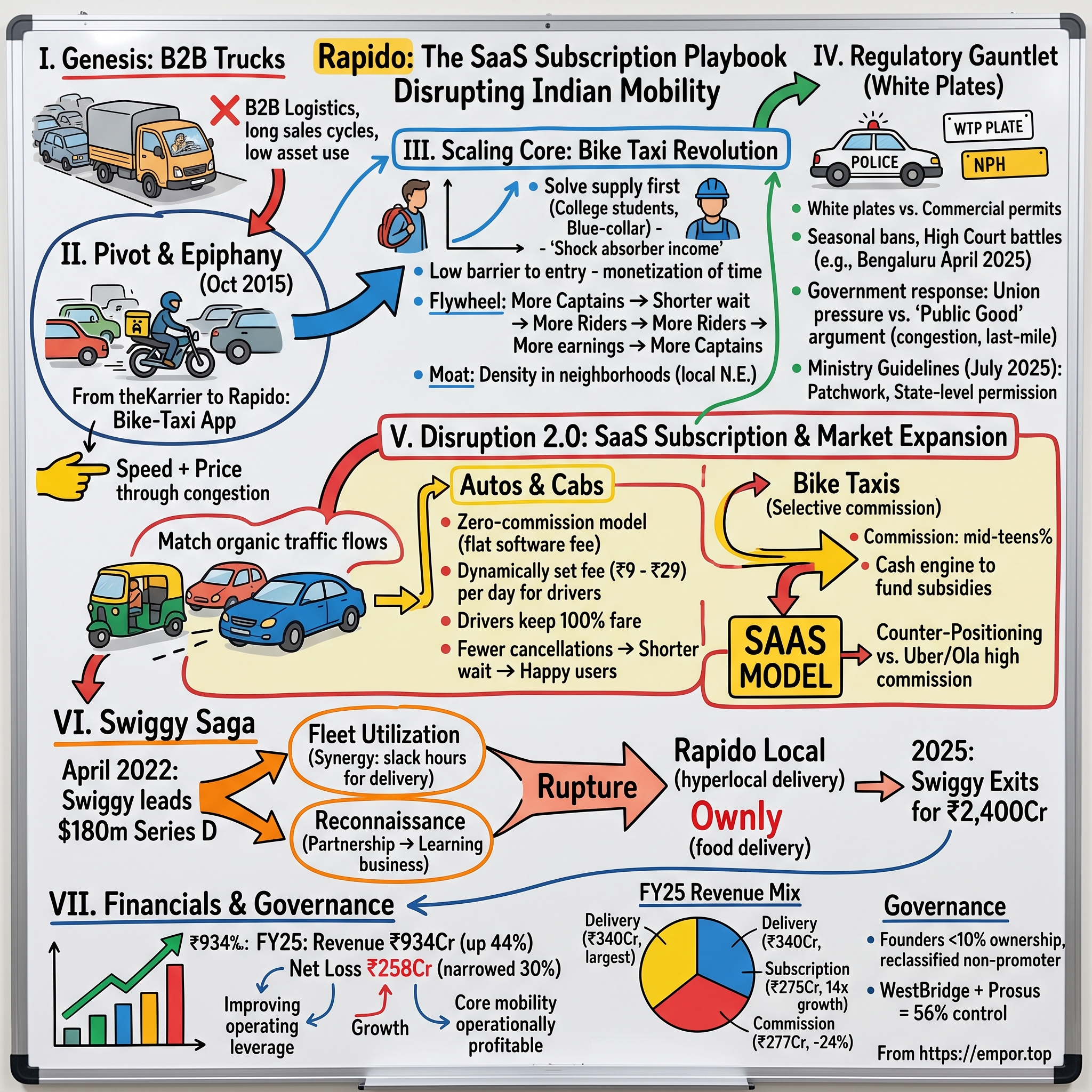
Rapido: The SaaS Subscription Playbook Disrupting Indian Mobility
I. Introduction & Episode Roadmap
Picture a Bengaluru arterial road at 6:15 p.m. on a weekday. Four lanes of cars, autos, and buses are fused into a single motionless mass, horns layered over horns, the air thick enough to chew. And then, threading the two-inch gaps between bumpers like water finding cracks in stone, comes a scooter — a young man in a company-branded jacket, a stranger perched on the back with her office bag, both wearing helmets, moving while everyone else waits. That image — motion inside gridlock — is the entire business.
It is also, on its face, an improbable one. The company behind that scooter, Rapido, did not begin life dreaming of two-wheelers. It began as an obscure, cash-strapped B2B startup trying to aggregate mini-trucks for small businesses in Bengaluru — a venture so unremarkable that most people who use Rapido today have never heard its original name. From that near-failure, a trio of engineers built what is now, by ride volume, India's largest bike-taxi platform and a genuine third force in a market long defined by a duopoly of Uber and homegrown pioneer Ola.2 By mid-2026, Rapido carried a roughly $3 billion valuation and claimed a record five million rides in a single day.14
The hook of this story is not simply the pivot from trucks to two-wheelers. It is a pricing idea. Nearly every ride-hailing platform on earth makes money the same way: it skims a commission — typically 20% to 30% — off the top of every fare. Rapido's most consequential bet was to walk away from that model on autos and cabs and instead charge drivers a flat software-as-a-service subscription — as little as a few rupees a day — after which the driver keeps 100% of the fare.[^12] It is a deceptively simple reframing: stop being a toll booth on every transaction, and start being a piece of software the driver rents. That single decision reorganized the incentives of an entire industry and forced Uber and Ola to respond.
But this is not a victory lap, and Rapido is not our client. A neutral investor has to hold two things at once. The subscription model is genuinely clever and has demonstrably pulled drivers onto the platform. It also structurally caps how much money Rapido can make per ride — a feature its competitors will happily point out. Add a regulatory foundation for its highest-margin bike-taxi business that sits, quite literally, on contested legal ground, founders who now own less than a tenth of the company, and a former strategic backer, Swiggy, that went from writing checks to going to war — and you have a company whose story is far from settled.
Our roadmap runs in that spirit. We start with the logistics failure and the traffic-jam epiphany that birthed the bike taxi. We scale the core two-wheeler marketplace and examine why supply density, not marketing, is the real moat. We walk through the brutal "white-plate" regulatory minefield that can switch Rapido's best business off overnight. We dissect the auto-rickshaw and cab expansion, the financial mechanics of the zero-commission SaaS model, and the slow-motion boardroom-to-street war with Swiggy. Then we put the whole thing through Helmer's 7 Powers and Porter's Five Forces, lay out the bull and bear cases without flinching, and end on the handful of numbers that actually matter. Let's begin where it began — with a truck that wouldn't scale.
 Subscribe on LinkedIn
II. The Genesis: B2B Trucks to Two-Wheeler Epiphany
In November 2014, three young engineers in Bengaluru pooled their savings and their nerve into a company with the earnest, slightly clunky name of theKarrier.[^2] The founders were Aravind Sanka, Pavan Guntupalli, and Rishikesh SR — Sanka and Guntupalli out of the IITs, Rishikesh from PES University in Bengaluru — the kind of technically gifted, credential-heavy team that Indian venture capital is supposed to love. The idea was reasonable on paper: India's intra-city goods logistics was a chaotic, fragmented mess of independent mini-truck owners who spent hours idle between jobs. Build an aggregator — an Uber for tempos and mini-trucks — and you could match small businesses needing a delivery with drivers needing work. theKarrier signed up over a thousand customers around Bengaluru.[^2] And then it hit a wall.
The wall was structural, and it is worth dwelling on because it shaped everything that followed. B2B logistics is a punishing business to bootstrap. Enterprise sales cycles are long — a procurement manager does not sign up on his phone at a traffic light. Fleet utilization sagged during off-peak hours, so the expensive trucks sat idle. And the revenue ceiling was hard: a business needs a delivery a few times a week, not a few times a day. There was no viral loop, no daily habit, no consumer pulling the product into their life. The founders were pushing a boulder uphill, and the hill kept getting steeper. This is the origin myth that Rapido rarely tells at conferences, but it is the more instructive one — the company's defining insight was born from watching a business fail to scale and asking why.
The answer arrived, as the best startup epiphanies tend to, by simply looking out the window. Stuck in the same Bengaluru gridlock that was strangling their trucks, the founders noticed something the whole city sees every day and no one had productized: while the cars, autos, and their own mini-trucks sat frozen, two-wheelers slipped through the gaps and kept moving.[^2] The insight compounded. A private car is a spectacularly inefficient way to move one human being — two tons of steel and a driver's wage to transport a single passenger through a city where road space is the scarcest resource of all. A motorcycle solved for the two things Indian commuters cared about most: speed through congestion, and price.
So in October 2015, they pivoted — hard. theKarrier's mini-truck aggregator was folded, and Rapido was born as a B2C bike-taxi app.[^2] The first fleet was almost comically small: a couple of dozen "Captains," Rapido's term for its drivers, recruited to ferry passengers on the back of their own scooters around Bengaluru. The pitch to riders was blunt and effective: get there faster than a car could, at a fare pitched well below what an auto-rickshaw or cab would charge. Within months, the company was clocking tens of thousands of rides a day.[^2]
It is worth pausing on the psychology of that decision, because founder pivots are easy to romanticize in hindsight and agonizing in real time. theKarrier was not a napkin sketch; it was a real company with real customers, real drivers, and a year of the founders' lives poured into it. Walking away from it meant admitting the original thesis was wrong — the single hardest thing for a proud, credentialed founding team to do. What distinguishes the Rapido story is that the founders did not cling. They treated theKarrier as a hypothesis that had been tested and falsified, and they redeployed the same muscle — matching fragmented supply to fragmented demand through software — onto a better substrate. The through-line was never the vehicle. It was the marketplace mechanic.
The pivot was not universally applauded. Bike taxis occupied a legal grey zone that we will spend an entire section untangling, and early investors were skeptical enough that the founders were said to have collected dozens of rejections before landing a believer — Guntupalli in particular has spoken of enduring roughly seventy-five investor "no"s before the money came. Rejection at that volume tends to do one of two things to a founder: it breaks him, or it clarifies him. For this team it clarified. That believer, tellingly, was Pawan Munjal of Hero MotoCorp — a two-wheeler manufacturer who understood the asset at the center of the model better than any generalist VC could. Where a software investor saw an unproven, quasi-legal service, a motorcycle manufacturer saw a business that put more of his product on the road and monetized the idle hours of machines his company had already sold. Later, TVS Motor would join the cap table too — again, a two-wheeler maker backing a two-wheeler network.3 The pattern is instructive: Rapido's earliest strategic conviction came not from generalist venture capital but from the industrialists who best understood the underlying asset.
The lesson embedded in Rapido's genesis is one investors should carry through the rest of this story: the company's core competence was never trucks or bikes specifically. It was a willingness to look at an inefficiency in Indian urban movement and rebuild the business around it. That reflex — kill the thing that isn't working, chase the thing that is — would define the next decade, and it is worth flagging early that the same reflex is double-edged: a company that pivots readily into every adjacent opportunity is also a company that can lose focus, a tension that will resurface when we reach Ownly. First, though, it had to build a marketplace from nothing.
III. Scaling the Core: The Bike Taxi Revolution & Market Creation
Every marketplace begins life staring down the same cruel paradox, and Rapido's version was especially unforgiving. No rider will open an app that has no bikes nearby; no driver will sign up to sit idle waiting for riders who aren't there. It is the chicken-and-egg problem, and it has killed more two-sided startups than any competitor ever did. Rapido's answer was to solve for supply first, and to solve for it among people for whom a few hundred rupees a day was genuinely life-changing.
The early Captains were not professional drivers. They were college students with a bike and gaps between classes, and blue-collar workers — delivery hands, security guards, small-shop assistants — looking for a second income. This was a deliberate targeting decision, and a shrewd one. These were people who already owned a two-wheeler, already knew the city's back lanes, and could switch the app on during hours they were idle anyway. Rapido didn't have to convince them to buy an asset or quit a job; it had to convince them to monetize time they were already spending on the road. That dramatically lowered the cost and friction of building supply density in a neighborhood.
The economics underneath were the quiet miracle. Consider the asset. A passenger car — the thing Uber and Ola needed on their platforms — cost a driver several lakh rupees, usually financed with a loan that turned the driver into a debt-servicing machine. A motorcycle or scooter cost a fraction of that. The barrier to becoming a Rapido Captain was therefore trivially low compared to becoming an Ola cab driver, which meant supply could be added fast and cheap. Then there was fuel. A two-wheeler returns something on the order of 50–60 kilometers per liter; an entry-level car manages perhaps 12–15. For a driver whose margins are eaten alive by fuel prices, that difference is not a rounding error — it is the difference between the work being worth it and not. Rapido's Captains kept more of every rupee they earned because the vehicle beneath them was radically cheaper to own and to run.
Layer on the "second income" framing and you get something structurally elegant. Because Captains could log on during their own commute — a student riding to campus, a worker heading home — Rapido was, in effect, matching organic traffic flows to commuter demand. Supply appeared precisely when and where people were already moving, at close to zero marginal cost to the Captain. This is the sort of native efficiency that is very hard for a car-based incumbent to replicate, because a professional cab driver's entire day is the job; there is no "already going that way."
There is a human texture to this that the spreadsheets miss and that matters to understanding the platform's durability. For a college student in Bengaluru or a warehouse worker in Hyderabad, being a Rapido Captain was not a career — it was a shock absorber. It was the way to cover a semester's fees, or to bridge the gap between a rent payment and a delayed salary, or to turn the dead time of a daily commute into a few hundred rupees. That framing changed the acquisition math profoundly. A platform recruiting full-time professional drivers has to offer enough to replace a livelihood; a platform recruiting part-timers only has to offer enough to beat idleness. The bar to add supply was simply lower for Rapido than for anyone whose model depended on someone quitting their day job to drive. The flip side, which the bear case will press on, is that a supply base of part-timers is also a fickle one — it swells when the economy is soft and people need side income, and it can thin when better opportunities appear, giving Rapido less control over its own supply than an asset-heavy operator has.
And then the flywheel caught. Here is the mechanism, in plain terms: the more Captains active in a given neighborhood, the shorter the wait for a rider — and once wait times dropped below roughly three minutes, the product crossed a psychological threshold where opening Rapido became a reflex rather than a gamble. Short waits pulled in more riders; more riders made the platform more lucrative for Captains; more earnings pulled in more Captains. Density begat density. This is the classic two-sided network effect, and in ride-hailing it is intensely local — being dense in Koramangala does nothing for a rider in Indiranagar. That locality is why early, concentrated scale in a neighborhood created a lead that was genuinely hard to attack: a competitor couldn't peel off riders without first matching Captain density, and couldn't fund Captain density without the rider demand that density itself produced.
The honest caveat — and a neutral analyst must plant it here — is that this moat is real but shallow at the edges. Riders in India are ferociously price-sensitive and notoriously disloyal; a rider will happily check Rapido, Uber, and Ola in the same thirty seconds and take whichever quotes ₹20 less. Density buys you the default open, not a lifetime customer. Rapido's supply-side flywheel was a powerful engine for creating an entirely new market — the bike taxi essentially did not exist at scale in India before players like Rapido willed it into being. But an engine built on private two-wheelers running a commercial service was also sitting on a legal fault line. Which brings us to the part of the story where the government, not the competition, becomes the antagonist.
IV. The Regulatory Gauntlet: Navigating the "White Plate" Legal Maze
To understand why Rapido's best business can be switched off by a courtroom, you have to understand a small detail on the back of every Indian vehicle: the color of its number plate. A private vehicle — the scooter your neighbor uses to buy groceries — carries a white plate. A commercial vehicle licensed to carry paying passengers carries a yellow plate, and behind that yellow plate sits a whole apparatus: a commercial permit, commercial insurance, a transport-category driving license, road-tax obligations. Under India's Motor Vehicles Act, a white-plate private vehicle is not legally permitted to ferry paying passengers. And the overwhelming majority of Rapido's bike-taxi Captains ride white-plate two-wheelers.
That is the fault line, and it has produced a decade of on-again, off-again warfare. The pattern repeats with almost seasonal regularity: a state transport authority declares bike taxis illegal, impounds vehicles, and threatens fines; Rapido and its peers rush to the High Court; the court grants some form of interim relief or orders the state to actually write rules; operations resume, tentatively, until the next flare-up. Bengaluru — Rapido's home turf and one of its largest markets — has been the epicenter. In April 2025, the Karnataka High Court effectively ordered bike-taxi operations to halt until the state framed proper regulations, a ruling that threw an estimated 1.5 lakh (150,000) Rapido Captains into limbo and disrupted more than 50 lakh (5 million) monthly rides in the state.7 The court gave the government a three-month window to draft rules — a familiar "you sort this out" punt that left drivers, not the state, holding the uncertainty.
To feel the human cost of that legal abstraction, sit for a moment with the April 2025 shutdown. A Karnataka High Court order does not arrive as an abstraction to a Captain; it arrives as a message that the source of his rent money is, effective immediately, illegal. Overnight, roughly 150,000 people who had built at least part of their income around the platform were told to stop, with a vague three-month promise that the state might eventually write rules.7 The riders felt it too — 50 lakh monthly trips in the state did not evaporate because the demand disappeared; they evaporated because a court said the supply was unlawful.7 This is the recurring signature of the white-plate business: the demand is real, the drivers are willing, the riders are eager, and the only thing standing between all of them and a completed trip is the color of a number plate and the mood of a bench.
Other states drew harder lines. Delhi had banned bike-taxi operations outright since 2023, and Maharashtra restricted them, both citing a recurring set of anxieties: passenger safety, the absence of commercial background checks and insurance, and — never far below the surface — intense lobbying from the entrenched auto-rickshaw and taxi unions who correctly saw bike taxis as a mortal threat to their fares.7 The union angle deserves to be named plainly, because it is often the real engine behind a "safety" ban. Auto-rickshaw and taxi drivers are among the most politically organized labor blocs in urban India — they can fill a street, swing a local election, and put a chief minister under pressure in an afternoon. A bike taxi that undercuts an auto fare by half is not a safety question to that bloc; it is an existential one. When a state suddenly discovers deep concern for passenger welfare, it is worth asking whose votes are on the line. It is worth being clear-eyed, though, that the safety concerns were not merely pretextual. Putting a lone female passenger on the back of a stranger's motorcycle, with no cage of steel around her and a driver who may never have been formally vetted, is a legitimate thing for a regulator to worry about — and the honest analyst holds both truths, that the ban is partly protectionist theater and partly a real response to a real vulnerability.
Rapido's response to the trust problem was to engineer around it, at least partially. The app added real-time GPS tracking so a rider's family could follow the trip, mandatory helmets for pillion riders (with disposable hairnets for hygiene), an in-app SOS button, and structured Captain verification.[^20] Whether these measures fully answered the safety critique or simply blunted it is a fair question — a verification process is only as good as its enforcement — but they gave Rapido something to point to when authorities and courts demanded accountability.
The more durable strategy was to change the argument itself. Rather than fight state-by-state as a lawbreaker seeking mercy, Rapido and the broader industry worked to reframe two-wheeler taxis as a public good — a way to cut traffic congestion, lower per-capita emissions, and provide the crucial first-and-last-mile link that gets a commuter from the metro station to her front door. That argument found its most important audience at the center. On July 1, 2025, the Ministry of Road Transport and Highways issued updated Motor Vehicle Aggregator Guidelines that, for the first time, explicitly permitted states to allow the aggregation of private (non-transport) motorcycles for passenger journeys through licensed aggregators.[^9] The framing in the guidelines was almost a paraphrase of Rapido's own advocacy: reduced congestion, lower pollution, affordable mobility, and livelihood creation.[^9]
But — and this is the hinge on which the entire bull case for bike taxis swings — the central government did not legalize anything. It handed the decision to the states, each of which "may" allow private bike-taxi aggregation and may charge aggregators a licensing fee to do so.[^9]8 So the fault line did not close; it was merely redrawn as a patchwork. A commuter can legally hail a bike taxi in one state and be committing a violation across the border in another, and a single adverse High Court ruling or a union-pressured state cabinet can still black out one of Rapido's largest markets overnight. For an investor, the takeaway is uncomfortable and important: the highest-margin engine in Rapido's fleet runs on a permission that is perpetually revocable. That precariousness is precisely why the company spent the back half of the decade building businesses on firmer legal ground.
V. Disrupted Disrupters: The Pivot to Auto-Rickshaws & Cabs
If the bike taxi was Rapido's soul, the auto-rickshaw was its hedge. Around 2020, staring at the regulatory whiplash of the white-plate business, the founders made a characteristically pragmatic move: they took the brand, the app, and the Captain network they had built and pointed all of it at a vehicle that was already, unambiguously, legal to drive for hire. The three-wheeled auto-rickshaw — the yellow-and-black workhorse of every Indian city — carries a commercial permit by default. There was no white-plate problem, no courtroom roulette. There was, however, a market that was miserable for everyone in it.
The auto-rickshaw segment as Rapido found it was dominated by Ola and Uber and defined by mutual resentment. Drivers loathed the 20–25% commissions that aggregators skimmed off fares that were already small; a ₹60 auto ride surrendering ₹15 to an app feels very different from a ₹600 cab ride surrendering the same percentage. That resentment expressed itself in the behavior every Indian rider knows too well: sky-high cancellation rates as drivers rejected app-assigned trips, and rampant off-app "meter jumping" and overcharging as drivers tried to claw back what the commission took. The incumbents had built a system that made everyone unhappy — and unhappy incumbents are the sweetest possible target for a challenger with a different pricing model. We will come to that model in detail; for now, note that the auto-rickshaw pivot handed Rapido a legally safe, driver-aggrieved market ripe for exactly the kind of disruption it was about to unleash.
Then, in late 2023, Rapido did the audacious thing: it went straight at the four-wheeler. "Rapido Cabs" launched to take on the Ola–Uber cab duopoly on its own turf, carrying over the same driver-first, low-take philosophy.9 This was no longer a scrappy bike-taxi upstart staying in its lane; it was a direct assault on the most capital-intensive, most fought-over segment in Indian mobility. To understand the boldness, size up the opponents.
Uber India was the global colossus — deep-pocketed, technologically formidable, but historically oriented toward higher-margin urban and corporate car rides, and repeatedly slow to adapt its global commission playbook to the on-the-ground economics of an Indian auto driver. Ola, the domestic pioneer that had once out-hustled Uber on home soil, had spent years diffusing its focus — pouring management attention and capital into Ola Electric's scooter-manufacturing ambitions and various quick-commerce and other adventures — leaving its core ride-hailing app under-tended and, arguably, vulnerable to exactly the kind of share erosion a hungry challenger could inflict. A distracted incumbent is a gift, and Rapido accepted it.
Ola's situation in particular rewards a closer look, because it is a cautionary tale about focus that sits right next to Rapido's own diversification temptation. Ola had been the local hero — the company that beat Uber's global machine on Indian soil in the mid-2010s by understanding autos, cash payments, and Indian driver economics better than a San Francisco playbook ever could. But its founder's ambitions metastasized across manufacturing electric scooters, building cells and batteries, and chasing quick commerce and other frontiers, and the original ride-hailing app — the cash cow that made all of it possible — was left to age. For a competitor, an incumbent that has stopped defending its core is not a fortress; it is an open door. Rapido walked through it. The irony that a neutral observer should hold onto is that Ola's cardinal sin — spreading management attention across too many bets — is precisely the risk that Rapido now courts as it stretches from bikes to autos to cabs to parcels to food.
The competitive map had niche players worth watching too, because each illuminates a different strategic choice. BluSmart pursued a premium, asset-heavy model — company-owned electric cars, salaried-feeling drivers, no surge, a clean and reliable experience — which produced a lovely product and a brutally capital-hungry balance sheet; it is the anti-Rapido in almost every dimension, and its later, well-publicized financial troubles underscored just how unforgiving the owned-fleet approach can be when capital tightens. Namma Yatri, backed by the payments company Juspay, went the opposite way: an open-source, near-zero-commission protocol for auto-rickshaws that let drivers keep essentially all of the fare, pioneering in Bengaluru the very zero-take philosophy Rapido would industrialize. Namma Yatri matters strategically out of proportion to its size, because it proved the zero-commission model could work and, in doing so, effectively set the price of driver goodwill in India to near zero — a genie Rapido, Ola, and Uber can no longer put back in the bottle. The spectrum from BluSmart's owned fleet to Namma Yatri's open protocol frames the central strategic question of Indian ride-hailing: who captures the value, and how thin are you willing to make your own slice to win the driver? Rapido's answer to that question — a SaaS subscription — is the heart of the whole story, and it deserves its own section.
VI. The SaaS Transformation: Zero-Commission vs. Traditional Aggregators
Here is a thought experiment that a Rapido product manager might have sketched on a whiteboard. Take an auto driver who does fifteen rides a day. On Uber or Ola, at a 20–25% commission, he might surrender well over a thousand rupees of his daily earnings to the platform. Now ask him a single question: what if, instead of taking a cut of every ride, we charged you a flat fee — call it twenty-odd rupees for the day — and let you keep every paisa of every fare after that? To that driver, the math is not a marketing message. It is the difference between resentment and loyalty.
That is the entire idea, and its elegance is that it reframes what Rapido is selling. In the commission model, the platform is a partner that takes a piece of your income forever — a landlord collecting rent on every transaction. In the SaaS model, the platform is a tool you rent by the day, like a shopkeeper paying for point-of-sale software: pay the flat fee, and the upside is yours. For autos, Rapido set that fee dynamically, ranging roughly between ₹9 and ₹29 depending on conditions, after which the Captain kept 100% of the passenger's fare.[^12] For cabs, the structure was a monthly subscription pack — on the order of ₹500 — typically kicking in only once a driver's monthly earnings crossed a threshold, so a driver having a slow month wasn't underwater on his subscription.9
Crucially, Rapido did not apply this uniformly, and the exception reveals the strategy. Bike taxis largely stayed on a traditional commission structure — in the mid-teens percentage range — because the bike-taxi business was the cash engine, the high-margin operation whose take-rate helped fund the customer-acquisition subsidies and technology costs across the rest of the platform.[^12] Read that carefully, because it is the tell: Rapido used commissions where it had pricing power (a bike taxi has few legal substitutes and a captive rider) and used subscriptions where it needed to steal drivers from entrenched rivals (autos and cabs, where Ola and Uber were the default). The SaaS model, in other words, was as much a competitive weapon as a philosophy — a tool for prying open a market Rapido did not yet own.
And as a weapon, it worked with unsettling speed. When a driver can keep the marginal rupee, two things happen almost mechanically. Supply floods onto the platform, because the economics are simply better for the driver. And cancellations collapse, because the driver no longer has any incentive to reject an app trip in favor of an off-app cash fare — the app trip already pays him everything. More supply and fewer cancellations mean shorter waits and more completed rides for consumers. The subscription didn't just save drivers money; it repaired the broken behavior that made the incumbents' product frustrating in the first place. This is the strongest, most evidence-backed part of the bull case, and it shows up in the financials: subscription income surged nearly fourteen-fold in a single year, which we'll quantify shortly — proof that drivers were, in fact, paying to be there.1
Look closely at the incentive alignment, because it is more subtle than "drivers get more money." Under a commission model, the platform and the driver are adversaries on every single ride: every rupee the platform takes is a rupee the driver loses, which is why commission platforms must invest so heavily in surveillance, ratings enforcement, and cancellation penalties to police behavior they have themselves incentivized. The driver's rational move is to game the system — accept the ride, call the passenger, ask to go off-app for cash. Under a flat subscription, that adversarial edge simply dissolves. Once the day's fee is paid, the platform's interest and the driver's interest point in the same direction: complete as many rides as possible, because every additional ride is pure driver income and every additional ride makes the platform's next-day subscription an easier sell. Rapido replaced an expensive policing problem with a cheap alignment one. That is not a marketing trick; it is a genuinely different architecture of incentives, and it explains why the behavioral improvements — fewer cancellations, less overcharging — followed so quickly from what looks like a mere pricing tweak.
There is a second-order consequence worth naming: the subscription converts a variable, volume-linked revenue stream into something closer to recurring revenue, which is precisely the kind of predictability public-market investors reward. A platform earning ₹275 crore of subscription fees from a large base of Captains paying daily and monthly passes has a revenue line that behaves more like a software business than a transaction business — visible, recurring, and reasonably forecastable. For a company marching toward an IPO, that optical shift is not incidental. It reframes Rapido from "Indian ride-hailing company with thin take rates" to "software platform with a captive subscriber base." Whether public investors accept that reframing, or see through it to the capped economics underneath, may matter more to Rapido's eventual listing multiple than any operational metric.
Myth vs. Reality
Before we go further, three pieces of consensus narrative deserve a fact-check, because Rapido's story has calcified into slogans that don't fully survive contact with the numbers.
Myth: Rapido is a zero-commission platform. Reality: Rapido is a selectively zero-commission platform. Autos and cabs run on subscriptions; the bike-taxi business — the original business, and the most profitable one — has largely continued to charge commissions.[^12] The company monetizes exactly where riders and drivers have the fewest alternatives and gives the fare away exactly where it needs to poach. That is smart, and it is not the egalitarian story the branding implies.
Myth: Rapido invented the zero-commission model for Indian drivers. Reality: Juspay-backed Namma Yatri was demonstrating near-zero-take auto-rickshaw hailing in Bengaluru around the same period. Rapido's genuine achievement was not invention but industrialization — taking a model proven at civic-experiment scale and running it across a national network with the capital and supply density to make it stick.
Myth: Rapido has turned profitable. Reality: management has signaled that the core mobility business reached operating profitability, but the consolidated company remained loss-making, and the audited FY25 result was a ₹258 crore net loss on a still-negative EBITDA margin.116 Improving, materially — but "our best segment covers its costs" is a very different sentence from "we make money," and investors should not let the first be quietly substituted for the second.
Predictably, the incumbents blinked. Faced with the prospect of their driver base quietly migrating to Rapido and Namma Yatri, both Ola and Uber rolled out their own subscription-style and lower-commission packages for auto drivers — a defensive concession that, in itself, validated Rapido's thesis. But — and here the neutral analyst must interrupt the triumphalism — the SaaS model carries a poison pill for Rapido's own economics, and it is the crux of the bear case. When you replace a percentage commission with a flat fee, you sever your revenue from the value of the ride. If average fares rise, if surge pricing spikes during a downpour, if the mix shifts toward longer and pricier trips — the commission-based platform captures a slice of all of it, and Rapido captures exactly ₹29. The company has, quite deliberately, capped its own take-rate on autos and cabs. That is a fantastic way to acquire a driver and a structurally limiting way to make money from him. Whether the volume unlocked by the model can outrun the margin it forfeits is the single most important open question in Rapido's business — and it is a question the company's investors, old and new, have every reason to be nervous about. One of those investors turned out to be more than nervous.
VII. The Swiggy Saga: From Strategic Backer to Boardroom Rival
In April 2022, the marriage looked perfect. Swiggy, the food-delivery giant, led a $180 million Series D round into Rapido at an $830 million valuation, writing the largest check itself — roughly $120–124 million — for a stake around 12%.34 On paper it was one of those rare fundings where the strategic logic was as compelling as the financial one, and everyone in the room could see the synergy on a napkin.
The napkin math was about fleet utilization, and it was genuinely clever. Rapido had an army of two-wheeler Captains whose demand was lumpy — packed during the morning and evening commutes, slack in the flat afternoon hours between roughly 2 and 5 p.m. Swiggy had the opposite problem in reverse: it needed delivery riders, and lunch-to-tea was a meaningful delivery window. Plug the two together and, in theory, a Captain who spent the morning ferrying office-goers could spend the sleepy afternoon delivering Swiggy food orders and Instamart groceries — maximizing his own earnings, maximizing fleet utilization, and lowering Swiggy's delivery costs. Dual-use of a single fleet is the kind of idea that makes strategy consultants weep with joy. The problem with joint fleets, it turns out, is that both partners are also learning each other's business.
Because here is what Rapido learned: it was sitting on one of the most valuable assets in Indian commerce — a dense, on-demand, real-time logistics network of hundreds of thousands of riders. And a logistics network does not have to stop at people. It can carry parcels, documents, and dinner. Every hour a Captain spent delivering a Swiggy order was an hour in which Rapido observed, in granular detail, exactly how the food-delivery business worked: the pickup choreography, the restaurant wait times, the routing, the unit economics of a ₹300 order. Partnership, in platform businesses, is very often reconnaissance conducted with the target's consent.
Rapido began pushing into intra-city courier and parcel delivery with "Rapido Local," stepping directly onto the turf of Swiggy Genie and the Dunzo-style hyperlocal players. The strategic backer was becoming a competitor one product launch at a time. From Rapido's seat, the logic was close to irresistible: the fleet was already deployed, the marginal cost of carrying a parcel instead of a passenger was near zero, and the afternoon slack that Swiggy had helpfully identified was capacity Rapido could monetize itself rather than rent out. From Swiggy's seat, the same logic must have looked considerably less charming.
Then came the launch that turned a drift into a rupture. Rapido began piloting its own food-delivery service — "Ownly" — in Bengaluru, using a zero-commission model for restaurants (charging a flat delivery fee to customers instead of skimming the restaurant's revenue), the same disruptive pricing philosophy it had unleashed on ride-hailing.12 The pilot began quietly in select Bengaluru neighborhoods in 2025, and by March 3, 2026, Rapido had rolled Ownly out across the entire city, claiming close to 20,000 restaurant partners and levying a flat ₹30 delivery fee per order.12 Rapido was now attacking the Swiggy–Zomato duopoly at its heart — food delivery — using a portfolio company's own capital as part of its war chest. You do not need a boardroom to feel how awkward that Swiggy directorship had become.
The conflict resolved the only way it could. In 2025, Swiggy exited Rapido entirely, selling its stake for a total of roughly ₹2,399.5 crore — the bulk to Prosus (via its MIH Investments entity) and the remainder to WestBridge affiliates — cashing out at about 2.35 times its original investment in under four years.1011 For a strategic bet gone sideways, a 2.35x return is a perfectly respectable financial outcome, and Swiggy was right to book it rather than sit on a board table across from a rival. Holding the stake would have meant funding a competitor's assault on its own core business while enjoying no control over the assault's direction — the worst of both worlds. There is also a hard-nosed corporate-finance reading: Swiggy, itself newly public and under pressure to fund its own quick-commerce war, converted an illiquid minority position into roughly ₹2,400 crore of cash it could deploy against Blinkit and Zepto. Sometimes a strategic exit is simply a balance-sheet decision wearing a strategy costume.
And yet the exit invites the "did they leave money on the table" question that follows every early sale of a fast-compounding asset. Swiggy exited at a valuation that reporting pegged in the mid-$2 billion range;11 within roughly a year, Rapido's next round would price it at around $3 billion.14 Swiggy captured the return and forfeited the further upside — a rational trade when the alternative is financing your own competitor, but a reminder that the cleanest exits are rarely the most lucrative ones.
The deeper lesson for investors is about the fragility of "strategic synergy" as an investment thesis. The 2022 deal was underwritten on the assumption that Rapido's fleet and Swiggy's demand were complements. They were — right up until Rapido realized that the fleet was the scarce asset and the demand was the commodity. In platform economics, whoever owns the supply-side network tends to accumulate optionality, and whoever rents it accumulates dependency. Swiggy had, in effect, paid $120 million to teach a logistics network how valuable it was. The buyers of that stake would come to dominate Rapido's cap table, which is exactly where the governance story gets interesting.
VIII. Financial Teardown, Governance, & the Path to IPO
Strip away the narrative and put the company on the examination table, and Rapido's numbers tell a story of a business scaling fast while still losing money — improving, but not yet proven. In FY24, operating revenue was about ₹648 crore against a net loss of roughly ₹371 crore.1 In FY25, operating revenue surged about 44% to ₹934 crore, and total income — including some ₹69 crore of interest on investments — crossed the landmark ₹1,000 crore threshold to reach ₹1,003 crore.1 More importantly for anyone underwriting a path to profitability, the net loss narrowed about 30% to ₹258 crore.1 Revenue up 44%, losses down 30% — that is the shape of improving operating leverage, the pattern investors want to see before an IPO. It is not yet profit.
That distinction matters because management has, at times, leaned into a rosier framing. Rapido's leadership signaled in 2024 that its core mobility business had turned operationally profitable — an EBITDA-positive claim at the segment level.16 A neutral reading holds both truths: the mature ride-hailing core may well cover its own costs, but the consolidated entity still posted a ₹258 crore loss and a deeply negative EBITDA margin in FY25, because the money the core throws off is being plowed straight into new bets — cabs, Rapido Local, and the cash-burning Ownly food-delivery push.1 The gap between "our core is profitable" and "the company is profitable" is the gap between a management claim and an audited fact, and investors should hold the two apart.
The revenue mix is where the strategic transformation becomes visible. The single largest revenue driver in FY25 was not ride-hailing at all — it was delivery services, at about ₹340 crore, up 28% year over year.1 Read that again: the bike-taxi company's biggest line item is now logistics. Subscription income — the financial signature of the SaaS model — surged nearly fourteen-fold to about ₹275 crore, contributing close to 30% of the top line and validating, in hard cash, that drivers were willing to pay to keep their fares.1 Underneath, gross order value — the total rupee value of everything transacted on the platform — roughly 2.5x'd to around $1.25 billion for the year, the scale metric that ultimately has to justify the valuation.6 The composition confirms the thesis of the whole episode: Rapido is quietly becoming a logistics-and-software network that happens to have started in bike taxis.
But the mix carries a warning the bulls tend to skip past. In the same year that subscription income exploded, Rapido's traditional platform-led income — the old commission-based revenue — actually fell, declining roughly 24% to about ₹277 crore.1 That is the SaaS transition rendered in accounting: the company is deliberately trading a shrinking, higher-take-rate revenue stream for a growing, lower-take-rate one. Net-net the top line grew smartly, so the trade has been worthwhile so far. Yet it tells you that a meaningful chunk of Rapido's 44% growth was a substitution effect, not purely incremental expansion. An analyst should watch whether subscription growth continues to outrun commission decay, or whether the two eventually converge into a slower-growing whole.
The relationship between gross order value and revenue is the other number that deserves translation, because it is where the capped-take-rate story stops being theoretical. Roughly $1.25 billion of transactions flowed across the platform; Rapido's operating revenue from that flow was about ₹934 crore — call it a little over $100 million.16 That implies a blended take-rate in the high single digits, against the 20–30% that a conventional commission aggregator extracts. Rapido moves an enormous amount of value and keeps a very small slice of it. That is, depending on your temperament, either the entire moat (drivers stay because Rapido barely taxes them) or the entire problem (a business that touches billions and retains millions must eventually find profit somewhere other than the ride). The company's answer, as the mix shows, is delivery. Which is why the delivery margin is the number that matters most — and which the company does not break out in a way that lets outsiders verify it.
Now the governance, which is where a skeptical investor should lean in. The three founders — Sanka, Guntupalli, and Rishikesh — collectively own only somewhere in the region of 9–10% of the company after years of dilutive rounds spanning Series A through the latest raise.13 Ownership at that level, this early relative to a public listing, is a genuine flag: it concentrates real control elsewhere. And elsewhere is a short list. After the 2026 round, WestBridge Capital was the largest shareholder at about 29.7% and Prosus at about 26.2% — together roughly 56% of the company, a commanding bloc with dominant board and voting influence.15 Two financial investors effectively control Rapido.
Consider how that concentration came about. The dilution was not the product of a single bad deal but of an unbroken sequence of capital raises stretching from an early Series A through the unicorn round of July 2024 — a $120 million raise led by WestBridge that first pushed Rapido past the billion-dollar mark — and on to the 2026 Prosus-led financing.514 Each round was individually rational and collectively corrosive to founder ownership. This is the ordinary arithmetic of venture capital in a capital-hungry, subsidy-driven industry: ride-hailing does not generate the cash to fund its own growth, so it must sell equity to buy density, and the founders' stakes are the currency. Rapido's founders financed a decade of expansion by selling nine-tenths of their company. Whether that was a good trade for them is a personal question; whether it is a good structure for a public company is an investor's question.
Against that backdrop, a board maneuver in August 2025 takes on added significance. Rapido's board reclassified the three co-founders from "promoters" to "non-promoter shareholders" under SEBI's framework — a preparatory step for a planned IPO in FY27.13 The board's stated rationale was technical and, on its face, defensible: none of the founders held more than 10% of voting rights or exercised control, and Rapido had matured into a "professionally managed" company.13 The practical effect is that founders shed the stringent lock-ins, pledge disclosures, and remuneration-approval requirements that promoter status imposes — following a well-worn path already trodden by Swiggy, Eternal, Delhivery, and PB Fintech.13 The charitable reading is housekeeping. The skeptical reading — the one an activist would voice — is that a company preparing to go public has formally acknowledged that the people who built it neither own nor control it, and that its destiny rests with two financial sponsors whose time horizon is an exit, not a mission. Whether those sponsors back bold, market-expanding bets like Ownly or steer toward a defensive, IPO-friendly march to profitability is the governance question that hangs over everything. To weigh it, we need a framework.
IX. The Playbook: Hamilton Helmer's 7 Powers & Porter's 5 Forces Analysis
Strategy frameworks are where hand-wavy "moat" talk goes to get tested, so let's run Rapido through two of them honestly — crediting the powers that are real and refusing to inflate the ones that aren't.
Hamilton Helmer's 7 Powers Applied to Rapido
Scale Economies (moderate-to-high power). Rapido's density lowers wait times and raises Captain utilization, which lowers effective cost per ride and lets it outcompete smaller regional entrants. The caveat is that in ride-hailing, scale economies are local, not national — dominance in Bengaluru does not automatically defend Pune. So this is a power that compounds neighborhood by neighborhood rather than as one continental moat.
Cornered Resource (moderate power). The genuinely differentiated asset is the vast, engaged Captain network — and specifically the fact that the subscription model makes those Captains stickier than a commission platform's drivers. But calling drivers a "cornered resource" overstates it: a driver is not a patent or a mineral deposit. He can and will multi-home, running Rapido and Uber apps simultaneously. What Rapido corners is not the driver's exclusivity but his preference, which is weaker.
Switching Costs (low-to-moderate power). For a driver, leaving Rapido's SaaS model for a commission platform means re-accepting a 20–30% haircut on every fare — a real financial deterrent. But it is a deterrent that evaporates the moment a rival matches the subscription, which Ola and Uber have moved to do. For riders, switching costs are close to zero.
Network Effects (high power). This is the strongest and most durable of Rapido's powers, and it is the classic two-sided loop: more drivers → shorter waits → more riders → more subscription-paying drivers → capital to subsidize demand. It is real, it is proven in the density data, and it is the single best reason to believe Rapido can defend its position.
Counter-Positioning (high power). This is the subtle one, and it is Rapido's cleverest structural advantage. Ola and Uber are trapped in a high-commission model that funds their overheads and, for Uber, global margin expectations. They cannot flip their entire auto-and-cab base to a flat ₹29-a-day subscription without vaporizing their own core revenue — the incumbent's dilemma in its purest form. Rapido can attack with a model the incumbents literally cannot fully copy without cannibalizing themselves. Counter-positioning is why the SaaS model is a weapon and not just a nicety.
Porter's Five Forces Analysis of Indian Ride-Hailing
Threat of new entrants (low-to-moderate). Building passenger–driver density from scratch requires enormous capital, which deters generic entrants. But open-source and localized protocols like Juspay-backed Namma Yatri lower that barrier in specific metros, so the threat is real at the city level.
Bargaining power of suppliers/drivers (high). Indian drivers are organized, quick to strike, and quick to delete an app over a pricing dispute. Rapido's SaaS model is, in essence, a structural surrender to this force — it hands the fare-pricing upside to the driver precisely because the driver's bargaining power is so high.
Bargaining power of buyers/riders (high). Urban Indian commuters are exquisitely price-sensitive and carry near-zero brand loyalty, multi-homing across three apps in seconds. This force caps everyone's pricing power and keeps the whole industry honest — and thin.
Threat of substitutes (high). Metro rail, suburban trains, city buses, personal two-wheelers, and rental e-bikes are all viable substitutes, and many are cheaper than any hailed ride. The threat is ever-present.
Competitive rivalry (extremely high). A capital-intensive, margin-thin war among Uber, Ola, Rapido, and asset-heavy EV fleets like BluSmart, with the occasional price war torching everyone's economics.
The framework verdict is nuanced, not triumphant: Rapido's network effects and counter-positioning are genuine and hard to attack, but they sit inside an industry structure — powerful drivers, powerful riders, abundant substitutes, ferocious rivalry — that makes sustained excess profit brutally difficult for anyone. That tension is exactly what the bull and bear cases have to resolve.
X. The Investment-Story Spine: Bull vs. Bear Case
The Bull Case ("Why Win from Here")
The bull case rests on three legs, and the first is the strongest thing Rapido has going for it. The SaaS flywheel is, on the evidence so far, genuinely superior at doing the one thing that matters in ride-hailing: attracting and retaining supply. Drivers keep more of their money on Rapido, so Rapido tends to have the density, and density produces shorter waits and lower cancellations than the commission incumbents can reliably match. That is not a slogan; it is visible in the fourteen-fold surge in subscription revenue, which is drivers voting with their wallets.1 Superior supply is the closest thing to a durable edge this industry offers.
The second leg is logistics optionality. Rapido's fleet is not merely a taxi service; it is a general-purpose, on-demand delivery network, and the fact that delivery became the company's single largest revenue line in FY25 — ₹340 crore — is hard proof that the network can be monetized well beyond passenger rides.1 Food, parcels, groceries, e-commerce last-mile — each is a lever on the same underlying asset, and each can absorb Captain capacity during the slack hours that would otherwise be dead time. If the take-rate on passenger rides is capped by the SaaS model, delivery is where incremental margin can come from.
The third leg is geography. Uber and Ola are saturated and expensive in the top metros; Rapido's radically lower cost structure — cheap two-wheelers, low-cost Captains — lets it push profitably into India's Tier II and Tier III cities, where the two-wheeler is not a novelty but the default mode of transport and where a car-based incumbent's economics simply don't work. That is a large, under-served runway that plays directly to Rapido's structural strengths.
The Bear Case ("Why Not")
The bear case is equally concrete, and it starts with the fault line we have already walked. The white-plate bike-taxi business — Rapido's highest-margin engine — rests on a permission that any state can revoke. The 2025 Karnataka shutdown was not a hypothetical; it idled 150,000 Captains and millions of monthly rides in a core market with a single ruling.7 The July 2025 central guidelines helped, but they explicitly left the yes/no decision to each state, so the risk was redrawn, not removed.[^9] A hostile state cabinet or an adverse High Court can still black out Rapido's best economics overnight — and unions have every incentive to make that happen.
The second bear leg is the one baked into the business model itself: the SaaS revenue cap. By trading commissions for flat fees on autos and cabs, Rapido cannot benefit from rising fares, longer trips, or surge pricing — the very tailwinds that lift a commission platform's revenue for free. It has purchased driver loyalty by permanently forfeiting its own operating leverage on the transaction, and it is not yet demonstrated that volume and subscription growth can outrun that structural cap to reach sustained profitability. FY25 was still a ₹258 crore loss.1
The third bear leg is governance and alignment. Founders own under 10% and have been formally reclassified as non-promoters, while two financial sponsors — WestBridge and Prosus — control roughly 56% of the company.1315 The risk is not that these are bad investors; it is that their incentives may not favor bold, market-disrupting, cash-burning bets like Ownly if a cleaner, cheaper, faster path to an IPO exit presents itself. When the people who own the company optimize for the exit and the people who built it can be outvoted, strategy can quietly shrink to fit the liquidity event. An activist would put that on the table on day one.
An activist would raise two further things, and both are worth pre-empting. The first is portfolio complexity — the "diworsification" question. Rapido is simultaneously running a bike-taxi business, an auto business, a cab business, a parcel-delivery business, and a subscale food-delivery insurgency against two entrenched, well-capitalized rivals. Ownly is a fascinating strategic option and a certain near-term cash incinerator; India's roughly $8 billion food-delivery market has buried better-funded challengers than Rapido, and the zero-commission pitch to restaurants, while genuinely disruptive, means Ownly monetizes only a flat customer delivery fee against real logistics costs.12 A skeptical investor is entitled to ask whether a company that has never earned a full-year profit should be opening a third front. The bulls' rejoinder — that Ownly rides on a fleet Rapido already pays for — is a real one, but marginal-cost arguments have a habit of understating the marketing, customer-acquisition, and restaurant-onboarding spend that a food-delivery war actually demands.
The second is disclosure. Rapido is a private company whose numbers reach the public through regulatory filings and journalism rather than quarterly earnings calls with hostile analysts asking follow-up questions. There is no transcript in which a management team is pressed on why consolidated EBITDA remains negative despite a purportedly profitable core, no Q&A in which someone asks what the contribution margin on an Ownly order actually is, and no segment-level disclosure that would let an outsider verify whether delivery is carrying its own weight. That informational vacuum is normal for a private company. It is also precisely the vacuum in which optimistic narratives flourish unchallenged, and it will not be tolerated once the company lists. The IPO will subject a decade of accumulated storytelling to a level of scrutiny it has never faced.
The Risk Radar
Two further risks belong on the radar because they operate through real business mechanisms rather than generic macro anxiety. The first is cost of capital. Rapido has never funded its own growth from operations; it has funded it from equity markets, and its valuation nearly tripled in roughly nine months into 2026 during a benign financing environment.14 A business that consumes cash to buy density is exquisitely sensitive to the price of that cash. If risk appetite for loss-making Indian consumer platforms cools before the IPO — as it did brutally in 2022 — the down-round or delayed-listing scenario is not exotic; it is the base case in a tighter market. BluSmart's difficulties are the nearest available demonstration of what happens when a capital-hungry mobility model meets a closed funding window.
The second is the driver-classification question that hangs over every gig platform on earth. Rapido's entire cost structure assumes Captains are independent contractors renting software, not employees owed wages and benefits. Ironically, the SaaS framing may help here — a driver paying a subscription for a tool looks less like an employee than a driver whose earnings are being skimmed by a supervisor. But Indian labor law and social-security codes for gig workers continue to evolve, and any move toward mandated benefits, minimum earnings, or employment reclassification would strike directly at the economics that make the model work. It is a low-probability, high-severity risk, and it is not priced into any bull case.
The synthesis a fundamental investor should sit with: Rapido has a real, network-effect-and-counter-positioning-driven edge in acquiring supply, and a proven ability to spin its fleet into new revenue. It also has a highest-margin business on revocable legal footing, a chosen revenue model that caps its own upside, and a control structure that may prioritize exit over ambition. The stock — when it eventually lists — will be a bet on which of those forces compounds faster. Watching that race requires knowing which numbers to watch.
XI. Outro & Key Performance Indicators
Strip this entire story down to what an investor should actually monitor quarter after quarter, and it reduces to three numbers — no more.
First, active subscription growth and Captain retention. The SaaS model is the whole thesis, so the health of the SaaS model is the whole scorecard. Is subscription income still compounding, and are Captains renewing their daily and monthly passes rather than drifting to a rival's newly matched offer? Rising, sticky subscription revenue means the flywheel is intact; stalling subscription revenue would be the earliest signal that the counter-positioning advantage is eroding.1
Second, average ETA and cancellation rates. These are the twin vital signs of the consumer experience and the truest real-time benchmark against Uber and Ola. Short waits and low cancellations are the visible output of supply density; if they deteriorate, it means the density moat is slipping, usually before it shows up anywhere in the financials.
Third, delivery margin contribution. Delivery is already the largest revenue line and the designated engine for the margin that the capped-take-rate passenger business cannot generate. The question is not whether delivery is big — it is whether it is profitable enough to cross-subsidize the capital-intensive cab war and the cash-burning food-delivery push. If delivery margins hold, the logistics-optionality bull case is real; if they don't, Rapido is just running three loss-making businesses at once.
The closing thought is the one the whole episode has been circling. Rapido is a case study in a specific, hard-won insight about emerging markets: that in a country of price-sensitive riders and organized, disloyal drivers, the battle is won on supply-side loyalty, not on brand or marketing spend. The company understood before its larger rivals that if you take care of the driver — really take care of him, by handing him back the marginal rupee — the density, the short waits, and the riders follow. Whether that insight survives contact with a revocable regulatory base, a self-imposed revenue cap, and a cap table controlled by sponsors hunting an exit is the question that the coming IPO, and the years after it, will answer. The bikes, for now, are still moving while everyone else sits in traffic.
References
-
Rapido joins Rs 1000 Cr income club in FY25, delivery biz outpaces ride-hailing — Entrackr, 2026 ↩↩↩↩↩↩↩↩↩↩↩↩↩↩
-
How Rapido's rapid strides made it the largest bike taxi player in India — Forbes India ↩
-
Rapido raises $180 mn at $830 mn valuation in funding round led by Swiggy — Business Standard, 2022-04-15 ↩↩
-
Swiggy backs bike taxi platform Rapido in $180 million funding — TechCrunch, 2022-04-15 ↩
-
Rapido enters unicorn club with $120 million round led by WestBridge — Business Standard, 2024-07-29 ↩
-
Rapido reports 2.5x increase in gross order value to Rs 2,461 cr in Q2FY25 — Business Standard, 2024-11-14 ↩↩
-
Rapido's 1.5 lakh riders face uncertainty as Karnataka HC bans bike taxi — Business Today, 2025-04-04 ↩↩↩↩↩
-
Centre Clears The Path For Bike Taxi Operations — Inc42, 2025 ↩
-
Rapido Launches Low-Commission Cab Service to Challenge Ola-Uber Duopoly — Business Standard, 2023-12-05 ↩↩
-
Swiggy cashes out of Rapido with 2.35x return; Prosus, WestBridge acquire stake — Entrackr, 2025 ↩
-
Swiggy is exiting Rapido; selling out at Rs 2,400 crore to Prosus, Westbridge — Deccan Herald, 2025 ↩↩
-
Rapido rolls out Ownly across Bengaluru with zero-commission model for restaurants — Storyboard18, 2026-03-03 ↩↩↩
-
Rapido IPO Preparation: Founders Shed Promoter Tags for Leaner Public Compliance — Outlook Business, 2025-08 ↩↩↩↩↩
-
Rapido raises $240M in primary funding led by Prosus at $3B valuation — YourStory, 2026-05 ↩↩↩↩
-
WestBridge and Prosus own 56% stake in Rapido after latest $240 Mn funding round — Entrackr, 2026 ↩↩
-
Aravind Sanka on Becoming EBITDA Positive and the SaaS Model Evolution — YourStory, 2024-09-12 ↩↩
 LinkedIn
 WhatsApp
 Reddit
 Hacker News
 Email
Email Kindle
 RSS Feed
 Spotify
 Apple Podcasts
 Amazon Music
 Audible
 YouTube