Rail Vikas Nigam: The Contractor That Never Owns the Bulldozer
I. Introduction & Episode Roadmap
Picture a new double line being laid across a stretch of central India. Earthmovers cut the embankment, a gantry swings concrete sleepers into place, and a signalling crew threads cable along the trackbed. Look at the logos on the machines and you will not find the company whose name is on the project board. The bulldozers belong to sub-contractors. The steel was bought through a tender. The engineers on site are mostly someone else's staff. The company responsible for the whole job, Rail Vikas Nigam Limited, owns almost none of it.
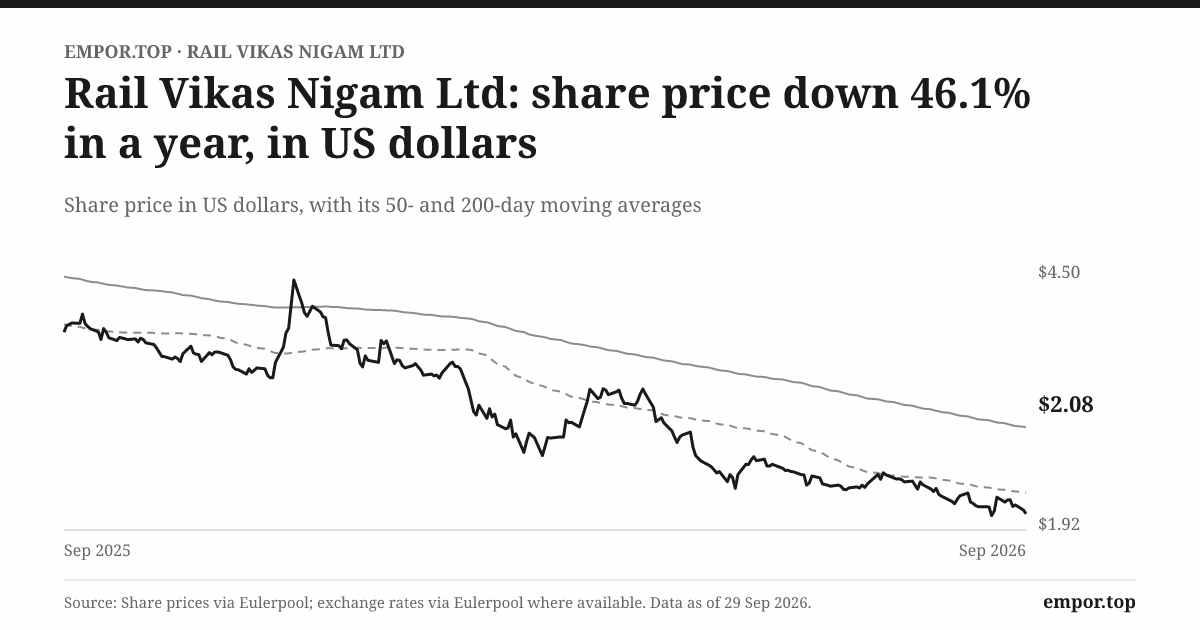
That is the paradox at the centre of this story. RVNL turned over about $2.3bn in the year to March 2026 and kept roughly 4% of it as net profit[^1]. Its property, plant and equipment is worth about $100m, less than a twentieth of its revenue[^1]. Yet on 29 September 2026 the stock market valued it at about $4.3bn, or ₹41,540 crore7. That price comes after a hard fall. At ₹199.23 the shares sit 48.6% below their 52-week high of ₹387.957.
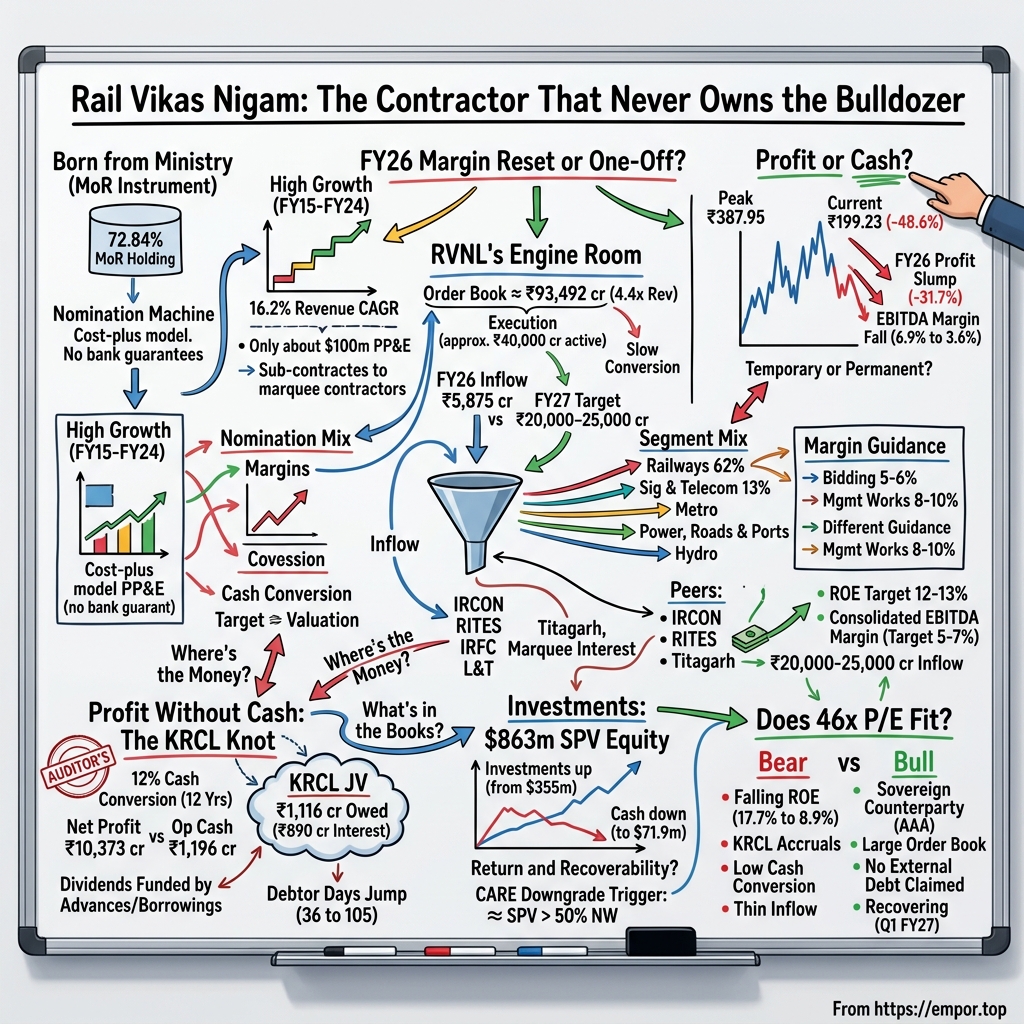
So what exactly is the market paying for? A construction company with no construction equipment, a single dominant customer who is also its controlling shareholder, and a profit line that has been shrinking for two years. Four questions organise the answer.
First, is the FY26 profit slump a one-off, or a permanent reset of margins as the easy, nominated work from the Ministry of Railways gives way to competitive bidding? Second, is the profit real cash? Over twelve years RVNL has turned only about 12% of its net profit into operating cash flow[^1], and one joint venture owes it ₹890 crore of interest alone6. Third, is RVNL really an executor of contracts, or increasingly a holder of equity in special-purpose vehicles and build-operate-transfer projects, and does that change how it should be valued? Fourth, does a price of 46 times earnings fit a contractor whose return on equity has halved, from 17.7% to 8.9%, in two years[^1]?
The route to those answers runs through the company's birth as an instrument of the ministry, the nomination machine that powered a decade of growth, the retail rally of 2024 and the cracks that followed it, and then the harder material: the cash, the balance sheet, the moat, and the bull and bear cases.
The place to start is a ministry that was tired of waiting for its own departments.
 Subscribe on LinkedIn
II. Born From the Ministry: Why the Railways Built Its Own Contractor
Indian Railways has never lacked projects. It has lacked the ability to finish them. For decades, doubling lines, new lines, gauge conversions and electrification schemes sat in the ministry's books for years, sometimes decades, held back by departmental tendering, fragmented approvals and the sheer weight of a bureaucracy that also has to run tens of thousands of trains a day. The answer the ministry reached for was not to reform itself. It was to build a company that could act like a private project manager while remaining wholly owned by the state.
That company is RVNL. It began as a special-purpose vehicle to implement rail infrastructure projects, and it grew into a Navratna central public-sector enterprise, one of the handful of state companies given extra financial and operational freedom1. The idea was simple. The ministry would hand RVNL projects directly, without a tender. RVNL would then break each project into packages, tender them out to contractors, supervise the work, and charge the ministry its costs plus a management margin.
The machine, explained simply
Think of RVNL as a general contractor that the client has hired on a cost-plus basis. On these nominated works the ministry pays RVNL's actual cost and a fixed margin on top1. There are no performance bank guarantees and no advance bank guarantees, which removes a large working-capital burden that private contractors carry1. Payments are reimbursed monthly, and they run back-to-back with RVNL's payments to its own sub-contractors, so in principle RVNL is never financing the project out of its own pocket1. On top of that, the ministry supplies interest-free mobilisation advances, cash paid upfront to get the work moving1.
The effect is a business with very little capital at risk and very little fixed investment. RVNL sub-contracts most of the physical work to what CARE Ratings calls "marquee contractors"1. Its own contribution is procurement, supervision, and the administrative power to get a railway project moving. That is why it can run a multi-billion-dollar order book with a tiny fixed-asset base.
A decade-long staircase
The model worked, and the numbers show it. Revenue grew from about $513m in FY15 to about $2.6bn in FY22, a ten-year compound rate of roughly 16% a year[^1]. Operating margin crept steadily from about 5% to nearly 7% by FY24, and return on equity climbed from 11% to a peak of about 18.5%[^1]. For a business whose customer set the price, that was a remarkably smooth staircase, with no year of falling profit between FY15 and FY24[^1].
The company came to the market in April 2019 with an initial public offering of about ₹477 crore1. The government sold more shares through an offer-for-sale in the first quarter of FY24 to meet minimum public shareholding rules, taking its stake from 78.20% to 72.84%1. That left a free float of only about 27%, of which foreign investors hold roughly 2.4% and domestic institutions about 6.6%8. Most of the tradable stock is in the hands of individuals.
What the staircase actually proves
The honest reading of that decade is that growth came from access, not from competitive wins. RVNL did not beat private engineering firms to projects. It was handed them. About 49% of the order book was still nomination work in January 20251, and the ten-year revenue compounding reflects how much the ministry chose to route through RVNL, not how much RVNL won in open contests.
That matters because nomination is the customer's discretion, not the company's right. The obvious way to falsify the claim that RVNL has a durable franchise is to look for signs that the ministry is steering work elsewhere, or that the nomination share is shrinking. The second sign is already visible. Management said FY26 order inflow was split roughly half and half between nomination and competitive bidding2. That is a direction of travel, not a collapse, but it weakens any argument that RVNL's pipeline is guaranteed by its parentage. The history narrows the franchise claim to something smaller: RVNL is a favoured executor, not a protected one.
To see what that means for margins, the next step is to open the order book itself.
III. The Engine Room: What RVNL Actually Sells and Who It Competes With
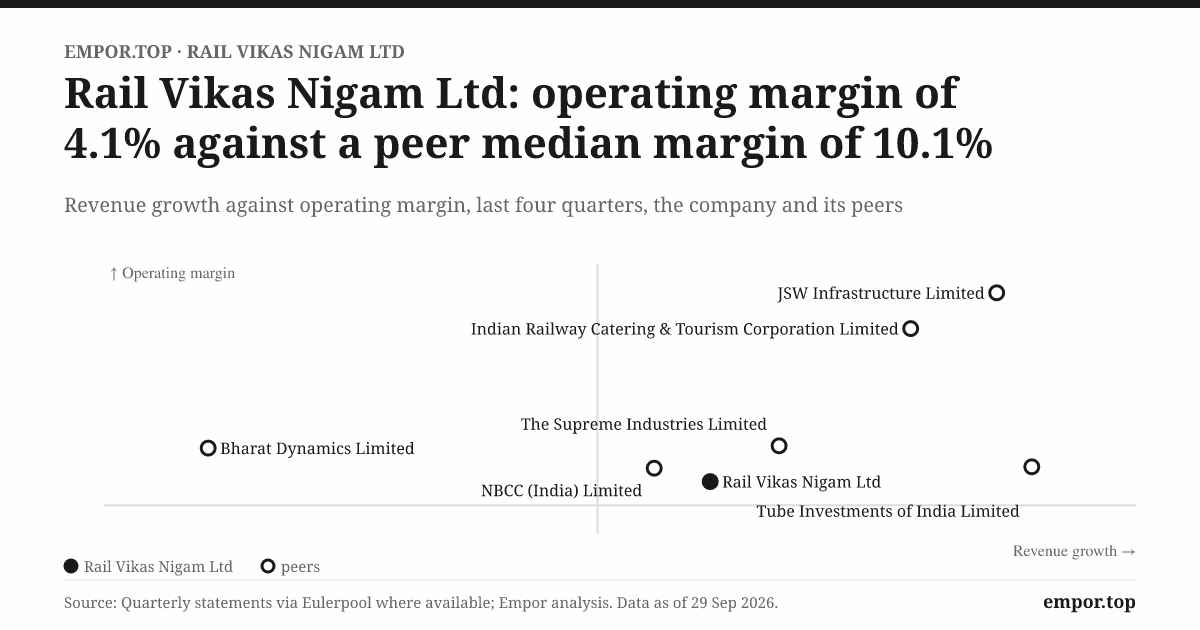
On the Q1 FY27 earnings call, management did something investors had long asked for. It put numbers on the margins of each kind of work it does. Competitively bid projects, it said, earn about 5–6% at the EBITDA level. Management or nominated works earn 8–10%. Project management consultancy earns about 7%. Overseas work is targeted at 15–20%3. In one short list, management gave investors the key to the whole margin question: every rupee of work that shifts from nomination to bidding takes three or four percentage points of margin with it.
The book, and why its size misleads
At the end of June 2026 RVNL reported an order book of ₹93,492 crore, down from ₹99,262 crore in March32. Against trailing revenue, that is about 4.4 years of work[^1]. On the surface, that is extraordinary visibility for any contractor.
The catch is that only about ₹40,000 crore of that book is under active execution3. The rest, roughly ₹53,000 crore, is waiting for approvals, land acquisition or financial closure3. A contract that cannot start earns nothing. So the useful way to read the book is not "4.4 years of revenue" but "about two years of work in progress, plus a long queue whose timing RVNL does not control."
By segment, railways dominate. Core railway projects make up about ₹58,000 crore, roughly 62% of the book. Signalling and telecom add about ₹12,000 crore, metros about ₹5,700 crore, power transmission about ₹4,000 crore, roads, highways and ports about ₹3,651 crore, and hydro and irrigation about ₹1,626 crore3. RVNL does not publish profit by segment, so the margin guidance is the best available proxy for where the money is made. The signalling, power and road contracts are largely won in open tender, which puts them in the lower 5–6% band. The high-margin work is the nominated railway business and the small overseas book.
Inflow: the number that actually moves
If the order book is a reservoir, inflow is the rain. And in FY26 it barely rained. Order inflow for the year was only about ₹5,875 crore2, about 0.3 times annual revenue. A contractor that books less than a third of what it burns is draining its reservoir, and the fall in the book from March to June is that drain made visible.
The first quarter of FY27 was better, with inflow of about ₹5,417 crore in three months3. Management has set a target of ₹20,000–25,000 crore for the full year3. That target is the credibility test for the whole recovery story. Reaching it would roughly replace revenue and stabilise the book. Missing it for a second year would confirm that the pipeline RVNL relied on for a decade has thinned.
Who else is at the table
RVNL sits within a family of railway public-sector companies. IRCON International is its closest cousin, another state-owned railway construction company that also executes nominated and bid work at home and abroad. RITES is a consultancy and engineering firm. IRFC is the railways' financing arm, not a competitor for projects but the funder of many of them. Titagarh builds rolling stock and metro coaches rather than track. In competitive bids the rivals are private engineering and construction firms such as Larsen & Toubro, NCC and KEC International, which own their own equipment and carry their own balance-sheet risk.
That comparison clarifies RVNL's position. Against private firms it has no cost advantage, because it sub-contracts to firms like them. Against its sister PSUs it has no structural advantage either; the ministry can route work to IRCON as easily as to RVNL. Its edge is administrative: it is set up to receive and manage the ministry's projects. That is a real edge, but a revocable one, and the full moat argument comes later.
Overseas: a phrase, not a pillar
RVNL has projects in the Maldives, East Africa, Uzbekistan and Saudi Arabia1, and management's 15–20% margin ambition for them is the highest in the business3. It is optionality in the true sense: small, uncertain, and not yet visible in the numbers. RVNL does not break out overseas revenue, and a foreign subsidiary was deregistered during the period3, which hardly suggests a mature international arm. Until overseas work shows up as a measurable share of revenue, it is a hope attached to a margin figure.
One customer, many faces
The customer list reads like a single entity wearing different uniforms: the Ministry of Railways and its zonal railways, the National Highways Authority of India, and state metro corporations1. Credit risk is low because these are sovereign or quasi-sovereign bodies. Concentration risk is extreme, because the railway family alone accounts for most of the book. And because RVNL sub-contracts the physical work, its value-add is procurement and management. That is a thin layer of value, and thin layers earn thin margins unless someone guarantees them.
For a decade someone did. The next section is about what happened when the guarantee began to loosen.
IV. The 2024 Rally and the Reset: What Broke in FY26?
In the spring and summer of 2024, RVNL became one of the most talked-about stocks in India. Railway PSUs were a retail favourite, carried by a story of government capital spending, a national rail modernisation push and order books that looked like decades of work. The share price climbed to a 52-week peak of ₹387.957. For a company that had listed five years earlier at a small fraction of that level, it was a rerating on a heroic scale.
The profits did not follow. Net profit fell about 17% in FY25 and about 32% in FY26[^1]. By the March 2026 quarter, net profit was roughly $20m, down 59% from a year earlier[^1]. The stock fell with it, back to about ₹199 by late September 20267.
The margin, from staircase to cliff
The clearest measure of what broke is operating margin. It went from about 6.9% in FY24 to about 3.6% in FY26, almost halving in two years[^1]. Return on equity fell from 17.7% to 8.9% over the same period[^1]. Net profit dropped from about $187m to about $99m[^1]. For a company whose entire pitch was steady, contract-backed profit, those are not small moves.
A first warning about the data. The quarterly figures show large negative operating profits in the March 2024 and March 2025 quarters, about −$172m and −$127m, while profit before tax in those same quarters was comfortably positive[^1]. That is impossible as a real outcome for a cost-plus contractor. It is a classification artefact: the data providers split year-end costs differently from RVNL's own statements, and the fourth-quarter figure absorbs annual true-ups that belong elsewhere. Those quarters were not losses. The annual numbers are the reliable guide, and they show a real decline without the fake drama.
Management's explanation
On the Q4 FY26 call, management blamed the weak quarter on specific one-off items: reconciliation adjustments in joint ventures and municipal tax charges2. Those are plausible explanations for one quarter. They do not explain two years of margin erosion. JV reconciliations, in particular, are not strictly one-off for a company with many JVs; they are a recurring feature of how RVNL's accounts settle. An investor should treat the "one-off" label as a management claim to be tested against the next three quarters, not as a finding.
The deeper cause is the mix. As the share of bid work rises towards half of inflow, and as bid margins sit around 5–6% against 8–10% for nominated work3, the blended margin must fall. That is arithmetic, not a one-off.
How much of the profit is the core business?
A second clue sits between operating profit and profit before tax. In FY26 RVNL reported operating profit of about $83m and profit before tax of about $134m[^1]. The gap, roughly $51m, is non-operating income: interest on treasury balances and receivables, and shares of profit from joint ventures. It amounts to nearly two-fifths of pre-tax profit. In other words, only about three-fifths of RVNL's earnings came from the project business it is known for in FY26.
That split matters for valuation. Interest income on a shrinking cash pile is not a growth engine, and interest accrued on overdue receivables from a JV is only as good as the JV's willingness to pay, which the next section examines. If a large part of profit comes from those sources, the core execution business is smaller than the headline suggests.
The Q1 FY27 rebound
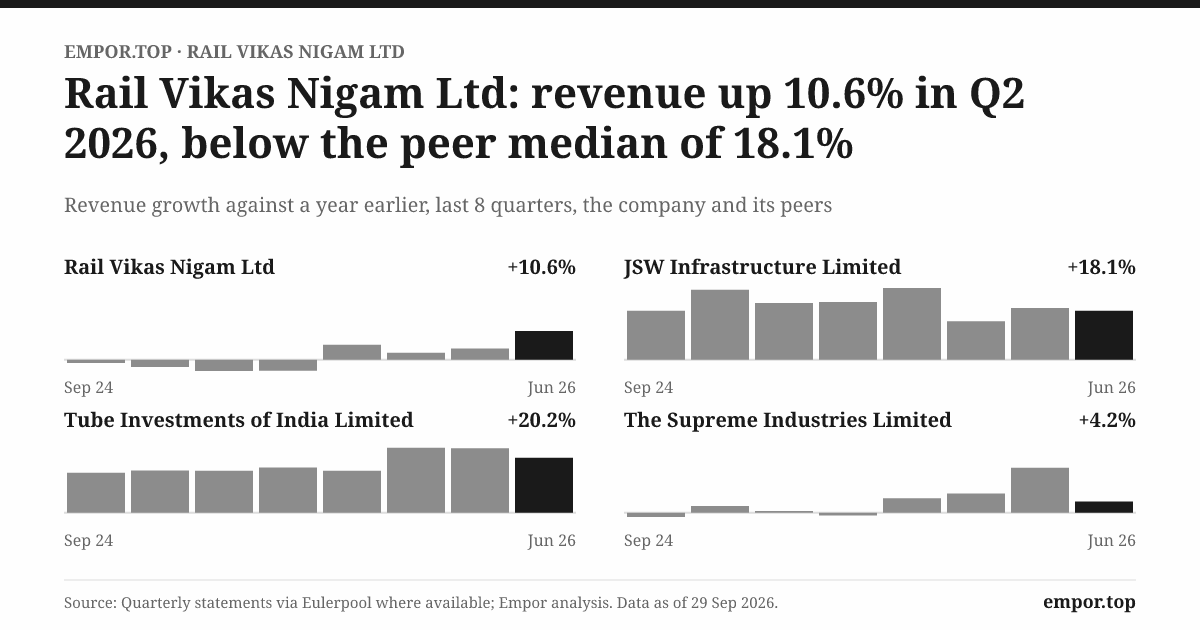
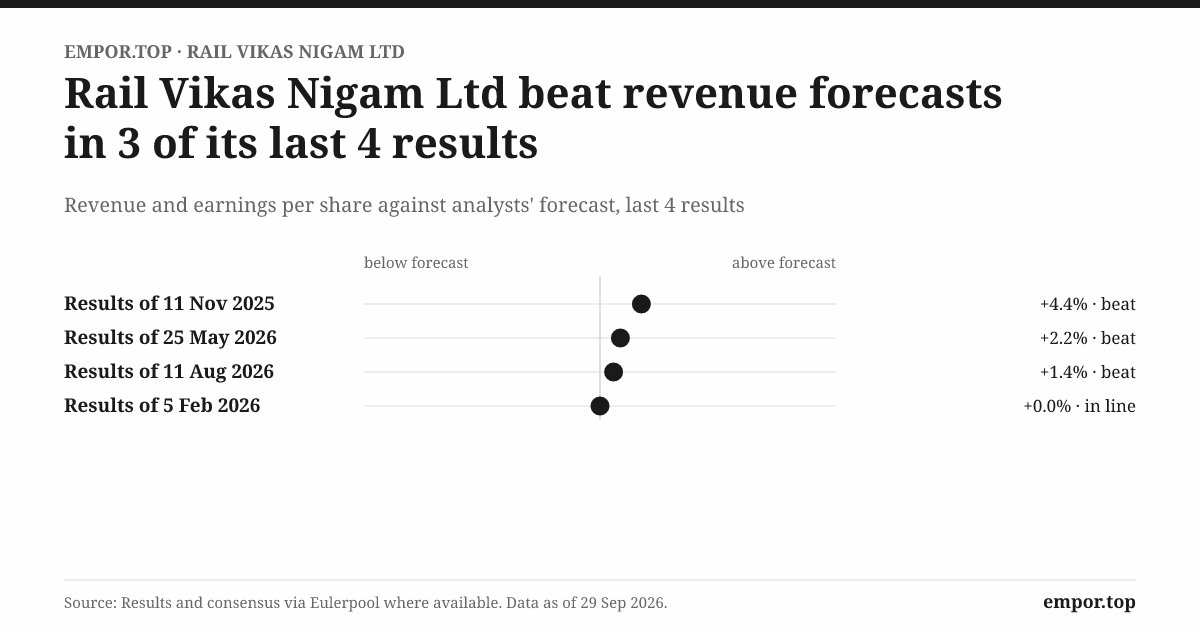
The June 2026 quarter offered the first sign of recovery. Revenue rose 10.6% from a year earlier and net profit about 18%[^1]4. Consolidated EBITDA margin was about 4.4%, against about 1.7% a year earlier, with the standalone figure close to 4%3.
Management's tone shifted accordingly. Where the Q4 call leaned on the one-off explanations, the Q1 call spoke of recovery, with guidance of about 15% revenue growth and 15–20% profit growth, and an EBITDA margin target of 5–7%3. Analysts on both calls kept returning to the same three topics: margins, order inflow and receivables23. Management's answers were specific on segment margins and receivables timing, and more general on how the inflow target would be met.
Testing management against its own record
The best way to judge the new guidance is to compare earlier promises with outcomes. The ₹90,000-crore-plus order book was presented for years as a guarantee of growth. Yet FY26 inflow of about ₹5,875 crore2 meant the book was being consumed far faster than it was replenished, and revenue over three years grew only about 0.2% a year[^1]. A big book did not deliver growth. That record does not make the current guidance wrong, but it lowers the confidence it deserves.
PL Capital, a domestic broker, called the June quarter a "recovery underway" but kept a SELL rating with a target price of ₹165, arguing that the bidding mix structurally caps margins unless overseas work converts4. That is its view, not a finding.
The verdict on question one
The evidence leans towards a partial reset. The Q1 rebound shows the FY26 trough was worse than the business's run-rate, so some of the damage was temporary. But the mix shift towards bidding is real, management's own margin table puts bid work well below nominated work, and nothing in the record suggests the ministry will reverse the half-and-half split. The most likely outcome is a margin that recovers from the trough but settles below the 6–7% of the nomination era. The settling figure is consolidated EBITDA margin across the September, December and March quarters of FY27 against the 5–7% target.
A margin, however, is only an accounting number. The harder question is whether any of this profit is turning into money.
V. Profit Without Cash: The KRCL Knot and the Debtor Days Jump
Buried in RVNL's audit report is a paragraph that deserves more attention than it gets. The auditors drew investors' attention to amounts owed by Krishnapatnam Railway Company Limited, a joint venture that built a rail link to the port of Krishnapatnam in Andhra Pradesh. By FY26 the receivable stood at about ₹1,116 crore, and about ₹890 crore of that was not the cost of any work. It was interest on delayed payments6. The auditors did not qualify their opinion. But they flagged that the basis for that interest is still waiting on a board decision6.
That single paragraph is a good entry point to the whole question of whether RVNL's profit is real.
Twelve years of profit, one year of cash
Over the twelve years from FY15 to FY26, RVNL reported cumulative net profit of about ₹10,373 crore. Over the same period it generated about ₹1,196 crore of operating cash flow[^1]. That is 12 cents of cash for every rupee of profit. For a company that sells itself as asset-light and cost-plus, where the customer supposedly pays back-to-back, that is a startling gap.
The explanation is mostly working capital and advances, and it helps to understand how the advances work. When the ministry pays an interest-free mobilisation advance, the cash arrives before the work, and operating cash flow looks wonderful. As the work is done, the advance is used up, and operating cash flow looks terrible. The FY22 and FY23 pair is the vivid example: operating cash flow of about +$642m in FY22, then about −$508m in FY23[^1]. The last four years have swung wildly, from strongly negative in FY23 to positive in FY24 and FY25 and negative again in FY26[^1].
So the twelve-year figure is not proof that the profit is fiction. Some of the gap is timing. But timing should wash out over twelve years, and it has not. Something has been absorbing cash persistently, and receivables are the chief suspect.
Where the cash went
Over the same twelve years, free cash flow was slightly negative in total, at about −₹339 crore[^1]. Yet RVNL paid about ₹2,426 crore in dividends, and its cash and short-term investments fell by about ₹594 crore[^1]. Put plainly, the dividends were not paid from free cash generated by the business. They were funded, in effect, by the float of advances, by borrowings and by running down cash. That is not a crisis for a state-backed company, but it is a sign that the dividend reflects accounting profit rather than surplus cash.
Debtor days: the FY26 jump
Debtor days measure how many days of revenue are sitting unpaid on the balance sheet. RVNL's figure fell to a lean 36 days in FY25, then jumped to 105 in FY26[^1]. That is not unprecedented; it peaked at 176 in FY19[^1]. But the direction reversed sharply at exactly the moment profits fell.
Management's counter is concrete. On the Q4 call it said the ministry owed about ₹3,400 crore at year-end, which was paid in April2. On the Q1 call it said about ₹2,500 crore was outstanding, with the ministry paying within about 30 days of billing3. That points to a year-end timing effect rather than a counterparty problem, at least for the ministry. It is a credible explanation for the main customer. It does not explain KRCL.
The KRCL knot
KRCL is where the profit-versus-cash question becomes sharp. RVNL has been accruing interest on KRCL's overdue payments for years. Until 30 September 2024 it charged compound interest; from 1 October 2024 it switched to simple interest6. KRCL has asked for simple interest to be applied all the way back to 1 April 20206. RVNL has also not raised a 5% departmental charge, pending KRCL's request for a waiver6. The matter sits with RVNL's board, and any adjustment will be recognised when it is finalised6.
The accounting consequence is important. The ₹890 crore of interest has been booked as income over the years without a matching cash receipt, and the treatment of any concession is deferred until the board decides. There is no provision against it disclosed. If the board grants KRCL's request, the difference between compound and simple interest for the period from April 2020 to September 2024 comes straight out of profit.
How large could that be? RVNL's shareholders' equity is roughly ₹9,800 crore, based on book value of about ₹47 a share7. The full ₹890 crore of accrued interest is therefore about a tenth of equity, and roughly a full year of FY26 profit. The partial concession KRCL wants would be smaller than the whole, but the whole is the ceiling of the risk.
A skeptical fund manager's question
Imagine a skeptical fund manager at an investor meeting. The question is simple: if the board grants KRCL simple interest from 2020, how much profit disappears, and why has none of it been provided for? The honest answer is that RVNL does not disclose the calculation, and the board has not ruled. A company whose customer, controlling shareholder and JV partner are all part of the same state family is being asked to decide how much of its own income to give up. That is a governance question as much as an accounting one.
Related parties, answered
The Ministry of Railways is RVNL's controlling shareholder, its main customer, and the supplier of its interest-free advances1. With railway projects making up about 62% of the order book3 and the ministry, zonal railways and railway-linked entities providing the bulk of the rest, the large majority of RVNL's revenue comes from the government family that owns it. RVNL does not publish a precise customer-by-customer revenue split in its results material, but the structure leaves no doubt: this is overwhelmingly a related-party business, with the price on nominated work set by the same party that owns 72.84% of the equity.
The smaller issues
Around the edges sit several other receivable questions. BharatNet payments, from rural broadband work, were being resolved as of the Q1 FY27 call, and another JV receivable was under negotiation3. The auditors noted that trade receivables, other assets and payables are "subject to confirmation/reconciliation"6, a standard but not reassuring phrase for a company with many JVs.
Contingent liabilities are small by comparison. Disputed income tax and GST demands total about ₹552 crore, of which about ₹541 crore has not been deposited6. There is also a land-acquisition compensation dispute6. Weighed against KRCL, these are background noise.
The counterweight, and the verdict
The strongest argument against alarm is the counterparty. The ministry is a sovereign payer, it cleared ₹3,400 crore in April2, and CARE rates RVNL AAA/Stable, citing low counterparty risk1. The FY25 audit opinion was unmodified6.
So the verdict on question two is nuanced. The long-run cash gap is mostly timing and advances, and the ministry pays. But the KRCL interest is an accrual with no cash behind it, unprovided, and subject to a decision by a board with an obvious conflict. Reported profit is real for the ministry work and uncertain for a meaningful slice of the rest. The settling events are the board's KRCL ruling and FY27 operating cash flow.
Cash, though, did not just disappear into receivables. A great deal of it moved to a single line on the balance sheet.
VI. Contractor or Financier? The $863m Investments Line
Between March 2025 and March 2026, two lines on RVNL's balance sheet moved in opposite directions. Cash and short-term investments fell from about $422m to about $72m. The line called "Investments" rose from about $355m to about $863m[^1]. For a company described as an asset-light project manager, the biggest asset on the balance sheet is now not machinery or receivables but a pile of investments whose composition matters enormously.
Two very different things in one line
"Investments" can mean two things at RVNL. It can mean treasury: fixed deposits and liquid instruments, which are cash by another name and move between lines depending on maturity. Or it can mean equity in subsidiaries, joint ventures and SPVs that build and operate projects, the kind of structure KRCL represents. The first is safe and liquid. The second is long-dated, illiquid, and exposed to exactly the kind of settlement risk the KRCL story illustrates.
Part of the jump is almost certainly a reclassification of treasury: cash fell by about $350m while investments rose by about $500m. But RVNL's growing JV portfolio means some of it is not. CARE names investments in subsidiaries and JVs, and the lifecycle risk of BOT projects, as a credit constraint1. And it sets a specific downgrade trigger: SPV exposure above 50% of tangible net worth1. That makes the investment note in the FY26 annual report the single most important balance-sheet disclosure for RVNL. If most of the $863m is SPV equity, RVNL is closer to the trigger than its AAA rating implies.
The capital allocation record
RVNL has made no acquisitions of note, so the usual test of capital allocation, price paid against comparable deals, does not apply. The equivalent is its equity cheques into SPVs and JVs, judged on return and recoverability. KRCL is the leading precedent, and it is not encouraging. An SPV in which RVNL invested, and for which it did work, still owes it more than ₹1,100 crore years later, and the dispute is over how much interest the parent is allowed to charge its own JV. That is one precedent, not a pattern proven across the portfolio, but it is the most material one and it points the wrong way.
The debt paradox
On the Q1 FY27 call, management said RVNL runs on internal resources with no external debt3. The balance sheet shows borrowings of about $546m at March 2026, down from about $889m in FY22, and debt to equity of about 0.49[^1]. Both statements can be true. CARE explains that some projects are funded through loans serviced by the ministry and through IRFC, the railways' financing arm1. Those borrowings sit on RVNL's balance sheet but are repaid by the ministry, so management treats them as not being RVNL's own debt. CARE's own debt trigger excludes ministry-serviced project loans and mobilisation advances1. The working-capital line of credit, priced around 5.5–5.9%, has been arranged but not drawn3. The borrowings are therefore less alarming than the headline, but they are not nothing: they depend on the ministry continuing to service them.
Dividends
For FY26 RVNL paid an interim dividend of ₹1 a share, about ₹208 crore, and recommended a final dividend of ₹0.71 a share, about ₹148 crore, for a total of ₹1.715. The data providers show FY26 dividends as zero, which reflects timing in their feeds rather than reality; the company's figures are the right ones. Over twelve years the payout ratio has ranged from nothing to a peak of about 48%, with a median around 16%[^1]. As a PSU, RVNL's dividend policy follows government guidelines on distributions to the exchequer, which partly explains why the dividend has continued even as free cash flow turned negative.
Who is running it
The chairman and managing director is Pradeep Gaur, in office since at least early 20251. Like most PSU heads, he rose through the government system rather than through private markets, and he runs a company whose strategy is shaped as much by the ministry's priorities as by the board's. At the time of CARE's review, the board comprised the CMD, four whole-time directors and only two independent directors1, a thin independent presence for a listed company deciding on matters such as the KRCL interest, where the counterparty is part of the same state family.
Pay at a PSU is set under government rules, so executive compensation does not track profit, and management owns no meaningful stake. That removes one common governance concern, pay for short-term earnings, and replaces it with another: nobody in the boardroom has a strong personal incentive to push back against the ministry on behalf of minority shareholders.
The verdict on question three
RVNL is still primarily an executor. The project business produces the bulk of profit and all of the order book. But the balance sheet is shifting towards a financier's profile, and nearly two-fifths of FY26 pre-tax profit came from outside the core project business. The market values RVNL as a growth contractor. If a large part of the $863m is SPV equity with KRCL-style recovery risk, it should be valued partly as a holding of illiquid infrastructure stakes, which typically command lower multiples. The FY26 investment note decides which description is closer to the truth.
All of which brings the story to its central strategic question: what, exactly, protects this business?
VII. The Moat Under a Single Customer: Porter and Helmer
Open the competitive-bid page of RVNL's order book and the company looks very different. Here there is no nomination and no cost-plus margin. RVNL bids against Larsen & Toubro, NCC, KEC and others for signalling contracts, transmission lines and road projects. When it wins, it wins on price, and its own guidance says those wins earn about 5–6%3. About half of FY26 inflow came this way2. That half is where the moat question gets answered.
Porter's five forces
Buyer power is extreme. RVNL's dominant customer is a sovereign ministry that also owns it, sets the terms of nominated work, and supplies its advances1. On bid work the buyer is equally powerful, choosing among many qualified contractors. RVNL has no lever against a buyer this concentrated.
Supplier power is moderate. RVNL depends on a pool of sub-contractors to do the physical work1. The pool is large, which limits any single contractor's leverage, but RVNL's margin is squeezed from both sides: the customer caps the price, and sub-contractors take most of the value.
Rivalry is high in bidding. Private engineering firms own their equipment, carry their own balance sheets and have long execution records. In an open tender RVNL has no cost advantage over the firms it would otherwise sub-contract to.
Substitution is easy. The ministry can route a project to IRCON, to RITES as a consultant, or to its own departments. The existence of several railway PSUs means RVNL is one channel among several.
Entry is easy for bid work. Private contractors need only prequalification to compete. Barriers exist only for nominated work, and those barriers are policy choices.
Helmer's seven powers
Run the same test through Hamilton Helmer's framework and most of the powers are simply absent. There are no scale economies, because RVNL is asset-light by design and larger volume does not reduce unit cost. There are no network economies. There are no switching costs, since the ministry can use another executor for the next project. There is no counter-positioning, no brand power that lets RVNL charge more, and no process power visible in its margins.
What remains is at best a weak form of cornered resource: the relationship with the ministry and the administrative status of being its designated executor. That is real. It generated a decade of nominated work. But a cornered resource is supposed to be something a rival cannot get, and the ministry can extend the same status to another PSU with a policy decision.
The government-buyer lens
Selling to a government changes the moat question. The ministry has multiple railway PSUs to choose from and a stated interest in competitive procurement. The shift of about half of inflow to bidding2 is the clearest evidence that its preference is moving. There is no public evidence of the ministry consolidating railway PSUs or deliberately reallocating RVNL's work to rivals, and none of tender cancellations singling RVNL out. But the absence of those events is not a guarantee. The risk is not a dramatic reversal; it is a slow drift in which a larger share of RVNL's work must be won at bid margins.
Policy risk lives here too, not in a generic list. Railway capital spending is set in the Union Budget each year, and RVNL's inflow depends on it. Land acquisition and clearance delays already hold about ₹53,000 crore of the book out of execution3. A budget cut or a slower approvals cycle would hit RVNL before it hit any private rival with a diversified client list.
The verdict on the moat
RVNL's advantage is regulatory and relational, not economic. It is real, and it explains the decade of growth. But it is revocable, and the evidence of the last two years shows it narrowing. The history does not reject the moat; it narrows it to a smaller claim: RVNL is the ministry's favoured executor for a declining share of its work, and competes as an ordinary contractor for the rest. The forward test is the nomination share of each year's inflow. If it holds near half, margins can stabilise. If it keeps falling, the moat narrows further.
That leaves a set of lessons that apply well beyond one railway contractor.
VIII. Playbook: Business & Investing Lessons
"A cost-plus contract is a margin without a moat." For ten years RVNL's margins climbed steadily, and it looked like skill. It was a contract. The ministry guaranteed the margin on nominated work, and when it began asking RVNL to bid for half its work, margins roughly halved in two years. A guaranteed margin tells an investor what the customer is willing to pay today, not what the company could earn if the customer went shopping. When the price is set by the buyer, the moat belongs to the buyer.
"Profit is an opinion, cash is a fact." Twelve years of profit, about 12 cents of operating cash for every rupee. Somewhere in that gap sits ₹890 crore of interest charged to a joint venture that has asked to pay less, and that has been booked as income for years without cash behind it. The lesson for investors in any contractor is to read the audit report's emphasis paragraphs before the earnings release. The auditor flags what the headline hides.
"An order book is a promise, inflow is proof." A ₹99,262 crore order book made RVNL look like a decade of guaranteed revenue. A year of ₹5,875 crore of inflow made it look like a reservoir with a leak. More than half the book was waiting on land or approvals. The number that matters for a contractor is not how much work is promised but how fast new work arrives and how much of the book can actually start.
"When the customer is also your owner, ask who audits the price." The Ministry of Railways owns about 73% of RVNL, provides most of its revenue, sets the margin on nominated work and funds it with advances. The KRCL decision will be taken by a board with a thin independent presence, about a counterparty in the same state family. Minority shareholders own a share of a company whose most important commercial terms are negotiated between branches of its controlling shareholder. That structure can be benign. It cannot be assumed to be.
"Retail rallies price the story, not the receivables." In 2024 the market paid for a railway modernisation narrative and pushed RVNL to ₹388. Debtor days, inflow and the KRCL accrual were all visible in the filings. When profits fell, the stock gave back nearly half its value. Stories of national infrastructure are compelling; they are not a substitute for reading the cash-flow statement.
On managing a PSU, RVNL offers a clear template of trade-offs. Ownership is stable, credit is cheap and the counterparty pays. But independence is thin, pay is set by the government, and nobody at the top holds meaningful stock. That combination produces steady execution in good years and little pressure to defend minority interests in hard ones.
IX. Analysis & Bear vs. Bull Case
In September 2026, a domestic broker published a note on RVNL calling for ₹165 and a SELL rating4. The stock traded at about ₹199, having already fallen from ₹3887. The broker's argument was not that the recovery was fake. It was that the price already assumed it. That is the valuation question in a sentence.
What the price assumes
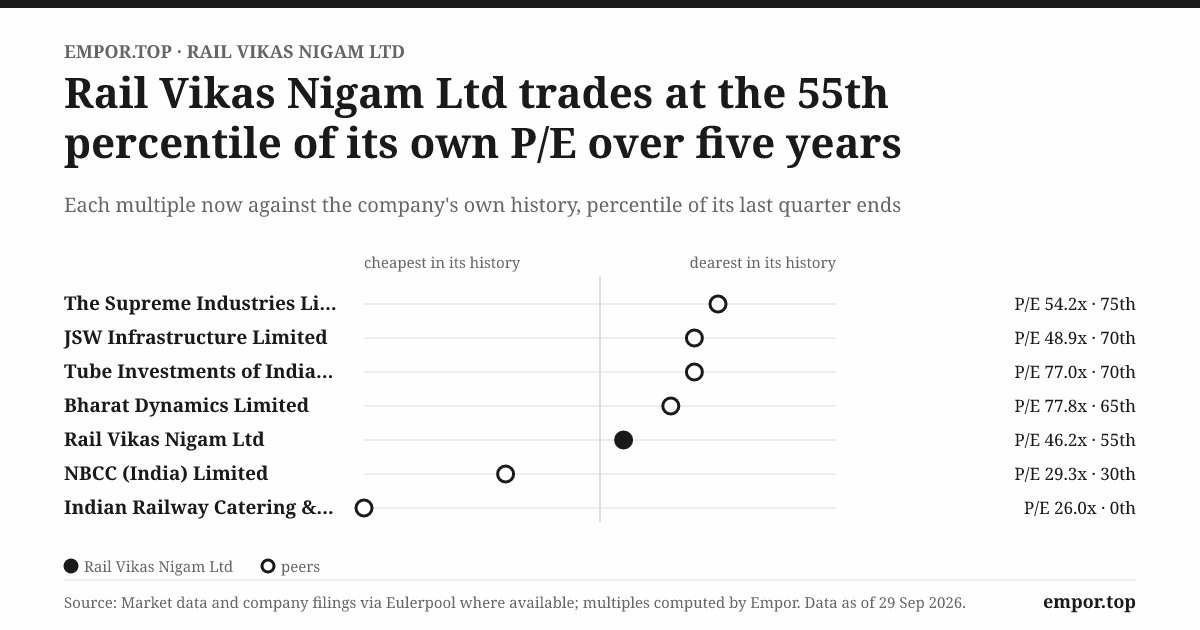
At ₹199, RVNL trades at about 46 times trailing earnings, against its own five-year median of about 31 times[^1]7. The earnings yield is about 2.2%, below the return on a government bond. Price to book is about 4.2 times, and enterprise value to EBITDA about 28 times7.
Put those numbers against a return on equity of 8.9% in FY26[^1]. A company earning 9% on its equity and trading at more than four times book offers a shareholder an earnings yield on book of about 2%. Management's target is to lift ROE to 12–13% within three years3. Even if that happens, at today's book value the implied return on the purchase price remains modest.
Consider the growth maths. If profit grows at the top of management's 15–20% guidance for three years, earnings rise by about 70%. At today's price, the P/E would then fall to about 27 times, still near the five-year median. So the current price already bakes in a full recovery, delivered on schedule, with no KRCL write-down, and treats the ₹93,492 crore order book as bankable. The case is not disproven. It is unproven, and the price leaves little room for disappointment.
The bull case
The bull case rests on the counterparty and the book. RVNL's main customer is the Government of India, CARE rates the company AAA/Stable1, and the ministry pays within weeks. The ₹93,492 crore order book is about 4.4 years of revenue3[^1]. The June 2026 quarter showed a real turn: revenue up about 11% and net profit up about 18%[^1]. Management says the company has no external debt, carries an undrawn credit line3, targets EBITDA margins of 5–7% and ROE of 12–13%3, and the stock already sits nearly half below its high7. If inflow reaches the ₹20,000–25,000 crore target and margins return to the top of the range, earnings could rebuild faster than the bears expect, and the overseas work could add a high-margin layer.
The bear case
The bear case rests on the record. Revenue has been flat for three years and profit has fallen about 13% a year over the same period[^1]. Cash conversion over twelve years is about 12%[^1]. The KRCL accrual is roughly a year's profit and unprovided6. FY26 inflow was a fraction of revenue2. Half of new work comes at bid margins well below the nomination era3. The free float is only about 27%, which amplifies price swings in both directions. And the stock trades at 46 times what may be close to trough earnings, but may also be closer to the new normal than the bulls accept.
The activist's stress test
A skeptical long-short investor would press on four points. First, the KRCL interest: why is there no provision, and why is the decision in the hands of a board with two independent directors? Second, the investments line: how much is SPV equity, and how close is RVNL to CARE's 50%-of-net-worth trigger? Third, the dividend: why pay one when free cash flow has been negative over twelve years? Fourth, disclosure: why does a company of this size not publish segment profitability or a receivables ageing table in its results? None of these is proof of wrongdoing. Each is a place where minority shareholders are asked to trust rather than verify.
Three KPIs to watch
Consolidated EBITDA margin. It was about 4.4% in the June 2026 quarter, up from about 1.7% a year earlier, against a 5–7% target3. The direction is up from a trough; the question is where it settles.
Order inflow against the FY27 target. About ₹5,417 crore arrived in the first quarter against a full-year target of ₹20,000–25,000 crore3. FY26 managed about ₹5,875 crore in total2. The direction is improving, from a very low base.
Debtor days, alongside operating cash flow. Debtor days rose from 36 to 105 in FY26, and operating cash flow was negative[^1]. The direction was worsening at the last annual reading; the ministry's April payment suggests some reversal.
Material risks, by mechanism
The ministry's budget and payment timing drive both inflow and cash; a slowdown in railway capital spending would hit RVNL directly. Land and clearance delays keep more than half the book idle3. A board decision on KRCL, or on the other JV receivable, could remove a year's profit. Credit depends on two triggers: the ministry's holding staying above 51% and SPV exposure staying below half of tangible net worth1; a further stake sale or more SPV investment would test the first and second. Overseas projects bring currency exposure, but RVNL does not publish a hedging policy, and the scale is small.
The investment case, then, depends on a handful of events that will play out over the next year.
X. Epilogue
Tonight, RVNL's shares sit near ₹199, within a couple of rupees of their 52-week low7. The first quarter of FY27 has given the company its first good headline in two years. The order book is still large. It still needs inflow to stay that way. And somewhere in the boardroom, a file on Krishnapatnam is waiting for a decision.
The next twelve months will be decided by a short list of moments.
The first is the KRCL ruling. If the board keeps the current basis and KRCL pays, the ₹890 crore accrual turns into cash and the profit-quality question mostly goes away. If the board grants simple interest from 2020, RVNL takes a hit to profit, and investors learn how its board weighs minority shareholders against the state family.
The second is the margin in the September, December and March quarters. A consolidated EBITDA margin that climbs into the 5–7% band would confirm that FY26 was a trough and not a floor. A margin stuck around 4% would confirm the partial reset and leave the 46-times multiple exposed.
The third is inflow. Reaching ₹20,000–25,000 crore would replace revenue and prove the pipeline still works. Another year near ₹6,000 crore would mean the book is running down, and the growth guidance would have no foundation.
The fourth is cash. FY27 operating cash flow, and whether debtor days return towards FY25 levels, will say whether the ministry's April payment was the start of a normal cycle or a one-time catch-up.
The fifth is the FY26 annual report's note on investments. It will show how much of the $863m is SPV equity and how close RVNL is to CARE's trigger. Any CARE review that follows will say whether the rating agency's view has moved.
Each outcome maps onto the four questions. Margin answers whether the slump is temporary. KRCL and cash flow answer whether profit is real. The investment note answers whether RVNL is an executor or a financier. And all of them together answer whether 46 times earnings is a price for a recovery or a price for a story.
The tension that remains is the one RVNL was built on. It is an agent of the state, created to get the state's projects built, and its profit depends on the same state choosing to send it work and choosing to pay on time. For a decade that arrangement produced a smooth staircase. Now the state is asking its agent to compete, and investors are learning what the agent earns when it has to.
XI. Outro
Go back to that stretch of new track in central India, the earthmovers and the gantry and the signalling crew. None of the machines belong to RVNL. None of the steel is its own. What it brings to the site is a signature: the authority to take a ministry's project and turn it into contracts, and the relationship that sends the next one its way.
That is what makes RVNL unlike any other company on the Indian market. It moves ₹93,492 crore of railways, roads and metros without owning a steel mill or a bulldozer. RVNL sells the government's ability to get things built, and it is only as valuable as the government's habit of choosing it, and paying it.
References
-
Rail Vikas Nigam Limited rating press release — CARE Ratings, 2025-03-28 ↩↩↩↩↩↩↩↩↩↩↩↩↩↩↩↩↩↩↩↩↩↩↩
-
RVNL Q4 FY26 earnings call highlights — Yahoo Finance ↩↩↩↩↩↩↩↩↩↩↩↩
-
RVNL Q1 FY27 earnings call highlights — Yahoo Finance ↩↩↩↩↩↩↩↩↩↩↩↩↩↩↩↩↩↩↩↩↩↩↩↩↩↩↩↩
-
RVNL Q4 & FY26 results, final dividend ₹0.71 — PSU Connect ↩
-
RVNL corporate announcements and market data — NSE India ↩↩↩↩↩↩↩↩↩↩
-
RVNL announcements, shareholding pattern and annual reports — BSE India ↩
 LinkedIn
 WhatsApp
 Reddit
 Hacker News
 Email
Email Kindle
 RSS Feed
 Spotify
 Apple Podcasts
 Amazon Music
 Audible
 YouTube