Rubicon Research: The 90x Specialty Generics Machine
I. The Formulation House That General Atlantic Took to Market
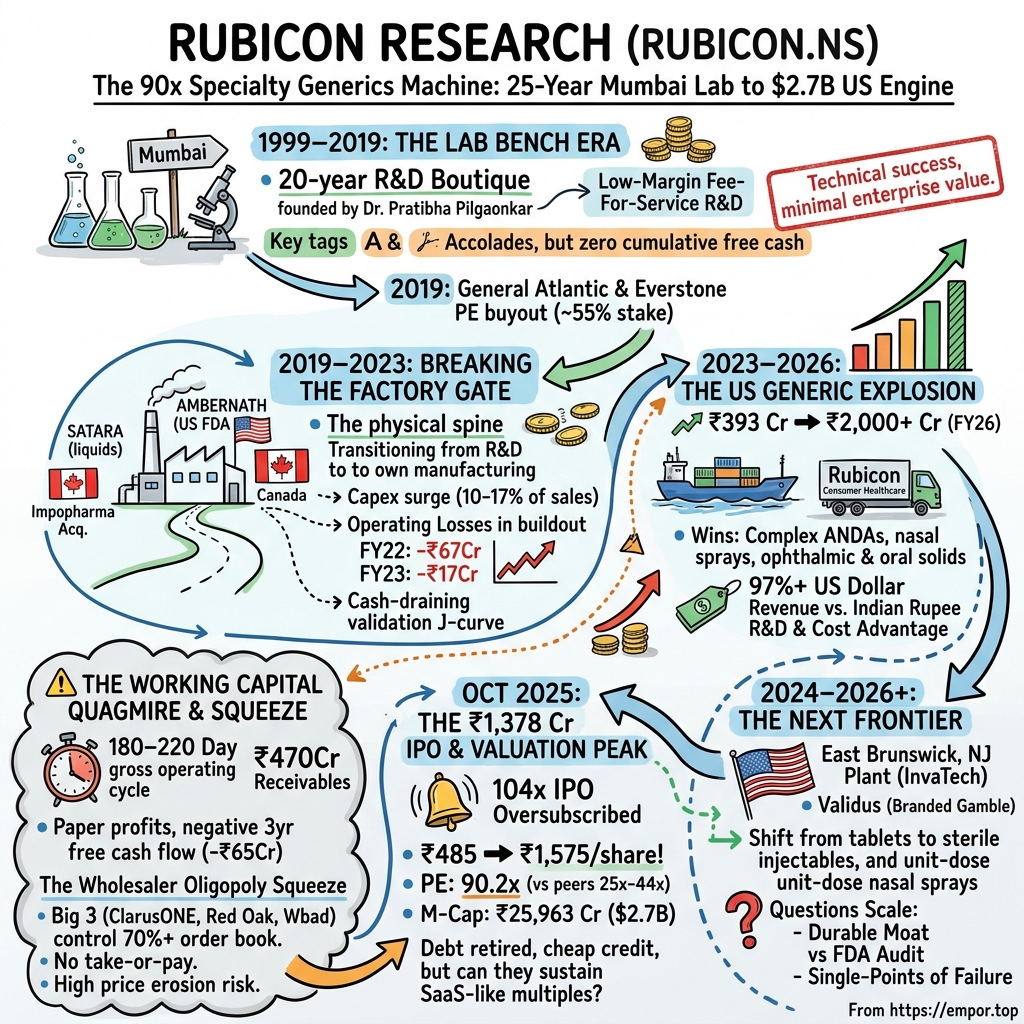
On the morning of October 16, 2025, a pharmaceutical company most Indian retail investors had never heard of a year earlier rang its way onto Dalal Street. Rubicon Research had priced its shares at ₹485, and the book behind that price was so crowded that the issue was subscribed roughly 104 times over.1 Investors had queued for a business that made tablets, liquids and nasal sprays in Maharashtra and sold almost all of them in America. There was no consumer brand anyone would recognise in a pharmacy aisle, no blockbuster molecule and no patented cure. There was a formulation lab, a handful of factories and a private equity owner, General Atlantic, which had bought control six years earlier and was now selling part of its stake.12
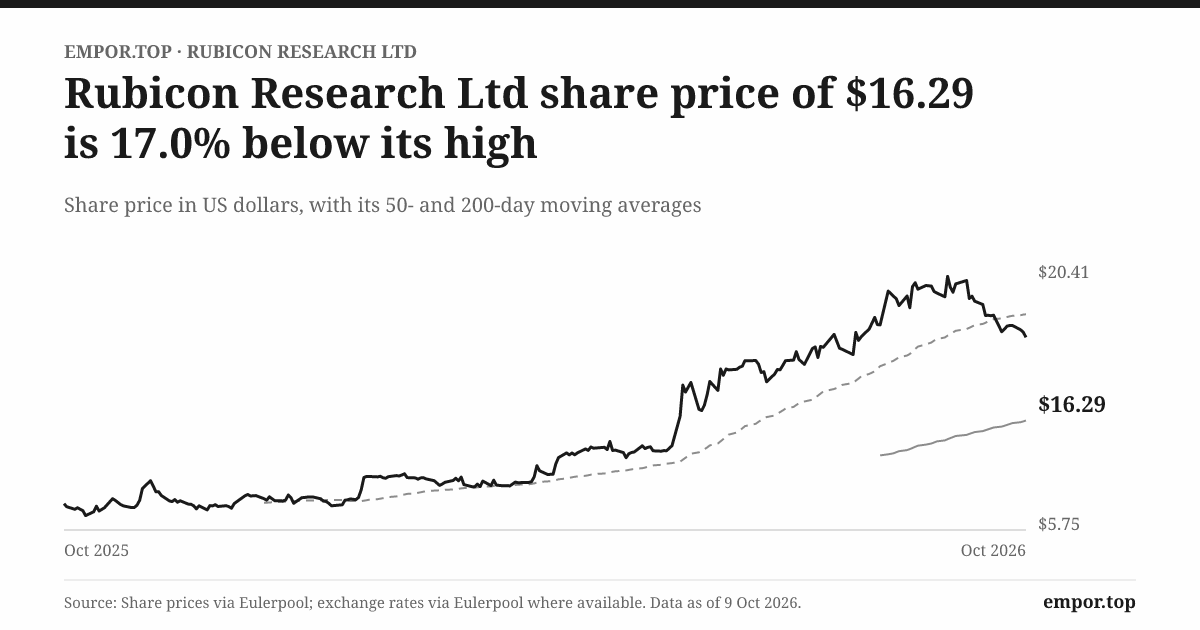
Twelve months later the stock tells a story of its own. On October 9, 2026, Rubicon closed at about ₹1,576, more than three times the issue price, which put the whole company at roughly ₹25,963 crore, or about $2.7 billion.3 The price had touched about ₹1,861 at its peak in the past year and had been as low as about ₹574, so even after a 15% pullback from the high, anyone who bought in the IPO and held has had a remarkable ride.3 More striking than the price is what it implies. At that market value investors pay about 90 times the company's last twelve months of earnings and about 13 times its sales.3
To put that multiple in context, consider who Rubicon sits beside. Gland Pharma, the injectables specialist that itself listed with a private equity pedigree, trades at a little over 40 times earnings. Eris Lifesciences, a domestic branded-generics compounder, trades in the mid-20s. Natco Pharma, which has made fortunes from difficult first-to-file generics, trades in the low teens.12 Rubicon is priced at roughly double Gland and about seven times Natco. The market is not valuing it as a generics maker. It is valuing it as something closer to a technology platform whose earnings will keep compounding for a decade.
The case for that optimism is not imaginary. Over the three years to March 2026, revenue grew at about 64% a year in rupees, from roughly ₹394 crore to roughly ₹1,896 crore, and over the twelve months to June 2026 it passed ₹2,060 crore, or about $213 million.34 A company that lost money in fiscal 2023 earned an operating margin of about 21% in fiscal 2026.3 Very few Indian pharmaceutical companies have grown that fast from a standing start into the hardest regulated market in the world.
Yet the business underneath the multiple has three features that should make any long-term investor slow down. The first is the gravity of American generics. A generic drug is, by definition, a copy that anyone with the skills and a clean factory can also make, and once competitors file, prices tend to fall year after year. Rubicon's whole proposition is that it chooses products hard enough to copy that the fall comes slowly. Whether that holds as its first wave of launches matures is the central question of this story.
The second is cash. Between fiscal 2023 and fiscal 2025 Rubicon reported a cumulative net profit of about ₹74 crore, but its free cash flow over the same three years was negative, at about minus ₹65 crore.3 The gap sits in receivables and inventory: US drug wholesalers take months to pay, and the company's operating cycle runs somewhere between 180 and 220 days.45 Profits that take half a year to become cash are still profits, but they behave very differently when growth needs funding.
The third is concentration. More than 97% of revenue is earned in US dollars, and between 65% and 77% of sales in fiscal 2023 and 2024 came from just five customers, which in American generics means the handful of giant wholesalers and their purchasing alliances.414 Production sits in a tight cluster of plants around Mumbai and Pune. One difficult inspection from the US Food and Drug Administration, or one hard-nosed contract renegotiation, can matter far more to Rubicon than to a diversified giant.
Today Rubicon is debt-light after using IPO money to prepay borrowings, it is expanding from oral tablets into nasal sprays, sterile injectables and branded products, and it has started buying manufacturing in the United States itself.59 The question is whether all of that turns a fast-growing generics business into something that deserves a monopoly-style price. To answer it, the story has to begin long before the bell rang, in a Mumbai laboratory that for two decades was very good at science and not very good at making money.
 Subscribe on LinkedIn
II. The Lab Bench Era: From Fee-for-Service to Private Equity Hands (1999–2019)
Around the turn of the millennium, in Thane on the edge of Mumbai, a formulation scientist named Dr. Pratibha Pilgaonkar set up a small research house with an unusual ambition for an Indian pharma startup of that era.141 Most Indian drug companies of the late 1990s were building scale by reverse-engineering molecules and selling cheap tablets at home and in less regulated export markets. Pilgaonkar's company wanted to do something more delicate. It wanted to solve the physical problems that make a drug hard to turn into a medicine.
Those problems are less glamorous than discovering a new molecule, but they are real. A drug can be chemically perfect and still useless if it will not dissolve in the gut, if it releases its whole dose in a rush and then disappears from the bloodstream, or if it tastes so bitter that a child spits it out. Formulation science is the art of the coating, the particle size, the polymer and the release mechanism. Think of it as the difference between a good recipe and a good restaurant kitchen: the ingredient is the same, but how it is prepared determines whether anyone wants to eat it. Pilgaonkar, who has remained Managing Director ever since, built Rubicon around controlled-release tablets, solubility enhancement and other drug-delivery tricks that larger companies would rather outsource.14
For most of its first two decades the business model followed from that identity. Rubicon was a service provider. Global and Indian pharmaceutical companies paid it to develop formulations, sometimes with milestone payments as projects passed regulatory gates and sometimes with a share of profits if a product reached market.14 The scientific reputation grew. The economics did not.
The reason is the trap that catches most contract research businesses. A formulation lab carries a heavy and fixed cost base: scientists, analytical equipment, stability chambers and pilot plants. Its revenue arrives in lumps, because clients pay when a project hits a milestone, not when the lab has a payroll to meet. And crucially, once the formulation works, the client owns the product. If a generic tablet that Rubicon designed went on to sell tens of millions of dollars a year in America, the partner that held the approval and the shelf space captured nearly all of that. Rubicon earned a fee or a royalty. The client earned the franchise.
The scale of the eventual pivot makes the point clearer than any description of the old model. As late as fiscal 2022, after Rubicon had already begun to change shape, revenue was about ₹313 crore and the company lost about ₹67 crore that year.144 Research spending ran at roughly 10% to 18.5% of revenue in the years leading up to listing, about two and a half times the median for Indian formulation peers.45 That is the signature of a company whose identity was still the lab: a large share of every rupee went back into science, and the science had not yet been converted into owned commercial products.
Private equity understood this before the public market did. Everstone Capital backed the company in an earlier growth round.14 Then, in 2019, General Atlantic acquired a controlling stake from those earlier investors, a deal it announced as an investment in an Indian formulation development player.814 The thesis behind that cheque was not that Rubicon needed better scientists. It was that Rubicon needed to stop giving away the commercial value of what its scientists produced.
The person who became the face of that shift was Parag Sancheti, who had joined in 2013 and rose to Chief Executive and Executive Director.14 Where Pilgaonkar was the founder-scientist, Sancheti became the operator who would push the company toward owning its own approvals, its own factories and its own American sales arms. The pairing is common in successful Indian pharma stories: a technical founder who gives the company credibility with regulators and partners, and an executive who builds the commercial machine around that credibility. The difference here is that the machine was being installed with a sponsor's capital and a sponsor's clock.
It is worth testing the founding myth against the record. The flattering version says Rubicon spent twenty years building a hidden jewel that the market finally noticed. The more accurate version is that twenty years of genuine technical skill produced very little enterprise value on their own, because the commercial rights were contracted away. The capability was real; the business model was the problem. That distinction matters for today's valuation, because it implies that the moat, if there is one, is not in the lab alone. It is in the combination of lab, factory and front-end distribution. The next phase of the story is about Rubicon buying the second of those three pieces, and discovering what factories cost.
III. Breaking the Factory Gate: The Satara Asset Carve-Out and Ambernath (2019–2023)
In July 2021, while the world was still untangling pandemic supply chains, Rubicon struck a deal with Meditab Specialities, a subsidiary of Cipla, to acquire a manufacturing facility at Satara, in the hills south of Pune.6 The plant made oral liquids and nasal formulations. For a lab that had spent two decades designing medicines other people manufactured, buying a working factory from one of India's best-known drug companies was a declaration. Rubicon intended to make the products itself.
The logic of the move is simple once the economics of the previous era are clear. An Abbreviated New Drug Application, the dossier that allows a generic to be sold in the United States, is filed for a specific product made at a specific site. Whoever owns the approved site and the approved application owns the commercial right. Without its own FDA-ready factories, Rubicon could only ever be a contractor. With them, it could file in its own name, sell under its own label and keep the margin that had always gone to partners.
The flagship of that physical spine was Ambernath, east of Mumbai, where Rubicon built and qualified a US FDA-inspected plant for oral solids that later added nasal spray capability.144 Satara gave it liquids and a second nasal platform. Before either, in early 2020, the company had already reached abroad by acquiring Impopharma, a small Canadian developer specialising in nasal and inhaled delivery, based in the Toronto area.7 The Impopharma deal was the most technically ambitious of the three, because nasal sprays and inhalers are among the hardest generics to copy: the device, the droplet size and the spray pattern all have to match the original, not just the chemistry.
Strategically this was a chess sequence. Ambernath provided volume in the dosage forms Rubicon already understood. Satara added categories with fewer competitors. Impopharma pointed toward a future in drug-device combinations where Indian rivals were thinner on the ground. Each move made Rubicon less of a service house and more of a product company.
The price of the sequence appeared in the accounts. Pharmaceutical industrialisation follows a J-curve. First comes the spending: building or refitting plants, validating them to US current Good Manufacturing Practice, running bioequivalence studies that prove a generic behaves like the brand in human volunteers, and waiting for FDA review. Only later, if everything clears, does revenue arrive. Capital spending in this period ran at roughly 10% to 17% of sales, and the company estimates investment of about ₹150 crore to ₹180 crore across the following buildout years.45
The losses followed. After the roughly ₹67 crore loss of fiscal 2022, Rubicon lost another ₹17 crore or so in fiscal 2023, and its operating margin that year was essentially zero.143 Cash was worse than profit. In fiscal 2023 operating activities consumed about $9 million and free cash flow was about minus $15 million, a hole that was filled by roughly $15 million of financing, largely borrowing.3 For a company of Rubicon's size, with revenue of about $49 million that year, that is a serious burn.3
What did the factories actually buy? They bought the right to file and sell. They also imported two risks that a pure lab never carries. The first is capital intensity: a factory has to be fed with working capital and maintained even in slow years. The second is regulatory exposure. A contractor whose client's plant receives a warning letter loses a project. A manufacturer whose own plant receives one can lose its export licence to the US. Rubicon traded a business with low upside and modest risk for one with large upside and concentrated risk.
By fiscal 2024 the new formulation blocks were commercial, and the trade began to pay.5 Rubicon had become an ANDA owner with its own plants shipping to America. Whether that would be enough depended on the last of the three pieces: who would sell the product once it landed in New Jersey.
IV. The US Generic Explosion: Turning Losses Into 50% Growth (2023–2026)
In late 2023, cartons carrying Rubicon's own label began arriving at American distribution centres through the company's US subsidiaries, Rubicon Research Inc. and Rubicon Consumer Healthcare.14 These front-end arms negotiated directly with wholesalers and pharmacy chains. The company that had once handed finished formulations to partners now owned the product from bench to American shelf.
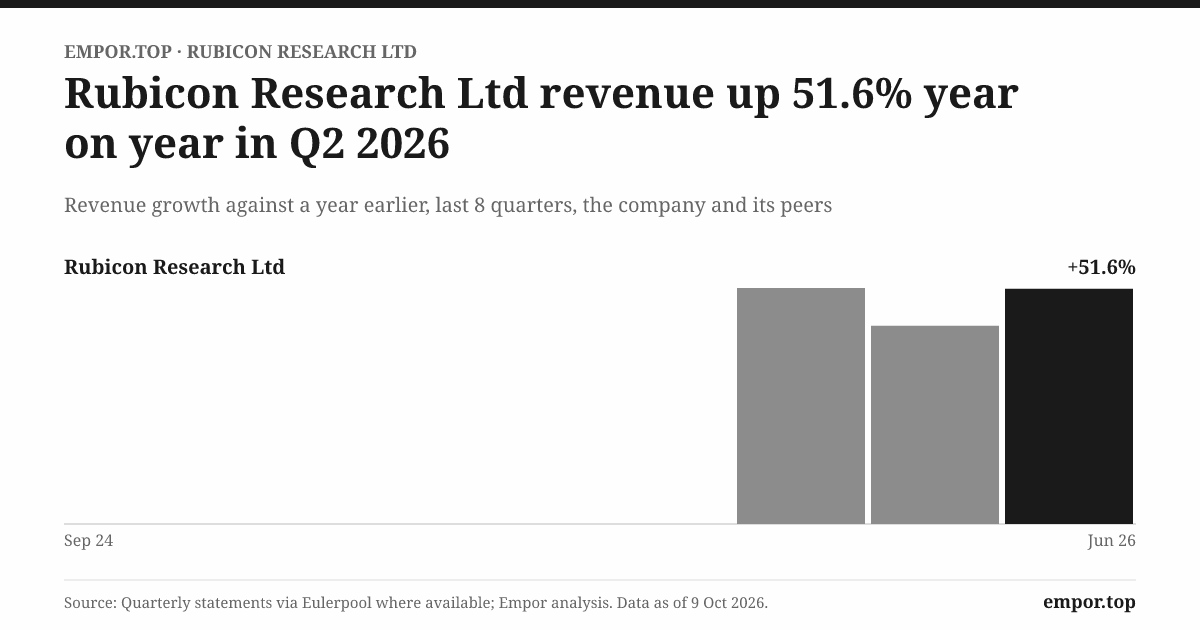
The numbers that followed are the reason this story exists. In fiscal 2024 revenue more than doubled, rising about 117% to roughly ₹854 crore, or about $103 million.314 The next year it reached about $150 million, and in fiscal 2026 about $196 million.3 Growth slowed in percentage terms, from more than doubling to roughly 48% and then about 37% in dollar terms, which is what happens when a base gets larger. Then, quarter by quarter in fiscal 2026, it reaccelerated: revenue in the June 2026 quarter was about $56.5 million, up nearly 52% on a year earlier.3
Profitability moved even more dramatically. Operating margin went from slightly negative in fiscal 2023 to about 21% in fiscal 2026, reaching 21.3% in the June 2026 quarter.3 Net profit moved from a loss to about ₹91 crore in fiscal 2024 and about ₹271 crore in fiscal 2026.14 The trend is clear and steady, and it tells investors something important: the fixed cost base built in the loss years is now being spread over far more revenue. That is operating leverage, and it is the most convincing evidence that the factory gamble was not a mistake.
Why did Rubicon win so much business so fast? The company's answer is product selection. It targets generics that are technically awkward, such as extended-release tablets that must release a drug evenly over twelve hours and multi-dose nasal sprays, where fewer competitors file and where large Indian generic houses either face compliance backlogs or find the volume too small to bother with.141 A useful analogy is a restaurant that only serves dishes most kitchens cannot cook. It will never sell the most plates, but each plate faces fewer rivals.
The currency adds a quiet kicker. More than 97% of revenue is earned in dollars, while the bulk of research, manufacturing and staff costs are paid in rupees.5 When the rupee weakens, as it has done over most of the past decade, each dollar of sales buys more Indian costs. The company hedges with plain forward contracts, so the benefit is smoothed rather than eliminated.5 This is a genuine structural tailwind, but it is one that every Indian exporter of generics enjoys. It explains some of Rubicon's margin; it does not distinguish Rubicon.
Now the test. Is this a durable specialty franchise, or a burst of launch-year sales from a narrow set of products? The company's own disclosures point to concentration. The top ten products contributed about 55% of revenue, and the top five about 39%.14 That is not unusual for a young generics portfolio, but it means a large share of the growth story rests on a handful of molecules. In US generics, the first years after a launch are often the most profitable, because few rivals have yet been approved. As more file, prices fall. A portfolio with 39% of sales in five products is a portfolio whose next three years depend heavily on how many competitors those five attract.
There is another subtle point. Revenue has now grown for three years at a pace that far exceeds the company's own history before fiscal 2023. Recent growth is therefore not a base rate; it is the one-time step of converting a lab into a product company. Some of that step can repeat, because the pipeline keeps feeding new launches, but the jump from service fees to owned sales cannot happen twice. The verdict is that the growth is authentic, earned in the marketplace and visible in operating margins, but narrower than the headline rate implies. What remains to be seen is how much of it survives first-cycle price erosion. And before that question even arrives, the growth has to be paid for, which is where the story moves from the income statement to the cash cycle.
V. The Working Capital Quagmire: The Anatomy of a 200-Day Cash Cycle
Picture the journey of a single bottle of Rubicon tablets. It is made in Ambernath, tested, packed and trucked to the port. It spends weeks on a container ship. It lands, clears customs and sits in a US warehouse. It is shipped to a wholesaler, which pays on terms. Along the way it is subject to chargebacks, which are payments back to the wholesaler when the drug is sold to a pharmacy or hospital at a contracted lower price, to prompt-pay discounts, and to adjustments if prices fall while stock is still on shelves. Only when all of that has been reconciled does Rubicon have its cash.
Rating agencies estimate that this cycle runs from 180 to 220 days.45 In plain terms, Rubicon finances roughly six to seven months of its own sales before collecting. Trade receivables alone grew from about ₹324 crore in fiscal 2023 to about ₹470 crore in fiscal 2024, a year in which revenue was roughly ₹854 crore.144 On those numbers, receivables were equal to more than half a year of sales.
Here is the puzzle that this creates. Over fiscal 2023 to 2025 Rubicon earned a combined net profit of about ₹74 crore. Over the same three years its cash from operations was about ₹105 crore, which looks healthy, around 142% of reported profit.3 Yet free cash flow, after capital spending, was negative by about ₹65 crore.3 How can a company convert more than all of its profit into operating cash and still run out of money?
The answer has two parts. The first is that profit in fiscal 2023 was a loss, so cash from operations was compared with a small cumulative profit and depreciation flattered the ratio; operating cash flow was negative in fiscal 2023 and only modestly positive in fiscal 2024 before jumping to about $19 million in fiscal 2025.3 The second is capital spending, which absorbed the operating cash and more. Free cash flow was about minus $15 million in fiscal 2023 and minus $4 million in fiscal 2024 before turning positive at about $10.5 million in fiscal 2025.3 Over the whole buildout, the factories and the inventory pipeline ate every rupee the business generated, and the difference was funded with debt and, later, with IPO equity.
How risky are the receivables themselves? Not very, on credit grounds. The customers are among the largest companies in American healthcare, and Rubicon provides for expected credit losses under the simplified approach of Indian accounting standards, with minimal historical write-offs.14 The problem is not that the money will not arrive. It is how long it takes. Money tied up for half a year is money that cannot fund a new plant or a new filing.
That creates a structural tension with growth. Each time revenue jumps by half, the working capital pipeline must grow by something close to half too. A business growing at 50% a year with a 200-day cycle is effectively required to borrow, raise equity or slow down. Rubicon's fiscal 2025 positive free cash flow is the first sign that the pipeline is reaching a scale where operating cash can fund it, but the company has not broken out full-year cash flow statements for fiscal 2026, so it is not yet clear whether that sign became a trend.3
The analytical conclusion is a narrow one, and important. Rubicon's profits are not illusory; they are slow. Every investor paying 90 times earnings is implicitly paying for profits that arrive as cash months later and are partly reinvested before they arrive. The figure that will settle this debate is not revenue growth but the ratio of free cash flow to net profit, and the length of the debtor cycle, in the fiscal 2026 and 2027 annual reports. And the reason that cycle is so long has a name, or rather three of them: the American wholesalers on the other side of the table.
VI. In Bed with Giants: The US Wholesaler Oligopoly and Customer Squeeze
Somewhere in an office park in suburban Ohio or Pennsylvania, a purchasing team for one of America's giant drug wholesalers is running a generic tender. On the screen are bids for a single molecule from half a dozen manufacturers in India, Europe and the United States. The buyer's job is to pay as little as possible for a reliable supply. The sellers' job is to stay on the list. Rubicon's US representatives have sat in rooms like this for every product they sell.
American generic drug distribution is one of the most concentrated buying markets in the world. Three wholesalers, McKesson, Cencora (the former AmerisourceBergen) and Cardinal Health, handle the bulk of drug distribution, and in generics they buy through sourcing alliances that combine their purchasing power with the largest pharmacy chains: ClarusONE for McKesson, Red Oak Sourcing for Cardinal and CVS, and Walgreens Boots Alliance Development for Walgreens and Cencora.13 For a generic supplier, that means a handful of buyers decide the fate of most of its American volume.
Rubicon does not name its customers individually, but the shape of its concentration matches that structure: the top five customers accounted for between 65% and 77% of revenue in fiscal 2023 and 2024.144 The contracts are typically Master Supply Agreements of one to three years with no take-or-pay minimums.14 In plain language, the buyer does not promise to buy any particular volume. If a competitor gets approval for the same product and bids lower, the buyer can move the business, usually on a few months' notice.
What does that do to pricing power? A good way to test any claim of pricing power is to ask whether a company has ever raised prices on an old product and kept the volume. In US generics, almost nobody does, and Rubicon's own disclosures describe the normal pattern of price erosion across established products, offset by new launches rather than by price increases.145 The rating agencies list aggressive pricing competition in US generics among the main constraints on Rubicon's credit profile.45 The company's history, short as it is in the commercial market, does not reject the claim of specialty pricing; it narrows it. Rubicon can earn better prices on products with few competitors, for as long as they have few competitors. It does not set prices; it times entry.
The supply side is less dramatic but still worth a sentence. Rubicon buys active pharmaceutical ingredients from Indian and Chinese makers, and its margin depends on keeping those costs stable against wholesaler prices that only fall.14 When input prices rise, the buyer does not absorb them.
The investor conclusion is uncomfortable. Rubicon's 20% operating margin exists at the discretion of buyers far larger than itself. That is not a reason to think the margin will vanish, because buyers also value reliable suppliers of hard-to-make products, especially during shortages. It is a reason to think the margin is earned product by product and tender by tender, rather than locked in. Which brings the story to the moment when the private equity owner decided this business was ready to face public investors.
VII. General Atlantic's Playbook: The ₹1,378 Crore Listing and Capital Re-Engineering (2024–2026)
On July 23, 2024, Rubicon Research Private Limited became Rubicon Research Limited, a public company in legal form, and eight days later it filed a draft prospectus with India's securities regulator.214 Fourteen months passed before the final Red Herring Prospectus arrived on October 1, 2025.3 The wait is not unusual in Indian IPOs, but it meant that by the time investors saw the final document, the company had already posted a second year of sharply higher earnings, which made the pitch much easier.
The deal itself was a carefully balanced piece of financial engineering. Of the roughly ₹1,378 crore raised, about ₹500 crore was a fresh issue of new shares, money that went to the company. The other ₹877 crore or so was an Offer for Sale, in which General Atlantic's Singapore holding vehicle sold existing shares and the money went to the sponsor.314 Both were priced at ₹485 a share.1 Roughly two-thirds of the IPO, in other words, was an exit for the private equity owner, and one-third was capital for the business.
That split is the right lens for the central question: did the listing strengthen the company or mainly serve the sponsor? The honest answer is both, in measurable proportions. General Atlantic realised a large part of its investment at a valuation that has since tripled, while staying the controlling shareholder with roughly half of the company.14 The company, meanwhile, used most of the fresh money for exactly what it said it would: retiring bank borrowings, with an estimated ₹300 crore to ₹400 crore going toward debt reduction.145
The before-and-after on debt is the clearest benefit. Ahead of the listing, Rubicon's rated bank facilities totalled about ₹466 crore.4 Post-IPO repayment brought net debt below one times operating profit before depreciation, and India Ratings put the company on a positive outlook at A-minus, with CARE also positive at BBB-plus.54 The practical effect is cheaper and more flexible working capital lines, which matter enormously in a business with a 200-day cash cycle. Lower interest is also part of why profit before tax rose to about $36 million in fiscal 2026.3
What about governance? An activist would look first at related-party flows. Rubicon's are modest: remuneration and incentives for Pilgaonkar and Sancheti, which rose as the company turned profitable, lease agreements for office premises with promoter-linked entities, and pre-IPO share transfers involving the sponsor.14 There are no brand royalties or licence fees flowing to the owners, and the statutory auditors' reports under India's Companies (Auditor's Report) Order carried no adverse qualifications.10 Contingent liabilities are the routine kind for an Indian manufacturer: disputed Maharashtra sales tax, central sales tax and income tax demands from older years, none of them large relative to current earnings.14 No promoter shares are pledged.14
The one structural point a skeptic would press is control. With General Atlantic holding around half the company and the founders holding meaningful stakes, minority investors are along for the sponsor's ride, and a sponsor eventually sells.14 Any future block sale is a supply overhang the market will have to absorb. That is not a governance failing; it is the arithmetic of a private equity-backed listing.
The conclusion is that the IPO was a well-executed sponsor exit that also repaired the balance sheet. It did not make the business more competitive by itself. What it did was give management a cleaner platform, and within months they used it to place bigger bets.
VIII. The Next Frontier: Specialty Inhalers, East Brunswick, and the US Branded Gamble (2024–2026)
In July 2026 Rubicon's US subsidiary AdvaGen agreed to acquire a manufacturing facility in East Brunswick, New Jersey, from InvaTech Pharma Solutions.9 For a company whose entire production base had been in Maharashtra, it was the first step toward making medicines on American soil. It followed an earlier move into US branded products through Validus Pharmaceuticals, a small American company with established branded drugs.91
Both deals answer the same strategic worry from different angles. The worry is that a generics maker in India, selling only to American wholesalers, is exposed to price erosion, to tariff or trade-policy shocks and to the political appetite for domestic drug manufacturing. An American plant offers a hedge: products made in the US may qualify for government and institutional contracts that prefer domestic supply, and are insulated from import disruptions. A branded portfolio offers another: branded drugs, even old ones, are sold to doctors and patients rather than tendered to wholesalers, so their prices do not collapse in the same way.
Alongside these deals, the company has been moving up what might be called the complexity ladder. It has filed or developed products in unit-dose and bi-dose nasal sprays, ophthalmic suspensions and sterile injectables, in addition to its core of complex oral solids.141 Each step up the ladder means fewer competitors, longer development times and harder manufacturing. Research spending of 10% to 18.5% of revenue is the fuel for this climb.4
Now the test, because this is exactly the kind of strategy that sounds better in a presentation than it proves in the accounts. Rubicon's technical history is long and strong; its history of converting technical breakthroughs into revenue is short. For twenty years, its formulation achievements earned fees while others captured the sales. Since fiscal 2024, its own launches have converted well, but mostly in oral solids, the category it knew best. Nasal and inhaled products, the bet that began with the Impopharma purchase in early 2020, sit in the slowest lane of US generic review, where development and approval commonly take three to five years and where few products from that pipeline have yet become large revenue lines.711 Certification and filings are not commercialisation, and the record so far supports a smaller version of the claim: Rubicon can climb the ladder, but how fast it turns the climb into cash is unproven.
The branded and American manufacturing bets carry different risks. Selling branded drugs requires sales reps, doctor relationships and marketing budgets, a skill set very different from tendering generics, and one Rubicon is learning rather than bringing. A US plant brings American labour costs into a business whose margin depends partly on rupee costs. The company has not published the purchase prices or projected revenues for these assets in a form that allows investors to judge returns, so for now they are best read as optionality with real costs attached.
The question that follows is whether any of this amounts to a moat, or just a well-chosen set of hard products. That is the question the market is implicitly answering at 90 times earnings.
IX. Strategic Position & The Moat Stress Test: Porter's 5 Forces and Hamilton Helmer's 7 Powers
Line up Rubicon beside its listed Indian peers and the gap in valuation is stark. Gland Pharma, a sterile injectables leader, trades at a little over 40 times earnings. Eris Lifesciences trades around the mid-20s. Natco Pharma, with its long history of difficult US generics, trades in the low teens.12 Rubicon is at about 90 times earnings and about 13 times sales.3 For the market to be right, Rubicon must have something those companies lack, either a stronger competitive advantage or a much longer runway of growth. The useful way to test that is to run it through the two frameworks long-term investors trust most.
Hamilton Helmer's seven powers ask whether a business has a structural reason to earn returns above its cost of capital that competitors cannot copy. Start with process power, which means accumulated know-how embedded in how a company works that rivals cannot easily replicate. This is Rubicon's strongest card. Twenty-five years of formulation work across release mechanisms, multiparticulate systems and nasal delivery is real institutional knowledge, and the speed with which its own launches ramped after fiscal 2024 suggests that know-how translates into products that work.14 The rating agencies cite the R&D pedigree as a primary strength.45 Process power is moderate to strong.
Cornered resource is weak. Rubicon owns no blockbuster patented molecule. It works through generic approvals and hybrid filings, and any well-funded competitor can design its own version of the same product given time. Switching costs are low to moderate. Wholesalers face some friction in moving away from a reliable supplier, especially in a shortage, but they re-tender contracts routinely, and the absence of minimum volume commitments in Rubicon's contracts is direct evidence that customers have kept their options open.14 Counter-positioning is absent; Rubicon runs a standard specialty generics model. Network economies and brand power are essentially irrelevant in tendered generics. Scale economies are developing, but Rubicon at roughly $213 million of revenue is small next to Sun Pharma, Cipla or Dr. Reddy's, which can spread regulatory and compliance costs across far larger volumes.3
Porter's five forces give the same answer from the industry side. Buyer power is severe: a few wholesale alliances control the majority of Rubicon's off-take, as the tender rooms showed. Supplier power is moderate, as Rubicon depends on regulated API makers but can multi-source. The threat of new entrants is moderate. Building an FDA-compliant plant and running bioequivalence studies, which for a complex generic can cost several million dollars, keeps out the casual entrant, but India alone has dozens of well-capitalised companies hunting the same niches. Substitutes are limited within a molecule but plentiful across a therapy, because doctors can prescribe alternatives. Rivalry is high in oral solids and more moderate in nasal and sterile products.
Put together, the verdict is clear. Rubicon has a genuine process advantage and benefits from regulatory barriers that make its chosen products harder to copy. It does not have the kind of power that protects margins regardless of what competitors do. The history of the business supports that narrower claim: specialty margins exist, but they are rented product by product and face erosion as competitors arrive. The 90 times multiple therefore cannot be explained by moat alone. It is a bet on growth, and that is where the bull and bear cases part company.
X. Bull vs. Bear: The 90x Valuation Reckoning
Imagine the debate at a fund manager conference in Mumbai late in 2026. One side argues that Rubicon is the early version of the next great Indian specialty pharma company, a smaller Sun Pharma in the making. The other side argues that it is a good generics business priced like a software monopoly. Both are working from the same facts. They disagree about time.
The bull case starts with momentum. Trailing revenue has passed about ₹2,060 crore, quarterly growth was about 52% in the June 2026 quarter, and operating margin has risen every year since fiscal 2023, reaching above 21%.3 The mix is shifting toward nasal sprays, ophthalmics and injectables where fewer rivals compete. The post-IPO balance sheet is nearly debt-free, which means internal cash can fund the next plants without fresh dilution.5 And the East Brunswick plant offers a hedge against the trade and political risks that could hit Indian exporters, plus access to buyers who want domestic supply.9 If operating profit keeps compounding at 35% to 40% a year for several years, today's earnings multiple compresses naturally because the earnings catch up with the price.
The bear case starts with the price itself. At 90 times earnings and with a trailing free cash flow yield of essentially zero, there is no margin for disappointment.3 Peers that have their own strong niches trade at half to a seventh of that multiple.12 The product concentration, with the top ten products near 55% of revenue, means that a few competitive launches against Rubicon's biggest molecules could slow growth sharply.14 The 200-day cash cycle means that even strong growth converts slowly into free cash. And production is concentrated in a few Maharashtra plants serving overwhelmingly US-bound volumes.5 An FDA inspection that ends in an Official Action Indicated classification, the most serious of the three possible outcomes, could stop new approvals from a site and, in the worst case, lead to an import alert that blocks shipments. For a company with Rubicon's concentration, that would hit earnings directly.
The skeptic would also point to the volatility. The stock's one-year volatility is about 47%, which is the behaviour of a stock priced on expectations rather than steady cash returns.3 Earnings per share over the last twelve months were about ₹18, so the market is paying ₹1,576 for a business that earned that amount in a year in which almost every operating trend was favourable.3
What would a fair-minded reconciliation look like? The bull case requires uninterrupted compounding, clean inspections and successful integration of acquisitions in new categories. None of those is improbable on its own. Together, they describe a flawless execution path that the history of US generics rarely allows. The bear case does not require disaster. It only requires that growth slows to the industry's normal pace and that the multiple drifts toward the peers'. That asymmetry is the core of the valuation debate.
Three measures will settle it more than any others. The first is operating margin and, where disclosed, gross margin, which tells investors whether early launches are holding their price as competitors arrive; the latest reading is an operating margin of 21.3% in the June 2026 quarter, rising.3 The second is free cash flow as a share of net profit, which tells them whether the cash cycle is easing; the last full reading, for fiscal 2025, showed free cash flow turning positive after two negative years.3 The third is FDA inspection classification at Ambernath, Satara and, in time, East Brunswick, where each outcome of No Action Indicated, Voluntary Action Indicated or Official Action Indicated changes the risk profile of the whole company.11
XI. Playbook: Business & Investing Lessons
Rubicon's arc, from a scientist's lab in Thane to a $2.7 billion listed company, teaches more than its size suggests. Five lessons stand out, and each belongs to this company in particular.
The first is about what science alone is worth. For twenty years Rubicon solved difficult formulation problems and watched its partners turn those solutions into American sales. Its revenue was modest, its profits erratic, and in fiscal 2022 it lost money on a sales base of about ₹313 crore.14 Three years after it owned its approvals, its plants and its US sales arms, it earned an operating margin above 20%.3 Nothing about the science changed in between. The ownership did. The line to remember is simple: whoever owns the lab earns a fee; whoever owns the label earns the equity.
The second is about the difference between profit and cash. Rubicon's operating cash flow over three years exceeded its reported profit, which sounds like a model of quality, and yet free cash flow over the same stretch was negative because factories and an American pipeline of goods consumed every rupee.3 Founders and investors in export businesses should look past the profit line to the length of the journey between factory gate and customer payment. In US generics, the pills on the water are where paper profits wait, and sometimes where they drown.
The third is about who sets the price. A company can make the hardest tablet in its category and still face buyers who own the shelf. With most of its revenue going to five customers on contracts with no minimum volumes, Rubicon learned that complexity buys time, not power.14 When three buyers stand between a manufacturer and the patient, the manufacturer does not set prices; it takes what the tender leaves.
The fourth is about what private equity actually adds. General Atlantic did not bring formulation science. It brought capital, a clock and a willingness to fund losses while factories were built, then a route to public markets that let it monetise most of its gain and repair the balance sheet at the same time.814 The lesson for founders is that the most important thing a sponsor can supply is often not money but permission to change the business model. Scale in pharma is built on capital courage as much as chemical elegance.
The fifth is the investor's lesson, and the sharpest. When the market pays 90 times earnings for a manufacturer of generic drugs, it is pricing something closer to a patent-protected franchise. Generic economics have a way of reasserting themselves, product by product and tender by tender. Rubicon may grow into its price, but the price leaves no room for the ordinary setbacks of its industry. Never pay a software multiple for a business that needs FDA clearance for every product and half a year of working capital for every sale.
XII. Epilogue
Tonight, Rubicon is the kind of company the Indian market loves to own: fast-growing, profitable, debt-light and young enough that the future feels open. The June 2026 quarter brought in about $56.5 million of revenue, the share price stands near ₹1,576, and trailing net profit is about $32 million.3 The next twelve to eighteen months will tell investors whether that price was a fair bet on a rising specialty company or a high-water mark for a generics business enjoying its best years.
The first test is in New Jersey. The East Brunswick plant must be integrated, staffed, qualified and loaded with products, and its economics must show up in group margins rather than diluting them.9 If it becomes a working base for US-made products with access to institutional buyers, the strategic case for Rubicon's diversification strengthens. If it becomes a costly site waiting for approvals, it will look like the expensive optionality that skeptics fear.
The second test is in the cash flow statements. The audited fiscal 2026 and fiscal 2027 accounts will show whether free cash flow finally tracks reported profit, or whether receivables, already about ₹470 crore two years ago, keep stretching as sales grow.14 Profit that converts to cash would turn the 200-day cycle from a constraint into a solved problem. Receivables rising past ₹600 crore with free cash flow flat would confirm that growth is still being financed rather than harvested.
The third test will arrive with less warning, in the form of an FDA investigator at the gate of Ambernath. The classification of the next inspection report there, and at Satara, is the single event most capable of changing Rubicon's valuation in either direction.11 A clean report strengthens the case that a small company can run world-class compliance across several sites. A serious finding would remind the market how concentrated Rubicon's production remains.
Each outcome settles one of the questions this story began with. Clean inspections and rising free cash would support the idea that Rubicon is becoming a platform with a durable process advantage. Inspection trouble or visible price erosion in its biggest products would push its multiple toward peers at 25 to 40 times earnings. In between lies the tension that defines the company today: quarterly growth of more than 50%, set against the slow, unforgiving gravity of America's drug supply chain.
XIII. Outro
Go back twenty-five years, to a lab in Thane where a team of formulation scientists studied crystalline drug particles and tested coatings, trying to make a molecule release over twelve hours instead of twelve minutes. Their craft was patience: controlling exactly when, and how slowly, a medicine gives itself up.
Rubicon Research has mastered that chemistry. It is now a ₹26,000 crore company, priced by the market at about 90 times its earnings.3 Its hardest release profile is no longer in a tablet. It is the slow release of cash from American distributors' payment terms, and the question is whether that cash arrives in full before the market's expectations dissolve.
References
-
Rubicon Research IPO Listing & Issue Subscription Analysis — Livemint, 2025-10-16 ↩↩↩↩↩↩↩
-
Draft Red Herring Prospectus (DRHP) Filed with SEBI — SEBI / Axis Capital, 2024-07-31 ↩↩
-
Rubicon Research Limited Red Herring Prospectus (RHP) and financial results — BSE India / NSE India, 2025-10-01 ↩↩↩↩↩↩↩↩↩↩↩↩↩↩↩↩↩↩↩↩↩↩↩↩↩↩↩↩↩↩↩↩↩
-
Rating Rationale: Rubicon Research Private Limited — CARE Ratings, 2024-04-05 ↩↩↩↩↩↩↩↩↩↩↩↩↩↩↩
-
Rating Watch / Positive Outlook Rationale: Rubicon Research — India Ratings and Research, 2025-07-15 ↩↩↩↩↩↩↩↩↩↩↩↩↩↩↩
-
Rubicon Research Acquired Meditab Specialities Oral Liquid and Nasal Facility in Satara — Livemint, 2021-07-06 ↩
-
Rubicon Research Completes Acquisition of Impopharma Canada Limited — Business Wire, 2020-01-15 ↩↩
-
General Atlantic Invests in Indian Formulation Development Player Rubicon Research — General Atlantic Press, 2019-09-20 ↩↩
-
Rubicon Research Subsidiary AdvaGen Acquires InvaTech Pharma Solutions Manufacturing Facility in New Jersey — ScanX / Regulatory Disclosures, 2026-07-22 ↩↩↩↩↩
-
Auditor's Report and Companies (Auditor's Report) Order (CARO) Disclosures — Rubicon Research Offer Documents / Annual Report, 2025-09-30 ↩
-
US FDA Drug Approvals and ANDA Database: Rubicon Research Generic Pipeline — US FDA, 2026-09-01 ↩↩↩
-
Peer Valuation & Financial Benchmarking: Gland Pharma, Natco Pharma, and Indian Specialty Generics — Motilal Oswal Financial Services, 2025-11-10 ↩↩↩
-
US Generic Pharmaceutical Wholesaler Purchasing Consortia Analysis (ClarusONE, Red Oak, Wbad) — Drug Channels Institute, 2025-06-18 ↩
-
Rubicon Research Limited Offer Documents — Axis Capital ↩↩↩↩↩↩↩↩↩↩↩↩↩↩↩↩↩↩↩↩↩↩↩↩↩↩↩↩↩↩↩↩↩↩↩↩↩
 LinkedIn
 WhatsApp
 Reddit
 Hacker News
 Email
Email Kindle
 RSS Feed
 Spotify
 Apple Podcasts
 Amazon Music
 Audible
 YouTube