RNFI Services: The Network Behind the Number
I. The ₹278 Crore Quarter With a Hidden Split
On 11 November 2026, RNFI Services put out an investor presentation for the half-year to September, and one slide in it explains the company better than the rest of the deck.1 It takes the quarter's revenue and splits it into two piles.
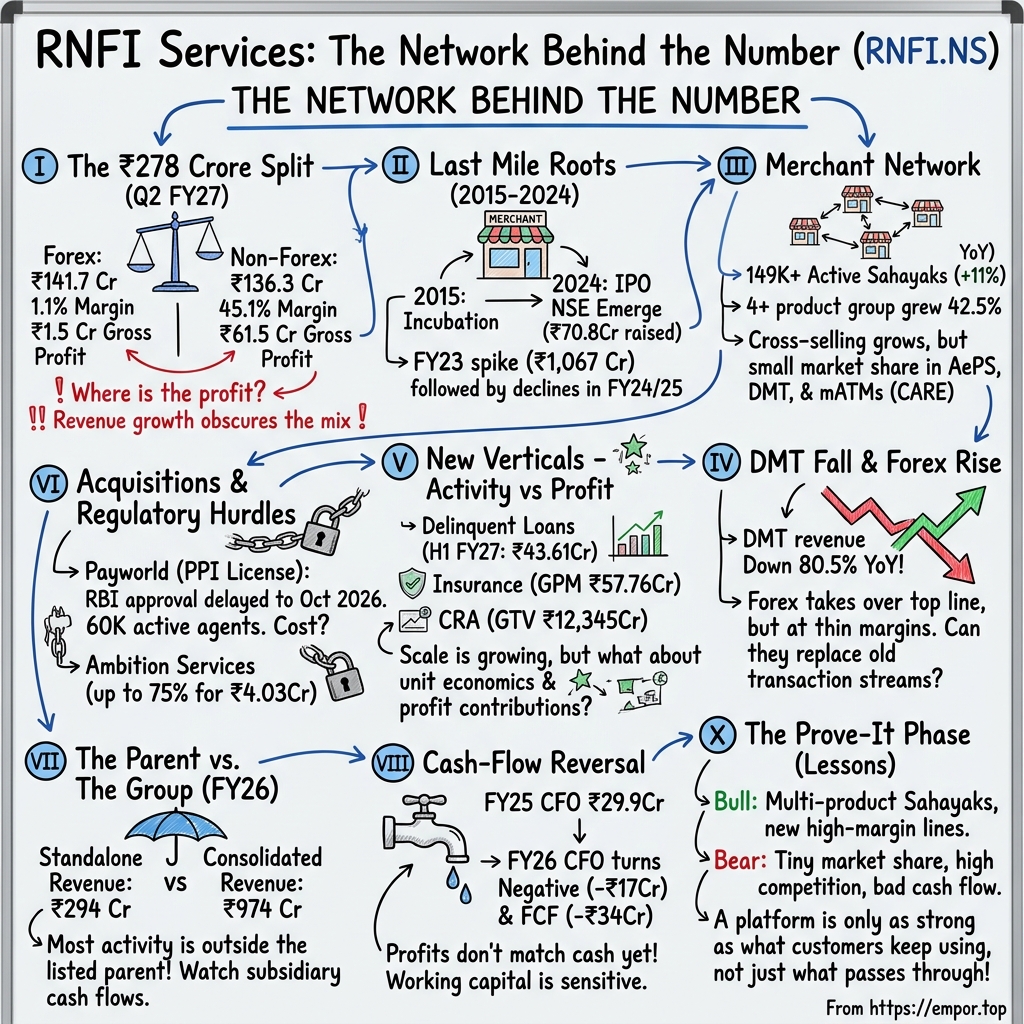
The first pile is foreign exchange: about ₹142 crore of sales in the three months to September.1 A crore is ten million rupees, so this is roughly 1.4 billion rupees of currency sold to travellers, students and businesses. The second pile is everything else RNFI does: cash withdrawals at village shops, money transfers, insurance, loan collections, identity checks and the refilling of ATMs. That pile came to about ₹136 crore.1 The two are almost the same height, and together they make the ₹278 crore quarter that let the company report revenue growth of about a quarter over the same period a year earlier.2
Then the slide shows how much of each pile RNFI kept.
The forex business turned ₹141.7 crore of sales into ₹1.5 crore of gross profit, a gross margin of about 1.1%.1 The non-forex business turned ₹136.3 crore of sales into ₹61.5 crore of gross profit, a margin of about 45%.1 Put simply, for every ₹100 of currency it sold, RNFI kept about a rupee. For every ₹100 of non-forex services, it kept about ₹45.
So half of RNFI's revenue earned about one fortieth of its gross profit. Anyone who looked only at the top line was looking at the wrong business.
Revenue in a business like this mixes two different things. In forex, the company records the full value of the currency that changes hands as sales, the way a currency booth at an airport would. Its real earnings are the thin spread between the buying and selling price. In the service businesses, revenue is much closer to a fee: a commission on a cash withdrawal, a share of an insurance premium, a payment for each loan collected. One rupee of forex revenue and one rupee of service revenue look the same on the income statement but are worth very different amounts to shareholders.
That split frames the rest of this story. RNFI has built a network of small shopkeepers across India who act as the last link between banks and people who live far from a branch. The company calls them Sahayaks, a Hindi word for helpers. The investment question is not whether the network exists. The presentation counts about 150,000 active ones.1 The question is whether the network can be made to pay.
Three questions follow from that slide. First, can RNFI earn enough from each shopkeeper to justify the cost of recruiting, equipping and supervising them, in a market where banks, fintech apps and rival agent networks all chase the same counters? Second, can newer, higher-margin services grow fast enough to replace the older transaction lines that are fading? Domestic money transfer lost about four fifths of its revenue in a year.1 Third, when the group earns money, how much of it reaches the shareholders of the listed company?
The third question needs one point of orientation before the story starts. RNFI Services Ltd is the listed parent, traded on NSE Emerge, the National Stock Exchange's platform for smaller companies. Most of the activity reported under its name happens in subsidiaries and controlled partnerships covering money transfer and forex, payments, insurance broking, fintech and collections.3 When CARE Ratings assessed the company in May 2026, it rated the parent together with nine subsidiaries and associates.4 In the year to March 2026, the parent on its own reported about ₹294 crore of revenue, while the consolidated group reported about ₹974 crore.2 About seven of every ten rupees of group revenue were booked somewhere other than the parent's own accounts.
None of this makes RNFI unusual by itself. Plenty of Indian financial-services groups are built as holding companies over licensed subsidiaries, because regulators often require each licence to sit in its own entity. It does mean that the headline numbers in RNFI's results are the end of a long chain of consolidation. Following the money means following it through each link.
The ₹278 crore quarter, then, is really two businesses sharing one set of counters. One is large and nearly profitless. The other is smaller and carries almost all the profit. RNFI's future depends on which of them the network is really built to serve, and to see why that is still an open question, the story has to start at one of those counters.
 Subscribe on LinkedIn
II. A Payments Company Built at the Last Mile
Picture a small general store on the edge of a town in Uttar Pradesh or Rajasthan. The shopkeeper sells soap, phone recharges and biscuits. A farmer walks in who needs ₹2,000 from his bank account. The nearest branch is an hour away by bus, and the nearest working ATM is not much closer. So the shopkeeper takes out a small fingerprint scanner, the farmer presses his thumb on it, the system checks his identity against India's national Aadhaar database, his bank approves the withdrawal, and the shopkeeper hands over cash from the till. The shopkeeper earns a small commission. The bank has served a customer it would never have built a branch for. And a company like RNFI, sitting between the two, takes its own cut for supplying the technology, the bank connection and the settlement.
That is the business-correspondent model, and it is the foundation RNFI was built on. India's banking regulator allows banks to appoint agents who carry out basic banking transactions on their behalf: cash deposits and withdrawals, balance enquiries, money transfers. Banks rarely sign up hundreds of thousands of corner shops themselves. They work through aggregators that recruit the shops, give them devices and software, train them, police them for fraud and settle the money each day. RNFI is one of those aggregators.3
The product list grew as the network did. On top of cash withdrawals with an Aadhaar fingerprint, known as AePS, RNFI added micro-ATMs, which are handheld card readers that let a shop act as a cash machine. It added domestic money transfer, where a migrant worker hands cash to an agent in a city and it lands in a family member's bank account back home. It added bill payments, travel bookings, insurance, KYC and verification tools for other companies, EMI and loan collections, cash management and forex.3
The company was incorporated in 2015.5 Its managing director is Ranveer Khyaliya, who signs its annual reports and fronts its conversations with investors.3 Ownership sat with a family trust: before the IPO, the Simran Singh Private Trust held 89.53% of the shares, alongside individual promoters.5 Simran Singh, the founder-promoter whose trust holds the controlling stake, has therefore been the anchor of ownership, while Khyaliya has been the face of operations.
The pre-listing financial history explains much of what follows. In the year to March 2021, RNFI reported revenue of about ₹134 crore. In FY2022 it was about ₹188 crore. Then, in FY2023, revenue jumped to about ₹1,067 crore, more than five times the previous year.6
A jump of that size in one year does not come from steadily recruiting more corner shops. It comes from a new kind of revenue or new entities entering the consolidated accounts. In RNFI's case, the most important new revenue was high-turnover currency business, which by FY2025 was more than half of the group's revenue.4 The FY2023 figure looks impressive on a chart, but it is better read as a change in what the company counted as revenue than as a sudden fivefold increase in its economic activity.
Another set of figures in the prospectus pointed the same way. In FY2022, RNFI's top five customers produced about 72% of revenue. By FY2024 that had fallen to about 19%, and the top ten went from about 81% to about 34%.5 A company that once depended on a handful of institutional partners had become a business with a much wider base of counterparties. That made it less fragile, and it also changed what it was.
That was the company RNFI took to the public market in 2024. A draft red herring prospectus was filed with NSE on 27 March 2024, and the red herring prospectus followed on 12 July 2024.65 The offer was simple. It was a fresh issue of 67.44 lakh shares at ₹105 each, with no existing shareholder selling, so every rupee raised went to the company.5 A lakh is a hundred thousand. The issue raised about ₹70.8 crore, and RNFI directed the proceeds to working capital and general corporate purposes.3
The choice of working capital as the main use of funds says a lot about how this business works. A payments aggregator does not need factories. It needs money in the pipes. When a shopkeeper pays out cash, someone has to fund the gap until the bank settles. When RNFI sells currency, it needs inventory of currency. When it handles collections and cash management, balances pile up in transit. Growth in a business like this eats cash before it makes cash, a theme that will return when the cash-flow statement comes into view.
After the listing, the revenue line did not behave like a growth story. Consolidated revenue fell about 12% in FY2024 and another 2% in FY2025.3 Yet net profit nearly doubled in FY2024 and rose about 72% in FY2025, and the operating margin rose from about 0.6% in FY2023 to 2.6% in FY2025.3 The company was shrinking its top line and growing its bottom line at the same time.
That is a reasonable outcome if the revenue being lost was low-margin and the revenue being kept was better. It also shows how unreliable revenue is as a guide to RNFI's progress. The FY2023 surge flattered the top line. The two years of decline then made it look worse than the underlying economics. Group membership kept changing as well, with subsidiaries added and the consolidation perimeter moving around the listing.3 Anyone who extends a straight line through RNFI's revenue history is drawing it through points that are not like-for-like.
So the IPO funded a real distribution footprint, though a lumpy one, and the company used the next two years to improve the quality of its earnings rather than their size. The question the listing could not answer was whether the network of shopkeepers RNFI had assembled gave it something rivals could not copy. That question begins with what happens over a shopkeeper's day.
III. The Network Has to Earn Its Keep
Go back to the general store and follow the shopkeeper through a day.
In the morning, a labourer's wife comes in to withdraw part of a government benefit with her thumbprint. Later a young man sends ₹5,000 to his brother in another state. Around noon, a field agent from a lender comes in to collect an overdue instalment. In the afternoon, someone renews a two-wheeler insurance policy. Toward evening, a customer opens a bank account and the shopkeeper runs the identity checks. Most days nobody buys foreign currency at this counter; forex is largely a different channel serving travellers and businesses. Each service is a separate source of commission for the shopkeeper and a separate revenue line for RNFI.
That is the economic loop RNFI describes. Each shopkeeper costs money to recruit, equip, train and supervise. Once that cost has been paid, every extra product the shopkeeper sells should earn more for both of them without a matching rise in distribution cost. The marginal product rides on a counter that is already there. If it works, revenue per merchant rises faster than cost per merchant, and margins expand.
The latest presentation offers evidence that the loop is turning. RNFI counted 149,494 active Sahayaks at September 2026, up about 11% from a year earlier.1 The number of Sahayaks using four or more products grew about 42.5%, almost four times as fast as the base.1 Average monthly revenue per Sahayak was higher in the first half of FY2027 than a year earlier.1 Taken together, those three facts show the multi-product cohort growing faster than the network and each counter earning more.
That is a promising sign, and it is still only a sign. The figures describe how much merchants are doing with RNFI. They do not show how long merchants stay, how many leave each year, what RNFI earns per transaction, or how transaction volumes per merchant have moved over several years. RNFI does not publish a consistent series on merchant churn, transaction throughput or take rates. Without those, a growing multi-product cohort could mean merchants deepening their relationship with RNFI. It could also mean RNFI concentrating on its best merchants while weaker ones quietly drift away.
A second number points to that gap. CARE, describing the company in May 2026, referred to a network of about 2.25 lakh merchants.4 The presentation counts about 1.5 lakh active Sahayaks.1 The two numbers measure different things, one the network on the books and the other the counters actually transacting. Read side by side, they suggest that roughly a third of the network is not active at any given time. That is not unusual for an agent business, but it shows that "network size" is a figure to handle with care.
The case for a moat has to start with the competition. The shopkeeper is not exclusive to RNFI. Banks run their own correspondent programmes. Specialist correspondent companies recruit the same shops. Fintech platforms offer the same kiosks, and payment apps on customers' own phones remove the need for an intermediary at all. CARE's description of RNFI's position is blunt: the company operates in a highly competitive market and holds a small share in core correspondent services such as AePS, domestic money transfer and micro-ATMs.4 The rating agency lists thin margins and competitive pressure among its main constraints.4
RNFI does not publish a market-share table or a comparison with named rivals, so the size of its share against peers cannot be pinned down. CARE's judgement is enough to settle the direction. RNFI is a participant in this market, not its leader.
That matters for the moat question because of who holds the bargaining power. A shopkeeper can run two or three kiosks from different aggregators on the same counter, and many do. A bank can appoint several aggregators and move volume between them. A fintech partner can switch API providers. RNFI has not disclosed exclusive contracts, minimum-volume commitments or the switching costs that would stop any of these parties from moving.3 When suppliers and customers can both multi-source, the aggregator in the middle earns what competition allows.
The industry has real barriers, but they are generic ones. Handling cash at scale requires controls, insurance, reconciliation systems and relationships with banks that take years to build. Some products need regulatory licences, and RNFI holds several across its group. Those barriers keep out an amateur. They do not keep out the other established aggregators who already hold similar permissions. A licence entitles a company to compete; it does not hand it a protected position.
The network also carries the kind of risk any distributed workforce brings. The prospectus disclosed an earlier episode in which network partners carried out fraudulent railway ticket bookings, leading to a penalty from IRCTC of about ₹24,000.6 The amount was trivial. The lesson is that every counter is also a place where something can go wrong, and RNFI is answerable to its bank partners for what its agents do. CARE identified cash-handling risk as a constraint and noted that advance deposits taken from merchants mitigate part of it.4 Those deposits also make the merchants partly fund the network, a point that will matter when the cash-flow statement comes up.
There is one more competitor, and it may be the most important. India's Unified Payments Interface lets anyone with a smartphone send money instantly and at no cost. Every customer who moves from walking into a shop to tapping a phone is a transaction the counter loses. The prospectus flagged UPI and other digital payment methods as a competitive risk.6 The question is not whether this substitution happens, but how fast, and which of RNFI's services it touches first.
Weighing all of it, the case that RNFI's network is a moat is unproven rather than rejected. The evidence supports a narrower claim: RNFI has built a sizeable, active network that is selling more products per counter, in a market where it holds a small share and where neither merchants nor partners appear to be locked in. The claim would strengthen if RNFI published merchant retention, revenue per active merchant over several years and segment take rates, and those numbers held up. It would weaken if the active count stalled while the registered network kept growing, or if revenue per merchant rose only because the company was trimming its weakest counters.
The test is already under way inside RNFI's own revenue lines, because the service most exposed to phone-based payments has just collapsed.
IV. DMT Falls as Forex Takes Over the Top Line
The half-year presentation opens on a confident note. Revenue for the six months to September 2026 was about ₹548 crore, up 16.2% on the year before.12 A few pages later, a single line in the product breakdown tells a much harsher story. Revenue from domestic money transfer was down 80.5% year on year.1
Domestic money transfer was, for years, one of the defining services of India's correspondent networks. A construction worker in Mumbai or a factory hand in Surat would walk into a shop with cash, and an agent would send it to a family bank account in Bihar or Odisha within minutes. For workers without a smartphone or a bank app, the agent was the remittance system. For aggregators like RNFI, it was steady, recurring traffic.
Losing four fifths of that revenue in a year is not the slow erosion of a mature product. It is a collapse. RNFI's own prospectus had named the most likely cause in advance: UPI and other digital payments compete directly with agent-assisted transfers.6 As more migrant workers carry smartphones linked to bank accounts, they no longer need a shopkeeper to send money home. A change in pricing, partner arrangements or regulation can also accelerate a drop of this kind.
What investors need from management is an account of the cause, its likely duration and the replacement plan. Is the decline over, or will the remaining fifth go the same way? Was it driven by customers moving to phones, by a bank partner withdrawing, by price competition or by RNFI walking away from unprofitable volume? Each answer implies a different future. The presentation records the scale of the fall. Its framing of the period as a move "from diversification to growth" does not by itself answer those questions.1
The DMT decline matters because it is a direct test of RNFI's central argument about itself. Management presents RNFI as a diversified platform whose network can carry many products, so that the fading of any one is absorbed by the growth of others. A diversified platform should be able to lose a product without its earnings faltering. If DMT revenue falls by four fifths and profit growth slows sharply at the same time, the diversification has absorbed the blow only in part.
That is roughly what the half-year figures show. Revenue grew 16.2%, but profit after tax grew just 4.1%, to about ₹15 crore.12 Some of the gap reflects the cost of building new businesses, and some reflects a revenue mix leaning further toward the low-margin side.
Forex has been the main reason the top line kept growing while older lines faded. CARE calculated that forex accounted for about 53% of RNFI's FY2025 revenue and about 52% in the nine months to December 2025.4 Over the same period, CARE observed, the correspondent services that built the company were losing share of revenue while non-correspondent activities expanded.4
As the opening slide showed, forex records the full currency value as revenue but keeps only a thin spread: its gross margin in the September quarter was 1.1%.1
Forex is not worthless. It brings in customers, adds scale with banks and correspondents abroad, and uses licences that are not easy to obtain. Its near-zero contribution at the EBITDA level in the latest quarter shows how little it currently adds.1
The other side of that slide offered the most encouraging data point of the year. In the September quarter, the non-forex business earned about ₹61.5 crore of gross profit at a margin of about 45%, and RNFI described the margin as an improvement.1 If the non-forex business can grow its gross profit while DMT shrinks, the diversification argument survives in a smaller, more specific form: the network has enough other products to absorb the loss of one.
One quarter is not enough to settle that. The figure comes from a single three-month period, is reported only in a presentation rather than as an audited segment note, and arrives alongside a half-year in which profit after tax barely grew. A durable replacement would show up as several consecutive quarters of rising non-forex gross profit, with DMT stable at its new level, and with that improvement reaching profit after tax.
Management has also described a direction for the forex business itself: moving from over-the-counter currency exchange toward outward remittances, trade-related payments and other services that should earn more per transaction. That would make sense if it worked. Remittances for education, medical treatment or travel, and payments for small exporters and importers, usually carry better fees than selling banknotes. It remains a strategy. RNFI has not yet reported earnings from these services large enough to change the forex margin, which stood at about 1% in the latest quarter.1
The forex story therefore carries a familiar risk. A company with a fading, higher-margin legacy product and a growing, low-margin new product can show rising revenue for a long time while its profit pool stands still. The test is whether gross profit rises along with revenue.
That shifts the spotlight to the businesses RNFI has been building for exactly this moment: collections, insurance and cash management. Management says they are moving from investment to growth. The numbers they publish about them need careful reading.
V. Three New Businesses Move From Investment to Activity
One page in the half-year presentation marks three businesses RNFI started about three years earlier: delinquent-loan collection, insurance distribution and a cash-replenishment agency.1 The presentation describes them as having moved past the investment phase into growth. Each comes with a chart that rises steeply from left to right.
The three charts measure three different things, though.
Start with collections. India's lenders, from banks to microfinance companies to fintech apps, have millions of small borrowers who fall behind on instalments. Chasing those borrowers door to door in small towns is expensive and difficult for a lender based in a metro. A company with a network of counters and field agents in exactly those towns can do it more cheaply, getting paid for each successful collection. In the first half of FY2027, RNFI earned about ₹43.6 crore of revenue from delinquent-loan collection, against about ₹11.8 crore in the same half two years earlier.1 Revenue grew almost fourfold.
That figure is revenue, which makes it the most meaningful of the three. It shows lenders are paying RNFI for the service and paying more each year. CARE also listed delinquent-loan collection among the newer RNFI services not facing the same margin pressure as its older correspondent lines.4 Of the three businesses, collections has the clearest evidence of becoming a real profit contributor.
It also has a risk of its own. Collections revenue depends on the volume of bad loans lenders want to outsource. When unsecured lending runs hot, delinquencies follow and collections agencies are busy. When lenders tighten, the flow slows. A business built on other people's credit problems is cyclical by nature, and collections work attracts regulatory scrutiny over how agents treat borrowers. The growth is real, but RNFI does not control the demand behind it.
Insurance is a different kind of number. In the first half of FY2027, the gross premium mobilised through RNFI's insurance channel was about ₹57.8 crore, against about ₹8.6 crore two years earlier.1 That is close to seven times the volume. Premium mobilised, though, is the total amount customers paid insurers, not RNFI's revenue. RNFI earns a commission on that premium, and what reaches the company is a fraction of the headline figure.
CARE's breakdown makes the point. In the nine months to December 2025, insurance broking contributed about 3.6% of RNFI's consolidated revenue.4 The premium chart rises steeply, but the business behind it is still a small part of the group. Insurance distribution through rural counters can be valuable because commissions are recurring when policies renew and the products are hard to sell without a trusted local face. Whether RNFI's policies renew at good rates, and at what commission levels, is not disclosed.
The third chart is the easiest to misread. RNFI's cash-replenishment agency moved about ₹12,345 crore of gross transaction value in the first half of FY2027, against about ₹7,996 crore two years earlier.1 A cash-replenishment agency loads cash into ATMs and moves currency for banks. The figure measures the rupees passing through the company's hands, not what it earns from them. At ₹12,000 crore in six months, the CRA's volume is about twenty times RNFI's entire half-year revenue. The fee RNFI earns on each rupee moved is very small, and the company does not publish it.
The three measures are therefore not interchangeable, even though they are presented on the same page with the same visual energy. Collections shows revenue growth. Insurance shows premium growth, a fraction of which becomes revenue. CRA shows growth in money moved, a much smaller fraction of which becomes revenue. Adding them up, or treating them as equivalent signs of momentum, would overstate how much the new businesses contribute.
What would show that these businesses have turned into durable earnings? Segment gross profit for each line, published over several years. Repeat usage: how many lenders send collections work again, how many insurance customers renew, how many banks extend CRA mandates. Partner retention, because each of these businesses depends on a small number of institutional clients whose departure would hurt. RNFI publishes none of these on a consistent basis. It does publish a forex and non-forex gross-profit split, but no comparable multi-year profit series for each new vertical.1
The same caution applies to the long tail of newer products. RNFI's group offers identity verification and KYC services, APIs that let other fintechs plug into payment rails, credit distribution and other payment services.3 CARE named two of those platforms, SprintNXT and SprintVerify, among the services it considered less exposed to margin pressure.4 A product page, a licence or a pilot is not a revenue line, though. Until a product appears with its own revenue and margin in the company's disclosures, it remains a possibility.
The company's spending record adds context. RNFI's prospectus reported research and development spending of about ₹2.3 crore in FY2023 and about ₹8.1 crore in just the six months to September 2023, a sharp increase from less than half a crore in FY2022.6 Its FY2024–25 board's report then described R&D expenditure as nil.3 Permanent employees on the parent's rolls were about 1,412 at March 2025, against about 1,405 a year earlier.37 Either the company stopped investing in product development after listing, or the spending moved to subsidiaries or was reclassified, for example as capitalised software. RNFI does not reconcile the two. A company presenting a growing product suite as its future would serve investors better by showing how much it spends to build that suite and where.
Management's framing of this period as a shift "from diversification to growth" has some support.1 The new businesses exist, they are bigger than they were two years ago, and at least one of them, collections, is producing meaningful revenue. Still, "growth" in that phrase mostly describes activity measures rather than profit. Without a profit series for each line, nobody outside the company can say whether these businesses are replacing DMT's lost earnings or merely its lost activity.
The new businesses therefore support a more modest claim than the presentation makes: RNFI has started credible new revenue streams, and one of them is already material. Whether they become the profit engine the company needs is the next thing to watch, and the clearest signal will be a published gross profit for each vertical, in rupees, rising over successive half-years.
Building businesses from scratch is one way to replace a fading line. RNFI has also chosen a faster and riskier route: buying them.
VI. Payworld Turns an Acquisition Into a Regulatory Test
In October 2024, three months after its listing, RNFI told the exchange it had agreed to acquire Payworld, a payments and distribution company with its own agent network.8 On paper, the logic was simple. Payworld brought another network of retail agents, a product set that overlapped with RNFI's, and a subsidiary licensed by the Reserve Bank of India to issue prepaid payment instruments.89
A prepaid payment instrument, or PPI, is the regulatory category for digital wallets and prepaid cards: money loaded in advance and spent later. In India, issuing one needs RBI authorisation, which is slow to obtain and closely supervised. For a company like RNFI, buying a business that already held one was a shortcut. It could add wallets and prepaid products to its counters without starting a licence application from scratch.
The deal was structured in tranches. RNFI updated the market on its terms in March 2025, and in April 2025 bought its first 24% of Payworld.104 Buying the rest was a different matter. A change in control of a PPI issuer needs RBI approval, and the regulator initially did not accept the change-of-control application for Payworld's PPI subsidiary.4 For the next year and a half, RNFI owned a minority stake in a company it had planned to control, with the licence that partly justified the purchase out of reach.
The approval eventually arrived. In October 2026, the RBI issued a no-objection for RNFI to acquire the remaining tranches.2 The regulatory path is now open, although the October no-objection is the start of the integration, not its end.
How big was Payworld? It reported turnover of about ₹60.8 crore for FY2024.8 On RNFI's May 2025 earnings call, management said Payworld had about 60,000 active agents, and distinguished them from a registered base of around a million users.9 That distinction mirrors the gap inside RNFI itself between a registered network and an active one. Sixty thousand active agents would be a meaningful addition alongside RNFI's roughly 150,000 active Sahayaks, if they could be kept active through a change of ownership.
What did RNFI pay? The purchase consideration is not disclosed in the company's acquisition filings.810 On the same May 2025 call, management said Payworld was profitable and had been acquired at a "very reasonable" price.9 That claim cannot be tested. With no published price, no disclosed Payworld profit for a recent year and no implied price-to-earnings or price-to-sales multiple, shareholders cannot judge whether "reasonable" means two times earnings or twenty. A shareholder can see what RNFI bought but not what it paid.
Holding back the price matters more in RNFI's case than it would for a larger company. For a group with a market value of about ₹650 crore in March 2026, an acquisition of a business with ₹60 crore of turnover and a PPI licence could be a material use of capital. Investors are being asked to trust management's judgement on value, at a point when the public track record of that judgement is about two years long.
The delay also carried a lesson that will stay with RNFI. Regulatory licences are an asset only when the regulator agrees about who owns them. The RBI's initial refusal showed that a buyer cannot assume a licence will come with the business. For a company whose strategy increasingly rests on regulated services, this was a reminder that the regulator remains a gatekeeper, with its own timetable.
In June 2026, RNFI announced a second, smaller deal. It agreed to acquire up to 75% of Ambition Services for about ₹4.03 crore, paid partly by issuing new RNFI shares to the sellers and partly by buying existing shares.11 In the September quarter, RNFI completed an initial tranche of up to 51%, again using a mix of new shares and share purchases.2
At ₹4 crore, Ambition is too small to change RNFI's economics. Its disclosed price, however, does not by itself show the deal was cheap or expensive. The company has not published Ambition's earnings or the milestones that govern the later tranches.11 A small price for a small business can still be a poor deal if the business earns little, and the pattern matters more than any single deal. RNFI has now made two acquisitions in two years, both structured in tranches, one partly paid in shares, and neither accompanied by a disclosed earnings multiple or return target.
That brings in the dilution question. Alongside the acquisitions, RNFI has raised equity through preferential warrants that convert into shares, and has created a 2026 employee stock option plan that received in-principle approval from NSE.2 Each of these adds shares. That is not wrong in itself. Warrants bring in cash, ESOPs keep staff, and shares can be a sensible acquisition currency when a company's own stock is richly valued. But each new share divides the group's future profit by a larger number.
The question an activist would ask is the right one here. If management issues shares to buy businesses and reward employees, the measure of success is not group revenue or group profit. It is profit and cash flow per share, measured over several years and after dilution. RNFI does not yet publish that comparison for its acquisitions, and its record as a listed company is too short to compute it reliably.
Payworld, then, is a test of capital allocation that has not yet been graded. It could prove a smart purchase of a profitable network and a scarce licence. It could also prove an expensive diversion that took eighteen months of regulatory waiting to consummate. The October 2026 no-objection settles the regulatory question. The economic one remains open until RNFI discloses what it paid and what Payworld earns inside the group.
To see who ultimately benefits when these acquisitions work, it helps to look at where all of this activity sits on the corporate chart, and how much of it belongs to the listed parent.
VII. The Parent Is Smaller Than the Group It Reports
As noted earlier, FY2026 consolidated revenue was more than three times standalone revenue.22 The year before, the figures were about ₹923 crore and about ₹282 crore.3 In both years, the parent's own revenue was a little under a third of the group's.
A holding-company structure is normal in Indian financial services, where licences often have to sit in separate entities. It does change what a shareholder in the listed company actually owns. A shareholder owns the parent. The parent owns stakes in subsidiaries and controlled partnerships, some wholly and some partly. Each of those entities has its own revenue, costs, cash and, in some cases, outside partners with a share of the profit.
RNFI's group includes RNFI Money, Paysprint, an insurance broking business, the Payworld stake and other entities, including controlled LLPs, across money transfer and forex, payments, fintech and collections.34 Consolidated accounts add all of these together and then deduct the share of profit belonging to minority holders. The share of profit attributable to RNFI's shareholders is what matters, not the group's total.
Following the money therefore requires subsidiary-level detail. Which entities earn the profit? Which ones need cash, and which ones send it up to the parent as dividends or loan repayments? RNFI's FY2024–25 related-party notes list intercompany loans, investments and balances between the parent and its subsidiaries.3 The company does not summarise its gross intercompany flows as a share of group revenue or cost, nor does it describe the transfer-pricing method used.3 The board's report says the related-party transactions complied with the law and none required shareholder approval.3 Compliance and transparency are different things, though, and investors cannot see how much value flows between the parent and the entities it controls.
One reassurance is available. The annual report does not describe a royalty, brand fee or management fee paid by the parent to promoter-owned entities as a material recurring cost.3 That is a common governance concern in Indian promoter-controlled groups, and its absence here is worth noting.
Executive pay is also modest. In FY2025, the related-party note recorded about ₹23.7 lakh of remuneration to managing director Ranveer Khyaliya and about ₹9.7 lakh to CFO Nimesh Khandelwal, with about ₹2.7 lakh to company secretary Kush Mishra.3 Against a group that earned about ₹20 crore of profit after tax that year, these sums are small.2 The same note shows professional consultancy payments of about ₹8.5 lakh to Nitesh Kumar Sharma, alongside remuneration.3 None of these figures suggests that executives are extracting value through pay.
Control sits with the promoters. They held about 65.4% of the company in March 2025, about 65.1% in March 2026 and about 64.3% in September 2026, largely through the family trust.12135 No pledge was reported in the latest shareholding pattern.13 Institutional ownership is tiny and shifting. Foreign institutions held 0.29% in March 2025, nothing in March 2026 and about 1.35% by September 2026.1213 The number of shareholders rose from about 1,390 to about 1,743 over that period.13 RNFI is a closely held company with a small, mostly retail free float.
The promoters have put money in as well as holding on. RNFI raised about ₹62.8 crore through preferential warrants in the first half of FY2026, and the presentation says management and promoters contributed about 17.6% of that, at a warrant price it cites as ₹270 a share.1 Conversions continued into 2026. In September, NSE admitted another 37,000 shares to trading following warrant conversion.14 A warrant price of ₹270 was about two and a half times the IPO price of ₹105, which means outside investors were willing to fund the company at a much higher value than at listing.
Promoter participation in that raise is a meaningful signal of alignment. It is also limited. At 17.6%, insiders took a smaller share of the raise than their roughly two-thirds stake in the company, so the warrant issue modestly diluted their holding, consistent with the gentle decline in the promoter stake.113
The 2026 ESOP plan and the share-based payments in the Ambition deal add to the share count.211 None of these is large by itself. Taken together, they create a steady flow of new shares, which makes per-share earnings, rather than group earnings, the figure to watch.
Shareholders vote on these decisions, and RNFI files the results. A postal ballot held in early 2026 produced a scrutiniser's report that the company published.15 With promoters controlling nearly two-thirds of the votes, the outcome of ordinary resolutions is rarely in doubt. The information worth reading in a controlled company's voting results is how the non-promoter votes split, because that is the only place independent shareholders can register dissent.
Read together, RNFI's group structure does not show the classic warning signs of a promoter-controlled company: no pledges, modest pay, no royalty, and insiders putting cash into the business. It does show a disclosure gap. Most of the reported activity happens outside the listed parent, and the company does not give investors a subsidiary-by-subsidiary view of profit, cash and intercompany flows. Until it does, investors are valuing a consolidated result whose components they cannot see.
That gap matters most when profits and cash start to diverge, and in FY2026 they did.
VIII. The Profit Recovery Meets a Cash-Flow Reversal
FY2025 looked like the year RNFI's profits finally turned into cash. The group reported profit before tax of about ₹26.7 crore, and cash from operations of about ₹29.9 crore.3 Cash coming in was greater than the accounting profit, which is usually a good sign. Investors in small financial-services companies often worry that reported profits are trapped in receivables, so a year where the cash arrived offered some comfort.
A year later, the picture reversed. In FY2026, consolidated cash from operations was negative, at about ₹17 crore out, and free cash flow, after spending on equipment and software, was negative by about ₹34 crore.16 The group reported its best-ever profit, about ₹32.4 crore after tax, in the same year its operations consumed cash.2
How did that happen? The answer lies in the kind of business RNFI runs and in the line where operating cash meets working capital.
Begin with FY2025. Before any working-capital movements, the group's operating cash was about ₹29.9 crore, close to its profit before tax once non-cash items such as depreciation and provisions, along with finance costs, were added back.3 Inventory, receivables and other operating balances then absorbed cash, while an increase in other current liabilities released it.3 The two roughly cancelled out. The final figure looked like excellent conversion, but it depended on a rise in liabilities, which can reverse.
That pattern runs through RNFI's history. The prospectus had already warned of negative operating cash flow in FY2021, FY2023 and the first half of FY2024.6 FY2024 brought a strong year, with about ₹47 crore from operations.3 Then FY2025 was weaker, and FY2026 turned negative. Over five years, the company's operating cash flow has swung between large positive and negative figures, with no steady relationship to profit.
The reason is the money in the pipes. Every day, RNFI's network handles cash for banks, merchants, lenders and customers. Merchants deposit advances. Banks settle with a delay. Collections are received before being passed on. Forex inventory has to be bought before it can be sold. Each of these flows creates balances on RNFI's books, some owed to the company and some owed by it, that move by large amounts from one quarter-end to the next. The cash flow statement of a business like this is partly a record of other people's money passing through. That is why ordinary measures such as cash flow relative to profit are less reliable here than they would be for a manufacturer.
That caveat cuts both ways. FY2025's strong conversion should not be over-interpreted, because part of it came from liabilities that can unwind. FY2026's negative figure should not be dismissed as merely timing, because it came during a year of acquisitions and rapid growth in the new businesses. A business growing collections, CRA and forex needs more money in transit, and the cash used to fund those balances is a real cost of growth even if it eventually comes back.
Free cash flow also leaves out acquisitions. FY2026 free cash flow was about ₹17 crore below operating cash flow, which is roughly the capital expenditure on equipment and software.16 Any cash paid for Payworld tranches or other investments came on top of that. The warrant money raised in FY2026 helped fund that combination of negative operating cash, capital spending and acquisitions. In practical terms, RNFI's growth in FY2026 was funded partly by its shareholders rather than by its own operations.
Receivables are a related question. At March 2025, consolidated trade receivables were about ₹31.8 crore, including about ₹7.4 crore of unbilled revenue, meaning services provided but not yet invoiced.3 The allowance for doubtful debts rose to about ₹0.39 crore, from about ₹0.09 crore a year earlier.3 The allowance quadrupled from a tiny base, but it remains small against total receivables. Most receivables were classified as good and under six months old, and none were classified as credit-impaired.3
That ageing schedule is reassuring, but it is a snapshot from March 2025. It says nothing about collection performance through FY2026, the year operating cash turned negative. Unbilled revenue, about a quarter of the receivables balance, also deserves attention, because it depends on management's judgement about when a service is complete and billable.
Then there is other income, which flattered the profit trend. In FY2025, RNFI's consolidated other income was about ₹6.6 crore, roughly a quarter of profit before tax.3 More than half of that, about ₹3.6 crore, came from liabilities written back: amounts the company had owed and later decided it no longer needed to pay.3 Interest on bank deposits contributed about ₹0.9 crore.3 Write-backs of this kind are legitimate, but they do not recur reliably. Without them, FY2025 profit before tax would have been about ₹23 crore rather than about ₹27 crore.
None of this erases the genuine improvement. Operating profit rose sharply in FY2025, and the operating margin more than doubled from about 1.1% to about 2.6%.3 That gain came from the business, not from one-off items. But the headline profit growth that year, about 72%, was helped by a write-back, and investors should not attribute all of it to recurring operations.
The cash record leaves RNFI's profits real but not yet self-funding. Two of the last three years produced positive operating cash flow, and one did not. The improvement in margins is genuine, and the conversion of that margin into cash depends on settlement balances that can move against the company as easily as for it. Until RNFI shows several consecutive years of positive operating and free cash flow after working capital and acquisitions, the claim that growth is paying for itself remains unproven.
That raises a broader question about the people making these decisions. A management team that promises growth, buys companies without disclosing prices and funds expansion with new equity has to earn credibility through results. How has this one done?
IX. What the Current Management Has to Prove
On 30 May 2025, RNFI held its first full-year earnings call as a listed company. Management described RNFI as a technology-enabled distribution company, a network that could carry many financial products to places banks found expensive to reach, and argued that Payworld would add agents and a licence at a reasonable price.9 Eighteen months later, the November 2026 presentation used a different frame: the investments made in earlier years were moving "from diversification to growth".1
The two descriptions are consistent. The first is a promise and the second claims it is being kept. Testing that claim means comparing what management said with what the business delivered.
Two people sit at the centre of that test. Ranveer Khyaliya, the managing director, runs the business and has led it through the listing, the Payworld deal and the push into new verticals.3 Simran Singh, the founder and promoter, stands behind the trust that controls about two thirds of the shares.513 Neither is a public figure in the way the founders of India's large fintechs are. They run a company that is built on small counters and talks to investors mainly through filings, presentations and earnings calls. What is known about their leadership comes from decisions, not interviews.
Some of those decisions look good. Margins improved and profit rose, customer concentration fell before the listing, and promoters and management participated in the warrant raise.3251 These are the actions of a team focused on profit rather than size.
The record from the most recent half-year is more mixed. Revenue grew about 16% while profit after tax grew about 4%.1 Domestic money transfer revenue collapsed.1 Operating cash flow turned negative in FY2026.16 And the half-year sits against an ambitious target. For FY2027, management has guided to revenue growth of 30% to 40%.17
A simple calculation shows how much that target asks of the second half. Revenue was about ₹969 crore in FY2026, and about ₹548 crore in the first half of FY2027, up 16.2%.21 Working backwards, the first half of FY2026 brought in about ₹472 crore and the second half about ₹497 crore. To reach 30% growth for the full year, RNFI's second half would need revenue of around ₹710 crore, up more than 40% on the year before. To reach 40% growth, it would need about ₹810 crore, an increase of over 60%. Consolidating Payworld and Ambition could add some of that, and a sharp rise in forex turnover could add more. Either would raise revenue faster than profit.
That is the problem with revenue guidance in a business like RNFI's. A target of 30% to 40% revenue growth can be met in ways that do very little for shareholders, by selling more low-margin currency or consolidating acquired turnover. It can be missed while the business is quietly improving, if the company pulls back from unprofitable forex volume. Guidance stated in terms of gross profit, or profit after tax, would be more useful. Investors should watch whether the company's explanation of its results over the next two quarters is framed around revenue or around profit.
When management took questions on the November 2026 results call, the issues were easy to name: why DMT fell so sharply and whether it has stabilised, how much the forex business contributes after costs, what Payworld and Ambition earn and what was paid for them, and how the full-year guidance would be met.16 The answers to those questions will show whether this management team explains misses with specific causes and plans, or retreats to broad descriptions of the platform.
The governance record is clean but short. The statutory auditor gave an unqualified opinion on the FY2024–25 accounts, and the CARO report found no loan default, no wilful-defaulter designation and no material fraud.3 The secretarial audit was also unqualified.3 That year RNFI replaced its auditor to fill a casual vacancy, appointing Kushal S. Poonia & Co. for a five-year term from the tenth AGM.3 A casual vacancy usually means the previous auditor resigned or could not continue. The company's filings do not suggest a dispute, but a change of auditor in the first full year after listing is a detail worth tracking, especially as the new firm signs its first full set of consolidated accounts covering acquisitions. One year of clean opinions is evidence for that year, not a general assurance.
The roster has changed too. The FY2024–25 annual report named Krishna Kumar Radheshyam Daga as chief executive, yet the related-party note recorded remuneration to him in FY2024 and none in FY2025.3 Directors Deepankar Aggarwal and Rahul Srivastava received about ₹36 lakh and ₹30 lakh respectively in FY2024 and nothing in FY2025.3 These changes may reflect roles moving between group companies. RNFI does not explain them, and for a company whose leadership depth beyond the managing director is hard to see, the reshuffle matters.
An activist would press on the gaps in disclosure around the network, acquisitions and cash conversion. None of these questions implies bad faith. Each describes something RNFI's management could disclose and has chosen not to.
The fair verdict is that profitability improved under this management, and promoters have backed expansion with their own money. The listed track record is a little over two years long. In that time, DMT has collapsed, cash flow has reversed and RNFI has not disclosed what it paid for Payworld. Guidance discipline and per-share returns remain to be demonstrated. The next two quarters, measured against the 30% to 40% target, will be the first real test of whether this team's forecasts can be relied on.
X. Lessons for Investors
Go back to the slide where it started, with forex and non-forex side by side, nearly the same size, and gross profits forty times apart. Several lessons run through the RNFI story. Each holds beyond this company, but each is anchored in something specific to it.
The first: a platform is only as strong as the products merchants keep using. RNFI can say with evidence that the number of Sahayaks using four or more products grew more than 40% in a year.1 It cannot say how many of those merchants were still using them a year later, because it does not publish retention. In a market where a shopkeeper can run several kiosks on one counter, the network's value depends on how often the shopkeeper chooses RNFI's terminal over a rival's. A registered network of 2.25 lakh merchants, of which about 1.5 lakh are active, shows how quickly the count of merchants signed up diverges from the count still transacting.41 For founders, that means building retention measures before building a sales story. For investors, it means distrusting any network claim that comes without a churn number.
The second: turnover can make a business look bigger than its profit pool. RNFI's forex business produces about half its revenue and about a fortieth of its gross profit.1 A company valued as a multiple of sales is being valued, in part, on currency that passed through its hands for a few hours. The general version applies to any intermediary that books gross transaction value: payment processors, travel agents, marketplaces, commodity traders. The figure that matters is what the company keeps, not what passes through. RNFI's slide is a model of what good disclosure looks like here. It is notable precisely because it is the slide that shows the problem.
The third: an acquisition thesis starts with the price and ends with cash returned. Payworld came with a story that was easy to tell: tens of thousands of active agents, a PPI licence and a management assurance that the price was "very reasonable".9 It came without a disclosed price, then spent eighteen months waiting for RBI approval for the remaining tranches.42 In the year the RBI's no-objection was still pending, RNFI's operating cash flow turned negative and the group relied on warrant money.161 An acquisition is worth what it returns relative to what was paid. When the price is hidden, the thesis cannot be tested until the returns arrive, if they ever show up clearly enough to measure.
The fourth: a group's revenue is not automatically the listed parent's return. RNFI's consolidated revenue is more than three times its standalone revenue.2 Shareholders own the parent, and the parent owns its subsidiaries through stakes that are not all complete, with intercompany flows that are not summarised. In any holding-company structure, the investor has to ask how much of each rupee of reported profit can actually reach the listed company's shareholders, and how much stays with minority partners or inside licensed entities that cannot freely send it upward. At RNFI, the answer depends on disclosures the company does not yet make.
The common thread is about measurement. RNFI is a business whose most visible numbers, revenue, network size, premium mobilised and transaction value, are the least informative about its value. The numbers that would settle the story, profit by segment, merchant retention, take rates and subsidiary cash flows, are the ones that are missing or appear only occasionally.
XI. Analysis & Bear vs. Bull Case
Here is the half-year in one sentence. Revenue up about 16% to about ₹548 crore, profit after tax up about 4% to about ₹15 crore, DMT down four fifths, and a slide showing one half of the business earning a 45% gross margin and the other half earning 1%.12 A bull and a bear can read that sentence in completely different ways, and both have evidence.
Start with the bull. RNFI has built a sizeable active network in places where banks will not open branches, and its multi-product group is growing faster than the base.1 Revenue per Sahayak is rising.1 The new businesses are real: collections revenue has grown nearly fourfold in two years, and CARE singled out collections and some of the newer platforms as less exposed to margin pressure.14 Banks, lenders and insurers need a way to reach rural India, and RNFI is one of a limited set of companies that can do it at scale. If more products per counter keep raising revenue per merchant without matching costs, operating margin can keep climbing from its low base, and the September quarter's 45% non-forex gross margin is the engine that would drive it.1
The bull would add that the regulatory path is clearing. The RBI's no-objection for Payworld's remaining tranches could bring a PPI licence and another agent network into the group.2 The Ambition deal adds more capability for a small sum.11 CARE's investment-grade rating of BBB- with a stable outlook, on a consolidated basis, reflects a business that a credit analyst considers adequately capitalised and growing.4
Now the bear. CARE, the same agency, says RNFI holds a small market share in its core services and faces strong competition.4 Neither merchants nor partners are locked in, and the company publishes no retention data to show they stay. DMT's collapse shows how sharply a core service can lose revenue.1 Forex accounts for half the revenue but earns almost nothing.1 Operating cash flow turned negative in FY2026, and the company funded growth partly through new equity.161 Payworld's price remains undisclosed, and the acquisition spent a year and a half in regulatory limbo.42 Liability write-backs flattered FY2025 profit.3 And the current guidance of 30% to 40% revenue growth requires a second half far stronger than the first.17
Where the power really sits
Porter's five forces give a structured way to weigh these claims. Rivalry is intense: banks, specialist aggregators and fintechs compete for the same counters and the same institutional mandates, and CARE identifies competition as a key constraint.4 Buyer power is high on both sides of the network. Banks and lenders can appoint several aggregators and shift volume, while customers increasingly bypass the counter entirely. Supplier power, in this business, sits with the partner banks and regulators whose permission RNFI needs, and CARE lists dependence on key business partners and regulatory risk among its concerns.4 The threat of substitutes is the most serious force. UPI and smartphone banking replace exactly the cash-to-account transactions that built the industry, and the prospectus flagged that risk years before DMT collapsed.6 The threat of new entrants is moderate. Cash-handling controls, bank relationships and licences slow newcomers, but the existing players already hold them.
On that reading, the industry structure is not kind to an intermediary. RNFI sits between powerful partners, mobile customers and well-resourced rivals, and the strongest force against it is substitution by technology that costs the end user nothing.
Hamilton Helmer's seven powers ask a narrower question: is there anything that lets RNFI earn more than its cost of capital for a long time while rivals cannot? Scale economies exist in principle, since a larger network spreads technology and compliance costs more widely, but RNFI is not the largest network, so the advantage, if any, belongs to others. Network effects are weak: an extra shopkeeper does not make RNFI more valuable to other shopkeepers or to a bank in the way an extra user strengthens a marketplace. Switching costs are not demonstrated. The merchant can run a second terminal, and RNFI discloses no exclusive or long-term partner contracts. There is no evidence of counter-positioning, since incumbents can and do copy the model. Brand matters to the shopkeeper's customers, but they trust the shopkeeper, not RNFI. A cornered resource would need an exclusive licence or relationship, and RNFI's licences are held by competitors too. Process power, the ability to run cash logistics, fraud controls and settlement more cheaply than rivals, is the most plausible source of advantage. It is also the hardest to verify from outside, because it would show up only in a cost-per-transaction comparison that RNFI does not publish.
The moat case is therefore narrow. RNFI may have a cost and operating edge in running a distributed cash network, and its multi-product cohort is growing. That is a capability, not yet a structural advantage that rivals cannot copy. The evidence that would change that verdict is specific: merchant retention rates, revenue per active merchant over several years and segment gross profit showing that cross-selling raises margins rather than only revenue.
Three numbers will tell investors which side of this argument is winning. The first is the active Sahayak count alongside multi-product penetration, both of which grew in the latest half-year.1 A rising count with rising penetration supports the bull. A stalled count, or penetration rising only because weaker merchants left, supports the bear. The second is segment revenue and gross profit, especially non-forex gross profit, DMT and forex. In the latest quarter, non-forex gross profit was about ₹61.5 crore, compared with about ₹1.5 crore for forex.1 The direction of non-forex gross profit, quarter after quarter, matters more than any revenue figure. The third is operating cash flow after working capital, which moved from positive in FY2025 to negative in FY2026.316 A return to positive operating and free cash flow would show growth paying for itself.
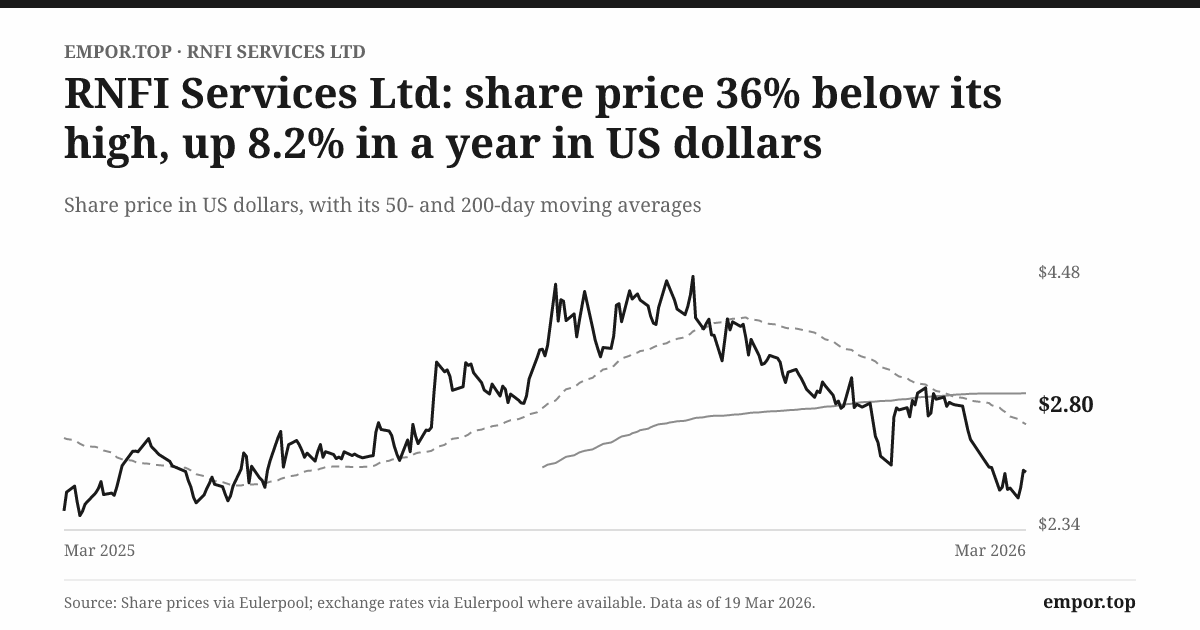
Then there is the price. On 19 March 2026, RNFI's shares traded at ₹261, giving the company a market value of about ₹654 crore. That was about 27% below the shares' 52-week high and about two and a half times the IPO price of ₹105.5 On the trailing profit then available, which ran to March 2025, the shares traded at about 36 times earnings, about 0.7 times sales and a free-cash-flow yield of about 1%.3 Measured against the FY2026 profit of about ₹32.4 crore reported a few weeks later, the same market value would have been closer to twenty times earnings, before allowing for any profit belonging to minority partners in subsidiaries.2
What does that price assume? At 0.7 times sales, the market is clearly not valuing RNFI as a high-margin platform. Half of those sales are forex turnover. At around twenty times recent earnings, it is valuing the profit stream as reasonably durable and growing. The FCF yield of about 1%, calculated before FY2026's negative cash flow, says the market is paying for profit that has not yet consistently turned into cash. RNFI has been listed for just over two years, there is no five-year valuation history to compare against, and no clean listed peer set exists for an SME-platform payments aggregator of this mix. The March 2026 multiple is a snapshot, not a range.
Weighing it all, the bull case rests on a real network adding higher-margin products, and the bear case on a low-share intermediary in a competitive market, with fragile cash conversion and acquisitions whose economics cannot yet be assessed. The evidence today supports a business that is improving but has not yet shown it can defend its position. At the March 2026 price, the market was not paying for perfection, but it was paying for earnings growth to continue. That leaves little room for an investor who mistakes revenue growth for earnings quality.
XII. Epilogue
As 2026 draws to a close, RNFI stands at a junction it has been working toward for two years. The RBI's October no-objection has opened the way to control of Payworld, agreed in 2024.28 Ambition Services has joined the group as a majority-owned subsidiary.2 The new businesses are larger than they were, and the network is still adding active counters.1 Management has promised a year of 30% to 40% revenue growth, and the first half delivered 16%.171
The next few results days will decide which version of RNFI is real.
The first test arrives with the results for the December quarter, expected early in 2027. If the second-half acceleration is coming, it should begin to show there. If it shows up mainly in forex turnover and consolidated acquisitions, revenue will rise and margins will not. If it shows up in non-forex gross profit, the company's own "diversification to growth" story will have its first real proof.1
The second test is DMT. If the decline has run its course, and DMT stabilises at a lower level while collections, insurance and cash management grow, the network will have shown it can lose a product without losing its earning power. If DMT keeps falling and other lines grow only in activity, not profit, the diversification argument narrows to something much smaller.
The third test is disclosure. Now that the RBI has cleared Payworld, RNFI can tell its shareholders what it paid, what Payworld earns and how its 60,000 active agents fit into the group.9 It can do the same for Ambition, whose later tranches depend on milestones not yet published.11 A company confident in its acquisitions has every reason to show their economics. Continued silence would itself be informative.
The fourth test is cash. FY2026 ended with negative operating cash flow and negative free cash flow.16 FY2027 is the year RNFI needs to show that profit can arrive in the bank, not just in the income statement, after funding the working capital that growth demands. Positive operating cash flow, without another round of equity, would answer the strongest bear argument.
Behind all four tests sits the question that frames the whole story. Can a network of last-mile counters turn reach into repeat, higher-margin business that the listed parent's shareholders can actually capture? The network is proven to exist. Its pricing power, retention and cash generation are not. The coming quarters will start to separate the two.
XIII. Outro
Return, finally, to the shop on the edge of town. One counter, one shopkeeper, one fingerprint scanner, and a queue of people who need cash, a transfer, a policy, a loan payment, a verified identity. From that counter, money flows in two very different ways. Some of it is a payment for a service, and RNFI keeps a meaningful share. Some of it is turnover that passes through almost untouched, and RNFI keeps almost nothing.
That is the RNFI story in a single quarter: forex produced little gross profit beside the far larger contribution from other services.1 The company is betting that the second can grow faster, making the counter a place people return to for services worth paying for. The network is visible in towns across India. Whether it holds real economic power is still being decided, one transaction at a time.
References
-
H1 FY2027 investor presentation — RNFI Services Ltd, 2026-11-11 ↩↩↩↩↩↩↩↩↩↩↩↩↩↩↩↩↩↩↩↩↩↩↩↩↩↩↩↩↩↩↩↩↩↩↩↩↩↩↩↩↩↩↩↩↩↩↩↩↩↩
-
Unaudited financial results for Q2 and half year ended 30 September 2026 — RNFI Services Ltd (NSE filing), 2026-11-06 ↩↩↩↩↩↩↩↩↩↩↩↩↩↩↩↩↩↩↩↩↩↩
-
Annual Report 2024–25 — RNFI Services Ltd ↩↩↩↩↩↩↩↩↩↩↩↩↩↩↩↩↩↩↩↩↩↩↩↩↩↩↩↩↩↩↩↩↩↩↩↩↩↩↩↩↩
-
Credit rating rationale, RNFI Services Ltd — CARE Ratings, 2026-05 ↩↩↩↩↩↩↩↩↩↩↩↩↩↩↩↩↩↩↩↩↩↩
-
Red Herring Prospectus — RNFI Services Ltd, 2024-07-12 ↩↩↩↩↩↩↩↩↩
-
Draft Red Herring Prospectus — RNFI Services Ltd, 2024-03-27 ↩↩↩↩↩↩↩↩
-
Payworld acquisition filing — RNFI Services Ltd, 2024-10-13 ↩↩↩↩↩
-
FY2025 earnings-call transcript — RNFI Services Ltd, 2025-05-30 ↩↩↩↩↩↩
-
Payworld acquisition update — RNFI Services Ltd, 2025-03-27 ↩↩
-
Ambition Services acquisition filing — RNFI Services Ltd, 2026-06-25 ↩↩↩↩↩
-
Shareholding pattern as at 31 March 2026 — RNFI Services Ltd ↩↩
-
Listing of further issues of securities, NSE circular — 2026-09-17 ↩
-
Voting results and scrutinizer's report, postal ballot — RNFI Services Ltd, 2026 ↩
-
Investor information, Annual Report 2025–26 and call materials — RNFI Services Ltd ↩↩↩↩↩↩↩↩
-
Q4 FY2026 earnings-call transcript — RNFI Services Ltd, 2026-06-02 ↩↩↩
 LinkedIn
 WhatsApp
 Reddit
 Hacker News
 Email
 Kindle
 RSS Feed
 Spotify
 Apple Podcasts
 Amazon Music
 Audible
 YouTube