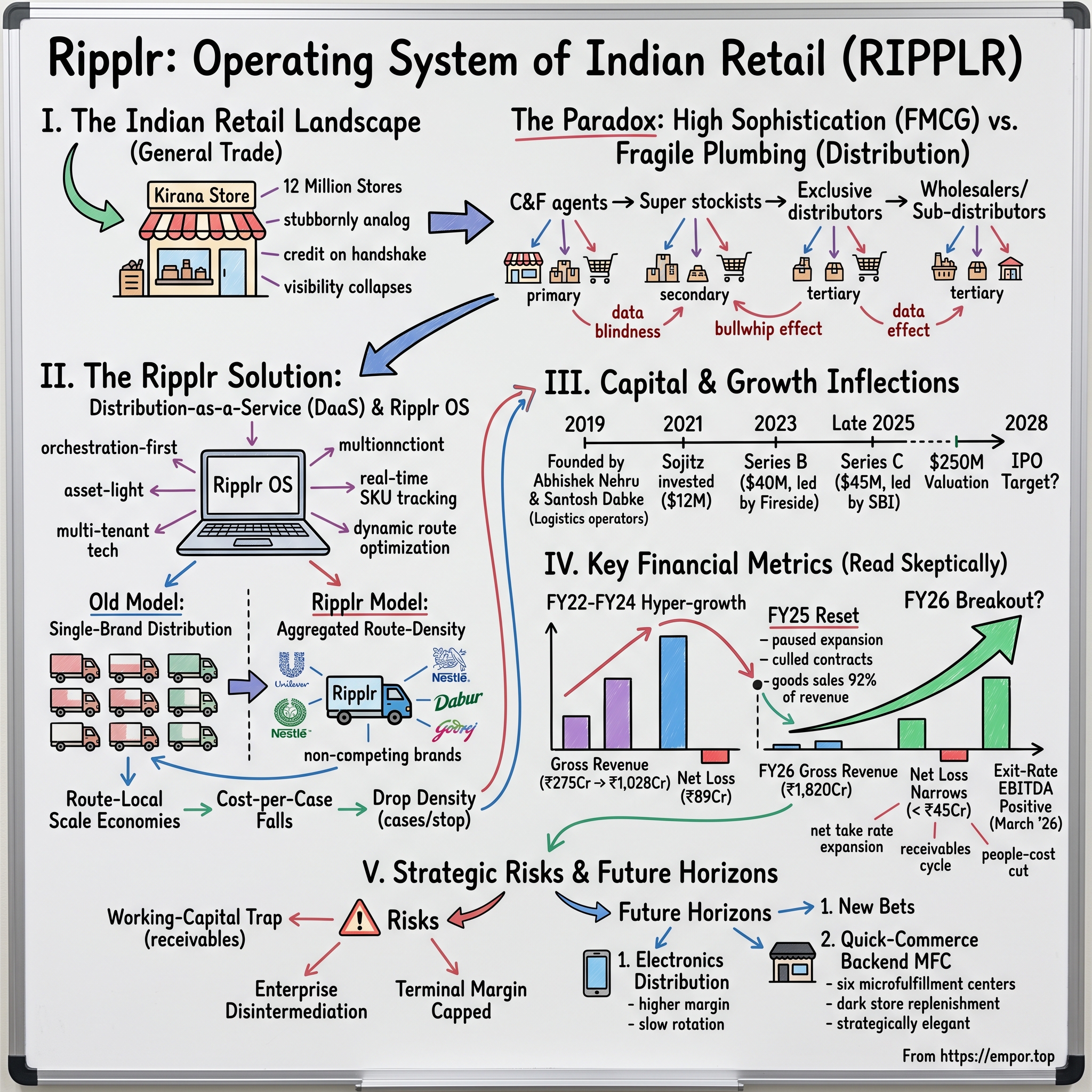
Ripplr: The Operating System of Indian Retail
I. Introduction & Episode Roadmap [00:00 - 15:00] (15 mins)
Every morning, before the metro trains fill and the office towers of Bengaluru switch on their air-conditioning, a different economy wakes up. A shopkeeper rolls up the shutter of a ten-foot-wide Kirana store, checks which brands of biscuit and shampoo he is short on, and mentally tallies which distributor's salesman is due to visit today, which one owes him a credit note, and which one shorted his last order. Multiply that scene by roughly twelve million stores and you have the plumbing of Indian consumption: enormous in aggregate, invisible in detail, and stubbornly analog.
The hook of this story is a deceptively simple question. How do you move billions of dollars of goods through millions of micro-retailers spread across a subcontinent without drowning in logistics chaos, inventory loss, and bad debt? Ripplr — the trading name of a Bengaluru company legally registered as Intelligent Retail Private Limited — was built to answer exactly that.1
The paradox it attacks is real. India's fast-moving consumer goods (FMCG) sector is dominated by some of the most sophisticated operators on earth. Unilever's Indian arm, Nestlé, Colgate, Dabur, and Godrej run cutting-edge demand planning inside their factories. But the moment a case of toothpaste leaves the warehouse gate, it enters a hundred-year-old, multi-tiered middleman network where visibility collapses, trucks run half-empty, and credit is extended on a handshake. Ripplr's thesis is that a digital-first "Distribution-as-a-Service" (DaaS) layer can replace — or at least re-plumb — the legacy distributor networks that power general trade.
The corporate arc is the kind venture investors like to tell. Founded in 2019 by two supply-chain operators, Abhishek Nehru and Santosh Dabke, Ripplr grew from a seed-stage idea into a company reporting roughly ₹1,820 crore of gross revenue in the financial year ending March 2026, having raised a $45 million Series C in late 2025 at a valuation of about $250 million, with the State Bank of India (SBI) leading and the Japanese trading house Sojitz Corporation sitting as its single largest shareholder.23 Management has signalled an intention to list, with reporting pointing to a 2028 IPO target.2
A note on what "RIPPLR" is and is not. The ticker in this piece is a placeholder: there are no publicly traded Ripplr shares, no exchange listing, and no free float. The company is tagged a Startup as a lifecycle marker, meaning it sits before any prospectus. Everything a public buyer would normally lean on — an audited fully diluted share count, formal risk factors, lock-up schedules, use-of-proceeds disclosure, the terms of each preferred class — does not yet exist in the public domain. That absence is not a verdict on the company; it is the defining condition of the analysis, and it dictates a posture of working from disclosed operating evidence while marking the many unknowns as unknowns.
That progression is the pricing story. This piece is about the value story, which is a different thing. A private round is a negotiated price between a handful of informed parties buying preferred securities with protections that public shareholders will never receive; it is a data point, not a valuation. So the roadmap here is deliberately structured to keep those two questions apart:
- The anatomy of Indian general trade, and why traditional distribution is structurally fragile.
- The founding of Ripplr and the asset-light, orchestration-first blueprint that distinguished it from the B2B startups that burned out before it.
- How "Ripplr OS" actually creates advantage — and where the moat is real versus rhetorical.
- The financial arc: the hyper-growth of FY22–FY24, the margin squeeze and reset of FY25, and the profitability inflection of FY26 — read skeptically, definition by definition.
- The new growth bets: electronics distribution and quick-commerce backend replenishment through microfulfillment centres.
- The investment spine — why Ripplr could win, why it could fail, what the private mark embeds, and which few metrics will confirm or falsify the underwriting once a filing finally exists.
A word on the title's ambition. Calling any company "the operating system of Indian retail" is a claim, not a description, and this piece treats it as a hypothesis to be tested rather than a banner to be waved. An operating system, in the sense that matters economically, is infrastructure that others depend on, cannot easily replace, and pay a durable toll to use. Whether Ripplr is building that — or is a well-run, thin-margin distributor with a good data story and a heavy dependence on continued fundraising — is precisely the question the following sections adjudicate. The answer, as with most pre-IPO companies, is "partly, and provisionally."
Because there is no DRHP, RHP, S-1, F-1, or prospectus for Ripplr, everything here is built from what is genuinely public: funding announcements, registry filings surfaced by the trade press, investor and counterparty disclosures, and interviews. That is a diligence record with real holes in it — no audited fully diluted share count, no preferred-term sheet, no formal risk factors — and the discipline throughout is to mark those holes as holes. Where a number is not disclosed, this piece says so rather than reverse-engineering false precision.
 Subscribe on LinkedIn
II. The Backdrop: The Fractured Plumbing of Indian Retail [15:00 - 45:00] (30 mins)
To underwrite Ripplr you first have to understand the market it is trying to re-wire, because the company's entire economic case rests on one claim: that legacy distribution is not merely old, but structurally inefficient in ways a shared platform can arbitrage.
Start with the scale of the opportunity and the scale of the incumbency, which are the same thing. Modern trade — organised supermarkets, hypermarkets, and e-commerce — takes the headlines, but the backbone of Indian retail remains the hyper-local Kirana store. General trade accounts for the large majority of Indian retail sales — commonly cited at north of 80% — and reaches into every lane and village in a way no organised chain has replicated.4 That is Ripplr's addressable universe, and it is also its problem: the customer base is millions of tiny, undercapitalised, credit-hungry shops, not a few procurement desks.
Between the brand's factory and that shopkeeper's shelf sits a classic four-layer pipeline, each layer adding cost and subtracting information:
- Carrying & Forwarding (C&F) agents, who hold state-level stock and are asset-heavy handlers paid a thin handling fee.
- Super stockists, regional consolidators who break bulk for smaller territories.
- Exclusive distributors, franchise-like operators who own a local warehouse, employ salesmen, and typically carry one or a few non-competing brands.
- Sub-distributors and wholesalers, the local runners who actually reach the smallest retailers and who extend the short-term, relationship-based credit that keeps the whole system liquid.
Each hop is rational in isolation and collectively wasteful. The reason is worth stating plainly, because it is the crux of Ripplr's opportunity.
For brands, the model is broken on data and density. A manufacturer has crisp visibility into primary sales — what it ships to its distributors. It has almost none into secondary and tertiary sales — what actually moves off the retail shelf into a consumer's basket.
That blindness produces the bullwhip effect: a small wobble in real consumer demand gets amplified as it travels upstream through independent inventory decisions, so factories oscillate between backlogs and localised stockouts. And because every brand runs its own exclusive distribution, freight density is terrible. In a single market, five trucks from five brands each drop a handful of cases at the same cluster of shops, each paying a full logistics cost to move a near-empty vehicle. The waste is not a bug in someone's execution; it is baked into a structure where every brand optimises its own channel in isolation.
For retailers, the model is broken on friction and credit. A shopkeeper must transact with dozens of distinct distributors, each with its own salesman, order book, delivery day, and minimum order.
And because banks have historically underserved this segment, the retailer's working capital comes from expensive, informal credit extended by the very wholesalers he buys from — a dependency that ties purchasing decisions to lending relationships rather than to price or availability. Whoever can offer that shopkeeper cleaner credit and a single, reliable order point holds real leverage over his basket. That, more than any app feature, is the prize.
A Porter's Five Forces read of legacy distribution explains why the incumbents cannot simply fix this themselves. The bargaining power of brands over distributors is very high: FMCG majors dictate terms and compress distributor gross spreads into a thin band, frequently cited in the 4–6% range, leaving no margin to invest in technology.4 Rivalry among distributors is high: local operators undercut each other to hold territory, so the surplus that might fund modernisation is competed away. And the threat of new entrants is medium-to-high precisely because tech-enabled platforms can, in principle, collapse layers of the pipeline — which is the wedge Ripplr, Udaan, ElasticRun, and others have all tried to drive.
It is worth completing the framework, because the two forces the outline leaves implicit are the ones that most constrain a would-be disruptor. The bargaining power of retailers is low individually but high in aggregate: no single Kirana store can negotiate, but the segment's dependence on informal credit means whoever finances the shopkeeper controls the shopkeeper's order book — which is why credit, not software, is the real lever in this market and why a platform that cannot underwrite retailer credit is playing with one hand tied. The threat of substitutes is rising fast: quick commerce and direct-to-retailer apps (including brand-owned ordering apps and JioMart-style B2B pushes) are not just new distributors but potential replacements for the general-trade purchase itself, which both enlarges the disruption opportunity and threatens the very shelf Ripplr is trying to serve. The net picture is an industry where value is competed away at every layer and the only durable profit pools accrue to whoever controls information and credit at scale — a demanding double mandate.
Sizing the market with restraint. The category TAM here is genuinely enormous — Indian retail is a multi-hundred-billion-dollar market and general trade is most of it — but the reachable market at Ripplr's present product, geography, and price point is a small fraction of that headline. Ripplr today operates in roughly eleven cities, serves on the order of one hundred thousand retailers, and concentrates on urban and semi-urban density where its shared-truck economics work.2 Against a universe of some twelve million retail outlets, that is a rounding error on store count, though a more meaningful share of modern urban FMCG throughput. The reachable market is better framed as "the outsourced-distribution and secondary-sales-visibility budget of large consumer brands in dense Indian metros," which is real and growing but far narrower than "85% of Indian retail." Any valuation that leans on the twelve-million-store TAM is leaning on a number Ripplr cannot, at its current model and price point, actually address for years.
The important analytical point is that a fragmented, low-margin, information-poor value chain is theoretically ripe for a platform that aggregates density and captures data. The graveyard of Indian B2B commerce — from cash-burning marketplaces to failed hyperlocal experiments — is proof that "theoretically ripe" and "reliably profitable" are very different states. The question is not whether the legacy model is inefficient — it plainly is — but whether a challenger can capture that inefficiency faster than the working-capital and coverage costs of general trade destroy it. That tension runs through everything that follows.
III. The Genesis: Abhishek Nehru, Santosh Dabke, and the Ripplr Blueprint (2019 - 2021) [45:00 - 70:00] (25 mins)
The most important early decision Ripplr made was what not to own — and that decision is best understood through who its founders were.
Ripplr was founded in 2019 by Abhishek Nehru and Santosh Dabke, and it matters that neither arrived as a pure software founder chasing a category.1 By the account carried in early profiles, Nehru had operating scar tissue from third-party logistics, having helped build a logistics business, Brring Integrated Logistics, from scratch to roughly ₹50 crore of annual revenue and EBITDA-positive within a few years.5 Dabke brought two decades of cross-functional experience across large consumer and financial organisations including Philips, Whirlpool, Bajaj Tempo, HDFC Bank, and Reliance AMC, running teams across regions and zones.5
These are not the résumés of people who underestimate how hard it is to set up a warehouse, manage a fleet, or collect cash from a shopkeeper who is having a slow month. That background shows up directly in the strategy — and, as the skeptic's note below argues, in its blind spots too.
The formative insight was a negative one, drawn from watching the previous generation of Indian B2B startups. The 2015–2019 cohort had raised enormous sums and, in several cases, bought the problem: heavy trucking fleets, large leased warehouses, and — most dangerously — inventory, purchasing goods onto their own balance sheet to resell to retailers. That model turned every operating mistake into a cash-consuming write-off. Ripplr's founders chose the opposite posture: build a plug-and-play orchestration layer that sits on top of third-party warehouses and last-mile vehicles rather than owning them, so the company's capital is spent on software and coordination rather than on steel and diesel.
The product expression of that posture is Ripplr OS: a multi-tenant technology platform designed to run distribution as a coordinated flow across assets Ripplr does not own. The core operational trick — and the source of whatever durable advantage the company has — is aggregation of non-competing brands into a single logistical stream. A shopkeeper who stocks Colgate toothpaste, Dabur honey, Britannia biscuits, Nivea cream, and Nestlé coffee historically received them on five different trucks on five different days. Route them through one platform and a single Ripplr vehicle can carry all five to the same store on the same visit. Drop density rises, cost-per-case falls, and — critically — the economics improve for reasons a single-brand exclusive distributor structurally cannot replicate, because that distributor only has one brand's volume to fill the truck.
The harder-to-explain part of the early story is trust. Convincing global FMCG majors to route primary-to-secondary distribution — the artery of their India business — through an unproven startup is a governance and reliability sale, not a features sale. Ripplr's answer was to make itself a full-service, accountable operator rather than a marketplace: it took responsibility for warehousing, billing, delivery, reconciliation, and the field sales force, so a brand's relationship quality did not degrade when it plugged in.
The company today lists blue-chip consumer brands — Unilever, Nestlé, Dabur, Godrej, Nivea among them — as clients, alongside logistics work for modern-trade and quick-commerce names.2 That client roster is the single strongest piece of external validation in the file, because enterprise procurement organisations are conservative and slow to hand over channel control; their willingness to do so is a real, behavioural signal, not a slide. It is the one piece of the bull case that does not depend on management's own telling.
There is a subtler point in the founding design that separates Ripplr from the software-only "retail tech" cohort. Many Indian startups sold tools to distributors — order-taking apps, ledger apps, retailer-facing SaaS (Bizom, Jumbotail's software layer, and others) — and discovered that selling a ₹500-a-month app to a distributor who runs on family labour and does not value software is a brutal business. Ripplr instead inserted itself into the flow of goods and cash, becoming the distributor rather than selling to it. That choice is more capital-intensive and operationally heavier, but it captures a distribution spread on every case rather than a thin software subscription, and it puts Ripplr at the chokepoint where the valuable secondary-sales data is actually generated. It is a bet that in Indian general trade you must own the physical flow to monetise the digital one — a bet the SaaS-only players' struggles arguably vindicate, at the cost of a heavier balance sheet.
The capital that underwrote this build arrived in structured stages from a recognisable set of early backers — 3one4 Capital, Zephyr Peacock, and Stellaris Venture Partners among the early institutional names, with the Japanese trading house Sojitz Corporation entering early through a December 2021 round.6[^7] That last relationship deserves flagging now and will recur: Sojitz did not arrive as a passive financial investor but as a strategic wholesaler-logistics partner, and it has since accumulated to become Ripplr's largest shareholder — a fact with governance consequences that a public-market buyer must weigh.7
The governance architecture that these early rounds established is worth noting now, because it shapes everything downstream. From the seed stage onward, Ripplr was built as an institutionally-backed company with structured preferred equity rather than a lightly-papered founder venture — a common Indian pattern in which each round layers in a new class of preferred shares with its own rights. That structure is efficient for raising capital and disciplining governance, but it steadily shifts economic control away from the founders and toward investors with contractual protections, and it is precisely why, by mid-2026, the founders held only about a fifth of the company (Section VI). None of the specific early-round terms — board seats, protective provisions, conversion mechanics — is public, which is a recurring theme: the shape of the cap table is visible, the terms that govern it are not.
Two things about the genesis should be held in tension by anyone underwriting the company. On the credit side, the founders' operator pedigree is exactly what you want in a business where the failure modes are physical and financial rather than technological — warehouse leakage, fleet utilisation, and cash collection, not app design. On the skeptic's side, the same operator instinct can bias a team toward building infrastructure the balance sheet must fund, and the early history is precisely one of front-loaded city-by-city cost (Section VI). The founding blueprint solved the ownership question well — orchestrating third-party assets rather than buying them — but it did not, and could not, solve the coverage-cost question, which is that reaching a fragmented retail base is expensive whether or not you own the truck. That unresolved tension is the throughline of the financial story.
IV. The Playbook: "Distribution-as-a-Service" (DaaS) & The Seven Powers [70:00 - 105:00] (35 mins)
"Distribution-as-a-Service" is a phrase that can mean everything or nothing, so it is worth pinning down what Ripplr actually does before testing whether it constitutes a durable business power.
Ripplr does not act as a broker that merely introduces a brand to a distributor and clips a fee. It offers full-stack distribution as a utility: a brand plugs in and immediately obtains warehousing, inventory management, automated billing, last-mile delivery, payment reconciliation, and a field sales force, all coordinated through Ripplr OS.8 Functionally, it is trying to be the outsourced distribution department of a consumer brand in a given geography — the way a cloud provider is the outsourced data centre of a software company. The comparison is apt because the promised advantage is the same shape: shared infrastructure spread across many tenants, priced as a service, with the provider absorbing the operational complexity.
Two technology capabilities do the heavy lifting in the pitch. The first is real-time, SKU-level tracking: because Ripplr handles the secondary sale into the retailer, it can in principle tell a brand how fast a new product is penetrating shelves, store by store, in near real time — the exact visibility the legacy pipeline destroys. The second is dynamic route optimisation: algorithms that sequence multi-stop urban deliveries to minimise distance, fuel, and idle time across the aggregated brand flow. Neither capability is exotic in isolation; logistics software has done route optimisation for decades. What is distinctive is the combination of the data position (Ripplr sits at the secondary-sale chokepoint) with the density position (many brands, one truck, one store).
It helps to make the unit economics concrete, because that is where the model either works or does not. Imagine a delivery van running a fixed urban route. Its cost — driver, fuel, depreciation, the salesman's time — is largely fixed per trip. A single-brand distributor fills that van with one brand's cases and drops a few boxes at each of, say, forty shops; the cost-per-case is high because the van is mostly empty air. Route the same van through Ripplr's aggregated flow and it now carries five non-competing brands to the same forty shops, so the drop at each store is larger, the van is fuller, and the fixed trip cost is spread across many more cases. Cost-per-case falls; contribution per stop rises. Multiply that across a densifying network and you get the operating leverage the FY26 numbers began to show. The economically meaningful metrics for this business are therefore not SaaS metrics at all — not ARR or seat counts — but drop density (cases and brands per stop), cost-per-case delivered, contribution margin per route, warehouse throughput/utilisation, and the receivables cycle. Those are the levers, and they are physical.
The subtle risk hiding inside this elegant story is that the economics are route-local and threshold-dependent. Below a critical density, a route loses money; above it, the route is a cash machine. Expansion into a new city means running sub-scale, loss-making routes until enough brands and shops are signed to cross the threshold — which is exactly why growth and losses moved together in Ripplr's early years, and why the discipline to not over-expand is worth more here than in a software business where a new customer is nearly free to serve.
The right way to test whether that combination is a business or just an operation is Hamilton Helmer's 7 Powers, applied honestly — which means being willing to conclude that some claimed powers are early or unproven.
Scale economies — the strongest of the claimed powers, and partly real. As more non-competing brands join a given route, the fixed cost of the truck, the warehouse slot, and the salesman's visit is amortised across more cases. Per-unit logistics cost falls with density, and a single-brand exclusive distributor — capped at one brand's volume per territory — cannot match it. This is a genuine cost-position advantage where density is achieved.
The crucial qualifier is "where achieved": the advantage is local, not national. Ripplr must win density market-by-market and route-by-route; a national logo count does not by itself lower the cost of the specific truck serving a specific cluster of shops. The scale economy is therefore real but geographically granular, and it explains exactly why the company's history is one of city-by-city margin fights (see Section VI). It also means the advantage is contestable: a competitor that achieves density first in a given city enjoys the same cost edge there, so the moat is a race to local density rather than a national fortress.
Process power — plausible but the hardest to verify from outside. The claim is that Ripplr OS's dispatch, sorting, and demand-forecasting minimise inventory holding periods and spoilage in ways rivals cannot easily copy. Process power, in Helmer's framing, must be both valuable and hard to replicate through hiring or purchase.
Route optimisation and order management are, frankly, buyable. What would make the process genuinely powerful is accumulated, proprietary secondary-sales data feeding forecasting that competitors cannot match without the same install base — a data-network effect. There are hints of this in the model, but no external evidence (cohort forecasting accuracy, inventory-turn benchmarks versus legacy) has been disclosed to confirm it. Treat process power as asserted and plausible, not demonstrated — and note that the burden of turning it into a real power falls on data the company has not yet shown.
Switching costs — real for enrolled brands, but narrow. Once a major brand's ERP (SAP or Oracle) is integrated into Ripplr's order-management APIs and Ripplr runs the physical channel in a territory, ripping it out is operationally risky — you are re-plumbing a live artery. That creates genuine switching friction at the account level. But two limits matter. First, large brands deliberately multi-source distribution to avoid dependence, so switching costs rarely translate into exclusivity. Second, the switching cost protects the account, not the category: it does little to stop a brand from building its own in-house tech-enabled distribution, which is precisely the disintermediation risk in the bear case.
There is one further Helmer power worth weighing because it is the most defensible thing about the model: counter-positioning. A legacy exclusive distributor cannot become a multi-brand shared-logistics platform without cannibalising the very single-brand exclusivity that is its relationship and its livelihood; a brand's own captive distribution arm cannot aggregate competitors' volume onto the same truck without absurdity. Ripplr's aggregation-of-non-competing-brands model is therefore something incumbents are structurally reluctant to copy, not because they cannot build the software but because doing so attacks their own business. Counter-positioning is real here — but it protects Ripplr against the legacy distributor, not against a well-funded new entrant with the same clean-sheet model, of which there are several.
Notably absent from Ripplr's power profile are network economies in the classic two-sided sense (the platform does not get more valuable to Brand A because Brand B joined, except indirectly through route density) and branded/cornered-resource advantages. That absence is not fatal — cost leadership through density can be a perfectly good business — but it does bound the terminal margin.
Distribution, however cleverly orchestrated, remains a business of moving other people's goods at a spread the goods' owners are determined to compress. The 7 Powers analysis, done without cheerleading, says Ripplr has a credible local cost advantage, account-level stickiness, and genuine counter-positioning against incumbents — but not a wide, self-reinforcing moat against fresh capital. That distinction is the whole ballgame for terminal value, and it is why the valuation cannot rest on "moat" alone.
V. The Competitive Landscape: Tech-Enabled B2B vs. Legacy Networks [105:00 - 130:00] (25 mins)
Ripplr's strategy is most legible when set against the companies that tried adjacent versions of the same idea and the incumbents it is trying to displace, because each comparison isolates a specific bet Ripplr has made.
Ripplr versus Udaan — the inventory-risk contrast. Udaan is the cautionary tale that shapes Ripplr's entire balance-sheet philosophy. It scaled explosively as a B2B marketplace that took principal inventory risk — buying goods and reselling them to retailers — which drove enormous GMV but also large cash burn, inventory write-downs, and, as reported, a sequence of down-rounds from its peak private valuation.
Ripplr's counter-positioning is deliberate: it operates primarily as a service-and-fulfilment partner, aiming to keep a lighter balance sheet and avoid speculative inventory ownership. This is a genuine strategic distinction and, on the evidence of Udaan's trajectory, a wiser one.
But it should not be oversold. Ripplr's own financials show goods sales dominate its top line — roughly 92% of revenue in FY25 — which means it is booking the full value of goods it moves and carries real working-capital exposure through receivables from retailers.[^10] "Asset-light" describes its warehouses and trucks; it does not fully describe its credit and inventory exposure, which is heavier than the DaaS label implies. The distinction from Udaan is one of degree and discipline, not a clean escape from the economics of moving goods on credit.
Ripplr versus ElasticRun — geography and customer. ElasticRun, backed by SoftBank, built a predominantly rural logistics network that used mom-and-pop shops as community-level storage and distribution nodes, optimising for the long tail of village retail. Ripplr has instead concentrated on high-velocity urban, semi-urban, and metro-fringe markets — currently around eleven cities — and on deep enterprise integrations with tier-one global brands rather than pure rural aggregation.2 The trade-off is clear: urban density is where Ripplr's shared-truck economics work best, but it is also where competition (including the brands' own direct distribution and quick-commerce players) is fiercest and where land, labour, and fuel costs are highest. Ripplr has chosen the market where its cost model is strongest and its competition is most sophisticated.
Ripplr versus the traditional sub-distributor — the incumbent that will not die. The most underrated competitor is the legacy sub-distributor running on near-zero overhead: family-owned real estate, generational relationships, cash-based credit judgement honed over decades, and a cost base that a venture-funded platform cannot underprice on day one. This is the competitor the platform narrative tends to wave away and shouldn't.
Ripplr's honest edge over them is not cost — it is scalability and information: multi-city reach, digital audit trails, systematic management of hundreds of SKUs, and real-time secondary-sales visibility that a single-territory family operator cannot provide to a multinational. Where the brand values that visibility and reach, Ripplr wins the mandate. Where the brand only cares about landed cost in one town, the incumbent's structurally lower overhead can still beat it. The competitive reality is therefore segmented, not a clean sweep: Ripplr is winning the enterprise-visibility job, not universally displacing the corner distributor — and the corner distributor's cost base is a permanent floor under how much margin Ripplr can ever extract.
Constructing an honest peer set — and the exclusions that matter. For valuation purposes, the temptation is to reach for the highest-multiple comparable available and apply it. The disciplined approach starts with businesses that share Ripplr's model, customer, monetisation, and capital intensity, then explicitly separates them from aspirational category leaders.
The closest operating peers are all private and imperfect: Udaan (B2B commerce, but principal-inventory and much larger), ElasticRun (B2B logistics, but rural-skewed), Jumbotail (B2B grocery marketplace with a wholesale arm), and Solv (an SC Ventures-backed B2B marketplace). These match the customer (retailers) and geography (India) but differ on inventory model and monetisation, and — crucially — none provides a clean public multiple, because they are unlisted and their own private marks are stale or contested. They are useful for business-model comparison, not for pricing.
For pricing discipline, the more honest reference points are listed distribution and logistics businesses that reveal how public markets actually value the economics Ripplr is in — the movement of other people's goods at a spread. India's listed electronics and IT distributors, such as Redington and Rashi Peripherals, are instructive precisely because they are the mature, at-scale version of the electronics vertical Ripplr is now entering: they run enormous gross revenue, thin net margins, meaningful working-capital cycles, and — the key fact — they trade at low fractions of sales (well under 1x) and modest earnings multiples, because the market correctly prices distribution as a low-margin, capital-cycling business rather than a software platform. Listed logistics-technology names such as Delhivery show the other end: a tech narrative can command a higher revenue multiple, but only where the market believes in asset-light operating leverage, and even then valuations have compressed hard when profitability disappointed. The lesson for Ripplr's underwriting is blunt: the distribution DNA of its revenue pulls its fair multiple toward the low-single-digits-of-net-revenue world of Redington, while the platform/data narrative is what management will argue pulls it toward the logistics-tech end. Which pole it deserves to sit near is the entire valuation debate, and the burden of proof is on the platform story.
What should be excluded from the peer set, and why: pure-play distributor-SaaS names (Bizom/Mobisy and similar) — different monetisation (subscription, not goods spread) and different margins; global logistics-tech champions and aspirational unicorns — different scale, geography, and capital access; and any "quick commerce" consumer platform (Zepto, Blinkit's parent) — different customer (consumers, not brands) and different economics. Anchoring Ripplr to a consumer quick-commerce multiple would be the classic error of borrowing a hot category's optics for a cold-margin business.
The synthesis across all comparisons is that Ripplr has chosen a defensible but demanding lane: lighter balance sheet than Udaan, denser urban economics than ElasticRun, and more information and scale than the corner distributor — but with no single advantage so large that it removes the need to execute relentlessly on density and credit discipline. Its competitive position is earned every quarter, not banked. And on the pricing question, its honest comparable universe sits closer to thin-margin listed distributors than to the software multiples the DaaS label invites — a gap the company must close with demonstrated take-rate and margin, not vocabulary.
VI. Financial Evolution: Navigating the Cash Burn & the Breakout FY26 Performance [130:00 - 155:00] (25 mins)
Ripplr's income statement tells a recognisable Indian-startup story — subsidised hyper-growth, a chastening squeeze, and a claimed inflection — but the numbers reward careful reading, because how "revenue" is defined changes the entire valuation.
Phase 1: Hyper-growth (FY22–FY24). The top line compounded hard off a small base. Reported gross revenue moved from roughly ₹275 crore in FY22 to about ₹740 crore in FY23 — a 2.7x leap — and then to roughly ₹1,028 crore in FY24, up about 38.9%.9 Growth of that shape is easy to celebrate and easy to buy: expanding into a new city requires upfront spend on warehouse leases, fleet setup, and salesmen before route density arrives to pay for them. The tell is on the bottom line. In FY24 net losses widened by about 43.5% to roughly ₹89 crore, meaning losses grew faster than the base of the business in percentage terms.9 This is the textbook "growth-at-all-costs" trap of asset-light distribution: the model is only asset-light on the balance sheet, not on the P&L, because each new territory front-loads operating cost against back-loaded density.
Phase 2: The squeeze and reset (FY25). Reality arrived. Revenue growth decelerated sharply to about 13%, reaching roughly ₹1,164 crore in FY25 (revenue from operations), while net losses stayed roughly flat at about ₹91 crore.[^10] Management's response is the most important behavioural evidence in the whole financial history: rather than push for more cities to keep the growth optics alive, they paused raw territorial expansion to densify existing nodes and, by their account, culled low-margin and unprofitable brand contracts. In FY25, goods sales made up about 92% of the top line — a reminder that the reported "revenue" is overwhelmingly the pass-through value of goods sold as principal, not a high-margin service fee.[^10] That single fact should govern how any reader thinks about revenue multiples on this company (more below).
Phase 3: The FY26 inflection — real, but read the definitions. FY26 is the number that anchors the IPO narrative, and it is genuinely better. Reported gross revenue rose about 32% to roughly ₹1,820 crore, and net losses narrowed by more than half, to under about ₹45 crore, with the EBITDA loss shrinking from roughly ₹39 crore in FY25 to about ₹23 crore in FY26, and management reporting that the company exited March 2026 EBITDA-positive on a monthly basis.3
The drivers cited are credible and consistent with the density thesis: a large reduction in employee-benefit expense through automation, better warehouse utilisation, and a shift toward higher-margin logistics contracts.3 Each is exactly what you would expect to see if the route-density flywheel from Section IV were finally turning — fixed costs spread over more volume, fewer manual hands per case, and a mix tilt toward the work that pays. The pattern is right; the question is durability.
Revenue quality — is this an annuity or a series of transactions? A public-market buyer pays more for revenue that recurs than for revenue that must be re-won each cycle, so the character of Ripplr's ₹1,820 crore matters as much as its size. The favourable read: distribution mandates from large FMCG brands are sticky, ERP-integrated, and repeat continuously — a brand does not re-tender its channel every quarter, so the underlying flow has annuity-like qualities and the switching costs discussed in Section IV are real at the account level. The unfavourable read: the revenue is transactional at the unit level (cases moved, not contracted minimums), it is concentrated in a small number of large brand relationships whose loss would dent the base materially, and it is channel-dependent — Ripplr's fortunes rise and fall with general-trade throughput in a handful of cities. Concentration cuts both ways with the quick-commerce logistics work too: a Blinkit or a BigBasket is a wonderful client until it in-sources or renegotiates. The honest characterisation is repeat but not contracted, sticky but concentrated — better than pure spot transactions, well short of subscription software. Any multiple applied to this revenue should reflect that middle position, and a filing's disclosure of top-customer concentration will be one of the most important numbers in it.
The path to durable — not merely adjusted — profitability. The brief for a public-market underwriter is to reconcile the whole cash equation, not to accept an EBITDA-exit headline. Stack the pieces.
Gross margin here is the distribution spread on goods plus logistics fees, structurally thin and capped by brand power. Operating expenses are dominated by people (field sales, warehouse ops) and fleet/warehouse charges — which is why the FY26 story is, at bottom, a people-cost story. Working capital is the silent giant: because Ripplr extends credit to retailers and holds inventory for the brands it serves, revenue growth consumes cash even when the P&L improves, and the electronics push lengthens that cycle. Capex is genuinely light by design (third-party assets), which is the model's real structural virtue.
Cash burn has been funded by a blend of equity and venture debt, and the presence of a mooted Series D indicates the company does not yet self-finance growth from operating cash flow.3 The scale at which this model produces sustainable free cash flow — not adjusted EBITDA, but cash after working-capital growth and financing costs — is the crux, and on the public record it has not yet been reached.
What must improve, concretely, is the net take rate (to widen the spread the business keeps) and the receivables cycle (to stop growth from eating the cash it generates). What would falsify the profitability path is FY27 showing margin gains reversing under competitive pressure, or DSO and bad-debt provisions climbing as the book grows. Cash runway itself is not disclosed with precision, but the pattern — recurring raises, venture debt for working capital, a fresh round mooted despite the IPO talk — describes a company still dependent on external capital. That dependence is the single most important qualifier to the "breakout FY26" framing.
Three cautions keep this from being a clean victory lap.
First, a definitional discrepancy sits right at the centre of the growth claim and a careful reader should not paper over it. The FY26 figure of ₹1,820 crore is described as up ~32% year-on-year, which implies a FY25 base near ₹1,375 crore — yet the FY25 figure reported earlier, off the company's registry filings, was ₹1,164 crore of revenue from operations.3[^10]
The gap of roughly ₹200 crore is most likely a difference between revenue from operations and total income / gross revenue (including other income and gross-versus-net treatment), but it is not reconciled in public reporting. Until a filing standardises the definition, the precise growth rate — and any multiple built on it — carries a margin of uncertainty that no headline conveys. This is a first-order diligence item, not a footnote, and it is a small illustration of why private-company trade-press numbers, however useful, are not a substitute for an audited prospectus.
Second, full-year EBITDA was still negative in FY26 (a ~₹23 crore loss); the profitability is a monthly exit rate, not a full-year result, and the company was still net-loss-making.3 Exit-run-rate profitability is a real milestone and a reasonable leading indicator, but it is the most flattering possible framing, and public-market investors should price the audited full-year reality, not the best month.
Third, the improvement leaned heavily on a 33%-scale cut in employee-benefit expense.3 Cost discipline that is genuinely structural (automation removing manual reconciliation) compounds; cost discipline that is really deferred investment (thinner field coverage, paused expansion) can borrow from future growth. From outside, the two are hard to distinguish, and the honest answer is that we cannot yet tell which this is. The falsifiable test is whether FY27 sustains both the margin gains and re-accelerated growth; margin bought by starving the field would show up as decelerating volumes.
Capital structure and the funding history — priced, not valued. Ripplr has been financed through a deliberate blend of equity and venture debt, using debt (from lenders including Trifecta Capital, Stride Ventures, and Northern Arc) to fund working-capital receivables without diluting equity for every rupee of retailer credit.1011 The equity history:
- December 2021 — roughly $12 million, a mix of equity and debt, anchored by Sojitz Corporation with Stride Ventures.[^7]12
- May 2023 (Series B) — $40 million led by Fireside Ventures, of which about $28 million was equity and the balance debt, with new investors including Bikaji and Neo Foods alongside existing backers 3one4 Capital, Zephyr Peacock, and Sojitz.613
- November 2025 (Series C) — $45 million led by SBI at a valuation of about $250 million, comprising roughly $30–32 million of primary capital and about $10 million of secondary (existing shareholders selling), with 3one4 Capital, Zephyr Peacock, and Sojitz participating.2314
Cumulative funding is variously reported at "over $56 million" before the Series C and around $100 million after it on an equity basis, with aggregator estimates running higher once debt is included — the spread itself a reminder that private totals are noisy.214
The cap table, as surfaced by a startup-data aggregator as of late October 2025, breaks down roughly as: enterprises/strategics ~36.10% (with Sojitz the largest single holder), institutional funds ~33.68% (3one4, Fireside, Zephyr Peacock, Stellaris and others), founders ~19.90% combined, angels ~5.24%, an ESOP pool ~3.56%, and other individuals ~1.52%.17 These percentages come from a third-party aggregator, not an audited register, so treat them as directional. Several implications nonetheless matter for a public buyer.
Founders no longer control the company. A combined ~20% founder stake, with strategics and funds together holding roughly 70%, means Ripplr is investor-governed, and the largest economic voice is a strategic corporate — Sojitz — whose own disclosures describe it as having become the largest shareholder and treated Ripplr as an equity affiliate.7
That is a double-edged fact. It brings global wholesale-logistics expertise and balance-sheet credibility, and a committed anchor reduces the risk of a disorderly cap table at listing. But it also raises the classic question of whether a strategic anchor's interests — supply relationships, category priorities, a possible eventual consolidation of Ripplr into its own operations — align perfectly with future minority public shareholders. The specific voting rights, board composition, and any special or veto rights attached to preferred shares are not publicly disclosed, and are exactly the kind of thing a DRHP will have to spell out.
The Series C secondary component is a signal worth reading both ways. Roughly $10 million of the round let existing holders take money off the table.3 Partial secondaries are normal at this stage and provide liquidity that keeps early backers patient; but a public buyer should note who sold and why when a filing eventually discloses it, because insiders reducing exposure ahead of a listing is information.
Price versus value — what the $250 million mark actually is. The Series C valuation of ~$250 million is an observed price for preferred shares carrying protections — almost certainly some combination of liquidation preference, and potentially participation, anti-dilution/ratchet, and information rights — that public common shareholders will not receive. None of those specific terms is public, which is itself the point: you cannot assume private preferred and future public common carry the same economic value.
It is worth spelling out in plain language why that gap is not academic, because it is routinely glossed over when private marks get carried into IPO expectations. A liquidation preference means the preferred investor gets its money back (often 1x, sometimes more) before common shareholders receive anything in a sale or wind-down; a participating preference means it gets its money back and then also shares in the remainder. An anti-dilution ratchet means that if the company later raises or lists at a lower price, the preferred investor's conversion ratio adjusts to protect it — at the direct expense of common holders and founders. The practical consequence is that in any outcome short of a strongly rising valuation, preferred dollars are worth more than common dollars, so a "$250 million valuation" is really "the price at which the most protected dollars in the cap table were struck." When the company converts everyone to common for an IPO, those protections fall away — which is good for common holders if the IPO price is high, but it also means the headline private number was never a clean read on per-common-share value. Because Ripplr's specific preferred terms are undisclosed, a public buyer must treat the $250 million as an upper-bound-flavoured reference, not a floor.
As a first-order sanity check, ~$250 million is roughly ₹2,050–2,100 crore at prevailing exchange rates, set against ~₹1,820 crore of gross revenue — a headline of barely over 1x sales. That looks cheap only until you remember that ~92% of that revenue is pass-through goods value.
On the economically meaningful base — the gross profit Ripplr actually captures from distribution spreads (structurally a mid-single-digit percentage of goods value, so plausibly on the order of ₹120–180 crore, though the exact figure is not disclosed) — the same price implies something closer to a low-double-digit multiple of gross profit on a business still posting net losses. That is not obviously cheap; it is a growth-and-margin-improvement bet.
Reverse-engineering it as "1x revenue, therefore inexpensive" would be a category error, because it compares an equity price to a pass-through top line the company does not keep. It also illustrates why the peer discussion in Section V matters: on a gross-revenue multiple Ripplr already trades near listed distributors like Redington; the premium the private market is paying is entirely in the expectation that Ripplr's captured margin will expand toward something a platform, not a distributor, would earn. Every rupee of that premium is a bet on the take rate — the single number this whole analysis keeps returning to.
Dilution and share count — build it only as far as the record allows. A rigorous market cap needs a fully diluted common-equivalent share count: common shares, all preferred converted to common, the ESOP pool (~3.56% and, importantly, whether it is fully allocated or has unissued headroom), any warrants attached to venture-debt facilities, and any convertible instruments. Ripplr has disclosed ownership percentages but not an audited, fully diluted share count with the conversion mechanics of each preferred class, and venture-debt lenders such as Trifecta, Stride, and Northern Arc frequently take warrants whose terms are not public.1011 The honest position is therefore that the fully diluted count cannot yet be built; the ~$250 million implied equity value is a negotiated round price, and the missing components (unallocated ESOP, debt warrants, preferred conversion adjustments) would, if anything, increase the diluted share base and thus lower per-share value versus a naive calculation. This is precisely the kind of gap a DRHP exists to close, and its absence should be treated as an open question, not as reassurance.
A clean enterprise-value bridge cannot be reliably constructed from the public record: Ripplr's precise cash balance, gross debt, lease liabilities, and the split of Series C primary proceeds still on the balance sheet are not disclosed. Any market-capitalisation figure derived from the private mark is therefore an implied equity value with meaningful missing components — not an enterprise value, and not a free float (no public float exists yet). Those distinctions are not pedantic; they are the difference between a defensible range and a made-up number.
A transparent intrinsic-value frame (a range, not a target). With the caveat that any model on a pre-filing company is scenario arithmetic rather than valuation, the honest way to think about intrinsic worth is to anchor on the economics Ripplr keeps, not the goods it moves. The right unit of the model is net revenue — the distribution and service margin Ripplr retains after the pass-through cost of goods — because that, not the ₹1,820 crore of goods value, is what the business converts into profit. Consider three scenarios, each holding the same structure (net revenue → EBIT margin at maturity → tax → reinvestment/working capital → discount at a cost of capital appropriate for a receivables-exposed Indian growth company, which is high — mid-teens or more).
Base case. Gross revenue compounds from ~₹1,820 crore toward roughly ₹3,000–3,500 crore over three to four years as density deepens and electronics/MFC add volume; the captured net take rate rises from today's thin band toward the higher end of mid-single-digits of gross revenue as automation and higher-margin logistics and electronics mix in; the business settles at a low-double-digit EBIT margin on net revenue at maturity. That produces a real but modest absolute profit pool, and — critically — much of the operating cash is consumed by growing receivables, so free cash flow lags reported profit by a wide margin. Discounted back, this scenario supports an equity value broadly in the neighbourhood of, to modestly below, the ~$250 million private mark — i.e., the private price is roughly fair-to-full, not a bargain.
Bull case. Density and the data position let Ripplr push the net take rate higher and hold it (the platform, not the distributor, outcome), electronics proves margin-accretive without a working-capital blowout, MFC utilisation ramps into a genuine recurring channel, and growth stays above 30%. Here the captured-margin expansion is the whole story, and the business could be worth a multiple of the current mark — this is the case the Series C investors are underwriting.
Bear case. Brand bargaining power caps the take rate near today's thin levels, electronics locks up working capital and introduces shrinkage and obsolescence losses, a retail-demand slowdown converts receivables into bad debt, and the FY26 cost cuts prove to be deferred investment that suppresses growth. In this world the company remains sub-scale on free cash flow, needs further dilutive capital (the mooted Series D is a live tell), and is worth materially less than ~$250 million — potentially a fraction of it, with preferred protections meaning common holders absorb most of the downside.
The output is deliberately a wide range that brackets ~$250 million rather than validating it, with the base case landing near-to-slightly-below the mark and the two variables that move everything being the net take rate (a single point of gross revenue is worth roughly ₹18 crore of contribution today and far more at scale) and working-capital intensity (receivables growth can consume most of the operating cash the P&L appears to generate). The private price therefore sits in the optimistic half of a defensible intrinsic range — which is exactly what one should expect from a negotiated, protected, preferred round led by a strategic bank with its own reasons (credit-channel relationships, priority access) to be at the table.
VII. Future Horizons: Electronics Distribution and Quick Commerce Backend [155:00 - 170:00] (15 mins)
Two adjacent bets carry a disproportionate share of the bull narrative, and the discipline here is to size them to their real economic weight rather than to their strategic romance. Both are being financed, in part, with Series C capital, which means a public-market reader is effectively being asked to underwrite them before they have a track record — the classic pre-IPO tension between a proven core and unproven growth engines whose optionality is doing quiet work in the valuation.
The right frame is to ask, for each, three questions: how large is the reachable market at Ripplr's present capability (not the category TAM); how different are the unit economics and risks from the FMCG core that Ripplr has actually mastered; and how likely is a powerful counterparty to compress or capture the margin. Applied honestly, the two bets score very differently on risk even as both look attractive on a slide.
Electronics distribution — higher margin, genuinely higher risk. The strategic logic is straightforward and follows the margin math from Section II. FMCG distribution spreads are structurally capped in the 4–6% band because the brands hold the whip hand.4 Electronics and white goods — smartphones, appliances — carry far higher average selling prices and larger absolute rupee margins per unit, so moving into them promises to lift the economics of every truck and warehouse slot. Ripplr has been deploying Series C capital to scale specialised electronics distribution, and reporting suggests the vertical has been scaling quickly.2
The risk profile, however, is almost the inverse of FMCG and deserves equal billing. Electronics rotates far more slowly than fast-moving staples, which means working capital is locked up longer per rupee of sales — a serious concern for a company whose core vulnerability is already receivables. It carries higher theft and shrinkage risk (a stolen carton of shampoo is a nuisance; a stolen carton of smartphones is a real loss), and steeper obsolescence: a phone model that does not sell becomes a markdown, not just aged stock. The retailer credit profile differs too, as electronics dealers finance larger, lumpier orders.
In short, electronics can raise blended margins or it can quietly reintroduce exactly the inventory and working-capital risks that Ripplr's asset-light thesis was built to avoid. Whether it is accretive depends entirely on execution disciplines — inventory turns, credit selection, shrinkage control — that have no track record yet at Ripplr's scale. This is optionality with a real cost of failure, not a free call option, and it is telling that the vertical most capable of lifting the margin story is also the one most capable of breaking the balance-sheet story.
Quick-commerce microfulfillment — strategically elegant, operationally unproven at scale. Quick commerce — Blinkit, Zepto, Swiggy Instamart — has reshaped urban Indian retail around hyper-local "dark stores" that need constant, rapid replenishment. Ripplr's play is not to compete with them on home delivery but to be their B2B replenishment engine, operating a set of microfulfillment centres (reported at around six across major metros) that use its route density and warehouse tech to restock dark stores systematically.27
This is the most intellectually satisfying of the growth bets because it reuses existing brand relationships and infrastructure to create a high-velocity, potentially recurring channel — and because the quick-commerce operators' relentless need for replenishment is a real, growing budget line rather than a speculative TAM. It is also the bet most aligned with what Ripplr already is: a densifier of urban logistics that happens to have both the brands and the trucks the dark stores need.
The restraint required is on scale and durability. Six MFCs is a pilot-to-early-scale footprint, not a national network, and the quick-commerce platforms are themselves aggressively building and internalising supply-chain capability — several would prefer to own replenishment rather than outsource the margin. The channel's recurring quality is therefore contingent on Ripplr remaining cheaper or better than the platforms' in-house alternative, which is not guaranteed against extremely well-capitalised counterparties. As a source of optionality it is attractive; as a modelled contributor to near-term intrinsic value it should be sized modestly until utilisation and contract durability are demonstrated. The right KPI — MFC capacity utilisation — is exactly the metric flagged in Section VIII for that reason.
Sizing both bets to reachable, not headline, markets. The electronics distribution market in India is large, but it is also mature, intensely competitive, and already served by scaled listed distributors with decades of retailer relationships and financing muscle. Ripplr's reachable slice near-term is the subset of electronics retailers who value its data and density enough to switch — a narrower prize than "the electronics distribution TAM," and one where Ripplr is the challenger, not the incumbent. The quick-commerce replenishment market is growing fast but is defined by a handful of powerful buyers (Blinkit, Zepto, Instamart), which is both an opportunity (concentrated demand is easy to sell into) and a risk (concentrated buyers have pricing power and can build in-house). Six MFCs address a real but early fraction of that replenishment need. In both cases the correct modelling posture is to treat the bets as option value layered on the core, credited modestly until utilisation, margin, and contract durability are demonstrated — not as pre-baked revenue lines that justify a platform multiple today.
One further note belongs here as a candour test. Reporting in mid-2026 pointed to Ripplr also planning a further Series D raise of roughly $30–40 million from a Japanese investor, even while signalling an eventual IPO.3 A company simultaneously pursuing another private round and an IPO is not contradictory — pre-IPO capital is common, and a strategic Japanese follow-on would be consistent with Sojitz's deepening role — but it does temper the "ready to list" narrative and suggests the growth bets above still require external funding before the model self-finances. That is a fact worth holding against management's framing, and a reminder that the electronics and MFC ambitions are being underwritten with investors' capital, not yet with the company's own free cash flow.
VIII. The Investment Spine: Bull vs. Bear Case & Management Credibility [170:00 - 180:00] (10 mins)
Strip away the narrative and the underwriting reduces to a small number of load-bearing questions. Here is the balanced spine, followed by what would confirm or break it.
Why Ripplr wins. First, a real — if local — cost moat. Route density across non-competing brands lowers cost-per-case in a way single-brand distributors cannot match, and the FY26 margin improvement is early evidence that density can convert into operating leverage.3
Second, the data mandate is structural and moving in Ripplr's favour. Consumer brands increasingly demand real-time secondary-sales visibility, and a full-stack DaaS operator is a natural default for delivering it; the blue-chip client roster is behavioural proof that serious procurement organisations will hand over channel control.2
Third, the cap table is a genuine asset. Sojitz brings global wholesale-logistics depth and made Ripplr an equity affiliate, and SBI brings both credibility and access to low-cost credit channels that matter enormously for a receivables-heavy model.72 In a business where the ultimate lever is financing the retailer, a controlling relationship with a major bank is not a vanity logo — it is potentially a structural cost-of-capital advantage over venture-funded rivals, if it translates into cheaper working-capital lines.
Why Ripplr may fail. First, the working-capital trap is the existential risk. General trade runs on credit extended to uncollateralised mom-and-pop retailers; a systemic slowdown in retail cash flows could convert receivables into bad debt faster than a thin distribution margin can absorb, and the electronics push lengthens that exposure.
Second, enterprise disintermediation. The same brands that value Ripplr's data could build their own tech-enabled regional distribution and cut out the third-party layer. The switching costs protect the account, not the category, and a large brand internalising distribution in its biggest markets is a permanent demand loss, not a competitive skirmish.
Third, terminal margin is capped by the counterparties' incentives. Distribution is a spread business whose spread the goods' owners are structurally motivated to compress; even flawless execution runs into a ceiling that no software layer fully removes. This is why the whole underwriting hinges on whether Ripplr can shift from being paid a logistics fee to being paid for data and outcomes — the former is commoditised, the latter is where a defensible margin could live.
The Risk Radar. Receivables and credit risk (high) is the dominant one and should be watched above all else — it is the single exposure most capable of turning a thin-margin grower into a cash trap in a downturn. Execution risk in electronics (medium-high) — slow rotation, theft, obsolescence, and different credit profiles could turn a margin-accretive story into a working-capital drain. IPO-execution and funding risk (medium) — an 18-to-24-month-plus listing window exposes the company to macro and market conditions, and the parallel Series D signals the model does not yet self-finance its growth.3
To these the public-market reader should add two disclosure risks that are not yet knowable and must not be mistaken for absence of risk: the undisclosed preferred-share terms and voting/veto rights, and the alignment between Sojitz as strategic anchor and future minority holders. These are diligence items for a real filing, not comfort — and the correct instinct is to widen, not narrow, the margin of safety while they remain dark.
Public-market readiness — the governance items a filing must resolve. A pre-IPO underwriter should treat the current record as a diligence record, and the gaps below as open questions rather than as evidence of safety. Founder control is already gone in the economic sense — a ~20% combined founder stake against ~70% held by funds and strategics means the company is investor-governed, and the identity of the largest single holder is a strategic corporate.17 Board independence, voting rights, and any special/veto rights attached to preferred classes or to Sojitz as anchor are not disclosed; whether public minority shareholders would sit behind protected preferred economics or special board control is unknown and material. Related-party exposure is a live question precisely because Sojitz is both the largest shareholder and a global wholesaler-logistics operator whose commercial relationship with Ripplr (supply, category, procurement) could involve related-party transactions that a DRHP would have to lay out. Executive pay, equity incentives, and the ESOP are disclosed only as a pool percentage, not as vesting, allocation, or unissued headroom. Insider selling already occurred in small size through the Series C secondary, and the identities and rationale are not public.3 None of this is damning; all of it is unresolved, and the correct posture is to flag each as a filing-stage diligence item and to resist reading the silence as reassurance.
Management credibility, judged by behaviour. The most creditable single act in Ripplr's history is the FY25 decision to pause expansion and cull unprofitable contracts rather than chase the growth optics that fundraising rewards — a choice that traded near-term headline growth for unit economics and appears, on FY26 evidence, to have worked.[^10]3 That is the behaviour of operators, consistent with the founders' logistics backgrounds, and it is the strongest single reason to give the team the benefit of the doubt on execution. Against that, the honest ledger includes the still-negative full-year EBITDA dressed as exit-rate profitability, the unreconciled revenue-definition gap, and a listing narrative running alongside a fresh private raise — none disqualifying, all reasons to weight audited disclosure over investor-deck framing when it finally arrives. The consistency test that matters most is forward: whether FY27's audited numbers match the FY26 story management has been telling investors, and whether the eventual prospectus reconciles the revenue definitions it has so far left ambiguous.
Reconciling price and value. The ~$250 million private mark sits in the optimistic half of a defensible intrinsic range. It embeds continued 25–30%+ gross-revenue growth, a rising net take rate as mix and automation improve, disciplined working capital through the electronics scale-up, and eventual low-double-digit EBIT margins on net revenue — a stack of things that must all go reasonably right, and any one of which failing pulls the value toward the base or bear case.
A public listing could price above that central range for reasons that are about markets, not business quality: IPO scarcity in a hot Indian primary market, a compelling "operating system of Indian retail" narrative, a constrained free float amplifying demand, and plain momentum. Indian primary markets have repeatedly awarded new-economy listings prices that intrinsic models struggle to defend, at least initially.
It could equally price below if a receivables scare, a growth deceleration, or a soft tape arrives first. The reader's job is to keep those pricing forces mentally separate from the enterprise's earning power. The two can diverge for a long time after listing — a price can run on mood and momentum well past what the receivables line and take rate justify, and it can also languish while a good business quietly compounds. Neither divergence is a signal about the business; both are facts about markets.
The post-listing test — the three KPIs that decide it. If you track nothing else, track these, because each maps directly to a pillar of the thesis:
- Gross-margin / net-take-rate expansion (%) — the single cleanest gauge of whether density and mix are producing real pricing power, or whether brand bargaining power is capping the model. Falsifier: net take flat-to-down even as revenue grows.
- Days Sales Outstanding (DSO) — the direct read on credit hygiene in general trade and the electronics push; it is the metric most likely to reveal the working-capital trap before the P&L does. Falsifier: DSO rising faster than revenue.
- MFC capacity utilisation — the growth-rate proxy for the quick-commerce replenishment optionality; it tells you whether that channel is a business or a pilot. Falsifier: utilisation stalling while capacity is added.
The next catalysts are visible: a Series D close, the FY27 results that will show whether FY26's margin gains survived alongside re-accelerated growth, and an eventual DRHP that will finally disclose the preferred terms, voting rights, related-party arrangements with Sojitz, use of proceeds, and audited full-year profitability that this analysis has had to flag as unknown. Ripplr has built something real — a genuinely differentiated, lighter-balance-sheet answer to a hundred-year-old distribution mess, with early proof that its density model converts to margin. Whether that translates into durable free cash flow at a price a public investor should pay is a question the current record narrows but does not answer, and the honest verdict is that it remains open, resting on the take rate and the receivables line above all else.
References
-
Ripplr — 2026 Company Profile, Team, Funding, Competitors & Financials — Tracxn, 2026 ↩↩↩↩
-
Ripplr's FY26 Revenue Jumps 32% To ₹1,820 Cr, Loss Narrows Over 50% — Inc42, 2026 ↩↩↩↩↩↩↩↩↩↩↩
-
Ripplr raises $45 Mn from SBI and existing investors — Entrackr, 2025-11-20 ↩↩↩↩↩↩↩↩↩↩↩↩↩↩
-
How Tech Startups are Rebuilding the B2B FMCG Supply Chain in India — The Ken, 2024-03-12 ↩↩↩
-
This B2B full-stack distribution startup helps brands up their game — YourStory, 2022-04 ↩↩
-
Ripplr closes $40 Million in Series B Funding, aims to increase India Footprint — 3one4 Capital, 2023-05-10 ↩↩
-
Sojitz Makes Additional Investment in Intelligent Retail Private Limited (RIPPLR) — Sojitz Corporation, 2023-06-06 ↩↩↩↩↩↩
-
Indian Retail Logistics Startup Ripplr Files FY24 Annual Financial Statements — Ministry of Corporate Affairs, Government of India, 2024-10-30 ↩↩
-
Ripplr — Funding, Revenue & Investors (2026) — Inc42, 2026 ↩↩
-
Exclusive: Logistics & Distribution Startup Ripplr To Raise $4.7 Mn Debt From Northern Arc — Inc42, 2024 ↩↩
-
Distribution And Logistics Startup Ripplr Raises $12 Mn — Inc42, 2021-12 ↩
-
India's Ripplr raises $40M in Series B funding led by Fireside Ventures — TNGlobal, 2023-05-11 ↩
-
Ripplr Secures $45 Mn Series C Funding From SBI, Investors — BW Disrupt, 2025-11-28 ↩↩
 LinkedIn
 WhatsApp
 Reddit
 Hacker News
 Email
Email Kindle
 RSS Feed
 Spotify
 Apple Podcasts
 Amazon Music
 Audible
 YouTube