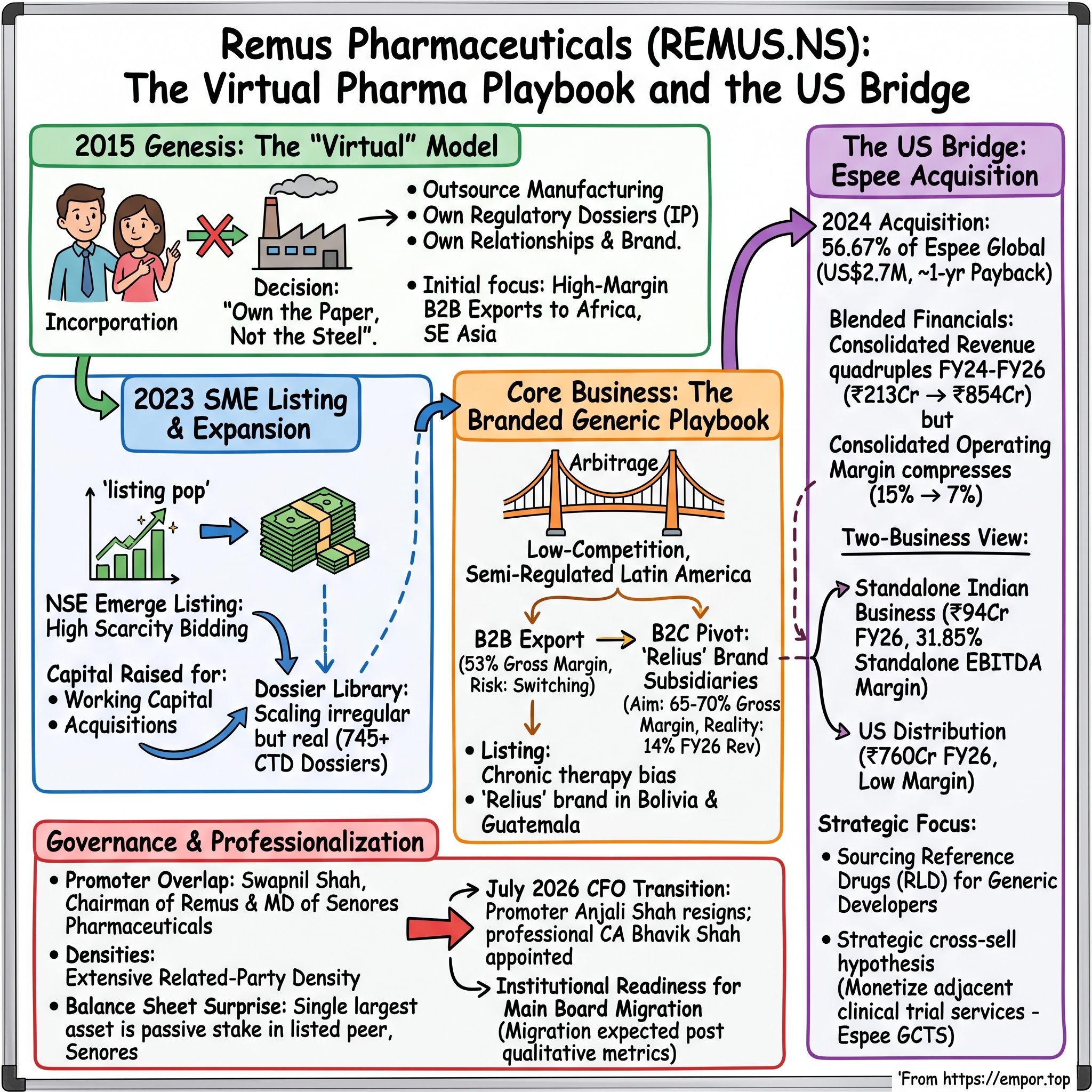
Remus Pharmaceuticals: The "Virtual" Pharma Playbook and the US Bridge
I. Introduction & Episode Roadmap
On the morning of July 9, 2026, a chartered accountant named Bhavik Shah walked into an office tower on Ambli-Bopal Road in Ahmedabad and took over the finance function of a company that, on paper, had just tripled its revenue in twenty-four months.11 The previous occupant of that chair, Anjali Shah, had resigned the day before.10 The handover was almost invisible to the market — two exchange filings, a few lines of Reuters copy, no analyst call, no press conference.
And yet the transition captured something essential about Remus Pharmaceuticals Limited at this exact moment: a company that had grown far faster than the machinery around it, now trying to fit itself with the plumbing of an institutional-grade business.
The paradox of the micro-cap
Start with the number that makes people stop scrolling. In the financial year ended March 2024, Remus reported consolidated revenue from operations of ₹212.94 crore. Two years later, for FY2026, it reported ₹853.63 crore — a fourfold increase in twenty-four months.24
Now look at what happened underneath. EBITDA over the same stretch went from ₹31.80 crore to ₹56.69 crore.24 Profit grew, but nowhere near as fast as the top line. Translate that into margin and you get the paradox: an operating margin of roughly 15% in FY2024 compressed to under 7% by FY2026.24 Revenue quadrupled; profitability per rupee of sales was cut in half.
For most companies, that pattern is an alarm. It usually means one of three things: the company bought growth by cutting price, it bought a bad business, or it started spending money it could not convert into profit. Each of those is a legitimate reason to be sceptical.
The core question
The bull answer is that none of those apply here — that this is arithmetic, not deterioration. That Remus bolted a very large, very low-margin American distribution business onto a small, very high-margin Indian export business, and the blended average simply moved toward the bigger number.
There is real evidence for that reading. In the second half of FY2026, on a standalone basis — meaning the original Indian formulation-export business alone — Remus reported an EBITDA margin of 31.85% and a net margin of 26.96%. On a consolidated basis, over the identical six months, those figures were 6.57% and 5.43%.1 Same company, same period, two completely different economic profiles.
So the question this story has to answer is not "why did margins fall." The arithmetic answer to that is straightforward. The real questions are harder: was buying that low-margin American business a clever, cheap way into the world's most valuable pharmaceutical market — or a top-line inflation exercise dressed up as strategy? And is the small, high-margin core actually compounding underneath, or is it being used as a decorative front for what is, in substance, a trading company?
Own the paper, not the steel
Remus belongs to a category that Indian pharma has quietly been producing for a decade: the virtual pharmaceutical company. It owns no drug factories. It does not run production lines, does not employ shift supervisors, does not fear a United States Food and Drug Administration inspector arriving unannounced at a plant gate, because there is no plant gate.
What it owns instead is paper — regulatory dossiers, product registrations, trademarks and brand names — and the relationships that turn paper into shelf space. Manufacturing is contracted out. As of the FY2026 call, management said Remus worked with roughly 34 approved manufacturers, of which around 20 were active, all of them in India.1
Managing director Arpit Shah has been unusually direct about defending this model against the obvious accusation. Pushed on the call by an analyst who suggested the entire return was "a trading return," he pushed back hard: "If this was a trading business, my gross margin wouldn't have been anywhere between 55% to 60%." He argued that registration takes six months to three years per product per country, that a single dossier runs 1,000 to 5,000 pages, and that "we are creating an infrastructure, which might not be asset visible."1 Whether that infrastructure is genuinely durable is the central investment question, and this story will test it rather than accept it.
The roadmap
What follows traces the arc: a 2015 incorporation in India's densest pharmaceutical cluster; a 2023 listing on the NSE Emerge small-company platform that arrived at the peak of India's SME IPO mania; the February 2024 purchase of a majority stake in an American reference-drug distributor for less than the price of a Mumbai apartment floor; the ongoing and expensive pivot from selling to importers to selling to patients in Bolivia and Guatemala; a governance structure with unusually deep entanglements with a second, larger listed pharmaceutical company; and a balance sheet whose single largest asset is not a factory or a dossier library but a block of shares in that other company.
It begins in a city where almost everyone else chose to build the factory.
 Subscribe on LinkedIn
II. The Genesis: The "Virtual" Pharma Model & Ahmedabad's Startup Ecosystem
Drive west out of Ahmedabad along the Sarkhej-Gandhinagar highway and the landscape tells you what this city does for a living. Zydus Lifesciences, Torrent Pharmaceuticals, Intas Pharmaceuticals — Gujarat's pharmaceutical dynasties are here, and behind their corporate campuses sprawl the industrial estates of Vatva, Odhav and Changodar, packed with the mid-sized contract manufacturers who actually make a large share of the medicine India exports to the world.
For a young entrepreneur in this city in 2015, the received wisdom was clear. You built a plant. You spent years and enormous capital getting it approved. Then you competed.
September 2015: the decision not to build
Remus Pharmaceuticals Limited was incorporated on September 21, 2015.7 Its founding directors — Arpit Deepakkumar Shah, Roma Vinodbhai Shah and Swapnil Jatinbhai Shah — were all appointed to the board on that date, with Anar Swapnil Shah joining in December 2020.2 The founding group was a family group: Arpit and Roma are spouses, as are Swapnil and Anar.2
They made an unusual choice for their neighbourhood. They decided not to build.
To understand why that mattered, consider what the conventional path actually costs. A generic formulation plant built to the standards required for a regulated export market is a multi-year capital project. It is not merely expensive to build; it is expensive to keep. Regulatory standards move. Equipment must be requalified. Data-integrity systems must be maintained continuously, not just before an inspection.
And then there is the tail risk that has defined Indian pharma's relationship with global regulators for fifteen years. An inspector arrives. Observations are issued. In the worst case, a warning letter or an import alert follows — and a facility that represented years of capital and the entire revenue base of a mid-sized company stops shipping to its most profitable market. The plant does not stop costing money. Only the revenue stops.
For a large diversified company, that is a bad year. For a startup with one plant, it is an extinction event. Operating leverage cuts both ways, and the second way is fatal.
What they built instead
The alternative Remus chose was to own the parts of the pharmaceutical value chain that are made of information and relationships rather than stainless steel.
The company's own description of its value chain runs in seven steps: track global therapy trends and patent expiries; identify high-margin off-patent molecules that fit a market gap; prepare and file dossiers through an in-house regulatory team; procure to global packing standards; outsource manufacturing to partners already approved by relevant regulators; export, either B2B to distributors who sell under their own brands or direct to Remus's own subsidiaries; and finally distribute, with dedicated field sales teams.2
Read that carefully and notice what is missing. There is no step called "manufacture." There is only "we outsource ready to market products from manufacturers who have already completed product development."2 Remus does not even necessarily commission the formulation work; where possible, it licenses products that a partner has already developed.
That is a genuinely different business. It converts the fixed-cost, high-operating-leverage economics of a factory into something closer to variable cost. It also, inescapably, means Remus's cost of goods is somebody else's revenue — which is why the interesting question about this model is always whether the value it adds downstream is large enough to justify the margin it gives up upstream.
The dossier as the asset
The central asset in this model is the dossier, and it is worth explaining in plain language because everything downstream depends on it.
Think of a dossier as a passport application for a drug. To sell a medicine in Peru, a company must submit to Peru's health authority a Common Technical Document containing the manufacturing process, the analytical methods, the stability data proving the drug survives the local climate, the packaging specifications, and where required, human bioequivalence data proving the generic behaves in the body like the original brand. Remus's own description of its process notes formulation must be customised to "regulatory and climatic zone requirements" — a tablet stable in a temperate warehouse may not be stable in tropical Central America.2
Compiling this takes months. Getting it approved takes longer — Arpit Shah put the range at six months to three years per product per country.1 And critically, the approval attaches to a specific product made at a specific site. It is not portable.
Which means two things at once. It is a barrier, because a competitor wanting to displace Remus in Bolivia cannot simply undercut on price; it has to spend two years getting registered first. And it is a liability, because the registration is chained to the contract manufacturer named in it — a point that returns later with some force.
By the FY2025 annual report, the company disclosed a regulatory affairs team of over 30 professionals, a claim of submitting more than 50 dossiers monthly, and 745-plus completed CTD dossiers ready to file.2 The registered-product count had climbed from 275 in 2021 to 622 by March 2025.2 Across all stages — filed, under process, and registered — the company put its total registration pipeline above 2,000, with Latin America alone accounting for 1,596.2
A note of caution on those figures, offered without accusation: the FY2025 annual report presents several different registration counts in different places — "620+ total registrations" in one summary panel, "2,000+" in the geographic breakdown, "745+ CTD dossier" in a third.2 They are measuring different things at different stages, but the report does not always define which. For investors, the useful discipline is to track the audited, narrowly defined number — commercialised products, which the same report put at 400-plus — rather than the largest headline available.2
The consultancy sideline
There is one more piece of the original model worth noting. Remus also provides technical consultancy to third-party distributors, helping them prepare reports on dossiers for products they intend to register in their own markets.2
It is a small line item, but strategically it is a clever one. A distributor who needs help getting a product registered is a distributor who tells you exactly what he is trying to sell, in which country, and where his regulatory gaps are. It is market intelligence that arrives wrapped in a fee.
The model was coherent. What it needed was capital — and in 2023, India's small-cap market was in a mood to provide it.
III. The SME Emerge Listing: Squeezing Value from Public Capital
In May 2023, India's SME IPO market was doing something close to a fever dream. Small companies with modest revenues were coming to market at prices that would have been unthinkable three years earlier, and being met by order books thirty, fifty, a hundred times the size of the offering.
Into this, on May 17, 2023, Remus Pharmaceuticals opened a book-built offer of 388,000 equity shares at a band of ₹1,150 to ₹1,229 per share, aiming to raise roughly ₹47.7 crore.7 The face value was ₹10. At the top of the band, that meant investors were being asked to pay nearly 123 times face value for a company most of them had never heard of.
The scramble
The issue closed on May 19. When the numbers came out, the overall book had been covered 57.21 times — with the high-net-worth and non-institutional tranche subscribed 229.31 times, retail 49.81 times, and the qualified institutional portion, notably, only 10.75 times.6
That spread is the most revealing statistic in the entire IPO. The institutional money was interested but measured. The HNI money — much of it leveraged, much of it playing for the listing pop rather than the decade — was in a frenzy. This was not the market carefully underwriting an asset-light pharmaceutical exporter. This was the market bidding for scarcity.
Shares were allotted on May 24 and listed on NSE Emerge on May 29, 2023, opening at ₹1,711.25 against the ₹1,229 issue price — a 39.24% listing gain.6
An investor evaluating Remus today should hold two thoughts about that debut simultaneously. First, it does say something real: the market genuinely was hungry for capital-efficient pharmaceutical exporters, and Remus was one. Second, and more soberly, a 57x-subscribed SME IPO in mid-2023 is weak evidence of business quality. Far worse companies achieved far better books that year. The IPO validated the moment, not the model.
What the money was for
The more informative document is the prospectus. At the time of listing, Remus described itself as marketing, distributing and exporting complex generics, with a portfolio of 429 products, agreements with 58 domestic and 139 international distributors, and access to 30 active contract manufacturing facilities as of January 31, 2023.7
The stated objects of the issue were working capital of ₹3,030.36 lakh — roughly ₹30 crore — plus funding for acquisitions and general corporate purposes, and issue expenses.7
Pause on that allocation, because it is the clearest early statement of what kind of company this intended to be. The single largest use of IPO proceeds was working capital. Not a plant. Not equipment. Not even, primarily, R&D. Working capital — the money required to buy finished product from a contract manufacturer, ship it across an ocean, and wait to be paid.
That is the honest economic signature of an asset-light distributor. Its balance sheet does not fill up with machines; it fills up with inventory and receivables. Every rupee of incremental sales requires a rupee of financing somewhere. A company like this does not have a capex problem. It has a cash-conversion-cycle problem, and it will have it forever.
The second object — funding acquisitions — turned out to matter enormously within nine months.
Building the library
Post-listing, the capital went where the model said it should. In FY2025, the company filed 170 new trademarks and obtained 35 approvals, launched more than ten off-patent niche products, secured registrations in eight new countries including Bosnia, Kosovo, Mexico, Tanzania, Azerbaijan, Mauritius, Bhutan and Cambodia, and began brand and marketing activations in Chile, Peru, the Dominican Republic, El Salvador, Myanmar, Ecuador, Kenya, Madagascar and Tanzania.2
The strategic logic of building a dossier library rather than a factory deserves to be stated precisely, because it is the crux of the bull case. Management's articulation is that a single dossier, once compiled, can be adapted for filing in multiple countries — "leveraging a single, cost-effective dossier for multi-country registrations."2 The development cost is largely borne once; the incremental cost of each additional country is the local adaptation and filing.
If that holds, it is a genuine scale economy — the marginal cost of the tenth country is meaningfully below the first. If it does not hold — if each market demands substantially different data, different stability zones, different local bioequivalence studies — then what looks like a compounding library is really just a long sequence of separate, full-cost projects.
The evidence in FY2026 pointed both ways. The company entered four new commercial markets (Myanmar, Nicaragua, North Macedonia and Madagascar) and cleared a manufacturing-site inspection by Peru's regulator DIGEMID in February 2026, after which management said it planned to file 60 products in three months with faster approval times.1 That is the reusable-dossier thesis working: one regulatory clearance unlocking a batch of filings.
But in the same call, management explained the year's margin compression partly by pointing at bioequivalence studies — human clinical work required for markets like Chile and Mexico that cannot be shared or reused.1 Arpit Shah was blunt that "any product bioequivalence study is not that cheap."1
So the honest reading is that the library scales, but unevenly. In the easier semi-regulated markets, dossier reuse is real. In the markets worth the most money, the toll gate is higher and must be paid per product. That is not a broken thesis, but it is a slower and more capital-hungry one than the headline suggests.
Which raises the obvious question: why go to those markets at all, when the world's largest pharmaceutical market was sitting right there?
IV. Core Business: The Branded Generic Playbook in Emerging Markets
There is a particular kind of arithmetic that governs generic drugs in the United States, and it explains why an Ahmedabad startup with no factory would look at the world's richest pharmaceutical market and walk the other way.
In the US generic market, approval is the beginning of a price war, not the end of one. Multiple approved players commoditise a molecule within quarters. Three enormous purchasing consortia control the bulk of buying. Price erosion in the high single digits annually is normal, and far worse is common. Winning an ANDA is expensive, slow, and frequently followed by discovering that the prize has evaporated.
Now consider Bolivia.
The semi-regulated arbitrage
Bolivia has a population of roughly twelve million, a national health system with real unmet need, and a drug-registration process that takes years and is completely unfamiliar to most global players. Nobody at a large multinational is building a Bolivian strategy. The market is too small to move their needle and too complicated to be worth the trouble.
That combination — meaningful demand, high administrative friction, low competitive interest — is what "semi-regulated" actually means as an investment proposition. The regulatory hurdle is high enough to keep competitors out, but not so high that a well-run small company cannot clear it. Approvals take longer, but once you are in, you are one of few. Price erosion is a fraction of what it is in the US.
Remus built its entire geographic strategy on this arbitrage. By FY2026, the company operated in more than 40 countries, with a distribution network spanning Latin America, Southeast Asia, the Middle East, the CIS, Africa and the Caribbean — through local distributors in 35-plus rest-of-world markets and direct subsidiaries in Bolivia and Guatemala.12
Latin America is the centre of gravity. Of the company's total registration pipeline, roughly four-fifths sat in South and Central America and the Caribbean, across Cuba, the Dominican Republic, Jamaica, Trinidad & Tobago, Costa Rica, El Salvador, Guatemala, Honduras, Nicaragua, Panama, Bolivia, Chile, Ecuador, Mexico, Peru, Suriname and Venezuela.2
The product selection follows the same logic — off-patent molecules with few competitors rather than commodity generics. The FY2026 launch list included Rifaximin and Fexofenadine in-licensed for Mexico, Chile and Peru; Rivastigmine patches supplied directly into Venezuela; Mirabegron and a Mirabegron-Solifenacin combination launched across four Latin American countries; and a Nicaraguan government tender for ceftazidime-avibactam, a specialised injectable antibiotic that management expects to recur every quarter or two.1
Notice the therapeutic bias. Central nervous system drugs — Brivaracetam, valproic acid, risperidone, lamotrigine — and urology. Arpit Shah explained the reasoning without dressing it up: CNS medications "are more or less for lifetime."1 Chronic therapy means a patient who takes your product this month takes it next month too. Recurring revenue, in a business that does not otherwise have any.
From selling to importers to selling to patients
For its first several years, Remus ran a pure B2B model: manufacture through a contract partner, ship to a local importer, and let that importer sell under his own brand.
It is a clean business. Overheads are trivial. Cash cycles are short. And it has one crushing structural flaw: you own nothing at the point of sale. The doctor prescribing the drug has never heard of Remus. The patient has never heard of Remus. The importer owns the brand, the relationship and the prescription habit — which means the importer, not Remus, captures the durable economics. If a cheaper supplier appears, the importer switches, and Remus's registration becomes worthless overnight.
The pivot to B2C was the decision to fix that, and it is by far the most consequential strategic choice the company has made outside the American acquisition.
Remus incorporated Relius Pharma S.R.L. in Bolivia on October 13, 2023, and Relius Pharmaceuticals LTDA in Guatemala on December 27, 2023, holding 99% of each.2 Under the Relius brand, the company began doing what a branded-generics company does: putting its own name on the box, hiring field sales representatives, and calling on doctors and pharmacies directly.
The FY2025 groundwork was granular and unglamorous. In Bolivia, ten-plus products launched through eight pharmacy chains, ten hospitals and three sub-distributors; a brand awareness conference with 55-plus doctors and pharmacy representatives; specialty events for gynaecologists, general practitioners and haematologists in Oruro; promotional work with the FarmaElías pharmacy chain.2 By FY2026, Relius Bolivia had launched 26 products, with roughly 40 more planned within two to three months, and the company had registered 126 brand names and trademarks for the B2C business in a single year.1
The margin mathematics, and why they cut both ways
Here is where the numbers become genuinely illuminating. The FY2025 annual report disclosed gross margins by business line: roughly 8% for the US distribution subsidiary, 53% for the traditional B2B export business, and an anticipated 65-70% for B2C.2
That is a very wide gap, and it explains the strategy completely. Selling the same tablet to a Bolivian pharmacy under your own brand rather than to a Bolivian importer under his is worth something like twelve to seventeen percentage points of gross margin.
But — and this is the part that gets lost in bullish retellings — gross margin is not operating margin. The reason the importer only captured a slice was that he was doing real work: warehousing, credit, field sales, regulatory maintenance, collections. Take his margin and you take his cost base. Field forces are expensive. Building brand recall in a country where nobody knows your name is expensive. Local subsidiaries carry overhead from day one and revenue considerably later.
Chief financial officer Anjali Shah acknowledged exactly this on the FY2026 call, noting that the newer subsidiaries "are still not 100% operational" and were "contributing to certain level of operational expenses until they start being fully operational."1
So the B2C pivot is not a free margin upgrade. It is a deliberate trade: spend now on people and brand, in exchange for pricing power and defensibility later. It is the correct trade if the brands stick. It is value destruction if they do not.
The Caplin Point comparison — and its uncomfortable implications
The obvious template is Caplin Point Laboratories, the Chennai company that spent two decades building exactly this kind of position in Central and South America — registering its own products with local regulators, holding inventory in-country, and supplying pharmacies and hospitals through its own distribution relationships across Guatemala, Nicaragua, Honduras, El Salvador, Ecuador, Colombia, Chile and Mexico.
The results are the reason anyone attempts this. In FY2026 Caplin reported revenue of ₹2,187 crore at an operating margin of 35% and net profit of ₹650 crore, with a market capitalisation around ₹20,253 crore as of late July 2026.15 Thirty-five percent operating margins in generic pharmaceuticals is not a commodity outcome. That is what a distribution moat looks like once it is built.
But the comparison is a double-edged sword, and intellectual honesty requires holding the sharp end.
Caplin has been in Latin America since the 1990s. Its position was built over roughly two decades, across currency collapses, political upheaval and payment crises. It also — importantly — vertically integrated backwards into manufacturing along the way, which is precisely the opposite of what Remus has chosen.
Remus incorporated its first Latin American subsidiary in late 2023. As of FY2026, B2C represented 14% of consolidated revenue.14 The playbook is genuinely the same. The elapsed time is not comparable. And crucially, nothing in Caplin's history suggests this can be done quickly.
The first test of management's word
Which brings us to the most useful governance datapoint in this section — one that comes from comparing what management said a year ago against what it delivered.
In the FY2025 annual report, Arpit Shah wrote to shareholders that the Relius B2C brand "is expected to contribute 20-25% of revenue in the current year." The strategy section of the same report repeated the target: "aiming for 20-25% of revenue from B2C by year-end."2
On the FY2026 call, two separate participants raised it directly. Arpit Shah's explanation was that product launches expected in the first quarter were delayed by "political and geographical mishappenings," that the launches were "delayed, not cancelled," and that travel restrictions had prevented his team from executing launches properly.1 When an analyst from Sapphire Capital pressed him — pointing out that the geopolitical situation still persisted — he answered that access had improved, that he had personally returned from the market the previous week, and that "we've been only delayed on a month or two, nothing beyond that."1
He also offered a second, more candid reason: the B2C share is a ratio, and the denominator grew. "We are comparing this with the total revenue. So, on our B2B, we've increased our share of sales a little. So, that also would give us a slightly lower on the B2C."1
How should an investor score this? It is a real miss — roughly a third short of the low end of a target management set publicly and in writing. But it is a miss that was acknowledged directly, explained with specifics rather than deflection, and answered with a concrete forward plan (26 products launched, 40 more queued). Management did not pretend the target had never existed.
The caution is the forward number. Having missed 20-25% for FY2026, management guided on the same call to B2C growing "at least 30%" in FY2027.1 That is a re-acceleration promise made immediately after a shortfall, which is precisely the pattern that deserves tracking rather than trust. The FY2027 result will be the cleanest read available on whether this management team sets targets it can hit.
The B2C build was one of two big bets. The other one arrived from a completely different direction, and it changed what Remus looked like on a spreadsheet entirely.
V. The US Bridge: Demystifying the Espee Global Acquisition
On February 7, 2024, the Remus board met and approved a definitive agreement that would, within a year, account for the overwhelming majority of the company's reported revenue. The consideration was US$2.7 million.5
To put that in perspective: at the exchange rates of the time, Remus had agreed to pay roughly ₹22 crore — less than half of what it had raised in its IPO nine months earlier — for control of a business with a revenue line larger than its own by an order of magnitude.
The structure and the numbers
The mechanics were slightly convoluted, and worth getting exactly right. Remus acquired a 56.67% membership interest in Espee Global Holdings LLC, a US holding company incorporated on August 21, 2013. EGHL in turn held the operating business, Espee Biopharma & Finechem LLC, incorporated on April 21, 2009. By taking 56.67% of the holding company, Remus indirectly acquired 51% of the operating company — which means EGHL owned roughly 90% of EBFL. Both became Remus subsidiaries, effective January 1, 2024.52
The turnover history disclosed in the filing was the striking part. EBFL had revenues of US$42.38 million in 2020, US$45.80 million in 2021, and US$50.43 million in 2022. The holding company itself had nil turnover across all three years — it was purely a holding vehicle.5
So: a business doing over fifty million dollars of annual revenue, majority control acquired for 2.7 million dollars, in cash.5 That is a transaction price that implies the market was valuing this revenue at a small fraction of one times sales.
The instinctive reaction is that something must be wrong with it. That instinct is half right, and understanding which half is the key to the whole story.
What Espee actually does
Espee sits in one of the more obscure and structurally interesting niches in the global pharmaceutical supply chain: sourcing reference listed drugs.
Explain it from first principles. Before a generic version of a drug can be approved anywhere in the world, the developer must prove that its copy behaves in the human body the same way the original brand does. That proof requires a bioequivalence study, and a bioequivalence study requires physical quantities of the original branded drug — the reference listed drug, or RLD — to test against.
Here is the awkward part. The company that must supply that reference drug is, by definition, the company whose market the generic developer is about to attack.
Innovators have every commercial incentive not to help, and a range of mechanisms available. Some simply refuse to sell to generic developers or attach burdensome conditions. Others limit pharmacy and wholesaler sales of samples for development purposes. And for a subset of drugs, the FDA itself mandates a Risk Evaluation and Mitigation Strategy with Elements to Assure Safe Use — a closed distribution system built for patient safety, but one that some sponsors have argued prevents them from sharing samples with generic developers.14
The problem became prominent enough that in May 2018 the FDA began publishing a public list of RLD access inquiries, naming the sponsors who had received requests — an explicit attempt to apply public pressure. The initial list contained 52 products.14 The underlying law is clear that a REMS cannot be used to block or delay a generic approval, and the FDA can issue Safety Determination Letters to that effect. But the practical friction remains substantial.14
The consequence is a chain of dependency with a hard link at the front: no samples, no bioequivalence study; no study, no application; no application, no generic drug.14
That friction is Espee's business. It sources reference and comparator drugs — directly from manufacturers or through an established supplier network, with attention to extended expiry dates and sequential lot availability — and supplies them to innovators, multinational generic manufacturers, contract research organisations and government entities across more than 25 countries.13 The Remus annual report described Espee as one of the largest RLD distributors, serving over 300 customers across 30-plus countries through an FDA-approved facility.2 The company also operates USFDA- and DEA-approved warehouse capability, the latter mattering for controlled substances.13
Myth versus reality: the "sub-1% margin trading shell"
The consensus shorthand on this acquisition — repeated widely enough to have become received wisdom — is that Espee is a razor-thin trading operation with net margins under one percent, and that Remus bought a revenue line rather than a business.
The audited numbers do not support that.
The FY2025 annual report's subsidiary disclosure showed Espee Global Holdings with turnover of ₹541.84 crore, profit before tax of ₹20.21 crore, and profit after tax of ₹18.03 crore for the year, against total assets of ₹170.83 crore.2 That is a net margin above three percent — thin by pharmaceutical standards, certainly, but roughly triple the sub-1% figure in circulation, and unambiguously profitable.
The gross margin disclosure tells a similar story: approximately 8% for the US distribution business.2 Low, but not a rounding error.
Now run the return arithmetic that actually matters. Remus paid US$2.7 million for 56.67% of a holding company that, in the first full financial year of ownership, generated ₹18.03 crore of after-tax profit at the subsidiary level.52 Even attributing only the majority share to Remus, the acquisition appears to have paid back its purchase price within roughly its first year.
Management has said explicitly that this is how they think about it. The FY2025 annual report stated that Espee's contribution "is viewed strategically in terms of Return on Equity (ROE) rather than solely its immediate EBITDA margins."2
That framing is self-serving, but on the arithmetic it is also defensible. A business bought at a fraction of one year's profit is a good outcome for shareholders almost regardless of its margin profile. The margin dilution is real; it is also, in isolation, the wrong lens.
Why was it cheap, then? Most plausibly for the reasons low-margin distribution businesses are always cheap: the earnings are volume-dependent and hard to scale without proportional working capital, the business is dependent on relationships rather than protected assets, and there is no obvious strategic buyer who wants a specialty US distributor at a premium. A three-percent net margin on fifty million dollars is a decent living for a private owner and a difficult sell to a public-market acquirer. Remus was the buyer for whom the fit was unusual.
The consolidation effect
The financial consequence was immediate and dramatic. Consolidated FY2024 revenue already included one quarter of Espee following the January 1, 2024 effective date.25 By FY2025, with a full year consolidated, Espee's ₹541.84 crore made up the overwhelming majority of the group's ₹620.36 crore.2
The clearest way to see what Remus actually is arrived with the FY2026 numbers. Standalone revenue — the Indian formulation-export business alone — was approximately ₹94 crore for the full year, with standalone net profit around ₹25 crore.8 Consolidated revenue was ₹853.63 crore with consolidated net profit of ₹46.17 crore, of which ₹37 crore was attributable to Remus shareholders after minority interests.14
So the group is, in substance, two businesses: a roughly ₹94 crore Indian export operation earning something close to a 27% net margin, and a roughly ₹760 crore American distribution operation earning low single digits.184 Averaged together, they produce a consolidated margin that describes neither.
Anjali Shah, on her final earnings call as CFO, put the analytical framing plainly: consolidated and standalone "is something that needs to be look at it from a different eye," because the consolidated numbers absorb a pure distribution business.1 Arpit Shah added that the US business "is basically a higher volume, lower margin business."1
They are right on the mechanics. The obligation that follows, though, is disclosure — and that obligation is not yet fully met. Investors currently reconstruct the segment picture from subsidiary schedules published once a year, several months after the fact, alongside half-yearly standalone results. There is no clean, regularly published segment-level EBITDA disclosure. For a group whose entire investment case rests on the difference between two businesses, that gap matters.
Is it a bridge, or is it a billboard?
Which leaves the strategic question. Did Remus buy Espee because it wanted a genuine foothold in the American pharmaceutical ecosystem — or because a ₹540 crore revenue line looks impressive on a company that would otherwise report ₹79 crore?
The cynical reading has teeth. Migrating from the NSE SME platform to the main board requires, among other things, revenue above a threshold and a track record of operating profit.18 A single acquisition that multiplies reported revenue eightfold is, at minimum, extremely convenient timing.
But the evidence for the strategic reading has accumulated since, and it is more interesting than the cynical one.
Consider who Espee's customers are. They are generic developers and CROs — precisely the population that files dossiers, runs bioequivalence studies, and needs manufacturing and regulatory partners. Espee is not a warehouse; it is a Rolodex of the global generic development community, with a commercial relationship already established.
The first concrete evidence of Remus attempting to monetise that adjacency came in July 2025, with the incorporation of Espee Global Clinical Trial Services Private Limited in Ahmedabad. It offers integrated clinical trial supply management — comparator sourcing, secondary packaging and labelling, storage, distribution, and returns, reconciliation and destruction.139
This is a meaningful move, and worth understanding. It takes Espee's existing core competence — obtaining hard-to-get drugs — and extends it into higher-value adjacent services, executed from India where the cost base is a fraction of the American one. Anjali Shah described it on the call as "a service distribution arm" expected to contribute partially in FY2027 and on a full basis from the following year.1
If it works, it converts an 8%-gross-margin logistics business into something with a services margin attached. That is genuine value creation, not financial engineering.
There is also early evidence of the reverse flow — sourcing capability being used to serve the Indian business. In FY2026, Remus in-licensed Peg-filgrastim and Filgrastim pre-filled syringes for the Philippines and Vietnam markets, manufactured in the United States. When an analyst from Suyash Advisors questioned whether US-manufactured biosimilars could possibly be economic in Southeast Asia, Arpit Shah's answer was specific: government buyers pay less, but B2C channels pay more, and the blend works — plus "always the government has this preference that they will buy a product which is U.S. approved even at a 2x price."1
That is a coherent answer, not a deflection. Whether it proves out commercially is unresolved.
The honest verdict at this point is that the acquisition was financially excellent and strategically unproven. The purchase price was recovered fast. The margin dilution is arithmetic rather than deterioration. But the "bridge" — the thesis that American relationships will pull Indian formulations into higher-value markets — remains a hypothesis with two early datapoints and no revenue yet attributable to it.
The people responsible for proving it out changed in July 2026.
VI. Corporate Governance & Professionalization: The July 2026 CFO Transition
Every family business that goes public eventually confronts the same question: at what point does the family stop being the company's greatest asset and start being its ceiling?
Remus reached a version of that question this month.
The promoter reality
The Shah family controls Remus comprehensively. As of March 2026, promoters held 70.95% of the equity, with foreign institutional investors at 5.28%, domestic institutions at 0.83%, and the public at 22.93%.3
The board reflects that concentration. Arpit Shah serves as managing director; Roma Shah as whole-time director, with a specialisation in regulatory affairs, R&D and technical quality that the annual report credits directly for the company's compliance record; Swapnil Shah as chairman and non-executive non-independent director; and Anar Shah, a dental surgeon by training who focuses on human resources and organisational culture, as a non-executive non-independent director.2 Three independent directors — Vishrut Pathak, Sanjana Shah and Balwant Purohit — complete the board.2
For FY2025, the four family directors drew remuneration of ₹2.07 crore, ₹1.10 crore, ₹1.35 crore and ₹0.80 crore respectively — approximately ₹5.3 crore in aggregate against consolidated net profit of ₹38.42 crore.2 Each held approximately ten lakh shares individually.2
The alignment is genuine — this family's wealth is overwhelmingly in this stock. The concentration is also genuine, and it means minority shareholders are, in practice, passengers on decisions the family makes.
The overlap that deserves attention
There is a structural feature here that is more material than the CFO change, and it receives far less attention.
Swapnil Shah, chairman of Remus, is also managing director of Senores Pharmaceuticals Limited — a separate, larger, NSE main-board-listed pharmaceutical company.2 Arpit Shah is a director of Senores Pharmaceuticals Limited as well, along with Havix Group Inc. (doing business as Aavis Pharmaceuticals), Senores Pharmaceuticals Inc. and Renosen Ventures Inc.2 Both men sit on Senores board committees.2
Senores is not a small company. In FY2026 it reported revenue of ₹633 crore and net profit of ₹122 crore, with a market capitalisation around ₹6,048 crore and a share price of ₹1,313 as of July 28, 2026 — roughly seven times the size of Remus by market value.16
And Remus owns a piece of it. The FY2025 balance sheet disclosed 3,261,744 equity shares of Senores Pharmaceuticals, carried at fair value through other comprehensive income at ₹186.12 crore as of March 31, 2025 — up from ₹104.38 crore a year earlier.2
Sit with that number. As of the last audited disclosure, a passive equity stake in a related listed company was carried at ₹186.12 crore, against a total company net worth of ₹242.22 crore.2 The single largest asset on Remus's balance sheet was not its dossier library, its inventory or its subsidiaries. It was shares in another company run by its own chairman.
The accounting consequence is significant and easy to miss. In FY2025, Remus reported other comprehensive income of ₹70.13 crore — nearly double its ₹38.42 crore of net profit for the year.2 That OCI was overwhelmingly unrealised mark-to-market gain on the Senores holding. It flows to net worth without touching the profit and loss account, which is exactly why the company's own ratio disclosures showed return on equity falling from 19.26% to 10.06% and return on capital employed from 14.64% to 11.06%, both explained in the report as arising from "substantial Increase in fair valuation of Financial Instruments held by the company."2
In plain terms: the returns look worse because the denominator inflated with an asset that has nothing to do with operations. Reported ROE on this balance sheet is not a measure of how well the operating business converts capital into profit, and should not be read as one.
The related-party schedule reinforces the picture of an interconnected group. FY2025 disclosed purchases of goods from Ratnatris Pharmaceuticals Private Limited of ₹7.74 crore, from Senores Pharmaceuticals of ₹0.60 crore, from Havix Group Inc. of ₹0.30 crore and Renosen Pharmaceuticals of ₹0.18 crore, alongside rent paid to Aelius Projects LLP of ₹0.38 crore and interest income from related entities.2 Individually, these are modest. Collectively, they describe a company operating inside a promoter ecosystem rather than at arm's length from one.
None of this is improper, and all of it is disclosed. But it is a legitimate and material governance consideration, and it is far less discussed than the CFO change.
July 2026: the handover
Against that backdrop, the finance transition. Anjali Shah resigned as chief financial officer effective July 8, 2026, citing the pursuit of other professional opportunities.1012 The board, at its meeting on June 23, 2026, approved the appointment of Bhavik Shah as her successor, effective July 9, 2026.1112
The incoming CFO is a chartered accountant and commerce graduate with over twenty years of experience across finance, accounts, treasury and taxation, with disclosed expertise in financial reporting under both Ind AS and IFRS, business planning, working capital management and ERP implementation, and prior leadership roles in healthcare and pharmaceutical organisations.1112
That skill list reads like a job description written backwards from the company's actual problems.
Dual-standard reporting matters because Remus consolidates American and Latin American subsidiaries and voluntarily adopted Ind AS from April 1, 2024, restating FY2024 in the process.2 Working capital management matters because it is, as the previous section established, the defining constraint of the entire business model. ERP implementation matters because a group with subsidiaries reporting in Bolivian bolivianos, US dollars and Guatemalan quetzals cannot be run on spreadsheets.2
Reading the signal without over-reading it
The tempting interpretation is that replacing a promoter-family CFO with a career finance professional is a clean institutional-grade upgrade.
That reading is probably directionally right, but it requires two caveats.
First, Anjali Shah was not a passive figure. Reviewing her contributions to the FY2026 call, her answers on working capital were among the most specific and least defensive in the transcript. Asked why operating cash flow was weak despite strong profit growth, she gave a mechanical explanation — that the RLD business requires holding inventory on behalf of customers who ship in parts against a single large order, that this ties up cash at the March year-end and unwinds through April and May, and that it is "a cyclical impact, but it stays at that level with the increase in turnover."1 Asked about debtor days, she conceded they had increased and pointed to a specific policy — advances of 25% to 50% in most cases — as the mitigation.1 That is a CFO answering the question asked. The departure is a change, not obviously an upgrade in candour.
Second, the departure was announced without a stated business reason beyond the standard formula, and without a transition period — the resignation took effect one day before the successor started.1011 That is not alarming on its own, but it is abrupt for a company mid-way through the institutional build-out that management has described.
The path to the main board
The strategic context for all of this is the migration from NSE Emerge to the NSE Main Board.
The economics of that move are straightforward. SME platform stocks carry large minimum lot sizes, thin liquidity, and are effectively off-limits to most institutional mandates. Main board listing removes those constraints. For a company with 70.95% promoter holding and a modest free float, it is the single most obvious re-rating catalyst available.3
The NSE revised its migration eligibility criteria effective from May 2025, requiring among other things a minimum paid-up equity capital, a minimum average market capitalisation, revenue from operations above a threshold in the last financial year, and positive operating profit in at least two of the last three financial years.18 On the reported numbers, Remus appears to clear the financial hurdles comfortably — which makes the qualitative requirements the binding constraint.
That is the honest way to interpret the last two years of corporate activity: the ERP implementation, the professional CFO, the appointment of Sharp & Tannan as internal auditors for FY2026, the regular half-yearly earnings calls with a dedicated investor relations agency.1 These are the components of institutional readiness.
But investors should be precise about one thing. As of this writing, Remus has not announced a formal application for main board migration. Management did not discuss migration on the FY2026 call.1 Every piece of evidence pointing toward it is circumstantial — a coherent circumstantial case, but circumstantial nonetheless. Treating migration as scheduled would be an assumption, not a fact.
Governance sets the frame. The next question is whether the business inside that frame can actually defend itself.
VII. Competitive Landscape & Porter's Five Forces
Picture the competitive map from a Bolivian pharmacist's counter. On the shelf sit products from local Bolivian manufacturers, a few multinational brands at premium prices, Indian generics arriving through three or four importers, and now boxes marked Relius. The pharmacist's decision is driven by what the prescribing doctor wrote, what margin the distributor offers, and whether the product will actually be in stock next month.
That is the real competitive arena. Not a spreadsheet — a counter.
Threat of new entrants: genuinely low, but for boring reasons
The barrier protecting Remus is administrative rather than technological, and it is more effective than it sounds.
A competitor who decides tomorrow to enter Bolivia with a competing CNS product cannot simply undercut on price. It must first identify a contract manufacturer, verify the site, compile a Common Technical Document, submit it to the Bolivian authority, respond to deficiency queries, and wait. Arpit Shah's stated range of six months to three years per product per country is consistent with the general experience of Latin American registration.1
Meanwhile Remus, with 745-plus completed dossiers ready to file, can move faster into an adjacent country than a new entrant can move into its first.2
But the barrier's nature should be understood precisely: it is a time barrier, not a permanent one. It delays competitors; it does not exclude them. And it protects Remus only where Remus got there first — which is why management's stated objective of entering five or more new markets annually and securing first-mover positions in niche molecules is not marketing language but the actual operating requirement of the model.2
Bargaining power of buyers: split, and asymmetric
Remus faces three completely different buyer types, with three different power profiles.
In the B2B export business, the buyer is a local importer-distributor. His power is moderate and structurally awkward: he can switch suppliers, but not instantly, because the registration is tied to a specific product-and-site combination. This is the switching cost that makes B2B tolerable rather than commoditised.
In institutional tenders — the Nicaraguan ceftazidime-avibactam order, the NUPCO tender for Topiramate capsules in Saudi Arabia, the anti-TB tender in North Macedonia, the multi-country Ondansetron agreement across five African countries — the buyer is a government, and government buyer power is high.1 Tenders are price-driven and periodic. The offsetting factor is technical qualification: for specialised injectables with few qualified suppliers, the field of bidders is small.
In B2C, buyer power is lowest and this is the entire point of the pivot. A doctor who has prescribed a chronic CNS medication for a year, to a patient stabilised on it, is a genuinely sticky relationship.
In the American RLD business, buyer power is high. CROs and generic developers are sophisticated, price-aware, and buying an input to their own cost base. That is precisely why the gross margin sits at roughly 8%.2
Bargaining power of suppliers: the model's real vulnerability
This is where the asset-light model exacts its price, and it deserves more weight than it usually receives.
Remus does not own a single manufacturing site. Every product it sells is made by somebody else — around 34 approved manufacturers, roughly 20 active, and as of the FY2026 call, all of them in India.1
The dependency has three distinct edges.
First, margin. The contract manufacturer captures the manufacturing profit. Remus's gross margins are what remain after somebody else has taken theirs.
Second, capacity. When a contract manufacturer is running full, its own products come first. Remus's stated mitigation is a diverse network and rigorous site selection to reduce reliance on any single manufacturer.2
Third, and most seriously, compliance — which is the subject of the risk section.
There is one further supplier note worth flagging: the FY2026 concentration disclosure is not encouraging on diversification of geography. All active manufacturing is in India. Management said it was in agreements and discussions with partners outside India, but limited to First-World-manufactured products, products not made in India, and biologicals or biosimilars.1 For a company selling to 40-plus countries, single-country manufacturing concentration is a real exposure.
Threat of substitutes: low, and legitimately so
Off-patent medicines for chronic conditions are among the most substitution-resistant products in commerce. A patient on an anticoagulant does not defer the purchase. There is no technological disruption on the horizon for a Rivaroxaban tablet.
The nuance is that substitution within the category is intense — another company's Rivaroxaban is a perfect substitute in chemistry, if not in the prescriber's habit. Which returns, again, to brand: the only thing standing between Remus and pure commodity competition in its core products is whether Relius means anything to the doctor writing the script.
Competitive rivalry: high, and getting more crowded
The competitive set is real and improving. Caplin Point is the mature version of this strategy, with the margin structure to prove it.15 Numerous Indian mid-cap formulation exporters chase the same semi-regulated geographies. Local Latin American manufacturers have home-market advantages in cost, regulatory familiarity and government relationships.
The comparison that should keep investors honest is scale. Caplin's FY2026 revenue was roughly 23 times Remus's standalone revenue, at an operating margin roughly comparable to Remus's standalone level but on a vastly larger base.158 Remus is not currently competing with Caplin. It is attempting, roughly two decades later, to walk a path Caplin has already walked.
Helmer's 7 Powers: what Remus has, and what it does not
Applying Hamilton Helmer's framework honestly produces a short list of real powers and a longer list of aspirational ones.
Scale economies — partial and conditional. The dossier library is a genuine fixed-cost asset amortised across countries where filings are reusable. But the bioequivalence-study requirement in higher-value markets breaks reusability precisely where the money is best.1 This is a real but incomplete power.
Switching costs — real, and the strongest current power. A distributor who has registered a Remus product as his official import source faces a multi-year re-registration to switch. A prescriber who has stabilised chronic patients on a brand faces clinical inertia. Both are genuine.1
Counter-positioning — arguably present. Remus's refusal to own factories is a business-model choice that incumbent manufacturers cannot easily copy, because their existing asset base is the thing they would have to abandon. Arpit Shah made this argument explicitly on the call, invoking Eris Lifesciences as a company that built substantial value pre-listing without a single manufacturing site.1 Whether counter-positioning holds depends on whether the manufacturing-free model is genuinely superior or merely cheaper to start.
Branding — under construction, unproven. 126 brand names and trademarks registered in FY2026 is input, not output.1 Brand power will be visible in pricing and repeat prescription, not in trademark counts.
Cornered resource, network economies, process power — not evident. There is no proprietary molecule, no user network, and no manufacturing process advantage, because there is no manufacturing.
The blunt summary: Remus today has switching costs and a partial scale economy in regulatory paperwork. Everything else in the moat narrative is a work in progress. That is not a disqualification — it is a stage of development. But it means the durability of the business is currently thinner than the strategy documents suggest.
Thin moats become dangerous when something goes wrong, and there are several specific ways this business can go wrong.
VIII. Risk Radar & Activist Stress Test
Imagine a phone call to Ahmedabad on an ordinary Tuesday. A WHO-GMP audit at a contract manufacturing site in Gujarat has gone badly. The site is not owned by Remus, its employees are not Remus employees, and Remus was not in the room.
But dozens of Remus registrations in a dozen countries name that site as the manufacturer.
The CMO audit risk
This is the sharpest specific risk in the model, and it follows directly from the structure of a dossier.
When a health authority approves a product, it approves a product made in a specific way at a specific place. The site is written into the registration. If that site loses its certification, every registration naming it is compromised — not because the regulator is punishing Remus, but because the approved manufacturing arrangement no longer exists.
Recovering means qualifying an alternative site, generating fresh stability data, and filing variations in every affected country — a process measured in quarters, during which the affected products cannot ship.
The company acknowledges the exposure and describes its mitigation as a diverse network of over 30 manufacturing partners, rigorous CDMO/CMO site selection based on required accreditations, and multi-step quality checks including in-process quality control, batch testing, stability studies, visual inspections, lab testing and packaging integrity verification.2
That is a reasonable answer, and Roma Shah's regulatory background provides some assurance that quality oversight is taken seriously at board level.2 But it is worth being clear about what the mitigation can and cannot do. Diversification limits the damage from any one failure. It does not prevent one. And because Remus is a customer rather than an owner, its control over the quality systems of these sites is influence, not authority.
A useful way to think about it: the asset-light model does not eliminate manufacturing risk. It converts an owned, controllable, insurable risk into a distributed, less controllable, uninsurable one. That is arguably a better trade. It is not the absence of a trade.
Working capital: the constraint that defines everything
This was the most probing line of questioning on the FY2026 call, and management's answers were more revealing than the prepared remarks.
Despite consolidated net profit of ₹46.17 crore, consolidated operating cash flow was approximately ₹18 crore, with free cash flow of roughly ₹4 crore.134 An individual investor named Jayveer Thakur put the question directly: strong PAT growth, weak operating cash flow.
Anjali Shah's explanation was mechanical and specific. The RLD distribution model requires holding inventory on behalf of customers — a million-dollar order is placed, and the customer draws it down in parts as studies proceed at different times and locations. Cash is therefore tied up at the March year-end and released in April and May. Her characterisation: cyclical, but structurally persistent, and scaling with turnover.1
On standalone operating cash flow — the Indian business alone — she cited approximately ₹25 crore, and described standalone working capital investment as "very nominal."1
That distinction is important and largely credible. The Indian export business appears to convert profit to cash reasonably. The cash absorption sits in the American distribution business, and it is structural rather than accidental.
But the analytical implication is uncomfortable for the growth story. If working capital scales with turnover in the RLD business, then every rupee of growth there consumes cash. Growth in that segment is not self-funding. Screener data indicates borrowings rose from ₹14 crore in FY2024 to ₹27 crore in FY2026 — still modest, but moving in one direction while the business scales.3
The receivables picture is more encouraging than the headline suggests. Debtor days improved from 198 in FY2024 to approximately 60 in FY2026, with inventory days around 35 and a cash conversion cycle near 58 days.3 That is a substantial improvement, and it undercuts the simplest bear case — that this is a company booking revenue it cannot collect.
Management's stated policy is advances of 25% to 50% in most cases, and Arpit Shah described Venezuelan business as done entirely on an advance basis, with production, filing and trademark registration commencing only after partner advances are received.1 That is disciplined commercial practice for a genuinely difficult market.
Anjali Shah did concede on her final call that debtor days "have increased a bit" because of geopolitical conditions in the final month of the financial year.1 The direction of travel over three years is good; the most recent quarter was not.
The integration trap
The strategic risk is that the bridge is never crossed.
If Espee remains, in five years, an 8%-gross-margin logistics business with no cross-sell of Remus formulations into higher-value markets, then Remus has bought a permanently margin-diluting asset. It would still have been a good financial acquisition — the payback arithmetic is what it is — but it would be a distraction from the compounding story rather than a contributor to it.
The Espee Global Clinical Trial Services launch is the first real test.139 Management has said it expects partial contribution in FY2027 and full contribution the year after.1 That timeline is specific enough to be scored against, which is exactly what investors should do.
Currency, geopolitics, and the awkward reality of the customer base
Remus's exposure map includes Venezuela, Bolivia, Ecuador, Nicaragua, Myanmar and various African markets — a list that is, frankly, a catalogue of currency and political risk.
An analyst raised this directly. Arpit Shah's response emphasised advance payment terms, subsidiary presence in Bolivia providing control over collections, and improving Venezuelan conditions, noting changes at the Ministry of Health level and dollar appreciation.1 He stated that the company had not experienced problems receiving inward payments.1
The candid assessment is that these controls are sensible and appear to be working, but they are commercial mitigations against sovereign-level risks. Advance payment protects against a slow payer. It does not protect against a market closing.
The FY2026 B2C shortfall is the proof. Launches were delayed by conditions entirely outside management's control, and no amount of payment discipline would have changed that.1
There is a second-order supply chain point worth noting. Around 30-35% of shipments move by sea and the balance by air, with transport cost generally borne by the buyer, and CIF shipments priced with a cushion for freight volatility.1 Air freight for the majority of volume is expensive but appropriate for high-value, temperature-sensitive product, and the cost pass-through is a genuine insulation from freight inflation.
The activist stress test
What would a sceptical investor with a large position and a loud voice actually attack?
The Senores holding. The first and hardest question: why does an operating pharmaceutical company hold a passive equity stake in a related listed company carried at ₹186.12 crore as of March 2025 — an amount representing the majority of its net worth?2 With Senores having re-rated substantially, that holding may now represent a very large fraction of Remus's own ₹850 crore market capitalisation.168 An activist would ask: is this an investment or an entanglement? Is it capital that should be deployed in the operating business, or returned? And is Remus, in substance, partly a holding vehicle for a stake in a company run by its own chairman? The FY2026 annual report will disclose the current carrying value, and that disclosure is worth waiting for.
Segment disclosure. For a group whose margin profile is entirely a mix question, the absence of regularly published segment-level EBITDA is a real deficiency. An activist would demand it, and would be right to.
Related-party density. Purchases from at least four related entities, rent to a promoter LLP, guarantees and interest income across the group.2 Each is small and disclosed. In aggregate they describe a company that transacts extensively inside a family ecosystem, and each such transaction is a place where value can leak without any single item being large enough to notice.
Auditor scale. The statutory auditor is Pankaj R. Shah & Associates, an Ahmedabad firm.2 There is no evidence of any audit issue, and no qualifications were reported.2 But a company consolidating US and Latin American subsidiaries and reporting nearly ₹854 crore of revenue is a large engagement, and an institutional investor pressing for main-board readiness would raise the question.
Target-setting discipline. The 20-25% B2C guidance versus 14% delivered is a documented miss.21 It was explained rather than buried, which counts for something. The FY2027 guidance is the test of whether it was an aberration.
Small compliance items. In June 2026, Espee Biopharma & Finechem received a penalty notice from the Internal Revenue Service for US$14,247.38 relating to alleged non-payment of tax and late filing. The company contested it, stating the tax had already been paid, and confirmed no material impact.17 The amount is immaterial. The signal — administrative friction in a newly acquired foreign subsidiary — is a minor but legitimate note on integration maturity.
Set against all of that, what would a bull say?
IX. Bull vs. Bear Case & Key KPIs
The two cases for Remus rest on the same set of facts. They differ entirely on which business you believe is the real one.
The bull case
The Caplin Point 2.0 scenario. The core argument is that the standalone Indian business — approximately ₹94 crore of revenue at roughly 27% net margin in FY2026 — is a genuinely excellent small business currently obscured by consolidation.81 If B2C climbs from 14% toward management's stated ambitions at 65-70% gross margin, and if the Bolivian and Guatemalan brand-building holds, the standalone margin profile improves further from an already strong base.21
The evidence supporting this is not merely narrative. Standalone revenue has grown from ₹45 crore in FY2023 to ₹64 crore, ₹79 crore and ₹94 crore in the years since — compounding at a strong rate without acquisitions.8 Standalone half-yearly EBITDA margins have held in the low thirties.81 This part of the business is working.
The disclosure catalyst. A significant part of the bull case is not operational at all. It is that the market is currently pricing a blended 7% margin business, when the group is arguably a 27% margin business with a large low-margin distribution operation attached that was acquired for a fraction of one year's profit.152 Better segment disclosure, a main-board migration, or simply broader analyst coverage could close the gap between how the group reports and how it actually earns.
The US bridge monetisation. If Espee Global Clinical Trial Services scales, it converts an 8%-gross-margin logistics operation into a services business at Indian cost with American customer relationships.132 The comparator sourcing problem it addresses is structural and unlikely to disappear.14
Balance sheet capacity. The company reported a net debt-to-equity ratio of 0.05 in FY2025 and remains close to debt-free.23 It has the capacity to fund B2C expansion without a dilutive raise — and, separately, holds a highly liquid listed equity stake that could in principle be monetised.2
The bear case
The margin trap. If Espee grows in line with, or faster than, the standalone business — and management has guided to stable growth with "margins will sustain" — the consolidated margin stays in the 5-7% band indefinitely.1 The market may simply refuse to look through the consolidation, and it would not be irrational to decline: consolidated numbers are what shareholders own.
B2C is harder and slower than promised. The FY2026 shortfall is the base case for scepticism, not an outlier.21 Building a pharmaceutical brand in Bolivia against local incumbents, in a market with real political volatility, is a decade-long project. Caplin took roughly two decades. Remus started in late 2023.2
Working capital eats the growth. If RLD distribution keeps absorbing cash proportionally to revenue, consolidated free cash flow — approximately ₹4 crore in FY2026 — stays near zero regardless of reported profit.3 Profit that does not become cash is, over a long enough period, a description rather than a result.
Single-country manufacturing concentration and CMO dependency. All active manufacturing partners are in India.1 One serious compliance event at a major partner site would freeze registrations across multiple countries simultaneously.
Governance discount. Promoter holding at 70.95%, extensive related-party transactions, overlapping directorships with a larger listed peer, and a balance sheet whose largest asset is a stake in that peer.32 Some investors will simply not underwrite this structure, and that is a permanent constraint on the buyer base regardless of operating performance.
The three KPIs that matter
Everything above reduces to three things worth tracking. Not more — these three are the ones where being right changes the conclusion.
1. Standalone EBITDA margin and the B2C revenue share. The standalone entity is the actual Remus business; the consolidated figure is a blend that describes neither part. Track the standalone margin alongside the disclosed B2C percentage of revenue. If B2C rises and standalone margin rises with it, the branded-generics thesis is working as designed. If B2C rises while standalone margin flattens or falls, it means the cost of building brands is consuming the gross-margin benefit — which would be the single most important negative signal available.12
2. Consolidated operating cash flow as a proportion of consolidated EBITDA. This is the cleanest test of whether growth is real. Management has framed the FY2026 gap as cyclical and structural to the RLD model, unwinding in April and May.1 That claim is directly falsifiable: if the ratio improves materially in FY2027, the explanation holds. If it stays depressed for a second and third year, working capital absorption is permanent, and the group is converting profit into inventory rather than cash.13
3. The carrying value and status of the Senores holding. As of March 2025 this was the largest single asset on the balance sheet and the primary driver of reported net worth and return ratios.2 Whether the position is held, added to, reduced or monetised — and how large it becomes relative to Remus's own market value — determines both what shareholders actually own and how much of the reported return ratio reflects operations at all. The FY2026 annual report is the next disclosure point.
Deliberately excluded from this list: dossier counts, country counts and trademark filings. These are activity metrics. They measure effort, not outcome. A company can file dossiers indefinitely without ever converting them into margin, and the gap between "2,000+ registrations" and "400+ products commercialized" in the same annual report is a reminder of exactly how wide the distance between filing and revenue can be.2
Why win, why not
The case for Remus winning from here rests on a specific, testable mechanism: that regulatory paperwork and local brand-building in neglected markets produce durable pricing power, and that the American acquisition provides both cheap earnings and a channel into higher-value markets. The standalone margin profile and the Espee payback arithmetic are real evidence for the first two limbs.
The case against rests on the observation that the durable parts are small and the large parts are not durable. The 27%-margin business is ₹94 crore. The ₹760 crore business earns single digits. The brands are two years old. The moat is mostly a time delay. And the balance sheet's largest asset has nothing to do with any of it.
Both cases are live. Neither is resolved. What resolves them is FY2027 and FY2028 execution against targets management has now stated publicly and specifically enough to be held to.
X. Epilogue & Surprises
There is a moment in the FY2026 earnings call that captures the whole company.
An analyst, having worked through the return-on-capital arithmetic, arrives at a conclusion and states it flatly: "So, basically, the entire return, therefore, is a trading return?"
Arpit Shah does not accept the framing. He talks about registration timelines, about dossiers running to thousands of pages, about brand-building and prescriber relationships, about not selling me-too products. And then he reaches for the comparison that reveals what he actually thinks he is building: Eris Lifesciences, which before its listing was a fifteen-year-old company with no manufacturing site at all, and a market capitalisation in the thousands of crores. His conclusion: "because from investors' perspective, if you don't have a plant, it's a trading business, but I would strongly reiterate in a better way that we are creating an infrastructure, which might not be asset visible."1
That is the argument in one sentence, and it is the right argument to be having. The question of whether an asset-light pharmaceutical company is building something durable or merely moving boxes is not rhetorical. It has a real answer, and the answer shows up in margin persistence and cash conversion over years.
What the model actually accomplished
Strip away the narrative and what Remus demonstrated over eleven years is a specific piece of capital efficiency. It reached ₹94 crore of standalone revenue at roughly 27% net margin without ever building a factory, and it did so having raised approximately ₹47.7 crore in public equity.87
That is the model working. In an industry where the conventional entry ticket is a multi-year capital project and a permanent regulatory tail risk, Remus bought its way in with paperwork and relationships instead.
Then it did something more unusual. It acquired majority control of a US$50 million American business for US$2.7 million, and appears to have recovered the purchase price within roughly a year.52 Whatever else is debatable, that was an exceptionally good use of shareholder capital.
The surprises
Three things about this company are not where a casual reader would expect to find them.
The first is that the American acquisition — the one blamed for destroying margins — was probably the best capital allocation decision in the company's history. The margin dilution is a mix effect. The return on the money spent was extraordinary.
The second is that the consensus description of Espee as a sub-1% net margin trading shell does not match the audited numbers, which showed ₹18.03 crore of after-tax profit on ₹541.84 crore of turnover in FY2025.2 Thin, yes. Marginal, no.
The third — and the one that would most surprise someone who reads only the equity research shorthand — is that the largest single asset on the Remus balance sheet is not a dossier library, not inventory, not a subsidiary. It is 3,261,744 shares of Senores Pharmaceuticals, carried at ₹186.12 crore as of March 31, 2025, in a company whose chairman is Senores' managing director.2 Set against Remus's own market capitalisation of roughly ₹850 crore in late July 2026, and against Senores' subsequent re-rating to around ₹6,048 crore, that single line item may represent a very substantial fraction of what Remus shareholders actually own.816
An investor who understands the virtual pharma model, the dossier library and the B2C pivot in complete detail, but who has not read the investments note in the annual report, does not know what they own.
The lesson
The durable insight from the Remus story is not that asset-light beats asset-heavy. It is narrower and more useful: in pharmaceuticals, the physical plant has never been the scarce resource. India has enormous surplus manufacturing capacity available for hire. What is scarce is the right to sell — the registration, the brand, the prescriber's habit, the shelf space in a market nobody else bothered to enter.
Remus made the bet that owning the right to sell is worth more than owning the means of production. Eleven years in, on the small part of the business, that bet has produced real economics.
The unresolved question is whether it scales — whether a company can keep buying the right to sell in one country after another, faster than competitors erode the position in the countries it already holds, and whether the brand it is building in Bolivia and Guatemala will eventually mean something to a doctor in a way that a registration certificate never can.
That question does not get answered by a strategy document. It gets answered by whether standalone margins hold as B2C scales, and by whether the cash finally shows up.
References
-
Transcript of the Earnings Conference Call – H2-FY26 & FY26, held May 21, 2026 — Remus Pharmaceuticals Limited / NSE, 2026-05-28 ↩↩↩↩↩↩↩↩↩↩↩↩↩↩↩↩↩↩↩↩↩↩↩↩↩↩↩↩↩↩↩↩↩↩↩↩↩↩↩↩↩↩↩↩↩↩↩↩↩↩↩↩↩↩↩↩↩↩
-
Annual Report FY 2024-2025 — Remus Pharmaceuticals Limited, 2025-09 ↩↩↩↩↩↩↩↩↩↩↩↩↩↩↩↩↩↩↩↩↩↩↩↩↩↩↩↩↩↩↩↩↩↩↩↩↩↩↩↩↩↩↩↩↩↩↩↩↩↩↩↩↩↩↩↩↩↩↩↩↩↩↩↩↩↩↩↩↩
-
Remus Pharmaceuticals Ltd — Consolidated Financials and Ratios — Screener.in ↩↩↩↩↩↩↩↩↩
-
Remus Pharmaceuticals FY26 net profit rises 20% to ₹46 crore — ScanX, 2026 ↩↩↩↩↩↩↩↩
-
Intimation for Acquisition — Espee Global Holdings LLC — Remus Pharmaceuticals Limited / NSE, 2024-02-07 ↩↩↩↩↩↩↩↩
-
Remus Pharmaceuticals IPO Performance and Subscription — Chittorgarh, 2023-05-29 ↩↩
-
Remus Pharmaceuticals Limited IPO – May 17-19, 2023 — ICICI Direct iLearn, 2023 ↩↩↩↩↩
-
Remus Pharmaceuticals Ltd — Company Financials and Ratios — Screener.in ↩↩↩↩↩↩↩↩↩
-
Remus Pharmaceuticals Ltd (NSE:REMUS) Full Year 2026 Earnings Call Highlights — Yahoo Finance, 2026 ↩↩
-
Remus Pharmaceuticals Says Anjali Shah Resigns As CFO — Reuters via TradingView, 2026 ↩↩↩
-
Remus Pharmaceuticals Appoints Bhavik Shah As CFO Effective July 09, 2026 — Reuters via TradingView, 2026 ↩↩↩↩
-
Remus Pharmaceuticals appoints Bhavik Shah as CFO effective July 9, 2026 — ScanX, 2026 ↩↩↩
-
Espee Group — Clinical Trial Supply Management and Comparator Sourcing — Espee USA ↩↩↩↩↩
-
Say My Name, Say My Name: FDA Posts List of RLD Access Inquiries — Arnall Golden Gregory LLP, 2018-05-24 ↩↩↩↩↩
-
Caplin Point Laboratories Ltd — Consolidated Financials — Screener.in ↩↩↩
-
Senores Pharmaceuticals Ltd — Consolidated Financials — Screener.in ↩↩↩
-
Remus Pharmaceuticals unit faces IRS penalty of USD 14,247.38 — ScanX, 2026 ↩
-
Indian SME Stock Exchange Rules and Emerge Platform Guidelines — National Stock Exchange of India (NSE) ↩↩
 LinkedIn
 WhatsApp
 Reddit
 Hacker News
 Email
Email Kindle
 RSS Feed
 Spotify
 Apple Podcasts
 Amazon Music
 Audible
 YouTube