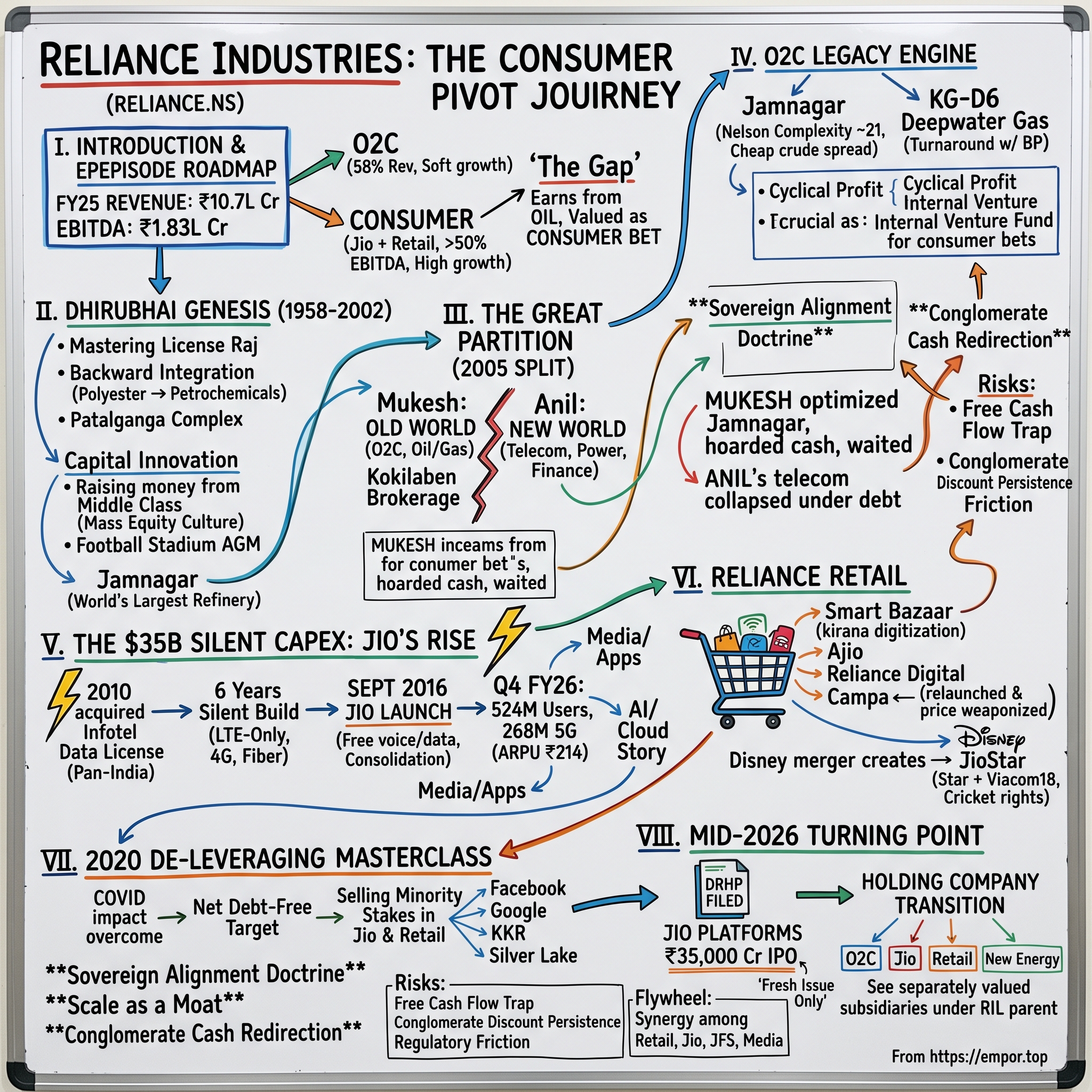
Reliance Industries: The Transition to India's Tech and Retail Kingpin
I. Introduction & Episode Roadmap
Picture the arithmetic that keeps a certain kind of Indian fund manager awake at night. On any given morning in mid-2026, roughly one out of every two rupees of revenue that flows into Reliance Industries Limited still comes from turning crude oil into diesel, jet fuel, and the plastic pellets that become everything from shampoo bottles to car bumpers. It is a heavy, cyclical, capital-devouring business that would look entirely familiar to an oil executive from 1985. And yet the market no longer prices Reliance as an oil company at all. It prices it as a bet on the shopping baskets and data plans of a billion-plus Indians.
That gap—between what Reliance earns from and what Reliance is valued as—is the whole story. It is the story of how a legacy refining and petrochemical conglomerate pulled off the most aggressive consumer pivot in the history of global business, using the cash from its oil pumps to build a telecom network and a retail empire from a standing start, and is now, in 2026, methodically dismantling its own conglomerate structure to force the market to pay up.
The numbers frame the ambition. For the financial year ending March 2025 (FY25), Reliance reported consolidated revenue of ₹10,71,174 crore—about $125 billion—up 7.1% year on year, and EBITDA of ₹1,83,422 crore, roughly $22 billion.12919 India has never produced a private enterprise this large. But the mix inside those numbers is where it gets interesting.
The Oil-to-Chemicals (O2C) division—the refineries and petrochemical crackers—still generated ₹6,26,921 crore of revenue in FY25, close to 58% of the group top line.7 Judged by revenue, Reliance is an energy company. Judged by profit growth and by the multiple investors will pay for it, it is something else entirely: the consumer-facing engines, Reliance Jio (digital services) and Reliance Retail, together now contribute more than half of consolidated EBITDA, and crucially, almost all of the growth.1 O2C's own EBITDA actually fell in FY25, to ₹54,988 crore, squeezed by weak refining margins and soft chemical demand.7 The cash cow is aging; the calves are doing the running.
Then came the event that reframed everything. On June 19, 2026, Jio Platforms—the holding entity for Reliance's telecom and digital business—filed a Draft Red Herring Prospectus with the Securities and Exchange Board of India (SEBI) for an initial public offering.3 The structure was a fresh issue of up to 27 crore shares, targeting roughly ₹35,000 crore (about $4.2 billion), with a striking design choice we will dissect later: no existing shareholder is selling.4 It is the opening move in Reliance's transformation from an operating conglomerate into what is effectively a strategic holding company sitting atop separately valued, pure-play subsidiaries.
Three themes will run through this story, and it is worth naming them upfront so we can test them rather than simply admire them.
The first is what we might call the sovereign alignment doctrine: Reliance has a long, deliberate habit of pointing its largest capital programs at whatever the Indian state has declared a national priority—Digital India, self-reliance, energy security—so that its private ambitions ride on public tailwinds. That can look like genius or like dependency, and we will ask which.
The second is scale as a moat: the brutal unit economics of running a telecom network and a retail chain at a size no domestic or foreign rival can match. Scale is real, but it is not the same thing as durable pricing power, and the difference matters.
The third is conglomerate cash redirection: the practice of using the stable, unglamorous O2C engine as an in-house venture fund to bankroll high-multiple consumer bets. It worked spectacularly once. The question for investors in 2026 is whether the machine can keep doing it as the oil business itself stops growing.
One more framing note before we begin, because it matters for how you should read everything that follows. Reliance is a company that has, more than almost any other, learned to shape its own narrative—through stadium AGMs, through a promoter who commands the attention of an entire nation, through carefully staged value-unlock events. The task of an independent analyst is to hold that narrative at arm's length and ask what the evidence actually supports. On some counts, management has earned real credibility: it said it would build a nationwide network and it did; it promised to be net-debt-free by a hard date and hit it early; it said it would list its consumer businesses and, in 2026, it started. That is a track record of doing what it said. On other counts—returns on capital, the durability of pricing power, the payoff from the newest bets—the promises are still promises, and the honest posture is skepticism until the numbers arrive. This story will try to keep those two categories cleanly separated.
To understand how any of this became possible, we have to go back—before the refineries, before the fiber, before the feud—to a man selling spices in a port town on the Arabian Peninsula.
 Subscribe on LinkedIn
II. The Dhirubhai Genesis: Polyester, Licensing, and Patalganga (1958–2002)
In the late 1950s, a young Gujarati clerk named Dhirubhai Ambani was working at a trading firm in Aden, the busy port at the mouth of the Red Sea, dealing in spices and, the legend has it, occasionally in the arbitrage of melting down Yemeni silver coins because the metal was worth more than the currency. He was watching global trade flow past him and taking notes. In 1958 he returned to Bombay with a modest stake—retellings put it at around ₹50,000—and started Reliance Commercial Corporation, a commodity trading house dealing in yarn and spices out of a tiny office.
What makes Dhirubhai a genuinely mythic figure in Indian business is not that he traded yarn. It is what he understood about the country he had come home to. Post-independence India ran on the "License Raj," a Byzantine system in which nearly every act of industrial ambition—building a factory, importing a machine, expanding capacity—required a government permit. The system was designed to allocate scarce resources and, in practice, rewarded whoever could best navigate the bureaucracy. Most established industrialists treated licensing as a constraint. Dhirubhai treated it as a competitive arena. He mastered the tariff schedules, the import-export incentive schemes, and the licensing queues with the same intensity a trader brings to a commodity spread.
His strategic instinct was relentless backward integration—the idea that you should keep marching upstream toward the raw material, capturing each margin along the way. He started by selling finished fabric under the "Only Vimal" brand, which became a household name in Indian textiles. But finished cloth was just the end of a chain. So he moved back into making polyester fiber. Then back again into the petrochemical precursors that fiber is made from—the alphabet soup of PTA, MEG, and PX—culminating in the Patalganga complex in the 1980s. Each step let Reliance capture a margin it had previously paid to a supplier, and each step raised the barrier for anyone trying to compete on price.
It is worth pausing on why this was so radical in the Indian context. In the License Raj, capacity was rationed by permit, and the received wisdom among established houses was to stay small and safe within your license. Dhirubhai did the opposite. He would apply for capacity far beyond what conventional demand seemed to justify, bet on obtaining the licenses through sheer persistence and relationships, and then build plants at world scale so that his per-unit costs collapsed below anything a smaller domestic rival could achieve. When the licenses came and demand caught up, he owned the low-cost position in an entire product category. It was a strategy that required nerve, political fluency, and a willingness to be leveraged—three things his more conservative peers lacked. The famous rivalry of the era, a running battle with Bombay Dyeing's Nusli Wadia over polyester feedstock licensing, was in essence a proxy war over exactly this question: whether the future belonged to the cautious incumbents or to the audacious outsider building at scale.
The second Dhirubhai innovation had nothing to do with chemistry and everything to do with capital. In an India where financing meant genuflecting before conservative state-owned banks, Dhirubhai simply went around them. He raised money directly from ordinary middle-class Indians, selling Reliance shares to hundreds of thousands of retail investors and, in doing so, effectively inventing India's mass equity culture. He pioneered instruments that were exotic for their time—convertible debentures that let small savers ride Reliance's growth, structured so that the company could keep tapping the public for cheap, patient capital while the banking establishment watched from the sidelines. The Reliance annual general meeting became a spectacle—held in football stadiums, drawing tens of thousands of small shareholders who treated Dhirubhai less like a CEO than a folk hero who had let them in on the wealth. That base of loyal retail shareholders would become a structural asset that persists to this day: a promoter family backed by a vast, emotionally invested public float that has repeatedly supported the company through rights issues and capex cycles when institutional opinion wavered.
There was a harder edge to this story that a neutral history should not airbrush. Dhirubhai's rise was inseparable from his mastery of the machinery of the state, and it drew persistent allegations—of import-license arbitrage, of policy crafted to fit Reliance's needs, of a bare-knuckle approach to competitors and the press. The 1980s saw open corporate warfare, including a notorious episode of manufactured share scarcity and settlement crises on the Bombay Stock Exchange as bear cartels tried and failed to break Reliance's stock. Whether one reads Dhirubhai as a visionary who beat a rigged system or as a man who bent the system to his will, the operative lesson for understanding today's Reliance is the same: proximity to the state, and the willingness to build at a scale that makes you strategically indispensable, has been part of the company's DNA from the very first decade.
The crowning act of the Dhirubhai era was Jamnagar. In the late 1990s, Reliance set out to build the world's largest grassroots oil refinery on the salt flats of coastal Gujarat—a first-of-its-kind mega-project in a country not known for delivering mega-projects on time. It was built at a pace that startled global engineering firms, survived a devastating cyclone during construction, and established the template that would define Reliance for the next thirty years: an almost obsessive competence at building enormous, complex physical assets faster and cheaper than anyone believed possible. Jamnagar was not just a refinery. It was a reputation.
Then, in 2002, at the height of his powers and with the empire still expanding, Dhirubhai Ambani died of a stroke. He left behind India's largest private company, two ambitious sons, a devoted shareholder army—and, fatefully, no will. The master builder had built everything except a plan for what came after him.
III. The Great Partition: Death without a Will, the Feud, and the 2005 Split
The absence of a single sheet of paper triggered one of the most consequential family disputes in corporate history. Dhirubhai's two sons could hardly have been more different in temperament. Mukesh, the elder, was the reserved operator—an engineer's mind, comfortable in the weeds of refinery throughput and project timelines. Anil was the showman—charismatic, at ease with bankers and Bollywood, drawn to the glamorous, capital-markets side of the empire. With their father gone and no instructions left behind, control of Reliance became contested ground, and the feud spilled into public view through leaked letters, board maneuvering, and dueling press briefings that transfixed the country for years.
The resolution, in 2005, came not from a court or a boardroom but from the family matriarch. Their mother, Kokilaben Ambani, brokered a formal, legally binding demerger that split the empire in two along a fault line that, in hindsight, reveals everything about how each brother read the future.
Mukesh kept the "old world": refining and petrochemicals (the O2C spine), and the upstream oil and gas exploration business. Heavy, cyclical, capital-hungry—but a cash machine. Anil took the "new world": telecommunications, power generation, and financial services. High-multiple, consumer-facing, glamorous—the businesses everyone in 2005 assumed were the future.
Crucially, the settlement included a non-compete agreement that barred Mukesh from entering telecom and consumer digital services. On paper, this looked like Anil had won the more exciting half and locked his brother out of it. Mukesh was, in effect, told to go run the oil business and stay away from the internet.
The feud did not end cleanly with the 2005 settlement. A second, even more public battle erupted over natural gas—specifically, over the price at which Mukesh's gas from the KG basin would be supplied to Anil's power plants under a family memorandum of understanding. That dispute climbed all the way to the Supreme Court of India, which in 2010 ruled essentially that natural resources belonged to the nation and that the government, not a private family MoU, would set the terms. It was a humbling moment for both brothers and a reminder—one that echoes through this entire story—that in India, the state is always the third party at the table, no matter how large your family name.
History then delivered a spectacular inversion. Anil's telecom venture, Reliance Communications, took on enormous debt to build out its network just as the industry's technology and economics shifted beneath it; by the mid-2010s it was collapsing under that debt and would eventually enter insolvency proceedings, wiping out much of Anil's fortune. Meanwhile Mukesh, boxed into the "boring" refining business, did something that in retrospect looks like patient strategy: he optimized Jamnagar into one of the most profitable refining assets on earth, hoarded the cash it threw off, and waited. The non-compete would not last forever. When it lapsed, he intended to walk straight into the very business he had been barred from—only this time with a war chest, no legacy baggage, and a clean sheet of paper on which to design something new. The cruelest irony is that Mukesh would ultimately re-enter telecom and, within a few years, effectively bury the very industry his brother had once been handed as the crown jewel.
The brother who was handed the future lost it. The brother who was handed the past used it to buy a better future. And the engine that made that possible was the asset nobody in 2005 was excited about.
IV. The O2C Legacy Engine: Jamnagar, Deepwater Gas, and the Cash Cow
Fly over the Gujarat coast near Jamnagar and the scale is genuinely difficult to process from the air: a sprawl of towers, flare stacks, and pipe racks stretching to the horizon, ringed—improbably—by one of the largest man-made mango orchards in the world, planted decades ago partly to prove that heavy industry and greenery could coexist on the salt flats. This single site processes more crude than almost anywhere else on earth. It has its own ports, its own power, its own township. It is, in a real sense, the physical foundation on which the entire modern Reliance was financed. To understand why Jamnagar is such a formidable machine, you need one concept: complexity. A simple refinery is like a cook who can only work with premium ingredients—it needs light, "sweet" crude oil, which is expensive, and it produces a modest slate of products. A complex refinery is a master chef who can take the cheapest, ugliest ingredients—heavy, "sour," sulfur-laden crude from Venezuela, Canada, or the Middle East that other refiners can't easily process—and convert them into the high-value output the world pays top dollar for: diesel, gasoline, and jet fuel. The industry measures this ability with the Nelson Complexity Index. Jamnagar's rating of roughly 21 is among the highest of any refining complex on the planet, meaning it can buy its feedstock at a discount and sell its output at a premium.
That spread—cheap heavy crude in, premium light distillates out—is the "gross refining margin," and capturing it at the scale of the world's largest single-site refining complex is the core of O2C's economics. Much of Jamnagar's output is exported, which historically insulated it from Indian domestic price controls and let it earn global margins. The competitive contrast is instructive: India's state-owned refiners like Indian Oil (IOCL) and Bharat Petroleum (BPCL) operate under public-sector mandates and often absorb fuel-subsidy pressure to shield consumers from price spikes. Reliance, as a private exporter of premium fuels, plays a different and more lucrative game. It has also proven nimble on the sourcing side: when Russian crude began trading at steep discounts after 2022, Jamnagar's flexibility to process almost any grade let Reliance become one of the world's largest buyers of discounted Russian barrels, converting a geopolitical dislocation into refining margin—an advantage that also carries the risk of sanctions and reputational scrutiny that a skeptical investor should keep on the radar.
The other half of O2C is petrochemicals—the business of cracking hydrocarbons into the building blocks of modern plastics: polymers, polyester, and the intermediates that go into packaging, textiles, and construction. This is a genuinely different animal from refining. Petrochemical margins move with a global capacity cycle: when China and the Middle East bring on huge new crackers, "downstream deltas" collapse, and Reliance's integrated model—feeding its own refinery streams into its own petrochemical plants—cushions but does not eliminate the pain. FY25 was one of those soft years on both counts. The catch, visible in FY25's numbers, is that even the best refinery on earth cannot escape the commodity cycle—O2C EBITDA fell to ₹54,988 crore as global fuel cracks and petrochemical margins weakened.7 Excellence buys you the best seat on a rollercoaster; it does not stop the rollercoaster. And it is precisely this cyclicality—the fact that a superbly run business can see profits swing by thousands of crores on forces entirely outside its control—that explains why the market is unwilling to pay a premium multiple for O2C, and why Reliance has spent fifteen years building something the market will pay up for.
The second leg of the legacy business sits deep under the Bay of Bengal. In the Krishna-Godavari basin off India's east coast, Reliance operates the KG-D6 block in partnership with the British energy major bp, which holds a 33.3% stake to Reliance's 66.7%.10 KG-D6 has a dramatic arc worth dwelling on, because it is a rare example of Reliance getting something badly wrong and then clawing back. When the block first came online in 2009, it was hailed as a national game-changer. Then output collapsed through the mid-2010s amid geological disappointments—the reservoir simply did not behave as modeled—and a bitter, years-long pricing dispute with the government that at times bled into accusations of gold-plating costs. For a company built on a reputation for flawless execution, KG-D6's decline was a genuine black eye. The turnaround came from a fresh set of ultra-deepwater developments—the R-Cluster, Satellites, and MJ fields—brought online in phases from late 2020 onward, and from bringing in bp's deepwater engineering expertise as a technical and financial partner.1011 Together they now produce roughly 30 million standard cubic meters of gas per day, close to 30% of India's domestic gas demand, and the oil-and-gas segment delivered ₹21,188 crore of EBITDA in FY25.1 In a country importing most of its energy, domestic gas is not just a profit line; it is a card to play with a government that cares intensely about energy security—an early instance of the sovereign alignment doctrine in action. The episode is also a useful corrective to the invincibility narrative: Reliance is superb at building, but subsurface geology and government pricing are two forces even it cannot simply engineer its way past.
Reliance has also begun the long project of repurposing the O2C asset base for a decarbonizing world. Management increasingly frames Jamnagar not merely as a fuels refinery but as a future "chemicals and materials" hub, tilting the product slate away from transport fuels—whose demand faces an eventual electric-vehicle-driven plateau—toward petrochemicals and specialty materials with longer demand runways. Whether that pivot outruns the structural decline of refining is one of the genuinely open long-term questions for the division, and it is intimately tied to the ₹75,000-crore-plus green-energy complex being built next door, which we will come to in the playbook.
Here is the strategic point that matters most for the rest of this story. For all its cyclicality, O2C throws off enormous and relatively steady operating cash flow. Through the 2010s, that cash flow became the funding source for Reliance's consumer reinvention. Rather than raise all the money for its telecom and retail bets from external lenders and equity markets, Reliance could self-finance the early, unprofitable years from the oil business—an internal venture-capital fund of a size no actual venture firm could match. There is a subtler version of this point worth stating plainly for investors: the O2C engine did not just fund the pivot, it de-risked it. A pure-play telecom startup burning billions with no revenue would have faced brutal terms from lenders and investors. Reliance could absorb years of Jio losses on a balance sheet backstopped by refining cash, buying itself the luxury of patience that no independent challenger could afford. That is what let Mukesh Ambani do the single most audacious thing in the company's history the moment his hands were untied.
V. The $35B Silent Capex: How Jio Built India's LTE-Only Digital Monopoly
In 2010, the non-compete clause expired. Within days, Reliance made its move—but not the obvious one. Instead of buying an existing mobile operator, it quietly acquired Infotel Broadband Services for about ₹4,800 crore. Infotel was, on the surface, an obscure minnow. Its actual value was a single asset: it was the only company to have won broadband wireless spectrum in every telecom circle across India in the government's auction. Reliance had, in one stroke, bought a pan-India data license and a blank canvas. And then it went silent for six years.
What happened during those six years is one of the great examples of patient, contrarian capital deployment. While incumbents—Bharti Airtel, Vodafone, Idea—competed on voice and layered patchy 3G data on top of aging 2G networks, Reliance poured a sum widely estimated at over $35 billion into building something no one else had: a greenfield, nationwide, 4G LTE-only data network. It laid hundreds of thousands of kilometers of optical fiber. Critically, it carried no legacy 2G or 3G baggage—no old equipment to maintain, no technical compromises to support ancient handsets. It was designed from the first day as a pure internet-delivery machine, at a moment when rivals still thought of data as a premium add-on to voice.
Then, on September 5, 2016, Reliance detonated the market. Jio launched with an offer that sounded like a misprint: free voice calls forever, free SMS, and free unlimited 4G data for months. In a country where mobile data had been a metered luxury, Reliance simply gave it away and dared everyone to follow. Tens of millions of Indians signed up in weeks. Data consumption per user exploded to among the highest levels in the world almost overnight.
The strategic logic was ruthless. By pricing data at zero, Jio didn't just win customers—it made the economics of the entire incumbent industry unviable. Rivals had built their businesses on charging for voice and data; Jio made both effectively free and monetized scale instead. The result was a bloodbath and a great consolidation. An industry that had a dozen operators collapsed into a three-player private oligopoly: Jio as market leader, a resilient Bharti Airtel, and a wounded, heavily indebted Vodafone Idea (Vi) surviving on government forbearance. Several operators went bankrupt or merged out of existence. Jio had not so much entered the telecom market as replaced it.
The damage was compounded by a piece of regulatory shrapnel that landed squarely on the old guard: a long-running dispute over "adjusted gross revenue" (AGR) dues owed to the government, which the Supreme Court resolved in 2019 in the government's favor, saddling the legacy operators with tens of thousands of crores in retroactive liabilities. Jio, having entered fresh and clean, carried almost none of that historical burden. So the incumbents were hit twice at once—by Jio's free data on one side and by a crushing legacy tax bill on the other. This is a crucial point for judging whether Jio's dominance is skill or circumstance: it was substantially both. Jio out-built and out-priced its rivals through genuine strategic audacity, but it also arrived at the exact moment when a regulatory sword was falling on everyone else. Great execution met great timing, and the combination was lethal.
The unit economics that emerged are the reason this was a business plan and not just a fireworks display. By the quarter ending March 2026 (Q4 FY26), Jio's user base had crossed 524 million, including 268 million on 5G—the largest 5G footprint outside China—with quarterly revenue of ₹44,929 crore and EBITDA of ₹20,060 crore.8 The metric to watch is average revenue per user (ARPU), the monthly rupees Jio extracts from each subscriber. After years of near-giveaway pricing, the three survivors began raising tariffs in coordination: a landmark hike in July 2024, followed by further increases, lifted Jio's ARPU roughly 17.8% over seven quarters to ₹214 by early 2026.8 The story here is a classic sequence—first buy the market with free service, then, once the field is cleared to three players, gently and repeatedly raise prices. Whether that pricing power is durable or politically fragile is a question we will return to in the bear case.
There is an important analytical nuance in how Jio built its 5G, and it goes to the heart of the "is this a tech company?" debate. Reliance rolled out 5G on a "standalone" architecture—a network that runs on its own dedicated 5G core rather than piggybacking on 4G infrastructure the way most operators did initially. Standalone 5G is more expensive and harder to deploy, but it unlocks capabilities like network slicing (carving the network into virtual lanes for different uses) and ultra-low-latency applications that are the prerequisite for enterprise and industrial use cases. Reliance's bet is that these capabilities let it sell far more than connectivity: fixed-wireless home broadband (JioAirFiber and JioFiber), which turns the mobile network into a broadband pipe for homes without laying cable to every door; a bundle of media and apps; and, increasingly, an artificial-intelligence and cloud story built around domestic data centers. Management frames Jio not as a telco but as a "digital services" platform, and the valuation debate later in this story turns almost entirely on whether investors accept that framing or see a very well-run telecom operator wearing a technology costume.
The honest read in mid-2026 is that the evidence is mixed. The connectivity business is unambiguously dominant and now, finally, profitable at scale. The broadband attach is real and growing fast, giving Jio a genuine second S-curve as it wires up tens of millions of Indian homes. But the higher-multiple pieces—enterprise cloud, AI, and monetizable digital apps beyond connectivity—remain small relative to the subscription base, and much of the "platform" revenue is still, at bottom, people paying for data. That gap between the platform narrative and the current revenue mix is not a reason to dismiss the story; it is the specific thing a diligent investor should size and track.
One more piece of engineering deserves attention because it flatters the reported financials. Reliance carved its telecom towers and fiber into separate Infrastructure Investment Trusts (InVITs)—independent vehicles that own the passive infrastructure and lease it back. This pushed tens of thousands of crores of associated debt off the parent's balance sheet, letting Reliance present Jio as a leaner, more capital-efficient operator than a fully consolidated view would show. It is legitimate and common in global telecom, but a skeptical investor should read Jio's standalone leverage with that off-balance-sheet structure firmly in mind. Building the network was the hard part. Building the appearance of a light balance sheet on top of it was the clever part.
VI. Reliance Retail: Aggressive M&A, Consolidation, and the High-Street Empire
If Jio was a single, spectacular detonation, Reliance Retail is the opposite: a grinding, relentless, city-by-city land grab that most global observers barely noticed until it was the largest retailer in the country. By FY25 it operated more than 19,000 stores across thousands of Indian towns and cities, generating around ₹2.91 lakh crore of revenue and ₹25,094 crore of EBITDA—a footprint spanning grocery, electronics, fashion, and more.1 (On a gross-turnover basis, which includes non-consolidated formats, the business crossed ₹3.3 lakh crore.7) No Indian retailer is remotely close in scale.
But scale in retail is not automatically an advantage, which is why the competitive picture is worth war-gaming. Reliance runs a sprawling multi-format model. Its most feared rival, Avenue Supermarts—the operator of DMart—runs the opposite playbook: a narrow, fanatically cost-disciplined grocery format that has historically earned higher margins and returns on capital than Reliance's grocery business. In fashion, Tata's Trent, with its Zudio and Westside brands, has built a hyper-profitable fast-fashion machine that many analysts consider best-in-class. The lesson is that being the biggest does not mean being the best on any single axis; Reliance's bet is that owning the whole board—grocery, electronics, fashion, and the digital rails connecting them—creates a system advantage that focused specialists cannot replicate. That thesis is plausible but not yet proven, and margin comparisons with DMart and Trent are exactly where a skeptic would press.
The strategy runs on three prongs. In grocery, the Smart Bazaar stores and the JioMart platform aim not only to sell to consumers but to digitize India's millions of small "kirana" mom-and-pop shops—wiring them into Reliance's supply chain and point-of-sale systems, turning potential competitors into distribution nodes. This is the most strategically ambitious idea in the whole retail portfolio. India's retail is still overwhelmingly "unorganized"—the corner store, not the chain—and rather than trying to kill the kirana the way Western big-box retail did, Reliance's play is to become the wholesaler and technology layer beneath it, supplying the shop, digitizing its billing, and capturing a slice of a channel that will take decades to formalize. If it works, it is a moat measured in millions of merchant relationships; if it stalls, it is an expensive way to sell packaged goods. In electronics, Reliance Digital has become the country's dominant physical retail channel for consumer tech, which gives Reliance real leverage over global device brands and a natural cross-sell into Jio connections and financing. In fashion and lifestyle, the Ajio online platform sits alongside a portfolio of licensing deals and joint ventures with international luxury and premium houses—the kind of partnerships that turn Reliance into the default gateway for global brands entering India, from mass-market apparel up to the marble-floored luxury boutiques it operates for names like Armani and Tiffany.
There is also a fast-growing consumer-goods arm that deserves a mention, because it is the newest front in the war. Reliance Consumer Products—the vehicle behind the Campa relaunch—has been assembling a stable of packaged-food, beverage, and staples brands with the explicit aim of building an Indian rival to the entrenched multinational giants Hindustan Unilever and Nestlé. The competitive weapon is the same one that made Campa work: Reliance controls a distribution and shelf-space network that a challenger brand would otherwise spend a decade and a fortune to build. Whether owning distribution is enough to overcome the brand equity and trade relationships those incumbents have compounded for generations is an open question, but it is a textbook example of the company's instinct to attack from its position of structural advantage rather than on the incumbent's terms.
Where Retail's ambition becomes most visible is in its acquisitions, and the discipline varies. In December 2022, Reliance Retail Ventures agreed to buy Metro Cash & Carry's India business for ₹2,850 crore—a clean strategic win that handed it dozens of large wholesale hubs to feed the JioMart supply chain, at a price most analysts considered reasonable.1516 In 2020 it acquired a majority stake in the online pharmacy Netmeds for about ₹620 crore, planting a flag in digital healthcare.16 And in a move that reveals the company's cheeky, distribution-first instinct, in 2022 Reliance bought the dormant Indian soft-drink brand Campa for roughly ₹22 crore—a rounding error—then relaunched it and priced a bottle aggressively below Coca-Cola and Pepsi, weaponizing its own shelf space to reintroduce a cola war India hadn't seen in decades.15 The point of Campa is not the drink; it is the demonstration that when you own the shelves, you can manufacture a challenger brand almost for free.
The most consequential deal, though, was in media. On November 14, 2024, Reliance and Disney completed an $8.5 billion merger of Star India and Reliance's Viacom18, folding the JioCinema and Hotstar streaming assets together into a single joint venture branded JioStar, controlled by Reliance.1213 The combined entity commands the crown jewels of Indian sports broadcasting—cricket rights including the IPL foremost among them—giving it decisive leverage in the one category that reliably captures Indian attention and advertising rupees, and squeezing rivals like Sony and Zee. The strategic logic connects directly back to Jio: sports content, especially live cricket, is the single most reliable driver of data consumption and subscriber engagement in India, so owning it is a way to feed the telecom and advertising machines simultaneously. That said, media is a notoriously margin-thin, content-cost-heavy business, and the price of retaining cricket rights has escalated to levels that make profitability a real question. The JioStar bet is best understood not as a standalone profit center but as a strategic keystone—control of the content that keeps the rest of the flywheel spinning—which is exactly the kind of investment whose returns are hard to isolate and easy to over-justify. Regulators, too, have taken note of the concentration of sports and entertainment rights under one roof, and antitrust scrutiny of the JV was a live issue during its approval. Media, telecom, and retail now feed a single consumer relationship. Which raises the obvious question: how did a company still carrying tens of billions in industrial debt in 2019 find the money to build all of this at once?
VII. The 2020 De-Leveraging Masterclass: Covid Cash Raises and the Value-Unlock Blueprint
By 2019, the bill for all this ambition had come due. Building a nationwide 4G network and thousands of retail stores simultaneously had pushed Reliance's net debt above $22 billion (roughly ₹1.61 lakh crore), and credit-rating agencies and analysts were growing audibly nervous about the group's return on capital and its appetite for spending. For a company that had cultivated an aura of financial invincibility, the debt load was a genuine vulnerability, and the market was starting to say so.
At the August 2019 AGM, Mukesh Ambani did something CEOs are generally advised never to do: he set a hard, public, unambiguous deadline. Reliance, he pledged, would become "net debt-free" by March 31, 2021. It was the kind of specific commitment that hands critics a scoreboard. And then a global pandemic arrived and froze the world economy, which by any normal reading should have made the target impossible.
What followed instead was one of the most audacious fundraising campaigns in corporate history, executed precisely while the rest of the world was paralyzed. Between April and roughly the end of the summer of 2020, Reliance sold a series of minority stakes in Jio Platforms to a who's-who of global technology and private-equity investors: Facebook (now Meta) bought 9.99% for $5.7 billion, Google bought a stake for $4.5 billion, and firms including KKR, Silver Lake, Vista, and Gulf sovereign funds piled in—altogether more than $20 billion for roughly a third of Jio Platforms.17 It then sold about 10% of Reliance Retail Ventures for around $6.4 billion to a similar cast including KKR, the Qatar Investment Authority, Silver Lake, and ADIA. On top of the stake sales, Reliance completed a ₹53,124 crore rights issue—its first in three decades and the largest in Indian history—inviting its loyal retail shareholders back in.18
In total, Reliance raised more than ₹1.68 lakh crore in a matter of weeks and declared itself net debt-free months ahead of the March 2021 deadline.18 Judged purely on execution, it was a masterclass: Ambani hit an audacious public target early, in the teeth of a pandemic, and did it while pulling the world's most powerful technology companies onto his cap table as strategic partners rather than mere financiers.
The strategic subtlety of who he sold to should not be missed. Facebook and Google were not passive check-writers; they were partners with reasons to want Jio to succeed. For Facebook, whose WhatsApp had hundreds of millions of Indian users, a stake in Jio was a bet on integrating commerce and payments into India's dominant messaging habit. For Google, it came bundled with a plan to co-develop low-cost Android smartphones to pull India's remaining feature-phone users onto the internet—and, not incidentally, onto Jio. By selecting strategic investors over pure financial ones, Reliance imported both validation and capability, and it signaled to the market that the world's smartest technology money believed the Jio platform thesis. That is a form of endorsement no amount of management commentary can manufacture. A skeptic would counter that strategic investors also buy influence and distribution for themselves, and that a minority stake bought at the bottom of a pandemic says as much about opportunistic pricing as about long-term conviction—but the capital was real and it did the job.
But the deeper significance was the blueprint it established. Those transactions put a benchmark price on the consumer businesses for the first time—valuing Jio in the neighborhood of $65 billion and Retail around $100 billion—entirely separate from the refining business. Reliance had discovered that it could crystallize value in its high-growth subsidiaries without giving up control, and that global capital was desperate for exposure to the Indian consumer. Once you have proven you can sell slices of a subsidiary at a premium valuation, the logical next step is obvious: sell those subsidiaries to the public market itself. Six years later, that is exactly what began to happen.
VIII. The Mid-2026 Turning Point: Jio's ₹35,000 Crore IPO Filing and the Holding Company Transition
On June 19, 2026, the long-anticipated shoe dropped. Jio Platforms filed its Draft Red Herring Prospectus with SEBI, formally beginning the process of listing the crown jewel of the consumer empire.3 Indian financial media, which had spent years speculating about the timing, finally had a document to parse—and the details revealed a great deal about how Reliance thinks about value.
The structure was the tell. The IPO was drafted as a 100% fresh issue of up to 27 crore equity shares—meaning all the money raised flows into Jio Platforms itself, with no "offer for sale" component in which existing owners cash out.34 This is unusual and deliberate. When early investors and promoters sell shares in an IPO, the proceeds go into their pockets and none of it strengthens the company. By making it a pure fresh issue, Reliance signaled that this offering is about capitalizing Jio for its next phase, not about liquidity for insiders. Of the proceeds, up to ₹27,500 crore was earmarked to prepay or repay borrowings at the telecom operating company—wiping out the residual telecom debt—with the remainder directed toward next-generation network infrastructure and Reliance's push into sovereign-scale artificial-intelligence data centers.4 (It is worth noting that press reports since the filing have suggested some early foreign backers may separately trim stakes in a later phase; the DRHP as filed, however, contains no such sale.14)
The valuation debate is where the real money is. Brokerage estimates for Jio Platforms have clustered in a very wide band—roughly $120 billion to $180 billion, or about ₹10 to ₹15 lakh crore—based on forward EV/EBITDA multiples applied to a business now generating over ₹80,000 crore in annual EBITDA.6 To put that in perspective, the low end of that range is nearly triple the $65 billion benchmark set in the 2020 fundraising round. The market is being asked to pay a technology-platform multiple for what is, at its core, a telecom operator with adjacent digital ambitions—and the gap between the bull and bear valuations is essentially a referendum on whether "Jio is a tech platform" is a thesis or a marketing line.
The earmarking of proceeds toward "sovereign AI infrastructure" is worth reading closely, because it is the sovereign-alignment doctrine expressed in its most current form. India's government has made building domestic AI compute a stated national priority, wary of depending entirely on American hyperscalers. Reliance has answered by announcing gigawatt-scale AI data-center ambitions—including a marquee facility planned at Jamnagar powered by the adjacent green-energy complex—and by courting global chip and cloud partners to anchor them. For investors, this is simultaneously the most exciting and the most speculative element of the Jio story: exciting because AI infrastructure could be an enormous new profit pool with government backing, speculative because it is capital-devouring, technologically dependent on foreign silicon, and years away from proving its returns. The IPO, in effect, asks the public market to help fund a bet whose payoff lies well beyond the current numbers.
For existing Reliance shareholders, there was a pointed disappointment buried in the structure. Unlike the 2023 demerger of Jio Financial Services—where Reliance shareholders received JFS shares directly in a one-to-one ratio and got a separately traded stake in their hands—the Jio Platforms IPO gives RIL shareholders no direct share allotment or reserved quota.5 The JFS demerger is a useful reference point precisely because it did the opposite: Reliance spun its financial-services arm out of the parent, handed every RIL shareholder a matching share, and let the market price the new entity directly. That structure put value straight into shareholders' hands. The Jio approach keeps the value inside the fortress. Their exposure to Jio's value unlock remains trapped inside the parent company's stock, dependent on the market choosing to reflect that value in RIL's price rather than discounting it. That is a meaningful distinction, and it goes to the heart of the risk in this whole transition. A cynical reading is that the fresh-issue-only, no-shareholder-quota design maximizes capital raised for the company and preserves the promoter family's control while offering minority owners of the parent only an indirect, discountable claim on the crown jewel. Management's counter is that a stronger, better-capitalized Jio ultimately accrues to RIL's net asset value. Both can be true; the tension between them is exactly what the holding-company debate is about.
Because the endgame is now visible. With Jio Platforms on the path to listing, and Reliance Retail widely expected to follow in the 2026–2027 window, Reliance is deliberately converting itself into a holding company: a parent that owns controlling stakes in separately listed, pure-play consumer subsidiaries, with the cyclical O2C business as one asset among several rather than the whole identity. The intent is to decouple the group's valuation from the swings of refining margins and let the market price each engine on its own merits. Whether that structure unlocks value or simply relocates the discount from the operating level to the holding-company level is the trillion-rupee question—and it is far from settled.
IX. Playbook: Business & Investing Lessons
Step back from the sequence of deals and a machine comes into focus—one Reliance itself likes to describe as a flywheel. The idea is that its businesses feed each other in a reinforcing loop. Reliance Retail's thousands of physical stores become customer-acquisition points for Jio, selling devices and onboarding kirana merchants; Jio's hundreds of millions of subscribers generate a torrent of transaction and behavioral data; that data feeds Jio Financial Services, which can underwrite credit and sell insurance; and JFS in turn extends financing to Retail's consumers and merchant base, driving more retail volume. On a whiteboard, it is beautiful. The honest investor's caveat is that "synergy flywheel" is one of the most over-promised concepts in conglomerate history, and the burden of proof is on management to show the loop produces returns rather than just an org chart. So far the evidence is suggestive—cross-selling is real—but not yet conclusive that the whole exceeds the sum of the parts.
The most powerful and least-discussed edge inside that flywheel is data. Reliance may be the only company on earth that can observe a single Indian household across so many surfaces at once: what it watches (JioStar), how it connects (Jio), what it buys in-store and online (Retail), and how it pays and borrows (JFS). In a market where formal credit histories are thin and consumer data is fragmented, that panoramic view is a genuine asset—for underwriting loans, for targeting promotions, for deciding what to stock and where. It is also, of course, the sharpest edge of the risk, because a company that knows this much about half a billion people is exactly the kind of entity that data-protection regulation is designed to constrain, and India's data-privacy regime is still maturing. The same asset that makes the flywheel spin faster is the one most likely to attract regulatory friction as the rules catch up.
The most transferable lesson is the sovereign alignment doctrine, and it deserves to be stated without either cynicism or celebration. Reliance has repeatedly structured its largest bets so that its private capital advances a stated national goal. Jio was framed as the infrastructure of "Digital India." The retail and kirana-digitization push aligns with self-reliance rhetoric. The roughly $10 billion Dhirubhai Ambani Green Energy Giga Complex at Jamnagar—solar modules, batteries, electrolyzers for green hydrogen, and fuel cells, with technology licensed from partners including Norway's Nel—maps directly onto India's decarbonization and energy-security targets. The pitch is elegant: use the cash and the engineering muscle of the old carbon business to build the infrastructure of the new clean one, on the same salt flats, aligned with the government's climate commitments. The advantage of aligning with the state is structural tailwinds: favorable policy, protected market access, production-linked incentives, spectrum, and regulatory patience. The risk, which we will sharpen in the bear case, is that a company this entwined with government priorities is also exposed to government whim. Alignment is a two-way street, and the state can change direction—or a different government can decide that the country's largest private conglomerate has grown too powerful and needs checking. The new-energy bet also remains, as of mid-2026, largely a capital story rather than a profit story: the gigafactories are still being commissioned, and none of the ambitious targets management has floated for cost-competitive green hydrogen or fully integrated solar manufacturing has yet been proven at commercial scale. It is optionality, not earnings, and investors should price it as such.
A third lesson is capital-allocation pivot mastery: the sheer difficulty, and rarity, of migrating a company from a low-multiple, asset-heavy commodity business to a high-multiple, high-growth platform without being crushed by the "conglomerate discount"—the market's habit of valuing a diversified group at less than the sum of its parts. Most conglomerates that attempt this fail, either because the cash cow starves the new business or because the new business never earns its multiple. Reliance's approach—self-fund the pivot from O2C cash, prove the valuation through private rounds, then list the subsidiaries—is a genuinely instructive template, though the final chapter on whether it defeats the discount is being written right now. The counter-lesson, which activist investors would press, is that this same machine risks tipping into "diworsification": a company that keeps entering new capital-hungry arenas—telecom, retail, media, consumer goods, green hydrogen, AI data centers—faster than it demonstrates adequate returns on the last one. There is a fine line between an admirable growth flywheel and an empire that expands because it can rather than because each new limb clears its cost of capital. Reliance has not obviously crossed that line, but it operates close enough to it that the question is fair, and the mediocre group-level return on equity is the number that keeps it fair.
Finally, there is the matter of succession, and here Mukesh Ambani has clearly studied the trauma of 2005. Having watched a missing will nearly tear the empire apart, he has pre-assigned the next generation with almost clinical clarity: Akash Ambani leads the digital and Jio businesses, his twin Isha Ambani leads Reliance Retail, and the youngest, Anant Ambani, oversees the new-energy and materials push. All three were placed on the RIL board in late 2023, under a framework of professional and advisory oversight designed to institutionalize continuity. The neatness of the design is itself telling: each heir has been matched to one of the three businesses that will, if the current plan holds, become separately listed entities—Jio, Retail, and eventually New Energy—so that the family's succession map and the corporate restructuring map are effectively the same document. It is a deliberate answer to his father's one great failure of planning.
But a candid governance assessment has to note what the tidy chart cannot resolve. The heirs are being handed roles rather than earning them through a public track record, and the ultimate ownership and control questions—how the family trust holds the promoter stakes, how disputes would be adjudicated, what happens if the siblings' interests diverge as their father's once did with his brother—remain opaque to outside shareholders. Reliance is, for all its scale, a promoter-controlled company in which minority investors ride alongside a family whose internal arrangements they cannot see. That is not a scandal; it is simply the structure, and it is a structure that has both enriched loyal shareholders for four decades and occasionally treated them as passengers rather than partners. Whether three co-equal heirs each running a listed subsidiary proves more stable than two brothers splitting one company is, of course, a hypothesis the family has yet to test under stress.
X. Analysis: Porter's 5 Forces, 7 Powers, and the Bear vs. Bull Stress Test
Let us put the whole edifice on the analyst's dissecting table and ask the only question that matters for a long-term owner: from here, why does Reliance win, and what could break the case?
Start with Hamilton Helmer's 7 Powers, a framework for identifying durable competitive advantage. Reliance can credibly claim three. The first is a cornered resource: Jamnagar's physical scale, coastal deepwater access, and near-unmatched refining complexity constitute an asset that simply cannot be rebuilt by a competitor at today's costs and permitting realities. The second is scale economies: Jio's 524 million subscribers and Retail's 19,000-plus stores spread fixed costs—network, logistics, procurement—across a base so large that no new entrant could match the unit costs without first spending tens of billions of dollars to reach comparable scale.81 The third, less textbook but very real in India, is what we might call the government-adjacency power: the regulatory and policy alignment that functions as a protective barrier for the domestic incumbent.
Run the same businesses through Porter's Five Forces and the picture is consistent. Barriers to entry in telecom (spectrum costs, network capex) and retail (real-estate footprint, supply-chain density) are formidable. Bargaining power over suppliers—both the small kirana stores being onboarded and the global brands seeking Indian distribution—is high, because Reliance controls access to the Indian consumer at a scale rivals can't offer. The threat that should keep management honest is rivalry and buyer power: in telecom, a resurgent Airtel and any government tenderness toward Vodafone Idea constrain pricing; in retail, DMart and Trent prove that focused competitors can out-earn Reliance on their home turf. And in the newest arena, quick-commerce—the ten-minute grocery delivery wars being fought by Blinkit, Zepto, and Swiggy Instamart—Reliance has arguably been a follower rather than a leader, a reminder that scale does not guarantee being first to the next consumer behavior. The threat of substitutes and new entrants is lowest in refining and highest in the fast-moving digital-commerce layer, which is precisely where the incumbency advantage is thinnest.
It is worth pausing on a myth versus reality that colors much of the popular narrative. The myth, propagated in breathless coverage, is that Reliance is an unstoppable juggernaut that has already won every market it enters. The reality is more textured. Jio won telecom decisively—that is not myth, it is fact. But Retail remains less profitable than its best-run rivals; the consumer-goods push against Unilever and Nestlé is early and unproven; the new-energy business is pre-profit; and in quick commerce Reliance is playing catch-up. A clear-eyed investor should separate the one arena where dominance is established from the several where the company is a very well-funded challenger whose victory is assumed rather than demonstrated.
Now the stress test—the part where we take the skeptic's chair. Three challenges stand out.
The first is the free-cash-flow trap. For all its ₹1.83 lakh crore of EBITDA, Reliance is a serial re-investor: spectrum, 5G standalone rollout, retail store expansion, and the multi-billion-dollar green-energy giga-complex consume cash almost as fast as the businesses generate it.1 The consequence is that consolidated free-cash-flow yield stays thin and return on equity has been stuck in the high single digits—roughly 9–10%—well below what a "premium consumer platform" valuation would imply. An activist would ask bluntly: when does the capex cycle actually end and the cash come back to shareholders, and why should we underwrite yet another giga-scale bet on faith?
The second is the conglomerate discount persistence. The entire holding-company thesis rests on the belief that listing Jio and Retail will force the market to value them at full multiples and lift RIL. But holding companies routinely trade at a discount to the sum of their listed stakes, because of tax leakage on dividends passed up through the structure and the lack of direct control for the end shareholder. The pointed refusal to give RIL shareholders direct Jio shares—unlike the JFS demerger—sharpens exactly this worry.5 It is entirely possible that Reliance simply trades one discount (conglomerate) for another (holding company).
The third is regulatory and pricing-power risk, which cuts to the core of Jio's economics. Jio's path to justifying its 5G and AI capex depends on continued ARPU growth, which depends on the three-player oligopoly continuing to raise tariffs in loose coordination. That is a politically sensitive arrangement in a country where affordable data is treated as a near-public good. A single populist intervention—a tariff freeze, a spectrum-pricing shift, a regulatory nudge toward Vodafone Idea's survival—could strand a chunk of that investment below its cost of capital. The same government adjacency that is a moat is also a leash.
A brief second-layer aside is warranted on the credit and ownership picture, because it complicates the simple "net debt-free" headline. The 2020 deleveraging was real, but Reliance did not stop spending—5G, retail expansion, media, and new energy have driven gross debt and capital commitments back up, even as the InVIT structures keep some of it off the parent's books. Global rating agencies have historically held Reliance at or above the sovereign ceiling, a rare compliment reflecting the sheer cash generation of the group, but the trajectory of consolidated leverage through the coming capex-heavy years is exactly what credit analysts will watch. On the ownership side, the promoter family retains a controlling stake north of 40%, and the story of the coming years is partly a story of how much of the consumer subsidiaries the family is willing to float to the public versus how tightly it holds control—a tension that sits at the center of the value-unlock thesis.
So where does that leave the bull and the bear? The bull case is coherent: unrivaled consumer data capture across telecom, retail, and media; dominant share of a structurally growing Indian consumption market; a stable O2C cash engine underwriting long-dated, high-optionality bets in clean energy and AI; and a management team with a demonstrated record of hitting audacious targets, from net-debt-free to nationwide 5G. The bear case is equally coherent: relentless capital intensity that keeps returns mediocre and free cash flow scarce; genuine key-person and succession risk as an untested next generation takes the controls; refining margins that can swing violently and drag reported earnings; regulatory and data-privacy exposure that scales with the company's own reach; and a valuation transition whose central promise—defeating the discount—may not survive contact with the tax code and market structure. Neither case is obviously correct, which is precisely why the metrics below matter more than the rhetoric on either side.
For an investor actually tracking this company quarter to quarter, the noise-to-signal ratio is high, so it is worth naming the few metrics that genuinely move the thesis. Watch Jio's ARPU, because it is the single cleanest read on whether the pricing-power story is real and durable or politically capped. Watch Reliance Retail's EBITDA margin, especially against DMart and Trent, because it reveals whether scale is translating into profitability or just square footage. And watch consolidated net debt and free cash flow, because the entire independence of the strategy—the ability to keep self-funding the next pivot—rests on the cash machine staying ahead of the capex machine.
XI. Outro
There is a symmetry to this story that is hard to miss. It begins with a young man returning from Aden with ₹50,000 and a trader's eye for the margin everyone else overlooked, and it arrives, sixty-eight years later, at his son filing to list a technology platform some analysts value north of $150 billion—built with cash pumped out of the salt flats where the father made his monument. Dhirubhai's genius was seeing that finished cloth was just the last link in a chain worth owning end to end. Mukesh's was seeing that a cyclical oil business could be the funding source for the next India entirely.
For the long-term investor watching the next phase of that country's growth, Reliance is neither the sure thing its promoters imply nor the value trap its critics fear. It is something harder and more interesting: a live experiment in whether the largest, most state-aligned, most capital-hungry conglomerate in the world's most populous nation can convert its scale into the one thing scale does not automatically buy—durable, high-return, shareholder-owned value. The refineries proved the family could build. The IPOs will prove whether they can share.
References
-
Integrated Annual Report 2024-25 — Reliance Industries Limited ↩↩↩↩↩↩
-
Media Release: RIL Q4 FY2024-25 Financial and Operational Performance — Reliance Industries Limited, 2025-04-25 ↩
-
Jio Platforms Ltd — Draft Red Herring Prospectus (DRHP) — SEBI, 2026-06-19 ↩↩↩
-
Jio Platforms IPO DRHP filed with SEBI: What will the company do with the issue proceeds? — Upstox, 2026-06-20 ↩↩↩
-
Jio DRHP Filed for ₹35,000 Cr IPO: Why RIL Shareholders May Not Get a Windfall — NiftyTrader, 2026-06 ↩↩
-
Jio IPO 2026: DRHP, Valuation & Latest News — Anand Rathi, 2026 ↩
-
Reliance FY25 Annual Report: Retail and Jio Power Growth, O2C Weakens, Green Push Accelerates — 5paisa, 2025 ↩↩↩↩
-
Jio Platforms: Q4 FY26 financial analysis — Communications Today, 2026 ↩↩↩
-
RIL's revenue tops ₹10.7L crore; Jio emerges as world's largest data network in FY25 — Upstox, 2025 ↩
-
Reliance and bp start up second new deepwater gas field in India's KG D6 block — bp, 2021-04-19 ↩↩
-
Reliance Industries, bp start regular production from MJ field in KG block — Business Standard, 2023-06-30 ↩
-
Reliance and Disney Announce Completion of Transaction to Form Joint Venture — JioStar, 2024-11-14 ↩
-
Disney, Reliance Industries Close $8.5 Billion Merger of Star India and Viacom18 — TheWrap, 2024-11-14 ↩
-
Reliance wants Meta, Google to offload just 8% of their stakes in Jio IPO — IndiaIPO, 2026 ↩
-
CCI approves Reliance's acquisition of METRO Cash & Carry India — Business Today, 2023-03-15 ↩↩
-
Media Release: Reliance Retail Ventures Limited acquires METRO Cash & Carry India — Reliance Industries Limited, 2022-12-22 ↩↩
-
Mukesh Ambani Sells Nearly A Quarter Of His Jio Platforms, Makes Reliance Net Debt-Free — Forbes, 2020-06-18 ↩
-
Reliance Industries now 'debt-free', Mukesh Ambani says 'fulfilled my promise before schedule' — India TV, 2020-06-19 ↩↩
-
Reliance Industries Reports Robust FY25 Revenue, Q4 Profit Growth Amidst Segment Dynamics — Groww, 2025 ↩
 LinkedIn
 WhatsApp
 Reddit
 Hacker News
 Email
Email Kindle
 RSS Feed
 Spotify
 Apple Podcasts
 Amazon Music
 Audible
 YouTube