REC Limited: The Lender Built for India’s Power Problem
I. The Power Lender That May Disappear Into Its Rival
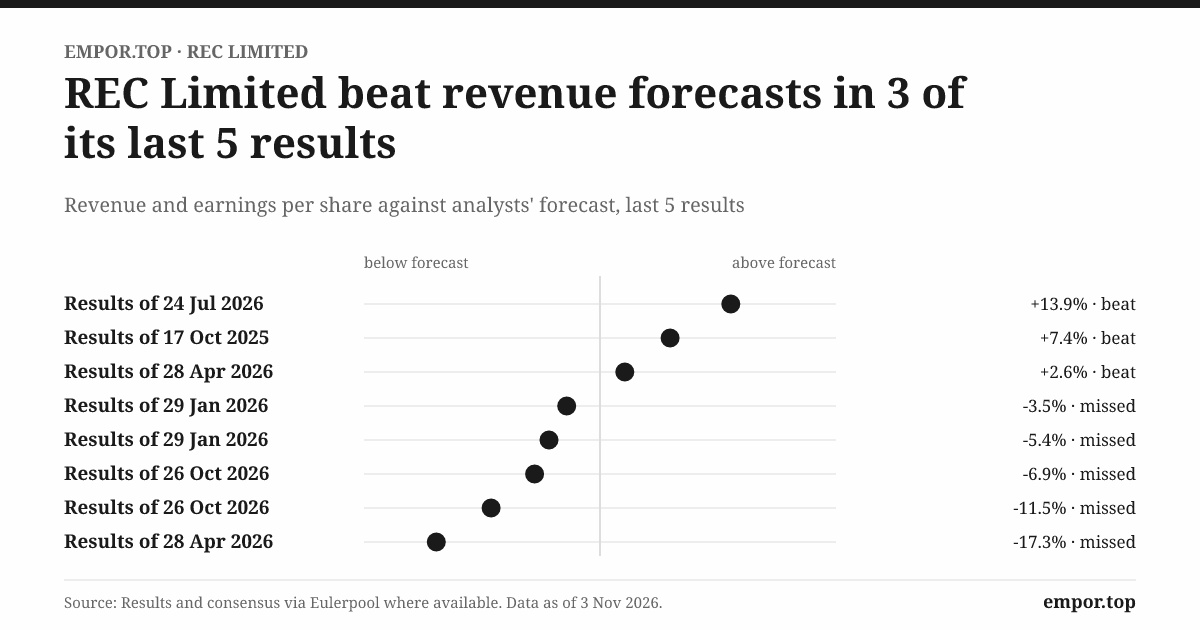
On the evening of October 29, 2026, Jitendra Srivastava joined a conference call to explain a quarter nobody at REC Limited wanted to dwell on. Profit had fallen by about a fifth from a year earlier.1 Analysts wanted to know whether banks flush with cash were stealing REC's best borrowers, whether the company's margin would hold, and what would happen once the whole institution was folded into its parent. Behind every one of those questions sat a stranger fact. The company Srivastava runs may soon stop existing as a listed business. Two weeks earlier, the Reserve Bank of India had issued a no-objection certificate for REC's merger into Power Finance Corporation, and on October 19 India's two stock exchanges had sent their own no-objection letters.1 Shareholders, creditors, the securities regulator and the company-law tribunal still had to sign off.2
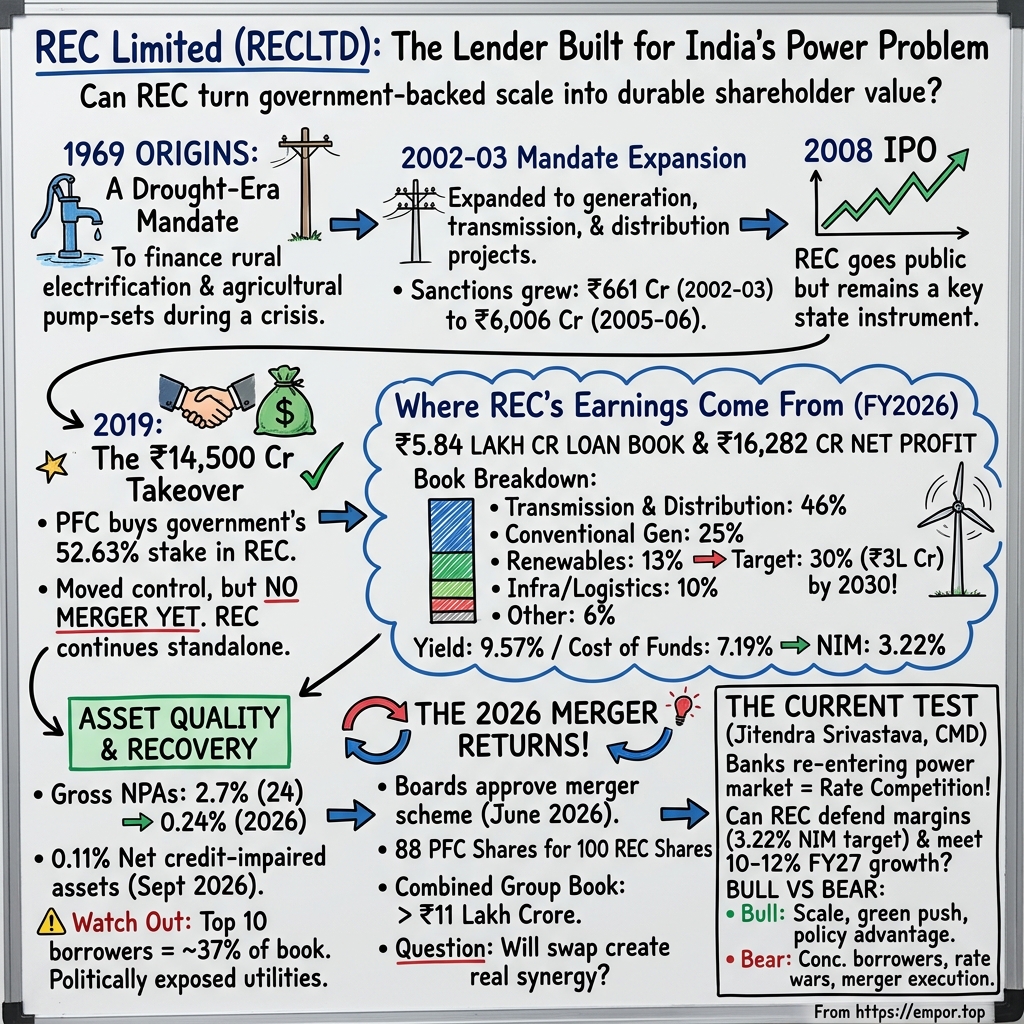
That is an unusual place for a big lender to stand. REC is one of the largest financiers of electricity in the world's most populous country. At the end of March 2026 it had ₹5.84 lakh crore of loans outstanding, roughly $62 billion, and it had just reported a record annual profit of ₹16,282 crore.3 By September its book had grown to ₹6.17 lakh crore.4 Yet the plan approved by both boards in June would cancel every REC share. A holder of 100 REC shares would receive 88 shares of PFC, and the merged company would carry a combined loan book above ₹11 lakh crore.5
The merger is less dramatic than it sounds, and that is the first thing to get right. PFC already owns 52.63% of REC. It bought that controlling stake from the Government of India in 2019, and it already consolidates REC's loans in its group accounts.5 The ₹11 lakh crore figure is not a new empire conjured by a deal. It is two balance sheets that already sit under one roof, finally sharing a single legal identity. What the merger changes is the corporate structure, the shares a public investor holds, and perhaps the cost and efficiency of running the business. What it does not change, at least not yet, is the fact that REC today is a standalone listed lender with its own borrowers, its own bonds and its own profit-and-loss account.
To understand why this lender exists at all, you have to rewind fifty-seven years, to a drought and a pump.
REC was born in 1969 with a mandate that sounds almost quaint today: get electricity to villages and to the pump-sets that pull groundwater onto farmland.6 India had just lived through a failure of the monsoon that made the case for irrigation brutally clear. A field with an electric pump could be watered when the sky failed; a field without one could not. The state wanted capital to flow toward that pump, and it needed an institution that could lend to state electricity boards, check whether their projects made sense, and keep chasing repayment for decades. REC was that institution.
Half a century later, the pump has become a grid. REC now lends to power plants, transmission lines, distribution companies, solar parks, pumped-storage hydro projects and, since 2022, roads, ports and other infrastructure.6 The lender built for village electrification has become, together with PFC, the dominant financier of India's power sector. The two companies have committed to maintaining a combined share of about 40% of power-sector infrastructure finance.6
That history sets up three questions this story will keep testing. The first is whether REC's public-sector position gives it a durable lending advantage, or just access to borrowers that other lenders can also reach. The second is whether its remarkably low reported bad-loan figures, which have collapsed from crisis levels in only two years, will hold up when India's state electricity utilities next run short of cash. The third is whether REC can grow faster than its margin shrinks, because a lender that grows its book while the spread on each rupee falls can end up running harder to stand still.
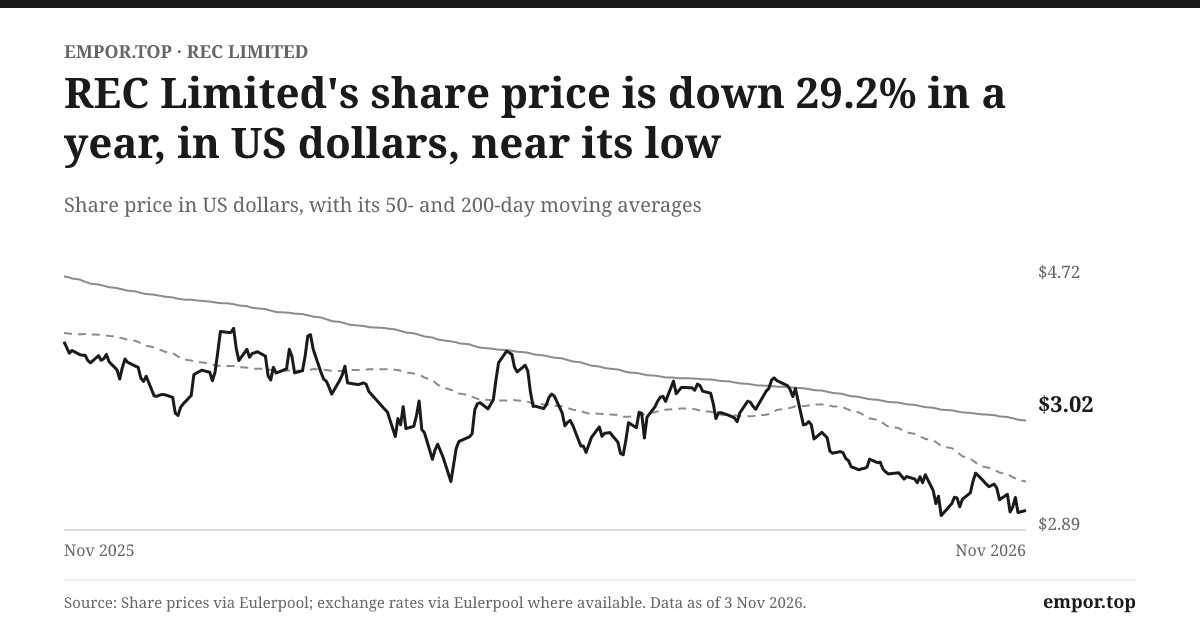
The market has already registered its doubts. On November 3, 2026, REC's shares closed at ₹286.90, about a quarter below their 52-week high, valuing the entire company at roughly ₹75,500 crore. That is less than 0.8 times the book value of its equity and under five times its last twelve months of earnings. For a lender that just posted record annual profit and carries the highest domestic credit rating, those are numbers that say investors either see something the income statement does not show, or are simply tired of waiting.
The merger adds a final twist. The exchange ratio was fixed in June, when REC traded near ₹365.5 Whatever an REC shareholder believes about the lender's future, the deal converts that belief into a bet on PFC's shares. The proposed effective date is April 1, 2027.2 Between now and then, REC remains what it has been since 1969: a state-built balance sheet trying to finance India's power system at a profit. The story of how it got here starts with a mandate that kept getting rewritten.
 Subscribe on LinkedIn
II. A Drought-Era Mandate, Rewritten for a New Power System
Imagine the original REC loan officer's job. A state electricity board in, say, Uttar Pradesh or Andhra Pradesh wants to string lines to a cluster of villages and connect a few thousand agricultural pump-sets. The project will never pay for itself on narrow commercial terms, because farmers pay little or nothing for power and politicians like it that way. But the project matters to the state, the board has a government standing behind it, and the money has to come from somewhere. REC's founding bargain was to be that somewhere: a specialist lender that took the state's development priorities and turned them into loan agreements with repayment schedules, appraisal reports and monitoring visits.6
For three decades, that bargain defined the institution. REC learned to lend to state utilities that were politically indispensable and financially weak, which is a peculiar skill. It is not the skill of a commercial bank, which can walk away from a bad borrower. It is the skill of a lender that knows it will be dealing with the same borrower, under the same state government, for decades, and must make the relationship work anyway. That skill is worth remembering, because it is both REC's competitive advantage and its central risk.
The rewrite came at the start of the 2000s. India's power deficit had become a national constraint on growth, and village wiring was not going to fix it. In 2002–03 REC's mandate expanded to include generation projects, and in that first year it sanctioned ₹661 crore for them.7 By 2005–06 annual generation sanctions had reached ₹6,006 crore, roughly nine times the starting level in three years.7 The rural electrifier had become a power-plant financier. Its mandate was later widened again to cover independent power producers and generation projects above 25 megawatts, and then transmission, distribution and wider power-related infrastructure.6
Why did the state rewrite REC's charter rather than build something new? Because REC already had what generation finance needed: a balance sheet, a relationship with every state utility, and a team that knew how to appraise long-dated power assets. The cheapest way to finance a national power build-out was to point an existing machine at a bigger target. That logic, using an established state lender as the vehicle for whatever the government's power priority happens to be, has repeated itself ever since, through rural electrification schemes, household connection drives, the revamped distribution programme and the rooftop solar push. REC has served as a nodal agency for several of these schemes, including the Revamped Distribution Sector Scheme, the Saubhagya household electrification programme and the Deendayal Upadhyaya Gram Jyoti Yojana.6
In March 2008, REC became a publicly traded company through an initial public offering while the government kept majority ownership.8 The listing gave it access to equity markets and a share price that would discipline it, at least in theory. In practice the IPO did not change who decided what REC was for. The government still appoints the chairman, still sets the dividend policy and still decides whether REC will carry out a scheme. Public shareholders bought a minority claim on a state instrument, not control of an independent bank.
The expansion carried an unresolved tension. Each widening of the mandate gave REC a larger market to lend into: generation was bigger than village wiring, and transmission plus distribution plus renewables plus infrastructure is bigger still. But each widening also pulled REC into new kinds of credit risk. Lending to private power plants exposed it to fuel shortages and to buyers who would not sign power-purchase agreements. Lending to distribution companies kept it tied to the weakest link in Indian power, the state utility that sells electricity below cost. Lending to infrastructure took it outside the sector it knew best.
By the mid-2010s, that tension became visible in the accounts. Stressed private power projects turned into bad loans, and as late as March 2024 REC's gross non-performing assets were still 2.7% of its book, almost all of it from private-sector borrowers.9 That stress was the legacy of the years in which India's private thermal power boom, financed generously in the late 2000s, collided with coal shortages and weak demand. REC had followed the state's priorities into generation, and the generation cycle punished it.
So the mandate gave REC something precious, a franchise that every new government power programme seemed to enlarge. It also gave it a recurring problem. Every enlargement came with risks that the state chose and REC had to carry. In 2019 the state made a different kind of decision about REC, one that had less to do with power and more to do with the government's budget.
III. The ₹14,500 Crore Takeover That Stopped Short of a Merger
In February and March 2019, India's finance ministry had a hole to fill. The government had promised a disinvestment target for the fiscal year, and the year was nearly over. Selling shares in the open market was slow and depended on market moods. Selling a state company to another state company was faster. On March 20, 2019, PFC announced that it had signed an agreement to buy the stake.[^10]
The price was ₹139.50 per REC share, about ₹14,500 crore in total.[^10] REC's shares had closed at ₹148.40 the previous day.[^10] PFC, in other words, bought control of its closest rival for about 6% less than the market's last price. Within days the deal was complete, and the government had its cash.10
It is worth sitting with that discount, because the usual story about controlling-stake purchases runs the other way. Buyers typically pay a premium for control, because control lets them change the business. Here the buyer paid less than the market price. One reading is that the government was not selling control in the ordinary commercial sense at all. It was moving REC from one pocket to another, since the state owned a majority of PFC and would continue to control REC indirectly. The other reading is that ₹139.50 reflected the market's mood toward a lender then carrying a meaningful stressed-asset book. Either way, the transaction price is a reference point, not a full valuation. It tells you what one state lender paid another, under a disinvestment deadline. It does not tell you what a free buyer would have paid for REC in an open auction, because there was no such auction.
PFC did not frame the deal as a balance-sheet shuffle. It argued that bringing the two lenders together would produce efficiencies in lending, combine complementary reach across borrowers and states, and let the two companies coordinate the resolution of stressed power assets that both had financed.[^10] The logic was plausible. The two lenders often financed the same projects, dealt with the same state utilities and competed for the same mandates. A combined group could stop bidding against itself.
Then nothing happened, at least not structurally. In January 2020, government officials said there was no road map yet for merging PFC and REC.11 The obstacle, as the 2026 debate would make plain, was not mysterious. Merging the two companies by share swap would dilute the government's direct holding in the combined entity, and the government needed to keep a majority to preserve the company's status as a government company.12 Two years after the purchase, PFC's own offering circular for foreign bond investors was candid about what the acquisition had and had not delivered. It warned investors that there could be no assurance the expected benefits of the REC acquisition would be realized.[^14]
That "no assurance" language is the most useful sentence in the whole 2019 episode, because it is the acquirer's own falsification of the acquirer's original pitch. The synergies PFC described were promises. Seven years later, the companies still raise money separately, still sanction loans separately and still report separately. When the government revived the merger in its February 2026 budget, it was making a second attempt at the integration PFC had described in 2019, not formalizing savings already in hand.13
What did the 2019 deal change? Control, certainly. PFC placed a nominee on REC's board14, and for a stretch PFC's chief executive, Parminder Chopra, held additional charge as REC's chairman.15 Strategic coordination likely improved, since both companies now answered to one parent on the most important questions. Credit agencies began rating the two lenders on a combined basis, treating them as a single group with sovereign backing.6 But the operating machinery of REC, its bond issues, its appraisal teams and its relationships with state utilities, carried on largely as before. For a public shareholder in REC, the main effect was that the controlling owner had changed from the government to a government-controlled lender with overlapping interests.
That overlap matters for the rest of this story. When two lenders under the same parent compete for the same borrowers, someone has to decide who gets the deal and at what price. Group-level coordination can help both, or it can direct the more attractive loans to whichever entity the parent prefers. REC's public shareholders have never had a disclosed answer to that question. For seven years, REC kept making its own lending and funding decisions inside a group that someone else controlled. To judge how well it used that freedom, you need to know how REC actually makes money.
IV. Where REC’s Earnings Come From
Follow a single loan. A state transmission company needs money to build a high-voltage line connecting a new solar park to the grid. It approaches REC, which appraises the project, checks the state government's support, and sanctions a loan. Sanction is a promise, not money. Disbursement comes later, in tranches, as construction progresses. From that point the borrower pays interest, typically for a decade or longer, and eventually repays the principal.
To fund that loan, REC borrows. It sells bonds to Indian insurers, pension funds and banks; it takes term loans from banks; and it borrows abroad in dollars, euros, yen and Singapore dollars.14 It earns the gap between what it charges borrowers and what it pays lenders, and it keeps a slice of its own equity behind every loan to absorb losses. That is the whole business. REC does not manufacture anything, and it has almost no fixed assets. It is a balance sheet that converts borrowed money into power infrastructure and earns a spread.
The scale is the first thing to grasp. At the end of March 2026, REC's loan book stood at ₹5.84 lakh crore.3 In the first half of fiscal 2027, its loans yielded 9.57% while its money cost 7.19%, a spread of 2.38 percentage points.4 Because REC also funds part of its book with its own equity, on which it pays no interest, its net interest margin, the income it keeps after funding costs as a share of its loan assets, came to 3.22%.4
Those few percentage points are the engine. On a book of about ₹6 lakh crore, each tenth of a percentage point of margin is worth roughly ₹600 crore a year of pre-tax income. That arithmetic is why a seemingly small shift in loan pricing can move REC's profit far more than any change in its costs. Operating expenses barely register; REC's entire fixed-asset base is under ₹1,000 crore.16 The things that decide whether REC has a good year are, in order, how fast the loan book grows, what it pays for money, what it can charge, how many borrowers repay early, and how many stop paying altogether.
The book's shape explains where the risk lives. In June 2026 transmission and distribution made up about 46% of REC's loans, conventional generation about 25%, renewables about 13%, infrastructure about 10% and other lending about 6%.9 The distribution share is the important one. Distribution companies are the utilities that buy power, sell it to households and farmers, and collect the bills. In India they are mostly state-owned and chronically short of cash, because many states set tariffs below cost for political reasons. REC's largest single exposure category is, in effect, the weakest part of the power chain, backed by the strongest promise in it: the state government.
Interest income looks recurring, and in one sense it is. A performing ten-year loan pays interest every quarter. But it is recurring only while the loan stays on the books and keeps paying. Fiscal 2026 showed how fragile that is. REC disbursed a record ₹2.11 lakh crore, and yet prepayments of close to ₹1 lakh crore wiped out much of the effect on the book.4 Borrowers who could refinance more cheaply, often with banks, did so. A rupee prepaid is a rupee that stops earning REC's spread, and it has to be re-lent just to keep the book the same size. That is why REC's loan book grew only modestly in fiscal 2026 despite record lending, and why standalone profit rose less than 4% that year.9
The cash-flow statement makes this business look stranger than it is. In most years, REC reports large negative operating cash flow: about ₹39,000 crore negative in fiscal 2025, swinging to roughly ₹6,000 crore positive in fiscal 2026.16 For an industrial company, years of negative operating cash flow would be a warning that profits are not turning into cash. For REC, the explanation is mechanical. Loans it disburses are recorded as operating outflows, and the borrowings that fund them appear as financing inflows. When REC grows, operating cash flow goes negative; when the book stands still or prepayments surge, it turns positive. Free cash flow in the industrial sense is the wrong lens. The right ones are the growth of the loan book, the stability of the margin, and the quality of the loans.
The same caution applies to the familiar industrial ratios. REC's trade receivables, the money it is owed for services rather than loans, were just ₹293 crore in March 2026, a rounding error beside the loan book.16 The swings in its "debtor days" over the past decade say nothing about credit quality. What matters is loan staging, which is the accounting system that sorts loans into healthy, under watch and impaired, and the provisions REC holds against them.
There is one more lever: foreign currency. Part of REC's funding comes from overseas, which exposes it to the rupee falling. REC hedges almost all of it. At March 2025, of about ₹14,900 crore of dollar exposure, only ₹73 crore was unhedged.14 Currency risk, in other words, is largely transferred to the cost of hedging rather than left open, which means it shows up as a slightly higher cost of funds rather than as a surprise loss.
Put together, the economics are simple and unforgiving. REC earns a thin spread on an enormous amount of borrowed money, and its return on equity, about 17% in the first half of fiscal 2027, comes from using between five and six rupees of debt for every rupee of equity.4 That leverage is normal for a lender of its kind, and REC's capital adequacy ratio of 24% is well above the regulator's 15% floor.4 But it means a small change in margin or credit losses swings equity returns sharply. A long-term lender can be indispensable to its borrowers and still be squeezed by them, and that is exactly the pressure analysts pressed on during the October call.
V. The Advantage of Being a State Lender—and Its Price
Midway through the October call, Sanket Chheda of DAM Capital raised a question that cut to the bone. He described an account in southern India where another lender had offered the borrower a lower rate. What would REC do?4 The answer from Rajesh Kumar, REC's director of finance, was confident: he did not expect pressure on yields, because most of REC's assets reset within a year or are linked to benchmarks.4 Srivastava was more candid about the backdrop. The environment, he said, was "full of competition," and banks were "flushed with liquidity."4 His consolation was structural. Banks have sectoral limits on how much they can lend to power, so "they will not be able to lend beyond a point."4
That exchange is the competitive question in miniature. REC's defenders say it has an advantage no commercial lender can match. Its critics say it is a large, cheap-funded lender whose borrowers can, and increasingly do, shop around. The evidence supports a narrower version of both views.
Start with who REC lends to. In June 2026 about 84% of its loan book was owed by state-sector entities, and the ten largest borrowers accounted for about 37%.9 That concentration has barely moved in two years: the top ten were about 40% in March 2024 and 36% at the end of 2024.6 In other words, REC's fortunes rest on a few dozen state utilities and generation companies, most of them owned by state governments, and on the willingness of those governments to stand behind their debts.
Now consider the competitive set. The closest rival is PFC, which lends to the same utilities, raises money from the same bond buyers and enjoys the same sovereign ownership. Since 2019 it has also been REC's parent, which means the most important competition REC faces is from inside its own family. At the other end is the Indian Renewable Energy Development Agency, a much smaller state-owned specialist in renewable lending. And then there are the banks: State Bank of India and the other public-sector banks, which have deposits, branches and, lately, more liquidity than they can comfortably deploy. When banks have surplus funds and power utilities are seen as safer than before, those banks will chase the best power loans at rates REC cannot match without cutting its spread.
What can REC genuinely defend? Four things stand out. The first is long-term capacity. A transmission line or a pumped-storage hydro project needs money for fifteen years or more, and banks funded by short-term deposits are reluctant to lend that long. REC funds itself with long-dated bonds, so it can match a long loan with long money. The second is scale and appraisal know-how in a narrow sector. Few lenders in India have appraised as many power projects. The third is the scheme role. REC's position as a nodal agency for national electrification and distribution programmes gives it a seat at the table when states plan their power spending.6 The fourth is funding cost. Because investors see REC as an extension of the state, it borrows close to sovereign rates.9 Exposures backed by state-government guarantees also carry lower risk weights, which stretches each rupee of REC's capital further than it would otherwise go.6
Those advantages are real. The question is whether they add up to what an investor would call a moat: an advantage that lets REC earn higher returns than competitors for a long time. Here the evidence is thinner.
Take switching costs. A state utility that borrows from REC is not locked in. It can refinance with PFC, with a bank, or with bonds of its own if its state guarantees them. The surge of prepayments in fiscal 2026 is the clearest evidence that borrowers do switch when cheaper money appears.4 A lender with lock-in would not see borrowers repay early on that scale.
Take pricing power. If REC had it, its spread would hold or widen as it grew. Instead, management told analysts in October that "there will be pressure on my NIMs," and that REC would be "very happy" if it could maintain its margin at 3.22%.4 Srivastava also said REC was "passing on whatever de-risking is happening in the sector" to borrowers.4 That is an honest description of a competitive market. As state utilities have improved their payment record under recent reforms, their credit risk has fallen, and that benefit is flowing to the borrower as lower rates rather than staying with the lender as higher returns.
Take bargaining power. In a classic five-forces framing, REC's buyers are powerful. They are few, large and politically connected, and their owners, the state governments, also shape the policy environment REC operates in. Suppliers of capital are numerous and competitive, which keeps REC's funding cheap, but that benefit is shared by every AAA-rated state lender. The threat of new entrants is low, since nobody new can conjure a sovereign-backed balance sheet of this size, but substitutes are abundant, because a utility's alternative to an REC loan is a bank loan or a bond. Rivalry is intense between REC, PFC and the banks. The picture is of an industry with high barriers to becoming a lender of REC's size and low barriers to taking any single loan away from it.
Hamilton Helmer's seven powers point the same way. REC visibly has scale economies, since its operating costs are tiny relative to its book, and a form of policy access that resembles a cornered resource, its nodal-agency status. But scale economies in lending mostly lower operating costs, and those were never the main cost; the cost of money is, and REC shares that advantage with every comparable state lender. The nodal role, meanwhile, gives REC information and relationships, not exclusive rights to lend. No evidence shows durable switching costs, network effects, a brand that lets REC charge more, or a process advantage that lowers its credit losses below peers'. What remains is counter-positioning in one narrow sense: REC can lend for longer than deposit-funded banks are comfortable with. That is a real edge, but it shrinks whenever banks decide long-dated power loans are safe.
So the verdict is that REC has a credible access and scale advantage in public power finance, but that the evidence for pricing power or customer lock-in is weak. Its AAA rating and government role guarantee that it can raise money cheaply; they do not guarantee that it can lend that money at an attractive margin. The skeptic's question is hard to escape. If the state connection is the moat, what stops banks and other public lenders from taking the safest borrowers, leaving REC with the riskier ones or forcing it to cut prices? Management's answer, bank sector limits, is a genuine constraint but a soft one, because limits can be raised and banks' power exposure has room to grow.
The KPI that will settle this is the net interest margin, now 3.22%. If REC holds it near that level while growing its book by double digits, the access advantage is translating into economics. If the margin slides as growth returns, the advantage is mostly volume, bought with price. That test is already playing out in the part of the business REC most likes to talk about: renewable energy.
VI. Renewables Grow; The Core Book Remains Broader
In May 2023, REC's then chairman Vivek Kumar Dewangan set out a target that sounded like a declaration of transformation. REC would more than double its loan book to ₹10 lakh crore by 2030, and roughly 30% of that, about ₹3 lakh crore, would come from renewable energy.17 At the time, REC's renewable loans were about ₹29,000 crore, under 7% of its book.18 The plan implied a tenfold increase in green lending in seven years. Two years later, his successor Jitendra Srivastava restated the same ambition: a ₹10 lakh crore book by 2030 with ₹3 lakh crore earmarked for renewables.19
The ambition has real momentum behind it. Renewable loans reached about ₹53,000 crore by March 2025, ₹80,823 crore by March 2026, and ₹86,660 crore by September 2026.1994 That is roughly a threefold rise in three and a half years, and the green book grew about 27% in the year to September 2026, far faster than REC's overall book.4 The mix is diverse: solar accounts for about 35% of renewable loans, hybrid projects 18%, pumped-storage hydro 14% and conventional hydro 13%.4 Pumped storage, which uses surplus power to pump water uphill and releases it through turbines when demand peaks, is the kind of long-lived, capital-heavy asset that suits a long-term lender. Renewables also made up 17% of REC's disbursements in the September quarter.4
So the affirmative case is not imaginary. India is building solar and wind capacity at a pace that requires enormous amounts of long-term debt, and REC is increasingly where some of that debt comes from.
Now the materiality test. At March 2026, renewables were about 14% of REC's loan book.9 The other 86% was distribution, transmission, conventional generation and infrastructure. Even at its recent growth rate, the green book remains a minority of REC's earning assets for years to come. A minority of the book also means an even smaller and undisclosed share of profit, since REC does not report profit by segment and management declined on the October call to give yield differences by sector beyond saying conventional generation earns slightly more.4 Renewable lending is growing fast, but it is not yet what drives REC's earnings.
The historical test is harsher. The 2030 targets were set when REC's total book was ₹4.35 lakh crore.17 Reaching ₹10 lakh crore by 2030 required growth of roughly 12.5% a year. In the three years to March 2026, REC grew its book at about 10% a year, and in the year to September 2026 it grew about 6%.4 To reach ₹10 lakh crore from ₹6.17 lakh crore by March 2030, REC now needs roughly 15% annual growth for three and a half years, faster than anything it has delivered recently. The renewable target is even steeper.
Getting from about ₹87,000 crore to ₹3 lakh crore by 2030 requires the green book to grow by about 40% a year, against the 27% it has managed. The target was never a contract, and REC described the renewable figure as a non-binding commitment.19 Its own record suggests the goal is better read as a direction than a forecast. Reports at the time did not even agree on the number: one account of the original announcement put the renewable target at ₹2.4 lakh crore rather than ₹3 lakh crore.18
It is also worth separating the things REC announces from the things REC books. Memoranda of understanding with developers, capacity "supported" and sanctions are all signals of intent. They are not loans, and they are certainly not income. Only disbursed, performing loans earn the spread.
What about the other new frontier? In fiscal 2023, REC and PFC changed their founding documents so they could lend beyond power, into roads, ports, metro rail and other infrastructure.6 It was a strategically significant move, since it widened the pool of borrowers REC could reach as power spending cycles rise and fall. But infrastructure was about 10% of REC's book in mid-2026, around ₹62,000 crore, and it grew about 6% over the half-year.94 It is a useful diversifier. It is not the growth engine.
There is also a trade-off REC does not hide. It continues to finance coal and other conventional generation alongside renewables, and conventional generation is still a quarter of its book.9 On the October call, its director of projects pointed to a national plan requiring a minimum of about 80 gigawatts of new capacity and an REC funding target of ₹1.8 to ₹2.2 lakh crore by 2031–32 for generation.4 For India, which still needs coal to meet peak demand, that is a pragmatic stance. For investors who screen for climate exposure, it means REC is a power-sector lender with a growing green book, not a green lender.
The renewables story, then, is plausible future materiality rather than current earnings dominance. If REC can grow green lending at 25–30% a year without sacrificing margin, renewables will become a meaningful share of its profit by the end of the decade. But growth in any lending book is only as good as the repayment at the end of it, and REC learned that lesson the hard way, in the years when its earlier generation boom went wrong.
VII. Low Impairments After a Stress Cycle
The cleanup began from the 2.7% gross NPA level reported in March 2024.9 By March 2026 the figure had fallen to 0.24%.9 By September 2026, management was reporting gross credit-impaired assets of 0.22% and net credit-impaired assets, after provisions, of 0.11%.4 On the October call it added a line it clearly enjoyed saying: there had been no new NPA "from last 19 quarters of REC operations."4
Those numbers describe a remarkable cleanup. The question is what kind of cleanup it was, and whether the low readings prove that REC's underwriting is safe or merely that the last cycle has been worked through.
The record answers the first part. The improvement came largely from resolving old stressed loans rather than from a portfolio that never went bad. Most of the stressed accounts were private power projects financed in the 2000s and early 2010s, which ran into coal shortages, cancelled supply agreements and weak demand. Many went to India's insolvency courts. At the end of December 2025, eight of the ten projects in REC's impaired category, worth about ₹5,110 crore, were being resolved through the National Company Law Tribunal.6 Then, in the following quarter, large stressed accounts were resolved, and the gross ratio collapsed from about 0.9% at December 2025 to 0.24% at March 2026.69 The credit agencies attribute the improvement to negligible fresh slippages over three years, resolution of a few stressed accounts, and a growing book that dilutes what remains.6
That combination tells the story honestly. Part of the falling ratio is workout success: old bad loans were sold, restructured or recovered. Part is denominator growth: a bigger book makes the same bad loans look smaller. And part is genuinely clean new lending, since the most recent cohorts of loans have not defaulted. Only the last part says much about the future.
The structural risk has not gone away. The book remains heavily concentrated in state-sector borrowers and its ten largest accounts.9 India's state distribution utilities have a long history of running up losses, being bailed out by their state governments, and then running up losses again. Under recent reforms, including the Revamped Distribution Sector Scheme that REC helps administer, their payment discipline has improved. But a utility's finances depend on tariffs set by state regulators under political pressure. A drought that raises farm power demand, an election promise of free electricity, or a spike in coal costs can all strain them quickly. The rating agencies flag that concentration toward relatively weak state utilities as the chief vulnerability of the REC and PFC group.6
Historically, state-sector loans have rarely turned into outright losses for REC, because state governments have usually stepped in before a default became final. That is the real meaning of "sovereign support" in this business. It is not a legal guarantee on every rupee. It is a pattern of behavior that has held so far. Investors in REC are, in effect, betting that the pattern continues.
There is a puzzle in the latest numbers worth naming plainly. On the October call, an REC executive said that "whatever NPA are there as of now are all in the state sector."4 That is the opposite of what the credit agencies reported. ICRA described the entire credit-impaired portfolio as coming from the private-sector book at the end of December 2025, and CRISIL, writing in October 2026 about June figures, said about 1.5% of REC's private loans were in the impaired stage with about 51% provision coverage.69 Simple arithmetic on CRISIL's figures, 1.5% of a private book that is about 16% of total loans, comes to roughly 0.24% of the whole book, almost exactly the overall gross ratio.
In other words, as of June, the impaired assets appear to have been private. Only one small resolution, a project worth about ₹4 crore, was reported in the September quarter.4 Either a meaningful state-sector account slipped and a private one was resolved in that quarter without being described, or the remark on the call was a misstatement. REC has not reconciled the two. Until it does, the sector attribution of its remaining bad loans should be treated as unresolved, and investors should watch the next disclosures closely.
A second, more encouraging signal sits one level below the impaired category. Lenders in India classify loans in three stages: stage 1 for healthy loans, stage 2 for loans showing early signs of trouble, and stage 3 for impaired loans. In the September quarter, REC's stage 2 loans fell from about ₹12,350 crore to about ₹3,235 crore, and stage 1 accounted for about 99.26% of the book.4 A falling stage 2 bucket means fewer loans are queuing up to become tomorrow's bad debts. That is the most forward-looking credit data point REC publishes, and right now it is moving the right way.
Provisions tell the rest. REC holds about 51% coverage against its impaired loans, and about 0.85% against its healthy stage 1 book.4 That 51% coverage is modest by the standards of Indian banks, but it is applied to a much smaller pool of bad loans, and REC's net worth of about ₹94,000 crore is more than 100 times its net impaired assets.49 The cushion is large relative to today's problems. Whether it is large relative to a future state-utility crisis depends on the scale of the crisis and on whether state governments keep stepping in.
REC's debt was about ₹5.27 lakh crore at September 2026.4 For an industrial company, that would be alarming. For a lender, borrowings are the raw material of the business, and the right questions are different: does REC hold enough capital against its risk-weighted loans, are its loans performing, and can it keep borrowing? Its capital adequacy ratio remained well above the regulatory minimum.4 It retains AAA domestic ratings and investment-grade international ratings.94 On all three, REC is in sound shape today.
The calibrated verdict is that asset quality has improved materially, but the stress cycle that preceded it is too recent and the book too concentrated to call the risk gone. The 19-quarter streak with no new NPA is a management claim with supporting evidence from the agencies, which have noted negligible fresh slippages. But that streak covers a period of unusually strong support for state utilities and a power market short of capacity, which is the most favorable backdrop REC is likely to see. The real test is the next downturn. The data to watch are stage 2 movements, any new slippages, and the progress of recoveries in the tribunal cases. Those numbers will decide whether the cleanup was a cycle or a change. And whether investors trust management's account of them depends on how that management has behaved when the news was less good.
VIII. The Current Team’s Test: Growth Without a Margin Promise
Jitendra Srivastava did not come up through banking. He is a 2000-batch officer of the Indian Administrative Service from the Bihar cadre, the elite civil service that staffs India's ministries and state governments.15 Before taking charge of REC on April 22, 2025, he was a joint secretary in the Department of Drinking Water and Sanitation at the Ministry of Jal Shakti, and before that he had run Bihar's home department and its public health engineering department.20 He studied economics at Hansraj College in Delhi and took an MBA in finance from the Cochin University of Science and Technology.20 He was appointed by the Appointments Committee of the Cabinet, in the rank and pay of an additional secretary to the Government of India, and he replaced PFC's chairman Parminder Chopra, who had been holding REC's top job as an additional charge.1520
That biography explains the governance model better than any organization chart. REC's chief executive is a senior civil servant chosen by the government, paid on a government scale, and accountable in the end to the Ministry of Power. He is not a founder, he owns no meaningful stake, and his pay is not tied to the share price in the way a private-sector chief executive's would be. That is not a criticism; it is the design. But it means investors should judge management by what it says and delivers, not by any alignment of ownership. The same logic applies to dividends: REC pays out at least 30% of profit, a ratio mandated by the government rather than chosen by the board, and it paid ₹18.55 per share for fiscal 2026.4
So how has this management behaved?
On the October call, the prepared remarks were upbeat and the Q&A was more revealing. The opening presentation stressed a record loan book of ₹6.17 lakh crore, disbursements up 67% from the previous quarter, a stable margin and falling bad loans.4 Srivastava said REC was hopeful of showing growth of "around 12%-13%" by the end of the year, and elsewhere described "a high growth of over 10%-12%."4 He said REC aimed to disburse more than ₹2 lakh crore over the year and hoped to beat the previous year's record.4 But the starting point was a book that had grown about 6% in the first half.4 To hit 10% to 12% for the year, REC needs a second half considerably stronger than its first.
The guidance on margins was more sober, and that is to management's credit. Srivastava reiterated that REC would be "very happy" to hold 3.22%, and argued that holding such a margin on a book of over ₹6 lakh crore would be hard for peers to match.4 Rajesh Kumar, the finance director, was more optimistic, saying he did not expect pressure on either yields or borrowing costs.4 Those two statements do not sit easily together. One says margins will be squeezed; the other says neither side of the spread is under pressure. Investors should weigh the chairman's caution more heavily, since the profit decline already in the numbers supports it.
The numbers behind that caution are stark. Consolidated profit in the September quarter fell 21.2% from a year earlier, to about ₹3,478 crore, while revenue slipped about 1%.1 For the half-year, profit fell about 14%.1 Those falls happened despite a growing loan book, which means the earnings pressure came from somewhere other than volume, chiefly margin and the costs of holding more provisions and running a larger book. Management's explanation of prepayments, that they "have peaked out," is a forecast, not a fact.4 Prepayments were around ₹20,000 crore in the first half, by management's account, far below the previous year's pace, which supports the claim so far.4
On the merger, the answers were carefully limited. Asked whether double-digit growth would continue in the combined company, Srivastava said he would not "hazard and put a figure for the merged entity right now."4 That is reasonable caution from a chairman whose company may cease to exist within months. It also means REC's shareholders are being asked to accept a share swap without any guidance on what the combined business will earn.
Governance carries a recorded lapse. From December 27, 2024 to March 31, 2025, REC's audit committee and its nomination and remuneration committee did not have the required number of independent directors.14 For a listed lender, those are the two committees that matter most: one oversees the accounts and the auditors, the other oversees appointments and pay. The cause lies in how state companies are run. Independent directors on the boards of central public-sector companies are selected through the government, and when their terms lapse, the company cannot simply fill the seats itself. The lapse ran until the end of that fiscal year, when the gap was closed.14 The episode is a documented failure with a recorded response, and it illustrates a real limit: REC's governance quality depends partly on how quickly a ministry acts.
Shareholder votes offer little independent signal. Because PFC owns 52.63% of the shares, routine resolutions at REC's annual meetings pass regardless of how the public votes.21 The more useful indicator is the merger vote ahead, where the size of the public shareholders' support or dissent will reveal how minority investors view the exchange terms.
Taken together, this management team's record is short but relatively candid. It has acknowledged margin pressure, refused to guide on the merged entity, and admitted that competition is fierce. The test now is execution: a 10% to 12% growth target from a 6% first half, and a margin held near 3.22% while banks press on price. Those are measurable promises, and the next two quarters will grade them. The larger promise, though, belongs to the government and PFC: that merging the two lenders will make the combined business stronger.
IX. The Merger Returns—with a Fixed Exchange Ratio
On Sunday, June 28, 2026, the boards of PFC and REC met and approved a scheme to merge REC into its parent.2 The road to that meeting had been laid months earlier. In the Union Budget in February 2026, the government flagged a restructuring of the two power lenders, and on February 6 PFC's board gave in-principle approval to a merger.1322 On June 10, the Ministry of Power conveyed the President's approval of the proposal.22 By the time the boards met, the decision was essentially political, already made at the top.
The terms were simple to state. REC shareholders would receive 88 PFC shares, each with a face value of ₹10, for every 100 REC shares they held.5 REC would be dissolved, its shares cancelled, and all its assets and liabilities transferred to PFC.2 Two valuation firms, RBSA Valuation Advisors and Ernst & Young Merchant Banking Services, prepared joint valuation reports, and fairness opinions came from SBI Capital Markets for PFC and Nuvama Wealth Management for REC.2 The combined company would have a loan book above ₹11 lakh crore.5 The proposed effective date was April 1, 2027, provided approvals arrived in time.2
The difference between this attempt and 2019 is worth stating clearly. In 2019 PFC bought control but left REC as a separate listed company. This time the plan is a formal legal merger under India's company law, with valuation reports, regulatory filings and a timetable. That makes it far more concrete. It does not make it inevitable. In October, the RBI and the stock exchanges issued their no-objection letters, but the scheme still needs approval from shareholders and creditors of both companies, the securities regulator, the company-law tribunal and other authorities.12
Start with the exchange ratio, because that is what a public REC shareholder actually receives. On June 29, the first trading day after the announcement, REC closed at ₹365 and PFC at ₹424.40.5 At those prices, 88 PFC shares were worth about ₹37,350, against ₹36,500 for 100 REC shares, so the ratio offered REC holders a premium of a little over 2%. In effect, the deal swapped REC shares for PFC shares roughly at market value. REC's shareholders got no meaningful control premium, which is unsurprising since PFC already had control.
Is that fair? The honest answer is that the market price is one reference, and the valuation reports are another, but neither has been published in full. This is a share swap between two lenders already under common control, not a cash acquisition. There is no industry purchase multiple to compare against, and claiming that one side overpaid would require comparing the two companies' relative profitability, asset quality, capital and growth around the time the ratio was set. The two lenders earn almost identical returns on the assets they manage, about 2.7% a year on the credit agencies' reckoning, and lend to the same kinds of borrowers, so a ratio near the market price is defensible.6 The relevant risk for REC holders is different. Once the ratio is fixed, REC's value floats with PFC's share price. A REC shareholder who wanted exposure to REC specifically will instead own a slice of a bigger lender with PFC's mix of borrowers and PFC's own exposures.
Then there is the thorny question of control. The government owns about 56% of PFC.12 When REC's public shareholders receive new PFC shares, the government's percentage stake in the combined company falls. One report in August 2026 put the government's expected ordinary stake after the merger at around 37%.23 Yet the scheme requires that the merged company remain a "government company," with the Government of India holding majority voting rights directly or indirectly.5 Officials have discussed issuing preference shares or fresh equity to the government, and the August report described a plan for special shares with superior voting rights, possibly ten votes each, alongside redeemable preference shares, to restore the government's majority vote.1223 On the October call, a Motilal Oswal analyst noted that remaining a government company was a prerequisite for both boards' approval.4
This matters to public shareholders for two reasons. First, special voting shares would separate economic ownership from control: the government could keep majority votes while owning a minority of the economics. Second, any fresh equity or preference capital issued to the government would affect the per-share value of what REC holders receive. Neither mechanism had been finalized when the scheme was approved. CRISIL, for its part, lists PFC's shareholding falling below 50% in REC as a potential trigger for a downgrade, and the merged entity's government-company status as a condition of the scheme.9 The control question is not a technicality. It is the reason the 2019 merger never happened.
Now the synergy case. The case for merging rests on a few claims: lower borrowing costs through a single, larger issuer; streamlined lending processes; less duplication of staff and offices; and a stronger position from which to finance large projects. Some of these are credible. Two lenders that lend to the same utilities and frequently co-finance the same projects, such as a large thermal project shared between them, should save something by appraising each loan once instead of twice.4 Srivastava said the merged entity would have "very significant synergies" as a single power financier of around ₹12 lakh crore.4
But stress-test each claim and the gains look smaller than the headline. Borrowing costs are already close to sovereign levels for both lenders, so there is limited room to fall. Operating costs are already a tiny share of income, so even large percentage savings would barely move profit. Meanwhile, the merger creates new constraints. Indian banks and other lenders face limits on how much they can lend to a single borrower or group. ICRA has flagged that the group's ability to raise incremental funds could be challenged by lenders' exposure limits.6 Mint argued that the merger would narrow India's corporate bond market, since two of its largest issuers would become one.24 The combined lender will also face the RBI's large-exposure limits on its own lending, which constrain how much it can lend to any one state utility, and a merged book means merged exposures to the same borrowers. The capital buffer will be larger in absolute terms, but so will the concentration.
The cleanest way to see the merger is to separate group effects from what a REC shareholder owns today. REC's ₹5.84 lakh crore book at March 2026 is its standalone scale.3 The ₹11 lakh crore figure belongs to the combined group, much of which PFC already consolidates. The merger does not create that scale; it changes who owns which slice of it.
What remains contingent is a long list. Shareholders and creditors of both companies must approve. The tribunal must sanction the scheme. The government must decide how it will keep majority control, and whether that requires fresh capital or special shares. And then, after all that, the combined company must actually deliver savings that PFC first promised in 2019 and never produced. Until those numbers appear, the synergy case is a hypothesis. That leaves investors with the larger question of what REC, merged or not, is actually worth.
X. Analysis & Bear vs. Bull Case
Fiscal 2026 ended with a record. REC's standalone profit of ₹16,282 crore was the highest in its history, its loan book was larger than ever, and its bad-loan ratio was the lowest in a decade.39 Then, six months later, quarterly profit was down by a fifth and the share price had fallen a quarter from its high.1 Both of those facts are true at once, and the stock's valuation reflects the tension between them.
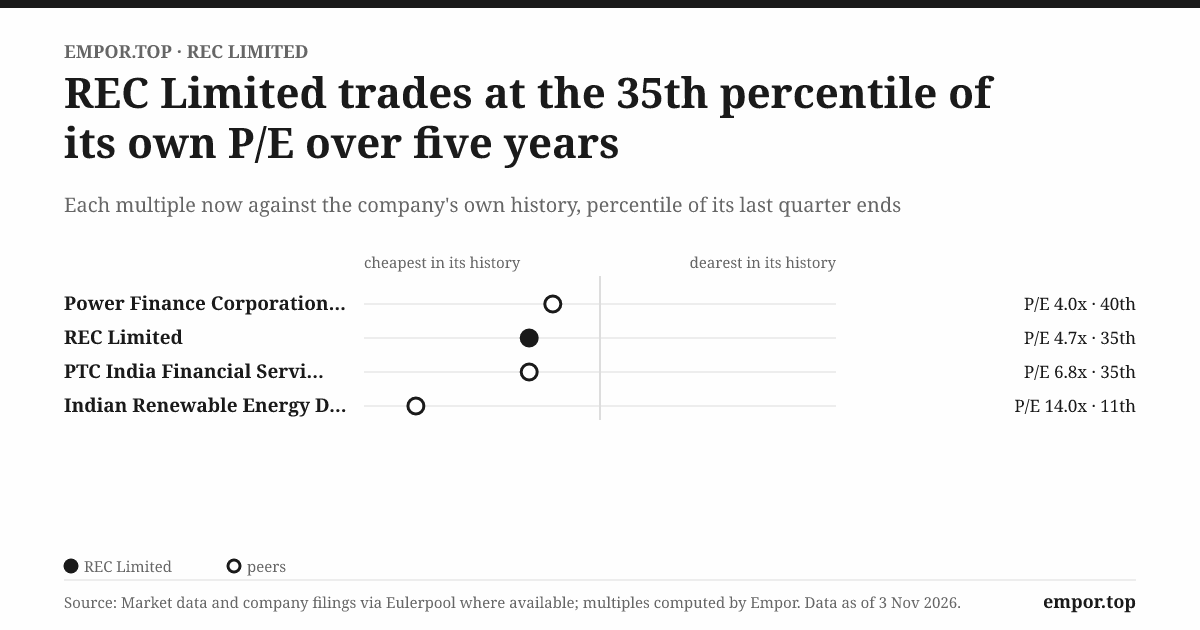
At ₹286.90, REC trades below its own five-year median earnings multiple of about 5.6 times and at about 0.8 times book value, against a book value of about ₹358 per share at September 2026.4 Its dividend yields about 4.7%. Put plainly, the market is paying less than the accounting value of REC's equity for a company that earns a high-teens return on that equity. Either the market expects returns to fall sharply, or it doubts that the book value is worth what the accounts say, or it is pricing in a risk that does not show up in current earnings.
The bull case is built from four strands. First, India's power sector needs enormous amounts of long-term capital. Transmission lines to connect renewable capacity, pumped storage to balance it, distribution upgrades and new conventional plants to meet peak demand all require debt that banks are reluctant to provide at long tenors. REC is one of the two institutions best placed to provide it. Second, REC's funding cost is close to sovereign, its capital adequacy is comfortable and its credit ratings are top-tier, so it can keep growing without raising equity. Third, its reported asset quality has improved dramatically, and its early-warning loans have fallen. Fourth, its renewable book is growing quickly. On this view, the recent profit decline is a pause caused by prepayments and margin pressure, and a company earning 16% to 17% on equity should not trade at less than book.
The bear case is equally coherent. REC's borrowers remain concentrated in state-sector entities.9 Its return on assets is low, about 2.5% to 2.6%, and its higher return on equity comes from leverage.9 That structure makes earnings sensitive to small changes in margin or credit cost. Its margin is under pressure from banks with surplus liquidity, and management itself has told investors not to expect it to rise. Its 2030 targets assume growth faster than it has recently achieved. And the merger introduces uncertainty about the final shape of the company REC holders will own, including how the government will retain control. On this view, a low multiple is not a bargain but fair compensation for a lower-return, concentrated, policy-exposed lender.
The skeptical investor's challenge remains the crux of the case: REC's access and scale have not translated into pricing power. The fiscal 2026 prepayment wave showed that borrowers refinance when they can get cheaper money. That distinction, first exposed by the bank competition raised on the October call, remains the crux of the investment case.
How does one interpret the valuation, then? The discount to REC's own history partly reflects weaker near-term growth: profit grew only about 3% to 4% in fiscal 2026 and fell in the first half of fiscal 2027, compared with roughly 13% to 14% annual growth over the previous three and five years.16 A lower multiple on slower growth is not irrational. The discount to book is harder to explain on earnings alone, since REC's return on equity is well above any plausible cost of equity. It is consistent with investors attaching a meaningful probability to a future credit event in the state-utility book, or to returns being competed away, or simply to the governance discount that many investors apply to state-owned lenders. The historical comparison cannot tell which explanation is right. It only tells us that the market is more skeptical than it has been on average over five years.
Two traps are worth avoiding. REC's negative free-cash-flow yield reflects loan growth, and its debtor-days swing reflects how data providers classify a lender's balance sheet, not a change in how borrowers pay.
Three numbers will decide which case wins. The first is loan-book growth net of prepayments, which was about 6% year on year at September 2026, against management's target of 10% to 12% for the full year.4 Disbursements alone flatter the picture; only net growth earns more spread. The second is net interest margin, which stood at 3.22% for the first half; management's stated aim is to hold it there.4 A margin sliding below that level as growth picks up would confirm the bear case on pricing. The third is credit migration: fresh slippages, stage 2 movements and recoveries. At September 2026, gross impaired assets were 0.22% and stage 2 had fallen sharply.4 A reversal in stage 2 would be the earliest sign that the cleanup is ending.
The case, then, comes down to whether REC can grow its loans at a double-digit pace without giving away margin or taking on bad credit. Its history shows it can do one or two of those at a time. Doing all three at once, in a market full of competitors and under a merger, is the test ahead. What REC's long history teaches is less about the numbers and more about the nature of a lender built by the state.
XI. Playbook: Business & Investing Lessons
REC began with the state financing electricity for farmers. Its later pivots—from generation to the IPO, the 2019 takeover and the proposed 2026 merger—also followed government decisions. The scale of that mandate is evident in the gap between its first-year generation sanctions and its fiscal 2026 loan book.73 Its lessons are about what that kind of franchise can and cannot do.
The first lesson: a public mandate can be a distribution advantage, but it does not make the borrower solvent. REC's nodal-agency roles and state relationships give it strong access to India's power utilities. But the private power projects it financed in the boom years went bad, and the cleanup required insolvency proceedings. Access to borrowers and the quality of borrowers are different things. For investors in any state-linked lender, the question is never just whether the institution can reach the customer, but whether the customer can repay.
The second: a bigger balance sheet only creates value when the spread survives the growth. Fiscal 2026 showed the risk: record disbursements translated into only modest profit growth as prepayments and margin pressure offset volume.4 Volume is easy for a lender with cheap funding; profitable volume is not. The right measure of a lender's growth is not how much it lends, but how much it earns on what stays on the books.
The third: a merger promise is not a synergy; the operating numbers have to show it. PFC's 2019 synergy case remained unproven years later, as its own bond documents acknowledged.[^14] The 2026 merger may succeed where the 2019 plan stalled, but the earlier record is a reminder that the announcement of a combination and the delivery of its benefits are separated by years of work and, sometimes, by political obstacles that never move.
The fourth lesson is the subtlest: when the state owns the lender, the state's needs come first. Government priorities shaped both the 2019 deal and the proposed 2026 merger. REC's dividend policy is mandated. Its chairman is appointed by the cabinet. None of this is sinister, and some of it is a source of strength. But investors who buy shares in REC are buying a minority claim on a policy instrument, and the policy will not always align with their returns.
Each of these lessons belongs to REC because each was earned in REC's own history. Together they help explain the valuation and point to what happens next.
XII. Epilogue
Tonight, REC stands at an unusual crossroads. It is a profitable, well-capitalized, top-rated lender with a growing loan book, and it is also a company with an expiry date, if the merger proceeds as planned. Its management is asking investors to judge a full-year growth target of 10% to 12% after a first half that delivered about 6%.4 Its margin of 3.22% is a floor management hopes to hold, not a level it promises to beat.4 And its net impaired assets, at 0.11% of the book, are about as low as they are likely to get.4
The next moments that will decide REC's story are already on the calendar. The first is the December quarter results, early in 2027. They will show whether the second-half acceleration in disbursements has arrived and whether prepayments have really peaked. If net loan growth climbs toward double digits while the margin holds, the bull case gains its strongest evidence. If disbursements are high but the book barely grows, it will mean borrowers are still refinancing elsewhere, and the competitive pressure management described is winning.
The second is the margin itself. Banks in India entered the fiscal year with ample liquidity, and the cost of funds for every lender will move with interest rates. REC funds about a quarter of its borrowings at floating rates and lends about a quarter of its book at floating rates, which partly hedges it.4 But the real pressure on its margin comes not from rates but from rivals. Every quarter the margin holds near 3.2% will be evidence that REC's access advantage has economic value. Every quarter it slips will be evidence that the advantage is mostly volume.
The third is credit. The stage 2 bucket, early-warning loans, fell sharply in the September quarter. The coming quarters will show whether that holds through a period in which state utilities face rising power purchase costs and politically sensitive tariff decisions. Investors should also look for a clear explanation of which sector REC's remaining bad loans sit in, since management's account on the October call did not match the agencies' account a few months earlier.
The fourth, and the biggest, is the merger. Shareholder and creditor meetings, the tribunal's sanction and the government's decision on how to keep majority control are all still ahead.2 If special voting shares are used, REC's minority holders will become minority holders of a company in which votes and economics are deliberately separated. If fresh capital is required from the government, its terms will matter. And after completion, the first annual report of the merged company will show whether borrowing costs actually fell, whether duplicated costs actually disappeared, and whether the combined book grew faster than the two did separately.
Each outcome speaks to one of REC's central questions. Strong net growth with a stable margin would show that its state access can translate into durable returns. Rising slippages would show that its low impairments were a point in the cycle, not a change in risk. A merger completed on clean terms, with demonstrable savings, would vindicate an idea first floated in 2019. A merger completed on complicated terms, with savings that never show up, would confirm that the restructuring was mainly about structure. Right now, none of those outcomes is settled, and the share price says the market is not willing to guess.
XIII. Outro
Picture that field in 1969 one more time. A farmer stood beside a well, the monsoon had failed, and the only thing that would save the crop was a pump connected to a wire that did not yet exist. REC was the institution India built to put that wire in the ground. It did not invent electricity, and it did not build the power stations. It did something less glamorous and more durable: it turned a public promise into a loan, and a loan into a line.
Fifty-seven years later, the same institution decides where hundreds of thousands of crores of rupees flow across India's grid, into transmission corridors and pumped-storage reservoirs, solar parks and coal plants. Soon it may make those decisions under PFC's name rather than its own. What survives the merger will not be the brand on the letterhead. It will be whatever discipline REC brings to the next rupee it lends. Its original mission endures in the successor only if the institution keeps making power finance work for both sides of the bargain: for the borrowers who need the money, and for the shareholders who supply part of the capital that lets it lend. The pump-set lender's final test is the same as its first one. Public purpose has to be paid for, and the bill always comes due.
References
-
REC’s Q2 net profit falls 21% despite expanding loan portfolio — Mercom India, 2026-10-27 ↩↩↩↩↩↩
-
PFC–REC merger gets board nod; combined loan book to exceed ₹11 lakh crore — Kotak Neo, 2026-06-30 ↩↩↩↩↩↩↩↩
-
Annual report of the company for the financial year 2025–26 — REC Limited (BSE filing), 2026-07-30 ↩↩↩↩↩
-
Q2 FY2027 earnings call transcript — REC Limited, 2026-10-29 ↩↩↩↩↩↩↩↩↩↩↩↩↩↩↩↩↩↩↩↩↩↩↩↩↩↩↩↩↩↩↩↩↩↩↩↩↩↩↩↩↩↩↩↩↩↩↩↩↩↩↩↩↩
-
PFC, REC boards approve merger with share exchange ratio at 88 PFC shares for every 100 REC shares — Outlook Money, 2026-06-30 ↩↩↩↩↩↩↩
-
REC Limited: Ratings reaffirmed — ICRA, 2026-03-27 ↩↩↩↩↩↩↩↩↩↩↩↩↩↩↩↩↩↩
-
Rating rationale, REC Limited — CRISIL Ratings, 2026-10-07 ↩↩↩↩↩↩↩↩↩↩↩↩↩↩↩↩↩↩↩↩
-
PFC completes REC buy, pays ₹14,500 crore to government — ET EnergyWorld, 2019-03-28 ↩
-
No road map for PFC–REC merger yet: government officials — The Economic Times, 2020-01-28 ↩
-
Govt mulling options to retain 51% stake in PFC post merger with REC: official — PSU Watch (PTI), 2026-04-07 ↩↩↩
-
PFC approves in-principle merger proposal with REC — Business Standard, 2026-02-06 ↩↩
-
Jitendra Srivastava takes over as CMD, REC — The Week (PTI), 2025-04-22 ↩↩↩
-
Audited financial results for the year ended March 31, 2026 — REC Limited / NSE, 2026-04-28 ↩↩↩↩
-
REC plans to increase loan book by two-fold to ₹10 lakh crore by 2030 — Outlook Business (PTI), 2023-05-19 ↩↩
-
REC eyes up to INR 3 lakh crore lending for renewables by 2030 — pv magazine India, 2023-05-19 ↩↩
-
REC boosts renewable focus with ₹2.5 lakh crore investment plan by 2030 — SolarQuarter, 2025-05-10 ↩↩↩
-
Veteran civil servant Jitendra Srivastava appointed CMD of REC — Business Today, 2025-04-24 ↩↩↩
-
REC merger into PFC receives President’s approval — PSU Watch, 2026-06-10 ↩↩
-
PFC–REC mega merger: blueprint ready, govt plans to retain 51% voting control — PSU Connect, 2026-08-26 ↩↩
-
PFC–REC merger is set to narrow India’s bond market — Mint, 2026-06-30 ↩
 LinkedIn
 WhatsApp
 Reddit
 Hacker News
 Email
 Kindle
 RSS Feed
 Spotify
 Apple Podcasts
 Amazon Music
 Audible
 YouTube