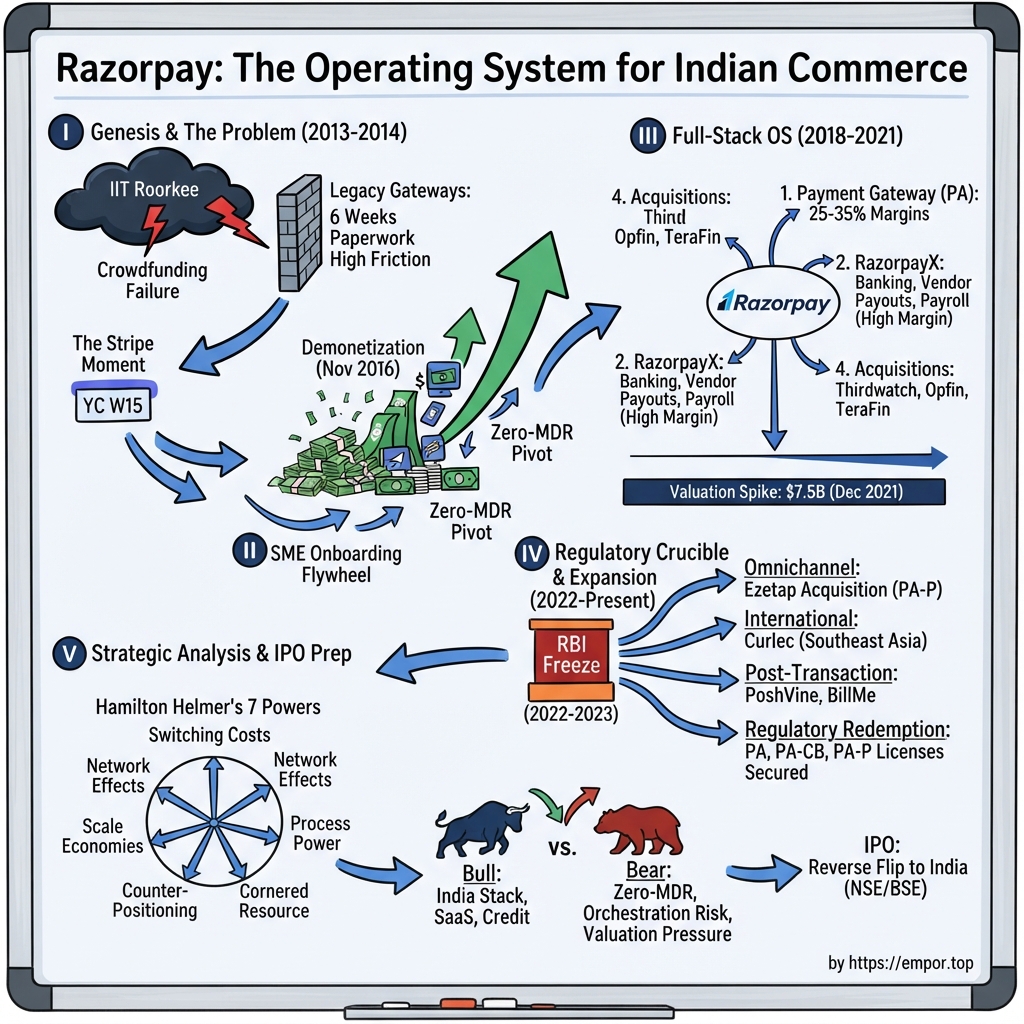
Razorpay: The Operating System for Indian Commerce
I. Introduction & Episode Roadmap (00:00 – 00:18)
On 12 June 2026, Razorpay filed a draft red herring prospectus with the Securities and Exchange Board of India. It did so confidentially, under a regulatory provision allowing an issuer to submit offer documents for review without public disclosure—a filing that became public knowledge only because statutory rules required a formal newspaper announcement.1 That procedural choice frames the entire investment thesis: India's most widely used digital payments processor has initiated its public listing process, yet the core disclosures required by public-market investors—share counts, preference structures, segment profitability, customer concentration, related-party transactions, and risk factors—remain under seal.
The public record instead consists of a decade of funding announcements, regulatory permissions, corporate registry filings, press releases, and financial journalism. That amounts to a diligence trail rather than a formal prospectus, and must be analyzed as such.
The business's operational scale is established. In the financial year ended March 2025, Razorpay posted consolidated revenue of ₹3,783 crore, up 65% from ₹2,296 crore in FY24, alongside gross profit of ₹1,277 crore, up 41% from ₹906 crore.2 Total payment volume expanded from roughly $150 billion in FY24 to about $180 billion in FY25.3 The company reports an onboarding base exceeding 12 million merchants. For FY25, it reported a consolidated net loss of ₹1,209 crore, which management attributed to employee stock option expenses and one-off tax and restructuring charges tied to shifting the parent company's legal domicile from the United States back to India, rather than underlying operational decay.23
The origin story is foundational to the company's narrative. In 2014, two IIT Roorkee graduates, Harshil Mathur and Shashank Kumar, left positions at Schlumberger and Microsoft to launch a crowdfunding platform. When Indian banks refused to grant payment gateway access to an unproven two-person team, they pivoted to solving the payment infrastructure problem directly.4 Razorpay became the first Indian startup admitted to Y Combinator, joining the winter 2015 batch on a standard $120,000 cheque.56 Eleven years later, the same founders lead the enterprise, but the equity narrative must now satisfy institutional public-market investors rather than venture backers.
The core thesis of this analysis is narrower than the founding lore. Razorpay is not merely a payment gateway that grew large. It is an effort to construct a bundled financial operating system for Indian enterprise—combining online acceptance, offline point-of-sale acquiring via Ezetap, corporate banking and payroll under RazorpayX, merchant lending, loyalty tools, and cross-border collection—on top of a payment rail whose underlying unit economics were deliberately regulated down to zero on its fastest-growing channel. Whether this multi-product bundle generates durable operating profits or merely spreads thin take rates across broader software surfaces is the central test of the upcoming listing.
Four fundamental tensions govern the analysis:
The first is friction arbitrage that has matured into table stakes. Razorpay's initial competitive advantage came from compressing merchant onboarding from weeks of physical paperwork into hours, coupled with reliable, well-documented APIs. That edge was transformative in 2015. By 2026, it is standard industry practice, as every licensed competitor provides automated onboarding and developer-friendly documentation. An operational edge that has been broadly replicated ceases to function as a moat; it becomes a baseline requirement.
The second is the India Stack bargain. The Unified Payments Interface has established itself as the country's primary retail payment rail, clearing 23.66 billion transactions valued at ₹29.88 lakh crore in July 2026 alone—a 22% year-on-year volume expansion.7 However, UPI and RuPay debit transactions have carried a government-mandated merchant discount rate of zero since January 2020, when authorities eliminated the initial 0.30% fee.8 Consequently, processing volume growth and revenue expansion have decoupled in a manner with no direct Western analog.
In August 2026, Parliament passed the Taxation and Other Laws (Amendment) Bill, amending the Payment and Settlement Systems Act to permit transaction fees on UPI and RuPay debit payments. The Ministry of Finance indicated that peer-to-peer transfers and retail consumers will remain free of charge, with any merchant levy applied strictly to larger enterprises above a defined turnover threshold at rates substantially below traditional card MDRs, leaving operational parameters to the National Payments Corporation of India.98 This structural policy adjustment represents the most critical open variable in Razorpay's monetization model.
The third is the regulatory barrier. In December 2022, the Reserve Bank of India directed Razorpay and Cashfree to pause onboarding new online merchants pending final payment aggregator authorization.10 The regulatory embargo lasted a full year before being lifted in December 2023, after which Razorpay assembled a complete set of authorizations: an online payment aggregator licence,11 a cross-border payment aggregator licence secured in December 2025,12 and a physical point-of-sale licence for Razorpay POS on 22 January 2026.13 While this licensing stack forms a genuine barrier to new entrants, roughly half a dozen direct competitors have now cleared the identical regulatory hurdles.
The fourth is capital structure and valuation re-anchoring. Razorpay's last private financing round, a $375 million Series F in December 2021 co-led by Lone Pine Capital, Alkeon Capital, and TCV, valued the company at $7.5 billion.14 Market reporting on the current listing process indicates a valuation target between ₹50,000 crore and ₹60,000 crore (approximately $5 billion to $6 billion at prevailing exchange rates), structured as a mix of fresh primary equity and an offer for sale, with Axis Capital, Kotak Mahindra Capital, JPMorgan, and Citi managing the book.3 A private valuation established at the peak of a global liquidity cycle and an initial public offering target set four and a half years later represent market prices, not intrinsic valuations. Separating the two is the objective of this study.
 Subscribe on LinkedIn
II. The Genesis: IIT Roorkee, Crowdfunding, and the Indian Banking Wall (2013–2014) (00:18 – 00:45)
Mathur and Kumar had met at IIT Roorkee through SDSLabs, the campus programming society, before leaving software engineering roles in 2014 to build a startup out of Jaipur.4 Their initial concept—a crowdfunding platform for schools and colleges—stalled almost immediately at a basic operational hurdle: collecting payments online.
In plain terms, an online payment gateway captures a transaction instruction from a merchant's website, translates it across disparate bank and card network protocols, routes it for authorization, manages exceptions and failures, settles funds into the merchant's account days later, and reconciles each ledger entry. While Western infrastructure providers like Stripe and Braintree had abstracted this complexity into developer APIs, India's payment architecture in 2014 remained heavily manual.
Incumbents such as BillDesk, CCAvenue, and TechProcess catered primarily to high-volume enterprise accounts—airlines, railways, insurers, utilities, and telecommunications providers—where transaction volumes justified dedicated bank relationship managers, bespoke technical integrations, physical paperwork, and negotiated commercial contracts. For early-stage ventures and small merchants processing modest monthly sums, this model imposed onboarding cycles measured in weeks or months, mandatory bank visits, physical documentation, security deposits, and unstable, poorly documented interfaces. Serving low-volume merchants through high-touch enterprise workflows was commercially unviable for incumbents, leaving the long tail of internet businesses unserved.
Faced with repeated bank rejections, the founders pivoted from crowdfunding to infrastructure. In India, a payment aggregator does not move funds under an independent banking charter; it operates atop sponsor banks' acquiring rails and regulatory permissions. Recognizing that banks rationally ignored smaller merchants due to high acquisition and compliance costs, Mathur and Kumar built a software layer designed to automate onboarding, risk assessment, and technical integration at scale.
The initial product focused on practical utility: a unified API standardizing fragmented banking protocols, transparent published pricing, digital onboarding, and an embeddable checkout modal. This self-serve architecture allowed Razorpay to acquire long-tail merchants without deploying an enterprise sales force, aligning customer acquisition costs with the unit economics of smaller transaction volumes.
Acceptance into Y Combinator's winter 2015 batch provided early counterparty credibility. As the accelerator's first Indian portfolio investment on a standard $120,000 cheque,56 institutional validation helped reassure risk-averse sponsor banks evaluating an unproven payments intermediary. Y Combinator maintained its equity position across subsequent funding rounds, including the December 2021 Series F.14
Two realities temper the founding narrative. First, the structural opportunity was not proprietary. Competitors including Instamojo, Cashfree, and Juspay identified the same infrastructure bottlenecks around the same time. Razorpay gained market share through rapid product execution and aggressive distribution rather than patented technical barriers. Second, concentrating on venture-backed startups and direct-to-consumer merchants created an initial client base characterized by rapid volume expansion, but also high price sensitivity and low platform stickiness once merchants achieved scale—a structural dynamic that continues to shape its enterprise economics.
III. The Inflection Supercycle: Demonetization, India Stack, & UPI (2015–2018) (00:45 – 01:25)
The years between the Y Combinator batch and the close of the decade delivered two macroeconomic shifts that reshaped Indian commerce, and Razorpay was positioned to capture both.
Before either shock arrived, the company built an acquisition engine designed to convert market tailwinds into market share. Rather than relying on traditional sales teams, distribution ran through code: lightweight server-side software development kits tailored for local developers, transparent flat pricing, and an embeddable checkout flow that could be integrated in an afternoon.
This developer-led go-to-market departed fundamentally from incumbent models and compounded in ways traditional sales forces could not replicate. Software engineers who integrated Razorpay at one startup brought those technical habits to their next venture, while published pricing eliminated lengthy commercial negotiations. Customer acquisition cost across the long tail effectively approached the fixed cost of maintaining documentation and developer tools, distributed across an expanding merchant base. Payback on small accounts could be virtually immediate. This low-friction mechanism underpinned the expansion to a multi-million-merchant footprint, allowing the company to service long-tail accounts generating modest annual revenue.
The corresponding structural risk was that merchants acquired with minimal friction face equally minimal switching costs. Self-serve distribution created a customer base vulnerable to high startup failure rates and price-based defection to competing gateways. To counter this structural churn, Razorpay adopted an expansive multi-product strategy—attaching broader software and workflow tooling to deepen merchant lock-in—though management has not publicly disclosed overall attach rates across its merchant base.
For active merchants, the product competed on transaction conversion—specifically authorization rates. Indian payment infrastructure routinely suffered from banking downtime, issuer declines, and dropped netbanking redirects. Dynamic routing software that directed transactions to the highest-performing acquiring bank in real time, automated retries, and streamlined checkout interfaces recovered abandoned transactions, offering merchants an immediate, measurable lift in completed sales.
On 8 November 2016, the government invalidated ₹500 and ₹1,000 banknotes, removing approximately ₹15.44 trillion of currency from circulation—representing roughly 86% of the cash in the economy.15 The operational impact on digital payments was swift: monthly digital transaction volume expanded from 71.27 crore in October 2016 to 111.45 crore by May 2017.15 For digital payment processors, the sudden liquidity contraction eliminated merchant inertia around adopting online acceptance.
The lasting effect of demonetisation, however, diverged from the initial digital-only narrative. Physical currency returned rapidly: currency in circulation rebounded to approximately 90% of pre-demonetisation levels within a year and, according to Reserve Bank of India data, stood 83% above November 2016 levels by early 2023.15 The policy shock did not eliminate cash; rather, it permanently lowered psychological and operational barriers by forcing millions of consumers and businesses into digital workflows for the first time. For Razorpay, the enduring value lay in merchant habit formation rather than a temporary processing spike.
The second structural catalyst proved far more consequential. The National Payments Corporation of India introduced the Unified Payments Interface in 2016, initially with a 0.30% merchant discount rate.8 Designed as an interoperable, real-time settlement rail addressed by virtual payment aliases rather than bank account details, UPI separated the payment interface from underlying banking rails. Consumer adoption accelerated through third-party apps including PhonePe, Google Pay, and Paytm, compelling merchants to support the rail. By July 2026, UPI processed 23.66 billion monthly transactions valued at ₹29.88 lakh crore—averaging 763 million daily transactions, up 22% in volume and 19% in value year over year.7
Razorpay moved early to integrate UPI acceptance, particularly across its core base of venture-funded startups, direct-to-consumer brands, and internet platforms, where consumer UPI adoption advanced rapidly. The company states that it processes payments for 80 of India's 100 unicorns.16 While that footprint reflects substantial early enterprise penetration, it also underlines client concentration within a fast-expanding but cyclical cohort of internet businesses.
The economic model was disrupted in January 2020, when the government eliminated the merchant discount rate entirely on UPI and RuPay debit card transactions.8 In traditional card acquiring, the merchant pays a processing fee shared among issuing banks, payment networks, and acquirers, with the gateway earning a net spread. Under the zero-MDR framework, the transaction fee was removed, leaving aggregators to absorb processing, fraud monitoring, reconciliation, settlement, and compliance costs without receiving direct processing revenue. While periodic government budgetary subsidies have partially offset acquiring expenses on low-value transactions, these allocations remain discretionary fiscal measures rather than recurring contractual income.
This regulatory framework created an economic paradox: India established the world's highest-volume retail real-time payment rail while prohibiting direct interchange monetization. Consequently, payment intermediaries have had to reconfigure their core business models around a central challenge: how to extract commercial value from merchant relationships acquired over a rail with zero direct fee margin.
Razorpay's strategic response—using zero-fee payment acceptance as a low-cost distribution funnel to sell software, corporate banking services, and merchant credit—reflects the standard playbook pursued by competitors including PayU, Pine Labs, and Cashfree. The core investment question is not the theoretical validity of the bundle, but whether Razorpay can execute this software expansion more profitably than well-funded peers. In FY25, the company posted a consolidated gross margin of roughly 34%, generating ₹1,277 crore in gross profit on ₹3,783 crore of revenue,2 establishing the financial baseline against which its shift toward software monetization must be evaluated.
The zero-MDR structure introduced an ongoing structural headwind: merchant payment mix became an unhedged operational variable. As consumer payment preferences shift from credit cards to UPI, a merchant generates comparable business volume but substantially less fee revenue for the processor, without any alteration in service delivery or operational overhead. Consequently, growth in merchant accounts and total processing volume does not reliably translate into top-line revenue growth.
For this reason, aggregate total payment volume provides an incomplete gauge of underlying economic performance in the Indian market. Gross profit generated per unit of processing volume offers a far more informative measure of business quality.
Furthermore, this payment mix shift remains an ongoing headwind. With monthly UPI volumes expanding 22% year on year in July 2026, faster than the broader digital payments sector,7 zero-fee transactions continue to represent an increasing share of aggregate processing volume. Without substantial expansion in software attach rates and non-payment revenue, industry-wide blended take rates face steady structural compression.
IV. Expanding the Surface Area: Neobanking, SaaS, and the "Full-Stack" Pivot (2018–2021) (01:25 – 02:05)
The strategic pivot defining Razorpay as an enterprise business rather than a standalone payment gateway began well before the zero-MDR mandate took effect. Starting around 2018, the company shifted positioning from online payment processing toward managing the full spectrum of small-business financial workflows.
The underlying commercial logic represents the foundational premise of the equity story. A payment gateway observes every transaction instruction a merchant processes. That vantage point provides visibility beyond direct processing fees: it reveals real-time revenue velocity, seasonality, refund rates, customer mix, and credit risk with greater immediacy than periodic bank statements. If a gateway can leverage this transaction data into adjacent software offerings—current accounts, automated vendor payouts, payroll, tax compliance, and working capital—it can generate software-like operating margins on customer relationships acquired at payment-gateway customer acquisition costs. In this model, core payment processing serves as the customer acquisition wedge, while software cross-selling delivers long-term margin expansion.
Before assessing individual product lines, public disclosures require an important analytical caveat. Industry commentary frequently circulates estimated revenue breakdowns—attributing roughly two-thirds to three-quarters of revenue to core acceptance, mid-teens percentages to business banking, and gross margins on processing in the high twenties to mid-thirties. Razorpay, however, has not officially published segment-level financial splits. The sole segment disclosure in the public record is ₹442.39 crore generated from prepaid cards and point-of-sale terminals in FY25, while the only audited profitability metric is the consolidated 34% gross margin derived from total reported revenue and gross profit.[^23]2 Unofficial breakdowns represent market inference rather than verified statutory reporting.
The core acceptance business. Payment gateway and aggregator operations remain the commercial engine, driving processing volume, enterprise relationships, and underlying data flow. Processing gross margins are structurally lower than software margins because card processing incurs non-negotiable interchange and network fees, while standard UPI transactions yield zero direct processing fees. While market estimates suggest core payment gateway revenue declined from roughly 90% to approximately 75% of total turnover as newer verticals expanded, verifying those exact operational proportions remains a matter for the formal prospectus to resolve.
RazorpayX. The neobanking and business finance suite integrates commercial accounts held with partner scheduled commercial banks, automated vendor payouts, statutory tax payments, and treasury workflows into a unified interface. Razorpay does not possess an independent banking charter; it operates on sponsor banks' underlying infrastructure, sharing economics while remaining exposed to partner banks' regulatory requirements.
The structural value of RazorpayX lies in customer retention. A merchant running daily vendor disbursements and tax compliance through the platform faces substantially higher switching costs than one utilizing Razorpay solely for checkout acquiring. Razorpay earmarked RazorpayX as a primary allocation for its Series F capital in December 2021, when it disclosed over 25,000 active businesses on the platform.14 In June 2026, the company introduced autonomous AI agents within RazorpayX designed to automate routine banking tasks—an ambitious product roadmap that currently functions as a product release rather than an established revenue driver.17
RazorpayX Payroll. Developed from the 2019 acquisition of Opfin, this product automates payroll disbursement, employee benefits, and statutory compliance, including provident fund, employee state insurance, and tax deducted at source. Payroll software represents an intrinsically high-retention product category: transitioning payroll providers mid-fiscal-year introduces operational disruption and statutory compliance risk, generating customer stickiness comparable to enterprise SaaS.
Razorpay Capital. This division provides working capital loans, invoice discounting, and merchant cash advances underwritten against observed transaction histories. Rather than lending from its own balance sheet at scale, Razorpay originates and services credit facilities in partnership with regulated non-banking financial companies and banks. While this partnership structure shields the balance sheet from direct credit loss, it constrains net interest margins and subjects originations to Reserve Bank of India digital lending guidelines. The acquisition of TERA Finlabs in 2021 integrated proprietary credit evaluation algorithms into this underwriting workflow.18
The corporate acquisition record during this expansion reflects targeted bolt-on integrations: Thirdwatch in 2019 for fraud detection and cash-on-delivery risk mitigation; Opfin in 2019 for payroll; and IZealiant alongside TERA Finlabs for core payment infrastructure and credit underwriting.18 Each acquisition was modest in scale and mapped directly onto an enduring product line.
The $7.5 billion valuation benchmark. In December 2021, Razorpay completed a $375 million Series F financing round co-led by Lone Pine Capital, Alkeon Capital, and TCV, with participation from Tiger Global, Sequoia Capital India, GIC, and Y Combinator, at a post-money valuation of $7.5 billion.14 That financing followed a $160 million Series E in April 2021 co-led by Sequoia Capital India and GIC at a $3 billion valuation, which had risen from a $1 billion valuation established during the October 2020 Series D.19 Total cumulative equity financing across all rounds reached an estimated $740 million to $800 million.1420
This valuation expansion—rising from $1 billion to $7.5 billion within fourteen months—represents the private benchmark against which current public listing expectations are evaluated. Three factors provide essential context for public-market investors:
First, this capital was committed when Razorpay processed an annualized total payment volume of $60 billion, alongside a target of $90 billion by the close of 2022.14 The 2021 benchmark capitalized an enterprise processing roughly one-third of its current volume at a valuation higher than the current ₹50,000 crore to ₹60,000 crore IPO target, illustrating the multiple compression experienced across global fintech since the peak of the private market cycle.
Second, venture funding rounds are structured as convertible preferred equity, which typically confers liquidation preferences, anti-dilution protections, and specific governance provisions unavailable to common public shareholders. Because preferred instruments carry structural seniority, equating a private headline valuation directly to public common equity value misinterprets the capital structure.
Third, these commitments were closed at the height of a global market cycle characterized by crossover fund participation pricing high-growth platforms on elevated revenue and volume multiples.
Following the Series F round, capital allocation remained comparatively disciplined. Disclosed filings show Razorpay did not deploy proceeds into subsidized consumer acquiring or aggressive discount promotions seen elsewhere in the fintech sector, maintaining a multi-year balance sheet cushion without raising further priced primary equity. Unverified internet directory claims asserting a "$490 million Series G at a $9.2 billion valuation" in 2025 lack corroborating evidence, conflict with corporate restructuring filings, and diverge from the current IPO parameters.
V. The Crucible: Regulatory Freezes, Omnichannel Expansion, & Reverse Flipping (2022–Present) (02:05 – 02:45)
In December 2022, the Reserve Bank of India directed Razorpay and Cashfree to pause onboarding new online merchants pending final payment aggregator authorization.10 The directive was part of a systemic regulatory tightening under the central bank's 2020 payment aggregator framework—compelling major intermediaries including Razorpay, Cashfree, PayU, and Paytm to secure formal operating licences—and coincided with Enforcement Directorate inquiries into payment gateways handling collections for illegal lending apps.11
For a platform whose customer acquisition engine relied on the frictionless, automated sign-up of early-stage startups and small businesses, the restriction struck at the core of its organic growth model. While Razorpay could process transactions for its existing merchant portfolio, it was legally prohibited from adding new online accounts. The onboarding freeze lasted an entire year, concluding on 19 December 2023 when the central bank granted final authorization, permitting the resumption of merchant sign-ups.11
Management's operational response during this twelve-month embargo provides a meaningful baseline for assessing execution discipline. With external acquisition halted, incremental volume had to be generated entirely from within the installed base: improving transaction authorization rates to capture larger shares of existing client processing, cross-selling RazorpayX and payroll software to current gateway accounts, expanding relationship-driven enterprise acquiring, and trimming processing overhead. Simultaneously, the company accelerated distribution across channels exempt from the online onboarding ban, specifically offline point-of-sale and international expansion. Sustained top-line revenue growth across this period confirmed the resilience of the existing merchant portfolio under regulatory constraint.
The regulatory pause, however, imposed a structural market-share penalty that statutory filings do not directly quantify. For twelve months, every newly formed digital business in India seeking online payment acceptance integrated with an unconstrained competitor. Because payment gateways carry meaningful integration inertia, software hooks once embedded in a merchant's checkout stack are difficult to displace. The embargo effectively ceded an entire annual cohort of newly formed enterprises to rival processors, permanently altering the compounding base. Public disclosures have not revealed the absolute size of this lost cohort or how much of it Razorpay subsequently managed to win back.
This resilience must also be interpreted within its macroeconomic context. The onboarding ban coincided with an exceptional expansion in digital payment volume, with UPI processing growing at more than 40% annually and existing merchants expanding organic throughput. Delivering top-line expansion while barred from acquiring new clients is considerably more achievable in a market expanding at that pace than in a mature, low-growth payments ecosystem. The embargo demonstrated operational flexibility; it did not establish that the platform can sustain growth without new merchant additions in a normalized environment.
Omnichannel: the Ezetap acquisition. In August 2022, amidst the regulatory embargo, Razorpay acquired offline payments provider Ezetap for approximately $200 million, marking its largest corporate acquisition and formal entry into in-person point-of-sale acquiring.21 Ezetap brought an established footprint of roughly 500,000 merchant touchpoints, enterprise accounts including Amazon and BigBasket, and over $10 billion in annualized transaction volume.2122
The commercial rationale aligned with broader retail dynamics: because physical retail continues to dominate aggregate Indian commerce, merchants operating across digital storefronts and physical outlets require unified settlement, refund processing, and ledger reconciliation across both channels. Globally, platforms such as Block's Square and Toast established substantial enterprise value on integrated omnichannel acquiring; in India, players like Pine Labs, Paytm, and Mswipe had already scaled physical acceptance infrastructure prior to Razorpay's entry.
The economic model in physical acquiring, however, differs sharply from pure-play digital processing. Deploying physical terminals introduces capital intensity: point-of-sale hardware must be procured, provisioned, maintained, and replaced, stretching working capital cycles. Concurrently, competitive pressure—accelerated by the widespread adoption of low-cost audio payment soundboxes—has structurally compressed margins across entry-level merchant tiers. Disclosed results indicate rapid revenue scaling alongside limited visibility into unit profitability: revenue from prepaid cards and point-of-sale machines expanded to ₹442.39 crore in FY25 from ₹21.05 crore in FY24, an inflection reflecting operational growth combined with post-acquisition consolidation accounting.[^23] The underlying return on capital deployed across Razorpay POS hardware remains undisclosed.
International. In February 2022, Razorpay made its first international expansion by acquiring a majority stake in Malaysian recurring-payments provider Curlec at a valuation reported at just over $19 million, with a roadmap toward full acquisition.2324 Curlec subsequently evolved from a specialized direct-debit provider into a full-stack payment gateway, regulated by Bank Negara Malaysia and integrated as a member of PayNet.25 In March 2025, Razorpay launched operations in Singapore as its second regional market.[^23]
At its current stage, international expansion represents a strategic option rather than a primary financial driver. Southeast Asian markets remain fragmented, distinct in regulatory architecture, and populated by established domestic processors. Segment-level international revenue has not been separately broken out, with management framing regional operations as a long-term growth frontier rather than a material contributor to current earnings.
Post-transaction products. In 2022, Razorpay acquired loyalty and rewards provider PoshVine, followed in 2023 by digital invoicing and post-purchase engagement platform BillMe, marking the group's eighth corporate acquisition.1826 In 2025, the company deployed $30 million for a majority stake in POP, a rewards-focused consumer UPI platform that had issued over 40,000 co-branded RuPay credit cards with Yes Bank and reported approximately 600,000 daily transactions within its first operational year.27 The POP investment represents a notable departure from Razorpay's core business-to-business model, entering a consumer payments segment where incumbents including PhonePe, Google Pay, and Paytm have deployed substantial marketing capital. Operated as an independent entity, POP functions as an adjacent consumer-loyalty experiment whose commercial synergies with the merchant acquiring business remain to be demonstrated.
Regulatory redemption. By early 2026, Razorpay had secured a comprehensive regulatory licensing stack: final payment aggregator authorization for online operations in December 2023; the Payment Aggregator – Cross Border licence in December 2025, authorizing both inbound and outbound international payment flows alongside Amazon Pay, Adyen, Cashfree, and BillDesk; and the Payment Aggregator – Physical licence for Razorpay POS on 22 January 2026.11122813 Co-founder Shashank Kumar characterized this licensing milestone primarily in terms of compliance governance and institutional trust rather than purely commercial expansion.13
This licensing portfolio establishes a tangible barrier to entry, requiring prospective processors to demonstrate substantial capital reserves, specialized compliance systems, and regulatory clearance before initiating operations. It does not, however, confer a monopolistic moat: several key competitors, including Paytm, PayU, Pine Labs, Easebuzz, and Airpay, have secured comparable authorisations, while Juspay obtained its cross-border payment aggregator licence in January 2026.13[^30] Regulatory authorization serves to filter out marginal new entrants rather than insulate the business from well-capitalized peers holding identical permissions.
The reverse flip. Like many Indian technology enterprises backed by foreign venture capital, Razorpay was historically organized under a US parent company, Razorpay Inc., in Delaware. Completing an initial public offering on Indian exchanges required collapsing this corporate architecture to place the domestic operating entity at the top of the corporate structure. In May 2025, Razorpay completed the legal amalgamation of Razorpay Inc. into its Indian operating company following statutory sanction from the Regional Director in Hyderabad, joining peers such as PhonePe, Groww, Zepto, and Dream11 in redomiciling to India.29
This corporate restructuring incurred a substantial tax obligation, reported at approximately $150 million, which together with employee stock option expenses drove the consolidated FY25 net loss of ₹1,209 crore, despite operating profitability across its core online processing division.2923
This statutory restructuring clarifies the company's financial profile ahead of public listing. The FY25 net loss did not stem from underlying unit deterioration in payment processing, but from a quantified, one-time corporate reorganization expense.
However, two financial distinctions remain critical for public-market diligence. First, the redomiciling tax represented a permanent cash outflow. Second, employee stock-based compensation is an ongoing operational cost of retaining engineering and executive talent rather than a one-time charge. Because equity-based compensation dilutes existing share capital, institutional investors treat stock-grant expenses as a standard component of operating overhead. Evaluating operating performance strictly through metrics that exclude share-based compensation provides an incomplete view of normalized cash generation, making post-listing dilution and ongoing compensation run-rates a primary diligence focus once full prospectus schedules are unsealed.
Ahead of its confidential regulatory submission, Razorpay converted its corporate status into a public limited entity, framing the governance adjustment as a preparatory step for public-market readiness.30 In May 2026, shareholders approved an enabling resolution for a fresh equity issuance of approximately ₹2,700 crore, laying the statutory groundwork for its June draft prospectus submission.31
VI. Strategic Analysis: Competitive Dynamics, 7 Powers, & Porter's 5 Forces (02:45 – 03:20)
The competitive map. In online acceptance, Razorpay competes against PayU India (owned by Prosus and the closest disclosed peer), Cashfree (strongest in payouts), BillDesk (the legacy enterprise incumbent), Infibeam Avenues (which operates CCAvenue and trades publicly on Indian bourses), alongside the payment gateway arms of Paytm and PhonePe. In offline acquiring, it faces Pine Labs, Mswipe, Paytm's device business, and bank-owned terminal estates. In business banking, RazorpayX contends with a thinning cohort of standalone neobanks and, more fundamentally, with the improving digital capabilities of commercial partner banks.
The neobanking vertical warrants distinct evaluation because its competitive structure is less favourable than headline commentary suggests. The Indian neobanking cohort that emerged alongside RazorpayX—including Open, Fi, and Jupiter—was built on the premise that a superior software interface atop partner banks could capture underserved small-business and retail accounts. That cohort has contracted significantly, for structural rather than accidental reasons.
A neobank lacking an independent banking charter earns an economic share on a partner bank's balance sheet, cannot capture the net interest margin generated by underlying deposits, and remains vulnerable whenever the Reserve Bank of India tightens third-party partnership regulations. RazorpayX entered this category with an operational advantage that standalone neobanks lacked: a captive base of payment gateway merchants routing daily settlement flows through the platform, acquired at near-zero incremental customer acquisition cost. However, the structural ceiling remains: RazorpayX monetises workflow automation software rather than deposit spreads, and its most formidable long-term competitor is not another venture-backed neobank, but the partner banks themselves, which have progressively modernised their corporate portals to retain primary client relationships.
PayU India provides the most instructive operational benchmark because Prosus publishes segment financials. In the first half of FY26, PayU India reported revenue of $397 million, up 20% year on year, of which payment gateway operations contributed $301 million (also up 20%), while processing volume expanded 55%, driven primarily by UPI.32 That divergence between 55% volume growth and 20% revenue growth illustrates the zero-MDR dynamic in a single metric, applying to Razorpay with equal force. PayU further disclosed that higher-margin value-added services—including fraud tooling, identity authentication, and software subscriptions—accounted for 34% of payments revenue, with consolidated adjusted EBITDA reaching positive $3 million compared to a $4 million loss in the prior-year period.32 A direct competitor operating at comparable scale is thus hovering near operational breakeven, establishing a realistic baseline for current industry economics.
Hamilton Helmer's 7 Powers applied.
Switching costs represent Razorpay's most durable advantage. Core checkout integration is embedded directly into merchant source code; recurring billing protocols encode proprietary logic; payroll modules carry statutory compliance risk if migrated mid-fiscal-year; and RazorpayX commercial accounts sit inside daily treasury workflows. The more products an enterprise adopts, the higher the friction of switching. The critical qualification is that switching costs are concentrated among multi-product accounts, while remaining low across the single-product long tail that constitutes the vast majority of the company's 12 million onboarded merchants.
Scale economies are moderate and structurally constrained. Higher transaction throughput secures improved acquiring margins and direct API links with sponsor banks, enhancing processing costs and success rates. However, the dominant expense in card acquiring remains network and interchange fees set by payment networks and regulators, while the fastest-growing rail—UPI—yields zero direct fee margin regardless of scale. Scale in Indian payments confers far less pricing power than in Western card-dominated markets.
Process power reflects Razorpay's technical routing and retry algorithms, refined across bank endpoints through a decade of transaction edge cases. Measurable uplifts in transaction authorization rates provide tangible merchant value. However, industry capabilities have steadily converged. Juspay's orchestration platform operates on the premise that dynamic multi-gateway routing delivers 5% to 15% improvements in authorization rates and 10% to 30% reductions in processing expenses—and Juspay sells that software independently to any enterprise, including merchants evaluating Razorpay.33 When specialized infrastructure providers unbundle proprietary routing as a third-party service, processor-level process advantages face steady erosion.
Network effects remain the least validated of the company's purported advantages. Magic Checkout, which allows shoppers to execute one-click transactions using credentials stored across the merchant network, incorporates a theoretical cross-merchant loop: merchant additions expand stored consumer profiles, improving conversion and attracting further merchants. However, this checkout acceleration is heavily contested by Shopify, Amazon Pay, and dominant consumer UPI apps. Razorpay has not disclosed network penetration, recognized-shopper conversion uplifts, or attributable revenue figures necessary to substantiate an active flywheel. Magic Checkout represents a strategic product initiative rather than a demonstrated structural power.
Counter-positioning was pivotal during the company's formative era but is now largely exhausted. Razorpay's initial edge stemmed from traditional banks' inability to offer developer-centric APIs without cannibalizing high-margin enterprise accounts. Over the subsequent decade, incumbent banks upgraded their developer portals, rival fintechs replicated self-serve onboarding, and central bank licensing standardized operating parameters across the sector. The counter-positioning that enabled Razorpay's initial rise no longer protects its market position.
Porter's Five Forces framework.
Supplier power is high and non-negotiable. Sponsor banks, card networks, and the National Payments Corporation of India control the underlying clearing rails and dictate fee structures. In NPCI's case, transaction pricing is governed by statutory policy. Operating on infrastructure where primary input costs are set by non-negotiable counterparties imposes a permanent ceiling on processor gross margins.
Buyer power is sharply bifurcated. The long tail of small and medium merchants possesses minimal bargaining leverage and pays standard published tariff rates. In contrast, large enterprise merchants exert substantial pricing power: they operate multi-gateway architectures, negotiate razor-thin spreads, and increasingly deploy independent orchestration layers to route transactions based on real-time cost and success rates rather than platform loyalty. Because top-line growth requires moving upmarket into enterprise accounts where take rates are compressed and switching costs are minimal, volume expansion and margin preservation pull in opposing directions.
Threat of new entrants is low, insulated by the Reserve Bank of India's stringent payment aggregator licensing regime and capital adequacy mandates. This regulatory barrier provides the most reliable structural protection in the business.
Threat of substitutes is moderate and expanding. Merchants can accept UPI directly through zero-fee bank QR codes, bypassing payment aggregators entirely. Doing so foregoes automated reconciliation, dispute management, fraud screening, subscription billing, and enterprise support—which is precisely why value-added software, rather than raw payment routing, forms the defensible product surface. Direct bank rails nonetheless impose a permanent pricing cap on entry-level payment acceptance.
Competitive rivalry is intense and structural. Half a dozen well-capitalized, licensed processors are pursuing an identical strategy of wrapping enterprise software around commoditized payment rails in an ecosystem where the dominant transaction rail generates zero direct fee revenue. The inevitable consequence is aggressive price competition in payment acquiring alongside a race to cross-sell software.
Market sizing and addressable revenue. Defining Razorpay's addressable market by total Indian digital payments volume—a rail clearing roughly ₹29.88 lakh crore monthly on UPI alone—conflates gross transaction flow with monetizable revenue pool.7 In a zero-MDR environment, total payment volume measures systemic throughput rather than processor economics. The true addressable market consists strictly of what enterprises will pay for payment processing, value-added software workflows, and embedded credit.
Within payment acceptance, third-party market estimates project the Indian payment gateway sector to expand from approximately $2.31 billion in 2026 to $4.01 billion by 2031, representing a compound annual growth rate of roughly 11.7%.45 Crucially, this revenue pool is expanding at less than half the pace of underlying transaction volume—a structural divergence directly attributable to zero-fee rails.
The company's reachable market is narrower still. Razorpay's distribution and product suite are optimized for digital-first enterprises, direct-to-consumer brands, SaaS providers, and the online small-business long tail—segments where developer-led distribution and conversion optimization carry premium value. Its penetration is comparatively constrained across large legacy volumes: tier-one public-sector utilities anchored by BillDesk, offline retail estates dominated by bank terminals and Pine Labs, and mega-merchants utilizing in-house orchestration.
Razorpay is expanding into these adjacent volume pools through POS hardware and its expanded licensing stack, but each channel is defended by entrenched incumbents and yields lower take rates than its core internet base. The assumptions underpinning premium valuation targets require Razorpay not only to defend its core digital merchant base, but to capture enterprise share from BillDesk and PayU, win offline POS volume from Pine Labs and sponsor banks, and contest payouts against Cashfree—competing against peers that hold identical licences, possess comparable capital, and deploy identical software-bundling strategies.
In synthesis, Razorpay operates within an industry characterized by high regulatory barriers to new entry, intense rivalry among licensed incumbents, dominant upstream suppliers, and an enterprise customer base whose bargaining power increases with scale. Its primary structural defence rests on multi-product switching costs. That advantage is genuine, but concentrated within the undisclosed fraction of merchants that adopt multiple software modules across its broader platform.
VII. The Investment Spine: Bull vs. Bear & Core KPIs (03:20 – 03:45)
What is actually disclosed, and what is not.
Before undertaking any valuation, the precise evidentiary boundary must be established. The verified public record for Razorpay consists of: FY25 consolidated revenue of ₹3,783 crore and gross profit of ₹1,277 crore, compared to ₹2,296 crore and ₹906 crore in FY24; a consolidated net loss of ₹1,209 crore driven by employee stock-based compensation and redomiciling tax liabilities; total payment volume of roughly $180 billion in FY25, up from $150 billion in FY24; management's statement that core online payment operations are EBITDA-positive and cash-generative; and FY25 revenue from prepaid cards and point-of-sale terminals of ₹442.39 crore.23[^23] Corporate registry filings compiled by Inc42 report FY25 total income—inclusive of non-operating items—at ₹3,932.1 crore against ₹2,501.4 crore in FY24, representing an accounting reconciliation variance from reported revenue from operations that investors must distinguish when comparing sources.34
Equally critical is what remains undisclosed: segment-level revenue and margin breakdowns; net and gross revenue retention rates; merchant cohort retention and churn curves; customer concentration metrics; transaction volume splits across UPI, debit and credit cards, netbanking, and physical POS; blended and method-specific take rates; ongoing stock compensation run-rates; cash balances, outstanding debt, and capital lease obligations; capital expenditure on POS terminal deployments; credit origination volumes and first-loss default guarantees; international revenue contributions; the fully diluted share count; and the conversion terms of outstanding preferred securities. Furthermore, financial performance for FY26, the financial year ended 31 March 2026, has not been publicly released as of mid-August 2026.
This information asymmetry is not an analytical impasse; it is the structural reason valuation analysis must be framed in probabilistic ranges rather than single-point targets.
The capital structure, built from what exists.
Across all private funding rounds, Razorpay raised an estimated $740 million to $800 million, culminating in the December 2021 Series F at a post-money valuation of $7.5 billion.1420 Its shareholder register includes Y Combinator, Peak XV Partners (formerly Sequoia Capital India), Tiger Global, GIC, Lone Pine Capital, Alkeon Capital, TCV, Ribbit Capital, and Lightspeed Venture Partners.14191 The board of directors comprises co-founders Harshil Mathur and Shashank Kumar alongside Arif Khan, with Subramaniam Somasundaram, Ira Gupta, and Shilpa Mankar Ahluwalia serving as independent directors.35
Employee equity participation has been structured through an ESOP programme punctuated by multiple liquidity events: an initial buyback in 2018 covering 140 staff; a $75 million secondary liquidity transaction in 2022 for approximately 650 current and former employees; and a ₹1 lakh equity grant to each of more than 3,000 employees on the company's tenth anniversary in December 2024.3637
What cannot be reconstructed from public records is a verified share count. The number of common shares outstanding, the classes and liquidation preferences of convertible preferred stock, the unallocated employee option pool, and outstanding warrants remain sealed. Consequently, any implied market capitalization derived from the IPO range reflects aggregate equity value rather than an auditable per-share price.
The reported deal structure—a fresh primary issue of ₹2,500 crore to ₹3,000 crore alongside an offer for sale of comparable size within an aggregate ₹5,000 crore to ₹6,000 crore transaction—indicates that roughly half the offering represents secondary share liquidation by early investors rather than growth capital entering the balance sheet.331 The resulting public free float will represent a modest percentage of total equity, an important technical consideration for post-listing price discovery.
Similarly, a formal enterprise value bridge cannot be constructed. Because cash reserves, outstanding borrowings, and lease liabilities are not public, and the primary-secondary split remains subject to final allocation, multiples must be evaluated on an equity-value basis for Razorpay. Where enterprise-value multiples of listed peers are referenced, they are explicitly designated as such and not compared directly.
Revenue quality.
The composition of top-line revenue carries as much weight as its expansion rate, and public data indicates a structural divergence from standard software economics.
The vast majority of Razorpay's revenue remains transactional. It is earned per completed transaction, fluctuates in lockstep with underlying merchant throughput, and ceases if merchant processing stops. While customer relationships may be durable, transactional revenue lacks the contracted predictability of software subscriptions. The mitigating factor is diversification: transaction volume spread across millions of active merchants insulates aggregate throughput from the performance of any single account.
The corresponding vulnerability is cyclical exposure: transactional revenue is directly geared to Indian consumer discretionary spending and the liquidity cycle of venture-backed startups and direct-to-consumer brands. Processing payments for 80 of India's 100 unicorns is a substantial distribution achievement, but it also creates concentrated exposure to a cyclical corporate cohort.16 A prolonged contraction in startup capital deployment or discretionary retail spend flows straight into processor revenue without contractual minimums to cushion the decline.
The genuinely recurring product lines—payroll software subscriptions, business banking workflow fees, fraud detection, and identity verification—represent the core of the SaaS multiple thesis, yet their underlying revenue contributions remain undisclosed. Contract durations, churn rates, and pricing power are unquantified.
Furthermore, merchant concentration remains an open variable: an enterprise processing for scale merchants like Amazon through its POS arm and major online platforms almost certainly exhibits greater revenue concentration than the 12-million-merchant aggregate implies. Disclosed top-ten and top-twenty customer concentration percentages will be among the most informative schedules in the final prospectus.
Two additional quality considerations apply to the historical growth trajectory:
First, the 65% revenue expansion in FY25 coincided with a jump in prepaid card and POS revenue from ₹21.05 crore to ₹442.39 crore, an inflection largely driven by post-acquisition consolidation accounting for Ezetap rather than pure organic terminal deployment.[^23] Isolating organic baseline growth from inorganic consolidation is impossible on current disclosures.
Second, gross profit expanded 41% against top-line revenue growth of 65%, resulting in gross margin compression from 39.5% in FY24 (₹906 crore on ₹2,296 crore) to 33.8% in FY25 (₹1,277 crore on ₹3,783 crore).2 This represents the most demanding data point in the statutory record: gross margins contracted precisely when the corporate narrative pointed to an expanding mix of higher-margin software and financial services. While consolidating hardware-heavy POS acquiring mechanically dilutes consolidated gross margins, a SaaS valuation multiple requires expanding gross margins. Explaining this margin divergence is a primary task for the prospectus.
The market's price, and what it embeds.
Market reporting indicates an IPO valuation target between ₹50,000 crore and ₹60,000 crore, or approximately $5 billion to $6 billion at prevailing exchange rates of roughly ₹95.6 to the US dollar in mid-August 2026.338 Against FY25 revenue of ₹3,783 crore, this pricing range implies an equity-value multiple of 13.2x to 15.9x revenue. Against FY25 gross profit of ₹1,277 crore, the valuation equates to 39x to 47x gross profit. These figures represent the audited trailing baseline. If FY26 top-line revenue expanded by an assumed 40%, the forward revenue multiple would compress to roughly 9.4x to 11.3x—though that growth rate remains an unverified market estimate.
Analyzing the dollar markdown from the $7.5 billion Series F benchmark requires currency adjustment. Rupee depreciation—from roughly ₹76 per dollar in December 2021 to approximately ₹95.6 in August 2026—means the valuation adjustment is substantially smaller in domestic currency.38 A $7.5 billion valuation in late 2021 equated to roughly ₹57,000 crore. An IPO target of ₹50,000 crore to ₹60,000 crore is essentially flat in rupee terms. Over that same period, Razorpay roughly tripled its payment processing volume and expanded revenue. The valuation adjustment has occurred almost entirely through multiple compression across global fintech rather than operational contraction.
Building a peer set honestly.
Direct peers—operating under the identical domestic regulatory framework, payment rails, and zero-MDR environment:
Pine Labs provides the closest direct operational benchmark. It completed its public listing on 14 November 2025 at an issue price of ₹221 per share, after revising its target valuation down from an initial $5 billion to $6 billion target to approximately $2.9 billion; it ended its debut trading session at ₹252 per share, representing a market capitalization of roughly ₹28,900 crore.39
For the first quarter of FY27 (ended June 2026), Pine Labs reported operational revenue of ₹736.92 crore (up 20% year on year), a contribution margin of 72.3% (₹533 crore), an adjusted EBITDA margin of 17.1% (₹126 crore), net profit of ₹19.57 crore, and quarterly gross transaction value of ₹4.22 lakh crore.40 As of 17 August 2026, Pine Labs' market capitalization stood at approximately ₹19,026 crore—down roughly 35% from its listing-day close and 26% below its IPO issue price.41 On an annualized Q1 FY27 run-rate, it trades at roughly 6.5x revenue.
This market performance provides critical empirical evidence on public-market pricing for Indian payments infrastructure. Pine Labs is profitable, expanding at 20% annually, and generating mid-teens adjusted EBITDA margins—yet its multiple de-rated by more than a third within nine months of listing after previously halving its private valuation target.
One97 Communications (Paytm) represents a partial peer: it overlaps in merchant acquiring and offline payment hardware, but maintains a substantial consumer-facing ecosystem and financial product distribution arm. As of mid-August 2026, Paytm traded at ₹1,580.20 per share, representing a market capitalization of approximately ₹1.01 lakh crore and an enterprise value of roughly ₹88,400 crore.42 On a trailing twelve-month basis to June 2026, it posted revenue of roughly ₹8,967 crore, gross profit of ₹2,413 crore, EBITDA of ₹1,256 crore, and net income of ₹650 crore.43 This yields a valuation of approximately 11.3x trailing revenue on equity value, 9.9x on enterprise value, and a trailing price-to-earnings multiple exceeding 150x. Paytm's multiple reflects an ongoing operational turnaround following quarterly losses in FY25, pricing in forward margin expansion rather than static earnings.43
PayU India is not independently listed, but its parent Prosus discloses segment financials. In H1 FY26, PayU India generated $397 million in revenue with barely positive adjusted EBITDA, providing clear evidence of aggregate margin constraints across the domestic acquiring landscape.32
Included with an accounting caveat: Infibeam Avenues (operator of CCAvenue) trades at a market capitalization of approximately ₹5,107 crore on trailing twelve-month revenue of roughly ₹9,516 crore and net profit of ₹294 crore, implying an apparent multiple of roughly 0.54x sales.4244 This extreme divergence from Paytm highlights critical accounting variations: Infibeam recognizes processing revenue on a predominantly gross basis, inflating the revenue denominator. Gross versus net revenue recognition makes unadjusted top-line multiples non-comparable across payment processors.
Excluded peers: Category leaders such as Adyen (market capitalization of roughly €32.9 billion) and Block (approximately $49.3 billion) operate in Western jurisdictions with intact card interchange structures; applying their valuation multiples imports take-rate assumptions prohibited by Indian regulation.42 Emerging-market specialist dLocal ($4.2 billion) and integrated software acquirer Shift4 ($4.1 billion) operate in markets without zero-fee payment mandates.42 Privately held competitors such as Cashfree and Juspay lack verified public filings, while Stripe's valuation reflects private market pricing.
An intrinsic view, expressed as scenarios.
The scenario model below evaluates equity value over a six-year horizon to FY31, using reported FY25 revenue of ₹3,783 crore as the baseline and applying a 13.5% cost of equity—a standard hurdle rate reflecting Indian risk-free yields and equity risk premia. The model assumes fresh primary capital is deployed near the cost of capital, making the issuance broadly neutral to per-share intrinsic value.
-
Bear Case: Revenue compounds at 16% annually—reflecting take-rate compression from an expanding enterprise mix, multi-gateway orchestration eroding acquiring margins, and the absence of UPI MDR reform. Revenue reaches approximately ₹9,200 crore by FY31 with a 7% net profit margin (₹645 crore in net earnings). Capitalized at a 20x exit price-to-earnings multiple, terminal equity value is roughly ₹12,900 crore. Discounted to present value at 13.5%, current intrinsic equity value is approximately ₹6,000 crore.
-
Base Case: Revenue compounds at 24% annually, broadly matching nominal digital commerce growth alongside steady enterprise retention and modest software attach rates. Revenue reaches roughly ₹13,750 crore by FY31 with a 12% net margin (₹1,650 crore in earnings). At a 28x exit multiple, terminal equity value reaches ₹46,200 crore, yielding a discounted present value of approximately ₹21,400 crore.
-
Bull Case: Revenue compounds at 32% annually, driven by partial MDR restoration on enterprise UPI, SaaS scaling across RazorpayX and payroll, positive POS hardware returns, and cross-border expansion. Revenue reaches roughly ₹20,000 crore by FY31 with a 16% net margin (₹3,200 crore in earnings). Capitalized at a 35x exit multiple, terminal equity value reaches ₹112,000 crore, resulting in a discounted present value of approximately ₹52,000 crore.
Sensitivity analysis indicates that outcomes are heavily driven by terminal assumptions. A two-percentage-point adjustment in terminal net margin shifts base-case value by roughly ₹3,500 crore, while a five-turn change in the terminal multiple alters value by approximately ₹3,800 crore. Adjusting the discount rate to 12% increases the base case by roughly 9%, whereas a 15% rate reduces it by 8%. The compound annual growth rate remains the primary driver of dispersion.
Reconciling the two views.
The intrinsic scenario model establishes a central fair-value range between ₹20,000 crore and ₹25,000 crore, within a broader band spanning ₹6,000 crore to ₹52,000 crore. The reported IPO target of ₹50,000 crore to ₹60,000 crore sits at the upper ceiling of this distribution.
Conversely, relative market comparables provide a more supportive frame: benchmarked against Paytm's ~11x trailing revenue multiple, an estimated FY26 revenue base of ₹5,000 crore to ₹5,500 crore supports a ₹55,000 crore to ₹60,000 crore valuation. Benchmarked against Pine Labs' 6.5x sales multiple, the same revenue base implies a valuation between ₹33,000 crore and ₹36,000 crore.
This valuation spread reflects the specific assumptions embedded in the target ask: 1. Sustained revenue compounding in the high twenties over the next five to six years; 2. Transition to low-to-mid teens net profit margins for an enterprise that has not yet demonstrated full-year consolidated profitability; 3. Meaningful software cross-selling that reverses gross margin compression and lifts gross margins beyond the 34% achieved in FY25; 4. Enterprise cohort retention robust enough that new client wins expand aggregate gross profit rather than cannibalizing blended margins; and 5. Structural take-rate expansion, either through government-mandated enterprise UPI MDR or high-margin software attach rates.
These conditions represent the bull case realized in full. In the public markets, technical factors may support initial pricing above intrinsic medians: limited domestic public pure-play fintech supply creates institutional scarcity value; the reverse-domiciled corporate narrative offers a clean governance profile; and structured primary offerings can sustain early listing premia. However, as Pine Labs demonstrated after its 14% listing pop, public-market valuations ultimately adjust to quarterly earnings execution rather than scarcity narrative.3941
The path to durable profitability.
The reported FY25 gross margin of roughly 34% forms the fundamental baseline that must expand.2 On $180 billion in total payment volume, ₹1,277 crore in gross profit reflects an aggregate retained margin of approximately eight basis points on volume processed (at roughly ₹85 per dollar in FY25). All operational costs—engineering, risk and compliance, customer acquisition, support, and stock-based compensation—must be funded from within these eight basis points.
Sustainable margin expansion requires several operational milestones: - Gross margins must trend toward 40% or higher, requiring RazorpayX, payroll, POS software, fraud prevention, and cross-border acquiring to outpace core payment processing growth over consecutive fiscal years. - Operating expenses must scale at a lower rate than gross profit, demonstrating that enterprise sales distribution can operate with software-like leverage. - Employee stock-based compensation must moderate to a sustainable percentage of revenue rather than being treated as a non-operating adjustment. - Working capital and hardware depreciation cycles across Razorpay POS must demonstrate positive returns on invested capital. - The lending business must navigate credit cycles without rising default provisions on SME cash-flow underwriting.
On liquidity and balance-sheet strength, the historical record provides constructive evidence. Razorpay deployed its $740 million to $800 million in private capital across eight strategic acquisitions and funded a ~$150 million redomiciling tax obligation without raising primary equity capital between December 2021 and its 2026 IPO filing.14202931 Navigating a four-and-a-half-year gap and a twelve-month regulatory onboarding freeze indicates sound balance-sheet management.
The fresh primary issuance of approximately ₹2,700 crore relative to ₹3,783 crore in FY25 revenue represents a measured capital raise, consistent with regulatory net-worth maintenance and strategic flexibility rather than operating cash burn.231
However, dilution risks remain unquantified until full prospectus schedules are unsealed. The issuance of new equity shares, expanding option pools, and preferred share conversion terms will determine the ultimate economic dilution borne by public common shareholders.
Concrete operational indicators that would challenge the investment thesis include: - Consolidated gross margins remaining flat or declining across FY26 and FY27 despite software expansion; - POS revenue expansion accompanied by persistent negative segment contribution; - Decelerating growth across RazorpayX relative to aggregate company growth; - Rising share-based compensation ratios relative to operational revenue; - Large enterprise volume additions that dilute aggregate gross profit per merchant; or - Deteriorating asset quality in SME lending originations.
The bull case, stated fairly. India's digital payment throughput continues to expand at more than 20% annually with sustained runway.7 Razorpay operates as a licensed market leader in a highly regulated oligopoly, holds the deepest developer distribution across the domestic startup ecosystem, and demonstrated operational resilience by sustaining revenue growth during a full-year merchant onboarding freeze. Its multi-product software bundle creates structural switching costs unachievable by pure-play gateways. Any partial reintroduction of MDR on enterprise UPI directly expands gross profit, since transaction processing infrastructure is already funded. The business has maintained disciplined capital allocation, integrated eight product acquisitions, and enters the public markets under the leadership of its founding team.
The bear case, stated with equal force. Core payment acquiring is a commoditizing utility where the fastest-growing rail is legally zero-fee, while value-added software workflows are being contested by five well-capitalized, licensed competitors pursuing identical bundling playbooks. Enterprise merchants—the primary driver of incremental scale—frequently commoditize payment gateways via multi-gateway orchestration layers.33 Only the core online acquiring unit has demonstrated positive EBITDA, while business banking, payroll, international operations, and POS hardware are scaling in highly competitive categories where segment returns remain unverified.3
At ₹50,000 crore to ₹60,000 crore, the target valuation prices an enterprise that is not yet consolidated-profitable at roughly five times the market capitalization of Pine Labs, which is profitable and has de-rated by a third since its debut.4140 Finally, persistent disclosure gaps around merchant retention, cohort churn, customer concentration, and segment margins require public investors to underwrite management narrative rather than verified operating history.
The three KPIs that will confirm or falsify the underwriting.
First, gross profit margin percentage and gross profit per unit of TPV. This metric confirms whether the platform is shifting toward higher-margin software. If gross margins expand from 34% toward 40% alongside volume growth, software cross-selling is functioning as designed. If gross profit expands only in tandem with volume, Razorpay is operating as a utility priced at software multiples.
Second, non-processing gross profit share. This tracks the contribution from RazorpayX, payroll software, POS merchant solutions, fraud tooling, and cross-border acquiring. PayU established a clear benchmark by disclosing that value-added services account for 34% of payments revenue.32 Razorpay's first audited segment disclosure will provide the primary test of its software mix.
Third, enterprise cohort retention and multi-product attach rates. Net revenue retention and product attach metrics will confirm whether switching costs exist in practice. Net revenue retention comfortably above 100% across enterprise cohorts validates the platform bundle; flat or negative retention indicates that commoditization and multi-gateway routing dominate merchant behavior.
Next milestones. Regulatory clearance of the draft prospectus by SEBI and the release of unsealed financial schedules; the disclosure of audited FY26 financial statements; NPCI operational guidelines governing transaction fee thresholds on enterprise UPI;89 and post-listing quarterly financial execution—the point at which market pricing transitions from narrative momentum to audited fundamentals.
VIII. Management, Governance, & Playbook Lessons (03:45 – 04:00)
Harshil Mathur has served as chief executive since 2014, with Shashank Kumar as managing director; both co-founded the business and sit on the board of directors.435 Eleven years of uninterrupted founder leadership across an entire sector's lifecycle is rare, and public markets generally view founder continuity as a positive indicator. However, founder tenure serves as an input to underwriting rather than a substitute for diligence; operational capital allocation and governance behavior provide the relevant tests.
On capital allocation, the historical record compares favorably with the broader fintech sector. Management executed eight bolt-on acquisitions, each modest relative to total capital raised, and mapped each directly to an operational product line: Thirdwatch and Opfin in 2019, TERA Finlabs and IZealiant in 2021, Curlec for just over $19 million in 2022, PoshVine in 2022, BillMe in 2023, and the $200 million acquisition of Ezetap, which represents the sole large-scale corporate transaction.18212326 Furthermore, public filings indicate that Razorpay avoided deploying its December 2021 Series F proceeds into subsidized merchant acquiring or consumer cash-burn during the peak of the market cycle. Following that round, the company did not raise another priced primary equity round, avoiding both down-round recapitalizations and subsequent equity dilution.
Two capital allocation decisions warrant closer scrutiny. First, the corporate reverse flip to redomicile in India incurred approximately $150 million in direct tax liabilities—a permanent cash outflow required to establish an Indian listing entity.29 While redomiciling was practically unavoidable given statutory listing requirements and the rupee-denominated nature of the underlying business, public investors will require full accounting visibility into these corporate restructuring costs once prospectus schedules are unsealed. Second, the $30 million majority investment in POP marks an entry into consumer-facing UPI, a category where dominant incumbents have deployed heavy marketing capital with minimal direct monetization.27 While modest in aggregate balance-sheet impact, this consumer pivot represents a strategic departure from the core business-to-business enterprise model that warrants ongoing monitoring.
On historical execution versus stated milestones, the record is quantifiable. In December 2021, alongside its Series F financing, the company reported $60 billion in annualized total payment volume, set a target of $90 billion by the close of 2022, and reported servicing over 8 million businesses with a target of 10 million.14 By FY25, processing volume reached roughly $180 billion—up from approximately $150 billion in FY24—while the merchant footprint expanded beyond 12 million accounts.316 The operational targets established during the private funding peak were met and exceeded.
In February 2025, marking its tenth anniversary, management established a revised long-term benchmark: reaching approximately $400 billion in total payment volume by 2030.46 Achieving this target implies volume compounding at roughly 17% annually from the FY25 base—a noticeably more moderate pace than the preceding decade's expansion, signaling management's own expectations regarding market maturation. This benchmark reinforces a core analytical reality: with blended take rates facing structural pressure from zero-fee rails, 17% volume growth will not translate into comparable top-line revenue expansion unless value-added software and cross-selling contribute a progressively larger share.
On corporate disclosure and communication, management's public statements have shown greater precision than industry norms. The framing of the consolidated FY25 net loss accurately identified and quantified the one-off restructuring charges, while the disclosure that online payment gateway operations are EBITDA-positive implicitly confirmed that newer business segments have not yet reached operating breakeven.23 Management's stated expectation that domestic operations would reach overall profitability in FY26, followed by consolidated profitability two to three quarters later, provides a concrete, auditable commitment against which upcoming statutory filings can be evaluated.
On corporate governance, the pre-listing structure presents standard institutional alignments. The board of directors includes three independent members—Subramaniam Somasundaram, Ira Gupta, and Shilpa Mankar Ahluwalia—alongside the co-founders and Arif Khan.35 Historical investor representation included nominee directors from Peak XV Partners and Tiger Global. Ahead of its draft prospectus submission, the company converted into a public limited entity, explicitly referencing public-market governance readiness.30 Broad-based employee equity participation has been supported through three liquidity events, including a $75 million buyback covering roughly 650 current and former staff and a ₹1 lakh equity grant to over 3,000 employees.3637 While widespread employee ownership aligns organizational incentives, it also generates ongoing stock-based compensation expenses that will continue to affect reported net earnings post-listing.
The transaction structure itself involves substantial secondary liquidity. Reporting indicates the offering will combine a fresh primary equity issue of roughly ₹2,500 crore to ₹3,000 crore with an offer for sale of comparable magnitude, with early venture backers including Tiger Global and Peak XV expected to monetize portions of their holdings.331 Secondary share sales are standard for mature venture-backed enterprises with finite fund lifecycles, and creating a secondary offer for sale is necessary to establish adequate public free float for index eligibility.
Nonetheless, the economic reality is clear: approximately half of the gross capital committed by public investors in the transaction will provide liquidity to existing shareholders rather than funding operational expansion. Furthermore, the selling shareholders represent institutional investors with the longest operating visibility into the enterprise. Whether the founders participate in the offer for sale, and the exact proportion of equity offered, remains confidential; founder retention levels at listing will provide an important indicator of insider valuation alignment.
The critical governance schedules remain under regulatory seal and can be evaluated only upon formal prospectus publication. These include: - Whether the founders hold shares carrying differential voting rights or special governance privileges; - Whether preferred shareholders retain residual consent rights that survive conversion into common equity; - Any shareholder veto rights that constrain future capital deployment or acquisition strategy; - Executive compensation structures, performance benchmarks, and founder equity vesting schedules; - The fully diluted share count, option pool sizing, and projected dilution schedules; - Related-party transactions, specifically fund flows between corporate entities and lending partners in Razorpay Capital, alongside the precise structure of any first-loss default guarantees; - The identity and allocation of each selling shareholder participating in the offer for sale; and - Mandatory promoter and pre-IPO shareholder lock-up schedules, specific use of net primary proceeds, and formal risk-factor disclosures.
Playbook lessons for builders and investors.
Identify structural bottlenecks that incumbents misclassify as permanent. Razorpay's initial breakthrough did not rely on proprietary technology; it recognized that slow bank onboarding was an economic friction driven by customer acquisition costs rather than a fixed industry constraint. By automating merchant onboarding, risk scoring, and integration through software, the company made serving long-tail businesses commercially viable. The broader principle: when an incumbent ignores a market segment, evaluate whether that segment is fundamentally unprofitable or simply incompatible with the incumbent's legacy cost structure.
When underlying infrastructure is regulated to zero margin, monetize adjacent software workflows—without assuming those workflows are naturally defensible. Processing zero-MDR payment rails forces processors to cross-sell business banking, payroll, and merchant lending. However, wrapping software around commoditized payment rails is a strategy shared across all major competitors. The multi-product bundle creates enterprise value only if software attach rates and cohort retention structurally exceed those of well-funded peers.
Regulatory compliance operates simultaneously as a barrier to entry and an operational constraint. Navigating a twelve-month merchant onboarding embargo required operational discipline and yielded a comprehensive regulatory licensing stack. Yet that identical licensing stack is now held by multiple direct competitors, while the regulator retains authority to adjust underlying rail economics by policy directive—as demonstrated by statutory amendments in August 2026.9 A regulatory regime that protects against unlicenced entrants while capping transaction pricing requires continuous operational adaptation.
Distinguish private transaction pricing from public equity valuation. A private valuation represents a negotiated price for senior preferred securities, agreed between a company and a concentrated syndicate of private investors at a discrete point in a global liquidity cycle. A public market capitalization represents a continuous, daily consensus on common equity, priced across transparent public disclosures. The transition from a $7.5 billion private benchmark in December 2021 to a ₹50,000 crore to ₹60,000 crore public listing target reflects how public markets normalize capital structures and multiples against verified cash generation.
References
-
Razorpay confidentially files draft IPO papers with SEBI — The Paypers, 2026-06 ↩↩
-
Razorpay revenue soars 65% in FY25; gross profit crosses Rs 1,200 Cr — Entrackr, 2025-10 ↩↩↩↩↩↩↩↩↩↩
-
Razorpay IPO Storm: Big ₹6,000 Cr Plan Meets Market Doubt Over Growth Re-Rating — NiftyTrader, 2026 ↩↩↩↩↩↩↩↩↩↩↩
-
Razorpay announces ESOPs of Rs 1 lakh each for over 3,000 employees — Business Standard, 2024-12-23 ↩↩↩
-
Y Combinator on Razorpay: first Indian company YC invested in, W15 batch — Y Combinator (X) ↩↩
-
Jaipur-based Razorpay raises $120,000 from Y Combinator — YourStory, 2015-03 ↩↩
-
UPI hits highest ever monthly volume with 23.66 Bn transactions in July — Entrackr, 2026-08 ↩↩↩↩↩
-
What is merchant discount rate on UPI and why does India want to bring it back? — Forbes India, 2026 ↩↩↩↩↩
-
Govt clarifies UPI to remain free; MDR may apply to large merchants later — Business Standard, 2026-08-08 ↩↩↩
-
RBI asks Razorpay, Cashfree to temporarily stop onboarding of new customers — Business Standard, 2022-12-16 ↩↩
-
RBI lifts embargo for Razorpay, Cashfree to operate as payment aggregators — YourStory, 2023-12 ↩↩↩↩
-
Razorpay secures RBI's PA-CB licence to enable cross-border payments — Business Standard, 2025-12-02 ↩↩
-
Razorpay POS Receives RBI Approval for Offline Payment Aggregator Licence — Razorpay Newsroom, 2026-01-22 ↩↩↩↩
-
Razorpay Raises $375 Mn Led by Lone Pine Capital, Alkeon Capital and TCV; Valuation Increases to $7.5 Bn — Razorpay Newsroom, 2021-12 ↩↩↩↩↩↩↩↩↩↩
-
Currency in circulation rises by 83% since demonetisation in 2016: RBI data — Business Standard, 2023-01-02 ↩↩↩
-
Razorpay Completes 10 Years: Rs 1 Lakh ESOPs for Employees, Powering 80 Unicorns, IPO by 2026 — Outlook Business, 2024-12 ↩↩↩
-
Razorpay takes over PoshVine, marks its 7th acquisition — YourStory, 2022-09 ↩↩↩↩
-
Razorpay Raises $160 Mn led by Sequoia Capital and GIC; Triples its Valuation to $3 Bn in 6 Months — Razorpay Newsroom, 2021-04 ↩↩
-
Razorpay completes reverse flip to India — Entrackr, 2025-05-29 ↩↩↩
-
Razorpay acquires Ezetap for $200 mn; forays into offline payments — Business Standard, 2022-08-18 ↩↩↩
-
Razorpay Forays Into Offline Payments with the Acquisition of Leading POS Company, Ezetap — Razorpay Newsroom, 2022-08 ↩
-
Razorpay Acquires Malaysian Recurring Payments Provider Curlec For $19+M — Crowdfund Insider, 2022-02 ↩↩
-
Razorpay acquires Malaysian fintech start-up at over $19 mn valuation — Business Standard, 2022-02-08 ↩
-
Redefining Payments: Curlec by Razorpay Gains License to Acquire Merchants in Malaysia — Razorpay Blog ↩
-
Fintech unicorn Razorpay acquires BillMe — Entrackr, 2023-09 ↩↩
-
Razorpay acquires majority stake in POP with $30 Mn investment — Entrackr, 2025 ↩↩
-
Razorpay Secures RBI Approval for Cross Border Payments License — Fintech News Singapore, 2025-12 ↩
-
Razorpay reports ₹1,209 crore loss in FY25 despite 65% revenue jump — Business Standard, 2025-10-16 ↩↩↩↩
-
Exclusive: Razorpay converts to public entity ahead of IPO plans — Entrackr, 2025 ↩↩
-
Razorpay gets shareholder nod for Rs 2,700 crore IPO — MediaNama, 2026-05 ↩↩↩↩↩
-
PayU India's Revenue Jumps 20% in H1 FY26 on Payments & Credit Growth — Outlook Business, 2025-11 ↩↩↩↩
-
Why Global Merchants Can't Afford to Ignore Payment Orchestration in 2026 — Juspay ↩↩
-
Fintech giant Razorpay converts into a public limited company ahead of IPO — Indian Startup News, 2025 ↩↩↩
-
Razorpay Announces its 4th ESOP Buyback Sale for 650 Employees as part of $75 Million Transaction — Razorpay Newsroom, 2022-05 ↩↩
-
Razorpay unveils ESOP buyback sale for 650 staffers as part of $75 mn deal — Business Standard, 2022-05-10 ↩↩
-
USD/INR spot rate, 95.592, retrieved 2026-08-17 — Financial Modeling Prep ↩↩
-
Pine Labs gets warm market welcome on $440M India IPO despite a valuation trim — TechCrunch, 2025-11-14 ↩↩
-
Pine Labs Q1 result: Revenue rises 20% to ₹737 crore; profit grows fourfold — Business Standard, 2026-07-28 ↩↩
-
Pine Labs Ltd share price and market capitalisation, 2026-08-17 — Tickertape ↩↩↩
-
Batch equity quotes for PAYTM.NS, INFIBEAM.NS, ADYEN.AS, DLO, XYZ and FOUR, retrieved 2026-08-17 — Financial Modeling Prep ↩↩↩↩
-
One97 Communications (PAYTM.NS) trailing-twelve-month income statement and key metrics to 2026-06-30 — Financial Modeling Prep ↩↩
-
AvenuesAI Ltd (INFIBEAM.NS) trailing-twelve-month income statement to 2026-06-30 — Financial Modeling Prep ↩
-
India Payment Gateway Market — Share & Industry Statistics — Mordor Intelligence ↩
-
Razorpay marks 10 years, targets about $400 billion in TPV by 2030 — Business Standard, 2025-02-09 ↩
 LinkedIn
 WhatsApp
 Reddit
 Hacker News
 Email
Email Kindle
 RSS Feed
 Spotify
 Apple Podcasts
 Amazon Music
 Audible
 YouTube