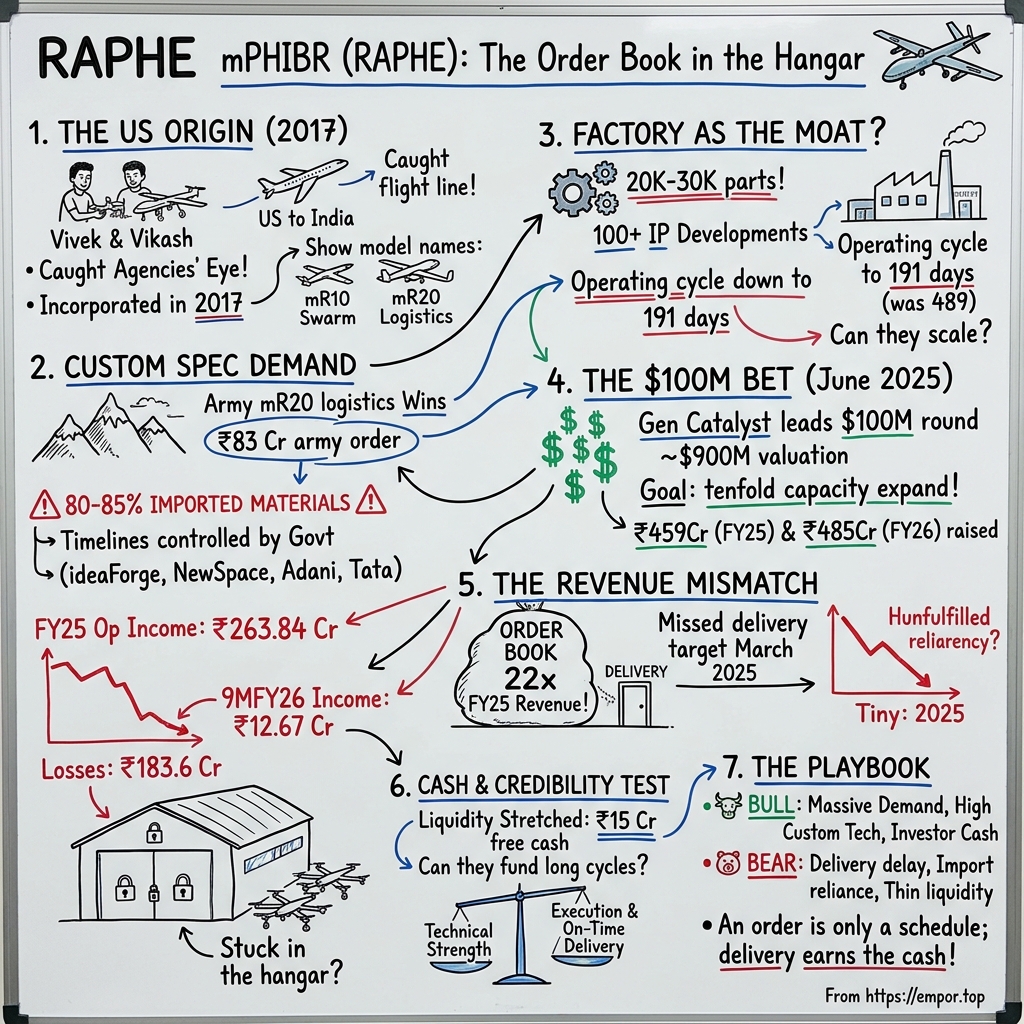
Raphe mPhibr: The Order Book in the Hangar
I. Twenty-Two Times Revenue, and Still a Miss
On April 6, 2026, a credit analyst at CARE Ratings finished a document that read like two different companies stapled together. One company had an unexecuted order book worth 22 times its last full year of operating income, a stack of contracts from the Indian Army and the Indian Navy, and investors willing to wire it hundreds of crores at a time.1
The other company had booked operating income of just ₹12.67 crore in the nine months from April to December 2025, had lost ₹158 crore before interest, depreciation and tax, and had lost ₹184 crore after everything.1 Both companies were Raphe mPhibr, the Noida drone maker that had spent the previous summer being celebrated as one of India's most valuable defence start-ups.
CARE's verdict was a downgrade. Raphe's long-term bank facilities fell from CARE BBB-, the lowest rung of investment grade, to CARE BB+, the top rung of speculative grade, and its short-term rating slipped from A3 to A4+.1 The reasons were blunt: lower than envisaged performance in the year to March 2025, a delay in executing orders, and a "substantial operational loss" in the first nine months of the following year.1
The contrast with the year before is what gives the downgrade its force. In the year to March 2025, Raphe's operating income had reached about ₹264 crore, roughly three times the year before, and it had still made a small profit of ₹6.5 crore.1 Twelve months later the same factory, with more people, more floor space and more capital behind it, had produced less than a twentieth of that income in nine months.
CARE did not publish the rupee value of the order book, but the ratio itself does the arithmetic: twenty-two years of FY25-sized revenue sitting in a queue, while the conveyor belt that should turn those orders into delivered aircraft had almost stopped moving.
That is the puzzle at the heart of this story. Raphe is not a company short of demand, at least on paper. Its customers are the armed forces of a country that has been rearming quickly and has made domestic drone manufacturing a matter of national policy.1 Its founders are credentialed engineers with a genuine origin story.
Its investors include General Catalyst, which called its cheque the firm's largest investment in India's defence ecosystem.2 What it has not yet shown is the thing a public-market investor most needs to see before paying for a manufacturer: that orders become deliveries on a predictable schedule, that deliveries become accepted invoices, and that invoices become cash.
So the questions that follow are practical ones. Can a specialist engineering house, which grew out of two brothers' research projects, become a dependable manufacturer of military aircraft at volume? Does years of designing for soldiers in hard terrain give it a real edge when the army writes the next tender, or merely an invitation to bid? And can investor capital carry the company through production delays long enough for the order book to pay out, without diluting existing owners into irrelevance?
Before answering, the boundaries need to be clear. Raphe Mphibr Private Limited is an unlisted private company. There is no share price, no quarterly earnings call and no exchange shareholding pattern to lean on. No draft red herring prospectus or other offer document has appeared on the Securities and Exchange Board of India's public-issue filings, even though the company told TechCrunch in June 2025 that it expected to go public within two to five years.34
The best financial evidence available is what CARE publishes in its rating rationales, on a standalone basis for this single legal entity, supplemented by the founders' interviews, investor statements and government records.1 That is thinner than a prospectus. It is also, in one important respect, more candid: a rating agency has no reason to flatter the borrower.
What that evidence shows is a company whose engineering has outrun its operations. The order book makes the opportunity tangible; the delivery failure makes conversion the whole story. And the hinge of that story is a single question the rest of this account has to answer: what happened between the order and the delivery?
 Subscribe on LinkedIn
II. The Drone That Brought Two Researchers Home
The company began, as many hardware companies do, with a project that was not supposed to be a company. In 2016, Vikash Mishra was at the Massachusetts Institute of Technology and his brother Vivek was at Georgia Tech.4 Both were on doctoral tracks in the United States. During a university winter break they built an octocopter, an eight-rotor drone, and Vikash shared videos of the work with mentors back in India.5 "We posted our entire drone-making journey on the internet and somehow caught the attention of government agencies in India," the founders later recalled.5
The brothers did not come from money or from the defence establishment. Their father worked as a truck driver at Northern Coalfields, the state coal miner, and Dassault Systèmes, which later profiled the company, describes Vikash as a self-made entrepreneur from a village near Prayagraj.56 What they had was complementary training. Vikash's background is in aerospace engineering, mechanical systems and advanced materials; CARE notes his patents in carbon fibre composites, prepreg technology and biomimetics.51
Vivek's is in robotics, electrical engineering, controls and software, with expertise in system identification and artificial intelligence.51 Together they covered most of what makes a drone fly: the structure, the propulsion, and the brain that keeps it in the air. A third co-founder, Nitin Katiyar, heads the software department and has worked on ground control stations and embedded firmware.1
The decision to form a company was, by Vivek's account, almost a financing technicality. "For us to get the funding for research, we had to form a company," he told Inc42.5 Raphe Mphibr Private Limited was incorporated on July 21, 2017, and is headquartered in Noida, on the eastern edge of Delhi.1 The first drone went to a government agency in 2018, according to Inc42, and Vivek said the company "started delivering products" in late 2019.57
The brothers consistently described the first three or four years as a period of listening rather than selling. They told TechCrunch they spent that time studying the operational needs of the defence forces.4 The product sequence reflects that. The first platform, Bharat, launched in 2017, was a man-portable surveillance drone, light enough to be carried by a soldier.5 Around 2020 came the mR10, which the company calls the world's first operational drone swarm.5 In 2021 came the mR20, a logistics drone built to carry supplies to troops in remote high-altitude areas, and the mR10-IC, a surveillance aircraft powered by an internal combustion engine the company designed itself.5
That sequence tells a sensible story about product strategy. The founders started with a small surveillance aircraft, where the technical risk was modest, then moved to coordination software for many aircraft at once, then to heavier platforms that solve logistical problems in terrain where trucks, mules and helicopters are slow, scarce or dangerous. Each step carried more payload, more endurance and more engineering content than the last. The narrative the founders tell is that the terrain and the soldiers' feedback drove each choice, and the product list is consistent with that claim.
But this is also where a careful investor has to separate two kinds of milestone. A launch year is not a sales year. "World's first operational drone swarm" is the company's own description, and no independent test record of the swarm's operational use has been published. A prototype that impresses an agency, a demonstration at a trade show, or an aircraft that flies once in front of generals earns the right to compete in a tender.
It does not earn revenue, and it certainly does not earn repeat revenue. For the first six years of the company's life, very little public financial evidence exists at all; CARE's published history begins in the year to March 2023, when operating income was about ₹41 crore.8
That figure is itself revealing. Six years after incorporation, Raphe was a business of roughly ₹40 crore a year, profitable in a small way, with a profit after tax of about ₹5 crore.8 It was real, and it was selling to the state. It was also small, the kind of specialised workshop that defence ministries around the world rely on for niche equipment without ever turning into a large industrial supplier.
The origin story therefore points somewhere specific. It suggests a user-led path into defence, built on a genuine technical capability and a sustained relationship with the people who would use the aircraft. It does not yet show that the company could manufacture at scale. Selling a novel aircraft to the armed forces is a long chain: a requirement, a trial, a tender, a contract, a design freeze, production, pre-delivery inspection, acceptance and payment. The brothers had proved they could start that chain. The next question was what it takes, with the army as customer, to run it again and again.
III. The Customer Writes the Specification
Picture a forward post in the high Himalaya. Supplies arrive by porter, by mule or by helicopter when the weather allows. Each of those methods is slow, expensive or dangerous, and at altitude a helicopter's lifting capacity falls just when it is most needed.
A drone that can carry a useful load up a valley and come back for more is not a gadget in that setting; it is a change in how a unit is sustained. That is the problem the mR20 was designed to solve, and the company says its logistics drones for high altitudes, which it calls a world first, have been deployed by the armed forces.7
The customer list confirms that this is a government business. In June 2025, Raphe told TechCrunch it had more than ten customers, all Indian government agencies, including the Army, Navy and Air Force and the Border Security Force, the Central Reserve Police Force and the Indo-Tibetan Border Police.4 CARE says most of its orders come from government entities, chiefly the Army and the Navy, with some from private clients.1 Neither the company nor CARE gives a breakdown by customer, but there is no doubt about who the decisive buyer is.
How much has actually been delivered? Two claims circulate, and they are not the same claim. In June 2025 the company told TechCrunch it had sold more than 300 drones in the previous twelve months.4 Vivek Mishra separately described Raphe as the first Indian start-up to supply more than 300 logistics drones to the Indian Army.5
The first is a count of all drones sold in a year; the second is a cumulative count of one product line to one customer. Neither tells an investor how many of those aircraft are in active service, how many were repeat orders from a satisfied unit, or what each sold for. Raphe does not publish per-unit prices, contract lengths, minimum commitments or the share of revenue from spares and service.1
The business model that sits behind those deliveries is simple to describe and hard to run. A government buyer issues a requirement or a tender. Raphe bids, often against several qualified suppliers. If it wins, the work depends on whether the customer wants an existing design or something new. CARE notes that orders using pre-existing designs can be completed in under a year, while customised orders take longer because of the research and development they require.1 Elsewhere CARE describes orders that need one to two years of design work before delivery, followed by a significant period of pre-delivery inspection.8 Only at the end of that chain is revenue recognised.
That structure is the source of both Raphe's opportunity and its vulnerability. The opportunity is that a customised platform, designed to the soldiers' own specification, can be hard for a competitor to replicate quickly, and a customer that has shaped a product has some reason to keep buying it. The vulnerability is that the customer controls almost every lever that matters.
It writes the specification and can change it. It sets the inspection standards and the inspection calendar. It can re-tender, split an order among several vendors, or pause procurement altogether when budgets or priorities shift. In the language of competitive strategy, buyer power is close to its maximum: one dominant customer, procurement rules that require competition, and a timetable set entirely on the buyer's side.
The competitive field is real, even if no reliable share data exist. ideaForge, the listed Mumbai company, has long been the best-known Indian supplier of surveillance drones to the armed forces and police. NewSpace Research & Technologies works on autonomous and swarming systems. The large defence groups, including Tata Advanced Systems, Adani Defence and Solar Industries, have their own unmanned programmes and far deeper balance sheets. These companies' categories overlap with Raphe's only partly, and no public series shows Raphe's share of any segment. What the field does establish is that the customer usually has alternatives, which caps how much any single supplier can charge.
The Indian procurement cycle also swings sharply. ideaForge's revenue from operations fell to about ₹161 crore in the year to March 2025, roughly half the previous year's, and its chief executive blamed a slowdown in government drone procurement.910 A year later the cycle had turned, and ideaForge reported revenue of about ₹226 crore for the year to March 2026.11 Any investor in an Indian defence-drone company is buying exposure to that rhythm, and a supplier with one dominant customer has no way to smooth it.
There is a second claim the company makes that deserves scrutiny: that its aircraft are indigenous. Raphe told TechCrunch it makes its own flight controllers, batteries and airframe components, that it imports radars and high-end cameras with plans to build them in-house within eighteen months, and that it does not rely on China for components.4 CARE, looking at the purchase ledger rather than the design sheet, says roughly 80 to 85% of raw materials are imported, including carbon fibre, motors, battery cells and camera lenses, sourced from the United Kingdom, Germany, Switzerland and France.1
The two descriptions can both be true. Designing a subsystem in-house is a different achievement from controlling the supply of what goes into it. A battery pack can be engineered in Noida from imported cells; an airframe can be designed in Noida and laid up from imported carbon fibre. The distinction matters for three reasons: imported inputs are priced in foreign currency while revenue is in rupees, a supplier's export licence or shipping delay can stall a production line, and a defence customer that prizes self-reliance will eventually ask how much of the bill of materials is truly domestic.
The avoidance of Chinese components is a genuine advantage in Indian defence procurement, where security screening of supply chains has tightened. Sourcing from European suppliers is a way of passing that test. It is not the same as supply-chain independence, and it creates its own concentration risk in a handful of Western vendors whose terms Raphe does not control.
The European names also appear on the other side of the ledger, as partners. Raphe cited partnerships with Hensoldt of Germany and Safran of France, as well as Dassault Systèmes, and exhibited at the Dubai and Paris air shows.4 Partnerships of this kind can bring sensors, engines or certification know-how that a young company could not develop alone. They are not revenue, and the company has not said what, if anything, has been jointly sold under them.
Inspection is where much of that buyer power is exercised. Before a military aircraft is accepted, the customer's own inspectors test it against the contract, and CARE described pre-delivery inspection as taking significant time, long enough to inflate the company's inventory days.8 In early 2025, management told CARE it was trying to shorten that stage by involving the inspectors in the initial stages of manufacturing and design.8 That is a sensible response, and it shows a company that understood where its cash was getting stuck. It is also an admission that the timetable for turning a finished aircraft into revenue was not in Raphe's hands.
That brings the story to the order that would come to define it. CARE records that an Indian Army order worth about ₹83 crore was originally expected to be executed and delivered by March 2025, and could not be executed to plan.1 The rating agency does not say which product it involved or why it slipped. It does not need to.
In a business where a contract's value only becomes revenue at acceptance, a slipped order is not a deferred line in a spreadsheet; it is a quarter in which the factory's costs arrive on time and the income does not. Winning a contract, it turned out, was the easy part. Getting the aircraft accepted and the cash collected was the business.
IV. A Factory Is Part of the Aircraft
Vikash Mishra likes to describe how many things have to go right in one aircraft. A single unmanned aerial vehicle, he told Dassault Systèmes, can involve 20,000 to 30,000 parts.6 That number is a useful corrective to the idea that a drone maker is an assembler, bolting a catalogue of components onto a frame.
A military aircraft that must fly at altitude in the cold, carry a payload, resist interference and come back is a system in which the airframe, the propulsion, the flight-control software, the communications link and the sensor payload all constrain one another. Change the weight of a camera and the balance changes; change the battery and the endurance, centre of gravity and thermal behaviour all change with it.
Raphe's answer has been to bring as much of that system as possible under one roof. The Noida campus combines additive and subtractive manufacturing, military-grade electronics and wire-harness production.7 The company uses Dassault's design and simulation software to manage the engineering, and its own materials list ultra-light carbon-fibre composites, aerodynamic simulation and in-house circuit boards.612 In August 2025, Defence Minister Rajnath Singh and Uttar Pradesh Chief Minister Yogi Adityanath inaugurated a new drone manufacturing unit and engine test facility there, and the minister praised what was described as India's largest aero-engine test bed.13
The best illustration of what this vertical approach can do is the engine. Most small military drones run on batteries, which are simple but limited. Vivek Mishra has explained the trade-off plainly: a 10-kilogram battery drone might fly for 60 minutes, while the same aircraft with an internal combustion engine can stay aloft for two to three hours.7 Raphe designed its own two-stroke engine for the mR10-IC. The company says the engine produces about four kilowatts while weighing 600 grams, compared with four to five kilograms for a typical equivalent. The company also says the engine was developed in three months using metal 3D printing, and that the aircraft "outperforms systems seven times its weight."612
Those are striking claims. They are also the company's own. No independent test report, production yield figure or field reliability record for the engine has been published. A light, powerful two-stroke engine is a remarkable prototype; whether it starts reliably at minus twenty degrees, how many hours it runs between overhauls, and whether the factory can make hundreds of them to the same tolerance are the questions that separate an engineering achievement from a commercial one.
The same caution applies to the intellectual property count. Raphe says it has more than 100 IP developments and more than 40 patent and design applications.6 Applications are not grants, and even granted patents in drones rarely stop a well-funded competitor from designing around them.
Even the company's own specifications move depending on where they are published. In June 2025, Raphe told TechCrunch its nine drone models carried payloads from about 2 kilograms to about 200 kilograms, with ranges from roughly 20 to 200 kilometres.4 Its technology page cites payloads of up to 100 kilograms, flight times of up to six hours, surveillance ranges of up to 150 kilometres and swarms of up to 100 aircraft.12
The figures may describe different products or different configurations, and none of them is wrong on its face. But a buyer comparing bids reads a datasheet the way an investor reads a prospectus, and specifications that vary by audience are a reminder that these are the company's claims, not test results.
The same competitive pressures apply: high buyer power, rising rivalry and meaningful supplier power.
The threat of substitutes is real in a quieter way: technology in this field moves fast, and CARE explicitly flags technology obsolescence as a rating weakness, noting that sustaining the business depends on the company's ability to keep developing technology that meets its clients' changing needs.1 Only the threat of new entrants is partly muted, by security clearances, testing requirements and the relationships that take years to build.
Against that structure, which of Hamilton Helmer's seven powers might Raphe plausibly hold? Two candidates stand out. The first is something like process power: the accumulated, hard-to-copy know-how of designing, integrating and testing aircraft for extreme conditions, embodied in people and in the factory's way of working. The second is a form of counter-positioning against importers and assemblers, in that a company willing to design its own engine and avionics can meet a self-reliance requirement that a reseller of foreign platforms cannot.
Both are credible hypotheses. Neither is yet proven by the evidence an investor would demand. There is no public data on switching costs, no evidence of a sustained price premium over rival bids, no published repeat-order rate, and no unit economics showing that vertical integration lowers cost per aircraft. The powers Raphe most obviously lacks are scale economies and network effects, and in a business sold through competitive tenders, branding counts for little against the price and the specification.
A rough sense of scale helps. In the year to March 2025, ideaForge reported revenue from operations of about ₹161 crore, while Raphe reported operating income of about ₹264 crore.91 For that one year, the younger private company was larger by revenue than the listed incumbent. The comparison should not be stretched.
The two companies sell different mixes of products, ideaForge's year was depressed by a procurement slowdown, and Raphe's own year would soon be shown to have been front-loaded. Neither figure establishes a share of the Indian defence-drone market. What the comparison does show is that Raphe's FY25 was not a rounding error: for a moment it had reached the top tier of Indian drone makers by sales.
The production side of the claim is where the evidence turns. In the year to March 2024, Raphe's operating cycle, the number of days between paying for inputs and collecting cash from customers, stretched to 489 days, driven by inventory of 360 days and receivables of 252 days.8 Put plainly, the company was carrying more than a year of inventory and waiting most of a year to be paid.
In the year to March 2025 the cycle improved to 191 days and inventory days fell to 166.1 That looks like a factory learning to move. Part of it, though, is arithmetic: inventory days are measured against the year's activity, and when revenue triples, the same warehouse looks leaner. The improvement coincided with an exceptional nine months of deliveries, not with a demonstrated change in how long design and inspection take.
The fair verdict on the engineering moat, then, is that it is real as a capability and unproven as an economic advantage. Raphe has shown it can design difficult things quickly and that the armed forces will buy them. It has not shown that designing them in-house makes them cheaper, faster to deliver or harder to displace in the next tender.
The test of that claim is not another patent filing or another impressive specification. It is whether the engineering shows up as on-time deliveries, repeat orders from the same units, and cash that arrives on schedule. To build the factory that could provide those things, the company would need a great deal of money.
V. The $100 Million Bet on Making More
On June 25, 2025, Raphe stepped out of what its investors described as years of quiet building. General Catalyst announced it had led a $100 million round in the company, its largest investment in India's defence ecosystem, and said it wanted to help Raphe become "India's leading vertically integrated defense innovation and manufacturing company."2 TechCrunch reported that the round was an all-equity Series B, that existing investor Think Investments had also taken part, and that it took total equity funding to $145 million.4 The Economic Times reported that the round valued the company at nearly $900 million.14 Vivek Mishra described the cheque as a record, worth about ₹860 crore.7
The timing mattered. Indian defence spending on drones was rising sharply, and the company cited the Drone Federation of India's estimate that spending had roughly tripled to $470 million over twelve to fourteen months.4 Raphe told TechCrunch it had about 600 employees, roughly 150 in research and more than 250 in production, and that its footprint had grown from 2,000 square feet in 2017 to 100,000 square feet and then to a 650,000-square-foot site.4 It also said its revenue had grown up to fourfold over four years and that it had been profitable in each of the last four years.4
That last claim illustrates why an investor should read company statements alongside the rating record. On a full-year basis it was accurate: CARE's figures show a profit after tax in each year from FY23 to FY25.81 But the two CARE rationales together reveal something the annual totals hide. In the nine months to December 2024, Raphe had booked ₹241 crore of operating income and ₹36 crore of profit after tax.8
For the full year to March 2025, those figures were ₹264 crore and ₹6.5 crore.1 Subtracting one from the other, the January to March 2025 quarter brought in only about ₹22 crore of income and lost roughly ₹30 crore. When the company told the world it had been profitable for four years, it had just come through a quarter that wiped out most of the year's profit, and the order that was supposed to land in that quarter had slipped.
The money itself is harder to reconcile than the headlines suggest. CARE's April 2025 rationale says the company raised ₹200 crore in the year to March 2024, then ₹120 crore of equity in August 2024 and ₹365 crore of compulsorily convertible preference shares in March 2025.8 Its April 2026 rationale describes ₹459 crore of equity raised in FY25 and a further ₹485 crore of preference shares in FY26.1 Those figures differ by about ₹26 crore for the same year, and neither lines up one-for-one with a $100 million round announced in June 2025.
One reading fits the pieces: if the ₹365 crore allotted in March 2025 and the ₹485 crore allotted in FY26 were two tranches of the same round, they would sum to about ₹850 crore, close to the ₹860 crore Vivek Mishra described, and the cumulative ₹1,150 crore or so raised since FY24 would sit close to the reported $145 million total. That reconciliation is plausible, not confirmed. Only the company's share-allotment filings, with their dates, share classes and prices, can settle it, and those terms have not been published.
The distinction between equity and preference shares is not a technicality. In Indian venture financings, investors usually buy compulsorily convertible preference shares rather than ordinary shares, and those instruments commonly carry rights that ordinary shareholders do not have, such as a preference to be paid back first in a sale, protection against later down-rounds, and veto rights over major decisions. Raphe has not disclosed the terms attached to its preference shares.
Until it does, the reported valuation of nearly $900 million should be read for what it is: the price at which a small number of sophisticated investors bought a specific, probably protected, security in a privately negotiated round. If the round was about $100 million at that valuation, those investors bought roughly a ninth of the company. That is a meaningful transaction, not a tiny trade extrapolated to the whole, but it is not a market capitalisation, and future public shareholders buying ordinary shares would not receive the same protections.
What was the money for? CARE says the equity raised over the prior two years went primarily into capital expenditure, research and development and working capital.1 In April 2025, CARE described a plan to spend about ₹700 crore of capex across FY26 and FY27, largely to expand the Noida plant and set up a new one, funded with roughly ₹250 crore of debt and the rest from equity.8 The public narrative around the round matched that ambition.
Dassault Systèmes' profile, published in 2025, quoted the company as having more than 500 people and planning to exceed 1,200 employees within six months.6 At the August 2025 inauguration of the new facility, officials said the company had grown from ten people in 2017 to more than 600 scientists and engineers and was expected to create about 5,000 jobs.13 Vivek Mishra put installed capacity at roughly 2,500 to 3,000 drones a year.7
Measured against later reporting, the ambition was partly met and partly paused. Inc42 reported a headcount of about 1,000 and a manufacturing campus of nearly 700,000 square feet, which suggests real growth but short of the 1,200 the company had targeted within six months.56 More tellingly, CARE's April 2026 rationale says Raphe is not planning any major capex in the near to medium term.1 The ₹700 crore programme described a year earlier had given way to conservation. Capacity, in any case, is not output. A factory capable of 3,000 drones a year that ships a few dozen is a fixed cost waiting for orders to clear inspection.
There is no evidence of an acquisition programme. Raphe's capital allocation has been organic: buildings, machines, test beds, people and inventory. That makes the relevant question simpler and harsher than in a roll-up. The company has turned perhaps ₹1,150 crore of outside equity, plus bank borrowings, into a factory, an engineering team and a stock of materials. The return on that capital depends entirely on whether the factory runs.
The private valuation belongs firmly in that context. Nearly $900 million was a price for a growth story told in mid-2025, when the most recent full-year figures showed revenue tripling and the order book looked enormous. It was not a traded value, its terms are private, and the fully diluted ownership behind it is not public. More capital and a larger factory did not reduce the execution risk. They raised the stakes on it.
VI. The ₹83 Crore Order That Slipped
Go back to April 2025, when CARE upgraded Raphe to investment grade. The rating agency's reasoning was straightforward. Operating income had reached ₹241 crore in the first nine months of FY25, almost three times the previous full year's, on the back of "timely execution" of orders and healthy margins: profit before interest, depreciation and tax had risen to about 25% of income.8 Equity infusions had strengthened the balance sheet. And as of February 28, 2025, Raphe's unexecuted order book stood at 64 times its total operating income.8
CARE also set out what would move the rating next. An upgrade would follow if timely execution lifted total operating income above ₹500 crore while keeping that margin above 25%. A downgrade would follow if income fell below ₹100 crore and margins slipped below 20% on a sustained basis, or if rising receivables pushed operating cash flow negative.8 In effect, the agency drew two lines on the floor and waited to see which one the company crossed.
It crossed the wrong one, and quickly. The quarter that ended a few days before the upgrade had already gone badly. Full-year FY25 operating income came in at ₹264 crore, below what had been projected, and the margin for the year fell to about 13% from about 22% the year before.1 CARE attributed the fall to lower sales in the January to March quarter and higher fixed overheads, chiefly employee costs.1 That was when the ₹83 crore Army order, due for delivery by March 2025, failed to be executed as planned.1
The following nine months were worse. Between April and December 2025, operating income fell to ₹12.67 crore, against ₹241 crore in the same period a year earlier.1 Because the payroll and the factory kept running, the operating loss was ₹158 crore and the net loss ₹184 crore.1
Put the January to March 2025 quarter together with those nine months and Raphe earned roughly ₹35 crore of operating income across a full year of operations, while spending at the rate of a company planning to deliver hundreds of crores. CARE's diagnosis was that "the envisaged order book execution did not progress per schedule," and that fixed overheads, primarily employee costs, resulted in an operational loss.1
This is the fixed-cost trap in its plainest form. A manufacturer that recruits engineers, technicians and inspectors in anticipation of deliveries carries those costs every month. If revenue arrives in lumps, at the moment an army acceptance board signs off, then a few months' slippage in a big order does not trim profits; it turns them into losses that can exceed a year's revenue.
Raphe's FY25 had looked like the start of scaled production. Seen with the next nine months beside it, it looks more like a run of deliveries clearing in a single window, followed by a factory geared for more volume than its customers were ready to accept.
The apparent improvement in working capital in FY25 deserves a careful reading against that backdrop.1 On its face this is a significant gain. But inventory days measure stock against a year's activity, and FY25 had unusually high activity concentrated in its first nine months.
CARE itself expected inventory to stay high, because the company was procuring materials in advance to execute orders in the April to June 2026 quarter, and because orders can need one to two years of design before delivery plus lengthy pre-delivery inspection.1 In FY24, receivables had taken 252 days to collect.8 CARE's FY25 figures do not break out receivable days, and its rating sensitivities continued to warn about any significant increase in debtors.1 The cash question was not settled by a better ratio in one exceptional year.
Then there is the order book. CARE's ratio fell from 64 times income in February 2025 to 22 times in March 2026.81 That sounds like a sharp drop, but the denominator changed. If, as seems likely, each ratio was struck against the most recent full year's income, then the order book was roughly ₹5,400 crore in February 2025 and roughly ₹5,800 crore in March 2026.
Raphe does not disclose the rupee amount, so these are inferences, not figures the company has published. The inference is still instructive: the queue did not shrink while the factory stalled. Orders kept arriving, or at least kept being counted, while almost none were delivered.
That is why a large order-book multiple can mislead. A backlog of twenty-two years of revenue is not twenty-two years of revenue. It is a set of contracts with delivery dates the customer can move, specifications the customer can change, and acceptance tests the customer administers. Some orders will be for existing designs and convert within a year; others will require new development and may take much longer. Some may be cancelled or re-tendered. The company does not disclose the mix. What CARE's record does establish is that, for at least four consecutive quarters, the conversion rate from order book to revenue was close to zero.
The nine-month loss also reveals roughly how large the business has to be just to stand still. With almost no revenue coming in, Raphe lost about ₹158 crore before interest, depreciation and tax in nine months, a loss that annualises to more than ₹200 crore if sustained.1 The company does not disclose its gross margin. But if materials and other costs that rise with volume absorb something like 40 to 45% of each rupee of revenue, broadly consistent with raw materials having been about 35% of total expenses in FY24, then each rupee of delivered revenue contributes perhaps 55 to 60 paise towards that fixed base.8
On those assumptions, Raphe needs something in the region of ₹350 to ₹400 crore a year of delivered revenue to break even at the operating level, and more once depreciation on a new campus and interest on a larger term loan are added. That is about one and a half times its best year, and a small fraction of the order book.
The bar sits above FY25's revenue because the cost base has grown well beyond the one that let that year turn a profit. The path to profit, in other words, does not require heroic demand. It requires the factory to deliver steadily, quarter after quarter, instead of in bursts.
The forward test is therefore narrow and demanding. Audited FY26 accounts should show how much of the order book was delivered and accepted in the January to March 2026 quarter, after the nine months of drought. Beyond that, investors need gross and operating margins, and some measure of factory utilisation, across more than one reporting period. FY25 proved that Raphe can grow quickly when deliveries clear. The missed order and the collapse that followed proved that one strong year does not establish repeatable production economics.
VII. From Profit to Cash—and Back to Investors
On March 23, 2026, CARE recorded that Raphe had free cash and bank balances of about ₹15 crore.1 The rating agency described liquidity as "stretched," supported by continued fund infusions from private-equity investors, with which the company would be able to meet its repayment obligations despite loss-making operations.1 A year earlier the same agency had described liquidity as "adequate," citing expected gross cash accruals of about ₹74 crore in FY25 against repayments of under ₹6 crore.8 The direction of travel was unmistakable.
The ₹15 crore figure is a point-in-time balance and should not be over-read; a company can hold cash in fixed deposits pledged against bank guarantees, or receive a capital tranche the week after a balance is struck. Still, set it beside the roughly ₹1,150 crore of equity and preference capital the rating agency recorded as raised since FY24, and the question becomes obvious: where did the money go?
The answer CARE gives is capex, research and development, and working capital.1 In practice that means a 650,000-square-foot campus, an engine test bed, metal printers, a large payroll, inventory bought ahead of deliveries, and nine months of losses approaching ₹184 crore.4131
The cash-conversion chain in this business has several links, and each can hold money for months. Design and pre-delivery inspection lengthen the time materials sit in the factory. Tender acceptance and public-sector payment processes determine how long it takes to collect after delivery. And because most inputs are imported, Raphe pays its suppliers, in foreign currency, long before its customers pay it in rupees.1 Reported profit, in a year like FY25, can therefore coexist with cash going out of the door. CARE's April 2025 rationale made the point directly by setting positive operating cash flow, driven by timely recovery from debtors, as a condition for further upgrades.8
Raphe has not published a cash-flow statement in any public summary, and the rating rationales do not reconcile profit with operating cash flow. That leaves the most important number for a manufacturer, cumulative cash generated by operations, outside public view. The FY25 audited statements filed with the Registrar of Companies should contain it, along with receivables ageing, any impairment of overdue government balances, related-party transactions and the composition of treasury holdings. None of those has been made public in the company's own communications.
The currency exposure is real but has so far been modest in its effects. CARE reports that Raphe earned a foreign-exchange gain of ₹0.90 crore in FY25, against ₹0.70 crore in FY24, and that it has no hedging policy.1 Raw materials accounted for about 35% of total expenses in FY24, up from 23% the year before.8 The larger risk lies in the structure rather than the recent gains: with 80 to 85% of materials imported and contracts priced in rupees, a sharp fall in the rupee between bid and delivery comes straight out of margin, and a long design-and-inspection cycle lengthens the window in which that can happen.
Debt is the other half of the financing picture. CARE reported overall gearing, debt relative to net worth, of 0.30 times in FY24, 0.43 times in FY25 and 0.48 times at December 2025, while interest coverage fell from about 6.9 times to 3.2 times and then became meaningless as earnings turned negative.1 The rated bank facilities grew from ₹50 crore with Canara Bank in 2024, under CRISIL, to ₹423 crore under CARE in 2025 and ₹643 crore in 2026, including a ₹420 crore term loan maturing in 2035, ₹123 crore of cash credit and ₹100 crore of bank guarantees and letters of credit.1581
Those are limits, not drawn balances, and the company has not published its borrowings. A gearing ratio approaching half of net worth, though, at a company that has raised over ₹1,000 crore of equity, implies that borrowings are substantial rather than nominal. CARE lists no financial covenants on the facilities, and no breach has been reported.1
One small figure hints at how the drought felt inside the treasury. The average use of Raphe's fund-based working-capital lines fell from about 61% in the year to February 2025 to about 51% in the year to December 2025.81 In a growing manufacturer, falling utilisation can signal comfort. Here, alongside a ₹15 crore cash balance and nine months of losses, it more likely reflects a factory that had less to finance because so little was moving through it, and a business that was leaning on investors' equity rather than its bankers to cover the gap.
The financing risk can be stated precisely. Raphe has been able to raise large amounts of equity, and CARE treats that resource-raising capability as a key strength.1 But CARE also says liquidity depends on continued investor funding while operations lose money.1 If orders keep stalling, the next round will be raised from a position of need, against a recent history of losses, and quite possibly at a valuation below the one reported in 2025.
Preference shareholders with anti-dilution protection would be partly shielded from that; founders, employees with options and any later ordinary shareholders would not. The company can fund its long-cycle, import-heavy model today. Whether it can do so without repeated dilution depends entirely on deliveries resuming.
VIII. The Founders' Next Test Is Credibility
In the summer of 2025, Raphe's public story was one of acceleration. The founders told reporters about a record funding round, a factory big enough to make thousands of drones a year, plans to make radars and high-end cameras in-house within eighteen months, "very advanced talks" with foreign governments, and a hope to begin export deliveries that year.47 At the August 2025 inauguration, the defence minister said three products the company had developed with the Defence Research and Development Organisation in fourteen months had been successfully deployed in Operation Sindoor, the military operation India launched against targets in Pakistan in May 2025.13
The same months, viewed through CARE's 2026 rationale, were the worst in the company's history: ₹12.67 crore of income in nine months and a net loss of ₹184 crore.1 Those two pictures are not necessarily contradictory. A product can perform well in an operation and still be delivered in small numbers; a contract can be won and its payment held up by an inspection. But they do describe a gap between the narrative the company projected and the operations it was running, and how management closes that gap is the clearest test of its credibility.
Judged on what they have built, Vivek and Vikash Mishra have earned a hearing. They turned a research project into a supplier to the Indian armed forces without a defence-industry pedigree, raised substantial capital from respected investors, recruited hundreds of engineers and built a manufacturing campus. Their customer-facing approach, listening to soldiers and designing for the terrain, is visible in the product line. CARE, which has no incentive to praise them, lists their experience and qualifications as a key strength.1
Judged on forecasting and execution, the record is weaker. The company's FY25 fell short of what it had projected to CARE.1 The ₹83 crore Army order missed its date.1 The capex programme was announced and then paused.81 The target of more than 1,200 employees within six months was not met on the evidence of later reporting.65
The plan to start export deliveries in 2025 has not been followed by any report of export revenue; CARE's 2026 rationale describes orders from Indian government entities and private clients and says nothing of exports.41 Inc42 reported that early deliveries of the company's long-endurance aircraft were delayed while capital was raised and production lines were commissioned, which is a partial acknowledgement of the problem, but the company has not publicly set out a dated recovery plan.5
There is an older episode that belongs in the record, weighed for what it is. In May 2024, CRISIL Ratings, which had rated ₹50 crore of Raphe's bank facilities with Canara Bank, said that despite repeated attempts by letter, email and phone it had failed to receive information from management, classified the company as "issuer not cooperating," and then withdrew the ratings at the company's request after receiving a no-objection certificate from the bank.15
The rating history shows the issuer-not-cooperating tag had already been applied in March 2023.15 The episode is dated, it concerned small facilities, and CARE, which has rated the company since April 2024, records no non-cooperation with a previous rating agency.1 It is not evidence of financial distress. It is evidence that, for at least a year, the company did not treat disclosure to an outside analyst as a priority, which is precisely the habit a public company cannot afford.
Ownership and incentives remain largely opaque. Funding announcements name General Catalyst, Think Investments and family offices as investors, but the founders' fully diluted stake, the size of any employee option pool, the conversion terms of the preference shares and executive pay are not public.414 Company records show eight directors and the appointment of Amitabh Kant, the former chief executive of NITI Aayog and India's former G20 Sherpa, as an additional director in December 2025.16
A high-profile appointment can strengthen a board's access and judgement; it does not, by itself, establish independence or oversight. Aggregated company records also list pending matters before the National Company Law Tribunal involving counterparties, without establishing amounts or liability.16 Each of these is a diligence item for any future prospectus, which would have to disclose related-party transactions, litigation, auditor qualifications, board composition and pay in full.
What would credibility look like? After a miss of this size, a management team that intends to go public specifies what slipped, why it slipped, what it cost, the revised delivery timeline, and the metric that will show the correction is working. The Mishra brothers have shown they can build aircraft and raise money. The next demonstration is that they can forecast what the factory will ship, say so in public, and then ship it.
IX. Analysis & Bear vs. Bull Case
Hold two images side by side. In one, an mR20 climbs a Himalayan valley with supplies for a post that a mule would take hours to reach, doing a job the company says no aircraft had done before.7 In the other, a contract worth about ₹83 crore sits unexecuted in Noida months after its delivery date.1 Both images are Raphe. The investment case depends on which of them describes the next five years.
The bull case is not fanciful. Raphe has moved beyond research into delivered military platforms used by several arms of the Indian state, and it claims more than 300 logistics drones supplied to the Army.45 Its products address demanding missions, high-altitude logistics, long-endurance surveillance and swarming, where specialised design matters more than catalogue price. Indian policy is unambiguously supportive: the government has liberalised drone regulation and set out to make the country a centre of drone research, production and export, and CARE expects more orders to be floated across the sector.1
The company has proved it can raise capital from serious investors, and it has used that capital to build a campus with an engine test bed the defence minister described as the country's largest.13 And the order book, whatever its precise size, is many times the company's best year of revenue.1 If deliveries resume and clear at the pace of the first nine months of FY25, when the company booked ₹241 crore with margins near 25%, Raphe could grow into its valuation with surprising speed.8
The bear case is equally concrete, and it is built from the same documents. Orders can be delayed, respecified or re-tendered, and Raphe has already shown what one delay can do to a fixed-cost base. Over roughly a year of operations, from January to December 2025, it earned about ₹35 crore of income while losing far more than that.81 It imports 80 to 85% of its raw materials without hedging.1
Its liquidity was stretched, with about ₹15 crore of free cash at the time of the downgrade, and its survival through the drought rested on investors' willingness to keep funding it.1 The industry's structure works against suppliers: the government is the customer, the regulator, the tender authority and the acceptance inspector all at once, and it has several qualified vendors to choose among.
The industry's demand is real but does not guarantee any single supplier either share or returns. ideaForge, the listed incumbent, saw revenue roughly halve in FY25 when government procurement slowed and then recover to about ₹226 crore in FY26, alongside record annual order bookings of about ₹530 crore.91117 The swing at ideaForge suggests some of Raphe's problem may be the procurement cycle rather than anything company-specific. CARE's account, though, points to a company-specific failure: orders that existed but were not executed to schedule.1 An industry downturn would have shown up as fewer orders. Raphe's order book, on the best available inference, held up or grew while its deliveries stopped.
Competitive position is the hardest part to measure. For FY25, Raphe's operating income of about ₹264 crore exceeded ideaForge's revenue from operations of about ₹161 crore; in FY26, ideaForge's revenue of about ₹226 crore will very likely exceed whatever Raphe reports, given its nine-month figure of ₹12.67 crore.1911 The lead reversed within a year. These are rough scale markers across different product mixes, and no public data establish either company's share of Indian military drone spending.
Valuation, then, starts with a price and works toward a value. The reported price is nearly $900 million, roughly ₹7,700 crore at the exchange rate implied by the founders' own conversion of the $100 million round.147 Against FY25 operating income, that is about 29 times revenue. Against the roughly ₹35 crore of income Raphe earned in the twelve months to December 2025, it is more than 200 times. For comparison, ideaForge's market capitalisation was about ₹3,300 crore in early November 2026, roughly 14 times its FY26 revenue.1811
Both figures are equity values set against revenue, so the comparison is on a like basis, but the two prices are very different things. ideaForge's is a daily traded price for ordinary shares with a public float. Raphe's is a negotiated price for preference shares with undisclosed protections, set a year before the downgrade. An enterprise value for Raphe cannot be calculated reliably, because its drawn debt is not public and its cash balance is a single snapshot.
A scenario framework makes the embedded expectations visible. Assume a young, single-customer defence manufacturer needs to earn about 15% a year for its owners, and that in five years the market pays a generous 30 times earnings for a defence business that has proved itself. To deliver that return from ₹7,700 crore, the company would need to be worth about ₹15,500 crore by FY31, which means after-tax profit of roughly ₹500 crore.
At a mature net margin of around 15%, that requires annual revenue of about ₹3,400 crore, some thirteen times FY25's level and more than half the inferred order book delivered in a single year. That is a bull case, not a central one, and it ignores the further dilution a company with ₹15 crore of free cash is likely to incur.
A more central path, in which Raphe reaches revenue of about ₹2,000 crore by FY31 at a 12% net margin and earns the same 30-times multiple, produces a future equity value of about ₹7,200 crore, worth roughly half that today at a 15% discount rate. A bear path, in which deliveries recover slowly to about ₹800 crore of revenue at thin margins, produces a value well under ₹2,000 crore.
The sensitivities are steep. Each five-point change in the eventual margin, or each year of delay in reaching scale, moves the answer by thousands of crores. The point of the exercise is not a target. It is that the 2025 price already assumes the factory runs close to full, the order book converts at speed, and margins recover to the levels of FY25's first nine months.
The size of the market puts those scenarios in proportion. The industry estimate Raphe itself cited put Indian drone spending at about $470 million a year, roughly ₹4,000 crore, after a rapid tripling.4 That is a broad category figure, covering civil as well as military buyers and every kind of aircraft from small quadcopters to large surveillance platforms. Raphe's reachable market today is narrower: military and paramilitary logistics, surveillance and swarm systems sold through Indian tenders.
A bull case that needs ₹3,400 crore of annual revenue therefore needs one of three things to happen. Indian military drone budgets must keep growing quickly, Raphe must take a commanding share of them against ideaForge, NewSpace and the conglomerates, or exports must become material. The company has export licences and has spoken of talks with foreign governments, but it has not reported export revenue.41 Each of those routes is possible; none comes free with the price.
The peer set needs the same care. The only listed, direct Indian operating peer is ideaForge: a domestic drone maker selling chiefly to Indian security forces through tenders, with lumpy revenue. Tata Advanced Systems, Adani Defence and Solar Industries are poor valuation comparables because drones are a small part of much larger and very differently financed businesses; their multiples would say more about shells, aerostructures or explosives than about Raphe.
Global unmanned-systems leaders in the United States and Europe are aspirational benchmarks rather than peers, because they sell into deeper defence budgets, export across alliances and are priced in different capital markets. Against the one genuine domestic comparable, Raphe's 2025 price was about twice ideaForge's current revenue multiple, and it was struck on a peak year rather than a trough.
There are reasons a public market might nonetheless pay more than a central value if Raphe lists. Listed Indian pure-play drone makers are scarce, defence manufacturing carries a strong national narrative, and Indian listings often float a small share of the company, which can let limited supply meet enthusiastic demand. Those forces can push a price well above what the cash flows justify, and they can reverse just as quickly when a quarter disappoints, as ideaForge's own shares, which have traded between about ₹366 and ₹997 over the past year, illustrate.19 Mood and momentum can set a price. They cannot make a delayed order arrive.
The newest ambition deserves the same discipline. Raphe has described long-endurance aircraft able to stay airborne for more than 26 hours and fly more than 2,000 kilometres, a class of machine that would move it from tactical drones toward the larger surveillance platforms that militaries buy in smaller numbers at much higher prices.5 Inc42 reported that early deliveries were delayed while capital was raised and production lines were commissioned.5 Given how the company's existing order book has converted, an investor should treat that programme as an option on future revenue, valuable if it works, and not as part of the base case until aircraft are accepted and paid for.
The skeptical investor's three numbers follow directly. The first is delivered and accepted revenue as a share of the order book, which tests whether the backlog is real. The second is operating cash flow together with receivable days, which tests whether government customers pay on time and whether growth funds itself. The third is operating margin and factory utilisation as volume returns, which tests whether vertical integration lowers cost or merely raises fixed overhead.
Behind those numbers sits the question any public-market buyer of a future Raphe listing will ask. Show a bridge from orders to delivery dates, from factory capacity to actual output, and from capital raised to cash returned. Raphe can answer the first part with names and dates when it chooses to. The second and third parts require audited FY26 accounts, the conversion terms of its preference shares, and at least one more year of deliveries. The moat remains plausible. It is not yet proven, and the last year of evidence has narrowed it.
X. Playbook: Business & Investing Lessons
Go back to the winter break when two doctoral students built an octocopter and posted the journey online, and then cut to the Army order that missed its March 2025 date. The distance between those two moments contains most of what Raphe has to teach.
The first lesson is about where engineering ends. Raphe's best products came from designing for the soldier's terrain: a logistics drone for valleys too high for helicopters to work well, an engine light enough to give a small aircraft hours of endurance. That is the founders' genuine advantage, and it explains why the armed forces kept buying. But the same customer that rewards bespoke design also inspects, accepts and pays on its own timetable. Build for the soldier's terrain, then prove you can build it on the soldier's timetable. A defence founder who masters the first half has earned a contract; only the second half earns a company.
The second lesson concerns the most seductive number in the story. Twenty-two times revenue in the order book looks like certainty. It is a schedule the customer can still rewrite. Raphe's backlog appears to have held steady or grown while its deliveries fell to almost nothing, which means the backlog measured the army's intentions, not the company's capacity to fulfil them. An order book is a promise the buyer can postpone. Investors in any backlog-driven business, from shipbuilders to engineering contractors, should ask for conversion history before they ask for backlog size.
The third lesson lives in the gap between a design sheet and a purchase ledger. Raphe designs its own flight controllers, batteries, airframes and engine, and avoids Chinese components. It also imports 80 to 85% of its raw materials, from a handful of European countries, without a currency hedge. Domestic design is not domestic supply. For a defence manufacturer selling to a government that prizes self-reliance, the next competitive advantage may be owning the materials chain, not just the drawings.
The fourth lesson is the one the 2025 funding round makes unforgettable. A record cheque, a minister cutting a ribbon, a campus of 650,000 square feet and plans for thousands of jobs did not produce deliveries in the nine months that followed. Capital bought engineers, machines and inventory. It could not buy an acceptance certificate. Capital buys capacity; only the customer buys utilisation. The founders who raise most easily are often the ones most tempted to staff ahead of demand, and in a lumpy, government-paced business that temptation turns a delay into a loss.
These lessons are not a verdict that Raphe has failed. A company that has built what it has built in nine years, from a winter-break octocopter to a supplier to the Army, the Navy, the Air Force and three paramilitary forces, has accomplished something rare. They are the tests the company must now pass, written in the language of its own history.
XI. Epilogue
Tonight, in November 2026, Raphe mPhibr is a company waiting for its own numbers. The financial year that ended in March 2026 is over, but its audited accounts are not public. The last independent snapshot is CARE's, taken in the spring, and it was grim.1 Somewhere between that snapshot and today, the company either began delivering or did not.
CARE left one clue about what management expected. The rating agency said Raphe was procuring inventory in advance to execute orders in the April to June 2026 quarter.1 That quarter has come and gone. If those deliveries cleared, the FY27 first-half numbers will show revenue returning in volume and the operating cycle compressing as stock leaves the warehouse and invoices go out. If they did not, the inventory bought in advance will be sitting in Noida alongside the fixed costs that have been running all year, and the next round of funding will have to cover both.
The next moments that will decide the story are already scheduled. The audited FY26 accounts, once filed with the Registrar of Companies, will show whether the January to March 2026 quarter rescued the year, and will finally disclose the cash-flow statement, receivables ageing and borrowings that the rating summaries leave out.
CARE's next annual review, if the agency keeps to its April rhythm, will either confirm the stable outlook or move the rating again, and its sensitivities are explicit: execution of the unexecuted order book, interest coverage above two times, and better liquidity.1 Any new funding round will reveal whether the nearly $900 million price of 2025 still holds, and whether its preference shares protect earlier investors at the expense of everyone else.
Other evidence will matter almost as much. Actual factory utilisation, headcount and capex set against the ambitions of 2025 will show whether the company has resized itself to its deliveries or is still waiting for its deliveries to grow into its size. A clear reconciliation of the financing rounds and the preference-share terms, and a candid account from management of what happened to the ₹83 crore order and the nine months that followed, would do more for a future listing than any new product launch.
Each outcome has a clear meaning. A year in which deliveries resume, margins recover toward the levels of early FY25 and receivables are collected inside a few months would turn the 2025 drought into an expensive lesson and give the company a credible path to a prospectus. A year of partial recovery, with revenue back but cash still trapped in inventory and receivables, would mean another round of capital, priced on evidence rather than enthusiasm. A second year of stalled deliveries would test whether investors who paid for a manufacturer still believe they own one.
The central questions remain where they were in April. Can the order book become revenue and cash? Was FY25 a step up or a spike? Can the company fund its model without repeatedly diluting its owners? Each now has a date attached, and none has an answer yet.
XII. Outro
Somewhere in Noida there is an aircraft built to climb a mountain valley with supplies for soldiers who cannot easily be reached any other way. It was designed by people who listened to those soldiers, in a building that also turns out an engine the company says weighs about 600 grams.6 It may be one of the finest machines of its kind in the country.
What it needs now is not more engineering. It needs an inspection date, an acceptance signature, an invoice and a payment, repeated a few hundred times. Raphe mPhibr has spent nine years learning to build aircraft for the hardest terrain on earth. Its next test is whether it can build a business that arrives on time on the ground.
References
-
Raphe Mphibr Private Limited: rating rationale — CARE Ratings, 2026-04-06 ↩↩↩↩↩↩↩↩↩↩↩↩↩↩↩↩↩↩↩↩↩↩↩↩↩↩↩↩↩↩↩↩↩↩↩↩↩↩↩↩↩↩↩↩↩↩↩↩↩↩↩↩↩↩↩↩↩↩↩↩↩↩↩↩↩↩
-
Our Investment in Raphe mPhibr — General Catalyst, 2025-06-25 ↩↩
-
Filings: Public Issues — Securities and Exchange Board of India ↩
-
Indian drone startup Raphe mPhibr raises $100M as military UAV demand soars — TechCrunch, 2025-06-25 ↩↩↩↩↩↩↩↩↩↩↩↩↩↩↩↩↩↩↩
-
After Eight Years Of Building Quietly, Can Raphe mPhibr Conquer The Skies With Its Long-Endurance UAVs? — Inc42 ↩↩↩↩↩↩↩↩↩↩↩↩↩↩↩↩↩
-
Raphe mPhibr: unmanned aerial vehicle design customer story — Dassault Systèmes ↩↩↩↩↩↩↩↩↩
-
"We build from scratch according to our clients' requirements" — Open, 2025-07-04 ↩↩↩↩↩↩↩↩↩
-
Raphe Mphibr Private Limited: rating rationale — CARE Ratings, 2025-04-04 ↩↩↩↩↩↩↩↩↩↩↩↩↩↩↩↩↩↩↩↩↩↩↩↩
-
ideaForge share price jumps 18% after FY25 results — Angel One, 2025-05-09 ↩↩↩↩
-
ideaForge Reports 3rd Consecutive Quarter Of Loss, Posts INR 26 Cr Loss In Q4 — Inc42, 2025-05 ↩
-
Aerospace & Defence Multibagger Company Announces FY26 Results; Share Price Locked in 20% Upper Circuit — DSIJ, 2026-05 ↩↩↩↩
-
Defence Minister Rajnath Singh, CM Yogi inaugurate drone manufacturing unit in Noida — IANS, 2025-08-30 ↩↩↩↩↩
-
Raphe mPhibr raises $100 million in round led by General Catalyst, valuing drone maker at $900 million — The Economic Times, 2025-06-26 ↩↩↩
-
Raphe Mphibr Private Limited: rating rationale — CRISIL Ratings, 2024-05-30 ↩↩↩
-
Raphe Mphibr Private Limited: company record — The Company Check ↩↩
-
IdeaForge Q4 Profit Soars, Shares Hit Highs But Analysts Skeptical — Whalesbook, 2026-05 ↩
-
ideaForge Technology Ltd: stock profile and market capitalisation — Value Research, 2026-11-03 ↩
-
Ideaforge Technology Ltd: share price and financials — Screener ↩
 LinkedIn
 WhatsApp
 Reddit
 Hacker News
 Email
 Kindle
 RSS Feed
 Spotify
 Apple Podcasts
 Amazon Music
 Audible
 YouTube