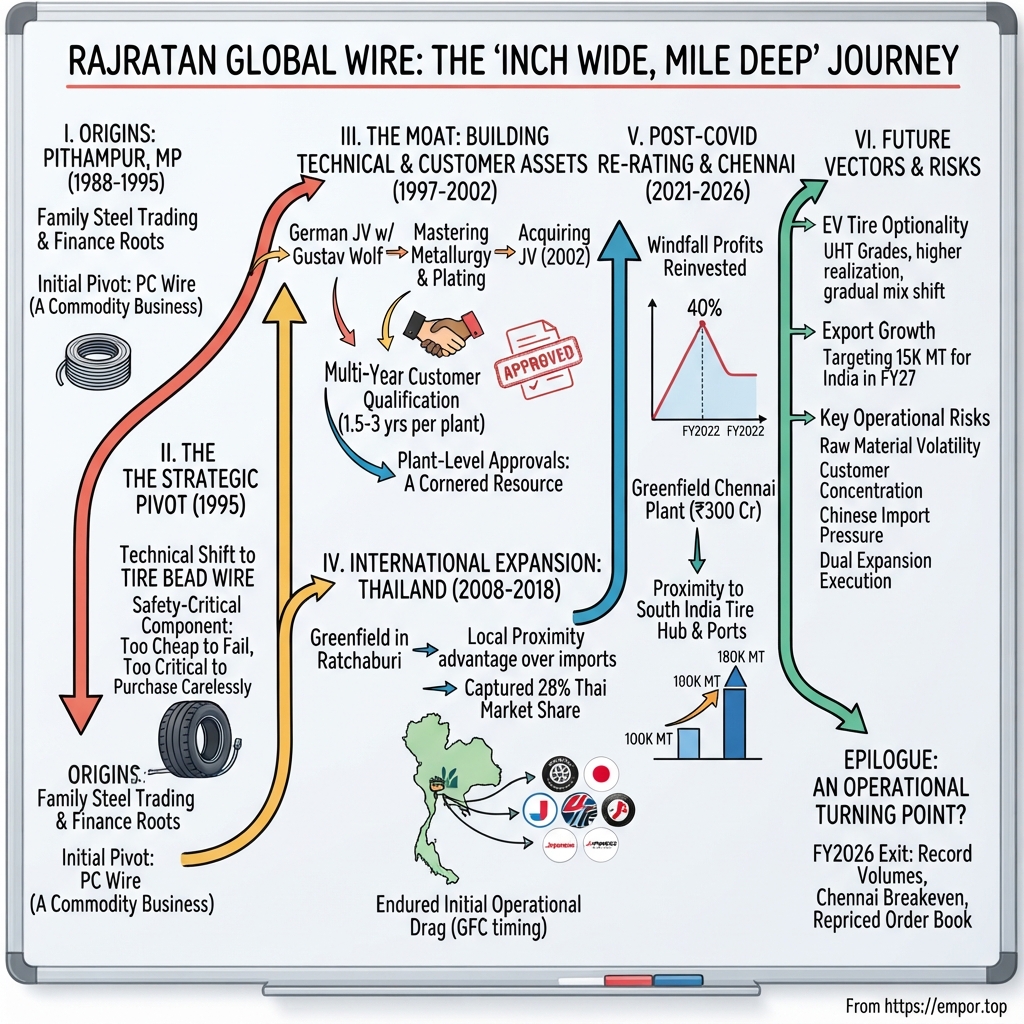
Rajratan Global Wire: The "Inch Wide, Mile Deep" Titan of Tire Bead Wire
I. Introduction & Episode Roadmap
Take apart a truck tire — really take it apart, with a knife, a pair of pliers, and a great deal of patience — and somewhere near the bottom of each sidewall, where the rubber curls inward to grip the steel rim, you will find a dense braided hoop of fine brass-colored wire. It looks like something from a piano. It measures about three millimeters in cross-section, wrapped around a wheel that carries eleven tonnes of cargo at 90 kilometers an hour on a highway in Rajasthan in June, when the road surface is hot enough to soften bitumen.
That hoop is the bead. It is the only component that keeps a pneumatic tire attached to the vehicle.
It also represents, by value, roughly three percent of the tire. Nobody buys a tire because of the bead wire, and no consumer has ever asked for it by brand. Yet if the bead fails, the tire leaves the rim, and everything downstream of that failure is catastrophic. This is the peculiar economic position tire bead wire occupies: a component too cheap to command a premium, yet too critical to purchase carelessly.
Rajratan Global Wire Limited (NSE: RAJRATAN) has spent three decades operating inside that contradiction. From a plant in Pithampur, an industrial township outside Indore in Madhya Pradesh, and a second in Ratchaburi, west of Bangkok, the company built itself into India's largest bead wire producer — management estimated domestic market share at 42–43% on its FY26 fourth-quarter earnings call — and the only dedicated, locally domiciled bead wire manufacturer in Thailand, where it holds roughly 28%.12
The company is a focused specialist. High-carbon steel wire rod comes in; drawn, plated, precisely tensioned wire goes out. Consolidated revenue reached ₹1,156 crore in FY2026 on record sales of more than 133,000 tonnes, representing an 18% volume increase over the prior year.31
This structure creates the central economic tension of the business.
Rajratan sits in a sandwich. Above it are the steelmakers — JSW Steel, Jindal Steel & Power, and Tata Steel — that supply the high-carbon wire rod constituting the overwhelming majority of the company's cost base. These are large, concentrated, price-setting enterprises. Below it are the tire manufacturers — MRF, Apollo Tyres, CEAT, JK Tyre, and the Indian and Thai facilities of Bridgestone, Goodyear, Michelin, and Yokohama — which are similarly concentrated and adept at negotiating component pricing. Rajratan operates in the thin middle layer, converting one commodity into a slightly more specified component while preserving its margin spread.
The bullish thesis holds that this spread is defensible: qualifying a bead wire supplier requires eighteen months to three years of plant audits and road testing, tire makers rarely swap suppliers on safety-critical components, and decades of process expertise in wire drawing create a cost structure that potential entrants cannot easily replicate.4
The bearish thesis argues that Rajratan remains a conversion business subject to a structural margin ceiling, that tire manufacturers deliberately maintain dual-sourcing strategies, and that qualification barriers act merely as speed bumps against established rivals like Bekaert or Tata Steel's wire division, which already hold customer approvals and can bid aggressively on contract renewals.
The financial record reflects this ongoing tension. Consolidated operating margin peaked at 20% in FY2022, fell to 18%, held at 14% over two fiscal years, and settled at 12% in FY2026 — even as revenue and volumes expanded.3 Return on capital employed followed the same downward trajectory, dropping from 40% in FY2022 to 13% in FY2026.3 These figures suggest either that recently added capacity has yet to generate full returns, or that peak margins were an anomaly and structural entry barriers were thinner than the stock's valuation multiple implied.
Here is where this story goes. It begins with the Chordia family in Pithampur and the decision to pivot from a standard concrete-wire business into a technical niche. It traces the German joint venture that introduced Rajratan to advanced metallurgy and the subsequent buyout that altered its capital structure. It follows the 2008 expansion into Thailand, which proved strategic following four initial years of operational drag. It breaks down the unit economics — examining the wire-drawing process, why steel price pass-through mechanisms create margin volatility, and what customer qualification actually protects. It tracks the post-COVID market re-rating and the ₹300 crore greenfield plant in Chennai that followed. It evaluates management's guidance against disclosed execution using historical earnings calls. It assesses whether electric vehicles represent a genuine growth catalyst or primarily a narrative point. Finally, it analyzes competitive dynamics, key operational risks, and the long-term investment cases.
Start where the company started — in a state with no automotive manufacturing base, no commercial port, and no obvious rationale for a wire plant.
 Subscribe on LinkedIn
II. Founding Origins, The Pivot, & The German JV (1988 – 2002)
Pithampur in the late 1980s was an act of faith by the Madhya Pradesh government. Thirty kilometres from Indore, it had been designated an industrial growth centre with land, power, and very little else — no coastline, no steel mill, and no cluster of customers. It was, in the vocabulary of Indian industrial policy, a backward-area incentive zone where companies went primarily for the subsidies.
Sunil Chordia went there to make wire.
Chordia came out of a family in the iron and steel trading business, joined it young, took a science degree, and completed an MBA in finance in 1987.4 That combination mattered more than it sounded. Steel trading teaches that the commodity is the enemy — that margins in metal are made or lost on procurement timing and inventory position, not on selling skill. Finance school teaches a manager to think in returns on capital. A founder carrying both instincts tends to be suspicious of businesses where raw materials account for more than 70 percent of cost and the product is undifferentiated, because that is a business where a converter works extremely hard to earn the steel mill's leftovers.
The company he founded — sources place the founding in 1988 or 1989 and the incorporation of the Pithampur operation in 1991, while the company's own public history emphasizes the late-1980s start — made pre-stressed concrete (PC) wire and strand.45 PC wire is the tensioned steel embedded in concrete beams, railway sleepers, and bridge girders. In an India about to spend three decades building infrastructure, that sounded like a promising market.
It was not, and Chordia recognized why fairly quickly.
PC wire is a technical specification rather than a customer relationship. Contractors bought it against Indian Standards (IS) specifications on price through tenders, purchasing from whichever supplier quoted lowest that week. Dozens of producers competed in the segment. Market entry required little more than a drawing bench and a working capital line. There was no qualification process, no customer stickiness, and no reason for any buyer to pay Rajratan a premium over the marginal supplier. The business generated volume and consumed capital while returning very little of consequence.
Consequently, in 1995, the company pivoted into tire bead wire.5
The term "pivot" makes the transition sound simpler than it was. While both products are drawn steel wire, the similarity ends there. PC wire is a structural product with generous tolerances. Bead wire is a safety-critical component made from high-carbon steel — with carbon content well above 0.7% — drawn down through a sequence of dies to a fine diameter at high tensile strength, then plated with a brass or bronze coating. The plating serves a chemical purpose: during tire vulcanization, sulfur in the rubber reacts with copper in the plating to form an adhesion layer that bonds steel to rubber at a molecular level.
If the plating chemistry is marginally wrong — with the copper-to-zinc ratio off or the coating a fraction of a micron too thick — the bond degrades over the tire's lifespan. That failure does not show up on the factory floor; it manifests years later on the road.
That is why tire manufacturers audit bead wire suppliers with the rigor aerospace companies apply to fastener suppliers. And it is why, in 1995, an Indian PC wire maker in Madhya Pradesh had virtually no realistic path to developing the product independently.
Why Madhya Pradesh Was a Problem
It is worth examining geography, because location shaped the company's economics for twenty years and explains the logic behind its Chennai plant decision three decades later.
Pithampur is landlocked and distant from major industrial hubs. High-carbon wire rod had to be transported by rail or road from steel mills in the east and west. Finished bead wire — heavy, dense, and low in value per kilogram — moved out the same way, traveling to tire plants scattered across India and to distant commercial ports. Freight represented a meaningful fraction of the delivered cost per tonne of bead wire, directly reducing the company's conversion spread.
The offsetting advantages were real but conventional: cheaper land, state industrial incentives, lower labor costs, and — as the plant matured — a specialized workforce. Wire drawing is a craft discipline as much as an engineering process; experienced operators learn to detect line tension issues by sound before a wire breaks. That operational knowledge accumulates over time and represents one of the few non-portable assets a converter possesses.
Nevertheless, the freight penalty remained a structural drag. It limited Pithampur's competitiveness in South India against regional producers and made exporting from Madhya Pradesh economically unattractive. This geographic constraint explains why the company eventually committed ₹300 crore to build a second Indian facility in Chennai: its original plant was misplaced for the next phase of expansion.
Buying the Knowledge
To overcome its technical barrier, Rajratan formed a joint venture in 1997 with Gustav Wolf, a German wire manufacturer. The partnership brought European drawing technology, precise die alignment discipline, and specialized plating processes that Rajratan could not have reverse-engineered within a reasonable timeframe.54
This arrangement reflected the classic post-liberalization Indian model — combining foreign technology with local execution and shared equity. The formula worked, enabling Rajratan to manufacture bead wire to international standards and begin exporting.5
In 2002, Rajratan bought out Gustav Wolf's stake and renamed itself Rajratan Global Wire Limited, framing "Global" as a strategic objective rather than an existing reality.5
Testing the Moat Claim at Its Origin
A common narrative suggests that the German joint venture created an immediate competitive moat. The historical record indicates a more gradual development, which established the operational pattern for the company's subsequent growth.
Three factors clarify this timeline.
First, technical capability is distinct from customer qualification. Mastering the drawing and plating of bead wire gets a supplier onto the starting line, but it does not secure a purchase order. Every tire plant conducts its own audit and road-validation testing. Management's framing of this qualification window — requiring 1.5 to 3 years per plant approval — represented a double-edged barrier in the late 1990s.4 Rajratan spent years converting technical capability into commercial orders plant by plant and customer by customer. The qualification moat protected the business only after the company paid the upfront cost of admission.
Second, the buyout required significant capital, funded during a period when Indian corporate borrowing costs were high. Purchasing a partner's equity is a capital allocation decision that creates no new production capacity, no new product lines, and no additional customers — it buys corporate control. Control proved strategically vital because a minority foreign partner could have constrained Rajratan's entry into Thailand six years later. However, it was a leveraged purchase of strategic optionality that temporarily made the balance sheet a binding constraint.
Third, the legacy PC wire line did not disappear immediately upon the pivot. It continued to consume management attention, working capital, and floor space while earning commodity-level returns, dampening consolidated profitability throughout its multi-year phase-out.
The realistic assessment of the 1988–2002 period is not that technical mastery created an instant moat. Rather, the joint venture bought Rajratan a decade of developmental time it could not have generated internally, which the company converted into customer approvals over years of execution. The competitive barrier was built on plant-level customer qualifications rather than proprietary German engineering alone; the engineering provided the entry ticket, while the customer approvals became the asset.
This distinction explains the company's next expansion phase. Because Rajratan's core asset consisted of plant-level approvals at tire manufacturing facilities, growth required locating production near expanding tire clusters. By 2006, major tire makers were expanding heavily in Thailand.
III. The Audacious Bet on Thailand & ASEAN Expansion (2006 – 2018)
Southeast of Bangkok along Highway 3 toward Rayong, industrial estates such as Amata City, Map Ta Phut, and Hemaraj form the primary supplier hub for the Japanese automotive industry in Southeast Asia. By the mid-2000s, Thailand had established itself as a regional manufacturing center often referred to as the "Detroit of Asia." As vehicle assembly expanded, major tire manufacturers followed. Bridgestone, Michelin, Goodyear, Yokohama, and Sumitomo built or expanded Thai production, attracted by local natural rubber supplies, export tax incentives, and proximity to assembly plants across the Association of Southeast Asian Nations (ASEAN).
These facilities required steady supplies of bead wire, yet none produced it on-site. Instead, tire makers relied on ocean shipments from Japan and South Korea.
For a mid-sized Indian converter with a single plant in Madhya Pradesh, entering Southeast Asia represented a significant strategic risk. In 2008, Rajratan established Rajratan Thai Wire Co. Ltd and constructed a greenfield manufacturing facility in Ratchaburi, west of Bangkok.56
The Strategic Logic
The strategic premise rested on the operational structure of tire manufacturing rather than aggregate demand alone.
Bead wire is dense, heavy, and consumed continuously. Importing it from East Asia entailed substantial ocean freight expenses, customs clearance friction, and extended supply chains with lead times measured in weeks and safety stock measured in months. For a lean tire factory, detecting a specification defect in a shipment arriving from four weeks away risked shutting down assembly lines.
Rajratan positioned itself on local proximity. By manufacturing inside Thailand, the company offered shorter lead times, local consignment inventory, immediate technical support, and a currency match between costs and revenues. It operated as the sole dedicated domestic bead wire producer in a market served primarily by importers, eventually capturing approximately 28% of Thai bead wire demand.26
Securing that position required winning approvals from Japanese tire manufacturers, which maintain strict supplier-qualification standards. Rather than competing solely on price for a safety-critical input, Rajratan won market share by offering responsive local service backed by consistent technical performance over extended audit periods.
What the Clean Version Leaves Out
While the Thai expansion eventually succeeded, its initial execution created severe financial strain due to unfavorable timing.
Rajratan committed capital to the greenfield Ratchaburi facility in 2008, just as the Global Financial Crisis hit. Global vehicle production contracted sharply, tire manufacturers reduced output, and Thai export shipments to North America and Europe stalled just as the plant sought its initial customers.
Furthermore, securing approvals from Japanese manufacturers required a plant-level qualification process lasting 1.5 to 3 years, which commenced only after the facility demonstrated steady production.4 Because greenfield facilities incur depreciation and interest charges immediately upon commissioning while revenue remains gated by customer audits, the Ratchaburi plant experienced years of negative cash flow. The Indian parent entity absorbed these losses, deferring domestic capital expenditure at Pithampur to sustain the Thai subsidiary.
This highlights a recurring structural characteristic of Rajratan's capital cycles: capital expenditure is immediate and concentrated, whereas revenue generation is delayed by customer approval timelines. Greenfield projects consequently create multi-year periods of depressed consolidated margins and return metrics during their ramp-up phases.
By the mid-2010s, the Ratchaburi plant achieved scale and turned profitable. It emerged as the group's higher-margin operations hub, benefiting from higher unit realizations, a consolidated customer base, and less aggressive price competition than the Indian market. The expansion demonstrated that Rajratan could replicate its specialized manufacturing model internationally.
What the Thai Business Actually Taught the Company
Beyond financial contributions, the Thai operation provided three strategic advantages that shaped Rajratan's subsequent corporate development.
First, it established a geographic and currency hedge. Generating a significant portion of revenue and incurring costs in Thai baht while serving export-oriented customers insulated consolidated earnings from single-market downturns. Softness in domestic Indian demand was offset by Thai performance, while margin pressures in Thailand were balanced by domestic operations.
Second, it built commercial credibility with global tire conglomerates. Securing plant approvals from multinational manufacturers in Thailand established an international operational record, supporting the company's broader export targets in Europe and North America.
Third, it provided an operational template for greenfield expansion. Management gained direct experience in estimating facility construction costs, commissioning timelines, customer audit cycles, and working capital requirements during multi-year ramp-up phases.
However, execution timelines remained a persistent challenge, as management continued to face delays between project completion and commercial volume ramp-up during subsequent expansion phases in fiscal years 2024 through 2026.
This capacity for cross-border replication was the foundation management later relied upon when committing ₹300 crore to build its Chennai facility. Before evaluating that project, examining the core unit economics of bead wire manufacturing clarifies the underlying drivers of Rajratan's historical margin performance.
IV. Segment Economics, Industry Structure, & Competitive Landscape
Inside a bead wire plant, the physical transformation is immediate and technical. High-carbon steel wire rod arrives in heavy coils roughly 5.5 millimeters in diameter. The steel is pickled to strip mill scale, then pulled — rather than rolled — through a descending series of tungsten carbide dies, with each pass reducing its diameter and work-hardening the metal to elevate tensile strength. Heat treatment is inserted mid-sequence to restore ductility so drawing can continue without fracturing. At the end of the line, electroplating applies a thin brass or bronze coating measured in fractions of a micron before the finished wire is spooled.
The manufacturing line demands continuous operational precision. A slight die misalignment creates surface flaws. Chemical shifts in the plating bath degrade rubber adhesion. Pushing drawing speeds beyond a steel grade's threshold causes snapping, resulting in downtime, scrap, and line restarts. Operating metrics — such as scrap rates, die life, line speed, plating consistency, and energy consumption per tonne — dictate profitability in this specialized conversion business.
The Revenue Shape
High-carbon steel bead wire generates the overwhelming majority of consolidated revenue. The company operates primarily as a bead wire specialist, using secondary product lines — such as drawn steel wire for automotive, construction, and engineering applications — to absorb surplus capacity and by-product grades.37
Geographically, operations are divided between India and Thailand, with exports serving as an expanding third vector. On its FY2026 year-end earnings call, management reported Indian exports of approximately 9,000 tonnes and targeted 15,000 tonnes for FY2027, aiming for growth of roughly 30% in North America and 50% in Europe off a small starting base.1
The Steel Sandwich and the Margin Sawtooth
Raw material dynamics dominate the business model. High-carbon wire rod accounts for approximately three-quarters of total cost of goods sold. Consequently, commercial contracts with tire manufacturers incorporate price pass-through clauses, adjusting finished goods pricing periodically against benchmark steel prices.
While these contracts theoretically isolate conversion spreads from raw material volatility, repricing lags introduce temporary margin swings. When raw steel prices rise rapidly, the company absorbs higher input costs while delivering against older contract prices, temporarily compressing margins. Conversely, when steel prices fall, finished goods pricing trails the decline, temporarily inflating operating margins regardless of underlying competitive position.
This lag effect manifested during the final quarter of FY2026. Steel prices increased by roughly ₹10,000 per tonne between January and March 2026. Because input costs could not be passed through within the quarter, management noted that EBITDA margins compressed during that three-month period.1 Consolidated operating margin fell to 9% in Q4 FY2026, down from 13–14% in preceding quarters.3
The subsequent repricing, effective April 1, 2026, reversed the compression. In the June 2026 quarter (Q1 FY2027), consolidated net profit increased 69.8% year-over-year to ₹22.96 crore as revenue rose 29.1% to ₹318.35 crore.8 Rather than signaling a permanent structural shift in earnings power, this sharp profit expansion largely reflected the delayed pass-through mechanism normalizing conversion spreads after the prior quarter's squeeze.
Accordingly, single-quarter margins provide an incomplete view of performance. Evaluating long-term economic performance requires tracking conversion spreads per tonne across full steel cycles. Historically, operating margins have fluctuated between the low-teens and 20%, with the 12% operating margin recorded in FY2026 sitting at the low end of its post-2020 range.3
Who Else Is In This Business
The competitive landscape consists of three distinct tiers:
At the top is Bekaert, the Belgium-based global leader in steel wire transformation, which possesses extensive metallurgical research capability alongside established supply relationships across all major global tire manufacturers.[^9] While Bekaert commands superior global scale, Rajratan competes by concentrating exclusively on bead wire conversion with a leaner overhead structure.
The second tier includes South Korea's Kiswire and Hyosung, technically advanced Asian manufacturers with strong positions supplying Japanese and Korean tire makers.9 These were the primary importers whose market share Rajratan displaced in Thailand.
The third tier comprises Chinese exporters such as Shandong Daye and Xingda International. Possessing substantial domestic capacity, these firms export surplus production during periods of weak domestic demand, competing primarily on price in spot markets across Southeast Asia.
Domestically, the most direct competitor is Tata Steel's wires division, which operates as an integrated producer with captive wire rod supply.[^11] While an integrated steelmaker can compress conversion margins within its broader value chain, Rajratan relies on specialized customer focus and local service agility to defend its market share.
Porter, Applied Honestly
A structural analysis of the industry reveals clear operational boundaries:
Buyer Power: High. The tire manufacturing sector is concentrated and enforces strict dual-sourcing mandates for safety-critical inputs. Tire makers avoid relying on a single bead wire supplier, capping pricing power on contract renewals.
Supplier Power: High. High-carbon wire rod supply is concentrated among a few integrated steelmakers, one of which competes directly in downstream wire drawing.
Threat of New Entrants: Low. Multi-year qualification cycles — requiring plant-by-plant audits and road testing over 1.5 to 3 years — represent a substantial barrier to entry.4
Threat of Substitutes: Very Low. High-tensile steel bead wire remains the standard structural component for pneumatic tires, as alternative composite materials remain restricted to niche applications.
Rivalry: High. Competition among qualified suppliers centers on conversion costs, scrap reduction, energy efficiency, and plant utilization rather than brand differentiation.
Overall, the industry structure provides strong defenses against new entrants and technological substitution, but leaves converters exposed to concentrated suppliers and powerful buyers.
Helmer's Powers, Tested
Evaluating the business against Hamilton Helmer's strategic framework highlights two partial competitive advantages:
Process Power: Decades of continuous wire-drawing operations have generated operational expertise in die management, tension control, and plating chemistry. Historically, this capability allowed the company to sustain returns above standard toll-conversion levels, generating ROCE above 20% in FY2016, FY2017, FY2021, FY2022, and FY2023.3 However, ROCE declined to the 13–18% range during FY2024–FY2026, reflecting the capital drag of unutilized new capacity.3
Cornered Resource: The company's portfolio of plant-level approvals across tire facilities in India and Southeast Asia provides an essential license to compete. However, this approval is not exclusive; qualified secondary and tertiary suppliers hold identical access. While qualification deters unapproved new entrants, it does not prevent established rivals from bidding aggressively for volume during periodic contract renewals.
Scale economies apply regionally in India and Thailand but remain limited compared to global competitors like Bekaert. Branding, network effects, and switching costs in the consumer sense do not meaningfully apply to this industrial intermediate.
V. The Post-COVID Re-Rating & The Greenfield Chennai Expansion
For a company that had spent thirty years being invisible, 2021 was disorienting.
The post-pandemic industrial recovery arrived with several tailwinds stacked on top of one another. Vehicle demand rebounded strongly. Global container shipping logistics broke down, making imports of heavy, low-value-density bead wire from China or South Korea suddenly expensive and unreliable. That disruption handed domestic suppliers a delivered-cost advantage. Indian trade remedies on various steel wire imports tightened the domestic market further. Tire makers, having experienced severe supply chain failures, sought reliable local, qualified suppliers and were briefly willing to pay a premium for them.
Rajratan's financial results expanded rapidly. Revenue grew from ₹547 crore in FY2021 to ₹893 crore in FY2022. Operating margins peaked at 20%, net profit more than doubled to ₹124 crore, and return on capital employed reached 40%.3
A 40% return on capital employed in a steel conversion business is an extraordinary result. It occurs when a plant near full capacity experiences falling input costs and strong pricing power simultaneously—operating leverage and raw material pass-through timing pulling in the same direction.
Equity markets reacted predictably, re-rating the stock by an order of magnitude.10 Investors implicitly priced in a scenario where a 40% return on capital employed represented a permanent new baseline—assuming the company's qualification barrier had finally translated into sustained pricing power.
The subsequent four years tested whether that valuation assumption was justified.
"Inch Wide, Mile Deep"
Unlike many promoter-led Indian industrial firms that diversify into unrelated sectors following sudden profit surges, Rajratan maintained its strategic focus. Management chose to concentrate exclusively on bead wire: expanding capacity, developing higher tensile grades, and entering new geographic markets for its core product line.
This concentration strategy is logical for a specialized converter. Sustained focus generates operational discipline, process expertise, scrap reduction, and close customer relationships. Spreading capital across unrelated industries risks undermining those foundational capabilities.
However, operational focus does not guarantee efficient capital allocation. Avoiding value-destroying diversification shows strategic restraint, but it does not prove that capital deployed within the core business generates strong returns.
Furthermore, the focus doctrine has gradually broadened. The company committed approximately ₹70 crore to a steel cord project—a related product requiring a distinct customer qualification process. By the end of FY2026, roughly ₹50 crore had been deployed toward building 10,000 tonnes of annual capacity, targeting realizations near ₹150 per kilogram and EBITDA margins around 20%, with commercial production scheduled for FY2029.1 Steel cord serves as the internal reinforcement belt for radial tires: it involves adjacent metallurgy and shared customers, but carries a higher technical threshold in a market dominated by Bekaert. It represents a logical adjacency, though it moves beyond pure single-product specialization.
Chennai
The company's largest capital allocation was a greenfield manufacturing plant at Sriperumbudur, near Chennai. Announced as part of a broader ₹320 crore capital expenditure program—comprising about ₹250 crore for the Indian greenfield facility and ₹70 crore for brownfield expansion in Thailand—the investment aimed to expand group capacity from 100,000 tonnes toward 180,000 tonnes.6 Subsequent disclosures revised the Chennai investment estimate closer to ₹300 crore.11 Management funded the program through internal cash generation—which exceeded ₹100 crore annually at the time—supplemented by modest debt.6
The location logic rested on three main factors. First, customer proximity: Tamil Nadu and adjacent southern industrial clusters house major manufacturing plants for MRF, Apollo, CEAT, Michelin, and Yokohama. Because freight represents a significant portion of delivered costs, operating nearby provides a structural cost advantage over shipping from Madhya Pradesh. Second, port access: proximity to Chennai and Kattupalli ports supports direct export shipping to Europe and North America, underpinning management's FY2027 export growth targets.1 Third, capacity headroom: the Pithampur facility was operating near its practical ceiling while domestic market demand continued to expand.
The Chennai facility was engineered for an initial capacity of 30,000 tonnes per annum with a design path to 60,000 tonnes. On its FY2026 year-end earnings call, management confirmed it was executing that expansion with approximately ₹25 crore of incremental capital expenditure, targeting 35,000 tonnes of production from Chennai in FY2027.1
Unit capital intensity for the initial build worked out to approximately ₹1 lakh per tonne of annual capacity—roughly $550 to $650 per tonne at prevailing exchange rates. This sits within international norms for greenfield wire facilities and remains below Western construction costs, reflecting a structural advantage in domestic engineering costs.
What the Capital Actually Did to Returns
This large capital deployment directly tested the thesis of disciplined capital allocation.
The Chennai plant was planned when consolidated return on capital employed stood at 40%. It was commissioned into a period when consolidated operating margins contracted from 20% to 12%, and return on capital employed fell to 13%.3 Revenue remained stagnant between FY2022 and FY2025—moving from ₹893 crore to ₹895 crore, ₹890 crore, and ₹935 crore—while net profit dropped from ₹124 crore to ₹59 crore.3
This resulted in three consecutive years of stagnant revenue and a halving of net profit during the execution of a major capacity expansion.
Part of this margin compression was structural and expected. Greenfield depreciation and interest expenses begin immediately upon commissioning, whereas revenue accumulates gradually as plant qualification proceeds. Borrowings reached ₹324 crore against equity of ₹650 crore by FY2026—a manageable leverage ratio for an asset-heavy manufacturer.3 This repeated the pattern observed during the Thai expansion detailed in Section III, where front-loaded capital investments temporarily depressed consolidated return metrics.
However, non-mechanical headwinds also contributed. Flat top-line revenue indicated that underlying volumes did not offset the unwinding of peak FY2022 pricing. While the ramp-up lag was predictable, the capital commitment required shareholders to absorb four years of depressed returns.
The Chennai investment was strategically sound but financially demanding. Evidence confirming its commercial viability emerged in FY2026, when the plant achieved 85–90% capacity utilization by March 2026 and turned monthly profitable, prompting management to initiate the capacity-doubling phase.12 This demonstrated that Rajratan could construct and fill greenfield bead wire capacity, though each major expansion required roughly four years of lower return metrics before reaching optimal operating scale. Whether long-term returns from the Chennai plant will match historical averages remains to be fully demonstrated.
VI. Management Quality & Conference Call Reality Check
There is a particular sound to an Indian earnings call when the numbers have missed. The Chairman's prepared remarks run warm — volumes, market share, long-term structural demand, the strength of the franchise — and then the moderator opens the line, and the second or third analyst asks the question everyone was waiting for, and the register changes.
Rajratan's calls have had a lot of those moments over the past three years, and how management handled them is genuinely informative.
The People
Sunil Chordia, Chairman and Managing Director, is the founder, and his fingerprints are on every strategic decision in this article: the pivot out of PC wire, the German JV and its buyout, Thailand, and the refusal to diversify.4 His background in steel trading and finance shows up in how he talks about the business — he discusses steel price movements per tonne and pass-through timing with the fluency of someone who has been watching metal prices for forty years, and on the FY26 call his explanation of the margin decline was specific and unhedged rather than atmospheric.1
Yashovardhan Chordia, Executive Director and CEO, represents the second generation — US-educated, and associated with the more technical and international agenda: factory automation, process control, and building the export business that the Chennai plant was designed to enable. The generational handover is visible in what the company now talks about. A founder-era bead wire company talks about capacity and customers; this one talks about North American and European approvals and per-region export growth targets.1
Family succession in Indian manufacturing is a real governance variable and deserves neither automatic credit nor automatic suspicion. What can be observed is that the transition has been gradual and public rather than abrupt, and that the second generation has been given genuine operational scope rather than a title.
Ownership: promoters held 65.20% as of June 2026 — a high, stable stake — with domestic institutions at 8.35%, foreign institutions at 0.83%, and public shareholders the remainder across roughly 62,500 holders.3 That is meaningful skin in the game, and it aligns promoters with shareholders on value creation. It also concentrates control such that minority shareholders have essentially no mechanism to force a change of course, which cuts both ways depending on whether the course is right.
Promises Versus Outcomes
Now the test. The material claim to falsify is that management's guidance is reliable — specifically, that Chennai would ramp smoothly and that consolidated margins would hold in the high-teens.
The record says: the direction was right, the timing was consistently optimistic, and the margin guidance was materially missed.
On margins. Around FY24, the company was publicly holding to roughly 20% volume growth and 15–16% EBITDA margin guidance.11 Consolidated operating margin came in at 14% in FY2024, 14% in FY2025, and 12% in FY2026.3 Three consecutive years below the guided band. On the FY26 year-end call the guided range had been reset downward to 13.5–14%.1 That is not a rounding error; it is a structural markdown of roughly two to three percentage points of margin expectation, and investors who underwrote the high-teens case were wrong for three years running.
On Chennai timing. The plant was originally expected to be completed by the end of FY24.6 Meaningful utilisation — the 85–90% figure — arrived in March 2026.2 Through FY24 and FY25 the gap between commissioned capacity and approved, saleable volume was the single largest drag on consolidated margins, because fixed costs, depreciation and finance charges were being absorbed against volumes that customer approvals had not yet released. Analysts pressed on precisely this through the FY24 calls, and the answer was necessarily some version of "the approvals take the time they take" — which is true, and is also exactly the thing management should have modelled before guiding.
On competition. Management has acknowledged Chinese export pricing pressure in Southeast Asian markets as a real constraint on Thai realisations rather than dismissing it, which is to their credit. The Q4 FY26 discussion made the capacity position in Thailand explicit — guidance there was 10–14% growth, described as capacity-constrained, with India expected to carry the higher growth rate.1 Admitting a geography is capacity-limited rather than demand-limited is a specific, checkable statement.
On Q4 FY26 itself. Volumes hit a record 133,000-plus tonnes, up 18%, with India up 19% and Thailand up 17%, while Q4 revenue rose 25% to ₹314.29 crore and margins fell.1 Management named the cause — the ₹10,000/tonne steel move — gave a specific remediation (price increases already implemented in the current quarter) and a specific expected outcome (13.5–14% EBITDA).1 The June 2026 quarter then delivered the profit recovery.8
The Calibrated Read
Putting it together: this is a management team that is credible on mechanism and unreliable on timing.
When Chordia explains why a margin moved, the explanation is concrete, quantified, and has repeatedly proven checkable against the next quarter's results. That is a meaningfully better disclosure standard than the Indian mid-cap average, and it is the reason the Q1 FY27 recovery was predictable rather than surprising.
When management forecasts how long an approval will take or where margins will settle in two years, the record shows systematic optimism. Chennai was late; the margin band was too high for three consecutive years; the guided range has since been cut.
Neither observation is disqualifying. Combined, they suggest a specific way to use the company's disclosures: treat the explanations of what happened as reliable and the projections of what will happen as a ceiling rather than a base case. Applied to the current guidance — 17–18% volume growth to about 155,000 tonnes in FY27, with margins recovering to 13.5–14% — the appropriate posture is that the volume target is grounded in a plant that is already filling and the margin target requires steel to behave.1
The falsifier to watch is simple and near-term: if FY27 closes with volumes near 155,000 tonnes and full-year operating margin at or above 13.5%, the timing-optimism critique weakens materially. If volumes arrive and margins do not, the skeptical thesis — that this is a conversion business whose spread is capped regardless of scale — gains real support.
Which brings us to the growth story management would prefer to discuss.
VII. Future Growth Vectors & EV Tire Optionality
Every industrial supplier in the 2020s includes an electric vehicle slide in its investor presentation, though few deliver the underlying value those slides imply. In Rajratan's case, the vector holds genuine physical rationale, but its financial impact requires realistic sizing.
The underlying physics is straightforward. An electric vehicle carries a heavy battery pack, making it 20% to 30% heavier than an equivalent internal-combustion car. It also delivers maximum torque instantly from zero revolutions, while regenerative braking applies substantial deceleration force back through the tire interface.
For the bead wire hoop, these dynamics translate into elevated mechanical stress at the point where the tire grips the rim: higher static loads, greater rotational torque, and increased lateral strain during cornering under heavier vehicle mass. The metallurgical response is higher-tensile and ultra-high-tensile (UHT) bead wire — steel drawn to greater tensile strength so the bead bundle can withstand these forces without expanding in physical volume.
Commercially, this shift is favorable for a specialized converter. Higher-tensile grades require tighter drawing discipline, command higher realisations per tonne, and reward the process capabilities Rajratan has accumulated over three decades. Every percentage-point shift toward UHT grades improves blended conversion spreads without requiring incremental volumetric capacity.
Sizing It Honestly
A proportionality check clarifies the true scope of this transition. EV-specific and ultra-high-tensile bead wire currently accounts for a modest share of Rajratan's total volume — roughly 10% to 15%. This is not a new product line; it is a grade upgrade within an established product sold to existing customers through existing plant qualifications.
That framing presents both opportunities and limitations.
On the positive side, because UHT wire represents a grade enhancement rather than a new venture, it requires no new greenfield plants, no new commercial relationships, and no qualification process from scratch. The execution risk of converting technical capability into revenue is lower than for speculative adjacencies. Growth does not depend on creating a new market, but on the gradual mix shift of existing tire production.
On the skeptical side, because this evolutionary upgrade is accessible to all qualified producers, it does not constitute a proprietary moat. Competitors such as Bekaert, Kiswire, and major Chinese manufacturers produce equivalent UHT bead wire grades. Tire makers maintain dual-sourcing strategies across high-tensile products just as they do for standard wire. A rising EV mix increases addressable product value across the industry rather than shifting market share exclusively to Rajratan. Modeling EV adoption as a company-specific margin catalyst mistakes a sector-wide tailwind for an enterprise moat.
Furthermore, domestic market timing introduces a constraint. Passenger EV adoption in India remains low compared to Europe or China, while the heavy commercial vehicle segment — which consumes the highest volume of bead wire per tire — electrifies at the slowest pace. Consequently, the most bead-wire-intensive portion of Indian road transport will be among the last to convert.
The Export Vector
The more immediate growth lever is geographic expansion. Port proximity at the Chennai facility, combined with Western tire makers seeking to diversify supply chains away from Chinese component manufacturers, creates an export opening. Management's targets for FY2027 — expanding Indian export volume from approximately 9,000 tonnes to 15,000 tonnes, driven by projected growth of 30% in North America and 50% in Europe — offer verifiable metrics for execution.1
However, historical execution patterns remain relevant. Securing new export customers requires plant-level qualifications, a process where Rajratan has historically experienced multi-year timelines across Pithampur, Thailand, and Chennai. Evaluating the export trajectory requires incorporating these structural audit timelines into growth projections.
The investor read on optionality: EV mix expansion represents a genuine, industry-wide improvement in unit realisations rather than a proprietary competitive edge, serving as a gradual tailwind to realisations per tonne rather than a rapid growth engine. International exports represent the primary near-term growth vector, with performance measurable by whether management achieves its disclosed tonnage targets.
This leads directly to the core operational and financial risks facing the business.
VIII. Material Risk Radar & Sceptical Investor Stress Test
The risks facing a single-product manufacturer are unusually concrete: because the operating focus is narrow, potential vulnerabilities are clear and visible.
Raw material volatility and pass-through lag. As established in the segment economics, raw material pass-through lags cannot be engineered away. They remain a permanent operating condition for a converter where high-carbon wire rod accounts for roughly three-quarters of total costs. Management can optimize contract structures and inventory discipline, but sharp steel price increases will inevitably compress single-quarter margins before contractual adjustments take effect. Investors must expect periodic margin volatility across steel price cycles.
Customer concentration. A concentrated group of tire manufacturers accounts for most of Rajratan's revenue—the unavoidable consequence of supplying a consolidated global industry. The primary risk is not total account loss, as tire plants rarely shut down or swap suppliers entirely, but quiet allocation drift. Because tire makers enforce strict dual-sourcing mandates, a minor shift in volume allocation by a major customer can lower plant utilization without generating a headline supplier cancellation.
Chinese import pressure and trade policy. Chinese producers retain excess capacity built for a domestic construction and automotive boom that has since moderated, directing surplus output into export markets. In Southeast Asia—where Rajratan's Thai facility competes—this creates direct, price-based margin pressure that management acknowledges constrains realisations. While anti-dumping duties provide relief, trade remedies are slow to implement, subject to periodic review, and vary by jurisdiction, leaving Thailand more exposed than India.
Cyclicality of the end market. Bead wire demand depends directly on tire manufacturing, which mirrors vehicle production and replacement demand. Replacement tire sales provide a stabilizing baseline as India's vehicle fleet expands. However, a prolonged contraction in commercial vehicle production would directly affect Rajratan, which lacks product diversification. The company's primary operational buffer during a downturn is redirecting domestic capacity toward lower-margin export markets—a flexibility enhanced by the Chennai plant, albeit at lower conversion spreads.
Execution risk on dual expansion projects. Management is simultaneously doubling capacity at the Chennai facility to 60,000 tonnes per annum and constructing a steel cord line targeted for commercial production in fiscal 2029.1 Steel cord represents a significant step up in technical complexity against entrenched global leaders like Bekaert, accompanied by a multi-year customer qualification timeline. Historical ramp-up timelines across Pithampur, Ratchaburi, and Chennai indicate that commercial volume delivery could extend beyond management's initial schedules.
Balance sheet leverage. Borrowings of ₹324 crore against an equity base of ₹650 crore represent a manageable capital structure for a cash-generative industrial producer.3 However, funding two concurrent capital projects reduces financial flexibility. If a prolonged margin downturn coincides with ongoing capital expenditure, debt servicing requirements could constrain cash allocation options.
The Activist Case
The bear thesis against Rajratan can be framed in its strongest activist form:
"Rajratan operates a metal conversion business framed around a technology moat. At its core, the company purchases steel wire rod from concentrated steelmakers and sells drawn wire to concentrated tire manufacturers, capturing a conversion spread that both sides continuously seek to compress. Because tire makers mandate dual sourcing, the qualification process protects the broader incumbent group—including Bekaert, Tata Steel, and Asian producers—without protecting Rajratan’s individual volume allocation. Conversion spreads are structurally capped at roughly $150 to $200 per tonne. The financial record reflects this constraint: return on capital employed dropped from 40% to 13% even as capacity nearly doubled. If scale generated a true competitive moat, returns would have expanded alongside capacity."
This critique highlights genuine structural constraints: dual-sourcing mandates, buyer concentration, and the sharp drop in return on capital employed.
However, the activist argument misattributes the cause of that financial decline. The peak 40% return on capital employed in fiscal 2022 reflected an extraordinary alignment of full capacity utilization, favorable raw material timing, and global logistics disruptions, rather than a permanent baseline of pricing power. Measuring performance against that peak overstates structural deterioration. A fairer baseline is fiscal 2016 through fiscal 2021, when return on capital employed ran between 15% and 23% with operating margins between 10% and 17%.3 Fiscal 2026's 13% return on capital sits at the bottom of that historical band, recorded while carrying substantial new capacity that achieved high utilization only in the final month of the fiscal year.32
Furthermore, operational results provide counter-evidence to the pure toll-converter argument. Securing a 28% market share in Thailand against established Japanese and Korean competitors demonstrates capabilities beyond generic wire drawing. Domestically, holding a 42% to 43% market share for years against Tata Steel’s integrated wire division indicates that customer qualification, process efficiency, and regional service agility create a defensible business model.1[^11]
The verdict supported by execution history: The activist thesis correctly identifies that conversion spreads face a structural ceiling, but understates the durability of the spread Rajratan defends. Plant-level qualifications, technical precision, and operational proximity support returns above generic commodity processing, even if they cannot sustain the peak returns seen in fiscal 2022. Rajratan operates as a defended, mid-teens-return business subject to cyclical swings, rather than a high-margin compounding machine. The key event that would test this thesis is whether full capacity utilization across Pithampur, Ratchaburi, and Chennai can restore return on capital employed above its current 13% baseline.
IX. Business & Investing Playbook
Several transferable lessons emerge from this history, and each comes with a boundary worth defining.
1. Hyper-specialization works when it compounds into something a customer cannot easily verify. Rajratan's "inch wide, mile deep" strategy is not intrinsically superior to diversification. It succeeds here because bead wire is a safety-critical component whose quality is invisible at purchase and expensive to get wrong, meaning the buyer is purchasing process reliability rather than comparing spot specifications. Focus builds that reliability. The limitation: specialization offers no shelter when the single end market contracts, concentrating macro risks into a single industry cycle.
2. Cross-border greenfield expansion is replicable, but only for companies that can fund a multi-year revenue gap. The Thailand playbook — locating near the customer base, offering proximity advantages over importers, and absorbing years of plant qualification before winning meaningful volume — proved repeatable at Chennai. Success relies less on proprietary strategic insight than on balance-sheet endurance and promoter patience. A business facing quarterly earnings pressure or an impatient capital structure cannot execute this model.
3. Index-linked pass-through pricing is survival infrastructure, not a competitive advantage. Without contractual pass-through mechanisms, a converter with three-quarters of its cost base tied to a single volatile commodity would be uninvestable. With pass-through clauses, the business survives steel cycles, but pricing lags persist. Analysts evaluating converters must focus on volume and spread per tonne, treating reported quarterly margin fluctuations as temporary noise around that underlying signal.
4. Refusing empire-building is necessary but not sufficient. Rajratan avoided deploying its windfall profits into unrelated sectors, preventing a common form of promoter value destruction. However, allocating ₹300 crore toward core capacity still required four years to generate target returns, while the move into steel cord pits the company against established global leaders. Strategic discipline regarding where capital is deployed is only half the test; the return earned on that capital remains the ultimate metric.
5. Treat long-cycle guidance as a directional vector rather than a calendar date. When customer approval cycles gate revenue, management cannot fully control delivery timelines. When public markets demand explicit target dates, guidance often leans optimistic, leading to predictable timeline disappointments. Rather than discounting management credibility entirely, analysts should apply systematic delay factors to milestones dependent on third-party audits, underwriting base-case valuations on already qualified capacity.
6. Capital allocated at cycle peaks carries structural return drag. A company's true capital allocation policy is revealed during high-profit years. Rajratan reinvested its FY2022 windfall into core capacity and a closely related adjacency. Yet capital committed at the peak of a cycle is often spent when construction costs are elevated and demand assumptions reflect peak optimism. Even when the strategic rationale is sound, peak-cycle investments require longer payback periods.
The overarching lesson connecting these observations is that while Rajratan's strategic direction has proven consistent, execution timelines have regularly exceeded initial forecasts. Any framework for evaluating the business must incorporate that structural delay.
X. Strategic Position, Key KPIs, & Epilogue
Rajratan enters the second half of fiscal 2027 in a clear operational position. Across three facilities—Pithampur, Ratchaburi, and Sriperumbudur—group capacity is heading toward roughly 180,000 tonnes.6 Domestic market share holds in the low 40% range, while Thai market share stands at roughly 28%.12 After delivering record fiscal 2026 volumes of over 133,000 tonnes, management guided toward 155,000 tonnes in fiscal 2027.1 The margin structure has settled below its post-COVID peak, management's guidance has aligned with operational reality, and the steel cord venture will consume capital for three more years before generating revenue.
The strategic question is no longer whether the company can build and fill capacity—it has executed that model twice across borders. The question is whether expanding volume generates returns that justify the capital, or merely creates more tonnage on which to earn the same capped spread.
Three KPIs
1. EBITDA per tonne — the conversion spread. This is the primary metric that isolates underlying operating performance from raw steel price fluctuations. Revenue can expand during steel price inflation without delivering economic gain, while percentage margins can compress for the same reason. Conversion spread per tonne strips away both effects. The critical test is the multi-year trajectory: if spread per tonne holds or improves alongside volume growth, the process-power and product-mix arguments carry weight. If it erodes as volume rises, it validates the skeptical view that scale is being traded for market share and price concessions.
2. Capacity utilisation across the group, with Chennai as the swing factor. The Chennai facility reached 85–90% capacity utilization in March 2026 and is being doubled.21 That expansion resets the utilization timeline, introducing new unabsorbed fixed costs and renewed dependence on customer audit schedules. Utilization serves as the cleanest measure of whether the qualification pipeline is converting into commercial volume. Thailand's position remains equally critical, as management has characterized the facility as capacity-constrained rather than demand-constrained—limiting group volume growth until additional capacity is addressed.1
3. Export volume — India's shipped tonnage. Management reported Indian export volume at roughly 9,000 tonnes, targeting 15,000 tonnes for fiscal 2027.1 This represents the company's most falsifiable operational claim. It simultaneously tests the Chennai port logic, the Western supply-chain diversification thesis, and management's qualification timeline forecasts in a single metric. Achieving this target will indicate that the second-generation international expansion strategy is succeeding. If incremental volumes stall, it will signal that customer qualification delays persist.
The Bull Case
The constructive thesis holds that the capital-intensive buildout that suppressed returns for four years is substantially complete. The fiscal 2026 exit—marked by record volumes, the Chennai plant reaching monthly profitability near full utilization, and a repriced order book effective April 2026—signals an operational turning point.12 The earnings recovery in the June 2026 quarter provides initial empirical support for this trajectory.8 With three facilities operating near capacity, operating leverage should emerge after years of drag. Product mix improves as adoption of electric vehicles and premium tires drives demand for high-tensile and ultra-high-tensile grades. Export markets expand the addressable customer base beyond domestic Indian automotive cycles. Meanwhile, the domestic market position remains protected by customer qualification barriers that have held for decades against integrated steelmakers and global competitors. Under this scenario, operating margins recover into the mid-to-high teens, return on capital employed approaches historical levels above 20%, and the business compounds through volume expansion.
The Bear Case
The skeptical thesis views three consecutive years of missed margin guidance as evidence of a structural reset rather than a temporary cyclical trough. Under this view, peak high-teens operating margins were an artifact of post-pandemic supply chain dislocations, while low-teens margins reflect the true earning power of a converter positioned between concentrated suppliers and consolidated buyers. Price competition from Chinese exporters continues to constrain realisations in Southeast Asia. Domestic commercial vehicle demand remains modest, forcing expanded capacity to compete primarily on price to maintain utilization. Simultaneously, the Chennai expansion and steel cord project extend capital commitments, with steel cord competing directly against Bekaert on its core product line while facing a multi-year qualification lag. Under this reading, sales volumes and revenues expand, but returns on capital remain constrained in the low teens—leaving the company larger without becoming structurally more profitable.
Both arguments hinge on the same core variable. The investment outcome depends on whether each tonne of bead wire yields more, less, or the same conversion spread as prior periods, and how many tonnes the company delivers.
The braided hoop of brass-colored wire in the tire sidewall remains indispensable—there is no commercial substitute, no disruptive technology on the horizon, and no version of road transport that operates without it. The remaining question is one Rajratan has faced for thirty years across every plant audit: how much of the economic value in a safety-critical component the manufacturer can permanently capture.
References
-
Rajratan Global Wire Limited Releases Q4 FY26 Earnings Conference Call Transcript — ScanX, 2026-04-22 ↩↩↩↩↩↩↩↩↩↩↩↩↩↩↩↩↩↩↩↩↩↩↩↩
-
Rajratan Global Wire Reports Record Sales Volume Despite Margin Pressures in Q4FY26 — ScanX, 2026 ↩↩↩↩↩↩↩↩
-
Rajratan Global Wire Consolidated Financials & Ratios — Screener.in ↩↩↩↩↩↩↩↩↩↩↩↩↩↩↩↩↩
-
Sunil Chordia, Chairman & Managing Director, Rajratan Global Wire Ltd — India Infoline ↩↩↩↩↩↩↩↩
-
Rajratan Global Wire investing Rs 320 cr for capacity addition — The Free Press Journal, 2021 ↩↩↩↩↩↩
-
Investor Presentations Archive — Rajratan Global Wire Investor Relations ↩
-
Rajratan Global Wire consolidated net profit rises 69.82% in the June 2026 quarter — Business Standard, 2026-07-24 ↩↩↩
-
Rajratan Global Wire Stock Overview & Quarterly Results — Moneycontrol ↩
 LinkedIn
 WhatsApp
 Reddit
 Hacker News
 Email
Email Kindle
 RSS Feed
 Spotify
 Apple Podcasts
 Amazon Music
 Audible
 YouTube