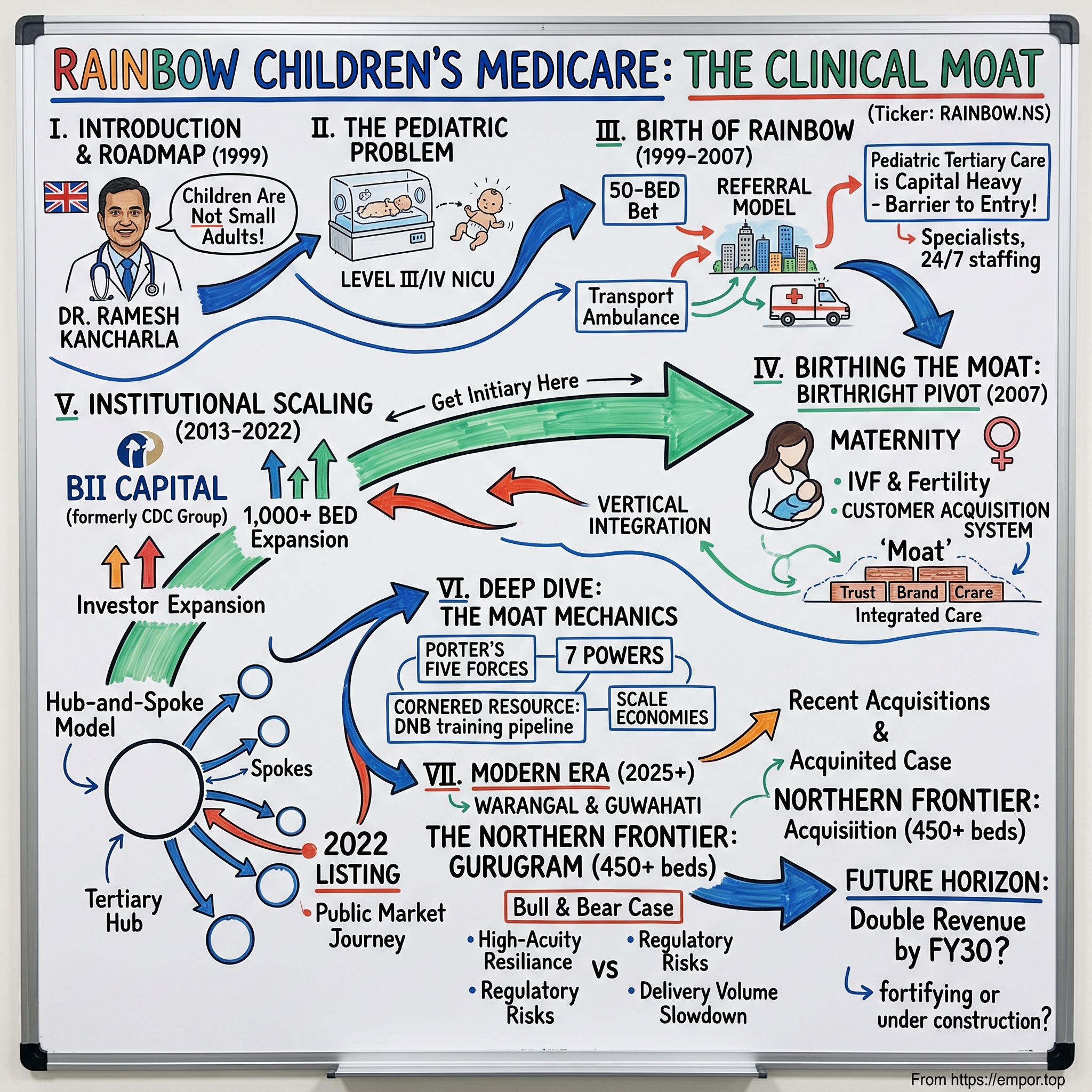
Rainbow Children's Medicare: The Clinical Moat of India's Pediatric Giant
I. Introduction & Episode Roadmap
There is a particular sound that a neonatal intensive care unit makes. It is not the sound most people imagine when they think of a hospital — no shouting, no gurneys crashing through doors. It is a low, constant electronic hum, punctuated by the soft percussion of ventilator cycles and the arrhythmic chirp of a dozen monitors, each keeping watch over a human being who weighs less than a bag of sugar. Walk into a Level III or Level IV NICU at two in the morning and you will find a team of specialists who are fully awake, fully staffed, and doing arithmetic in micrograms. The cost of running that room, hour after hour, whether it holds twenty babies or two, is the single most important fact in this story.
In 1999, a pediatrician named Dr. Ramesh Kancharla came back to Hyderabad after training in London and decided to build a hospital that did nothing but treat children. Almost everyone he spoke to thought this was a category error. India's private hospital industry was, and largely still is, organized around adults: cardiology, oncology, orthopedics, the profitable middle-aged body. Children were a ward, not a business. Twenty-seven years later, Rainbow Children's Medicare Limited operates 24 hospitals across nine cities with roughly 2,435 beds, generated ₹1,703.1 crore of revenue in the financial year ended March 2026, converted about a third of that into EBITDA, carries no debt, and sits on roughly ₹700 crore of net cash.910 The equity market values it in the neighbourhood of ₹14,800 crore — comfortably north of $1.5 billion.8
That is the hook. But the interesting question is not how did a pediatric hospital survive. It is why does a pediatric hospital earn better economics than the adult multi-specialty giants it was supposed to lose to — and whether that advantage is a durable structural feature or a temporary artifact of being early in a market nobody else wanted.
The organizing idea, the one that Rainbow's clinicians repeat with the insistence of a catechism, is that children are not small adults. A neonate is not a scaled-down thirty-year-old any more than a sapling is a scaled-down oak. Their airways are different, their drug metabolism is different, their thermoregulation is different, their veins are the diameter of a thread. This is a clinical philosophy. It is also, and this is the part that matters for investors, a business model. Because if children genuinely require dedicated infrastructure, dedicated equipment, and dedicated round-the-clock specialists, then the fixed cost of entering pediatric tertiary care is enormous — and the general hospital down the road cannot casually decide to compete with you next quarter.
Here is where this story goes. We start in the clinical void of late-1990s India, where a child in respiratory failure had roughly two options, both bad. We watch the founding of a fifty-bed hospital that had to fill beds it could not guarantee would fill. We follow the 2007 pivot into obstetrics under the BirthRight brand — a move that looks, in hindsight, like the most consequential customer-acquisition decision the company ever made. We examine the arrival of institutional capital in 2013 in the form of Britain's development finance institution, the scaling of a hub-and-spoke network across South India, and the 2022 listing that turned a founder-led clinical enterprise into a public company with quarterly obligations.
Then we get analytical. We take apart the alleged moat with Hamilton Helmer's 7 Powers and Porter's Five Forces, and we test each claimed advantage against evidence rather than management assertion — including the doctor-engagement model, which turns out to be considerably more nuanced than the "exclusive full-time retainer" shorthand suggests. We look at the two acquisitions of 2025, in Warangal and Guwahati, and ask whether the prices paid were as disciplined as they first appear. We look hard at the 450-bed bet on Gurugram, a market where Rainbow's own founder has acknowledged the north behaves differently from the south. We watch a founder hand day-to-day control to a professional chief executive in January 2026. And we build the bull and bear cases against each other, including the uncomfortable fact that Rainbow guided to "late teens to around 20%" revenue growth for FY26 and delivered 12.4%.39
None of this resolves into a verdict. It resolves into a set of things worth watching. Let's start where the pediatric problem starts: with a child who cannot breathe, in a country that had nowhere to take him.
 Subscribe on LinkedIn
II. The Pediatric Problem: Children Are Not "Small Adults"
Picture a district hospital in Andhra Pradesh in 1997. A two-day-old infant, born six weeks early, is struggling. His lungs have not finished manufacturing surfactant, the soapy film that keeps the microscopic air sacs from collapsing on every exhale. Without it, each breath is like trying to inflate a balloon that has been glued shut. There is a ventilator in the building. It is an adult ventilator, calibrated to push a volume of air appropriate for a seventy-kilogram body. Used on a two-kilogram body it will do what a fire hose does to a paper cup.
This is not a metaphor. It is the literal, physical reason that pediatric medicine exists as a separate discipline, and it is the reason that the phrase "children are not small adults" is a clinical statement before it is a marketing line. Endotracheal tubes come in sizes measured in millimetres. Drug doses are computed per kilogram of body weight, and the therapeutic window — the gap between too little and toxic — narrows dramatically as the patient shrinks. A premature infant cannot regulate its own body temperature, which is why the incubator exists. It cannot mount a normal immune response, which is why infection control in a NICU is closer to a semiconductor cleanroom than to a general ward.
Dr. Ramesh Kancharla learned this in the places where it was best understood. He trained in Britain, in the institutional ecosystem anchored by Great Ormond Street Hospital and King's College Hospital — the former being, for a century, roughly what CERN is to physics for the world of children's medicine. What he encountered there was not merely better equipment. It was an organizational form: a hospital where every system, every protocol, every staffing rota, every piece of capital equipment had been designed around the pediatric patient rather than adapted to him.
Then he came home. Rainbow Children's Medicare was established in Hyderabad in 1999 by Dr. Kancharla together with Dr. Dinesh Kumar Chirla, a neonatal and pediatric intensive care specialist who would become the clinical spine of the intensive care operation.2 What the two men found in India was a market split into two unsatisfactory halves.
On one side sat the solo pediatrician. India had — and has — many excellent ones. But the economics of a single-doctor clinic support a stethoscope, a vaccination refrigerator, and a nebulizer. They do not support a ventilator, a blood gas analyzer, a 24-hour respiratory therapist, or a pediatric surgeon on call. When a child in that clinic deteriorated, the pediatrician's job became logistics: find a bed somewhere else, fast.
On the other side sat the general multi-specialty hospital. Here the equipment existed, but it was pointed at adults, because that is where the revenue was. Pediatrics occupied a corridor. The pediatric ICU, where it existed at all, was frequently a partitioned corner of the adult ICU, staffed by intensivists whose primary training was in adult critical care. Capital budgets flowed toward the cath lab and the oncology block. This was not villainy; it was arithmetic. A hospital administrator allocating a marginal crore of capital between a cardiac catheterization suite serving affluent adults and a neonatal ventilator bank serving newborns will, absent an unusual mandate, choose the cath lab.
The gap between those two halves was where children died. And it was into that gap that Kancharla and Chirla proposed to insert an entire hospital.
The reaction was close to universal skepticism, and the skepticism was not stupid. The objection ran like this. Children get sick, yes, but they mostly get sick briefly and cheaply — a fever, an ear infection, a course of antibiotics. The expensive, high-margin chronic disease burden that fills adult hospital beds for weeks arrives with middle age. A dedicated children's hospital would therefore be a business with enormous fixed costs and a patient population that, by nature and by design, wants to leave as quickly as possible. Where, capital providers asked, is the volume?
It is worth sitting with that objection, because it is the same objection an investor should interrogate today. The bear case against Rainbow in 1999 and the bear case against Rainbow in 2026 rhyme. Both concern the tension between a very heavy fixed-cost base and a patient population characterized by short stays. Rainbow's average length of stay in FY26 was 2.71 days.9 A hospital whose patients are gone in under three days must refill its beds continuously, forever, or the fixed costs eat it alive.
What the skeptics missed was the second-order effect. Precisely because pediatric intensive care is so fixed-cost heavy, and precisely because no general hospital wants to fund it, whoever builds it first becomes the only place in the city that can take the sickest children. And the sickest children are also the most complex, the most intensive, and — in a fee-for-service system — the most economically valuable. The unattractiveness of the business to everyone else was, in a strict sense, the business.
That was the bet. It required someone to be willing to eat years of underutilized capacity to find out.
III. The Birth of Rainbow: Launching Hyderabad's First Dedicated Pediatric Hospital (1999–2007)
The first Rainbow was fifty beds. Fifty beds in a city that had never had a hospital exclusively for children, run by two doctors whose credentials were impeccable and whose commercial track record was nonexistent.2
The early problem was not clinical. The early problem was that a Level III NICU does not care whether it is full. The nurses are rostered whether there are two babies or twenty. The respiratory therapist is on shift. The neonatologist is in the building at three in the morning, because that is when neonates decompensate. The ventilators depreciate. The oxygen plant runs. Every one of those costs is incurred before a single admission. In the language of the operating model, pediatric tertiary care has one of the most brutal fixed-to-variable cost ratios in medicine, and a new hospital feels every rupee of it.
So the early years were a race between the burn rate and the referral network.
And here Rainbow made the decision that arguably shaped its next two decades — a decision about positioning within an ecosystem rather than about medicine. The obvious strategy for a new children's hospital would have been to compete with the city's private pediatricians for routine outpatient volume: vaccinations, coughs, colds, the daily bread of pediatric practice. That volume is high-frequency and cash-generative. It is also exactly what the incumbent pediatricians live on.
Rainbow did something else. It declared itself a tertiary referral hub — the place a solo pediatrician sends the child she cannot save in her clinic — and it made the referral relationship non-predatory. The pediatrician who sent a critically ill child to Rainbow would get that child back, stabilized, along with the family's continued loyalty. Rainbow would take the hard case, the case requiring the ventilator and the surgeon and the blood gas analyzer at 3 a.m., and would not attempt to poach the routine follow-up.
Think about what this does structurally. It converts every independent pediatrician in Hyderabad from a competitor into a distributor. Rainbow acquired a citywide sales force it did not have to pay, motivated by the strongest incentive in medicine: the desire not to have a child die in your clinic because you had nowhere to send him. The company reinforced the loop with the physical apparatus of a referral system — neonatal transport ambulances fitted with mobile ventilators and incubators, so that the retrieval itself became a Rainbow-branded clinical act rather than a terrifying gamble in the back of a taxi.
This is the mechanism people gesture at when they say Rainbow has "trust." Trust is not an emotion here. It is a routing decision made under time pressure by a professional who knows exactly what happens if she routes wrong.
The clinical proof points accumulated in the way that clinical proof points do — one impossible case at a time. Extremely preterm infants who survived. Congenital cardiac defects corrected in bodies the size of a forearm. Over the subsequent decades this culture of complex intervention produced things that are genuinely rare for an Indian hospital group: on the Q1 FY26 earnings call, management noted that Dr. Nageswara Rao Koneti, who directs Rainbow's pediatric heart institute, had been granted a US patent for a multifunctional cardiac occluder device used to close ventricular septal defects, deployed in roughly 18,000 patients across some 90 countries.3 A hospital chain that produces a patented cardiac device is doing something different from a hospital chain that produces occupancy.
Here we should be careful, because this is exactly the point at which a company history becomes hagiography. The clinical brand is real and it is measurable in referral behaviour. But brand equity built on saving children has a dangerous property that its owners rarely mention: it is asymmetric. Two decades of miracles buy you a reputation. One publicized clinical catastrophe, one billing scandal involving a grieving family, one viral video of a bill presented to parents of a dead infant — and the emotional charge that powers the brand reverses polarity instantly. Indian private hospitals have lived through precisely this. The very intensity that makes pediatric brand loyalty so sticky makes pediatric brand damage uniquely explosive. Rainbow's moat is, in part, a reservoir of goodwill held behind an earthen dam.
By the mid-2000s the fifty-bed bet had been settled. Rainbow could fill an intensive care unit, could staff it, and could charge for it. But Kancharla and Chirla had noticed something about where their sickest patients were coming from — and the answer pointed upstream, to a place they did not yet operate.
IV. Completing the Lifecycle: The BirthRight Pivot (2007–2009)
Ask a neonatologist to describe the worst part of her job and she will not describe the ventilator. She will describe the ambulance.
A baby born in crisis at a maternity hospital across town must be moved. Moving a 900-gram infant with immature lungs through urban traffic is, in the language of the profession, a "transport event," and transport events are where outcomes go to die. Temperature drops. Lines get dislodged. The golden hour — the sixty minutes after birth in which intervention most powerfully determines lifelong outcome — is spent in a vehicle.
The insight that reshaped Rainbow was therefore not a marketing insight. It was that the highest-risk pediatric patient in the world is a baby who has not been born yet, and that the correct place to deliver that baby is the room next to the intensive care unit that will receive him.
In 2007, Rainbow entered obstetrics, gynaecology and fertility under a separate brand: BirthRight by Rainbow.2 Read superficially, this was diversification — a children's hospital adding a maternity line. Read properly, it was vertical integration into the origin of its own patient flow.
The clinical logic came first and it is genuinely elegant. In an integrated fetal-maternal unit, a high-risk pregnancy is co-managed from the second trimester. Fetal medicine specialists identify the congenital anomaly on the anomaly scan. The pediatric cardiac surgeon meets the parents before the child is born. Delivery is scheduled. The neonatal team is standing in the room. There is no transport event, because there is no transport. The distance between the obstetric table and the NICU incubator is measured in metres.
Now consider the same architecture as a customer-acquisition system, which is what the income statement sees. Maternity is, in Indian private healthcare, a relatively low-acuity, high-frequency, high-margin service. Women choose their delivery hospital months in advance, deliberately, often with family input, and they are — for obvious reasons — extremely brand-loyal afterwards. Maternity contributes roughly 30% of Rainbow's revenue against roughly 70% from pediatrics.2 But the 30% does something the 70% cannot do for itself: it acquires the patient at the earliest possible moment in the human lifecycle, and hands her child to the pediatric business for the following fifteen years of vaccinations, fevers, fractures, surgeries and specialist care.
The patient lifetime value implied by that funnel is unusual. Most healthcare businesses acquire patients episodically, at the moment of illness, and lose them afterwards. Rainbow acquires a family at the moment of birth — the single most emotionally charged transaction a hospital ever conducts — and then owns the relationship through the entire pediatric window. If the funnel works, the customer acquisition cost of the pediatric business is effectively subsidized by a maternity business that is itself profitable. This is closer to how a bank thinks about a current account than how a hospital thinks about a surgery.
Attached to the same infrastructure sits fertility, which Rainbow has scaled more recently and which management has begun flagging as a growth lever. On the Q1 FY26 call, Kancharla described 12 fertility centres, mostly embedded inside existing hospitals, tracking toward roughly 2,000 IVF cycles for the year, with revenue up about 50% year on year off a small base.3 For FY26 as a whole, fertility contributed ₹61.4 crore, about 3.7% of group revenue, with management projecting roughly 25% annual growth over the following three years.9 The strategic point is that IVF sits one step further upstream than obstetrics — it acquires the patient before conception. The commercial point is that at under 4% of revenue, it is not yet material, and a projection of 25% growth from a small base is a hypothesis, not a moat.
There is also a question the funnel narrative does not answer, and Rainbow's own management raised it before any analyst did. On that same call, an IIFL analyst pressed on a 2% year-on-year decline in delivery volumes. Kancharla's response was notably unpolished, and better for it: he said the company was "not entirely sure" why, floated wedding-cycle seasonality as one possibility, observed that the Hyderabad rival Fernandez Hospital had also seen deliveries soften by 2–3%, noted the weakness was concentrated in the larger, more competitive hub hospitals rather than the newer micro-market units, and concluded that Rainbow needed to "re-energize and recommit" its birthing proposition to get back to double-digit growth.3
That is a founder describing a problem he has not solved, on a public call, without blaming the macro environment. It is also a warning. If the top of the funnel narrows — if deliveries stagnate in Rainbow's densest, most contested markets — then the elegant machine that converts births into fifteen years of pediatric revenue begins, quietly, to run slower.
For the funnel to keep widening, Rainbow needed more hubs, in more cities. That required capital it did not have.
V. The Institutional Scaling: BII Capital & The 1,000-Bed Expansion (2013–2022)
Development finance institutions are a peculiar species of investor. They are government-owned, they answer to a development mandate as well as a return threshold, and they take positions in businesses that commercial private equity finds either too slow or too socially entangled. Britain's CDC Group — renamed British International Investment in 2022 — is among the oldest of them, founded in 1948 to deploy capital in what the era called the colonies and what we now call emerging markets.
In 2013, CDC put $33.6 million into Rainbow, and subsequently invested a further $15 million.4 For a development institution, the appeal was self-evident: neonatal and pediatric mortality is one of the canonical development metrics, and here was a profitable private operator moving the needle on it. For Rainbow, the appeal was that this was patient capital. A DFI does not need an exit in four years.
What that capital bought was the industrialization of a model that had, until then, existed mostly in one city. The architecture Rainbow adopted was hub-and-spoke, and it is worth understanding precisely, because the capital intensity of each node is what drives the return on capital of the whole.
The hub is a large tertiary or quaternary hospital — 150 to 250-plus beds — carrying the full weight of pediatric super-specialization: pediatric neurology, nephrology, oncology, cardiology, transplant, and the Level III/IV intensive care that anchors everything. It is expensive. It is also the only node capable of treating the most complex 5% of cases.
The spoke is a smaller 50-to-100-bed unit in a suburb, offering maternity and secondary pediatrics near where families actually live. It captures the routine volume — deliveries, common admissions, outpatient consults — and it functions as a clinical triage layer. When a spoke encounters a case it cannot handle, the child goes to the hub.
Two things make this structure economically potent. First, the spoke is cheap. Marcellus Investment Managers, which has covered the company closely, has estimated Rainbow's capital cost at roughly ₹50–60 lakh per spoke bed against ₹60–70 lakh per hub bed, and pegged the group's overall capex intensity at 30–40% below comparable adult multi-specialty hospitals — because a children's hospital does not need a cardiac cath lab, a linear accelerator, a robotic surgery suite and a dialysis floor.2 Second, the spokes feed the hub the high-acuity cases that generate the hub's revenue per bed, meaning the expensive node is fed by the cheap nodes rather than by its own marketing budget.
Rainbow rolled this out beyond Hyderabad into Bengaluru, Vijayawada and Chennai. By the time BII exited, the company it had backed had grown from roughly five units and 270 beds in one city to 14 units and about 1,500 beds across multiple cities.4
Then came the public markets, and a lesson in the difference between a good business and a good IPO.
The Rainbow Children's Medicare offering opened on April 27, 2022 and closed on April 29, at a price band of ₹516 to ₹542 per share, raising approximately ₹1,580.85 crore.6 The structure told you who was doing what: a modest fresh issue whose proceeds were earmarked substantially for redeeming non-convertible debentures — instruments held by CDC — with the bulk of the transaction being an offer for sale allowing existing holders to monetize.[^4] In other words, the IPO was primarily a liquidity event, not a growth financing. Rainbow did not need the money. That is a compliment to the business and an important caveat when reading the "IPO proceeds funded expansion" narrative, which is not what happened.
The market was not impressed. Shares listed on May 10, 2022 at around ₹510 — below the ₹542 issue price.67 April and May 2022 were an unkind window for Indian new issues; the LIC IPO was in the same queue and global rates were repricing everything. Investors who bought the offering watched it break issue on day one.
The postscript matters more than the debut. BII exited its position in 2022 following the listing.5 And from that listing price, the stock has compounded hard — up roughly 134% by early 2026, with the company reporting FY25 profit of ₹244.2 crore, some 75% above its FY22 level.7
There is a genuinely useful investing lesson buried here, and it has nothing to do with Rainbow specifically. The IPO was correctly priced for the seller and poorly priced for the moment; the business kept compounding regardless. A listing that breaks issue tells you about the market's mood in a particular fortnight. It tells you nothing about the durability of a clinical franchise. The people who watched Rainbow's opening print and concluded the business was overrated were reading the wrong instrument.
Which brings us to the question that the last four years of compounding has posed and not yet answered: is the moat real, and how would we know?
VI. Deep Dive: The Mechanics of the Clinical Moat & Unit Economics
Start with the competitor set, because it is where most analysis of Rainbow goes wrong.
The obvious comparables — Cloudnine, Motherhood, Ankura — are frequently described as "mother and child" chains, as though the category were homogeneous. It is not. Cloudnine, which has raised roughly $205 million across eleven funding rounds and in which Temasek has taken a stake, is overwhelmingly a maternity brand.16 Its proposition, refined to a very high standard, is the birth experience: the suite, the lactation consultant, the photography package, the sense that having a baby should feel like checking into a good hotel with excellent obstetricians. Motherhood, which has raised about $49 million, plays a similar hand.16 Ankura, a Hyderabad-based women-and-children chain, raised ₹165 crore from the Asian Development Bank and has explored a further ₹400–500 crore round with Alvarez & Marsal as advisor.1519
These are real, well-capitalized businesses. But their revenue mix is inverted relative to Rainbow's. They are maternity-led with pediatrics attached. Rainbow is pediatrics-led — roughly 70% — with maternity attached.2 And that inversion is the entire argument, because the two businesses have completely different replication costs.
A luxury birthing suite can be built by anyone with capital and taste. It is furniture, hospitality, and a strong obstetric roster. A Level IV NICU with a 24/7 pediatric intensivist, pediatric cardiac surgery, pediatric nephrology and a bone marrow transplant unit cannot be bought. It has to be assembled, credentialed, and — crucially — kept busy enough that the surgeons stay sharp and stay employed. You can hire a great obstetrician in a month. You cannot conjure a pediatric cardiac surgeon with a hundred cases a year under her belt, because India does not produce many, and the ones who exist are already somewhere.
Let us run this through Hamilton Helmer's 7 Powers properly, and let us be adversarial about it.
Cornered Resource. This is Rainbow's strongest claim, and it lives in the training program. Rainbow operates one of India's largest private postgraduate pediatric programs, running Diplomate of National Board (DNB) residencies and fellowships and training on the order of 200 doctors a year across neonatology, pediatric intensive care, neurology, nephrology and gastroenterology.142 The reason this works is that DNB accreditation requires case volume — you cannot run a fellowship without patients — and Rainbow's high-acuity throughput is exactly what qualifies it. A generalist hospital with a small pediatric ward cannot run these programs. So Rainbow gets first refusal on the output of its own training pipeline, in a specialty where the binding constraint on national capacity is human, not physical.
Turn education, in other words, from a cost centre into a supply line. That is the elegant part.
But test it. A cornered resource requires that the resource cannot walk out the door. And here the popular description of Rainbow's doctor model — "exclusive full-time retainership with equity participation and near-zero churn" — does not survive contact with what management actually says. Pressed on this exact question by an analyst from HG Hawa on the Q1 FY26 call, Kancharla described a two-stage system: new specialists spend their first two to three years on a fixed retainer, and once they begin performing, "they transition to a variable fee structure."3 Most Hyderabad doctors, he said, are already on revenue share; a significant portion in Bengaluru have moved; Chennai remains largely on retainer because the operation is young.
So the mature model is not salaried exclusivity. It is a graduated migration from salary to production-linked pay. Kancharla's argument for why doctors stay is not the contract — it is the institution: "Doctors here require strong support from the hospital infrastructure and from their colleagues. It's not a solo practice — it's a collaborative system."3
That claim is more defensible than it sounds, and it points at a subtler power. A pediatric intensivist's output depends on the team around her at 3 a.m. — the respiratory therapist, the pediatric anaesthetist, the surgeon two floors down. Poaching one such doctor gets you one doctor. It does not get you the team, the protocols, or the referral network that fills her operating list. Rainbow's retention story, if it holds, is a complementary-assets story, not a lock-in story. It is also the sort of story that is very difficult to verify from outside, because Rainbow does not disclose a senior clinical attrition rate. Not disclosed is not the same as zero.
Scale Economies. Straightforward and real. A pediatric nephrologist, a pediatric oncologist and a pediatric neurologist each require a minimum case volume to justify their existence. A hub with 200 high-acuity pediatric beds can support all three; a 30-bed pediatric ward inside a general hospital can support none. This is why the sub-specialties cluster at Rainbow and why general hospitals structurally cannot follow. Note the direction of causation: scale creates the sub-specialty, the sub-specialty attracts the complex case, the complex case creates the scale.
Branding. Present, powerful, and — as noted — fragile in a way most brands are not.
Switching Costs and Network Economies. Weaker than the story implies. A family whose child needs a routine tonsillectomy is not locked in. The referral network is a strong habit, not a contract. There is no meaningful network effect: one more Rainbow patient in Chennai does not make Rainbow better in Hyderabad.
Counter-Positioning. Arguably the original power, now largely spent. In 1999, the general hospitals could not respond to Rainbow because responding meant reallocating capital away from adult specialties, which their own economics forbade. That asymmetry still exists, but the challengers today — Cloudnine, Ankura, Motherhood, and the well-funded regional operators — are not encumbered by adult businesses. They are attacking from the same side of the field.
Process Power. Possible, unproven from public data.
Now, Porter. Supplier power in this industry is overwhelmingly doctor power, and Rainbow has partially internalized it via the DNB pipeline — the single smartest structural move in the story. Buyer power is unusually low: a parent whose child is in a PICU is the most price-insensitive customer in commerce, which is precisely why the ethical burden here is heavy and why regulatory attention is a permanent feature. Threat of substitution is limited at high acuity — there is no telemedicine substitute for extracorporeal support. Threat of new entry is high at the maternity end and low at the tertiary pediatric end. Rivalry is intensifying, and it is best measured not in market share but in what competitors pay for clinical talent.
Which brings us to the numbers, and to what they actually mean.
Rainbow's headline unit economics look, at first glance, extraordinary. In FY26, average revenue per occupied bed rose about 11% to ₹60,141 per day, and average length of stay fell to 2.71 days from 2.85.9 EBITDA of ₹544.2 crore on revenue of ₹1,703.1 crore implies a margin near 32%.9 Payor mix, per the CFO, ran roughly 52% insurance and 48% cash in Q1 FY26 — with essentially no exposure to low-tariff government schemes.3
Read those together and a picture emerges that is more interesting than "high margins." Revenue per bed rose 11% while length of stay fell. Those two facts pull in opposite directions on total revenue per patient, and the reconciliation is case mix: Rainbow is treating sicker children, faster. Modern pediatric surgery is minimally invasive; a child who once stayed six days now stays two. The CFO put it precisely on the Q1 call when explaining an ARPOB jump that coexisted with weak volumes: the seasonal, low-value pediatric walk-ins had evaporated, "while the icing on the cake — the seasonal pediatric volumes — were missing, the core high-value business remained intact."3
That sentence is the single most useful disclosure in the transcript, and it cuts both ways. It confirms the high-acuity core is genuinely resilient and not dependent on seasonal fever traffic. It also confirms that reported ARPOB improvements can be flattered by the absence of cheap patients rather than by the presence of pricing power. An investor watching ARPOB climb should ask which mechanism is operating. In Q1 FY26, management conceded there had been no tariff increases at all that year — price revisions in Hyderabad, Bengaluru and Chennai were still pending.3 The ARPOB rise was mix, not price.
And then there is occupancy, which is where the whole beautiful structure meets physics. Group occupancy fell to 46.3% in FY26 from 50.5% in FY25.9 In Q4 FY26 the split was stark: mature hospitals ran at 51.8% occupancy with ARPOB of ₹67,239; new hospitals ran at 35.9% with ARPOB of ₹52,419.9 Management's stated ambition is a group-level 56–58%.10
The benign reading — and it is a reasonable one — is that Rainbow added roughly 500 beds in FY26, the largest single-year capacity addition in its history, and freshly opened beds are empty beds.9 Dilution of occupancy is the arithmetic consequence of growth, not evidence of demand failure. Kancharla told analysts on the Q1 call that Sarjapur had reached breakeven and Anna Nagar was roughly six months away.3
The less benign reading is that a hospital group whose beds sit empty more than half the time has, by definition, enormous latent operating leverage that it has not yet converted — and every year it fails to convert it, the compounding math on return on capital gets worse. Rainbow's return on capital employed of 17.4% and return on equity of 15.9% are respectable, not spectacular, for a business trading around nine times book value.8 That gap between operating excellence and capital returns is explained almost entirely by two things: a large cash pile earning treasury yields, and a large tranche of beds earning nothing yet.
Both of those are choices. Which is a capital allocation question.
VII. Capital Allocation & The Modern Era: Inorganic Consolidation & The Northern Expansion
Here is a sentence that is uncommon in Indian healthcare: Rainbow has no debt.
The CFO, Vikas Maheshwari, put a number on it on the Q1 FY26 call — a net cash position of ₹735 crore as of June 30, 2025 — and added the line that defines the company's financial philosophy: given current cash and anticipated internal accruals, "we remain confident in our ability to complete all planned capital expenditures through internal accruals without any debt financing."3 By the FY26 results in May 2026, cash stood at roughly ₹700 crore against zero borrowings.10 The company declared a ₹3.50 per share dividend for the year.20
To appreciate why this matters, remember what leverage has done to this industry. Indian hospital chains have a long and unhappy history of borrowing against greenfield projects that took longer to fill than the debt schedule assumed, and several of the country's most ambitious operators have spent the past decade in restructuring, asset sales or insolvency proceedings as a direct result. A hospital's cash flows arrive slowly. Its interest payments do not.
But a debt-free balance sheet is not automatically a virtue. It is an allocation stance, and it invites the question a skeptical investor should always ask: what is the ₹700 crore doing? Cash earning a money-market yield inside a business that earns 17% on capital is, in the strict sense, value-destructive at the margin. Rainbow's answer in 2025 was to spend some of it, and the two transactions it chose are a useful window into how management thinks.
Warangal. In the first quarter of FY26, Rainbow acquired a 76% stake in Prashanthi Medicare Private Limited, together with 100% of its non-convertible redeemable preference shares, at an enterprise valuation of roughly ₹32.60 crore.11 Prashanthi is a 100-bed NABH-accredited hospital founded in 2015 by Dr. Prasanthi Macha, strong in obstetrics, gynaecology, neonatology and pediatrics; Dr. Macha and associates retained 24%.11 The disclosed multiple was approximately nine times estimated FY25 adjusted EBITDA, funded entirely from cash.11
The strategic reading is that Warangal is a Tier-2 city of 1.1 million with a catchment of 3 million, sitting inside Telangana — and it therefore functions as an extended spoke into Rainbow's Hyderabad hub.3 The financial reading is that nine times EBITDA for an established, accredited, cash-generating asset in a market where greenfield hospital beds cost ₹60–80 lakh apiece is a defensible entry price, provided the earnings are real. The structural reading is more interesting: Rainbow left the founding clinician with a quarter of the equity. In a business where the asset walks out of the building every evening, buying 76% and leaving the doctor 24% is not stinginess. It is a retention instrument.
Guwahati. In August 2025, the board approved the acquisition of 76% of the fully diluted equity of Pratiksha Women & Child Care Hospital, plus 100% of its preference shares, for ₹171 crore — ₹129.96 crore for the equity and ₹41.04 crore for the NCRPS — funded, again, from cash and internal accruals.[^13][^14] Pratiksha is a 150-bed NABH-accredited facility in Assam, of which 100 beds were operational at signing, specializing in pediatrics, obstetrics, gynaecology and infertility.[^13] It took Rainbow's network to 21 hospitals across eight cities and roughly 2,185 beds, and it marked the group's first entry into Northeast India.[^13]
The common gloss on this deal — that Rainbow bought beds at roughly ₹1.1 crore each against a ₹1.5–2.0 crore greenfield cost in Tier-1 metros — is arithmetically true and analytically lazy. Guwahati is not a Tier-1 metro. The relevant comparison is what it would cost Rainbow to build 150 beds in Assam, and by management's own guidance, non-Gurugram projects carry capex intensity of ₹65–70 lakh per bed.9 On that basis, Rainbow paid a meaningful premium to replacement cost.
Is the premium justified? Possibly, and for reasons that have nothing to do with concrete. Rainbow bought an operating hospital with existing clinical teams, existing accreditation, existing referral flows, and — critically — existing permissions. Recall that on the same Q1 call, management noted its completed 100-bed Rajahmundry hospital was sitting finished, waiting for government clearances to open.3 Bricks are the cheap part. Bricks that are licensed, staffed and full are the expensive part. Rainbow paid for time and for a de-risked entry into a geography it had never operated in, 2,000 kilometres from its clinical base. Whether that was value-accretive will be visible not in the price paid but in Pratiksha's occupancy in 2028.
And a governance note that deserves more attention than it gets: acquiring 76% of two hospitals founded and still part-owned by practising physicians creates minority interests and, potentially, related-party dynamics inside subsidiaries. Rainbow's consolidated numbers now include earnings it does not fully own. That is normal, it is disclosed, and it is worth tracking.
The Northern Frontier. Then there is Gurugram, which is not a spoke. It is a bet.
Rainbow is building two facilities in the Delhi-NCR satellite city: approximately 325 beds in Sector 44, targeted for the first quarter of FY29, and approximately 125 beds in Sector 56, targeted for the second half of FY28.107 Roughly 450 beds. On the Q1 FY26 call, asked how much of the then-800-bed pipeline would be asset-light, Kancharla was blunt: everything except the 450 Gurugram beds.3 Gurugram, in other words, is where Rainbow is putting its own balance sheet at risk, at a capex intensity management has explicitly guided as higher than its ₹65–70 lakh per bed elsewhere.9
Why do it? Kancharla's public reasoning is demographic and, in fairness, coherent: Rainbow's model works where there are young, insured, knowledge-economy families, which is why NCR and Pune interest him alongside Hyderabad and Bengaluru.3 He has also offered a candid explanation of why the north lagged: "South India moved earlier because of literacy, medical colleges and early private investment. Now North India is building capacity aggressively."7
Why worry? Three reasons.
First, Rainbow already manages a hospital in South Delhi, and analysts who have studied the company have described its earlier northern execution as challenging.23 This is not virgin territory; it is territory where the model has previously underperformed.
Second, a 325-bed tertiary hub is the most fixed-cost-intensive object Rainbow knows how to build, and it will open into what may be the most competitive private healthcare market in India, against entrenched adult multi-specialty giants who will fight for the same insured families and the same doctors.
Third, and most concretely: the ramp. Rainbow's own FY26 numbers show new hospitals running at 35.9% occupancy and ARPOB roughly 22% below mature units.9 Apply that profile to 450 metro beds carrying above-average capital cost and the arithmetic on group EBITDA margin over FY28–FY30 is not friendly. Management's stated aspiration — articulated on the Q4 FY26 call — is roughly 20% growth "while maintaining margins."10 Holding a 32% margin through the commissioning of Gurugram, Coimbatore, Pune and Indore would be a genuinely impressive feat. It is also exactly the promise most likely to be quietly abandoned.
Professionalizing Leadership. Against this backdrop, the board on November 13, 2025 approved the appointment of Abrarali Dalal as Chief Executive Officer, effective January 20, 2026 — a career hospital operator with over 25 years across large multi-location networks, brought in for turnaround management, brownfield expansion and brand repositioning.12
Read the timing. Rainbow hired an operations executive precisely as it entered the phase of its life where the problem stops being clinical excellence and becomes bed-fill, cost discipline, and integrating hospitals in Assam and Telangana into a Hyderabad-designed system. Dr. Kancharla remains Chairman and Managing Director; the promoter group held about 49.84% of the company as of March 2026, with foreign and domestic institutions holding roughly 17.2% and 21.1% respectively.8
Founder-to-professional transitions in clinician-led hospital groups are among the most delicate in business, because the founder is the clinical recruiting proposition. Marcellus flagged dependence on Kancharla for talent management as a specific vulnerability.2 The optimistic case is that Dalal runs the machine while Kancharla runs the medicine and the capital. The pessimistic case is that the machine's operating system was always the founder's personal authority over doctors, and that authority does not transfer with a job title. It will take three years to know which.
Before we get to the argument, it is worth extracting what generalizes.
VIII. Playbook: Business & Investing Lessons
Every durable business is a solution to a bottleneck that its competitors chose not to solve. The discipline is in identifying which bottleneck.
Solve for the scarce input, not the visible one. The intuitive constraint in hospital growth is beds. Beds are what press releases count, what analysts model, and what capital buys. Rainbow's founders concluded that beds were the easy part and that the binding constraint on pediatric care in India was pediatric super-specialists — a stock of human capital that the country produces slowly and that no amount of capital expenditure can accelerate. So they built a training system, accepted the cost and complexity of running one of India's largest private DNB pediatric programs, and converted the industry's scarcest input into a proprietary supply line.14
Note the general form of this move. The academic program is only viable because the hospital has high case volume; the hospital has high case volume because it can staff sub-specialties others cannot. Each side of the loop is a precondition for the other, which means a competitor cannot enter it at any single point. They must build both halves simultaneously, without the case volume to justify either. That is the real barrier — not the ventilators.
Build the funnel where the emotion is. The BirthRight architecture works because it acquires the customer at the moment of maximum trust formation and maximum lifetime value, then hands her to a business with structurally higher acuity. The transferable principle is not "add maternity." It is: find the low-acuity, high-frequency, high-margin service that sits upstream of your high-acuity core, and own it, because whoever owns the upstream service controls the referral. Distribution beats product in healthcare exactly as it does everywhere else — it is simply disguised as clinical pathway design.
The caveat, which the funnel's admirers usually skip, is that the funnel is only as wide as its mouth. Rainbow's delivery volumes wobbled in FY26 in its most competitive urban clusters.3 A funnel with a narrowing mouth is a beautiful machine attached to a shrinking pipe.
Grow on your own cash, and understand what that costs you. The debt-free posture has kept Rainbow solvent and optionality-rich through a period in which leveraged peers were forced sellers. It is the reason the company could write a ₹171 crore cheque for a Guwahati hospital without asking a bank's permission, and the reason the pipeline of more than 900 beds under execution over roughly two and a half years is credible rather than aspirational.10
But self-funding is a growth-rate ceiling as much as a safety mechanism. A company that will only spend what it earns grows at the rate it earns. Rainbow's willingness to structure roughly half its bed additions as asset-light build-to-suit arrangements — the Pune greenfield, at a management-estimated capex well under ₹1 crore per bed and probably nearer ₹80 lakh, being the template — is the interesting adaptation.3 It is how you get the growth rate of a leveraged expansion with the balance sheet of an unleveraged one, by pushing the real estate onto a landlord and keeping the clinical operation. The cost shows up in lease liabilities and in perpetual rent. There is no free capital structure; there are only different places to hide the obligation.
Let the seller keep a fifth of the hospital. In asset-light services businesses, the acquired asset is the people. Rainbow's willingness to take 76% rather than 100%, twice in one year, is a recognition that a hospital purchased outright from a founding physician who then leaves is a building with a name on it.
These lessons all point the same direction: Rainbow has built something structurally unusual. The remaining question is whether the structure is strong enough to carry what management has now loaded onto it.
IX. Analysis: Bull vs. Bear Investment Spine & Risk Radar
Why Win
The bull case does not rest on growth. It rests on a claim about replication cost.
If it is true that a Level IV pediatric intensive care network cannot be assembled in under a decade; that the specialists required do not exist in sufficient number outside the institutions that train them; that Rainbow trains roughly 200 of them a year and gets first refusal; and that a general multi-specialty hospital cannot economically reallocate capital toward pediatrics — then Rainbow occupies a position that money alone does not buy. The evidence for each link is decent. The DNB program is real and its accreditation depends on case volume Rainbow's peers do not have.142 The high-acuity core demonstrably held its revenue in a quarter when low-value pediatric footfall collapsed.3 The payor mix — roughly half insurance, half cash, effectively no government-scheme tariff exposure — is the cleanest in Indian hospital care and reflects genuine willingness to pay.3
Layer on the balance sheet. Roughly ₹700 crore of net cash, zero debt, a fragmented target universe of single-city women-and-children hospitals founded by ageing clinicians with no succession plan, and a demonstrated ability to buy them at reasonable multiples with equity retention for the seller.1011 Rainbow is the natural consolidator of a category that private equity has been busily inflating around it. And its capital intensity per bed is 30–40% below adult multi-specialty peers, which means every rupee of capex buys more revenue capacity.2
That is a coherent thesis. It has one demand: execution on 900-plus new beds without breaking the margin structure.
Why Not
The guidance problem. In July 2025, Kancharla told analysts Rainbow expected FY26 revenue growth "in the late teens to around 20%," with three quarters still to run and roughly 350 beds landing that year.3 FY26 revenue grew 12.4%.9 That is a material miss against a specific, voluntarily offered number.
How management handled it matters as much as the miss. Rainbow did not hide it, and the shortfall's proximate cause — an unusually benign pediatric infection season, with Kancharla noting on the Q1 call that respiratory infections had declined "thanks to better flu vaccine coverage, improved hygiene, and nutrition" and that such low-incidence stretches recur "once every 5 or 6 years" — is genuinely exogenous.3 But now, on the Q4 FY26 call, management has again aspired to roughly 20% growth "while maintaining margins," into a year when new-hospital dilution is heavier.10 An investor is entitled to ask whether the target-setting is calibrated or habitual. One miss is weather. Two consecutive years of guiding to twenty and delivering low-teens would be a pattern, and it is the single cleanest test of this management team's credibility available over the next twelve months.
The seasonality trap. Rainbow's earnings are levered to pediatric viral cycles in a way no adult hospital's are. Q1 FY26 illustrated it with unusual clarity: revenue grew 7%, EBITDA 11%, and occupancy fell to 40.2%, because — as Kancharla explained — Bengaluru and Hyderabad's IT corridors empty out by 40–50% in the summer holidays, and children simply do not get sick in April.3 Management's strategic response is honest and revealing: build out pediatric sub-specialties and quaternary care "so that our services remain relevant and impactful year-round, beyond just seasonal needs."3 Translation — the company is deliberately trying to reduce its dependence on the very seasonal volume that historically filled its beds. That is the right long-term answer. It also means the beds must be filled by complex cases that require more specialists, more capital, and more time.
Regional concentration. The overwhelming majority of Rainbow's revenue and nearly all its mature, high-occupancy, high-ARPOB capacity sits in Hyderabad and Bengaluru.2 A single state-level tariff regulation, a coordinated departure of a senior clinical group, or a reputational event in either city would strike at the profit engine, not the periphery. The Guwahati and Warangal acquisitions diversify the map without yet diversifying the earnings.
The talent war is escalating, and it is priced. Ankura, operating out of Rainbow's home city, took ₹165 crore from the Asian Development Bank and has explored a further ₹400–500 crore raise.1519 Cloudnine has a sovereign wealth fund on its register.16 This capital does not primarily buy buildings. It buys clinicians, with guarantees Rainbow's graduated retainer-to-revenue-share model may struggle to match for a star pediatric surgeon in year three. Kancharla's counterargument — that Rainbow is an institution rather than a collection of solo practitioners — is plausible and untestable from outside, because senior clinical attrition is not disclosed.
The activist's ledger. A skeptical investor would press on four things. First, the cash: ₹700 crore parked at treasury yields inside a company earning 17.4% on capital, against a stock at roughly nine times book — either deploy it faster or return it, but do not describe idleness as prudence.810 Second, disclosure: Rainbow reports occupancy, ARPOB and ALOS, and only began publishing average revenue per patient after an HSBC analyst asked for it on the Q1 FY26 call — a reasonable request that management initially deflected by noting ARPP is a derivative of ARPOB and ALOS.3 It does not disclose doctor attrition, hospital-level P&Ls, or a clean seasonal versus non-seasonal revenue split, the last of which an IIFL analyst explicitly requested and Kancharla declined on the grounds that pediatric care is too team-based to segment cleanly.3 That explanation is clinically defensible. It is also, conveniently, an argument against the disclosure that would let outsiders separate structural growth from viral weather. Third, the Gurugram capital commitment, made just as a new CEO arrives and just as the founder steps back from operations. Fourth, minority interests in two subsidiary hospitals whose founding physicians retain 24% each.
The regulatory and legal overhang, which is live. In May 2024, Rainbow disclosed a demand notice from the Directorate General of GST Intelligence, Bengaluru Zonal Unit, issued under Section 74(5) of the CGST Act — the provision reserved for alleged fraud, wilful misstatement or suppression of facts, which carries materially heavier penalties than ordinary demands. On May 7, 2026, the company received an order from the Principal Commissioner (Appeals) disallowing its appeal. Rainbow has stated it is taking expert advice to appeal further, that no payment or penalty has been made, and that there is no material impact on its financial position at this stage.13 The rupee amount has not been disclosed in the company's public communications. Investors should treat an undisclosed Section 74 demand upheld on first appeal as an open contingency, not a closed one — and should watch whether the quantum appears in the FY27 contingent liabilities note.
Sitting behind that is the broader regulatory reality of this business: a hospital chain that earns superior margins from the parents of critically ill children operates permanently within reach of price control. India has capped stent prices, knee implant prices and, during the pandemic, treatment tariffs. Neonatal intensive care is not a politically safe place to have pricing power. This is not a tail risk. It is a structural feature of the industry, and it is arguably the reason a business with these margins does not trade at an even higher multiple.
The KPIs That Actually Matter
Ignore quarterly revenue. Three things determine whether this story works.
1. New-hospital occupancy ramp. Rainbow disclosed new-hospital occupancy of 35.9% in Q4 FY26 against 51.8% at mature units.9 Every incremental point of new-bed occupancy converts almost directly into EBITDA, because the staff and the ventilators are already paid for. Watch the gap between the two cohorts close — or fail to. This is the number that decides whether roughly 900 beds under execution become an earnings engine or a margin anchor.
2. ARPOB growth decomposed into price versus mix. Headline ARPOB rose 11% in FY26.9 But management acknowledged there had been no tariff revisions that year — the gain came from case mix and from the disappearance of cheap patients.3 Real pricing power shows up when tariffs are raised and volumes do not fall. Watch for the Hyderabad, Bengaluru and Chennai price revisions, and watch whether ARPOB growth persists once low-value pediatric footfall returns.
3. Delivery volumes at mature hubs. Deliveries are the mouth of the funnel. They declined 2% year on year in Q1 FY26, concentrated in the mature, competitive clusters, and management admitted it did not fully understand why.3 Everything downstream — pediatric admissions, lifetime value, the entire integrated logic of BirthRight — depends on this number turning back up.
Three numbers. Occupancy convergence, price versus mix, and births at the hubs. Everything else is commentary.
X. Epilogue & Outro
Return, one last time, to the hum of a neonatal intensive care unit at two in the morning.
Twenty-seven years ago, a doctor who had trained among the world's best children's hospitals came back to a country where that room, in the private sector, essentially did not exist — and where every serious person he consulted explained that it could not be made to pay. He built it anyway, filled it slowly, then discovered that its unprofitability to everyone else was the reason it would be profitable to him. He then reasoned backwards from the incubator to the delivery table to the fertility clinic, assembling a business that captures a family at conception and does not let go until the child is grown. And he solved the one constraint no cheque can solve — the supply of doctors who know how to keep a 900-gram human alive — by teaching them himself.
That is a genuinely rare corporate achievement, and it deserves to be described accurately rather than reverently. Rainbow in 2026 is a company of 24 hospitals and roughly 2,435 beds, generating a third of its revenue as EBITDA, with no debt, ₹700 crore of cash, and a founder who has just handed operational control to a professional CEO recruited from the adult multi-specialty world he spent his career defining himself against.91012
It is also a company whose beds sit empty more than half the time, whose deliveries went backwards in its strongest markets, whose promised revenue growth arrived at 12.4% against a "late teens to around 20%" indication, and which is about to commit its most expensive capital to the most contested healthcare market in India while carrying an unquantified tax demand upheld on first appeal.3913
Management has said it intends to double revenue by FY30.23 Take that apart. Doubling ₹1,703 crore over four years requires roughly 15% compounded growth — arithmetically modest relative to the 22% median sales growth of the past decade, and plausible given roughly 900 beds in execution.810 But the composition matters more than the rate. If the doubling comes from filling existing and acquired beds toward the 56–58% occupancy management targets, it arrives with expanding margins and rising returns on capital, and the compounding is genuine.10 If it comes from adding metro beds that sit at 35% occupancy while mature-hospital deliveries stagnate, then revenue doubles, margins compress, invested capital balloons, and the return on capital — already only 17.4% — declines.8 Same headline. Opposite businesses.
That is the honest state of the question. Rainbow has built the hardest thing in healthcare: a clinical franchise that competitors cannot buy, in a specialty they cannot afford to enter. Whether it can also do the ordinary thing — fill beds in cities it does not yet understand, under a chief executive who did not build the culture, while the low-acuity volume that once filled its wards structurally declines — is a different competence entirely, and one on which the record is genuinely open.
The moat is real. The next four years will reveal whether it surrounds a fortress or a construction site.
References
-
Spotlighting Rainbow Children's Medicare — Marcellus Investment Managers, Little Champs newsletter ↩↩↩↩↩↩↩↩↩↩↩↩
-
Rainbow Children's Medicare Limited Q1 FY'26 Earnings Conference Call Transcript — Rainbow Children's Medicare Limited, 2025-07-28 ↩↩↩↩↩↩↩↩↩↩↩↩↩↩↩↩↩↩↩↩↩↩↩↩↩↩↩↩↩
-
Rainbow Healthcare — Investment 01 — British International Investment ↩↩
-
British International Investment Completes Exit from Rainbow Children's Medicare — British International Investment, 2022-12-16 ↩
-
Rainbow Children's Medicare IPO — Date, Price, Details — Chittorgarh, 2022 ↩↩
-
Rainbow Children's Hospital takes its paediatric model to North India — Business Today, 2026-02-27 ↩↩↩↩
-
Rainbow Childrens Medicare Ltd — Consolidated Financials and Shareholding — Screener.in ↩↩↩↩↩↩
-
Rainbow Children's Medicare Q4 FY26: Growth holds up as capacity expands and new hospitals ramp — Multibagg, 2026 ↩↩↩↩↩↩↩↩↩↩↩↩↩↩↩↩↩
-
Rainbow Children's Medicare Limited Q4 FY26 Earnings Conference Call Transcript — InvestyWise, 2026-05-25 ↩↩↩↩↩↩↩↩↩↩↩↩
-
Rainbow Children's Hospital acquires Prashanthi Hospital, Warangal — EquityBulls, 2025 ↩↩↩↩
-
Rainbow Children's Medicare Appoints Abrarali Dalal as Chief Executive Officer — eHealth Magazine, 2026-01 ↩↩
-
Rainbow Children's Medicare's GST Demand Appeal Disallowed; Company to Pursue Further Legal Recourse — ScanX, 2026-05-08 ↩↩
-
Ankura Hospitals Secures INR 165 Crores Funding from Asian Development Bank — Healthcare Executive ↩↩
-
Cloudnine — Company Profile, Funding & Competitors — Tracxn, 2026 ↩↩↩
-
Rainbow Children's Medicare Share Price, Financials & Transcripts — Moneycontrol ↩
-
Rainbow Children's Medicare Limited Stock Quote & Filings — National Stock Exchange of India ↩
-
Ankura Hospitals Plans ₹400-500 Crore Capital Raise with Alvarez & Marsal as Advisor — ScanX ↩↩
-
Rainbow Childrens Medicare recommends ₹3.5 dividend for FY26 — ScanX, 2026 ↩
-
Rainbow Children's Medicare Ltd — Stock Quote & Corporate Disclosures — Bombay Stock Exchange ↩
-
Rainbow Children's Medicare Ltd — Stock Analysis & Peer Comparison — The Economic Times ↩
-
Rainbow Children's Medicare Reports 37% YoY Profit Growth; Recommends 35% Dividend — Trade Brains ↩
 LinkedIn
 WhatsApp
 Reddit
 Hacker News
 Email
Email Kindle
 RSS Feed
 Spotify
 Apple Podcasts
 Amazon Music
 Audible
 YouTube