Purplle: The Battle for Bharat's Beauty
I. Introduction: The Valuation Stand-off in Mumbai
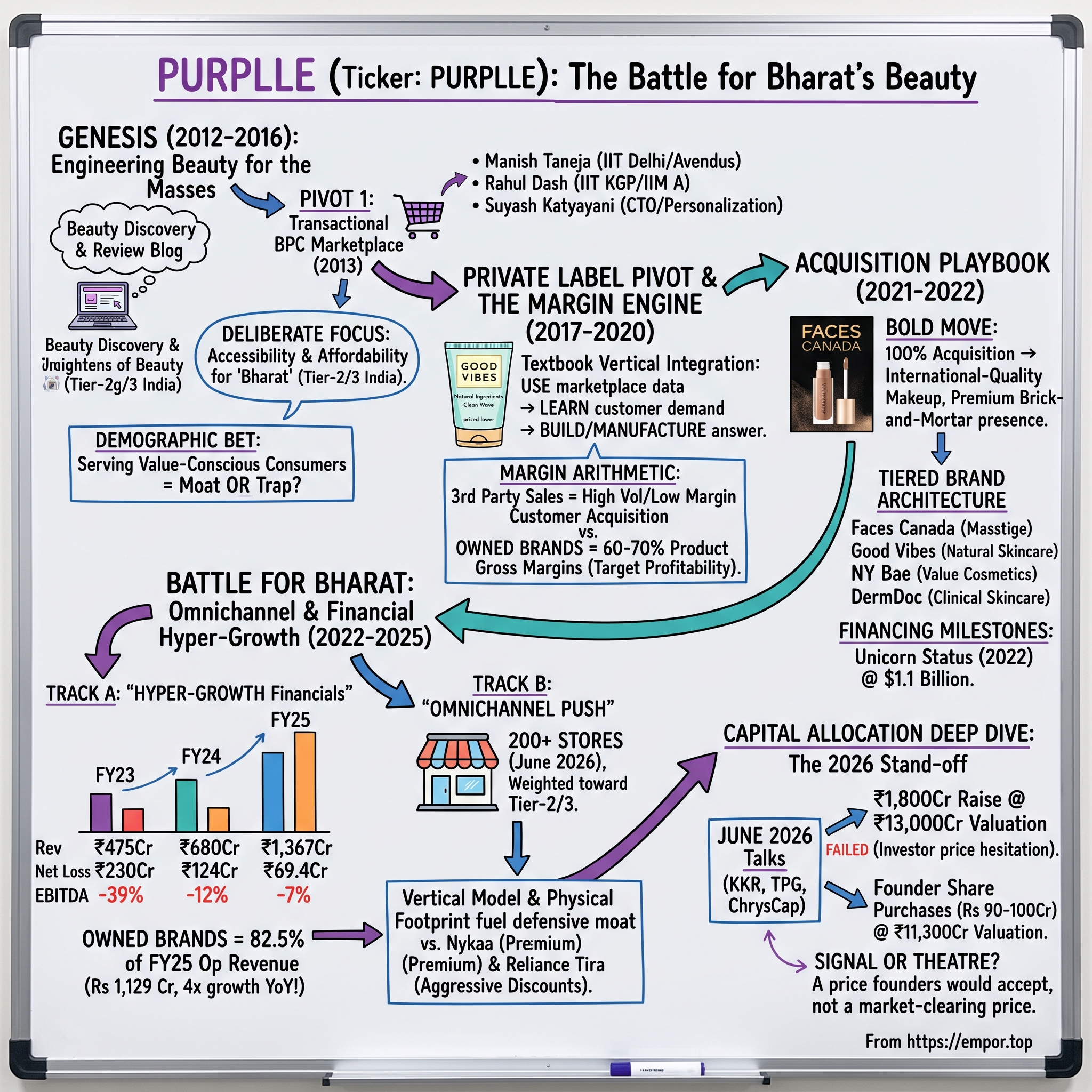
In June 2026, a fast-growing Indian beauty company did something companies chasing capital almost never do: it walked away from the money. Purplle, the Mumbai-based omnichannel beauty and personal care (BPC) retailer, had spent months in advanced discussions to raise roughly ₹1,800 crore from a marquee group of private-equity names — KKR, TPG Growth, and ChrysCapital — at a valuation approaching ₹13,000 crore, or a little over $1.5 billion. Then the talks stalled. The investors, according to reporting, hesitated on price; Purplle's management believed the offered multiples did not reflect the company's trajectory. Rather than accept a valuation it considered too low, the company paused the raise.1
What happened next is the more revealing signal. Instead of capitulating to a down-round or a flat mark, the three co-founders — Manish Taneja, Rahul Dash, and Suyash Katyayani — stepped in personally to buy shares worth a reported ₹90–100 crore from early angel investors and employees, at a valuation of about ₹11,300 crore.1 That figure is roughly an 11% premium to the ₹10,000 crore (~$1.2 billion) valuation at which the Abu Dhabi Investment Authority (ADIA) had led Purplle's Series F round in 2024.[^2] The message the founders were trying to send is not subtle: we would rather deploy our own capital at this price than let outside investors set a lower one.
For a public-market investor underwriting Purplle ahead of an eventual listing, both halves of this episode deserve scrutiny rather than applause. A paused fundraise is a pricing event, not a valuation proof. The ₹11,300 crore figure at which founders bought secondary shares is an observed transaction price between related insiders — not an independent, arm's-length mark, and certainly not the intrinsic value of the business.
The far larger ₹13,000 crore number that circulated was a proposed price that willing institutional buyers declined to pay. The gap between those two numbers, and the fact that the higher one did not clear the market, is itself the most important data point in the story.
Underneath the financing theatre sits a genuinely interesting operating question, and it is the thesis this piece will test. Can a vertically integrated, private-label-heavy BPC retailer carve out a durable, high-margin franchise among the "masstige" and value-conscious consumers of Tier-2 and Tier-3 India — the market often labelled "Bharat" — while caught in a pincer between the listed category leader Nykaa (FSN E-Commerce Ventures) at the premium end and the effectively bottomless balance sheet of Reliance Retail's Tira at the aggressive-discount end?
Purplle's answer is a business that, on the numbers it has disclosed, has more than doubled revenue while cutting losses sharply, and that derived 82.5% of FY25 operating revenue from brands it owns rather than merely distributes.2 That combination — hyper-growth plus a genuine, structurally higher-margin owned-brand engine — is unusual in Indian consumer internet, where growth has more often been bought with permanent losses. It is the reason Purplle is worth a serious underwriting rather than a passing glance — and the reason the gap between its operating record and its financing theatre repays careful separation.
This is the arc we will trace: from a modest beauty-discovery blog founded around 2011–2012, through a deliberate pivot into owning the brands that flow through its own pipes, an opportunistic acquisition of Faces Canada, a unicorn financing in 2022, an ADIA-led round in 2024, and finally to a 200-store omnichannel network reached in June 2026 — and to the valuation stand-off that opened this story.34 Along the way we will separate what Purplle has actually proven from what it merely asserts, build the capital structure and valuation from the public evidence rather than the headline mark, and ask the only question that ultimately matters to a long-term public shareholder: at what price does this business become worth owning, and what has to be true for that price to be justified?
It is worth being explicit at the outset about the evidentiary posture this piece adopts, because it governs everything that follows. Purplle is a private company. There is no draft red herring prospectus (DRHP), no red herring prospectus, no S-1 or F-1, and no IPO prospectus of any kind.
That means the disclosures a public-market investor would ordinarily lean on — audited financials restated to listing standards, a complete and reconciled capitalization table, the terms of every class of preferred stock, related-party disclosures, formal risk factors, use of proceeds, and lock-up structure — simply do not exist in the public domain. What exists instead is a reporting record: filings gleaned by financial-media outlets from the company's registrar submissions, funding announcements, founder and investor interviews, and third-party data aggregators.
That record is genuinely useful, and much of it is quantitatively specific. But it is a reporting record, not a disclosure record, and the difference matters: numbers reach the public filtered through management framing and journalists' summaries rather than through an audited, legally-accountable document. Throughout, therefore, we will treat these figures as the best available evidence while flagging — repeatedly and deliberately — the specific places where only a real filing could settle the question. Absence of disclosure is treated as an open diligence item, never as reassurance.
 Subscribe on LinkedIn
II. The Genesis: Engineering Beauty for the Masses (2012–2016)
Purplle did not begin as a store. It began as content. Around 2011–2012, Manish Taneja and Rahul Dash launched what was essentially a beauty-discovery and product-review site — a place where Indian women could read about cosmetics and skincare at a time when the category was thinly served online and dominated offline by a fragmented mix of general-trade shops and a handful of premium counters.3 The founders quickly ran into the oldest problem in digital media: attention without transaction is hard to monetize, especially in an early-stage Indian internet where advertising budgets were thin and affiliate economics negligible.
By 2013 they had made the first of the company's defining pivots, turning the review site into a transactional BPC marketplace.1
The founding team's résumés matter here because they shaped how the company was run. Manish Taneja, the CEO, is an IIT Delhi engineer who spent time in financial services, including at Avendus Capital, before starting the company — a background that shows up in Purplle's later obsession with unit economics and margin discipline rather than growth-at-all-costs.
Rahul Dash, the COO, brought IIT Kharagpur and IIM Ahmedabad credentials and corporate operating experience, and has anchored the logistics and physical-operations side. Suyash Katyayani, the CTO, built the personalization and recommendation technology that the company would later lean on to lower customer-acquisition costs.4
These backgrounds are worth stating plainly, but they are context, not proof; a public-market investor judges founders by capital allocation and candour over time, not by their alma maters.
We will return to that test in Section VI, where the founders' own share purchases put real money behind their words — and where the same purchases raise related-party questions that a diligent investor cannot wave away.
The strategic choice that separated Purplle from the field was made in these early years and never abandoned. India's most visible beauty-commerce success, Nykaa, was building a metro-focused, premium-and-prestige business — global brands, aspirational positioning, urban Tier-1 consumers with disposable income. Purplle deliberately aimed elsewhere: at accessibility, affordability, and the aspirational middle-class shopper in India's regional heartlands, where a ₹300 face serum is a considered purchase and brand trust is earned through price-value rather than luxury signalling.
This was not a glamorous position, and it did not attract the same investor enthusiasm. Standing in the shadow of horizontal giants like Flipkart and Amazon India — both of which sold cosmetics — and a fast-rising, better-capitalized Nykaa, Purplle struggled early to attract top-tier capital, and leaned on backers such as Blume Ventures to keep the business alive.3
There is a subtler point about the demographic bet that a public-market investor should register, because it cuts both ways. Serving Bharat is often described as if it were purely a matter of virtue — reaching the underserved, democratizing beauty.
Economically it is a much more double-edged proposition. The value-conscious consumer is, definitionally, the consumer with the least to spend per transaction, which means the absolute rupee contribution from each order is small and the business must make its money on volume, velocity, and cost discipline rather than on fat unit margins. It also means the consumer is the most price-elastic in the market — the shopper most likely to defect for a ₹50 saving, and therefore the shopper a deep-pocketed rival can most cheaply poach with a discount. The Bharat position is thus simultaneously a large, under-penetrated opportunity and the segment structurally most vulnerable to a subsidy war. Whether it is a moat or a trap depends entirely on execution — on whether Purplle can serve this consumer at a lower cost than anyone else can.
That is why the private-label pivot is not a nice-to-have layered on top of the Bharat strategy; it is the only thing that makes the Bharat strategy economically viable at all.
For an underwriter, the important question about this period is therefore whether the "Bharat" positioning is a genuine structural advantage or simply the market that was left over after stronger competitors claimed the premium consumer. The honest answer in 2016 was: unproven. Serving value-conscious consumers is a legitimate strategy, but it is also the hardest place to make money in retail, because low absolute basket sizes mean thin rupee-margins per order and unforgiving logistics economics. The thesis that Purplle could turn this demographic into a profitable franchise rested entirely on a second idea the company had not yet executed — that it would stop being a mere reseller of other people's brands and start owning the products themselves.
That is the pivot that made the difference, and it is the subject of the next section. Everything charming about the origin story is, economically, a prelude to it.
III. The Private Label Pivot & The Margin Engine (2017–2020)
Every third-party marketplace in a commoditized category eventually confronts the same brutal arithmetic. When you sell someone else's shampoo, the brand keeps most of the value, the customer shops on price, and your take rate is squeezed between the two. In BPC — where global conglomerates own the hero brands and consumers are promiscuous — pure distribution is a low-margin, high-competition business that can generate enormous gross merchandise value while producing almost no durable profit.
Purplle's most consequential decision was to recognize this early and to attack it directly: if the margin lived in the brand, then Purplle would build the brands.
The pivot took shape through the launch and incubation of in-house labels, the first flagship of which was Good Vibes.
It rode a real and durable consumer shift — the "clean," natural-ingredient wave (neem, tea tree, charcoal, and similar formulations) — and priced it well below premium incumbents, exactly matching the value-conscious positioning Purplle had chosen. Around Good Vibes the company assembled a stable of owned and incubated brands: NY Bae, an affordable, quirky makeup line themed around New York; DermDoc, positioned as clinical, ingredient-led skincare; and Alps Goodness, among others, later joined by Carmesi.2
The strategic logic is a textbook example of vertical integration in retail: use the marketplace to acquire customers and, critically, to learn what they want, then manufacture the answer and capture the full margin. It is a clean idea; the question an underwriter must press is whether the execution produces brands or merely house labels.
The economics of this split are the heart of the entire Purplle investment case, and they are worth stating precisely rather than in slogans. Third-party marketplace sales are high-volume and low-margin; their real value is as a data and customer-acquisition engine. Owned-brand sales, by contrast, carry gross margins that management and industry observers place in the 60–70% range — the structural prize that makes the whole model potentially profitable rather than perpetually loss-making. That gap between marketplace economics and brand economics is the entire reason the pivot was worth attempting.
The "data-science secret weapon" that Purplle describes is the use of its own transaction and search data to spot unmet demand — a formulation, a skin-type need, a price gap in a particular region — and to formulate a private-label answer faster than a traditional brand could. This is a plausible and increasingly common playbook (Amazon Basics, marketplace private labels globally), and Purplle's version is real.
But an underwriter should hold two caveats firmly.
First, the 60–70% gross-margin figure describes the product margin, not the business margin. A private-label lipstick can carry a 65% gross margin at the factory gate and still lose money once you load in the marketing to make anyone aware it exists, the returns and breakage endemic to cosmetics, the discounting needed to compete with Tira, and the fixed cost of 200 physical stores. The gap between a healthy gross margin and a still-negative EBITDA margin — which, as Section V shows, Purplle only narrowed to roughly -7% in FY25 — is precisely the marketing-and-overhead load that owned brands must eventually out-earn.2
Second, "we use data to build brands" is a claim made by nearly every marketplace; the proof is not that the brands exist but that they retain customers and command repeat purchase at a price that survives competition. That evidence — cohort retention, repeat rates, brand-level contribution margin — is not publicly disclosed, and its absence is one of the central diligence gaps a future prospectus would need to fill. What Purplle has proven by 2020 is that it can launch owned brands and grow them; what it has not yet proven is that they compound into durable, defensible franchises. Faces Canada, the subject of the next section, was in part an attempt to buy that durability rather than build it.
It is worth pausing on why the private-label playbook, for all its elegance, is not a guaranteed win — because the same strategy has produced very different outcomes elsewhere. In global e-commerce, marketplace-owned private labels have a decidedly mixed record: some (a handful of Amazon Basics categories) became durable franchises, while many others withered once the platform stopped subsidizing their visibility.
A private label that survives only on preferential placement on its owner's shelf is not really a brand — it is a house label with the economics of a commodity. The distinction that matters for Purplle is whether its owned brands can stand on their own two feet: whether a consumer who discovers Good Vibes on Purplle would seek it out again, recommend it, or buy it at a competitor if Purplle stopped promoting it.
If yes, Purplle has built genuine brand equity and the 60–70% margin is defensible.
If no, the owned-brand revenue is really just Purplle's marketplace traffic recycled through higher-margin SKUs — profitable while the traffic lasts, but not an independent moat. The disclosed data cannot distinguish between these two worlds, and the entire durability of the investment case turns on which one is true. A skeptical reading notes that value-priced brands, sold predominantly on their owner's own platform to price-elastic consumers, sit closer to the "house label" end of that spectrum than the "beloved franchise" end — which is precisely why the acquisition of an externally recognized brand with independent distribution was such a telling next move.
IV. The Acquisition Playbook: Faces Canada & Portfolio Scaling (2021–2022)
In December 2021, Purplle made the boldest capital-allocation move of its history to that point: it acquired 100% of Faces Canada, a cosmetics brand with genuine recognition in India and — more importantly — a physical distribution footprint in premium department stores that Purplle, a digital-first company, did not otherwise have.56 The deal instantly changed the shape of the portfolio. Where Good Vibes and NY Bae were home-grown and value-priced, Faces Canada arrived as an established, "international-quality" makeup brand that could serve as Purplle's bridge into the masstige tier — the aspirational middle ground between mass and prestige where Indian beauty spending is growing fastest. For a company built on home-grown value labels, it was a deliberate reach upmarket, bought rather than built.
The valuation test around this acquisition is instructive, even though Purplle never disclosed the price it paid. The relevant benchmark is that Sequoia Capital India (now Peak XV) had itself bought Faces Canada from Everstone Capital in 2017, reportedly for around $40 million, and Sequoia was among the sellers to Purplle.6 At the time of the Purplle acquisition, Purplle's own valuation sat at roughly $630 million, established by a $60 million round led by Premji Invest.6
Two things follow. The undisclosed price is a real diligence gap: without it, we cannot know whether Purplle acquired a strategic asset cheaply or overpaid for revenue.
An acquirer buying a brand from its own incoming investor (Sequoia was both a Faces seller and a Purplle backer) is exactly the kind of related-party dynamic a public-market investor scrutinizes rather than takes on faith. What we can say is that the strategic rationale — acquiring an established brand and an offline distribution network in one move — was coherent, and that Faces Canada subsequently became the flagship makeup brand in Purplle's owned portfolio.
The portfolio that resulted is best understood as a deliberately tiered brand architecture sitting on top of a single platform. At the base is the third-party marketplace, which supplies breadth, traffic, and data. Above it sits the owned-brand segment, which by FY25 would account for 82.5% of operating revenue.
That segment is itself layered by price and positioning: Good Vibes in natural skincare, Faces Canada as the acquired makeup flagship, NY Bae in value cosmetics, DermDoc in clinical skincare, and Alps Goodness and Carmesi filling further niches.2
The strategic elegance is that Purplle both makes the products and owns the shelf — physical and digital — on which they are sold, capturing margin at two stages of the value chain.
The strategic risk, which an underwriter should not lose sight of, is that a house of many small owned brands is not obviously more defensible than a house of one strong one; managing brand proliferation, avoiding cannibalization, and building any single label into a franchise with pricing power are unsolved challenges the disclosed data cannot yet confirm Purplle has met.
There is a governance nuance in the Faces Canada deal that a public-market investor should file away rather than wave through. Peak XV / Sequoia Capital India was, at the moment of the transaction, both a seller of Faces Canada and an investor in Purplle — it had participated in Purplle's Series D. A deal in which one of your own shareholders sells you an asset is not inherently improper; such transactions happen constantly in venture ecosystems and can be perfectly fair. But it is structurally a related-party transaction, and related-party transactions carry an inherent tension: the shareholder-seller has an interest in a high price, while the acquiring company's other shareholders have an interest in a low one. Without a disclosed price, an independent valuation, or the details of who negotiated on Purplle's behalf, an outside investor cannot verify that the deal was struck at arm's length. This is not an accusation — there is no evidence the deal was unfair, and the strategic logic was sound.
It is a flag: pre-IPO, Purplle's history already contains at least two consequential related-party dynamics (the Faces Canada purchase and, later, the 2026 founder buyback), and a diligent public investor would want a future prospectus to disclose the full set of related-party transactions, their terms, and the independence of the process by which they were approved.
The period closed with external validation. In June 2022, Purplle raised roughly $33 million in a Series E round led by Paramark Ventures, with returning investors Premji Invest, Blume Ventures, and Kedaara participating, at a valuation of about $1.1 billion — crossing into unicorn territory and taking total equity raised to around $215 million at that point.78 That milestone is worth framing carefully, because it is the first place the price-versus-value distinction bites hard. A $1.1 billion "valuation" set by a $33 million primary round is a mark on a small slice of new preferred stock, not a market-clearing price for the whole company.
The mechanics are worth spelling out because they recur at every subsequent round. When an investor pays $33 million for newly issued preferred shares that represent, say, 3% of the company, the arithmetic yields a "$1.1 billion valuation" — but that number is the price of the marginal share, extrapolated across the entire cap table, and it embeds two distortions. The new shares are almost always preferred, carrying downside protections (liquidation preferences, anti-dilution, sometimes participation) that make each preferred share worth more than an ordinary common share; and the round prices only a thin new slice, so the headline valuation is a linear extrapolation of a small, protected, information-advantaged transaction onto 100% of a company whose common equity has none of those protections.
Unicorn status therefore validated investor enthusiasm for the multi-brand, private-label-first strategy; it did not validate that the strategy produced profits, because in FY22 it did not, and it certainly did not establish that the common equity a future public shareholder would buy was worth $1.1 billion. The genuinely impressive validation came later, in the operating numbers — which is where we turn next.
V. The Battle for Bharat: Omnichannel & Financial Hyper-Growth (2022–2025)
Strip away the financing headlines and Purplle's case rests on three fiscal years of disclosed financials that, taken together, describe one of the cleaner growth-with-improving-economics stories in Indian consumer internet. The trajectory is worth laying out precisely, because the whole valuation argument depends on whether it is durable.
In FY23, Purplle reported operating revenue of about ₹475 crore against a net loss of roughly ₹230 crore, with an EBITDA margin in the region of -39% — the profile of a company still buying its growth. In FY24, operating revenue grew about 46% to ₹680 crore while the net loss was roughly halved to about ₹124 crore and the EBITDA margin improved toward -12%.9
Then FY25 delivered the inflection the bulls point to: operating revenue more than doubled to ₹1,367 crore, the net loss narrowed a further 44% to ₹69.4 crore, and the EBITDA margin improved to roughly -7%. Total income reached about ₹1,409 crore, and — the single most important line in the whole disclosure — owned brands contributed ₹1,129 crore, or 82.5% of operating revenue, with that owned-brand income rising roughly fourfold year-on-year.210
Two things make these numbers more than the usual growth-story fireworks. The first is that losses shrank in absolute terms while revenue doubled.
It is easy to grow revenue by spending more; it is much harder to grow revenue and cut the rupee loss, and Purplle did both. The second is the composition: the growth was led by high-margin owned brands, not by low-margin third-party GMV, which is exactly the mix shift the entire strategy was built to produce.
Underneath, the FY25 detail also shows the tensions of a company scaling a physical-product business — procurement costs jumped roughly 5.6x to about ₹671 crore as owned-brand volumes surged, and marketing income earned from third-party brands actually declined about 22% to around ₹225 crore as the company leaned into its own labels.2 That trade-off is coherent with the strategy but worth watching: Purplle is deliberately swapping easy, high-margin platform-marketing income for harder, inventory-heavy owned-brand revenue, betting the latter compounds further.
The mix shift also reframes what "revenue" even means for Purplle, and this is a point worth dwelling on because it is easy to misread the top line. When Purplle sells a third-party brand, it books either a commission/marketing fee (net revenue) or a thin retail margin; when it sells an owned brand, it books the full product price as revenue and carries the full cost of goods below it. As the owned-brand mix rose toward 82.5%, an ever-larger share of the reported ₹1,367 crore is gross product sales rather than platform take — which is why procurement costs exploded 5.6x. This is not a criticism; it is the arithmetic of a company transitioning from an asset-light marketplace to an asset-heavier vertical brand house.
But it has two implications an underwriter must internalize. First, the headline revenue-growth rate flatters the underlying economic progress somewhat, because part of the "doubling" is the accounting effect of gross-booking owned-brand sales that previously would have been thinner third-party transactions.
Second, and more importantly, a vertical brand house consumes working capital — it must buy or manufacture inventory ahead of selling it, hold stock across 200 stores and warehouses, and finance the gap. That working-capital absorption sits between EBITDA and cash flow and is invisible in the disclosed loss figure. A company can post an improving EBITDA margin while its cash burn worsens because it is tying up more rupees in inventory to fuel the very growth being celebrated. Whether that is happening at Purplle is unknowable from the public record, and it is one of the first things a prospectus — with its cash-flow statement and working-capital schedule — would reveal.
An underwriter must, however, be precise about what these figures do and do not establish. EBITDA of -7% is an improving loss, not a profit, and the reconciliation from -7% EBITDA to actual, sustainable free cash flow is not disclosed — we do not have public visibility into stock-based compensation, working-capital absorption from inventory, store capex, or lease-financing obligations, all of which sit between EBITDA and the cash the business actually generates or burns. A private company reporting "net loss of ₹69.4 crore" has made accounting choices a future prospectus would restate under listing standards.
The revenue quality is also inherently transactional rather than recurring — this is retail, where every rupee must be re-earned each quarter, there is no contracted ARR, and the FY25 doubling, however impressive, is a single year that needs a second and third to confirm it is a trend rather than a spike driven by store openings and channel expansion. The causal chain the bulls need is straightforward to state and hard to prove: owned-brand mix drives gross margin, gross margin plus operating leverage on a growing revenue base drives EBITDA toward positive, and scale eventually funds the physical network out of the business's own cash flow.
FY25 is consistent with that chain. It does not yet close it.
The second front in this period was physical. In a market where in-store retail still accounts for well over 70% of overall BPC sales, an online-only beauty company is fishing in a minority of the pond, and Purplle moved aggressively to correct that, crossing the 200-store milestone in June 2026 with a footprint weighted toward Tier-2 and Tier-3 markets.4 Physical stores serve the "touch and feel" discovery that cosmetics and fragrance shoppers value, and they extend the brand into towns where digital penetration is shallow.
But offline retail is a different, more capital-intensive business than a marketplace, and the honest reading is that 200 stores is an ambitious start whose unit economics have not been publicly disclosed. Whether these stores are profitable at the box level, what their payback period is, and how same-store sales trend are precisely the metrics that will determine whether the offline land-grab is a moat or a margin drain — and none of them are yet public.
The competitive frame sharpens the stakes. At the premium end stands Nykaa, whose parent FSN E-Commerce reported total operating revenue of about ₹7,950 crore in FY25, up roughly 24%, with the beauty vertical driving the business and its beauty GMV rising about 30% to ₹11,775 crore — and, crucially, Nykaa is listed and profitable at the net level, a scale and legitimacy Purplle has not yet reached.1112 It is important to be precise: that ₹7,950 crore is Nykaa's total revenue including fashion, not a pure BPC figure, so it overstates the like-for-like beauty gap somewhat — but even adjusting for that, Nykaa's beauty business alone dwarfs Purplle's ₹1,367 crore.
At the aggressive end stands Tira, Reliance Retail's beauty format, backed by India's largest and best-capitalized conglomerate, using deep discounts and high-technology flagship stores to court the premium metro consumer. Purplle's claimed defensibility against both — lower-cost retail footprints, tighter inventory, and an average order value tuned to middle-class wallets — is plausible and consistent with its positioning, but it is a claim about cost position and focus, not a demonstrated structural moat. The next sections stress-test exactly how much of that defensibility is real.
The comparison with Nykaa deserves one more layer, because it is the single most instructive benchmark for what a mature version of Purplle might look like. Nykaa is not merely bigger; it has already made the journey Purplle is attempting.
It grew a beauty-led business to scale, took it public in late 2021, and has since ground its way to consolidated net profitability — its Q4 FY25 consolidated profit after tax roughly tripled year-on-year (off a small base) even as revenue grew in the low-to-mid twenties percent, with EBITDA margins expanding.1112 Two lessons follow for underwriting Purplle.
The encouraging one is that a proof-of-concept exists: an Indian BPC platform can reach durable profitability at scale, so Purplle's path is not fantastical.
The sobering one is how Nykaa got there — its net margins remain thin (low single digits) even after years of scale and a heavy owned-brand and premium mix, which tells you that Indian beauty retail is a fundamentally low-margin business even for the category leader. If the most successful, largest, most established player in the market earns only thin single-digit net margins, an investor should be deeply skeptical of any model for Purplle that assumes it will earn dramatically more. Purplle's owned-brand mix is higher than Nykaa's, which could support a somewhat better structural margin — but "somewhat better than thin" is still thin, and it must be weighed against Purplle's smaller scale, its more price-elastic customer, and the capital cost of the store network it is still building. The honest read is that Nykaa both proves the destination is reachable and caps the realistic reward on arrival.
VI. Capital Allocation Deep Dive: The 2026 Stand-off
Return now to where we began — the June 2026 stand-off — because with the operating picture in hand, the financing choices can be read as evidence about management rather than as public relations. Purplle had been in advanced talks to raise about ₹1,800 crore at a valuation of nearly ₹13,000 crore.
Management's stated rationale for pausing was that, with revenue estimated to be growing 35–40% in FY26 (an implied path toward roughly ₹1,850–1,900 crore, on management's own framing, not audited results), the multiples private-equity buyers were offering did not reflect the company's rapid, margin-improving trajectory.1 Whether one finds that persuasive depends on a distinction the company would prefer to blur: the difference between a price it wanted and a price the market would pay.
Sophisticated institutional buyers — KKR, TPG, ChrysCapital — declined ₹13,000 crore.
That is not proof the business is worth less than ₹13,000 crore, but it is meaningful evidence that at least three well-informed potential owners judged the risk-adjusted price too high, and an underwriter should weight the revealed preference of arm's-length buyers more heavily than the aspiration of the seller.
The ownership structure frames why the stand-off matters for future public shareholders, and it also surfaces one of the article's clearest diligence flags. The figures circulated around the episode place the three co-founders' combined stake at about 15.6%, private equity and venture capital at about 65.6%, and early angel investors at about 6.8%.1 Those figures should be handled with care, because an independent data-provider snapshot (Tracxn, dated to mid-2024) put founders closer to 11.5%, funds near 69%, ESOP around 11%, and angels near 7% — a different distribution.13 The discrepancy is not a gotcha; it is the point.
Pre-filing, there is no single authoritative capitalization table, different sources report materially different splits, and the exact fully diluted structure — common versus preferred, the size of the ESOP pool, warrants or convertible instruments, and the voting rights attached to each class — is simply not public. Reconciling these figures is precisely the work a DRHP would force.
Until it exists, any "market capitalization" derived from a headline valuation is an implied figure resting on an unverified share count — a rough gauge of scale, not a precise equity value, and certainly not one that separates total equity value from the free float that would actually trade.
What is consistent across sources is the shape: founders own a distinct minority, and financial investors own roughly two-thirds. That structure has two consequences a public-market investor should hold in mind.
It means the eventual IPO will be driven substantially by the liquidity needs and return timelines of private-equity and venture holders — several of whom have been invested since the mid-2010s and will be looking for exit — so the float, the offer-for-sale component, and the timing will reflect their agenda as much as the company's.
And it means the preferred shares those investors hold may carry economic rights — liquidation preferences, anti-dilution protection, conversion terms — that ordinary public common shares will not. None of those terms are disclosed, and their absence is not evidence of their non-existence; it is a gap. The general principle from Purplle's own funding history applies: a private preferred share priced at a ₹11,300 or ₹13,000 crore valuation is not economically equivalent to a public common share at the same headline number, and carrying a private mark forward unchanged into a public valuation would be an error.
It is worth making the preferred-versus-common point concrete, because it is the most commonly ignored error in valuing pre-IPO companies. Suppose — purely to illustrate the mechanism, not because the specific terms are known — that Purplle's later-round investors hold preferred shares with a 1x liquidation preference. That means, in any outcome below their invested capital, they get their money back first, before common shareholders (founders, employees, and eventually public investors converting from common) receive anything. The preference sits like a trapdoor beneath the common shares, invisible in good outcomes and decisive in bad ones. In a strong outcome, such as a successful IPO well above the last round, the preference is irrelevant because everyone converts to common and shares proportionally.
But in a weak or flat outcome, the preference transfers value from common to preferred — meaning the common shares are worth less than a simple "valuation ÷ share count" calculation would suggest. The ₹11,300 crore founder-buyback price and the ₹13,000 crore proposed round are both preferred-inclusive headline numbers. A public IPO sells common shares.
If the preferred stack carries meaningful preferences (and late-stage Indian venture rounds frequently do), then the fair value of the common equity that public investors will actually own is somewhat below the headline private valuation, all else equal — and materially below it in any scenario where the business underperforms. Because none of these terms are public, an underwriter cannot quantify the adjustment; but the direction is unambiguous, and it argues for treating the private marks as a ceiling on common-equity value rather than a floor. This is the single most important reason the ₹11,300–13,000 crore band should not be carried forward into a public valuation unadjusted.
Against that backdrop, the founder buyback reads as a genuine, if imperfect, signal. Deploying a reported ₹90–100 crore of personal capital to buy secondary shares from angels and employees at ₹11,300 crore is a real financial commitment, and for founders holding a minority stake it is a credible way to increase alignment and to signal belief that the eventual IPO will price above that level.1
The skeptic's reading is equally legitimate and should be stated alongside it. A founder buyback from insiders is a related-party transaction: the founders are simultaneously the buyers, members of management setting the narrative, and beneficiaries of the ₹11,300 crore reference price that the purchase helps to establish. Providing early angels and employees a liquidity exit at a premium mark is good for morale and optics, and it conveniently sets a floor reference for the next external round — all while the transaction is between aligned insiders rather than at arm's length.
Both readings can be true at once: the founders may sincerely believe in the price and benefit from anchoring it. What the buyback is not is independent price discovery, and it should not be mistaken for it.
On management credibility more broadly, the record supports a measured positive. The team said it would drive owned-brand mix and margin, and the disclosed numbers show EBITDA margin moving from roughly -39% to -7% in two years while revenue doubled.
Those were promises broadly matched by results, which is more than can be said for many venture-funded peers.29 That is the strongest single argument in Purplle's favour: demonstrated execution against a stated plan.
The counterweight is that the plan is not finished — the company is still loss-making, the hardest part of the margin journey (crossing into sustained positive EBITDA and then free cash flow while funding an expensive store rollout) lies ahead, and the "guidance" of 35–40% FY26 growth is management's own unaudited framing offered in the middle of a valuation negotiation. Credible, but not yet corroborated.
VII. The Purplle Playbook: Investing & Operating Lessons
Step back from the transaction detail and Purplle offers a set of transferable lessons about building a vertical consumer business in an emerging market — each of which is also a lens for judging the investment.
Lesson 1: In vertical e-commerce, private labels are the profit engine — but only if they retain. The single most important structural fact about Purplle is that owned brands supplied 82.5% of FY25 operating revenue and carry gross margins far above third-party distribution.2 The generalizable insight is that third-party sales in a commoditized category are best understood as a customer-acquisition and data cost, and that the path to profitability runs through owning the product.
The discipline an investor must impose on this lesson is that mix is necessary but not sufficient: a high owned-brand mix only produces durable economics if those brands earn repeat purchase at prices that survive competition. Purplle has proven the mix; the retention and pricing-power evidence remains undisclosed.
Lesson 2: "Bharat" is not a monolith, and serving it is an operational feat, not a slogan. Winning value-conscious Tier-2 and Tier-3 consumers requires genuinely different pricing architecture, localized and regional-language influencer marketing, and physical "touch and feel" points — hence the 200-store push into smaller cities.4 The lesson is that the value segment is a distinct operating discipline, not a discount version of the premium playbook.
The caution is that it is also the lowest-margin-per-order segment in retail, which is why execution — inventory turns, store payback, logistics cost — matters more here than in the premium tier, and why Purplle's cost position is the whole game.
Lesson 3: A valuation stand-off is a signal of strength only when the balance sheet backs it. Pausing a fundraise when growth is robust tells the market a company is not desperate for survival capital and can wait for terms that match its operating reality.1 That is a real and useful signal — but it is only credible if the company genuinely does not need the money.
Purplle is still loss-making and funding an expensive store rollout; the stand-off is convincing to the extent that its cash runway lets it wait, and that runway is not publicly disclosed. The lesson holds, with the asterisk that "we don't need your money" is only powerful when it is demonstrably true.
Lesson 4: Personalization can lower customer-acquisition cost — if the data compounds. Purplle's use of app-based skin profiles and personalization to match users with effective, lower-priced owned brands, rather than relying on expensive celebrity endorsement, is a genuinely capital-efficient acquisition strategy in principle.4
The lesson is that first-party data plus owned product can, in theory, produce a lower-CAC, higher-margin loop than the influencer-and-discount arms race. The evidence gap is that Purplle discloses neither CAC, payback, nor LTV, so the efficiency of this loop is asserted rather than demonstrated — which is exactly why CAC/LTV sits on the KPI list in Section IX.
There is a fifth lesson that Purplle's history teaches almost in spite of itself, and it is the one most relevant to a public-market investor: capital discipline compounds into optionality. Purplle raised roughly $215 million to reach unicorn status — a modest figure by the standards of Indian consumer-internet unicorns of its vintage, many of which consumed multiples of that to reach similar scale — and by 2026 had raised on the order of $600 million in total across its life.18
Because it did not incinerate capital, by the time of the 2026 stand-off it retained the ability to say no: to pause a fundraise, to let founders buy stock rather than dilute, and to wait for a price it preferred.
Companies that burn recklessly forfeit that optionality — they must take whatever capital is on offer, on whatever terms, because the alternative is insolvency.
The lesson generalizes: in a downturn or a repricing, the capital-efficient operator has choices and the profligate one does not, and those choices are worth real money precisely when money is scarce. This is the most genuinely differentiated aspect of the Purplle story relative to its cohort, and it is a point in management's favour that survives skeptical scrutiny — with the caveat, noted earlier, that the degree of that optionality depends on a cash runway the company has not publicly quantified.
The through-line of all four lessons is the same tension that runs through the whole underwriting: Purplle has built a structurally sound model and executed it visibly well, but the specific operating proof that would convert "structurally sound" into "durably valuable" — cohort retention, store-level economics, CAC/LTV, brand-level contribution margin — is precisely the data that remains behind the private-company curtain.
VIII. Moat Analysis: Helmer's 7 Powers & Porter's 5 Forces
To judge whether Purplle's advantages are durable or merely present, it helps to run the business through two disciplined frameworks. Hamilton Helmer's 7 Powers asks what, if anything, prevents a competitor from competing away Purplle's returns. Porter's Five Forces asks how the structure of the industry distributes profit among rivals, suppliers, and buyers.
The point of the exercise is not to award grades but to locate honestly where Purplle's economics are protected and where they are exposed.
Hamilton Helmer's 7 Powers
Cornered Resource — real but modest. Purplle's strongest claim to a durable edge is ownership of its brands — Faces Canada, Good Vibes, DermDoc, NY Bae, and the rest — which competitors cannot sell because Purplle owns them outright.25 This is a genuine cornered resource in the narrow sense: a rival platform literally cannot stock a Purplle-owned label.
But the power is bounded by the strength of the brands themselves. A cornered resource only generates excess returns if the resource is valuable — and a value-priced private label with undisclosed retention is a far weaker cornered resource than, say, an irreplaceable patent or a beloved franchise brand. The ownership is real; the pricing power it confers is unproven.
Scale Economies — emerging, not yet decisive. Growing store density in Tier-2/3 regions can, in principle, optimize regional supply chains and marketing spend, and a private-label manufacturer gains cost advantages as volume grows. But at ₹1,367 crore of revenue and 200 stores, Purplle is roughly a fifth the size of Nykaa's beauty business and a rounding error next to Reliance, so it is the smaller-scale player in most of its battles.211
Scale economies are a power Purplle is building toward, not one it currently wields over its main rivals.
Switching Costs — low, and honestly so. Consumers can trivially buy the same categories from Nykaa, Tira, Amazon, Myntra, or a local store; there is no contract, no lock-in, and minimal friction. The only mitigants are the modest stickiness of a personal skin-profile in the Purplle app and whatever brand loyalty the owned labels earn — both real but weak.
This is the force that most limits Purplle's pricing power and is the honest reason the whole model must win on cost and product rather than on captivity.
Brand — the swing factor. In the Tier-2/3 value segment, Purplle has a plausible claim to being a trusted "affordable-yet-premium" destination, and brand trust in beauty is durable when earned. But this power is asserted from positioning, not demonstrated from data: Purplle discloses no brand-tracking, repeat-rate, or Net Promoter evidence, and the same consumers are being courted aggressively by Tira's discounts and Nykaa's downward reach.
Brand is the power that could most plausibly become a genuine moat — and the one for which the public evidence is thinnest.
The remaining three powers — Network Economies, Counter-Positioning, and Process Power — are largely absent. There is no meaningful network effect in buying lipstick; Purplle's model (marketplace-plus-private-label-plus-offline) is not something incumbents are structurally unable to copy (indeed Nykaa runs a similar owned-brand and offline playbook), so there is little counter-positioning; and no evidence supports a proprietary process advantage rivals cannot replicate.
The honest verdict from Helmer's lens is that Purplle has nascent powers — real brand ownership and emerging scale — but nothing yet that would stop a determined, better-capitalized competitor from compressing its returns. Powers under construction are not yet powers in hand.
Porter's Five Forces
- Rivalry — extremely high. Purplle fights Nykaa above it and Tira beside it, in a category where advertising and discounting are the primary weapons, keeping constant downward pressure on margins. This is the defining feature of the industry and the single biggest structural headwind to Purplle's path to profitability.
- Threat of New Entrants — medium-high. India's D2C beauty explosion means new brands appear constantly, and capital is available; the barrier is not starting a brand but scaling one to omnichannel volume, which is genuinely capital-intensive. Purplle is somewhat insulated at scale but not at the level of any individual product category.
- Supplier Power — low-to-medium, and falling by design. By deriving 82.5% of revenue from owned brands, Purplle has structurally reduced its dependence on — and the bargaining power of — the global brand conglomerates whose products dominate third-party distribution.2 This is one area where Purplle's strategy genuinely improves its structural position.
- Buyer Power — high. Indian beauty consumers are value-conscious and face near-zero switching cost, so they hold real power over price. This is the mirror image of the low switching-cost problem, and it caps how much Purplle can ever charge.
- Threat of Substitutes — low at the product level, real at the channel level. There is no substitute for makeup or skincare as products, but there is abundant substitution of channel — the same consumer can buy from a local general store, a horizontal app like Myntra, or a rival platform. The threat is not that demand disappears but that it flows through someone else's pipes.
Synthesizing both frameworks: Purplle operates in a structurally difficult industry — intense rivalry, powerful buyers, low switching costs — and has built exactly the right strategic response to it (own the product, shrink supplier power, target an underserved segment on cost). Its powers are real but early.
That combination is neither a fortress nor a house of cards; it is a well-run business in a hard industry whose durability depends on out-executing better-capitalized rivals for years. That is a coherent bet, but it is a bet — which is the right frame for the closing section.
IX. Risk Radar, Bull vs. Bear Case & KPIs to Track
Material Risk Radar
The Tira price war — the balance-sheet asymmetry. The gravest structural risk is not that Purplle is outsmarted but that it is out-spent. Reliance Retail can subsidize loss-making customer acquisition through Tira essentially indefinitely, funded by a conglomerate balance sheet Purplle cannot match.
In a category where buyers are price-sensitive and switching costs are low, a sustained discount war could compress Purplle's margins precisely as it is trying to reach profitability, forcing it to spend more to hold share exactly when it needs to spend less.
This is the risk that most directly threatens the central thesis.
Execution risk in the offline rollout. Physical retail is capital-intensive and unforgiving. Purplle's 200-store network is a bet that box-level economics work in Tier-2/3 markets, but store-level profitability, payback periods, and same-store sales are undisclosed.4
Unprofitable leases in weak locations could quietly convert the growth story into a cash drain, and because the losses would show up gradually as leases mature, the risk is easy to under-appreciate until it is entrenched. This is a "prove it with unit economics" item that only future disclosure can resolve.
Founder–investor alignment and governance. With financial investors holding roughly two-thirds of the company and founders a minority, the interests that drive IPO timing, offer structure, and float will be substantially those of private-equity and venture holders seeking exit, not necessarily those of long-term public shareholders.113
Preferred-share rights, voting arrangements, and board independence are undisclosed, and the founder buyback — however well-intentioned — was a related-party transaction that set a reference price. None of this is disqualifying; all of it is a live governance-diligence agenda for a future filing rather than a settled comfort.
Beyond these three, an underwriter should carry a standing list of items that simply cannot be assessed pre-filing and must not be mistaken for absent risks: the true fully diluted share count and cap-table, liquidation preferences and anti-dilution terms, stock-based compensation, the cash balance and runway, lease and debt-like obligations, use of any IPO primary proceeds, lock-up structure, related-party dealings, and audited (rather than management-framed) financials.
The lack of these disclosures is not evidence of safety; it is the reason the underwriting must remain provisional.
Sizing the Reachable Market with Restraint
Before weighing bull against bear, the addressable-market claim deserves the same discipline applied to everything else, because TAM figures are where consumer-internet stories most often substitute a big number for an argument. The commonly cited statistic — that India's BPC market is heading toward roughly $30–34 billion later this decade — is a category total: every lipstick, shampoo, soap, and fragrance sold through every channel, including the mass-market fast-moving-consumer-goods staples (think everyday soap and hair oil) that Purplle does not meaningfully sell and the ultra-premium prestige products it does not target.4 The reachable market for Purplle specifically is far narrower: the colour-cosmetics, masstige-skincare, and personal-care spending of value-conscious Tier-2/3 and aspirational middle-class consumers, accessible at Purplle's price points, through its app and its 200-store footprint, within categories where it either owns a brand or earns a retail margin. That is the market Purplle actually competes for, and it is the base against which any market-share assumption must be sized.
That reachable market is still large and genuinely under-penetrated — which is the real bull argument — but it is a fraction of the headline TAM.
Crucially, it is also contested: every rupee of it is also being pursued by Nykaa reaching down, Tira spending aggressively, horizontal platforms like Amazon and Myntra, thousands of D2C brands, and the vast unorganized general trade that still commands the majority of Indian beauty spend.
Any credible market-share assumption for Purplle must be pinned to that reachable, contested figure and to the specific competitive responses named rivals can afford — not to a $34 billion abstraction. An investor who underwrites Purplle on "even 5% of a $34 billion market" is not doing analysis; they are doing arithmetic on the wrong base.
The Bull vs. Bear Case
The bull case is that Purplle is early in a structurally attractive market and has already proven the hard part. India's BPC market is large and growing fast — industry estimates commonly cited by the sector's own participants put it on a path toward roughly $30–34 billion later this decade — and offline still dominates, leaving a long runway for an omnichannel value player.4
In this scenario Purplle owns the Tier-2/3 value segment that Nykaa and Tira under-serve; it converts its -7% FY25 EBITDA margin into positive territory as owned-brand mix and scale compound, funds a 500-plus store network increasingly from its own cash flow, and lists in a well-received IPO at a valuation comfortably above the ₹11,300 crore founder-buyback mark — perhaps toward $2 billion — with the doubling of FY25 revenue proving to be the start of a multi-year compounding trend rather than a one-off.2
The bear case is that Purplle is a good business in an industry that does not let good businesses keep their profits. Tira and Nykaa reach down into Tier-2/3 with lower-priced offerings, buyers switch at the margin for a better discount, and Purplle's private-label growth plateaus as the low-hanging demand gaps are filled.
Store unit economics decay under lease costs in weaker markets, the path from -7% EBITDA to positive free cash flow stalls because every gain in gross margin is spent on defending share, and a funding environment that has already balked at ₹13,000 crore forces a flat or down round — turning the 2026 stand-off from a display of strength into a delay of a reckoning. In this scenario the private mark proves to be a ceiling, not a floor, and public investors who anchor to it overpay.
The truth an underwriter should hold is that both cases are internally consistent and the evidence does not yet decide between them. Purplle has demonstrated growth and margin improvement (favouring the bull) but not durable profitability, retention, or store economics (leaving the bear alive).
What the eventual IPO price will embed — and what a prospective public buyer must therefore accept as true — is a specific set of assumptions: that owned-brand mix stays above 80% at healthy margins, that EBITDA crosses into sustained positive territory within roughly two years, that the offline network is genuinely accretive, and that Purplle holds share against two better-funded rivals.
Where the market ultimately prices the stock may diverge from that central case for reasons that have nothing to do with the business — IPO scarcity value in a hot Indian primary market, narrative momentum around "Bharat consumption," a constrained free float that exaggerates demand, and listing-day sentiment. Those forces can lift a price well above intrinsic value, or leave it below.
They are pricing phenomena, not evidence of worth, and an investor should be able to name which part of any post-listing move is business and which is mood.
Constructing a genuinely comparable peer set is harder than it looks, and doing it honestly requires separating three categories that are often blurred.
The direct operating peer — same business model (omnichannel BPC retail with a heavy owned-brand mix), same geography (India), same customer (mass-to-masstige), same monetization (product sales plus platform fees) — is essentially Nykaa's beauty business, and it is the single most relevant benchmark despite being several times larger and already profitable.11
Reliance's Tira is a direct competitor but not a usable comparable, because it is an unlisted division of a conglomerate with no standalone financials, no independent valuation, and a cost of capital and strategic logic entirely unlike Purplle's.
The second category is aspirational category leaders — global beauty-and-personal-care platforms and brand houses (the L'Oréals, the Estée Lauders, the e.l.f. Beautys) — which are instructive for what a mature, branded beauty business can earn but are the wrong comparables for pricing Purplle today: different geography, different margin structure, different scale, and multiples set in different capital markets. Applying a developed-market prestige-beauty multiple to an Indian value player would flatter Purplle's valuation on a false premise.
The third category is recent Indian consumer-internet IPO comparables — the D2C and new-age consumer listings that came to market in 2024–2026. These are useful for gauging how Indian public markets currently price growth-stage, thin-or-negative-margin consumer businesses (and how brutally they re-rate when growth slows), but each carries idiosyncratic category economics, so they inform the multiple environment rather than provide a clean read-through.
Pure D2C beauty brands (a Mamaearth-style Honasa, or a Plum) are partial peers — they share the owned-brand, India-beauty DNA but lack Purplle's marketplace-plus-offline structure — and are worth watching precisely because at least one has reached profitability, proving the owned-brand model can pay.
The exclusion principle throughout is consistency: a comparable is only useful if its metric (revenue vs. GMV), period (FY25), currency (INR), share-count basis, and enterprise-versus-equity framing are stated and matched. The lazy error — reaching for the highest revenue multiple in the beauty universe and stapling it to Purplle — is exactly the error this discipline exists to prevent.
On valuation, the disciplined conclusion is a range with explicit sensitivities rather than a number. The observable anchors are the ₹10,000 crore ADIA round (2024), the ₹11,300 crore founder-buyback mark (2026), and the ₹13,000 crore that institutional buyers declined (2026) — a band of roughly $1.2–1.6 billion, all on private preferred economics that do not translate one-for-one to public common shares.1[^2]
Sizing that against FY25 operating revenue of ₹1,367 crore implies a revenue multiple in the high single digits to low double digits — though the cash, debt, and lease adjustments needed to turn an equity-value multiple into a true enterprise-value multiple cannot be computed from public data, which is why no precise EV multiple should be quoted, and why an equity-value multiple must never be compared against an enterprise-value one. For context, listed and profitable Nykaa trades at a rich multiple of its far larger revenue, so a still-loss-making Purplle at a high-single-digit revenue multiple is asking public investors to pay a premium for growth and future margin, not for present profit.
A transparent intrinsic view is best framed as a set of scenarios rather than a single discounted-cash-flow point estimate, because the inputs that matter most are exactly the ones that are undisclosed or unproven. Start from the FY25 base of ~₹1,367 crore in revenue.
In a bull scenario, revenue grows 35–40% for a few years and fades toward the mid-teens over a decade as the store network and owned brands scale.
The EBITDA margin — currently -7% — crosses zero within roughly two years and climbs toward the low-to-mid teens at maturity, supported by the high owned-brand mix; reinvestment in stores and working capital is heavy early but self-funding later; taxes apply at Indian corporate rates; the share count dilutes modestly from the ESOP and one primary IPO issuance; and the whole stream is discounted at an emerging-market equity cost of capital appropriate to a loss-making consumer growth company (high, not the low rates used for stable compounders). Under those favourable-but-not-heroic assumptions, an intrinsic value in the neighbourhood of the ₹11,300–13,000 crore private band is reachable — but only on an equity-value basis, and only before the preferred-share adjustment that pulls the common-equity value below the headline. The market's ask is defensible if you believe the margin story compounds.
In a base scenario, growth decelerates faster (competition bites, the low-hanging demand gaps fill), the EBITDA margin reaches only high-single-digits at maturity because the price-elastic customer and Tira's discounting cap pricing power, and store economics prove merely adequate rather than accretive. That world supports a valuation below the private marks — a reminder that the ₹11,300 crore founder price already embeds meaningful optimism.
In a bear scenario, margins stall near breakeven, growth halves, and a chunk of the store estate is written down; the intrinsic value falls well short of the private band, and the preferred-share overhang discussed in Section VI transfers still more value away from common holders.
The point of running all three is not to pick one but to see the shape of the sensitivity: Purplle's value is extraordinarily levered to the single question of whether owned-brand economics can carry the model to a durable double-digit EBITDA margin against two better-funded rivals.
Small changes in that terminal-margin assumption swing the valuation by a large multiple. That is the honest state of the evidence — the valuation is defensible if you believe the margin story compounds and indefensible if you do not, and no amount of DCF precision can substitute for a judgement on that one question.
Key KPIs to Watch
The underwriting will be confirmed or falsified by a small number of metrics, and a prospective public investor should watch these above all:
- Private-label contribution as a share of operating revenue. This must remain above roughly 80% for the gross-margin story to hold; a slide back toward third-party mix would signal the margin engine is stalling.2
- EBITDA margin, and then free cash flow. The trajectory from -7% in FY25 into sustained positive territory is the number; adjusted-EBITDA breakeven is a milestone, but the real test is free cash flow after store capex and working capital, which is the metric that ultimately forces any public-market profitability reckoning.
- Same-store sales growth and store-level payback. These will reveal whether the 200-plus store network is a moat or a drag — the most important currently-undisclosed dataset in the entire story.
- CAC-to-LTV and marketing efficiency. The proof, or refutation, of the personalization-driven, capital-efficient acquisition claim that underpins the whole "profitable value player" thesis.
The catalysts that will move these from thesis to fact are concrete and near-term: FY26 audited results (testing the 35–40% growth management has floated), any resumed or restructured fundraise (which will reveal the price the market actually clears), continued store openings and — critically — the first disclosure of store-level economics, and eventually a DRHP that would, for the first time, force the cap-table, preferences, cash, and audited accounting into the open.
Building the post-listing test explicitly into the story matters because of how these situations typically resolve. In the months around a hot Indian consumer IPO, a stock can trade far from its intrinsic value in either direction.
On the upside, scarcity of high-quality listed BPC exposure, a compelling "Bharat consumption" narrative, a deliberately constrained free float, and retail-investor momentum can push the price well above what the cash flows justify — the same forces that lifted several 2021-vintage Indian internet listings before gravity reasserted itself. On the downside, if broader sentiment sours or a lock-up expiry releases a wave of insider selling from the private-equity holders who own two-thirds of the company, the price can fall well below fair value regardless of operating progress.
The discipline is to recognize that neither the pop nor the slump is evidence about the business; they are pricing phenomena driven by supply, demand, and mood. The business itself will be judged, eventually and unavoidably, by whether it crosses into sustained free-cash-flow profitability at the scale it is building toward.
The moment that reckoning arrives — typically a few quarters after listing, when the growth-versus-profitability trade-off can no longer be deferred — is when price and value are forced back together. A prospective public shareholder should size their conviction to the operating evidence, not to the listing-day tape, and should know in advance which of the four KPIs above would confirm the underwriting and which would break it.
Until a real filing exists, then, Purplle is best understood as a genuinely impressive operating story — visible execution, a structurally sound owned-brand model, rare capital discipline — wrapped around a valuation that the market has already, once, declined to pay in full, and a set of the most important economic facts (store unit economics, retention, cash runway, preferred-share terms, the true cap table) that remain undisclosed.
The gap between the impressive story and the undisclosed facts is not a reason to dismiss the company; it is precisely the space in which a disciplined public-market investor does their work — insisting on the evidence, adjusting the private mark down to a common-equity basis, and refusing to mistake a price the founders were willing to pay themselves for the value the business has actually proven.
References
-
Beauty-care retailer Purplle pauses fundraise over valuation expectation mismatch — Venture Intelligence, 2026 ↩↩↩↩↩↩↩↩↩↩
-
Purplle doubles operating revenue to Rs 1,367 Cr in FY25, losses shrink — Entrackr, 2026 ↩↩↩↩↩↩↩↩↩↩↩↩↩
-
Purplle — Company Profile, Team, Funding, Competitors & Financials — Tracxn, 2026 ↩↩↩
-
Purplle Crosses 200 Stores, Accelerates Omnichannel Beauty Play Across India — India Retailing, 2026-06 ↩↩↩↩↩↩↩↩
-
Purplle acquires Faces Canada to strengthen its makeup footprint — Business Today, 2021-12-16 ↩↩
-
Purplle in talks to acquire Sequoia-owned Faces Canada — Entrackr, 2021-12 ↩↩↩
-
Beauty retailer Purplle joins unicorn club with $33M round — YourStory, 2022-06 ↩
-
Purplle turns unicorn with $33 Mn Series E round — Entrackr, 2022-06 ↩↩
-
Purplle hits Rs 700 Cr revenue in FY24, trims losses by 46% — Entrackr, 2024-09 ↩↩
-
Purplle trims FY25 net loss by 44% to ₹69.4 Cr — Inc42, 2026 ↩
-
Nykaa Q4 FY25 Results: Consolidated PAT grows 193%, revenue up 24% — Business Standard, 2025-05-30 ↩↩↩↩
-
Nykaa parent FSN E-commerce nearly triples Q4 profit on robust beauty business — YourStory, 2025-05 ↩↩
 LinkedIn
 WhatsApp
 Reddit
 Hacker News
 Email
Email Kindle
 RSS Feed
 Spotify
 Apple Podcasts
 Amazon Music
 Audible
 YouTube