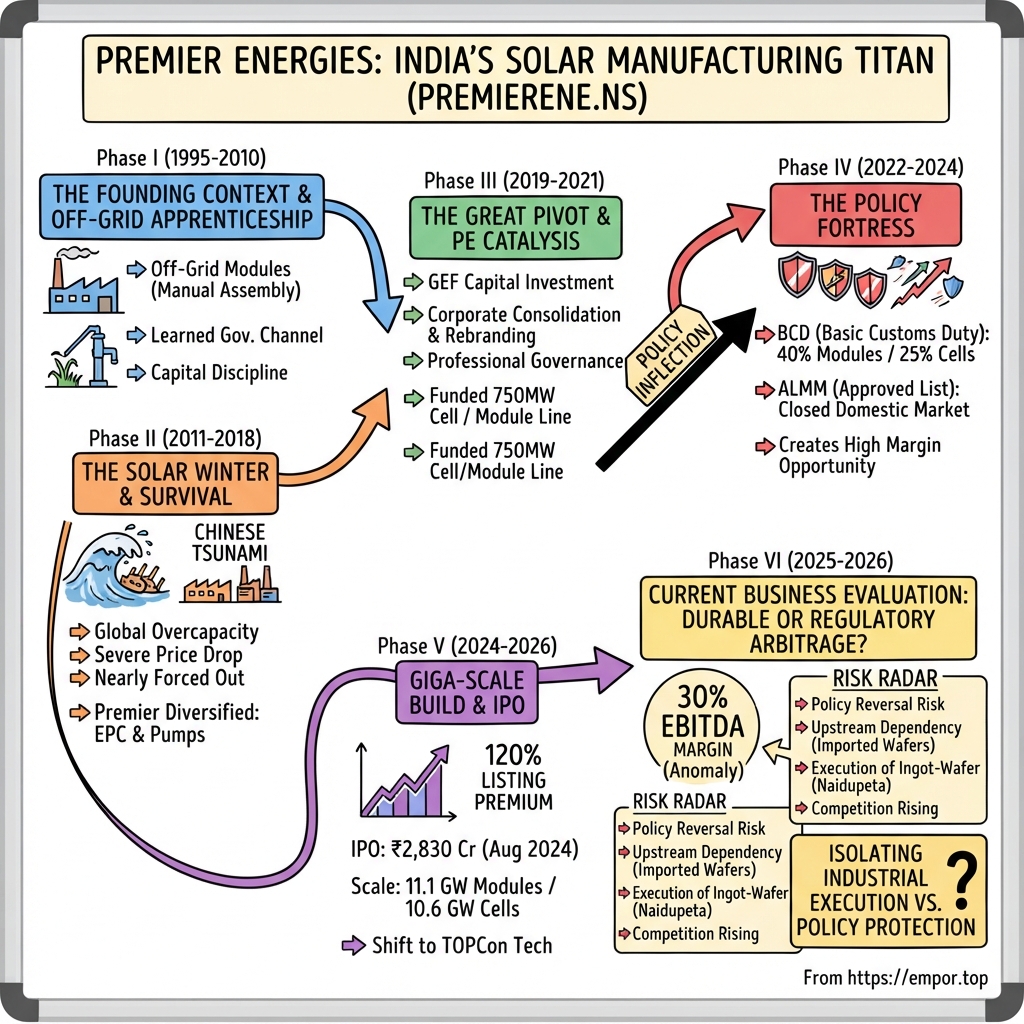
Premier Energies: The Story of India's Solar Manufacturing Titan
I. Introduction & Episode Roadmap
On the morning of September 3, 2024, a modest Hyderabad-headquartered manufacturer opened for trading on the National Stock Exchange at ₹990 per share against an issue price of ₹450—a 120% listing premium that instantly repriced the company at well over ₹40,000 crore.[^1] The moment highlighted a striking corporate transformation: a family business incorporated in 1995, in an era when solar power in India mostly meant a single panel attached to a village water pump, was suddenly valued above most of the mid-cap industrial firms it had spent three decades quietly supplying.
That market debut presents an engaging headline, but it obscures a more fundamental question.
Historically, solar photovoltaic manufacturing has been among the most challenging industrial businesses. It is a capital-intensive, fast-evolving commodity sector where cost curves fell roughly 90% over fifteen years, where each new technology generation renders the last obsolete within five to seven years, and where a single nation—China—controls 80% to 95% of every upstream node from polysilicon to wafers and cells. The industrial graveyard is extensive: Solyndra, Q-Cells, SunEdison, Suntech, LDK, alongside a long list of Indian module assemblers that eventually ceased filing accounts. Value destruction in solar manufacturing is not an anomaly; it is the historical baseline.
The core paradox at the heart of this story is straightforward: how did a second-tier Indian module assembler end up earning a 30% EBITDA margin in a global commodity industry?7 The evidence—tested against the company's own historical record—indicates that this margin is not primarily a manufacturing breakthrough. It is, to a large extent, a policy-driven achievement. The key analytical objective is determining how much of that profitability stems from industrial execution versus regulatory protection, and what happens to the underlying business when those policy dynamics evolve.
The analytical roadmap unfolds across seven distinct phases:
First, the origin story (1995–2010) receives brief coverage, as fifteen years of off-grid module assembly matter less for historical earnings than for the operational habits and government relationships established during that period. Second, the solar winter (2011–2018) examines the era when Chinese overcapacity disrupted the global solar sector and nearly forced Premier out of business—a period containing critical evidence challenging the company's "manufacturing heritage" narrative. Third, the pivot (2019–2021) analyzes the arrival of capital from a Washington-based ESG private equity fund at an extraordinarily opportune moment. Fourth, the policy fortress (2022–2024) dissects the Basic Customs Duty, the Approved List of Models and Manufacturers, and domestic-cell mandates to isolate how specific policy mechanisms generated corporate margin, while examining the temporary suspension of those protections in March 2023. Fifth, the giga-scale build and the IPO (2024–2026) tracks the rapid expansion leading to the public listing. Sixth, the current business evaluates the company's position as of September 2026, centering on the strategic risks of its ingot-wafer integration plans at Naidupeta. Finally, the analysis presents a comprehensive evaluation incorporating earnings-call disclosures, competitive strategy frameworks, risk mapping, and an investor stress test to determine whether Premier operates a durable franchise or a regulatory arbitrage.
A note on analytical posture: Premier Energies has delivered rapid profit growth over the past two years, but compounding earnings alone do not validate an uncritical bullish thesis. Management claims require clear attribution and rigorous testing against disclosed data, including evidence the company rarely highlights. Where empirical evidence narrows a thesis, the analysis explicitly outlines those limits and identifies the precise operating metrics required to disprove the case.
The narrative begins in a Hyderabad industrial shed in the mid-1990s, long before any of this outcome was foreseeable.
 Subscribe on LinkedIn
II. Founding Context & The Early Solar Bet (1995–2010)
In 1995, India functionally had no grid-connected solar industry. There were no utility auctions, power purchase agreements, renewable purchase obligations, or Approved List of Models and Manufacturers (ALMM) regulations. The market consisted of a scattered patchwork of state nodal agencies purchasing small quantities of hardware for rural electrification: streetlights for off-grid villages, solar lanterns distributed under government schemes, and water pumps for farmers. Annual national demand was measured in single-digit megawatts. A solar "factory" was typically a workshop where workers hand-laid cells onto glass, soldered ribbons, laminated assemblies, and fitted aluminum frames.
Into this nascent market, Surender Pal Singh Saluja incorporated Premier Solar Systems in Hyderabad in 1995 — a first-generation technocrat entrepreneur, not an industrial heir, entering an industry that did not yet have customers in any conventional sense.4 The company that emerged from that decision was best understood not as a bet on solar economics — which nobody could have modeled in 1995 — but as a wager that an Indian manufacturer who learned to assemble modules reliably and navigate government procurement channels would eventually find a far larger market waiting.
The off-grid apprenticeship
What the off-grid era taught Premier, and why it matters three decades later, comes down to three foundational capabilities.
The first was mastery of the government channel. Selling solar water pumps and streetlights to state agencies required navigating tender documentation, technical qualification criteria, performance bank guarantees, delayed receivables, and bureaucratic cycles. While low-margin and operationally demanding, this background prepared Premier for the domestic-content-requirement (DCR) regime established decades later — policy tenders that were fundamentally government procurements with a domestic manufacturing condition attached.
The second was capital discipline by necessity. With no venture capital available for Indian solar hardware in the late 1990s and early 2000s, capacity was added in small increments as internal cash flow permitted, keeping debt modest. While forced by market constraints rather than strategic foresight, this balance sheet discipline produced financial resilience that enabled the company to survive subsequent industry downturns.
The third was an early lesson in the limits of module assembly. A solar module is, in economic terms, a packaging operation: buying cells — the semiconductor where the physics and core intellectual property reside — and encapsulating them between glass, polymer, and an aluminum frame. The value added is thin, capital intensity is low, technology is licensable, and barriers to entry are minimal. Given that anyone with working capital and space could assemble modules, the Saluja family learned early that assembly alone offered limited structural defensibility.
The second generation arrives
The company's trajectory shifted when Chiranjeev Saluja, the founder's son, joined the business and pushed it in a direction the founder's instincts might not have chosen: away from manual packaging toward automated lines, and eventually toward the far riskier upstream step of making cells rather than buying them.4 It reflected a familiar pattern in Indian family-owned manufacturing — a founder builds a durable, cash-generative trade, and a second generation argues for a leap in capital intensity to capture broader market shifts.
By the late 2000s, the logic for that shift was becoming visible. The Jawaharlal Nehru National Solar Mission, launched in 2010, set India's first national capacity targets and signaled an intent to build utility-scale solar. For a company that had spent fifteen years supplying megawatts, the prospect of a market measured in gigawatts represented the largest commercial opportunity in its history.
What no manufacturer in Hyderabad could foresee was that the same global forces about to make solar power cheap enough for India to deploy at scale were also about to make solar manufacturing almost impossible to operate profitably. The gigawatt market was arriving, but so was a global flood of supply.
III. The Solar Winter & Survival Against the Chinese Tsunami (2011–2018)
In 2011, Premier took a major strategic risk by moving upstream into solar cell manufacturing in Hyderabad—becoming one of the few Indian companies producing the semiconductor itself rather than merely packaging imported components.[^2]
The timing proved exceptionally difficult.
What actually happened to global solar between 2011 and 2013
Understanding the decade Premier subsequently endured requires examining Chinese industrial policy. Between 2008 and 2012, Chinese provincial governments, policy banks, and state institutions directed massive capital into every node of the photovoltaic supply chain—polysilicon refineries, ingot pullers, wire saws, cell lines, and module plants—at a scale disconnected from existing global demand. Subsidized land, low-cost electricity, and state-backed credit fueled rapid industrial expansion.
The resulting oversupply triggered severe global price deflation. Polysilicon, which had peaked above $400 per kilogram during a 2008 supply shortage, crashed toward $15 to $20 per kilogram. Finished solar module prices dropped by approximately 80% within a few years. While lower hardware costs accelerated solar adoption globally, solar manufacturers faced widespread insolvency. Germany's Q-Cells, previously the world's largest cell maker, filed for insolvency in 2012, following the 2011 bankruptcy of U.S.-based Solyndra. Leading Chinese producers also suffered severe losses; Suntech, the largest global module manufacturer in 2011, defaulted on its convertible bonds, forcing its primary subsidiary into insolvency by 2013.
For a Hyderabad manufacturer that had just committed capital to a cell line built for an undeveloped domestic market, the commercial reality was stark. The landed price of a finished, imported Chinese module—shipped and cleared through customs—fell below the bill-of-materials cost for raw inputs needed to produce a module domestically. This structural cost gap was an insurmountable arithmetic imbalance that operational refinements alone could not bridge.
The survival years
Between 2012 and 2018, domestic cell manufacturers faced prolonged operational stagnation. Indian cell lines ran at low utilization, and aggregate domestic cell capacity barely grew. In contrast, module assembly capacity expanded significantly because packaging imported Chinese cells remained commercially viable while manufacturing cells did not. As a result, the domestic solar ecosystem effectively functioned as a packaging layer reliant on Chinese supply chains.
Premier adapted by diversifying into lower-margin service and niche segments. The company expanded into engineering, procurement, and construction (EPC) projects, government rooftop installations, and operations and maintenance contracts. It also re-engaged its historical off-grid business, particularly agricultural solar water pumps—a segment later institutionalized under the PM-KUSUM scheme. While these activities yielded modest returns, they generated sufficient cash flow to cover fixed overheads and preserve cell manufacturing operations.
Financial strain during this period was evident in the company's credit profile. Credit rating agencies noted compressed operating cash flows and constrained credit facilities. ICRA withdrew its ratings in 2020 following adjustments to Premier's banking arrangements. The credit narrative improved only after post-2021 recapitalization and supportive domestic policy shifts, with CARE and CRISIL both rating the company against a substantially strengthened business profile in 2024 ahead of its public listing.[^4]2
Disconfirming evidence: does the early cell bet prove manufacturing superiority?
A key element of the corporate narrative—frequently highlighted in sell-side coverage—is that Premier's 2011 entry into cell manufacturing established an irreplaceable manufacturing heritage and a decade-long lead in the most complex segment of the value chain.
Testing this assertion against historical performance reveals important nuances.
If manufacturing heritage provided a durable competitive advantage, it should have generated tangible economic returns between 2012 and 2018 through premium pricing, market share gains over imports, or superior cost efficiencies. However, available evidence indicates the cell division remained sub-scale and financially constrained, with broader corporate survival dependent on service diversification and off-grid projects. Financial performance reinforces this finding: as recently as fiscal year 2023, consolidated revenue reached ₹1,428 crore alongside a net loss of ₹13.3 crore.[^2] Twelve years after entering cell manufacturing, the business remained unprofitable on a net basis.
Technological shifts further complicate the heritage narrative. The aluminum back-surface-field (Al-BSF) cell architecture deployed in 2011 was subsequently replaced by passivated emitter and rear cell (PERC) technology, which is now yielding to N-type TOPCon processes. Each technology cycle requires distinct manufacturing equipment, process recipes, and operational knowledge. Because cell manufacturing expertise is not strictly cumulative in the manner of aerospace tooling or specialized chemical synthesis, operating an early-generation facility offers limited technical advantage when building a modern TOPCon plant.
Verdict: the claim is narrowed, not rejected. Premier's 2011 entry provided operational optionality and institutional familiarity—an established organizational understanding of cell fabrication, relationships with global equipment vendors, and qualification track records with domestic buyers. These assets enabled Premier to expand cell capacity rapidly once regulatory conditions turned favorable. Nevertheless, performance between 2012 and 2018 demonstrates that domestic cell manufacturing lacked pricing power without state trade protections. The structural profitability of the business originated from policy interventions in New Delhi rather than manufacturing advantages in Hyderabad.
This reality underscores the key transition that followed: the consecutive arrivals of institutional capital and protective industrial policy.
IV. The Great Pivot & PE Catalysis: GEF Capital & Rebranding (2019–2021)
By 2019, Premier Energies resembled a classic family-owned Indian industrial group: a cluster of related operating entities—including Premier Solar Systems, Premier Photovoltaic, an engineering, procurement, and construction (EPC) arm, and various project vehicles—bound together primarily by shared promoters and common premises. For institutional investors, this structure presented an insurmountable underwriting challenge, as group economics were fragmented across multiple private entities connected by related-party transactions.
The corporate consolidation and rebranding into Premier Energies Limited was therefore not a cosmetic exercise. It established the legal and operational structure necessary to attract external capital: a unified entity with consolidated financials, an auditable capital structure, and a governance framework suitable for institutional diligence.[^2]
The cheque that arrived at the right moment
In 2021, GEF Capital Partners—a Washington, D.C.-based private equity firm specializing in climate and resource-efficiency investments in emerging markets—invested ₹200 crore (roughly $25 million at the time) for a significant minority stake.4
Relative to Premier's post-IPO valuation, $25 million appears minor. In 2021, however, that capital was transformational, and the contrast illustrates a critical investment lesson.
GEF underwrote a company emerging from a decade of sub-scale returns, a history of withdrawn credit ratings, and an industry notorious for global capital destruction. At the time, domestic solar cell manufacturing in India had no proven track record of sustained profitability. GEF's investment rested on a single thesis: that India's policy intent to build domestic solar manufacturing was genuine, and that once implemented, supply constraints would emerge in cell capacity rather than module assembly.
That thesis proved accurate, grounded in policy signals already visible in 2021—including the announced Basic Customs Duty framework, established module standards under the Approved List of Models and Manufacturers (ALMM), and a clear trajectory of trade protection. While broad market skepticism persisted—reflecting India's historical record of regulatory protections being diluted or delayed under pressure from downstream power developers—GEF explicitly underwrote regulatory durability.
Where the money went
The capital funded a greenfield, automated 750-megawatt cell and 750-megawatt module facility at E-City, Hyderabad.4 Rather than expanding standalone module assembly—which was less capital-intensive and quicker to execute—management constructed a matched cell-and-module footprint, positioning the company for vertical integration before the market fully priced in that capability.
Analyzing the economics of this investment yields two key insights. First, GEF entered at a valuation established before domestic policy protections triggered a market re-rating, later realizing a partial exit via the offer-for-sale component in the 2024 initial public offering at a dramatically expanded valuation.3 Second, the investment returns stemmed primarily from multiple expansion driven by exogenous policy shifts rather than operational engineering. The transaction stands as a notable example of macro-policy timing structured within a growth equity vehicle.
Professionalisation
Beyond capital, GEF introduced institutional governance. The firm established an institutional board structure, rigorous external auditing standards, professional financial leadership, and formal capital-return benchmarks to discipline future capital expenditure.
However, this governance layer operates alongside a promoter group that retained approximately 69% to 70% equity ownership following the public listing.[^2] While concentrated promoter ownership aligns management incentives with long-term execution, it also limits the ability of minority shareholders to influence capital allocation decisions. Subsequent analysis will return to this dynamic when evaluating the company's capital commitments to upstream ingot and wafer manufacturing.
By late 2021, Premier had restructured its corporate identity, secured expansion capital, and upgraded its operational governance. The remaining requirement for commercial expansion was the implementation of promised government trade protections.
V. The Policy Fortress: ALMM, BCD, and PLI (2022–2024)
In April 2022, the Government of India fundamentally altered the return profile of domestic solar cell lines by imposing a Basic Customs Duty of 40% on imported solar modules and 25% on imported solar cells.5
Understanding why this policy shift proved so consequential requires analyzing the economics of a protected commodity.
How a tariff becomes a margin
Solar modules function largely as a standardized commodity—priced per watt, benchmarked globally, and showing minimal differentiation among products from tier-one manufacturers. In an unprotected market, domestic Indian prices simply tracked Chinese landed costs plus freight. Operating with higher structural input costs, domestic manufacturers remained price-takers, resulting in a decade of operational losses across the sector.
When New Delhi imposed a 40% duty on imported modules alongside a 25% duty on imported cells, two complementary dynamics took effect.
First, domestic module pricing rose toward the landed cost of imported modules inclusive of the 40% tariff. This created a protective price umbrella above historical market-clearing levels, under which domestic assemblers could operate.
Second, and more critical for Premier specifically, was the 15-percentage-point differential between the cell and module tariffs. That gap represented the explicitly protected value of domestic cell manufacturing—the regulatory headroom within which a domestic cell could be priced relative to an imported alternative while making local module assembly commercially attractive.
Tariffs alone, however, remained vulnerable to global price erosion, trade rerouting, and supply chain adjustments. The more decisive mechanism was a non-tariff regulatory instrument.
ALMM: the list that decides who gets to sell
The Approved List of Models and Manufacturers (ALMM) was deceptively bureaucratic in title but decisive in execution. Maintained by the Ministry of New and Renewable Energy, this register specified the solar module models and manufacturers eligible for procurement across government-supported, government-assisted, and utility-scale projects.5 Mandatory factory inspections served as a prerequisite for listing, effectively excluding most foreign producers from the regulated domestic market.
While tariffs rendered imports expensive, ALMM made non-compliant imports ineligible. For the vast majority of Indian solar projects requiring institutional financing, the regulation transformed an open global market into a closed domestic domain.
The decisive regulatory move was extending domestic procurement mandates from modules down to the cell level. Under domestic-content-requirement architecture, qualifying projects were required to use modules built from domestically fabricated cells. This single mandate converted Premier's historically struggling cell manufacturing lines into its most strategically valuable asset.
This shift capitalized on a structural imbalance across India's solar supply chain. Following the tariff implementation, Indian module assembly capacity rapidly expanded to between 40 and 50 gigawatts, driven by low capital intensity and straightforward process logistics. Conversely, cell fabrication capacity—demanding significant capital, technical sophistication, and longer commissioning timelines—remained constrained below 10 gigawatts for most of the period. India effectively had 40 to 50 gigawatts of assembly demand competing for less than 10 gigawatts of domestic cell supply.
That supply deficit established Premier as a rare merchant cell supplier. Major module competitors—including Waaree Energies, Vikram Solar, and Tata Power Solar—required domestic cells to bid for domestic-content tenders but lacked sufficient captive cell capacity. Consequently, they purchased cells directly from Premier. Competing against an entity in module markets while depending on it for essential cell inputs created pricing leverage for the seller and an uncomfortable bottleneck for buyers, explaining a substantial portion of Premier's subsequent margin expansion.
Disconfirming evidence: is the policy moat permanent?
A central premise of the bullish investment case asserts that ALMM regulations and cell-level mandates create a durable structural moat for domestic cell manufacturers.
Testing this hypothesis against historical execution, however, reveals a clear structural vulnerability.
In March 2023, the Ministry of New and Renewable Energy suspended the ALMM requirement for the financial year 2023-24.[^11] The suspension stemmed from a recurring policy conflict: India's ambitious renewable deployment targets collided with project delays and cost overruns caused by domestic module shortages. When rapid capacity installation conflicted with domestic industrial protection, deployment took priority. Upon the suspension of ALMM, Chinese imports surged into the market, immediately depressing domestic realizations.
This event provides a documented empirical baseline for evaluating Premier's business model. Rather than an abstract risk factor, it records an actual instance where state protections were temporarily withdrawn when domestic supply bottlenecks threatened broader infrastructure goals.
Verdict: the "permanent moat" claim is rejected. Premier holds a policy-contingent advantage whose value is directly tied to the deficit between domestic cell supply and government deployment targets. This proposition remains falsifiable: regulatory relaxations, deadline extensions, or exemptions for pre-existing project pipelines directly compress domestic cell realizations.
Furthermore, extraordinary returns in domestic cell manufacturing trigger an inevitable market response. High margins signal an opportunity that prompts both existing competitors and new entrants to expand capacity. The policy protections that drive Premier's current profitability are simultaneously funding a nationwide build-out of cell capacity. As domestic cell supply approaches parity with module assembly capacity, the scarcity premium will compress regardless of regulatory stance. Consequently, Premier's advantage represents a temporary operational lead time rather than an unassailable defensive wall.
The answer, beginning in 2024, was: everything at once.
VI. The Giga-Scale Explosion & The Blockbuster 2024 IPO
The Seetharampur site in Telangana is where that strategic ambition took physical form. The company constructed a 5.6-gigawatt TOPCon cell and module complex to scale operations from output previously measured in hundreds of megawatts up to 11.1 gigawatts of module capacity, alongside a target of 10.6 gigawatts of cell capacity.711 To put that expansion in perspective: Premier's entire cell output in fiscal year 2026 was approximately 2.27 gigawatts.7 Management was effectively building capacity at several multiples of its existing production, under the operational assumption that both market demand and state policy protections would hold.
PERC to TOPCon, explained without the physics
A solar cell is fundamentally a slice of silicon designed to convert photons into electrons. Conversion efficiency—the percentage of incident sunlight converted into usable electricity—serves as the core economic metric in solar manufacturing, because each fractional percentage gain in efficiency reduces the downstream requirement for glass, aluminum, land, cabling, labor, and structural steel per megawatt of power. It represents the primary operational lever that compounds across the entire balance-of-plant cost stack.
For nearly a decade, the global industry standard was Passivated Emitter and Rear Cell (PERC) technology—a P-type silicon design that reached commercial production efficiencies of roughly 22% to 23%. By the early 2020s, PERC had approached its theoretical physical limits, leaving minimal room for further operational optimization.
Tunnel Oxide Passivated Contact (TOPCon) emerged as the dominant N-type successor. In a standard cell design, electrons freed by sunlight must travel to metal contacts to be collected; whenever an electron strikes a metal surface directly, it risks recombining and dissipating as heat rather than contributing to electrical current. TOPCon addresses this by inserting an ultra-thin oxide layer—only a few atoms thick—between the silicon substrate and the metal contact. The layer is thin enough to allow quantum tunneling of electrons while chemically passivating the silicon surface to minimize recombination losses. The resulting cell converts a higher fraction of sunlight, achieves commercial efficiencies above 25%, and exhibits lower degradation rates over its operational lifespan.[^9]
The strategic significance of this transition lies in its manufacturing complexity. TOPCon fabrication requires additional processing steps, stricter contamination control, advanced metrology, and higher-grade N-type silicon wafers. Consequently, line yield—the proportion of manufactured cells meeting technical specifications—becomes a decisive economic variable rather than a routine operational detail. If Premier is to establish a genuine manufacturing advantage independent of regulatory protection, operational execution in TOPCon yield represents the critical testing ground.
The IPO
The public offering came to market in late August 2024, raising ₹2,830.40 crore—roughly $340 million—split between a fresh issue of ₹1,291.68 crore and an offer for sale of ₹1,538.72 crore.[^2]3 The composition of the offering is notable: more than half the capital accrued to selling equity holders rather than the corporate treasury. While standard for private equity exits in Indian capital markets, this structure qualifies the transaction as a liquidity event as much as a primary growth raise.
Investor demand proved substantial. Overall subscription reached 74.38 times the issue size, driven by qualified institutional buyers who subscribed for more than 210 times their allotted tranche.3
When trading opened on September 3, 2024, the stock listed at ₹990 per share against an issue price of ₹450—a 120% premium.[^1][^9]
A listing gain of that magnitude indicates the issue was priced well below market clearing levels, reflecting both bookrunning mechanics and the heightened risk appetite of Indian capital markets in mid-2024. During that period, record domestic mutual fund inflows and strong appetite for energy transition assets generated substantial scarcity premiums for listing candidates. Rather than validating Premier's long-term competitive moat, the immediate price appreciation primarily transferred value to initial allottees while signaling prevailing market sentiment.
Net proceeds from the fresh issue were allocated primarily to debt reduction—paying down borrowings incurred during prior capacity expansion—and to funding a new 4-gigawatt cell line through a subsidiary, alongside general corporate purposes.[^2] Deleveraging represented a prudent capital allocation choice for a business exposed to commodity price volatility and regulatory shifts, preventing balance-sheet leverage from compounding policy exposure.
Subsequent financial results demonstrated continued earnings momentum. In the third quarter of fiscal year 2025, profit after tax rose multi-fold to approximately ₹255 crore, confirming that pre-IPO margin expansion reflected broader operating conditions rather than a short-term accounting artifact.12
With fresh capital, expanded manufacturing capacity, and active regulatory protections in place, the company faced a critical strategic question: whether its post-listing profitability reflected an enduring industrial franchise or a temporary policy window.
VII. Current Operations, Segment Breakdown & Capital Deployment (2025–2026)
By the close of fiscal year 2026 on March 31, Premier Energies presented a dramatically different financial profile than the company that had listed eighteen months earlier. Full-year revenue reached ₹8,026 crore, representing a 20.7% year-on-year increase, while net profit surged 61.1% to ₹1,510 crore—delivering an operating EBITDA margin of 30.4% and a net profit margin of 18.8%.711
Those margin figures warrant close scrutiny, as they represent the single most revealing metric in the company's financial profile.
A 30% EBITDA margin in solar manufacturing is an anomaly. Globally, major Chinese module producers spent much of the preceding two years operating near or below gross breakeven. First Solar, the most profitable Western producer, generates its returns through proprietary thin-film technology and U.S. tax credits. Premier, by contrast, manufactures conventional crystalline silicon products using largely imported upstream inputs, yet generates margins comparable to a high-specialty chemical producer. Manufacturing efficiency alone cannot explain this divergence; it reflects the tariff-plus-ALMM protective umbrella appearing directly on the income statement.
The fact that profit growth outpaced revenue growth threefold illustrates this dynamic in action: each incremental rupee of revenue in fiscal year 2026 was substantially more profitable than the last, as scarce, policy-protected solar cells accounted for a growing share of a sales mix historically dominated by lower-margin module assembly.
The shape of the business
The company's revenue breakdown highlights the structural composition of its earnings. Solar modules remain the dominant segment, accounting for approximately 70% to 75% of total revenue through high-volume utility and domestic-content-requirement sales, where Premier competes primarily on price per watt and delivery reliability. Solar cells contribute between 15% and 20% of revenue, split between internal consumption and merchant sales to competing module manufacturers, while generating disproportionately high margins due to domestic cell scarcity. EPC, operations and maintenance, and solar pumps generate the remaining 8% to 10%—the legacy service segments that sustained the business during the industry downturn.
This segment breakdown underscores the core tension in Premier's valuation. The largest revenue driver remains a commoditized assembly operation, while overall profitability is driven by a smaller, policy-protected cell segment. Evaluating the blended 30% margin as a corporate-wide structural advantage, rather than a weighted average driven by a supply-constrained niche, risks overstating the company's long-term terminal value.
The FY27 capital plan and the acquisitive turn
Looking ahead, management committed to investing approximately ₹5,100 crore during fiscal year 2027 across cells, ingots, wafers, batteries, and inverters, alongside a plan to expand transformer capacity sevenfold to 16.75 GVA by July 2026.8 Premier also completed the acquisition of a 51% stake in Transcon, which contributed approximately ₹423 crore in annual revenue, while exploring joint venture structures—including with SMA SGS—for inverter production.8
One disclosure from the same period warrants particular attention: management abandoned a planned acquisition of K-Solar following contractual disagreements.8 Terminating a transaction over contractual terms provides a positive governance signal, demonstrating financial discipline over deal momentum. While a single transaction does not establish a permanent track record of capital allocation discipline, such empirical actions offer clearer insight into management behavior than forward-looking guidance.
Nevertheless, the broader capital allocation strategy signals a notable shift. Premier is concurrently expanding from core cell and module manufacturing into transformers, inverter joint ventures, and battery storage. While each adjacency carries a logical commercial rationale—such as turnkey balance-of-system offerings and shared customer channels—they also represent moves beyond the company's core operational capabilities, funded by temporary regulatory windfalls. Similar multi-directional expansions among Indian industrial groups historically highlight the need to treat this capital deployment as an open strategic question rather than a guaranteed value driver.
The optionality bets, sized honestly
Battery Energy Storage Systems. Premier announced a 12-gigawatt-hour joint venture with Germany's RCT Group.6 The strategic logic is sound: as solar grid penetration increases, power firming becomes the primary operational bottleneck, positioning storage much like cell capacity today. However, realistic sizing indicates near-term revenue contributions will remain minimal. Battery chemistry and cell manufacturing involve distinct technologies, supply chains, and established global competitors with substantial scale advantages. Consequently, the venture represents long-term strategic optionality rather than an immediate earnings driver.
Transformers and inverters. These represent logical operational adjacencies that remain modest in scope, offering incremental value provided capital commitments remain controlled.
Ingots and wafers — the primary commitment. Premier is constructing a 10-gigawatt ingot and wafer facility at Naidupeta in Andhra Pradesh, targeting a first 5-gigawatt phase by December 2027 and full completion by December 2028.7 Representing a capital deployment of thousands of crores, this project constitutes the company's most significant strategic commitment and requires thorough evaluation.
Disconfirming evidence: will backward integration insulate margins?
The claim: integrating upstream into ingots and wafers will secure supply and insulate margins from Chinese dependence.
Evaluating a wafer facility requires recognizing that ingot and wafer fabrication is fundamentally distinct from downstream cell assembly. Monocrystalline silicon ingot growth requires pulling a single crystal from molten polysilicon at temperatures exceeding 1,400°C using the Czochralski process—a technology closely aligned with semiconductor substrate fabrication—before precision wire-sawing into wafers under 150 microns thick. It represents one of the most electricity-intensive, purity-critical, and yield-sensitive processes in industrial manufacturing.
Historically, India has not established large-scale, commercially viable ingot and wafer production due to three structural barriers. First, industrial electricity costs in India remain elevated relative to the hydro-powered Chinese provinces where wafer production is concentrated, impacting the primary variable cost of crystal growth. Second, India lacks domestic solar-grade polysilicon refining, requiring raw material imports that shift Chinese supply dependence one stage upstream rather than eliminating it. Third, manufacturing technology and yield expertise remain concentrated among leading global producers.
Furthermore, global market pricing presents a challenging environment. Chinese wafer prices have remained depressed due to structural overcapacity, with major producers operating near cash cost. A smaller domestic wafer operation burdened by higher power costs and imported inputs must compete against global market pricing over a multi-year asset payback period, risking higher internal transfer costs compared to merchant wafer procurement.
Verdict: the claim is narrowed sharply. Backward integration achieves three specific objectives: qualifying Premier for upstream domestic-content mandates, mitigating potential supply-denial risks, and capturing state industrial incentives. However, available evidence suggests it is unlikely to deliver a lower cost structure than imported wafers. Naidupeta is best understood as a policy-compliance and supply-security investment carrying potential margin-drag risk, rather than a structural cost-advantage initiative.
This outcome remains verifiable through key operating metrics: following the commissioning of the initial 5-gigawatt phase, disclosures will indicate whether cell gross margins equal or exceed historical merchant-wafer baselines. If integrated cell margins lag merchant-sourced levels, the wafer operation represents an operational cost of policy compliance. Monitoring project execution against the December 2027 timeline and initial capital expenditure estimates will provide early indications of execution performance.
Whether management addresses these operational realities transparently remains directly observable through ongoing quarterly earnings calls and financial disclosures.
VIII. Transcripts & Earnings Call Forensics
Earnings calls are where a corporate narrative meets analytical resistance. Prepared remarks are controlled communications; the executive Q&A session is not. Reviewing Premier's conference calls across the post-listing period reveals a consistent pattern in both strategy and disclosure.
What management chooses to lead with
Management's prepared remarks have maintained a stable focus since listing: capacity commissioned, order book depth, utilization rates, and product launches. On the fiscal 2026 results call, executives framed annual performance around expanding domestic demand and supportive ALMM policy shifts that favored established manufacturers, alongside the completion of the Seetharampur module plant and commercial rollouts of zero-busbar cells and all-black modules.8
That framing is notably transparent regarding earnings drivers. Rather than attributing margins primarily to proprietary technology or brand equity, management explicitly acknowledged the role of domestic demand growth and trade policy protections. This candid assessment reflects the underlying economics of the business, while confirming the fundamental regulatory dependency central to skeptical analysis.
The order book and what it does and does not promise
The most prominent metric in Premier's disclosures remains its order book. The backlog grew 66% year-on-year to ₹14,010 crore as of March 31, 2026, expanding further to approximately ₹15,000 crore representing 9,867 megawatts by June 30, 2026, supported by ₹3,011 crore in fresh orders for 1,846 megawatts of cells and modules booked during the June quarter alone.8139 Domestic projects account for nearly the entire order backlog—a concentration reflecting a distinct strategic positioning.
At roughly 1.9 times fiscal 2026 revenue, the backlog provides substantial multi-year revenue visibility.13 However, three operational qualifications warrant equal weight.
First, an order book in a commodity industry represents a volume commitment rather than a guaranteed spread over raw material input costs. Second, Indian solar contracts remain vulnerable to renegotiation or deferral when module market prices shift or when downstream project developers experience delays in land acquisition, financing, or grid interconnection. Third, the contracted backlog is priced under prevailing trade protections; any future relaxation of ALMM regulations would expand low-cost import alternatives for buyers, altering delivery schedules and pricing terms.
Consequently, while the order backlog indicates robust demand, it does not constitute an unconditional revenue guarantee.
The live quarter
For the first quarter of fiscal 2027, reported in early August 2026, Premier recorded revenue of ₹2,508 crore, up 34% year-on-year, operating EBITDA of ₹759 crore, up 27%, and profit after tax of ₹472 crore, up 53%.910 Quarterly output reached 844 megawatts of cells, 953 megawatts of modules, and 570 megavolt-amperes of transformers, with newly commissioned module lines operating at high utilization.10
Financial results for the quarter highlight an important underlying metric: operating EBITDA grew at 27%, trailing top-line revenue growth of 34%. Operating margins compressed slightly despite expanding top-line scale. While single-quarter performance can be influenced by product mix shifts between domestic-content requirement (DCR) tenders and standard commercial sales, this margin compression aligns with expectations as broader industry cell capacity comes online across India.
Production volumes also remained below the annualized run-rate implied by the company's 11.1-gigawatt module capacity. Such lag is typical during capacity ramp-ups, as scaling newly commissioned facilities requires multiple quarters. However, it indicates that fixed-cost absorption will remain a critical variable, improving if plant utilization rises or pressuring earnings if volume growth slows in fiscal 2028.
The three questions analysts keep asking
On cell supply tightness. Analysts have regularly questioned whether domestic cell realizations can maintain a premium over imported cells plus tariffs as domestic manufacturing expands. Management maintained that the premium persists, noting that the domestic-content-requirement segment yields higher margins and remains a key strategic target.8 While supported by current market conditions, this position reflects active market dynamics rather than a long-term structural guarantee.
On exports and US exposure. Concentration in the domestic market reflects a strategic choice made amid heightened U.S. regulatory scrutiny regarding Chinese supply chain inputs in Indian solar exports.[^12] Indian manufacturers exporting to the United States face trade enforcement, anti-dumping duties, and rigorous input traceability requirements. Premier stated that it evaluates export opportunities in the U.S. and Europe selectively.8 This domestic focus can be viewed either as prudent risk management to avoid unpredictable foreign trade regimes or as concentrated exposure to a single national policy framework.
On input cost pass-through. The expansion of gross margins from mid-single digits in fiscal 2023 to mid-teens and above across fiscal 2024 and 2025 represented the primary quantitative driver of the stock's re-rating.[^2] Management explained this trajectory through back-to-back contracting, matching input material costs with fixed output order prices to lock in operating spreads. While effective for mitigating intra-contract input volatility, this practice protects margins only within active contract windows and does not establish structural pricing power when long-term contracts reprice in lower-cost environments.
Management credibility, assessed on behaviour
Evaluating corporate execution relies on verifiable management practices.
Promoter equity retention remains high, with the founding group holding approximately 69% to 70% post-IPO.[^2] Disclosure practices have been consistent, with management regularly publishing output volumes by product category, order book figures in both currency and megawatt terms, and specific target dates for capacity commissioning. These detailed disclosures provide clear, measurable benchmarks for evaluating execution performance. Stated timelines remain explicit: expanding cell capacity to 10.6 gigawatts by September 2026, scaling transformer capacity by July 2026, and completing the first phase at Naidupeta by December 2027.78
Assessing management track records requires observing performance across changing market cycles. Having listed in late 2024, Premier operated through two years of highly favorable industry tailwinds. True management credibility is tested when executive teams address operational misses, navigate strategic adjustments, or manage cyclical downturns—conditions the company has not yet encountered as a public entity. Disclosed operational targets provide the primary metrics against which long-term execution will be measured.
IX. Competitive Landscape, Helmer's 7 Powers & Porter's 5 Forces
A map of Indian solar manufacturing in September 2026 reveals an intense industrial arms race. Every major producer is expanding capacity, and most are targeting the exact same node: high-efficiency cell fabrication.
The field
Waaree Energies remains the scale leader in module assembly, with total capacity in the mid-teens of gigawatts and a dominant distribution presence across Indian channels. It is also expanding cell manufacturing aggressively. Historically, Waaree maintained a heavier export orientation, driving strong volume in the United States but exposing the firm to American trade enforcement to a far greater extent than Premier's domestically focused strategy.
Adani Solar represents the most fully integrated competitor, pursuing end-to-end manufacturing from ingots to modules at Mundra. Supported by the balance sheet of a major infrastructure conglomerate and a large captive project pipeline that guarantees downstream offtake, Adani provides the primary benchmark for Premier's ingot-wafer plans at Naidupeta. However, Adani's internal demand and access to group financing create a distinct risk and underwriting profile.
Vikram Solar and Tata Power Solar are established module assemblers and engineering, procurement, and construction (EPC) providers with recognized brands—particularly Tata in consumer and rooftop segments. However, both have expanded merchant TOPCon cell capacity at a slower pace.
Premier's strategic positioning centers not on absolute scale, but on a high cell-to-module capacity ratio and a willingness to supply merchant cells to competitors. While this creates a distinct operational profile, competing manufacturers are actively deploying capital to build their own cell lines and eliminate this dependency.
Helmer's 7 Powers, assessed honestly
Cornered Resource — present but conditional. Approved List of Models and Manufacturers (ALMM)-listed domestic cell capacity remains scarce and essential for module makers bidding on domestic-content-requirement (DCR) projects. However, a true cornered resource represents an asset competitors cannot replicate—such as a proprietary patent, mineral deposit, or exclusive rights. Solar cell manufacturing line capacity can be built, requiring roughly $50 million per gigawatt and 18 to 24 months of lead time. Premier's current advantage stems from policy-induced supply constraints and competitor build-out delays rather than an unreplicable asset. Consequently, this represents a strong temporary operational lead built on a policy foundation rather than a permanent structural moat.
Scale Economies — moderate, and improving. At 11.1 gigawatts of module capacity, Premier purchases glass, encapsulants, backsheets, frames, and junction boxes in volumes that command better terms than smaller assemblers.7 However, these scale benefits remain limited. Bill-of-materials procurement takes place in a competitive global market where major Chinese producers operate at up to ten times Premier's volume and several Indian peers maintain comparable scale. In this context, scale mitigates a cost disadvantage against global leaders rather than establishing a structural cost moat.
Process Power — emerging, unproven, and critical for long-term differentiation. Any durable advantage independent of regulatory protection must originate from superior operational execution, such as consistently high TOPCon line yields, rapid technology transitions, and lower fabrication costs per watt at equivalent conversion efficiencies. Execution indicators are positive: commissioned production lines are active, product specifications are competitive, and management has introduced advanced cell variants, including zero-busbar architectures.8 However, standard operational metrics required to verify process power—such as exact cell yield percentages, fabrication costs per watt, and efficiency bin distributions—remain undisclosed. Process power currently represents an unverified hypothesis supported by initial operational progress.
Branding, Network Economies, Counter-Positioning, and Switching Costs — largely absent. Solar cells are evaluated strictly on conversion efficiency, technical reliability, and price per watt. There is no meaningful brand premium at the cell layer, no network effect, and only minor switching costs limited to routine vendor qualification cycles lasting a few months.
Porter's Five Forces
Threat of new entrants — medium, and rising. Capital commitments of approximately $50 million per gigawatt for TOPCon cell fabrication, equipment lead times, and qualification cycles present initial entry barriers. However, these represent barriers of capital and time rather than proprietary knowledge. In an operating environment where domestic cell manufacturing generates 30% EBITDA margins, capital deployment accelerates. Sustained elevated returns naturally incentivize entry, steadily lowering barriers over time.
Buyer power — medium, currently suppressed. The customer base is concentrated among major independent power producers and utilities—including NTPC, Tata Power, ReNew Power, and Azure Power—that secure projects through competitive tariff auctions. These institutional buyers operate with strong incentives to minimize procurement costs. While buyer power is currently muted by domestic cell scarcity, customer concentration will reassert pricing pressure once cell supply balances demand.
Supplier power — high, representing the primary structural constraint. Polysilicon refining and wafer manufacturing remain concentrated among a small group of major Chinese producers—including LONGi Green Energy Technology, TCL Zhonghuan, and Tongwei—that control the vast majority of global output. Premier relies on imported wafers from an upstream oligopoly operating within a complex geopolitical context. Current low wafer prices reflect Chinese supply overcapacity rather than domestic buyer leverage. This upstream dependency provides the strategic rationale for the Naidupeta ingot and wafer investment, while making the project economically sensitive to global pricing dynamics.
Threat of substitutes — low. Solar photovoltaic generation remains the lowest-cost source of new marginal electricity across most of India, with no competing power generation technology threatening its economic position over the near term. Within the solar sector, substitution risks are primarily architectural and technological rather than categorical.
Rivalry — high and intensifying. Major domestic manufacturers are expanding capacity simultaneously to target the protected domestic market, competing primarily on price per watt in auction-driven procurement. Because India's annual solar installation capacity is finite, total industry-wide domestic cell expansions currently announced would comfortably exceed projected national demand if fully commissioned, heightening utilization risk across the sector.
In summary, Premier occupies a favorable near-term market position within a highly competitive commodity sector, with current profitability reflecting market timing and policy protections more than structural moats. Establishing durable long-term advantage depends primarily on developing unproven process capabilities. This distinction defines the core premise that investors must underwrite.
X. Material Risk Radar & Skeptical Investor Stress Test
Evaluating corporate risk requires precision regarding specific transmission mechanisms. Four primary exposures could materially alter the company's earnings power, each operating through a distinct transmission channel.
Policy reversal. The transmission channel is direct and immediate. A reduction in the 40% module or 25% cell tariff, or a relaxation, suspension, or deadline extension for the ALMM cell mandate, would instantly re-establish imported Chinese cells and modules as viable alternatives for domestic buyers. Realizations would compress toward landed import prices within one to two quarters, as solar components are standardized commodity products sold in competitive auctions without switching friction. The March 2023 suspension demonstrated both the mechanism and the political conditions under which it occurs—a direct conflict between national solar deployment targets and domestic manufacturing protection.[^11] Those competing priorities remain structural features of Indian energy policy.
Upstream dependency. Premier relies on imported Chinese wafers, creating two distinct risk scenarios that cut in opposite directions. If Chinese wafer prices rise—whether through industry consolidation, production discipline, or export restrictions—Premier faces higher input costs that may not be fully recoverable under fixed-price contracts. Conversely, if Chinese wafer prices remain depressed, Premier's current input costs remain favorable, but its planned Naidupeta wafer facility risks becoming uncompetitive against cheaper imports. Consequently, no single wafer pricing environment benefits both the existing cell business and the backward integration strategy, challenging the premise that integration inherently reduces operational risk.
Trade enforcement. U.S. anti-dumping and countervailing duty investigations have increasingly targeted Indian modules containing foreign, primarily Chinese, upstream components.[^12] Premier's focus on the domestic market provides meaningful direct insulation. However, secondary exposure persists: if competing Indian manufacturers are restricted from the U.S. market, their output will redirect into the domestic market, intensifying local price competition.
Technology obsolescence. Having committed substantial capital to TOPCon production lines, Premier remains exposed to rapid technology shifts. Heterojunction cells offer higher efficiency through a distinct, largely incompatible manufacturing process, while perovskite-silicon tandem cells promise higher efficiency ceilings, though commercial durability and scalable manufacturing remain unproven. Capital equipment in solar manufacturing historically faces economic obsolescence well before physical depletion. If a technology transition occurs before TOPCon investments achieve their payback period, substantial assets risk write-downs or costly re-tooling. The PERC-to-TOPCon transition demonstrated this pattern by stranding legacy PERC assets globally on a five-to-seven-year cycle.
Concentration and governance. Two structural factors warrant scrutiny. Promoter equity ownership of approximately 69% to 70% leaves minority shareholders with limited influence should capital allocation decisions falter.[^2] Furthermore, the company is pursuing simultaneous expansions across cells, wafers, ingots, transformers, inverters, and battery systems while its primary profit pool remains policy-dependent. While these conditions do not indicate current operational failure, they represent structural factors that would make strategic missteps harder for outside investors to correct.
The stress test
This leads to the fundamental strategic question: is Premier Energies an enduring high-technology manufacturing franchise, or a policy-arbitrage entity temporarily valued as one?
The skeptical case rests on documented operational history. The company's margin expansion occurred within twenty-four months of tariff implementation; prior to those trade protections, the same facilities and management team operated at a net loss. Furthermore, the core policy protection was previously suspended, the primary revenue segment remains an un-differentiated commodity, and key upstream inputs originate from an oligopoly in a competitive trade environment. Meanwhile, domestic peers are expanding cell capacity into the same finite domestic market, even as Premier commits capital to upstream wafer manufacturing—a node where domestic production has historically struggled against low-cost foreign incumbents.
The counter-argument centers on capital conversion. Policy protections, regardless of origin, generate cash flows that fund tangible manufacturing assets and operational capabilities. Rather than distributing profits or retaining liquid reserves, Premier is building gigawatt-scale TOPCon lines, advancing process expertise at the most technically demanding node in its history, and securing upstream supply chains. If regulatory protections endure through the commissioning and optimization phase, the resulting entity will be an integrated, scaled manufacturer with an established cost base—a structurally different business than the assembly operation that entered the tariff window.
Current evidence synthesis. The skeptical case accurately describes current operating realities, while the bullish thesis outlines a plausible future that remains unverified. As of September 2026, Premier is best understood as a policy-protected manufacturer attempting to convert temporary regulatory cash flows into long-term industrial scale and technical capability, a transition that remains incomplete. Ultimate validation depends on whether Premier's manufacturing cost per watt, at comparable conversion efficiency, achieves global cost competitiveness before trade protections narrow. That operational race represents the central metric determining the company's long-term valuation.
XI. The Investment Story Spine: Bull vs. Bear Case & Key KPIs
Why this wins from here
The bull thesis relies on four core arguments, each carrying varying levels of empirical support.
First, the cell supply deficit represents the most solid pillar. It is backed by clear market data: the structural gap between India's module assembly capacity and its domestic cell fabrication capacity remains well documented, while Premier's merchant cell sales to competing module makers provide commercial proof of that tightness.
Second, margin expansion driven by product mix is partially supported by evidence. Tunnel Oxide Passivated Contact (TOPCon) technology commands higher realizations than legacy Passivated Emitter and Rear Cell (PERC) lines, and Premier has brought that capacity online. However, whether Premier's TOPCon economics outperform those of its peers remains unverified, as company disclosures omit line-level yield figures and fabrication costs per watt.
Third, the order book offers clear revenue visibility at roughly 1.9 times fiscal year 2026 revenue, though it remains subject to the pricing adjustment and delivery deferral risks noted earlier.13
Fourth, backward integration represents the least supported pillar on current evidence. Expanding into ingots and wafers is best evaluated as a strategy for securing supply and satisfying policy mandates rather than a guaranteed cost-reduction initiative.
What breaks the case
The bear thesis centers on three primary risks, beginning with a vulnerability that prevailing market expectations understate.
Policy dependency is not a distant tail risk; it is the central operational variable. The regulatory framework carries a documented history of temporary suspension when domestic hardware shortages threaten broader infrastructure deployment.
Global oversupply means Indian domestic prices remain anchored to a continuously declining global cost floor. Chinese manufacturers operate with capacity that far exceeds global demand. While domestic tariffs insulate local pricing by a fixed percentage, that protection contracts in absolute terms as global baseline costs fall.
Execution complexity and capital intensity present immediate operational challenges. Premier plans to invest approximately ₹5,100 crore in fiscal year 2027 across five distinct product categories simultaneously.8 Industrial companies rarely execute five concurrent expansions without operational friction, and Premier's largest capital commitment—the Naidupeta wafer facility—enters a manufacturing node that has not previously operated at commercial scale within India.
Regarding equity performance, Premier's shares experienced a substantial re-rating following its public listing, trading on expectations of sustained, policy-protected profit margins.1 This analysis takes no position on valuation or equity price targets. However, any valuation premised on ongoing margin expansion requires investors to underwrite the durability of government trade protection as much as the operational execution of the company's factories.
The three KPIs that matter
The broader analytical framework narrows to three primary operating metrics that determine the company's long-term trajectory.
1. Blended EBITDA margin per watt, and its multi-quarter trajectory. This metric represents the most critical indicator of operational performance. If unit margins remain steady or expand as wider industry cell capacity comes online, Premier will have validated a genuine manufacturing advantage. Conversely, if margins compress as domestic supply balances demand, recent profitability will prove to have been driven by policy arbitrage. The margin compression observed in the first quarter of fiscal year 2027—where top-line revenue growth outpaced operating EBITDA growth—provides an initial data point in that multi-quarter trend.9
2. Cell capacity utilization, alongside the captive-versus-merchant sales split. Utilization figures demonstrate whether market demand is absorbing Premier's expanded manufacturing footprint, as operating a 30% EBITDA margin across 10 gigawatts of output yields a fundamentally different business profile than doing so across 3 gigawatts. The ratio of captive consumption to external merchant sales offers a secondary indicator: elevated merchant sales confirm that competing module assemblers remain unable to self-supply, whereas a shrinking merchant share provides early evidence that rival domestic cell capacity is reaching the market.
3. Naidupeta project execution, capital discipline, and post-commissioning margins. The ingot and wafer facility represents management's largest capital allocation decision and a major test of execution beyond its core capabilities. Key milestones include tracking the December 2027 target for the initial phase against actual commissioning, monitoring total capital outlay against initial estimates, and determining whether integrated cell margins after commissioning exceed the baseline returns earned when purchasing merchant wafers.7
XII. Playbook: Business & Investing Lessons
Survive the cycle to own the catalyst. The most underrated corporate skill is not being brilliant during good years; it is being present when conditions turn. Premier spent roughly a decade earning inadequate returns on its cell investment, covering overheads with EPC work and water pumps, and avoiding the leverage that killed peers. When the policy regime changed in 2022, the companies positioned to capture it were the small set that still had cell capability and an intact balance sheet. The lesson is not "persistence is rewarded"—many persistent companies simply die more slowly. It is that in industries where the return profile is determined by exogenous shifts, the correct strategy is to minimize the cost of waiting while retaining the capability that makes the eventual shift capturable. Premier executed that strategy; most of its 2011 cohort did not.
Move upstream to where the bottleneck forms—but understand what the bottleneck actually is. The conventional framing of Premier's success is that it moved upstream from commoditized assembly into capital-intensive cells, and captured the value. That is half right. The bottleneck at the cell node was not created by physics or capital intensity—India's module assemblers could have built cell lines at any point. It was created by regulation, which made domestic cells mandatory for a large slice of demand while domestic cell capacity was insufficient. The generalizable lesson is more precise than "move upstream": identify the node where demand is regulatorily or physically constrained and where supply cannot respond quickly, and position there before the constraint binds. Note that the same lesson, applied honestly today, highlights the reality that a regulatory bottleneck attracts supply faster than a physical one.
Private equity's most valuable contribution is often timing, not operations. GEF Capital's ₹200 crore investment did not transform Premier operationally. It arrived at the right moment, with a governance framework attached, at a valuation set before the market understood what was coming. The lesson for company builders is that the value of capital is highly state-dependent—the same check is transformative at one moment and irrelevant at another. The lesson for investors is that a great deal of private equity's headline returns in emerging markets derive from correctly underwriting policy durability, which is an underrated and genuinely difficult analytical skill, and one that should be named rather than dressed up as operational value creation.
Policy windfalls must be converted into capability, and the conversion must be verified. This is the lesson Premier is currently navigating, with the outcome undetermined. Protectionist policy generates cash flow that is, by construction, temporary—the whole point of infant-industry protection is that the infant is supposed to grow up. The correct use of that cash flow is to build something that survives the protection's withdrawal: cost position, process capability, scale, and technology. The incorrect uses are capital distribution, diversification into unrelated adjacencies, and capacity that only makes sense inside the tariff wall. Premier is visibly attempting the correct version. Whether it succeeds is precisely what the key performance indicators above are designed to reveal, and investors should insist on empirical evidence rather than taking management's intent for granted.
XIII. Epilogue & What to Watch Next
The company's trajectory presents a striking historical contrast. In 1995, a first-generation entrepreneur in Hyderabad began assembling solar modules by hand for a domestic market with minimal grid-connected solar power. Three decades later, the business operates gigawatt-scale facilities in Telangana, delivers operating margins well above industry baselines, and holds a market valuation that places it among India's significant industrial enterprises.[^1]7
Yet that expansion also highlights heightened exposure. While the original 1995 operation was small and low-risk, the expanded 2026 enterprise operates at scale but remains vulnerable to tariff adjustments, ministry policy lists, Chinese wafer pricing controlled by an upstream oligopoly, and rapid technology cycles that have rendered equipment obsolete every five to seven years. In expanding its manufacturing footprint, Premier has traded the operational risks of small-scale assembly for structural reliance on government trade policy and foreign supply chains.
The immediate outlook centers on several verifiable milestones over the coming eighteen months. First, output must demonstrate whether the cell capacity target of 10.6 gigawatts attracts sufficient market demand. Second, execution will show whether the ingot and wafer facility at Naidupeta remains on schedule for its December 2027 initial phase.7 Third, financial results will reveal whether unit margins withstand the expansion of competing domestic cell lines across India. Over a longer horizon, progress on the planned battery storage joint venture will indicate whether the initiative develops into a material revenue driver or remains a strategic commitment.6
In a broader context, Premier Energies serves as a primary listed proxy for a national industrial experiment: whether India can establish a domestic solar manufacturing sector behind protective trade barriers and cultivate globally competitive producers rather than permanently protected entities. Industrial policy history provides precedents in both directions—South Korean and Japanese programs developed global industrial leaders, whereas numerous other protected regimes resulted in lasting subsidy dependencies. India has committed to this policy framework, with Premier operating as one of its central test cases.
For investors, evaluating the business requires balancing two distinct realities: acknowledging the operational growth achieved by a family-owned enterprise in Hyderabad, while recognizing that its primary earnings driver remains regulatory policy established in New Delhi rather than operational execution in Telangana. The coming years will determine which factor ultimately shapes the company's long-term enterprise value.
References
-
Premier Energies Limited Stock Quote & Filings — National Stock Exchange of India (NSE) ↩
-
CRISIL Rating Rationale: Premier Energies Limited — CRISIL Ratings, 2024-08-20 ↩
-
Premier Energies IPO subscribed 74 times on final day of bidding — Business Standard, 2024-08-29 ↩↩↩
-
How Premier Energies built a solar manufacturing giant — Forbes India, 2024-09-05 ↩↩↩↩
-
Approved List of Models and Manufacturers (ALMM) Guidelines & Regulations — Ministry of New and Renewable Energy (MNRE) ↩↩
-
Premier Energies partners with Germany's RCT Group for battery storage — Financial Express, 2024-07-18 ↩↩
-
Premier Energies FY26 profit jumps 61% on demand growth — TaiyangNews, 2026-05-16 ↩↩↩↩↩↩↩↩↩↩
-
Premier Energies Limited Q4 FY26 earnings transcript summary — InvestyWise, 2026-05-16 ↩↩↩↩↩↩↩↩↩↩
-
Premier Energies Q1 FY27 profit rises 53% YoY as orders grow — TaiyangNews, 2026-08-07 ↩↩↩
-
Premier Energies reports INR 2,508 crore Q1 FY27 revenue, INR 472 crore PAT — SolarQuarter, 2026-08-07 ↩↩
-
Premier Energies reports FY26 PAT of INR 15,097 Mn, up 61 percent YoY, module capacity reaches 11.1 GW — Energetica India, 2026-05-16 ↩↩
-
Premier Energies records multi-fold jump in Q3 PAT to Rs 255 cr — Business Standard, 2025-02-04 ↩
-
Rs 14,010 crore order book: Premier Energies secures Rs 3,011 crore orders in Q1 FY27 — DSIJ Insights, 2026-08 ↩↩↩
 LinkedIn
 WhatsApp
 Reddit
 Hacker News
 Email
Email Kindle
 RSS Feed
 Spotify
 Apple Podcasts
 Amazon Music
 Audible
 YouTube