Polycab: The Wire That Connected India
I. The 53% Quarter
Nobody looks at the wire. It runs behind the plaster of a new flat in Pune, under the floor of a pharmaceutical plant in Gujarat, along the racking of a rooftop solar array in Rajasthan, and once the electrician closes the switchboard it disappears for twenty years.
It is the least glamorous object in a building and one of the few that cannot be skipped. A tower can do without marble. It cannot do without copper conductors wrapped in insulation, rated to carry current without catching fire.
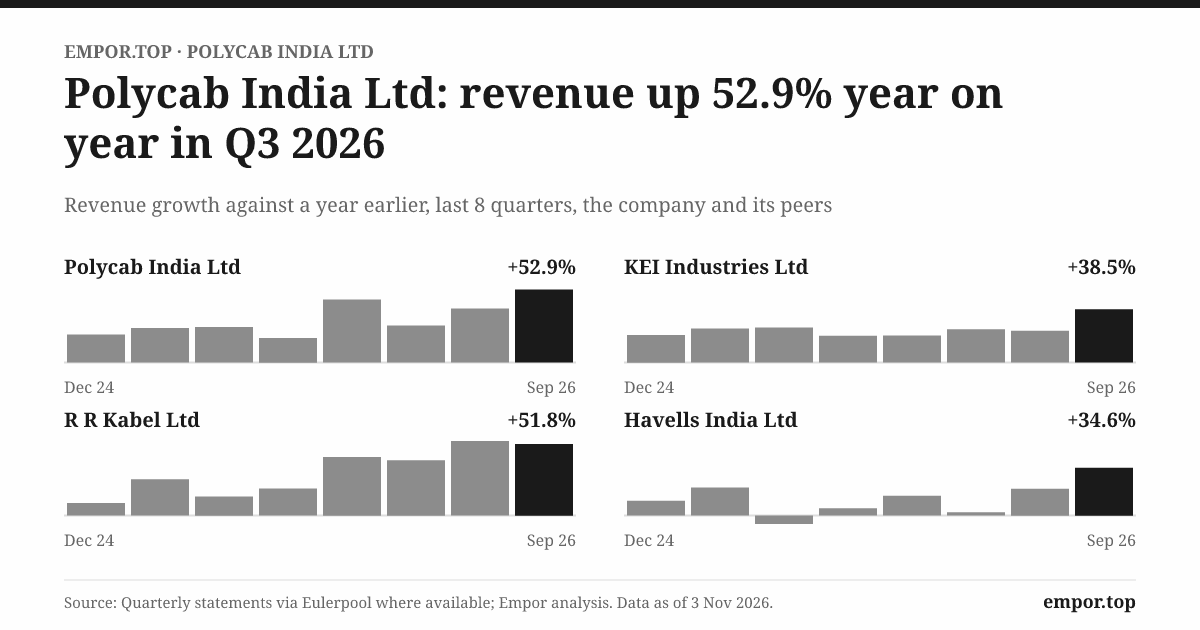
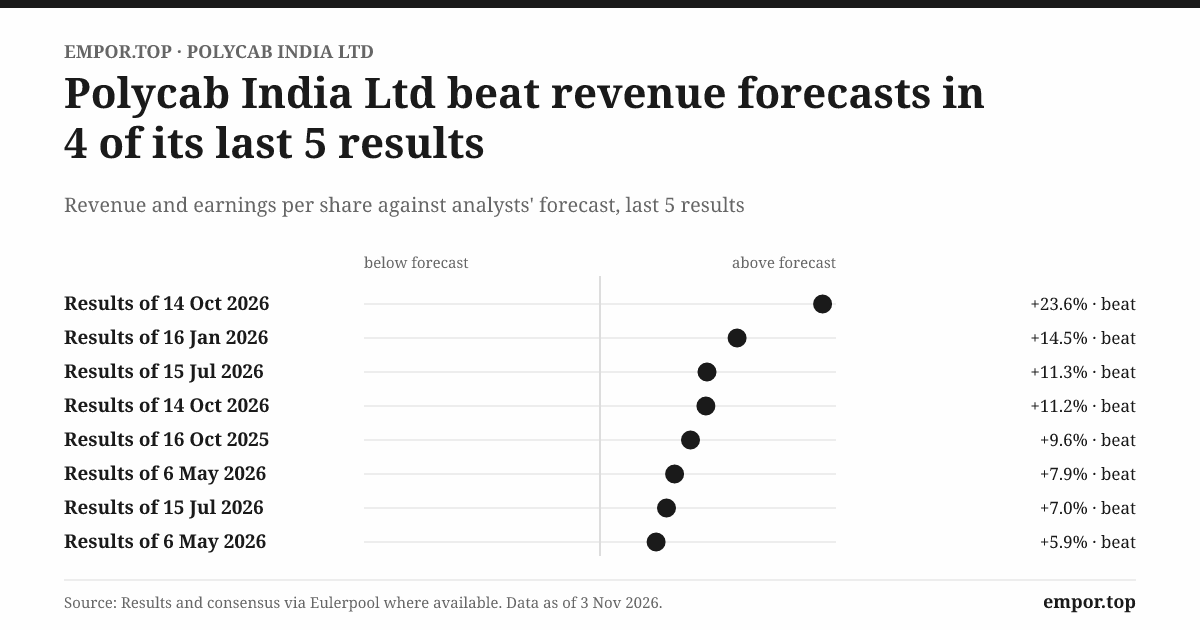
On 15 October 2026, the company that makes more of that wire than anyone else in India reported the biggest quarter in its history. Polycab India's revenue for the three months to September rose about 53% from a year earlier, to roughly ₹9,900 crore, and profit after tax rose about 43%, to roughly ₹990 crore.1
On the earnings call that afternoon, the chief financial officer, Niyant Maru, opened with the macro picture, and the investor-relations head, Aditya Nathani, walked analysts through a set of numbers that would have looked implausible for a cable maker a decade ago: wires and cables revenue up 47%, domestic wires and cables up about 50%, and the consumer-electricals business more than doubling.2
For a business that sells a product most customers never see, that is an extraordinary pace. It is also the kind of pace that should make a careful investor slow down rather than speed up, because in this industry the headline number is a blend of three different things. Some of it is more metres of wire leaving the factory. Some of it is Polycab taking orders that would otherwise have gone to a rival.
And some of it is simply copper: when the price of the metal inside the cable rises, the invoice rises with it, even if the same number of coils ships. Management itself said volumes grew only in the "mid to high single digits" in the quarter, with favourable commodity-linked realisations doing a great deal of the rest.2 The 53% quarter, in other words, is a puzzle to be solved, not a fact to be celebrated.
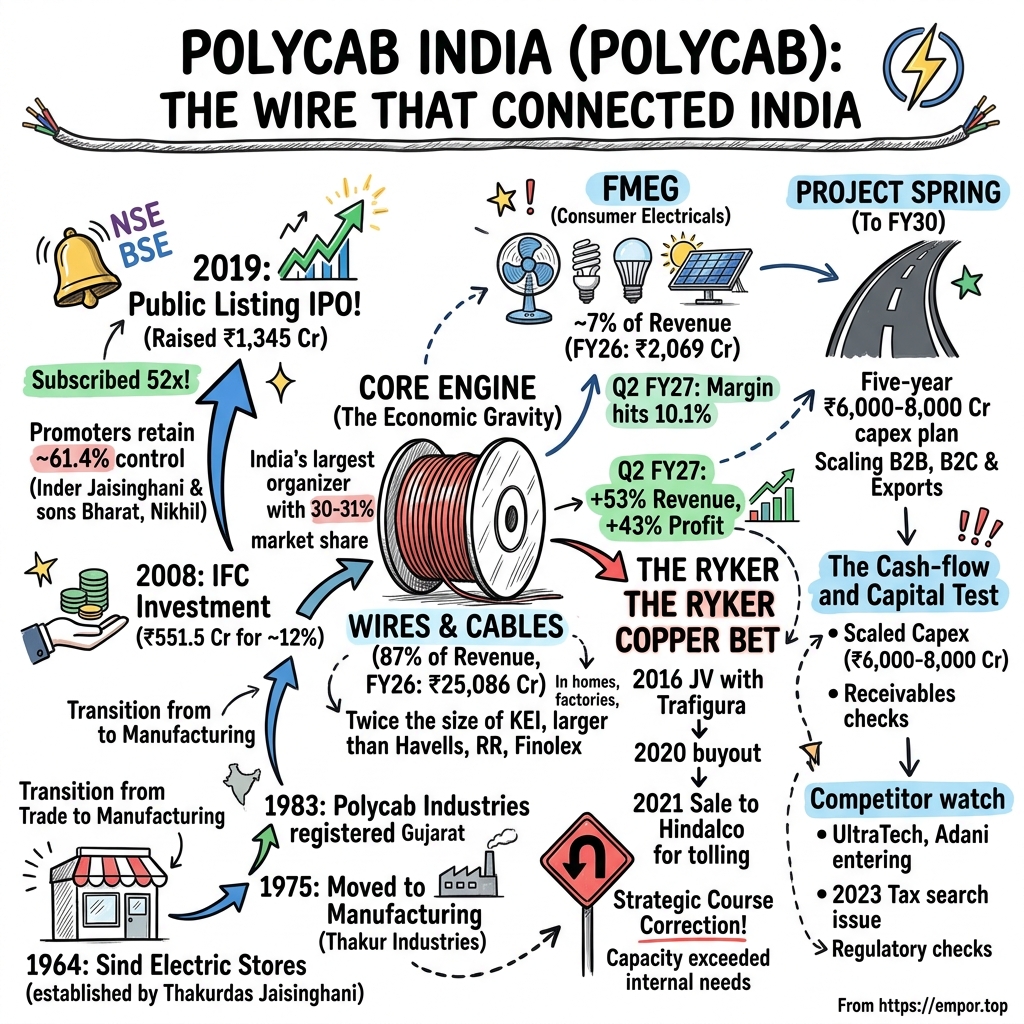
The scale of the thing is easier to state. In the year to March 2026, Polycab's consolidated revenue reached about ₹28,884 crore.3 Roughly ₹25,086 crore of that, about 87%, came from wires and cables. Fast-moving electrical goods, the fans, switches, lights and solar products sold under the Polycab name, brought in about ₹2,069 crore, or about 7%.
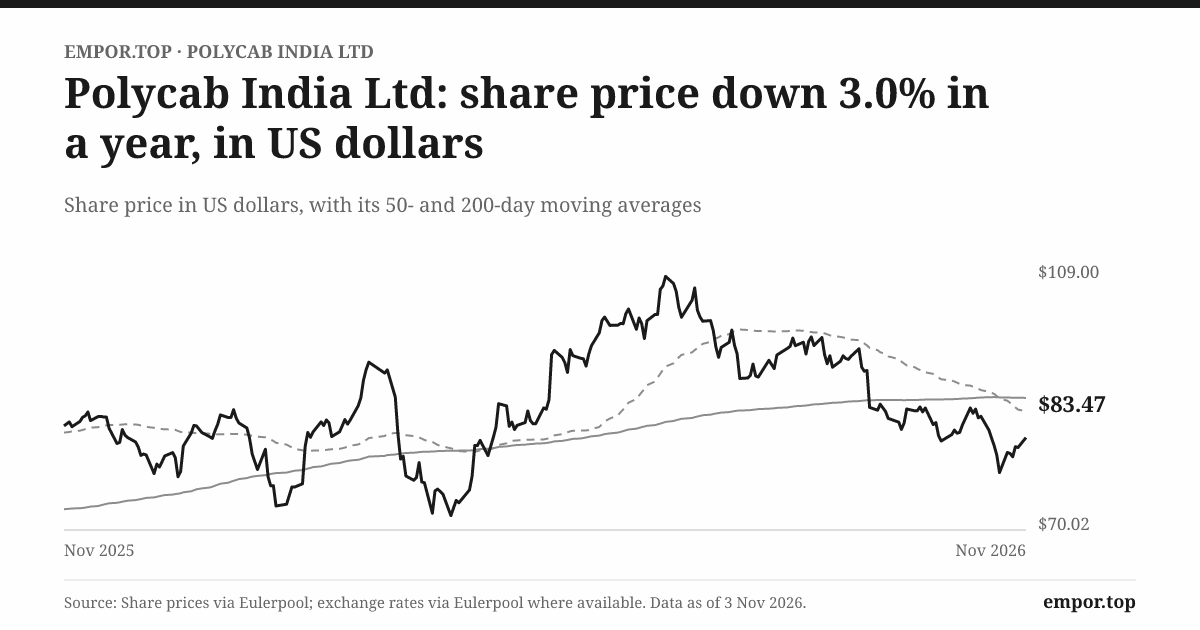
Engineering, procurement and construction contracts, mostly power-distribution and telecom projects, made up about ₹1,650 crore, or roughly 6%.3 On 3 November 2026 the stock market valued the whole company at about ₹1.2 lakh crore, even after the share price had fallen about a fifth from its 52-week high.4
That mix is the first thing to hold on to. The October quarter produced exciting news in consumer electricals, where segment revenue grew about 124% and the margin crossed into double digits for the first time.2 But a business that is 7% of revenue cannot carry the valuation of a ₹1.2 lakh crore company on its own, however fast it grows. Polycab's story is still, overwhelmingly, the story of the wire.
So this episode asks four questions, and they run through every chapter that follows. Can Polycab keep winning share in wires and cables as the market grows and well-funded new rivals arrive? Can its consumer business become a second profit engine rather than a second set of product launches?
Does the profit it reports turn into cash it can count, especially now that it has committed to the largest investment programme in its history? And does family control, which has steered the company for six decades, support patient long-term investment while protecting the minority shareholders who now own nearly two-fifths of it?
None of those questions can be answered by one record quarter. They can be tested against a long record, though, because Polycab has made big bets before, reversed some of them, and been examined by tax officials, rating agencies, bankers and public investors along the way. That record begins far from the stock exchange, in a small electrical shop run by a family that sold other people's products before it ever made its own.
 Subscribe on LinkedIn
II. The shop that became a factory
In 1964, Thakurdas Jaisinghani opened an electrical-goods shop in Bombay and called it Sind Electric Stores.5 The name carried a geography the family had left behind, Sind, now in Pakistan, but the business was firmly a creature of its new city: a trading counter in a market where contractors, electricians and small builders came to buy fittings, switches and wire by the bundle.
It is tempting to tell this as a story of Partition refugees building an empire from nothing, and some retellings drift toward that version. The company's own chronology is quieter and more useful. It dates the store to 1964, not to the upheavals of 1947, and it describes a slow move from selling electrical goods to making them over the following two decades.5
What a shop teaches is not glamorous, but it is valuable. A trader in electrical goods learns which products move and which sit on the shelf, which contractors pay on time, how electricians judge quality by the feel of the insulation and the weight of the coil, and how thin the margin is on a commodity sold to price-sensitive buyers.
Above all, a trader learns that the person standing at the counter has choices. In a market full of small manufacturers, a contractor who distrusts one brand of wire can walk to the next shop.
The family's first step out of trading came in 1975, when it set up Thakur Industries to manufacture.5 Eight years later, in 1983, Polycab Industries was registered in Gujarat.5 The sequence matters because it shows a deliberate climb up the value chain rather than a single leap.
The Jaisinghanis did not raise a fortune and build a giant plant. They added manufacturing to an existing trading relationship, which meant they had customers before they had capacity, and knowledge of what those customers wanted before they committed capital to making it.
The next generation turned that base into a national company. Thakurdas Jaisinghani's sons, led by the eldest, Inder, joined the business, and by the time of the 2019 public listing the prospectus named four brothers, Inder, Ajay, Ramesh and Girdhari Jaisinghani, among the promoters who controlled it.6 Inder Jaisinghani has been chairman and managing director since 1997, and he is the figure most associated with the company's expansion from a regional cable maker into a national brand.6
He is not a showman. Over three decades he has made his reputation through capacity, distribution and an appetite for scale in a business where most competitors stayed small, and later through the decision to bring his own sons, Bharat and Nikhil, into the top executive tier as joint managing directors.7
Why did manufacturing change the economics? A trader earns a slice of someone else's margin and has little control over quality or supply. A manufacturer controls the copper drawing, the insulation compound, the testing and the brand stamped on the coil. In a product that carries electricity into homes and factories, quality is not a marketing word.
A cheap wire with thin copper or poor insulation can overheat, and the electrician who installed it carries the blame. That gives a manufacturer with consistent quality an argument a trader cannot make on its own: buy this brand, because it will not fail.
Manufacturing also opened the door to range. A company that can draw copper and extrude insulation can make house wires, then power cables for industry, then control cables, instrumentation cables, solar cables, telecom cables and eventually extra-high-voltage cables for transmission grids.
Each new product line uses some of the same machines, raw materials and skills, and each can be sold, at least partly, to the same contractors and distributors. The company that grew out of Sind Electric Stores eventually described itself as making thousands of products, but the logic behind that breadth was already present in the first step from counter to factory.
Yet a factory, on its own, explains very little about why Polycab became India's largest wire and cable maker rather than one of hundreds of competent regional ones. India had, and still has, a long tail of small manufacturers that can make adequate wire.
What separated the companies that became national was something harder to copy: a route to customers in every state, the working capital to keep that route stocked, and the money to keep adding capacity faster than demand. By the 2000s the Jaisinghanis had the factories and the products. What they needed next was capital on a scale a family business could not supply by itself.
III. Capital opens the next door
In June 2008, an investment committee at the International Finance Corporation, the private-sector arm of the World Bank Group, approved an equity investment in a family-controlled Indian cable maker.8 The timing was striking. Global credit markets were months away from seizing up, and the IFC was putting money into a business that sold copper wire to builders and factories in a country where much of the electrical market still ran on cash and handshakes.
Reported figures for the size of the stake have varied, with contemporary accounts describing a minority holding in the low-to-mid teens of the company, and the IFC's own project record shows the investment approved in mid-2008 and the funds disbursed over the following year.8
The money mattered, but the signal mattered more. An IFC investment comes with conditions: environmental and social standards, governance requirements, audited accounts that an international institution is prepared to stand behind. For a family business that hoped one day to borrow from large banks, sell to large infrastructure projects and perhaps list its shares, accepting that scrutiny was a way of saying the company was ready to be examined.
The IFC did not buy control and did not run the business. It became a long-term minority partner whose presence lent credibility, and it would remain a shareholder for more than a decade, until the public listing gave it an exit.6
That listing came in April 2019. Polycab's initial public offering opened on 5 April and closed on 9 April, at a price band of ₹533 to ₹538 a share, and it raised about ₹1,345 crore.9
Institutional buyers bid for about 92 times the shares reserved for them and wealthy individual investors for about 110 times; the issue overall was subscribed about 52 times, generating bids worth roughly ₹49,000 crore.9 When the shares began trading a week later they closed the first day about 21% above the issue price.10
The detail that matters most for investors is where the ₹1,345 crore went, because most of it did not go to Polycab. The offer had two parts. A fresh issue of new shares, worth about ₹400 crore, put money into the company, and the prospectus earmarked those proceeds largely for repaying borrowings, funding working capital and general corporate purposes.6 The larger part was an offer for sale, in which existing shareholders, including promoters and the IFC, sold shares they already held.6
That money went to the sellers, not the business. The IPO was therefore less a capital raise for expansion than a liquidity event that let an early institutional backer exit, let the family diversify a little of its wealth, and gave Polycab a listed currency and a public valuation. SEBI records the final offer document as filed with the Registrar of Companies on 11 April 2019.11
The family kept control. In September 2026 the promoter group still held about 61% of the company, down from about 65.8% at the end of 2023 as family members sold small portions of their holdings, and the exchange filing showed no promoter shares pledged.12 The number of shareholders stood at 385,413.12 Foreign institutions held about 18% and domestic institutions about 8% by September 2026, compared with roughly 15% and 8% early in the year.1312
The pattern is the classic Indian family company after listing: a controlling block that slowly sells down without losing its grip, and a public float in which foreign funds have become the more important marginal buyer. That last point has a practical consequence. When foreign investors grow nervous about Indian equities or about a sector, they can move this stock more sharply than a domestic-heavy register would.
At the top, the family structure has been formalised rather than diluted. Inder Jaisinghani remains chairman and managing director, while his sons Bharat and Nikhil serve as joint managing directors; a February 2026 postal ballot approved Nikhil's appointment as joint managing director with little dissent among votes cast.147 Nikhil also spoke on the October 2026 call.2 The board includes independent directors who make up just over half its strength, a fact the company highlights.7
The finance chief has changed more recently, and the sequence is worth stating precisely because it explains why two sets of documents name different people. Gandharv Tongia, who had joined Polycab in 2018 as deputy CFO, became CFO in 2020 and executive director in 2023, announced his resignation in August 2025 for personal reasons, with effect by the close of business on 27 October 2025.15
Niyant Maru, a Tata Group veteran who had been chief financial officer of the airline Vistara, joined as executive president for finance on 17 October 2025 and was designated CFO from 28 October 2025.16
The annual report for the year to March 2026 lists Tongia because he held the role for more than half of that year; by the October 2026 call, Maru was the voice of the finance function. The handover was orderly and dated, which is the reassuring part. The less reassuring part is timing: Polycab changed its chief financial officer just as it was preparing the largest capital programme in its history.
The listing gave Polycab something it had never had before: a public price on its decisions. Every capital-allocation choice after 2019 would be judged in real time by investors who could sell. And one of the first big choices the newly listed company had to resolve was a bet it had made a few years earlier, on the metal at the heart of every wire it sold.
IV. The copper bet—and the exit
Every Polycab cable begins as a rod of copper or aluminium. The rod is drawn through progressively smaller dies until it becomes fine wire, the wire is stranded, the strands are insulated and sheathed, and the result is coiled, tested and shipped.
Copper is the largest single input by value. It is also the one most exposed to world markets, because India imports much of its refined copper and the price is set on global exchanges. A cable maker that cannot get copper rod of consistent quality, at the right time, cannot make cable.
That was the logic behind Ryker Base, a copper-rod manufacturing joint venture Polycab formed in 2016 with Trafigura, one of the world's largest commodity traders.17 The pairing looked elegant. Trafigura understood metals sourcing and trading; Polycab understood the downstream demand.
A plant in Gujarat with capacity of about 225,000 tonnes a year would turn imported copper cathode into rod, and Polycab would have a captive, quality-controlled supply of its most important input.18 This was textbook backward integration, the kind of strategic move that looks wise in a business-school case. Own the input, and you protect the core business from supply shocks and quality failures.
The chessboard shifted quickly. Trafigura decided to exit, and in May 2020, in the first weeks of the Covid lockdown, Polycab announced it would buy its partner's 50% stake, making Ryker a wholly owned subsidiary.17
The consideration for the remaining half was modest, about ₹30 crore, alongside the settlement of a put-option arrangement that had been part of the original joint-venture terms.17 It is important not to confuse that figure with the value of the whole operation. ₹30 crore was the price of buying out a partner's equity in a leveraged joint venture, not the price of a copper plant.
Then, within eighteen months, Polycab sold the whole thing. In November 2021, Hindalco Industries, the Aditya Birla Group's metals company, agreed to buy all of Ryker at an enterprise value of about ₹323 crore, before adjustments for debt and working capital.19
Ryker had reported turnover of about ₹535 crore in the year to March 2021.19 As part of the arrangement, Polycab kept access to copper rod through a multi-year tolling deal with the new owner: Hindalco would convert copper into rod for Polycab, so Polycab retained the supply without owning the plant.18
Why reverse course so quickly? Management's own explanation on the January 2022 earnings call was candid. Ryker's capacity was far larger than Polycab's internal requirements, which meant the plant had to sell much of its output to third parties to run efficiently, and Polycab had little interest or experience in running a metals business that competed on the thin spreads of copper conversion.18
Put plainly, Polycab had bought a factory that was too big for its own needs and that operated in a different kind of business from the one the company knew how to run. A wire company earns its margin on branding, distribution and product range. A rod plant earns a conversion fee on high volumes of metal, with little brand value and heavy working capital.
It would be easy to call Ryker a failure and equally easy to call the exit a masterstroke. The record supports neither conclusion. The headline figures, a ₹30 crore buyout followed by a ₹323 crore enterprise-value sale, do not prove a gain, because enterprise value includes debt and the full amount of capital Polycab had tied up in the venture over five years is not separately disclosed.
Nor do they prove a loss. What the record does show is a real strategic reversal: a vertical-integration bet made with a partner, absorbed when the partner left, and sold within eighteen months when management concluded the asset did not fit.
That pattern deserves a fair reading. On one side, the original decision misjudged scale. A 225,000-tonne plant was sized for a business Polycab did not intend to be in. On the other side, management recognised the mismatch quickly, explained it publicly and found a structure, tolling, that kept the strategic benefit of secure supply without the capital burden of ownership. Many family companies hold on to a mistake for a decade because selling feels like admitting defeat. Polycab sold.
The tolling alternative is worth understanding with a simple analogy. Owning Ryker was like owning a bakery to guarantee bread for a restaurant that needed only a quarter of the bakery's output. The tolling deal is like contracting a large bakery to bake to the restaurant's recipe. The restaurant still gets its bread, made to specification, and it does not have to sell the other three-quarters of the loaves to strangers.
Ryker was not the last time Polycab would talk about backward integration. Its current plans describe investments in materials and components that feed its own production, and the five-year programme it began in 2025 is explicitly about capacity, integration and automation.20 The lesson of Ryker is not that integration is wrong.
It is that ownership is only one way to secure an input, and that a company that once built more capacity than it could use should be expected to show, project by project, why each new plant is sized to its own needs.
With copper secured through a contract rather than a smelter-adjacent factory, the company turned its capital and attention back to the thing that had always made it money: making wire and getting it into the hands of the people who install it.
V. The wire business: scale without much pricing power
Picture two identical trucks leaving Polycab's plant at Halol in Gujarat, a year apart, each loaded with the same number of coils of house wire. If the price of copper has risen by a fifth between the two trips, the second truck carries a larger invoice, and Polycab's reported revenue goes up, even though not one extra metre of wire has been sold.
Now picture a contractor in Lucknow pricing a housing project. He has quotes from Polycab, from KEI, from Havells, from RR Kabel, from Finolex and from two regional makers whose names never appear in a stock-market report. He knows the copper content in every quote is priced off the same global benchmark. What he is really comparing is everything else.
That is the economic heart of Polycab. It buys copper, aluminium, PVC and other inputs; it turns them into a very wide range of wires and cables; and it sells them through a network of distributors and dealers to electricians and contractors, and directly to large institutional buyers such as utilities, industrial companies and infrastructure developers. The price of the metal flows through to the customer.
Management describes the business as cost-plus, adjusting wire prices roughly every fortnight and cable prices roughly monthly as copper moves, and said on the October 2026 call that the company is not exposed to copper volatility the way a speculative holder of the metal would be.2 The margin Polycab earns sits on top of the metal: conversion, branding, distribution and the cost of carrying stock and credit.
So when Polycab says wires and cables revenue grew 47% in the September 2026 quarter, the right question is how much came from each of three sources. The first is volume, more product sold. The second is mix and realisation, selling more of the higher-value products or earning a better spread.
The third is pure commodity pass-through, the copper price flowing straight into the invoice. Management gave the clue that resolves most of the puzzle: total wires and cables volume grew in the mid-to-high single digits, with wires growing in early double digits and cables in mid-single digits, against a strong prior-year comparison in which volumes had grown about 18%.2
If volume grew, say, seven or eight percent and revenue grew 47%, then the great majority of the growth in that quarter came from price, much of it copper. Some of that will have lifted absolute profit, since a cost-plus margin on a higher base is a larger rupee amount, and management said high copper prices did help absolute margins.2 But a business that grows 47% on mid-single-digit volume is not seeing demand surge by 47%. It is seeing a commodity cycle on top of steady share gains.
That is not a criticism. Steady share gains in a growing market are exactly what a scale leader should deliver. It is a warning about how to read the headline. A reader who treated the 53% quarter as proof of an accelerating demand boom would be making the same mistake in reverse when copper falls and revenue slows even as volumes keep growing.
The leader in a crowded field
How big is Polycab's lead? Very large, by the standards of this industry. In the year to March 2025, Polycab's wires and cables revenue was about ₹18,900 crore, according to an industry assessment by CRISIL Intelligence that Polycab hosts on its own website.21
KEI Industries, the next largest, reported about ₹8,860 crore; Havells about ₹7,180 crore from its cables segment; RR Kabel about ₹6,690 crore; and Finolex Cables about ₹5,010 crore.21 Polycab was therefore roughly twice the size of its nearest listed competitor and larger than KEI and Havells combined.
Polycab estimates its share of India's organised wires and cables market at about 30 to 31%, and CRISIL Ratings cited a similar figure when it reaffirmed the company's AAA rating in October 2026.22 That share should be held loosely, because it depends on how the "organised market" is defined and who is counted.
But the direction is consistent: management said on the October 2026 call that Polycab has gained roughly a percentage point of share a year and that it had gained three to four percentage points in the most recent year.2
What produces that lead? Three things, and they reinforce one another. The first is range. A contractor building a factory needs house wire, power cable, control cable, flexible cable and perhaps solar and fire-survival cable. A supplier that can quote all of it on one order, with one set of certifications and one delivery schedule, saves the buyer time and risk. The second is reach.
Polycab sells through a large network of distributors and dealers spread across the country, which means its wire is on the shelf when an electrician walks into a shop in a district town. The third is scale in manufacturing. A company that runs more lines can buy copper and compounds in larger lots, spread fixed costs over more tonnes, and invest in testing and automation that a regional maker cannot justify.
Brand matters too, though in a particular way. Most homeowners never choose their wire. The electrician does, and electricians care about two things: that the product will not fail and embarrass them, and that it is available when they need it. In a safety-critical product, a trusted name lowers the risk of the choice. That is a real advantage. But it is not the same as the kind of brand that lets a company charge whatever it likes.
Where the moat stops
The weakness in the bullish story is pricing power. If Polycab could raise prices above its rivals without losing volume, its margins would show it, and the business would look like a consumer brand rather than a manufacturer. Instead, Polycab's medium-term target for wires and cables, set out under its five-year plan, is an operating margin before depreciation of 11 to 13%.2
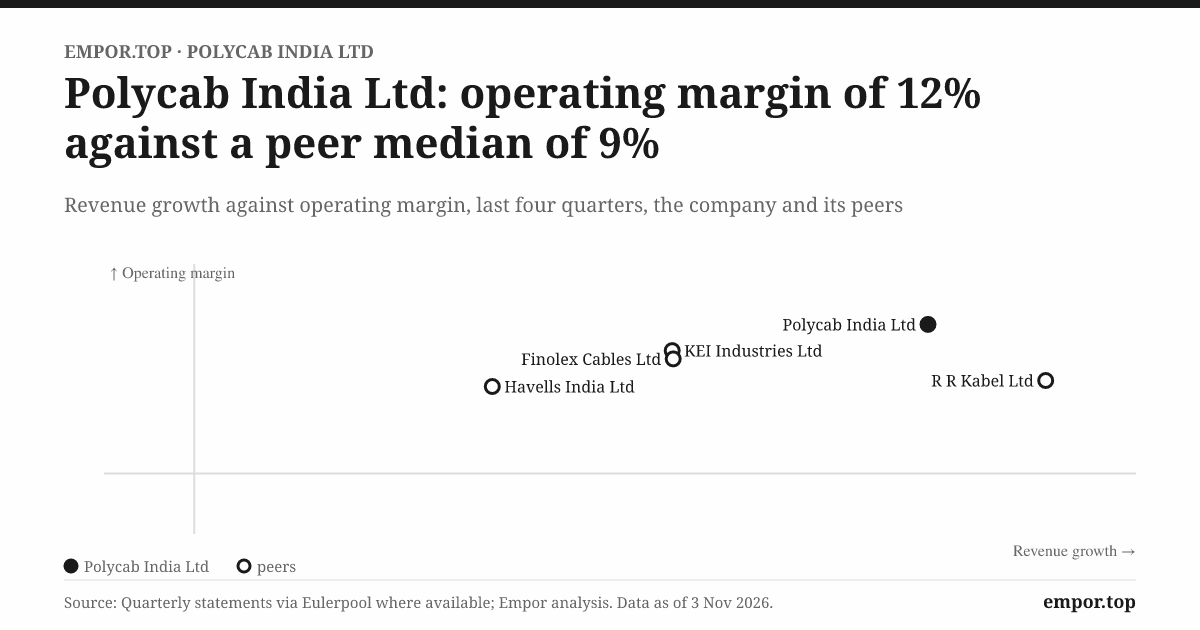
In the September 2026 quarter, that margin was about 14.2%, above the range, and management said the business would at times operate at the higher end but declined to raise the long-term target.2 When an analyst asked about pricing actions in the face of new competition, the answer was "Nothing as of now."2 That is the behaviour of a company that knows its customers can compare quotes.
CRISIL put the constraint plainly. Its rating rationale lists intense competition, including from unorganised suppliers, as a factor that limits pricing power, alongside the sector's sensitivity to economic downturns.22 The long tail is the reason.
Management estimates the total Indian wires and cables market at about ₹1.1 lakh crore, with wires roughly 30% of it and a third or so of the wire market still unorganised.2 Small makers that sell on price, sometimes with thinner copper or weaker insulation, cap what branded players can charge for basic house wire, even as tighter standards and quality enforcement slowly push buyers toward organised brands.
What about the stronger forms of competitive advantage? There is no evidence of meaningful switching costs: a contractor can change wire brands from one project to the next with no technical penalty. There are no network effects; one buyer's choice of Polycab does not make the product more useful to the next.
Polycab does not disclose customer retention, repeat-purchase rates or the share of revenue from its largest customers, so any claim that its customer relationships are locked in rests on inference rather than data.3
The honest verdict is that Polycab's moat is real but specific: scale, range and distribution reach, reinforced by a trusted name in a safety-critical product. It is not a pricing moat. Its durability will be measured by whether Polycab keeps outgrowing the market in volume through a full copper and demand cycle, not by any single quarter's revenue.
One part of Polycab works very differently from the rest. Its engineering, procurement and construction arm builds projects such as rural electrification, power-distribution upgrades under the government's Revamped Distribution Sector Scheme and fibre networks under BharatNet.2 In the year to March 2026 it generated about ₹1,650 crore of revenue.3 Here revenue is recognised as milestones are met, not when a coil ships, and the customers are largely state utilities and government programmes.
Management described the order book at around ₹9,000 to ₹10,000 crore on the October 2026 call, and the annual report disclosed about ₹11,270 crore of remaining performance obligations, of which only about a third was expected within a year.23 That backlog is visibility, not annuity.
It is a set of contracts that must be executed, billed and collected, and it carries much lower margins: the EPC segment's operating margin before depreciation was about 7.2% in the September 2026 quarter, with management guiding to the high single digits over time.2
The difference shows up in how the company gets paid. Product customers generally receive credit terms of up to 90 days. EPC terms are set contract by contract, and retention money, the share of a contract value a client holds back until the project is complete, is typically receivable within six months of completion.3 The company does not say which customers account for its older unpaid balances, a question that becomes important when the story turns to cash.
Then there are the newcomers. In late February 2025, UltraTech Cement, India's largest cement maker and the flagship of the Aditya Birla Group, announced that it would enter wires and cables with about ₹1,800 crore of investment over two years.23 Cable stocks fell hard on 27 February, with Polycab, KEI, Havells and RR Kabel losing up to about 15% in a single session.23
Less than a month later, Adani Enterprises formed a joint venture called Praneetha Ecocables to make metal products, cables and wires, and Polycab's shares fell about 9% on the news.24 In September 2026, UltraTech began commercial production at a plant at Jhagadia in Gujarat under the Ultravolt brand, and cable stocks fell again.25
The fear is understandable. UltraTech and Adani are conglomerates with deep pockets, existing relationships with builders and contractors, and dealer networks that already reach every district. A cement dealer who sells to a contractor could, in principle, sell that contractor wire on the same invoice. And a well-funded entrant willing to accept low returns for several years could pressure prices in the most commoditised products.
The evidence so far is more measured. Management called UltraTech's wires entry "a very small portion" of the market and argued that the entrant's revenue ambitions looked "elusive at the moment."2 That is management's view and should be weighed as such.
But the numbers that matter, Polycab's volumes and share, have kept moving in its favour since the announcements, and the company has not had to cut prices. An announcement is not a lost customer. The real test will come when the new capacity is running, the entrants have established their products with electricians, and copper prices stop flattering everyone's revenue.
If the entrants succeed, the damage would appear first in a few specific places: slower volume growth in house wires sold through the channel, where a cement network might plausibly cross-sell; pressure on margins as Polycab chooses between matching prices and ceding share; and slower share gains in the industry estimates.
There are also quieter threats. Copper suppliers, including the Hindalco plant that converts copper rod for Polycab, are large and powerful, and a supplier that decides to move downstream could become a rival. India's tight metals market means Polycab has limited leverage over the price of its main input, though cost-plus pricing passes most of it on.
For an investor tracking whether the core business is holding its edge, two numbers matter more than any others. The first is domestic wires and cables volume growth compared with the market's growth. Management anchors its own ambition at about one and a half times the market's growth rate, and it estimated the market's growth at roughly 12 to 13% a year.2
The latest reading, mid-to-high single-digit volume growth against a very strong prior-year base, is below that ambition for a single quarter, which is worth watching rather than over-reading. The second is market share, measured consistently. The company's 30 to 31% organised-market estimate and its claim of a percentage point a year of gains are the baseline. If the new entrants are making headway, these are the numbers that will show it first.
The wire business has made Polycab large. The company has long argued that the same distribution system could make it a consumer brand as well. That argument is about to get its most serious test.
VI. FMEG: a second engine, or still a small business?
Walk into an electrical retailer in Indore and look at the wall of ceiling fans. There are a dozen brands, some with decades of household recognition, priced in a narrow band and stacked beside lights, switches and water heaters. For a cable company, that wall looks like an opportunity. The shop already stocks Polycab wire. The electrician who recommends the wire also recommends the switch plate and, sometimes, the fan. Why should a different company capture that sale?
Polycab began asking that question more than a decade ago. It entered switches in 2013 and fans and LED lighting in 2014, and it later added switchgear, water heaters, pumps, solar products and other categories, grouping them under the label fast-moving electrical goods, or FMEG.5
The strategy was easy to explain: use the existing dealer and electrician network to sell adjacent products, build a consumer-facing brand on top of a largely business-to-business cable franchise, and earn the higher margins that branded consumer goods can command.
The early record shows how hard that is. Building a catalogue is not the same as building demand. For most of the decade after its entry, FMEG grew steadily in revenue, about 25% a year over nine years to reach roughly ₹1,650 crore by the year to March 2025, while delivering margins that were often thin and at times negative as the company spent on brand, distribution and product development.20 In consumer electricals, Polycab was not a leader.
It was a challenger against companies such as Havells, Crompton, Bajaj Electricals and Orient, whose fans and switches had been on Indian walls for a generation. Havells is the closest mirror: it built a consumer brand over decades on top of an electrical-equipment base, and it remains a far more consumer-led company than Polycab. Polycab's ambition, in a sense, is to become more like Havells, while Havells has been trying to become more like Polycab in cables.
By the year to March 2026, FMEG remained a side dish.3 Polycab has also launched products such as HOHM, a smart-home range, but the company does not report revenue for these lines, and they are best seen as small options rather than a storyline of their own.20
The quarter that changed the conversation
The September 2026 quarter was the moment FMEG stopped looking like a perpetual investment phase. It was the eleventh consecutive quarter of what management called industry-leading growth.2
The segment margin before depreciation crossed 10% for the first time, at 10.1%, and Nikhil Jaisinghani noted that it was the seventh consecutive profitable quarter.2 Management's long-term target for FMEG is an operating margin before depreciation of 8 to 10% by 2030, so the business had reached the top of its 2030 ambition three and a half years early.2
That is a milestone, not a verdict, and the reason is solar. Management described solar products, chiefly inverters, as the largest FMEG category in the quarter and the "primary growth driver," with growth that was "multi-fold."2 India's rooftop-solar push has created a surge in demand for inverters and related products, and Polycab rode that surge.
But a business riding a policy-driven category boom is not the same as a business winning share in fans, lights and switches. Inverters depend more on sourcing and assembly than on the copper-drawing skills at the core of Polycab, and the margins and durability of that business depend on subsidy programmes and competitive intensity that can change quickly. The company did not break out solar's share of FMEG revenue in numbers.
Management pointed to other drivers of the margin too: scale and operating leverage, a richer mix of premium products in fans and lights, bundled solutions and regional profit-and-loss accountability.2 When an analyst asked whether 10.1% was sustainable, the answer was revealing for what it did not say. Management called the margin "very high" and kept its 8 to 10% long-term range rather than raising it.2 A company confident that a new margin level was structural would raise the target. Polycab did not.
So how much of the surge came from volume, how much from price and mix, and how much from a weak base? The base effect is clear: a year earlier the segment was barely profitable, so the percentage gains are flattered. The volume contribution is real, given the scale of growth.
The mix contribution, solar and premium products, is real but partly cyclical. The honest reading is that FMEG has crossed a threshold that took twelve years to reach, and that the next two or three years will reveal whether that threshold was the beginning of a durable second profit pool or the peak of a solar-led cycle.
The comparison with the history matters. Polycab spent more than a decade proving that it could launch consumer products and get them onto shelves. It did not, for most of that period, prove that it could earn money doing so.
Technical capability and a broad catalogue are necessary but not sufficient. The proof of a second engine is sustained segment profit, growth above the industry in the core consumer categories, and a solar business whose contribution is visible and stable rather than a one-off surge.
If that proof arrives, FMEG could matter a great deal: a consumer-electricals business earning high single-digit or low double-digit margins on several thousand crore of revenue would add meaningfully to group profit and diversify it away from copper cycles. If it does not, FMEG will remain what it was for most of its history, a respectable side business sustained by the cable franchise. Either way, both engines need fuel, and Polycab has now committed to spending more money than ever before to provide it.
VII. Project Spring meets the cash test
In 2021, Polycab set itself a target that sounded ambitious at the time. Under a plan it called Project LEAP, it aimed to reach ₹20,000 crore of annual revenue by the year to March 2026. It got there a year early, reporting revenue of about ₹22,400 crore for the year to March 2025.26
Hitting a target early is the kind of thing management teams like to remind investors about, and it is genuine evidence of execution. It is also worth noting that the copper cycle and India's construction boom did part of the lifting, so the achievement says as much about the market Polycab was in as about the plan itself.
The successor plan, Project SPRING, runs to the year ending March 2030 and is broader in scope. It aims to defend and extend leadership in business-to-business wires and cables, scale the consumer business and exports, and build capabilities in areas such as extra-high-voltage cable, automation and digital systems.20
Its financial markers are the margin ranges already described, 11 to 13% for wires and cables and 8 to 10% for FMEG, and a growth ambition of about one and a half to two times the industry's rate.2 And it comes with a price tag. The annual report describes a five-year capital-expenditure programme of ₹6,000 to ₹8,000 crore.20
To put that in proportion: Polycab spent about ₹1,480 crore on capital projects in the year to March 2026, about 5% of revenue, and about ₹610 crore in the first half of the following year.32 A programme of ₹6,000 to ₹8,000 crore over five years implies roughly ₹1,200 to ₹1,600 crore a year, so the recent pace is consistent with the plan.
The centrepiece is an extra-high-voltage cable plant, the kind of high-specification product used in transmission networks and large industrial sites, which management now expects to commission in the year to March 2028.2 This is a capacity and integration commitment on a scale Polycab has never attempted. It is not a capital-light growth story, and investors should not price it as one.
Two numbers that cannot both be right
Here is the puzzle. Polycab's audited consolidated cash-flow statement for the year to March 2026 reports net cash from operating activities of about ₹3,811 crore.3 Yet several widely used standardised financial databases, which reclassify company accounts into common formats, show operating cash flow for the same year of only about ₹770 crore, and free cash flow after capital spending of negative ₹908 crore. The gap is more than ₹3,000 crore, larger than a full year's net profit.
The audited figure is the one to prefer, because it is what the company and its auditors stand behind. But the gap is a signal worth decoding, not a nuisance to ignore. The audited statement shows cash generated by operations before tax of about ₹4,694 crore, after which Polycab paid about ₹883 crore in tax.3 Within the working-capital movements, one line stands out: an increase of about ₹980 crore in non-financial liabilities, which includes contract liabilities, essentially advances received from customers ahead of delivery.3
Another lies in how Polycab pays for copper. On the October 2026 call, management said its working-capital cycle had fallen to about 11 days, "aided by higher payable days arising from the increased use of letters of credit," and said it expected the cycle to drift back toward its long-term range of 45 to 50 days as those benefits normalised.2
CRISIL, for its part, counts letter-of-credit acceptances as debt when it calculates Polycab's gearing of 0.37 times, whereas the company's own conventional borrowings were only about ₹122 crore at the end of the year.223
The likeliest explanation for the gap, then, is classification. When a company buys copper on a bank-backed letter of credit with extended terms, the amount it owes can be treated as a trade payable, which boosts operating cash flow, or as a form of short-term financing, which does not. Polycab's accounts treat much of it as payables; a database or analyst who treats it as borrowing would see much weaker operating cash and higher debt.
The company does not publish a bridge between the two views, so the precise split cannot be stated. But the economic substance is clear enough. Part of Polycab's strong operating cash in the latest year came from paying suppliers later and collecting customer advances earlier, and management itself expects that tailwind to fade.
The long record helps calibrate the latest year. Over the twelve years to March 2026, on the standardised basis, Polycab's cumulative operating cash flow was about ₹9,460 crore against about ₹11,740 crore of net profit, roughly 81 cents of cash for every rupee of reported profit.3 That is respectable for a manufacturer that has grown quickly and carries large inventories of metal. It is not exceptional.
And it implies that, over long periods, a meaningful share of profit has been reinvested in working capital rather than arriving as cash. The company has nonetheless built a strong balance sheet. It reported net cash of about ₹4,194 crore at the end of March 2026, and about ₹4,520 crore at the end of September 2026.202 CRISIL said in October 2026 that it expected no major debt-funded capex.22
Receivables tell a more nuanced story. At the end of March 2026, Polycab's trade receivables were about ₹3,759 crore after an impairment allowance of about ₹203 crore.3 Two-thirds of the gross balance, about ₹2,501 crore, was not yet due, and another ₹822 crore or so was less than six months overdue.3
That is a healthy-looking profile. But the ageing schedule also shows about ₹111 crore of undisputed receivables classified as credit-impaired, most of it more than a year overdue, and the expected-credit-loss charge for the year jumped to about ₹92 crore from about ₹19 crore a year earlier.3
Those are small numbers relative to revenue, but the jump in the provision is the kind of change that deserves an explanation. The most likely pocket is the EPC business, where state utilities and government programmes pay on milestones and sometimes slowly, and where retention money sits on the books until projects close. The company does not name the customers behind the older balances, so that inference cannot be confirmed from its disclosures.
Over the long run, the trend in collection is favourable: debtor days fell from about 84 in the year to March 2015 to about 48 in the year to March 2026.3 The question is whether the recent rise in provisioning is a one-off clean-up or the start of a credit-quality drift as the EPC book grows.
Two other details round out the picture: Polycab pledges receivables as security for some facilities, and at year-end it had about ₹75 crore of receivables it had transferred to financiers but not removed from its balance sheet.3
The family, the pay and the trust question
How should investors judge the people making these decisions? Through behaviour over time, not statements. The record has several parts.
On pay, Inder Jaisinghani's remuneration rose 29% in the year to March 2026, and his pay was about 690 times that of the company's median employee.7 The two joint managing directors' pay ratios were about 48 and 47 times the median, each with a 9% increase.7 Net profit rose about 32% that year, so the chairman's raise roughly tracked earnings growth.7
But a ratio of nearly 700 to 1 is high even by the standards of Indian family companies, and it reflects how much of the company's pay pool sits with its controlling family.
The company also increased its contribution to the Polycab Social Welfare Foundation, an entity in which key managerial personnel are interested, to about ₹43 crore from about ₹11.5 crore the year before.3 That is small relative to revenue and the company describes such related-party dealings as arm's-length, but it is a line worth watching.
On governance, independent directors make up just over half the board, and recent shareholder votes have passed with very little dissent.714 With promoters holding more than three-fifths of the shares, however, a lack of dissent tells you little about what minority shareholders think. The more telling evidence is how management has handled hard moments.
The hardest came in December 2023, when the Income Tax Department searched Polycab's premises. On 10 January 2024, the Central Board of Direct Taxes said the searches had found evidence of unaccounted cash sales of about ₹1,000 crore.27 Polycab's shares fell sharply that day.
The company's first response was to call reports of tax evasion rumours and to say it had not received any communication from the department about the outcome.27 On subsequent earnings calls, management discussed responding to the department's queries without accepting the allegation.28
It is important to separate the allegation from a finding. A department's press statement after a search is not an assessment order, still less a final judgement. What has happened since is mixed but, on balance, less dramatic than the January 2024 headline suggested. In August 2025, Polycab disclosed orders from the Commissioner of Income Tax (Appeals) covering assessment years from 2014-15 to 2023-24.29
In March 2026, it received an assessment order for the 2024-25 assessment year carrying a demand of about ₹327 crore, which it said contained computational errors; a rectification order reduced the demand to about ₹58 crore, and the company said it would appeal the underlying additions, which it considers unsustainable.3031
The annual report's auditor annexure lists disputed income-tax demands of about ₹70 crore before the Income Tax Appellate Tribunal and about ₹58 crore before the appeals commissioner, alongside other disputed indirect-tax matters, and the auditors did not modify their opinion.3 None of those figures comes close to the ₹1,000 crore of alleged unaccounted sales. But the matter is not formally closed, and an investor should treat it as a live, if diminishing, overhang rather than a resolved one.
A smaller episode in October 2026 showed a different kind of risk. The Ahmedabad bench of the National Company Law Tribunal admitted an insolvency petition against Polycab over an alleged operational debt of about ₹2.78 crore owed to a supplier, Asier Metals, a tiny sum for a company with more than ₹4,000 crore of net cash.32
Polycab appealed, and on 30 October 2026 the appellate tribunal set aside the admission order.32 The amount was trivial and the appeal succeeded, but for a few weeks India's largest cable maker was technically subject to an insolvency process over a commercial dispute it could have settled for pocket change. It is a reminder that procedural risk in Indian corporate law can bite even very solvent companies.
Put the capital-allocation record beside the new plan, and the picture is two-sided. Ryker showed a company willing to admit that an asset did not fit and to sell it quickly. LEAP showed a company that set a target and beat it.
Neither proves that a ₹6,000 to ₹8,000 crore programme will earn good returns. The new plan is bigger, more varied and more technically demanding than anything Polycab has tried, and it will be managed by a finance chief who arrived only a year ago.
The operating test, then, has three parts: whether cash conversion holds up after the letter-of-credit benefit fades and capex rises, whether receivables ageing and credit-loss charges stabilise, and whether the new finance team's disclosures make the cash story easier rather than harder to follow. Those are the questions the stock price is implicitly answering every day.
VIII. What has to go right—and what can break
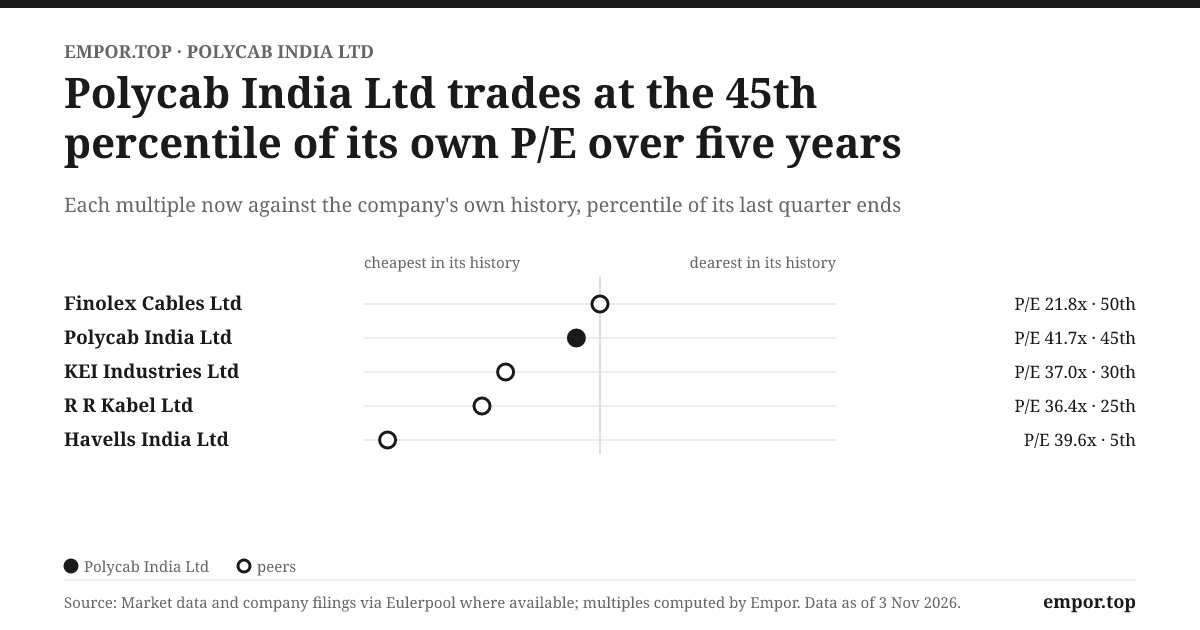
On 3 November 2026, Polycab's shares closed at ₹7,920, about 21% below their 52-week high of ₹10,083.4 At that price, the company traded at about 42 times its trailing earnings, slightly below its own five-year median multiple of about 43 times, at about 25 times enterprise value to operating profit before depreciation, and at about three and a half times sales.4
Polycab's own investor materials show a different historical series, with a P/E of about 51 times for the year to March 2026 on its own calculation date and basis; the two should not be mixed, because they are measured at different moments.33 Either way, the market is paying a price that assumes Polycab will keep growing earnings faster than the economy for many years. A dividend yield of about 0.6% means almost all of the return a shareholder expects has to come from growth.
So what has to go right? Start with the strongest version of the bull case.
The first argument is momentum with substance behind it. Over the ten years to March 2026, revenue grew about 19% a year, and over the latest three years about 27% a year, so the recent pace is well above the long-run base rate.3 Volume, not only copper, has been growing faster than the market, and Polycab says it has gained market share consistently, including three to four percentage points in the latest year.2
The second argument is the balance sheet: AAA ratings from both CRISIL and India Ratings, net cash of more than ₹4,500 crore, and no plan for debt-funded expansion.22 The third is returns. Return on equity was about 22% in the year to March 2026, near the top of its range over a decade, even with a large cash pile diluting it.3
The fourth is optionality: FMEG has finally become profitable at scale, the EHV plant opens a higher-specification market, and exports, still a small share of revenue, give Polycab a second market for its capacity.2
The bear case begins with the copper problem. Reported revenue moves with metal prices, so the faster growth of recent years partly reflects a commodity cycle that will eventually turn. When it does, revenue growth will slow even if volumes hold, and investors who extrapolated the 53% quarter will be disappointed.
The second mechanism is competition. Even if UltraTech and Adani never become leaders, a well-funded entrant willing to accept thin margins in commoditised house wires could cap Polycab's price realisation and slow its share gains.
The third is cash. If the letter-of-credit tailwind reverses, receivables lengthen and capex rises toward ₹1,500 crore a year, Polycab could spend several years reporting healthy profits while free cash flow stays thin.
The fourth is returns on new capital. On one standardised measure, return on capital employed fell from about 45% to about 29% in the latest year, largely because the asset base grew much faster than profit as the balance sheet absorbed cash, payables and new plant.3
Some of that decline reflects how the measure is calculated rather than worse economics, but it is a reminder that a business earning very high returns on a small asset base will find it hard to earn the same returns on a much larger one.
Twice the size, and still a price-taker
The best way to test these claims is to look at the industry structure as a whole. Rivalry among existing competitors is intense: five large listed players and a long tail of regional manufacturers compete for the same contractors, and no player can raise prices freely.
The threat of new entrants is real and has just materialised in the form of two of India's largest conglomerates, but the barriers are not trivial: certifications, a broad product range, manufacturing know-how and, above all, distribution take years to build, which is why Polycab's lead has widened rather than narrowed over two decades.
Supplier power is meaningful, because copper and aluminium are global commodities and a handful of large Indian metal producers dominate supply, but cost-plus pricing passes most input moves to customers.
Buyer power is moderate: the customer base is spread across thousands of contractors, distributors and institutions, and Polycab does not disclose any concentration, but those buyers can compare quotes easily. The threat of substitutes is low; there is no practical alternative to copper or aluminium conductors for carrying electricity, and no software can replace a cable.
Through the lens of Hamilton Helmer's seven powers, the sources of durable advantage are narrower still. Scale economies are Polycab's clearest power: it is twice the size of its nearest rival and can spread fixed costs, procurement and testing across far more volume. Branding is a partial power, real in a safety-critical product but bounded by the absence of pricing premium.
Something like a cornered resource exists in the distribution network, though it is not legally exclusive and could in principle be replicated by a conglomerate with deep pockets. Switching costs and network effects are absent. Counter-positioning and process power are not clearly demonstrated. Polycab's moat, on this reading, is the moat of the scale leader in a fragmented manufacturing industry: durable as long as it keeps investing to stay ahead, vulnerable to an entrant willing to absorb years of low returns.
A skeptical long-short investor would press on five points. First, what return will the ₹6,000 to ₹8,000 crore programme earn, and on what assumptions about copper prices and market growth? The company has given margin ranges but not return targets for the new capacity. Second, why does the operating cash flow look so different depending on how letter-of-credit payables are classified, and how much of the latest year's strong cash generation will reverse?
Third, what evidence shows that the older receivables, especially in EPC, are being collected rather than provided for in stages? Fourth, what is the plan if the solar boom that powered FMEG cools? And fifth, what would make the family change course? Ryker showed that it can. The concern is whether a much larger and more visible commitment would be harder to reverse.
The answers will not come from one quarter. They will come from three numbers tracked over several years: domestic wires and cables volume growth against the market, latest reading mid-to-high single digits on a tough comparison; FMEG segment margin and solar's share of it, latest reading just above 10%; and cash conversion after capex, which on the company's own audited numbers was strong in the latest year but leaned on supplier credit that management expects to normalise.
A comparison with peers' valuations would need same-date, same-definition data that is not assembled here, so the most useful frame remains Polycab's own history: at roughly its five-year median multiple, the market is betting that the next five years look broadly like the last five. Whether they do is a question about the business, and the business has already taught a few lessons worth remembering.
IX. Playbook: Business & Investing Lessons
Go back to two moments. In the first, a family of electrical traders in Bombay decides, in 1975, that selling other people's wire is not enough, and starts making its own.
In the second, forty-six years later, the same family's company sells a copper plant it had owned outright for barely eighteen months, because the plant was too big for what the business needed. One decision built the company. The other protected it. Between them lie the lessons that belong to Polycab and no one else.
The first lesson is that a factory gets you into the business, but a route to the customer is what keeps you there. Polycab's founders learned the electrical trade at a shop counter before they learned it on a factory floor, and that order of operations shaped everything. Hundreds of Indian companies can make adequate wire. Very few can get it onto a shelf in every district, stocked, financed and trusted by the electrician who chooses it.
Polycab's lead over its nearest rival is not a manufacturing secret. It is the compound interest of decades spent building the route from factory to installer. The lesson for founders is that in a commoditised physical product, distribution is not a cost of doing business. It is the business. The lesson for investors is to measure the moat at the counter, not in the plant.
The second is that owning the input is only useful if you can use the capacity. Ryker showed how backward integration can turn a supply-security strategy into a business Polycab did not want to run.
The tolling arrangement kept the supply security and dropped the burden. Vertical integration should be sized to the core business, not to the ambition of the moment. The lesson for anyone evaluating a new plant is to ask not whether it secures a supply, but whether the company can use what it builds.
The third is that a second business becomes an engine when it earns, not when it launches. Polycab's long FMEG build-out showed it could sell consumer products before it proved it could profit from them.
The September 2026 quarter's 10.1% margin was the first real evidence that it can, though solar drove much of the growth. A new segment's launch dates, product counts and growth rates are signals of effort. Sustained segment profit through a normal year is the signal of success. Investors should wait for the second, and founders should budget for how long it takes.
The fourth is that fast growth still has to come home as cash. Polycab's latest year showed that operating cash flow can look very different depending on how copper bills are classified, while supplier credit and customer advances can flatter the figure and slow-paying project customers can weaken it.
The discipline is to follow every rupee of profit through payables, receivables and capex until it lands in the bank, and to ask what would happen if the most generous terms were withdrawn. A company that grows on borrowed time from suppliers is not the same as one that grows on its own cash.
X. Epilogue
Tonight Polycab sits at an interesting point in its own story. It is larger than it has ever been, more profitable than it has ever been, and about to spend more money than it ever has. The market has stopped treating it as a story stock and started treating it as a compounder priced for steady growth. That is a harder position to defend than it sounds.
The next moments that will decide the story are already on the calendar. The December 2026 quarter, reported in January 2027, will be measured against a very strong prior-year comparison, when revenue grew about 46%.13 Management told analysts on the October call not to read too much into a single quarter, and that advice cuts both ways.2
More telling will be the annual results for the year to March 2027, which will show how the cash and capex tests are progressing. The new CFO's first full annual report will also show whether the cash story has become clearer.
The year to March 2028 brings the extra-high-voltage plant, the clearest test of whether Polycab can turn a large investment into a profitable product line. By then, the competitive test from UltraTech's Ultravolt should be clearer.
And by 2030, the end of Project SPRING, the company will either have met its margin ambitions on a much larger base, or it will be explaining why not.
Each outcome carries a meaning. If volumes keep outgrowing the market and margins hold as copper normalises, the scale-leader thesis will have survived its most serious test. If FMEG keeps earning near double-digit margins after the solar surge fades, Polycab will have a genuine second engine. If cash conversion holds through the capex cycle, the family's long-term investment posture will have served minority shareholders well. If any of those fail, the valuation will have been too generous.
Some questions will remain open regardless, including the strength of customer relationships and the cash returns on new capacity, which will only be visible years after the money is spent. The wire is in the wall. Whether it was worth what it cost will take a while to know.
XI. Outro
Go back once more to Bombay in 1964, to Sind Electric Stores and its counter piled with switches and bundles of wire. A contractor walks in, looks at two brands of cable, feels the weight of the coil and picks one.
More than six decades later, the same choice is being made in thousands of shops across India every day, and Polycab, the company that grew from that counter into a ₹28,884 crore manufacturer, wins more of those choices than anyone else.3 It did not win them by inventing a new product. It won them by making an old one reliably, in every size, and getting it to every counter first.
That is both the company's triumph and its limit. The wire is essential, invisible and, in the end, a commodity wrapped in insulation and trust. Polycab has built the largest system in India for making and moving it.
Now it is spending to make that system larger still, in a market where new rivals are arriving and the price of copper decides how fast the headlines grow. The question the next five years will answer is simple to state and hard to fake: can the system that made Polycab large keep turning growth into cash as the company spends to become larger?
References
-
Polycab India Q2 Net Profit Jumps 43% To ₹990 Crore, Revenue Up 53% — Free Press Journal, 2026-10-15 ↩
-
Q2 FY27 Earnings Call Transcript — Polycab India, 2026-10-15 ↩↩↩↩↩↩↩↩↩↩↩↩↩↩↩↩↩↩↩↩↩↩↩↩↩↩↩↩↩↩↩
-
Consolidated and Standalone Financial Statements, FY2026 — Polycab India, 2026 ↩↩↩↩↩↩↩↩↩↩↩↩↩↩↩↩↩↩↩↩↩↩↩↩
-
Integrated Filing (Financial Results), Q2 FY27 — Polycab India via NSE, 2026-10-15 ↩↩↩
-
Polycab Investment Project (SPI 26794) — International Finance Corporation ↩↩
-
Polycab IPO subscribed 52 times on strong institutional, HNI interest — Business Standard, 2019-04-09 ↩↩
-
Polycab India ends 21% higher over issue price on stock market debut — Business Standard, 2019-04-16 ↩
-
Public-Issue Filing: Polycab India Limited — SEBI, 2019-04-11 ↩
-
Shareholding-Pattern Filings: Polycab India — National Stock Exchange of India, 2026-09-30 ↩↩↩
-
Q3 FY26 Earnings Presentation — Polycab India, 2026-01-16 ↩↩
-
Postal-Ballot E-Voting Results and Scrutinizer's Report — Polycab India, 2026-02 ↩↩
-
Polycab India's Executive Director & CFO Gandharv Tongia resigns — Storyboard18, 2025-08 ↩
-
Polycab India appoints Niyant Maru as Chief Financial Officer — Storyboard18, 2025-10 ↩
-
Intimation to Stock Exchanges and Press Release on Ryker Base — Polycab India, 2020-05-02 ↩↩↩
-
Q3 FY22 Earnings Call Transcript — Polycab India, 2022-01 ↩↩↩
-
Hindalco to acquire Polycab's 100 per cent equity stake in Ryker — Aditya Birla Group, 2021-11-03 ↩↩
-
Integrated Annual Report 2025–26 — Polycab India, 2026 ↩↩↩↩↩↩
-
Competitive Assessment of the Wires & Cables Sector in India — CRISIL Intelligence, hosted by Polycab India ↩↩
-
Rating Rationale: Polycab India Limited — CRISIL Ratings, 2026-10-07 ↩↩↩↩↩
-
Polycab India, KEI, Havells, RR Kabel, UltraTech tank up to 15%: Here's why — Business Standard, 2025-02-27 ↩↩
-
Polycab share price falls 9% on Adani's entry — Value Research, 2025-03 ↩
-
Cable Stocks Fall: KEI, Polycab, RR Kabel, Finolex Fall as UltraTech Launches Ultravolt — Kotak Neo, 2026-09 ↩
-
Polycab India achieves record ₹224 billion revenue in FY25, beats FY26 target early — Angel One, 2025-05 ↩
-
I-T dept found unaccounted sales of Rs 1,000 crore during raids against Polycab — The Economic Times, 2024-01-10 ↩↩
-
Q4 FY24 Earnings Call Transcript — Polycab India, 2024-05-17 ↩
-
Intimation on Orders of the Commissioner of Income Tax (Appeals) — Polycab India via NSE, 2025-08-31 ↩
-
Intimation on Income-Tax Assessment Order for AY 2024-25 — Polycab India via NSE, 2026-03-04 ↩
-
Intimation on Rectification Order Reducing Income-Tax Demand — Polycab India via NSE, 2026-03-10 ↩
-
NCLAT sets aside insolvency proceedings against Polycab over ₹2.78 crore dues — Bar & Bench, 2026-10-30 ↩↩
-
Shareholder Information and Investor Ratios — Polycab India ↩
 LinkedIn
 WhatsApp
 Reddit
 Hacker News
 Email
 Kindle
 RSS Feed
 Spotify
 Apple Podcasts
 Amazon Music
 Audible
 YouTube