Punjab National Bank: The Resurrection of India's Swadeshi Giant
I. Introduction & Episode Roadmap
Picture a bank whose founding shareholders were revolutionaries. Not investors in the modern sense — men who would go on to be beaten by colonial police, jailed, exiled, and in one case killed for the idea that Indians should control Indian money. In the spring of 1894, in a courtyard in Lahore, a handful of nationalist lawyers, editors, and merchants pooled their savings to prove a point: that Indians could build and run a bank as well as the British could. That bank opened its doors for business on April 12, 1895, with a first-day working capital of a few lakh rupees and a name that was itself a manifesto — Punjab National Bank.2
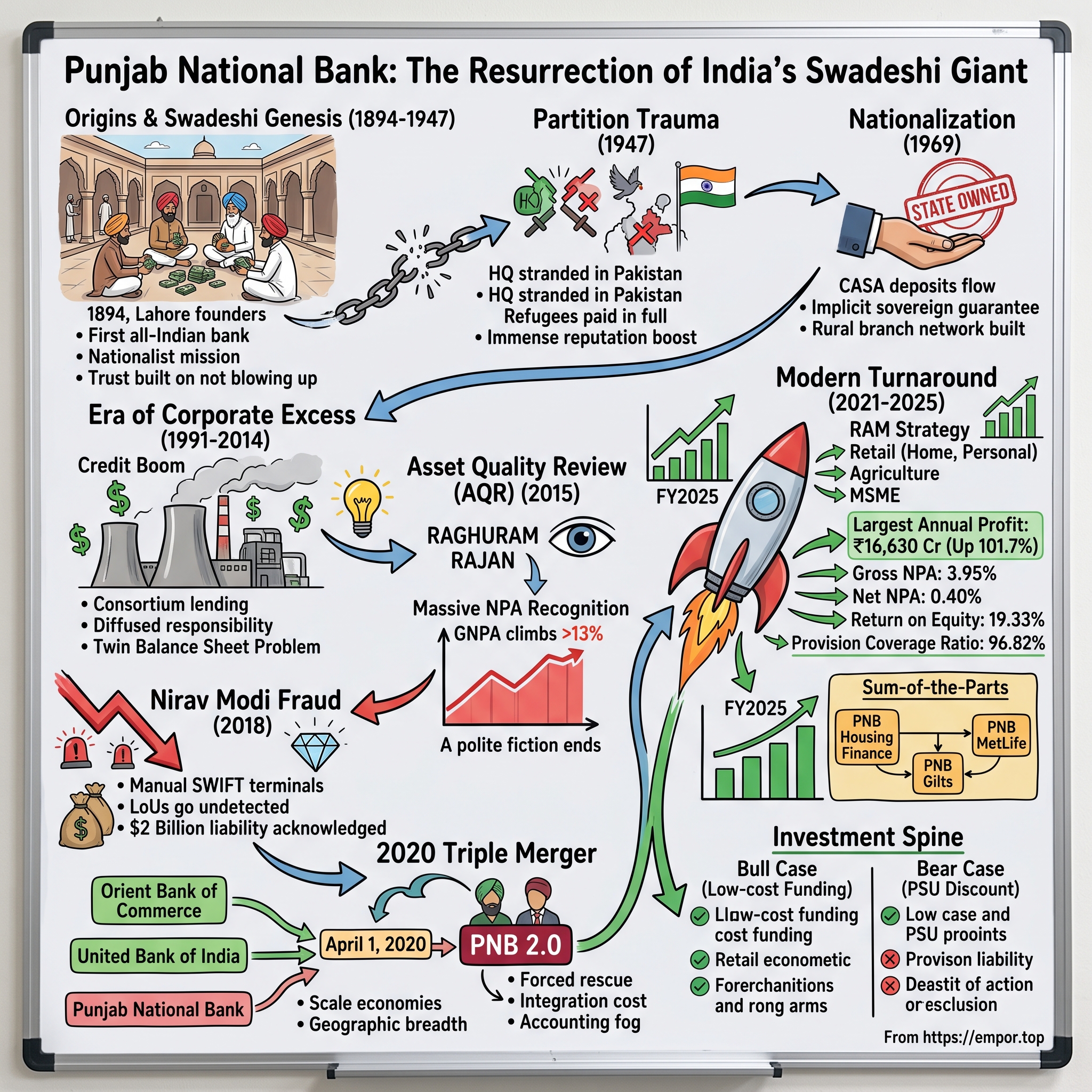
Now fast-forward 131 years. That same institution processes a total business — deposits plus advances — of ₹26.83 lakh crore, roughly $320 billion, through a network of 10,189 domestic branches that reaches into villages most private banks have never bothered to map.1 It is India's second-largest public sector bank by footprint. And in the financial year that ended in March 2025, it reported the largest annual profit in its history: ₹16,630 crore, up 101.7% year-on-year — a doubling.1
Here is the puzzle that makes PNB worth two hours of your attention. How does a bank founded by freedom fighters survive the trauma of Partition, which literally cut its home city out of the country? How does it survive being nationalized and turned into an instrument of state policy? How does it survive the largest corporate credit bust in emerging-market history, in which its gross bad loans climbed toward one rupee in every seven it had lent? How does it survive a $2 billion fraud run out of a single branch by a celebrity diamond merchant — a fraud so large it briefly exceeded the bank's own market value? How does it then survive being ordered by the government to swallow two other banks, one of them a near-corpse, in the middle of a global pandemic? And how, after all of that, does it emerge in 2025 reporting a return on equity of 19.33% and a net non-performing asset ratio of 0.40% — a number that would make many pristine private banks nod in respect?1
The core thesis of this episode is that PNB is not really a company story at all. It is the story of modern Indian public-sector banking compressed into one balance sheet: the arc from nation-building idealism, to state-directed corporate lending that nearly bankrupted the system, and finally to a disciplined, retail-first, technology-mediated deposit franchise. When you understand why PNB almost died and why it came back, you understand the entire Indian PSU banking trade — a trade that has minted extraordinary returns for investors who bought at the moment of maximum disgust and understood one unglamorous truth: that in banking, the cheapest money usually wins.
But this is not a redemption anthem. Turnarounds are seductive precisely because they flatter both management and the investors who bought early, so the harder questions deserve to run throughout. How much of PNB's recovery is management skill versus a rising tide — a benign credit cycle, a government that refuses to let it fail, and an economy growing near 7%? What breaks the story from here? And why does the market still, even now, price this bank at a fraction of what it pays for a private lender with worse deposits? The story starts where the bank started — in a city that is no longer in India.
There is one more framing worth establishing at the outset, because it hangs over every chapter. Indian public-sector banks trade at a persistent, structural discount to their private-sector counterparts — often a fraction of the multiple on book value that a HDFC Bank or an ICICI Bank commands. Some of that discount is simply memory: these banks destroyed enormous amounts of shareholder capital within living investor memory. But a good deal of it is not memory at all. It is a rational assessment of ownership, incentives, and control — of what it means to own a minority stake in an institution whose majority shareholder is a government with objectives that do not begin and end with your returns. The interesting question is not whether the discount exists. It is whether, after everything PNB has fixed, the discount is now too wide, exactly right, or still not wide enough. This piece will not settle that question — but it will lay out the evidence on both sides.
Our roadmap: the Swadeshi origins and the Partition trauma that forged the trust franchise; the 1969 nationalization and the slow corruption of underwriting standards it seeded; the infrastructure credit bubble and the Asset Quality Review that exposed it; the Nirav Modi fraud and what it revealed about the plumbing of Indian banking; the forced 2020 triple merger; the 2021–2025 turnaround and the numbers behind it; a walk through the segments and subsidiaries; and finally the investment spine — why PNB wins from here, why it might not, and the one or two metrics that will tell you which way it is going.
 Subscribe on LinkedIn
II. The Swadeshi Genesis & Partition Survival (1894–1968)
A Bank as a Political Act
The idea did not begin in a boardroom. It began in the pages of a newspaper. In the 1880s and 1890s, a generation of northern Indian nationalists had become obsessed with a maddening dependency: every rupee of Indian savings, every deposit from every Indian merchant and landowner, flowed through banks that were British-owned, British-managed, and structurally uninterested in lending to Indian enterprise. The Swadeshi idea — self-reliance, "of our own country" — was usually told through cloth and salt. But its founders understood that political freedom without financial self-sufficiency was a hollow prize. You cannot own your nation if you do not own your capital.
The men who registered the bank's memorandum of association on May 19, 1894 were not bankers by trade. Lala Lajpat Rai — "the Lion of Punjab," lawyer, writer, and one of the fiercest voices of the independence movement — was among the driving forces, and he insisted that he personally open the first account so that no one could accuse the founders of asking others to risk what they would not.2 Dyal Singh Majithia, a wealthy philanthropist and the proprietor of The Tribune newspaper, became the bank's first chairman.2 The group deliberately spread ownership widely across Punjabi merchants and professionals — a nineteenth-century version of crowdfunding, engineered so that the bank could never be captured by a single family or interest. This was ideology expressed as capital structure.
When the doors opened in Lahore in April 1895, the bank was, by its own claim, the first entirely Indian-owned and Indian-managed joint-stock bank to actually commence operations.2 That distinction mattered enormously to the customer base it attracted. Over the following decades, the roster of people who banked with PNB read like a syllabus of the freedom struggle. It is part of the institution's founding lore that leaders of the national movement kept accounts there — the bank became, in the public imagination, the "people's bank," the place where nationalist India kept its money. Whether every anecdote is precisely documented matters less than the fact that the reputation became real and self-reinforcing: an Indian who wanted to make a small daily act of political defiance could do it by choosing where to deposit.
It is worth pausing on what the Indian banking landscape actually looked like in these decades, because it explains why the founders' conservatism was a competitive strategy and not merely a temperament. Pre-independence Indian banking was chaotic and frequently predatory. Small joint-stock banks proliferated, often established by a single industrial family, and lending flowed overwhelmingly to the promoters and their associates — a structure that worked beautifully until it didn't. Bank runs were routine. Failures were common enough that ordinary depositors treated any bank as a gamble, which is precisely why the trust question dominated everything. Against that backdrop, an institution that lent against actual trade receivables to merchants it knew personally, kept its capital base diffuse, and refused to become a financing arm for a single family was doing something genuinely differentiated. PNB's early reputation was not built on innovation. It was built on the far rarer commodity of not blowing up.
The Rupture
Then came 1947, and the test that would have killed a weaker institution. Partition did not merely redraw a border; it ran that border directly through PNB's own body. Lahore — the bank's birthplace, its headquarters, the center of its branch network — was awarded to Pakistan. Overnight, an Indian bank found its head office and a huge share of its physical infrastructure and depositor base stranded on the wrong side of one of the most violent frontier creations in history. The bank's directors, anticipating catastrophe, had moved to transfer the registered office to Delhi, securing the Lahore High Court's permission in June 1947 before the axe fell.2 Deposits, staff, and records had to be evacuated amid communal slaughter and one of the largest forced migrations of the twentieth century.
Here is the moment that built the moat. Millions of PNB's depositors were themselves refugees, arriving in the new India of Delhi and East Punjab with nothing but the claim that a bank in a now-foreign city owed them money. PNB honored those claims. Depositors who had fled were paid. In an era when a bank run was a routine occurrence and small banks failed constantly, PNB's decision to make its displaced customers whole — when it would have been financially and legally easy to plead force majeure — converted a near-death experience into an almost unassailable brand of trustworthiness across northern India. Trust in banking is not marketed; it is demonstrated exactly once, at the worst possible moment, and remembered for generations. PNB got its demonstration in 1947, and it is still collecting the dividend.
The two decades that followed were, by comparison, quiet. In a pre-nationalization landscape littered with insider lending and periodic bank collapses, PNB positioned itself as the conservative, community-anchored trade financier of the north — steady, unspectacular, and deeply woven into the commercial life of Punjab, Delhi, and the surrounding states. That conservatism, and the refugee-trust franchise beneath it, is the asset the rest of this story keeps spending down and rebuilding. Because in 1969, the government of India decided that a bank this trusted and this large was too useful an instrument to leave in private hands.
V. Nationalization & The Era of Corporate Excess (1969–2014)
On the night of July 19, 1969, Prime Minister Indira Gandhi went on All India Radio and told the country that fourteen of its largest privately owned commercial banks — Punjab National Bank among them — had, effective immediately, been nationalized.3 The stated logic was social. Private banks, the argument went, lent to their owners and to big industry while the farmer, the small trader, and the rural poor went unbanked. Ownership by the state would redirect that credit toward "the priority sector" — agriculture, small-scale industry, the parts of the economy that a profit-maximizing bank ignored. It was also, transparently, a consolidation of political and economic power at a moment when Gandhi was fighting for control of her own party. Both things were true at once.
For PNB, nationalization was a Faustian bargain whose two halves would define the next half-century. Understand this trade and you understand the entire investment case.
The Gift
The gift was the deposit franchise. Once the government owned the bank, an implicit sovereign guarantee settled over every deposit like a warm blanket. To an ordinary Indian household, a nationalized bank simply could not fail — the state stood behind it — and so PNB became a default home for the nation's savings. It was ordered to expand aggressively into the rural hinterland, opening branches in towns and villages where no private bank saw a profit. Each of those branches, unglamorous as it was, became a straw drawing up low-cost deposits: current accounts and savings accounts, the money that sits in a bank paying little or no interest. This is the celebrated CASA franchise — current account, savings account — and it is the single most valuable and durable asset PNB owns. A bank funded cheaply can lend profitably even when it lends carelessly. Hold that thought.
There is a second, subtler gift buried in the nationalization mandate that investors often miss. Because PNB was compelled to open branches in places no commercial logic justified, it accumulated, over decades, a distribution network whose replacement cost is effectively infinite — not because the buildings are expensive, but because the relationships are. A branch that has served three generations of a farming family in rural Punjab is embedded in the local economy in a way that cannot be bought. The government imposed this network as a social obligation, and the obligation was genuinely costly for years. But obligations that persist long enough sometimes turn into assets, and this one did.
The Curse
The curse was everything else. Once the state owned the bank, the state ran the bank. The board filled with government appointees. Compensation was set by public-sector pay scales, which meant the person underwriting a billion-rupee loan earned a bureaucrat's salary and, crucially, owned no equity and faced no market-aligned incentive to protect the balance sheet. Powerful staff unions constrained the ability to hire, fire, and modernize. And credit allocation became, at the margin, a political act — a channel through which the state's industrial priorities, and sometimes the priorities of individual politicians, could be pursued. The organization optimized not for return on capital but for the avoidance of blame and the fulfillment of mandates. These are not incidental complaints; they are the structural reasons a state-owned bank tends to lend badly, and they will recur in every chapter that follows.
The 1991 liberalization of the Indian economy exposed the gap the hard way. New private banks — HDFC Bank, ICICI Bank — were licensed, and they arrived tech-first, hungry, and unburdened by legacy. Where PNB still ran on manual ledgers and slow, form-heavy branch processes, the newcomers offered speed and service. PNB responded as large public institutions do: slowly, but not fatally, undertaking the grinding multi-year work of computerizing branches and centralizing its treasury. It did not lose the retail deposit war outright — its trust franchise and rural reach were too deep — but it entered the new century as the incumbent that had to run to stand still.
The Boom
And then came the credit boom that would nearly destroy it. Between roughly 2004 and 2011, riding a global commodity supercycle and India's own infrastructure ambitions, the country's banks — and public-sector banks most of all — poured capital into enormous, capital-intensive, long-gestation projects: power plants, steel mills, highways, telecom. The economics seemed irresistible. India needed the infrastructure; the projects were huge; and lending to them let a bank grow its loan book by tens of percent a year. PNB, like its peers, deployed a mountain of money into these consortia, often as one lender among many in a syndicate where no single bank felt fully responsible for the underwriting.
The consortium structure deserves a moment, because it is where the incentive failure becomes visible. In Indian infrastructure lending, a single mega-project was typically financed not by one bank but by a syndicate of a dozen or more, each taking a slice. In principle this diversified risk. In practice it diffused responsibility to the point of vanishing. If SBI, the largest lender, had done the diligence, why would the eleventh bank in the syndicate spend real resources duplicating it? Everyone assumed someone else was the adult in the room. Layer onto that a public-sector credit officer with no equity, a bonus structure indifferent to loan performance, and a promotion path that rewarded loan-book growth, and you have a machine engineered to approve. The remarkable thing is not that Indian banks lent badly in this period. It is that anyone expected otherwise.
The problem with lending against a fifteen-year power plant is that a great deal can go wrong in fifteen years, and in India between 2011 and 2015, all of it did at once. Coal blocks were cancelled by the Supreme Court. Environmental and land-acquisition clearances stalled projects for years. Fuel supply agreements fell through. Global commodity prices, having lured everyone in, collapsed. The projects that were supposed to generate the cash to repay the loans instead sat half-built, generating nothing. This is the setup for what economists would come to call the Twin Balance Sheet problem — over-leveraged corporations on one side, and the banks that had financed them on the other, each dragging the other down. The bad loans were already there, festering on PNB's books around 2013 and 2014. They were simply not yet admitted. That admission — forced, painful, and cathartic — is the subject of the next chapter.
VI. Anatomy of a Disaster: The Twin-Balance Sheet Crisis & The 2018 Fraud
For years, the Indian banking system ran on a polite fiction, and the fiction had a name that would become notorious: evergreening. When a corporate borrower could not repay a loan, the bank did not classify the loan as non-performing — which would force it to set aside painful provisions and admit a loss. Instead it "restructured" the loan, or quietly extended fresh credit that the borrower used to pay the interest on the old debt. Extend and pretend. The bad asset stayed dressed up as a good one, the bank kept booking phantom income, and the day of reckoning was pushed into the future. Everyone in the system knew. Almost no one wanted to be the first to stop.
The man who stopped it was Raghuram Rajan. Appointed Governor of the Reserve Bank of India in 2013, the University of Chicago economist who had famously warned of the 2008 crisis before it happened turned his attention to the rot in India's banks. In 2015, the RBI launched the Asset Quality Review — the AQR — a forensic, standardized audit that went bank by bank, loan by loan, and forced lenders to recognize as non-performing the assets that were, in economic reality, already dead.4 It was the regulatory equivalent of turning on the lights in a room everyone had agreed to keep dark.
The numbers that emerged were staggering, and for PNB they were among the worst in the system. As the recognition worked through the books over the following two years, PNB's gross non-performing asset ratio — the share of its loan book that was formally bad — climbed toward and past 13%, and eventually toward 18% at its peak in the late 2010s. Think about what that means: nearly one rupee in every six the bank had lent was not being repaid on schedule. Profits evaporated into provisions; the bank swung to enormous losses. The AQR did not create these bad loans — the reckless lending of the boom created them — but it ripped away the accounting bandage and made the wound visible. For investors, the lesson is permanent: in banking, reported asset quality is a choice until a regulator makes it a fact, and the gap between the two is where fortunes are lost.
It is worth being precise about why the AQR mattered so much more than a normal audit, because the mechanism recurs in every banking crisis everywhere. A loan classified as "standard" requires a bank to set aside only a token provision. The moment it is classified as non-performing, the required provision jumps enormously, and that provision comes straight out of profit. So the accounting classification is not a description of reality — it is a lever that directly controls reported earnings. Left to its own devices, a bank facing a bad year has an overwhelming incentive to pull that lever in its own favor, and Indian banks pulled it for the better part of a decade. What Rajan did was take the lever away. Once classification was imposed by an external, standardized regulatory audit rather than chosen by management, reported profits across the Indian public-sector system collapsed simultaneously — not because the banks got worse in 2015 and 2016, but because they stopped being allowed to lie about how bad they already were.
The Second Bomb
And then, just as the system was absorbing the AQR shock, PNB detonated a second bomb entirely of its own making. This one did not come from bad loans. It came from a single branch, a piece of software that did not talk to another piece of software, and a diamond merchant with a taste for red-carpet fame.
To understand the Nirav Modi fraud, you have to understand two systems that every large bank runs. The first is SWIFT — the global interbank messaging network, essentially a secure telex system that banks use to send each other binding financial instructions across borders. The second is the core banking system, the central ledger that records every transaction the bank makes; PNB's was Finacle, built by Infosys. In a properly run bank, these two are hard-wired together: any instruction sent out over SWIFT automatically writes itself into the core ledger, where audit and risk controls can see it. That integration is the whole point — the ledger is supposed to be the single source of truth.
At PNB's Brady House branch in the Fort district of Mumbai, that integration did not exist. The SWIFT terminal was operated manually and was not linked to Finacle. And so a small number of employees, over several years, discovered a hole in the floor of the bank. They used the SWIFT terminal to issue Letters of Undertaking — LoUs, essentially guarantees in which PNB promised to repay credit that foreign branches of other Indian banks would extend to Nirav Modi's and his uncle Mehul Choksi's diamond and jewelry firms. Because the instructions went out over SWIFT but were never entered into Finacle, they were invisible. The bank had guaranteed billions of rupees of credit that appeared nowhere on its own books, escaped every internal audit, and rolled over year after year as fresh LoUs were issued to repay the maturing ones. It was the evergreening logic of the credit bubble, but weaponized into outright fraud.78
When it finally unravelled in early 2018, the initial disclosure was roughly $1.77–1.8 billion, and the market recoiled in horror.6 As investigators pulled the thread, the total liability PNB itself acknowledged rose to ₹14,356.84 crore — on the order of $2 billion.5 For a sense of scale, that single fraud, run out of one branch, briefly rivalled the bank's entire market capitalization. Nirav Modi — a jeweler to Bollywood and Hollywood stars, a man who had walked red carpets and whose creations had adorned Oscar attendees — fled the country and became one of the world's most-wanted economic fugitives. PNB's leadership was purged, its stock cratered, and the bank was forced to absorb the loss and rebuild trust from a smoking crater.
What the Fraud Actually Revealed
There is a comforting version of this story in which a handful of corrupt employees and a charismatic fraudster defeated an otherwise sound institution. That version is wrong, and getting it wrong matters for how an investor assesses PNB today. The fraud ran for years — not weeks — across multiple reporting cycles, multiple internal audits, multiple statutory audits, and multiple regulatory inspections, and none of them caught it. That is not a story about two bad employees. It is a story about an institution whose control architecture was so weak that a multi-billion-dollar off-balance-sheet exposure could exist continuously without anyone noticing, and about an audit culture that checked whether the ledger was internally consistent rather than whether the ledger described reality.
The related-party dimension compounds it. Because LoUs were rolled over — new guarantees issued to repay maturing ones — the scheme required continuous fresh issuance to avoid collapse. Any competent reconciliation of PNB's contingent liabilities against its counterparties' records would have exposed it immediately, since other Indian banks were holding PNB guarantees that PNB itself did not know it had issued. The information existed. It simply lived on the other side of a control gap nobody was responsible for closing. For an investor, the durable lesson is about governance quality rather than criminality: the question to ask of any financial institution is not "do you have controls" but "who reconciles the things that cross organizational boundaries, and what happens when they don't match."
The System Responds
The regulatory response was swift and system-wide, and it is the part of the story with lasting structural importance. The RBI mandated that every bank in India integrate its SWIFT operations directly into its core banking system, eliminating the manual, unreconciled logging that had made the fraud possible.9 The specific hole in the floor was welded shut across the entire industry. But the deeper lesson for investors transcends PNB: the fraud was not a failure of strategy or credit judgment. It was a failure of plumbing — of operational controls, of the unglamorous back-office integration that nobody celebrates and everybody assumes is already done. Scale without hard-coded software integration is not strength; it is surface area for catastrophe. PNB learned that at a cost of two billion dollars. And it learned it at the worst possible moment, because within a year the government would hand it two more banks to integrate.
VII. The 2020 Triple Merger: Building "PNB 2.0"
On August 30, 2019, Finance Minister Nirmala Sitharaman stood at a New Delhi podium and reorganized the map of Indian public-sector banking in a single afternoon. Ten banks would be consolidated into four. And Punjab National Bank — barely eighteen months removed from the Nirav Modi disaster, still bleeding from the AQR — was handed two others to absorb: Oriental Bank of Commerce and United Bank of India. The Union Cabinet approved the mega-consolidation, and the amalgamation took effect on April 1, 2020.1011 Overnight, PNB became the second-largest public-sector bank in the country, behind only State Bank of India.
Read the timing again, because it is almost unbelievable. The government ordered a three-way bank merger — one of the most operationally fraught things a financial institution can attempt — to take legal effect on the exact day that India entered one of the world's strictest COVID-19 lockdowns. PNB was told to fuse three distinct organizations, three cultures, three sets of legacy technology, and more than eleven thousand branches into a single entity while its staff were locked in their homes and the economy was in free-fall.
The Arithmetic of a Forced Marriage
The mechanics tell you everything about how public-sector M&A differs from the real thing. The share-exchange ratios were not negotiated between willing counterparties in a competitive process; they were determined by the state and handed down. Oriental Bank of Commerce shareholders received 1,150 PNB shares for every 1,000 OBC shares they held; United Bank of India shareholders received 121 PNB shares for every 1,000 UBI shares.12 The chasm between those two ratios is the whole story. OBC was a reasonably respectable institution with decent northern reach. UBI, by contrast, was a deeply stressed, capital-deficient lender out of eastern India whose battered asset quality was reflected in a swap ratio that valued its shares at a fraction of OBC's.
This is where the neutral lens matters most. From PNB's own shareholders' point of view, the merger was not a strategic triumph they chose; it was a state-mandated rescue they were compelled to underwrite. Absorbing UBI meant importing a fresh tranche of bad loans and a capital hole that would have to be filled — and it was filled, ultimately, by the taxpayer through government recapitalization. The merger diluted PNB's existing equity, spiked its consolidated NPA ratio at exactly the moment it was trying to bring that number down, and imposed years of integration cost. If you were a PNB minority shareholder in 2019, you had reason to be furious: your bank was being used as the government's balance sheet of last resort to keep a weaker institution's depositors whole. It was, in a sense, the mirror image of 1947 — this time PNB was made to absorb someone else's failure rather than surviving its own.
And the integration itself was genuinely brutal. Three core banking migrations, millions of legacy customer accounts to be moved onto a single Finacle platform, three IFSC-code universes to reconcile, three product catalogs, three sets of employee grades and union agreements — all executed through a pandemic. Customers endured months of disruption. The reason a merger like this destroys value in the near term is not mysterious: management attention, the scarcest resource in any turnaround, gets consumed by plumbing rather than by lending well.
A skeptical investor should also note what the merger did to accountability. When three banks become one, the historical performance record becomes almost impossible to parse. Which bad loans came from PNB's own reckless lending, and which were imported from UBI? Which recoveries reflect management skill, and which reflect provisions inherited already-taken? A merger of this kind creates a natural accounting fog — a legitimate reason for every subsequent number to be non-comparable to the past — and fog is convenient for management. This is not an accusation that PNB exploited it; it is an observation that the merger sharply reduced an outside investor's ability to hold anyone to a prior track record, at precisely the moment the bank most needed to rebuild credibility. Comparability is itself a governance asset, and PNB lost several years of it.
The Case For
So what was the case for it, beyond obedience? Geography and scale. UBI, for all its financial sickness, brought a genuine and hard-to-replicate branch network across eastern India — West Bengal, the northeast, Bihar — regions where PNB had been thin. OBC deepened the northern stronghold. The combined entity emerged with a footprint of unusual national breadth and, critically, an enlarged low-cost deposit base. If — and it was a large if — PNB could survive the integration and clean up the imported bad loans, it would come out the other side as a bigger, more diversified deposit-gathering machine. The bet the government was making, and the one PNB's shareholders were forced to ride, was that the cost of digestion was a one-time price worth paying for permanent scale. Whether that bet paid off is precisely what the next chapter measures.
VIII. The Modern Turnaround: Asset Quality Redemption (2021–2025)
Every turnaround has a moment when the survivors stop bailing water and start rowing. For PNB, that shift came under two consecutive chief executives — S.S. Mallikarjuna Rao, who steadied the ship through the merger, and Atul Kumar Goel, who took the wheel for the crucial recovery years and reoriented the bank around a single, disciplined idea. The idea was not clever. It was almost embarrassingly simple, and its simplicity is the point: stop betting the balance sheet on giant corporate infrastructure projects, and rebuild the loan book out of many small, diversified, higher-yielding loans to retail customers, farmers, and small businesses.
RAM: The Strategy With a Boring Name
Inside PNB this strategy has a three-letter name: RAM — Retail, Agriculture, and MSME. To understand why RAM matters, contrast it with what came before. A single ₹2,000-crore loan to a power plant is one underwriting decision, one point of failure, and — as the whole industry learned — one route to catastrophe when the project stalls. Twenty thousand home loans of ₹1 crore each represent the same amount of credit spread across twenty thousand independent borrowers, secured by property, in a book where no single default can move the needle. RAM lending is inherently more diversified, generally higher-yielding, and — done properly — lower-risk than concentrated corporate exposure. It is the private-bank playbook, and PNB, humbled by a decade of corporate disasters, finally adopted it in earnest.
The other half of the reset was underwriting itself. PNB moved loan processing out of thousands of individual branches — where a local manager could be pressured, fooled, or simply wrong — and into centralized processing hubs with digital underwriting engines and standardized pre-approval checks. The goal was to make the new book, the loans underwritten after the merger, structurally cleaner than the old one. The proof is in the slippage ratio, which measures how many previously-good loans go bad in a given year. For the newly underwritten book, that number fell to remarkably low levels, and the bank's overall slippage ratio for FY25 came in at just 0.73% — a fraction of the hemorrhage of the AQR years.19 When management says the cleanup is structural rather than cosmetic, this is the number that either supports the claim or exposes it, and for now it supports it.
The Numbers of Redemption
Now the results, and they are genuinely dramatic — with the analytical caveats that follow. For the financial year ended March 2025, PNB reported a standalone net profit of ₹16,630 crore, up 101.7% year-on-year — an all-time record and a doubling of the prior year's figure.1 The fourth quarter alone delivered ₹4,567 crore, up 51.7% from the same quarter a year earlier.118
The asset-quality repair beneath that profit is what actually matters, because profit at a bank is meaningless if the loan book is quietly rotting. Here the numbers are striking. Gross NPA fell to 3.95% as of March 2025, down from 5.73% a year earlier — and down from a peak that had exceeded 14% in the depths of the crisis.1 Net NPA — the bad loans left after provisioning — shrank to just 0.40%, from 0.73% the year before.1 To put 0.40% in context: that is a net bad-loan ratio comfortably in the range of well-run private banks, from an institution that a few years earlier had been a byword for asset-quality disaster. The provision coverage ratio, including technical write-offs, reached 96.82%, meaning the bank had already set aside provisions against nearly all of its recognized bad loans; even excluding technical write-offs, coverage stood above 90%.1 A bank that is heavily provisioned has already absorbed its pain and has little hidden downside left to surprise investors — which is exactly the reassurance the market needed after a decade of nasty surprises.
Profitability followed asset quality, as it always does once the provisioning drag lifts. Return on assets climbed to 0.97% in FY25 from 0.54% the year before, and return on equity nearly doubled to 19.33% from 11.66%.1 An RoE approaching 20% is, on its face, an excellent number for any bank anywhere. But here is where the neutral analyst has to interject. A large part of that RoE surge is arithmetic: when a bank stops taking huge provisions, profit rebounds violently off a depressed base, and much of the "doubling" of profit reflects the absence of last year's provisioning burden rather than a doubling of underlying earning power. The recovery is real, but it is riding a benign credit cycle — a growing economy, low system-wide defaults, and rising asset prices. The honest question, which no single year's results can answer, is how these numbers hold up when the cycle turns and slippages inevitably rise from today's unusually low levels. A turnaround that has only been tested in good weather has not yet been fully tested.
Myth vs. Reality
Three consensus narratives about this turnaround deserve testing, because each contains a partial truth wrapped around a distortion.
The first myth is that PNB's profit doubled because the business doubled. It did not. Revenue and loan growth were solid but nowhere near 100%; the profit surge came overwhelmingly from the collapse in credit costs as the bank stopped provisioning against the old bad book. This is a real and welcome improvement — a bank that no longer bleeds provisions is a fundamentally healthier bank — but it is a one-time normalization, not a repeatable growth rate. An investor extrapolating 100% profit growth forward is extrapolating the end of a crisis, which by definition only happens once.
The second myth is the inverse pessimism: that PNB's improved metrics are cosmetic, achieved through write-offs rather than genuine recovery. There is a kernel here worth taking seriously — the headline provision coverage of 96.82% includes technical write-offs, which are loans moved off the books rather than money recovered, and the "excluding technical write-offs" figure above 90% is the more conservative and more honest number to anchor on.1 But even that conservative figure represents heavy provisioning, and the low slippage on newly underwritten loans is not a write-off artifact — it is forward-looking evidence about lending quality.19 The cleanup appears to be substantially real, not merely accounting.
The third myth is that this is a PNB-specific management triumph. It is not, or at least not only. Across the Indian public-sector banking system, the same arc played out over the same period: recognition, provisioning, recapitalization, and recovery, as the sector collectively emerged from the bad-debt shadow.22 PNB's recovery was steeper than most because its hole was deeper than most, but a rising sector tide lifted every PSU balance sheet. Distinguishing management skill from sector beta is genuinely difficult here, and any analyst claiming certainty in either direction is overreaching. The fairest reading is that PNB executed competently within a favorable environment — which is praise, but bounded praise.
Still, credit where due. Across four years, PNB took a balance sheet that was arguably the most damaged of India's large banks and hauled it back to respectability — cleaning the book, re-underwriting the franchise, and doing it while digesting the largest forced merger in the sector. The management team set targets on asset quality and, quarter after quarter, largely hit or beat them, which is itself a form of credibility that had to be rebuilt from zero after 2018. That earned credibility is the foundation the current leadership inherited. Whether they build on it or squander it turns on the parts, the pieces, and the people examined next.
IX. Segment Analysis & Subsidiary Sum-of-the-Parts
Strip a bank down to its engine and you find three chambers, each with a different temperament, and PNB's are worth walking through because the mix tells you where the value now lives.
The first and most important is retail and RAM banking, and after the reset this is the heart of the franchise. Home loans, vehicle loans, personal loans, farm credit, and small-business lending now drive the bulk of loan growth and, crucially, the bulk of the risk-adjusted margin. These loans yield more than blue-chip corporate credit and, spread across millions of borrowers, carry less concentrated risk. This is the segment that turns PNB's cheap deposits into profit, and its expansion is the single clearest expression of the post-2020 strategy.
The second chamber is corporate and wholesale banking, and its story now is one of deliberate restraint. This is the business that nearly killed the bank in the last cycle, and management's stated posture is caution: lending selectively, favoring highly rated borrowers, cash-flow-backed public-sector enterprises, and blue-chip corporates over the speculative infrastructure consortia of the 2000s. The analytical watch-item here is discipline over time. It is easy to be disciplined about corporate lending when you have just been burned; the test is whether that restraint survives a few years of good conditions and volume pressure — a tension the risk radar returns to.
The third chamber is treasury. Like every Indian bank, PNB is legally required to park a large slice of its deposits in government securities to satisfy the Statutory Liquidity Ratio — a regulatory mandate that turns the bank into a captive holder of sovereign bonds. This G-Sec portfolio is a reliable earner, especially when interest rates fall and bond prices rise, delivering trading and treasury gains. But it cuts both ways: when yields spike, the same portfolio generates mark-to-market losses. Treasury is thus a stabilizer in easing cycles and a source of volatility in tightening ones — a chamber that breathes with the bond market rather than the credit cycle.
Beyond the core bank sits a portfolio of subsidiaries and associates that a sum-of-the-parts investor should not ignore, because collectively they hold real, and partly listed, value.
The most significant is PNB Housing Finance, in which PNB holds roughly a 28% associate stake.13 This is a separately listed home-loan specialist that had its own near-death experience — a wholesale developer-loan book that soured badly during the same period the parent was in crisis. It has since recapitalized, worked through its bad assets, and refocused on retail housing, and its recovery adds material, market-priced equity value to PNB's holding. Because it is listed, an investor can actually observe that value rather than guess at it — a rare luxury in a sum-of-the-parts analysis.
Then there is PNB MetLife India Insurance, an unlisted life insurer in which PNB holds around 30%.13 Its strategic value is less about the standalone insurance economics and more about bancassurance: PNB's ten-thousand-plus branches are a distribution channel of enormous reach, and selling life insurance across that network generates fee income and deepens customer relationships without consuming much capital. It is the kind of capital-light, distribution-leveraged business a branch-heavy bank is uniquely positioned to run.
Finally, PNB Gilts, a listed primary dealer in government securities in which the bank holds about 74%.13 It is small relative to the parent, but it provides fee income, a window into the bond market, and treasury-market intelligence that complements the bank's own large G-Sec book. None of these subsidiaries will move PNB's valuation on their own. But taken together, the listed housing-finance stake, the insurance distribution asset, and the gilts dealer represent a layer of optionality that the market, focused on the parent bank's headline metrics, tends to under-price. That gap between the visible bank and the fuller sum of its parts is one thread of the bull case, which the investment spine takes up next.
X. The Investment Spine: Why PNB Wins vs. Why It Doesn't
Every bank investment ultimately comes down to two questions. Where does the money come from, and how well is it lent? PNB's bull and bear cases are simply the optimistic and pessimistic answers to those two questions, and a serious investor has to hold both in mind at once.
The Bull Case
Start with the money, because in banking the liability side is the real moat. PNB's domestic CASA ratio stood at 37.95% as of March 2025, representing ₹5,73,543 crore — roughly ₹5.73 lakh crore — of ultra-low-cost current and savings deposits.1 This is the franchise that seven decades of branch expansion into semi-urban and rural India built, and it is genuinely hard to replicate. A private bank can out-innovate PNB on a mobile app in a week; it cannot conjure a physically present, trusted branch in ten thousand towns and villages in a decade. Cheap, sticky deposits are the raw material of banking profitability, and PNB gathers them at a scale and cost that most competitors, particularly in the rural and semi-urban markets, structurally cannot match. This is the single most important sentence in the bull case: PNB's edge is not what it lends, but how cheaply it can fund.
The second pillar is the underwriting reset. The bear on PNB has always been that its asset quality is a time bomb. The counter is the 0.40% net NPA and the low slippage on the new book: the evidence, at least through a benign cycle, is that the cleanup is structural.1 The market, the bulls argue, is still anchored to PNB's historical baggage and refuses to give it credit for metrics that now look like a normal bank's.
The third pillar is capital. In September 2024, PNB raised ₹5,000 crore of fresh equity through a qualified institutional placement, selling shares to institutional investors.141523 By March 2025, its capital adequacy ratio (CRAR) stood at 17.01%, up from 15.97% a year earlier.1 A well-capitalized bank can grow its loan book without repeatedly returning to shareholders for dilutive fresh equity, and it has a thicker cushion to absorb shocks. After a decade in which PNB survived only because the taxpayer kept recapitalizing it, standing on its own capital — and raising it from private institutions rather than the government — is a meaningful signal of restored health.
The Bear Case and the PSU Discount
Now the other side, and it is substantial, because the market's persistent discount on PNB is not irrational.
Begin with incentives. MD & CEO Ashok Chandra, who took charge in January 2025, operates under a government-mandated compensation structure with no stock options and no equity-linked incentive.16 This is the crux of the PSU discount. A private-bank CEO whose net worth is tied to the share price is powerfully motivated to compound shareholder value over a decade. A public-sector bank CEO on a fixed civil-service-style package, appointed for a defined term, is rationally motivated to avoid blame, execute public policy, and not blow up on their watch — a posture that favors risk-minimization and continuity over aggressive long-term value creation. Neither is villainous, but they produce different banks, and the market prices the difference. It is also why every strategy claim from a PSU has to be tested against behavior rather than taken on faith: the person making the promise has little personal stake in keeping it.
Second, the deposit war. The very CASA moat that anchors the bull case is under pressure, because across the Indian system deposit growth has lagged credit growth, forcing banks to compete for money. PNB's term deposits — the expensive, rate-sensitive kind — grew 21.5% in FY25, and that shift toward pricier funding compressed the bank's global net interest margin to 2.93%.1 Margin is the spread between what a bank earns on loans and pays on deposits; when the cost of deposits rises faster than loan yields, the spread narrows and profitability erodes. The moat is real, but it is being taxed.
Third, the new risk hiding inside the good news. PNB's higher profitability partly rests on growth in higher-yielding unsecured retail — personal loans and micro-loans. Those loans yield more precisely because they carry more risk, and a book grown fast in good times has not yet been stress-tested by a downturn. If India's retail economy slows, the same segment driving today's margins could drive tomorrow's slippages. This is the classic late-cycle trap, and it is the mirror image of the corporate infrastructure mistake — different assets, same underlying temptation to reach for yield.
The Activist's Stress Test
Imagine a skeptical long/short investor building the short thesis. Where would they press? Not, anymore, on asset quality — that argument has largely been won by the numbers. They would press on ownership and capital allocation. The government holds the commanding majority of PNB's equity, which means three things a minority shareholder cannot escape. First, the government is a seller in waiting: to meet its own fiscal and minimum-public-shareholding objectives, the state periodically offloads stock, and that overhang caps how far the valuation can run. Second, the government is a claimant on the bank's capital for policy purposes — dividends, recapitalization of weaker peers, participation in state schemes — in ways that may not maximize per-share value. Third, the QIP that strengthened the balance sheet also diluted existing holders, and further capital raising to fund growth would dilute again; "well-capitalized" and "will not need to dilute" are not the same statement, and management's own growth ambitions are in tension with the second.
The activist would also flag portfolio complexity and disclosure. A bank with a listed housing-finance associate, an unlisted insurer, a listed gilts dealer, and a sprawling merged branch network is not a clean, single-thesis instrument; the sum-of-the-parts value is real but obscured, and PSU disclosure standards, while improving, still lag the granularity a private-bank analyst expects. And they would note the accountability gap already discussed: a CEO on a fixed term with no equity, a board answerable ultimately to the state, and a performance record fogged by the merger. None of this makes PNB a short. But it explains, rigorously, why the market assigns it a discount — and why closing that discount requires not just good numbers but a sustained demonstration that the good numbers survive a full cycle and a change of leadership.
Porter, Helmer, and the War Game
Zoom out to the competitive structure and the picture sharpens. Under Porter's Five Forces, PNB sits in a fortress on entry — India issues bank licenses sparingly, and the capital and physical distribution required to build a rival branch network are prohibitive, so the threat of new entrants is genuinely low. But rivalry is ferocious: PNB fights State Bank of India (larger, better-run, the default PSU), Bank of Baroda (its closest PSU peer), and the aggressive private duo of HDFC Bank and ICICI Bank, all chasing the same deposits and the same creditworthy borrowers. Customer bargaining power splits by geography — urban borrowers have infinite choice and squeeze margins, while rural and agricultural customers, tethered to PNB's local presence, have far less.
Through Hamilton Helmer's Seven Powers lens, PNB's durable advantages are narrower than its size suggests but real. Its clearest power is scale economies in funding: the vast branch network is a distribution engine for cheap deposits that a smaller or newer competitor cannot cost-effectively match. A second is a cornered-resource-like benefit — the implicit state guarantee, which in moments of systemic stress causes depositors to flee toward government banks, turning state ownership into a structural shield against runs (the same asset, ironically, that 1947 first demonstrated). A third, softer power is switching costs: when a bank is woven into a farmer's crop-procurement payments or a village's salary accounts, moving is genuinely painful. What PNB conspicuously lacks is any power rooted in superior technology, brand prestige, or network effects — precisely the powers the private banks wield. Its moat is made of mud and distribution, not silicon and UX, and an investor should be clear-eyed that this is a low-cost-funding advantage, not a premium-franchise one.
XI. Strategic Analysis: Helmer's 7 Powers & Porter's 5 Forces
Having laid out the frameworks in the investment spine, it is worth pressing on the one strategic tension that will decide whether PNB's advantages compound or erode: the collision between its physical distribution moat and the digital transformation of Indian banking.
The bull's mental model runs like this. Sovereign backing produces depositor confidence; the ten-thousand-branch footprint converts that confidence into low-cost CASA deposits; and a modern digital layer — PNB's mobile platform, "PNB One" — retains retail customers who might otherwise defect to slicker private apps. Confidence, distribution, and retention together produce the one power that matters for a lender: a structurally low cost of funds, which flows through to competitive lending and, ultimately, to returns. If that chain holds, PNB is a cheap-funding machine that can lend profitably almost regardless of how the asset side is managed, because it starts every loan with a cost advantage.
But each link in that chain is contestable, and the neutral analyst should name where it strains. Depositor confidence rooted in state backing is real but generic — it is shared by every public-sector bank, so it differentiates PNB from private lenders but not from SBI or Bank of Baroda, which enjoy the identical guarantee and, in SBI's case, greater trust. The branch footprint is a genuine cost-of-funds advantage in rural and semi-urban India, but branches are also a cost: a physical network is expensive to run, and as banking digitizes, the fixed cost of maintaining ten thousand branches can shift from asset to liability if deposits migrate to digital channels where PNB has no structural edge. And the digital-retention link is the weakest of all — this is precisely the terrain where HDFC and ICICI are strongest, and "we also have an app" is a defensive necessity, not a source of power.
So the honest strategic verdict is this. PNB possesses a durable, quantifiable advantage in the cost of gathering deposits from underbanked India — a scale-economy-and-distribution power that is hard to attack head-on. It does not possess, and shows little sign of building, a differentiated advantage on the asset side or in technology. Its competitive position is therefore asymmetric: strong where money is raised, ordinary-to-weak where money is lent and where customer experience is won. Whether that asymmetry is enough depends entirely on execution and on the credit cycle — which is why the things to watch are so specific.
XII. Current Risk Radar & What to Watch
The most immediate variable is at the very top of the building. Ashok Chandra assumed charge as Managing Director and Chief Executive Officer of Punjab National Bank on January 16, 2025, succeeding Atul Kumar Goel.1617 Chandra arrived from an executive-director role at Canara Bank, a career public-sector banker stepping into the seat at the precise moment the turnaround had been declared a success.16 That is a delicate inheritance. A new CEO taking over a recovering bank faces a standing temptation: the balance sheet is clean, capital is ample, and the fastest way to show growth is to loosen the credit spigot and chase volume. The single most important thing to watch over the next few years is whether Chandra sustains the underwriting discipline that produced the 0.40% net NPA, or whether the pressure to grow — and to hit the volume targets a government owner tends to favor — pulls PNB back toward the aggressive asset accumulation that caused the last catastrophe. This is not a prediction; it is the open question on which the whole thesis turns.
The early evidence carries a useful cautionary footnote. In the first quarter of FY26 — the June 2025 quarter, Chandra's first full quarter — PNB's net profit fell about 48% year-on-year to ₹1,675 crore.20 The headline looked alarming, but the cause was not operating deterioration: it was a sharp jump in tax expense as the bank transitioned to a new tax regime, while operating profit actually hit a record and asset quality kept improving, with gross NPA easing further to 3.78%.2021 The episode is a reminder for the reader to look past a bank's headline profit to its operating profit and its slippages — the numbers that reveal whether the underlying machine is healthy or the accounting merely noisy.
Beyond leadership sit three structural pressures. The first is cost. Public-sector bank wages are set through industry-wide bipartite settlements, and periodic wage revisions impose large, lumpy increases on operating expenses that a private bank managing its own payroll does not face in the same way — a persistent drag on PNB's cost-to-income ratio. The second is regulation. The RBI has tightened risk weights on unsecured retail lending and personal loans — meaning banks must now hold more capital against exactly the high-margin loans driving PNB's profitability — which threatens to slow the bank's most attractive growth engine. The third is the deposit war already described, which will keep pressure on margins for as long as system-wide credit growth outruns deposit growth.
For an investor who wants to track this bank without drowning in disclosure, three metrics carry most of the signal. First, the slippage ratio — the rate at which good loans turn bad — which management has guided to stay near or below 1% and which came in around 0.73% in FY25.19 A sustained rise is the earliest warning that discipline is slipping. Second, the domestic net interest margin, worth watching for stability roughly in the 3.0–3.1% band; sharp compression signals the deposit war is winning. Third, the CASA ratio: a drift below the ~37% level would indicate that the cheap-deposit moat — the entire foundation of the investment case — is eroding under funding-cost pressure. Watch those three, and you are watching the load-bearing walls of the whole structure.
XIII. Playbook: Key Business & Investing Lessons
Three lessons generalize from PNB's near-death and recovery, and each is worth more than the specific facts that produced it.
The first is that infrastructure must lead operational scale, not trail it. The Nirav Modi fraud was not, at root, a story about a charming criminal; it was a story about a SWIFT terminal that was never wired into the core ledger. PNB had achieved enormous administrative scale — thousands of branches, billions in transactions — without hard-coding the software integration that scale demands. The bank had the size of a giant and the control systems of a much smaller institution, and the gap between the two was exactly where two billion dollars walked out the door. For any organization, the lesson is that manual workarounds inside a large institution are not shortcuts; they are latent disasters waiting for someone to notice them. Technology integration is not a back-office nicety to be deferred — it is a load-bearing control, and administrative scale without it is a hazard, not an achievement.
The second lesson is that deposit moats are built in the mud, not the cloud. The dominant narrative in Indian finance for two decades has been that private banks win because they win on technology and customer experience — and in high-end urban retail, they do. But PNB's story is a reminder that the liability side of banking is won on physical presence and trust in exactly the places digital-first banks find uneconomic to serve. A branch in a small town, staffed by people the community knows, gathering savings from customers who have banked there for generations, is an irreplaceable and genuinely high-return deposit-gathering asset. The unglamorous, capital-intensive, deeply physical franchise turned out to be the durable one. In banking, the cheapest money usually wins, and the cheapest money often comes from the least glamorous places.
The third lesson is the one that made PNB such an extraordinary trade for those who understood it: public-sector bank valuations move in violent rerating cycles, not smooth compounding curves. A private bank that compounds book value at 18% a year is a machine you buy and hold. A public-sector bank is something different — a cyclical vehicle whose price is dominated not by steady compounding but by the market's shifting perception of its asset quality. When that perception moves from "disastrous" to merely "average," as PNB's did across FY24 and FY25, the rerating can be explosive, because the stock had been priced for permanent impairment and is suddenly repriced for ordinary survival. The corollary is a warning: the same mechanism runs in reverse. Buy the disgust, respect the cycle, and never mistake a cyclical rerating for a permanent transformation. The investor who confuses the two will hold through the next downturn convinced that "this time it's different," which in public-sector banking it rarely is.
XIV. Epilogue
The arc is almost novelistic. A bank conceived in 1894 as an act of anti-colonial defiance, funded by men who would be jailed and exiled for the nation they were trying to build. A bank cut in half by Partition that chose to honor the claims of its refugee depositors when it could have walked away, and in doing so purchased a century of trust. A bank nationalized and turned into an instrument of the state, granted the priceless gift of cheap deposits and cursed with the incentives that would eventually lead it to lend that money recklessly. A bank brought to the edge of ruin by the corporate credit bubble, humiliated by a fraud that exposed the hollowness of its controls, and then ordered to rescue two weaker institutions in the middle of a pandemic. And finally, a bank that cleaned itself up, re-underwrote its franchise, and reported the best numbers in its history.
That is a survival story of rare durability. The institution has now outlasted the British Empire, a national partition, a nationalization, a systemic credit crisis, and a two-billion-dollar theft. Survival, at this point, is not in question.
The open question is different, and it is the one an investor should sit with. PNB has proven it can endure. It has proven it can gather deposits more cheaply than almost anyone in the markets it dominates. What it has not yet proven — because a benign cycle and a forgiving economy have not yet let it be tested — is whether it can convert that structural low cost of funds into a genuinely well-run, disciplined, technology-forward credit machine across a full cycle, under leadership that owns none of the equity and answers ultimately to the state. The recovery is real. Whether it is repeatable is the wager. And the three numbers to watch — slippage, margin, and CASA — will tell the story long before the headlines do.
References
-
Press Release — Financial Results for the Quarter and Year Ended 31st March 2025 — Punjab National Bank, 2025-05-07 ↩↩↩↩↩↩↩↩↩↩↩↩↩↩
-
July 19, 1969: Fifty years ago, India nationalised 14 private banks — Scroll.in, 2019-07-19 ↩
-
Government measures on stressed assets and the Asset Quality Review — Press Information Bureau, 2019-07-16 ↩
-
Total liability from Nirav Modi fraud is Rs 14,356.84 crore, says PNB — Onmanorama/PTI, 2018-05-15 ↩
-
India's Punjab National Bank reports $1.8bn fraud — Al Jazeera, 2018-02-16 ↩
-
How PNB's Tech Gap Allowed a $2 Billion Diamond Heist — Bloomberg, 2018-02-22 ↩
-
RBI circular on SWIFT-CBS Integration — Reserve Bank of India, February 2018 ↩
-
Cabinet approves Mega Consolidation in Public Sector Banks with effect from 1.4.2020 — Press Information Bureau, PRID 1605147, 2020-03-04 ↩
-
Union Cabinet approves amalgamation of OBC and UBI into PNB — Press Information Bureau, PRID 1605151, 2020-03-04 ↩
-
Scheme of Amalgamation — share exchange ratios (NSE filing) — Punjab National Bank, 2020-03-21 ↩
-
PNB successfully raises Rs 5,000 Crore Equity Capital via QIP — Punjab National Bank, September 2024 ↩
-
State-owned Punjab National Bank raises Rs 5,000 crore through QIP issue — Business Standard, 2024-09-27 ↩
-
Shri Ashok Chandra, MD & CEO — Punjab National Bank, 2025-01-16 ↩↩↩
-
PNB's Ashok Chandra assumes charge as MD & CEO — The Economic Times, 2025-01-16 ↩
-
PNB Q4 results: Net profit rises, asset quality improves significantly — Moneycontrol, 2025-05-02 ↩
-
Q4 FY25 Investor Presentation (slippage ratio, NIM, operating metrics) — Punjab National Bank, 2025-05-07 ↩↩↩
-
PNB Q1 net profit drops 48% to Rs 1,675 crore in FY26 — Business Standard, 2025-07-30 ↩↩
-
Financial Results for the Quarter Ended 30th June 2026 (restating prior-year base) — Punjab National Bank, 2026-07-18 ↩
-
India's public sector banks emerge from the bad-debt shadow — Financial Times, 2024-11-12 ↩
-
Punjab National Bank raises Rs 5,000 crore via QIP — Reuters, 2024-09-27 ↩
 LinkedIn
 WhatsApp
 Reddit
 Hacker News
 Email
Email Kindle
 RSS Feed
 Spotify
 Apple Podcasts
 Amazon Music
 Audible
 YouTube