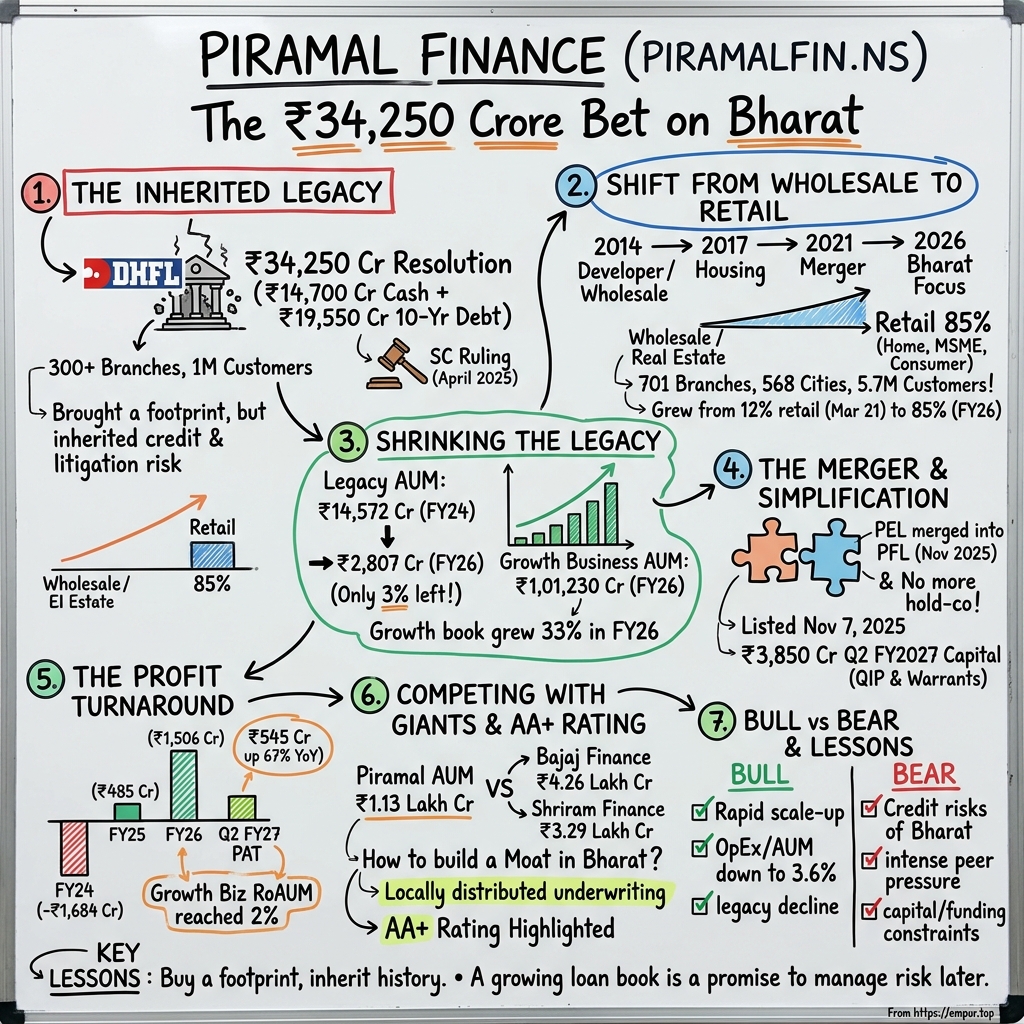
Piramal Finance: The ₹34,250 Crore Bet on Bharat
I. The Lender That Inherited a Broken Company
At the end of September 2021, a housing lender that no longer had a board, a promoter or the trust of its creditors changed hands. Dewan Housing Finance Corporation, better known as DHFL, had once been one of the largest names in Indian home loans. Now it was a case file. After at least fifteen months of negotiation and five rounds of bidding against rivals that included Oaktree and the Adani Group, Ajay Piramal's group had won it, with 94% of DHFL's creditors voting for its plan.1 Piramal later said he had felt "a quiet sense of confidence" throughout, and that his team "knew from day one that we would get it."1
The company Piramal bought had collapsed in public. In November 2019 the Reserve Bank of India removed DHFL's board, citing "governance concerns and defaults" on payment obligations, and appointed an administrator to steer it into insolvency court.2 DHFL owed the financial system more than ₹80,000 crore and had missed payments on loans and bonds in the months before.2 It became a test case for a new power: only a regulator could push a financial company into bankruptcy, and the rules allowing the RBI to do so had only just arrived.2
DHFL's chairman, Kapil Wadhawan, had argued almost to the end that the company was paying its way. In a clarification to the stock exchanges earlier that November, he said DHFL had repaid about ₹44,000 crore of debt over the previous thirteen months, and that court orders were now preventing it from paying creditors, including fixed-deposit holders.2 The regulator's move ended the argument. A lender that had financed homes for lower-income families across small-town India passed into the hands of an administrator, R. Subramaniakumar, a former chief executive of Indian Overseas Bank.2 Whatever DHFL's branches and borrowers were worth would now be decided by its creditors and a bankruptcy court.
That is the setting most people remember: a distressed sale, a court-supervised process, creditors taking a large loss. It sounds like a bargain. The price does not. Piramal paid a total consideration of about ₹34,250 crore.3 About ₹14,700 crore of that was cash on the day. The other ₹19,550 crore came as ten-year debentures paying 6.75% a year, interest every six months.3 Add the roughly ₹3,810 crore that creditors took from DHFL's own balance sheet, and the lenders recovered about ₹38,060 crore, or nearly 46% of what they were owed.1
So was this a bargain or a stretch? The honest answer is that the price cannot be judged like an ordinary acquisition. A normal lender deal comes with a price-to-book multiple and a stream of earnings to divide it by. This one came with a book that had to be re-underwritten, a pool of allegedly fraudulent loans whose recoveries were assigned a notional value of one rupee in the plan, and a payment structure in which more than half the price was itself debt that Piramal's lending business has to carry for a decade.34 Ajay Piramal's own case, written in his chairman's letter the following summer, was that the deal was "profit accretive" and that "the valuation paid by us has created an adequate buffer to mitigate any unforeseen asset quality risks."5 Those two claims are worth holding on to. The rest of this story is, in part, a test of both.
What Piramal bought was reach. DHFL came with about 300 branches across 24 states and union territories, roughly one million customers it had served over its life, and more than 3,000 employees whom Piramal chose to retain.5 Most of those branches sat in the smaller cities and towns where Piramal's own lender, then called Piramal Capital & Housing Finance, barely existed. Within six months, nearly all of them were back to taking and approving loan applications.5
What Piramal also bought was a legal fight. For years after the deal, former promoter Kapil Wadhawan and some creditors contested how recoveries from DHFL's suspect transactions should be shared. Those so-called avoidance applications concerned roughly ₹45,000 crore of transactions.4 An appeals tribunal sent the plan back to creditors to reconsider their valuation; the Supreme Court stayed that order, and on 1 April 2025 a bench of Justices Bela Trivedi and Satish Chandra Sharma set the tribunal's ruling aside and upheld the plan as approved.4[^6] Recoveries from those fraudulent transactions, the court held, belong to the successful bidder.4 That ruling gave Piramal a legal right. It did not hand Piramal a cheque. The tribunal still has to decide the underlying applications, and every rupee will have to be traced, litigated and collected.4
There is a boundary to draw before the story goes further. The company listed today as Piramal Finance Limited, ticker PIRAMALFIN on the National Stock Exchange, has been a public company only since 7 November 2025.6 It is the old Piramal Capital & Housing Finance, renamed, with its former parent Piramal Enterprises merged into it. The parent's shares were delisted and the subsidiary's shares took their place.6 Everything before that date is lineage, not a continuous public record. The financial history before the merger was reported by a different listed entity, under a different structure, and the first annual report under the new identity covers only FY2026.7
That boundary sharpens the question rather than blurring it. Piramal Finance today manages just over ₹1 lakh crore of loans, and almost all of it sits in businesses it calls "growth" rather than "legacy."8 It reported ₹1,506 crore of consolidated profit in FY2026, two years after a ₹1,684 crore loss.8 So four questions run through this episode. Did buying DHFL change the economics of the business for good, or only its size? Can a retail lender that is still small next to India's giants build a real edge against them? Did the merger simplify the company, or move the old group ties into the listed vehicle? And can returns keep pace with the cost of credit losses and the cost of money? To answer them, the story has to go back to the moment a pharmaceutical fortune turned into a lending business.
 Subscribe on LinkedIn
II. From Wholesale Loans to a Retail Footprint
Ajay Piramal did not come to finance as a banker. He came to it as a dealmaker with a habit of buying what others thought he should not. In 1984, at 29, after the death of his elder brother Ashok, he took charge of the family's textile flagship, Morarjee Gokuldas Spinning & Weaving Mills, and returned it to profit, though textiles were clearly not where the future lay.9 In 1988 he bought Nicholas Laboratories for about ₹16 crore, against the advice of people who pointed out he knew nothing about pharmaceuticals. He later called it his best investment.9
That pharmaceutical business became the engine of the group, and in 2010 he sold its domestic formulations arm to Abbott Laboratories for $3.72 billion, with $2.12 billion paid upfront.10 It was about nine times sales, then the richest price a global drugmaker had paid for an Indian drug business.10 The sale left Piramal with a mountain of cash and a reputation for unsentimental timing. He twice bought a stake of about 5.5% in Vodafone's Indian business and sold it in 2013, booking a profit of about ₹3,037 crore.9 And he began to put money into real estate financing at a time when the sector was struggling, betting that it would recover within a few years.9
That bet shaped everything that followed. Piramal entered financial services in 2011 by acquiring Indiareit, a real-estate fund manager.11 The model was wholesale: large loans to property developers and companies, often structured, often high-yielding. It grew very fast. The closing loan book was about ₹2,900 crore in 2014 and nearly ₹25,000 crore by 2017, close to a ninefold rise in three years.11 In 2017 the group launched a housing finance business and raised about ₹5,000 crore through a qualified institutional placement of compulsorily convertible debentures to fund the expansion.11
Alongside the lending book, Piramal built a second bet on Indian finance by buying into someone else's. In May 2013 it paid about ₹1,636 crore for 9.9% of Shriram Transport Finance, and in 2014 it added 20% of Shriram Capital, the group's holding company, for about ₹2,014 crore, and about 10% of Shriram City Union Finance for ₹790 crore.12 At close to ₹4,500 crore in total, Piramal became the single largest shareholder in the Shriram Group.12 Ajay Piramal also became chairman of Shriram Capital.12
The marriage never quite fused. By 2019, people close to the companies were describing a "cultural misfit": Piramal's lending focused on large corporate and developer borrowers, while Shriram had built its success on grassroots truck, micro and small-business loans.12 Piramal said that year that the group would exit "if we get the right value and the right partner."12 The exit came slowly. In FY2024 the group sold its stake in Shriram Finance for about ₹4,824 crore and its stake in Shriram Investments for about ₹1,440 crore, and in FY2026 it sold its stake in Shriram Life Insurance for about ₹600 crore.13 On those cash figures alone, Piramal took out roughly half as much again as it put in, over about a decade. That is a modest return for the time involved, though dividends received along the way are not in that arithmetic and a stake in Shriram General Insurance is still to be sold.14 The final scorecard is not settled. What the episode shows is a change of playbook: the group stopped holding minority stakes in other people's retail lenders and decided to build its own.
The year the wholesale model broke
The decision did not come from a whiteboard. It came from a crisis. From 2019, India's lenders to property developers went through what Piramal's management later called a "prolonged crisis environment," with heavy consolidation among the non-bank lenders that had financed real estate.5 Piramal's book was mostly developers, and much of it was funded with short-term money that could vanish overnight. So the group spent the next three years on defence. It lifted capital adequacy to 39% by June 2021, from 22% in March 2019. It raised about ₹34,000 crore of long-term borrowing and replaced most of its short-term commercial paper. It broke up its largest exposures until no single borrower, net of provisions, exceeded 15% of the financial-services net worth. At the onset of the pandemic, in the last quarter of FY2020, it set aside ₹1,903 crore of provisions on a stress-case scenario, lifting provisions from about 2% of loans to almost 6%.5 A ₹3,650 crore rights issue in 2020 added equity to the cushion.11
That defensive crouch bought time for a different business to be born. Jairam Sridharan arrived to build it. A chemical engineer from IIT Delhi with a management degree from IIM Calcutta, he had started at ICICI Bank during its first push into retail loans, run "new to credit" card acquisitions at Capital One in the United States, and spent five years running retail lending and payments at Axis Bank, where the retail book grew about sixfold, before becoming Axis's chief financial officer.5 Institutional Investor named him best bank CFO in its all-Asia rankings in 2019.5 He is, by his own company's description, an avid reader who spends free time "looking for a track to run."5 At Piramal he was handed a lender with fourteen branches and a retail book of about ₹5,200 crore.5
In November 2020, the company launched a multi-product retail lending platform aimed at affordable and mass-affluent borrowers in tier-2 and tier-3 cities, built to be "digital at its core" and "phygital" at the customer's end.5 Behind it sat a digital centre in Bengaluru that had grown to about 200 technologists and analysts by 2022, and an ambition to build a cloud-native, AI-driven lending business.5 The pivot, in other words, preceded DHFL. But the arithmetic of building retail from fourteen branches was brutal. By March 2021, retail loans were only about 12% of the book.5 Organic growth could take a decade to change that mix. A failed lender with three hundred branches already sitting in the right towns could change it in a quarter.
The rights issue had been a deliberate, equity-funded step. DHFL was a far larger commitment, funded with cash and debt, under a court's supervision, and with a liability that took years to understand. The question it was meant to answer was simple to state: could an acquired footprint of branches and borrowers build a retail lender faster than building one from scratch? The next five years answered it, and they also revealed that the hardest part of the legacy was not the one everyone was watching.
III. What the DHFL Deal Bought—and What It Left Behind
In the last days of September 2021, under the insolvency resolution plan, DHFL merged into Piramal Capital & Housing Finance, and the combined company took Piramal's name.3 Overnight the lender's retail loan book roughly quadrupled. By March 2022, retail loans stood at about ₹21,550 crore, and their share of the book had jumped from 12% a year earlier to 36%.5 Total assets under management rose about a third, to roughly ₹65,200 crore.5 The lender also inherited an off-balance-sheet pool of securitised DHFL loans worth about ₹18,750 crore, which earned fees for servicing.5
The integration story told in that year's annual report is a story of switching the lights back on. By March 2022, 99% of former DHFL branches were "login active," meaning they were taking applications again; 98% were approving loans and 97% were disbursing them.5 Management set out an ambition for 500 to 600 branches across about 1,000 locations.5 And it described a "twin engine" model: a secured, branch-led engine for affordable housing, mass-affluent housing and small-business loans, supplemented by a digital engine making small, short loans through partners, which management said brought in more than 90% of new customers.5
Was that worth ₹34,250 crore? The temptation is to compute a multiple and declare a verdict. Resist it. The deal was a court-supervised resolution, paid partly in long-dated debt, for a lender whose book had to be marked, cleaned and partly run off. No clean price-to-book or price-to-earnings benchmark exists for such a deal, and none is established by anything the company has published. The better test is to follow the platform forward and ask what it became.
Here the record is strong. By FY2026, Piramal Finance's retail book had grown to about ₹85,900 crore, four times the March 2022 level and 85% of total AUM.14 By September 2026, retail AUM was about ₹97,500 crore, growing 30% a year.15 The retail franchise that DHFL's branches seeded is now the company. Sridharan's run, measured in the way the group likes to measure it, took the retail book from about ₹5,300 crore to nearly ₹72,000 crore and the branch network from 14 to 517 by the time he became chief executive of the merged company in September 2025.16
The legacy that hurt most was Piramal's own
The surprise in the record is where the pain actually came from. The consensus version of this story is that Piramal bought a broken company and then spent years paying for DHFL's sins. The filings tell a more uncomfortable story. In its first year with DHFL, management reported that the acquired book's asset quality was "in line with our expectations."5 The same report disclosed something else: in the last quarter of FY2022, the company had moved several non-real-estate wholesale exposures into a watchlist category and taken ₹822 crore of extra provisions plus ₹215 crore of reversed interest.5 Those were "high-yield, structured mezzanine loans" made under holding-company structures before FY2019, which Piramal said it had stopped doing.5 They were Piramal's loans, not DHFL's.
That old developer and corporate book, which the company later named Wholesale 1.0, was the real legacy. In March 2023 it was still 45% of total AUM.13 The company's broader "legacy" category, which combined Wholesale 1.0 with the parts of the DHFL book it did not intend to keep, was about ₹43,200 crore, or two-thirds of AUM, in March 2022.14 Running it down meant selling, restructuring and writing off loans to borrowers that the healthy part of the market did not want.
The cost arrived in FY2024. In December 2023 the RBI barred lenders from investing in alternative investment funds that had, in turn, invested in companies the lender had financed within the previous year, and required lenders to exit or fully provide against such holdings within 30 days.17 Piramal had used such fund structures. It took a quarterly loss of ₹2,378 crore in the December quarter of FY2024 and a net provision of about ₹2,470 crore across the year.17 Then, in the March quarter, it made what it called a "strategic decision" to run down the legacy book "as quickly as possible," which meant accepting higher credit costs and markdowns on land and receivables. The legacy business lost about ₹1,350 crore in that quarter even after the fund-related gains.17 The year ended with the ₹1,684 crore consolidated loss.17
Set that against Ajay Piramal's 2022 promise that the DHFL valuation had created an "adequate buffer" against unforeseen asset-quality risks.5 The history narrows the claim rather than rejecting it. The DHFL retail book does not appear to be what blew a hole in FY2024 earnings; the old wholesale lending and the fund structures around it were. But the claim of a balance sheet that could absorb the unexpected did not survive intact. The group needed a full-year loss, a regulator-triggered provision and a forced acceleration to clear its own past.
Promises kept on the rundown
Here the management record deserves credit, and it can be checked. In May 2024, alongside that loss, management guided that legacy AUM would fall below about ₹6,000 to ₹7,000 crore in FY2025, to under 10% of total AUM, and to under 5% in FY2026.17 The outcome: legacy AUM ended FY2025 at about ₹6,900 crore, roughly 9% of the total, and FY2026 at about ₹2,800 crore, under 3%.8 By September 2026 it was about ₹1,700 crore, or 1.5% of AUM.15 The rundown of the old book from March 2022 to March 2026 was about 93%.14 That is a promise made in a bad quarter and delivered on schedule, and it is the strongest single piece of evidence for this management team's execution.
It is not the end of the legacy, though. CARE Ratings, reaffirming its AA+ rating in April 2026, still cited "relatively higher stressed assets arising through Wholesale 1.0 book" as a constraint.13 On the FY2026 results call, management said the fourth quarter's markdowns were partly a safety buffer and partly "losses expected over the next two years," and it flagged the possibility of provision write-backs of "a few hundred crores," without a timeline.18 In the September 2026 quarter, a ₹90 crore legacy recovery helped bring the company-wide credit cost down to 1.1%.15 Legacy can still swing a quarter in either direction. The book is small, but the outcomes are lumpy.
The Supreme Court settled ownership of any recoveries;[^6] the tribunal still has to decide the applications themselves, and the transactions date back years.4 An investor who wants to price the upside should watch for actual recovery receipts and the related provisions and litigation outcomes, not the headline value of transactions under challenge.
There is one further item in the legacy drawer, unrelated to DHFL credit. At 31 March 2025, the standalone lender reported about ₹503 crore of disputed income-tax demands as contingent liabilities, alongside smaller GST and other claims. Management said these might not become payable and made no provision.19 The auditor's opinion on those accounts was unmodified.19 It is a modest number against a net worth of about ₹28,000 crore, but it is the kind of item that deserves a check against each new annual report rather than an assumption that it has gone away.
So the deal bought exactly what it promised in reach, and the company has largely cleaned out the old book. What it did not buy, and could not buy, was an answer to the question every lender eventually faces: now that you have the branches, why should anyone borrow from you rather than from someone bigger?
IV. Can a Branch Network Become an Edge?
Jairam Sridharan has a phrase for his customer. In his FY2026 letter to shareholders he described Piramal Finance as serving the "Budget Customers of Bharat," the middle of India, neither at the top of the economic pyramid nor at the bottom.20 He means the shopkeeper in Nashik who wants a loan against the house where the shop sits, the salaried accountant in Coimbatore buying a first flat, the trader in Indore who needs working capital and has no audited accounts to show for it. To reach them, the company had 701 branches across 568 cities in 26 states at the end of FY2026.20
The customer data in the annual report makes the phrase concrete. About half the borrowers live in tier-2 cities. More than half are self-employed. About a third earn less than ₹30,000 a month. The average home loan is about ₹23 lakh.14 These are not the customers who walk into a private bank's flagship branch in south Mumbai. They are customers whose income is real but uneven and often undocumented, which is precisely why reaching them requires people on the ground.
To understand what Piramal sells, think of a loan not as a product with a price tag but as a bet with a term sheet. A lender prices each loan by who the borrower is, what collateral backs it, how long it runs and how likely it is to go bad. Piramal's home loans yield about 11.7%; loans against property about 12.9%; used-car loans about 15.3%; salaried personal loans about 16.8%; unsecured business loans about 18.7%; and rural micro-loans are expected to yield 23% to 26%.14 Interest arrives month after month while the loan is outstanding, which makes the revenue look recurring. It is not recurring in the way a software subscription is. Every rupee of future income depends on new originations, on borrowers who keep paying, on the ones who prepay and leave, and on what the lender itself must pay to borrow. Nothing is contracted beyond the loan.
Retail is the engine. Home loans and loans against property together were about 57% of the portfolio in FY2026.20 Wholesale 2.0, the rebuilt developer and mid-market corporate lending business, grew 38% in FY2026 to about ₹12,500 crore, with no non-performing loans so far.14 The legacy book is a rounding error that is still being run off. The company also owns half of Pramerica Life Insurance and manages about $1.6 billion of committed capital in alternatives funds with partners such as CDPQ and Bain Capital Credit.14 Those are real assets, but they are footnotes to the lending story, and the lending story is where this company will be won or lost.
The newest branches show where management sees the next leg of that story. In FY2026 the company opened 60 rural branches, which make loans of about ₹50,000 repaid over two to two and a half years, and 22 gold-loan branches in Maharashtra and Telangana, with about 180 more planned by the end of FY2027.2014 A digital channel, working through lending-service partners, was disbursing more than ₹750 crore a month.14 But the backbone is still the urban branch, through which 91% of retail customers, measured by AUM, were acquired.14 Piramal Finance is betting on branches in an age when many lenders are betting on apps. It uses digital partners as a tap it can open or close, and the branch as the place where it underwrites borrowers that algorithms struggle to read.
The operating case for the branch network rests on one trend: the business is getting cheaper to run as it grows. Retail AUM grew about 33% in FY2026.14 In the growth businesses, operating expenses fell from about 5.1% of AUM in FY2024 to about 3.6% in FY2026.8 By September 2026 they were about 3.2%, and the cost-to-income ratio had fallen to 52% from 61% a year earlier.15 Branches went from 490 to 701 over two years, while headcount growth slowed sharply in FY2026, rising by fewer than 300 people.8 Put simply, every new branch and employee is now carrying more loans than the ones before.
Management says there is more to come. On the FY2026 results call it said about another 50 basis points of efficiency remained in retail operating costs, and that it would favour the cost ratio over branch openings if the two conflicted.18 The new branch formats are built to be cheap: a gold-loan branch costs about a third of an urban branch to run, and a rural branch needs about a tenth of the investment.18 In the July 2026 call, Sridharan put the remaining opportunity at "another 40, 50 basis points" over four or five quarters.21 The numbers have, so far, followed the words.
There is also early evidence that the branches do more than make one loan and move on. Cross-selling to existing customers accounts for about 25% to 30% of unsecured loan disbursements.14 Roughly two-thirds of branch originations come through the company's own channels rather than third-party agents.20 The customer franchise reached about 5.7 million in FY2026, up 22%.14 Those are the first signs of a relationship business, rather than a transaction business.
Smaller than the giants
Now the war game. Piramal Finance reported AUM of about ₹1.13 lakh crore at the end of September 2026.15 At the same quarter-end, Bajaj Finance reported about ₹4.27 lakh crore and Shriram Finance about ₹3.29 lakh crore.2223 Bajaj is nearly four times Piramal's size and Shriram nearly three. Behind them sit HDFC Bank and the specialist housing financiers, who fund themselves more cheaply in secured home lending. A borrower in Indore seeking a loan against property can get quotes from a bank, a housing-finance company and several non-bank lenders in the same week. Nothing in Piramal's disclosures shows high switching costs, and the economics of the product make them unlikely: refinancing a home loan is a nuisance, not a barrier.
The customer count is impressive, but a count is not retention. The company does not disclose repeat-borrowing rates by cohort, lifetime credit losses by product vintage, or the pricing it achieves relative to peers on comparable risk. The cross-sell figure is the nearest proxy, and it is encouraging but partial. Until those numbers appear, the claim that the branch network is an advantage remains a hypothesis supported by cost trends, not by customer behaviour.
The technology claim needs the same treatment. The company says it has more than 300 product engineers and more than 200 AI scientists, and that it intends to become "AI-native."20 Technical capability is not proof of better lending. The test of an underwriting model is the losses it produces over a full cycle, and the measurable outputs to watch are approval quality, fraud rates, collection cost and credit cost. Some evidence points the right way. On the September 2026 call, Sridharan said that between 15% and 23% of the industry's gold-loan disbursements over the past year had gone to customers already more than 90 days late on another loan, and that Piramal's share was under 1% so far that month.15 That is a sharp claim of discipline in a hot product. It is also the company's own data, about a business that is only months old.
The recent calls show where the stress is appearing. In July 2026, Sridharan described rising stress among salaried IT-sector customers in southern India as "breaking news," and said underwriting had been tightened at the margin.21 He traced an uptick in loans against property to four idiosyncratic cases and a rise in one housing vintage to a single ₹4 crore fraud.2115 These are candid answers with specific causes, the kind that build credibility. They are also reminders that a book growing at 30% a year is mostly young, and young books always look better than they will later.
Run the industry through Michael Porter's five forces and the picture is sobering. Borrowers are fragmented, so no single one has bargaining power, but collectively they have choice, which caps pricing. Funding providers, the banks and bond investors who supply Piramal's raw material, hold real leverage, because a non-bank lender cannot take deposits and must refinance in the market. New entrants face regulatory barriers, but those barriers apply to every licensed lender equally and protect incumbents as a group rather than Piramal in particular. Substitutes abound: banks, fintech lenders, co-lending partnerships and, for gold, the pawnbroker down the street. Rivalry among existing lenders is intense in exactly the secured retail segments Piramal favours.
Hamilton Helmer's seven powers ask a narrower question: what could give this company persistent returns above its cost of capital? Scale economies favour the larger peers today. Network effects do not apply to lending. Switching costs are low. Brand matters at the margin, but Piramal's retail brand is young. Cornered resources do not exist here, and counter-positioning is weak because banks can and do compete for the same borrowers. The most plausible power is process power: a locally distributed underwriting and servicing system that knows the self-employed borrower of a tier-2 town better than a centralised bank and runs more cheaply than the older non-bank lenders. Shriram and Bajaj have built versions of exactly that over decades. Piramal's version is about five years old, and its edge is unproven until it survives a credit cycle.
So the verdict on this question is that the ingredients of an advantage are present. Distribution, cost leverage and early signs of cross-sell are real. A moat is not yet demonstrated. The proof would be a disclosure Piramal does not yet make: credit losses by product cohort, compared with peers, through a downturn. And the first place the cost of that missing proof shows up is in the profit line, where the turnaround has begun to look persuasive.
V. The Profit Turnaround Meets Its First Listed-Year Test
The first annual report to carry the Piramal Finance name told a recovery story in three numbers. In FY2024 the lender, then still inside Piramal Enterprises, lost ₹1,684 crore. In FY2025 it earned ₹485 crore. In FY2026 it earned ₹1,506 crore, more than three times as much.8 Total income rose from about ₹4,000 crore to about ₹5,600 crore across the same two years.8 Management had targeted FY2026 profit of ₹1,300 to ₹1,500 crore, and it landed just above the top of that range.18
The momentum continued into the listed company's second year. In the September 2026 quarter, profit rose 67% year on year to ₹545 crore, and profit for the first half passed ₹1,000 crore.15 The growth businesses earned a pre-tax return of about 2% on their assets under management, up from 1.7% a year earlier.15 On the call, chief financial officer Vikash Singhla and Sridharan reaffirmed guidance for about 50% profit growth in FY2027 and an exit rate of about 2.5% return on AUM by the fourth quarter, even without any further decline in borrowing costs.15
It is tempting to read the threefold jump as a growth rate. It is not one. The FY2026 increase came off a low FY2025 base, and that base was itself depressed by the last of the legacy cleanup. The three-year series also crosses a corporate merger and a wholesale-to-retail portfolio transition, so it is not a constant-boundary earnings history. The FY2024 and FY2025 figures were reported under the old structure; FY2026 is the first year under the new one.7 What the series shows is a business climbing out of a hole, not the slope of the hill beyond it.
Where the improvement actually came from
The more revealing number is the one management uses to judge its own growth businesses: pre-tax return on AUM. It went from about 2.4% in FY2024 down to 1.4% in FY2025 and back up to 1.8% in FY2026.8 A simple way to see what drove it is to break return into three parts: what the lender earns on its loans after paying for funding and adding fees, minus what it costs to run, minus what it loses to bad loans.
Between FY2024 and FY2025, operating costs fell by almost a full percentage point of AUM, but credit costs doubled, from about 0.8% to 1.6%.8 Return still fell by a full point, which means the income margin itself shrank by roughly a point. Average borrowing costs rose over that year, from about 8.8% to 9.1%, and the company sharply cut its digital lending, by more than 60% in FY2025 according to management.818 Between FY2025 and FY2026, operating costs fell another 0.6 points and credit costs eased slightly, while return rose only 0.4 points.8 On that rough decomposition, the income margin narrowed again.
The conclusion is plain. Almost all the improvement in growth-business returns since FY2024 has come from running the business more cheaply. Very little, so far, has come from earning more on each rupee lent. That is genuine operating leverage, but it is not inexhaustible: an operating-cost ratio that has fallen from about 5% to about 3% cannot fall another two points. The next leg has to come from margin. Management's plan says it will. On the FY2026 call it pointed to a bigger share of higher-yielding unsecured loans, gold loans, and the gradual repricing of its debt after the rating upgrade, and said the consolidated and growth-business margins should converge in the second half of FY2027 as the legacy book's drag disappears.18 By September 2026 the company-wide net interest margin was about 6.5%, up about 35 basis points from a year earlier.15 That is the first evidence of the margin lever working. It needs several more quarters to count as a trend.
Credit cost is the lever that could move the other way. On the April 2026 call, an analyst put the steady-state credit cost for this product mix at about 1.9%, against the 1.5% the growth businesses were then reporting. Management accepted that some normalisation was possible but said cheaper funding, lower costs and fee income would absorb it.18 That is the whole bet in a sentence: that efficiency and repricing will outrun whatever losses the young book produces as it ages.
Two things the headline profit hides
The first is tax. Piramal Finance carries accumulated tax losses of about ₹24,500 crore, much of it from the legacy cleanup. Management estimated on the FY2026 call that about ₹16,000 crore of future profit is effectively shielded, usable until roughly 2032, so reported profit after tax will track profit before tax for now.18 That is valuable, and it is real cash saved. It also flatters the comparison with peers who pay a full tax rate, and it is a finite benefit.
Put the pieces together and the return to shareholders is still modest. FY2026 profit of about ₹1,500 crore against average net worth of roughly ₹26,000 crore, between about ₹24,100 crore at the start of the year and ₹28,200 crore at the end, works out to a return on equity of about 6%, and that is before any tax.1320 Even the growth businesses, earning 2% pre-tax on AUM with assets at about 3.6 times equity, produce a pre-tax return on equity of around 7%.15 Management's longer-run ambition of a 3% return on AUM at leverage of four and a half to five times would lift that into the low-to-mid teens before tax.18 It is a credible ambition. It is also several steps away.
The second hidden item is what happened inside the FY2026 fourth quarter. The company booked about ₹900 crore of fair-value losses and about ₹590 crore of impairments, which management described as balance-sheet strengthening, funded by one-time gains from the deferred consideration on the old Piramal Imaging sale and the Shriram Life stake.18 The net effect on profit was small, but it shows how much non-lending noise still passes through the income statement. Fair-value movements added about ₹169 crore to revenue in the first half of FY2027, against core interest income of about ₹6,300 crore.24 Other income, at about ₹119 crore against pre-tax profit of about ₹1,000 crore, was not the main driver.24 The core lending engine is now what produces the profit. But the treasury line can still move a quarter.
A word on cash flow, because a lender's cash-flow statement can frighten anyone who reads it like an industrial company's. In the first half of FY2027, Piramal Finance generated about ₹2,000 crore of cash before working-capital changes, and then lent out about ₹12,700 crore more than it collected.24 For a lender, new loans are operating cash outflows, so a growing lender will show deeply negative operating cash flow almost by definition. That is not a sign of poor earnings quality. The measures that matter are the ones that tell whether the loans will come back: credit costs, impairment charges of about ₹509 crore in the half, the roughly ₹3,400 crore paid in interest, and the capital that funds the growth.24
And capital is where the counterweight sits. Capital adequacy fell from about 25.6% in FY2024 to 19.8% in FY2026.8 Part of that fall was technical: when the company converted from a housing finance company to a general non-bank lender in 2025, its assets attracted heavier risk weights.13 Part of it was growth eating capital, which is the normal life of a lender. Average borrowing costs stayed just under 9%.8 So the operating story and the balance-sheet story moved in opposite directions: costs falling, returns rising, but the capital cushion thinning as the book expanded. That thinning set up the decision that made the listed company's first year eventful, and it starts with how the listed company came to exist at all.
VI. The Merger Put the Finance Business on the Front Door
On 10 September 2025, the National Company Law Tribunal approved the merger of Piramal Enterprises into its own wholly owned lending subsidiary, and six days later, on 16 September, it took effect.16 The parent disappeared into the child. Ajay Piramal stepped down as non-executive chairman of the lender and his son Anand Piramal took the chair; Sridharan, who had been managing director, became managing director and chief executive of the combined company.16 Ajay Piramal remained chairman of the wider Piramal Group.16
Anand Piramal is not a caretaker heir. A Harvard MBA, he had founded a rural primary-healthcare initiative, Piramal Swasthya, run the group's real-estate developer, Piramal Realty, which counts Warburg Pincus and Goldman Sachs among its investors, and overseen the group's alternatives business and its embedded-finance push.5 His presence at the head of the board is a statement that the family intends to run this lender, not merely own it.
On 7 November 2025, the shares of Piramal Finance began trading, replacing those of Piramal Enterprises.6 There was no initial public offering and no prospectus; the listing came through the court-approved scheme.625 That matters for investors in a practical way: there is no offer document, with its catalogue of risks and related-party arrangements, to fall back on. The record is built from annual reports, results filings and rating rationales instead.
Why do it? A holding company that owns a lender, plus a few other assets, tends to trade at a discount to the sum of its parts, and creates a layer of governance and capital between the shareholder and the business. The pharmaceutical business had already been demerged and separately listed in 2022, a simplification approved by the board in October 2021.5 Merging the parent into the lender removed the last layer. Investors who buy PIRAMALFIN now own a regulated non-bank lender directly, with its board, its capital and its disclosures. Sridharan's letter described it as an independent, RBI-governed upper-layer non-bank lender.20
What the simplification did not remove
The ownership tells the next part of the story. At 30 September 2026, the promoter group held about 44% of the company, mutual funds about 17%, and domestic institutions in total about 22%.26 The board was chaired by a member of the founding family and included four independent directors among seven members.27 That is a strong alignment of the family with outside shareholders. It is also a concentration of influence that makes the terms of any dealing between the company and the family's other businesses a legitimate subject of scrutiny.
There were such dealings before the merger. In FY2025, the standalone lender paid about ₹52 crore of royalty, ₹38 crore of rent and ₹40 crore of donations to Piramal Corporate Services, a group company, and about ₹25 crore of interest to its then-parent, Piramal Enterprises.19 It earned about ₹143 crore of insurance commission from Pramerica Life, the group's insurance joint venture.19 It took ₹1,100 crore of intercorporate deposits from the parent and repaid ₹1,550 crore, and bought about ₹427 crore of loans and investments from it.19 Against FY2025 revenue, each of those cost items was around 1%. The accounts describe arm's-length policies but give no royalty rate or price benchmark, so the figures alone neither show unfair pricing nor rule it out.19 The denominator also predates the merger. The post-merger roll-forward of these transactions, starting with the FY2026 related-party note, is the test of whether simplification reduced operating dependence on the group or merely relabelled it.
There is a subtler dependence too. CARE's rating explicitly factors in a letter of support from "the entity owned by persons related to PFL's promoters," to be called upon "in times of exigencies," and lists any change in the expectation of that support as a possible trigger for a downgrade.13 CARE notes that this support is neither an implicit nor an explicit guarantee.13 In other words, part of the lender's cost of funds rests on the family's balance sheet as well as its own. That is a benefit to shareholders today. It is also a tie the merger did not cut.
The first capital raise as Piramal Finance
The capital question arrived quickly. In July 2026, the board sought permission to raise up to ₹4,000 crore, and in August shareholders approved it by postal ballot. Public institutions voted more than 99.9% in favour; the promoter group voted all its shares in favour too.2821 By the end of September, the company had raised ₹3,850 crore: ₹2,100 crore through a qualified institutional placement at ₹2,110 a share, and ₹1,750 crore through warrants issued to Nithyam Realty, a promoter-group entity.2415 Only a quarter of the warrant price was received after the quarter ended, with the balance due when the warrants are exercised.24 The placement proceeds were used for onward lending and general corporate purposes, with about ₹40 crore of issue expenses still unspent.24
Promoter warrants deserve a careful look, because they are the place where a family can buy into its own company on favourable terms. In this case the structure tells a mixed story. The promoter group put its own money behind the raise, which is a signal of conviction, and the shareholding moved only modestly, from about 44.0% to about 44.2% over the quarter.26 But warrants give the holder an option: pay a quarter now, and decide on the rest later, at a fixed price. If the shares rise, the promoter converts and gains. If they fall, the promoter can walk away and forfeit the upfront payment. Outside shareholders bear the dilution in the good case. The conversion terms, the timing of exercise and the eventual change in ownership are the details to watch.
Fresh capital also widens the menu of what management could do with it. On the April 2026 call, management said it was interested in microfinance, gold and small-business loan portfolios at value prices, though nothing was imminent, and that it did not need transformational acquisitions; in July, Sridharan said the company was not on the cusp of any deal.1821 For a group whose defining moment was a ₹34,250 crore acquisition, and whose earlier minority bet on Shriram took a decade to unwind, the statement that it does not need another big deal is a promise worth holding it to.
One more governance item sits in the record without an answer yet. The FY2025 accounts disclose pay for directors and key management only in aggregate, so they cannot show how the chief executive's pay has tracked profit.19 The FY2026 remuneration disclosures and annual general meeting votes are where that link has to be tested, now that the company stands on its own.
The QIP price also gives the only clean reading of how the market valued the new company. The promoter group's roughly 104.6 million shares made up about 44% of the company before the placement, which implies about 238 million shares in issue, and the placement added about 10 million more.2826 At ₹2,110 a share, that made Piramal Finance worth about ₹52,000 crore, or roughly 1.7 times its September 2026 net worth of about ₹31,200 crore.2815 For a lender currently earning a mid-single-digit return on equity, that price assumes returns will rise well above today's levels. The market, in effect, has already priced in a good part of management's plan. Whether the balance sheet can carry that plan is the next question.
VII. What the Ratings Upgrade Does—and Doesn't—Prove
For a lender, the most important letters are not the ones in the annual report. They are the ones a rating agency assigns. In 2026 all three domestic agencies moved Piramal Finance to AA+, a notch below the top. CRISIL assigned AA+ with a stable outlook in January.29 CARE and ICRA upgraded from AA.30 S&P raised its international rating to BB from BB-, and Moody's moved its outlook to positive.30 For a company that had posted a full-year loss two years earlier, it was a remarkable run.
The upgrades matter because liabilities are a lender's raw material. Piramal Finance does not take deposits. It borrows from banks, sells bonds and commercial paper, securitises loans and raises foreign-currency debt, then lends that money on at a markup. At the end of December 2025, bank and institutional loans made up about 40% of its borrowing, bonds and debentures about 37%, external commercial borrowings about 9%, securitisation about 8% and commercial paper about 5%.13 In FY2026 it added its first development-finance funding, $350 million from the IFC and the Asian Development Bank, and a $400 million syndicated foreign loan.2011 The diversity is real, and CARE cited it as a strength.13
Size the balance sheet and the scale of the dependence becomes clear. At the end of FY2026, gross debt was about ₹80,000 crore against cash and liquid investments of about ₹8,600 crore and net worth of about ₹28,200 crore, which puts gross debt at about 2.8 times equity.820 In the September 2026 quarter, the company's average liquidity coverage ratio was 442%, meaning it held more than four times the high-quality liquid assets the regulator requires to survive a month of stress.31 The company reports positive gaps between maturing assets and liabilities across all time buckets.31 Liquidity is not the problem. The question is price.
The repricing bet
Here management's argument is specific. On the September 2026 call, Sridharan laid out three tailwinds: the rating upgrade, which he said narrowed credit spreads by 40 to 45 basis points; legacy debt carrying rates at least 60 basis points above current borrowing costs; and a shift away from expensive market-linked debt.15 About ₹37,500 crore of long-term debt matures over the next 18 months at higher carrying costs.15 The incremental long-term cost of borrowing fell from about 9.4% in the first half of FY2026 to about 8.5% in the first half of FY2027.15 After the upgrade, management estimated a 50 to 80 basis point fall in borrowing costs over about three years as the liability book reprices.1820
Against that, the chairman sounded a warning on the same call. Anand Piramal flagged rising global inflation, rising American and Japanese government bond yields and high crude prices, and said he expected a broad-based increase in Indian borrowing costs in the second half of FY2027 as the RBI moved toward calibrated tightening.15 The two messages can both be true. Piramal's own spread over the market can narrow while the market rate itself rises. Management said the balance sheet was positioned for that: about ₹56,000 crore of floating-rate assets against about ₹51,000 crore of floating-rate liabilities, and a lending-rate policy that does not raise customer rates until its own costs rise, with roughly a year's lag either way.15 It also noted, in July, that it had not cut its prime lending rate during the entire easing cycle.21 That is pricing discipline, and also an admission that when rates fall, Piramal keeps the gain rather than passing it on, which is a reminder of how little the company competes on price.
Foreign borrowing adds a currency dimension. In FY2025 the lender paid out about ₹519 crore in foreign currency, covering principal and interest on overseas borrowings, and said it managed the exposure mainly with currency swaps and forward contracts.19 Gross outflow is not loss. The risk to watch is the cost of hedging, which rises when global rates and volatility rise, exactly the conditions the chairman described.
The insurance surprise and the capital line
The newest threat came from an unexpected regulator. On 23 September 2026, the insurance regulator published a consultation paper proposing caps on insurance commissions. If implemented as drafted from 1 April 2027, management estimated it could reduce the company's gross return on assets by 18 to 24 basis points in FY2028.15 Lenders earn commissions for selling insurance alongside loans, and Piramal earned about ₹143 crore from Pramerica Life in FY2025 alone.19 Management argued that its 50% stake in Pramerica Life provides a partial natural hedge, because lower commissions paid by the insurer improve the insurer's profits, and it cited sales-incentive changes and product clawbacks as further offsets.15 Pramerica itself is in good health: in FY2026 it reported its highest-ever value of new business, about ₹97 crore, an embedded value of about ₹2,510 crore and a solvency ratio of 189%.14 Sridharan was candid that even if half the impact were offset, the remainder would be meaningful, and that the company would "recalibrate" its FY2028 trajectory; the insurance cap may prevent it from reaching a 3% return at exit, and FY2028 guidance would come with the fourth-quarter results.15 The hedge is real in principle but partial in practice: the stake is half, so at most half the insurer's gain flows back, and only after the insurer's own costs.
Capital is the binding constraint. CARE's rationale is, in effect, a map of the limits. Its upgrade triggers include a return on total assets above 3% on a sustained basis. Its downgrade triggers include overall gearing above 4.5 times and net bad loans above 10% of net worth.13 Management's medium-term ambition is AUM of four and a half to five times equity, a target Sridharan noted had been set when the company was rated AA.2115 Those are different measures, since AUM and debt are not the same thing, but the direction is clear: the plan to lift returns by leveraging the balance sheet more heavily runs toward the edge the agencies have drawn.
The QIP added about 200 basis points to capital adequacy, which stood at about 20.1% at the end of September 2026.15 In July, capital adequacy had been about 19% against a 15% regulatory minimum, and management had said it wanted to stay above 18%; in April it had said it would consider raising capital at around 17.5% to 18%.2118 It also explained why regulatory capital trails book equity by about ₹9,000 crore: deductions for deferred tax assets, investments and normal items.21 Management did exactly what it said it would do. It raised equity when the ratio approached its floor, and it said the raise, plus possible capital release over the next one to two years, would fund growth "for some years."15
The skeptic's question is whether this equity was raised to capture attractive returns or to compensate for a business that consumes capital faster than it earns it. On the current evidence, the honest answer is both. Growth at 25% a year with a pre-tax return on equity near 7% cannot be self-funding; something had to give, and it was new shares. The resolution sits in incremental returns: if the new capital earns well above its cost as returns rise toward management's targets, the raise will look well timed. If returns stall near today's levels, it will look like the first of several. That tension between growth and returns is the spine of the bull and bear cases.
VIII. Analysis & Bear vs. Bull Case
By the September 2026 quarter, Piramal Finance's total AUM had grown 24% in a year, and its growth businesses 30%.15 It was still a fraction of the size of Bajaj Finance and Shriram Finance, the lenders it most resembles in ambition.2223 The case for and against the company comes down to whether the momentum of the past three years is the start of a compounding machine or the easy part of a turnaround.
The bull case starts with the record of execution. The acquired footprint helped turn a wholesale lender into a retail one, with retail now 85% of AUM.145 Management delivered on its legacy rundown and FY2026 profit guidance.17818 Operating costs have also fallen relative to AUM.8 Credit quality in the growth book has held: consolidated gross bad loans were about 2.4%.831 Ratings have risen. If growth-business returns climb while credit costs and delinquency stay contained, the platform can compound without any help from the legacy book, with a decade of tax shield behind it.
The bear case starts with the nature of the business. This is a lender with credit risk, not a software company with contracted recurring revenue, and its edge over much larger rivals is unproven. Profitability is moderate: CARE calls it "relatively moderate but improving."13 Capital adequacy has fallen as the book has grown, and the next leg of returns depends on more leverage. Funding costs remain a stated rating constraint.13 The book is young; CARE explicitly flags "relatively low seasoning in recently originated retail portfolios" and exposure to riskier segments including small businesses, unsecured loans and real-estate-linked lending.13 Unsecured retail AUM grew 46% in the year to September 2026, to about ₹23,800 crore or 21% of the book.15 That is the fastest-growing part of the portfolio, and it is the part that turns first in a downturn. Asked in April about the knock-on effects of the war in West Asia on self-employed and unsecured borrowers, Sridharan did not pretend otherwise: "It is inconceivable... that you will see no effect here."18
There is also a quieter echo of the past. Wholesale 2.0, which management describes as granular and cash-flow backed, is about 73% real estate, spread across roughly 60 projects in ten or eleven cities, with Mumbai's metropolitan region, Bengaluru and Chennai the largest exposures.14 It has produced no bad loans so far.14 That is what Wholesale 1.0 looked like in its early years, before the developer cycle turned. The 2022 promise was a smaller-ticket, cash-flow-backed book watched by early-warning systems, with high-yield loans done only through funds.5 The record so far supports a narrower claim: a younger, better-diversified book that has not yet met a property downturn. At about an eighth of AUM, a stumble there would hurt rather than threaten the company. Its stressed and non-performing loans, which management put below 0.2% in July 2026, are the place to watch.21
The questions analysts keep asking
The September 2026 call showed which parts of the story analysts trust least. Shreya Shivani of Nomura pressed on vintage stress in home loans and on gold-loan risk; Sridharan answered with specific causes, one fraud case and a sub-1% share of risky borrowers.15 Anand Dama of Nuvama asked how the company could reach its return targets with the insurance cap looming; Sridharan acknowledged it changed the FY2028 path and said, of loan growth, "Growth is an outcome of our framework. It is not an input to our framework."15 Analysts asked about pass-through of rates, and about what happens if global funding conditions worsen; management pointed to its floating-rate balance and liquidity buffers.15
Compare those answers with the earlier calls and a pattern emerges. In April, management guided to about 25% AUM growth, about 50% profit growth and a 2.5% exit return.18 In July, it said it was "confident of meeting our original guidance" while describing new IT-sector stress.21 In October, it reaffirmed the guidance after a 67% profit increase, but began, for the first time, to qualify the FY2028 goal.15 The narrative has been consistent, the numbers have arrived on time, and the first visible softening concerns a regulatory change outside the company's control. That is the profile of a management team that sets targets it can hit. It is not yet the profile of one that has been tested by a recession.
Three numbers that will tell the story
The case reduces to three measures. The first is growth-business pre-tax return on AUM, after credit and funding costs. It was about 2% in September 2026, up from 1.4% in FY2025, and management's exit target for FY2027 is 2.5%.158 If it rises, the cost leverage is turning into returns; if it stalls, the platform is growing without getting better.
The second is retail credit quality, measured by loans more than 90 days overdue and credit cost by product. Retail 90-plus delinquency was about 0.7% in September 2026, broadly stable over the past year, and growth-business credit cost has held near 1.5%.1531 If unsecured or small-business stress pushes those higher while the book is still young, the margin gains will evaporate.
The third is capital adequacy alongside the cost of funds. Capital adequacy stood at about 20.1% after the QIP, and incremental long-term borrowing costs were about 8.5% and falling.15 If capital adequacy falls toward the 18% floor before returns rise, the company will need more equity; if borrowing costs rise with the market, the repricing tailwind narrows.
The public trading history remains short. The QIP price already embedded improvement, which means the market's patience depends on the three numbers above.
No activist campaign has emerged. But a skeptical investor would push on four points: the promoter warrants and their exercise terms; the related-party royalty, rent and donation flows after the merger; the capital intensity of 25% growth at today's returns; and the gap between headline AUM growth and risk-adjusted returns. None of these is a red flag on present evidence. Each is a place where the company's next disclosures will either earn trust or spend it.
IX. Business & Investing Lessons
Picture the two moments side by side. In September 2021, Piramal bought a lender seized by its regulator. In March 2026, the company that came out of that purchase reported a retail book of about ₹85,900 crore and a legacy book of about ₹2,800 crore.14 Between those two moments is a set of lessons that belong to Piramal Finance and no other company.
The first lesson is that when you buy a footprint, you inherit its history, and sometimes the history that hurts most is your own. DHFL came with a large branch network and legal and credit legacies. Yet the losses that broke FY2024 came mostly from Piramal's own old developer book and the fund structures around it. The deal's reach was real; its cleanliness was not something anyone could buy. Founders who acquire distribution should price the inherited past, and then look hard at their own.
The second lesson is that a growing loan book is a promise to manage risk later. The retail book grew quickly, but most of those loans have not yet lived through a downturn, and the fastest-growing slice is unsecured. Credit quality in a young book is a forecast, not a fact. Investors should read delinquency and credit cost by product and by vintage, and treat the absence of bad loans in a two-year-old book as the absence of time.
The third lesson is that a merger can simplify the chart, but it cannot simplify the economics. Folding the parent into the lender removed a holding company. It did not remove the group's economic ties or the family's ability to buy more of the company through warrants. Structure is a diagram. Economics is who pays whom, and on what terms.
The fourth lesson is that efficiency only counts after the losses. Efficiency drove nearly all the improvement in returns. But a lender keeps its savings only if credit costs and funding costs do not rise to meet them. The number that matters is what is left after all three.
The last lesson is the hardest: a bargain in a bankruptcy court is still a bet. Five years later, the company Piramal built is larger, cleaner and better rated. It is not yet obviously better at lending than its biggest rivals. Distress can give you the assets cheaply. Only underwriting, funding discipline and capital returns can make them valuable.
X. Epilogue
Tonight Piramal Finance stands as a listed, AA+ rated lender with just over ₹1.1 lakh crore of loans under management, a legacy book down to about 1.5% of the total, fresh capital from its first equity raise under its own name and a management team that has hit its targets for three years running.15 It has a decade of tax shield, a branch network still adding gold and rural outposts, and a chairman warning that the cost of money may be about to rise.15
The next moments that will decide the story are already on the calendar. The fourth-quarter FY2027 results will show whether profit grew by about half, as guided, and whether the growth businesses exited the year at about a 2.5% return on AUM.15 They will also bring the first FY2028 guidance, which management has said will reflect the insurance commission rules.15 If the return target holds despite the cap, the cost and margin levers are stronger than they look. If it is cut, the market will learn how much of the plan depended on fee income that a regulator can take away.
The insurance regulator's final rule is the second moment. A cap implemented as drafted from April 2027 would test whether the Pramerica stake really works as a hedge, and whether sales incentives can be reshaped without losing the borrowers who buy insurance with their loans.15
The third is the credit cycle itself. Management has been candid about stress among salaried IT workers in the south and in a handful of property loans, and has said it expects some effect on self-employed and unsecured borrowers from conflict in the Middle East.2118 If those pockets stay pockets, the young book will season into a profitable one. If they spread into the unsecured and small-business loans that are growing fastest, the growth-business credit cost will move first, and the returns story will stall.
Then there is the residue of the past. The legacy book's final recoveries, write-offs and provision releases, the tribunal's decisions on the DHFL avoidance applications, and the roll-forward of disputed tax demands will determine whether the old story ends with a write-back or one last charge.18419 The promoter warrants will be exercised or not, and the shareholding will show which. And the related-party note in each annual report will show whether the group's flows into and out of the lender are shrinking.
The question of the moat should stay open until better evidence arrives. Product-level credit cohorts, repeat borrowing by existing customers, risk-adjusted pricing against Bajaj and Shriram: these are the disclosures that would turn a plausible advantage into a demonstrated one. Until then, Piramal Finance is a lender doing many things right in a market that has not yet tested it. The tension that remains is the one that has run through this story from the start. The business is growing fast, and growth is the easy part to measure.
XI. Outro
Go back to that September in 2021. A failed lender, a regulator's administrator, a creditors' vote and a buyer who paid partly in cash and partly with debentures that will not mature until 2031.3 Piramal did not buy DHFL for its balance sheet. It bought it for its branches, its borrowers and the towns they sat in, and for the chance to become, quickly, the retail lender it had been trying to build slowly.
Five years on, the broken lender has become the route to Piramal's retail scale: ₹34,250 crore for a platform that now carries about ₹1 lakh crore of loans, with only a sliver of the old book left.8 The wager has paid off in reach, and in the cleanup. It has not yet paid off in returns. Picture the new company carrying an old loan book into a new market, ten-year debt still on its balance sheet and a young retail portfolio still to season. The next credit cycle, not the last acquisition, will be the real verdict.
References
-
Ajay Piramal on DHFL acquisition: 'We knew we would clinch the deal' — Business Today, 2021-09-29 ↩↩↩
-
RBI takes over mortgage lender DHFL, to initiate insolvency process soon — The Week, 2019-11-20 ↩↩↩↩↩
-
Piramal Group completes acquisition of DHFL by paying Rs 34,250 crore — The News Minute, 2021-09-30 ↩↩↩↩↩
-
Supreme Court upholds Piramal's resolution plan for DHFL, sets aside NCLAT order — LiveLaw, 2025-04-01 ↩↩↩↩↩↩↩
-
Piramal Enterprises Annual Report FY2021–22 — Piramal Enterprises, 2022 ↩↩↩↩↩↩↩↩↩↩↩↩↩↩↩↩↩↩↩↩↩↩↩↩↩↩
-
Listing of equity shares of Piramal Finance Limited — Piramal Finance, 2025-11-04 ↩↩↩↩
-
Integrated Annual Report 2025–26: About the Report — Piramal Finance, 2026 ↩↩
-
Integrated Annual Report 2025–26: FY2026 Highlights — Piramal Finance, 2026 ↩↩↩↩↩↩↩↩↩↩↩↩↩↩↩↩↩↩↩
-
From the Editor: Taking contrarian bets — Business Today, 2016-07-23 ↩↩↩↩
-
Integrated Annual Report 2025–26: Key milestones — Piramal Finance, 2026 ↩↩↩↩↩
-
BT Buzz: Piramal–Shriram alliance to end? — Business Today, 2019-04-27 ↩↩↩↩↩
-
Piramal Finance Limited rating rationale — CARE Ratings, 2026-04-08 ↩↩↩↩↩↩↩↩↩↩↩↩↩
-
Integrated Annual Report 2025–26: Business Segments — Piramal Finance, 2026 ↩↩↩↩↩↩↩↩↩↩↩↩↩↩↩↩↩↩↩
-
Q2 FY2027 earnings call transcript — Piramal Finance, 2026-10-19 ↩↩↩↩↩↩↩↩↩↩↩↩↩↩↩↩↩↩↩↩↩↩↩↩↩↩↩↩↩↩↩↩↩↩↩↩↩↩↩
-
Anand Piramal takes charge as Piramal Finance chairman; Sridharan named MD & CEO — Storyboard18, 2025-09 ↩↩↩↩
-
Press release and investor presentation, Q4 and FY24 results — Piramal Enterprises, 2024-05-08 ↩↩↩↩↩↩
-
Q4 FY2026 earnings call transcript — Piramal Finance, 2026-04-27 ↩↩↩↩↩↩↩↩↩↩↩↩↩↩↩↩↩↩
-
Integrated Annual Report 2025–26: MD & CEO's Message — Piramal Finance, 2026 ↩↩↩↩↩↩↩↩↩↩↩
-
Q1 FY2027 earnings call transcript — Piramal Finance, 2026-07-16 ↩↩↩↩↩↩↩↩↩↩↩↩
-
Q2 FY2027 results and limited review — Piramal Finance, 2026-10-19 ↩↩↩↩↩↩↩
-
Shareholding pattern for the quarter ended 30 September 2026 — Piramal Finance, 2026 ↩↩↩
-
Integrated Annual Report 2025–26: Board & Management Team — Piramal Finance, 2026 ↩
-
Disclosure of postal ballot results — Piramal Finance, 2026-08-18 ↩↩↩
-
Piramal Finance Limited rating rationale — CRISIL Ratings, 2026-01-04 ↩
-
Integrated Annual Report 2025–26: Financial Capital — Piramal Finance, 2026 ↩↩
-
Q2 FY2027 earnings release — Piramal Finance, 2026-10-19 ↩↩↩↩
 LinkedIn
 WhatsApp
 Reddit
 Hacker News
 Email
 Kindle
 RSS Feed
 Spotify
 Apple Podcasts
 Amazon Music
 Audible
 YouTube