Pilani Investment and Industries Corporation: The ₹25,000 Crore Vault at an 80% Discount
I. Introduction & The ₹25,000 Crore Vault Trading at an 80% Discount
Certain Indian holding companies never appear on magazine covers, host earnings calls, or issue press releases about strategic transformation, yet they hold blue-chip equity portfolios large enough to acquire an entire mid-cap index. Pilani Investment and Industries Corporation is a prime example of this model.
The company derives its name from Pilani, a town in Rajasthan's Shekhawati region best known as the home of BITS Pilani, the engineering institute endowed by the Birla family. The corporate entity carrying the name conducts no manufacturing, sells no products, employs no factory personnel, and operates no distribution network. Its sole activity is holding equity investments.
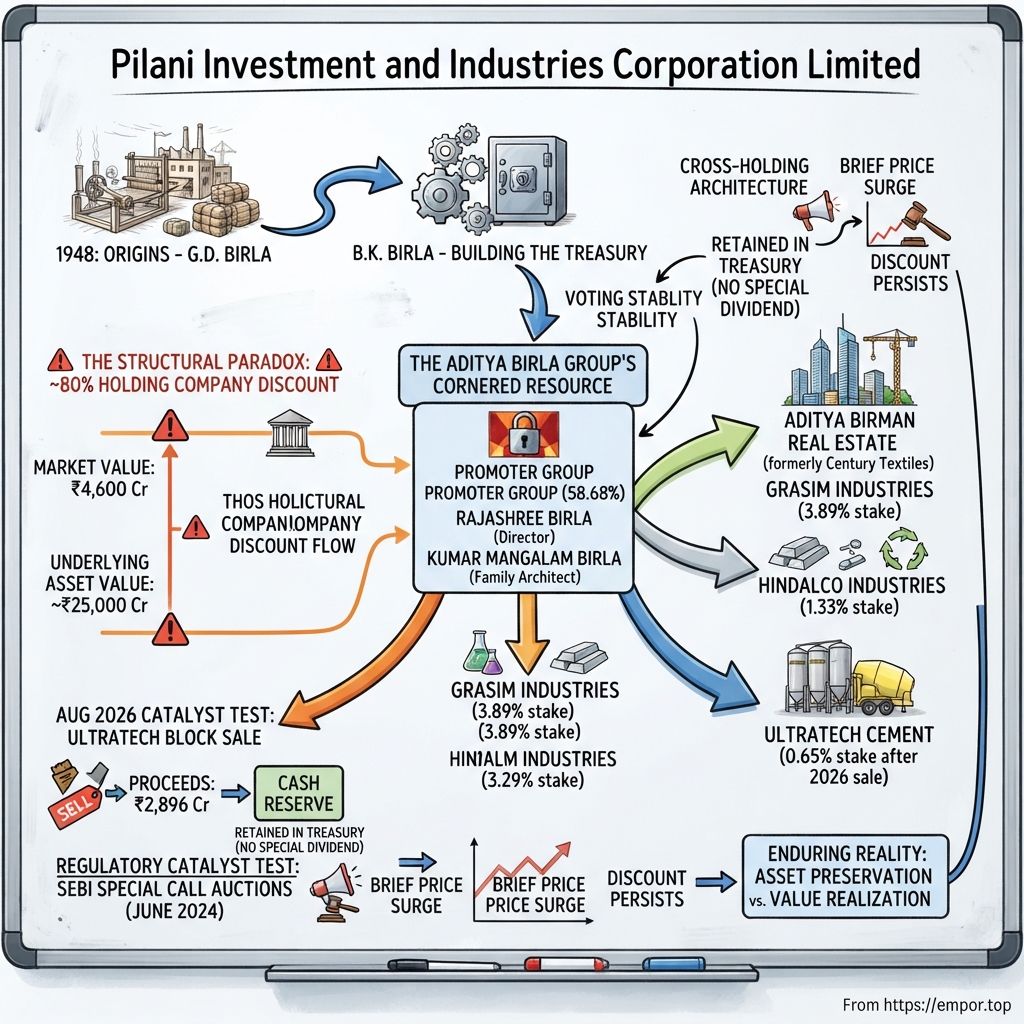
Its portfolio mirrors the industrial spine of the Aditya Birla Group: a stake in Grasim Industries, the chemicals-to-viscose-to-paints conglomerate; a commanding one-third interest in Aditya Birla Real Estate (formerly Century Textiles); a stake in Hindalco Industries, a major global aluminum producer through its Novelis subsidiary; and, until recently, a larger holding in UltraTech Cement, India's leading cement manufacturer.12 With smaller positions in Aditya Birla Capital, Aditya Birla Lifestyle Brands, and a minor residual stake in Vodafone Idea, market observers have valued the equity book between ₹23,000 crore and ₹26,000 crore.23
Here lies the structural paradox: the market capitalization of the holding company carrying these assets has persistently stayed below ₹4,600 crore.43 Put simply, public markets value a vault holding approximately ₹25,000 crore of liquid, listed, daily-priced equities at roughly one-sixth to one-fifth of its underlying asset value. This reflects a holding company discount of 78% to 82%, which has persisted as a baseline valuation for nearly two decades rather than a brief market anomaly.
Initial observers often assume hidden liabilities must account for the gap, such as off-balance-sheet debt, pledged shares, or undisclosed encumbrances. However, disclosures show a balance sheet that is nearly debt-free, while credit rating agencies consistently assign Pilani their highest short-term and near-highest long-term ratings.5[^7] The discount stems not from hidden risks, but from structural frictions: unavoidable capital gains taxes, unchallengeable promoter control, non-compellable dividend payouts, and constrained trading liquidity for holding company shares.
Two recent developments make this an opportune moment to analyze the structure.
The first was a major portfolio sale. On August 13, 2026, Pilani executed a rare transaction, selling 2.5 million shares of UltraTech Cement — approximately 0.85% of the company — via a secondary-market block trade at ₹11,585 per share, yielding gross proceeds of ₹2,896.3 crore.[^9]6 For a company with a market capitalization below ₹4,600 crore, a single trade generated cash equal to more than half its total market value.
Institutional and sovereign investors acquired the block, including HDFC Mutual Fund, ICICI Prudential, Kotak, Norges Bank, and JP Morgan.[^11] This participation demonstrates that the underlying portfolio assets can be liquidated immediately at full market value. The deep discount, therefore, reflects market pricing of the holding company wrapper rather than an asset liquidity penalty.
The second development was regulatory. In June 2024, the Securities and Exchange Board of India (SEBI) introduced a special call auction mechanism without price bands for listed investment companies whose shares traded infrequently and at deep discounts to net asset value.[^8] SEBI noted that low trading volumes combined with daily circuit limits prevented efficient price discovery. The framework provided a dedicated auction session without price caps to let buyers and sellers establish a market-clearing price. Pilani participated in these special call auctions in late 2024.7
These two developments highlight the central valuation debate: empirical proof of underlying asset liquidity alongside regulatory efforts to narrow the valuation gap. Yet the deep discount persists.
This situation raises a key strategic question. Is Pilani Investment a tax-inefficient promoter voting vehicle — a structure designed primarily to consolidate family control at minimal capital cost, leaving public shareholders with no operational leverage? Or is it a compelling deep-value asset in Indian public markets, offering exposure to ₹25,000 crore in operating businesses at eighteen paise on the rupee, awaiting a catalyst for value realization?
Evaluating this trade-off requires analyzing both perspectives and identifying the specific triggers that could alter the holding company's valuation dynamics. Understanding how the structure was established and why it has resisted change requires examining its origins shortly after Indian independence.
 Subscribe on LinkedIn
II. Origins: G.D. Birla, Basant Kumar, and the Cross-Holding Architecture
In 1948, one year after Indian independence, partition's wounds were raw, and the country's industrial capacity was concentrated among roughly a dozen business houses. Ghanshyam Das Birla — G.D. to contemporaries, a key financier to Mahatma Gandhi, and the industrialist in whose Delhi residence Gandhi was assassinated that January — was building an enterprise designed for generational longevity.
Pilani Investment and Industries Corporation was incorporated that year, named for the family's ancestral town.1 Its function was structural rather than operational. The Birla enterprise already spanned jute in Bengal, textiles across northern India, sugar, paper, and the early stages of cement and aluminum production. Each business operated as a separate entity, many with public shareholders. The family required a central vehicle to hold and fund equity stakes across the group without overextending the personal balance sheets of individual family members across generations.
Why the web was built the way it was
Understanding this architecture requires examining the regulatory constraints of post-independence India. From the mid-1950s through 1991, Indian industry operated under the License Raj, a system of strict government controls dictating production capacity, plant locations, and business expansion. Capital was rationed, foreign exchange was tightly controlled, and the Monopolies and Restrictive Trade Practices (MRTP) Act penalized the concentration of industrial assets within single corporate entities.
To build and maintain a large industrial footprint under these restrictions, business families faced distinct choices. Direct ownership of operating assets invited aggressive taxation and regulatory intervention, while equity dilution risked loss of operational control. The alternative was a pyramidal holding structure: a family retained control of a central investment company, which held dominant stakes in operating businesses that, in turn, held cross-stakes in one another and back in the holding vehicle. Control propagated downward through multiple corporate tiers, allowing the family to direct vast industrial assets with a fraction of direct equity ownership.
Similar pyramidal models existed globally, including the Wallenberg sphere in Sweden, the Agnelli structure in Italy, and Japan's pre-war zaibatsu. However, India's framework proved uniquely resilient due to structural market conditions. Underdeveloped capital markets made hostile takeovers nearly impossible to execute, while cross-holdings between operating entities ensured that any external acquirer buying a single unit would face a hostile block of treasury shares voting against them from within the network.
Pilani sat at the center of this framework. It was not established as an open-ended investment fund, but as a keystone designed to consolidate group governance.
B.K. Birla and the making of a treasury
G.D.'s son, Basant Kumar (B.K.) Birla, expanded this governance model over a career spanning seven decades. He assembled and managed Century Textiles and Industries, Kesoram Industries, Jay Shree Tea, and Century Enka, while presiding over the family's educational trusts.[^15]
B.K. Birla's role was central to Pilani's structural evolution. While his branch of the family directed the operating companies, Pilani held the equity blocks that secured voting control. The holding company functioned as the branch's central treasury, warehousing cross-holdings and maintaining control over Century Textiles and related entities. When his grandson, Kumar Mangalam Birla, assumed leadership of the broader Aditya Birla Group following the death of his father, Aditya Vikram Birla, in 1995, Pilani's cross-holdings remained the foundational voting architecture.
Testing the founding story
A flattering narrative often surrounds this history, suggesting that cross-holding structures were created as efficient capital allocation vehicles. Under this view, a central investment firm recycled dividends from mature businesses into emerging industries, providing minority shareholders with a professionally managed, diversified holding vehicle.
Historical disclosures do not support this interpretation. For public minority shareholders in Birla-style investment entities throughout the second half of the twentieth century, financial returns remained minimal. Dividend yields were historically low because holding companies within control pyramids prioritized capital retention over distributions to prevent cash from leaving the corporate group. Outside shareholders held no board representation, while secondary market liquidity remained constrained for decades, with shares trading infrequently on regional exchanges prior to the establishment of modern national exchanges and mandatory listing rules in the 1990s. Furthermore, public shareholders possessed no structural mechanism to redeem their holding company shares for the underlying equity portfolio.
The holding structure succeeded primarily as a defensive governance mechanism. It effectively insulated companies from hostile corporate bids during the takeover waves of the 1980s, when raiders targeted Indian firms with fragmented ownership. It also preserved family voting control across multiple generational transitions and survived major policy shifts, including MRTP regulations, the Foreign Exchange Regulation Act (FERA), nationalization initiatives, and the 1991 economic reforms.
Pilani was not designed primarily for minority equity investors and later diverted from that mission. It was built as an instrument of corporate control, has operated continuously under that mandate, and admitted public shareholders largely to fulfill listing compliance requirements. This structural reality defines executive decision-making, which prioritizes group voting stability over the holding company's standalone share price.
The remaining question is whether recent corporate restructurings and increased regulatory oversight have altered this historic dynamic.
III. Modern Era: Succession, Board Realignment & Century's Real Estate Pivot
In August 2018, a single-line regulatory filing signaled a key shift in how the family managed its corporate structure. Kumar Mangalam Birla, chairman of an industrial group spanning cement, aluminum, chemicals, telecommunications, financial services, and fashion, stepped down from the board of Pilani Investment. His mother, Rajashree Birla, assumed the directorship.8
For an operating company, a board change commands immediate attention. For a holding vehicle, it revealed how the family prioritized executive bandwidth. By 2018, Kumar Mangalam Birla was navigating major operational integrations: the merger of Vodafone India and Idea Cellular, the combination of Grasim and Aditya Birla Nuvo, and UltraTech's acquisition of Jaiprakash Associates' cement assets. Pilani did not require daily operational oversight; it required a trusted family representative. Rajashree Birla — widow of Aditya Vikram Birla and leader of the group's philanthropic initiatives — provided that continuity.
Less than a year later, in July 2019, Basant Kumar Birla died at age 98.[^15] His passing completed a generational transition across the family enterprise. The operating companies he had built — led by Century Textiles — consolidated under Kumar Mangalam Birla and Rajashree Birla without public governance disputes. The cross-holding architecture fulfilled its core design by maintaining voting stability during a generational leadership transfer.
Who actually owns this company
Understanding Pilani requires examining its shareholder register. The promoter group holds approximately 58.68% of the equity, distributed across a syndicate of Aditya Birla Group entities including Vasavadatta Services, Century Enka, and various corporate treasury vehicles.2 Public float accounts for roughly 11.3%, while domestic financial institutions hold about 1.4% and foreign portfolio investors hold approximately 0.4%.2
Combined institutional ownership sits below 2%. This low institutional presence reflects structural reality rather than an oversight by asset managers. Fund managers recognize that despite Pilani's underlying asset value, minority investors lack direct mechanisms to force value realization or influence corporate strategy.
The syndicate ownership structure also adds strategic friction. If the promoter stake were concentrated in a single entity, a future corporate reorganization could collapse the holding company relatively easily. Because ownership is spread across multiple listed and unlisted group companies — each with separate boards and minority shareholders — unwinding Pilani would require coordinating multiple corporate approvals, independent director consents, and tax clearances. The structure is built to resist casual unwinding.
From looms to luxury towers
A significant shift in Pilani's net asset value over the past decade occurred through changes within an underlying portfolio company rather than direct transactions by Pilani itself.
For decades, Century Textiles and Industries operated primarily as a textile and paper producer. Crucially, the company owned extensive real estate in central Mumbai, including mill land in Worli acquired when the area was an industrial hub. During the 2010s, Century exited textile manufacturing, transferred its cement operations to UltraTech, and reallocated capital toward real estate development under the Birla Estates brand. In 2024, the company formally renamed itself Aditya Birla Real Estate Limited.
Pilani holds a 33.29% stake in the entity, representing its largest single percentage holding in any listed operating company.2 As a result, Pilani's net asset value shifted from an exposure based on industrial paper and textiles to a leveraged claim on prime urban real estate.
This transition alters the risk and return profile for Pilani's shareholders. On one hand, a one-third stake in a prime real estate developer backed by valuable Mumbai land reserves represents a substantial asset whose economic value may exceed historical book carrying costs. On the other hand, residential property development exhibits higher cyclicality and working-capital intensity than traditional manufacturing. Consequently, a slowdown in high-end urban housing demand would impact Pilani's underlying asset value more directly than fluctuations in industrial output, reflecting a higher concentration of value in a single business segment than a surface-level list of holdings suggests.
Testing the simplification thesis
Investors in Indian holding companies often hypothesize that broader corporate restructurings will eventually extend to parent-level entities, narrowing the holding company discount as group structures simplify.
The Aditya Birla Group has repeatedly restructured its operating companies. Aditya Birla Nuvo merged into Grasim in 2017, Century's cement assets were integrated into UltraTech, Aditya Birla Capital was demerged and listed, and Aditya Birla Fashion and Retail separated its brand portfolio into Aditya Birla Lifestyle Brands.
Despite these extensive operational reorganizations over fifteen years, the parent holding architecture remained intact. Pilani was not collapsed, its equity stakes were not unbundled to public shareholders, and its cross-holdings were not dismantled.
This distinction reflects fundamental corporate incentives. Simplifying operating companies lowers capital costs and improves business visibility. By contrast, dismantling the holding company wrapper would eliminate the low-cost voting control that allows the promoter group to direct major operating entities while holding modest direct economic stakes.
The empirical record shows that operational simplification has not led to holding-level unwinding. The holding structure has been retained by design. Short of specific external catalysts — such as regulatory mandates or strategic capital reallocations — the underlying cross-holding architecture remains structured to preserve promoter voting control.
With the architecture and governing incentives established, the central question shifts to what sits inside the vault itself.
IV. Portfolio Deep-Dive: Sizing the Crown Jewels & Segment Economics
An examination of Pilani's equity vault reveals that its underlying economic value is overwhelmingly concentrated in a small selection of core assets.
The four that count
The largest economic position by value has historically been Grasim Industries, in which Pilani holds a 3.89% stake.2 Grasim serves as the Aditya Birla Group's primary manufacturing and holding vehicle, maintaining controlling positions in UltraTech Cement and Aditya Birla Capital while operating large standalone industrial businesses. Its core operations include viscose staple fiber, where it ranks among the world's largest producers, and chlor-alkali chemicals. In addition, Grasim launched Birla Opus, a major greenfield initiative targeting India's decorative paints market. The paints sector in India has historically generated high returns on capital and strong pricing power dominated by established leaders. Birla Opus represents a capital-intensive effort to capture market share through scale and distribution. Whether this expansion earns its cost of capital remains a key swing factor for Grasim's equity valuation and, by extension, Pilani's net asset value.
The largest position by ownership percentage is Aditya Birla Real Estate, at 33.29%.2 Following its transformation from Century Textiles, the company's economics reflect those of a premium residential property developer. Revenues are recognized upon project completion, cash flows are periodic, and enterprise value depends heavily on land bank quality and project launch timing, alongside a residual pulp and paper division.
Pilani also holds approximately 1.33% of Hindalco Industries.2 Hindalco operates as an integrated global aluminum producer. Its North American subsidiary, Novelis, is a leading provider of flat-rolled aluminum and recycling for the automotive and packaging industries, paired with low-cost upstream smelting operations in India. Because aluminum prices and recycling scrap spreads fluctuate with global market cycles, Hindalco provides cyclical commodity exposure within Pilani's equity book, while its smaller copper business provides demand exposure linked to electrification.
The fourth core asset is UltraTech Cement, in which Pilani holds roughly 0.65% following its August 2026 share sale, down from approximately 1.5%.2[^9] UltraTech maintains a leading scale position in the Indian cement industry, where regional freight economics create localized pricing discipline and cost advantages compound through consolidation. Pilani selected this specific liquid asset for its major capital monetization.
The rest
The remaining equity holdings represent a minor fraction of the total portfolio. Combined stakes in Aditya Birla Fashion and Retail and its demerged entity, Aditya Birla Lifestyle Brands, account for roughly 3.67% of Pilani's holdings.2 The position in Aditya Birla Capital stands at approximately 1.29%.2 Meanwhile, a 0.17% stake in Vodafone Idea retains minimal economic value, following years of subscriber losses and substantial government regulatory liabilities that severely eroded the telecom operator's equity base.2
How the money actually comes in
Pilani operates a highly simplified financial structure. Cash inflow is derived almost entirely from two sources: dividend distributions declared by underlying portfolio companies, and interest income earned on treasury assets, including bank deposits and inter-corporate loans.5
Operating expenses are similarly minimal. With no manufacturing facilities, sales organizations, or research departments, Pilani functions with a modest administrative staff. Credit rating agencies consistently highlight this low operational cost structure as negligible relative to underlying portfolio value.[^7] On an asset base valued at approximately ₹25,000 crore, annual overhead consumes a tiny fraction of one percent, resulting in an expense ratio lower than typical domestic equity index funds.
However, a low expense ratio offers limited benefit to public shareholders without an open-ended redemption mechanism. Investors in standard low-cost funds can subscribe or redeem units at net asset value. By contrast, public investors can trade Pilani shares on the open market, but possess no structural right to redeem them for the underlying equity portfolio. As a result, low operating costs do not resolve the structural discount imposed by the holding company wrapper.
Testing the optionality claim
Market observers sometimes argue that secondary holdings provide upside potential, framing small positions like Vodafone Idea or unlisted ventures as low-cost options on operational turnarounds.
Pilani's financial disclosures do not support this thesis. Secondary assets have historically resulted in impairments rather than asymmetric upside. Vodafone Idea has generated no dividend cash flows while suffering substantial equity value declines. Furthermore, smaller holdings contribute negligibly to overall dividend receipts, which represent Pilani's primary source of recurring cash flow. Financial data indicates that over 95% of Pilani's total portfolio value resides in its four primary holdings: Grasim, Aditya Birla Real Estate, Hindalco, and UltraTech.23
These metrics demonstrate that secondary holdings carry minimal weight in evaluating the company's intrinsic value. Pilani is functionally structured as a concentrated four-stock equity portfolio alongside a cash reserve. Consequently, the core analytical question is not what assets Pilani holds, but why owning them through this specific corporate vehicle results in an 80% discount to underlying market value.
V. Holding Company Economics, Regulatory Framework & Moat Analysis
Imagine two investors. The first buys ₹100 worth of Grasim, Hindalco, UltraTech, and Aditya Birla Real Estate directly, in the exact proportions Pilani holds them. The second buys Pilani shares representing a claim on that same ₹100 of underlying assets — and pays about ₹19. Both investors hold exposure to the same operating businesses, the same cash flows, the same factory operations, and the same executive management. Yet one pays five times more than the other.
In an efficient market, such a valuation gap would trigger immediate arbitrage. The reason it persists stems from three distinct barriers: regulatory, fiscal, and constitutional.
The RBI cage
Pilani is not simply a company that happens to own equities. It is registered with the Reserve Bank of India as a Core Investment Company — specifically a systemically important non-deposit-taking CIC, abbreviated in regulatory terminology as a CIC-ND-SI.5[^7] That registration imposes strict legal constraints on corporate action.
To qualify as a CIC, an entity must maintain at least 90% of its net assets in equity shares, preference shares, bonds, debentures, or loans in group companies, with no less than 60% held specifically in equity shares of group companies. Crucially, the regulations prohibit active trading in these assets; the entity cannot buy and sell group shares as a commercial dealing activity, permitting transactions only for block sales or dilution of holdings. Furthermore, the company must adhere to explicit leverage caps and an adjusted net worth requirement relative to risk-weighted assets.5
These rules fundamentally alter the investment case. In a standard closed-end fund trading at a deep discount, management can execute share buybacks below net asset value, immediately augmenting value for remaining shareholders until the discount narrows. Alternatively, an unconstrained investment vehicle can reallocate capital from overvalued positions into undervalued opportunities. Pilani, under the terms of its CIC registration, can pursue neither strategy freely. It cannot diversify away from the group, nor can it trade tactically. Regulatory restrictions bolt the entity to the Aditya Birla Group's equity, preventing management from arbitraging away the discount through corporate actions.
This structural constraint is a defining characteristic of Indian holding company investing, establishing the valuation discount as a permanent regulatory feature rather than a temporary market inefficiency.
The tax wedge
The second barrier is fiscal. When Pilani liquidated a portion of its UltraTech stake in August 2026, the realized gain — measured against a historical cost base built over decades — incurred substantial capital gains tax.[^9] Any portfolio liquidation, whether incremental or comprehensive, incurs a similar tax liability.
Consequently, calculating net asset value simply by multiplying share percentages by prevailing market prices produces an unadjusted figure. The actual recoverable asset value is net of tax liabilities. On holdings carrying near-zero historical cost bases, this tax haircut is material. Even under flawless governance, a rational market discount to gross asset value would exist simply to reflect embedded capital gains tax obligations — accounting for a fraction of the observed discount, though not the full four-fifths gap.
The constitutional problem
The third barrier concerns shareholder governance and legal rights.
A minority shareholder in Pilani possesses an economic claim on a portfolio without the corporate mechanisms required to exercise influence over it. Public shareholders cannot force asset sales, compel dividend distributions, pass a scheme of arrangement, or replace board members. Furthermore, the company provides limited investor relations channels, operating without quarterly earnings calls, analyst presentations, or formal management guidance.
Dividend policy illustrates this structural disconnect. Cash dividends paid by Grasim, UltraTech, and Hindalco flow directly into Pilani's treasury. However, the distribution passed through to Pilani shareholders represents a dividend yield of roughly 0.8% to 1.5% on market capitalization — modest relative to total incoming cash flows.2 The remainder is retained within the corporate structure, where public shareholders exercise no oversight regarding its allocation.
Running the frameworks
Evaluating Pilani through standard strategic frameworks highlights this structural imbalance.
Under Hamilton Helmer's 7 Powers framework, which identifies drivers of durable differential returns, Pilani possesses only one power: a Cornered Resource. The promoter group's 58.68% ownership stake represents an asset inaccessible to outside investors, granting the promoter syndicate voting control over Grasim, Hindalco, and Aditya Birla Real Estate at a small fraction of the cost of acquiring direct majority ownership in those operating entities.2 However, this strategic advantage accrues entirely to the promoter group rather than to public equity holders. For minority shareholders, Pilani shares offer no scale economies, network effects, counter-positioning, switching costs, branding, or process advantages.
Applying Porter's Five Forces yields a similar conclusion. The dominant force is buyer bargaining power, where public equity investors occupy a weak position characterized by lack of board representation, an inability to aggregate voting blocs, no right of exit at net asset value, and limited share liquidity. While supplier power and threat of substitutes remain secondary for a holding company, asset substitution is relevant: investors seeking exposure to the underlying operating businesses can purchase shares of Grasim, Hindalco, or UltraTech directly on public exchanges. The availability of direct market access ensures that the holding company wrapper must trade at a discount to attract public capital.
Testing the moat translation claim
A common premise among holding company investors is that underlying operational strength — such as UltraTech's cement distribution scale or Grasim's market position in viscose staple fiber — automatically enhances the quality of the holding company share.
Historical pricing data refutes this assumption. During extended bull markets in Indian industrial equities, when underlying portfolio companies experienced earnings growth and valuation re-ratings, Pilani's holding discount did not contract. In several periods, the discount expanded because net asset value grew faster than public markets re-priced the holding wrapper. The valuation gap functions less as an inefficient mispricing and more as a persistent structural toll.
This historical pattern clarifies how underlying performance translates to investor returns. If the discount percentage remains relatively stable, holding company shares still capture the compounding growth of underlying assets — a doubling of net asset value at a constant 80% discount yields a corresponding doubling of the holding company's share price. However, investors do not realize additional returns from discount contraction. Operational excellence in the underlying businesses drives asset compounding, but does not trigger a holding-level re-rating without an explicit structural catalyst. A sustained shift in the discount beyond its historical trading range across multiple consecutive quarters would be required to falsify this structural baseline.
That leads directly to the event that gave investors their best recent test of whether anything structural had changed.
VI. Capital Allocation & The August 2026 UltraTech Block Deal Catalyst
On August 13, 2026, brokers executed a major secondary market transaction, transferring 2.5 million UltraTech Cement shares at ₹11,585 per share. The block trade generated ₹2,896.3 crore in gross cash proceeds for Pilani Investment, a corporate entity that had historically maintained static equity holdings.[^9]6
The transaction provided a clear empirical test of the company's capital allocation dynamics and the nature of its valuation discount.
What the trade proved
The transaction demonstrated the underlying portfolio's immediate liquidity. Institutional buyers — including HDFC Mutual Fund, ICICI Prudential, Kotak, Norges Bank, and JP Morgan — absorbed the block near prevailing market prices.[^11] This institutional participation confirms that Pilani's core assets are neither illiquid nor subject to a marketability penalty. If management chose to monetize holdings, public markets offer immediate liquidity at full market value.
This transaction eliminates asset illiquidity as an explanation for the holding company discount. The valuation gap reflects market pricing of the corporate wrapper rather than a penalty on the underlying assets.
The deal also revealed how the promoter group prioritizes portfolio sales. UltraTech Cement represents one of the highest-quality operating businesses in the portfolio. Liquidating a stake in a core compounder — rather than selling cyclical or impaired holdings — indicates that transaction scale and market depth drove the execution, rather than an asset-quality assessment that cement was an unattractive long-term holding.
Where does the cash go?
The deployment of the sale proceeds defines the central capital allocation question for minority shareholders.
For a company with a market capitalization below ₹4,600 crore, gross proceeds of ₹2,896 crore represented cash equal to more than half its total market valuation.4[^9] That cash influx created three potential capital deployment pathways:
First, management could declare a special dividend. Distributing even a fraction of the cash would generate a substantial dividend yield relative to Pilani's market value. Because the promoter group holds 58.68% of the equity, the family syndicate would receive the majority of any cash distribution.2
Second, Pilani could execute a share buyback at a price between market value and net asset value. Buying back shares at a discount would immediately increase net asset value per share for continuing holders. However, from a promoter perspective, a buyback transfers capital out of the control vehicle to public shareholders while setting a precedent of active discount management.
Third, management could retain the funds within bank deposits and inter-corporate loans, preserving capital for prospective group funding requirements.
Disclosures confirm that management selected the third path. Following the transaction, proceeds were retained within the group treasury framework rather than distributed as a special dividend to public shareholders.7 This outcome bears directly on the catalyst thesis: the largest single asset monetization in the company's recent history — generating cash equal to over half of Pilani's market capitalization — yielded no direct cash distribution to minority investors.
The auction that was supposed to fix this
The regulatory framework attempted a structural solution earlier in 2024. Recognizing that holding company shares traded infrequently at persistent discounts, SEBI issued a June 2024 circular establishing a special call auction mechanism without daily price bands.[^8] The mechanism aimed to facilitate efficient price discovery by allowing buyers and sellers to establish a market-clearing price in a single session without price caps.
While the design addressed trading friction, the structural impact proved temporary. During the initial sessions in late 2024, several holding company equities experienced brief price surges before returning to historical discount ranges.7 The outcome highlights a key distinction between market mechanics and investment demand. An auction mechanism improves price discovery, but cannot alter underlying asset demand. If public investors demand a discount because the holding company wrapper grants no operational governance rights, removing price bands allows the market to establish that same structural discount more efficiently.
Testing the catalyst thesis
Combining these two events provides an empirical test of whether regulatory interventions or major portfolio monetizations act as catalysts to narrow holding company discounts.
Evidence from both events refutes that thesis. During the regulatory test in late 2024, initial price gains faded as trading volumes remained limited, leaving the valuation discount intact.7 Similarly, during the corporate test in August 2026, cash proceeds exceeding half of Pilani's market capitalization were retained in treasury vehicles rather than distributed to public equity holders.7
What remains is a more specific dynamic. Portfolio monetization does not automatically unlock minority value, but it alters the composition of net asset value. Replacing an appreciating equity holding with cash eliminates future capital gains tax uncertainty on that position while dampening overall portfolio volatility. The ultimate impact on minority shareholders depends on how that cash is redeployed. If management uses the capital to fund group entities generating lower returns on capital than UltraTech Cement, the transaction transfers economic value from Pilani's public shareholders to broader group priorities. If the funds remain in low-yielding cash reserves or eventually support shareholder distributions, the valuation impact takes a different path.
The pattern indicates that evaluating Pilani requires focusing not merely on balance sheet asset values, but on the governance framework that dictates how those assets are deployed.
VII. Governance Audit, Management Credibility & Skeptical Stress Test
Searching for a Pilani Investment earnings call transcript, an investor presentation explaining the ₹2,896 crore UltraTech share sale, or management commentary outlining a capital allocation framework yields no results.
None of these documents exist. Pilani's investor relations footprint is strictly limited to mandatory filings: annual reports, quarterly financial results, shareholding patterns, and statutory exchange disclosures.[^2]9 The company maintains no voluntary reporting layer—issuing no forward guidance, hosting no analyst days, and conducting no investor Q&A sessions.
This minimal disclosure reflects corporate posture rather than non-compliance. Pilani fulfills its statutory requirements, submits audited accounts, and maintains top-tier credit ratings from CRISIL and CARE.5[^7] The entity operates purely as a corporate treasury and compliance vehicle rather than a company seeking public equity capital. Having no requirement to raise outside capital, it maintains no investor outreach program.
The board
The board is chaired by Rajashree Birla in a non-executive capacity.8 Rather than employing an active executive managing director to steer strategy, day-to-day administration is managed by key managerial personnel and secretarial staff, overseen by a board that meets statutory independence requirements.
While a lean executive structure might raise concerns at an operating company, it aligns with a holding entity whose primary functions are receiving dividends and executing occasional block trades. Employing an extensive management team for a portfolio that regulatory rules prohibit from active trading would add unnecessary overhead. The primary governance challenge is not executive staffing, but the absence of a mechanism ensuring that the interests of the 41.3% non-promoter shareholders are represented when deciding how to allocate major cash inflows, such as the ₹2,896 crore block sale proceeds.
Assessing management credibility
Assessing management credibility typically involves comparing forward-looking commitments against actual execution. Pilani presents an unusual case because management makes virtually no public commitments, leaving no guidance record to evaluate.
This absence of guidance provides its own analytical clarity. Without forward-looking targets, management avoids broken promises, missed guidance, or shifting strategic narratives.
Instead, management credibility must be evaluated through long-term corporate behavior. Across multiple market cycles, group restructurings, a generational leadership transition, and regulatory reforms designed for investment companies, management has consistently prioritized structural preservation and capital retention. The company has not executed share buybacks to exploit the valuation discount, distributed block-sale windfalls as special dividends, or proposed schemes to distribute underlying portfolio shares directly to shareholders.
This historical record reflects deliberate strategy rather than operational oversight. Management is not failing to unlock value due to inattention; it is consistently pursuing a distinct objective: preserving low-cost voting control across the group's operating companies. Investors who anticipate proactive discount intervention misjudge management's primary objective rather than its execution capability.
The activist stress test
Evaluating the potential for activist-driven value creation highlights severe structural limitations.
A shareholder-led restructuring, such as a scheme of arrangement to demerge holdings and distribute shares directly, requires formal proposal by the board, approval by a supermajority of voting shareholders, and sanction from the National Company Law Tribunal. Because the board is appointed by a promoter group holding 58.68% of the equity, management will not propose a corporate reorganization opposed by the controlling syndicate.2
Accumulating an influential voting stake through public markets presents similar hurdles. With a public float of roughly 11%, trading liquidity is constrained.2 Acquiring a sizable position would drive up share prices against the buyer, while acquiring the entire public float would still leave an investor well short of the votes required to challenge promoter control.
Legal avenues offer limited leverage. While Indian corporate law provides remedies for oppression and mismanagement, retaining cash on a debt-free balance sheet without explicit dividend commitments does not constitute legal oppression under established precedents.
Consequently, standard activist strategies—such as proxy contests, board representation campaigns, tender offers, and shareholder litigation—cannot force structural changes in this governance environment. While activist interventions have narrowed holding company discounts in international markets, that playbook cannot be readily applied to Pilani.
What would actually work
Because external shareholder pressure cannot force restructuring, mechanisms to narrow the valuation discount depend on either voluntary promoter action or regulatory mandates:
A voluntary promoter buyback or open offer near net asset value would narrow the valuation gap immediately. While the promoter group possesses the financial resources, executing a buyback would require a shift in capital allocation priorities that shows no sign of emerging.
A tax-neutral demerger of portfolio shares to Pilani shareholders—distributing proportional stakes in Grasim, Hindalco, and Aditya Birla Real Estate directly—represents the most direct structural solution. Unbundling the portfolio would eliminate the holding company wrapper and its associated discount. However, it would also dismantle the low-cost voting vehicle protecting promoter control, explaining why such a proposal has not been advanced.
A SEBI mandate enforcing minimum dividend pass-through requirements for core investment companies represents a potential regulatory path independent of promoter initiative. While no such rule exists, SEBI's 2024 implementation of special call auctions demonstrates active regulatory oversight of investment company valuation gaps.[^8]
Testing the alignment claim
Evaluating shareholder alignment requires testing the common assumption that management's primary goal is maximizing the holding company's share price.
Historical evidence refutes this premise. At annual general meetings, the promoter syndicate has consistently voted to support board positions on dividend distributions and capital retention, while post-monetization proceeds have been retained within treasury accounts rather than distributed.7 Because the promoter group's economic wealth is overwhelmingly concentrated in the underlying operating companies rather than Pilani equity, a higher standalone share price for Pilani provides minimal financial benefit to the family, whereas preserving the cross-holding structure secures voting control across the enterprise.
This incentive structure requires a distinction between asset preservation and value realization. Management remains aligned with public shareholders regarding asset preservation: portfolio holdings remain intact, the balance sheet carries minimal debt, and asset integrity is maintained. However, management is not incentivized to pursue immediate value realization for minority holders. Conflating asset protection with active discount reduction remains a key analytical misstep for investors evaluating the security. This baseline model would be falsified only by an unprompted corporate action—such as a board-initiated buyback, special dividend distribution, or demerger proposal—that returns capital to shareholders without regulatory compulsion.
The distinction between preserving underlying assets and realizing public market value defines the core economic reality of Pilani Investment.
VIII. Playbook: Business & Investing Lessons
Every deep-value investor eventually encounters a situation like Pilani. The structure recurs across public markets and business cycles, offering clear lessons for asset evaluation.
Lesson one: quality assets do not cure a broken wrapper. The impulse to acquire high-quality businesses at a discount is understandable, but the error lies in assuming the market discounts the underlying assets rather than the corporate wrapper. Pilani holds four major operating positions, yet its stock has traded at an 80% discount for nearly two decades. Before underwriting a holding company discount, investors must examine the legal mechanism: through what specific corporate action does a shareholder's claim convert into the underlying assets? If no such mechanism exists, the discount represents a structural feature rather than a margin of safety.
Lesson two: regulators can fix plumbing, not governance power. SEBI's special call auction targeted trading friction—specifically, daily price bands that prevented efficient price discovery in illiquid securities.[^8] The mechanism functioned as intended but altered nothing structural, because trading mechanics were never the primary constraint. When evaluating regulatory catalysts, market participants must distinguish between operational trading friction and core governance structures, identifying which barrier a regulatory rule actually addresses.
Lesson three: a holding company's asset profile can shift without parent-level action. Pilani made no strategic pivot into real estate; Century Textiles executed that transformation independently. As a result, one-third of Pilani's largest equity holding shifted from industrial manufacturing into premium residential real estate, introducing distinct cyclical risks and capital requirements.2 An investor who purchased Pilani shares a decade ago for industrial conglomerate exposure now holds a substantially different portfolio mix. Consequently, analyzing a holding company requires tracking the strategic evolution of each underlying business, as net asset value composition can change without any action by parent management.
Lesson four: a deep discount provides downside defense, not a return strategy. Purchasing assets at eighteen paise on the rupee offers downside protection: even if the underlying portfolio's value declines by 40%, net asset value remains well above market capitalization, while a debt-free balance sheet eliminates forced liquidation risk during market downturns.5 This structural buffer has historically attracted long-term capital.
However, capital protection does not guarantee investment returns. Historical evidence indicates that the valuation discount does not contract automatically, does not narrow purely from operational performance in underlying companies, and did not close following regulatory reform or major asset sales. Without a specific structural catalyst, investor returns depend entirely on underlying asset compounding—growth that investors can capture directly by purchasing listed operating companies with full market liquidity and voting rights. Capturing excess returns from discount contraction requires a structural catalyst that has not materialized over the past two decades. A persistent valuation gap without a realization mechanism remains a structural constraint rather than an actionable opportunity.
This reality leaves a final strategic question: what specific catalysts could alter this long-standing valuation dynamic?
IX. Strategic Position, Bull vs. Bear Case & Key KPIs
The bull case
The bull case does not depend on the valuation discount closing, making the thesis more resilient than it first appears.
Its foundation rests on asset compounding across operating subsidiaries. If Grasim's Birla Opus paints initiative captures durable market share in an industry historically dominated by high-return incumbents, it would materially enhance Grasim's long-term earnings power.2 Similarly, UltraTech's position as India's leading cement manufacturer benefits from the direct connection between national infrastructure spending and cement consumption, where cost advantages compound with scale. Meanwhile, Aditya Birla Real Estate's residential pipeline in Mumbai and Bengaluru sits on land carrying historical accounting values that likely understate its true economic worth. Even if the holding company discount remains fixed, compounding growth across these operating assets flows through proportionally to Pilani's stock price.
The second leg relies on regulatory optionality. Through its 2024 special call auction framework, SEBI demonstrated that market regulators view persistent holding company discounts as a structural issue requiring intervention.[^8] Potential future measures—such as mandating minimum dividend pass-through ratios for core investment companies or establishing tender-offer requirements—could substantially alter valuation dynamics. This represents asymmetric upside optionality rather than a baseline expectation.
The third leg is balance sheet protection. Following the August 2026 UltraTech share sale, Pilani holds a substantial liquid cash reserve alongside an unlevered balance sheet.[^9][^7] The entity carries no debt service obligations, debt covenants, or forced-liquidation triggers. For investors prioritizing capital preservation over annualized return targets, this structural buffer provides downside defense.
The bear case
The bear case serves as the functional baseline: the structural status quo persists.
The discount has traded within a 75% to 85% range across nearly two decades, enduring bull and bear markets, corporate restructurings, a generational leadership transition, and dedicated regulatory changes.73 Because the promoter group has little incentive to dismantle a structure that secures low-cost voting control across the enterprise, continuation remains the standard analytical expectation absent external regulatory mandates.
The second risk involves capital redeployment. Following the monetization of 2.5 million UltraTech shares, roughly ₹2,896 crore in cash sits where a prime equity holding previously compounded.[^9] If management redeploys these funds into group entities generating lower returns on capital—such as the telecommunications exposure already present in the portfolio's tail—the transaction represents a value-dilutive reallocation for minority shareholders, executed to serve broader group priorities rather than standalone returns.
The third constraint stems from market microstructure. Daily trading volumes remain constrained, institutional ownership totals less than 2%, and the company operates without analyst coverage or management roadshows.29 Consequently, exiting a substantial position incurs meaningful market impact costs. This limited trading liquidity does not merely complicate execution; it actively reinforces the holding company discount.
Industry framing
Relative to peer Indian family holding structures—such as those of the Tata, Bajaj, and Kalyani groups—Pilani trades toward the wider end of the discount spectrum. Comparing these vehicles reveals that valuation gaps correlate less with underlying asset quality than with two operational factors: whether the holding entity owns standalone operating businesses that generate direct earnings, and whether management maintains a history of active capital returns to shareholders. Holding companies that combine operating assets with consistent distribution policies trade at narrower discounts. Pilani features neither.
Applying strategic frameworks at the operating level presents a stark contrast to the holding company's valuation. The underlying businesses possess clear competitive advantages: UltraTech maintains scale economies within a freight-sensitive cement market; Grasim commands process advantages in viscose while investing to build market position in decorative paints; and Hindalco combines low-cost upstream aluminum smelting with Novelis's global recycling network. Similarly, analyzing sector dynamics shows that Indian cement benefits from high entry barriers linked to limestone reserves and logistics networks, while aluminum remains exposed to global commodity cycles and real estate requires heavy working capital.
However, these operational strengths sit one corporate tier below the public investor's equity claim. As two decades of market pricing demonstrate, operational performance in underlying companies does not automatically compress the parent-level valuation discount. Public shares in Pilani function essentially as a derivative claim on the Aditya Birla Group's equity assets, subject to a persistent structural discount.
The three KPIs that matter
Evaluating Pilani's ongoing investment case requires filtering out secondary noise and monitoring three specific indicators:
The net asset value discount. Calculating net asset value from disclosed equity holdings and market prices provides the primary benchmark. Tracking whether the valuation gap moves permanently outside its historical 78% to 82% trading range offers the clearest signal of a structural shift in market pricing or corporate governance.
The dividend pass-through ratio. Tracking the percentage of inter-corporate dividends received from Grasim, UltraTech, and Hindalco that management passes through to Pilani's public shareholders measures governance alignment over time.[^2] Annual report disclosures will reveal whether this payout ratio shifts, offering an early indicator of potential capital allocation changes.
The deployment of monetization proceeds. Observing how management allocates the ₹2,896 crore cash reserve generated by the August 2026 UltraTech share sale provides empirical insight into governance priorities.[^9]7 Retaining funds in treasury deposits, initiating a share buyback, or funding group equity issues will clarify whether capital deployment serves minority equity holders or broader enterprise goals.
Tracking these three metrics requires no speculative forecasting—only systematic monitoring of disclosed corporate actions.
X. Epilogue & Closing Reflections
There is an almost archaeological quality to Pilani Investment and Industries Corporation. Incorporated in the first year of independent India, named after a town in the Rajasthan desert, and established by an industrialist who helped finance the freedom movement, the company has survived the License Raj, economic liberalization, three generations of family succession, the passing of the patriarch who used it as his central treasury, and regulatory efforts to alter how public markets price it.1[^15] Through all of it, the corporate entity has fulfilled a singular mandate: to hold.
The broader lesson Pilani presents is not primarily about cement, aluminum, viscose, or Mumbai real estate, despite its underlying claims on each of those assets. Rather, it illustrates the structural gap between owning an asset and controlling one, as well as how persistently public markets price that distinction. Nearly eight decades after its incorporation, the market's evaluation of an economic claim lacking operational control has remained remarkably consistent: roughly one-fifth of underlying asset value.
For long-term investors, Pilani is best evaluated not as a mispriced bargain, but as a specialized holding vehicle with distinct characteristics. It offers proportional exposure to a portfolio of major Indian industrial enterprises, backed by a debt-free balance sheet and substantial equity assets, at a purchase price that has historically reflected a deep and persistent structural discount. In exchange, the vehicle offers public shareholders no operational voice, minimal dividend distributions, no dedicated investor relations dialogue, and no direct mechanism for value realization.
Whether that combination remains compelling depends on which specific characteristics an investor prioritizes. If the objective is simply economic exposure to the Aditya Birla Group's compounding assets, the holding company wrapper imposes a heavy discount while reducing liquidity and shareholder rights—all while the underlying operating shares remain directly accessible on public exchanges. If the objective is speculating on a catalyst for structural change—such as a tax-neutral demerger, a promoter buyback, or a regulatory mandate—the two-decade record of potential triggers failing to compress the discount provides the most relevant empirical evidence.
The vault is real. The underlying equity assets are real. And for nearly eight decades, the governance lock preserving the structure has proven equally durable.
References
-
Pilani Investment and Industries Corporation Limited — Official Corporate Website ↩↩↩
-
Screener.in — Pilani Investment Consolidated Financial Data & Shareholding Pattern ↩↩↩↩↩↩↩↩↩↩↩↩↩↩↩↩↩↩↩↩↩
-
Moneycontrol — Stock Overview & Portfolio Details of Pilani Investment ↩↩↩↩
-
BSE India — Pilani Investment and Industries Corporation Ltd (539874) Stock Information ↩↩
-
CRISIL Ratings — Pilani Investment Rating Rationale, 2024-06-25 ↩↩↩↩↩↩
-
Business Standard — UltraTech Cement Block Trade: Pilani Investment Offloads 2.5 Million Shares, 2026-08-13 ↩↩
-
Moneycontrol — SEBI Special Call Auction Framework for Holding Companies: Price Discovery Breakdown, 2024-10-28 ↩↩↩↩↩↩↩↩
-
DNA India — Kumar Mangalam Birla Steps Down from Pilani Investment Board, Succeeded by Rajashree Birla, 2018-08-14 ↩↩
-
NSE India — Pilani Investment and Industries Corporation Limited (PILANIINVS) Stock Quote ↩↩
 LinkedIn
 WhatsApp
 Reddit
 Hacker News
 Email
Email Kindle
 RSS Feed
 Spotify
 Apple Podcasts
 Amazon Music
 Audible
 YouTube