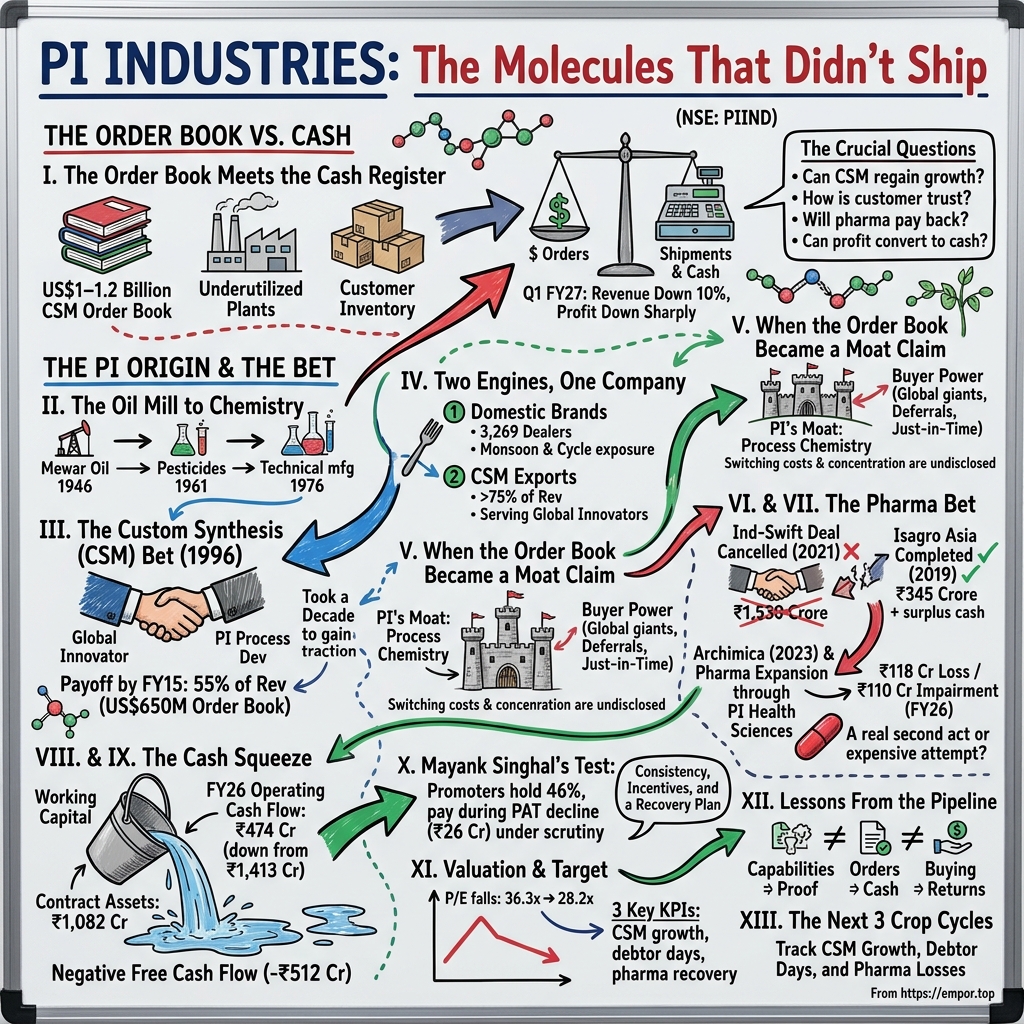
PI Industries: The Molecules That Didn’t Ship
I. The Order Book Meets the Cash Register
Somewhere on a plant floor in Gujarat, a batch of chemistry is finished. It was made to a recipe that belongs to someone else, a global crop-protection company that invented the molecule, patented it, registered it with regulators on several continents and now sells it to farmers under its own brand.
PI Industries did the hard, invisible part. It worked out how to make the thing reliably at industrial scale, ran the reactions, purified the product, tested it, and packed it. And then, through much of the fiscal year that ended in March 2026, a great deal of that kind of material did not go anywhere. The customer did not want it yet.
That is the contradiction at the heart of PI Industries today. On paper the company has never had more work in hand. Its credit rating agency describes a confirmed order book of between US$1 billion and US$1.2 billion for its custom-synthesis-and-manufacturing business, known inside the company and across the industry as CSM.1 Yet management told analysts in May 2026 that its plants were running a little below 80% of capacity,2 and the balance sheet was filling up with customer-specific inventory that had been made, but not yet shipped, invoiced or paid for.3
The numbers from fiscal 2026 tell the story bluntly. Consolidated revenue fell about 16%, to roughly ₹6,700 crore from about ₹8,000 crore, and consolidated profit after tax fell from about ₹1,660 crore to about ₹1,320 crore.3 The fall in revenue was bad; the fall in cash was worse. Cash generated by operations dropped to about ₹474 crore, a third of the roughly ₹1,413 crore generated the year before.3 A company that had long turned most of its profit into cash suddenly turned barely a third of it into cash.
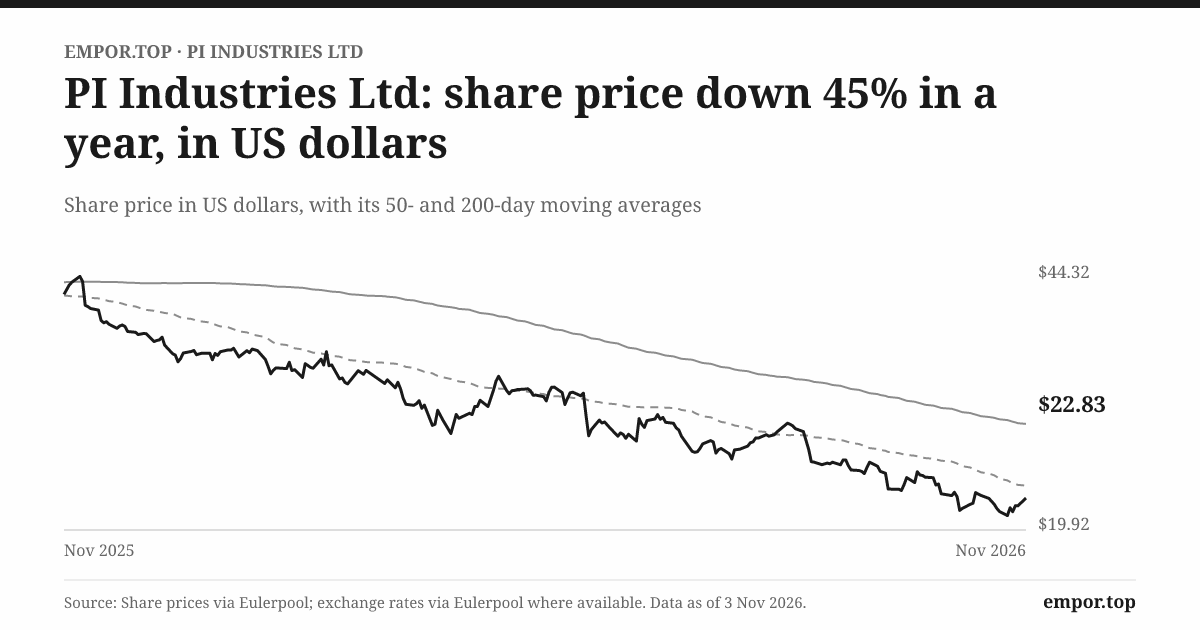
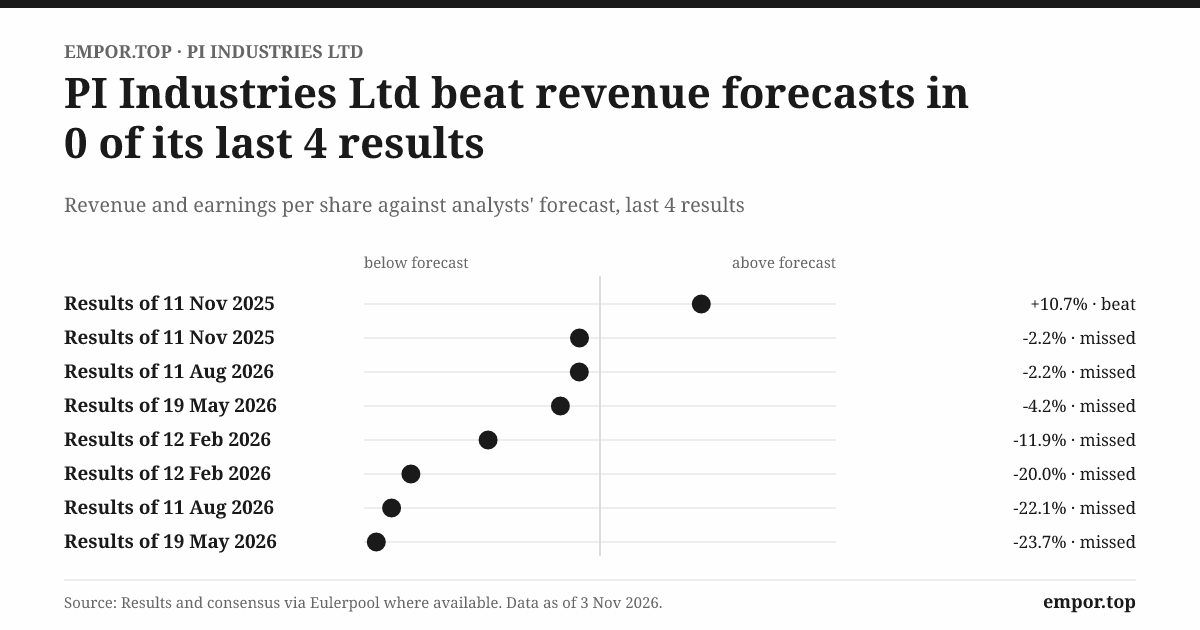
Then came the first quarter of fiscal 2027, the three months to June 2026. Management had pointed to an order book and to customers working through their inventories, so investors were looking for the turn. Instead revenue fell about 10% from a year earlier and net profit fell by close to 40%.4 The share price tells the rest. On November 3, 2026, PI traded around ₹2,166, roughly 43% below its 52-week high of ₹3,814, valuing the company at about ₹32,900 crore.5
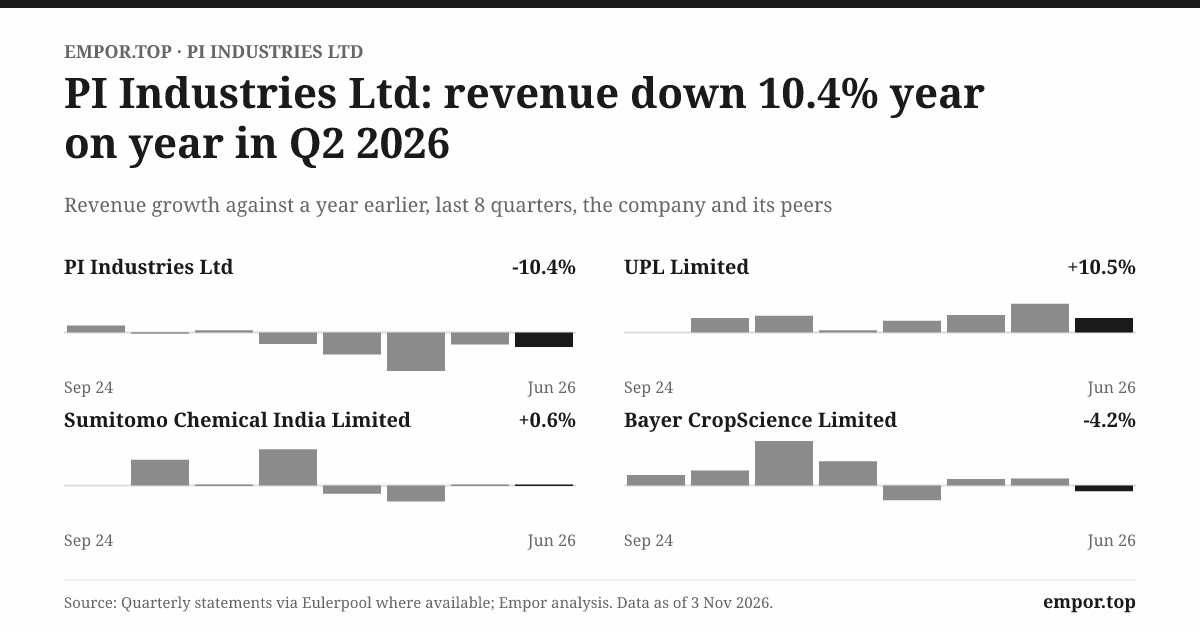
The shape of the decline matters as much as its size. In the quarter to June 2023, PI's revenue was still growing at almost a quarter a year.6 Growth then faded quarter by quarter until, by the end of calendar 2024, it had all but stopped.6
In fiscal 2026 it went negative, and the worst point came in the quarter to December 2025, when revenue fell by more than a quarter from a year earlier.6 The two quarters since have been less severe, with revenue down by about a tenth in each.4 That is the pattern of a downturn that has eased without reversing: the bleeding slowed, but it did not stop.
So the central question of this story is simple to state and hard to answer. Is PI living through a temporary inventory pause, the kind the agrochemical industry has suffered before, after which orders flow again and plants fill up? Or has the custom-manufacturing engine that made PI one of India's most admired chemical companies lost some of its old earning power for good?
Four smaller questions sit inside that one, and they run through every chapter that follows. The first is whether CSM can regain its role as a growth engine, rather than simply an engine. The second is how durable the trust between PI and its customers really is, given that those customers own the molecules and decide when to buy. The third is whether PI's newer businesses, above all its push into pharmaceutical contract manufacturing, will ever earn back what has been invested in them. And the fourth, which turns out to be the most immediate, is whether management can convert reported profit back into cash.
A word on boundaries before the story begins, because it matters for the numbers. The subject here is PI Industries Limited, the company listed on the National Stock Exchange as PIIND and on BSE, together with the subsidiaries it controls and consolidates, including PI Health Sciences and PI AgSciences.3 CRISIL, the rating agency, analyses a slightly wider "PI group" that combines the listed company with specified subsidiaries and affiliates, so its figures for debt, net worth and liquidity do not map exactly onto the listed company's own accounts.1 Where this story uses CRISIL's numbers, it says so.
The stakes are clearest when PI's recent record is set against its longer one. Over the ten years to March 2026, revenue compounded at about 12.5% a year and net profit at about 15.5%, a record most industrial companies anywhere would envy.3 Over the last three years, revenue grew barely more than 1% a year and profit a little over 2%.3 The long record says PI knows how to build. The recent record says that building, on its own, no longer guarantees growth.
The order book is real visibility. But an order is not a shipment, and a shipment is not cash. To understand why that gap has become the whole investment debate, it helps to go back to the moment this company first decided to stop being what it was.
 Subscribe on LinkedIn
II. The Oil Mill That Became a Chemistry Company
In 1946, a year before India's independence, P.P. Singhal incorporated a company in Udaipur, in what was then the princely state of Mewar, under the name Mewar Oil & General Mills.7 It was exactly what it sounds like: an agricultural commodity business, processing oilseeds in a region where most people still made their living from the land. Nothing about it suggested a future making sophisticated molecules for multinational chemical companies.
What changed was India itself. The newly independent country was haunted by the memory of famine and dependent on food imports, and in the decades after 1947 agricultural productivity became a national obsession. Better seeds, fertiliser and irrigation were part of the answer. So was protecting crops from the insects, fungi and weeds that could destroy a harvest before it reached the market. Crop protection, once a niche, became a matter of national priority.
In 1961, the company entered the pesticide business, formulating and marketing crop-protection products.7 Formulation is the downstream end of the trade: a company buys an active ingredient, the chemical that actually does the work, and mixes it with solvents, carriers and other agents into a product a farmer can spray. It is closer to marketing and distribution than to chemistry. The company that had milled oil now sold protection for the crops that produced it, a shift from processing an agricultural commodity to selling an agricultural input.
The decisive step came in 1976, when the company began manufacturing technical-grade active ingredients itself.7 That was a different business altogether. Making a technical, as the industry calls it, means running multi-step chemical reactions, controlling impurities, handling hazardous reagents and building plants that can do all of that safely. Along the way the company's name followed its identity: Mewar Oil gave way to Pesticides India, and later to PI Industries.7
The popular telling of PI's origin often frames this as the story of an oil business that failed and a family that reinvented itself out of necessity. The record supports something narrower and more interesting. It documents a pivot, from commodity processing into formulation and then into manufacturing chemistry; it does not establish that the oil business simply collapsed. What it does show is a pattern that would recur: PI repeatedly moved up the chain toward the harder, more technical part of the work.
The man who carried that move furthest in the company's middle years was Salil Singhal, P.P. Singhal's son, who took the leadership from 1979.8 He would go on to become one of the best-known figures in Indian agrochemicals, and in 2015 Business Today named him among India's best CEOs, describing a leader who said he preferred quality to numbers.8 The phrase is worth holding onto, because it captures the instinct that shaped what PI became. A company that cares about quality over volume does not try to win by being the cheapest formulator of off-patent products. It tries to win by doing things others cannot.
Under Salil Singhal, the generational handoff was also a handoff in ambition. Selling branded pesticides in India was a respectable business, but it was crowded and seasonal, tied to the monsoon and to the credit cycles of rural dealers. Manufacturing depth offered a way out of that crowd. If PI could build real chemical capability, it could serve not only Indian farmers but the global companies that invented the molecules in the first place.
That is the question that matters for the present day, far more than the oil mill. Why would an Indian company that already sold its own products under its own name decide to make molecules for other companies, under their names, to their specifications, on their schedules? The answer is the bet that defined PI. It took the better part of two decades to pay off, and it is the same bet that is now being tested.
III. The Bet That Took a Decade to Pay Off
In 1996, PI started a custom synthesis and manufacturing business.7 It is hard to overstate how unglamorous the idea looked at the time. India was known in global chemicals mainly as a source of cheap generics: off-patent molecules made in bulk and sold on price.
Global agrochemical innovators, the companies that spent years and fortunes discovering and registering new active ingredients, did not routinely hand their newest patented chemistry to Indian manufacturers. Intellectual property protection was a live worry. So was quality. So was the simple question of whether a supplier on the other side of the world could be trusted with a product whose launch depended on it.
The distinction at the heart of CSM is worth spelling out, because it explains both the strength and the vulnerability of the model. In custom manufacturing, the innovator owns the molecule. It owns the patent, the regulatory registrations, the brand, the relationships with distributors and farmers, and the decision about how much to make and when.
PI owns something else: the process. It works out how to take a molecule that might have been made in grams in a laboratory and produce it in tonnes, consistently, safely and at a cost that leaves both parties a margin. Then it makes the customer-specific active ingredient or intermediate and ships it.
A useful analogy is a master chef who cooks someone else's signature dish for a restaurant chain. The restaurant owns the recipe and the brand, sets the menu and decides how many plates to order. The chef's value lies in being able to cook that dish perfectly, thousands of times, in a kitchen built for it. If the chain changes its menu or cuts its order, the chef cannot sell the dish elsewhere.
The work itself follows a long arc. It begins in process research, where chemists look for a synthetic route that avoids dangerous intermediates, minimises steps and gives high yields. It moves into scale-up, where a reaction that behaves nicely in a flask can behave very differently in a large reactor, because heat builds up faster than it escapes and mixing becomes uneven.
Analytical chemists must develop methods to detect impurities at tiny concentrations, because a regulator approved the product with a specific impurity profile and the customer cannot deviate from it. Safety engineers must understand what happens if a reaction runs away. Only then comes commercial production, and even then the first commercial batches are a test.
That arc explains why the business took so long to matter. A technically sound process is not enough. It must be reproducible from batch to batch, compliant with environmental and safety rules, and reliable enough that a customer will build its own launch plans around it. Each of those proofs takes time, and trust accumulates only as batches are delivered. By PI's own historical account, the custom synthesis business did not gain substantial traction until around fiscal 2008, roughly a dozen years after it began.7
Once it did, it changed the company. By fiscal 2015, CSM accounted for about 55% of PI's revenue, and the company spoke of an order book of around US$650 million.8 In less than a decade from first traction, the business that had looked like a side bet had become the larger part of PI. The company's fiscal 2015 accounts show revenue of about ₹1,900 crore and return on equity above 27%,7 numbers that reflected a business earning unusually high returns on the capital it employed.
It would be easy to tell this as a story of sticky customers who, once they found a reliable Indian supplier, never left. That is how the CSM story has often been told, and the model certainly suggests it. A customer that has validated PI's process with regulators and built its supply chain around PI's plants faces real costs in switching. But the evidence available is thinner than the narrative.
PI does not publish its customer concentration, the share of revenue from its top customers, the length of its contracts or the terms on which they can be cut.3 There is no retention series of the kind a software company would report. Repeat business is strongly implied by the model and by the size of the order book; it is not proven by a published track record of who stayed and for how long.
That matters, because the long gestation cuts both ways. It is evidence that the capability is hard to build, which is the bull case for a moat. It is also evidence that the customers set the pace. They decided when to trust PI, how much to give it and which molecules to hand over. Nothing in the early history shows PI dictating those terms.
What the first CSM orders created was credibility. And credibility created a new problem. To serve global innovators at scale, PI now had to build plants dedicated to their products, invest ahead of orders, and do it all while running a domestic branded business with entirely different rhythms. The company had become two companies under one roof.
IV. Two Engines, One Company
Drive through the industrial belt of Gujarat and you pass the two places where PI's two engines meet. At Panoli and at Jambusar, PI built and expanded manufacturing facilities, including multi-purpose plants designed to switch between customer-specific products.3 The same chemistry capability that serves a European or Japanese innovator also feeds PI's own branded products for Indian farmers. On the plant floor, a reactor does not care whose label goes on the drum. In the economics of the business, it matters enormously.
The first engine is CSM. By CRISIL's analysis of fiscal 2026, CSM exports made up more than three-quarters of revenue.1 Geography confirms the tilt: in fiscal 2026, standalone revenue from customers in North America alone was about ₹3,360 crore, more than half the total, while revenue from customers in India was about ₹1,200 crore, under a fifth.3 Customers in Europe and the rest of Asia made up most of the remainder.3 That is the profile of a global exporter that also sells at home, not of a domestic company with an export sideline.
The second engine is the domestic branded business, and it runs on a different clock. Picture a product launch in India's agrochemical market. A new insecticide or herbicide arrives just before the kharif sowing season, when the monsoon rains set off planting of rice, cotton and soybeans. Sales teams push it through distributors to thousands of rural dealers, who in turn persuade farmers to try it, often on credit.
If the monsoon is good and pests are bad, it flies off the shelves. If the rains fail or come late, dealer shelves fill with unsold stock, and the next season's orders shrink. PI's domestic business sells through 3,269 dealers, and the top ten account for only about 9% of dealer sales, which makes the domestic channel genuinely diversified.3
The contrast in rhythm is the point. A domestic launch lives and dies within a season or two, judged by farmers in the field. A CSM molecule scales over years, judged by a single innovator's global sales and inventory policy. One is exposed to the weather and the rural credit cycle; the other to the boardroom decisions of a handful of multinational companies.
The competition differs as well. In Indian crop protection, PI faces multinationals such as Bayer and Sumitomo Chemical India, the Indian arm of Sumitomo Chemical, alongside large Indian companies such as UPL, Rallis and Dhanuka. In CSM, it competes for outsourced work against custom manufacturers in India, China and elsewhere in Asia, as well as against innovators' own in-house plants.
A tempting way to describe PI's position is through market share, and this is where false precision creeps in. Estimates depend entirely on the denominator. A share of domestic crop-protection sales is a different number from a share of Indian agrochemical exports or of total production, and industry studies of India's pesticide market draw these boundaries differently.9
UPL is materially larger than PI on a global scale, with its own international distribution. PI does not consistently disclose a precise share of the fragmented domestic market. The honest statement is that PI is a significant player in Indian crop protection and a leading Indian name in agrochemical custom manufacturing, and that the latter, not the former, drives its valuation.
So did the domestic business make CSM stronger, or did CSM simply become the bigger engine? The evidence supports both, in different proportions. The domestic business gave PI a second route to market, a diversified customer base and a feel for products in the field. It also offers something practical: a home for PI's own chemistry, including molecules licensed from or developed with partners, that does not depend on one innovator's schedule. But by fiscal 2026, CSM drove most of the revenue and nearly all of the investment case.
Neither engine removes cyclicality. In a year like fiscal 2026, when global innovators were cutting inventories, the domestic business could not offset the decline. CSM revenue fell by about 19%, mainly because global innovator customers destocked, moved to just-in-time purchasing, deferred deliveries and saw lower realisations.1 Domestic sales face the monsoon and dealer inventories; export CSM faces global channel inventories, product mix and the timing of deliveries. When both turn at once, PI has no counterweight.
That leaves the strategic question that the rest of this story must answer. If CSM is now the centre of gravity, how much of its apparent moat belongs to PI, and how much belongs to the customers' molecules? A plant built for a blockbuster molecule earns blockbuster returns while the molecule is in demand. When the customer changes its mind, the plant is only as valuable as the next molecule PI can win.
V. When the Order Book Became a Moat Claim
Walk into a dedicated CSM plant and the first thing to notice is how specific it is. The reactors, the filtration and drying equipment, the solvent-recovery systems and the effluent treatment are configured around particular chemistries. The analytical laboratory runs methods developed for particular impurity profiles. The operators are trained on particular procedures.
Some of PI's capacity is multi-purpose, built to be reconfigured, but much of the value lies in the know-how of running specific processes well.3 Meanwhile, in an office thousands of kilometres away, a customer's supply-chain team decides how many tonnes of that molecule it needs next quarter.
That picture contains both halves of the moat argument, and it is worth walking through the chain of proof one link at a time.
The first link is process expertise. PI's R&D organisation ran 40 development programmes in fiscal 2026 and commercialised ten of them.3 That is evidence of a working machine that moves molecules from the laboratory into production. The second link is safe scale-up: making hazardous chemistry at industrial volume without incident, which is a capability that takes years to build and can be destroyed by a single accident.
The third is regulatory discipline. An innovator's product is registered with a specific manufacturing route and impurity profile; a supplier that drifts from that profile can put the registration at risk. The fourth is reliable delivery, the unglamorous ability to ship on time, every time. The fifth is customer-specific capacity, plants built and validated for a product so that the customer would face both cost and delay if it moved.
Each link is plausible, and several are supported by evidence. Together they describe real switching costs: moving a molecule from PI to another supplier would require qualifying a new site, potentially updating regulatory filings and running validation batches. That friction is the core of the moat.
Now apply the pressure. The most important force acting on PI is the power of its buyers. Its customers are among the largest crop-protection companies in the world. They control product timing. They can, and in fiscal 2026 did, switch to just-in-time purchasing and defer deliveries.1 On the fiscal 2026 call, management referred to the company's "largest product" and a major client without naming either.2 PI does not publish top-customer or top-molecule revenue shares.3 So the switching costs that protect PI from being replaced do not protect it from being paused. A customer that cannot easily leave can still simply buy less, later.
Substitution adds a second pressure. Patented molecules eventually lose protection, and generic manufacturers, many of them Chinese, then compete on price. When that happens, the innovator's own realisations fall and it presses its suppliers. CRISIL identified generic competition and lower realisations among the drivers of PI's fiscal 2026 decline.1 Alternative chemistries, including biological products, can also displace a molecule in farmers' fields. And rivalry for outsourced work is real: Chinese manufacturers have long been the default for much of the world's agrochemical supply, and other Indian companies have built CSM businesses of their own.
The order book needs to be read with the same care. It represents confirmed orders, and a US$1–1.2 billion figure is large relative to a company whose CSM exports were somewhere above three-quarters of about ₹6,700 crore of revenue.1 But PI does not disclose delivery schedules, pricing terms or cancellation rights, which makes it hard to judge how much of that value will ship, or when.3 In fiscal 2026, intent ran into customers' inventory decisions, and intent lost.
The boom years before the downturn deserve the same skepticism. Between fiscal 2021 and fiscal 2024, PI's revenue grew at between about 17% and 37% a year, and profit grew even faster.6 Part of that was PI winning new molecules. Part of it, almost certainly, was an industry-wide phenomenon: during the pandemic and the supply shocks that followed, crop-protection companies around the world built up inventories, and many innovators looked for suppliers outside China to reduce their dependence on a single country.
Both forces flattered every Indian custom manufacturer at once. When the inventories were worked down from 2024 onward, the same forces ran in reverse. A moat that is measured during a restocking boom will always look wider than it is. The honest test of PI's position is not how fast it grew when everyone was buying, but how it holds its share of a customer's needs when everyone is cutting.
History offers a check. PI has repeatedly built visibility of this kind. In 2015, it spoke of an order book of around US$650 million.8 Large order books did not prevent revenue from stalling in fiscal 2018, when sales were flat, or profit from falling by a fifth that year.7 They did not prevent the fiscal 2026 downturn. The record does not reject the claim that the order book provides visibility. It narrows it: the order book tells investors that customers intend to keep using PI over several years; it does not tell them when, at what price, or in what volume.
There is one encouraging data point within the business itself. Management said on the fiscal 2026 call that newer products accounted for about 18% of export CSM revenue,2 which suggests that PI is not wholly dependent on its older molecules. But "newer" is defined by management, and without the underlying mix of molecules and customers, investors cannot judge how concentrated the remaining 82% is.
So what does the moat look like after the pressure test? PI has credible process and execution capabilities, built over decades and validated by long-lived relationships with innovators. The moat is plausible. But switching costs protect PI against replacement, not against timing, and the buyer dependence at the heart of the model cannot be fully measured because PI does not publish customer or molecule concentration. The KPIs that will test the claim are utilisation, which sat a little below 80% in fiscal 2026;2 CSM sales growth; the rate at which new molecules are commercialised; and the conversion of all that into cash.
If the core moat depends on customers' molecules, the natural strategic response is to find more kinds of molecules. That is exactly what PI tried to do next, and its first attempt at the biggest adjacency ended before it began.
VI. The Deal That Closed—and the Pharma Deal That Didn’t
On July 31, 2021, PI's board approved the acquisition of the active pharmaceutical ingredient and intermediates business of Ind-Swift Laboratories, an Indian pharmaceutical company, for ₹1,530 crore.10 For PI, it was a statement. The company had raised ₹2,000 crore in a qualified institutional placement in the quarter to September 2020,3 and here was a way to deploy a large slice of it quickly. Instead of building a pharmaceutical business from scratch, PI would buy one with facilities, products, regulatory approvals and customers.
The price tells you how PI valued that shortcut. Ind-Swift's fiscal 2021 revenue was about ₹857 crore,11 so PI was offering roughly 1.8 times sales. At the operating margin of around 23% cited for the business when the deal was announced,10 that implied a multiple of EBITDA a little under eight times. For a pharmaceutical ingredients business, that was not an extravagant headline price, which is partly why the deal looked attractive to PI's admirers.
Then it unravelled. By the time PI presented its second-quarter fiscal 2022 results, it reported that the conditions precedent to closing had not been met, that the seller had sought to renegotiate the terms, and that PI had terminated the agreement.12 The company that had planned to buy instant scale in pharma walked away.
That moment is a useful test of discipline, and on its face PI passed it. A management team eager for growth at any price might have accepted revised terms in order to close the deal it had already announced. PI chose instead to let a high-profile transaction die rather than pay more for it or accept a weaker structure.
Investors who worry about acquisitive managers chasing adjacencies should weigh that in PI's favour. It is also worth being exact about what it proves: it shows that PI would not close on changed terms. It does not show that the original price was right, or that PI would have run the business well.
Two years earlier, PI had completed a smaller acquisition that did close, and it offers a contrast. In December 2019, PI completed the purchase of Isagro Asia Agrochemicals, the Indian subsidiary of Italy's Isagro group.13 The headline price was ₹345 crore, plus an adjustment for surplus cash in the business.14 What PI got was a manufacturing facility near its own base at Panoli, a domestic distribution network, and a manufacturing relationship with the seller.13 In fiscal 2019, Isagro Asia had reported about ₹314 crore of revenue and about ₹23 crore of net profit.14
Set those figures beside each other and the disclosed price equated to roughly 1.1 times revenue and about 15 times net profit. That sounds modest. But a careful investor should be clear about what those multiples can and cannot settle.
The figures come from different reporting periods, the surplus-cash adjustment changes the effective price, and no proper peer-deal comparison exists to say whether 15 times earnings for an Indian agrochemical manufacturing asset in 2019 was cheap or dear. The fairest conclusion is that the price was not obviously rich, and that Isagro fitted PI's existing agrochemical business so closely that integration risk was lower than in a move into a new industry.
What the two deals share is less important than what separates them. Isagro was a bolt-on: more of what PI already did, in a location PI knew, in an industry PI understood. Ind-Swift was an attempt to enter pharmaceuticals at scale in one move. When it failed, PI did not abandon the ambition. It reshaped it into a distinct and in some ways larger plan, built through a new subsidiary, PI Health Sciences, and through acquisitions of research and manufacturing capabilities rather than a single large API business.15
That later plan deserves to be judged on its own terms rather than as a continuation of Ind-Swift. Acquisitions can buy capability quickly. They cannot buy proof. Only the revenue, profit and cash that follow show whether a capability was worth what it cost, and for PI's pharmaceutical ambitions, those results have now begun to arrive.
VII. The New Growth Pillar Starts in the Red
In 2023, PI Health Sciences bought Archimica, an Italian contract development and manufacturing business, for €34.2 million.15 Archimica brought something PI did not have: an established European pharmaceutical manufacturing site with regulatory history, a team experienced in serving pharmaceutical customers, and a foothold in the market for active pharmaceutical ingredients made under contract. Alongside earlier, smaller acquisitions of chemistry research capabilities in India, it became the base of a pharma CDMO platform aimed at global customers.15
The strategic logic is easy to see, and management has been explicit about it. A CDMO, or contract development and manufacturing organisation, does for drug companies what PI's CSM business does for agrochemical innovators. The customer owns the molecule; the CDMO develops the process, scales it up and manufactures it under strict quality rules. Complex chemistry, process R&D and long relationships with global customers are the same skills. If PI could transplant its CSM playbook into pharmaceuticals, it would tap a market with higher value per kilogram and less exposure to the monsoon and to agricultural destocking.
What PI actually bought, though, was capability rather than earnings. Facilities, research programmes and access to customers are inputs. The outputs that matter are repeat orders, a growing portfolio of molecules in late-stage and commercial supply, and positive cash generation. A pharma CDMO typically earns its keep only once its customers' drugs reach the clinic in late-stage trials and then commercial launch, which can take many years, and most early-stage candidates never get there.
The early results are sobering. In fiscal 2026, PI Health Sciences reported revenue of about ₹300 crore and a loss of about ₹118 crore.3 To put that in proportion, the subsidiary's revenue was under 5% of PI's consolidated revenue, and its loss equalled almost a tenth of the group's net profit.
More telling still, PI recorded a ₹110 crore impairment of its standalone investment in PI Health Sciences, and the statutory auditor made that impairment the key audit matter of the year, noting that the valuation depended on projected growth, discount rates and terminal growth assumptions.3 An impairment is an accounting admission that an investment is worth less than was paid or carried. It does not mean the strategy has failed. It does mean PI's own board and auditors accepted that the early economics had fallen short of the assumptions behind the investment.
The comparison with the abandoned Ind-Swift deal is instructive. That deal would have brought immediate scale. The route PI took instead was cheaper in headline terms and avoided the risk of overpaying for a business with changed terms. But it also meant building a pharma franchise from a much smaller revenue base, which is precisely why the subsidiary is now loss-making. PI swapped acquisition risk for commercialisation risk.
The full cost of the experiment should be read alongside PI's broader spending. Consolidated R&D expenditure rose to about ₹356 crore in fiscal 2026 from about ₹231 crore a year earlier, from roughly 3% of revenue to more than 5%.3 The company also funded PI Health Sciences directly, including ₹230 crore of optionally fully convertible debentures subscribed by the listed company in fiscal 2026.3 That is cash leaving the core business to support a subsidiary that does not yet generate cash.
PI's other adjacencies deserve proportionate treatment. PI AgSciences, which houses the biologicals business, reported about ₹104 crore of revenue and a loss of about ₹124 crore in fiscal 2026,3 which means its loss exceeded its sales. CRISIL's expectation of recovery in fiscal 2027 leans partly on biologicals and on the pharma ramp-up,1 but neither has yet produced profit. Electronic chemicals and new crop-protection molecules may matter to the future. Today, they are technical milestones and development programmes, and certification is not commercialisation. PI's own history counsels patience: the CSM business itself took about a dozen years to gain traction.
That history points to the real question about pharma. Not whether it can work eventually, but whether PI can commercialise adjacent capabilities faster and more profitably than the first years of pharma suggest. If the answer is the CSM timeline, pharma will be a drag on returns for much of the rest of this decade. The core business would have to carry it, and in fiscal 2026 the core business was struggling to carry itself. The clearest sign of that struggle was not in the income statement at all. It was in the inventory.
VIII. The Inventory That Was Ordered but Not Yet Paid For
Follow one batch through PI's books, and the cash problem comes into focus.
The batch starts as raw materials bought from suppliers, and once the reactions begin it becomes work in progress. Consolidated work in progress more than doubled in fiscal 2026, to about ₹381 crore from about ₹152 crore.3 When the batch is finished, it is a customer-specific product: made to one customer's specification and of little use to anyone else.
Under PI's revenue-recognition approach, some of that customer-specific material is recorded as a contract asset, reflecting PI's right to be paid for work performed under a customer contract even though the product has not yet been invoiced.3 When the customer finally calls for delivery, PI ships and invoices, and the contract asset becomes a trade receivable. Only when the customer pays does the batch become cash.
In a normal year, a batch moves through that chain in a few months. In fiscal 2026, every stage slowed. Consolidated contract assets rose to about ₹1,082 crore from about ₹793 crore.3 In the standalone company the rise was steeper, to about ₹698 crore from about ₹404 crore, and the annual report attributed it to higher inventory held for contract-manufacturing products, supported by open purchase orders.3
Net trade receivables rose to about ₹1,611 crore from about ₹1,406 crore.3 And debtor days, the number of days of revenue sitting in receivables, jumped to 126 from 85.3 For most of the previous decade, PI's debtor days had run between about 50 and 100.
It is important to separate two different exposures here, because they are often blended into a single "bad debt" worry and they should not be. A contract asset is not an overdue bill. It reflects work performed on product made for a customer under an order, which the customer has not yet called for. Its risk is timing, and ultimately the risk that the customer reduces or cancels the order. An overdue receivable is a bill that has been sent and not paid. Its risk is collection.
The counterevidence on contract assets deserves its full weight. PI says they are supported by open purchase orders.3 The company assessed the consolidated contract-asset credit-loss exposure as insignificant, with no allowance made.3 On the fiscal 2026 call, management described the level of contract assets as part of the business model and of customers' supply needs, and said it expected the balance to remain around that level.2
PI also says its customers have good credit ratings and that it sets and monitors credit limits individually.3 If one takes those statements at face value, the contract assets are a bridge: product waiting to be called for by creditworthy customers.
The receivables tell a less comfortable story. Of about ₹1,719 crore of gross receivables, about ₹52 crore were classified as credit-impaired, up from about ₹29 crore a year earlier.3 More striking, the ageing table shows about ₹445 crore of receivables more than three years past due, of which about ₹260 crore were credit-impaired.3
The company carries a loss allowance of about ₹108 crore.3 Very old overdue balances do not sit naturally beside a narrative of creditworthy global innovators paying on normal terms. They do not imply a crisis; the loss allowance and impairment classification show that PI has recognised some of the risk. But they warrant monitoring alongside the jump in debtor days.
Management's statement that contract assets would remain "around that level" is itself revealing. It suggests that this is not a one-time bulge that will reverse quickly, but a feature of how customers now want to buy. The operating model explains why. When global innovators move to just-in-time procurement and defer deliveries, PI faces a choice.
It can stop production and leave its plants idle, or it can keep producing against open orders and hold the inventory until customers call for it. The second choice protects relationships and keeps plants running, but it turns PI into the financier of its customers' supply chains. The customers carry less inventory; PI carries more.
That shift is the hidden cost of buyer power, and it is a more subtle point than simple pricing pressure. A customer does not need to cut PI's price to take value from PI. It only needs to make PI wait. Every extra month that a batch sits in contract assets or receivables is a month in which PI's capital earns nothing.
The settling test is straightforward to state. If contract assets convert into invoiced shipments and the cash arrives, while the ageing of receivables and the level of impairment stay controlled, then fiscal 2026 will look in hindsight like a temporary squeeze. If contract assets stay elevated, debtor days stay above 100, and the old receivables continue to age, the cash drag will have become part of the business.
The cash squeeze is substantially explained by working capital rather than by a collapse in accounting earnings. That is both reassuring and worrying. Reassuring, because PI's profit was still real. Worrying, because the working capital was absorbing cash at exactly the moment PI was spending heavily on its future.
IX. The Cash PI Built—and the Cash It Is Spending
For most of the last decade, PI's financial story was simple, and pleasant. The company earned high returns, turned most of its profit into cash, paid a modest dividend, and piled up the rest. Over the twelve fiscal years from 2015 to 2026, PI reported cumulative net profit of about ₹9,700 crore and cumulative cash from operations of about ₹9,200 crore, so roughly 94 paise of every rupee of reported profit arrived as operating cash.3 After capital spending, the company generated about ₹3,600 crore of free cash flow over the period, and it paid about a third of that out as dividends.3
The dividend itself barely flinched in the downturn. PI paid out roughly the same amount of cash to shareholders in fiscal 2026 as in fiscal 2025, even though free cash flow had turned negative, so the payout ratio rose to about 17% of profit, near the top of its decade-long range of between about 5% and 23%.3
That was affordable only because of the cash built up in better years. It was a signal of confidence, and a small one: dividends have never consumed more than a modest share of PI's earnings. Cash and short-term investments rose from about ₹35 crore at the end of fiscal 2014 to about ₹3,500 crore at the end of fiscal 2026, a figure that also reflects the ₹2,000 crore QIP of 2020.3
That is the baseline against which fiscal 2026 should be read, and against it fiscal 2026 was a sharp break. Operating cash fell to ₹474 crore. Free cash flow turned negative, at about minus ₹512 crore.3 The company that had spent a decade accumulating cash was, for the first time in years, consuming it.
The reasons were a combination of choices and circumstances. Working capital, as the inventory story showed, absorbed a large share of the operating cash: the statements show cash generated before tax falling to about ₹839 crore from about ₹1,797 crore, with tax payments of about ₹365 crore on top.3 Capital spending was rising at the same time.
PI spent about ₹1,118 crore on property, plant, equipment, work in progress, intangibles and capital advances in fiscal 2026, up from about ₹850 crore the year before, or roughly a sixth of revenue against about a tenth previously.3 Research spending climbed. And the listed company continued to fund its subsidiaries. No single cause explains the shortfall, and it would be wrong to blame it all on one. PI was funding new plants, new research programmes and new businesses through a downturn, while its customers were asking it to hold more inventory.
The pattern is investment, not harvesting. PI's permanent employee count rose to about 3,750 at March 2026 from about 3,590 a year earlier,3 even as revenue fell. That is a company building capacity ahead of a recovery it expects, not one cutting back to protect margins. Whether that is wise depends entirely on whether the recovery arrives.
Financial resilience gives PI room to make that bet. The listed company had no borrowings at all at the standalone level at March 2026.3 Consolidated borrowings, which include subsidiary debt, were about ₹238 crore, split between about ₹149 crore of long-term debt and about ₹89 crore of short-term, and the group's audited notes say it had no long-term borrowings or loan arrangements with covenants at year-end.3
Lease liabilities added a separate ₹104 crore.3 The consolidated balance sheet held about ₹283 crore of cash equivalents and about ₹1,900 crore of other bank balances, mostly fixed deposits.3 CRISIL, on its wider group boundary, reported about ₹3,509 crore of unencumbered cash and equivalents and reaffirmed PI's long-term rating at AA+ with a stable outlook in July 2026.1 For practical purposes, refinancing risk is negligible.
The treasury also matters to the income statement. Consolidated other income was about ₹311 crore in fiscal 2026, against profit before tax of about ₹1,696 crore, or roughly 18%.3 Most of it was interest on deposits. That is meaningful support to earnings, though not the principal profit engine; it does mean that a portion of PI's reported return on equity comes from cash sitting in banks rather than from chemistry.
Currency is the other quiet variable. PI's export revenue is mostly in dollars and euros, and the company hedges with forward contracts. At March 2026, it held 259 forward contracts with a nominal value of about ₹3,315 crore, at a weighted average rate of about ₹91 per dollar, maturing as late as June 2029.3
With the rupee at about ₹95 per dollar in November 2026,5 those hedges lock in rates below the current spot rate. The fiscal 2026 accounts recorded a negative hedging movement of about ₹259 crore in other comprehensive income.3 Hedging protects PI from a strengthening rupee; it also means PI will capture less of the benefit of a weakening one than an unhedged exporter would.
So the long record supports PI's financial resilience, and low debt means that solvency is not the question. The question is returns. Return on equity fell to about 12% in fiscal 2026 from about 16% the year before and from above 27% a decade earlier, and return on capital employed fell to about 15%.3 Some of that decline is the arithmetic of a growing cash pile and a falling profit.
Some of it is the cost of plants and businesses that have not yet earned anything. If utilisation and cash conversion recover before the new asset base starts to weigh on returns, PI's balance sheet will have done exactly what it was built to do. If they do not, the company will have spent through the cycle and come out with more capital and lower returns. That judgement belongs, in the end, to the people who made the spending decisions.
X. Mayank Singhal’s Test: Consistency, Incentives and the Recovery Plan
Mayank Singhal has run PI's operations as managing director since 1998.3 In practical terms, that means almost the entire modern history of the company belongs to his tenure: the CSM business's slow climb to traction and then its rapid scaling, the Isagro acquisition, the cancelled Ind-Swift deal, the creation of PI Health Sciences and the Archimica purchase, and now the downturn. He is also the single largest individual shareholder, with about 20.45% of the company.3 Promoters as a group held 46.09% at September 2026, with none of it pledged, and that figure has been stable.16
That stake is the strongest argument for alignment. A manager who owns a fifth of the company bears a fifth of the cost of every bad decision. It is a meaningful contrast with professionally managed companies where executives own little and are paid largely in short-term cash.
Yet it is not the whole story, because alignment of ownership does not settle the question of pay. In fiscal 2026, Mayank Singhal received remuneration of about ₹26 crore, including about ₹15 crore of commission.3 Rajnish Sarna, then joint managing director, received about ₹10 crore, including about ₹4 crore of commission.3 These amounts fall within the remuneration framework that shareholders approved when Mayank Singhal was reappointed, set out in the fiscal 2025 annual report.17
They also landed in a year in which consolidated profit fell by about a fifth. Commission is, by design, a share of profit, so it falls as profit falls. But a skeptical shareholder is entitled to ask how the commission was set against the year's performance, and whether the criteria the board applied went beyond the formula. Mayank Singhal's pay was roughly 2% of consolidated profit, which is not outlandish. The issue is less the level than the visibility of the link between pay and the year's outcomes.
The record of execution should be read business by business, because it differs sharply. The CSM core scaled substantially under Mayank Singhal and his team.1
That is a genuine achievement and the main reason PI became one of India's most valuable chemical companies. The pharma record is different: losses, an impairment, and an ambition that so far exceeds its economic weight. Isagro shows competent bolt-on execution; Ind-Swift shows a willingness to walk away. A fair assessment credits the core and withholds judgement on the adjacencies.
The live version of the story comes through on earnings calls. On the fourth-quarter fiscal 2026 call in May 2026, analysts pressed management on the reasons for the decline: delivery deferrals, lower utilisation and the relationship between the order book and actual shipments.2 Management's explanation centred on customer destocking and just-in-time purchasing, the same explanation CRISIL adopted.1 Management offered a low-single-digit revenue growth outlook for fiscal 2027.2
On the first-quarter fiscal 2027 call after the August results, the questions returned to the same themes, now with a quarter in which revenue had fallen again rather than recovered.18 The explanations were consistent across the two calls, which counts in management's favour: there was no sudden change of story. What the answers lacked was measurable milestones. Management described the order book and customers' inventory normalisation, but did not commit to a timetable for when deliveries would recover or utilisation would return to former levels.
The consistency itself has a limit. When a company says, quarter after quarter, that demand will return because customers' inventories will normalise, the claim is unfalsifiable until it either comes true or becomes untenable. A low-single-digit outlook for fiscal 2027, after a first quarter in which revenue fell about 10%,4 already requires the remaining quarters to improve.
Personnel changes deserve a place in the record without overinterpretation. CFO Manikantan Viswanathan left in August 2024, and Sanjay Agarwal took the role that month.3 The company secretary changed in 2025.3 At the May 2026 call, management said Rajnish Sarna had stepped down from executive responsibilities but would remain associated with PI as a non-executive director.2 Those are governance transitions, and they should be followed in current filings. They are not, on their own, evidence of a broader succession plan for the top role, and PI has not described one.
Governance has formal strengths. CRISIL describes board independence of about 44% and a split between the chair and the managing director.1 At the August 2026 annual general meeting, all nine resolutions passed.19 The statutory auditor issued an unmodified opinion.3
The disclosed disputes are modest in scale. Claims against the standalone company not acknowledged as debt totalled about ₹140 crore at March 2026, most of it income-tax matters, and PI says it does not expect a materially adverse outcome.3 The more consequential accounting judgement of the year was the pharma impairment, not any legal overhang. Related-party dealings, mostly with PI's own subsidiaries and its joint venture with Kumiai, ran at around 3% of purchases and of sales and are reported as conducted on arm's-length terms.3
The shareholder register has quietly changed character during the downturn. Foreign portfolio investors held about 19% of PI in September 2024 and about 15% two years later, while domestic institutions raised their holdings from about 23% at the end of 2023 to more than 31%.1620 Domestic mutual funds and insurers have been buying what foreign investors sold. That rotation does not change PI's economics, but it does mean that the shareholders who will judge management's recovery plan are increasingly Indian institutions with long horizons, the kind of owners who tend to give a promoter-led company time and then hold it to the results.
What should shareholders demand next? Specific markers rather than general reassurance: CSM shipments against the order book, utilisation, the ageing of receivables, cash conversion, and the trajectory of pharma losses. Management has earned credibility for building the core. It will earn credibility for the recovery plan only by delivering against those markers, and the stock market has already told management what it thinks of the plan so far.
XI. The Multiple Falls, but So Does the Earnings Base
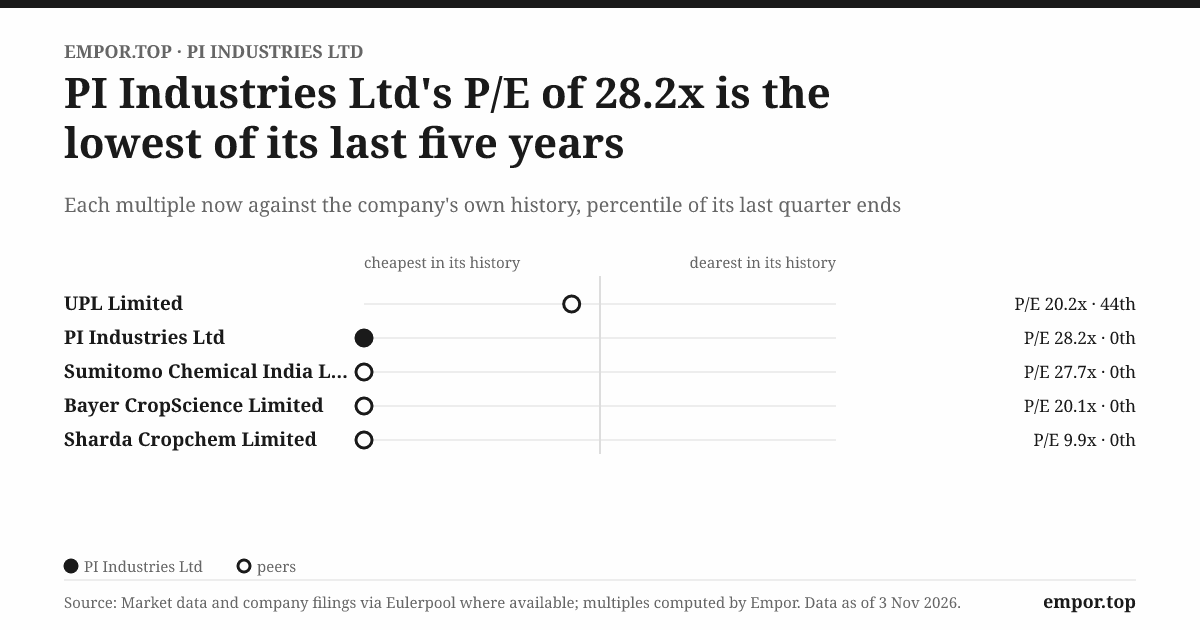
On November 3, 2026, PI Industries traded at about 28 times its trailing earnings.5 For a company that had for years commanded one of the richest valuations in Indian chemicals, that was a comedown: its median price-earnings multiple over the previous five years was about 36 times. On enterprise value, the market valued the business at about 15.6 times EBITDA and about 5.1 times sales, with an enterprise value of about ₹29,400 crore once net cash is deducted.5
A lower multiple can mean two very different things. It can mean that the market has become too pessimistic about a business whose earnings will recover, in which case today's price is a more reasonable entry point. Or it can mean that the market has correctly concluded that the earnings base itself has shrunk, in which case the multiple has fallen because the future looks smaller.
PI's numbers are consistent with either reading, and that is the problem. Fiscal 2026 revenue fell about 16%, profit about 20%, return on equity to about 12% and return on capital employed to about 15%.3 Free cash flow was negative, giving a free cash flow yield of about minus 0.6%.5 The multiple is lower, but it is a lower multiple of a lower number.
There is a simpler way to see what the price assumes. At about 28 times earnings, PI's earnings yield is roughly 3.5%, less than an investor could earn from an Indian government bond.5 At about three times book value, with return on equity running between roughly 10% and 12%, the market is paying a premium for each rupee of shareholders' capital that today's returns do not justify on their own.5
Both readings point the same way. The current price is not pricing PI as a business that has permanently reset to its fiscal 2026 level. It still assumes that returns and growth recover, just less spectacularly than the market once believed. A cheaper PI is not a PI priced for failure.
The bull case starts with capability. PI has deep process chemistry skills, built over three decades and validated by relationships with global innovators that have lasted for years. It has a confirmed order book of US$1–1.2 billion.1 It has domestic brands and a diversified dealer network. It has almost no debt and substantial cash.
And if global innovators' inventories normalise, its plants, now running below 80%, have room to absorb higher volumes with modest additional spending, which would push returns up quickly. On this view, fiscal 2026 is a cyclical trough of the kind the agrochemical industry has seen before, and PI is spending through it so it emerges larger.
The bear case is just as concrete. PI does not disclose customer or molecule concentration, so investors cannot measure the risk that one large product or customer accounts for much of the business. Customers have shown that they can shift schedules and make PI carry their inventory. Generic competition compresses realisations as patents expire. Working capital is rising. The pharma bet is loss-making and already impaired. And the three-year growth record is nearly flat even before the decline.
The industry structure explains why both cases are plausible. Buyer power is the dominant force. PI's customers are large, sophisticated and few, and they control molecule timing and sourcing. Supplier power is moderate but rising in one specific place: PI reports buying through 433 trading-house vendors, and the top ten accounted for about 47% of purchases from trading houses in fiscal 2026, up from about 39% a year earlier.3 That is not a single-supplier exposure, but it is a concentration worth watching, especially given how much of the world's chemical input supply runs through China.
The threat of new entrants is real but bounded: building a CSM capability takes years, as PI's own history shows, yet Chinese manufacturers and other Indian companies have done it. Substitution comes from generics, alternative chemistries and biologicals. Rivalry among custom manufacturers is intense, particularly when innovators are cutting orders and every supplier wants to fill idle capacity. Product chemistry and regulatory requirements create real barriers to entry, but they are not absolute.
Hamilton Helmer's framework for durable competitive advantage sharpens the picture. Of his seven powers, PI has a plausible claim to two. Switching costs are the clearest: an innovator that has validated PI's process and built its regulatory filings around PI's route faces cost and delay to move. Process power, the embedded organisational know-how that rivals cannot easily copy, is the second: PI's ability to scale hazardous chemistry safely and reliably is the product of decades of accumulated learning.
PI does not obviously have scale economies relative to the largest Chinese producers, network effects, a cornered resource or a counter-positioning advantage. Its brand matters in the domestic market but not in CSM, where the customer's brand is on the product. Switching costs and process power are genuine sources of advantage, but both operate within the customer's decision about how much to buy. They protect PI's share of a customer's needs; they do not protect the size of those needs.
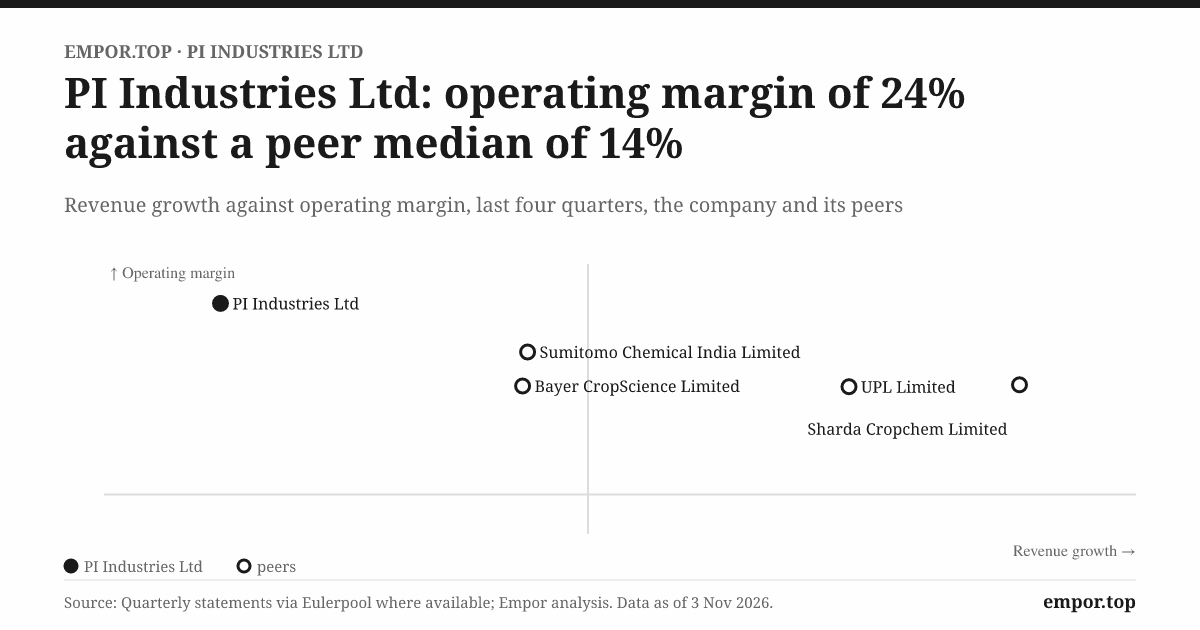
Peer comparisons on valuation need care. One near-cutoff snapshot from a market-data provider showed UPL at about 21 times earnings and Sumitomo Chemical India at about 30 times, with PI at about 28 times on that provider's figures.21 Another comparison showed different absolute figures.22 UPL is a global, leveraged, distribution-heavy business with a very different mix; Sumitomo Chemical India is mostly a domestic formulator with a multinational parent.
Neither is a like-for-like comparison with a CSM-led exporter, and the snapshots vary by provider and date. What the comparison does suggest is that PI no longer trades at a large premium to the Indian agrochemical sector, which it did for much of the last decade. The market has stopped paying extra for PI's growth because the growth has, for now, stopped.
Three measures matter most for following what happens next. The first is CSM sales growth and deliveries, which show whether the order book is turning into shipments; in fiscal 2026 CSM revenue fell about 19%.1
The second is debtor days and operating cash conversion, which show whether those shipments are turning into cash; debtor days stood at 126 at March 2026, up from 85, and operating cash flow equalled about a third of profit.3 The third is the contribution and cash generation of the pharma business, which shows whether the largest bet outside the core is paying off; PI Health Sciences lost about ₹118 crore in fiscal 2026.3
The investment debate comes down to a single spine. PI has a credible answer to the question of why it can win: process execution and customer access, built over decades. What it must now prove is that orders still become earnings, and earnings still become cash.
XII. Lessons From the Molecule Pipeline
A moat built in chemistry is built one repeatable batch at a time. PI’s CSM franchise grew through batches delivered on specification, each one adding a little more trust.
That is the lesson for any founder in process industries: the capability that matters most is the one customers can rely on, and reliability compounds slowly. It is also the lesson for investors who value such businesses: the moat is as strong as the last few hundred batches, and it is tested every time a customer reconsiders where to source.
An order book is a promise of work, not a receipt of cash. Fiscal 2026 showed the gap between the two: the order book measures intent. The cash flow statement measures what happened.
Buying a capability is the beginning of the return, not the return itself. PI’s acquisitions show the difference between adding to a business it already understood and entering a new industry. The lesson is that an acquisition's price is only the first number. The second is how long it takes for the capability to earn, and that number is not knowable on the day the deal closes.
The best pivot is the one that survives the numbers. PI's earlier pivots into pesticides and chemistry worked because the new business eventually earned more than the old one. Its current pivots into pharmaceuticals, biologicals and electronic chemicals will be judged the same way. A pivot that looks visionary in an investor presentation still has to show up, eventually, as profit and cash. The Singhal family's long record of reinvention is a reason to take PI's ambitions seriously. It is not a reason to grade them before the results are in.
XIII. The Next Three Crop Cycles
Tonight, PI Industries stands at an awkward point in its own story. Its plants have spare capacity. Its warehouses and balance sheet hold customer-specific product that has been made and not shipped. Its order book is measured in billions of dollars. Its newest businesses are losing money. And the market has taken away the premium it once paid for the company's growth. Over the next few quarters, the evidence that settles whether PI is recovering will arrive in a predictable order.
The first piece is the customers' delivery schedules. When PI next reports, the question to ask is not whether the order book is intact, but whether shipments are rising, and whether utilisation is moving back toward full capacity from below 80%. If CSM growth begins to track the order book, the inventory pause will have been just that. If the order book stays large and shipments stay flat, the gap between promise and delivery will have become a structural feature.
The second piece is the conversion of contract assets. Debtor days are the reading to beat. If contract assets turn into invoices and invoices into cash, operating cash flow should recover faster than profit, because working capital would release cash rather than absorb it. If the old receivables keep ageing, that will deserve a harder look than the headline numbers.
The third piece is the adjacencies. Investors will need disclosed revenue, contribution and cash generation from pharma, biologicals and other new businesses, not development milestones. PI Health Sciences' loss-making fiscal 2026 is the base. A narrowing loss with rising revenue would suggest the CDMO strategy is on its timeline. A widening loss, or another impairment, would suggest the timeline is longer than assumed.
There are also moments that would change the story outright. If management revises its fiscal 2027 outlook, either down from low-single-digit growth or up, that will say more about the cycle than any explanation on a call. If it offers a concrete recovery timetable with measurable milestones, that will be a new kind of commitment, and one it can be held to. If it changes its capital-allocation plan, either slowing capital spending to protect cash or accelerating it, that will reveal how confident it really is.
A recovery is credible if shipments, cash conversion and returns improve together. Revenue growth without cash collection would leave the inventory question open. Capacity growth without profitable utilisation would leave the returns question open. PI needs all three to move in the same direction, and it has not yet shown that they will.
XIV. Outro
Go back to the batch on the plant floor in Gujarat. PI's contribution was process chemistry at scale, which is a harder thing than it sounds and the reason this company exists in its current form. For most of three decades, that contribution was enough: the batch left the plant, crossed an ocean, reached a farmer's field, and returned to PI as cash.
PI built a global business around process chemistry, which is what makes it distinctive among Indian chemicals companies. Its next chapter depends on whether that chemistry still travels all the way from plant to cash. The batch is finished. It is ready. Somewhere a customer's supply-chain team is deciding whether to call for it this quarter, or to let it wait for another.
References
-
PI Industries Limited Rating Rationale — CRISIL Ratings, 2026-07-21 ↩↩↩↩↩↩↩↩↩↩↩↩↩↩
-
PI Industries Q4 FY2025-26 Earnings Call Transcript — PI Industries management via StockAnalysis, 2026-05-20 ↩↩↩↩↩↩↩↩
-
Integrated Annual Report FY 2025–26 — PI Industries, 2026-07-20 ↩↩↩↩↩↩↩↩↩↩↩↩↩↩↩↩↩↩↩↩↩↩↩↩↩↩↩↩↩↩↩↩↩↩↩↩↩↩↩↩↩↩↩↩↩↩↩↩↩↩↩↩↩↩↩↩↩↩↩↩↩↩
-
Performance of the Company for the Quarter Ended June 30, 2026 — PI Industries, 2026-08-11 ↩↩↩
-
PI Industries Limited Equity Quote — National Stock Exchange of India, 2026-11-03 ↩↩↩↩↩↩↩
-
PI Industries’ Singhal Prefers Quality to Numbers — Business Today, 2015-12-25 ↩↩↩↩
-
Pesticides and Other Agro-chemical Products in India — Euromonitor International, 2025 ↩
-
PI Industries Board Approves Acquisition of API & Intermediate Business of Ind-Swift Laboratories — PI Industries, 2021-07-31 ↩↩
-
Ind-Swift Laboratories Annual Report FY2020–21 — Ind-Swift Laboratories, 2021 ↩
-
Investor Presentation Q2 FY22: Update on Pharma Acquisition Deal — PI Industries, 2021 ↩
-
PI Industries Completes Acquisition of Isagro Asia — PI Industries, 2019-12-27 ↩↩
-
PI Industries to Acquire 100% Stake in Isagro Asia Agrochemicals — Business Standard, 2019-11-05 ↩↩
-
Earnings Call Transcripts and Audio Recordings — PI Industries ↩
-
AGM Materials, Voting Results and Scrutinizer Reports — PI Industries, 2026-08-14 ↩
-
PI Industries Shareholding — Fund Tracker India, NSE filing data, 2026-09-30 ↩
 LinkedIn
 WhatsApp
 Reddit
 Hacker News
 Email
 Kindle
 RSS Feed
 Spotify
 Apple Podcasts
 Amazon Music
 Audible
 YouTube